

IEC 60951-4:2009
(Main)Nuclear power plants - Instrumentation important to safety - Radiation monitoring for accident and post-accident conditions - Part 4: Equipment for continuous in-line or on-line monitoring of radioactivity in process streams
General Information
- Abstract
IEC 60951-4:2009 provides general guidance on the design principles and performance criteria for equipment for continuous in-line or on-line monitoring of radioactivity in process stream in nuclear power plants for accident and post-accident conditions. General requirements for technical characteristics, test procedures, radiation characteristics, electrical, mechanical, and environmental characteristics are given in IEC 60951-1. These requirements are applicable in this part unless otherwise stated. The main technical changes with regard to the previous edition are as follows:
- clarify the definitions;
- up-date the references to new standards published since the first edition;
- update the units of radiation.
This publication is to be read in conjunction with IEC 60951-1:2009.
- Status
- Published
- Publication Date
- 28-Jun-2009
- Technical Committee
- SC 45A - Instrumentation, control and electrical power systems of nuclear facilities
- Drafting Committee
- WG 5 - TC 45/SC 45A/WG 5
- Current Stage
- PPUB - Publication issued
- Start Date
- 29-Jun-2009
- Completion Date
- 15-Jul-2009
Buy Documents
IEC 60951-4:2009 - Nuclear power plants - Instrumentation important to safety - Radiation monitoring for accident and post-accident conditions - Part 4: Equipment for continuous in-line or on-line monitoring of radioactivity in process streams Released:6/29/2009
Overview
IEC 60951-4:2009 is an international standard developed by the International Electrotechnical Commission (IEC) that provides essential guidance for the design and performance of radiation monitoring equipment in nuclear power plants, specifically for accident and post-accident conditions. This standard focuses on equipment used for continuous in-line or on-line monitoring of radioactivity in process streams, such as pipes and tanks, to ensure ongoing safety-critical measurements. The guidance ensures that installed instrumentation can operate reliably during and after accidents, facilitating timely protection and control actions.
The requirements defined in IEC 60951-4:2009 build upon general provisions outlined in IEC 60951-1 and address specific technical and environmental challenges for accident scenarios, such as extreme temperatures or pressures, potential corrosion, and mechanical stresses. The document also includes clarifications, updated references to newer standards, and revised radiation units to reflect the latest technical advancements.
Key Topics
- Scope of Application: Applies to continuous in-line or on-line monitors where detectors are immersed in or positioned adjacent to process streams in nuclear facilities, capturing real-time radiation levels during abnormal and post-incident events.
- Design Principles: Outlines design considerations to withstand severe operational environments, including radiation fields, temperature fluctuations, and seismic impacts.
- Performance Criteria: Requires a broad measurement range (at least six decades) and robust, reliable operation throughout a wide array of accident conditions.
- Mechanical and Environmental Requirements: Covers material selection, corrosion resistance, allowable stress, construction standards for pressurized components, and ease of maintenance.
- Functional Testing: Specifies tests for stability and performance under varying ambient and process conditions, such as temperature, pressure, humidity, and flow rates.
- Certification and Verification: Guidance on documentation, quality control, and verification procedures to ensure dependable operation during plant emergencies.
Applications
IEC 60951-4:2009 is used extensively in the nuclear power industry for:
- Continuous process stream monitoring: Ensures that plant operators receive accurate, real-time data on radioactivity levels in liquid and gaseous process lines during emergencies, critical for decision-making and initiating protective actions.
- Alarm and Control Integration: Enables the instrumentation to trigger alarms and interface with other safety systems (such as process isolation) if radiation exceeds preset thresholds.
- Post-accident assessment: Facilitates rapid radiological assessment following incidents, supporting regulatory compliance and ensuring safe conditions for plant personnel and the public.
- Design and Procurement: Provides specification guidance for both power plant operators and equipment suppliers when defining system requirements for new builds, retrofits, or system upgrades.
Related Standards
- IEC 60951-1: General requirements for radiation monitoring equipment used in accident and post-accident conditions.
- IEC 60951-2: Focuses on continuous off-line monitoring of radioactivity in gaseous effluents and ventilation air during incidents.
- IEC 60951-3: Covers continuous high-range area gamma monitoring equipment.
- IEC 60768: Details requirements for process stream radiation monitoring under normal and incident (not accident) operating conditions.
- IEC 60068 series: Pertains to environmental testing methods relevant to equipment qualification.
- ISO 2889: Provides guidance on gas and particulate sampling techniques.
- IAEA Safety Guides (NS-R-1, NS-G-1.3): Offer a broader safety framework and terminology consistent with IEC standards for nuclear plant instrumentation.
IEC 60951-4:2009 is essential for ensuring nuclear power plant safety, offering clear, internationally recognized requirements for radiation monitoring systems in critical accident and post-accident contexts. Its adoption supports regulatory compliance, operational reliability, and the protection of people and the environment from potential radiological hazards.
Buy Documents
IEC 60951-4:2009 - Nuclear power plants - Instrumentation important to safety - Radiation monitoring for accident and post-accident conditions - Part 4: Equipment for continuous in-line or on-line monitoring of radioactivity in process streams Released:6/29/2009
Get Certified
Connect with accredited certification bodies for this standard

DNV
DNV is an independent assurance and risk management provider.

Lloyd's Register
Lloyd's Register is a global professional services organisation specialising in engineering and technology.
DNV Energy Systems
Energy and renewable energy certification.
Sponsored listings
Frequently Asked Questions
IEC 60951-4:2009 is a standard published by the International Electrotechnical Commission (IEC). Its full title is "Nuclear power plants - Instrumentation important to safety - Radiation monitoring for accident and post-accident conditions - Part 4: Equipment for continuous in-line or on-line monitoring of radioactivity in process streams". This standard covers: IEC 60951-4:2009 provides general guidance on the design principles and performance criteria for equipment for continuous in-line or on-line monitoring of radioactivity in process stream in nuclear power plants for accident and post-accident conditions. General requirements for technical characteristics, test procedures, radiation characteristics, electrical, mechanical, and environmental characteristics are given in IEC 60951-1. These requirements are applicable in this part unless otherwise stated. The main technical changes with regard to the previous edition are as follows: - clarify the definitions; - up-date the references to new standards published since the first edition; - update the units of radiation. This publication is to be read in conjunction with IEC 60951-1:2009.
IEC 60951-4:2009 provides general guidance on the design principles and performance criteria for equipment for continuous in-line or on-line monitoring of radioactivity in process stream in nuclear power plants for accident and post-accident conditions. General requirements for technical characteristics, test procedures, radiation characteristics, electrical, mechanical, and environmental characteristics are given in IEC 60951-1. These requirements are applicable in this part unless otherwise stated. The main technical changes with regard to the previous edition are as follows: - clarify the definitions; - up-date the references to new standards published since the first edition; - update the units of radiation. This publication is to be read in conjunction with IEC 60951-1:2009.
IEC 60951-4:2009 is classified under the following ICS (International Classification for Standards) categories: 27.120.20 - Nuclear power plants. Safety. The ICS classification helps identify the subject area and facilitates finding related standards.
IEC 60951-4:2009 is available in PDF format for immediate download after purchase. The document can be added to your cart and obtained through the secure checkout process. Digital delivery ensures instant access to the complete standard document.
Standards Content (Sample)
IEC 60951-4 ®
Edition 2.0 2009-06
INTERNATIONAL
STANDARD
NORME
INTERNATIONALE
Nuclear power plants – Instrumentation important to safety – Radiation
monitoring for accident and post-accident conditions –
Part 4: Equipment for continuous in-line or on-line monitoring of radioactivity in
process streams
Centrales nucléaires de puissance – Instrumentation importante pour la sûreté –
Surveillance des rayonnements pour les conditions accidentelles et post-
accidentelles –
Partie 4: Equipement pour la surveillance en continu des rayonnements internes
ou externes aux flux de procédé
All rights reserved. Unless otherwise specified, no part of this publication may be reproduced or utilized in any form or by
any means, electronic or mechanical, including photocopying and microfilm, without permission in writing from either IEC or
IEC's member National Committee in the country of the requester.
If you have any questions about IEC copyright or have an enquiry about obtaining additional rights to this publication,
please contact the address below or your local IEC member National Committee for further information.
Droits de reproduction réservés. Sauf indication contraire, aucune partie de cette publication ne peut être reproduite
ni utilisée sous quelque forme que ce soit et par aucun procédé, électronique ou mécanique, y compris la photocopie
et les microfilms, sans l'accord écrit de la CEI ou du Comité national de la CEI du pays du demandeur.
Si vous avez des questions sur le copyright de la CEI ou si vous désirez obtenir des droits supplémentaires sur cette
publication, utilisez les coordonnées ci-après ou contactez le Comité national de la CEI de votre pays de résidence.
IEC Central Office
3, rue de Varembé
CH-1211 Geneva 20
Switzerland
Email: inmail@iec.ch
Web: www.iec.ch
About the IEC
The International Electrotechnical Commission (IEC) is the leading global organization that prepares and publishes
International Standards for all electrical, electronic and related technologies.
About IEC publications
The technical content of IEC publications is kept under constant review by the IEC. Please make sure that you have the
latest edition, a corrigenda or an amendment might have been published.
ƒ Catalogue of IEC publications: www.iec.ch/searchpub
The IEC on-line Catalogue enables you to search by a variety of criteria (reference number, text, technical committee,…).
It also gives information on projects, withdrawn and replaced publications.
ƒ IEC Just Published: www.iec.ch/online_news/justpub
Stay up to date on all new IEC publications. Just Published details twice a month all new publications released. Available
on-line and also by email.
ƒ Electropedia: www.electropedia.org
The world's leading online dictionary of electronic and electrical terms containing more than 20 000 terms and definitions
in English and French, with equivalent terms in additional languages. Also known as the International Electrotechnical
Vocabulary online.
ƒ Customer Service Centre: www.iec.ch/webstore/custserv
If you wish to give us your feedback on this publication or need further assistance, please visit the Customer Service
Centre FAQ or contact us:
Email: csc@iec.ch
Tel.: +41 22 919 02 11
Fax: +41 22 919 03 00
A propos de la CEI
La Commission Electrotechnique Internationale (CEI) est la première organisation mondiale qui élabore et publie des
normes internationales pour tout ce qui a trait à l'électricité, à l'électronique et aux technologies apparentées.
A propos des publications CEI
Le contenu technique des publications de la CEI est constamment revu. Veuillez vous assurer que vous possédez
l’édition la plus récente, un corrigendum ou amendement peut avoir été publié.
ƒ Catalogue des publications de la CEI: www.iec.ch/searchpub/cur_fut-f.htm
Le Catalogue en-ligne de la CEI vous permet d’effectuer des recherches en utilisant différents critères (numéro de référence,
texte, comité d’études,…). Il donne aussi des informations sur les projets et les publications retirées ou remplacées.
ƒ Just Published CEI: www.iec.ch/online_news/justpub
Restez informé sur les nouvelles publications de la CEI. Just Published détaille deux fois par mois les nouvelles
publications parues. Disponible en-ligne et aussi par email.
ƒ Electropedia: www.electropedia.org
Le premier dictionnaire en ligne au monde de termes électroniques et électriques. Il contient plus de 20 000 termes et
définitions en anglais et en français, ainsi que les termes équivalents dans les langues additionnelles. Egalement appelé
Vocabulaire Electrotechnique International en ligne.
ƒ Service Clients: www.iec.ch/webstore/custserv/custserv_entry-f.htm
Si vous désirez nous donner des commentaires sur cette publication ou si vous avez des questions, visitez le FAQ du
Service clients ou contactez-nous:
Email: csc@iec.ch
Tél.: +41 22 919 02 11
Fax: +41 22 919 03 00
IEC 60951-4 ®
Edition 2.0 2009-06
INTERNATIONAL
STANDARD
NORME
INTERNATIONALE
Nuclear power plants – Instrumentation important to safety – Radiation
monitoring for accident and post-accident conditions –
Part 4: Equipment for continuous in-line or on-line monitoring of radioactivity in
process streams
Centrales nucléaires de puissance – Instrumentation importante pour la sûreté –
Surveillance des rayonnements pour les conditions accidentelles et post-
accidentelles –
Partie 4: Equipement pour la surveillance en continu des rayonnements internes
ou externes aux flux de procédé
INTERNATIONAL
ELECTROTECHNICAL
COMMISSION
COMMISSION
ELECTROTECHNIQUE
PRICE CODE
INTERNATIONALE
M
CODE PRIX
ICS 27.120.20 ISBN 978-2-88910-349-2
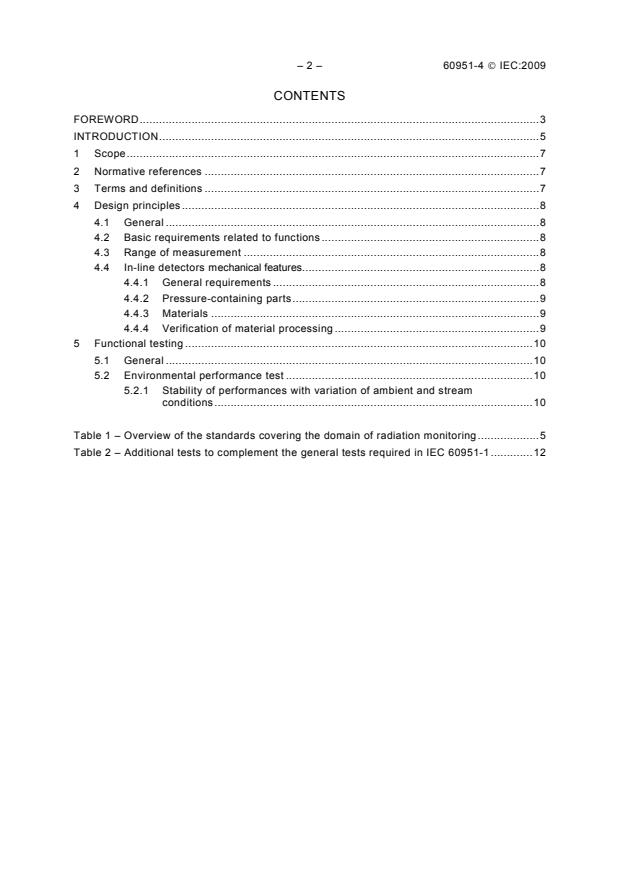
– 2 – 60951-4 © IEC:2009
CONTENTS
FOREWORD.3
INTRODUCTION.5
1 Scope.7
2 Normative references .7
3 Terms and definitions .7
4 Design principles.8
4.1 General .8
4.2 Basic requirements related to functions .8
4.3 Range of measurement .8
4.4 In-line detectors mechanical features.8
4.4.1 General requirements .8
4.4.2 Pressure-containing parts.9
4.4.3 Materials .9
4.4.4 Verification of material processing .9
5 Functional testing .10
5.1 General .10
5.2 Environmental performance test .10
5.2.1 Stability of performances with variation of ambient and stream
conditions.10
Table 1 – Overview of the standards covering the domain of radiation monitoring.5
Table 2 – Additional tests to complement the general tests required in IEC 60951-1.12
60951-4 © IEC:2009 – 3 –
INTERNATIONAL ELECTROTECHNICAL COMMISSION
____________
NUCLEAR POWER PLANTS –
INSTRUMENTATION IMPORTANT TO SAFETY –
RADIATION MONITORING FOR ACCIDENT
AND POST-ACCIDENT CONDITIONS –
Part 4: Equipment for continuous in-line or on-line monitoring
of radioactivity in process streams
FOREWORD
1) The International Electrotechnical Commission (IEC) is a worldwide organization for standardization comprising
all national electrotechnical committees (IEC National Committees). The object of IEC is to promote
international co-operation on all questions concerning standardization in the electrical and electronic fields. To
this end and in addition to other activities, IEC publishes International Standards, Technical Specifications,
Technical Reports, Publicly Available Specifications (PAS) and Guides (hereafter referred to as “IEC
Publication(s)”). Their preparation is entrusted to technical committees; any IEC National Committee interested
in the subject dealt with may participate in this preparatory work. International, governmental and non-
governmental organizations liaising with the IEC also participate in this preparation. IEC collaborates closely
with the International Organization for Standardization (ISO) in accordance with conditions determined by
agreement between the two organizations.
2) The formal decisions or agreements of IEC on technical matters express, as nearly as possible, an international
consensus of opinion on the relevant subjects since each technical committee has representation from all
interested IEC National Committees.
3) IEC Publications have the form of recommendations for international use and are accepted by IEC National
Committees in that sense. While all reasonable efforts are made to ensure that the technical content of IEC
Publications is accurate, IEC cannot be held responsible for the way in which they are used or for any
misinterpretation by any end user.
4) In order to promote international uniformity, IEC National Committees undertake to apply IEC Publications
transparently to the maximum extent possible in their national and regional publications. Any divergence
between any IEC Publication and the corresponding national or regional publication shall be clearly indicated in
the latter.
5) IEC provides no marking procedure to indicate its approval and cannot be rendered responsible for any
equipment declared to be in conformity with an IEC Publication.
6) All users should ensure that they have the latest edition of this publication.
7) No liability shall attach to IEC or its directors, employees, servants or agents including individual experts and
members of its technical committees and IEC National Committees for any personal injury, property damage or
other damage of any nature whatsoever, whether direct or indirect, or for costs (including legal fees) and
expenses arising out of the publication, use of, or reliance upon, this IEC Publication or any other IEC
Publications.
8) Attention is drawn to the Normative references cited in this publication. Use of the referenced publications is
indispensable for the correct application of this publication.
9) Attention is drawn to the possibility that some of the elements of this IEC Publication may be the subject of
patent rights. IEC shall not be held responsible for identifying any or all such patent rights.
International Standard IEC 60951-4 has been prepared by subcommittee 45A:
Instrumentation and control of nuclear facilities, of IEC technical committee 45: Nuclear
instrumentation.
This second edition of IEC 60951-4 cancels and replaces the first edition issued in 1991. It
constitutes a technical revision.
The main technical changes with regard to the previous edition are as follows:
• To clarify the definitions.
• To update the references to new standards published since the first issue.
• To update the units of radiation.
– 4 – 60951-4 © IEC:2009
This standard is to be read in conjunction with IEC 60951-1.
The text of this standard is based on the following documents:
FDIS Report on voting
45A/737/FDIS 45A/759/RVD
Full information on the voting for the approval of this standard can be found in the report on
voting indicated in the above table.
This publication has been drafted in accordance with the ISO/IEC Directives, Part 2.
A list of all parts of IEC 60951 series, under the general title Nuclear power plants –
Instrumentation important to safety – Radiation monitoring for accident and post-accident
conditions, can be found on the IEC website.
The committee has decided that the contents of this publication will remain unchanged until
the maintenance result date indicated on the IEC web site under "http://webstore.iec.ch" in
the data related to the specific publication. At this date, the publication will be
• reconfirmed,
• withdrawn,
• replaced by a revised edition, or
• amended.
60951-4 © IEC:2009 – 5 –
INTRODUCTION
a) Technical background, main issues and organisation of this standard
This IEC standard specifically focuses on radiation monitoring systems used for accident and
post-accident operations.
This standard is intended for use by purchasers in developing specifications for their plant-
specific radiation monitoring systems and by manufacturers to identify needed product
characteristics when developing systems for accident monitoring conditions. Some specific
instrument characteristics such as measurement range, required energy response, and
ambient environment requirements will depend upon the specific application. In such cases
guidance is provided on determining the specific requirements, but specific requirements
themselves are not stated.
This standard is one in a series of standards covering post-accident radiation monitors
important to safety. The full series is comprised of the following standards.
• IEC 60951-1 – General requirements
• IEC 60951-2 – Equipment for continuous off-line monitoring of radioactivity in gaseous
effluents and ventilation air
• IEC 60951-3 – Equipment for continuous high range area gamma monitoring
• IEC 60951-4 – Equipment for continuous in-line or on-line monitoring of radioactivity in
process streams
b) Situation of the current standard in the structure of the IEC SC 45A standard series
IEC 60951 series of standards are at the third level in the hierarchy of SC 45A standards.
They provide guidance on the design and testing of radiation monitoring equipment used for
accident and post-accident conditions. Other standards developed by SC 45A and SC 45B
provide guidance on instruments used for monitoring radiation as part of normal operations.
IEC 60761 series provide requirements for equipment for continuous off-line monitoring of
radioactivity in gaseous effluents in normal conditions. IEC 60861 provides requirements for
equipment for continuous off-line monitoring of radioactivity in liquid effluents in normal
conditions. IEC 60768 provides requirements for equipment for continuous in-line and on-line
monitoring of radioactivity in process streams in normal and incident conditions. Finally, ISO
2889 gives guidance on gas and particulate sampling. The relationship between these various
radiation monitoring standards is given in Table 1 below:
Table 1 – Overview of the standards covering the domain of radiation monitoring
Developer ISO SC 45A – Process and safety monitoring SC 45B – Radiation
protection and
Scope Sampling circuits Accident and post- Normal and incident
effluents monitoring
and methods accident conditions conditions
Gas, particulate and ISO 2889 IEC 60951-1 and IEC 60761 series and IEC 62302 (noble
iodine with sampling IEC 60951-2 gases only)
(OFF LINE)
Liquid with sampling N/A N/A IEC 60861
(OFF LINE)
Process streams N/A IEC 60951-1 and IEC 60768 N/A
(gaseous effluents, IEC 60951-4
steam or liquid)
without sampling
(ON or IN-LINE)
Area monitoring N/A IEC 60951-1 and IEC 60532
IEC 60951-3
– 6 – 60951-4 © IEC:2009
Developer ISO SC 45A – Process and safety monitoring SC 45B – Radiation
protection and
Scope Sampling circuits Accident and post- Normal and incident
effluents monitoring
and methods accident conditions conditions
Central system N/A IEC 61504 IEC 61559
For more details on the structure of the IEC SC 45A standard series, see item d) of this
introduction.
c) Recommendations and limitations regarding the application of this standard
It is important to note that this Standard establishes no additional functional requirements for
safety systems.
d) Description of the structure of the IEC SC 45A standard series and relationships
with other IEC documents and other bodies documents (IAEA, ISO)
The top-level document of the IEC SC 45A standard series is IEC 61513. It provides general
requirements for I&C systems and equipment that are used to perform functions important to
safety in NPPs. IEC 61513 structures the IEC SC 45A standard series.
IEC 61513 refers directly to other IEC SC 45A standards for general topics related to
categorization of functions and classification of systems, qualification, separation of systems,
defence against common cause failure, software aspects of computer-based systems,
hardware aspects of computer-based systems, and control room design. The standards
referenced directly at this second level should be considered together with IEC 61513 as a
consistent document set.
At a third level, IEC SC 45A standards not directly referenced by IEC 61513 are standards
related to specific equipment, technical methods, or specific activities. Usually these
documents, which make reference to second-level documents for general topics, can be used
on their own.
A fourth level extending the IEC SC 45A standard series, corresponds to the Technical
Reports which are not normative.
IEC 61513 has adopted a presentation format similar to the basic safety publication
IEC 61508 with an overall safety life-cycle framework and a system life-cycle framework and
provides an interpretation of the general requirements of IEC 61508-1, IEC 61508-2 and
IEC 61508-4, for the nuclear application sector. Compliance with IEC 61513 will facilitate
consistency with the requirements of IEC 61508 as they have been interpreted for the nuclear
industry. In this framework IEC 60880 and IEC 62138 correspond to IEC 61508-3 for the
nuclear application sector.
IEC 61513 refers to ISO standards as well as to IAEA 50-C-QA (now replaced by IAEA GS-R-
3) for topics related to quality assurance (QA).
The IEC SC 45A standards series consistently implements and details the principles and
basic safety aspects provided in the IAEA code on the safety of NPPs and in the IAEA safety
series, in particular the Requirements NS-R-1, establishing safety requirements related to the
design of Nuclear Power Plants, and the Safety Guide NS-G-1.3 dealing with instrumentation
and control systems important to safety in Nuclear Power Plants. The terminology and
definitions used by SC 45A standards are consistent with those used by the IAEA.
60951-4 © IEC:2009 – 7 –
NUCLEAR POWER PLANTS –
INSTRUMENTATION IMPORTANT TO SAFETY –
RADIATION MONITORING FOR ACCIDENT
AND POST-ACCIDENT CONDITIONS –
Part 4: Equipment for continuous in-line or on-line monitoring
of radioactivity in process streams
1 Scope
This part of IEC 60951 provides general guidance on the design principles and performance
criteria for equipment for continuous in-line or on-line monitoring of radioactivity in process
stream in nuclear power plants for accident and post-accident conditions.
General requirements for technical characteristics, test procedures, radiation characteristics,
electrical, mechanical, and environmental characteristics are given in IEC 60951-1. These
requirements are applicable in this part unless otherwise stated.
IEC 60951-4 is only applicable to continuous in-line or on-line measurement, i.e. monitors for
which the detector measures radioactivity by being positioned in the process stream (i.e.
immerged in) or adjacent to the process stream (i.e. viewing straight through a pipe or tank).
It does not apply to monitors for which the detector measures a representative proportion of
the stream at some remote location (sampling assembly), which are within the scope of
IEC 60951-2.
IEC 60951-4 is only applicable to monitors for accident and post-accident conditions. Process
stream radiation monitoring equipment for normal and incident conditions are within the scope
of IEC 60768.
2 Normative references
The following referenced documents are indispensable for the application of this document.
For dated references, only the edition cited applies. For undated references, the latest edition
of the referenced document (including any amendments) applies.
IEC 60068-2-30:2005, Environmental testing – Part 2-30: Tests – Test Db: Damp heat, cyclic
(12 h + 12 h cycle)
IEC 60068-2-78:2001, Environmental testing – Part 2-78: Tests – Test Cab: Damp heat,
steady state
IEC 60951-1:2009, Nuclear power plants – Instrumentation important to safety – Radiation
monitoring for accident and post-accident conditions – Part 1: General requirements
3 Terms and definitions
For the purposes of this document, the terms and definitions given in IEC 60951-1 apply.
– 8 – 60951-4 © IEC:2009
4 Design principles
4.1 General
Except where otherwise specified, all the requirements specified in Clause 4 of IEC 60951-1
shall be carried out, unless otherwise stated.
4.2 Basic requirements related to functions
The main purpose of equipment for continuous in-line or on-line monitoring of radioactivity in
process streams is to continuously measure radiation levels in appropriate pipes or tanks,
either by being positioned in them (i.e. immerged in the process stream) or adjacent to them
(i.e. viewing straight through the process stream). These radiation measurements are
displayed locally and/or in control rooms to keep plant operators aware of current radiological
conditions. This information is used for control purposes and/or initiation of protective actions.
Therefore, the equipment concerned by this standard is capable of actuating alarms and
providing inputs to other plant systems and processes in order to isolate processes at
abnormal radiation levels.
The basic requirements for the design, selection, testing, calibration and functional location of
equipment for continuous in-line and on-line monitoring of radioactivity in process streams are
plant specific. Process radiation monitors within the scope of this standard can be classified
into two basic types:
– in-line monitors: the detector is located directly in the process stream (pipe, tank, duct),
– on-line monitors: the detector faces directly the process stream.
For the purpose of critical data collection, these monitors may be designed to withstand
adverse environmental and seismic conditions, during and after an accident.
In addition to the basic requirements of IEC 60951-1, the specification procedure should
include the following:
– Establish the required measurement characteristics (purchaser): Determine the stream
characteristics (physical, chemical and dynamic characteristics of the stream to be
monitored) such as: type of fluid, thermodynamic state, temperature range and rate of
change, pressure range and rate of change, radiochemical properties, etc.
4.3 Range of measurement
In addition to 4.2 of IEC 60951-1, the following requirements shall apply:
The effective range of measurement should be at least six decades.
4.4 In-line detectors mechanical features
4.4.1 General requirements
Whenever in-line detectors are located in a sleeve or a piping system implanted as part of a
pipe or tank under pressure or carrying hot or corrosive fluid, specific requirements shall
apply to ensure thermodynamical and mechanical conditions are taken into account.
When specified, the sleeve or piping system, including all accessories, shall be supplied by
the detector manufacturer and fully assembled on the main pipe or tank when possible.
The sleeve or piping system shall be designed and arranged to permit an easy removal of the
detector for maintenance and cleaning. The detector shall be adequately installed in the
sleeve or piping system to prevent damage due to vibration under normal operation and
maintenance activities.
60951-4 © IEC:2009 – 9 –
The mechanical features of piping and its connections, including bolting and sealing, shall be
agreed between the purchaser and manufacturer, and shall conform to relevant standards.
4.4.2 Pressure-containing parts
The maximum allowable working pressure of the detector at the most severe operating
conditions shall be clearly defined by the manufacturer. In no case shall the maximum
allowable working pressure of the detector and the sleeve exceed that of the sleeve flanges.
Pressure casings including the detector housing shall be of such thickness as will be suitable
for containing pressure and limiting distortion under the maximum allowable pressure at the
operating temperature.
The casing shall also be suitable for the hydrostatic test pressure at ambient temperature.
The pressure-containing parts shall be made of non-corrosive materials, to be agreed upon
between the purchaser and the manufacturer.
The bolting selected (property class) shall be adequate for the maximum allowable working
pressure of the detector sleeve and for normal tightening procedures. If at some point it is
necessary to use a fastener of special quality, interchangeable fasteners for other joints shall
be of the same quality.
4.4.3 Materials
The materials used for pressure-containing parts shall be suitable for the fluid to be
monitored. In particular, they shall resist corrosion caused by the liquid handled and by
environmental conditions.
Materials are selected by the purchaser. If the detector manufacturer considers other
materials to be more suitable, these should be offered as alternatives by the manufacturer
according to the operating conditions specified on the data sheet.
For hazardous liquids, the manufacturer shall propose suitable materials for agreement by the
purchaser.
For high or low temperature applications, the detector manufacturer shall give due
consideration to mechanical design.
Chemical composition, mechanical properties, heat treatment and welding procedures shall
be in accordance with the relevant material standards.
4.4.4 Verification of material processing
When tests and certificates for the above-mentioned properties are required, the procedures
shall conform to relevant standards and be agreed between the purchaser and manufacturer.
All certificates shall be issued by the manufacturer’s quality control.
Any or all of the following inspections may be requested by the purchaser:
a) examination of components before assembling;
b) internal examination of the casing after running of test;
c) installation dimensions;
d) auxiliary or additional equipment;
e) chemical composition: according to manufacturer's standard specification or with
specimen per melt;
– 10 – 60951-4 © IEC:2009
f) mechanical properties: according to manufacturer's standard specification or with
specimen per melt and heat treatment;
g) susceptibility to intergranular attack (where applicable);
h) non-destructive tests (leakage, ultrasonic, dye penetrant, magnetic particle, radiographic,
spectroscopic identification, etc.).
All pressurised parts, including their fasteners, shall meet the same mechanical performances
as the pipe or tank on which they are installed. The means of verification shall be agreed
upon between the purchaser and the manufacturer.
5 Functional testing
5.1 General
Except where otherwise specified, all the tests specified in Clause 5 of IEC 60951-1 shall be
carried out.
The tests described hereinafter are only additional tests dedicated to the type of monitors
within the scope of the present standard. As for tests stated in IEC 60951-1, these tests are to
be considered as type tests, although any or all may be considered as acceptance tests by
agreement between manufacturer and purchaser.
These tests are carried out under standard conditions or with variation of the influence
quantities. They are listed in Table 2.
5.2 Environmental performance test
5.2.1 Stability of performances with variation of ambient and stream conditions
5.2.1.1 On-line measurement – Stability of performances with variation of ambient
temperature or humidity
5.2.1.1.1 Requirements
Wherever the equipment or part of the equipment are submitted to variations of temperature
or humidity of the ambient atmosphere, the influence of such variations shall be tested.
As the ranges of variation of such influence quantities may be different for testing the
measurement assembly and testing the detector, these tests shall be performed in two steps
if necessary:
– Test of the influence of the temperature or humidity on the measurement assembly.
– Test of the influence of the temperature or humidity on the detector.
The change in indication shall be less than 10 % for each test over the entire ranges of
variation of temperature and humidity.
Unless otherwise agreed upon between the manufacturer and the purchaser, the following
ranges of variation of temperature and humidity shall apply.
5.2.1.1.2 Test method
The measurement assembly (or part of it), if necessary without its shielding, shall be exposed
to suitable solid sources as defined in 5.2.5 of IEC 60951-1, such that the nominal reading
under standard test conditions is known.
The test shall be performed following the method described in the following IEC standards:
60951-4 © IEC:2009 – 11 –
– IEC 60068-2-78 for damp heat, steady test, supplemented by the following procedures:
– the assemblies are fitted in their reference position,
– they shall not be subjected to heat radiated by the walls of the test chamber,
– the assemblies are energised,
– test duration: 96 h,
– T = + 40 °C, 93 % relative humidity.
– IEC 60068-2-30 (test Db variant 2) for damp heat cyclic test, supplemented by the
following procedures:
– the assemblies are fitted in their reference position,
– they shall not be subjected to heat radiated by the walls of the test chamber,
– the assemblies are energised,
– number of cycles: 6,
– TA = + 25 °C, TB = + 55 °C.
Switch on the instrument, select the most sensitive range and place in an environmental
chamber at the reference conditions. The other characteristics of the air in the chamber shall
be lower than the value that could cause damage to the equipment. This value shall be
indicated by the manufacturer.
The detection assembly shall be exposed to suitable test sources in such a way that the
nominal reading under standard test conditions is known.
The instrument shall be left in this condition for 30 min or until equilibrium is assured. If a set-
zero control is available to the operator, this shall then be adjusted to bring the indication to a
point stated by the manufacturer.
For instruments with a non-linear scale, such a control is used to bring the indication to some
reference point rather than to zero. If this is the case, the control shall be set to bring the
indication to the appropriate reference point.
The measured value of the instrument shall be recorded during the tests. On completion, the
instruments are placed in normal atmospheric conditions for 2 h so that they reach thermal
equilibrium. The performances of the monitors shall comply with the performances stipulated
by the manufacturer.
NOTE Certain detectors are particularly sensitive to temperature variations (for instance Nal scintillator). During
this test it is advisable to provide means that will allow the permissible maximum heat gradient given by the
manufacturer to be checked in addition to the non-deterioration of their characteristics.
5.2.1.2 In-line measurement – Stability of performances with variation of stream
temperature, pressure or flow-rate
5.2.1.2.1 Requirements
For in-line measurement, detectors are submitted to variations of temperature, pressure and
flow-rate of the stream to be measured, the outside part of the monitor (not in contact with the
stream) being submitted to the influence of ambient temperature or humidity.
As it is obvious that such influence quantities and their ranges of variation are different for
testing the measurement assembly and testing the detector, these tests shall be performed in
two steps:
– Test of the influence of the ambient temperature and humidity on the measurement
assembly as described in 5.5.3.1 of IEC 60951-1.
– Test of the influence of the temperature, pressure and flow-rate on the detector being in
contact with the medium to be measured.
– 12 – 60951-4 © IEC:2009
For all parts of the monitor, the change in indication shall be less than 10 % over the entire
ranges of variation of temperature, pressure, humidity or flow-rate.
5.2.1.2.2 Test method
The test procedure shall be agreed upon between the purchaser and the manufacturer. The
following method may be used so far as it is applicable:
The detector should be exposed to suitable solid sources as defined in 5.2.5 of IEC 60951-1,
such that the nominal reading under standard test conditions is known. The indication should
be monitored during the test.
The part of the measurement assembly designed to operate in-line, including the detector,
should be completely immerged in water in a pressurized chamber, mounted in position of
industrial use, and submitted to the specified variation of temperature, pressure and/or flow-
rate for the duration prescribed in the relevant specification. The severities shall be agreed
upon between the purchaser and the manufacturer, in accordance with the postulated stream
characteristics. Relevant measurements shall be carried out to ensure that the water
temperature, pressure and/or flow-rate shall not differ by more than values agreed upon.
Table 2 – Additional tests to complement the general tests required in IEC 60951-1
Tests Tests conditions Limits of variation of Reference
indication (subclause)
Stability of Damp heat T = + 40 °C, Change in indication <±10 % 5.2.1.1
performances with t = 96 h
over the entire ranges of
variation of ambient
variation of temperature and
Cyclic damp heat T = + 25 °C
temperature or
humidity
to + 55 °C
humidity (on-line
measurement)
Stability of As specified in relevant test As specified in relevant test 5.2.1.2
performances with
variation of stream
temperature, pressure
or flow-rate (in-line
measurement)
NOTE For assemblies having a non-linear scale, a linear instrument may be substituted for the indicating meter of
the assembly to verify the performance specified in this table.
___________
– 14 – 60951-4 © CEI:2009
SOMMAIRE
AVANT-PROPOS.15
INTRODUCTION.17
1 Domaine d’application .20
2 Références normatives.20
3 Termes et définitions .20
4 Principes de conception .21
4.1 Généralités.21
4.2 Exigences de base liées aux fonctions .21
4.3 Gamme de mesures .21
4.4 Caractéristiques mécaniques des détecteurs internes .21
4.4.1 Exigences générales .21
4.4.2 Composants sous pression.22
4.4.3 Matériaux .22
4.4.4 Vérification du traitement des matériaux .22
5 Essais fonctionnels.23
5.1 Généralités.23
5.2 Essai de performance environnemental .23
5.2.1 Stabilité de performances en présence de variations du flux ou des
conditions d’ambiance .23
Tableau 1 – Vue d’ensemble des normes couvrant le domaine de la surveillance des
rayonnements .17
Tableau 2 – Essais supplémentaires à réaliser en complément des essais généraux
de la CEI 60951-1.26
60951-4 © CEI:2009 – 15 –
COMMISSION ÉLECTROTECHNIQUE INTERNATIONALE
____________
CENTRALES NUCLÉAIRES DE PUISSANCE –
INSTRUMENTATION IMPORTANTE POUR LA SÛRETÉ –
SURVEILLANCE DES RAYONNEMENTS POUR LES CONDITIONS
ACCIDENTELLES ET POST-ACCIDENTELLES –
Partie 4: Equipement pour la surveillance en continu des rayonnements
internes ou externes aux flux de procédé
AVANT-PROPOS
1) La Commission Electrotechnique Internationale (CEI) est une organisation mondiale de normalisation
composée de l'ensemble des comités électrotechniques nationaux (Comités nationaux de la CEI). La CEI a
pour objet de favoriser la coopération internationale pour toutes les questions de normalisation dans les
domaines de l'électricité et de l'électronique. A cet effet, la CEI – entre autres activités – publie des Normes
internationales, des Spécifications techniques, des Rapports techniques, des Spécifications accessibles au
public (PAS) et des Guides (ci-après dénommés "Publication(s) de la CEI"). Leur élaboration est confiée à des
comités d'études, aux travaux desquels tout Comité national intéressé par le sujet traité peut participer. Les
organisations internationales, gouvernementales et non gouvernementales, en liaison avec la CEI, participent
également aux travaux. La CEI collabore étroitement avec l'Organisation Internationale de Normalisation (ISO),
selon des conditions fixées par accord entre les deux organisations.
2) Les décisions ou accords officiels de la CEI concernant les questions techniques représentent, dans la mesure
du possible, un accord international sur les sujets étudiés, étant donné que les Comités nationaux de la CEI
intéressés sont représentés dans chaque comité d’études.
3) Les Publications de la CEI se présentent sous la forme de recommandations internationales et sont agréées
comme telles par les Comités nationaux de la CEI. Tous les efforts raisonnables sont entrepris afin que la CEI
s'assure de l'exactitude du contenu technique de ses publications; la CEI ne peut pas être tenue responsable
de l'éventuelle mauvaise utilisation ou interprétation qui en est faite par un quelconque utilisateur final.
4) Dans le but d'encourager l'uniformité internationale, les Comités nationaux de la CEI s'engagent, dans toute la
mesure possible, à appliquer de façon transparente les Publications de la CEI dans leurs publications
nationales et régionales. Toutes divergences entre toutes Publications de la CEI et toutes publications
nationales ou régionales correspondantes doivent être indiquées en termes clairs dans ces dernières.
5) La CEI n’a prévu aucune procédure de marquage valant indication d’approbation et n'engage pas sa
responsabilité pour les équipements déclarés conformes à une de ses Publications.
6) Tous les utilisateurs doivent s'assurer qu'ils sont en possession de la dernière édition de cette publication.
7) Aucune responsabilité ne doit être imputée à la CEI, à ses administrateurs, employés, auxiliaires ou
mandataires, y compris ses experts particuliers et les membres de ses comités d'études et des Comités
nationaux de la CEI, pour tout préjudice causé en cas de dommages corporels et matériels, ou de tout autre
dommage de quelque nature que ce soit, directe ou indirecte, ou pour supporter les coûts (y compris les frais
de justice) et les dépenses découlant de la publication ou de l'utilisation de cette Publication de la CEI ou de
toute autre Publication de la CEI, ou au crédit qui lui est accordé.
8) L'attention est attirée sur les références normatives citées dans cette publication. L'utilisation de publications
référencées est obligatoire pour une application correcte de la présente publication.
9) L’attention est attirée sur le fait que certains des éléments de la présente Publication de la CEI peuvent faire
l’objet de droits de propriété intellectuelle ou de droits analogues. La CEI ne saurait être tenue pour
responsable de ne pas avoir identifié de tels droits de propriété et de ne pas avoir signalé leur existence.
La Norme internationale CEI 60951-4 a été établie par le sous-comité 45A: Instrumentation et
contrôle-commande des installations nucléaires, du comité d'études 45 de la CEI:
Instrumentation nucléaire.
Cette deuxième édition annule et remplace la première édition, parue en 1991, dont elle
constitue une révision technique.
Les principaux changements techniques par rapport à l’édition précédente sont les suivants:
• Clarifier les définitions.
• Mettre à jour les références aux nouvelles normes publiées depuis la première édition.
– 16 – 60951-4 © CEI:2009
• Mettre à jour les unités relatives aux rayonnements.
Le texte de cette norme est issu des documents suivants:
FDIS Rapport de vote
45A/737/FDIS 45A/759/RVD
Le rapport de vote indiqué dans le tableau ci-dessus donne toute information sur le vote ayant
abouti à l'approbation de cette norme.
Cette publication a été rédigée selon les Directives ISO/CEI, Partie 2.
Cette norme doit être lue conjointement avec la CEI 60951-1.
Une liste de toutes les parties de la série CEI 60951, présentées sous le titre général
Centrales nucléaires de puissance – Instrumentation importante pour la sûreté – Surveillance
des rayonnements pour les conditions accidentelles et post-accidentelles, peut être consultée
sur le site web de la CEI.
Le comité a décidé que le contenu de cette publication ne sera pas modifié avant la date de
maintenance indiquée sur le site web de la CEI sous "http://webstore.iec.ch" dans les
données relatives à la publication recherchée. A cette date, la publication sera
• reconduite,
• supprimée,
• remplacée par une édition révisée, ou
• amendée.
60951-4 © CEI:2009 – 17 –
INTRODUCTION
a) Contexte technique, questions importantes et s
...