

IEC 62006:2010
(Main)Hydraulic machines - Acceptance tests of small hydroelectric installations
General Information
- Abstract
IEC 62006:2010 defines the test, the measuring methods and the contractual guarantee conditions for field acceptance tests of the generating machinery in small hydroelectric power installations. It applies to installations containing impulse or reaction turbines with unit power up to about 15 MW and reference diameter of about 3 m. The driven generator can be of synchronous or asynchronous type. This International Standard contains information about most of the tests required for acceptance of the hydraulic turbine such as safety approval tests, trial operating and reliability tests, as well for verification of cavitation, noise and vibration conditions, if required. This standard represents the typical methods used on smaller hydroelectric installations, and is divided into three classes as follows:
Class A: Default, normal test program (panel measurement), to determine the maximum output of the installation.
Class B: Recommended, extended test program, to determine the performance characteristics of the installation.
Class C: Optional, comprehensive test program, to determine the absolute efficiency of the installation.
All classes contain safety tests, trial operating tests, and reliability tests. This standard gives all necessary references for the contract in order to execute the test, evaluate, calculate and compare the result to the guarantee for all the classes A, B and C.
- Status
- Published
- Publication Date
- 27-Oct-2010
- Technical Committee
- TC 4 - Hydraulic turbines
- Drafting Committee
- WG 25 - TC 4/WG 25
- Current Stage
- PPUB - Publication issued
- Start Date
- 28-Oct-2010
- Completion Date
- 15-Nov-2010
Overview
IEC 62006:2010 is an International Electrotechnical Commission (IEC) standard that specifies the requirements for field acceptance tests of generating machinery in small hydroelectric power installations. Applicable to impulse and reaction turbines with unit power up to approximately 15 MW and a reference diameter of about 3 meters, this standard establishes test procedures, measurement methods, and the contractual guarantee conditions essential for validating the performance of small hydroelectric systems.
By providing clear guidelines for safety, reliability, and performance verification, IEC 62006:2010 helps ensure efficient and dependable operation in small hydro installations, promoting international uniformity in testing and commissioning practices.
Key Topics
IEC 62006:2010 offers comprehensive coverage for the acceptance testing of small hydroelectric installations, focusing on:
- Scope of Acceptance Tests
- Safety approval checks
- Trial operating and reliability tests
- Performance validation (output, efficiency, cavitation, noise, vibration)
- Test Program Classes
- Class A - Standard test (panel measurement) to determine maximum power output
- Class B - Extended tests to assess overall performance characteristics
- Class C - Comprehensive tests for determining absolute efficiency
- Contractual Guarantee Conditions
- Procedures for executing, evaluating, calculating, and comparing test results to contractual guarantees
- Testing Procedures
- Measuring methods for power output, pressure, discharge, and efficiency
- Safety mechanisms such as emergency shutdown and overspeed protection
- Reliability assessments under real operating conditions
- Reference Installations
- Applicability to synchronous/asynchronous generators connected to small-scale hydroelectric machinery
Applications
IEC 62006:2010 is designed to be practically invaluable for:
- Manufacturers and Consulting Engineers
- Facilitates standardized field acceptance tests to verify equipment performance before client handover
- Ensures all necessary connections for standardized testing are integrated at the design and installation stages
- Plant Operators and Owners
- Provides a benchmark for operational reliability, efficiency, and system safety
- Aids in the objective evaluation of machinery acceptance, minimizing disputes and ensuring compliance with guaranteed parameters
- Contractual and Regulatory Processes
- Supplies detailed reference points for contractual agreements, performance guarantees, and dispute resolution
- Supports regulatory and environmental compliance by verifying efficiency, emissions (noise), and safety protocols
- Renewable Energy Projects
- Enhances the commissioning process for new small hydroelectric installations, contributing to grid stability and renewable energy targets
Related Standards
IEC 62006:2010 is closely linked with several other international standards relevant to hydroelectric power and hydraulic machinery testing:
- IEC 60041 – Field acceptance tests for hydraulic turbines, storage pumps, and pump turbines
- IEC 60193 – Model acceptance tests for hydraulic turbines and pumps
- IEC 60308 – Testing of hydraulic turbine control systems
- IEC 60609 Series – Cavitation pitting evaluation in hydraulic machinery
- IEC 60651 – Sound level meter specification
- ISO 1680 – Measurement of airborne noise from rotating electrical machinery
- ISO 1940-1 – Balance quality of rotors
- ISO 5168 – Procedures for evaluation of fluid flow measurement uncertainties
Practical Value
By following IEC 62006:2010, stakeholders in the small hydropower sector are equipped with:
- Transparent, reproducible test procedures for maximum power output, efficiency, and safety
- Contract clarity regarding performance expectations and guarantee verification
- Risk reduction through rigorous trial, reliability, and safety testing
- Promoted international best practices supporting efficiency and reliability in small hydroelectric power generation
Whether for commissioning new installations or validating upgrades to existing schemes, IEC 62006:2010 provides the essential framework for robust acceptance testing and ongoing performance assurance in the small hydroelectric industry.
Get Certified
Connect with accredited certification bodies for this standard

DNV
DNV is an independent assurance and risk management provider.

Lloyd's Register
Lloyd's Register is a global professional services organisation specialising in engineering and technology.
DNV Energy Systems
Energy and renewable energy certification.
Sponsored listings
Frequently Asked Questions
IEC 62006:2010 is a standard published by the International Electrotechnical Commission (IEC). Its full title is "Hydraulic machines - Acceptance tests of small hydroelectric installations". This standard covers: IEC 62006:2010 defines the test, the measuring methods and the contractual guarantee conditions for field acceptance tests of the generating machinery in small hydroelectric power installations. It applies to installations containing impulse or reaction turbines with unit power up to about 15 MW and reference diameter of about 3 m. The driven generator can be of synchronous or asynchronous type. This International Standard contains information about most of the tests required for acceptance of the hydraulic turbine such as safety approval tests, trial operating and reliability tests, as well for verification of cavitation, noise and vibration conditions, if required. This standard represents the typical methods used on smaller hydroelectric installations, and is divided into three classes as follows: Class A: Default, normal test program (panel measurement), to determine the maximum output of the installation. Class B: Recommended, extended test program, to determine the performance characteristics of the installation. Class C: Optional, comprehensive test program, to determine the absolute efficiency of the installation. All classes contain safety tests, trial operating tests, and reliability tests. This standard gives all necessary references for the contract in order to execute the test, evaluate, calculate and compare the result to the guarantee for all the classes A, B and C.
IEC 62006:2010 defines the test, the measuring methods and the contractual guarantee conditions for field acceptance tests of the generating machinery in small hydroelectric power installations. It applies to installations containing impulse or reaction turbines with unit power up to about 15 MW and reference diameter of about 3 m. The driven generator can be of synchronous or asynchronous type. This International Standard contains information about most of the tests required for acceptance of the hydraulic turbine such as safety approval tests, trial operating and reliability tests, as well for verification of cavitation, noise and vibration conditions, if required. This standard represents the typical methods used on smaller hydroelectric installations, and is divided into three classes as follows: Class A: Default, normal test program (panel measurement), to determine the maximum output of the installation. Class B: Recommended, extended test program, to determine the performance characteristics of the installation. Class C: Optional, comprehensive test program, to determine the absolute efficiency of the installation. All classes contain safety tests, trial operating tests, and reliability tests. This standard gives all necessary references for the contract in order to execute the test, evaluate, calculate and compare the result to the guarantee for all the classes A, B and C.
IEC 62006:2010 is classified under the following ICS (International Classification for Standards) categories: 27.140 - Hydraulic energy engineering. The ICS classification helps identify the subject area and facilitates finding related standards.
IEC 62006:2010 is available in PDF format for immediate download after purchase. The document can be added to your cart and obtained through the secure checkout process. Digital delivery ensures instant access to the complete standard document.
Standards Content (Sample)
IEC 62006 ®
Edition 1.0 2010-10
INTERNATIONAL
STANDARD
NORME
INTERNATIONALE
colour
inside
Hydraulic machines – Acceptance tests of small hydroelectric installations
Machines hydrauliques – Essais de réception des petits aménagements
hydroélectriques
All rights reserved. Unless otherwise specified, no part of this publication may be reproduced or utilized in any form or by
any means, electronic or mechanical, including photocopying and microfilm, without permission in writing from either IEC or
IEC's member National Committee in the country of the requester.
If you have any questions about IEC copyright or have an enquiry about obtaining additional rights to this publication,
please contact the address below or your local IEC member National Committee for further information.
Droits de reproduction réservés. Sauf indication contraire, aucune partie de cette publication ne peut être reproduite
ni utilisée sous quelque forme que ce soit et par aucun procédé, électronique ou mécanique, y compris la photocopie
et les microfilms, sans l'accord écrit de la CEI ou du Comité national de la CEI du pays du demandeur.
Si vous avez des questions sur le copyright de la CEI ou si vous désirez obtenir des droits supplémentaires sur cette
publication, utilisez les coordonnées ci-après ou contactez le Comité national de la CEI de votre pays de résidence.
IEC Central Office
3, rue de Varembé
CH-1211 Geneva 20
Switzerland
Email: inmail@iec.ch
Web: www.iec.ch
About the IEC
The International Electrotechnical Commission (IEC) is the leading global organization that prepares and publishes
International Standards for all electrical, electronic and related technologies.
About IEC publications
The technical content of IEC publications is kept under constant review by the IEC. Please make sure that you have the
latest edition, a corrigenda or an amendment might have been published.
ƒ Catalogue of IEC publications: www.iec.ch/searchpub
The IEC on-line Catalogue enables you to search by a variety of criteria (reference number, text, technical committee,…).
It also gives information on projects, withdrawn and replaced publications.
ƒ IEC Just Published: www.iec.ch/online_news/justpub
Stay up to date on all new IEC publications. Just Published details twice a month all new publications released. Available
on-line and also by email.
ƒ Electropedia: www.electropedia.org
The world's leading online dictionary of electronic and electrical terms containing more than 20 000 terms and definitions
in English and French, with equivalent terms in additional languages. Also known as the International Electrotechnical
Vocabulary online.
ƒ Customer Service Centre: www.iec.ch/webstore/custserv
If you wish to give us your feedback on this publication or need further assistance, please visit the Customer Service
Centre FAQ or contact us:
Email: csc@iec.ch
Tel.: +41 22 919 02 11
Fax: +41 22 919 03 00
A propos de la CEI
La Commission Electrotechnique Internationale (CEI) est la première organisation mondiale qui élabore et publie des
normes internationales pour tout ce qui a trait à l'électricité, à l'électronique et aux technologies apparentées.
A propos des publications CEI
Le contenu technique des publications de la CEI est constamment revu. Veuillez vous assurer que vous possédez
l’édition la plus récente, un corrigendum ou amendement peut avoir été publié.
ƒ Catalogue des publications de la CEI: www.iec.ch/searchpub/cur_fut-f.htm
Le Catalogue en-ligne de la CEI vous permet d’effectuer des recherches en utilisant différents critères (numéro de référence,
texte, comité d’études,…). Il donne aussi des informations sur les projets et les publications retirées ou remplacées.
ƒ Just Published CEI: www.iec.ch/online_news/justpub
Restez informé sur les nouvelles publications de la CEI. Just Published détaille deux fois par mois les nouvelles
publications parues. Disponible en-ligne et aussi par email.
ƒ Electropedia: www.electropedia.org
Le premier dictionnaire en ligne au monde de termes électroniques et électriques. Il contient plus de 20 000 termes et
définitions en anglais et en français, ainsi que les termes équivalents dans les langues additionnelles. Egalement appelé
Vocabulaire Electrotechnique International en ligne.
ƒ Service Clients: www.iec.ch/webstore/custserv/custserv_entry-f.htm
Si vous désirez nous donner des commentaires sur cette publication ou si vous avez des questions, visitez le FAQ du
Service clients ou contactez-nous:
Email: csc@iec.ch
Tél.: +41 22 919 02 11
Fax: +41 22 919 03 00
IEC 62006 ®
Edition 1.0 2010-10
INTERNATIONAL
STANDARD
NORME
INTERNATIONALE
colour
inside
Hydraulic machines – Acceptance tests of small hydroelectric installations
Machines hydrauliques – Essais de réception des petits aménagements
hydroélectriques
INTERNATIONAL
ELECTROTECHNICAL
COMMISSION
COMMISSION
ELECTROTECHNIQUE
PRICE CODE
INTERNATIONALE
XE
CODE PRIX
ICS 27.140 ISBN 978-2-88912-228-8
– 2 – 62006 © IEC:2010
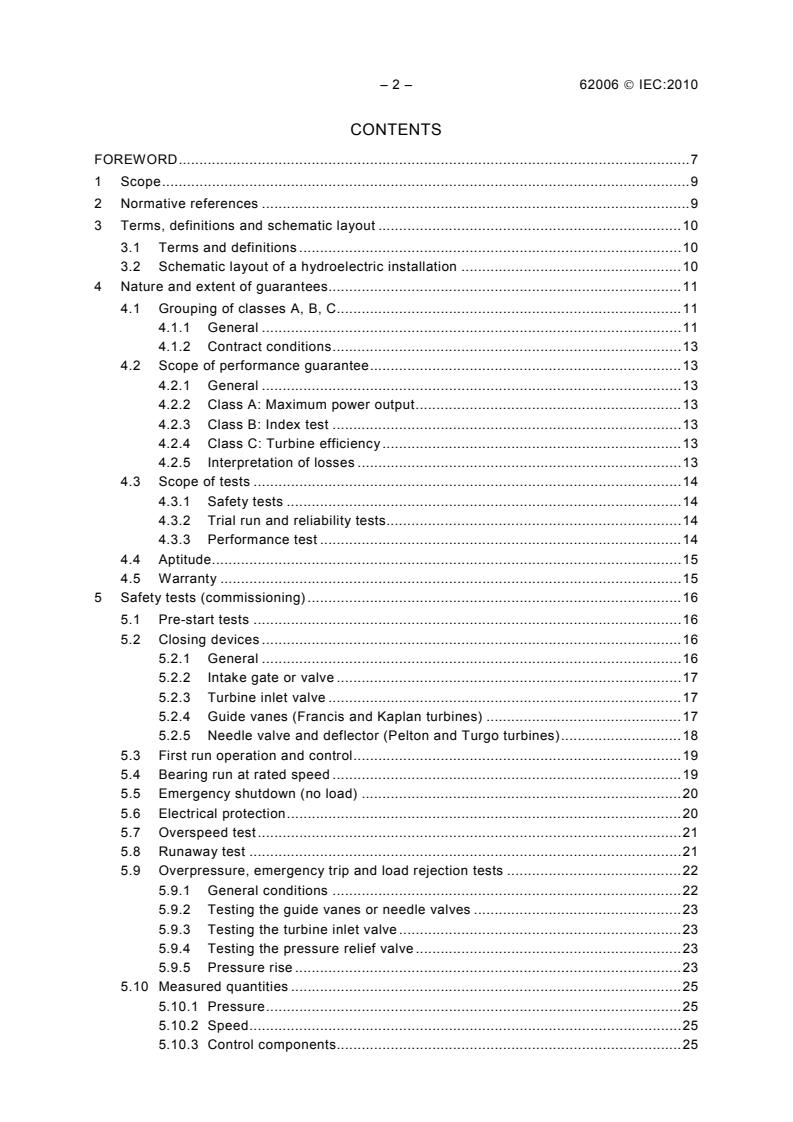
CONTENTS
FOREWORD.7
1 Scope.9
2 Normative references .9
3 Terms, definitions and schematic layout .10
3.1 Terms and definitions .10
3.2 Schematic layout of a hydroelectric installation .10
4 Nature and extent of guarantees.11
4.1 Grouping of classes A, B, C.11
4.1.1 General .11
4.1.2 Contract conditions.13
4.2 Scope of performance guarantee.13
4.2.1 General .13
4.2.2 Class A: Maximum power output.13
4.2.3 Class B: Index test .13
4.2.4 Class C: Turbine efficiency .13
4.2.5 Interpretation of losses .13
4.3 Scope of tests .14
4.3.1 Safety tests .14
4.3.2 Trial run and reliability tests.14
4.3.3 Performance test .14
4.4 Aptitude.15
4.5 Warranty .15
5 Safety tests (commissioning) .16
5.1 Pre-start tests .16
5.2 Closing devices .16
5.2.1 General .16
5.2.2 Intake gate or valve .17
5.2.3 Turbine inlet valve .17
5.2.4 Guide vanes (Francis and Kaplan turbines) .17
5.2.5 Needle valve and deflector (Pelton and Turgo turbines).18
5.3 First run operation and control.19
5.4 Bearing run at rated speed .19
5.5 Emergency shutdown (no load) .20
5.6 Electrical protection.20
5.7 Overspeed test.21
5.8 Runaway test .21
5.9 Overpressure, emergency trip and load rejection tests .22
5.9.1 General conditions .22
5.9.2 Testing the guide vanes or needle valves .23
5.9.3 Testing the turbine inlet valve.23
5.9.4 Testing the pressure relief valve.23
5.9.5 Pressure rise .23
5.10 Measured quantities .25
5.10.1 Pressure.25
5.10.2 Speed.25
5.10.3 Control components.25
62006 © IEC:2010 – 3 –
6 Trial operating and reliability tests (commissioning).25
6.1 General .25
6.2 Temperature stability of rotating parts .25
6.2.1 General .25
6.2.2 Temperature guarantees .26
6.3 Speed controller system .26
6.3.1 General .26
6.3.2 Unit operating without regulation .26
6.3.3 Unit operating with a speed governor.27
6.3.4 Unit operating with a voltage governor.28
6.3.5 Unit operating with a controller .28
6.3.6 Measurements when testing the control system .28
6.4 Control of cam correlation .29
7 Performance guarantees and tests .29
7.1 General .29
7.2 Maximum generator (transformer) power output as a function of net head .30
7.2.1 Guarantee .30
7.2.2 Instrumentation.30
7.3 Index test .30
7.3.1 General .30
7.3.2 Index discharge measurement .31
7.3.3 Shape control .31
7.3.4 Index plant efficiency.32
7.3.5 Optimizing cam correlation .33
7.4 Turbine efficiency.33
7.4.1 Efficiency test by absolute discharge measurement.33
7.4.2 Efficiency test by thermodynamic method .34
7.5 Correcting the efficiency using the model curve.34
8 Computation of results and comparison to the guarantee.36
8.1 General .36
8.1.1 Site data.36
8.1.2 Measured values (readings) .36
8.1.3 Scale effect due to water temperature .37
8.1.4 Shifting of the plant characteristic.37
8.2 Power output .37
8.2.1 Plant power output measurement .37
8.2.2 Generator power output measurement.38
8.2.3 Turbine power output measurement.38
8.3 Relative turbine efficiency (index test) .38
8.3.1 General .38
8.3.2 Relative discharge.38
8.3.3 Guarantee of the shape of the plant characteristics .39
8.3.4 Relative index plant efficiency .40
8.4 Absolute turbine efficiency .40
8.4.1 General .40
8.4.2 Absolute discharge .40
8.4.3 Guarantee of the plant efficiency and comparison to the results .40
9 Error analysis .40
– 4 – 62006 © IEC:2010
9.1 General .40
9.2 Estimation of systematic (bias) uncertainties .41
9.2.1 General .41
9.2.2 Typical systematic uncertainties .41
9.2.3 Systematic uncertainty for turbines used to indicate discharge .42
9.3 Estimation of random (precision) uncertainties .42
9.3.1 Measurement at a single operation point .42
9.3.2 Measurement over a range of operating condition .44
9.4 Evaluation of the uncertainties .45
9.4.1 General .45
9.4.2 Head .45
9.4.3 Power output .47
9.4.4 Index test measurement .49
9.4.5 Efficiency test by absolute discharge measurement.51
9.4.6 Efficiency test by the thermodynamic method .51
10 Other guarantees .51
10.1 Cavitation.51
10.1.1 General .51
10.1.2 Measurement methods .52
10.1.3 Comparison with specified guarantees.52
10.2 Noise .53
10.2.1 General .53
10.2.2 Measurement methods .53
10.2.3 Comparison with specified guarantees.54
10.3 Vibration.54
10.3.1 General .54
10.3.2 Measurements and measurement methods.54
10.3.3 Comparison with specified guarantees.55
Annex A (normative) Terms, definitions, symbols and units.56
Annex B (normative) Head definition.64
Annex C (normative) Method of speed measurements .77
Annex D (normative) Power output measurement .78
Annex E (normative) Methods of discharge measurement.82
Annex F (informative) Plant condition .95
Annex G (informative) Commissioning .97
Annex H (informative) Performance test efficiency calculation .99
Annex I (informative) Cam correlation test . 106
Bibliography.109
Figure 1 – Schematic layout of a hydroelectric installation (water to wire system) .11
Figure 2 – Warranty period .16
Figure 3 – Vanes and blades servomotors force measurements (Kaplan on line) .17
Figure 4 – Evaluation of the guide vane (GV) closing characteristic .18
Figure 5 – Needle servomotor force .18
Figure 6 – Automatic start – Synchronization – No load test (Kaplan turbine).19
Figure 7 – Emergency shutdown from no load test (Kaplan turbine) .20
62006 © IEC:2010 – 5 –
Figure 8 – Runaway test (Kaplan turbine) .21
Figure 9 – Emergency shutdown due to an electrical fault.22
Figure 10 – Emergency shutdown due to a mechanical fault .23
Figure 11 – Emergency shutdown due to the governor failure .24
Figure 12 – Evaluation of the maximum overpressure .24
Figure 13 – Temperature stability, recording at no load up to stable conditions.26
Figure 14 – Speed governor check at no load .27
Figure 15 – Maximum power output: procedure to compare measured power output at
actual net head to the guarantee.30
Figure 16 – Comparison of the shape of the turbine characteristic to the guarantee.32
Figure 17 – Example of an optimized switch band for 1 and 2 turbine operation.33
Figure 18 – Efficiency test: procedure to compare guaranteed turbine efficiency to the
prototype measurement results, including the overall uncertainties .34
Figure 19 – Hill chart – Showing head loss examples with one and two units in
operation using the same penstock.35
Figure 20 – Shifting of the performance curves .37
Figure 21 – Variation of factor k and exponent x on turbine index efficiency.39
Figure 22 – Random uncertainties of a single operation point, example for penstock
pressure variation and fluctuation .43
Figure 23 – Detection of outlier errors: example to find out offset and reading errors
by plotting in linear and logarithmic form with the same data.44
Figure 24 – Example of scattered points with function of second order .44
Figure 25 – Scattered points smoothed by individual fitting on adjacent sections .45
Figure 26 – Overall uncertainty of head for free water level for low head turbines .46
Figure 27 – Overall uncertainty of head in a closed conduit .47
Figure 28 – Estimated overall uncertainties of the discharge by index measurement
versus full scale differential pressure .50
Figure 29 – Operation range and cavitation limits .52
Figure A.1 – Transient pressure fluctuation at the turbine high pressure reference
section, when a specified load is suddenly rejected .61
Figure A.2 – Transient pressure fluctuation at the turbine high pressure reference
section, when a specified load is suddenly accepted.62
Figure B.1 – High pressure reference and measuring sections.65
Figure B.2 – Measuring section at tail water.66
Figure B.3 – Measuring section at draft tube.66
Figure B.4 – Definition of measuring sections .67
Figure B.5 – Kaplan turbine with horizontal shaft .68
Figure B.6 – Kaplan turbine with vertical shaft .68
Figure B.7 – Francis open flume turbine with vertical shaft .69
Figure B.8 – Francis turbine with horizontal shaft.69
Figure B.9 – Francis turbine with vertical shaft, with stagnation probe .70
Figure B.10 – Francis turbine with horizontal shaft with pressure on suction side.70
Figure B.11 – Pelton turbine with horizontal shaft .71
Figure B.12 – Pelton turbine with vertical shaft .71
Figure B.13 – Turgo turbine with horizontal shaft .72
Figure B.14 – Turgo turbine with vertical shaft .72
– 6 – 62006 © IEC:2010
Figure B.15 – Crossflow turbine with horizontal shaft, with draft tube.73
Figure B.16 – Crossflow turbine with horizontal shaft, without draft tube .73
Figure B.17 – Specifications for static pressure taps.74
Figure B.18 – Example: discharge versus guide vane opening.76
Figure C.1 – Overspeed and runaway .77
Figure D.1 – Typical losses of a synchronous generator .79
Figure D.2 – Asynchronous generator: typical power factor and slip factor.80
Figure D.3 – Power measurement using the two wattmeter method.80
Figure D.4 – Power measurement using the three wattmeter method .81
Figure E.1 – Typical arrangements of acoustic transducers .84
Figure E.2 – Arrangement for pressure time method .85
Figure E.3 – Example of pressure-time diagram for a uniform conduit.86
Figure E.4 – Example of pressure-time diagram for a non-uniform conduit.86
Figure E.5 – Example of pressure-time diagram for a combination of uniform and non-
uniform conduits between several sections .87
Figure E.6 – Location of taps for differential pressure method of discharge
measurement.93
Figure E.7 – Location of taps for differential pressure measurement of discharge in a
bulb turbine .93
Figure E.8 – Location of taps for Winter-Kennedy method of discharge measurement
through a turbine equipped with a steel spiral case.94
Figure H.1 – Comparison of measured index efficiency with the guaranteed values .105
Figure I.1 – Index measurement to optimize the efficiency .107
Figure I.2 – Two dimensional cam correlation .108
Table 1 – Scope of classes A, B, and C .12
Table 2 – Maximum runaway speeds (n ) expressed as a percentage of rated speed.21
run
Table 3 – Performance test parameters .29
Table 4 – Index discharge measurement methods .31
Table 5 – Site data .36
Table 6 – Systematic uncertainties at full load .41
Table 7 – Systematic uncertainties of discharge versus turbine opening .42
Table 8 – Overall uncertainties of the shape of turbine characteristics with respect to
the guaranteed efficiency.49
Table 9 – Data used in Figure 28 .51
Table 10 – Limits for cavitation damage.53
Table A.1 – Density of water .62
Table E.1 – Selection of flow measurement method .82
Table E.2 – Evaluation of the penstock factor with estimation of the systematic
uncertainty.91
Table H.1 – Plant index efficiency guarantee .99
Table H.2 – Transformer data .100
Table H.3 – Data measurements (not all tests included) .101
Table H.4 – Calculation of results .102
62006 © IEC:2010 – 7 –
INTERNATIONAL ELECTROTECHNICAL COMMISSION
____________
HYDRAULIC MACHINES – ACCEPTANCE TESTS
OF SMALL HYDROELECTRIC INSTALLATIONS
FOREWORD
1) The International Electrotechnical Commission (IEC) is a worldwide organization for standardization comprising
all national electrotechnical committees (IEC National Committees). The object of IEC is to promote
international co-operation on all questions concerning standardization in the electrical and electronic fields. To
this end and in addition to other activities, IEC publishes International Standards, Technical Specifications,
Technical Reports, Publicly Available Specifications (PAS) and Guides (hereafter referred to as “IEC
Publication(s)”). Their preparation is entrusted to technical committees; any IEC National Committee interested
in the subject dealt with may participate in this preparatory work. International, governmental and non-
governmental organizations liaising with the IEC also participate in this preparation. IEC collaborates closely
with the International Organization for Standardization (ISO) in accordance with conditions determined by
agreement between the two organizations.
2) The formal decisions or agreements of IEC on technical matters express, as nearly as possible, an international
consensus of opinion on the relevant subjects since each technical committee has representation from all
interested IEC National Committees.
3) IEC Publications have the form of recommendations for international use and are accepted by IEC National
Committees in that sense. While all reasonable efforts are made to ensure that the technical content of IEC
Publications is accurate, IEC cannot be held responsible for the way in which they are used or for any
misinterpretation by any end user.
4) In order to promote international uniformity, IEC National Committees undertake to apply IEC Publications
transparently to the maximum extent possible in their national and regional publications. Any divergence
between any IEC Publication and the corresponding national or regional publication shall be clearly indicated in
the latter.
5) IEC itself does not provide any attestation of conformity. Independent certification bodies provide conformity
assessment services and, in some areas, access to IEC marks of conformity. IEC is not responsible for any
services carried out by independent certification bodies.
6) All users should ensure that they have the latest edition of this publication.
7) No liability shall attach to IEC or its directors, employees, servants or agents including individual experts and
members of its technical committees and IEC National Committees for any personal injury, property damage or
other damage of any nature whatsoever, whether direct or indirect, or for costs (including legal fees) and
expenses arising out of the publication, use of, or reliance upon, this IEC Publication or any other IEC
Publications.
8) Attention is drawn to the Normative references cited in this publication. Use of the referenced publications is
indispensable for the correct application of this publication.
9) Attention is drawn to the possibility that some of the elements of this IEC Publication may be the subject of
patent rights. IEC shall not be held responsible for identifying any or all such patent rights.
International Standard IEC 62006 has been prepared by IEC technical committee 4: Hydraulic
turbines.
The text of this standard is based on the following documents:
FDIS Report on voting
4/254/FDIS 4/257/RVD
Full information on the voting for the approval of this standard can be found in the report on
voting indicated in the above table.
This publication has been drafted in accordance with the ISO/IEC Directives, Part 2.
– 8 – 62006 © IEC:2010
The committee has decided that the contents of this publication will remain unchanged until
the stability date indicated on the IEC web site under "http://webstore.iec.ch" in the data
related to the specific publication. At this date, the publication will be
• reconfirmed,
• withdrawn,
• replaced by a revised edition, or
• amended.
IMPORTANT – The 'colour inside' logo on the cover page of this publication indicates
that it contains colours which are considered to be useful for the correct
understanding of its contents. Users should therefore print this document using a
colour printer.
62006 © IEC:2010 – 9 –
HYDRAULIC MACHINES – ACCEPTANCE TESTS
OF SMALL HYDROELECTRIC INSTALLATIONS
1 Scope
This International Standard defines the test, the measuring methods and the contractual
guarantee conditions for field acceptance tests of the generating machinery in small
hydroelectric power installations. It applies to installations containing impulse or reaction
turbines with unit power up to about 15 MW and reference diameter of about 3 m. The driven
generator can be of synchronous or asynchronous type.
This International Standard contains information about most of the tests required for
acceptance of the hydraulic turbine such as safety approval tests, trial operating and reliability
tests, as well for verification of cavitation, noise and vibration conditions, if required.
This standard represents the typical methods used on smaller hydroelectric installations, and
is divided into three classes as follows (see Table 1 for more detail):
Class A Normal test program (panel measurement) Default
To determine the maximum power output of the
installation.
Class B Extended test program Recommended
To determine the performance characteristics of the
installation.
Class C Optional
Comprehensive test program
To determine the absolute efficiency of the installation.
NOTE All classes contain safety tests, trial operating tests, and reliability tests.
This standard gives all necessary references for the contract in order to execute the test,
evaluate, calculate and compare the result to the guarantee for all the classes A, B and C.
The manufacturer or consulting engineer is responsible for ensuring that standardized
connections are installed for performing these tests. This standard does not cover the
structural details of a hydroelectric installation or its component parts.
2 Normative references
The following referenced documents are indispensable for the application of this document.
For dated references, only the edition cited applies. For undated references, the latest edition
of the referenced document (including any amendments) applies.
IEC 60041:1991, Field acceptance tests to determine the hydraulic performance of hydraulic
turbines, storage pumps and pump turbines
IEC 60193, Hydraulic turbines, storage pumps and pump-turbines – Model acceptance tests
IEC 60308, Hydraulic turbines – Testing of control systems
IEC 60609 (all parts), Hydraulic turbines, storage pumps and pump-turbines – Cavitation
pitting evaluation
IEC 60651, Specification for sound level meters
– 10 – 62006 © IEC:2010
IEC 61362, Guide to specification of hydraulic turbine control systems
ISO 1680 Acoustics – Test code for the measurement of airborne noise emitted by rotating
electrical machinery
ISO 1940-1:2003, Mechanical vibration – Balance quality requirements for rotors in a
constant (rigid) state – Part 1: Specification and verification of balance tolerances
ISO 3746, Acoustics – Determination of sound power levels of noise sources using sound
pressure – Survey method using an enveloping measurement surface over a reflecting plane
ISO 4412 (all parts), Hydraulic fluid power – Test code for determination of airborne noise
levels
ISO 5168, Measurement of fluid flow – Procedures for the evaluation of uncertainties
ISO 7919-5, Mechanical vibration – Evaluation of machine vibration by measurements on
rotating shafts – Part 5: Machine sets in hydraulic power generating and pumping plants
ISO 10816-3, Mechanical vibration – Evaluation of machine vibration by measurements on
non-rotating parts – Part 3: Industrial machines with nominal power above 15 kW and nominal
speeds between 120 r/min and 15 000 r/min when measured in situ
ANSI/IEEE 810, Hydraulic Turbine and Generator Integrally Forged Shaft Couplings and
Shaft Runout Tolerances
3 Terms, definitions and schematic layout
3.1 Terms and definitions
A complete list of terms and definitions is given in Annex A.
3.2 Schematic layout of a hydroelectric installation
In general, there are three connected hydraulic regimes in a hydroelectric installation as
shown in Figure 1 below. These are the upstream water passage, the turbine guarantee
domain, and the downstream water passage.
62006 © IEC:2010 – 11 –
Head water level
(HWL)
P
out
Transformer
U2
P
L,tf
Generator
U1
Exciter (P )
L,ex
electr./mech.
P
gen
P
L,gn
E- el
Auxiliary device (P )
L,ax
Sub system
P
L,ax
E-mech
Transmission (gear/belt)
P
L,tr
Turbine bearing
P
Tail water level
t
(TWL)
Turbine setting
level
Upstream
Discharge
water passage
Turbine
Turbine guarantee domain
Downstream
water passage
High pressure
reference section 1
Low pressure
Reference datum
reference section 2
NOTE The losses in the upstream and downstream water passage are not part of the turbine losses.
Nevertheless, they may influence the hydraulic conditions in the turbine guarantee domain and lower the efficiency
of the turbine. Only the energy losses in the turbine guarantee section are to be considered when measuring the
efficiency of a turbine. If it is not possible to measure the energy in the reference section 1 and 2, the measuring
section should be changed in agreement with all parties.
The definition of the reference section 1 and 2 and that of net head and specific energy for the most common small
turbines is given in Annex B.
Figure 1 – Schematic layout of a hydroelectric installation (water to wire system)
4 Nature and extent of guarantees
4.1 Grouping of classes A, B, C
4.1.1 General
The scope of the measurement classes for hydroelectric installations is shown in Table 1.
z
z
z
T
z
Hg (gross head)
z
– 12 – 62006 © IEC:2010
Table 1 – Scope of classes A, B, and C
Class A Normal (panel measurement) test program
Class B Extended test program
Class C Comprehensive test program
Measurement of class C B A Clause
Safety tests (commissioning) 5
Pre-start tests (dry test) yes yes yes 5.1
Closing devices (dry and wet tests) yes yes yes 5.2
First run operation and control (wet tests) yes yes yes 5.3
Bearing run at rated speed yes yes yes 5.4
Emergency shutdown (no load) yes yes yes 5.5
Electrical protection yes yes yes 5.6
Overspeed test yes yes yes 5.7
Runaway test no/opt no/opt no/opt 5.8
Overpressure, emergency trip and load rejection tests yes yes yes 5.9
Trial operating and reliability tests (commissioning) 6
Temperature stability of rotating parts yes yes yes 6.2
Speed controller system yes/opt yes/opt yes/opt 6.3
Control of cam correlation (double regulated turbines) yes yes yes 6.4
Performance guarantees and tests 7
a a
Maximum generator (transformer) power output yes 7.2
Index test 7.3
a
- Shape control yes – 7.3.3
a
- Index plant efficiency yes – 7.3.4
a a a
- Optimizing cam correlation 7.3.5
Turbine efficiency 7.4
- Absolute discharge measurement yes – – 7.4.1
- Thermodynamic method yes – – 7.4.2
Computation of results and comparison to the guarantee yes yes yes 8
Error analysis yes yes yes 9
Other guarantees 10
Cavitation yes/opt yes/opt yes/opt 10.1
Noise no/opt no/opt no/opt 10.2
Vibration no/opt no/opt no/opt 10.3
NOTE Definitions used in Table 1 are the following:
yes – may be required.
yes/opt(ional) – normally yes, but depends on the turbine type and site conditions.
no/opt(ional) – normally no, but depends on the turbine type and site conditions.
a
included in other tests.
– not required.
62006 © IEC:2010 – 13 –
4.1.2 Contract conditions
The contract specifies the guarantees, and includes the scope of the tests, and the
classification of measuring instruments. Safety tests shall always be included. The condition
of the plant, water quality, and setting levels shall all be specified (see Anne x F ) .
4.2 Scope of performance guarantee
4.2.1 General
All guarantees concern the hydraulic passage between reference section 1 and 2 (turbine
guarantee domain) and the corresponding net head. The guaranteed data required for each
class is given below:
4.2.2 Class A: Maximum power output
a) Maximum power output of the generator, including losses a) to
P = f (H)
d) of 4.2.5 gen, max
b) Maximum power output of the transformer, including losses a) to
P = f (H)
e) of 4.2.5 out, max
• Power output versus net head, see Figure 15
• Discharge versus turbine opening, see Figure B.18
• Electrical connection sheet, see A n nex D
4.2.3
...