

IEC TS 62454:2007
(Main)Mechanical structures for electronic equipment - Design guide: Interface dimensions and provisions for water cooling of electronic equipment within cabinets of the IEC 60297 and IEC 60917 series
General Information
- Abstract
Provides interface dimensions and cooling performance guidelines for cabinets, using water supplied heat exchangers. Is applicable to cabinets in accordance with the IEC 60297 (19 in) and IEC 60917 (25 mm) series.
- Status
- Published
- Publication Date
- 09-Oct-2007
- Technical Committee
- SC 48D - Mechanical structures for electrical and electronic equipment
- Drafting Committee
- WG 5 - TC 48/SC 48D/WG 5
- Current Stage
- PPUB - Publication issued
- Start Date
- 10-Oct-2007
- Completion Date
- 15-Nov-2007
Buy Documents
IEC TS 62454:2007 - Mechanical structures for electronic equipment - Design guide: Interface dimensions and provisions for water cooling of electronic equipment within cabinets of the IEC 60297 and IEC 60917 series Released:10/10/2007
Overview
IEC TS 62454:2007 is a technical specification published by the International Electrotechnical Commission (IEC) that provides a comprehensive design guide for mechanical structures of electronic equipment, focusing specifically on interface dimensions and water cooling provisions within electronic cabinets. The standard applies to cabinets conforming to the IEC 60297 (19 inch) and IEC 60917 (25 mm) series, which are widely used in electronic rack and cabinet infrastructures.
With the rapid increase in electronic device performance, resulting in higher power consumption and heat generation, efficient heat dissipation methodologies have become crucial. Traditional air-cooling approaches in air-conditioned rooms are often insufficient for next-generation equipment with heat loads up to 35 kW per cabinet. IEC TS 62454 addresses this challenge by introducing standardized water-cooled heat exchanger interfaces within cabinets, enabling effective thermal management.
Key Topics
Scope and Application
The standard targets the essential design aspects needed for integrating water cooling heat exchangers into electronic equipment cabinets - specifically dimensions, interface coordination, and cooling performance criteria.Interface Levels for Water Cooling
To handle various cooling needs and implementation complexity, the specification defines three interface levels:- Level 1: Cabinets with an entire heat exchanger either bottom or side-mounted for whole cabinet cooling.
- Level 2: Cabinets equipped with sectional heat exchangers dedicated to individual subracks or subrack groups.
- Level 3: Cabinets with subracks containing water-cooled heat sinks connected directly to electronic components; this level is outlined mainly in principle without detailed mechanical specifications due to complexity.
Dimensional Coordination
The specification provides exact dimensions and mounting details for heat exchangers and water supply interfaces to ensure compatibility across equipment and cabinet manufacturers, easing system integration and maintenance.Cooling Performance Guidelines
Performance considerations include heat capacity transfer depending on air volume and velocity, chilled water flow rates, and temperature differentials. Diagrams and calculation methods help engineers estimate cooling effectiveness under different operating conditions.Water Supply Interface and Connections
Guidelines for external water supply inlet/outlet areas and connection principles are provided to guarantee safe, reliable, and standardized plumbing integration within cabinets.
Applications
IEC TS 62454:2007 is essential for design engineers, system integrators, and manufacturers who develop or implement high-density electronic equipment cabinets requiring advanced thermal management through water cooling. Key application areas include:
- Data centers and telecommunication facilities where heat dissipation demands exceed traditional air conditioning capabilities.
- Industrial electronic cabinets handling power-intensive computing or control equipment.
- Server racks where energy-efficient cooling reduces operational costs and extends equipment lifespan.
- Facilities aiming to integrate water cooling solutions compatible with the commonly used IEC 60297 and IEC 60917 cabinet standards.
By following IEC TS 62454 provisions, users can optimize cooling infrastructure, reduce heat-induced failures, and support environmentally sustainable cooling solutions.
Related Standards
IEC TS 62454 complements several other standards critical to mechanical and environmental design of electronic equipment:
- IEC 60297-2: Defines mechanical dimensions for 19-inch cabinets and rack structures, providing the foundational cabinet architecture to which water cooling is applied.
- IEC 60917-2-1: Covers mechanical modular orders and interface coordination for the 25 mm equipment practice series.
- IEC 60529: Specifies degrees of protection by enclosures (IP Code), impacting cabinet sealing and environmental protection when adding water cooling systems.
- ISO 228-1: Details pipe thread dimensions and tolerances crucial for plumbing connections in water supply interfaces.
Integrating this technical specification with these related IEC and ISO standards supports robust, interoperable cabinet and cooling system design.
Keywords: IEC TS 62454, water cooling, electronic equipment cabinets, IEC 60297, IEC 60917, heat exchanger interface, cabinet cooling design, water-cooled heat exchangers, electronic rack cooling, thermal management, electronic cabinet standards.
Buy Documents
IEC TS 62454:2007 - Mechanical structures for electronic equipment - Design guide: Interface dimensions and provisions for water cooling of electronic equipment within cabinets of the IEC 60297 and IEC 60917 series Released:10/10/2007
Frequently Asked Questions
IEC TS 62454:2007 is a technical specification published by the International Electrotechnical Commission (IEC). Its full title is "Mechanical structures for electronic equipment - Design guide: Interface dimensions and provisions for water cooling of electronic equipment within cabinets of the IEC 60297 and IEC 60917 series". This standard covers: Provides interface dimensions and cooling performance guidelines for cabinets, using water supplied heat exchangers. Is applicable to cabinets in accordance with the IEC 60297 (19 in) and IEC 60917 (25 mm) series.
Provides interface dimensions and cooling performance guidelines for cabinets, using water supplied heat exchangers. Is applicable to cabinets in accordance with the IEC 60297 (19 in) and IEC 60917 (25 mm) series.
IEC TS 62454:2007 is classified under the following ICS (International Classification for Standards) categories: 31.240 - Mechanical structures for electronic equipment. The ICS classification helps identify the subject area and facilitates finding related standards.
IEC TS 62454:2007 is available in PDF format for immediate download after purchase. The document can be added to your cart and obtained through the secure checkout process. Digital delivery ensures instant access to the complete standard document.
Standards Content (Sample)
IEC/TS 62454
Edition 1.0 2007-10
TECHNICAL
SPECIFICATION
SPÉCIFICATION
TECHNIQUE
Mechanical structures for electronic equipment – Design guide: Interface
dimensions and provisions for water cooling of electronic equipment within
cabinets of the IEC 60297 and IEC 60917 series
Structures mécaniques pour équipement électronique – Guide de conception:
Dimensions d’interface et dispositions relatives au refroidissement par l’eau des
équipements électroniques dans les armoires des séries CEI 60297 et CEI 60917
IEC/TS 62454:2007
All rights reserved. Unless otherwise specified, no part of this publication may be reproduced or utilized in any form or by
any means, electronic or mechanical, including photocopying and microfilm, without permission in writing from either IEC or
IEC's member National Committee in the country of the requester.
If you have any questions about IEC copyright or have an enquiry about obtaining additional rights to this publication,
please contact the address below or your local IEC member National Committee for further information.
Droits de reproduction réservés. Sauf indication contraire, aucune partie de cette publication ne peut être reproduite
ni utilisée sous quelque forme que ce soit et par aucun procédé, électronique ou mécanique, y compris la photocopie
et les microfilms, sans l'accord écrit de la CEI ou du Comité national de la CEI du pays du demandeur.
Si vous avez des questions sur le copyright de la CEI ou si vous désirez obtenir des droits supplémentaires sur cette
publication, utilisez les coordonnées ci-après ou contactez le Comité national de la CEI de votre pays de résidence.
IEC Central Office
3, rue de Varembé
CH-1211 Geneva 20
Switzerland
Email: inmail@iec.ch
Web: www.iec.ch
About the IEC
The International Electrotechnical Commission (IEC) is the leading global organization that prepares and publishes
International Standards for all electrical, electronic and related technologies.
About IEC publications
The technical content of IEC publications is kept under constant review by the IEC. Please make sure that you have the
latest edition, a corrigenda or an amendment might have been published.
ƒ Catalogue of IEC publications: www.iec.ch/searchpub
The IEC on-line Catalogue enables you to search by a variety of criteria (reference number, text, technical committee,…).
It also gives information on projects, withdrawn and replaced publications.
ƒ IEC Just Published: www.iec.ch/online_news/justpub
Stay up to date on all new IEC publications. Just Published details twice a month all new publications released. Available
on-line and also by email.
ƒ Electropedia: www.electropedia.org
The world's leading online dictionary of electronic and electrical terms containing more than 20 000 terms and definitions
in English and French, with equivalent terms in additional languages. Also known as the International Electrotechnical
Vocabulary online.
ƒ Customer Service Centre: www.iec.ch/webstore/custserv
If you wish to give us your feedback on this publication or need further assistance, please visit the Customer Service
Centre FAQ or contact us:
Email: csc@iec.ch
Tel.: +41 22 919 02 11
Fax: +41 22 919 03 00
A propos de la CEI
La Commission Electrotechnique Internationale (CEI) est la première organisation mondiale qui élabore et publie des
normes internationales pour tout ce qui a trait à l'électricité, à l'électronique et aux technologies apparentées.
A propos des publications CEI
Le contenu technique des publications de la CEI est constamment revu. Veuillez vous assurer que vous possédez
l’édition la plus récente, un corrigendum ou amendement peut avoir été publié.
ƒ Catalogue des publications de la CEI: www.iec.ch/searchpub/cur_fut-f.htm
Le Catalogue en-ligne de la CEI vous permet d’effectuer des recherches en utilisant différents critères (numéro de référence,
texte, comité d’études,…). Il donne aussi des informations sur les projets et les publications retirées ou remplacées.
ƒ Just Published CEI: www.iec.ch/online_news/justpub
Restez informé sur les nouvelles publications de la CEI. Just Published détaille deux fois par mois les nouvelles
publications parues. Disponible en-ligne et aussi par email.
ƒ Electropedia: www.electropedia.org
Le premier dictionnaire en ligne au monde de termes électroniques et électriques. Il contient plus de 20 000 termes et
définitions en anglais et en français, ainsi que les termes équivalents dans les langues additionnelles. Egalement appelé
Vocabulaire Electrotechnique International en ligne.
ƒ Service Clients: www.iec.ch/webstore/custserv/custserv_entry-f.htm
Si vous désirez nous donner des commentaires sur cette publication ou si vous avez des questions, visitez le FAQ du
Service clients ou contactez-nous:
Email: csc@iec.ch
Tél.: +41 22 919 02 11
Fax: +41 22 919 03 00
IEC/TS 62454
Edition 1.0 2007-10
TECHNICAL
SPECIFICATION
SPÉCIFICATION
TECHNIQUE
Mechanical structures for electronic equipment – Design guide: Interface
dimensions and provisions for water cooling of electronic equipment within
cabinets of the IEC 60297 and IEC 60917 series
Structures mécaniques pour équipement électronique – Guide de conception:
Dimensions d’interface et dispositions relatives au refroidissement par l’eau des
équipements électroniques dans les armoires des séries CEI 60297 et CEI 60917
INTERNATIONAL
ELECTROTECHNICAL
COMMISSION
COMMISSION
ELECTROTECHNIQUE
PRICE CODE
INTERNATIONALE
S
CODE PRIX
ICS 31.240 ISBN 2-8318-9334-8
– 2 – TS 62454 © IEC:2007
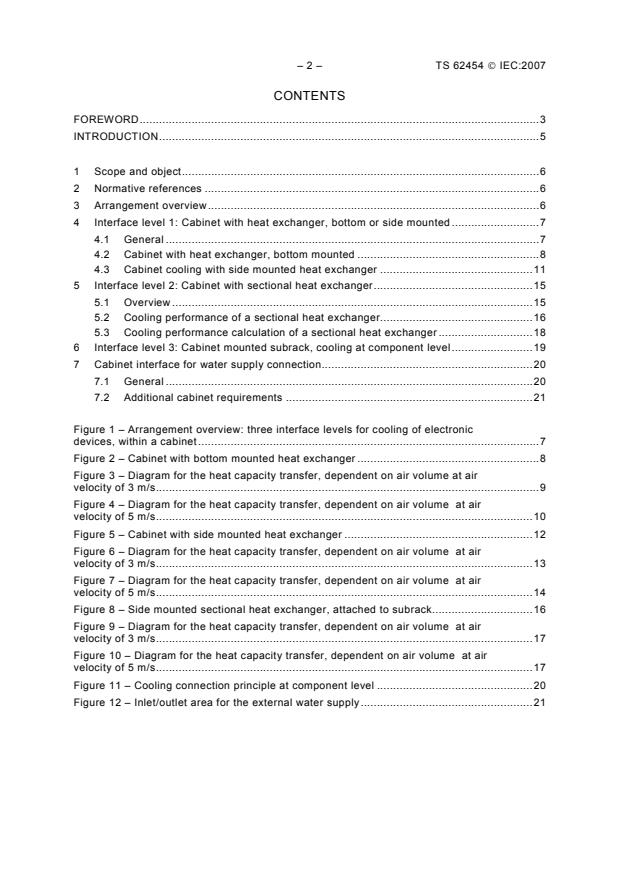
CONTENTS
FOREWORD.3
INTRODUCTION.5
1 Scope and object.6
2 Normative references .6
3 Arrangement overview.6
4 Interface level 1: Cabinet with heat exchanger, bottom or side mounted .7
4.1 General .7
4.2 Cabinet with heat exchanger, bottom mounted .8
4.3 Cabinet cooling with side mounted heat exchanger .11
5 Interface level 2: Cabinet with sectional heat exchanger.15
5.1 Overview .15
5.2 Cooling performance of a sectional heat exchanger.16
5.3 Cooling performance calculation of a sectional heat exchanger .18
6 Interface level 3: Cabinet mounted subrack, cooling at component level.19
7 Cabinet interface for water supply connection.20
7.1 General .20
7.2 Additional cabinet requirements .21
Figure 1 – Arrangement overview: three interface levels for cooling of electronic
devices, within a cabinet.7
Figure 2 – Cabinet with bottom mounted heat exchanger .8
Figure 3 – Diagram for the heat capacity transfer, dependent on air volume at air
velocity of 3 m/s.9
Figure 4 – Diagram for the heat capacity transfer, dependent on air volume at air
velocity of 5 m/s.10
Figure 5 – Cabinet with side mounted heat exchanger .12
Figure 6 – Diagram for the heat capacity transfer, dependent on air volume at air
velocity of 3 m/s.13
Figure 7 – Diagram for the heat capacity transfer, dependent on air volume at air
velocity of 5 m/s.14
Figure 8 – Side mounted sectional heat exchanger, attached to subrack.16
Figure 9 – Diagram for the heat capacity transfer, dependent on air volume at air
velocity of 3 m/s.17
Figure 10 – Diagram for the heat capacity transfer, dependent on air volume at air
velocity of 5 m/s.17
Figure 11 – Cooling connection principle at component level .20
Figure 12 – Inlet/outlet area for the external water supply.21
TS 62454 © IEC:2007 – 3 –
INTERNATIONAL ELECTROTECHNICAL COMMISSION
____________
MECHANICAL STRUCTURES FOR ELECTRONIC EQUIPMENT –
DESIGN GUIDE: INTERFACE DIMENSIONS AND PROVISIONS
FOR WATER COOLING OF ELECTRONIC EQUIPMENT WITHIN
CABINETS OF THE IEC 60297 AND IEC 60917 SERIES
FOREWORD
1) The International Electrotechnical Commission (IEC) is a worldwide organization for standardization comprising
all national electrotechnical committees (IEC National Committees). The object of IEC is to promote
international co-operation on all questions concerning standardization in the electrical and electronic fields. To
this end and in addition to other activities, IEC publishes International Standards, Technical Specifications,
Technical Reports, Publicly Available Specifications (PAS) and Guides (hereafter referred to as “IEC
Publication(s)”). Their preparation is entrusted to technical committees; any IEC National Committee interested
in the subject dealt with may participate in this preparatory work. International, governmental and non-
governmental organizations liaising with the IEC also participate in this preparation. IEC collaborates closely
with the International Organization for Standardization (ISO) in accordance with conditions determined by
agreement between the two organizations.
2) The formal decisions or agreements of IEC on technical matters express, as nearly as possible, an international
consensus of opinion on the relevant subjects since each technical committee has representation from all
interested IEC National Committees.
3) IEC Publications have the form of recommendations for international use and are accepted by IEC National
Committees in that sense. While all reasonable efforts are made to ensure that the technical content of IEC
Publications is accurate, IEC cannot be held responsible for the way in which they are used or for any
misinterpretation by any end user.
4) In order to promote international uniformity, IEC National Committees undertake to apply IEC Publications
transparently to the maximum extent possible in their national and regional publications. Any divergence
between any IEC Publication and the corresponding national or regional publication shall be clearly indicated in
the latter.
5) IEC provides no marking procedure to indicate its approval and cannot be rendered responsible for any
equipment declared to be in conformity with an IEC Publication.
6) All users should ensure that they have the latest edition of this publication.
7) No liability shall attach to IEC or its directors, employees, servants or agents including individual experts and
members of its technical committees and IEC National Committees for any personal injury, property damage or
other damage of any nature whatsoever, whether direct or indirect, or for costs (including legal fees) and
expenses arising out of the publication, use of, or reliance upon, this IEC Publication or any other IEC
Publications.
8) Attention is drawn to the Normative references cited in this publication. Use of the referenced publications is
indispensable for the correct application of this publication.
9) Attention is drawn to the possibility that some of the elements of this IEC Publication may be the subject of
patent rights. IEC shall not be held responsible for identifying any or all such patent rights.
The main task of IEC technical committees is to prepare International Standards. In
exceptional circumstances, a technical committee may propose the publication of a technical
specification when
• the required support cannot be obtained for the publication of an International Standard,
despite repeated efforts, or
• the subject is still under technical development or where, for any other reason, there is the
future but no immediate possibility of an agreement on an International Standard.
Technical specifications are subject to review within three years of publication to decide
whether they can be transformed into International Standards.
IEC 62454, which is a technical specification, has been prepared by subcommittee 48D:
Mechanical structures for electronic equipment, of IEC technical committee 48:
Electromechanical components and mechanical structures for electronic equipment.
– 4 – TS 62454 © IEC:2007
The text of this technical specification is based on the following documents:
Enquiry draft Report on voting
48D/357/DTS 48D/363/RVC
Full information on the voting for the approval of this technical specification can be found in
the report on voting indicated in the above table.
This publication has been drafted in accordance with ISO/IEC Directives, Part 2.
The committee has decided that the contents of this publication will remain unchanged until
the maintenance result date indicated on the IEC web site under "http://webstore.iec.ch" in
the data related to the specific publication. At this date, the publication will be
• transformed into an international standard;
• reconfirmed;
• withdrawn;
• replaced by a revised edition, or
• amended.
TS 62454 © IEC:2007 – 5 –
INTRODUCTION
The increasing computing performance of electronic devices with increasing electrical power
consumption creates very high heat loads within electronic cabinets.
Next generations of electronic equipment built into cabinets require new ways of cooling.
State of the art in office or data centre environments is the cooling by ambient air, within air
conditioned rooms. The dimensioning of the heat loads was typically based on approximately
1 kW per cabinet. Next generation equipment cooling solutions, as described in this Technical
specification, take heat loads of up to 35 kW per cabinet under consideration.
The heat management in such installations becomes difficult if the heat per cabinet reaches
such levels or if the distribution across the multiple cabinets becomes extremely uneven.
In order to meet such heat spots or uneven heat concentration, it is necessary to conduct the
heat to the outside of the room, instead of loading the room. The proposed solution uses
water cooled heat exchangers within the individual cabinet.
Assuming that the chilled water supply is the easiest cooling opportunity within existing
infrastructures and new installations, this Technical specification was initiated for the
definition of dimensional interfaces and cooling performance guidelines.
Three different cooling arrangements for heat exchangers within cabinets have been
regarded, called “interface levels”, where level 1 and 2 are described in detail in this
Technical specification. The third level, which is per definition the component level on a single
board is not described in detail due to the fact, that such an interface depends on too complex
design details and that a water cooled heat sink is used, principally working by conduction
cooling of the component (e.g. processor). Level 3 is described by some basic considerations
of the interfaces.
For a clear definition of interface dimensions and cooling performance guidelines, only
cabinets have been regarded from the IEC 60297 (19 in) and IEC 60917 (25 mm) series.
Interface level 1: Cabinet with heat exchanger bottom or side mounted for the cooling of a
whole cabinet.
Interface level 2: Cabinet with sectional heat exchanger, dedicated to individual subracks
or groups of subracks.
Interface level 3: Cabinet with inbuilt subrack where the water pipe connects to
components on individual boards.
In this Technical specification, the terms ‘Water’ and ‘Air’ require further definition in
application specific standards or specifications.
– 6 – TS 62454 © IEC:2007
MECHANICAL STRUCTURES FOR ELECTRONIC EQUIPMENT –
DESIGN GUIDE: INTERFACE DIMENSIONS AND PROVISIONS
FOR WATER COOLING OF ELECTRONIC EQUIPMENT WITHIN
CABINETS OF THE IEC 60297 AND IEC 60917 SERIES
1 Scope and object
This technical specification provides interface dimensions and cooling performance guidelines
for cabinets, using water supplied heat exchangers. For a clear definition of interface
dimensions and cooling performance guidelines, only cabinets have been regarded from the
IEC 60297 (19 in) and IEC 60917 (25 mm) series.
As the cooling performance is in direct relation to volume flows and temperatures of air and
water, cooling performance guidelines are provided for two structural interface levels –
Interface level 1 and 2 – of equipment built into cabinets.
The third interface level is only described by main interfaces, but without detailed dimensions
and without cooling performance guidelines. This interface needs very complex details for the
ducting of water supply within the cabinet and down to the component heat sinks on boards
within subracks. Therefore, only the principle is shown usable for individual design solutions.
2 Normative references
The following referenced documents are indispensable for the application of this document.
For dated references, only the edition cited applies. For undated references, the latest edition
of the referenced document (including any amendments) applies.
IEC 60297-2, Dimensions of mechanical structures of the 482,6 mm (19 in) series – Part 2:
Cabinets and pitches of rack structures
IEC 60917-2-1, Modular order for the development of mechanical structures for electronic
equipment practices – Part 2: Sectional specification – Interface coordination dimensions for
the 25 mm equipment practice – Section 1: Detail specification – Dimensions for cabinets and
racks
IEC 60529:1989, Degrees of protection provided by enclosures (IP Code)
Amendment 1 (1999)
ISO 228-1:2000, Pipe threads where pressure tight joints are not made on the threads –
Part 1: Dimensions, tolerances and designation
ISO 11690-1, Acoustics – Recommended practice for design of low-noise workplaces
containing machinery – Part 1: Noise control strategies
3 Arrangement overview
The arrangement overview shown in Figure 1 illustrates the typical interface levels.
TS 62454 © IEC:2007 – 7 –
Interface level 1:
cabinet with heat exchanger bottom
or side mounted for the cooling of
a whole cabinet
Interface level 2:
cabinet with sectional heat exchanger,
dedicated to individual subracks or
groups of subracks
Subrack with air duct
on top and bottom
for a sectional heat
exchanger Sectional heat exchanger,
attached to the subrack
Interface level 3:
subrack with water pipe connecting
to components on individual boards
IEC 1995/07
Figure 1 – Arrangement overview: three interface levels for cooling of electronic
devices, within a cabinet
4 Interface level 1: Cabinet with heat exchanger, bottom or side mounted
4.1 General
The following figures illustrate the mounting positions of the heat exchanger and the direction
of the air circulation. For the individual application, the provided cabinet dimensions and
dimensions relevant for the air volume shall be used as the reference.
– 8 – TS 62454 © IEC:2007
4.2 Cabinet with heat exchanger, bottom mounted
4.2.1 Overview
Figure 2 illustrates the principal application of a bottom mounted heat exchanger. The air
stream is in the vertical direction, on the front side upwards between the front door and the
equipment face plate.
The principal drawing in the figure shows only one subrack as an example. The whole area
above the heat exchanger may be assembled with subracks or electronic equipment to direct
the air upwards along the face plates (or to be closed by filler panels in case of unused
mounting sections). In such configurations, the heat exchanger systems most likely will have
their own fans for the air circulation. The subracks or electronic equipment usually also have
fans for the throughput from the front to the rear. All open sections in the face plate area (also
on the side) should be closed to prevent air bypassing.
Three dimensional view on a cabinet Top view, cross section A-B
with bottom mounted heat exchanger
Air downstream
W
in the rear
W
D
Air downstream
in the rear
Subrack
example
Heat exchanger,
bottom mounted
A
B
Air upstream
in the front
Heat
exchanger
Air upstream
in the front
IEC 1996/07
Abbreviations:
W Width of the cabinet
D Depth of the front door and rear door
H Height of the cabinet
H Useable height for electronic equipment
U
D Distance between the front of the equipment and the front door
F
D Distance between the rear door and the rear of the equipment
R
D Depth of the equipment
E
Figure 2 – Cabinet with bottom mounted heat exchanger
4.2.2 Cooling performance in cabinets with bottom mounted heat exchanger
Figure 3 illustrates the cooling performance guidelines of a cabinet with a bottom mounted
heat exchanger as direct function of the air throughput defined by the available cross section
at the front and rear of the installed equipment. The cross section (W × D ) times the air
R
velocity determines the possible air volume, which in turn determines the possible heat
transfer to the heat exchanger. The cabinet model to which this diagram belongs is assumed
as H = 2 000 mm by W = 600 mm and variable depth from 600 mm to 1 200 mm.
H
U
H
D D
F D R
E
D
TS 62454 © IEC:2007 – 9 –
The assumption is made, that 25 % of the rear area may be blocked by cabling. Therefore,
the calculation includes 25 % more space at the rear than at the front. The same effect
applies if the cabling restricts the front area or if both areas are blocked by 12,5 %. The air
velocity of 3 m/s is taken as one example for the possibility to approach the acoustic noise
pressure level of ≤ 45 dB(A) in accordance with ISO 11690-1.
Figure 4 illustrates the cooling performance for the same cabinet dimensions, but at 5 m/s air
velocity. The cooling capacity of the suitable heat exchanger may be chosen in accordance
with the required total heat load. The air velocity of 5 m/s is taken as one example for the
possibility to approach the acoustic noise pressure level of ≤ 55 dB(A) in accordance with
ISO 11690-1.
Depth of cabinet D at a vertical direction of air stream
W = 600 mm
Depth of the equipment D = 400 mm
E
V = 3 m/s
max
22,5
17,5
12,5
7,5
0 2 4 6 8 10 12 14 16 18 20
Q (kW)
IEC 1997/07
Figure 3 – Diagram for the heat capacity transfer, dependent on air volume at air
velocity of 3 m/s
ΔT (K)
D = 600 mm
D = 700 mm
D = 800 mm
D = 900 mm
D = 1 000 mm
D = 1 100 mm
D = 1 200 mm
– 10 – TS 62454 © IEC:2007
Depth of cabinet D at a vertical direction of air stream
W = 600 mm
Depth of the equipment D = 400 mm
E
V = 5 m/s
max
22,5
D = 1 000 mm
D = 1 100 mm
17,5
D = 1 200 mm
12,5
7,5
0 2 4 6 8 10 12 14 16 18 20
Q (kW)
IEC 1998/07
Figure 4 – Diagram for the heat capacity transfer, dependent on air volume
at air velocity of 5 m/s
4.2.3 Cooling performance calculation for a cabinet with bottom mounted heat
exchanger
The cooling performance of the above diagrams is calculated with the following formula. The
results are not representative for the specific application, but are rather a guideline for the
assessment of dimensional requirements for the air flow volume as an indicator for the
possible heat capacity transfer to the heat exchanger.
+ D + D
D = D
R F E
where
&
Q
D =
F
ρ × υ × W ×Cp × ΔT
air air
Calculation example of the diagram in Figure 3:
D = 1, 25 × D
R F
D = 1,25 × D + D + D
F F E
D = 2,25 × D + D
F E
10[kW]
D = × 2,25 + 0,4[m]
1,2[kg/m³] × 3[m/s] ×0,6[m]×1,007[kJ/kg × K]×15[K]
ΔT (K)
D = 600 mm
D = 700 mm
D = 800 mm
D = 900 mm
TS 62454 © IEC:2007 – 11 –
D = 1 089,6 mm⇒ Selected cabinet depth: D = 1 100 mm
Default data of the calculation:
H = 2 000 mm Cabinet height
D = 600 mm to 1 200 mm Cabinet depth
W = 600 mm Cabinet width
D = 400 mm Depth of equipment
E
D = Depth between face plate of equipment and front door
F
D = Depth between rear door and equipment
R
(D is 1,25 × greater than D , with regard to space for cabling)
R F
Q = Heat capacity (cooling performance)
V = air velocity at the front and rear of the equipment (3 m/s or 5 m/s)
ΔT = Temperature increase between front area and rear
Cp = Air specific heat capacity/latent heat of air
air
ρ = Air density
air
4.3 Cabinet cooling with side mounted heat exchanger
4.3.1 Overview
Figure 5 illustrates the principal application of a side mounted heat exchanger. The air stream
is in horizontal direction and through the equipment from front to rear. The principal drawing
in the figure shows only one subrack or electronic equipment as an example. The whole area
above the heat exchanger may be assembled with subracks or electronic equipment or
should be closed by filler panels in case of unused mounting sections. In such configurations,
the heat exchanger system will most likely have its own fans for the air circulation; similarly
the subracks usually have fans for the throughput from the front to the rear. All open sections
in the face plate area (also on side) should be closed to prevent air bypassing.
– 12 – TS 62454 © IEC:2007
Top view, cross section A-B
Three dimensional view on a cabinet
with side mounted heat exchanger
W
W
W
D
W
A
B
Compartment for
heat exchanger
IEC 1999/07
Figure 5 – Cabinet with side mounted heat exchanger
4.3.2 Cooling performance in cabinets with side mounted heat exchanger
Figure 6 illustrates the cooling performance guideline of a cabinet with a side mounted heat
exchanger as direct function of the air throughput defined by the available cross section in
front and rear of the installed equipment. The cross section (H × D ) times the air velocity
R
determines the possible air volume which in turn determines the possible heat transfer to the
heat exchanger. The cabinet model to which this diagram belongs is assumed as
H = 2 000 mm by W = 600 mm, W = 800 mm and variable depth from 600 mm to 1 200 mm.
The assumption is made that 25 % of the rear area may be blocked by cabling. Therefore, the
calculation includes 25 % more space at the rear than at the front. The same effect applies if
the cabling restricts the front area or if both areas are blocked by 12,5 %. The air velocity of
3 m/s is taken as one example for the possibility to approach the acoustic noise pressure
level of ≤ 45 dB(A) in accordance with ISO 11690-1.
Figure 7 illustrates the cooling performance for the same cabinet dimensions, but at 5 m/s air
velocity. The cooling capacity of the suitable heat exchanger may be chosen in accordance
with the required total heat load. The air velocity of 5 m/s is taken as one example for the
possibility to meet the acoustic noise pressure level of ≤ 55 dB(A) in accordance with
ISO 11690-1.
H
D D
D E R
F
D
TS 62454 © IEC:2007 – 13 –
Depth of cabinet D at a vertical direction of air stream
H = 2 000 mm W = 600 mm
Depth of the equipment D = 400 mm
E
= 3 m/s
V
max
22,5
D = 1 000 mm
17,5
D = 1 100 mm
D = 1 200 mm
12,5
7,5
0 2 4 6 8 10 12 14 16 18 20 22 24 26 28 30
Q (kW) IEC 2000/07
Figure 6 – Diagram for the heat capacity transfer, dependent on air volume
at air velocity of 3 m/s
ΔT (K)
D = 600 mm
D = 700 mm
D = 800 mm
D = 900 mm
– 14 – TS 62454 © IEC:2007
Depth of cabinet D at a vertical direction of air stream
H = 2 000 mm W = 800 mm
Depth of the equipment D = 400 mm
E
V = 5 m/s
max
22,5
17,5
D = 800 mm
D = 900 mm
12,5
D = 1 000 mm
10 D = 1 100 mm
D = 1 200 mm
7,5
0 2 4 6 8 10 12 14 16 18 20 22 24 26 28 30
Q (kW)
IEC 2001/07
Figure 7 – Diagram for the heat capacity transfer, dependent on air volume
at air velocity of 5 m/s
4.3.3 Cooling performance calculation for a cabinet with side mounted heat
exchanger
The cooling performance of the above diagrams is calculated with the following formula. The
results are not representative for the specific application but are rather a guideline for the
individual assessment of dimensional requirements for the air flow volume as an indicator for
the possible heat capacity transfer to the heat exchanger.
D = D + D + D
F R E
where
&
Q
D =
F
ρ × υ × H × W ×Cp × ΔT
air eff air
Calculation example of the diagram in Figure 6:
D = 1, 25 × D
R F
D = 1,25 × D + D +D
E
F F
D = 2,25 × D + D
F E
ΔT (K)
D = 600 mm
D = 700 mm
TS 62454 © IEC:2007 – 15 –
10[kW]
D = ×2,25 + 0,4[m]
1,2[kg/m³] ×3[m/s] ×1,6[m] ×1,007[kJ/kg×K]×15[K]
D = 658,6 mm
⇒ Selected Cabinet depth: D = 700 mm
Default data of the calculation:
H = 2 000 mm Cabinet height
H = 1 600 mm Selected for calculation
eff
D = 600 mm to 1 200 mm Cabinet depth
W = 600 mm Cabinet width
W = Cabinet width including side mounted heat exchanger
D = 400 mm Depth of equipment
E
D = Depth between face plate of equipment and front door
F
D = Depth between rear door and equipment
R
(D is 1,25 × greater than D , with regard to space for cabling)
R F
Q = Heat capacity (cooling performance)
v = air velocity at the front and rear of the equipment (3 m/s or 5 m/s)
ΔT = Temperature increase between front area and rear
Cp = Air specific heat capacity/latent heat of air
air
ρ = Air density
air
5 Interface level 2: Cabinet with sectional heat exchanger
5.1 Overview
Figure 8 illustrates the principal application of a side mounted, sectional heat exchanger
attached to a subrack or to multiple, stacked subracks. The air stream through the subrack is
bottom to top. The example is considered as a reference for this kind of application.
The side square openings on top and bottom of the subrack are decisive regarding the
possible air stream volume with respect to the air velocity. Therefore, the cooling performance
diagrams consist of different cooling performance curves (stipulated by height units (U)). The
main example considers a constant depth of 400 mm as a typical subrack depth dimension.
Other values may be easily implemented in the calculation formula. The heights of the
subrack include an air duct, closing the air loop to the heat exchanger (H – H ). The height
1 2
units in Figures 9 and 10 are given as an example, in accordance with the IEC 60297 series.
For subracks of the IEC 60917 series, instead of 1 U, the dimension of 2 SU shall be used.
– 16 – TS 62454 © IEC:2007
Detail X:
Front view
Front view, subrack/heat exchanger
Sectional heat
Envelope of
exchanger
Envelope of
the heat
the subrack
exchanger
Detail X
B
A
Heat
exchanger
Top view A-B
Cabinet
cross section
envelope
W
W
W
IEC 2002/07
Figure 8 – Side mounted sectional heat exchanger, attached to subrack
5.2 Cooling performance of a sectional heat exchanger
This example describes the cooling performance of a heat exchanger, dedicated to individual
subracks or multiple, stacked subracks. The assumptions for this model are, that the subrack
consists of an air duct, linked to a side mounted heat exchanger and that there is a closed air
loop between the two. The dimensions in this example are chosen with respect to the size of
a subrack which may generate between 1 kW and 5 kW heat loss and there are the suitable
air duct dimensions in accordance with the heat loss. The assumption is made that the system
has an air flow loss of 10 % caused by geometry.
Figure 9 illustrates the the air velocity of 3 m/s as one example for the possibility to meet the
acoustic noise pressure level of ≤ 45 dB(A) in accordance with ISO 11690-1. Figure 10
illustrates the cooling performance for the same dimensions but at 5 m/s air velocity. The air
velocity of 5 m/s is taken as one example for the possibility to meet the acoustic noise
pressure level of ≤ 55 dB(A) in accordance with ISO 11690-1.
D
H
D
E
H
H H
B T
TS 62454 © IEC:2007 – 17 –
Cooling performance for
D = 400 mm and v = 3 m/s
E max
4,0
25 K
3,5
22,5 K
3,0
20 K
17,5 K
2,5
15 K
2,0
12,5 K
1,5
10 K
7,5 K
1,0
5 K
0,5
0,0
3,82
0 1 2 3 4 5
Additional height units H + H
B T
IEC 2003/07
Figure 9 – Diagram for the heat capacity transfer, dependent on air volume
at air velocity of 3 m/s
Cooling performance for
D = 400 mm and v = 5 m/s
E max
7,0
25 K
6,0
22,5 K
5,0
20 K
17,5 K
4,0
15 K
12,5 K
3,0
10 K
2,0
7,5 K
5 K
1,0
0,0
0 1 2 3 4 5
Additional height units H + H
B T
IEC 2004/07
Figure 10 – Diagram for the heat capacity transfer, dependent on air volume
at air velocity of 5 m/s
Q (kW)
Q (kW)
ΔT
ΔT
– 18 – TS 62454 © IEC:2007
5.3 Cooling performance calculation of a sectional heat exchanger
The cooling performance of the above diagrams is calculated with the following formula. The
results are not representative for the specific application but are rather a guideline for the
individual assessment of dimensional requirements for the air flow volume as an indicator for
the possible heat capacity transfer to the heat exchanger.
&
Q
H =
Β
ρ × υ × 1U × D × Cp × ΔT
air E air
Calculation example of the diagram in Figure 9:
2,5 [kW]
H =
Β
1,2[kg/m³] × 3[m/s] × 0,04445 [m] × 0,4[m] ×1,007 [kJ/kg × K] × 22,5 [K]
H = 1,72 U
B
H + H = 3,44 U
B T
An additional 10 % of height units because of geometric caused loss airflow = 3,82
⇒ Selected additional Height Units: 4 U
Default data of the calculation:
H = Height of the subrack with air duct
H = Height of the subrack
H = Height of bottom air duct in height units [U]
B
H = Height of top air duct in height units [U]
T
(example using H = H )
B T
D = Depth of cabinet (≥ 600 mm)
D = Depth of the subrack/heat exchanger
E
(example using 400 mm)
1U = 44,45 mm
W = 600 mm
W = 800 mm
W = 200 mm
Q = Heat capacity
v = air velocity at the front and rear of the equipment (3 m/s or 5 m/s)
TS 62454 © IEC:2007 – 19 –
ΔT = Temperature increase between top and bottom
Cp = Air specific heat capacity/latent heat of air
air
ρ = Air density
air
6 Interface level 3: Cabinet mounted subrack, cooling at component level
This interface needs very complex details for the ducting of water supply within the cabinet
and down to the component heat sinks on boards within subracks. Therefore, only the
principle is shown in Figure 11, applicable for individual design solutions.
The cold water source may be provided by an internal or external heat exchanger/chiller. The
installation of the water pipes at the component level may be with an interface to the front
panel or to the rear connector area.
– 20 – TS 62454 © IEC:2007
Principle of the water cooling at
component level:
the water supply is connected to the front
or rear of a plug-in unit, mounted into a subrack.
The cool water source may be supplied inside
the cabinet by a connection to a heat exchanger
or by an interface outside the cabinet
Principle of a plug-in unit with interfaces to
the water supply:
front or rear connection possible
Interface to the rear
of a plug-in unit
Component heat sink
with water cooling
Interface to the heat
exchanger/chiller
Interface to the front panel
Electronic
connection of a plug-in unit
connector
IEC 2005/07
Figure 11 – Cooling connection principle at component level
7 Cabinet interface for water supply connection
7.1 General
The water supply to the cabinet may be via the plinth or via the double floor, inside the
cabinet footprint W × D (see Figure 12).
TS 62454 © IEC:2007 – 21 –
The Footprint W × D includes the cabinet and all types of additional auxiliary cases. Cabinets
with bottom mounted heat exchanger may use the footprint of W × D.
Cross section A-B
Top view
W
W
W
D
W
B
A
Area for cabinet mounts to
the floor or for feet/castors
IEC 2006/07
Figure 12 – Inlet/outlet area for the external water supply
7.2 Additional cabinet requirements
Degree of protection according to IEC 60529:
≥ IP40
Pipe interface thread to the cabinet should be: G ¾ in (according to ISO 228-1)
≤ 10 kW:
G 1 in (according to ISO 228-1)
> 10 kW:
Condensate water: If condensate water occurs, it should be
drained without any contact to the
equipment
Air tightness: Air exchange between internal and external
air volumes should be avoided
________________
D
– 22 – TS 62454 © CEI:2007
SOMMAIRE
AVANT-PROPOS.23
INTRODUCTION.25
1 Domaine d'application et objet.26
2 Références normatives.26
3 Vue d'ensemble de la disposition.27
4 Niveau d’interface 1: Armoire avec échangeur de chaleur, à montage inférieur ou
latéral.28
4.1 Généralités.28
4.2 Armoire avec échangeur de chaleur, à montage inférieur .28
4.3 Refroidissement de l’armoire avec échangeur de chaleur à montage latéral .31
5 Niveau d’interface 2: Armoire avec échangeur thermique sectionnel.35
5.1 Vue d’ensemble.35
5.2 Performance de refroidissement d’un échangeur de chaleur sectionnel .36
5.3 Calcul de la performance de refroidissement d’un échangeur de chaleur
sectionnel.38
6 Niveau d’interface 3: Bac à montage en armoire, refroidissement au niveau du
composant.39
7 Interface d’armoire pour le raccordement de l’alimentation en eau .40
7.1 Généralités.40
7.2 Exigences supplémentaires pour l’armoire.41
Figure 1 – Vue d'ensemble de la disposition: Trois niveaux d’interface pour le
refroidissement des dispositifs électroniques, à l’intérieur d’une armoire .27
Figure 2 – Armoire avec échangeur de chaleur à montage inférieur .28
Figure 3 – Schéma représentant le transfert de capacité thermique, en fonction du
volume d’air à une vitesse de l’air de 3 m/s.29
Figure 4 – Schéma représentant le transfert de capacité thermique, en fonction du
volume d’air à une vitesse de l’air de 5 m/s.30
Figure 5 – Armoire avec échangeur de chaleur à montage latéral .32
Figure 6 – Schéma représentant le transfert de capacité thermique, en fonction du
volume d’air à une vitesse de l’air de 3 m/s.33
Figure 7 – Schéma représentant le transfert de capacité thermique, en fonction du
volume d’air à une vitesse de l’air de 5 m/s.34
Figure 8 – Echangeur de chaleur sectionnel à montage latéral, fixé au bac .36
Figure 9 – Schéma représentant le transfert de capacité thermique, en fonction du
volume d’air à une vitesse de l’air de 3 m/s.
Figure 10 – Schéma représentant le transfert de capacité thermique, en fonction du
volume d’air à une vitesse de l’air de 5 m/s.37
Figure 11 – Principe de connexion pour le refroidissement au niveau du composant.40
Figure 12 – Zone d’entrée/de sortie pour l’alimentation en eau extérieure.41
TS 62454 © CEI:2007 – 23 –
COMMISSION ÉLECTROTECHNIQUE INTERNATIONALE
____________
STRUCTURES MÉCANIQUES POUR ÉQUIPEMENT ÉLECTRONIQUE –
GUIDE DE CONCEPTION: DIMENSIONS D’INTERFACE ET
DISPOSITIONS RELATIVES AU REFROIDISSEMENT
PAR L’EAU DES ÉQUIPEMENTS ÉLECTRONIQUES
DANS LES ARMOIRES DES SÉRIES CEI 60297
ET CEI 60917
AVANT-PROPOS
1) La Commission Electrotechnique Internationale (CEI) est une organisation mondiale de normalisation
composée de l'ensemble des comités électrotechniques nationaux (Comités nationaux de la CEI). La CEI a
pour objet de favoriser la coopération internationale pour toutes les questions de normalisation dans les
domaines de l'électricité et de l'électronique. A cet effet, la CEI – entre autres activités – publie des Normes
internationales, des Spécifications techniques, des Rapports techniques, des Spécifications accessibles au
public (PAS) et des Guides (ci-après dénommés "Publication(s) de la CEI"). Leur élaboration est confiée à des
comités d'études, aux travaux desquels tout Comité national intéressé par le sujet traité peut participer. Les
organisations internationales, gouvernementales et non gouvernementales, en liaison avec la CEI, participent
...