

IEC 60565-2:2019
(Main)Underwater acoustics - Hydrophones - Calibration of hydrophones - Part 2: Procedures for low frequency pressure calibration
General Information
- Abstract
IEC 60565-2:2019 specifies the methods for low frequency pressure calibration of hydrophones at frequencies from 0,01 Hz to several kilohertz depending on calibration method.
IEC 60565-2:2019, together with IEC 60565-1, replaces the second edition of IEC 60565 published in 2006. This edition constitutes a technical revision.
IEC 60565-2:2019 includes the following significant technical changes with respect to the previous edition.
1) IEC 60565 has been divided into two parts:
• Part 1: Procedures for free-field calibration;
• Part 2: Procedures for low frequency pressure calibration (this document).
2) A relative calibration method has been added to Clause 8: Calibration by piezoelectric compensation.
3) A relative calibration method has been added to Clause 11: Calibration by vibrating column.
4) Clause 12: Calibration by static pressure transducer, has been added.
5) Annex A: Equivalent circuit of the excitation system for calibration with a vibrating column, has been deleted.
6) Subclauses 9.6, 9.7 and 9.8 have been moved to form a new Annex A: Advanced acoustic coupler calibration methods.
- Status
- Published
- Publication Date
- 18-Sep-2019
- Technical Committee
- TC 87 - Ultrasonics
- Drafting Committee
- WG 15 - TC 87/WG 15
- Current Stage
- PPUB - Publication issued
- Start Date
- 19-Sep-2019
- Completion Date
- 27-Sep-2019
Overview
IEC 60565-2:2019 is an international standard published by the International Electrotechnical Commission (IEC) that focuses on the calibration of hydrophones used in underwater acoustics. Specifically, this Part 2 document defines procedures for low frequency pressure calibration of hydrophones within the frequency range of 0.01 Hz to several kilohertz. It complements IEC 60565-1, which covers free-field calibration, together forming a comprehensive technical revision over the 2006 edition.
This standard is essential for ensuring accurate, reliable measurement of underwater acoustic pressures at low frequencies-a critical requirement for scientific, industrial, and defense applications where precise underwater sound measurements are necessary.
Key Topics
Scope and Frequency Range
Calibration methods described apply to low-frequency pressure measurements from 0.01 Hz up to several kHz, depending on the selected calibration technique.Calibration Methods
IEC 60565-2:2019 introduces multiple low-frequency calibration procedures:- Hydrostatic excitation calibration
- Piezoelectric compensation method (including a newly added relative calibration procedure)
- Acoustic coupler reciprocity calibration
- Pistonphone calibration
- Vibrating column calibration (including a new relative calibration method)
- Static pressure transducer calibration (newly added in this edition)
Technical Updates
The standard was revised to split the original document into two parts and add new methods such as calibration by static pressure transducer and relative calibration methods for piezoelectric compensation and vibrating columns, enhancing accuracy and flexibility.Measurement and Reporting Protocols
Detailed guidelines include electrical measurement setups, correction factors, temperature and pressure considerations, and data reporting to ensure precision and reproducibility.Uncertainty Assessment
Annex B helps users evaluate measurement uncertainty, a crucial aspect for confidence in hydrophone calibration results.
Applications
IEC 60565-2:2019 is applicable across a wide range of practical underwater acoustics tasks requiring highly accurate hydrophone calibration at low frequencies:
Oceanographic Research
Calibration ensures precise measurement of underwater acoustic signals for marine biology, seismology, and environmental monitoring.Naval and Defense Systems
Accurate hydrophone calibration supports sonar system performance and underwater surveillance.Offshore Industry
Calibration of hydrophones used in underwater noise monitoring, subsea infrastructure inspection, and environmental impact assessments.Underwater Communication Systems
Optimizing transducer sensitivity for low-frequency acoustic signals used in communication and data transmission underwater.Manufacturing and Quality Control
Testing hydrophone performance during production with certified low-frequency calibration methods.
Related Standards
IEC 60565-1 – Covers procedures for free-field calibration of hydrophones complementing low frequency methods in Part 2.
Other Underwater Acoustics Standards
Standards related to sonar performance, underwater noise measurement, and acoustic sensor specifications may be used in conjunction with IEC 60565-2 to ensure comprehensive system calibration and testing.International Electrotechnical Vocabulary (IEV)
Provides standardized terminology used throughout IEC 60565-2 ensuring consistent communication and understanding within the industry.
Summary
IEC 60565-2:2019 provides a detailed, rigorously defined framework for calibrating hydrophones at low frequencies, critical for underwater acoustics measurement accuracy. Its inclusion of multiple calibration methods, updated technical content, and uncertainty evaluation makes it a vital resource for hydrophone manufacturers, researchers, and professionals working in marine and underwater acoustic fields. Adhering to this standard ensures dependable hydrophone sensitivity measurements and supports high-quality underwater acoustic data acquisition.
Relations
- Effective Date
- 05-Sep-2023
Get Certified
Connect with accredited certification bodies for this standard

BSMI (Bureau of Standards, Metrology and Inspection)
Taiwan's standards and inspection authority.
Sponsored listings
Frequently Asked Questions
IEC 60565-2:2019 is a standard published by the International Electrotechnical Commission (IEC). Its full title is "Underwater acoustics - Hydrophones - Calibration of hydrophones - Part 2: Procedures for low frequency pressure calibration". This standard covers: IEC 60565-2:2019 specifies the methods for low frequency pressure calibration of hydrophones at frequencies from 0,01 Hz to several kilohertz depending on calibration method. IEC 60565-2:2019, together with IEC 60565-1, replaces the second edition of IEC 60565 published in 2006. This edition constitutes a technical revision. IEC 60565-2:2019 includes the following significant technical changes with respect to the previous edition. 1) IEC 60565 has been divided into two parts: • Part 1: Procedures for free-field calibration; • Part 2: Procedures for low frequency pressure calibration (this document). 2) A relative calibration method has been added to Clause 8: Calibration by piezoelectric compensation. 3) A relative calibration method has been added to Clause 11: Calibration by vibrating column. 4) Clause 12: Calibration by static pressure transducer, has been added. 5) Annex A: Equivalent circuit of the excitation system for calibration with a vibrating column, has been deleted. 6) Subclauses 9.6, 9.7 and 9.8 have been moved to form a new Annex A: Advanced acoustic coupler calibration methods.
IEC 60565-2:2019 specifies the methods for low frequency pressure calibration of hydrophones at frequencies from 0,01 Hz to several kilohertz depending on calibration method. IEC 60565-2:2019, together with IEC 60565-1, replaces the second edition of IEC 60565 published in 2006. This edition constitutes a technical revision. IEC 60565-2:2019 includes the following significant technical changes with respect to the previous edition. 1) IEC 60565 has been divided into two parts: • Part 1: Procedures for free-field calibration; • Part 2: Procedures for low frequency pressure calibration (this document). 2) A relative calibration method has been added to Clause 8: Calibration by piezoelectric compensation. 3) A relative calibration method has been added to Clause 11: Calibration by vibrating column. 4) Clause 12: Calibration by static pressure transducer, has been added. 5) Annex A: Equivalent circuit of the excitation system for calibration with a vibrating column, has been deleted. 6) Subclauses 9.6, 9.7 and 9.8 have been moved to form a new Annex A: Advanced acoustic coupler calibration methods.
IEC 60565-2:2019 is classified under the following ICS (International Classification for Standards) categories: 17.140.50 - Electroacoustics. The ICS classification helps identify the subject area and facilitates finding related standards.
IEC 60565-2:2019 has the following relationships with other standards: It is inter standard links to IEC 60565:2006. Understanding these relationships helps ensure you are using the most current and applicable version of the standard.
IEC 60565-2:2019 is available in PDF format for immediate download after purchase. The document can be added to your cart and obtained through the secure checkout process. Digital delivery ensures instant access to the complete standard document.
Standards Content (Sample)
IEC 60565-2 ®
Edition 1.0 2019-09
INTERNATIONAL
STANDARD
NORME
INTERNATIONALE
Underwater acoustics – Hydrophones – Calibration of hydrophones –
Part 2: Procedures for low frequency pressure calibration
Acoustique sous-marine – Hydrophones – Étalonnage des hydrophones –
Partie 2: Procédures pour l’étalonnage à basse pression de fréquence
All rights reserved. Unless otherwise specified, no part of this publication may be reproduced or utilized in any form
or by any means, electronic or mechanical, including photocopying and microfilm, without permission in writing from
either IEC or IEC's member National Committee in the country of the requester. If you have any questions about IEC
copyright or have an enquiry about obtaining additional rights to this publication, please contact the address below or
your local IEC member National Committee for further information.
Droits de reproduction réservés. Sauf indication contraire, aucune partie de cette publication ne peut être reproduite
ni utilisée sous quelque forme que ce soit et par aucun procédé, électronique ou mécanique, y compris la photocopie
et les microfilms, sans l'accord écrit de l'IEC ou du Comité national de l'IEC du pays du demandeur. Si vous avez des
questions sur le copyright de l'IEC ou si vous désirez obtenir des droits supplémentaires sur cette publication, utilisez
les coordonnées ci-après ou contactez le Comité national de l'IEC de votre pays de résidence.
IEC Central Office Tel.: +41 22 919 02 11
3, rue de Varembé info@iec.ch
CH-1211 Geneva 20 www.iec.ch
Switzerland
About the IEC
The International Electrotechnical Commission (IEC) is the leading global organization that prepares and publishes
International Standards for all electrical, electronic and related technologies.
About IEC publications
The technical content of IEC publications is kept under constant review by the IEC. Please make sure that you have the
latest edition, a corrigendum or an amendment might have been published.
IEC publications search - webstore.iec.ch/advsearchform Electropedia - www.electropedia.org
The advanced search enables to find IEC publications by a The world's leading online dictionary on electrotechnology,
variety of criteria (reference number, text, technical containing more than 22 000 terminological entries in English
committee,…). It also gives information on projects, replaced and French, with equivalent terms in 16 additional languages.
and withdrawn publications. Also known as the International Electrotechnical Vocabulary
(IEV) online.
IEC Just Published - webstore.iec.ch/justpublished
Stay up to date on all new IEC publications. Just Published IEC Glossary - std.iec.ch/glossary
details all new publications released. Available online and 67 000 electrotechnical terminology entries in English and
once a month by email. French extracted from the Terms and Definitions clause of
IEC publications issued since 2002. Some entries have been
IEC Customer Service Centre - webstore.iec.ch/csc collected from earlier publications of IEC TC 37, 77, 86 and
If you wish to give us your feedback on this publication or CISPR.
need further assistance, please contact the Customer Service
Centre: sales@iec.ch.
A propos de l'IEC
La Commission Electrotechnique Internationale (IEC) est la première organisation mondiale qui élabore et publie des
Normes internationales pour tout ce qui a trait à l'électricité, à l'électronique et aux technologies apparentées.
A propos des publications IEC
Le contenu technique des publications IEC est constamment revu. Veuillez vous assurer que vous possédez l’édition la
plus récente, un corrigendum ou amendement peut avoir été publié.
Recherche de publications IEC - Electropedia - www.electropedia.org
webstore.iec.ch/advsearchform Le premier dictionnaire d'électrotechnologie en ligne au
La recherche avancée permet de trouver des publications IEC monde, avec plus de 22 000 articles terminologiques en
en utilisant différents critères (numéro de référence, texte, anglais et en français, ainsi que les termes équivalents dans
comité d’études,…). Elle donne aussi des informations sur les 16 langues additionnelles. Egalement appelé Vocabulaire
projets et les publications remplacées ou retirées. Electrotechnique International (IEV) en ligne.
IEC Just Published - webstore.iec.ch/justpublished Glossaire IEC - std.iec.ch/glossary
Restez informé sur les nouvelles publications IEC. Just 67 000 entrées terminologiques électrotechniques, en anglais
Published détaille les nouvelles publications parues. et en français, extraites des articles Termes et Définitions des
Disponible en ligne et une fois par mois par email. publications IEC parues depuis 2002. Plus certaines entrées
antérieures extraites des publications des CE 37, 77, 86 et
Service Clients - webstore.iec.ch/csc CISPR de l'IEC.
Si vous désirez nous donner des commentaires sur cette
publication ou si vous avez des questions contactez-nous:
sales@iec.ch.
IEC 60565-2 ®
Edition 1.0 2019-09
INTERNATIONAL
STANDARD
NORME
INTERNATIONALE
Underwater acoustics – Hydrophones – Calibration of hydrophones –
Part 2: Procedures for low frequency pressure calibration
Acoustique sous-marine – Hydrophones – Étalonnage des hydrophones –
Partie 2: Procédures pour l’étalonnage à basse pression de fréquence
INTERNATIONAL
ELECTROTECHNICAL
COMMISSION
COMMISSION
ELECTROTECHNIQUE
INTERNATIONALE
ICS 17.140.50 ISBN 978-2-8322-7346-3
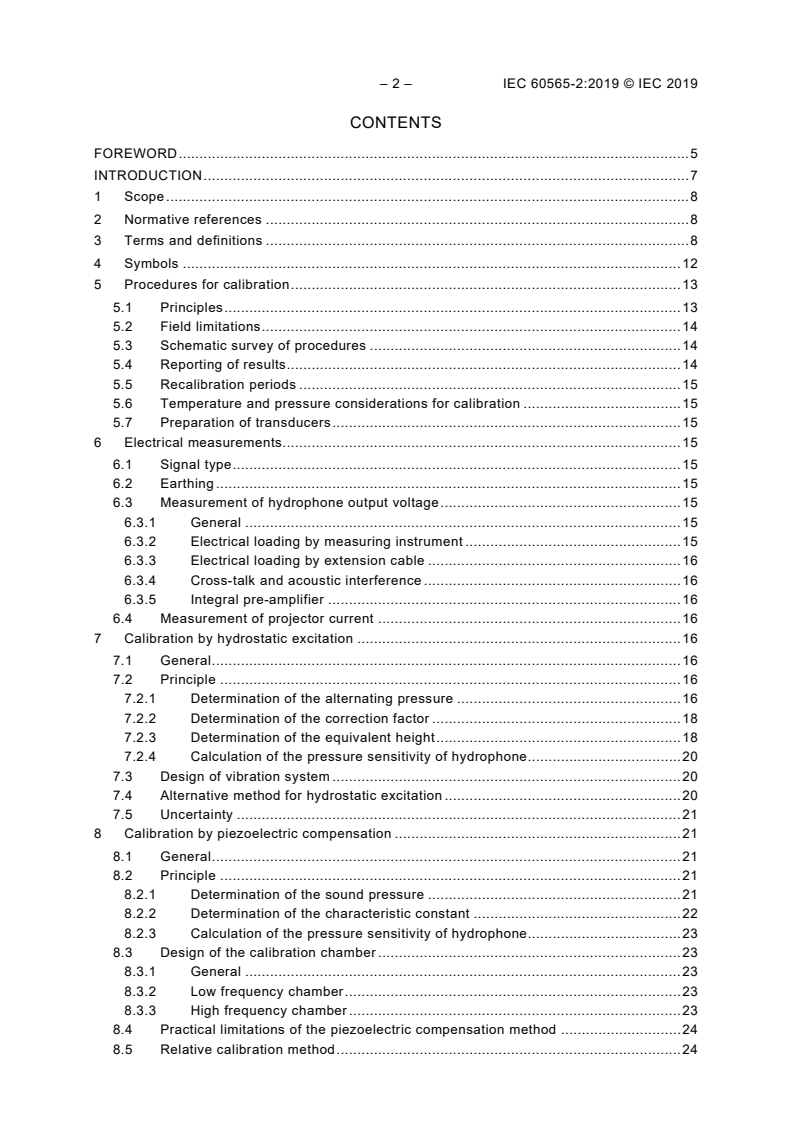
– 2 – IEC 60565-2:2019 © IEC 2019
CONTENTS
FOREWORD . 5
INTRODUCTION . 7
1 Scope . 8
2 Normative references . 8
3 Terms and definitions . 8
4 Symbols . 12
5 Procedures for calibration . 13
5.1 Principles . 13
5.2 Field limitations . 14
5.3 Schematic survey of procedures . 14
5.4 Reporting of results . 14
5.5 Recalibration periods . 15
5.6 Temperature and pressure considerations for calibration . 15
5.7 Preparation of transducers . 15
6 Electrical measurements. 15
6.1 Signal type . 15
6.2 Earthing . 15
6.3 Measurement of hydrophone output voltage . 15
6.3.1 General . 15
6.3.2 Electrical loading by measuring instrument . 15
6.3.3 Electrical loading by extension cable . 16
6.3.4 Cross-talk and acoustic interference . 16
6.3.5 Integral pre-amplifier . 16
6.4 Measurement of projector current . 16
7 Calibration by hydrostatic excitation . 16
7.1 General . 16
7.2 Principle . 16
7.2.1 Determination of the alternating pressure . 16
7.2.2 Determination of the correction factor . 18
7.2.3 Determination of the equivalent height . 18
7.2.4 Calculation of the pressure sensitivity of hydrophone . 20
7.3 Design of vibration system . 20
7.4 Alternative method for hydrostatic excitation . 20
7.5 Uncertainty . 21
8 Calibration by piezoelectric compensation . 21
8.1 General . 21
8.2 Principle . 21
8.2.1 Determination of the sound pressure . 21
8.2.2 Determination of the characteristic constant . 22
8.2.3 Calculation of the pressure sensitivity of hydrophone . 23
8.3 Design of the calibration chamber . 23
8.3.1 General . 23
8.3.2 Low frequency chamber . 23
8.3.3 High frequency chamber . 23
8.4 Practical limitations of the piezoelectric compensation method . 24
8.5 Relative calibration method . 24
8.6 Uncertainty . 25
9 Calibration by acoustic coupler reciprocity . 25
9.1 General . 25
9.2 Principle . 25
9.2.1 Theory of acoustic coupler reciprocity . 25
9.2.2 Procedures for the reciprocity calibration . 26
9.2.3 Calculation of transfer impedance . 27
9.2.4 Determination of acoustic compliance . 27
9.3 Limitation of acoustic coupler reciprocity . 27
9.3.1 Frequency limit . 27
9.3.2 Hydrophone limit. 28
9.4 Measurement . 28
9.4.1 General . 28
9.4.2 Evidence of interference effects . 28
9.4.3 Reciprocity verification . 28
9.4.4 Linearity verification . 29
9.5 Uncertainty . 29
10 Calibration by pistonphone . 29
10.1 General . 29
10.2 Principle . 29
10.2.1 Determination of the sound pressure . 29
10.2.2 Determination of the compliance of the medium . 30
10.2.3 Calculation of the pressure sensitivity . 30
10.3 Limitations . 30
10.4 Relative calibration . 31
10.4.1 Comparison with a reference transducer . 31
10.4.2 Comparison using air–water pistonphone . 31
10.5 Uncertainty . 32
11 Calibration by vibrating column . 32
11.1 General . 32
11.2 Principle . 32
11.2.1 General . 32
11.2.2 Expression for the pressure . 33
11.2.3 Determination of the sensitivity . 34
11.3 Conditions of measurement . 35
11.3.1 Mechanical . 35
11.3.2 Acoustical . 36
11.4 Relative calibration method . 36
11.5 Uncertainty . 37
12 Calibration by static pressure transducer . 37
12.1 General . 37
12.2 Principle . 38
12.2.1 Theory of static pressure calibration . 38
12.2.2 Determination of the sensitivity of static pressure transducer . 38
12.2.3 Calculation of the pressure sensitivity . 39
12.3 Limitations . 39
12.4 Uncertainty . 39
Annex A (informative) Advanced acoustic coupler calibration methods . 40
– 4 – IEC 60565-2:2019 © IEC 2019
A.1 General . 40
A.2 Acoustic-coupler calibration using a reference coupler with two reciprocal
transducers and an auxiliary coupler with the same two transducers and a
hydrophone to be calibrated . 41
A.2.1 General . 41
A.2.2 Theory . 42
A.3 Acoustic-coupler calibration using a reference coupler with two reciprocal
transducers and an auxiliary coupler with the same two transducers, a
hydrophone to be calibrated, and a sound source . 43
A.3.1 General . 43
A.3.2 Theory . 44
A.4 Acoustic-coupler calibration using a coupler, a reciprocal transducer, a
projector, a hydrophone to be calibrated, and a subsidiary body of known
compliance . 45
A.4.1 General . 45
A.4.2 Theory . 45
Annex B (informative) Assessment of uncertainty in the low frequency pressure
calibration of hydrophone . 48
B.1 General . 48
B.2 Type A evaluation of uncertainty . 48
B.3 Type B evaluation of uncertainty . 48
B.4 Reported uncertainty . 48
B.5 Common sources of uncertainty . 49
Bibliography . 51
Figure 1 – Diagram of calibration by hydrostatic excitation . 17
Figure 2 – Schematic drawing of calibration by piezoelectric compensation . 22
Figure 3 – Diagram of the chamber for high frequency . 24
Figure 4 – Reciprocity coupler with three transducers: a projector P, a reciprocal
transducer T, and a hydrophone H to be calibrated . 26
Figure 5 – Comparison calibration using pistonphone with calibrated hydrophone . 32
Figure 6 – Diagram of calibration by vibrating column . 33
Figure 7 – Diagram of calibration by vibrating column using comparison . 37
Figure 8 –Diagram of comparison calibration using static pressure transducer . 38
Figure A.1 – Reference coupler with two transducers: a projector P and a reciprocal
transducer T . 42
Figure A.2 – Auxiliary coupler with three transducers: a projector P, a reciprocal
transducer T and a hydrophone H to be calibrated . 42
Figure A.3 – Auxiliary coupler with four transducers: a projector P, a reciprocal
transducer T, a sound source S and a hydrophone H to be calibrated . 44
Figure A.4 – Schematic drawing of the measuring system . 46
INTERNATIONAL ELECTROTECHNICAL COMMISSION
____________
UNDERWATER ACOUSTICS – HYDROPHONES –
CALIBRATION OF HYDROPHONES –
Part 2: Procedures for low frequency pressure calibration
FOREWORD
1) The International Electrotechnical Commission (IEC) is a worldwide organization for standardization comprising
all national electrotechnical committees (IEC National Committees). The object of IEC is to promote
international co-operation on all questions concerning standardization in the electrical and electronic fields. To
this end and in addition to other activities, IEC publishes International Standards, Technical Specifications,
Technical Reports, Publicly Available Specifications (PAS) and Guides (hereafter referred to as "IEC
Publication(s)"). Their preparation is entrusted to technical committees; any IEC National Committee interested
in the subject dealt with may participate in this preparatory work. International, governmental and non-
governmental organizations liaising with the IEC also participate in this preparation. IEC collaborates closely
with the International Organization for Standardization (ISO) in accordance with conditions determined by
agreement between the two organizations.
2) The formal decisions or agreements of IEC on technical matters express, as nearly as possible, an international
consensus of opinion on the relevant subjects since each technical committee has representation from all
interested IEC National Committees.
3) IEC Publications have the form of recommendations for international use and are accepted by IEC National
Committees in that sense. While all reasonable efforts are made to ensure that the technical content of IEC
Publications is accurate, IEC cannot be held responsible for the way in which they are used or for any
misinterpretation by any end user.
4) In order to promote international uniformity, IEC National Committees undertake to apply IEC Publications
transparently to the maximum extent possible in their national and regional publications. Any divergence
between any IEC Publication and the corresponding national or regional publication shall be clearly indicated in
the latter.
5) IEC itself does not provide any attestation of conformity. Independent certification bodies provide conformity
assessment services and, in some areas, access to IEC marks of conformity. IEC is not responsible for any
services carried out by independent certification bodies.
6) All users should ensure that they have the latest edition of this publication.
7) No liability shall attach to IEC or its directors, employees, servants or agents including individual experts and
members of its technical committees and IEC National Committees for any personal injury, property damage or
other damage of any nature whatsoever, whether direct or indirect, or for costs (including legal fees) and
expenses arising out of the publication, use of, or reliance upon, this IEC Publication or any other IEC
Publications.
8) Attention is drawn to the Normative references cited in this publication. Use of the referenced publications is
indispensable for the correct application of this publication.
9) Attention is drawn to the possibility that some of the elements of this IEC Publication may be the subject of
patent rights. IEC shall not be held responsible for identifying any or all such patent rights.
International Standard IEC 60565-2 has been prepared by IEC technical committee 87:
Ultrasonics.
This first edition of IEC 60565-2, together with IEC 60565-1, replaces the second edition of
IEC 60565 published in 2006. This edition constitutes a technical revision.
This edition includes the following significant technical changes with respect to the previous
edition.
1) IEC 60565 has been divided into two parts:
• Part 1: Procedures for free-field calibration;
• Part 2: Procedures for low frequency pressure calibration (this document).
2) A relative calibration method has been added to Clause 8: Calibration by piezoelectric
compensation.
– 6 – IEC 60565-2:2019 © IEC 2019
3) A relative calibration method has been added to Clause 11: Calibration by vibrating
column.
4) Clause 12: Calibration by static pressure transducer, has been added.
5) Annex A: Equivalent circuit of the excitation system for calibration with a vibrating
column, has been deleted.
6) Subclauses 9.6, 9.7 and 9.8 have been moved to form a new Annex A: Advanced acoustic
coupler calibration methods.
The text of this International Standard is based on the following documents:
FDIS Report on voting
87/720/FDIS 87/723/RVD
Full information on the voting for the approval of this International Standard can be found in
the report on voting indicated in the above table.
This document has been drafted in accordance with the ISO/IEC Directives, Part 2.
NOTE Words in bold in the text are terms defined in Clause 3.
A list of all parts in the IEC 60565 series, published under the general title Underwater
acoustics – Hydrophones – Calibration of hydrophones, can be found on the IEC website.
The committee has decided that the contents of this document will remain unchanged until the
stability date indicated on the IEC website under "http://webstore.iec.ch" in the data related to
the specific document. At this date, the document will be
• reconfirmed,
• withdrawn,
• replaced by a revised edition, or
• amended.
INTRODUCTION
The purpose of this document is to establish the procedures for low frequency pressure
calibrations of hydrophones in the frequency range from 0,01 Hz to several kilohertz.
To ensure the correctness of the calibrations, the hydrophones to be calibrated are "rigid"
hydrophones with small size compared to the acoustic wavelength, and are not sensitive to
vibration when calibrated.
Principles, procedures, and uncertainties of physical calibrations such as hydrostatic
excitation, piezoelectric compensation, pistonphone, vibrating column, static pressure
transducer, etc., and reciprocity calibrations in acoustic couplers are given in this document.
Calibrations are carried out using one of these methods, depending on the different principles
to be used, and its limitations to the sound field and the frequency range.
– 8 – IEC 60565-2:2019 © IEC 2019
UNDERWATER ACOUSTICS – HYDROPHONES –
CALIBRATION OF HYDROPHONES –
Part 2: Procedures for low frequency pressure calibration
1 Scope
This part of IEC 60565 specifies the methods for low frequency pressure calibration of
hydrophones at frequencies from 0,01 Hz to several kilohertz depending on calibration
method.
2 Normative references
The following documents are referred to in the text in such a way that some or all of their
content constitutes requirements of this document. For dated references, only the edition
cited applies. For undated references, the latest edition of the referenced document (including
any amendments) applies.
IEC 60050-801, International Electrotechnical Vocabulary – Chapter 801: Acoustics and
electroacoustics (available at http://www.electropedia.org/)
IEC 60500:2017, Underwater acoustics – Hydrophones – Properties of the hydrophone in the
frequency range 1 Hz to 500 kHz
3 Terms and definitions
For the purposes of this document, the terms and definitions given in IEC 60050-801,
IEC 60500:2017 and the following apply.
ISO and IEC maintain terminological databases for use in standardization at the following
addresses:
• IEC Electropedia: available at http://www.electropedia.org/
• ISO Online browsing platform: available at http://www.iso.org/obp
3.1
coupler
apparatus comprising a rigid fluid-filled chamber into which transducers and hydrophones
can be inserted whose largest dimension is small compared to the wavelength
Note 1 to entry: In this document, the term small chamber is used interchangeably with coupler.
[SOURCE: IEC 60565:2006 [1] , 3.3, modified – In the definition, "small dimensions" has
been replaced by "whose largest dimension is small compared to the wavelength".]
___________
Numbers in square brackets refer to the Bibliography.
3.2
diffraction factor
ratio of the root-mean-square value of the sound pressure, averaged over the part of the
hydrophone designed to receive an incident plane wave sound pressure from a given
direction to the free-field root-mean-square sound pressure that would exist at the position of
the reference centre of the hydrophone if the hydrophone was removed
Note 1 to entry: Spatial average is undertaken first and then time average.
[SOURCE: IEC 60500:2017, 3.3, modified – In the definition, "the root-mean-square sound
pressure" has been replaced by "the root-mean-square value of the sound pressure,", and
"the position of" has been added after "that would exist at".]
3.3
electrical transfer impedance
Z
PH
quotient of the Fourier transform of the open circuit voltage
ℑ(U (t)) across the hydrophone electrical terminals, to the Fourier transform of the electrical
H
current ℑ(I (t)) through the projector, when projector and hydrophone are mounted in a
P
coupler
ℑ Ut
( ())
H
Z = (1)
PH
ℑ It
( ())
P
Note 1 to entry: The electrical transfer impedance is a complex-valued parameter. The modulus of the
electrical transfer impedance is expressed in ohm, Ω. The phase angle is expressed in degrees, and represents
the phase difference between the hydrophone voltage and the projector current.
Note 2 to entry: Because the electrical transfer impedance depends on the field conditions, the hydrostatic
pressure, water temperature and the length of the cable attached to the transducer, these parameters, as well as
the frequency and the electrical terminals where the electrical impedance is measured, are specified.
[SOURCE: IEC 60565:2006 [1], 3.10, modified – In the term, "transducer pair" has been
deleted. The domain "" has been added. In the definition,
"complex ratio of the open circuit instantaneous voltage U " has been replaced by "quotient of
H
the Fourier transform of the open circuit voltage ℑ(U (t))", "the instantaneous current I " has
H P
( )
been replaced by "Fourier transform of the electrical current ℑ I (t) ", and "if projector and
P
hydrophone are mounted in a free field with their principal axes in line and directed towards
each other" has been replaced by "when projector and hydrophone are mounted in a
coupler".]
3.4
hydrophone
electroacoustic transducer that produces electrical voltages in response to water borne
pressure signals
Note 1 to entry: A hydrophone is designed to respond principally to underwater sound pressure.
Note 2 to entry: In general, a hydrophone can also produce a signal in response to non-acoustic pressure
fluctuations (for example, those existing in a turbulent boundary layer during conditions of high water flow).
Note 3 to entry: Hydrophone types include reference hydrophones and measuring hydrophones. Measuring
hydrophones are used in general measurements of sound fields, and reference hydrophones are principally used
for calibration purposes (for example in comparison calibrations with measuring hydrophones).
Note 4 to entry: Hydrophones are principally used as listening devices, but in reciprocity calibration, a
hydrophone is used as reciprocal transducer, not only acting as a hydrophone, but also as a projector (sound
source).
Note 5 to entry: A hydrophone which is integrated with a digital acquisition system is sometimes termed a "digital
hydrophone", but the combination is best considered as a measuring system, not a hydrophone alone.
– 10 – IEC 60565-2:2019 © IEC 2019
Note 6 to entry: If a hydrophone is connected to a charge amplifier, the sensitivity of the hydrophone is
sometimes described in terms of charge sensitivity, which is related to the voltage sensitivity of the hydrophone by
its electrical capacitance.
[SOURCE: IEC 60500:2017, 3.17, modified – In the definition, "electrical signals" has been
replaced by "electrical voltages".]
3.5
pistonphone
apparatus having a rigid piston which can be given a reciprocating motion of a known
frequency and amplitude to establish a known sound pressure in a closed small chamber
[SOURCE: IEC 60565:2006 [1], 3.20, modified – In the definition, "so permitting the
establishment of" has been replaced by "to establish", and "a closed chamber of small
dimensions" by "a closed small chamber".]
3.6
pressure sensitivity
M
p
quotient of the Fourier transform of the hydrophone open-circuit voltage
signal ℑ(U (t)) to the Fourier transform of the acoustic pressure signal ℑ(p(t)) averaged over
H
the hydrophone active element, at a specified frequency
ℑ Ut
( ())
H
M = (2)
p
ℑ pt()
( )
Note 1 to entry: The hydrophone pressure sensitivity is a complex-valued parameter. The modulus of the
pressure sensitivity of a hydrophone is expressed in units of volt per pascal, V/Pa. The phase angle of the
sensitivity is expressed in degrees, and represents the phase difference between the electrical voltage and the
sound pressure.
Note 2 to entry: The term "response" is sometimes used instead of "sensitivity".
Note 3 to entry: The hydrophone active element is the electroacoustic element of the hydrophone which is
sensitive to sound pressure.
[SOURCE: IEC 60500:2017, 3.23, modified – In the definition, "ratio of the root-mean-square
output voltage" has been replaced by "quotient of the Fourier transform of the hydrophone
open-circuit output voltage signal ℑ(U (t))", and "root-mean-square of the sound pressure"
H
has been replaced by "Fourier transform of the sound pressure ℑ(p(t))".The description of the
hydrophone active element has been moved to a Note to entry.]
3.7
pressure sensitivity level
L
M
twenty times the logarithm to the base 10 of the ratio of the modulus of the pressure
sensitivity M to a reference sensitivity of M , in decibels
p
ref
M
p
L =20 log dB
(3)
M 10
M
ref
Note 1 to entry: The value of reference sensitivity is 1 V/μPa.
M
ref
[SOURCE: IEC 60500:2017, 3.24, modified – In the definition, "modulus of the" has been
added before "pressure sensitivity", and "in decibels" has been added after " M ".]
ref
3.8
projector
electro-acoustic transducer that converts electric signals into sound signals propagating in
water
[SOURCE: IEC 60565:2006 [1], 3.37]
3.9
ratio of specific heats
γ
ratio of specific heats under constant pressure and under constant volume
Note 1 to entry: For dry air and temperature 0 °C to 17 °C, γ = 1,40.
3.10
reciprocal transducer
linear, passive, and reversible electroacoustic transducer such that the coupling coefficients
are equal for transduction in either direction
[SOURCE: IEC 60565:2006 [1], 3.24, modified – In the definition, "transducer" has been
replaced by "electroacoustic transducer", and "such that the coupling coefficients are equal
for transduction in either direction" has been added at the end of the definition.]
3.11
signal
specified time-varying electric current, voltage, sound pressure, sound particle displacement,
or other field quantity of interest
[SOURCE: ISO 18405:2017 [2], 3.1.5.8]
3.12
transmitting response to current
S
I,T
quotient of the Fourier transform of the acoustic pressure
signal ℑ(p(t)) to the Fourier transform of the electrical current signal ℑ(𝐼𝐼(t)) through a
transducer T inserted into the coupler at a given frequency
ℑ pt
( ())
S = (4)
I,T
ℑ It()
( )
Note 1 to entry: Transmitting response to current is expressed in units of pascal per ampere, Pa/A.
Note 2 to entry: Different with the free-field calibration, no distance term is required here.
Note 3 to entry: The acoustic pressure signal is assumed uniform in a coupler.
[SOURCE: IEC 60565:2006 [1], 3.36, modified – In the term, "small chamber transmitting
response to current of a transducer" has been replaced by "transmitting response to
current". The domain "" has been added. In the definition, "a
small chamber" has been replaced by "a coupler", and "flowing through the electrical
terminals of a transducer inside the chamber" by "through a transducer inserted into the
coupler". Also, "current" has been replaced by "Fourier transform of the electrical current
signal ℑ(U (t))", and "ratio of the acoustical pressure (assumed uniform)" has been replaced
H
by "quotient of the Fourier transform of the acoustic pressure signal ℑ(p(t))".]
– 12 – IEC 60565-2:2019 © IEC 2019
3.13
uncertainty
non-negative parameter characterizing the dispersion of the quantity
values being attributed to a measurand, based on the information used
[SOURCE: ISO/IEC Guide 99:2007 [3], 2.26]
3.14
vibrating column
apparatus in which a column of water in a vertically placed cylindrical container is set in
vibration, causing a depth-dependent sound pressure in the water column
Note 1 to entry: The length of the column is sufficiently small compared with the wavelength of the sound in the
water. The cross-sectional dimension of the column is small compared with its length.
[SOURCE: IEC 60565:2006 [1], 3.38]
3.15
wavenumber
k
reciprocal of the acoustic wavelength multiplied by 2π
k =2π/λ (5)
−1
Note 1 to entry: Wavenumber is expressed in units of per metre, m .
Note 2 to entry: In different branches of physics, the term wavenumber can be considered equal to either 2π/λ or
1/λ, but in the technical field of acoustics, 2π/λ is preferred. This term given in IEC 60050-103:2009, 103-10-12 is
"angular wavenumber".
[SOURCE: IEC 60050-726:1982 [4], 726-05-02, modified – In the definition, "the reciprocal
of the waveguide wavelength or the" and "for a plane wave" have been deleted, and
"acoustic" and "multiplied by 2π" have been added before and after "wavelength",
respectively.]
4 Symbols
C acoustic compliance of chamber
t
C compliance of the medium
M
c speed of sound in water
c speed of sound in a fluid
f
d depth or distance of the hydrophone
d piezoelectric modulus of the shell material
jk
E Young’s modulus
f frequency
g acceleration due to gravity
h displacement of the water surface in the open vessel
H equivalent height
e
ΔH change of the water level
I current through projector
P
I current through transducer
T
I compensation current through null projector
c
K characteristic constant of piezoelectric null transducer
K hydrostatic pressure correction factor
k wavenumber
L length of column or coupler
L pressure sensitivity level of the hydrophone
M
M sensitivity of the hydrophone
H
M pressure sensitivity
p
M sensitivity of the static pressure transducer
T
M sensitivity of the microphone
M
p sound pressure
p static pressure
s
Q mechanical quality factor
r radius of transducer shell
transmitting response to current of a projector in a coupler
S
P
S transmitting response to current of a transducer in a coupler
T
U compensation voltage
C
U open-circuit voltage at hydrophone
H
U open-circuit voltage at microphone
M
U open-circuit voltage at hydrophone with a projector as sound source
PH
U open-circuit voltage at transducer with a projector as sound source
PT
U open-circuit voltage at hydrophone with a transducer as sound source
TH
U open-circuit voltage at a reference hydrophone
R
u volume velocity
V volume of the subsidiary body
b
V total volume
t
ΔV volume change
x vibration amplitude
Z contains all the terms involving transfer impedance
Z acoustic impedance
AI
Z electrical transfer impedance of projector and hydrophone in a coupler
PH
Z electrical transfer impedance of projector and transducer in a coupler
PT
Z electrical transfer impedance of transducer and hydrophone in a coupler
TH
Z electrical transfer impedance of transducer to projector in a coupler
TP
γ ratio of specific heats
ρ density of water
ρ density of fluid
f
σ Poisson’s modulus
ω angular frequency
ω resonance angular frequency
r
5 Procedures for calibration
5.1 Principles
a) Absolute calibration
– 14 – IEC 60565-2:2019 © IEC 2019
Calibration without a reference transducer.
b) Relative calibration
Calibration with a calibrated reference transducer.
5.2 Field limitations
The sound fields of calibrations conducted in accordance with Clauses 7 to 12 shall be
restricted within a small chamber.
5.3 Schematic survey of procedures
Calibration shall be carried out by one of the following methods, depending on the different
principles, with its limitations on the sound field and the frequency range.
a) Calibration by hydrostatic excitation in accordance with Clause 7 is valid in the frequency
range 0,01 Hz to 1 Hz.
b) Calibration by piezoelectric compensation in accordance with Clause 8 is valid in the
frequency range 1,0 Hz to 4 kHz, but with a reference transducer is usually valid in the
frequency range 1,0 Hz to 2 kHz.
c) Calibration by acoustic coupler reciprocity in accordance with Clause 9 is valid in the
frequency range 0,1 Hz to 5 kHz.
d) Calibration by pistonphone in accordance with Clause 10 with or without a reference
transducer is valid in the frequency range from a few hertz to several hundred hertz.
e) Calibration by vibrating column in accordance with Clause 11 with or without a reference
transducer is valid in the frequency range 10 Hz to 2 kHz.
f) Calibration by static pressure transducer in accordance with Clause 12 with a reference
transducer is valid in the frequency range 0,5 Hz to 3,15 kHz.
5.4 Reporting of results
Calibration of pressure sensitivity or pressure sensitivity level is only valid on the date of
calibration and for the environmental conditions which existed during the calibration. When
the calibration result of a hydrophone is reported, the environmental conditions that pertain
to that calibration shall be stated, including all those conditions that may influence the
sensitivity of the device [5] to [9].
Conditions to be reported may include:
–
...