

IEC 62040-1:2017
(Main)Uninterruptible power systems (UPS) - Part 1: Safety requirements
General Information
- Abstract
IEC 62040-1:2017 applies to movable, stationary, fixed or built-in UPS for use in low-voltage distribution systems and that are intended to be installed in an area accessible by an ordinary person or in a restricted access area as applicable, that deliver fixed frequency AC output voltage with port voltages not exceeding 1 000 V AC or 1 500 V DC and that include an energy storage device. It applies to pluggable and to permanently connected UPS, whether consisting of a system of interconnected units or of independent units, subject to installing, operating and maintaining the UPS in the manner prescribed by the manufacturer.
This document specifies requirements to ensure safety for the ordinary person who comes into contact with the UPS and, where specifically stated, for the skilled person. The objective is to reduce risks of fire, electric shock, thermal, energy and mechanical hazards during use and operation and, where specifically stated, during service and maintenance.
This product standard is harmonized with the applicable parts of group safety publication IEC 62477-1:2012 for power electronic converter systems and contains additional requirements relevant to UPS.
This edition includes the following significant technical change with respect to the previous edition: the reference document has been changed from IEC 60950-1:2005 (safety for IT equipment) to IEC 62477-1 (group safety standard for power electronic converters).
The contents of the corrigendum of October 2019 have been included in this copy.
- Status
- Published
- Publication Date
- 28-Nov-2022
- Technical Committee
- SC 22H - Uninterruptible power systems (UPS)
- Drafting Committee
- MT 62040-1 - TC 22/SC 22H/MT 62040-1
- Current Stage
- PPUB - Publication issued
- Start Date
- 12-Jul-2017
- Completion Date
- 14-Jul-2017
Buy Documents

IEC 62040-1:2017+AMD1:2021 CSV - Uninterruptible power systems (UPS) - Part 1: Safety requirements Released:5/20/2021
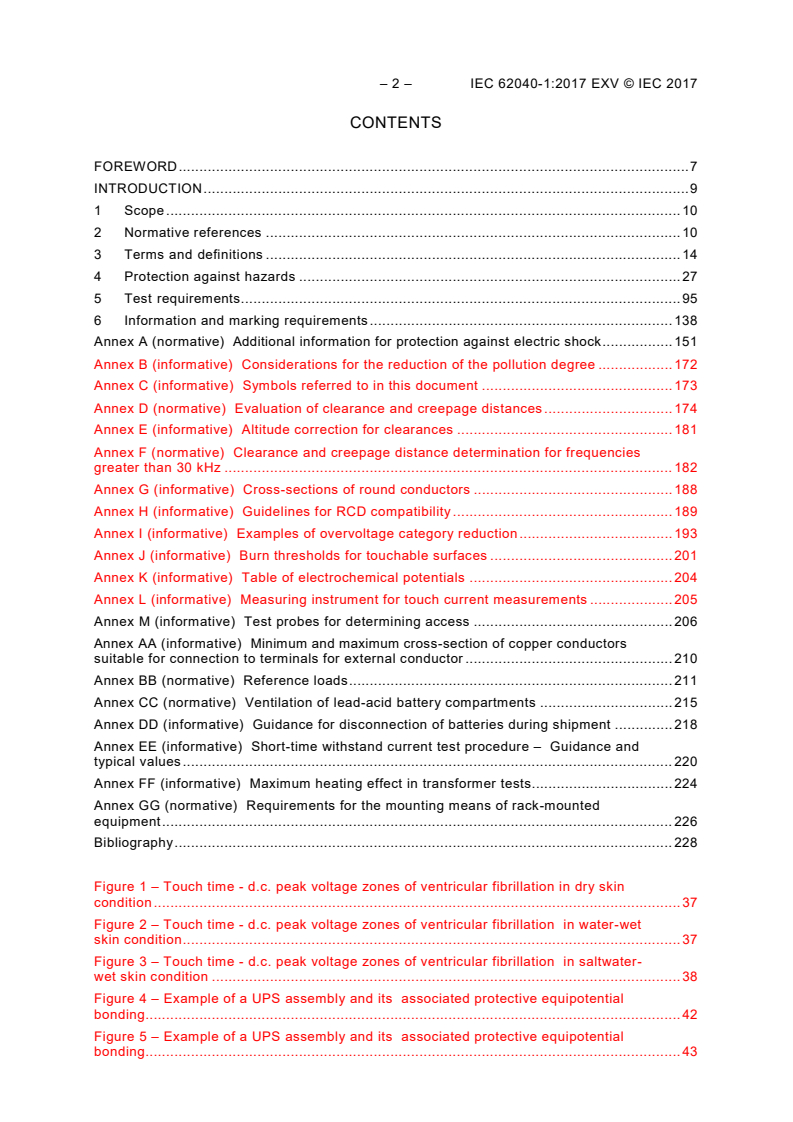
IEC 62040-1:2017 EXV - Uninterruptible power systems (UPS) - Part 1: Safety requirements Released:9/28/2017

IEC 62040-1:2017+AMD1:2021+AMD2:2022 CSV - Uninterruptible power systems (UPS) - Part 1: Safety requirements Released:11/29/2022

IEC 62040-1:2017+AMD1:2021 CSV - Uninterruptible power systems (UPS) - Part 1: Safety requirements Released:5/20/2021
IEC 62040-1:2017 - Uninterruptible power systems (UPS) - Part 1: Safety requirements Released:7/12/2017
Overview
IEC 62040-1:2017 (with AMD1:2021) is the international product safety standard for uninterruptible power systems (UPS). It applies to movable, stationary, fixed or built‑in UPS used in low‑voltage distribution systems that deliver fixed‑frequency AC outputs with port voltages up to 1 000 V AC or 1 500 V DC and include an energy storage device. The standard specifies safety requirements intended to protect ordinary persons (and, where stated, skilled persons) from hazards such as fire, electric shock, thermal, energy and mechanical risks during installation, use and-when applicable-service and maintenance.
Key topics and technical requirements
- Scope and applicability: Covers pluggable and permanently connected UPS, single units or interconnected systems, provided they are installed, operated and maintained as the manufacturer prescribes.
- Safety objectives: Reduce risks of fire, electric shock, thermal and mechanical hazards and energy‑related risks associated with batteries and power electronic converters.
- Reference to group standard: Harmonized with parts of IEC 62477-1:2012 (power electronic converter systems); the 2017 edition replaces the earlier IEC 60950-1 reference.
- Protection against hazards (Clause 4): Design and construction rules to limit access to live parts, prevent overheating, and control mechanical and energy hazards.
- Test requirements (Clause 5): Performance and verification tests including short‑time withstand current, reference load behaviour and temperature limits for magnetic and transformer components (see normative annexes).
- Information and marking (Clause 6): Mandatory labeling, safety instructions and warnings (e.g., voltage backfeed, battery shipping states).
- Normative and informative annexes: Practical guidance such as test probes for access, reference load configurations, ventilation of lead‑acid battery compartments, guidance for battery disconnection during shipment, rack‑mounting requirements and test procedures.
Practical applications - who uses this standard
- UPS manufacturers and OEMs: For safe product design, documentation and compliance.
- Test laboratories and certification bodies: For type testing and conformity assessment to obtain approvals or marks.
- Safety and compliance engineers: To verify design meets international safety requirements.
- Installers, maintenance technicians and facilities managers: To follow marking, ventilation and servicing guidance to reduce operational risk.
- Procurement and asset managers: To specify compliant UPS systems for data centers, telecom, healthcare and industrial installations.
Related standards
- IEC 62477-1:2012 - Group safety standard for power electronic converters (reference document)
- IEC 62040 series - Other parts (e.g., IEC 62040-3 for UPS performance and testing)
- Applicable national or regional electrical safety regulations and building codes
Keywords: IEC 62040-1:2017, UPS safety standard, uninterruptible power systems, IEC 62477-1, low‑voltage UPS, battery ventilation, short‑time withstand current, UPS testing, safety requirements, conformity.
Relations
- Effective Date
- 05-Sep-2023
- Effective Date
- 05-Sep-2023
- Effective Date
- 05-Sep-2023
- Effective Date
- 05-Sep-2023
- Effective Date
- 05-Sep-2023
- Effective Date
- 05-Sep-2023
Buy Documents
IEC 62040-1:2017+AMD1:2021 CSV - Uninterruptible power systems (UPS) - Part 1: Safety requirements Released:5/20/2021
IEC 62040-1:2017 EXV - Uninterruptible power systems (UPS) - Part 1: Safety requirements Released:9/28/2017
IEC 62040-1:2017+AMD1:2021+AMD2:2022 CSV - Uninterruptible power systems (UPS) - Part 1: Safety requirements Released:11/29/2022
IEC 62040-1:2017+AMD1:2021 CSV - Uninterruptible power systems (UPS) - Part 1: Safety requirements Released:5/20/2021
IEC 62040-1:2017 - Uninterruptible power systems (UPS) - Part 1: Safety requirements Released:7/12/2017
Get Certified
Connect with accredited certification bodies for this standard

IMQ S.p.A. (Certification)
Italian electrical product certification.

SLG Prüf- und Zertifizierungs GmbH
German testing and certification body.

UL Solutions
Global safety science company with testing, inspection and certification.
Sponsored listings
Frequently Asked Questions
IEC 62040-1:2017 is a standard published by the International Electrotechnical Commission (IEC). Its full title is "Uninterruptible power systems (UPS) - Part 1: Safety requirements". This standard covers: IEC 62040-1:2017 applies to movable, stationary, fixed or built-in UPS for use in low-voltage distribution systems and that are intended to be installed in an area accessible by an ordinary person or in a restricted access area as applicable, that deliver fixed frequency AC output voltage with port voltages not exceeding 1 000 V AC or 1 500 V DC and that include an energy storage device. It applies to pluggable and to permanently connected UPS, whether consisting of a system of interconnected units or of independent units, subject to installing, operating and maintaining the UPS in the manner prescribed by the manufacturer. This document specifies requirements to ensure safety for the ordinary person who comes into contact with the UPS and, where specifically stated, for the skilled person. The objective is to reduce risks of fire, electric shock, thermal, energy and mechanical hazards during use and operation and, where specifically stated, during service and maintenance. This product standard is harmonized with the applicable parts of group safety publication IEC 62477-1:2012 for power electronic converter systems and contains additional requirements relevant to UPS. This edition includes the following significant technical change with respect to the previous edition: the reference document has been changed from IEC 60950-1:2005 (safety for IT equipment) to IEC 62477-1 (group safety standard for power electronic converters). The contents of the corrigendum of October 2019 have been included in this copy.
IEC 62040-1:2017 applies to movable, stationary, fixed or built-in UPS for use in low-voltage distribution systems and that are intended to be installed in an area accessible by an ordinary person or in a restricted access area as applicable, that deliver fixed frequency AC output voltage with port voltages not exceeding 1 000 V AC or 1 500 V DC and that include an energy storage device. It applies to pluggable and to permanently connected UPS, whether consisting of a system of interconnected units or of independent units, subject to installing, operating and maintaining the UPS in the manner prescribed by the manufacturer. This document specifies requirements to ensure safety for the ordinary person who comes into contact with the UPS and, where specifically stated, for the skilled person. The objective is to reduce risks of fire, electric shock, thermal, energy and mechanical hazards during use and operation and, where specifically stated, during service and maintenance. This product standard is harmonized with the applicable parts of group safety publication IEC 62477-1:2012 for power electronic converter systems and contains additional requirements relevant to UPS. This edition includes the following significant technical change with respect to the previous edition: the reference document has been changed from IEC 60950-1:2005 (safety for IT equipment) to IEC 62477-1 (group safety standard for power electronic converters). The contents of the corrigendum of October 2019 have been included in this copy.
IEC 62040-1:2017 is classified under the following ICS (International Classification for Standards) categories: 29.200 - Rectifiers. Convertors. Stabilized power supply. The ICS classification helps identify the subject area and facilitates finding related standards.
IEC 62040-1:2017 has the following relationships with other standards: It is inter standard links to IEC 62040-1:2017/AMD1:2021, IEC 62040-1:2017/AMD2:2022, IEC 62040-1:2017/COR1:2019, IEC 62040-1:2008/AMD1:2013, IEC 62040-1:2008, IEC 62040-1:2008/COR1:2008. Understanding these relationships helps ensure you are using the most current and applicable version of the standard.
IEC 62040-1:2017 is available in PDF format for immediate download after purchase. The document can be added to your cart and obtained through the secure checkout process. Digital delivery ensures instant access to the complete standard document.
Standards Content (Sample)
IEC 62040-1 ®
Edition 2.1 2021-05
CONSOLIDATED VERSION
INTERNATIONAL
STANDARD
colour
inside
Uninterruptible power systems (UPS) –
Part 1: Safety requirements
All rights reserved. Unless otherwise specified, no part of this publication may be reproduced or utilized in any form
or by any means, electronic or mechanical, including photocopying and microfilm, without permission in writing from
either IEC or IEC's member National Committee in the country of the requester. If you have any questions about IEC
copyright or have an enquiry about obtaining additional rights to this publication, please contact the address below or
your local IEC member National Committee for further information.
IEC Central Office Tel.: +41 22 919 02 11
3, rue de Varembé info@iec.ch
CH-1211 Geneva 20 www.iec.ch
Switzerland
About the IEC
The International Electrotechnical Commission (IEC) is the leading global organization that prepares and publishes
International Standards for all electrical, electronic and related technologies.
About IEC publications
The technical content of IEC publications is kept under constant review by the IEC. Please make sure that you have the
latest edition, a corrigendum or an amendment might have been published.
IEC publications search - webstore.iec.ch/advsearchform IEC online collection - oc.iec.ch
The advanced search enables to find IEC publications by a Discover our powerful search engine and read freely all the
variety of criteria (reference number, text, technical publications previews. With a subscription you will always
committee, …). It also gives information on projects, replaced have access to up to date content tailored to your needs.
and withdrawn publications.
Electropedia - www.electropedia.org
IEC Just Published - webstore.iec.ch/justpublished
The world's leading online dictionary on electrotechnology,
Stay up to date on all new IEC publications. Just Published
containing more than 22 000 terminological entries in English
details all new publications released. Available online and
and French, with equivalent terms in 18 additional languages.
once a month by email.
Also known as the International Electrotechnical Vocabulary
(IEV) online.
IEC Customer Service Centre - webstore.iec.ch/csc
If you wish to give us your feedback on this publication or
need further assistance, please contact the Customer Service
Centre: sales@iec.ch.
IEC 62040-1 ®
Edition 2.1 2021-05
CONSOLIDATED VERSION
INTERNATIONAL
STANDARD
colour
inside
Uninterruptible power systems (UPS) –
Part 1: Safety requirements
INTERNATIONAL
ELECTROTECHNICAL
COMMISSION
ICS 29.200 ISBN 978-2-8322-9836-7
IEC 62040-1 ®
Edition 2.1 2021-05
CONSOLIDATED VERSION
REDLINE VERSION
colour
inside
Uninterruptible power systems (UPS) –
Part 1: Safety requirements
– 2 – IEC 62040-1:2017+AMD1:2021 CSV
© IEC 2021
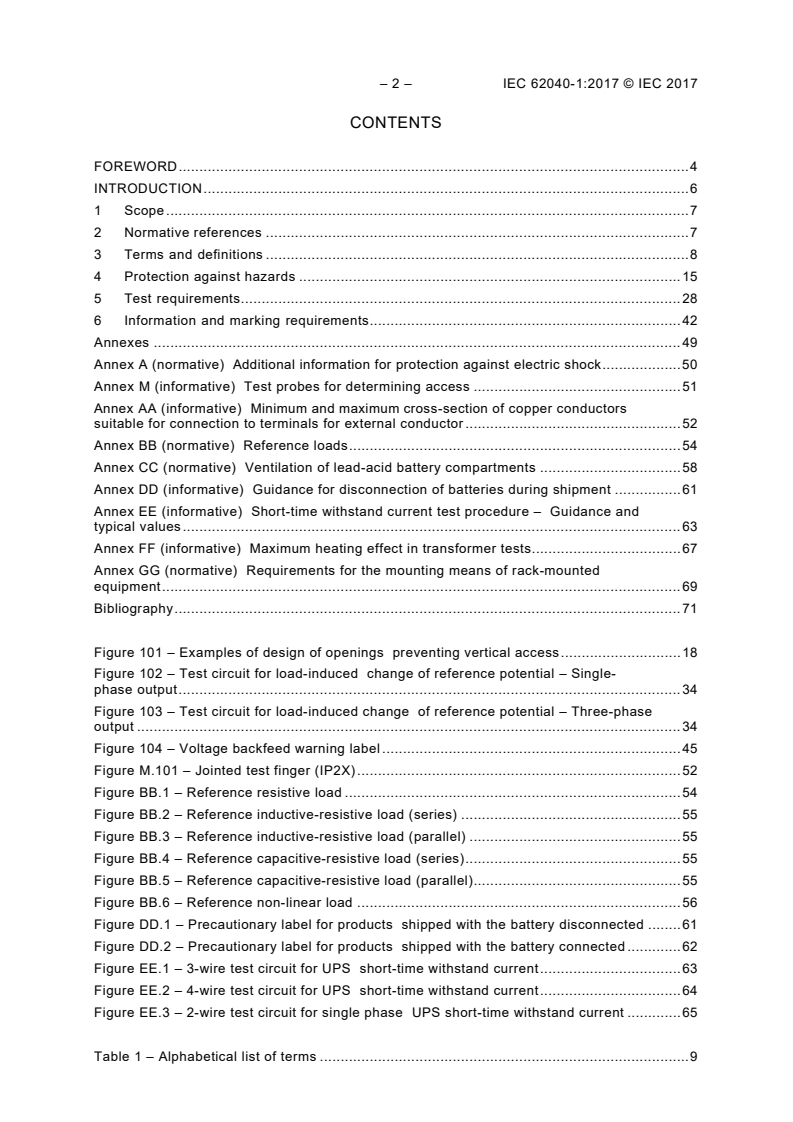
CONTENTS
FOREWORD . 4
INTRODUCTION . 6
1 Scope . 7
2 Normative references . 7
3 Terms and definitions . 8
4 Protection against hazards . 15
5 Test requirements . 29
6 Information and marking requirements . 42
Annexes . 49
Annex A (normative) Additional information for protection against electric shock . 50
Annex M (informative) Test probes for determining access . 51
Annex AA (informative) Minimum and maximum cross-section of copper conductors
suitable for connection to terminals for external conductor . 52
Annex BB (normative) Reference loads . 54
Annex CC (normative) Ventilation of lead-acid battery compartments . 58
Annex DD (informative) Guidance for disconnection of batteries during shipment . 61
Annex EE (informative) Short-time withstand current test procedure – Guidance and
typical values . 63
Annex FF (informative) Maximum heating effect in transformer tests. 67
Annex GG (normative) Requirements for the mounting means of rack-mounted
equipment . 69
Bibliography . 71
Figure 101 – Examples of design of openings preventing vertical access . 18
Figure 102 – Test circuit for load-induced change of reference potential – Single-
phase output . 35
Figure 103 – Test circuit for load-induced change of reference potential – Three-phase
output . 35
Figure 104 – Voltage backfeed warning label . 45
Figure M.101 – Jointed test finger (IP2X) . 52
Figure BB.1 – Reference resistive load . 54
Figure BB.2 – Reference inductive-resistive load (series) . 55
Figure BB.3 – Reference inductive-resistive load (parallel) . 55
Figure BB.4 – Reference capacitive-resistive load (series) . 55
Figure BB.5 – Reference capacitive-resistive load (parallel) . 55
Figure BB.6 – Reference non-linear load . 56
Figure DD.1 – Precautionary label for products shipped with the battery disconnected . 61
Figure DD.2 – Precautionary label for products shipped with the battery connected . 62
Figure EE.1 – 3-wire test circuit for UPS short-time withstand current . 63
Figure EE.2 – 4-wire test circuit for UPS short-time withstand current . 64
Figure EE.3 – 2-wire test circuit for single phase UPS short-time withstand current . 65
Table 1 – Alphabetical list of terms . 9
© IEC 2021
Table 101 – UPS input port configuration . 16
Table 102 – Overvoltage categories . 19
Table 103 – Maximum temperature limits for magnetic components during stored
energy mode of operation . 22
Table 22 – Test overview . 29
Table 104 – Short-time withstand current . 37
Table 105 – Temperature limits for transformer windings . 40
Table A.101 – Comparison of limits of working voltage . 50
Table AA.1 – Conductor cross-sections (extract from IEC 61439-1:2011) . 53
Table FF.1 – Test steps . 67
– 4 – IEC 62040-1:2017+AMD1:2021 CSV
© IEC 2021
INTERNATIONAL ELECTROTECHNICAL COMMISSION
____________
UNINTERRUPTIBLE POWER SYSTEMS (UPS) –
Part 1: Safety requirements
FOREWORD
1) The International Electrotechnical Commission (IEC) is a worldwide organization for standardization comprising
all national electrotechnical committees (IEC National Committees). The object of IEC is to promote
international co-operation on all questions concerning standardization in the electrical and electronic fields. To
this end and in addition to other activities, IEC publishes International Standards, Technical Specifications,
Technical Reports, Publicly Available Specifications (PAS) and Guides (hereafter referred to as "IEC
Publication(s)"). Their preparation is entrusted to technical committees; any IEC National Committee interested
in the subject dealt with may participate in this preparatory work. International, governmental and non-
governmental organizations liaising with the IEC also participate in this preparation. IEC collaborates closely
with the International Organization for Standardization (ISO) in accordance with conditions determined by
agreement between the two organizations.
2) The formal decisions or agreements of IEC on technical matters express, as nearly as possible, an international
consensus of opinion on the relevant subjects since each technical committee has representation from all
interested IEC National Committees.
3) IEC Publications have the form of recommendations for international use and are accepted by IEC National
Committees in that sense. While all reasonable efforts are made to ensure that the technical content of IEC
Publications is accurate, IEC cannot be held responsible for the way in which they are used or for any
misinterpretation by any end user.
4) In order to promote international uniformity, IEC National Committees undertake to apply IEC Publications
transparently to the maximum extent possible in their national and regional publications. Any divergence
between any IEC Publication and the corresponding national or regional publication shall be clearly indicated in
the latter.
5) IEC itself does not provide any attestation of conformity. Independent certification bodies provide conformity
assessment services and, in some areas, access to IEC marks of conformity. IEC is not responsible for any
services carried out by independent certification bodies.
6) All users should ensure that they have the latest edition of this publication.
7) No liability shall attach to IEC or its directors, employees, servants or agents including individual experts and
members of its technical committees and IEC National Committees for any personal injury, property damage or
other damage of any nature whatsoever, whether direct or indirect, or for costs (including legal fees) and
expenses arising out of the publication, use of, or reliance upon, this IEC Publication or any other IEC
Publications.
8) Attention is drawn to the Normative references cited in this publication. Use of the referenced publications is
indispensable for the correct application of this publication.
9) Attention is drawn to the possibility that some of the elements of this IEC Publication may be the subject of
patent rights. IEC shall not be held responsible for identifying any or all such patent rights.
This consolidated version of the official IEC Standard and its amendment has been
prepared for user convenience.
IEC 62040-1 edition 2.1 contains the second edition (2017-07) [documents 22H/217/FDIS
and 22H/218/RVD], its corrigendum (2019-10) and its amendment 1 (2021-05)
[documents 22H/269/FDIS and 22H/271/RVD].
In this Redline version, a vertical line in the margin shows where the technical content
is modified by amendment 1. Additions are in green text, deletions are in strikethrough
red text. A separate Final version with all changes accepted is available in this
publication.
© IEC 2021
International Standard IEC 62040-1 has been prepared by subcommittee 22H: Uninterruptible
power systems (UPS), of IEC technical committee 22: Power electronic systems and
equipment.
This second edition constitutes a technical revision.
This edition includes the following significant technical change with respect to the previous
edition: the reference document has been changed from IEC 60950-1:2005 (safety for IT
equipment) to IEC 62477-1 (group safety standard for power electronic converters).
This document has been drafted in accordance with the ISO/IEC Directives, Part 2.
This International Standard is to be read in conjunction with IEC 62477-1:2012.
The provisions of the general rules dealt within IEC 62477-1:2012 are only applicable to this
document insofar as they are specifically cited. Clauses and subclauses of IEC 62477-1:2012
that are applicable in this document are identified by reference to IEC 62477-1:2012, for
example, "Clause 4 of IEC 62477-1:2012 applies, except as follows".
The exceptions are then listed. The exceptions can take the form of a deletion, a replacement
or an addition of subclauses, tables, figures or annexes.
Subclauses, tables and figures that are additional to those in IEC 62477-1:2012 are, in this
document, identified by a suffix in the format of X.10x, for example 4.3.101.
Annexes that are additional to those in IEC 62477-1:2012 are, in this document, lettered AA,
BB, etc.
In this document, the following print types are used:
• requirements and normative annexes: roman type
• compliance statements and test specifications: italic type
• notes and other informative matter: smaller roman type
• normative conditions within tables: smaller roman type
• terms that are defined in Clause 3: bold
A list of all parts in the IEC 62040 series, published under the general title Uninterruptible
Power Systems (UPS), can be found on the IEC website.
The committee has decided that the contents of the base publication and its amendment will
remain unchanged until the stability date indicated on the IEC web site under
"http://webstore.iec.ch" in the data related to the specific publication. At this date, the
publication will be
• reconfirmed,
• withdrawn,
• replaced by a revised edition, or
• amended.
IMPORTANT – The 'colour inside' logo on the cover page of this publication indicates
that it contains colours which are considered to be useful for the correct
understanding of its contents. Users should therefore print this document using a
colour printer.
– 6 – IEC 62040-1:2017+AMD1:2021 CSV
© IEC 2021
INTRODUCTION
IEC technical sub-committee 22H: Uninterruptible power systems (UPS) carefully considered
the relevance of each paragraph of IEC 62477-1:2012 in UPS applications. This part of
IEC 62040 utilizes IEC 62477-1:2012 as a reference document and references, adds,
replaces or modifies requirements as relevant. This is because product-specific topics not
covered by the reference document are the responsibility of the technical committee using the
reference document.
IEC 62477-1:2012 relates to products that include power electronic converters, with a rated
system voltage not exceeding 1 000 V AC or 1 500 V DC. It specifies requirements to
reduce risks of fire, electric shock, thermal, energy and mechanical hazards, except
functional safety as defined in IEC 61508 (all parts). The objectives of this document are to
establish a common terminology and basis for the safety requirements of products that
contain power electronic converters across several IEC technical committees.
IEC 62477-1:2012 was developed with the intention:
• to be used as a reference document for product committees inside IEC technical
committee 22: Power electronic systems and equipment in the development of product
standards for power electronic converter systems and equipment;
• to replace IEC 62103 as a product family standard providing minimum requirements for
safety aspects of power electronic converter systems and equipment in apparatus for
which no product standard exists; and
NOTE The scope of IEC 62103 contains reliability aspects, which are not covered by this document.
• to be used as a reference document for product committees outside TC 22 in the
development of product standards of power electronic converter systems and equipment
intended for renewable energy sources. TC 82, TC 88, TC 105 and TC 114, in particular,
have been identified as relevant technical committees at the time of publication.
The reference document, being a group safety standard, will not take precedence over this
product-specific standard according to IEC Guide 104. IEC Guide 104 provides information
about the responsibility of product committees to use group safety standards for the
development of their own product standards.
© IEC 2021
UNINTERRUPTIBLE POWER SYSTEMS (UPS) –
Part 1: Safety requirements
1 Scope
This part of IEC 62040 applies to movable, stationary, fixed or built-in UPS for use in low-
voltage distribution systems and that are intended to be installed in an area accessible by an
ordinary person or in a restricted access area as applicable, that deliver fixed frequency AC
output voltage with port voltages not exceeding 1 000 V AC or 1 500 V DC and that include an
energy storage device. It applies to pluggable and to permanently connected UPS, whether
consisting of a system of interconnected units or of independent units, subject to installing,
operating and maintaining the UPS in the manner prescribed by the manufacturer.
NOTE 1 Typical UPS configurations, including voltage and/or frequency converters and other topologies, are
described in IEC 62040-3, the test and performance product standard for UPS.
NOTE 2 UPS generally connect to their energy storage device through a DC link. A chemical battery is used
throughout the standard as an example of an energy storage device. Alternative devices exist, and as such, where
"battery" appears in the text of this document, this is to be understood as "energy storage device".
This document specifies requirements to ensure safety for the ordinary person who comes
into contact with the UPS and, where specifically stated, for the skilled person. The objective
is to reduce risks of fire, electric shock, thermal, energy and mechanical hazards during use
and operation and, where specifically stated, during service and maintenance.
This product standard is harmonized with the applicable parts of group safety publication
IEC 62477-1:2012 for power electronic converter systems and contains additional
requirements relevant to UPS.
This document does not cover:
• UPS that have a DC output;
• systems for operation on moving platforms including, but not limited to, aircrafts, ships
and motor vehicles;
• external AC or DC input and output distribution boards covered by their specific product
standard;
• stand-alone static transfer systems (STS) covered by IEC 62310-1;
• systems wherein the output voltage is directly derived from a rotating machine;
• telecommunications apparatus other than UPS for such apparatus;
• functional safety aspects covered by IEC 61508 (all parts).
NOTE 3 Even if this document does not cover the applications listed above, it is commonly taken as a guide for
such applications.
NOTE 4 Specialized UPS applications are generally governed by additional requirements covered elsewhere, for
example UPS for medical applications.
2 Normative references
The following documents are referred to in the text in such a way that some or all of their
content constitutes requirements of this document. For dated references, only the edition
cited applies. For undated references, the latest edition of the referenced document (including
any amendments) applies.
– 8 – IEC 62040-1:2017+AMD1:2021 CSV
© IEC 2021
Clause 2 of IEC 62477-1:2012 applies, except as follows:
Add the following normative references:
IEC 60364-4-42, Low-voltage electrical installations – Part 4-42: Protection for safety –
Protection against thermal effects
IEC 60384-14, Fixed capacitors for use in electronic equipment – Part 14: Sectional
specification – Fixed capacitors for electromagnetic interference suppression and connection
to the supply mains
IEC TR 60755, General requirements for residual current operated protective devices
IEC 60947-2:2006, Low-voltage switchgear and controlgear – Part 2: Circuit-breakers
IEC 60950-1:2005, Information technology equipment – Safety – Part 1: General requirements
IEC 61000-2-2:2002, Electromagnetic compatibility (EMC) – Part 2-2: Environment –
Compatibility levels for low-frequency conducted disturbances and signaling in public low-
voltage power supply systems
IEC 61008-1, Residual current operated circuit-breakers without integral overcurrent
protection for household and similar uses (RCCBs) – Part 1: General rules
IEC 61009-1, Residual current operated circuit-breakers with integral overcurrent protection
for household and similar uses (RCBOs) – Part 1: General rules
IEC 62040-2:2005, Uninterruptible power systems (UPS) – Part 2: Electromagnetic
compatibility (EMC) requirements
IEC 62477-1:2012, Safety requirements for power electronic converter systems and
equipment – Part 1: General
3 Terms and definitions
Clause 3 of IEC 62477-1:2012 applies, except as follows:
Add the following new terms and definitions, and new notes:
___________
th th th
4 edition (2006). This 4 edition has been replaced in 2016 by a 5 edition IEC 60947-2:2016, Low-voltage
switchgear and controlgear – Part 2: Circuit-breakers.
nd nd rd
2 edition (2005). This 2 edition has been replaced in 2016 by a 3 edition IEC 62040-2:2016,
Uninterruptible power systems (UPS) – Part 2: Electromagnetic compatibility (EMC) requirements.
© IEC 2021
Table 1 – Alphabetical list of terms
Terms Term number Terms Term number
62040-1 62477-1 62040-1 62477-1
adjacent circuit 3.1 power semiconductor device 3.34
active power 3.111 primary power 3.108
apparent power 3.112 prospective short-circuit 3.122
current
backfeed 3.127 protective equipotential 3.36
bonding
backfeed protection 3.128 protective class I 3.37
basic insulation 3.2 protective class II 3.38
basic protection 3.3 protective class III 3.39
bypass 3.110 protective earthing (PE) 3.40
commissioning test 3.4 PE conductor 3.41
cord 3.109 protective impedance 3.42
decisive voltage class 3.5 (electrically) protective 3.43
(DVC) screening
double insulation 3.6 protective separation 3.44
DVC As 3.7 PEC 3.45
DVC Ax 3.8 PECS 3.46
earth fault 3.131 rated conditional short-circuit 3.120
current
electrical breakdown 3.9 rated current 3.117
(electrical) insulation 3.10 rated load 3.115
(electronic) (power) 3.11 rated peak withstand current 3.118
conversion
enclosure 3.12 rated short-time withstand 3.119
current
enhanced protection 3.13 rating 3.113
expected lifetime 3.14 rated value 3.114
Extra Low Voltage (ELV) 3.15 rated voltage 3.116
fault protection 3.16 reference non-linear load 3.126
field wiring terminal 3.17 reference test load 3.125
fire enclosure 3.18 reinforced insulation 3.47
functional insulation 3.19 restricted access area 3.48
hazardous energy 3.107 routine test 3.49
hazardous live part 3.20 sample test 3.50
hazardous voltage 3.106 SELV (systems) 3.51
installation 3.21 short-circuit backup protection 3.52
instructed person 3.103 service acces area 3.105
linear load 3.123 short-circuit protective device 3.130
(SCPD)
live part 3.22 simple separation 3.53
low impedance path 3.121 single fault condition 3.54
low voltage 3.23 skilled person 3.102
mains supply 3.24 startle reaction 3.55
muscular reaction (inability 3.25 supplementary insulation 3.56
to let go)
– 10 – IEC 62040-1:2017+AMD1:2021 CSV
© IEC 2021
Terms Term number Terms Term number
62040-1 62477-1 62040-1 62477-1
non-linear load 3.124 surge protective device (SPD) 3.57
non-mains supply 3.26 system 3.58
open type 3.27 system voltage 3.59
ordinary person 3.104 stored energy mode 3.129
output short-circuit current 3.28 temporary overvoltage 3.60
PELV (systems) 3.29 touch current 3.61
Permanently connected 3.30 type test 3.62
pluggable equipment 3.31 ventricular fibrillation 3.63
type A
pluggable equipment 3.32 working voltage 3.64
type B
port 3.33 uninterruptible power system 3.101
(UPS)
zone of equipotential bonding 3.65
Note 1 to entry: Where the terms "voltage" and "current" are used, RMS values are implied unless otherwise
specified.
Note 2 to entry: Non-sinusoidal signals are measured with appropriate true RMS measuring instruments.
3.101
uninterruptible power system
UPS
combination of convertors, switches and energy storage devices (such as batteries),
constituting a power system for maintaining continuity of load power in case of input power
failure
Note 1 to entry: Continuity of load power occurs when voltage and frequency are within rated steady-state and
transient tolerance bands, and with distortion and interruptions within the limits specified for the output port. Input
power failure occurs when voltage and frequency are outside rated steady-state and transient tolerance bands, or
with distortion or interruptions outside the limits specified for the UPS.
3.102
skilled person
person with relevant education and experience to enable him or her to perceive risks and to
avoid hazards which the equipment can create
Note 1 to entry: Such person has access to restricted access areas.
[SOURCE: IEC 60050-195:1998, 195-04-01, modified – The word "(electrically)" has been
deleted from the term, and "electricity" has been replaced by "the equipment" in the definition.
The note has been added.]
3.103
instructed person
person adequately advised or supervised by skilled persons to enable him or her to perceive
risks and to avoid hazards which the equipment can create
Note 1 to entry: Such person has access to restricted access areas.
Note 2 to entry: Examples of activities performed by an instructed person can be found in IEC 61140:2001,
Clause 8.
[SOURCE: IEC 60050-195:1998, 195-04-02, modified – The word "(electrically)" has been
deleted from the term, and the notes have been added.]
© IEC 2021
3.104
ordinary person
person who is neither a skilled person nor an instructed person
Note 1 to entry: Such person does not have access to a restricted access area and is not trained to identify
hazards. Such person may otherwise have access to the equipment or may be in the vicinity of the equipment. An
ordinary person will not intentionally create hazards nor have access to hazardous parts under normal and single
fault conditions.
[SOURCE: IEC 60050-195:1998, 195-04-03, modified – The note has been added.]
3.105
service access area
area accessible by skilled persons by the use of a tool, where it is necessary for skilled
person to have access regardless of the equipment being energized
3.106
hazardous voltage
voltage exceeding 42,4 V peak, or 60 V DC, existing in a circuit that does not meet the
requirements for either a limited current circuit or a TNV-1 circuit
Note 1 to entry: A limited current circuit is understood in the context of "protection by means of protective
impedance" as described in IEC 62477-1:2012, 4.4.5.4.
[SOURCE: IEC 60950-1:2005, 1.2.8.6 modified – TNV has been replaced by TNV-1.]
3.107
hazardous energy
available power level of 240 VA or more, having a duration of 60 s or more, or a stored energy
level of 20 J or more (for example, from one or more capacitors), at a potential of 2 V or more
Note 1 to entry: See IEC 62477-1:2012, 4.5.1.2.
3.108
primary power
power supplied by an electrical utility company or by a local generator
3.109
cord
flexible cable with a limited number of conductors of small cross-sectional area
[SOURCE: IEC 60050-461:2008, 461-06-15.]
3.110
bypass
alternative power path, either internal or external to the UPS
3.111
active power
under periodic conditions, mean value, taken over one period T, of the instantaneous power p
T
P = pdt
∫
T
Note 1 to entry: Under sinusoidal conditions, the active power is the real part of the complex power S, thus
P = Re S
Note 2 to entry: The coherent SI unit for active power is watt, W.
– 12 – IEC 62040-1:2017+AMD1:2021 CSV
© IEC 2021
Note 3 to entry: DC, fundamental and harmonic voltages and currents contribute to the magnitude of the active
power. Where applicable, instruments used to measure active power should therefore present sufficient
bandwidth and be capable of measuring any significant non-symmetrical and harmonic power components.
[SOURCE: IEC 60050-131: 2013, 131-11-42, modified – A third note to entry has been
added.]
3.112
apparent power
product of the RMS voltage and RMS current
3.113
rating
set of rated values and operating conditions of a machine, a device or equipment
[SOURCE: IEC 60050-151:2001, 151-16-11, modified – The words "of a machine, a device or
equipment" have been added.]
3.114
rated value
value of a quantity used for specification purposes, generally established by a manufacturer
for a specified set of operating conditions of a component, device, equipment, or system
[SOURCE: IEC 60050-151:2001, 151-16-08, modified – The word "established" has been
expanded to read "generally established by a manufacturer".]
3.115
rated load
load or condition in which the output of the UPS delivers the power for which the UPS is rated
Note 1 to entry: The rated load is expressed in apparent power (VA) and active power (W) resulting in a (rated)
power factor that includes the effect of any applicable combination of linear and of non-linear load as prescribed
in Annex BB.
Note 2 to entry: Rated load is a value of load used for specification purposes, generally established by a
manufacturer for a specified set of operating conditions of a component, device, equipment, or system
3.116
rated voltage
input or output voltage as declared by the manufacturer
Note 1 to entry: For a three-phase supply, the rated voltage corresponds to the phase-to-phase voltage.
3.117
rated current
input or output current of the UPS as declared by the manufacturer
3.118
rated peak withstand current
I
pk
value of peak short-circuit current, declared by the UPS manufacturer, that can be withstood
under specified conditions
Note 1 to entry: For the purpose of this document, I refers to the initial asymmetric peak value of the
pk
prospective test current listed in Table 104.
3.119
rated short-time withstand current
I
cw
RMS value of short-time current, declared by the UPS manufacturer, that can be carried under
specified conditions, defined in terms of current and time
© IEC 2021
[SOURCE: IEC 61439-1:2011, 3.8.10.3, modified – The definition has been rephrased and
the word "assembly" has been replaced by "UPS".]
3.120
rated conditional short-circuit current
I
cc
RMS value of prospective short-circuit current, declared by the UPS manufacturer, that can
be withstood for the total operating time (clearing time) of the short-circuit protective device
(SCPD) under specified conditions
Note 1 to entry: The short-circuit protective device does not necessarily form an integral part of the UPS.
[SOURCE: IEC 61439-1:2011, 3.8.10.4, modified – The word "RMS" has been added to
"value", the word "assembly" has been replaced by "UPS", and the note has been rephrased.]
3.121
low impedance path
path containing devices that for UPS load purposes present negligible impedance, such as
cabling, switching devices, protecting devices and filtering devices
Note 1 to entry: The devices in a low impedance path generally present current limiting characteristics under
short-circuit conditions.
Note 2 to entry: Examples include current limiting fuses, current limiting circuit-breakers, transformers and
inductors.
3.122
prospective short-circuit current
I
cp
RMS value of the current which would flow if the supply conductors to the circuit are short-
circuited by a conductor of negligible impedance located as near as practicable to the supply
terminals of the UPS
[SOURCE: IEC 61439-1:2011, 3.8.7, modified – The word "assembly" has been replaced by
"UPS".]
3.123
linear load
load where the current drawn from the supply is defined by the relationship:
I = U/Z
where
I is the load current;
U is the supply voltage;
Z is the constant load impedance
Note 1 to entry: Application of a linear load to a sinusoidal voltage results in a sinusoidal current.
[SOURCE: IEC 62040-3:2011, 3.2.4]
3.124
non-linear load
load where the parameter Z (load impedance) is no longer a constant but is a variable
dependent on other parameters, such as voltage or time
[SOURCE: IEC 62040-3:2011, 3.2.5]
– 14 – IEC 62040-1:2017+AMD1:2021 CSV
© IEC 2021
3.125
reference test load
load or condition in which the output of the UPS delivers the active power (W) for which the
UPS is rated
Note 1 to entry: This definition permits, when in test mode and subject to local regulations, the UPS output to be
injected into the input AC supply.
[SOURCE: IEC 62040-3:2011, 3.3.5]
3.126
reference non-linear load
non-linear load that when connected to a UPS, consumes the apparent power at which the
UPS shall be tested
Note 1 to entry: Refer to Clause BB.5 for test details.
[SOURCE: IEC 62040-3:2011, 3.3.6, modified – The expression "the apparent and active
power for which the UPS is rated in accordance with Annex E" has been replaced by "the
apparent power at which the UPS shall be tested", and the note has been added.]
3.127
backfeed
condition in which a voltage or energy available within the UPS is fed back to any of the input
terminals, either directly or by a leakage path while operating in the stored energy mode and
with primary power not available
[SOURCE: IEC 62040-3:2011, 3.2.3, modified – The words "while AC input power is" have
been replaced by "with primary power".]
3.128
backfeed protection
control scheme that reduces the risk of electric shock due to backfeed
3.129
stored energy mode
stable mode of operation that the UPS attains under the following conditions:
a) AC input power is disconnected or is out of required tolerance;
b) all power is derived from the energy storage device;
c) the load is within the specified rating of the UPS
[SOURCE: IEC 62040-3:2011, 3.2.10, modified – The words "of UPS operation" have been
deleted in the term, and the word "system" has been replaced by "device" in b).]
3.130
short-circuit protective device
SCPD
device intended to protect a circuit or parts of a circuit against short-circuit currents by
interrupting them
[SOURCE: IEC 60947-1:2007, 2.2.21]
3.131
earth fault
occurrence of an accidental conductive path between a live conductor and the earth
[SOURCE: IEC 60050-826:2004, 826-04-14, modified – The second preferred term "ground
fault" has been deleted, as well as the notes.]
© IEC 2021
4 Protection against hazards
Clause 4 of IEC 62477-1:2012 applies, except as follows:
4.2 Fault and abnormal conditions
Subclause 4.2 in IEC 62477-1:2012 applies, except as follows:
Replace the fourth paragraph of IEC 62477-1:2012, 4.2 by the following:
Compliance is checked by analysis or by test according to 5.2.4.6 of IEC 62477-1:2012.
Compliance through analysis only is permitted when such analysis conclusively shows that no
hazard will result from failure of the component.
4.3 Short-circuit and overload protection
Subclause 4.3 in IEC 62477-1:2012 applies except as follows:
Add the following:
4.3.101 AC input current
The input current to the UPS shall not exceed that declared by the UPS manufacturer –
see 6.2 a).
In determining the steady state input current, the consumption due to optional features offered
or provided by the manufacturer for inclusion in or with the UPS shall be considered and
adjusted to give the most unfavourable result.
NOTE Transient input current arising from dynamic occurences, for example inrush or overload current, is not
considered.
Compliance is checked when highest current measured or calculated (as applicable) when
performing the test described in 5.2.3.102 does not exceed the input current declared by the
manufacturer (see 6.2).
4.3.102 Transformer protection
Transformers shall be protected against overtemperature.
NOTE Means of protection include:
• overcurrent protection,
• internal thermal cut-outs,
• use of current limiting devices.
Compliance is checked by the applicable tests of 5.2.3.104.
4.3.103 AC input short-circuit current
The UPS manufacturer shall specify the rated conditional short-circuit current (I ) or the
cc
rated short-time withstand current (I ) at each AC input port of the UPS. The UPS
cw
manufacturer may specify both. Individual AC input ports of a UPS may have individual
ratings.
A UPS with AC input ports that may be configured with jumpers or busbars to present a single
AC input port or multiple AC input ports shall be tested as having multiple AC input ports.
Testing with installed jumpers or busbars that combine multiple AC input ports into a single
– 16 – IEC 62040-1:2017+AMD1:2021 CSV
© IEC 2021
AC input port is not required when the construction of the jumpers or busbars is at least as
robust as that of the phase conductors in terms of cross-sectional area, mechanical support
and clearance.
A UPS with multiple AC input ports and different ratings for each port shall indicate, when
configured as a single AC input port, a rating equal to the lowest rating of any port
(see table 101).
Table 101 – UPS input port configuration
UPS input port
AC input port(s) I /I rating
cc cw
configuration
Single input port Port 1 e.g. combined rectifier and bypass I /I
cc cw
input
Multiple input ports Port 1 e.g. rectifier input I /I
cc1 cw1
Port 2 e.g. bypass input I /I
cc2 cw2
Combined ports 1 and 2 Lesser of I /I or I /I
cc1 cw1 cc2 cw2
Except where exempted in 5.2.3.103.4, conditional short-circuit ratings and withstand current
ratings shall be verified by application of a short-circuit across the AC output port only in
modes of operation wherein the output power is delivered by the AC input through a low
impedance path. Refer to 5.2.3.103.1 for general procedure, and to Figures EE.1 to EE.3 for a
typical circuit for implementation of the test of Clause EE.4.
The effects of faults that originate within the UPS are addressed in 4.2, except as follows.
Where a UPS has an AC input port with no low impedance path to the AC output port,
compliance is checked by applying the short-circuit immediately before the point where the
input path no longer presents negligible impedance. The point of application of the short-
circuit may be internal to the UPS.
Compliance shall be verified in the modes of operation wherein the output power is or, as a
result of the short-circuit, becomes delivered, by the AC input through a low impedance path.
Verification in stored energy mode is not required.
NOTE 1 Examples of such modes of operation include:
– input voltage and frequency dependent (VFD) UPS operating in normal and/or bypass modes;
– input voltage independent (VI) UPS operating in normal and/or bypass modes;
– input voltage and frequency independent (VFI) UPS operating in bypass mode;
– UPS with built-in maintenance bypass switch when operating in maintenance bypass mode.
NOTE 2 UPS performance classifications VFD, VI and VFI are detailed in IEC 62040-3:2011.
4.3.104 Protection of the energy storage device
The energy storage device whether internal (integral) or external to the UPS unit shall be
protected against fault current and against overcurrent.
An overcurrent protective device providing the functions of a disconnect device as stated in
4.101.2 shall be located in close proximity to the energy storage device, and the following
requirements apply:
a) for the purpose of interrupting a fault current supplied by the energy storage device, the
overcurrent protective device shall:
– not require a current greater than the fault current available,
– be rated to interrupt the maximum fault current available.
© IEC 2021
b) the cables interconnecting the energy storage device, the overcurrent protective device
and the UPS unit shall be rated to support:
– the maximum current required by the UPS when operating in stored energy mode,
– the maximum fault current available.
The maximum fault current available shall be determined at the output of the fully charged
energy storage device.
Compliance with requirements a) and b) above is verified by investigation of the
characteristics of the protective device(s) and of the cables as supplied (or as specified for
installation) while considering the energy storage device (or range of energy storage devices)
to be supported.
NOTE Guidance for current rating of cables is found in IEC 60287-1-1.
4.3.105 Unsynchronised load transfer
This abnormal condition is to be simulated on a UPS which employs either a solid state or
manual switch that connects the bypass source of supply to the UPS output.
Compliance is determined by conducting the test in 5.2.3.105.
NOTE This test is to simulate the effects of foreseeable wiring connection misplacements in the sources of supply
to the UPS.
4.4 Protection against electric shock
Subclause 4.4 in IEC 62477-1:2012 applies, except as follows:
4.4.2.2.2 Selection tables for contact area and skin humidity condition
Subclause 4.4.2.2.2 in IEC 62477-1:2012 applies, except as follows:
Add the following text:
UPS within the scope of this document are by default specified for indoor dry environmental
service conditions and for access by an ordinary person. For such default application, select
the following area and condition:
a) body contact area: "Hand" (Table 3)
b) skin humidity condition: "Dry" (Table 4)
NOTE The area and condition ab
...
IEC 62040-1 ®
Edition 2.0 2017-09
EXTENDED VERSION
colour
inside
This Extended version of IEC 62040-1:2017 includes the provisions of the general rules
of IEC 62477-1:2012
Uninterruptible power systems (UPS) –
Part 1: Safety requirements
All rights reserved. Unless otherwise specified, no part of this publication may be reproduced or utilized in any form
or by any means, electronic or mechanical, including photocopying and microfilm, without permission in writing from
either IEC or IEC's member National Committee in the country of the requester. If you have any questions about IEC
copyright or have an enquiry about obtaining additional rights to this publication, please contact the address below or
your local IEC member National Committee for further information.
IEC Central Office Tel.: +41 22 919 02 11
3, rue de Varembé Fax: +41 22 919 03 00
CH-1211 Geneva 20 info@iec.ch
Switzerland www.iec.ch
About the IEC
The International Electrotechnical Commission (IEC) is the leading global organization that prepares and publishes
International Standards for all electrical, electronic and related technologies.
About IEC publications
The technical content of IEC publications is kept under constant review by the IEC. Please make sure that you have the
latest edition, a corrigenda or an amendment might have been published.
IEC Catalogue - webstore.iec.ch/catalogue Electropedia - www.electropedia.org
The stand-alone application for consulting the entire The world's leading online dictionary of electronic and
bibliographical information on IEC International Standards, electrical terms containing 20 000 terms and definitions in
Technical Specifications, Technical Reports and other English and French, with equivalent terms in 16 additional
documents. Available for PC, Mac OS, Android Tablets and languages. Also known as the International Electrotechnical
iPad. Vocabulary (IEV) online.
IEC publications search - www.iec.ch/searchpub IEC Glossary - std.iec.ch/glossary
The advanced search enables to find IEC publications by a 65 000 electrotechnical terminology entries in English and
variety of criteria (reference number, text, technical French extracted from the Terms and Definitions clause of
committee,…). It also gives information on projects, replaced IEC publications issued since 2002. Some entries have been
and withdrawn publications. collected from earlier publications of IEC TC 37, 77, 86 and
CISPR.
IEC Just Published - webstore.iec.ch/justpublished
Stay up to date on all new IEC publications. Just Published IEC Customer Service Centre - webstore.iec.ch/csc
details all new publications released. Available online and If you wish to give us your feedback on this publication or
also once a month by email. need further assistance, please contact the Customer Service
Centre: csc@iec.ch.
IEC 62040-1 ®
Edition 2.0 2017-09
REDLINE VERSION
colour
inside
This Extended version of IEC 62040-1:2017 includes the provisions of the general rules
of IEC 62477-1:2012
Uninterruptible power systems (UPS) –
Part 1: Safety requirements
INTERNATIONAL
ELECTROTECHNICAL
COMMISSION
ICS 29.200 ISBN 978-2-8322-4886-7
– 2 – IEC 62040-1:2017 EXV © IEC 2017
CONTENTS
FOREWORD . 7
INTRODUCTION . 9
1 Scope . 10
2 Normative references . 10
3 Terms and definitions . 14
4 Protection against hazards . 27
5 Test requirements . 95
6 Information and marking requirements . 138
Annex A (normative) Additional information for protection against electric shock . 151
Annex B (informative) Considerations for the reduction of the pollution degree . 172
Annex C (informative) Symbols referred to in this document . 173
Annex D (normative) Evaluation of clearance and creepage distances . 174
Annex E (informative) Altitude correction for clearances . 181
Annex F (normative) Clearance and creepage distance determination for frequencies
greater than 30 kHz . 182
Annex G (informative) Cross-sections of round conductors . 188
Annex H (informative) Guidelines for RCD compatibility . 189
Annex I (informative) Examples of overvoltage category reduction . 193
Annex J (informative) Burn thresholds for touchable surfaces . 201
Annex K (informative) Table of electrochemical potentials . 204
Annex L (informative) Measuring instrument for touch current measurements . 205
Annex M (informative) Test probes for determining access . 206
Annex AA (informative) Minimum and maximum cross-section of copper conductors
suitable for connection to terminals for external conductor . 210
Annex BB (normative) Reference loads . 211
Annex CC (normative) Ventilation of lead-acid battery compartments . 215
Annex DD (informative) Guidance for disconnection of batteries during shipment . 218
Annex EE (informative) Short-time withstand current test procedure – Guidance and
typical values . 220
Annex FF (informative) Maximum heating effect in transformer tests. 224
Annex GG (normative) Requirements for the mounting means of rack-mounted
equipment . 226
Bibliography . 228
Figure 1 – Touch time - d.c. peak voltage zones of ventricular fibrillation in dry skin
condition . 37
Figure 2 – Touch time - d.c. peak voltage zones of ventricular fibrillation in water-wet
skin condition . 37
Figure 3 – Touch time - d.c. peak voltage zones of ventricular fibrillation in saltwater-
wet skin condition . 38
Figure 4 – Example of a UPS assembly and its associated protective equipotential
bonding. 42
Figure 5 – Example of a UPS assembly and its associated protective equipotential
bonding. 43
Figure 6 – Fire enclosure bottom openings below an unenclosed or partially enclosed
fire-hazardous component. 71
Figure 7 – Fire enclosure baffle construction. 72
Figure 8 – Supported and unsupported enclosure parts . 89
Figure 9 – Impact test using a steel ball . 101
Figure 10 – Voltage test procedures . 109
Figure 11 – Protective equipotential bonding impedance test for separate unit with
power fed from the UPS with protection for the power cable . 115
Figure 12 – Protective equipotential bonding impedance test for sub-assembly with
accessible parts and with power fed from the UPS . 116
Figure 13 – Circuit for high-current arcing test . 131
Figure 14 – Test fixture for hot-wire ignition test . 132
Figure 101 – Examples of design of openings preventing vertical access . 40
Figure 102 – Test circuit for load-induced change of reference potential – Single-
phase output . 119
Figure 103 – Test circuit for load-induced change of reference potential – Three-phase
output . 119
Figure 104 – Voltage backfeed warning label . 146
Figure A.1 – Protection by DVC As with protective separation . 151
Figure A.2 – Protection by means of protective impedance . 152
Figure A.3 – Protection by using limited voltages . 153
Figure A.4 – Touch time- d.c. voltage zones for dry skin condition . 156
Figure A.5 – Touch time- d.c. voltage zones for water-wet skin condition . 156
Figure A.6 – Touch time- d.c. voltage for saltwater-wet skin condition . 157
Figure A.7 – Touch time- d.c. voltage zones of dry skin condition . 158
Figure A.8 – Touch time- d.c. voltage zones of water-wet skin condition . 158
Figure A.9 – Touch time- d.c. voltage zones of saltwater-wet skin condition . 159
Figure A.10 – Touch time- d.c. voltage zones of dry skin condition . 160
Figure A.11 – Touch time- d.c. voltage zones of water-wet skin condition . 160
Figure A.12 – Touch time- a.c. voltage zones for dry skin condition . 161
Figure A.13 – Touch time- a.c. voltage zones of water-wet skin condition . 162
Figure A.14 – Touch time- a.c. voltage of saltwater-wet skin condition . 162
Figure A.15 – Touch time- a.c. voltage zones of dry skin condition . 163
Figure A.16 – Touch time- a.c. voltage zones of water-wet skin condition . 164
Figure A.17 – Touch time- a.c. voltage zones of saltwater-wet skin condition . 164
Figure A.18 – Touch time- a.c. voltage zones of dry skin condition . 165
Figure A.19 – Touch time- a.c. voltage zones of water-wet skin condition . 166
Figure A.20 – Typical waveform for a.c. working voltage . 167
Figure A.21 – Typical waveform for d.c. working voltage . 167
Figure A.22 – Typical waveform for pulsating working voltage . 168
Figure F.1 – Diagram for dimensioning of clearances . 183
Figure F.2 – Diagram for dimensioning of creepage distances . 185
Figure F.3 – Permissible field strength for dimensioning of solid insulation according
to Equation (1) . 187
Figure H.1 – Flow chart leading to selection of the RCD type upstream of a UPS . 189
– 4 – IEC 62040-1:2017 EXV © IEC 2017
Figure H.2 – Fault current waveforms in connections with power electronic converter
devices . 191
Figure I.1 – Basic insulation evaluation for circuits connected to the origin of the
installation mains supply . 193
Figure I.2 – Basic insulation evaluation for circuits connected to the mains supply . 194
Figure I.3 – Basic insulation evaluation for single and three phase equipment not
permanently connected to the mains supply . 194
Figure I.4 – Basic insulation evaluation for circuits connected to the origin of the
installation mains supply where internal SPDs are used . 194
Figure I.5 – Basic insulation evaluation for circuits connected to the mains supply
where internal SPDs are used . 195
Figure I.6 – Example of protective separation evaluation for circuits connected to the
mains supply where internal SPDs are used . 195
Figure I.7 – Example of protective separation evaluation for circuits connected to the
mains supply where internal SPDs are used . 196
Figure I.8 –Example of protective separation evaluation for circuits connected to the
mains supply where internal SPDs are used . 196
Figure I.9 – Basic insulation evaluation for circuits not connected directly to the mains
supply . 197
Figure I.10 – Basic insulation evaluation for circuits not connected directly to the
supply mains . 197
Figure I.11 – Functional insulation evaluation within circuits affected by external
transients . 198
Figure I.12 – Basic insulation evaluation for circuits both connected and not connected
directly to the mains supply . 198
Figure I.13 – Insulation evaluation for accessible circuit of DVC A . 199
Figure I.14 – UPS with mains and non-mains supply without galvanic separation . 199
Figure I.15 – Transformer (basic) isolated UPS inverter with SPD and transformer to
reduce impulse voltage for functional and basic insulation. . 200
Figure J.1 – Burn threshold spread when the skin is in contact with a hot smooth
surface made of bare (uncoated) metal . 201
Figure J.2 – Rise in the burn threshold spread from Figure J.1 for metals which are
coated by shellac varnish of a thickness of 50 µm, 100 µm and 150 µm . 202
Figure J.3 – Rise in the burn threshold spread from Figure J.1 for metals coated with
the specific materials . 202
Figure J.4 – Burn threshold spread when the skin is in contact with a hot smooth
surface made of ceramics, glass and stone materials . 203
Figure J.5 – Burn threshold spread when the skin is in contact with a hot smooth
surface made of plastics . 203
Figure K.1 – Electrochemical potentials (V) . 204
Figure L.1 – Measuring instrument . 205
Figure M.2 – Jointed test finger (IPXXB) . 207
Figure M.3 – Test rod 2,5 mm (IP3X) . 208
Figure M.101 – Jointed test finger (IP2X) . 209
Figure BB.1 – Reference resistive load . 211
Figure BB.2 – Reference inductive-resistive load (series) . 212
Figure BB.3 – Reference inductive-resistive load (parallel) . 212
Figure BB.4 – Reference capacitive-resistive load (series) . 212
Figure BB.5 – Reference capacitive-resistive load (parallel) . 212
Figure BB.6 – Reference non-linear load . 213
Figure DD.1 – Precautionary label for products shipped with the battery disconnected . 218
Figure DD.2 – Precautionary label for products shipped with the battery connected . 219
Figure EE.1 – 3-wire test circuit for UPS short-time withstand current . 220
Figure EE.2 – 4-wire test circuit for UPS short-time withstand current . 221
Figure EE.3 – 2-wire test circuit for single phase UPS short-time withstand current . 222
Table 1 – Alphabetical list of terms . 14
Table 2 – Selection of DVC for touch voltage to protect against ventricular fibrillation . 35
Table 3 – Selection of body contact area . 35
Table 4 – Selection of humidity condition of the skin . 35
Table 5 – Steady state voltage limits for the decisive voltage classes . 36
Table 6 – Protection requirements for circuit under consideration . 39
a
Table 7 – PE conductor cross-section . 44
Table 8 – Definitions of pollution degrees . 50
Table 9 – Impulse withstand voltage and temporary overvoltage versus system voltage . 52
Table 10 – Clearance distances for functional, basic or supplementary insulation . 58
Table 11 – Creepage distances (in millimetres) . 60
Table 12 – Generic materials for the direct support of uninsulated live parts . 62
Table 13 – Permitted openings in fire enclosure bottoms . 72
Table 14 – Maximum measured total temperatures for internal materials and
components . 74
Table 15 – Maximum measured temperatures for accessible parts of the UPS . 76
Table 16 – Limits for sources without an overcurrent protective device . 77
Table 17 – Limits for power sources with an overcurrent protective device . 77
Table 19 – Wire bending space from terminals to enclosure . 86
Table 20 – Thickness of sheet metal for enclosures: carbon steel or stainless steel . 90
Table 21 – Thickness of sheet metal for enclosures: aluminium, copper or brass . 91
Table 22 – Test overview . 97
Table 23 – Pull values for handles and manual control securement . 103
Table 24 – Impulse voltage test . 105
Table 25 – Impulse test voltage . 106
Table 26 – AC or d.c. test voltage for circuits connected directly to mains supply . 107
Table 27 – A.c. or d.c. test voltage for circuits connected to non-mains supply without
temporary overvoltages. 108
Table 28 – Partial discharge test . 111
Table 29 – Test duration for protective equipotential bonding test . 117
Table 30 – Environmental tests . 135
Table 31 – Dry heat test (steady state) . 136
Table 32 – Damp heat test (steady state) . 137
Table 101 – UPS input port configuration . 32
Table 102 – Overvoltage categories . 51
Table 103 – Maximum temperature limits for magnetic components during stored
energy mode of operation . 73
– 6 – IEC 62040-1:2017 EXV © IEC 2017
Table 104 – Short-time withstand current . 121
Table 105 – Temperature limits for transformer windings . 124
Table A.1 – Selection of touch voltage sets to protect against ventricular fibrillation . 154
Table A.2 – Selection of touch voltage sets to protect against muscular reaction . 155
Table A.3 – Selection of touch voltage sets to protect against startle reaction . 155
Table A.4 – Examples for protection against electrical shock . 170
Table A.101 – Comparison of limits of working voltage . 171
Table C.1 – Symbols used . 173
Table D.1 – Width of grooves by pollution degree . 174
Table E.1 – Correction factor for clearances at altitudes between 2 000 m and
20 000 m . 181
Table E.2 – Test voltages for verifying clearances at different altitudes . 181
Table F.1 – Minimum values of clearances in air at atmospheric pressure for
inhomogeneous field conditions (Table 1 of IEC 60664-4:2005) . 184
Table F.2 – Multiplication factors for clearances in air at atmospheric pressure for
approximately homogeneous field conditions . 184
Table F.3 – Minimum values of creepage distances for different frequency ranges
(Table 2 of IEC 60664-4:2005) . 186
Table G.1 – Standard cross-sections of round conductors. 188
Table AA.1 – Conductor cross-sections (extract from IEC 61439-1:2011) . 210
Table FF.1 – Test steps . 224
INTERNATIONAL ELECTROTECHNICAL COMMISSION
____________
UNINTERRUPTIBLE POWER SYSTEMS (UPS) –
Part 1: Safety requirements
FOREWORD
1) The International Electrotechnical Commission (IEC) is a worldwide organization for standardization comprising
all national electrotechnical committees (IEC National Committees). The object of IEC is to promote
international co-operation on all questions concerning standardization in the electrical and electronic fields. To
this end and in addition to other activities, IEC publishes International Standards, Technical Specifications,
Technical Reports, Publicly Available Specifications (PAS) and Guides (hereafter referred to as "IEC
Publication(s)"). Their preparation is entrusted to technical committees; any IEC National Committee interested
in the subject dealt with may participate in this preparatory work. International, governmental and non-
governmental organizations liaising with the IEC also participate in this preparation. IEC collaborates closely
with the International Organization for Standardization (ISO) in accordance with conditions determined by
agreement between the two organizations.
2) The formal decisions or agreements of IEC on technical matters express, as nearly as possible, an international
consensus of opinion on the relevant subjects since each technical committee has representation from all
interested IEC National Committees.
3) IEC Publications have the form of recommendations for international use and are accepted by IEC National
Committees in that sense. While all reasonable efforts are made to ensure that the technical content of IEC
Publications is accurate, IEC cannot be held responsible for the way in which they are used or for any
misinterpretation by any end user.
4) In order to promote international uniformity, IEC National Committees undertake to apply IEC Publications
transparently to the maximum extent possible in their national and regional publications. Any divergence
between any IEC Publication and the corresponding national or regional publication shall be clearly indicated in
the latter.
5) IEC itself does not provide any attestation of conformity. Independent certification bodies provide conformity
assessment services and, in some areas, access to IEC marks of conformity. IEC is not responsible for any
services carried out by independent certification bodies.
6) All users should ensure that they have the latest edition of this publication.
7) No liability shall attach to IEC or its directors, employees, servants or agents including individual experts and
members of its technical committees and IEC National Committees for any personal injury, property damage or
other damage of any nature whatsoever, whether direct or indirect, or for costs (including legal fees) and
expenses arising out of the publication, use of, or reliance upon, this IEC Publication or any other IEC
Publications.
8) Attention is drawn to the Normative references cited in this publication. Use of the referenced publications is
indispensable for the correct application of this publication.
9) Attention is drawn to the possibility that some of the elements of this IEC Publication may be the subject of
patent rights. IEC shall not be held responsible for identifying any or all such patent rights.
DISCLAIMER
This Extended version is intended only to provide the user with a comprehensive
content consisting of a product standard and its reference document. An Extended
version is not an official IEC Standard. Only the current versions of the related
standards are to be considered the official documents.
This Extended version of IEC 62040-1:2017 includes the provisions of the general rules
dealt with in IEC 62477-1:2012. Clauses and subclauses of IEC 62477-1:2012 that are
applicable in IEC 62040-1:2017 have been introduced in the content in red text.
International Standard IEC 62040-1 has been prepared by subcommittee 22H: Uninterruptible
power systems (UPS), of IEC technical committee 22: Power electronic systems and
equipment.
This second edition cancels and replaces the first edition published in 2008 and its
Amendment 1:2013. This edition constitutes a technical revision.
– 8 – IEC 62040-1:2017 EXV © IEC 2017
This edition includes the following significant technical change with respect to the previous
edition: the reference document has been changed from IEC 60950-1:2005 (safety for IT
equipment) to IEC 62477-1 (group safety standard for power electronic converters).
The text of this International Standard is based on the following documents:
FDIS Report on voting
22H/217/FDIS 22H/218/RVD
Full information on the voting for the approval of this International Standard can be found in
the report on voting indicated in the above table.
This document has been drafted in accordance with the ISO/IEC Directives, Part 2.
This International Standard is to be read in conjunction with IEC 62477-1:2012.
The provisions of the general rules dealt within IEC 62477-1:2012 are only applicable to this
document insofar as they are specifically cited. Clauses and subclauses of IEC 62477-1:2012
that are applicable in this document are identified by reference to IEC 62477-1:2012, for
example, "Clause 4 of IEC 62477-1:2012 applies, except as follows".
The exceptions are then listed. The exceptions can take the form of a deletion, a replacement
or an addition of subclauses, tables, figures or annexes.
Subclauses, tables and figures that are additional to those in IEC 62477-1:2012 are, in this
document, identified by a suffix in the format of X.10x, for example 4.3.101.
Annexes that are additional to those in IEC 62477-1:2012 are, in this document, lettered AA,
BB, etc.
In this document, the following print types are used:
• requirements and normative annexes: roman type
• compliance statements and test specifications: italic type
• notes and other informative matter: smaller roman type
• normative conditions within tables: smaller roman type
• terms that are defined in Clause 3: bold
A list of all parts in the IEC 62040 series, published under the general title Uninterruptible
Power Systems (UPS), can be found on the IEC website.
The committee has decided that the contents of this document will remain unchanged until the
stability date indicated on the IEC website under "http://webstore.iec.ch" in the data related to
the specific document. At this date, the document will be
• reconfirmed,
• withdrawn,
• replaced by a revised edition, or
• amended.
IMPORTANT – The 'colour inside' logo on the cover page of this publication indicates
that it contains colours which are considered to be useful for the correct
understanding of its contents. Users should therefore print this document using a
colour printer.
The contents of the corrigendum of October 2019 have been included in this copy.
INTRODUCTION
IEC technical sub-committee 22H: Uninterruptible power systems (UPS) carefully considered
the relevance of each paragraph of IEC 62477-1:2012 in UPS applications. This part of
IEC 62040 utilizes IEC 62477-1:2012 as a reference document and references, adds,
replaces or modifies requirements as relevant. This is because product-specific topics not
covered by the reference document are the responsibility of the technical committee using the
reference document.
IEC 62477-1:2012 relates to products that include power electronic converters, with a rated
system voltage not exceeding 1 000 V AC or 1 500 V DC. It specifies requirements to
reduce risks of fire, electric shock, thermal, energy and mechanical hazards, except
functional safety as defined in IEC 61508 (all parts). The objectives of this document are to
establish a common terminology and basis for the safety requirements of products that
contain power electronic converters across several IEC technical committees.
IEC 62477-1:2012 was developed with the intention:
• to be used as a reference document for product committees inside IEC technical
committee 22: Power electronic systems and equipment in the development of product
standards for power electronic converter systems and equipment;
• to replace IEC 62103 as a product family standard providing minimum requirements for
safety aspects of power electronic converter systems and equipment in apparatus for
which no product standard exists; and
NOTE The scope of IEC 62103 contains reliability aspects, which are not covered by this document.
• to be used as a reference document for product committees outside TC 22 in the
development of product standards of power electronic converter systems and equipment
intended for renewable energy sources. TC 82, TC 88, TC 105 and TC 114, in particular,
have been identified as relevant technical committees at the time of publication.
The reference document, being a group safety standard, will not take precedence over this
product-specific standard according to IEC Guide 104. IEC Guide 104 provides information
about the responsibility of product committees to use group safety standards for the
development of their own product standards.
– 10 – IEC 62040-1:2017 EXV © IEC 2017
UNINTERRUPTIBLE POWER SYSTEMS (UPS) –
Part 1: Safety requirements
1 Scope
This part of IEC 62040 applies to movable, stationary, fixed or built-in UPS for use in low-
voltage distribution systems and that are intended to be installed in an area accessible by an
ordinary person or in a restricted access area as applicable, that deliver fixed frequency
AC output voltage with port voltages not exceeding 1 000 V AC or 1 500 V DC and that
include an energy storage device. It applies to pluggable and to permanently connected
UPS, whether consisting of a system of interconnected units or of independent units, subject
to installing, operating and maintaining the UPS in the manner prescribed by the
manufacturer.
NOTE 1 Typical UPS configurations, including voltage and/or frequency converters and other topologies, are
described in IEC 62040-3, the test and performance product standard for UPS.
NOTE 2 UPS generally connect to their energy storage device through a DC link. A chemical battery is used
throughout the standard as an example of an energy storage device. Alternative devices exist, and as such, where
"battery" appears in the text of this document, this is to be understood as "energy storage device".
This document specifies requirements to ensure safety for the ordinary person who comes
into contact with the UPS and, where specifically stated, for the skilled person. The objective
is to reduce risks of fire, electric shock, thermal, energy and mechanical hazards during use
and operation and, where specifically stated, during service and maintenance.
This product standard is harmonized with the applicable parts of group safety publication
IEC 62477-1:2012 for power electronic converter systems and contains additional
requirements relevant to UPS.
This document does not cover:
• UPS that have a DC output;
• systems for operation on moving platforms including, but not limited to, aircrafts, ships
and motor vehicles;
• external AC or DC input and output distribution boards covered by their specific product
standard;
• stand-alone static transfer systems (STS) covered by IEC 62310-1;
• systems wherein the output voltage is directly derived from a rotating machine;
• telecommunications apparatus other than UPS for such apparatus;
• functional safety aspects covered by IEC 61508 (all parts).
NOTE 3 Even if this document does not cover the applications listed above, it is commonly taken as a guide for
such applications.
NOTE 4 Specialized UPS applications are generally governed by additional requirements covered elsewhere, for
example UPS for medical applications.
2 Normative references
The following documents are referred to in the text in such a way that some or all of their
content constitutes requirements of this document. For dated references, only the edition
cited applies. For undated references, the latest edition of the referenced document (including
any amendments) applies.
IEC 60364-4-42, Low-voltage electrical installations – Part 4-42: Protection for safety –
Protection against thermal effects
IEC 60384-14, Fixed capacitors for use in electronic equipment – Part 14: Sectional
specification – Fixed capacitors for electromagnetic interference suppression and connection
to the supply mains
IEC TR 60755, General requirements for residual current operated protective devices
IEC 60947-2:2006, Low-voltage switchgear and controlgear – Part 2: Circuit-breakers
IEC 60950-1:2005, Information technology equipment – Safety – Part 1: General requirements
IEC 61000-2-2:2002, Electromagnetic compatibility (EMC) – Part 2-2: Environment –
Compatibility levels for low-frequency conducted disturbances and signaling in public low-
voltage power supply systems
IEC 61008-1, Residual current operated circuit-breakers without integral overcurrent
protection for household and similar uses (RCCBs) – Part 1: General rules
IEC 61009-1, Residual current operated circuit-breakers with integral overcurrent protection
for household and similar uses (RCBOs) – Part 1: General rules
IEC 62040-2:2005, Uninterruptible power systems (UPS) – Part 2: Electromagnetic
compatibility (EMC) requirements
IEC 62477-1:2012, Safety requirements for power electronic converter systems and
equipment – Part 1: General
IEC 60050 (all parts), International Electrotechnical Vocabulary (available at
)
IEC 60060-1:2010, High-voltage test techniques – Part 1: General definitions and test
requirements
IEC 60068-2-2, Environmental testing – Part 2-2: Tests – Test B: Dry heat
IEC 60068-2-6, Environmental testing – Part 2-6: Tests – Test Fc: Vibration (sinusoidal)
IEC 60068-2-52, Environmental testing – Part 2-52: Tests – Test Kb: Salt mist, cyclic (sodium
chloride solution)
IEC 60068-2-68, Environmental testing – Part 2-68: Tests – Test L: Dust and sand
IEC 60068-2-78:2001, Environmental testing – Part 2-78: Tests – Test Cab: Damp heat,
steady state
IEC 60112:2003, Method for the determination of the proof and the comparative tracking
indices of solid insulating materials
___________
th th th
edition (2006). This 4 edition has been replaced in 2016 by a 5 edition IEC 60947-2:2016, Low-voltage
switchgear and controlgear – Part 2: Circuit-breakers.
nd nd rd
2 edition (2005). This 2 edition has been replaced in 2016 by a 3 edition IEC 62040-2:2016,
Uninterruptible power systems (UPS) – Part 2: Electromagnetic compatibility (EMC) requirements.
– 12 – IEC 62040-1:2017 EXV © IEC 2017
IEC 60216-4-1, Electrical insulating materials – Thermal endurance properties – Part 4-1:
Ageing ovens – Single-chamber ovens
IEC 60364-1, Low-voltage electrical installations – Part 1: Fundamental principles,
assessment of general characteristics, definitions
IEC 60364-4-41:2005, Low-voltage electrical installations – Part 4-41: Protection for safety –
Protection against electric shock
IEC 60364-4-44:2007, Low-voltage electrical installations – Part 4-44: Protection for safety –
Protection against voltage disturbances and electromagnetic disturbances
IEC 60364-5-54:2011, Low voltage electrical installations – Part 5-54: Selection and erection
of electrical equipment – Earthing arrangements and protective conductors
IEC 60417, Graphical symbols for use on equipment (available at
symbols.info/equipment>)
IEC/TS 60479-1, Effects of current on human beings and livestock – Part 1: General aspects
IEC 60529:1989, Degrees of protection provided by enclosures (IP code)
IEC 60617, Graphical symbols for diagrams (available from )
IEC 60664-1:2007, Insulation coordination for equipment within low-voltage systems – Part 1:
Principles, requirements and tests
IEC 60664-3:2003, Insulation coordination for equipment within low-voltage systems – Part 3:
Use of coating, potting or moulding for protection against pollution
IEC 60664-4:2005, Insulation coordination for equipment within low-voltage systems – Part 4:
Consideration of high-frequency voltage stress
IEC 60695-2-11:2000, Fire hazard testing – Part 2-11: Glowing/hot-wire based test methods –
Glow-wire flammability test method for end-products
IEC 60695-10-2, Fire hazard testing – Part 10-2: Abnormal heat - Ball pressure test
IEC 60695-11-10, Fire hazard testing – Part 11-10: Test flames – 50 W horizontal and vertical
flame test methods
IEC 60721-3-3, Classification of environmental conditions – Part 3: Classification of groups of
environmental parameters and their severities – Section 3: Stationary use at weatherprotected
locations
IEC 60721-3-4, Classification of environmental conditions – Part 3: Classification of groups of
environmental parameters and their severities – Section 4: Stationary use at non-
weatherprotected locations
IEC 60730-1, Automatic electrical controls for household and similar use – Part 1: General
requirements
IEC/TR 60755, General requirements for residual current operated protective devices
IEC 60949, Calculation of thermally permissible short-circuit currents, taking into account non-
adiabatic heating effects
IEC 60695-2-10, Fire hazard testing – Part 2-10: Glowing/hot-wire based test methods –
Glow-wire apparatus and common test procedure
IEC 60695-2-13, Fire hazard testing – Part 2-13: Glowing/hot-wire based test methods –
Glow-wire ignition temperature (GWIT) test method for materials
IEC 60695-11-10, Fire hazard testing – Part 11-10: Test flames – 50 W horizontal and vertical
flame test methods
IEC 60695-11-20, Fire hazard testing – Part 11-20: Test fla
...
IEC 62040-1 ®
Edition 2.2 2022-11
CONSOLIDATED VERSION
INTERNATIONAL
STANDARD
NORME
INTERNATIONALE
colour
inside
Uninterruptible power systems (UPS) –
Part 1: Safety requirements
Alimentations sans interruption (ASI) –
Partie 1: Exigences de sécurité
All rights reserved. Unless otherwise specified, no part of this publication may be reproduced or utilized in any form
or by any means, electronic or mechanical, including photocopying and microfilm, without permission in writing from
either IEC or IEC's member National Committee in the country of the requester. If you have any questions about IEC
copyright or have an enquiry about obtaining additional rights to this publication, please contact the address below or
your local IEC member National Committee for further information.
Droits de reproduction réservés. Sauf indication contraire, aucune partie de cette publication ne peut être reproduite
ni utilisée sous quelque forme que ce soit et par aucun procédé, électronique ou mécanique, y compris la photocopie
et les microfilms, sans l'accord écrit de l'IEC ou du Comité national de l'IEC du pays du demandeur. Si vous avez des
questions sur le copyright de l'IEC ou si vous désirez obtenir des droits supplémentaires sur cette publication, utilisez
les coordonnées ci-après ou contactez le Comité national de l'IEC de votre pays de résidence.
IEC Secretariat Tel.: +41 22 919 02 11
3, rue de Varembé info@iec.ch
CH-1211 Geneva 20 www.iec.ch
Switzerland
About the IEC
The International Electrotechnical Commission (IEC) is the leading global organization that prepares and publishes
International Standards for all electrical, electronic and related technologies.
About IEC publications
The technical content of IEC publications is kept under constant review by the IEC. Please make sure that you have the
latest edition, a corrigendum or an amendment might have been published.
IEC publications search - webstore.iec.ch/advsearchform IEC Products & Services Portal - products.iec.ch
The advanced search enables to find IEC publications by a Discover our powerful search engine and read freely all the
variety of criteria (reference number, text, technical publications previews. With a subscription you will always
committee, …). It also gives information on projects, replaced have access to up to date content tailored to your needs.
and withdrawn publications.
Electropedia - www.electropedia.org
IEC Just Published - webstore.iec.ch/justpublished
The world's leading online dictionary on electrotechnology,
Stay up to date on all new IEC publications. Just Published
containing more than 22 300 terminological entries in English
details all new publications released. Available online and
and French, with equivalent terms in 19 additional languages.
once a month by email.
Also known as the International Electrotechnical Vocabulary
(IEV) online.
IEC Customer Service Centre - webstore.iec.ch/csc
If you wish to give us your feedback on this publication or
need further assistance, please contact the Customer Service
Centre: sales@iec.ch.
A propos de l'IEC
La Commission Electrotechnique Internationale (IEC) est la première organisation mondiale qui élabore et publie des
Normes internationales pour tout ce qui a trait à l'électricité, à l'électronique et aux technologies apparentées.
A propos des publications IEC
Le contenu technique des publications IEC est constamment revu. Veuillez vous assurer que vous possédez l’édition la
plus récente, un corrigendum ou amendement peut avoir été publié.
Recherche de publications IEC - IEC Products & Services Portal - products.iec.ch
webstore.iec.ch/advsearchform Découvrez notre puissant moteur de recherche et consultez
La recherche avancée permet de trouver des publications IEC gratuitement tous les aperçus des publications. Avec un
en utilisant différents critères (numéro de référence, texte, abonnement, vous aurez toujours accès à un contenu à jour
comité d’études, …). Elle donne aussi des informations sur adapté à vos besoins.
les projets et les publications remplacées ou retirées.
Electropedia - www.electropedia.org
IEC Just Published - webstore.iec.ch/justpublished
Le premier dictionnaire d'électrotechnologie en ligne au
Restez informé sur les nouvelles publications IEC. Just
monde, avec plus de 22 300 articles terminologiques en
Published détaille les nouvelles publications parues.
anglais et en français, ainsi que les termes équivalents dans
Disponible en ligne et une fois par mois par email.
19 langues additionnelles. Egalement appelé Vocabulaire
Electrotechnique International (IEV) en ligne.
Service Clients - webstore.iec.ch/csc
Si vous désirez nous donner des commentaires sur cette
publication ou si vous avez des questions contactez-nous:
sales@iec.ch.
IEC 62040-1 ®
Edition 2.2 2022-11
CONSOLIDATED VERSION
INTERNATIONAL
STANDARD
NORME
INTERNATIONALE
colour
inside
Uninterruptible power systems (UPS) –
Part 1: Safety requirements
Alimentations sans interruption (ASI) –
Partie 1: Exigences de sécurité
INTERNATIONAL
ELECTROTECHNICAL
COMMISSION
COMMISSION
ELECTROTECHNIQUE
INTERNATIONALE
ICS 29.200 ISBN 978-2-8322-6193-4
IEC 62040-1 ®
Edition 2.2 2022-11
CONSOLIDATED VERSION
REDLINE VERSION
VERSION REDLINE
colour
inside
Uninterruptible power systems (UPS) –
Part 1: Safety requirements
Alimentations sans interruption (ASI) –
Partie 1: Exigences de sécurité
– 2 – IEC 62040-1:2017+AMD1:2021
+AMD2:2022 CSV © IEC 2022
CONTENTS
FOREWORD . 4
INTRODUCTION . 6
1 Scope . 7
2 Normative references . 7
3 Terms and definitions . 8
4 Protection against hazards . 15
5 Test requirements . 29
6 Information and marking requirements . 42
Annexes . 49
Annex A (normative) Additional information for protection against electric shock . 50
Annex M (informative) Test probes for determining access . 51
Annex AA (informative) Minimum and maximum cross-section of copper conductors
suitable for connection to terminals for external conductor . 52
Annex BB (normative) Reference loads . 54
Annex CC (normative) Ventilation of lead-acid battery compartments . 58
Annex DD (informative) Guidance for disconnection of batteries during shipment . 61
Annex EE (informative) Short-time withstand current test procedure – Guidance and
typical values . 63
Annex FF (informative) Maximum heating effect in transformer tests. 67
Annex GG (normative) Requirements for the mounting means of rack-mounted
equipment . 69
Bibliography . 71
Figure 101 – Examples of design of openings preventing vertical access . 18
Figure 102 – Test circuit for load-induced change of reference potential – Single-
phase output . 35
Figure 103 – Test circuit for load-induced change of reference potential – Three-phase
output . 35
Figure 104 – Voltage backfeed warning label . 45
Figure M.101 – Jointed test finger (IP2X) . 52
Figure BB.1 – Reference resistive load . 54
Figure BB.2 – Reference inductive-resistive load (series) . 55
Figure BB.3 – Reference inductive-resistive load (parallel) . 55
Figure BB.4 – Reference capacitive-resistive load (series) . 55
Figure BB.5 – Reference capacitive-resistive load (parallel) . 55
Figure BB.6 – Reference non-linear load . 56
Figure DD.1 – Precautionary label for products shipped with the battery disconnected . 61
Figure DD.2 – Precautionary label for products shipped with the battery connected . 62
Figure EE.1 – 3-wire test circuit for UPS short-time withstand current . 63
Figure EE.2 – 4-wire test circuit for UPS short-time withstand current . 64
Figure EE.3 – 2-wire test circuit for single phase UPS short-time withstand current . 65
Table 1 – Alphabetical list of terms . 9
+AMD2:2022 CSV © IEC 2022
Table 101 – UPS input port configuration . 16
Table 102 – Overvoltage categories . 19
Table 103 – Maximum temperature limits for magnetic components during stored
energy mode of operation . 22
Table 22 – Test overview . 29
Table 104 – Short-time withstand current . 37
Table 105 – Temperature limits for transformer windings . 40
Table A.101 – Comparison of limits of working voltage . 50
Table AA.1 – Conductor cross-sections (extract from IEC 61439-1:2011) . 53
Table FF.1 – Test steps . 67
– 4 – IEC 62040-1:2017+AMD1:2021
+AMD2:2022 CSV © IEC 2022
INTERNATIONAL ELECTROTECHNICAL COMMISSION
____________
UNINTERRUPTIBLE POWER SYSTEMS (UPS) –
Part 1: Safety requirements
FOREWORD
1) The International Electrotechnical Commission (IEC) is a worldwide organization for standardization comprising
all national electrotechnical committees (IEC National Committees). The object of IEC is to promote
international co-operation on all questions concerning standardization in the electrical and electronic fields. To
this end and in addition to other activities, IEC publishes International Standards, Technical Specifications,
Technical Reports, Publicly Available Specifications (PAS) and Guides (hereafter referred to as "IEC
Publication(s)"). Their preparation is entrusted to technical committees; any IEC National Committee interested
in the subject dealt with may participate in this preparatory work. International, governmental and non-
governmental organizations liaising with the IEC also participate in this preparation. IEC collaborates closely
with the International Organization for Standardization (ISO) in accordance with conditions determined by
agreement between the two organizations.
2) The formal decisions or agreements of IEC on technical matters express, as nearly as possible, an international
consensus of opinion on the relevant subjects since each technical committee has representation from all
interested IEC National Committees.
3) IEC Publications have the form of recommendations for international use and are accepted by IEC National
Committees in that sense. While all reasonable efforts are made to ensure that the technical content of IEC
Publications is accurate, IEC cannot be held responsible for the way in which they are used or for any
misinterpretation by any end user.
4) In order to promote international uniformity, IEC National Committees undertake to apply IEC Publications
transparently to the maximum extent possible in their national and regional publications. Any divergence
between any IEC Publication and the corresponding national or regional publication shall be clearly indicated in
the latter.
5) IEC itself does not provide any attestation of conformity. Independent certification bodies provide conformity
assessment services and, in some areas, access to IEC marks of conformity. IEC is not responsible for any
services carried out by independent certification bodies.
6) All users should ensure that they have the latest edition of this publication.
7) No liability shall attach to IEC or its directors, employees, servants or agents including individual experts and
members of its technical committees and IEC National Committees for any personal injury, property damage or
other damage of any nature whatsoever, whether direct or indirect, or for costs (including legal fees) and
expenses arising out of the publication, use of, or reliance upon, this IEC Publication or any other IEC
Publications.
8) Attention is drawn to the Normative references cited in this publication. Use of the referenced publications is
indispensable for the correct application of this publication.
9) Attention is drawn to the possibility that some of the elements of this IEC Publication may be the subject of
patent rights. IEC shall not be held responsible for identifying any or all such patent rights.
This consolidated version of the official IEC Standard and its amendments has been
prepared for user convenience.
IEC 62040-1 edition 2.2 contains the second edition (2017-07) [documents 22H/217/FDIS
and 22H/218/RVD] and its corrigendum (2019-10), its amendment 1 (2021-05)
[documents 22H/269/FDIS and 22H/271/RVD] and its amendment 2 (2022-11) [documents
22H/288/CDV and 22H/298/RVC].
In this Redline version, a vertical line in the margin shows where the technical content
is modified by amendments 1 and 2. Additions are in green text, deletions are in
strikethrough red text. A separate Final version with all changes accepted is available
in this publication.
+AMD2:2022 CSV © IEC 2022
International Standard IEC 62040-1 has been prepared by subcommittee 22H: Uninterruptible
power systems (UPS), of IEC technical committee 22: Power electronic systems and
equipment.
This second edition constitutes a technical revision.
This edition includes the following significant technical change with respect to the previous
edition: the reference document has been changed from IEC 60950-1:2005 (safety for IT
equipment) to IEC 62477-1 (group safety standard for power electronic converters).
This document has been drafted in accordance with the ISO/IEC Directives, Part 2.
This International Standard is to be read in conjunction with IEC 62477-1:2012.
The provisions of the general rules dealt within IEC 62477-1:2012 are only applicable to this
document insofar as they are specifically cited. Clauses and subclauses of IEC 62477-1:2012
that are applicable in this document are identified by reference to IEC 62477-1:2012, for
example, "Clause 4 of IEC 62477-1:2012 applies, except as follows".
The exceptions are then listed. The exceptions can take the form of a deletion, a replacement
or an addition of subclauses, tables, figures or annexes.
Subclauses, tables and figures that are additional to those in IEC 62477-1:2012 are, in this
document, identified by a suffix in the format of X.10x, for example 4.3.101.
Annexes that are additional to those in IEC 62477-1:2012 are, in this document, lettered AA,
BB, etc.
In this document, the following print types are used:
• requirements and normative annexes: roman type
• compliance statements and test specifications: italic type
• notes and other informative matter: smaller roman type
• normative conditions within tables: smaller roman type
• terms that are defined in Clause 3: bold
A list of all parts in the IEC 62040 series, published under the general title Uninterruptible
Power Systems (UPS), can be found on the IEC website.
The committee has decided that the contents of the base publication and its amendments will
remain unchanged until the stability date indicated on the IEC web site under
"http://webstore.iec.ch" in the data related to the specific publication. At this date, the
publication will be
• reconfirmed,
• withdrawn,
• replaced by a revised edition, or
• amended.
IMPORTANT – The 'colour inside' logo on the cover page of this publication indicates
that it contains colours which are considered to be useful for the correct
understanding of its contents. Users should therefore print this document using a
colour printer.
– 6 – IEC 62040-1:2017+AMD1:2021
+AMD2:2022 CSV © IEC 2022
INTRODUCTION
IEC technical sub-committee 22H: Uninterruptible power systems (UPS) carefully considered
the relevance of each paragraph of IEC 62477-1:2012 in UPS applications. This part of
IEC 62040 utilizes IEC 62477-1:2012 as a reference document and references, adds,
replaces or modifies requirements as relevant. This is because product-specific topics not
covered by the reference document are the responsibility of the technical committee using the
reference document.
IEC 62477-1:2012 relates to products that include power electronic converters, with a rated
system voltage not exceeding 1 000 V AC or 1 500 V DC. It specifies requirements to
reduce risks of fire, electric shock, thermal, energy and mechanical hazards, except
functional safety as defined in IEC 61508 (all parts). The objectives of this document are to
establish a common terminology and basis for the safety requirements of products that
contain power electronic converters across several IEC technical committees.
IEC 62477-1:2012 was developed with the intention:
• to be used as a reference document for product committees inside IEC technical
committee 22: Power electronic systems and equipment in the development of product
standards for power electronic converter systems and equipment;
• to replace IEC 62103 as a product family standard providing minimum requirements for
safety aspects of power electronic converter systems and equipment in apparatus for
which no product standard exists; and
NOTE The scope of IEC 62103 contains reliability aspects, which are not covered by this document.
• to be used as a reference document for product committees outside TC 22 in the
development of product standards of power electronic converter systems and equipment
intended for renewable energy sources. TC 82, TC 88, TC 105 and TC 114, in particular,
have been identified as relevant technical committees at the time of publication.
The reference document, being a group safety standard, will not take precedence over this
product-specific standard according to IEC Guide 104. IEC Guide 104 provides information
about the responsibility of product committees to use group safety standards for the
development of their own product standards.
+AMD2:2022 CSV © IEC 2022
UNINTERRUPTIBLE POWER SYSTEMS (UPS) –
Part 1: Safety requirements
1 Scope
This part of IEC 62040 applies to movable, stationary, fixed or built-in UPS for use in low-
voltage distribution systems and that are intended to be installed in an area accessible by an
ordinary person or in a restricted access area as applicable, that deliver fixed frequency AC
output voltage with port voltages not exceeding 1 000 V AC or 1 500 V DC and that include an
energy storage device. It applies to pluggable and to permanently connected UPS, whether
consisting of a system of interconnected units or of independent units, subject to installing,
operating and maintaining the UPS in the manner prescribed by the manufacturer.
NOTE 1 Typical UPS configurations, including voltage and/or frequency converters and other topologies, are
described in IEC 62040-3, the test and performance product standard for UPS.
NOTE 2 UPS generally connect to their energy storage device through a DC link. A chemical battery is used
throughout the standard as an example of an energy storage device. Alternative devices exist, and as such, where
"battery" appears in the text of this document, this is to be understood as "energy storage device".
This document specifies requirements to ensure safety for the ordinary person who comes
into contact with the UPS and, where specifically stated, for the skilled person. The objective
is to reduce risks of fire, electric shock, thermal, energy and mechanical hazards during use
and operation and, where specifically stated, during service and maintenance.
This product standard is harmonized with the applicable parts of group safety publication
IEC 62477-1:2012 for power electronic converter systems and contains additional
requirements relevant to UPS.
This document does not cover:
• UPS that have a DC output;
• systems for operation on moving platforms including, but not limited to, aircrafts, ships
and motor vehicles;
• external AC or DC input and output distribution boards covered by their specific product
standard;
• stand-alone static transfer systems (STS) covered by IEC 62310-1;
• systems wherein the output voltage is directly derived from a rotating machine;
• telecommunications apparatus other than UPS for such apparatus;
• functional safety aspects covered by IEC 61508 (all parts).
NOTE 3 Even if this document does not cover the applications listed above, it is commonly taken as a guide for
such applications.
NOTE 4 Specialized UPS applications are generally governed by additional requirements covered elsewhere, for
example UPS for medical applications.
2 Normative references
The following documents are referred to in the text in such a way that some or all of their
content constitutes requirements of this document. For dated references, only the edition
cited applies. For undated references, the latest edition of the referenced document (including
any amendments) applies.
– 8 – IEC 62040-1:2017+AMD1:2021
+AMD2:2022 CSV © IEC 2022
Clause 2 of IEC 62477-1:2012 applies, except as follows:
Add the following normative references:
IEC 60364-4-42, Low-voltage electrical installations – Part 4-42: Protection for safety –
Protection against thermal effects
IEC 60384-14, Fixed capacitors for use in electronic equipment – Part 14: Sectional
specification – Fixed capacitors for electromagnetic interference suppression and connection
to the supply mains
IEC TR 60755, General requirements for residual current operated protective devices
IEC 60947-2:2006, Low-voltage switchgear and controlgear – Part 2: Circuit-breakers
IEC 60950-1:2005, Information technology equipment – Safety – Part 1: General requirements
IEC 61000-2-2:2002, Electromagnetic compatibility (EMC) – Part 2-2: Environment –
Compatibility levels for low-frequency conducted disturbances and signaling in public low-
voltage power supply systems
IEC 61008-1, Residual current operated circuit-breakers without integral overcurrent
protection for household and similar uses (RCCBs) – Part 1: General rules
IEC 61009-1, Residual current operated circuit-breakers with integral overcurrent protection
for household and similar uses (RCBOs) – Part 1: General rules
IEC 62040-2:2005, Uninterruptible power systems (UPS) – Part 2: Electromagnetic
compatibility (EMC) requirements
IEC 62477-1:2012, Safety requirements for power electronic converter systems and
equipment – Part 1: General
3 Terms and definitions
Clause 3 of IEC 62477-1:2012 applies, except as follows:
Add the following new terms and definitions, and new notes:
___________
th th th
4 edition (2006). This 4 edition has been replaced in 2016 by a 5 edition IEC 60947-2:2016, Low-voltage
switchgear and controlgear – Part 2: Circuit-breakers.
nd nd rd
2 edition (2005). This 2 edition has been replaced in 2016 by a 3 edition IEC 62040-2:2016,
Uninterruptible power systems (UPS) – Part 2: Electromagnetic compatibility (EMC) requirements.
+AMD2:2022 CSV © IEC 2022
Table 1 – Alphabetical list of terms
Terms Term number Terms Term number
62040-1 62477-1 62040-1 62477-1
adjacent circuit 3.1 power semiconductor device 3.34
active power 3.111 primary power 3.108
apparent power 3.112 prospective short-circuit 3.122
current
backfeed 3.127 protective equipotential 3.36
bonding
backfeed protection 3.128 protective class I 3.37
basic insulation 3.2 protective class II 3.38
basic protection 3.3 protective class III 3.39
bypass 3.110 protective earthing (PE) 3.40
commissioning test 3.4 PE conductor 3.41
cord 3.109 protective impedance 3.42
decisive voltage class 3.5 (electrically) protective 3.43
(DVC) screening
double insulation 3.6 protective separation 3.44
DVC As 3.7 PEC 3.45
DVC Ax 3.8 PECS 3.46
earth fault 3.131 rated conditional short-circuit 3.120
current
electrical breakdown 3.9 rated current 3.117
(electrical) insulation 3.10 rated load 3.115
(electronic) (power) 3.11 rated peak withstand current 3.118
conversion
enclosure 3.12 rated short-time withstand 3.119
current
enhanced protection 3.13 rating 3.113
expected lifetime 3.14 rated value 3.114
Extra Low Voltage (ELV) 3.15 rated voltage 3.116
fault protection 3.16 reference non-linear load 3.126
field wiring terminal 3.17 reference test load 3.125
fire enclosure 3.18 reinforced insulation 3.47
functional insulation 3.19 restricted access area 3.48
hazardous energy 3.107 routine test 3.49
hazardous live part 3.20 sample test 3.50
hazardous voltage 3.106 SELV (systems) 3.51
installation 3.21 short-circuit backup protection 3.52
instructed person 3.103 service acces area 3.105
linear load 3.123 short-circuit protective device 3.130
(SCPD)
live part 3.22 simple separation 3.53
low impedance path 3.121 single fault condition 3.54
low voltage 3.23 skilled person 3.102
mains supply 3.24 startle reaction 3.55
muscular reaction (inability 3.25 supplementary insulation 3.56
to let go)
– 10 – IEC 62040-1:2017+AMD1:2021
+AMD2:2022 CSV © IEC 2022
Terms Term number Terms Term number
62040-1 62477-1 62040-1 62477-1
non-linear load 3.124 surge protective device (SPD) 3.57
non-mains supply 3.26 system 3.58
open type 3.27 system voltage 3.59
ordinary person 3.104 stored energy mode 3.129
output short-circuit current 3.28 temporary overvoltage 3.60
PELV (systems) 3.29 touch current 3.61
Permanently connected 3.30 type test 3.62
pluggable equipment 3.31 ventricular fibrillation 3.63
type A
pluggable equipment 3.32 working voltage 3.64
type B
port 3.33 uninterruptible power system 3.101
(UPS)
zone of equipotential bonding 3.65
Note 1 to entry: Where the terms "voltage" and "current" are used, RMS values are implied unless otherwise
specified.
Note 2 to entry: Non-sinusoidal signals are measured with appropriate true RMS measuring instruments.
3.101
uninterruptible power system
UPS
combination of convertors, switches and energy storage devices (such as batteries),
constituting a power system for maintaining continuity of load power in case of input power
failure
Note 1 to entry: Continuity of load power occurs when voltage and frequency are within rated steady-state and
transient tolerance bands, and with distortion and interruptions within the limits specified for the output port. Input
power failure occurs when voltage and frequency are outside rated steady-state and transient tolerance bands, or
with distortion or interruptions outside the limits specified for the UPS.
3.102
skilled person
person with relevant education and experience to enable him or her to perceive risks and to
avoid hazards which the equipment can create
Note 1 to entry: Such person has access to restricted access areas.
[SOURCE: IEC 60050-195:1998, 195-04-01, modified – The word "(electrically)" has been
deleted from the term, and "electricity" has been replaced by "the equipment" in the definition.
The note has been added.]
3.103
instructed person
person adequately advised or supervised by skilled persons to enable him or her to perceive
risks and to avoid hazards which the equipment can create
Note 1 to entry: Such person has access to restricted access areas.
Note 2 to entry: Examples of activities performed by an instructed person can be found in IEC 61140:2001,
Clause 8.
[SOURCE: IEC 60050-195:1998, 195-04-02, modified – The word "(electrically)" has been
deleted from the term, and the notes have been added.]
+AMD2:2022 CSV © IEC 2022
3.104
ordinary person
person who is neither a skilled person nor an instructed person
Note 1 to entry: Such person does not have access to a restricted access area and is not trained to identify
hazards. Such person may otherwise have access to the equipment or may be in the vicinity of the equipment. An
ordinary person will not intentionally create hazards nor have access to hazardous parts under normal and single
fault conditions.
[SOURCE: IEC 60050-195:1998, 195-04-03, modified – The note has been added.]
3.105
service access area
area accessible by skilled persons by the use of a tool, where it is necessary for skilled
person to have access regardless of the equipment being energized
3.106
hazardous voltage
voltage exceeding 42,4 V peak, or 60 V DC, existing in a circuit that does not meet the
requirements for either a limited current circuit or a TNV-1 circuit
Note 1 to entry: A limited current circuit is understood in the context of "protection by means of protective
impedance" as described in IEC 62477-1:2012, 4.4.5.4.
[SOURCE: IEC 60950-1:2005, 1.2.8.6 modified – TNV has been replaced by TNV-1.]
3.107
hazardous energy
available power level of 240 VA or more, having a duration of 60 s or more, or a stored energy
level of 20 J or more (for example, from one or more capacitors), at a potential of 2 V or more
Note 1 to entry: See IEC 62477-1:2012, 4.5.1.2.
3.108
primary power
power supplied by an electrical utility company or by a local generator
3.109
cord
flexible cable with a limited number of conductors of small cross-sectional area
[SOURCE: IEC 60050-461:2008, 461-06-15.]
3.110
bypass
alternative power path, either internal or external to the UPS
3.111
active power
under periodic conditions, mean value, taken over one period T, of the instantaneous power p
T
P = pdt
∫
T
Note 1 to entry: Under sinusoidal conditions, the active power is the real part of the complex power S, thus
P = Re S
Note 2 to entry: The coherent SI unit for active power is watt, W.
– 12 – IEC 62040-1:2017+AMD1:2021
+AMD2:2022 CSV © IEC 2022
Note 3 to entry: DC, fundamental and harmonic voltages and currents contribute to the magnitude of the active
power. Where applicable, instruments used to measure active power should therefore present sufficient
bandwidth and be capable of measuring any significant non-symmetrical and harmonic power components.
[SOURCE: IEC 60050-131: 2013, 131-11-42, modified – A third note to entry has been
added.]
3.112
apparent power
product of the RMS voltage and RMS current
3.113
rating
set of rated values and operating conditions of a machine, a device or equipment
[SOURCE: IEC 60050-151:2001, 151-16-11, modified – The words "of a machine, a device or
equipment" have been added.]
3.114
rated value
value of a quantity used for specification purposes, generally established by a manufacturer
for a specified set of operating conditions of a component, device, equipment, or system
[SOURCE: IEC 60050-151:2001, 151-16-08, modified – The word "established" has been
expanded to read "generally established by a manufacturer".]
3.115
rated load
load or condition in which the output of the UPS delivers the power for which the UPS is rated
Note 1 to entry: The rated load is expressed in apparent power (VA) and active power (W) resulting in a (rated)
power factor that includes the effect of any applicable combination of linear and of non-linear load as prescribed
in Annex BB.
Note 2 to entry: Rated load is a value of load used for specification purposes, generally established by a
manufacturer for a specified set of operating conditions of a component, device, equipment, or system
3.116
rated voltage
input or output voltage as declared by the manufacturer
Note 1 to entry: For a three-phase supply, the rated voltage corresponds to the phase-to-phase voltage.
3.117
rated current
input or output current of the UPS as declared by the manufacturer
3.118
rated peak withstand current
I
pk
value of peak short-circuit current, declared by the UPS manufacturer, that can be withstood
under specified conditions
Note 1 to entry: For the purpose of this document, I refers to the initial asymmetric peak value of the
pk
prospective test current listed in Table 104.
3.119
rated short-time withstand current
I
cw
RMS value of short-time current, declared by the UPS manufacturer, that can be carried under
specified conditions, defined in terms of current and time
+AMD2:2022 CSV © IEC 2022
[SOURCE: IEC 61439-1:2011, 3.8.10.3, modified – The definition has been rephrased and
the word "assembly" has been replaced by "UPS".]
3.120
rated conditional short-circuit current
I
cc
RMS value of prospective short-circuit current, declared by the UPS manufacturer, that can
be withstood for the total operating time (clearing time) of the short-circuit protective device
(SCPD) under specified conditions
Note 1 to entry: The short-circuit protective device does not necessarily form an integral part of the UPS.
[SOURCE: IEC 61439-1:2011, 3.8.10.4, modified – The word "RMS" has been added to
"value", the word "assembly" has been replaced by "UPS", and the note has been rephrased.]
3.121
low impedance path
path containing devices that for UPS load purposes present negligible impedance, such as
cabling, switching devices, protecting devices and filtering devices
Note 1 to entry: The devices in a low impedance path generally present current limiting characteristics under
short-circuit conditions.
Note 2 to entry: Examples include current limiting fuses, current limiting circuit-breakers, transformers and
inductors.
3.122
prospective short-circuit current
I
cp
RMS value of the current which would flow if the supply conductors to the circuit are short-
circuited by a conductor of negligible impedance located as near as practicable to the supply
terminals of the UPS
[SOURCE: IEC 61439-1:2011, 3.8.7, modified – The word "assembly" has been replaced by
"UPS".]
3.123
linear load
load where the current drawn from the supply is defined by the relationship:
I = U/Z
where
I is the load current;
U is the supply voltage;
Z is the constant load impedance
Note 1 to entry: Application of a linear load to a sinusoidal voltage results in a sinusoidal current.
[SOURCE: IEC 62040-3:2011, 3.2.4]
3.124
non-linear load
load where the parameter Z (load impedance) is no longer a constant but is a variable
dependent on other parameters, such as voltage or time
[SOURCE: IEC 62040-3:2011, 3.2.5]
– 14 – IEC 62040-1:2017+AMD1:2021
+AMD2:2022 CSV © IEC 2022
3.125
reference test load
load or condition in which the output of the UPS delivers the active power (W) for which the
UPS is rated
Note 1 to entry: This definition permits, when in test mode and subject to local regulations, the UPS output to be
injected into the input AC supply.
[SOURCE: IEC 62040-3:2011, 3.3.5]
3.126
reference non-linear load
non-linear load that when connected to a UPS, consumes the apparent power at which the
UPS shall be tested
Note 1 to entry: Refer to Clause BB.5 for test details.
[SOURCE: IEC 62040-3:2011, 3.3.6, modified – The expression "the apparent and active
power for which the UPS is rated in accordance with Annex E" has been replaced by "the
apparent power at which the UPS shall be tested", and the note has been added.]
3.127
backfeed
condition in which a voltage or energy available within the UPS is fed back to any of the input
terminals, either directly or by a leakage path while operating in the stored energy mode and
with primary power not available
[SOURCE: IEC 62040-3:2011, 3.2.3, modified – The words "while AC input power is" have
been replaced by "with primary power".]
3.128
backfeed protection
control scheme that reduces the risk of electric shock due to backfeed
3.129
stored energy mode
stable mode of operation that the UPS attains under the following conditions:
a) AC input power is disconnected or is out of required tolerance;
b) all power is derived from the energy storage device;
c) the load is within the specified rating of the UPS
[SOURCE: IEC 62040-3:2011, 3.2.10, modified – The words "of UPS operation" have been
deleted in the term, and the word "system" has been replaced by "device" in b).]
3.130
short-circuit protective device
SCPD
device intended to protect a circuit or parts of a circuit against short-circuit currents by
interrupting them
[SOURCE: IEC 60947-1:2007, 2.2.21]
3.131
earth fault
occurrence of an accidental conductive path between a live conductor and the earth
[SOURCE: IEC 60050-826:2004, 826-04-14, modified – The second preferred term "ground
fault" has been deleted, as well as the notes.]
+AMD2:2022 CSV © IEC 2022
3.132
movable UPS
UPS that is either
– 18 kg or less in mass and not fixed in place, or
– provided with wheels, casters, or other means to facilitate movement by an ordinary
person as required to perform its intended use
4 Protection against hazards
Clause 4 of IEC 62477-1:2012 applies, except as follows:
4.2 Fault and abnormal conditions
Subclause 4.2 in IEC 62477-1:2012 applies, except as follows:
Replace the fourth paragraph of IEC 62477-1:2012, 4.2 by the following:
Compliance is checked by analysis or by test according to 5.2.4.6 of IEC 62477-1:2012.
Compliance through analysis only is permitted when such analysis conclusively shows that no
hazard will result from failure of the component.
4.3 Short-circuit and overload protection
Subclause 4.3 in IEC 62477-1:2012 applies except as follows:
Add the following:
4.3.101 AC input current
The input current to the UPS shall not exceed that declared by the UPS manufacturer –
see 6.2 a).
In determining the steady state input current, the consumption due to optional features offered
or provided by the manufacturer for inclusion in or with the UPS shall be considered and
adjusted to give the most unfavourable result.
NOTE Transient input current arising from dynamic occurences, for example inrush or overload current, is not
considered.
Compliance is checked when highest current measured or calculated (as applicable) when
performing the test described in 5.2.3.102 does not exceed the input current declared by the
manufacturer (see 6.2).
4.3.102 Transformer protection
Transformers shall be protected against overtemperature.
NOTE Means of protection include:
• overcurrent protection,
• internal thermal cut-outs,
• use of current limiting devices.
Compliance is checked by the applicable tests of 5.2.3.104.
– 16 – IEC 62040-1:2017+AMD1:2021
+AMD2:2022 CSV © IEC 2022
4.3.103 AC input short-circuit current
The UPS manufacturer shall specify the rated conditional short-circuit current (I ) or the
cc
rated short-time withstand current (I ) at each AC input port of the UPS. The UPS
cw
manufacturer may specify both. Individual AC input ports of a UPS may have individual
ratings.
A UPS with AC input ports that may be configured with jumpers or busbars to present a single
AC input port or multiple AC input ports shall be tested as having multiple AC input ports.
Testing with installed jumpers or busbars that combine multiple AC input ports into a single
AC input port is not required when the construction of the jumpers or busbars is at least as
robust as that of the phase conductors in terms of cross-sectional area, mechanical support
and clearance.
A UPS with multiple AC input ports and different ratings for each port shall indicate, when
configured as a single AC input port, a rating equal to the lowest rating of any port
(see table 101).
Table 101 – UPS input port configuration
UPS input port
AC input port(s) I /I rating
cc cw
configuration
Single input port Port 1 e.g. combined rectifier and bypass I /I
cc cw
input
Multiple input ports Port 1 e.g. rectifier input I /I
cc1 cw1
Port 2 e.g. bypass input I /I
cc2 cw2
Combined ports 1 and 2 Lesser of I /I or I /I
cc1 cw1 cc2 cw2
Except where exempted in 5.2.3.103.4, conditional short-circuit ratings and withstand current
ratings shall be verified by application of a short-circuit across the AC output port only in
modes of operation wherein the output power is delivered by the AC input through a low
impedance path. Refer to 5.2.3.103.1 for general procedure, and to Figures EE.1 to EE.3 for a
typical circuit for implementation of the test of Clause EE.4.
The effects of faults that originate within the UPS are addressed in 4.2, except as follows.
Where a UPS has an AC input port with no low impedance path to the AC output port,
compliance is checked by applying the short-circuit immediately before the point where the
input path no longer presents negligible impedance. The point of application of the short-
circuit may be internal to the UPS.
Compliance shall be verified in the modes of oper
...
IEC 62040-1 ®
Edition 2.1 2021-05
CONSOLIDATED VERSION
INTERNATIONAL
STANDARD
NORME
INTERNATIONALE
colour
inside
Uninterruptible power systems (UPS) –
Part 1: Safety requirements
Alimentations sans interruption (ASI) –
Partie 1: Exigences de sécurité
All rights reserved. Unless otherwise specified, no part of this publication may be reproduced or utilized in any form
or by any means, electronic or mechanical, including photocopying and microfilm, without permission in writing from
either IEC or IEC's member National Committee in the country of the requester. If you have any questions about IEC
copyright or have an enquiry about obtaining additional rights to this publication, please contact the address below or
your local IEC member National Committee for further information.
Droits de reproduction réservés. Sauf indication contraire, aucune partie de cette publication ne peut être reproduite
ni utilisée sous quelque forme que ce soit et par aucun procédé, électronique ou mécanique, y compris la photocopie
et les microfilms, sans l'accord écrit de l'IEC ou du Comité national de l'IEC du pays du demandeur. Si vous avez des
questions sur le copyright de l'IEC ou si vous désirez obtenir des droits supplémentaires sur cette publication, utilisez
les coordonnées ci-après ou contactez le Comité national de l'IEC de votre pays de résidence.
IEC Secretariat Tel.: +41 22 919 02 11
3, rue de Varembé info@iec.ch
CH-1211 Geneva 20 www.iec.ch
Switzerland
About the IEC
The International Electrotechnical Commission (IEC) is the leading global organization that prepares and publishes
International Standards for all electrical, electronic and related technologies.
About IEC publications
The technical content of IEC publications is kept under constant review by the IEC. Please make sure that you have the
latest edition, a corrigendum or an amendment might have been published.
IEC publications search - webstore.iec.ch/advsearchform IEC Products & Services Portal - products.iec.ch
The advanced search enables to find IEC publications by a Discover our powerful search engine and read freely all the
variety of criteria (reference number, text, technical publications previews. With a subscription you will always
committee, …). It also gives information on projects, replaced have access to up to date content tailored to your needs.
and withdrawn publications.
Electropedia - www.electropedia.org
IEC Just Published - webstore.iec.ch/justpublished
The world's leading online dictionary on electrotechnology,
Stay up to date on all new IEC publications. Just Published
containing more than 22 300 terminological entries in English
details all new publications released. Available online and
and French, with equivalent terms in 19 additional languages.
once a month by email.
Also known as the International Electrotechnical Vocabulary
(IEV) online.
IEC Customer Service Centre - webstore.iec.ch/csc
If you wish to give us your feedback on this publication or
need further assistance, please contact the Customer Service
Centre: sales@iec.ch.
A propos de l'IEC
La Commission Electrotechnique Internationale (IEC) est la première organisation mondiale qui élabore et publie des
Normes internationales pour tout ce qui a trait à l'électricité, à l'électronique et aux technologies apparentées.
A propos des publications IEC
Le contenu technique des publications IEC est constamment revu. Veuillez vous assurer que vous possédez l’édition la
plus récente, un corrigendum ou amendement peut avoir été publié.
IEC Products & Services Portal - products.iec.ch
Recherche de publications IEC -
webstore.iec.ch/advsearchform Découvrez notre puissant moteur de recherche et consultez
La recherche avancée permet de trouver des publications IEC gratuitement tous les aperçus des publications. Avec un
en utilisant différents critères (numéro de référence, texte, abonnement, vous aurez toujours accès à un contenu à jour
comité d’études, …). Elle donne aussi des informations sur adapté à vos besoins.
les projets et les publications remplacées ou retirées.
Electropedia - www.electropedia.org
IEC Just Published - webstore.iec.ch/justpublished
Le premier dictionnaire d'électrotechnologie en ligne au
Restez informé sur les nouvelles publications IEC. Just
monde, avec plus de 22 300 articles terminologiques en
Published détaille les nouvelles publications parues.
anglais et en français, ainsi que les termes équivalents dans
Disponible en ligne et une fois par mois par email.
19 langues additionnelles. Egalement appelé Vocabulaire
Electrotechnique International (IEV) en ligne.
Service Clients - webstore.iec.ch/csc
Si vous désirez nous donner des commentaires sur cette
publication ou si vous avez des questions contactez-nous:
sales@iec.ch.
IEC 62040-1 ®
Edition 2.1 2021-05
CONSOLIDATED VERSION
INTERNATIONAL
STANDARD
NORME
INTERNATIONALE
colour
inside
Uninterruptible power systems (UPS) –
Part 1: Safety requirements
Alimentations sans interruption (ASI) –
Partie 1: Exigences de sécurité
INTERNATIONAL
ELECTROTECHNICAL
COMMISSION
COMMISSION
ELECTROTECHNIQUE
INTERNATIONALE
ICS 29.200 ISBN 978-2-8322-2201-0
IEC 62040-1 ®
Edition 2.1 2021-05
CONSOLIDATED VERSION
REDLINE VERSION
VERSION REDLINE
colour
inside
Uninterruptible power systems (UPS) –
Part 1: Safety requirements
Alimentations sans interruption (ASI) –
Partie 1: Exigences de sécurité
– 2 – IEC 62040-1:2017+AMD1:2021 CSV
© IEC 2021
CONTENTS
FOREWORD . 4
INTRODUCTION . 6
1 Scope . 7
2 Normative references . 7
3 Terms and definitions . 8
4 Protection against hazards . 15
5 Test requirements . 29
6 Information and marking requirements . 42
Annexes . 49
Annex A (normative) Additional information for protection against electric shock . 50
Annex M (informative) Test probes for determining access . 51
Annex AA (informative) Minimum and maximum cross-section of copper conductors
suitable for connection to terminals for external conductor . 52
Annex BB (normative) Reference loads . 54
Annex CC (normative) Ventilation of lead-acid battery compartments . 58
Annex DD (informative) Guidance for disconnection of batteries during shipment . 61
Annex EE (informative) Short-time withstand current test procedure – Guidance and
typical values . 63
Annex FF (informative) Maximum heating effect in transformer tests. 67
Annex GG (normative) Requirements for the mounting means of rack-mounted
equipment . 69
Bibliography . 71
Figure 101 – Examples of design of openings preventing vertical access . 18
Figure 102 – Test circuit for load-induced change of reference potential – Single-
phase output . 35
Figure 103 – Test circuit for load-induced change of reference potential – Three-phase
output . 35
Figure 104 – Voltage backfeed warning label . 45
Figure M.101 – Jointed test finger (IP2X) . 52
Figure BB.1 – Reference resistive load . 54
Figure BB.2 – Reference inductive-resistive load (series) . 55
Figure BB.3 – Reference inductive-resistive load (parallel) . 55
Figure BB.4 – Reference capacitive-resistive load (series) . 55
Figure BB.5 – Reference capacitive-resistive load (parallel) . 55
Figure BB.6 – Reference non-linear load . 56
Figure DD.1 – Precautionary label for products shipped with the battery disconnected . 61
Figure DD.2 – Precautionary label for products shipped with the battery connected . 62
Figure EE.1 – 3-wire test circuit for UPS short-time withstand current . 63
Figure EE.2 – 4-wire test circuit for UPS short-time withstand current . 64
Figure EE.3 – 2-wire test circuit for single phase UPS short-time withstand current . 65
Table 1 – Alphabetical list of terms . 9
© IEC 2021
Table 101 – UPS input port configuration . 16
Table 102 – Overvoltage categories . 19
Table 103 – Maximum temperature limits for magnetic components during stored
energy mode of operation . 22
Table 22 – Test overview . 29
Table 104 – Short-time withstand current . 37
Table 105 – Temperature limits for transformer windings . 40
Table A.101 – Comparison of limits of working voltage . 50
Table AA.1 – Conductor cross-sections (extract from IEC 61439-1:2011) . 53
Table FF.1 – Test steps . 67
– 4 – IEC 62040-1:2017+AMD1:2021 CSV
© IEC 2021
INTERNATIONAL ELECTROTECHNICAL COMMISSION
____________
UNINTERRUPTIBLE POWER SYSTEMS (UPS) –
Part 1: Safety requirements
FOREWORD
1) The International Electrotechnical Commission (IEC) is a worldwide organization for standardization comprising
all national electrotechnical committees (IEC National Committees). The object of IEC is to promote
international co-operation on all questions concerning standardization in the electrical and electronic fields. To
this end and in addition to other activities, IEC publishes International Standards, Technical Specifications,
Technical Reports, Publicly Available Specifications (PAS) and Guides (hereafter referred to as "IEC
Publication(s)"). Their preparation is entrusted to technical committees; any IEC National Committee interested
in the subject dealt with may participate in this preparatory work. International, governmental and non-
governmental organizations liaising with the IEC also participate in this preparation. IEC collaborates closely
with the International Organization for Standardization (ISO) in accordance with conditions determined by
agreement between the two organizations.
2) The formal decisions or agreements of IEC on technical matters express, as nearly as possible, an international
consensus of opinion on the relevant subjects since each technical committee has representation from all
interested IEC National Committees.
3) IEC Publications have the form of recommendations for international use and are accepted by IEC National
Committees in that sense. While all reasonable efforts are made to ensure that the technical content of IEC
Publications is accurate, IEC cannot be held responsible for the way in which they are used or for any
misinterpretation by any end user.
4) In order to promote international uniformity, IEC National Committees undertake to apply IEC Publications
transparently to the maximum extent possible in their national and regional publications. Any divergence
between any IEC Publication and the corresponding national or regional publication shall be clearly indicated in
the latter.
5) IEC itself does not provide any attestation of conformity. Independent certification bodies provide conformity
assessment services and, in some areas, access to IEC marks of conformity. IEC is not responsible for any
services carried out by independent certification bodies.
6) All users should ensure that they have the latest edition of this publication.
7) No liability shall attach to IEC or its directors, employees, servants or agents including individual experts and
members of its technical committees and IEC National Committees for any personal injury, property damage or
other damage of any nature whatsoever, whether direct or indirect, or for costs (including legal fees) and
expenses arising out of the publication, use of, or reliance upon, this IEC Publication or any other IEC
Publications.
8) Attention is drawn to the Normative references cited in this publication. Use of the referenced publications is
indispensable for the correct application of this publication.
9) Attention is drawn to the possibility that some of the elements of this IEC Publication may be the subject of
patent rights. IEC shall not be held responsible for identifying any or all such patent rights.
This consolidated version of the official IEC Standard and its amendment has been
prepared for user convenience.
IEC 62040-1 edition 2.1 contains the second edition (2017-07) [documents 22H/217/FDIS
and 22H/218/RVD], its corrigendum (2019-10) and its amendment 1 (2021-05)
[documents 22H/269/FDIS and 22H/271/RVD].
In this Redline version, a vertical line in the margin shows where the technical content
is modified by amendment 1. Additions are in green text, deletions are in strikethrough
red text. A separate Final version with all changes accepted is available in this
publication.
© IEC 2021
International Standard IEC 62040-1 has been prepared by subcommittee 22H: Uninterruptible
power systems (UPS), of IEC technical committee 22: Power electronic systems and
equipment.
This second edition constitutes a technical revision.
This edition includes the following significant technical change with respect to the previous
edition: the reference document has been changed from IEC 60950-1:2005 (safety for IT
equipment) to IEC 62477-1 (group safety standard for power electronic converters).
This document has been drafted in accordance with the ISO/IEC Directives, Part 2.
This International Standard is to be read in conjunction with IEC 62477-1:2012.
The provisions of the general rules dealt within IEC 62477-1:2012 are only applicable to this
document insofar as they are specifically cited. Clauses and subclauses of IEC 62477-1:2012
that are applicable in this document are identified by reference to IEC 62477-1:2012, for
example, "Clause 4 of IEC 62477-1:2012 applies, except as follows".
The exceptions are then listed. The exceptions can take the form of a deletion, a replacement
or an addition of subclauses, tables, figures or annexes.
Subclauses, tables and figures that are additional to those in IEC 62477-1:2012 are, in this
document, identified by a suffix in the format of X.10x, for example 4.3.101.
Annexes that are additional to those in IEC 62477-1:2012 are, in this document, lettered AA,
BB, etc.
In this document, the following print types are used:
• requirements and normative annexes: roman type
• compliance statements and test specifications: italic type
• notes and other informative matter: smaller roman type
• normative conditions within tables: smaller roman type
• terms that are defined in Clause 3: bold
A list of all parts in the IEC 62040 series, published under the general title Uninterruptible
Power Systems (UPS), can be found on the IEC website.
The committee has decided that the contents of the base publication and its amendment will
remain unchanged until the stability date indicated on the IEC web site under
"http://webstore.iec.ch" in the data related to the specific publication. At this date, the
publication will be
• reconfirmed,
• withdrawn,
• replaced by a revised edition, or
• amended.
IMPORTANT – The 'colour inside' logo on the cover page of this publication indicates
that it contains colours which are considered to be useful for the correct
understanding of its contents. Users should therefore print this document using a
colour printer.
– 6 – IEC 62040-1:2017+AMD1:2021 CSV
© IEC 2021
INTRODUCTION
IEC technical sub-committee 22H: Uninterruptible power systems (UPS) carefully considered
the relevance of each paragraph of IEC 62477-1:2012 in UPS applications. This part of
IEC 62040 utilizes IEC 62477-1:2012 as a reference document and references, adds,
replaces or modifies requirements as relevant. This is because product-specific topics not
covered by the reference document are the responsibility of the technical committee using the
reference document.
IEC 62477-1:2012 relates to products that include power electronic converters, with a rated
system voltage not exceeding 1 000 V AC or 1 500 V DC. It specifies requirements to
reduce risks of fire, electric shock, thermal, energy and mechanical hazards, except
functional safety as defined in IEC 61508 (all parts). The objectives of this document are to
establish a common terminology and basis for the safety requirements of products that
contain power electronic converters across several IEC technical committees.
IEC 62477-1:2012 was developed with the intention:
• to be used as a reference document for product committees inside IEC technical
committee 22: Power electronic systems and equipment in the development of product
standards for power electronic converter systems and equipment;
• to replace IEC 62103 as a product family standard providing minimum requirements for
safety aspects of power electronic converter systems and equipment in apparatus for
which no product standard exists; and
NOTE The scope of IEC 62103 contains reliability aspects, which are not covered by this document.
• to be used as a reference document for product committees outside TC 22 in the
development of product standards of power electronic converter systems and equipment
intended for renewable energy sources. TC 82, TC 88, TC 105 and TC 114, in particular,
have been identified as relevant technical committees at the time of publication.
The reference document, being a group safety standard, will not take precedence over this
product-specific standard according to IEC Guide 104. IEC Guide 104 provides information
about the responsibility of product committees to use group safety standards for the
development of their own product standards.
© IEC 2021
UNINTERRUPTIBLE POWER SYSTEMS (UPS) –
Part 1: Safety requirements
1 Scope
This part of IEC 62040 applies to movable, stationary, fixed or built-in UPS for use in low-
voltage distribution systems and that are intended to be installed in an area accessible by an
ordinary person or in a restricted access area as applicable, that deliver fixed frequency AC
output voltage with port voltages not exceeding 1 000 V AC or 1 500 V DC and that include an
energy storage device. It applies to pluggable and to permanently connected UPS, whether
consisting of a system of interconnected units or of independent units, subject to installing,
operating and maintaining the UPS in the manner prescribed by the manufacturer.
NOTE 1 Typical UPS configurations, including voltage and/or frequency converters and other topologies, are
described in IEC 62040-3, the test and performance product standard for UPS.
NOTE 2 UPS generally connect to their energy storage device through a DC link. A chemical battery is used
throughout the standard as an example of an energy storage device. Alternative devices exist, and as such, where
"battery" appears in the text of this document, this is to be understood as "energy storage device".
This document specifies requirements to ensure safety for the ordinary person who comes
into contact with the UPS and, where specifically stated, for the skilled person. The objective
is to reduce risks of fire, electric shock, thermal, energy and mechanical hazards during use
and operation and, where specifically stated, during service and maintenance.
This product standard is harmonized with the applicable parts of group safety publication
IEC 62477-1:2012 for power electronic converter systems and contains additional
requirements relevant to UPS.
This document does not cover:
• UPS that have a DC output;
• systems for operation on moving platforms including, but not limited to, aircrafts, ships
and motor vehicles;
• external AC or DC input and output distribution boards covered by their specific product
standard;
• stand-alone static transfer systems (STS) covered by IEC 62310-1;
• systems wherein the output voltage is directly derived from a rotating machine;
• telecommunications apparatus other than UPS for such apparatus;
• functional safety aspects covered by IEC 61508 (all parts).
NOTE 3 Even if this document does not cover the applications listed above, it is commonly taken as a guide for
such applications.
NOTE 4 Specialized UPS applications are generally governed by additional requirements covered elsewhere, for
example UPS for medical applications.
2 Normative references
The following documents are referred to in the text in such a way that some or all of their
content constitutes requirements of this document. For dated references, only the edition
cited applies. For undated references, the latest edition of the referenced document (including
any amendments) applies.
– 8 – IEC 62040-1:2017+AMD1:2021 CSV
© IEC 2021
Clause 2 of IEC 62477-1:2012 applies, except as follows:
Add the following normative references:
IEC 60364-4-42, Low-voltage electrical installations – Part 4-42: Protection for safety –
Protection against thermal effects
IEC 60384-14, Fixed capacitors for use in electronic equipment – Part 14: Sectional
specification – Fixed capacitors for electromagnetic interference suppression and connection
to the supply mains
IEC TR 60755, General requirements for residual current operated protective devices
IEC 60947-2:2006, Low-voltage switchgear and controlgear – Part 2: Circuit-breakers
IEC 60950-1:2005, Information technology equipment – Safety – Part 1: General requirements
IEC 61000-2-2:2002, Electromagnetic compatibility (EMC) – Part 2-2: Environment –
Compatibility levels for low-frequency conducted disturbances and signaling in public low-
voltage power supply systems
IEC 61008-1, Residual current operated circuit-breakers without integral overcurrent
protection for household and similar uses (RCCBs) – Part 1: General rules
IEC 61009-1, Residual current operated circuit-breakers with integral overcurrent protection
for household and similar uses (RCBOs) – Part 1: General rules
IEC 62040-2:2005, Uninterruptible power systems (UPS) – Part 2: Electromagnetic
compatibility (EMC) requirements
IEC 62477-1:2012, Safety requirements for power electronic converter systems and
equipment – Part 1: General
3 Terms and definitions
Clause 3 of IEC 62477-1:2012 applies, except as follows:
Add the following new terms and definitions, and new notes:
___________
th th th
4 edition (2006). This 4 edition has been replaced in 2016 by a 5 edition IEC 60947-2:2016, Low-voltage
switchgear and controlgear – Part 2: Circuit-breakers.
nd nd rd
2 edition (2005). This 2 edition has been replaced in 2016 by a 3 edition IEC 62040-2:2016,
Uninterruptible power systems (UPS) – Part 2: Electromagnetic compatibility (EMC) requirements.
© IEC 2021
Table 1 – Alphabetical list of terms
Terms Term number Terms Term number
62040-1 62477-1 62040-1 62477-1
adjacent circuit 3.1 power semiconductor device 3.34
active power 3.111 primary power 3.108
apparent power 3.112 prospective short-circuit 3.122
current
backfeed 3.127 protective equipotential 3.36
bonding
backfeed protection 3.128 protective class I 3.37
basic insulation 3.2 protective class II 3.38
basic protection 3.3 protective class III 3.39
bypass 3.110 protective earthing (PE) 3.40
commissioning test 3.4 PE conductor 3.41
cord 3.109 protective impedance 3.42
decisive voltage class 3.5 (electrically) protective 3.43
(DVC) screening
double insulation 3.6 protective separation 3.44
DVC As 3.7 PEC 3.45
DVC Ax 3.8 PECS 3.46
earth fault 3.131 rated conditional short-circuit 3.120
current
electrical breakdown 3.9 rated current 3.117
(electrical) insulation 3.10 rated load 3.115
(electronic) (power) 3.11 rated peak withstand current 3.118
conversion
enclosure 3.12 rated short-time withstand 3.119
current
enhanced protection 3.13 rating 3.113
expected lifetime 3.14 rated value 3.114
Extra Low Voltage (ELV) 3.15 rated voltage 3.116
fault protection 3.16 reference non-linear load 3.126
field wiring terminal 3.17 reference test load 3.125
fire enclosure 3.18 reinforced insulation 3.47
functional insulation 3.19 restricted access area 3.48
hazardous energy 3.107 routine test 3.49
hazardous live part 3.20 sample test 3.50
hazardous voltage 3.106 SELV (systems) 3.51
installation 3.21 short-circuit backup protection 3.52
instructed person 3.103 service acces area 3.105
linear load 3.123 short-circuit protective device 3.130
(SCPD)
live part 3.22 simple separation 3.53
low impedance path 3.121 single fault condition 3.54
low voltage 3.23 skilled person 3.102
mains supply 3.24 startle reaction 3.55
muscular reaction (inability 3.25 supplementary insulation 3.56
to let go)
– 10 – IEC 62040-1:2017+AMD1:2021 CSV
© IEC 2021
Terms Term number Terms Term number
62040-1 62477-1 62040-1 62477-1
non-linear load 3.124 surge protective device (SPD) 3.57
non-mains supply 3.26 system 3.58
open type 3.27 system voltage 3.59
ordinary person 3.104 stored energy mode 3.129
output short-circuit current 3.28 temporary overvoltage 3.60
PELV (systems) 3.29 touch current 3.61
Permanently connected 3.30 type test 3.62
pluggable equipment 3.31 ventricular fibrillation 3.63
type A
pluggable equipment 3.32 working voltage 3.64
type B
port 3.33 uninterruptible power system 3.101
(UPS)
zone of equipotential bonding 3.65
Note 1 to entry: Where the terms "voltage" and "current" are used, RMS values are implied unless otherwise
specified.
Note 2 to entry: Non-sinusoidal signals are measured with appropriate true RMS measuring instruments.
3.101
uninterruptible power system
UPS
combination of convertors, switches and energy storage devices (such as batteries),
constituting a power system for maintaining continuity of load power in case of input power
failure
Note 1 to entry: Continuity of load power occurs when voltage and frequency are within rated steady-state and
transient tolerance bands, and with distortion and interruptions within the limits specified for the output port. Input
power failure occurs when voltage and frequency are outside rated steady-state and transient tolerance bands, or
with distortion or interruptions outside the limits specified for the UPS.
3.102
skilled person
person with relevant education and experience to enable him or her to perceive risks and to
avoid hazards which the equipment can create
Note 1 to entry: Such person has access to restricted access areas.
[SOURCE: IEC 60050-195:1998, 195-04-01, modified – The word "(electrically)" has been
deleted from the term, and "electricity" has been replaced by "the equipment" in the definition.
The note has been added.]
3.103
instructed person
person adequately advised or supervised by skilled persons to enable him or her to perceive
risks and to avoid hazards which the equipment can create
Note 1 to entry: Such person has access to restricted access areas.
Note 2 to entry: Examples of activities performed by an instructed person can be found in IEC 61140:2001,
Clause 8.
[SOURCE: IEC 60050-195:1998, 195-04-02, modified – The word "(electrically)" has been
deleted from the term, and the notes have been added.]
© IEC 2021
3.104
ordinary person
person who is neither a skilled person nor an instructed person
Note 1 to entry: Such person does not have access to a restricted access area and is not trained to identify
hazards. Such person may otherwise have access to the equipment or may be in the vicinity of the equipment. An
ordinary person will not intentionally create hazards nor have access to hazardous parts under normal and single
fault conditions.
[SOURCE: IEC 60050-195:1998, 195-04-03, modified – The note has been added.]
3.105
service access area
area accessible by skilled persons by the use of a tool, where it is necessary for skilled
person to have access regardless of the equipment being energized
3.106
hazardous voltage
voltage exceeding 42,4 V peak, or 60 V DC, existing in a circuit that does not meet the
requirements for either a limited current circuit or a TNV-1 circuit
Note 1 to entry: A limited current circuit is understood in the context of "protection by means of protective
impedance" as described in IEC 62477-1:2012, 4.4.5.4.
[SOURCE: IEC 60950-1:2005, 1.2.8.6 modified – TNV has been replaced by TNV-1.]
3.107
hazardous energy
available power level of 240 VA or more, having a duration of 60 s or more, or a stored energy
level of 20 J or more (for example, from one or more capacitors), at a potential of 2 V or more
Note 1 to entry: See IEC 62477-1:2012, 4.5.1.2.
3.108
primary power
power supplied by an electrical utility company or by a local generator
3.109
cord
flexible cable with a limited number of conductors of small cross-sectional area
[SOURCE: IEC 60050-461:2008, 461-06-15.]
3.110
bypass
alternative power path, either internal or external to the UPS
3.111
active power
under periodic conditions, mean value, taken over one period T, of the instantaneous power p
T
P = pdt
∫
T
Note 1 to entry: Under sinusoidal conditions, the active power is the real part of the complex power S, thus
P = Re S
Note 2 to entry: The coherent SI unit for active power is watt, W.
– 12 – IEC 62040-1:2017+AMD1:2021 CSV
© IEC 2021
Note 3 to entry: DC, fundamental and harmonic voltages and currents contribute to the magnitude of the active
power. Where applicable, instruments used to measure active power should therefore present sufficient
bandwidth and be capable of measuring any significant non-symmetrical and harmonic power components.
[SOURCE: IEC 60050-131: 2013, 131-11-42, modified – A third note to entry has been
added.]
3.112
apparent power
product of the RMS voltage and RMS current
3.113
rating
set of rated values and operating conditions of a machine, a device or equipment
[SOURCE: IEC 60050-151:2001, 151-16-11, modified – The words "of a machine, a device or
equipment" have been added.]
3.114
rated value
value of a quantity used for specification purposes, generally established by a manufacturer
for a specified set of operating conditions of a component, device, equipment, or system
[SOURCE: IEC 60050-151:2001, 151-16-08, modified – The word "established" has been
expanded to read "generally established by a manufacturer".]
3.115
rated load
load or condition in which the output of the UPS delivers the power for which the UPS is rated
Note 1 to entry: The rated load is expressed in apparent power (VA) and active power (W) resulting in a (rated)
power factor that includes the effect of any applicable combination of linear and of non-linear load as prescribed
in Annex BB.
Note 2 to entry: Rated load is a value of load used for specification purposes, generally established by a
manufacturer for a specified set of operating conditions of a component, device, equipment, or system
3.116
rated voltage
input or output voltage as declared by the manufacturer
Note 1 to entry: For a three-phase supply, the rated voltage corresponds to the phase-to-phase voltage.
3.117
rated current
input or output current of the UPS as declared by the manufacturer
3.118
rated peak withstand current
I
pk
value of peak short-circuit current, declared by the UPS manufacturer, that can be withstood
under specified conditions
Note 1 to entry: For the purpose of this document, I refers to the initial asymmetric peak value of the
pk
prospective test current listed in Table 104.
3.119
rated short-time withstand current
I
cw
RMS value of short-time current, declared by the UPS manufacturer, that can be carried under
specified conditions, defined in terms of current and time
© IEC 2021
[SOURCE: IEC 61439-1:2011, 3.8.10.3, modified – The definition has been rephrased and
the word "assembly" has been replaced by "UPS".]
3.120
rated conditional short-circuit current
I
cc
RMS value of prospective short-circuit current, declared by the UPS manufacturer, that can
be withstood for the total operating time (clearing time) of the short-circuit protective device
(SCPD) under specified conditions
Note 1 to entry: The short-circuit protective device does not necessarily form an integral part of the UPS.
[SOURCE: IEC 61439-1:2011, 3.8.10.4, modified – The word "RMS" has been added to
"value", the word "assembly" has been replaced by "UPS", and the note has been rephrased.]
3.121
low impedance path
path containing devices that for UPS load purposes present negligible impedance, such as
cabling, switching devices, protecting devices and filtering devices
Note 1 to entry: The devices in a low impedance path generally present current limiting characteristics under
short-circuit conditions.
Note 2 to entry: Examples include current limiting fuses, current limiting circuit-breakers, transformers and
inductors.
3.122
prospective short-circuit current
I
cp
RMS value of the current which would flow if the supply conductors to the circuit are short-
circuited by a conductor of negligible impedance located as near as practicable to the supply
terminals of the UPS
[SOURCE: IEC 61439-1:2011, 3.8.7, modified – The word "assembly" has been replaced by
"UPS".]
3.123
linear load
load where the current drawn from the supply is defined by the relationship:
I = U/Z
where
I is the load current;
U is the supply voltage;
Z is the constant load impedance
Note 1 to entry: Application of a linear load to a sinusoidal voltage results in a sinusoidal current.
[SOURCE: IEC 62040-3:2011, 3.2.4]
3.124
non-linear load
load where the parameter Z (load impedance) is no longer a constant but is a variable
dependent on other parameters, such as voltage or time
[SOURCE: IEC 62040-3:2011, 3.2.5]
– 14 – IEC 62040-1:2017+AMD1:2021 CSV
© IEC 2021
3.125
reference test load
load or condition in which the output of the UPS delivers the active power (W) for which the
UPS is rated
Note 1 to entry: This definition permits, when in test mode and subject to local regulations, the UPS output to be
injected into the input AC supply.
[SOURCE: IEC 62040-3:2011, 3.3.5]
3.126
reference non-linear load
non-linear load that when connected to a UPS, consumes the apparent power at which the
UPS shall be tested
Note 1 to entry: Refer to Clause BB.5 for test details.
[SOURCE: IEC 62040-3:2011, 3.3.6, modified – The expression "the apparent and active
power for which the UPS is rated in accordance with Annex E" has been replaced by "the
apparent power at which the UPS shall be tested", and the note has been added.]
3.127
backfeed
condition in which a voltage or energy available within the UPS is fed back to any of the input
terminals, either directly or by a leakage path while operating in the stored energy mode and
with primary power not available
[SOURCE: IEC 62040-3:2011, 3.2.3, modified – The words "while AC input power is" have
been replaced by "with primary power".]
3.128
backfeed protection
control scheme that reduces the risk of electric shock due to backfeed
3.129
stored energy mode
stable mode of operation that the UPS attains under the following conditions:
a) AC input power is disconnected or is out of required tolerance;
b) all power is derived from the energy storage device;
c) the load is within the specified rating of the UPS
[SOURCE: IEC 62040-3:2011, 3.2.10, modified – The words "of UPS operation" have been
deleted in the term, and the word "system" has been replaced by "device" in b).]
3.130
short-circuit protective device
SCPD
device intended to protect a circuit or parts of a circuit against short-circuit currents by
interrupting them
[SOURCE: IEC 60947-1:2007, 2.2.21]
3.131
earth fault
occurrence of an accidental conductive path between a live conductor and the earth
[SOURCE: IEC 60050-826:2004, 826-04-14, modified – The second preferred term "ground
fault" has been deleted, as well as the notes.]
© IEC 2021
4 Protection against hazards
Clause 4 of IEC 62477-1:2012 applies, except as follows:
4.2 Fault and abnormal conditions
Subclause 4.2 in IEC 62477-1:2012 applies, except as follows:
Replace the fourth paragraph of IEC 62477-1:2012, 4.2 by the following:
Compliance is checked by analysis or by test according to 5.2.4.6 of IEC 62477-1:2012.
Compliance through analysis only is permitted when such analysis conclusively shows that no
hazard will result from failure of the component.
4.3 Short-circuit and overload protection
Subclause 4.3 in IEC 62477-1:2012 applies except as follows:
Add the following:
4.3.101 AC input current
The input current to the UPS shall not exceed that declared by the UPS manufacturer –
see 6.2 a).
In determining the steady state input current, the consumption due to optional features offered
or provided by the manufacturer for inclusion in or with the UPS shall be considered and
adjusted to give the most unfavourable result.
NOTE Transient input current arising from dynamic occurences, for example inrush or overload current, is not
considered.
Compliance is checked when highest current measured or calculated (as applicable) when
performing the test described in 5.2.3.102 does not exceed the input current declared by the
manufacturer (see 6.2).
4.3.102 Transformer protection
Transformers shall be protected against overtemperature.
NOTE Means of protection include:
• overcurrent protection,
• internal thermal cut-outs,
• use of current limiting devices.
Compliance is checked by the applicable tests of 5.2.3.104.
4.3.103 AC input short-circuit current
The UPS manufacturer shall specify the rated conditional short-circuit current (I ) or the
cc
rated short-time withstand current (I ) at each AC input port of the UPS. The UPS
cw
manufacturer may specify both. Individual AC input ports of a UPS may have individual
ratings.
A UPS with AC input ports that may be configured with jumpers or busbars to present a single
AC input port or multiple AC input ports shall be tested as having multiple AC input ports.
Testing with installed jumpers or busbars that combine multiple AC input ports into a single
– 16 – IEC 62040-1:2017+AMD1:2021 CSV
© IEC 2021
AC input port is not required when the construction of the jumpers or busbars is at least as
robust as that of the phase conductors in terms of cross-sectional area, mechanical support
and clearance.
A UPS with multiple AC input ports and different ratings for each port shall indicate, when
configured as a single AC input port, a rating equal to the lowest rating of any port
(see table 101).
Table 101 – UPS input port configuration
UPS input port
AC input port(s) I /I rating
cc cw
configuration
Single input port Port 1 e.g. combined rectifier and bypass I /I
cc cw
input
Multiple input ports Port 1 e.g. rectifier input I /I
cc1 cw1
Port 2 e.g. bypass input I /I
cc2 cw2
Combined ports 1 and 2 Lesser of I /I or I /I
cc1 cw1 cc2 cw2
Except where exempted in 5.2.3.103.4, conditional short-circuit ratings and withstand current
ratings shall be verified by application of a short-circuit across the AC output port only in
modes of operation wherein the output power is delivered by the AC input through a low
impedance path. Refer to 5.2.3.103.1 for general procedure, and to Figures EE.1 to EE.3 for a
typical circuit for implementation of the test of Clause EE.4.
The effects of faults that originate within the UPS are addressed in 4.2, except as follows.
Where a UPS has an AC input port with no low impedance path to the AC output port,
compliance is checked by applying the short-circuit immediately before the point where the
input path no longer presents negligible impedance. The point of application of the short-
circuit may be internal to the UPS.
Compliance shall be verified in the modes of operation wherein the output power is or, as a
result of the short-circuit, becomes delivered, by the AC input through a low impedance path.
Verification in stored energy mode is not required.
NOTE 1 Examples of such modes of operation include:
– input voltage and frequency dependent (VFD) UPS operating in normal and/or bypass modes;
– input voltage independent (VI) UPS operating in normal and/or bypass modes;
– input voltage and frequency independent (VFI) UPS operating in bypass mode;
– UPS with built-in maintenance bypass switch wh
...
IEC 62040-1 ®
Edition 2.0 2017-07
INTERNATIONAL
STANDARD
NORME
INTERNATIONALE
colour
inside
Uninterruptible power systems (UPS) –
Part 1: Safety requirements
Alimentations sans interruption (ASI) –
Partie 1: Exigences de sécurité
All rights reserved. Unless otherwise specified, no part of this publication may be reproduced or utilized in any form
or by any means, electronic or mechanical, including photocopying and microfilm, without permission in writing from
either IEC or IEC's member National Committee in the country of the requester. If you have any questions about IEC
copyright or have an enquiry about obtaining additional rights to this publication, please contact the address below or
your local IEC member National Committee for further information.
Droits de reproduction réservés. Sauf indication contraire, aucune partie de cette publication ne peut être reproduite
ni utilisée sous quelque forme que ce soit et par aucun procédé, électronique ou mécanique, y compris la photocopie
et les microfilms, sans l'accord écrit de l'IEC ou du Comité national de l'IEC du pays du demandeur. Si vous avez des
questions sur le copyright de l'IEC ou si vous désirez obtenir des droits supplémentaires sur cette publication, utilisez
les coordonnées ci-après ou contactez le Comité national de l'IEC de votre pays de résidence.
IEC Central Office Tel.: +41 22 919 02 11
3, rue de Varembé Fax: +41 22 919 03 00
CH-1211 Geneva 20 info@iec.ch
Switzerland www.iec.ch
About the IEC
The International Electrotechnical Commission (IEC) is the leading global organization that prepares and publishes
International Standards for all electrical, electronic and related technologies.
About IEC publications
The technical content of IEC publications is kept under constant review by the IEC. Please make sure that you have the
latest edition, a corrigenda or an amendment might have been published.
IEC Catalogue - webstore.iec.ch/catalogue Electropedia - www.electropedia.org
The stand-alone application for consulting the entire The world's leading online dictionary of electronic and
bibliographical information on IEC International Standards, electrical terms containing 20 000 terms and definitions in
Technical Specifications, Technical Reports and other English and French, with equivalent terms in 16 additional
documents. Available for PC, Mac OS, Android Tablets and languages. Also known as the International Electrotechnical
iPad. Vocabulary (IEV) online.
IEC publications search - www.iec.ch/searchpub IEC Glossary - std.iec.ch/glossary
The advanced search enables to find IEC publications by a 65 000 electrotechnical terminology entries in English and
variety of criteria (reference number, text, technical French extracted from the Terms and Definitions clause of
committee,…). It also gives information on projects, replaced IEC publications issued since 2002. Some entries have been
and withdrawn publications. collected from earlier publications of IEC TC 37, 77, 86 and
CISPR.
IEC Just Published - webstore.iec.ch/justpublished
Stay up to date on all new IEC publications. Just Published IEC Customer Service Centre - webstore.iec.ch/csc
details all new publications released. Available online and If you wish to give us your feedback on this publication or
also once a month by email. need further assistance, please contact the Customer Service
Centre: csc@iec.ch.
A propos de l'IEC
La Commission Electrotechnique Internationale (IEC) est la première organisation mondiale qui élabore et publie des
Normes internationales pour tout ce qui a trait à l'électricité, à l'électronique et aux technologies apparentées.
A propos des publications IEC
Le contenu technique des publications IEC est constamment revu. Veuillez vous assurer que vous possédez l’édition la
plus récente, un corrigendum ou amendement peut avoir été publié.
Catalogue IEC - webstore.iec.ch/catalogue Electropedia - www.electropedia.org
Application autonome pour consulter tous les renseignements
Le premier dictionnaire en ligne de termes électroniques et
bibliographiques sur les Normes internationales,
électriques. Il contient 20 000 termes et définitions en anglais
Spécifications techniques, Rapports techniques et autres
et en français, ainsi que les termes équivalents dans 16
documents de l'IEC. Disponible pour PC, Mac OS, tablettes
langues additionnelles. Egalement appelé Vocabulaire
Android et iPad.
Electrotechnique International (IEV) en ligne.
Recherche de publications IEC - www.iec.ch/searchpub
Glossaire IEC - std.iec.ch/glossary
65 000 entrées terminologiques électrotechniques, en anglais
La recherche avancée permet de trouver des publications IEC
en utilisant différents critères (numéro de référence, texte, et en français, extraites des articles Termes et Définitions des
comité d’études,…). Elle donne aussi des informations sur les publications IEC parues depuis 2002. Plus certaines entrées
projets et les publications remplacées ou retirées. antérieures extraites des publications des CE 37, 77, 86 et
CISPR de l'IEC.
IEC Just Published - webstore.iec.ch/justpublished
Service Clients - webstore.iec.ch/csc
Restez informé sur les nouvelles publications IEC. Just
Published détaille les nouvelles publications parues. Si vous désirez nous donner des commentaires sur cette
Disponible en ligne et aussi une fois par mois par email. publication ou si vous avez des questions contactez-nous:
csc@iec.ch.
IEC 62040-1 ®
Edition 2.0 2017-07
INTERNATIONAL
STANDARD
NORME
INTERNATIONALE
colour
inside
Uninterruptible power systems (UPS) –
Part 1: Safety requirements
Alimentations sans interruption (ASI) –
Partie 1: Exigences de sécurité
INTERNATIONAL
ELECTROTECHNICAL
COMMISSION
COMMISSION
ELECTROTECHNIQUE
INTERNATIONALE
ICS 29.200 ISBN 978-2-8322-4469-2
– 2 – IEC 62040-1:2017 © IEC 2017
CONTENTS
FOREWORD . 4
INTRODUCTION . 6
1 Scope . 7
2 Normative references . 7
3 Terms and definitions . 8
4 Protection against hazards . 15
5 Test requirements . 28
6 Information and marking requirements . 42
Annexes . 49
Annex A (normative) Additional information for protection against electric shock . 50
Annex M (informative) Test probes for determining access . 51
Annex AA (informative) Minimum and maximum cross-section of copper conductors
suitable for connection to terminals for external conductor . 52
Annex BB (normative) Reference loads . 54
Annex CC (normative) Ventilation of lead-acid battery compartments . 58
Annex DD (informative) Guidance for disconnection of batteries during shipment . 61
Annex EE (informative) Short-time withstand current test procedure – Guidance and
typical values . 63
Annex FF (informative) Maximum heating effect in transformer tests. 67
Annex GG (normative) Requirements for the mounting means of rack-mounted
equipment . 69
Bibliography . 71
Figure 101 – Examples of design of openings preventing vertical access . 18
Figure 102 – Test circuit for load-induced change of reference potential – Single-
phase output . 34
Figure 103 – Test circuit for load-induced change of reference potential – Three-phase
output . 34
Figure 104 – Voltage backfeed warning label . 45
Figure M.101 – Jointed test finger (IP2X) . 52
Figure BB.1 – Reference resistive load . 54
Figure BB.2 – Reference inductive-resistive load (series) . 55
Figure BB.3 – Reference inductive-resistive load (parallel) . 55
Figure BB.4 – Reference capacitive-resistive load (series) . 55
Figure BB.5 – Reference capacitive-resistive load (parallel) . 55
Figure BB.6 – Reference non-linear load . 56
Figure DD.1 – Precautionary label for products shipped with the battery disconnected . 61
Figure DD.2 – Precautionary label for products shipped with the battery connected . 62
Figure EE.1 – 3-wire test circuit for UPS short-time withstand current . 63
Figure EE.2 – 4-wire test circuit for UPS short-time withstand current . 64
Figure EE.3 – 2-wire test circuit for single phase UPS short-time withstand current . 65
Table 1 – Alphabetical list of terms . 9
Table 101 – UPS input port configuration . 16
Table 102 – Overvoltage categories . 19
Table 103 – Maximum temperature limits for magnetic components during stored
energy mode of operation . 21
Table 22 – Test overview . 29
Table 104 – Short-time withstand current . 37
Table 105 – Temperature limits for transformer windings . 40
Table A.101 – Comparison of limits of working voltage . 50
Table AA.1 – Conductor cross-sections (extract from IEC 61439-1:2011) . 53
Table FF.1 – Test steps . 67
– 4 – IEC 62040-1:2017 © IEC 2017
INTERNATIONAL ELECTROTECHNICAL COMMISSION
____________
UNINTERRUPTIBLE POWER SYSTEMS (UPS) –
Part 1: Safety requirements
FOREWORD
1) The International Electrotechnical Commission (IEC) is a worldwide organization for standardization comprising
all national electrotechnical committees (IEC National Committees). The object of IEC is to promote
international co-operation on all questions concerning standardization in the electrical and electronic fields. To
this end and in addition to other activities, IEC publishes International Standards, Technical Specifications,
Technical Reports, Publicly Available Specifications (PAS) and Guides (hereafter referred to as "IEC
Publication(s)"). Their preparation is entrusted to technical committees; any IEC National Committee interested
in the subject dealt with may participate in this preparatory work. International, governmental and non-
governmental organizations liaising with the IEC also participate in this preparation. IEC collaborates closely
with the International Organization for Standardization (ISO) in accordance with conditions determined by
agreement between the two organizations.
2) The formal decisions or agreements of IEC on technical matters express, as nearly as possible, an international
consensus of opinion on the relevant subjects since each technical committee has representation from all
interested IEC National Committees.
3) IEC Publications have the form of recommendations for international use and are accepted by IEC National
Committees in that sense. While all reasonable efforts are made to ensure that the technical content of IEC
Publications is accurate, IEC cannot be held responsible for the way in which they are used or for any
misinterpretation by any end user.
4) In order to promote international uniformity, IEC National Committees undertake to apply IEC Publications
transparently to the maximum extent possible in their national and regional publications. Any divergence
between any IEC Publication and the corresponding national or regional publication shall be clearly indicated in
the latter.
5) IEC itself does not provide any attestation of conformity. Independent certification bodies provide conformity
assessment services and, in some areas, access to IEC marks of conformity. IEC is not responsible for any
services carried out by independent certification bodies.
6) All users should ensure that they have the latest edition of this publication.
7) No liability shall attach to IEC or its directors, employees, servants or agents including individual experts and
members of its technical committees and IEC National Committees for any personal injury, property damage or
other damage of any nature whatsoever, whether direct or indirect, or for costs (including legal fees) and
expenses arising out of the publication, use of, or reliance upon, this IEC Publication or any other IEC
Publications.
8) Attention is drawn to the Normative references cited in this publication. Use of the referenced publications is
indispensable for the correct application of this publication.
9) Attention is drawn to the possibility that some of the elements of this IEC Publication may be the subject of
patent rights. IEC shall not be held responsible for identifying any or all such patent rights.
International Standard IEC 62040-1 has been prepared by subcommittee 22H: Uninterruptible
power systems (UPS), of IEC technical committee 22: Power electronic systems and
equipment.
This second edition cancels and replaces the first edition published in 2008 and its
Amendment 1:2013. This edition constitutes a technical revision.
This edition includes the following significant technical change with respect to the previous
edition: the reference document has been changed from IEC 60950-1:2005 (safety for IT
equipment) to IEC 62477-1 (group safety standard for power electronic converters).
The text of this International Standard is based on the following documents:
FDIS Report on voting
22H/217/FDIS 22H/218/RVD
Full information on the voting for the approval of this International Standard can be found in
the report on voting indicated in the above table.
This document has been drafted in accordance with the ISO/IEC Directives, Part 2.
This International Standard is to be read in conjunction with IEC 62477-1:2012.
The provisions of the general rules dealt within IEC 62477-1:2012 are only applicable to this
document insofar as they are specifically cited. Clauses and subclauses of IEC 62477-1:2012
that are applicable in this document are identified by reference to IEC 62477-1:2012, for
example, "Clause 4 of IEC 62477-1:2012 applies, except as follows".
The exceptions are then listed. The exceptions can take the form of a deletion, a replacement
or an addition of subclauses, tables, figures or annexes.
Subclauses, tables and figures that are additional to those in IEC 62477-1:2012 are, in this
document, identified by a suffix in the format of X.10x, for example 4.3.101.
Annexes that are additional to those in IEC 62477-1:2012 are, in this document, lettered AA,
BB, etc.
In this document, the following print types are used:
• requirements and normative annexes: roman type
• compliance statements and test specifications: italic type
• notes and other informative matter: smaller roman type
• normative conditions within tables: smaller roman type
• terms that are defined in Clause 3: bold
A list of all parts in the IEC 62040 series, published under the general title Uninterruptible
Power Systems (UPS), can be found on the IEC website.
The committee has decided that the contents of this document will remain unchanged until the
stability date indicated on the IEC website under "http://webstore.iec.ch" in the data related to
the specific document. At this date, the document will be
• reconfirmed,
• withdrawn,
• replaced by a revised edition, or
• amended.
The contents of the corrigendum of October 2019 have been included in this copy.
IMPORTANT – The 'colour inside' logo on the cover page of this publication indicates
that it contains colours which are considered to be useful for the correct
understanding of its contents. Users should therefore print this document using a
colour printer.
– 6 – IEC 62040-1:2017 © IEC 2017
INTRODUCTION
IEC technical sub-committee 22H: Uninterruptible power systems (UPS) carefully considered
the relevance of each paragraph of IEC 62477-1:2012 in UPS applications. This part of
IEC 62040 utilizes IEC 62477-1:2012 as a reference document and references, adds,
replaces or modifies requirements as relevant. This is because product-specific topics not
covered by the reference document are the responsibility of the technical committee using the
reference document.
IEC 62477-1:2012 relates to products that include power electronic converters, with a rated
system voltage not exceeding 1 000 V AC or 1 500 V DC. It specifies requirements to
reduce risks of fire, electric shock, thermal, energy and mechanical hazards, except
functional safety as defined in IEC 61508 (all parts). The objectives of this document are to
establish a common terminology and basis for the safety requirements of products that
contain power electronic converters across several IEC technical committees.
IEC 62477-1:2012 was developed with the intention:
• to be used as a reference document for product committees inside IEC technical
committee 22: Power electronic systems and equipment in the development of product
standards for power electronic converter systems and equipment;
• to replace IEC 62103 as a product family standard providing minimum requirements for
safety aspects of power electronic converter systems and equipment in apparatus for
which no product standard exists; and
NOTE The scope of IEC 62103 contains reliability aspects, which are not covered by this document.
• to be used as a reference document for product committees outside TC 22 in the
development of product standards of power electronic converter systems and equipment
intended for renewable energy sources. TC 82, TC 88, TC 105 and TC 114, in particular,
have been identified as relevant technical committees at the time of publication.
The reference document, being a group safety standard, will not take precedence over this
product-specific standard according to IEC Guide 104. IEC Guide 104 provides information
about the responsibility of product committees to use group safety standards for the
development of their own product standards.
UNINTERRUPTIBLE POWER SYSTEMS (UPS) –
Part 1: Safety requirements
1 Scope
This part of IEC 62040 applies to movable, stationary, fixed or built-in UPS for use in low-
voltage distribution systems and that are intended to be installed in an area accessible by an
ordinary person or in a restricted access area as applicable, that deliver fixed frequency AC
output voltage with port voltages not exceeding 1 000 V AC or 1 500 V DC and that include an
energy storage device. It applies to pluggable and to permanently connected UPS, whether
consisting of a system of interconnected units or of independent units, subject to installing,
operating and maintaining the UPS in the manner prescribed by the manufacturer.
NOTE 1 Typical UPS configurations, including voltage and/or frequency converters and other topologies, are
described in IEC 62040-3, the test and performance product standard for UPS.
NOTE 2 UPS generally connect to their energy storage device through a DC link. A chemical battery is used
throughout the standard as an example of an energy storage device. Alternative devices exist, and as such, where
"battery" appears in the text of this document, this is to be understood as "energy storage device".
This document specifies requirements to ensure safety for the ordinary person who comes
into contact with the UPS and, where specifically stated, for the skilled person. The objective
is to reduce risks of fire, electric shock, thermal, energy and mechanical hazards during use
and operation and, where specifically stated, during service and maintenance.
This product standard is harmonized with the applicable parts of group safety publication
IEC 62477-1:2012 for power electronic converter systems and contains additional
requirements relevant to UPS.
This document does not cover:
• UPS that have a DC output;
• systems for operation on moving platforms including, but not limited to, aircrafts, ships
and motor vehicles;
• external AC or DC input and output distribution boards covered by their specific product
standard;
• stand-alone static transfer systems (STS) covered by IEC 62310-1;
• systems wherein the output voltage is directly derived from a rotating machine;
• telecommunications apparatus other than UPS for such apparatus;
• functional safety aspects covered by IEC 61508 (all parts).
NOTE 3 Even if this document does not cover the applications listed above, it is commonly taken as a guide for
such applications.
NOTE 4 Specialized UPS applications are generally governed by additional requirements covered elsewhere, for
example UPS for medical applications.
2 Normative references
The following documents are referred to in the text in such a way that some or all of their
content constitutes requirements of this document. For dated references, only the edition
cited applies. For undated references, the latest edition of the referenced document (including
any amendments) applies.
– 8 – IEC 62040-1:2017 © IEC 2017
Clause 2 of IEC 62477-1:2012 applies, except as follows:
Add the following normative references:
IEC 60364-4-42, Low-voltage electrical installations – Part 4-42: Protection for safety –
Protection against thermal effects
IEC 60384-14, Fixed capacitors for use in electronic equipment – Part 14: Sectional
specification – Fixed capacitors for electromagnetic interference suppression and connection
to the supply mains
IEC TR 60755, General requirements for residual current operated protective devices
IEC 60947-2:2006, Low-voltage switchgear and controlgear – Part 2: Circuit-breakers
IEC 60950-1:2005, Information technology equipment – Safety – Part 1: General requirements
IEC 61000-2-2:2002, Electromagnetic compatibility (EMC) – Part 2-2: Environment –
Compatibility levels for low-frequency conducted disturbances and signaling in public low-
voltage power supply systems
IEC 61008-1, Residual current operated circuit-breakers without integral overcurrent
protection for household and similar uses (RCCBs) – Part 1: General rules
IEC 61009-1, Residual current operated circuit-breakers with integral overcurrent protection
for household and similar uses (RCBOs) – Part 1: General rules
IEC 62040-2:2005, Uninterruptible power systems (UPS) – Part 2: Electromagnetic
compatibility (EMC) requirements
IEC 62477-1:2012, Safety requirements for power electronic converter systems and
equipment – Part 1: General
3 Terms and definitions
Clause 3 of IEC 62477-1:2012 applies, except as follows:
Add the following new terms and definitions, and new notes:
___________
th th th
4 edition (2006). This 4 edition has been replaced in 2016 by a 5 edition IEC 60947-2:2016, Low-voltage
switchgear and controlgear – Part 2: Circuit-breakers.
nd nd rd
2 edition (2005). This 2 edition has been replaced in 2016 by a 3 edition IEC 62040-2:2016,
Uninterruptible power systems (UPS) – Part 2: Electromagnetic compatibility (EMC) requirements.
Table 1 – Alphabetical list of terms
Terms Term number Terms Term number
62040-1 62477-1 62040-1 62477-1
adjacent circuit 3.1 power semiconductor device 3.34
active power 3.111 primary power 3.108
apparent power 3.112 prospective short-circuit 3.122
current
backfeed 3.127 protective equipotential 3.36
bonding
backfeed protection 3.128 protective class I 3.37
basic insulation 3.2 protective class II 3.38
basic protection 3.3 protective class III 3.39
bypass 3.110 protective earthing (PE) 3.40
commissioning test 3.4 PE conductor 3.41
cord 3.109 protective impedance 3.42
decisive voltage class 3.5 (electrically) protective 3.43
(DVC) screening
double insulation 3.6 protective separation 3.44
DVC As 3.7 PEC 3.45
DVC Ax 3.8 PECS 3.46
earth fault 3.131 rated conditional short-circuit 3.120
current
electrical breakdown 3.9 rated current 3.117
(electrical) insulation 3.10 rated load 3.115
(electronic) (power) 3.11 rated peak withstand current 3.118
conversion
enclosure 3.12 rated short-time withstand 3.119
current
enhanced protection 3.13 rating 3.113
expected lifetime 3.14 rated value 3.114
Extra Low Voltage (ELV) 3.15 rated voltage 3.116
fault protection 3.16 reference non-linear load 3.126
field wiring terminal 3.17 reference test load 3.125
fire enclosure 3.18 reinforced insulation 3.47
functional insulation 3.19 restricted access area 3.48
hazardous energy 3.107 routine test 3.49
hazardous live part 3.20 sample test 3.50
hazardous voltage 3.106 SELV (systems) 3.51
installation 3.21 short-circuit backup protection 3.52
instructed person 3.103 service acces area 3.105
linear load 3.123 short-circuit protective device 3.130
(SCPD)
live part 3.22 simple separation 3.53
low impedance path 3.121 single fault condition 3.54
low voltage 3.23 skilled person 3.102
mains supply 3.24 startle reaction 3.55
muscular reaction (inability 3.25 supplementary insulation 3.56
to let go)
– 10 – IEC 62040-1:2017 © IEC 2017
Terms Term number Terms Term number
62040-1 62477-1 62040-1 62477-1
non-linear load 3.124 surge protective device (SPD) 3.57
non-mains supply 3.26 system 3.58
open type 3.27 system voltage 3.59
ordinary person 3.104 stored energy mode 3.129
output short-circuit current 3.28 temporary overvoltage 3.60
PELV (systems) 3.29 touch current 3.61
Permanently connected 3.30 type test 3.62
pluggable equipment 3.31 ventricular fibrillation 3.63
type A
pluggable equipment 3.32 working voltage 3.64
type B
port 3.33 uninterruptible power system 3.101
(UPS)
zone of equipotential bonding 3.65
Note 1 to entry: Where the terms "voltage" and "current" are used, RMS values are implied unless otherwise
specified.
Note 2 to entry: Non-sinusoidal signals are measured with appropriate true RMS measuring instruments.
3.101
uninterruptible power system
UPS
combination of convertors, switches and energy storage devices (such as batteries),
constituting a power system for maintaining continuity of load power in case of input power
failure
Note 1 to entry: Continuity of load power occurs when voltage and frequency are within rated steady-state and
transient tolerance bands, and with distortion and interruptions within the limits specified for the output port. Input
power failure occurs when voltage and frequency are outside rated steady-state and transient tolerance bands, or
with distortion or interruptions outside the limits specified for the UPS.
3.102
skilled person
person with relevant education and experience to enable him or her to perceive risks and to
avoid hazards which the equipment can create
Note 1 to entry: Such person has access to restricted access areas.
[SOURCE: IEC 60050-195:1998, 195-04-01, modified – The word "(electrically)" has been
deleted from the term, and "electricity" has been replaced by "the equipment" in the definition.
The note has been added.]
3.103
instructed person
person adequately advised or supervised by skilled persons to enable him or her to perceive
risks and to avoid hazards which the equipment can create
Note 1 to entry: Such person has access to restricted access areas.
Note 2 to entry: Examples of activities performed by an instructed person can be found in IEC 61140:2001,
Clause 8.
[SOURCE: IEC 60050-195:1998, 195-04-02, modified – The word "(electrically)" has been
deleted from the term, and the notes have been added.]
3.104
ordinary person
person who is neither a skilled person nor an instructed person
Note 1 to entry: Such person does not have access to a restricted access area and is not trained to identify
hazards. Such person may otherwise have access to the equipment or may be in the vicinity of the equipment. An
ordinary person will not intentionally create hazards nor have access to hazardous parts under normal and single
fault conditions.
[SOURCE: IEC 60050-195:1998, 195-04-03, modified – The note has been added.]
3.105
service access area
area accessible by skilled persons by the use of a tool, where it is necessary for skilled
person to have access regardless of the equipment being energized
3.106
hazardous voltage
voltage exceeding 42,4 V peak, or 60 V DC, existing in a circuit that does not meet the
requirements for either a limited current circuit or a TNV-1 circuit
Note 1 to entry: A limited current circuit is understood in the context of "protection by means of protective
impedance" as described in IEC 62477-1:2012, 4.4.5.4.
[SOURCE: IEC 60950-1:2005, 1.2.8.6 modified – TNV has been replaced by TNV-1.]
3.107
hazardous energy
available power level of 240 VA or more, having a duration of 60 s or more, or a stored energy
level of 20 J or more (for example, from one or more capacitors), at a potential of 2 V or more
Note 1 to entry: See IEC 62477-1:2012, 4.5.1.2.
3.108
primary power
power supplied by an electrical utility company or by a local generator
3.109
cord
flexible cable with a limited number of conductors of small cross-sectional area
[SOURCE: IEC 60050-461:2008, 461-06-15.]
3.110
bypass
alternative power path, either internal or external to the UPS
3.111
active power
under periodic conditions, mean value, taken over one period T, of the instantaneous power p
T
P = pdt
∫
T
Note 1 to entry: Under sinusoidal conditions, the active power is the real part of the complex power S, thus
P = Re S
Note 2 to entry: The coherent SI unit for active power is watt, W.
– 12 – IEC 62040-1:2017 © IEC 2017
Note 3 to entry: DC, fundamental and harmonic voltages and currents contribute to the magnitude of the active
power. Where applicable, instruments used to measure active power should therefore present sufficient
bandwidth and be capable of measuring any significant non-symmetrical and harmonic power components.
[SOURCE: IEC 60050-131: 2013, 131-11-42, modified – A third note to entry has been
added.]
3.112
apparent power
product of the RMS voltage and RMS current
3.113
rating
set of rated values and operating conditions of a machine, a device or equipment
[SOURCE: IEC 60050-151:2001, 151-16-11, modified – The words "of a machine, a device or
equipment" have been added.]
3.114
rated value
value of a quantity used for specification purposes, generally established by a manufacturer
for a specified set of operating conditions of a component, device, equipment, or system
[SOURCE: IEC 60050-151:2001, 151-16-08, modified – The word "established" has been
expanded to read "generally established by a manufacturer".]
3.115
rated load
load or condition in which the output of the UPS delivers the power for which the UPS is rated
Note 1 to entry: The rated load is expressed in apparent power (VA) and active power (W) resulting in a (rated)
power factor that includes the effect of any applicable combination of linear and of non-linear load as prescribed
in Annex BB.
Note 2 to entry: Rated load is a value of load used for specification purposes, generally established by a
manufacturer for a specified set of operating conditions of a component, device, equipment, or system
3.116
rated voltage
input or output voltage as declared by the manufacturer
Note 1 to entry: For a three-phase supply, the rated voltage corresponds to the phase-to-phase voltage.
3.117
rated current
input or output current of the UPS as declared by the manufacturer
3.118
rated peak withstand current
I
pk
value of peak short-circuit current, declared by the UPS manufacturer, that can be withstood
under specified conditions
Note 1 to entry: For the purpose of this document, I refers to the initial asymmetric peak value of the
pk
prospective test current listed in Table 104.
3.119
rated short-time withstand current
I
cw
RMS value of short-time current, declared by the UPS manufacturer, that can be carried under
specified conditions, defined in terms of current and time
[SOURCE: IEC 61439-1:2011, 3.8.10.3, modified – The definition has been rephrased and
the word "assembly" has been replaced by "UPS".]
3.120
rated conditional short-circuit current
I
cc
RMS value of prospective short-circuit current, declared by the UPS manufacturer, that can
be withstood for the total operating time (clearing time) of the short-circuit protective device
(SCPD) under specified conditions
Note 1 to entry: The short-circuit protective device does not necessarily form an integral part of the UPS.
[SOURCE: IEC 61439-1:2011, 3.8.10.4, modified – The word "RMS" has been added to
"value", the word "assembly" has been replaced by "UPS", and the note has been rephrased.]
3.121
low impedance path
path containing devices that for UPS load purposes present negligible impedance, such as
cabling, switching devices, protecting devices and filtering devices
Note 1 to entry: The devices in a low impedance path generally present current limiting characteristics under
short-circuit conditions.
Note 2 to entry: Examples include current limiting fuses, current limiting circuit-breakers, transformers and
inductors.
3.122
prospective short-circuit current
I
cp
RMS value of the current which would flow if the supply conductors to the circuit are short-
circuited by a conductor of negligible impedance located as near as practicable to the supply
terminals of the UPS
[SOURCE: IEC 61439-1:2011, 3.8.7, modified – The word "assembly" has been replaced by
"UPS".]
3.123
linear load
load where the current drawn from the supply is defined by the relationship:
I = U/Z
where
I is the load current;
U is the supply voltage;
Z is the constant load impedance
Note 1 to entry: Application of a linear load to a sinusoidal voltage results in a sinusoidal current.
[SOURCE: IEC 62040-3:2011, 3.2.4]
3.124
non-linear load
load where the parameter Z (load impedance) is no longer a constant but is a variable
dependent on other parameters, such as voltage or time
[SOURCE: IEC 62040-3:2011, 3.2.5]
– 14 – IEC 62040-1:2017 © IEC 2017
3.125
reference test load
load or condition in which the output of the UPS delivers the active power (W) for which the
UPS is rated
Note 1 to entry: This definition permits, when in test mode and subject to local regulations, the UPS output to be
injected into the input AC supply.
[SOURCE: IEC 62040-3:2011, 3.3.5]
3.126
reference non-linear load
non-linear load that when connected to a UPS, consumes the apparent power at which the
UPS shall be tested
Note 1 to entry: Refer to Clause BB.5 for test details.
[SOURCE: IEC 62040-3:2011, 3.3.6, modified – The expression "the apparent and active
power for which the UPS is rated in accordance with Annex E" has been replaced by "the
apparent power at which the UPS shall be tested", and the note has been added.]
3.127
backfeed
condition in which a voltage or energy available within the UPS is fed back to any of the input
terminals, either directly or by a leakage path while operating in the stored energy mode and
with primary power not available
[SOURCE: IEC 62040-3:2011, 3.2.3, modified – The words "while AC input power is" have
been replaced by "with primary power".]
3.128
backfeed protection
control scheme that reduces the risk of electric shock due to backfeed
3.129
stored energy mode
stable mode of operation that the UPS attains under the following conditions:
a) AC input power is disconnected or is out of required tolerance;
b) all power is derived from the energy storage device;
c) the load is within the specified rating of the UPS
[SOURCE: IEC 62040-3:2011, 3.2.10, modified – The words "of UPS operation" have been
deleted in the term, and the word "system" has been replaced by "device" in b).]
3.130
short-circuit protective device
SCPD
device intended to protect a circuit or parts of a circuit against short-circuit currents by
interrupting them
[SOURCE: IEC 60947-1:2007, 2.2.21]
3.131
earth fault
occurrence of an accidental conductive path between a live conductor and the earth
[SOURCE: IEC 60050-826:2004, 826-04-14, modified – The second preferred term "ground
fault" has been deleted, as well as the notes.]
4 Protection against hazards
Clause 4 of IEC 62477-1:2012 applies, except as follows:
4.2 Fault and abnormal conditions
Subclause 4.2 in IEC 62477-1:2012 applies, except as follows:
Replace the fourth paragraph of IEC 62477-1:2012, 4.2 by the following:
Compliance is checked by analysis or by test according to 5.2.4.6 of IEC 62477-1:2012.
Compliance through analysis only is permitted when such analysis conclusively shows that no
hazard will result from failure of the component.
4.3 Short-circuit and overload protection
Subclause 4.3 in IEC 62477-1:2012 applies except as follows:
Add the following:
4.3.101 AC input current
The input current to the UPS shall not exceed that declared by the UPS manufacturer –
see 6.2 a).
In determining the steady state input current, the consumption due to optional features offered
or provided by the manufacturer for inclusion in or with the UPS shall be considered and
adjusted to give the most unfavourable result.
NOTE Transient input current arising from dynamic occurences, for example inrush or overload current, is not
considered.
Compliance is checked when highest current measured or calculated (as applicable) when
performing the test described in 5.2.3.102 does not exceed the input current declared by the
manufacturer (see 6.2).
4.3.102 Transformer protection
Transformers shall be protected against overtemperature.
NOTE Means of protection include:
• overcurrent protection,
• internal thermal cut-outs,
• use of current limiting devices.
Compliance is checked by the applicable tests of 5.2.3.104.
4.3.103 AC input short-circuit current
The UPS manufacturer shall specify the rated conditional short-circuit current (I ) or the
cc
rated short-time withstand current (I ) at each AC input port of the UPS. The UPS
cw
manufacturer may specify both. Individual AC input ports of a UPS may have individual
ratings.
A UPS with AC input ports that may be configured with jumpers or busbars to present a single
AC input port or multiple AC input ports shall be tested as having multiple AC input ports.
Testing with installed jumpers or busbars that combine multiple AC input ports into a single
– 16 – IEC 62040-1:2017 © IEC 2017
AC input port is not required when the construction of the jumpers or busbars is at least as
robust as that of the phase conductors in terms of cross-sectional area, mechanical support
and clearance.
A UPS with multiple AC input ports and different ratings for each port shall indicate, when
configured as a single AC input port, a rating equal to the lowest rating of any port
(see table 101).
Table 101 – UPS input port configuration
UPS input port
AC input port(s) I /I rating
cc cw
configuration
Single input port Port 1 e.g. combined rectifier and bypass I /I
cc cw
input
Multiple input ports Port 1 e.g. rectifier input I /I
cc1 cw1
Port 2 e.g. bypass input I /I
cc2 cw2
Combined ports 1 and 2 Lesser of I /I or I /I
cc1 cw1 cc2 cw2
Except where exempted in 5.2.3.103.4, conditional short-circuit ratings and withstand current
ratings shall be verified by application of a short-circuit across the AC output port only in
modes of operation wherein the output power is delivered by the AC input through a low
impedance path. Refer to 5.2.3.103.1 for general procedure, and to Figures EE.1 to EE.3 for a
typical circuit for implementation of the test of Clause EE.4.
The effects of faults that originate within the UPS are addressed in 4.2, except as follows.
Where a UPS has an AC input port with no low impedance path to the AC output port,
compliance is checked by applying the short-circuit immediately before the point where the
input path no longer presents negligible impedance. The point of application of the short-
circuit may be internal to the UPS.
Compliance shall be verified in the modes of operation wherein the output power is or, as a
result of the short-circuit, becomes delivered, by the AC input through a low impedance path.
Verification in stored energy mode is not required.
NOTE 1 Examples of such modes of operation include:
– input voltage and frequency dependent (VFD) UPS operating in normal and/or bypass modes;
– input voltage independent (VI) UPS operating in normal and/or bypass modes;
– input voltage and frequency independent (VFI) UPS operating in bypass mode;
– UPS with built-in ma
...