

IEC 61097-14:2010
(Main)Global maritime distress and safety system (GMDSS) - Part 14: AIS search and rescue transmitter (AIS-SART) - Operational and performance requirements, methods of testing and required test results
General Information
- Abstract
IEC 61097-14:2010 specifies the minimum performance requirements, technical characteristics and methods of testing, and required test results, for Automatic Identification Systems (AIS) search and rescue transmitters (AIS-SART) which may be carried by ships as a search and rescue locating device as required by Chapters III and IV of the International Convention for Safety of Life at Sea (SOLAS), as amended. It takes account of IMO resolution A.694(17) and is associated with IEC 60945.
- Status
- Published
- Publication Date
- 17-Feb-2010
- Technical Committee
- TC 80 - Maritime navigation and radiocommunication equipment and systems
- Drafting Committee
- WG 15 - TC 80/WG 15
- Current Stage
- PPUB - Publication issued
- Start Date
- 18-Feb-2010
- Completion Date
- 28-Feb-2010
Buy Documents
IEC 61097-14:2010 - Global maritime distress and safety system (GMDSS) - Part 14: AIS search and rescue transmitter (AIS-SART) - Operational and performance requirements, methods of testing and required test results Released:2/18/2010
IEC 61097-14:2010 - Global maritime distress and safety system (GMDSS) - Part 14: AIS search and rescue transmitter (AIS-SART) - Operational and performance requirements, methods of testing and required test results Released:2/18/2010
Overview
IEC 61097-14:2010 specifies minimum operational and performance requirements, technical characteristics, methods of testing, and required test results for AIS search and rescue transmitters (AIS‑SARTs). It applies to AIS‑SART equipment carried by ships as required by Chapters III and IV of the SOLAS Convention and takes account of IMO resolution A.694(17). The standard is part of the Global Maritime Distress and Safety System (GMDSS) family and is associated with IEC 60945.
Key topics and technical requirements
IEC 61097-14:2010 covers both functional design and rigorous type‑approval tests. Major technical topics include:
- Performance requirements
- Operational behaviour in active and test modes
- Range performance and environment-specific criteria
- Transmission scheduling and message content (e.g., Message 1 and Message 14)
- Technical/functional blocks
- TDMA transmitter (AIS Tx), controller, timing/synchronisation device
- Battery system (capacity, expiry date, reverse‑polarity protection)
- Electronic position fixing system (EPFS), activator and user indicator
- Physical and link layer requirements
- Transmitter characteristics, modulation and slotted transmission parameters
- Medium access control (MAC), data link service and link management entities
- Testing methods and required results
- Physical radio tests: frequency error, conducted/radiated power, spurious emissions, modulation accuracy, power vs time
- Link layer tests: synchronisation accuracy, active/test mode message timing and content
- Preparation, normal and extreme test conditions, standard test signals, artificial antenna (dummy load)
- Documentation and marking
- Labelling, manuals and user information required for safe operation and maintenance
Practical applications and users
IEC 61097-14:2010 is used for ensuring AIS‑SARTs reliably support maritime search and rescue operations. Typical users include:
- Equipment manufacturers - design and validate AIS‑SART hardware and firmware to meet type‑approval criteria
- Type‑approval and test laboratories - perform specified physical and link layer tests and certify compliance
- Flag state administrations and classification societies - evaluate equipment for SOLAS compliance and approval
- Shipowners and procurement teams - select compliant AIS‑SART devices and verify documentation, battery lifecycle and labelling
- Search and rescue agencies and maritime safety officers - understand operational behaviour and limitations for SAR planning
Related standards
- IEC 60945 (general maritime navigation and radiocommunication equipment requirements) - associated environmental and EMC guidance
- IMO resolution A.694(17) - operational context for AIS‑SART use under SOLAS
Keywords: IEC 61097-14:2010, AIS‑SART, GMDSS, SOLAS, AIS search and rescue transmitter, performance requirements, type‑approval testing, maritime safety.
Buy Documents
IEC 61097-14:2010 - Global maritime distress and safety system (GMDSS) - Part 14: AIS search and rescue transmitter (AIS-SART) - Operational and performance requirements, methods of testing and required test results Released:2/18/2010
IEC 61097-14:2010 - Global maritime distress and safety system (GMDSS) - Part 14: AIS search and rescue transmitter (AIS-SART) - Operational and performance requirements, methods of testing and required test results Released:2/18/2010
Get Certified
Connect with accredited certification bodies for this standard

DNV
DNV is an independent assurance and risk management provider.

Lloyd's Register
Lloyd's Register is a global professional services organisation specialising in engineering and technology.

FSC International
Forest Stewardship Council certification.
Sponsored listings
Frequently Asked Questions
IEC 61097-14:2010 is a standard published by the International Electrotechnical Commission (IEC). Its full title is "Global maritime distress and safety system (GMDSS) - Part 14: AIS search and rescue transmitter (AIS-SART) - Operational and performance requirements, methods of testing and required test results". This standard covers: IEC 61097-14:2010 specifies the minimum performance requirements, technical characteristics and methods of testing, and required test results, for Automatic Identification Systems (AIS) search and rescue transmitters (AIS-SART) which may be carried by ships as a search and rescue locating device as required by Chapters III and IV of the International Convention for Safety of Life at Sea (SOLAS), as amended. It takes account of IMO resolution A.694(17) and is associated with IEC 60945.
IEC 61097-14:2010 specifies the minimum performance requirements, technical characteristics and methods of testing, and required test results, for Automatic Identification Systems (AIS) search and rescue transmitters (AIS-SART) which may be carried by ships as a search and rescue locating device as required by Chapters III and IV of the International Convention for Safety of Life at Sea (SOLAS), as amended. It takes account of IMO resolution A.694(17) and is associated with IEC 60945.
IEC 61097-14:2010 is classified under the following ICS (International Classification for Standards) categories: 47.020.70 - Navigation and control equipment. The ICS classification helps identify the subject area and facilitates finding related standards.
IEC 61097-14:2010 is available in PDF format for immediate download after purchase. The document can be added to your cart and obtained through the secure checkout process. Digital delivery ensures instant access to the complete standard document.
Standards Content (Sample)
IEC 61097-14 ®
Edition 1.0 2010-02
INTERNATIONAL
STANDARD
colour
inside
Global maritime distress and safety system (GMDSS) –
Part 14: AIS search and rescue transmitter (AIS-SART) – Operational and
performance requirements, methods of testing and required test results
All rights reserved. Unless otherwise specified, no part of this publication may be reproduced or utilized in any form
or by any means, electronic or mechanical, including photocopying and microfilm, without permission in writing from
either IEC or IEC's member National Committee in the country of the requester.
If you have any questions about IEC copyright or have an enquiry about obtaining additional rights to this publication,
please contact the address below or your local IEC member National Committee for further information.
IEC Central Office
3, rue de Varembé
CH-1211 Geneva 20
Switzerland
Email: inmail@iec.ch
Web: www.iec.ch
About the IEC
The International Electrotechnical Commission (IEC) is the leading global organization that prepares and publishes
International Standards for all electrical, electronic and related technologies.
About IEC publications
The technical content of IEC publications is kept under constant review by the IEC. Please make sure that you have the
latest edition, a corrigenda or an amendment might have been published.
ƒ Catalogue of IEC publications: www.iec.ch/searchpub
The IEC on-line Catalogue enables you to search by a variety of criteria (reference number, text, technical committee,…).
It also gives information on projects, withdrawn and replaced publications.
ƒ IEC Just Published: www.iec.ch/online_news/justpub
Stay up to date on all new IEC publications. Just Published details twice a month all new publications released. Available
on-line and also by email.
ƒ Electropedia: www.electropedia.org
The world's leading online dictionary of electronic and electrical terms containing more than 20 000 terms and definitions
in English and French, with equivalent terms in additional languages. Also known as the International Electrotechnical
Vocabulary online.
ƒ Customer Service Centre: www.iec.ch/webstore/custserv
If you wish to give us your feedback on this publication or need further assistance, please visit the Customer Service
Centre FAQ or contact us:
Email: csc@iec.ch
Tel.: +41 22 919 02 11
Fax: +41 22 919 03 00
IEC 61097-14 ®
Edition 1.0 2010-02
INTERNATIONAL
STANDARD
colour
inside
Global maritime distress and safety system (GMDSS) –
Part 14: AIS search and rescue transmitter (AIS-SART) – Operational and
performance requirements, methods of testing and required test results
INTERNATIONAL
ELECTROTECHNICAL
COMMISSION
PRICE CODE
W
ICS 47.020.70 ISBN 978-2-88910-412-3
– 2 – 61097-14 © IEC:2010(E)
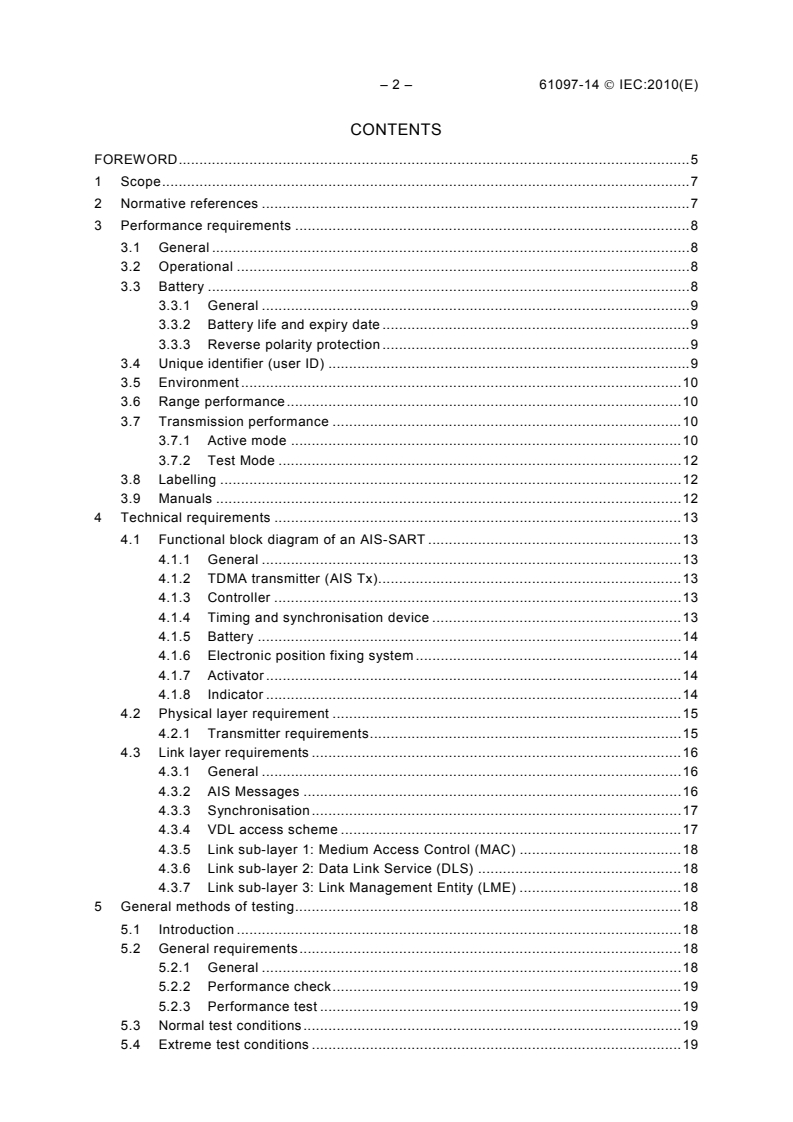
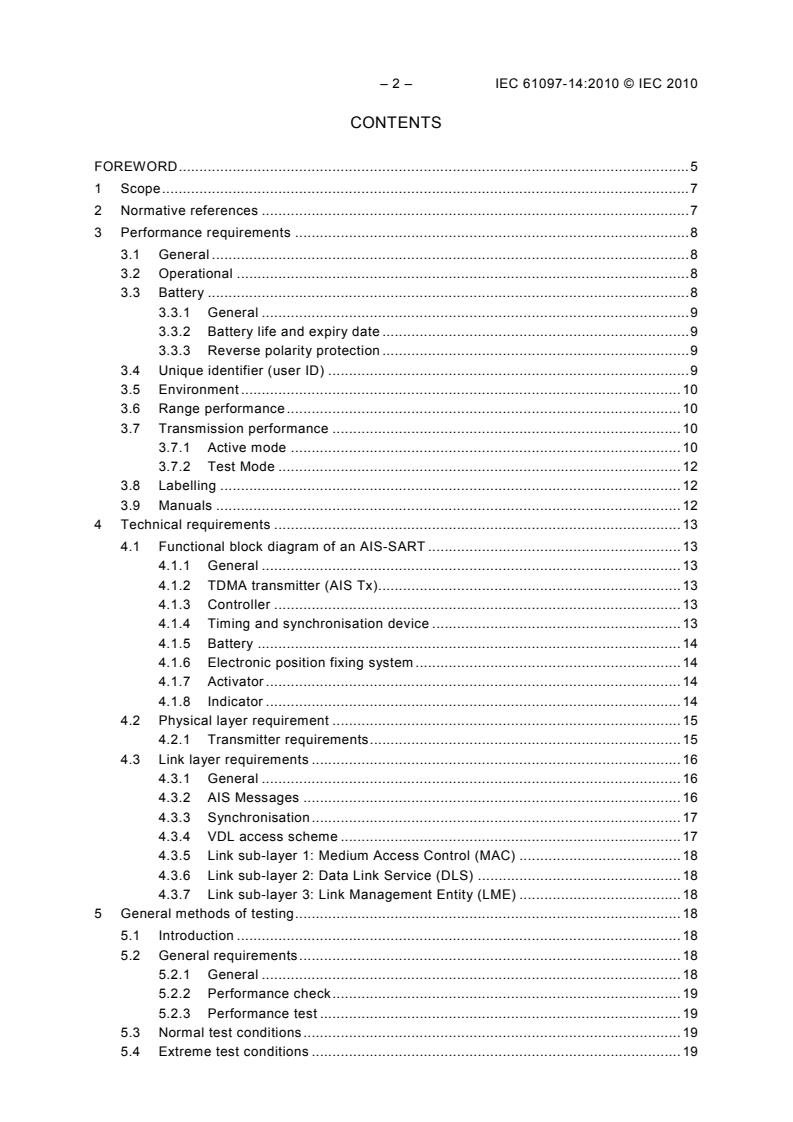
CONTENTS
FOREWORD.5
1 Scope.7
2 Normative references .7
3 Performance requirements .8
3.1 General .8
3.2 Operational .8
3.3 Battery .8
3.3.1 General .9
3.3.2 Battery life and expiry date .9
3.3.3 Reverse polarity protection .9
3.4 Unique identifier (user ID) .9
3.5 Environment .10
3.6 Range performance.10
3.7 Transmission performance .10
3.7.1 Active mode .10
3.7.2 Test Mode .12
3.8 Labelling .12
3.9 Manuals .12
4 Technical requirements .13
4.1 Functional block diagram of an AIS-SART .13
4.1.1 General .13
4.1.2 TDMA transmitter (AIS Tx).13
4.1.3 Controller .13
4.1.4 Timing and synchronisation device .13
4.1.5 Battery .14
4.1.6 Electronic position fixing system .14
4.1.7 Activator .14
4.1.8 Indicator .14
4.2 Physical layer requirement .15
4.2.1 Transmitter requirements.15
4.3 Link layer requirements .16
4.3.1 General .16
4.3.2 AIS Messages .16
4.3.3 Synchronisation.17
4.3.4 VDL access scheme .17
4.3.5 Link sub-layer 1: Medium Access Control (MAC) .18
4.3.6 Link sub-layer 2: Data Link Service (DLS) .18
4.3.7 Link sub-layer 3: Link Management Entity (LME) .18
5 General methods of testing.18
5.1 Introduction .18
5.2 General requirements.18
5.2.1 General .18
5.2.2 Performance check.19
5.2.3 Performance test .19
5.3 Normal test conditions.19
5.4 Extreme test conditions .19
61097-14 © IEC:2010(E) – 3 –
5.5 Preparation of AIS-SART for type-approval testing .19
5.6 Test signals.19
5.6.1 Standard test signal number 1 .19
5.6.2 Standard test signal number 2 .19
5.6.3 Standard test signal number 3 .20
5.7 Artificial antenna (dummy load) .20
5.8 Facilities for access.20
5.9 Modes of operation of the transmitter .20
5.10 Measurement uncertainties .20
6 Performance tests .21
6.1 Operational tests .21
6.2 Battery .21
6.2.1 Battery capacity test .21
6.2.2 Expiry date indication .22
6.2.3 Reverse polarity protection .22
6.3 Unique identifier .22
6.4 Environment .22
6.5 Range performance.22
6.6 Transmission performance .22
6.7 Labelling .22
6.8 Manuals .23
6.9 Electronic position fixing system.23
6.10 Activator.23
6.11 Indicator .23
7 Physical radio tests .23
7.1 General description .23
7.2 Frequency error.24
7.2.1 Purpose.24
7.2.2 Method of measurement .24
7.2.3 Required results .24
7.3 Conducted power .24
7.3.1 Purpose.24
7.3.2 Method of measurement .24
7.3.3 Required result.25
7.4 Radiated power .25
7.4.1 Purpose.25
7.4.2 Method of measurement .25
7.4.3 Required results .26
7.5 Modulation spectrum slotted transmission .26
7.5.1 Purpose.26
7.5.2 Method of measurement .26
7.5.3 Required results .26
7.6 Transmitter test sequence and modulation accuracy .27
7.6.1 Purpose.27
7.6.2 Method of measurement .27
7.6.3 Required results .28
7.7 Transmitter output power versus time function.28
7.7.1 Definition.28
7.7.2 Method of measurement .29
– 4 – 61097-14 © IEC:2010(E)
7.7.3 Required results .30
7.8 Spurious emissions from the transmitter.30
7.8.1 Purpose.30
7.8.2 Method of measurement .30
7.8.3 Required results .30
8 Link layer tests .30
8.1 Tests for synchronisation accuracy.30
8.1.1 Method of measurement .30
8.1.2 Required results .30
8.2 Active mode tests .30
8.2.1 Method of measurement .31
8.2.2 Initialisation period – Required results .31
8.2.3 Message content of Message 1 – Required results .31
8.2.4 Message content of Message 14 – Required results .31
8.2.5 Transmission schedule for Message 1 – Required results.32
8.2.6 Communication state of Message 1 – Required results .32
8.2.7 Transmission schedule of Message 14 – Required results .32
8.2.8 Transmission with lost EPFS – Required results .32
8.3 Test mode tests.33
8.3.1 General .33
8.3.2 Transmission with EPFS data available .33
8.3.3 Transmission without EPFS data available .33
Annex A (informative) Results of trials to verify the range performance of the AIS-
SART.35
Bibliography.39
Figure 1 – Functional block diagram of an AIS-SART.13
Figure 2 – Burst transmissions in active mode .18
Figure 3 – Measurement arrangement .24
Figure 4 – Emission mask.27
Figure 5 – Measurement arrangement for modulation accuracy .27
Figure 6 – Power versus time mask .29
Table 1 – Required parameter settings for an AIS-SART.15
Table 2 – Required settings of physical layer constants .15
Table 3 – Modulation parameters of the physical layer of the AIS-SART .16
Table 4 – Minimum required transmitter characteristics.16
Table 5 – Maximum values of absolute measurement uncertainties .20
Table 6 – Conducted power – Required results .25
Table 7 – Peak frequency deviation versus time .28
Table 8 – Definition of timings.29
Table A.1 – Test results, AIS-SART to vessel (Oban Bay, Scotland) Distances detected
in nautical miles (NM) .37
Table A.2 – Test results, AIS-SART to helicopter (Oban Bay, Scotland) Distances
detected in nautical miles (NM).37
Table A.3 – Test results, AIS-SART to aircraft (Key West, Florida) Distances detected
in nautical miles (NM) .38
61097-14 © IEC:2010(E) – 5 –
INTERNATIONAL ELECTROTECHNICAL COMMISSION
____________
GLOBAL MARITIME DISTRESS AND
SAFETY SYSTEM (GMDSS) –
Part 14: AIS search and rescue transmitter (AIS-SART) –
Operational and performance requirements,
methods of testing and required test results
FOREWORD
1) The International Electrotechnical Commission (IEC) is a worldwide organization for standardization comprising
all national electrotechnical committees (IEC National Committees). The object of IEC is to promote
international co-operation on all questions concerning standardization in the electrical and electronic fields. To
this end and in addition to other activities, IEC publishes International Standards, Technical Specifications,
Technical Reports, Publicly Available Specifications (PAS) and Guides (hereafter referred to as “IEC
Publication(s)”). Their preparation is entrusted to technical committees; any IEC National Committee interested
in the subject dealt with may participate in this preparatory work. International, governmental and non-
governmental organizations liaising with the IEC also participate in this preparation. IEC collaborates closely
with the International Organization for Standardization (ISO) in accordance with conditions determined by
agreement between the two organizations.
2) The formal decisions or agreements of IEC on technical matters express, as nearly as possible, an international
consensus of opinion on the relevant subjects since each technical committee has representation from all
interested IEC National Committees.
3) IEC Publications have the form of recommendations for international use and are accepted by IEC National
Committees in that sense. While all reasonable efforts are made to ensure that the technical content of IEC
Publications is accurate, IEC cannot be held responsible for the way in which they are used or for any
misinterpretation by any end user.
4) In order to promote international uniformity, IEC National Committees undertake to apply IEC Publications
transparently to the maximum extent possible in their national and regional publications. Any divergence
between any IEC Publication and the corresponding national or regional publication shall be clearly indicated in
the latter.
5) IEC itself does not provide any attestation of conformity. Independent certification bodies provide conformity
assessment services and, in some areas, access to IEC marks of conformity. IEC is not responsible for any
services carried out by independent certification bodies.
6) All users should ensure that they have the latest edition of this publication.
7) No liability shall attach to IEC or its directors, employees, servants or agents including individual experts and
members of its technical committees and IEC National Committees for any personal injury, property damage or
other damage of any nature whatsoever, whether direct or indirect, or for costs (including legal fees) and
expenses arising out of the publication, use of, or reliance upon, this IEC Publication or any other IEC
Publications.
8) Attention is drawn to the Normative references cited in this publication. Use of the referenced publications is
indispensable for the correct application of this publication.
9) Attention is drawn to the possibility that some of the elements of this IEC Publication may be the subject of
patent rights. IEC shall not be held responsible for identifying any or all such patent rights.
International Standard IEC 61097-14 has been prepared by IEC technical committee 80:
Maritime navigation and radiocommunication equipment and systems.
The text of this standard is based on the following documents:
FDIS Report on voting
80/582/FDIS 80/589/RVD
Full information on the voting for the approval of this standard can be found in the report on
voting indicated in the above table.
This publication has been drafted in accordance with the ISO/IEC Directives, Part 2.
– 6 – 61097-14 © IEC:2010(E)
A list of all parts of the IEC 61097 series published under the general title Global maritime
distress and safety system (GMDSS), can be found on the IEC website.
The committee has decided that the contents of this publication will remain unchanged until
the maintenance result date indicated on the IEC web site under "http://webstore.iec.ch" in
the data related to the specific publication. At this date, the publication will be
• reconfirmed,
• withdrawn,
• replaced by a revised edition, or
• amended.
A bilingual version of this publication may be issued at a later date.
IMPORTANT – The “colour inside” logo on the cover page of this publication indicates
that it contains colours which are considered to be useful for the correct understanding
of its contents. Users should therefore print this publication using a colour printer.
61097-14 © IEC:2010(E) – 7 –
GLOBAL MARITIME DISTRESS AND
SAFETY SYSTEM (GMDSS) –
Part 14: AIS search and rescue transmitter (AIS-SART) –
Operational and performance requirements,
methods of testing and required test results
1 Scope
This part of IEC 61097 specifies the minimum performance requirements, technical
characteristics and methods of testing, and required test results, for Automatic Identification
Systems (AIS) search and rescue transmitters (AIS-SART) which may be carried by ships as
a search and rescue locating device as required by Chapters III and IV of the International
Convention for Safety of Life at Sea (SOLAS), as amended. It takes account of IMO resolution
A.694(17) and is associated with IEC 60945. When a requirement in this standard is different
from IEC 60945, the requirement in this part of IEC 61097 takes precedence.
This standard incorporates the applicable parts of the performance standards included in IMO
Resolution MSC.246(83) and the applicable technical characteristics included in
Recommendation ITU-R M.1371 and is associated with IEC 61993-2 (Class A shipborne AIS).
All the text of this standard, whose wording is identical to that of IMO Resolution
MSC.246(83), is printed in italics, and the Resolution and associated performance standard
paragraph numbers are indicated in brackets.
NOTE IEC 61097-1 specifies the requirements for radar transponders for use in search and rescue operations
(SART) which may alternatively be carried by ships as a search and rescue locating device.
2 Normative references
The following referenced documents are indispensable for the application of this document.
For dated references, only the edition cited applies. For undated references, the latest edition
of the referenced document (including any amendments) applies.
IEC 60945, Maritime navigation and radiocommunication equipment and systems – General
requirements – Methods of testing and required test results
IEC 61108 (all parts), Maritime navigation and radiocommunication equipment and
systems – Global navigation satellite systems (GNSS)
IMO Resolution MSC.246(83), Performance standards for survival craft AIS search and
rescue transmitter (AIS-SART)
ITU-R Recommendation M.1371, Technical characteristics for an automatic identification
system using time division multiple access in the VHF maritime mobile band
ITU-T Recommendation O.153, Basic parameters for the measurement of error performance
at bit rates below the primary rate
– 8 – 61097-14 © IEC:2010(E)
3 Performance requirements
3.1 General
(246/A2) The AIS-SART shall be capable of transmitting messages that indicate the position,
static and safety information of a unit in distress. The transmitted messages shall be
compatible with existing AIS installations. The transmitted messages shall be recognized and
displayed by assisting units in the reception range of AIS-SART, and clearly distinguish the
AIS-SART from an AIS installation.
3.2 Operational
(See 6.1)
(246/A2.1) The AIS-SART shall
a) be capable of being easily activated by unskilled personnel,
b) be fitted with means to prevent inadvertent activation,
c) be equipped with a means which is either visual or audible, or both visual and audible, to
indicate correct operation,
d) be capable of manual activation and deactivation, provision for automatic activation may
be included,
e) be capable of withstanding without damage drops from a height of 20 m into water,
f) be watertight at a depth of 10 m for at least 5 min,
g) maintain water tightness when subjected to a thermal shock of 45 °C under specified
conditions of immersion,
h) be capable of floating (not neccesarily in an operating position) if it is not an integral part
of the survival craft,
i) be equipped with a buoyant lanyard, suitable for use as a tether, if it is capable of floating,
The buoyant lanyard shall have a length not less than 10 m.
j) be not unduly affected by seawater or oil,
k) be resistant to deterioration in prolonged exposure to sunlight,
l) be of a highly visible yellow/orange colour on all surfaces where this will assist detection,
m) have a smooth external construction to avoid damaging the survival craft,
n) be provided with an arrangement to bring the AIS-SART antenna to a level of at least 1
metre above sea level, together with illustrated instruction,
The manufacturer shall provide a visible means of indicating the base of the antenna. The
height of 1 metre shall be measured to the declared 1 metre mark from sea level. The
instructions shall illustrate the minimum requirement of 1 metre above sea level during use
along with the installation method.
o) be capable of transmitting with a reporting interval of 1 minute or less,
p) be equipped with an internal position source and be capable of transmitting its current
position in each message, and
q) be capable of being tested for all functionalities using specific test information.
3.3 Battery
(See 6.2)
61097-14 © IEC:2010(E) – 9 –
3.3.1 General
(246/A2.2) The AIS-SART shall have sufficient battery capacity to operate for 96 h within a
temperature range of −20 °C to +55 °C, and to provide for testing of the functions on the
equipment.
3.3.2 Battery life and expiry date
The life of the battery as defined by its expiry date shall be at least three years. The expiry
date of the battery shall be the battery manufacturing date plus no more than half the useful
life of the battery. The useful life of the battery is defined as the period of time after the date
of battery manufacture that the battery will continue to meet the input power requirements of
the AIS-SART for at least 96 h, after allowing for all losses over the useful life of the battery.
To define the useful life of the battery, the following losses at the temperature of
+20 °C ± 5 °C shall be included, in addition to the power required to operate the AIS-SART:
a) self-testing annually with Electronic Position Fixing System (EPFS) data available;
b) self-discharge of the battery;
c) stand-by loads.
The manufacturer shall provide evidence to support the above battery life calculations
including the time for self testing and assuming typical EPFS acquisition time.
The AIS-SART shall be clearly and durably marked with the battery expiry date (see 3. 8) .
NOTE For example a battery that has a useful life of 10 years from the date of manufacture, cannot have an
expiry date that exceeds 5 years from the date of manufacture and would have to be capable of providing enough
power for 10 years of self-testing, self-discharge and stand-by loads in addition to the operational power
requirement of the AIS-SART.
3.3.3 Reverse polarity protection
It shall not be possible to connect the battery with the polarity reversed.
3.4 Unique identifier (user ID)
(See 6.3)
(246/A2.2) The AIS-SART shall have an unique identifier to ensure the integrity of the VHF
data link.
The user ID for an AIS-SART is 970xxyyyy, where xx = manufacturer ID 01 to 99; yyyy = the
sequence number 0000 to 9999.
The manufacturer ID xx = 00 is reserved for test purposes The unique identifier used for the
purposes of type approval to this standard shall be in the format 97000yyyy.
After being programmed by the manufacturer, it shall not be possible for the user to change
the unique identifier of the AIS SART.
The configuration method for the unique identifier shall be as defined by the manufacturer and
held in non-volatile memory.
—————————
The manufacturer ID can be obtained from CIRM, South Bank House, Black Prince Road, London SE1 7SJ, UK.
Telephone: +44 20 7587 1245. E-mail: secgen@cirm.org. Web-site: www.cirm.org. Each manufacturers ID will
support 10 000 units. Further IDs can be issued when production exceeds 10 000 units.
– 10 – 61097-14 © IEC:2010(E)
3.5 Environment
(See 6.4)
(246/A2.3) The AIS-SART shall be so designed as to be able to operate under ambient
temperatures of −20 °C to +55 °C. It shall not be damaged in stowage throughout the
temperature range of −30 °C to +70 °C.
The AIS-SART shall meet the environmental condition requirements of IEC 60945 for
equipment category Portable.
3.6 Range performance
(See 6.5)
(246/A2.4)The AIS-SART shall be detectable at a range of 5 nautical miles over water.
The nominal radiated power (EIRP ) of the AIS-SART shall be 1 W.
This radiated power provides the range performance of the AIS-SART as described in
Annex A.
NOTE To a surface vessel the 5 nautical mile range is based on an antenna height for the AIS-SART of 1 m
above sea level, and the antenna height for a receiving AIS Station of at least 15 m above sea level. The receiving
AIS Station has the minimum sensitivity of a Class A mobile AIS station as defined in IEC 61993-2.
3.7 Transmission performance
(See 6.6)
3.7.1 Active mode
In active mode the AIS-SART transmits messages in a burst of 8 messages once per minute.
The SOTDMA (Self-Organising Time Division Multiple Access) communication state of
Message 1 is used to pre-announce its future transmissions.
The AIS-SART shall transmit Message 1 “Position report” with the Navigational Status set to
14 and Message 14 “Safety related broadcast message” with the text “SART ACTIVE”.
NOTE A future revision of Recommendation ITU-R M.1371 may define navigational status 14 as “AIS-SART”.
Message 14 shall be transmitted nominally every 4 min and replace one of the position
reports on both channels.
The AIS-SART transmissions shall alternate between AIS 1 and AIS 2.
st th
The 1 and 5 burst shall be as follows.
• AIS 1, Message 1, Nav Status = 14, comm-state (time-out={7,3}, sub-message=0)
• AIS 2, Message 1, Nav Status = 14, comm-state (time-out={7,3}, sub-message=0)
• AIS 1, Message 1, Nav Status = 14, comm-state (time-out={7,3}, sub-message=0)
• AIS 2, Message 1, Nav Status = 14, comm-state (time-out={7,3}, sub-message=0)
• AIS 1, Message 14 “SART ACTIVE”
• AIS 2, Message 14 “SART ACTIVE”
• AIS 1, Message 1, Nav Status = 14, comm-state (time-out={7,3}, sub-message=0)
• AIS 2, Message 1, Nav Status = 14, comm-state (time-out={7,3}, sub-message=0)
—————————
Equivalent Isotropically Radiated Power
61097-14 © IEC:2010(E) – 11 –
nd th th
The 2 , 4 , 6 burst shall be as follows.
• AIS 1, Message 1, Nav Status =14, comm-state (time-out={6,4,2}, sub-message=slot)
• AIS 2, Message 1, Nav Status =14, comm-state (time-out={6,4,2}, sub-message=slot)
• AIS 1, Message 1, Nav Status =14, comm-state (time-out={6,4,2}, sub-message=slot)
• AIS 2, Message 1, Nav Status =14, comm-state (time-out={6,4,2}, sub-message=slot)
• AIS 1, Message 1, Nav Status =14, comm-state (time-out={6,4,2}, sub-message=slot)
• AIS 2, Message 1, Nav Status =14, comm-state (time-out={6,4,2}, sub-message=slot)
• AIS 1, Message 1, Nav Status =14, comm-state (time-out={6,4,2}, sub-message=slot)
• AIS 2, Message 1, Nav Status =14, comm-state (time-out={6,4,2}, sub-message=slot)
rd
The 3 burst shall be as follows.
• AIS 1, Message 1, Nav Status = 14, comm-state (time-out=5, sub-message=0)
• AIS 2, Message 1, Nav Status = 14, comm-state (time-out=5, sub-message=0)
• AIS 1, Message 1, Nav Status = 14, comm-state (time-out=5, sub-message=0)
• AIS 2, Message 1, Nav Status = 14, comm-state (time-out=5, sub-message=0)
• AIS 1, Message 1, Nav Status = 14, comm-state (time-out=5, sub-message=0)
• AIS 2, Message 1, Nav Status = 14, comm-state (time-out=5, sub-message=0)
• AIS 1, Message 1, Nav Status = 14, comm-state (time-out=5, sub-message=0)
• AIS 2, Message 1, Nav Status = 14, comm-state (time-out=5, sub-message=0)
th
The 7 burst shall be as follows.
• AIS 1, Message 1, Nav Status = 14, comm-state (time-out=1, sub-message=utc)
• AIS 2, Message 1, Nav Status = 14, comm-state (time-out=1, sub-message=utc)
• AIS 1, Message 1, Nav Status = 14, comm-state (time-out=1, sub-message=utc)
• AIS 2, Message 1, Nav Status = 14, comm-state (time-out=1, sub-message=utc)
• AIS 1, Message 1, Nav Status = 14, comm-state (time-out=1, sub-message=utc)
• AIS 2, Message 1, Nav Status = 14, comm-state (time-out=1, sub-message=utc)
• AIS 1, Message 1, Nav Status = 14, comm-state (time-out=1, sub-message=utc)
• AIS 2, Message 1, Nav Status = 14, comm-state (time-out=1, sub-message=utc)
th
The 8 burst shall be as follows.
• AIS 1, Message 1, Nav Status = 14, comm-state (time-out=0, sub-message=incr)
• AIS 2, Message 1, Nav Status = 14, comm-state (time-out=0, sub-message=incr)
• AIS 1, Message 1, Nav Status = 14, comm-state (time-out=0, sub-message=incr)
• AIS 2, Message 1, Nav Status = 14, comm-state (time-out=0, sub-message=incr)
• AIS 1, Message 1, Nav Status = 14, comm-state (time-out=0, sub-message=incr)
• AIS 2, Message 1, Nav Status = 14, comm-state (time-out=0, sub-message=incr)
• AIS 1, Message 1, Nav Status = 14, comm-state (time-out=0, sub-message=incr)
• AIS 2, Message 1, Nav Status = 14, comm-state (time-out=0, sub-message=incr)
th
In the 8 burst the increment to the next burst (sub-message=incr) shall be randomly selected
between 2 025 and 2 475 slots.
This pattern of transmissions is repeated. It is permissible to start the sequence on AIS 2.
st th
Message 14 is transmitted at the 1 and 5 bursts (slot-time-out = 7 and 3) thereby ensuring
that all future Message 14 messages are pre-announced.
(246/A.2.5) The AIS-SART shall continue transmission even if the position and time
synchronization from the positioning system is lost or fails.
– 12 – 61097-14 © IEC:2010(E)
If position and time synchronization are lost the AIS-SART shall continue to transmit with last
known position, COG (Course Over Ground), SOG (Speed Over Ground) and indicate that the
positioning system is inoperative (Time stamp = 63) and synch state 3 (see 4.3.3).
(246/A.2.6) The AIS-SART shall transmit within 1 minute of activation.
The AIS-SART shall start transmitting within 1 min. If the position is unknown then it shall use
default position (+91; +181). If time is not established the unit shall begin transmission
unsynchronised. The unit shall begin synchronised transmission with the correct position
within 15 min under normal operating conditions.
The position of the AIS-SART shall be determined every minute.
In conditions when the AIS-SART cannot get time and position within 15 min, the AIS-SART
shall attempt to obtain a position for at least 30 min in the first hour after activation and at
least 5 min in subsequent hours.
3.7.2 Test Mode
It shall be possible to put the AIS-SART in a test mode. When operating in the test mode
there shall be one burst of 8 messages, 4 on each channel alternating.
• AIS 1, Message 14 “SART TEST”
• AIS 2, Message 1, Nav Status = 15 not defined, comm-state (time-out=0, sub-message=0)
• AIS 1, Message 1, Nav Status = 15 not defined, comm-state (time-out=0, sub-message=0)
• AIS 2, Message 1, Nav Status = 15 not defined, comm-state (time-out=0, sub-message=0)
• AIS 1, Message 1, Nav Status = 15 not defined, comm-state (time-out=0, sub-message=0)
• AIS 2, Message 1, Nav Status = 15 not defined, comm-state (time-out=0, sub-message=0)
• AIS 1, Message 1, Nav Status = 15 not defined, comm-state (time-out=0, sub-message=0)
• AIS 2, Message 14 “SART TEST”
It is permissible to start the sequence on AIS 2.
The test messages shall be transmitted in one burst after position, SOG, COG and time are
available. If the AIS-SART does not acquire position, SOG, COG and time within 15 min it
shall transmit the test messages but with appropriate field values (including default values) in
Message 1 for position, SOG, COG and time stamp.
Activation of the test facility shall reset automatically after transmission of the burst.
3.8 Labelling
(See 6.7)
In addition to the items specified in IEC 60945, the following shall be clearly indicated on the
exterior of the equipment:
a) brief operating and test instructions (in English);
b) expiry date (in English) for the primary battery used and
c) the unique identifier (user ID field of the AIS messages).
NOTE Expiry date is battery replacement date (see 3. 3. 2 ) .
3.9 Manuals
(See 6.8)
61097-14 © IEC:2010(E) – 13 –
In addition to the requirements of IEC 60945, the manuals shall include instructions for
periodic testing and maintenance for the AIS-SART.
NOTE Instructions on how to operate the AIS-SART in a SART active mode should be part of the labelling on the
device (see 3. 8).
4 Technical requirements
4.1 Functional block diagram of an AIS-SART
4.1.1 General
Figure 1 shows the functional block diagram of an AIS-SART.
AIS-SART
EPFS
Activator
Controller
AIS Tx
Indicator
Timing
and
sync device
Battery
IEC 117/10
Figure 1 – Functional block diagram of an AIS-SART
The components of the AIS-SART are as listed below.
4.1.2 TDMA transmitter (AIS Tx)
The transmitter has the following characteristics:
• transmits using modified SOTDMA;
• has nominal 1 W (EIRP) transmitter power;
• has dual channel transmission (see 4.2).
4.1.3 Controller
The controller composes Message 1 and Message 14 and ensures the correct operation of
the AIS-SART on the VHF Data Link (VDL) (see 4.3).
4.1.4 Timing and synchronisation device
This device provides the time and synchronisation for the controller (see 4.3.3).
– 14 – 61097-14 © IEC:2010(E)
4.1.5 Battery
The battery supplies the internal voltages (see 3.3).
4.1.6 Electronic position fixing system
4.1.6.1 General
(See 6.9)
Electronic Position Fixing System (EPFS) provides the current position of the AIS-SART.
4.1.6.2 Position source
An EPFS shall be used as the source for AIS-SART position reporting.
The internal EPFS shall be a GNSS receiver that meets the following requirements of the
IEC 61108 series: position accuracy, acquisition, re-acquisition, receiver sensitivity, RF
dynamic range, position update, effects of specific interfering signals but with an minimum
update of once per minute, provide a resolution of one ten-thousandth of a minute of arc and
use WGS 84 datum.
The manufacturer shall provide evidence that an internal EPFS device cold start is forced at
every AIS-SART activation (cold start refers to the absence of time dependent or position
dependent data in memory, which might affect the acquisition of the GNSS position).
4.1.6.3 Invalid position, COG and SOG
On activation, if the EPFS device is unable to provide a valid position fix, then the reported
position shall be longitude = 181° = not available = default and latitude = 91° = not available =
default, COG = not available = default, SOG = not available = default, and the time stamp
field shall be set to a value of 63.
If the EPFS data is lost then the AIS-SART shall continue to transmit with the last known
position, COG and SOG, and the time stamp field shall be set to a value of 63 “positioning
system inoperative” and with the synchronisation state set to 3.
4.1.7 Activator
(See 6.10)
The Activator provides a means for manual activation and deactivation of the AIS-SART.
Manual activation shall provide a means to avoid inadvertent activation such as the use of not
less than two simple but independent actions.
The AIS-SART shall be provided with means to indicate that the AIS-SART has been
previously activated, to advise the users of a possible reduction of the required battery
capacity. These means shall not be capable of reset by the user. For example, manual
activation requires the breaking of a seal that cannot be replaced by the user.
This indication of previous activation shall be unaffected when initiating the test mode. The
Activator provides a means for manual activation and deactivation of the AIS-SART test
mode.
4.1.8 Indicator
(See 6.11)
The indicator shall be visual and/or audible.
61097-14 © IEC:2010(E) – 15 –
The indica
...
IEC 61097-14 ®
Edition 1.0 2010-02
INTERNATIONAL
STANDARD
NORME
INTERNATIONALE
colour
inside
Global maritime distress and safety system (GMDSS) –
Part 14: AIS search and rescue transmitter (AIS-SART) – Operational and
performance requirements, methods of testing and required test results
Système mondial de détresse et de sécurité en mer (GMDSS) –
Partie 14: Émetteur de recherche et sauvetage AIS – Exigences opérationnelles
et de fonctionnement, méthodes d'essai et résultats exigibles
All rights reserved. Unless otherwise specified, no part of this publication may be reproduced or utilized in any form
or by any means, electronic or mechanical, including photocopying and microfilm, without permission in writing from
either IEC or IEC's member National Committee in the country of the requester. If you have any questions about IEC
copyright or have an enquiry about obtaining additional rights to this publication, please contact the address below or
your local IEC member National Committee for further information.
Droits de reproduction réservés. Sauf indication contraire, aucune partie de cette publication ne peut être reproduite
ni utilisée sous quelque forme que ce soit et par aucun procédé, électronique ou mécanique, y compris la photocopie
et les microfilms, sans l'accord écrit de l'IEC ou du Comité national de l'IEC du pays du demandeur. Si vous avez des
questions sur le copyright de l'IEC ou si vous désirez obtenir des droits supplémentaires sur cette publication, utilisez
les coordonnées ci-après ou contactez le Comité national de l'IEC de votre pays de résidence.
IEC Central Office Tel.: +41 22 919 02 11
3, rue de Varembé Fax: +41 22 919 03 00
CH-1211 Geneva 20 info@iec.ch
Switzerland www.iec.ch
About the IEC
The International Electrotechnical Commission (IEC) is the leading global organization that prepares and publishes
International Standards for all electrical, electronic and related technologies.
About IEC publications
The technical content of IEC publications is kept under constant review by the IEC. Please make sure that you have the
latest edition, a corrigenda or an amendment might have been published.
IEC Catalogue - webstore.iec.ch/catalogue Electropedia - www.electropedia.org
The stand-alone application for consulting the entire The world's leading online dictionary of electronic and
bibliographical information on IEC International Standards, electrical terms containing more than 30 000 terms and
Technical Specifications, Technical Reports and other definitions in English and French, with equivalent terms in 14
documents. Available for PC, Mac OS, Android Tablets and additional languages. Also known as the International
iPad. Electrotechnical Vocabulary (IEV) online.
IEC publications search - www.iec.ch/searchpub IEC Glossary - std.iec.ch/glossary
The advanced search enables to find IEC publications by a More than 55 000 electrotechnical terminology entries in
variety of criteria (reference number, text, technical English and French extracted from the Terms and Definitions
committee,…). It also gives information on projects, replaced clause of IEC publications issued since 2002. Some entries
and withdrawn publications. have been collected from earlier publications of IEC TC 37,
77, 86 and CISPR.
IEC Just Published - webstore.iec.ch/justpublished
Stay up to date on all new IEC publications. Just Published IEC Customer Service Centre - webstore.iec.ch/csc
details all new publications released. Available online and If you wish to give us your feedback on this publication or
also once a month by email. need further assistance, please contact the Customer Service
Centre: csc@iec.ch.
A propos de l'IEC
La Commission Electrotechnique Internationale (IEC) est la première organisation mondiale qui élabore et publie des
Normes internationales pour tout ce qui a trait à l'électricité, à l'électronique et aux technologies apparentées.
A propos des publications IEC
Le contenu technique des publications IEC est constamment revu. Veuillez vous assurer que vous possédez l’édition la
plus récente, un corrigendum ou amendement peut avoir été publié.
Catalogue IEC - webstore.iec.ch/catalogue Electropedia - www.electropedia.org
Application autonome pour consulter tous les renseignements
Le premier dictionnaire en ligne de termes électroniques et
bibliographiques sur les Normes internationales,
électriques. Il contient plus de 30 000 termes et définitions en
Spécifications techniques, Rapports techniques et autres
anglais et en français, ainsi que les termes équivalents dans
documents de l'IEC. Disponible pour PC, Mac OS, tablettes
14 langues additionnelles. Egalement appelé Vocabulaire
Android et iPad.
Electrotechnique International (IEV) en ligne.
Recherche de publications IEC - www.iec.ch/searchpub
Glossaire IEC - std.iec.ch/glossary
Plus de 55 000 entrées terminologiques électrotechniques, en
La recherche avancée permet de trouver des publications IEC
en utilisant différents critères (numéro de référence, texte, anglais et en français, extraites des articles Termes et
comité d’études,…). Elle donne aussi des informations sur les Définitions des publications IEC parues depuis 2002. Plus
projets et les publications remplacées ou retirées. certaines entrées antérieures extraites des publications des
CE 37, 77, 86 et CISPR de l'IEC.
IEC Just Published - webstore.iec.ch/justpublished
Service Clients - webstore.iec.ch/csc
Restez informé sur les nouvelles publications IEC. Just
Published détaille les nouvelles publications parues. Si vous désirez nous donner des commentaires sur cette
Disponible en ligne et aussi une fois par mois par email. publication ou si vous avez des questions contactez-nous:
csc@iec.ch.
IEC 61097-14 ®
Edition 1.0 2010-02
INTERNATIONAL
STANDARD
NORME
INTERNATIONALE
colour
inside
Global maritime distress and safety system (GMDSS) –
Part 14: AIS search and rescue transmitter (AIS-SART) – Operational and
performance requirements, methods of testing and required test results
Système mondial de détresse et de sécurité en mer (GMDSS) –
Partie 14: Émetteur de recherche et sauvetage AIS – Exigences opérationnelles
et de fonctionnement, méthodes d'essai et résultats exigibles
INTERNATIONAL
ELECTROTECHNICAL
COMMISSION
COMMISSION
ELECTROTECHNIQUE
PRICE CODE
INTERNATIONALE
CODE PRIX W
ICS 47.020.70 ISBN 978-2-8322-1977-5
– 2 – IEC 61097-14:2010 © IEC 2010
CONTENTS
FOREWORD . 5
1 Scope . 7
2 Normative references . 7
3 Performance requirements . 8
3.1 General . 8
3.2 Operational . 8
3.3 Battery . 8
3.3.1 General . 9
3.3.2 Battery life and expiry date . 9
3.3.3 Reverse polarity protection . 9
3.4 Unique identifier (user ID) . 9
3.5 Environment . 10
3.6 Range performance . 10
3.7 Transmission performance . 10
3.7.1 Active mode . 10
3.7.2 Test Mode . 12
3.8 Labelling . 12
3.9 Manuals . 12
4 Technical requirements . 13
4.1 Functional block diagram of an AIS-SART . 13
4.1.1 General . 13
4.1.2 TDMA transmitter (AIS Tx) . 13
4.1.3 Controller . 13
4.1.4 Timing and synchronisation device . 13
4.1.5 Battery . 14
4.1.6 Electronic position fixing system . 14
4.1.7 Activator . 14
4.1.8 Indicator . 14
4.2 Physical layer requirement . 15
4.2.1 Transmitter requirements . 15
4.3 Link layer requirements . 16
4.3.1 General . 16
4.3.2 AIS Messages . 16
4.3.3 Synchronisation . 17
4.3.4 VDL access scheme . 17
4.3.5 Link sub-layer 1: Medium Access Control (MAC) . 18
4.3.6 Link sub-layer 2: Data Link Service (DLS) . 18
4.3.7 Link sub-layer 3: Link Management Entity (LME) . 18
5 General methods of testing . 18
5.1 Introduction . 18
5.2 General requirements . 18
5.2.1 General . 18
5.2.2 Performance check . 19
5.2.3 Performance test . 19
5.3 Normal test conditions . 19
5.4 Extreme test conditions . 19
5.5 Preparation of AIS-SART for type-approval testing . 19
5.6 Test signals . 19
5.6.1 Standard test signal number 1 . 19
5.6.2 Standard test signal number 2 . 19
5.6.3 Standard test signal number 3 . 20
5.7 Artificial antenna (dummy load) . 20
5.8 Facilities for access . 20
5.9 Modes of operation of the transmitter . 20
5.10 Measurement uncertainties . 20
6 Performance tests . 21
6.1 Operational tests . 21
6.2 Battery . 21
6.2.1 Battery capacity test . 21
6.2.2 Expiry date indication . 22
6.2.3 Reverse polarity protection . 22
6.3 Unique identifier . 22
6.4 Environment . 22
6.5 Range performance . 22
6.6 Transmission performance . 22
6.7 Labelling . 22
6.8 Manuals . 23
6.9 Electronic position fixing system . 23
6.10 Activator . 23
6.11 Indicator . 23
7 Physical radio tests . 23
7.1 General description . 23
7.2 Frequency error . 24
7.2.1 Purpose . 24
7.2.2 Method of measurement . 24
7.2.3 Required results . 24
7.3 Conducted power . 24
7.3.1 Purpose . 24
7.3.2 Method of measurement . 24
7.3.3 Required result . 25
7.4 Radiated power . 25
7.4.1 Purpose . 25
7.4.2 Method of measurement . 25
7.4.3 Required results . 26
7.5 Modulation spectrum slotted transmission . 26
7.5.1 Purpose . 26
7.5.2 Method of measurement . 26
7.5.3 Required results . 26
7.6 Transmitter test sequence and modulation accuracy . 27
7.6.1 Purpose . 27
7.6.2 Method of measurement . 27
7.6.3 Required results . 28
7.7 Transmitter output power versus time function . 28
7.7.1 Definition . 28
7.7.2 Method of measurement . 29
– 4 – IEC 61097-14:2010 © IEC 2010
7.7.3 Required results . 30
7.8 Spurious emissions from the transmitter . 30
7.8.1 Purpose . 30
7.8.2 Method of measurement . 30
7.8.3 Required results . 30
8 Link layer tests . 30
8.1 Tests for synchronisation accuracy . 30
8.1.1 Method of measurement . 30
8.1.2 Required results . 30
8.2 Active mode tests . 30
8.2.1 Method of measurement . 31
8.2.2 Initialisation period – Required results . 31
8.2.3 Message content of Message 1 – Required results . 31
8.2.4 Message content of Message 14 – Required results . 31
8.2.5 Transmission schedule for Message 1 – Required results . 32
8.2.6 Communication state of Message 1 – Required results . 32
8.2.7 Transmission schedule of Message 14 – Required results . 32
8.2.8 Transmission with lost EPFS – Required results . 32
8.3 Test mode tests . 33
8.3.1 General . 33
8.3.2 Transmission with EPFS data available . 33
8.3.3 Transmission without EPFS data available . 33
Annex A (informative) Results of trials to verify the range performance of the AIS-
SART . 35
Bibliography . 39
Figure 1 – Functional block diagram of an AIS-SART . 13
Figure 2 – Burst transmissions in active mode . 18
Figure 3 – Measurement arrangement . 24
Figure 4 – Emission mask . 27
Figure 5 – Measurement arrangement for modulation accuracy . 27
Figure 6 – Power versus time mask . 29
Table 1 – Required parameter settings for an AIS-SART . 15
Table 2 – Required settings of physical layer constants . 15
Table 3 – Modulation parameters of the physical layer of the AIS-SART . 16
Table 4 – Minimum required transmitter characteristics . 16
Table 5 – Maximum values of absolute measurement uncertainties . 20
Table 6 – Conducted power – Required results . 25
Table 7 – Peak frequency deviation versus time . 28
Table 8 – Definition of timings . 29
Table A.1 – Test results, AIS-SART to vessel (Oban Bay, Scotland) Distances detected
in nautical miles (NM) . 37
Table A.2 – Test results, AIS-SART to helicopter (Oban Bay, Scotland) Distances
detected in nautical miles (NM) . 37
Table A.3 – Test results, AIS-SART to aircraft (Key West, Florida) Distances detected
in nautical miles (NM) . 38
INTERNATIONAL ELECTROTECHNICAL COMMISSION
____________
GLOBAL MARITIME DISTRESS AND
SAFETY SYSTEM (GMDSS) –
Part 14: AIS search and rescue transmitter (AIS-SART) –
Operational and performance requirements,
methods of testing and required test results
FOREWORD
1) The International Electrotechnical Commission (IEC) is a worldwide organization for standardization comprising
all national electrotechnical committees (IEC National Committees). The object of IEC is to promote
international co-operation on all questions concerning standardization in the electrical and electronic fields. To
this end and in addition to other activities, IEC publishes International Standards, Technical Specifications,
Technical Reports, Publicly Available Specifications (PAS) and Guides (hereafter referred to as “IEC
Publication(s)”). Their preparation is entrusted to technical committees; any IEC National Committee interested
in the subject dealt with may participate in this preparatory work. International, governmental and non-
governmental organizations liaising with the IEC also participate in this preparation. IEC collaborates closely
with the International Organization for Standardization (ISO) in accordance with conditions determined by
agreement between the two organizations.
2) The formal decisions or agreements of IEC on technical matters express, as nearly as possible, an international
consensus of opinion on the relevant subjects since each technical committee has representation from all
interested IEC National Committees.
3) IEC Publications have the form of recommendations for international use and are accepted by IEC National
Committees in that sense. While all reasonable efforts are made to ensure that the technical content of IEC
Publications is accurate, IEC cannot be held responsible for the way in which they are used or for any
misinterpretation by any end user.
4) In order to promote international uniformity, IEC National Committees undertake to apply IEC Publications
transparently to the maximum extent possible in their national and regional publications. Any divergence
between any IEC Publication and the corresponding national or regional publication shall be clearly indicated in
the latter.
5) IEC itself does not provide any attestation of conformity. Independent certification bodies provide conformity
assessment services and, in some areas, access to IEC marks of conformity. IEC is not responsible for any
services carried out by independent certification bodies.
6) All users should ensure that they have the latest edition of this publication.
7) No liability shall attach to IEC or its directors, employees, servants or agents including individual experts and
members of its technical committees and IEC National Committees for any personal injury, property damage or
other damage of any nature whatsoever, whether direct or indirect, or for costs (including legal fees) and
expenses arising out of the publication, use of, or reliance upon, this IEC Publication or any other IEC
Publications.
8) Attention is drawn to the Normative references cited in this publication. Use of the referenced publications is
indispensable for the correct application of this publication.
9) Attention is drawn to the possibility that some of the elements of this IEC Publication may be the subject of
patent rights. IEC shall not be held responsible for identifying any or all such patent rights.
International Standard IEC 61097-14 has been prepared by IEC technical committee 80:
Maritime navigation and radiocommunication equipment and systems.
This bilingual version (2014-12) corresponds to the English version, published in 2010-02.
The text of this standard is based on the following documents:
FDIS Report on voting
80/582/FDIS 80/589/RVD
Full information on the voting for the approval of this standard can be found in the report on
voting indicated in the above table.
– 6 – IEC 61097-14:2010 © IEC 2010
The French version of this standard has not been voted upon.
This publication has been drafted in accordance with the ISO/IEC Directives, Part 2.
A list of all parts of the IEC 61097 series published under the general title Global maritime
distress and safety system (GMDSS), can be found on the IEC website.
The committee has decided that the contents of this publication will remain unchanged until
the maintenance result date indicated on the IEC web site under "http://webstore.iec.ch" in
the data related to the specific publication. At this date, the publication will be
• reconfirmed,
• withdrawn,
• replaced by a revised edition, or
• amended.
IMPORTANT – The “colour inside” logo on the cover page of this publication indicates
that it contains colours which are considered to be useful for the correct understanding
of its contents. Users should therefore print this publication using a colour printer.
GLOBAL MARITIME DISTRESS AND
SAFETY SYSTEM (GMDSS) –
Part 14: AIS search and rescue transmitter (AIS-SART) –
Operational and performance requirements,
methods of testing and required test results
1 Scope
This part of IEC 61097 specifies the minimum performance requirements, technical
characteristics and methods of testing, and required test results, for Automatic Identification
Systems (AIS) search and rescue transmitters (AIS-SART) which may be carried by ships as
a search and rescue locating device as required by Chapters III and IV of the International
Convention for Safety of Life at Sea (SOLAS), as amended. It takes account of IMO resolution
A.694(17) and is associated with IEC 60945. When a requirement in this standard is different
from IEC 60945, the requirement in this part of IEC 61097 takes precedence.
This standard incorporates the applicable parts of the performance standards included in IMO
Resolution MSC.246(83) and the applicable technical characteristics included in
Recommendation ITU-R M.1371 and is associated with IEC 61993-2 (Class A shipborne AIS).
All the text of this standard, whose wording is identical to that of IMO Resolution
MSC.246(83), is printed in italics, and the Resolution and associated performance standard
paragraph numbers are indicated in brackets.
NOTE IEC 61097-1 specifies the requirements for radar transponders for use in search and rescue operations
(SART) which may alternatively be carried by ships as a search and rescue locating device.
2 Normative references
The following referenced documents are indispensable for the application of this document.
For dated references, only the edition cited applies. For undated references, the latest edition
of the referenced document (including any amendments) applies.
IEC 60945, Maritime navigation and radiocommunication equipment and systems – General
requirements – Methods of testing and required test results
IEC 61108 (all parts), Maritime navigation and radiocommunication equipment and
systems – Global navigation satellite systems (GNSS)
IMO Resolution MSC.246(83), Performance standards for survival craft AIS search and
rescue transmitter (AIS-SART)
ITU-R Recommendation M.1371, Technical characteristics for an automatic identification
system using time division multiple access in the VHF maritime mobile band
ITU-T Recommendation O.153, Basic parameters for the measurement of error performance
at bit rates below the primary rate
– 8 – IEC 61097-14:2010 © IEC 2010
3 Performance requirements
3.1 General
(246/A2) The AIS-SART shall be capable of transmitting messages that indicate the position,
static and safety information of a unit in distress. The transmitted messages shall be
compatible with existing AIS installations. The transmitted messages shall be recognized and
displayed by assisting units in the reception range of AIS-SART, and clearly distinguish the
AIS-SART from an AIS installation.
3.2 Operational
(See 6.1)
(246/A2.1) The AIS-SART shall
a) be capable of being easily activated by unskilled personnel,
b) be fitted with means to prevent inadvertent activation,
c) be equipped with a means which is either visual or audible, or both visual and audible, to
indicate correct operation,
d) be capable of manual activation and deactivation, provision for automatic activation may
be included,
e) be capable of withstanding without damage drops from a height of 20 m into water,
f) be watertight at a depth of 10 m for at least 5 min,
g) maintain water tightness when subjected to a thermal shock of 45 °C under specified
conditions of immersion,
h) be capable of floating (not neccesarily in an operating position) if it is not an integral part
of the survival craft,
i) be equipped with a buoyant lanyard, suitable for use as a tether, if it is capable of floating,
The buoyant lanyard shall have a length not less than 10 m.
j) be not unduly affected by seawater or oil,
k) be resistant to deterioration in prolonged exposure to sunlight,
l) be of a highly visible yellow/orange colour on all surfaces where this will assist detection,
m) have a smooth external construction to avoid damaging the survival craft,
n) be provided with an arrangement to bring the AIS-SART antenna to a level of at least 1
metre above sea level, together with illustrated instruction,
The manufacturer shall provide a visible means of indicating the base of the antenna. The
height of 1 metre shall be measured to the declared 1 metre mark from sea level. The
instructions shall illustrate the minimum requirement of 1 metre above sea level during use
along with the installation method.
o) be capable of transmitting with a reporting interval of 1 minute or less,
p) be equipped with an internal position source and be capable of transmitting its current
position in each message, and
q) be capable of being tested for all functionalities using specific test information.
3.3 Battery
(See 6.2)
3.3.1 General
(246/A2.2) The AIS-SART shall have sufficient battery capacity to operate for 96 h within a
temperature range of −20 °C to +55 °C, and to provide for testing of the functions on the
equipment.
3.3.2 Battery life and expiry date
The life of the battery as defined by its expiry date shall be at least three years. The expiry
date of the battery shall be the battery manufacturing date plus no more than half the useful
life of the battery. The useful life of the battery is defined as the period of time after the date
of battery manufacture that the battery will continue to meet the input power requirements of
the AIS-SART for at least 96 h, after allowing for all losses over the useful life of the battery.
To define the useful life of the battery, the following losses at the temperature of
+20 °C ± 5 °C shall be included, in addition to the power required to operate the AIS-SART:
a) self-testing annually with Electronic Position Fixing System (EPFS) data available;
b) self-discharge of the battery;
c) stand-by loads.
The manufacturer shall provide evidence to support the above battery life calculations
including the time for self testing and assuming typical EPFS acquisition time.
The AIS-SART shall be clearly and durably marked with the battery expiry date (see 3.8).
NOTE For example a battery that has a useful life of 10 years from the date of manufacture, cannot have an
expiry date that exceeds 5 years from the date of manufacture and would have to be capable of providing enough
power for 10 years of self-testing, self-discharge and stand-by loads in addition to the operational power
requirement of the AIS-SART.
3.3.3 Reverse polarity protection
It shall not be possible to connect the battery with the polarity reversed.
3.4 Unique identifier (user ID)
(See 6.3)
(246/A2.2) The AIS-SART shall have an unique identifier to ensure the integrity of the VHF
data link.
The user ID for an AIS-SART is 970xxyyyy, where xx = manufacturer ID 01 to 99; yyyy = the
sequence number 0000 to 9999.
The manufacturer ID xx = 00 is reserved for test purposes The unique identifier used for the
purposes of type approval to this standard shall be in the format 97000yyyy.
After being programmed by the manufacturer, it shall not be possible for the user to change
the unique identifier of the AIS SART.
The configuration method for the unique identifier shall be as defined by the manufacturer and
held in non-volatile memory.
—————————
The manufacturer ID can be obtained from CIRM, South Bank House, Black Prince Road, London SE1 7SJ, UK.
Telephone: +44 20 7587 1245. E-mail: secgen@cirm.org. Web-site: www.cirm.org. Each manufacturer's ID will
support 10 000 units. Further IDs can be issued when production exceeds 10 000 units.
– 10 – IEC 61097-14:2010 © IEC 2010
3.5 Environment
(See 6.4)
(246/A2.3) The AIS-SART shall be so designed as to be able to operate under ambient
temperatures of −20 °C to +55 °C. It shall not be damaged in stowage throughout the
temperature range of −30 °C to +70 °C.
The AIS-SART shall meet the environmental condition requirements of IEC 60945 for
equipment category Portable.
3.6 Range performance
(See 6.5)
(246/A2.4)The AIS-SART shall be detectable at a range of 5 nautical miles over water.
The nominal radiated power (EIRP ) of the AIS-SART shall be 1 W.
This radiated power provides the range performance of the AIS-SART as described in
Annex A.
NOTE To a surface vessel the 5 nautical mile range is based on an antenna height for the AIS-SART of 1 m
above sea level, and the antenna height for a receiving AIS Station of at least 15 m above sea level. The receiving
AIS Station has the minimum sensitivity of a Class A mobile AIS station as defined in IEC 61993-2.
3.7 Transmission performance
(See 6.6)
3.7.1 Active mode
In active mode the AIS-SART transmits messages in a burst of 8 messages once per minute.
The SOTDMA (Self-Organising Time Division Multiple Access) communication state of
Message 1 is used to pre-announce its future transmissions.
The AIS-SART shall transmit Message 1 “Position report” with the Navigational Status set to
14 and Message 14 “Safety related broadcast message” with the text “SART ACTIVE”.
NOTE A future revision of Recommendation ITU-R M.1371 may define navigational status 14 as “AIS-SART”.
Message 14 shall be transmitted nominally every 4 min and replace one of the position
reports on both channels.
The AIS-SART transmissions shall alternate between AIS 1 and AIS 2.
st th
The 1 and 5 burst shall be as follows.
• AIS 1, Message 1, Nav Status = 14, comm-state (time-out={7,3}, sub-message=0)
• AIS 2, Message 1, Nav Status = 14, comm-state (time-out={7,3}, sub-message=0)
• AIS 1, Message 1, Nav Status = 14, comm-state (time-out={7,3}, sub-message=0)
• AIS 2, Message 1, Nav Status = 14, comm-state (time-out={7,3}, sub-message=0)
• AIS 1, Message 14 “SART ACTIVE”
• AIS 2, Message 14 “SART ACTIVE”
• AIS 1, Message 1, Nav Status = 14, comm-state (time-out={7,3}, sub-message=0)
• AIS 2, Message 1, Nav Status = 14, comm-state (time-out={7,3}, sub-message=0)
—————————
Equivalent Isotropically Radiated Power
nd th th
The 2 , 4 , 6 burst shall be as follows.
• AIS 1, Message 1, Nav Status =14, comm-state (time-out={6,4,2}, sub-message=slot)
• AIS 2, Message 1, Nav Status =14, comm-state (time-out={6,4,2}, sub-message=slot)
• AIS 1, Message 1, Nav Status =14, comm-state (time-out={6,4,2}, sub-message=slot)
• AIS 2, Message 1, Nav Status =14, comm-state (time-out={6,4,2}, sub-message=slot)
• AIS 1, Message 1, Nav Status =14, comm-state (time-out={6,4,2}, sub-message=slot)
• AIS 2, Message 1, Nav Status =14, comm-state (time-out={6,4,2}, sub-message=slot)
• AIS 1, Message 1, Nav Status =14, comm-state (time-out={6,4,2}, sub-message=slot)
• AIS 2, Message 1, Nav Status =14, comm-state (time-out={6,4,2}, sub-message=slot)
rd
The 3 burst shall be as follows.
• AIS 1, Message 1, Nav Status = 14, comm-state (time-out=5, sub-message=0)
• AIS 2, Message 1, Nav Status = 14, comm-state (time-out=5, sub-message=0)
• AIS 1, Message 1, Nav Status = 14, comm-state (time-out=5, sub-message=0)
• AIS 2, Message 1, Nav Status = 14, comm-state (time-out=5, sub-message=0)
• AIS 1, Message 1, Nav Status = 14, comm-state (time-out=5, sub-message=0)
• AIS 2, Message 1, Nav Status = 14, comm-state (time-out=5, sub-message=0)
• AIS 1, Message 1, Nav Status = 14, comm-state (time-out=5, sub-message=0)
• AIS 2, Message 1, Nav Status = 14, comm-state (time-out=5, sub-message=0)
th
The 7 burst shall be as follows.
• AIS 1, Message 1, Nav Status = 14, comm-state (time-out=1, sub-message=utc)
• AIS 2, Message 1, Nav Status = 14, comm-state (time-out=1, sub-message=utc)
• AIS 1, Message 1, Nav Status = 14, comm-state (time-out=1, sub-message=utc)
• AIS 2, Message 1, Nav Status = 14, comm-state (time-out=1, sub-message=utc)
• AIS 1, Message 1, Nav Status = 14, comm-state (time-out=1, sub-message=utc)
• AIS 2, Message 1, Nav Status = 14, comm-state (time-out=1, sub-message=utc)
• AIS 1, Message 1, Nav Status = 14, comm-state (time-out=1, sub-message=utc)
• AIS 2, Message 1, Nav Status = 14, comm-state (time-out=1, sub-message=utc)
th
The 8 burst shall be as follows.
• AIS 1, Message 1, Nav Status = 14, comm-state (time-out=0, sub-message=incr)
• AIS 2, Message 1, Nav Status = 14, comm-state (time-out=0, sub-message=incr)
• AIS 1, Message 1, Nav Status = 14, comm-state (time-out=0, sub-message=incr)
• AIS 2, Message 1, Nav Status = 14, comm-state (time-out=0, sub-message=incr)
• AIS 1, Message 1, Nav Status = 14, comm-state (time-out=0, sub-message=incr)
• AIS 2, Message 1, Nav Status = 14, comm-state (time-out=0, sub-message=incr)
• AIS 1, Message 1, Nav Status = 14, comm-state (time-out=0, sub-message=incr)
• AIS 2, Message 1, Nav Status = 14, comm-state (time-out=0, sub-message=incr)
th
In the 8 burst the increment to the next burst (sub-message=incr) shall be randomly selected
between 2 025 and 2 475 slots.
This pattern of transmissions is repeated. It is permissible to start the sequence on AIS 2.
st th
Message 14 is transmitted at the 1 and 5 bursts (slot-time-out = 7 and 3) thereby ensuring
that all future Message 14 messages are pre-announced.
(246/A.2.5) The AIS-SART shall continue transmission even if the position and time
synchronization from the positioning system is lost or fails.
– 12 – IEC 61097-14:2010 © IEC 2010
If position and time synchronization are lost the AIS-SART shall continue to transmit with last
known position, COG (Course Over Ground), SOG (Speed Over Ground) and indicate that the
positioning system is inoperative (Time stamp = 63) and synch state 3 (see 4.3.3).
(246/A.2.6) The AIS-SART shall transmit within 1 minute of activation.
The AIS-SART shall start transmitting within 1 min. If the position is unknown then it shall use
default position (+91; +181). If time is not established the unit shall begin transmission
unsynchronised. The unit shall begin synchronised transmission with the correct position
within 15 min under normal operating conditions.
The position of the AIS-SART shall be determined every minute.
In conditions when the AIS-SART cannot get time and position within 15 min, the AIS-SART
shall attempt to obtain a position for at least 30 min in the first hour after activation and at
least 5 min in subsequent hours.
3.7.2 Test Mode
It shall be possible to put the AIS-SART in a test mode. When operating in the test mode
there shall be one burst of 8 messages, 4 on each channel alternating.
• AIS 1, Message 14 “SART TEST”
• AIS 2, Message 1, Nav Status = 15 not defined, comm-state (time-out=0, sub-message=0)
• AIS 1, Message 1, Nav Status = 15 not defined, comm-state (time-out=0, sub-message=0)
• AIS 2, Message 1, Nav Status = 15 not defined, comm-state (time-out=0, sub-message=0)
• AIS 1, Message 1, Nav Status = 15 not defined, comm-state (time-out=0, sub-message=0)
• AIS 2, Message 1, Nav Status = 15 not defined, comm-state (time-out=0, sub-message=0)
• AIS 1, Message 1, Nav Status = 15 not defined, comm-state (time-out=0, sub-message=0)
• AIS 2, Message 14 “SART TEST”
It is permissible to start the sequence on AIS 2.
The test messages shall be transmitted in one burst after position, SOG, COG and time are
available. If the AIS-SART does not acquire position, SOG, COG and time within 15 min it
shall transmit the test messages but with appropriate field values (including default values) in
Message 1 for
...