

IEC 60958-5:2021
(Main)Digital audio interface - Part 5: Consumer application enhancement
General Information
- Abstract
IEC 60958-5:2021 enhances the consumer application of the interface for the interconnection of digital audio equipment defined in IEC 60958-1 and IEC 60958-3, introducing:
- multichannel;
- multi-stream;
- high-resolution;
- multimedia extension;
- related applications.
- Status
- Published
- Publication Date
- 02-Feb-2021
- Technical Committee
- TA 20 - Analogue and digital audio
- Drafting Committee
- PT 60958-5 - TC 100/TA 20/PT 60958-5
- Current Stage
- PPUB - Publication issued
- Start Date
- 03-Feb-2021
- Completion Date
- 22-Feb-2021
Overview
IEC 60958-5:2021 is an international standard developed by the International Electrotechnical Commission (IEC) that enhances the consumer applications of digital audio interfaces. Building upon the foundational standards IEC 60958-1 and IEC 60958-3, this standard introduces significant advancements aimed at improving the quality, versatility, and functionality of digital audio equipment connections.
Key enhancements include support for multichannel audio, multi-stream capabilities, high-resolution audio formats, and multimedia extensions. These improvements enable interoperability and enable richer audio experiences in consumer electronic devices while maintaining backward compatibility with existing IEC 60958 applications.
Key Topics
Multichannel Audio Support
IEC 60958-5 expands the interface to accommodate up to 64 audio channels, allowing immersive surround sound and complex audio configurations far beyond traditional stereo systems.Multi-Stream Transmission
The standard enables the simultaneous transmission of two independent audio streams over the same interface, facilitating advanced multimedia applications such as mixing audio sources or concurrent transmission of separate audio programs.High-Resolution Audio
Support is extended to handle audio sample words of 32 and 64 bits per sample, significantly improving audio fidelity and precision. This extension caters to high-end audio applications demanding superior sound quality.Multimedia Extensions
By integrating multimedia-specific functionalities, IEC 60958-5 caters to the evolving needs of consumer audio devices involved in broader multimedia ecosystems, including synchronization with MIDI and vibrotactile feedback.Channel Status and Operation Modes
The standard defines new formats for channel status information tailored to enhanced consumer use, addressing parameters like sampling frequency, sample resolution, and specific channel assignments. Operation modes include linear PCM, one-bit audio, and high-precision multi-bit linear audio modes.
Applications
Home Theater Systems
The multichannel support allows manufacturers to design advanced home theater systems delivering immersive surround sound experiences with up to 64 discrete audio channels.High-Fidelity Audio Equipment
Audiophile-grade devices benefit from high-resolution audio capabilities, enabling playback and transmission of ultra-high-definition audio signals with greater dynamic range and accuracy.Digital Audio Workstations and Multimedia Devices
Multi-streaming facilitates complex audio workflows and multimedia interactions, supporting scenarios where multiple audio signals are transmitted and processed concurrently.Vibrotactile and Interactive Technologies
Annexes to the standard include guidelines for vibrotactile channel assignments, enabling integration of tactile feedback systems alongside audio for enhanced user experiences in gaming, VR, and assistive technologies.Audio and MIDI Integration
The standard also covers provisions for audio and MIDI 2.0 applications, ensuring seamless interoperability between digital audio and music instrument control protocols.
Related Standards
- IEC 60958-1: Digital audio interface – Part 1: General description of the interface fundamentals.
- IEC 60958-3: Digital audio interface – Part 3: Consumer applications focusing on stereophonic digital audio transmission.
- IEC 62574:2020: Definitions for multichannel audio channel assignments addressing general principles for audio and multimedia systems.
- ISO/IEC 23001-8:2016: MPEG systems technologies related to coding-independent code points for audio data.
- ITU-R BS.2094-1:2017 & ITU-R BS.2051-2:2018: Recommendations defining audio coding models and advanced sound systems for program production.
IEC 60958-5:2021 represents a vital step towards more flexible, high-quality digital audio interfaces for consumer applications. By addressing the demands of modern multimedia environments, it ensures compatibility and future-proofing of audio equipment in homes and professional settings alike.
Keywords: IEC 60958-5, digital audio interface, consumer application, multichannel audio, multi-stream audio, high-resolution audio, multimedia extension, audio standards, IEC digital audio, audio channel status, high-fidelity audio, digital audio interconnection.
Get Certified
Connect with accredited certification bodies for this standard

ANCE
Mexican certification and testing association.

Intertek Slovenia
Intertek testing, inspection, and certification services in Slovenia.

LNE (Laboratoire National de Métrologie et d'Essais)
French national laboratory for metrology and testing.
Sponsored listings
Frequently Asked Questions
IEC 60958-5:2021 is a standard published by the International Electrotechnical Commission (IEC). Its full title is "Digital audio interface - Part 5: Consumer application enhancement". This standard covers: IEC 60958-5:2021 enhances the consumer application of the interface for the interconnection of digital audio equipment defined in IEC 60958-1 and IEC 60958-3, introducing: - multichannel; - multi-stream; - high-resolution; - multimedia extension; - related applications.
IEC 60958-5:2021 enhances the consumer application of the interface for the interconnection of digital audio equipment defined in IEC 60958-1 and IEC 60958-3, introducing: - multichannel; - multi-stream; - high-resolution; - multimedia extension; - related applications.
IEC 60958-5:2021 is classified under the following ICS (International Classification for Standards) categories: 33.160.01 - Audio, video and audiovisual systems in general; 33.160.30 - Audio systems. The ICS classification helps identify the subject area and facilitates finding related standards.
IEC 60958-5:2021 is available in PDF format for immediate download after purchase. The document can be added to your cart and obtained through the secure checkout process. Digital delivery ensures instant access to the complete standard document.
Standards Content (Sample)
IEC 60958-5 ®
Edition 1.0 2021-02
INTERNATIONAL
STANDARD
NORME
INTERNATIONALE
Digital audio interface –
Part 5: Consumer application enhancement
Interface audionumérique –
Partie 5: Amélioration de l'application grand public
All rights reserved. Unless otherwise specified, no part of this publication may be reproduced or utilized in any form
or by any means, electronic or mechanical, including photocopying and microfilm, without permission in writing from
either IEC or IEC's member National Committee in the country of the requester. If you have any questions about IEC
copyright or have an enquiry about obtaining additional rights to this publication, please contact the address below or
your local IEC member National Committee for further information.
Droits de reproduction réservés. Sauf indication contraire, aucune partie de cette publication ne peut être reproduite ni
utilisée sous quelque forme que ce soit et par aucun procédé, électronique ou mécanique, y compris la photocopie et
les microfilms, sans l'accord écrit de l'IEC ou du Comité national de l'IEC du pays du demandeur. Si vous avez des
questions sur le copyright de l'IEC ou si vous désirez obtenir des droits supplémentaires sur cette publication, utilisez
les coordonnées ci-après ou contactez le Comité national de l'IEC de votre pays de résidence.
IEC Central Office Tel.: +41 22 919 02 11
3, rue de Varembé info@iec.ch
CH-1211 Geneva 20 www.iec.ch
Switzerland
About the IEC
The International Electrotechnical Commission (IEC) is the leading global organization that prepares and publishes
International Standards for all electrical, electronic and related technologies.
About IEC publications
The technical content of IEC publications is kept under constant review by the IEC. Please make sure that you have the
latest edition, a corrigendum or an amendment might have been published.
IEC publications search - webstore.iec.ch/advsearchform IEC online collection - oc.iec.ch
The advanced search enables to find IEC publications by a Discover our powerful search engine and read freely all the
variety of criteria (reference number, text, technical publications previews. With a subscription you will always have
committee, …). It also gives information on projects, replaced access to up to date content tailored to your needs.
and withdrawn publications.
Electropedia - www.electropedia.org
IEC Just Published - webstore.iec.ch/justpublished
The world's leading online dictionary on electrotechnology,
Stay up to date on all new IEC publications. Just Published
containing more than 22 000 terminological entries in English
details all new publications released. Available online and once
and French, with equivalent terms in 18 additional languages.
a month by email.
Also known as the International Electrotechnical Vocabulary
(IEV) online.
IEC Customer Service Centre - webstore.iec.ch/csc
If you wish to give us your feedback on this publication or need
further assistance, please contact the Customer Service
Centre: sales@iec.ch.
A propos de l'IEC
La Commission Electrotechnique Internationale (IEC) est la première organisation mondiale qui élabore et publie des
Normes internationales pour tout ce qui a trait à l'électricité, à l'électronique et aux technologies apparentées.
A propos des publications IEC
Le contenu technique des publications IEC est constamment revu. Veuillez vous assurer que vous possédez l’édition la
plus récente, un corrigendum ou amendement peut avoir été publié.
Recherche de publications IEC - Découvrez notre puissant moteur de recherche et consultez
webstore.iec.ch/advsearchform gratuitement tous les aperçus des publications. Avec un
La recherche avancée permet de trouver des publications IEC abonnement, vous aurez toujours accès à un contenu à jour
en utilisant différents critères (numéro de référence, texte, adapté à vos besoins.
comité d’études, …). Elle donne aussi des informations sur les
projets et les publications remplacées ou retirées. Electropedia - www.electropedia.org
Le premier dictionnaire d'électrotechnologie en ligne au monde,
IEC Just Published - webstore.iec.ch/justpublished
avec plus de 22 000 articles terminologiques en anglais et en
Restez informé sur les nouvelles publications IEC. Just
français, ainsi que les termes équivalents dans 16 langues
Published détaille les nouvelles publications parues.
additionnelles. Egalement appelé Vocabulaire
Disponible en ligne et une fois par mois par email.
Electrotechnique International (IEV) en ligne.
Service Clients - webstore.iec.ch/csc
Si vous désirez nous donner des commentaires sur cette
publication ou si vous avez des questions contactez-nous:
sales@iec.ch.
IEC online collection - oc.iec.ch
IEC 60958-5 ®
Edition 1.0 2021-02
INTERNATIONAL
STANDARD
NORME
INTERNATIONALE
Digital audio interface –
Part 5: Consumer application enhancement
Interface audionumérique –
Partie 5: Amélioration de l'application grand public
INTERNATIONAL
ELECTROTECHNICAL
COMMISSION
COMMISSION
ELECTROTECHNIQUE
INTERNATIONALE
ICS 33.160.01; 33.160.30 ISBN 978-2-8322-9325-6
– 2 – IEC 60958-5:2021 © IEC 2021
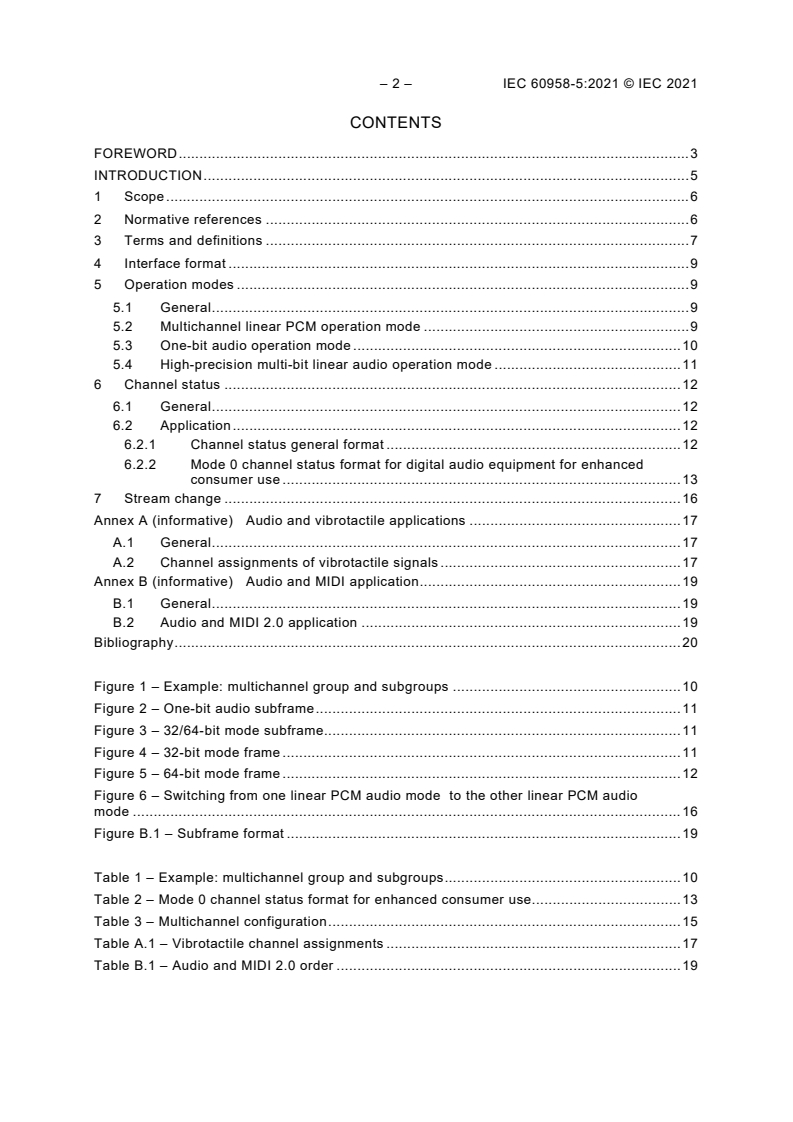
CONTENTS
FOREWORD . 3
INTRODUCTION . 5
1 Scope . 6
2 Normative references . 6
3 Terms and definitions . 7
4 Interface format . 9
5 Operation modes . 9
5.1 General . 9
5.2 Multichannel linear PCM operation mode . 9
5.3 One-bit audio operation mode . 10
5.4 High-precision multi-bit linear audio operation mode . 11
6 Channel status . 12
6.1 General . 12
6.2 Application . 12
6.2.1 Channel status general format . 12
6.2.2 Mode 0 channel status format for digital audio equipment for enhanced
consumer use . 13
7 Stream change . 16
Annex A (informative) Audio and vibrotactile applications . 17
A.1 General . 17
A.2 Channel assignments of vibrotactile signals . 17
Annex B (informative) Audio and MIDI application . 19
B.1 General . 19
B.2 Audio and MIDI 2.0 application . 19
Bibliography . 20
Figure 1 – Example: multichannel group and subgroups . 10
Figure 2 – One-bit audio subframe . 11
Figure 3 – 32/64-bit mode subframe. 11
Figure 4 – 32-bit mode frame . 11
Figure 5 – 64-bit mode frame . 12
Figure 6 – Switching from one linear PCM audio mode to the other linear PCM audio
mode . 16
Figure B.1 – Subframe format . 19
Table 1 – Example: multichannel group and subgroups . 10
Table 2 – Mode 0 channel status format for enhanced consumer use. 13
Table 3 – Multichannel configuration . 15
Table A.1 – Vibrotactile channel assignments . 17
Table B.1 – Audio and MIDI 2.0 order . 19
INTERNATIONAL ELECTROTECHNICAL COMMISSION
____________
DIGITAL AUDIO INTERFACE –
Part 5: Consumer application enhancement
FOREWORD
1) The International Electrotechnical Commission (IEC) is a worldwide organization for standardization comprising
all national electrotechnical committees (IEC National Committees). The object of IEC is to promote international
co-operation on all questions concerning standardization in the electrical and electronic fields. To this end and
in addition to other activities, IEC publishes International Standards, Technical Specifications, Technical Reports,
Publicly Available Specifications (PAS) and Guides (hereafter referred to as “IEC Publication(s)”). Their
preparation is entrusted to technical committees; any IEC National Committee interested in the subject dealt with
may participate in this preparatory work. International, governmental and non-governmental organizations liaising
with the IEC also participate in this preparation. IEC collaborates closely with the International Organization for
Standardization (ISO) in accordance with conditions determined by agreement between the two organizations.
2) The formal decisions or agreements of IEC on technical matters express, as nearly as possible, an international
consensus of opinion on the relevant subjects since each technical committee has representation from all
interested IEC National Committees.
3) IEC Publications have the form of recommendations for international use and are accepted by IEC National
Committees in that sense. While all reasonable efforts are made to ensure that the technical content of IEC
Publications is accurate, IEC cannot be held responsible for the way in which they are used or for any
misinterpretation by any end user.
4) In order to promote international uniformity, IEC National Committees undertake to apply IEC Publications
transparently to the maximum extent possible in their national and regional publications. Any divergence between
any IEC Publication and the corresponding national or regional publication shall be clearly indicated in the latter.
5) IEC itself does not provide any attestation of conformity. Independent certification bodies provide conformity
assessment services and, in some areas, access to IEC marks of conformity. IEC is not responsible for any
services carried out by independent certification bodies.
6) All users should ensure that they have the latest edition of this publication.
7) No liability shall attach to IEC or its directors, employees, servants or agents including individual experts and
members of its technical committees and IEC National Committees for any personal injury, property damage or
other damage of any nature whatsoever, whether direct or indirect, or for costs (including legal fees) and
expenses arising out of the publication, use of, or reliance upon, this IEC Publication or any other IEC Publications.
8) Attention is drawn to the Normative references cited in this publication. Use of the referenced publications is
indispensable for the correct application of this publication.
9) Attention is drawn to the possibility that some of the elements of this IEC Publication may be the subject of patent
rights. IEC shall not be held responsible for identifying any or all such patent rights.
IEC 60958-5 has been prepared by Technical Area 20: Analogue and digital audio, of IEC
Technical Committee 100: Audio, video and multimedia systems and equipment. It is an
International Standard.
The text of this International Standard is based on the following documents:
Draft Report on voting
100/3449/CDV 100/3517/RVC
Full information on the voting for its approval can be found in the report on voting indicated in
the above table.
The language used for the development of this International Standard is English.
This document was drafted in accordance with ISO/IEC Directives, Part 2, and developed in
accordance with ISO/IEC Directives, Part 1 and ISO/IEC Directives, IEC Supplement, available
at www.iec.ch/members_experts/refdocs. The main document types developed by IEC are
described in greater detail at www.iec.ch/standardsdev/publications.
– 4 – IEC 60958-5:2021 © IEC 2021
A list of all parts in the IEC 60958 series, published under the general title Digital audio interface,
can be found on the IEC website.
The committee has decided that the contents of this document will remain unchanged until the
stability date indicated on the IEC website under "http://webstore.iec.ch" in the data related to
the specific document. At this date, the document will be
• reconfirmed,
• withdrawn,
• replaced by a revised edition, or
• amended.
INTRODUCTION
IEC 60958-3 edition 1.0 was released in 1999 specifying the consumer applications of the
interface for the inter-connection of digital audio equipment defined in IEC 60958-1. The
applications have enhanced their quality including multichannel modes, high-precision bit length,
and multi-stream modes. These enhancements imply a new part in the IEC 60958 series,
appropriately keeping backward compatibility with IEC 60958-3 and providing a new enhanced
digital audio interface.
– 6 – IEC 60958-5:2021 © IEC 2021
DIGITAL AUDIO INTERFACE –
Part 5: Consumer application enhancement
1 Scope
This part of IEC 60958 enhances the consumer application of the interface for the
interconnection of digital audio equipment defined in IEC 60958-1 and IEC 60958-3, introducing:
– multichannel;
– multi-stream;
– high-resolution;
– multimedia extension;
– related applications.
NOTE IEC 60958-3 specifies a consumer application to carry stereophonic programmes with a resolution of up to
24 bits per sample. This part of IEC 60958 enhances the application, allowing programmes with up to 64 channels,
64 bits per sample, and two simultaneous streams.
2 Normative references
The following documents are referred to in the text in such a way that some or all of their content
constitutes requirements of this document. For dated references, only the edition cited applies.
For undated references, the latest edition of the referenced document (including any
amendments) applies.
IEC 60958-1:20— , Digital audio interface – Part 1: General
IEC 60958-3:20— , Digital audio interface – Part 3: Consumer applications
IEC 62574:2020, Audio, video and multimedia systems – General channel assignment of
multichannel audio
ISO/IEC 23001-8:2016, Information technology – MPEG systems technologies – Part 8: Coding-
independent code points
ITU-R BS.2094-1:2017, Common definitions for the audio definition model
ITU-R BS.2051-2:2018, Advanced sound system for programme production
—————————
Under preparation. Stage at the time of publication: IEC CCDV 60958-1:2021.
Under preparation. Stage at the time of publication: IEC CCDV 60958-3:2021.
This publication was withdrawn and replaced with ISO/IEC 23091-3:2018, ISO/IEC 23091-1:2018 and ISO/IEC
23091-2:2019.
3 Terms and definitions
For the purposes of this document, the following terms and definitions apply.
ISO and IEC maintain terminological databases for use in standardization at the following
addresses:
• IEC Electropedia: available at http://www.electropedia.org/
• ISO Online browsing platform: available at http://www.iso.org/obp
3.1
one-bit audio
one-bit length audio data stream
Note 1 to entry: A one-bit audio data stream can be directly played back through the analogue low-pass filter bit by
bit (MSB first).
3.2
high-precision multi-bit linear audio
linear PCM audio data longer than 25 bits length per sample
Note 1 to entry: This document supports 32- and 64-bit lengths.
3.3
sampling frequency
frequency of the samples representing an audio signal.
Note 1 to entry: When more than one signal is transmitted through the same interface, the sampling frequencies
are identical.
[SOURCE: IEC 60958-1:20—, 3.1]
3.4
audio sample word
value of a digital audio sample
Note 1 to entry: Representation is linear in 2's complement binary form.
Note 2 to entry: Positive numbers correspond to positive analogue voltages at the input of the analogue-to-digital
converter (ADC).
[SOURCE: IEC 60958-1: 20—, 3.2]
3.5
channel status
data carrying, in a fixed format, information associated with each main data field channel, which
is decodable by any interface user.
Note 1 to entry: IEC 60958-3 specifies the mode 0 channel status format for digital audio equipment for consumer
use.
EXAMPLE 1 Length of audio sample words.
EXAMPLE 2 Sampling frequency.
[SOURCE: IEC 60958-1:20—, 3.5, modified – Modification of the Note to entry, and addition of
two examples.]
3.6
preamble
specific patterns used for synchronization.
– 8 – IEC 60958-5:2021 © IEC 2021
Note 1 to entry: There are three different preambles: “B”; “M”; and “W”.
[SOURCE: IEC 60958-1:20—, 3.8, modified – Modification of the Note to entry.]
3.7
sub-frame
fixed structure used to carry information
[SOURCE: IEC 60958-1:20—, 3.9]
3.8
frame
sequence of two successive and associated sub-frames
[SOURCE: IEC 60958-1:20—, 3.10]
3.9
block
group of 192 consecutive frames
Note 1 to entry: The start of a block is designated by a special sub-frame preamble.
[SOURCE: IEC 60958-1:20—, 3.11]
3.10
channel number
number that shows channel order in two-channel operation mode
3.11
channel label ID
label of ID
[SOURCE: IEC 62574:2020, 3.73]
3.11.1
multichannel number
number that identifies multichannel addressing
Note 1 to entry: Same as IEC 62574 channel number
3.12
multichannel group
group composed of one or two multichannel subgroups
3.13
multichannel count
count of channels in a multichannel group
3.14
multichannel subgroup
subgroup, in a multichannel group, composed of several multichannel
Note 1 to entry: Multichannel subgroup A is set according to multichannel configuration.
Note 2 to entry: Multichannel subgroup B is set according to multichannel map.
3.15
multichannel configuration
configuration of multichannel addressing
3.16
multichannel order
order of multichannel in a multichannel group
3.17
multichannel map
map of multichannel selections
4 Interface format
The interface format as defined in IEC 60958-1 and IEC 60958-3 shall be used unless otherwise
specified in this document.
5 Operation modes
5.1 General
IEC 60958-1 specifies single- and two-channel operation modes. This document introduces
several new operation modes based on the same interface format of IEC 60958-1 without the
pre-emphasis function defined in IEC 60958-3. Channel status information identifies these
modes in operation. This document shares the information with IEC 60958-1 and IEC 60958-3
and specifies new usages.
5.2 Multichannel linear PCM operation mode
In multichannel linear PCM operation mode, the samples taken from multichannel linear PCM
are transmitted by time multiplexing in consecutive sub-frames.
A multichannel group is composed of several multichannel by consecutive frames. The number
of multichannels included in the group is identified by the multichannel count of channel status
bits 44 to 47. The group starts with preamble “B” and repeats itself with no break in the block
and without un-grouped frames. The group is divided into one or two multichannel subgroups
by the multichannel configuration of channel status bits 49 to 60 and the multichannel map of
channel status bits 64 to 165. The subgroup is composed of some specific multichannels by
consecutive sub-frames. Each multichannel within the multichannel subgroup B is re-numbered
according to the multichannel number of channel status bits 64 to 165. Each channel carries
consecutive audio sample words.
An example is shown in Figure 1 and Table 1. The multichannel group is composed of eight
multichannels. This number of eight is identified by the multichannel count value of “1110”. The
multichannel subgroup A is composed of three multichannels identified by the multichannel
configuration value of “100001010000”, which includes FrontLeft channel, FrontRight channel
and FrontCenter channel given in ITU-R BS.2094-1. The multichannel subgroup B is composed
th
of the 77 multichannel (channel label ID name of HFL) and 78th multichannel (channel label
ID name of HFR) by setting the channel status bit 77 to “1” and the channel status bit 78 to “1”.
Channels of multichannel order 6, 7 and 8 are not used in this example.
– 10 – IEC 60958-5:2021 © IEC 2021
Figure 1 – Example: multichannel group and subgroups
The sampling frequency of each audio multichannel is identical and identified by the original
sampling frequency of channel status bits 36 to 39. The sampling frequency of channel status
bits 24 to 27, 30 and 31 identifies the IEC 60958 frame rate in operation.
Table 1 – Example: multichannel group and subgroups
Preamble Channel Multichannel Multichannel Multichannel subgroup B
number order subgroup A
ITU-R BS.2094-1; Multichannel map C‑Bit 64‑191;
audioPackFormatID, Multichannel number value:
audioChannelNames Channel label ID name
B 1 1 AP_0001000a
FrontLeft
W 2 2
FrontRight
M 1 3 FrontCenter
W 2 4 77: HFL
M 1 5 78: HFR
W 2 6
M 1 7
W 2 8
M 1 1 AP 0001000a
FrontLeft
W 2 2
FrontRight
M 1 3 FrontCenter
W 2 4 77: HFL
M 1 5 78: HFR
W 2 6
M 1 7
W 2 8
M 1 1 AP_0001000a
⁞ ⁞ ⁞ ⁞ ⁞
M 1 7
W 2 8
AP 0001000a
B 1 1
FrontLeft
M 2 2
FrontRight
W 1 3 FrontCenter
5.3 One-bit audio operation mode
In one-bit audio operation mode, the samples taken from multichannel one-bit audio stream are
transmitted by time multiplexing in consecutive sub-frames. The sub-frame format is shown in
Figure 2.
Figure 2 – One-bit audio subframe
Time slots 4 to 19 carry on-bit audio samples composed of 16 bits of the consecutive one-bit
audio stream. Significant bit (MSB) is carried by time slot 19.
Time slots 20 to 17 are not used; they are filled with zeros or a few fixed patterns and ignored.
The frame format as defined in multichannel linear PCM operation mode is used for
multichannel one-bit audio operation mode.
The sampling frequency of each one-bit audio channel is identical and identified by the original
sampling frequency of the channel status bits 36 to 39, which is 16 multiples of that of the
multichannel linear PCM. The sampling frequency of channel status bits 24 to 27, 30 and 31
identifies the IEC 60958 frame rate in operation. IEC 60958-3 defines the original sampling
frequency where one-bit audio multiples 16 and sampling frequency as the IEC 60958 frame
rate.
5.4 High-precision multi-bit linear audio operation mode
In the high-precision multi-bit linear audio operation mode, the samples taken from the
multichannel high-precision multi-bit linear audio are transmitted by time multiplexing in
consecutive sub-frames dividing of word. The sub-frame format of 32/64-bit mode is shown in
Figure 3. The frame formats are shown in Figure 4 and Figure 5.
Figure 3 – 32/64-bit mode subframe
In 32-bit audio operation mode, time slots 4 to 19 carry 16-bit samples of 32-bit audio words.
Significant bit (MSB) is carried by time slot 19. Time slots 20 to 17 are not used; they are filled
with zeros or a few fixed patterns and ignored.
Figure 4 – 32-bit mode frame
The frame format as defined in the multichannel linear PCM operation mode is used for
multichannel 32-bit operation modes.
– 12 – IEC 60958-5:2021 © IEC 2021
The original sampling frequency for the 32-bit mode corresponds to 1/2 of that of the
multichannel linear PCM.
In 64-bit audio operation mode, time slots 4 to 19 carry 16-bit samples of 64-bit audio words.
Most significant bit (MSB) is carried by time slot 19. Time slots 20 to 17 are not used; they are
filled with zeros or a few fixed patterns and ignored.
Figure 5 – 64-bit mode frame
The frame format as defined in the multichannel linear PCM operation mode is used for
multichannel 64-bit operation modes.
The original sampling frequency for 64-bit mode corresponds to 1/4 of that of the multichannel
linear PCM.
6 Channel status
6.1 General
The channel status format as defined in IEC 60958-1 and IEC 60958-3 shall be used unless
this document specifies.
6.2 Application
6.2.1 Channel status general format
For each IEC 60958-5 channel, the channel status block provides the information described in
this clause and summarized in Table 2.
6.2.2 Mode 0 channel status format for digital audio equipment for enhanced
consumer use
Table 2 – Mode 0 channel status format for enhanced consumer use
Byte
0 a = “0” b = “0” c D Mode = “0 0”
“0 0 1”: Multichannel LPCM
“0 1 1”: refer to bit 32-35
bit 0 1 2 3 4 5 6 7
1 Category code
bit 8 9 10 11 12 13 14 15
Source number Channel number
bit 16 17 18 19 20 21 22 23
Sampling frequency
3 Sampling frequency Clock accuracy
extension
bit 24 25 26 27 28 29 30 31
Word length Original sampling frequency
“0 0 0 0”: one-bit audio
“1 0 0 0”: 32-bit audio (2 sub-frames per channel)
“0 1 0 0”: 64-bit audio (4 sub-frames per channel)
bit 32 33 34 35 36 37 38 39
CGMS-A CGMS-A Audio sampling frequency coefficient/Multichannel Count
validity “0 0 0 0”: 2 ch (x 1 speed)
“1 0 1 1”: 64 ch (x 32 speed)
“1 1 0 0”: 32 ch (x 16 speed)
“1 1 0 1”: 16 ch (x 8 speed)
“1 1 1 0”: 8 ch (x 4 speed)
“1 1 1 1”: 4 ch (x 2 speed)
bit 40 41 42 43 44 45 46 47
Information General channel
6 General channel assignment channel number for A channel
hidden in PCM assignment
signal channel number
for B channel
Multichannel configuration
bit 48 49 50 51 52 53 54 55
General channel assignment
7 LFE Playback level reserved
channel number for B channel
Multichannel configuration
bit 56 57 58 59 60 61 62 63
8 IEC 62574:2020 general channels
Multichannel
FL FR FC LFE LS RS FLc
map bit 65 to
191;
0: De-
activated
1: Activated
bit 64 65 66 67 68 69 70 71
IEC 62574:2020 general channels
FRc BC LFE1 SiL SiR HFL HFR HFC
bit 72 73 74 75 76 77 78 79
10 IEC 62574:2020 general channels
OhC HLS HRS HsiL HSiR HBC BtFC BtFLmid
bit 80 81 82 83 84 85 86 87
IEC 62574:2020 general channels
BtFRmid FLw FRw BL BR LBS RBS HBL
bit 88 89 90 91 92 93 94 95
IEC 62574:2020 general channels
HBR HFLw HFRw OhFL OhFR OhSiL OhSiR OhBL
bit 96 97 98 99 100 101 102 103
IEC 62574:2020 general channels
OhBR HFLmid HFRmid HBLmid HBRmid FLmid FRmid BLmid
bit 104 105 106 107 108 109 110 111
14 IEC 62574:2020 general channels
BRmid LFE2 OhBC
112 113 114 115 116 117 118 119
bit
bit 120 121 122 123 124 125 126 127
– 14 – IEC 60958-5:2021 © IEC 2021
bit 128 129 130 131 132 133 134 135
bit 136 137 138 139 140 141 142 143
DL
bit 144 145 146 147 148 149 150 151
IEC 62574:2020 general channels
DR DLc DRc DC HDL HDR HDLc HDRc
bit 152 153 154 155 156 157 158 159
20 IEC 62574:2020 general channels
HDC BtDL BtDR BtDLc BtDRc BtDC
bit 160 161 162 163 164 165 166 167
bit 168 169 170 171 172 173 174 175
bit 176 177 178 179 180 181 182 183
bit 184 185 186 187 188 189 190 191
Key
a: use of channel status block.
b: linear PCM identification.
c: copyright information.
d: additional format information.
Bit 0 “0” Consumer use of channel status block.
Bit 1 “0” Audio sample word represents linear PCM samples.
Bit s 3 4 5 additional format information, meaning depends on bit 1 = “0”.
State “0 0 1” multichannel Linear PCM operation mode.
“0 1 1” operation mode depending on bit 32-35.
Bits 6 7
State “0 0” Mode 0, refer to IEC 60958-3:20—, 5.2.2.
When bit 3 4 5 = “0 1 1”,
Bits 32 33 34 35 Sample word length information
State “0 0 0 0” one-bit audio operation mode
“1 0 0 0” 32-bit audio operation mode (2 sub-frames per channel)
“0 1 0 0” 64-bit audio operation mode (4 sub-frames per channel)
When bits 3 4 5 = “0 0 1” or “0 1 1”,
Bits 44 45 46 47 Multichannel count
“0 0 0 0”: 2 channels (x 1 speed transmission)
“1 0 1 1”: 64 channels (x 32 speed transmission)
“1 1 0 0”: 32 channels (x 16 speed transmission)
“1 1 0 1”: 16 channels (x 8 speed transmission)
“1 1 1 0”: 8 channels (x 4 speed transmission)
“1 1 1 1”: 4 channels (x 2 speed transmission)
When bits 3 4 5 = “0 0 1” or “0 1 1”,
Bits 49 to 60 Multichannel configuration
Table 3 lists multichannel configurations for multichannel subgroup A. Transmitting channel
order is as same as the listed order in each reference document, except for the specification in
this document.
Table 3 – Multichannel configuration
Multichannel configuration Number of Reference Remark
value channels
000000000000 0 No configuration Multichannel subgroup A is not available.
Configured by Recommendation ITU-R BS.2094-1: ‘DirectSpeakers’ audioPackFormatID
100010000000 1 AP_00010001 Also see ITU-R BS.775-3
100001000000 2 AP_00010002 Also see ITU-R BS.775-3, BS.2051-2 (A)
100011000000 6 AP_00010003 Also see ITU-R BS.775-3, BS.2051-2 (B)
100000100000 8 AP_00010004 Also see ITU-R BS.2051-2 (C)
100010100000 10 AP_00010005 Also see ITU-R BS.2051-2 (D)
100001100000 11 AP_00010006 Also see ITU-R BS.2051-2 (E)
100011100000 12 AP_00010007 Also see ITU-R BS.2051-2 (F)
100000010000 14 AP_00010008 Also see ITU-R BS.2051-2 (G)
100010010000 24 AP_00010009 Also see ITU-R BS.2051-2 (H)
100001010000 3 AP_0001000a Also see ITU-R BS.775-3
100011010000 4 AP_0001000b Also see ITU-R BS.775-3
100000110000 5 AP_0001000c Also see ITU-R BS.775-3
100010110000 7 AP_0001000d
100001110000 8 AP_0001000e
100011110000 8 AP_0001000f Also see ITU-R BS.2051-2 (I)
100010001000 19 AP_00010011
100001001000 8 AP_00010012
100011001000 8 AP_00010013
100000101000 10 AP_00010014
100010101000 12 AP_00010015
100001101000 10 AP_00010016
100011101000 12 AP_00010017 Also see ITU-R BS.2051-2 (J)
Configured by Recommendation ITU-R BS.2094-1: ‘Binaural’ audioPackFormatID
101010000000 2 AP_00050001
Configured by ISO/IEC 23001-8: ChannelConfigutation
011010000000 1 ChannelConfiguration 1 Also see ITU-R BS.2094-1 (AP_00010001)
011001000000 2 ChannelConfiguration 2 Also see ITU-R BS.2094-1 (AP_00010002)
011011000000 3 ChannelConfiguration 3 Also see ITU-R BS.2094-1 (AP_0001000a)
011000100000 4 ChannelConfiguration 4 Also see ITU-R BS.2094-1 (AP_0001000b)
011010100000 5 ChannelConfiguration 5 Also see ITU-R BS.2094-1 (AP_0001000c)
011001100000 6 ChannelConfiguration 6 Also see ITU-R BS.2094-1 (AP_00010003)
011011100000 8 ChannelConfiguration 7 Also see ITU-R BS.2094-1 (AP_0001000e)
011000010000 2 ChannelConfiguration 8
011010010000 3 ChannelConfiguration 9
011001010000 4 ChannelConfiguration 10
011011010000 7 ChannelConfiguration 11 Also see ITU-R BS.2094-1 (AP_0001000d)
011000110000 8 ChannelConfiguration 12
011010110000 24 ChannelConfiguration 13 Also see ITU-R BS.2094-1 (AP_00010009)
011001110000 8 ChannelConfiguration 14 Also see ITU-R BS.2094-1 (AP_00010004)
011011110000 12 ChannelConfiguration 15 Also see ITU-R BS.2094-1 (AP_00010007)
011000001000 10 ChannelConfiguration 16 Also see ITU-R BS.2094-1:(AP_00010005)
011010001000 12 ChannelConfiguration 17
011001001000 14 ChannelConfiguration 18
011011001000 12 ChannelConfiguration 19
011000101000 12 ChannelConfiguration 20
Configured by IEC documents
111110000000 32 IEC 62574:2011 Also see IEC 62574:2020 Annex A
111101000000 22 Audio and vibrotactile application A See Annex A
111111000000 12 Audio and vibrotactile application B See Annex A
111100100000 12 Audio and vibrotactile application C See Annex A
111110100000 10 Audio and vibrotactile application D See Annex A
11110110000 6 Audio and vibrotactile application E See Annex A
11111110000 6 Audio and vibrotactile application F See Annex A
– 16 – IEC 60958-5:2021 © IEC 2021
11110001000 6 Audio and vibrotactile application G See Annex A
11111001000 3 Audio and vibrotactile application H See Annex A
11110101000 4 Audio and vibrotactile application I See Annex A
11111101000 4 Audio and vibrotactile application J See Annex A
11110011000 6 Audio and vibrotactile application K See Annex A
11111011000 4 Audio and MIDI 2.0 application See Annex B
Any other combinations are reserved and not used until they are defined in the future editions
of this document.
Bit 64 Multichannel map bits 65 to 165
”0”: De-activated
“1”: Activated
NOTE When the multichannel map is de-activated, multichannel subgroup B is unused in the multichannel group.
When bit 64 = “1”,
Bits 65 to 165 IEC 62574:2020 general channels
Bit XX ”0”: the corresponding channel is not included in multichannel subgroup B.
“1”: the corresponding channel is included in multichannel subgroup B.
A channel whose channel number is XX in IEC 62574:2020 is mapped on bit XX. Each bit XX
is named by the corresponding channel label ID name in IEC 62574:2020, shown in Table 2.
7 Stream change
IEC 60958-1:20—, Annex F introduces stream change procedure; switching from linear PCM to
nonlinear PCM, switching from nonlinear PCM to linear PCM, and switching from nonlinear PCM
to another nonlinear PCM.
This document adopts the same switching procedure as one defined in IEC 60958-1:20—,
Annex F to the switching procedure from one linear PCM audio mode to the other linear PCM
audio mode; see Figure 6. This switching is involved by any changes in channel status bits 3 to
5, 32 to 35, 44 to 47, 49 to 60 and 64 to 165.
Figure 6 – Switching from one linear PCM audio mode
to the other linear PCM audio mode
The interface should be idle during the transition, the null data is applied, and the channel status
bit 1 is set to nonlinear PCM. The audio signal at the start and end portions of linear PCM data
can fade in and out; this is effective for avoiding artefacts.
Annex A
(informative)
Audio and vibrotactile applications
A.1 General
ISO 9241-910 provides a framework for understanding and communicating various aspects of
tactile/haptic interaction. In addition to these ergonomic interactions, audio and vibrotactile
applications are becoming increasingly important in the field of audio, video and multimedia
systems and equipment as IEC TR 63344 reports. The term "vibrotactile" is defined in ISO 9241-
910 as vibration-based stimulation of the skin. In this annex, preliminary channel assignments
for interface of audio and vibrotactile applications are supported. The vibrotactile signal is
transmitted over the existing LPCM audio channel. This annex does not specify the vibrotactile
properties, but handles it as the same specification as the transmitted audio signal. Further
developments in this technical area can introduce general channel assignments.
A.2 Channel assignments of vibrotactile signals
Table A.1 collects vibrotactile contact positions on human skin for some audio and vibrotactile
applications. Typically, in signal transmission, the left audio and the right audio are assigned
for channel 1 and 2, respectively. The channel assignment of vibrotactile signals starts from
channel number 3. Vibrotactile application is labelled with character A to K and vibrotactile
channel numbers are detailed.
Table A.1 – Vibrotactile channel assignments
Audio and vibrotactile application
A B C D E F G H I J K
Vibrotactile Front head 3
contact
Back head 4
Left head 3
Right head 4
Left shoulder 3
Right shoulder 4
a a
Left chest 3 3 5 3
13 5
a a
Right chest 4 4 6 4
13 5
Left low chest 15 5 5 7
Right low chest 16 6 6 8
a a
Left belly 17 7 9
4 3
a a
Right belly 18 8 10
4 3
Left leg 23 7 11
Right leg 24 8 12
a a a
Left foot 25 9 13 5
6 6 6
a a a
Right foot 26 10 14 6
6 6 6
Left upper arm 5 5
Right upper arm 6 6
Left forearm 7 9
Right forearm 8 10
– 18 – IEC 60958-5:2021 © IEC 2021
Audio and vibrotactile application
A B C D E F G H I J K
Left wrist 9 11 (3)
Right wrist 10 12 3
a
Left hand 11 3 3
a
Right hand 12 4 4
a a a
Left back 9
14 5 4
a a a
Right back 10
14 5 4
Left low back 19 11
Right low back 20 12
a
Left hip 21
a
Right hip 22
a
When the left signal and right signal are same, mono presentation may be used.
Vibrotactile application A to K are referred as follows:
• Vibrotactile application A: Synesthesia Suit, https://synesthesia-suit.com/
• Vibrotactile application B: JUMANJI, https://www.sonypictures.jp/corp/press/2018-03-24
(only available in Japanese)
• Vibrotactile application C: CAPTAIN TSUBASA,
http://hapticdesign.org/designer/file016_Ryo_Yokoyama (only available in Japanese)
• Vibrotactile application D: ANGRY BIRDS,
https://news.livedoor.com/article/detail/12036742/ (only available in Japanese)
• Vibrotactile application E: VR,
https://taclim.cerevo.com/ja/?fbclid=IwAR2uW_ndk6ZojK_PgQBLPZPUiX3Nix6PL9l5-
K61WtZVV57YI1EWWZ6uinw (only available in Japanese)
• Vibrotactile application F: Gaming, http://hapbeat.com/index.html#en
• Vibrotactile application G: IPTV, https://www.ntticc.or.jp/en/archive/works/tactile-tv/
• Vibrotactile application H: GHOSTBUSTERS, https://www.ginzasonypark.jp/e/program/019/
• Vibrotactile application I: Headset, https://www.sony.com.tw/en/electronics/headband-
headphones/mdr-xb450bv
• Vibrotactile application J: Neck,
https://labevent.ecl.ntt.co.jp/forum2019/elements/pdf_jpn/A06_j.pdf (only available in
Japanese)
• Vibrotactile application K: Relaxation,
https://jpn.pioneer/ja/corp/sustainability/karadadekikou/about/ (only available in Japanese)
Annex B
(informative)
Audio and MIDI application
B.1 General
Audio and MIDI application in this annex is a supported preliminary protocol. Further
developments in this technical area can introduce different usages.
B.2 Audio and MIDI 2.0 application
Audio and MIDI 2.0 application consists of four channels and each channel is transmitted in the
order shown in Table B.1 and Figure B.1. The first two channels convey audio signals and the
others convey MIDI 2.0 packets in the following subframes format.
Table B.1 – Audio and MIDI 2.0 order
Order Audio and MIDI 2.0, four channels case
1 L channel
2 R channel
3 MIDI 2.0
Figure B.1 – Subframe format
MIDI 2.0 packet is inserted into the packet-payload with 16-bit arraignment in MSB first. The
packet-preamble indicates the state of the insertion.
Time slots 20 to 27 Packet-preamble
Slot 20 21 22 23 24 25 26 27
State “ 0 0 0 0 0 0 0 0” no packet
“ 1 0 0 0 0 0 0 0” packet starts
“ 0 1 0 0 0 0 0 0” packet continues
– 20 – IEC 60958-5:2021 © IEC 2021
Bibliography
[1] ISO 9241-910:2011, Ergonomics of human-system interaction – Part 910: Framework
for tactile and haptic interaction
[2] MMA/AMEI, Universal MIDI Packet (UMP) Format and MIDI 2.0 Protocol:2020,
https://www.midi.org/
[3] IEC TR 63344:20— , Multimedia systems – Haptics – Conceptual model of
standardization
[4] IEC 61883-6:2014, Consumer audio/video equipment – Digital interface – Part 6: Audio
and music data transmission protocol
[5] IEC 62574:2011 , Audio, video and multimedia systems – General channel assignment
of multichannel audio
[6] ITU-R BS.775-3:2012, Multichannel stereophonic sound system with and without
accompanying picture
___________
—————————
Under preparation. Stage at the time of publication: IEC ADTR 63344:2021.
This publication was withdrawn.
– 22 – IEC 60958-5:2021 © IEC 2021
SOMMAIRE
AVANT-PROPOS . 23
INTRODUCTION . 25
1 Domaine d'application . 26
2 Références normatives . 26
3 Termes et définitions . 27
4 Format d'interface.
...