

IEC 62841-4-2:2017
(Main)Electric motor-operated hand-held tools, transportable tools and lawn and garden machinery - Safety - Part 4-2: Particular requirements for hedge trimmers
General Information
- Abstract
IEC 62841-4-2:2017 applies to hand-held hedge trimmers which are designed for use by one operator for trimming hedges and bushes, including extended-reach hedge trimmers with a maximum length of 3,5 m. The rated voltage is not more than 250 V for single-phase a.c. or d.c. tools, and 480 V for three-phase a.c. tools. The rated input is not more than 3 700 W. The limits for the applicability of this standard for battery tools are given in K.1 and L.1. This standard deals with the hazards presented by tools which are encountered by all persons in the normal use and reasonably foreseeable misuse of the tools. Hand-held electric tools, which can be mounted on a support or working stand for use as fixed tools without any alteration of the tool itself, are within the scope of this standard and such combination of a hand-held tool and a support is considered to be a transportable tool and thus covered by the relevant Part 3.
This standard is not applicable to hedge trimmers with a rotating blade.
This standard is not applicable to scissors type grass shears.
This Part 4-2 is to be used in conjunction with the first edition of IEC 62841-1:2014.
The attention of National Committees is drawn to the fact that equipment manufacturers and testing organizations may need a transitional period following publication of a new, amended or revised IEC publication in which to make products in accordance with the new requirements and to equip themselves for conducting new or revised tests.
It is the recommendation of the committee that the content of this publication be adopted for implementation nationally not earlier than 36 months from the date of publication
The contents of the corrigendum of June 2018 have been included in this copy.
Key words: Hedge trimmer, Hand-held tool, Safety
- Status
- Published
- Publication Date
- 10-May-2022
- Technical Committee
- TC 116 - Safety of motor-operated electric tools
- Drafting Committee
- WG 10 - TC 116/WG 10
- Current Stage
- PPUB - Publication issued
- Start Date
- 14-Dec-2017
- Completion Date
- 01-Dec-2017
Buy Documents
IEC 62841-4-2:2017 - Electric motor-operated hand-held tools, transportable tools and lawn and garden machinery - Safety - Part 4-2: Particular requirements for hedge trimmers Released:12/14/2017

IEC 62841-4-2:2017+AMD1:2022 CSV - Electric motor-operated hand-held tools, transportable tools and lawn and garden machinery - Safety - Part 4-2: Particular requirements for hedge trimmers Released:5/11/2022
Overview
IEC 62841-4-2:2017 is an international standard published by the International Electrotechnical Commission (IEC) that sets forth particular safety requirements for electric motor-operated hand-held hedge trimmers. This standard specifically applies to hand-held hedge trimmers designed for use by a single operator for trimming hedges and bushes, including extended-reach hedge trimmers up to 3.5 meters in length. It covers tools powered by single-phase AC or DC at voltages up to 250 V, and three-phase AC tools up to 480 V, with a rated input power not exceeding 3,700 W. Battery-operated hedge trimmers are included within specific limits detailed in annexes K.1 and L.1.
Key safety aspects addressed focus on hazards during normal use and reasonably foreseeable misuse. The standard excludes hedge trimmers with rotating blades and scissors-type grass shears. It is intended to be used alongside IEC 62841-1:2014, which contains general safety requirements for electric hand-held tools.
Key Topics
- Scope and Applicability: Covers hand-held and transportable hedge trimmers, including electric and battery-powered units under specified voltage and power limits.
- Safety Requirements: Addresses critical issues such as protection against mechanical hazards, electrical safety, protection against live parts, and prevention of access to dangerous moving blades.
- Mechanical and Constructional Safety: Defines requirements for mechanical strength, cutting device design, handle positioning, and operator controls to minimize risk.
- Testing Protocols: Includes rigorous testing for endurance, abnormal operation, impact resistance, moisture and rust resistance, heating, and overload protection.
- Marking and Instructions: Specifies the required safety markings, labels, and user instructions for safe operation and hazard warnings.
- Noise and Vibration Emissions: Provides methods to measure and limit noise and vibration levels to protect operators.
- Battery Tools: Contains normative annexes with additional safety considerations for battery-powered hedge trimmers, including battery packs and safety protection.
- Safety Signage: Includes standardized safety signs for communicating hazards and protective measures effectively to operators.
Applications
IEC 62841-4-2:2017 is essential for:
- Manufacturers of electric and battery-powered hand-held hedge trimmers aiming to comply with international safety standards.
- Testing and Certification Bodies conducting conformity assessments and safety evaluations on hedge trimming tools.
- Product Designers and Engineers developing new hedge trimmers seeking guidance on minimum safety criteria for electrical, mechanical, and ergonomic design.
- Regulatory Authorities adopting this IEC standard for national legislation and safety regulations concerning garden power tools.
- Workplace Safety Professionals implementing safe usage practices and ensuring that equipment adheres to recognized safety benchmarks.
By following this standard, stakeholders ensure that hedge trimmers are safer to operate, reducing risk of injury from cutting components, electrical faults, or mechanical failures.
Related Standards
- IEC 62841-1:2014 – General requirements for electric motor-operated hand-held tools and transportable tools, serving as the foundational document for Part 4-2.
- IEC 62841-4-1 – Particular requirements for lawn and garden machinery, complementing the hedge trimmer focus by covering other garden power tools.
- IEC 61000 series – Standards addressing electromagnetic compatibility (EMC) which may apply to electric hedge trimmers used in proximity to other equipment.
- ISO 7000 / IEC 60417 – Collections of standardized safety signs applicable for use in marking and instructions on hedge trimmers.
- Battery Safety Standards (such as IEC 62133) – Relevant for battery-powered hedge trimmers, ensuring safe battery construction, charging, and handling.
Adherence to IEC 62841-4-2 ensures that hedge trimmers meet stringent international safety requirements tailored for electric motor-operated garden tools, enhancing user safety, reducing hazards, and supporting regulatory compliance worldwide.
Relations
- Effective Date
- 04-Sep-2026
- Effective Date
- 05-Sep-2023
- Effective Date
- 05-Sep-2023
Buy Documents
IEC 62841-4-2:2017 - Electric motor-operated hand-held tools, transportable tools and lawn and garden machinery - Safety - Part 4-2: Particular requirements for hedge trimmers Released:12/14/2017
IEC 62841-4-2:2017+AMD1:2022 CSV - Electric motor-operated hand-held tools, transportable tools and lawn and garden machinery - Safety - Part 4-2: Particular requirements for hedge trimmers Released:5/11/2022
Get Certified
Connect with accredited certification bodies for this standard

DVS-ZERT GmbH
German welding certification society.
CARES (UK Certification Authority for Reinforcing Steels)
UK certification for reinforcing steels and construction.
EWF/IIW (European/International Welding Federation)
International welding personnel certification.
Sponsored listings
Frequently Asked Questions
IEC 62841-4-2:2017 is a standard published by the International Electrotechnical Commission (IEC). Its full title is "Electric motor-operated hand-held tools, transportable tools and lawn and garden machinery - Safety - Part 4-2: Particular requirements for hedge trimmers". This standard covers: IEC 62841-4-2:2017 applies to hand-held hedge trimmers which are designed for use by one operator for trimming hedges and bushes, including extended-reach hedge trimmers with a maximum length of 3,5 m. The rated voltage is not more than 250 V for single-phase a.c. or d.c. tools, and 480 V for three-phase a.c. tools. The rated input is not more than 3 700 W. The limits for the applicability of this standard for battery tools are given in K.1 and L.1. This standard deals with the hazards presented by tools which are encountered by all persons in the normal use and reasonably foreseeable misuse of the tools. Hand-held electric tools, which can be mounted on a support or working stand for use as fixed tools without any alteration of the tool itself, are within the scope of this standard and such combination of a hand-held tool and a support is considered to be a transportable tool and thus covered by the relevant Part 3. This standard is not applicable to hedge trimmers with a rotating blade. This standard is not applicable to scissors type grass shears. This Part 4-2 is to be used in conjunction with the first edition of IEC 62841-1:2014. The attention of National Committees is drawn to the fact that equipment manufacturers and testing organizations may need a transitional period following publication of a new, amended or revised IEC publication in which to make products in accordance with the new requirements and to equip themselves for conducting new or revised tests. It is the recommendation of the committee that the content of this publication be adopted for implementation nationally not earlier than 36 months from the date of publication The contents of the corrigendum of June 2018 have been included in this copy. Key words: Hedge trimmer, Hand-held tool, Safety
IEC 62841-4-2:2017 applies to hand-held hedge trimmers which are designed for use by one operator for trimming hedges and bushes, including extended-reach hedge trimmers with a maximum length of 3,5 m. The rated voltage is not more than 250 V for single-phase a.c. or d.c. tools, and 480 V for three-phase a.c. tools. The rated input is not more than 3 700 W. The limits for the applicability of this standard for battery tools are given in K.1 and L.1. This standard deals with the hazards presented by tools which are encountered by all persons in the normal use and reasonably foreseeable misuse of the tools. Hand-held electric tools, which can be mounted on a support or working stand for use as fixed tools without any alteration of the tool itself, are within the scope of this standard and such combination of a hand-held tool and a support is considered to be a transportable tool and thus covered by the relevant Part 3. This standard is not applicable to hedge trimmers with a rotating blade. This standard is not applicable to scissors type grass shears. This Part 4-2 is to be used in conjunction with the first edition of IEC 62841-1:2014. The attention of National Committees is drawn to the fact that equipment manufacturers and testing organizations may need a transitional period following publication of a new, amended or revised IEC publication in which to make products in accordance with the new requirements and to equip themselves for conducting new or revised tests. It is the recommendation of the committee that the content of this publication be adopted for implementation nationally not earlier than 36 months from the date of publication The contents of the corrigendum of June 2018 have been included in this copy. Key words: Hedge trimmer, Hand-held tool, Safety
IEC 62841-4-2:2017 is classified under the following ICS (International Classification for Standards) categories: 25.140.20 - Electric tools. The ICS classification helps identify the subject area and facilitates finding related standards.
IEC 62841-4-2:2017 has the following relationships with other standards: It is inter standard links to IEC 60745-2-15:2006, IEC 62841-4-2:2017/AMD1:2022, IEC 62841-4-2:2017/COR1:2018. Understanding these relationships helps ensure you are using the most current and applicable version of the standard.
IEC 62841-4-2:2017 is available in PDF format for immediate download after purchase. The document can be added to your cart and obtained through the secure checkout process. Digital delivery ensures instant access to the complete standard document.
Standards Content (Sample)
IEC 62841-4-2 ®
Edition 1.0 2017-12
INTERNATIONAL
STANDARD
NORME
INTERNATIONALE
Electric motor-operated hand-held tools, transportable tools and lawn and
garden machinery – Safety –
Part 4-2: Particular requirements for hedge trimmers
Outils électroportatifs à moteur, outils portables et machines pour jardins et
pelouses – Sécurité –
Partie 4-2: Exigences particulières pour les taille-haies
All rights reserved. Unless otherwise specified, no part of this publication may be reproduced or utilized in any form
or by any means, electronic or mechanical, including photocopying and microfilm, without permission in writing from
either IEC or IEC's member National Committee in the country of the requester. If you have any questions about IEC
copyright or have an enquiry about obtaining additional rights to this publication, please contact the address below or
your local IEC member National Committee for further information.
Droits de reproduction réservés. Sauf indication contraire, aucune partie de cette publication ne peut être reproduite
ni utilisée sous quelque forme que ce soit et par aucun procédé, électronique ou mécanique, y compris la photocopie
et les microfilms, sans l'accord écrit de l'IEC ou du Comité national de l'IEC du pays du demandeur. Si vous avez des
questions sur le copyright de l'IEC ou si vous désirez obtenir des droits supplémentaires sur cette publication, utilisez
les coordonnées ci-après ou contactez le Comité national de l'IEC de votre pays de résidence.
IEC Central Office Tel.: +41 22 919 02 11
3, rue de Varembé Fax: +41 22 919 03 00
CH-1211 Geneva 20 info@iec.ch
Switzerland www.iec.ch
About the IEC
The International Electrotechnical Commission (IEC) is the leading global organization that prepares and publishes
International Standards for all electrical, electronic and related technologies.
About IEC publications
The technical content of IEC publications is kept under constant review by the IEC. Please make sure that you have the
latest edition, a corrigenda or an amendment might have been published.
IEC Catalogue - webstore.iec.ch/catalogue Electropedia - www.electropedia.org
The stand-alone application for consulting the entire The world's leading online dictionary of electronic and
bibliographical information on IEC International Standards, electrical terms containing 20 000 terms and definitions in
Technical Specifications, Technical Reports and other English and French, with equivalent terms in 16 additional
documents. Available for PC, Mac OS, Android Tablets and languages. Also known as the International Electrotechnical
iPad. Vocabulary (IEV) online.
IEC publications search - www.iec.ch/searchpub IEC Glossary - std.iec.ch/glossary
The advanced search enables to find IEC publications by a 65 000 electrotechnical terminology entries in English and
variety of criteria (reference number, text, technical French extracted from the Terms and Definitions clause of
committee,…). It also gives information on projects, replaced IEC publications issued since 2002. Some entries have been
and withdrawn publications. collected from earlier publications of IEC TC 37, 77, 86 and
CISPR.
IEC Just Published - webstore.iec.ch/justpublished
Stay up to date on all new IEC publications. Just Published IEC Customer Service Centre - webstore.iec.ch/csc
details all new publications released. Available online and If you wish to give us your feedback on this publication or
also once a month by email. need further assistance, please contact the Customer Service
Centre: csc@iec.ch.
A propos de l'IEC
La Commission Electrotechnique Internationale (IEC) est la première organisation mondiale qui élabore et publie des
Normes internationales pour tout ce qui a trait à l'électricité, à l'électronique et aux technologies apparentées.
A propos des publications IEC
Le contenu technique des publications IEC est constamment revu. Veuillez vous assurer que vous possédez l’édition la
plus récente, un corrigendum ou amendement peut avoir été publié.
Catalogue IEC - webstore.iec.ch/catalogue Electropedia - www.electropedia.org
Application autonome pour consulter tous les renseignements
Le premier dictionnaire en ligne de termes électroniques et
bibliographiques sur les Normes internationales,
électriques. Il contient 20 000 termes et définitions en anglais
Spécifications techniques, Rapports techniques et autres
et en français, ainsi que les termes équivalents dans 16
documents de l'IEC. Disponible pour PC, Mac OS, tablettes
langues additionnelles. Egalement appelé Vocabulaire
Android et iPad.
Electrotechnique International (IEV) en ligne.
Recherche de publications IEC - www.iec.ch/searchpub
Glossaire IEC - std.iec.ch/glossary
65 000 entrées terminologiques électrotechniques, en anglais
La recherche avancée permet de trouver des publications IEC
en utilisant différents critères (numéro de référence, texte, et en français, extraites des articles Termes et Définitions des
comité d’études,…). Elle donne aussi des informations sur les publications IEC parues depuis 2002. Plus certaines entrées
projets et les publications remplacées ou retirées. antérieures extraites des publications des CE 37, 77, 86 et
CISPR de l'IEC.
IEC Just Published - webstore.iec.ch/justpublished
Service Clients - webstore.iec.ch/csc
Restez informé sur les nouvelles publications IEC. Just
Published détaille les nouvelles publications parues. Si vous désirez nous donner des commentaires sur cette
Disponible en ligne et aussi une fois par mois par email. publication ou si vous avez des questions contactez-nous:
csc@iec.ch.
IEC 62841-4-2 ®
Edition 1.0 2017-12
INTERNATIONAL
STANDARD
NORME
INTERNATIONALE
Electric motor-operated hand-held tools, transportable tools and lawn and
garden machinery – Safety –
Part 4-2: Particular requirements for hedge trimmers
Outils électroportatifs à moteur, outils portables et machines pour jardins et
pelouses – Sécurité –
Partie 4-2: Exigences particulières pour les taille-haies
INTERNATIONAL
ELECTROTECHNICAL
COMMISSION
COMMISSION
ELECTROTECHNIQUE
INTERNATIONALE
ICS 25.140.20 ISBN 978-2-8322-4988-8
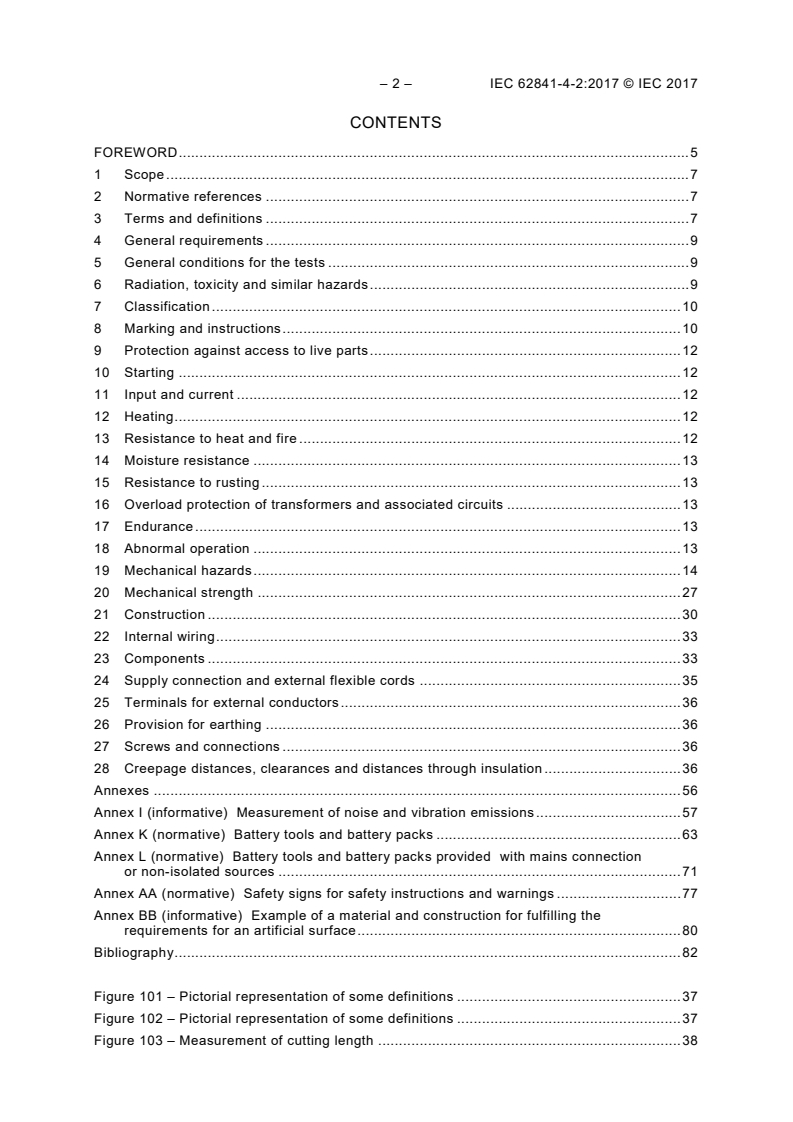
– 2 – IEC 62841-4-2:2017 © IEC 2017
CONTENTS
FOREWORD . 5
1 Scope . 7
2 Normative references . 7
3 Terms and definitions . 7
4 General requirements . 9
5 General conditions for the tests . 9
6 Radiation, toxicity and similar hazards . 9
7 Classification . 10
8 Marking and instructions . 10
9 Protection against access to live parts . 12
10 Starting . 12
11 Input and current . 12
12 Heating . 12
13 Resistance to heat and fire . 12
14 Moisture resistance . 13
15 Resistance to rusting . 13
16 Overload protection of transformers and associated circuits . 13
17 Endurance . 13
18 Abnormal operation . 13
19 Mechanical hazards . 14
20 Mechanical strength . 27
21 Construction . 30
22 Internal wiring . 33
23 Components . 33
24 Supply connection and external flexible cords . 35
25 Terminals for external conductors . 36
26 Provision for earthing . 36
27 Screws and connections . 36
28 Creepage distances, clearances and distances through insulation . 36
Annexes . 56
Annex I (informative) Measurement of noise and vibration emissions . 57
Annex K (normative) Battery tools and battery packs . 63
Annex L (normative) Battery tools and battery packs provided with mains connection
or non-isolated sources . 71
Annex AA (normative) Safety signs for safety instructions and warnings . 77
Annex BB (informative) Example of a material and construction for fulfilling the
requirements for an artificial surface . 80
Bibliography . 82
Figure 101 – Pictorial representation of some definitions . 37
Figure 102 – Pictorial representation of some definitions . 37
Figure 103 – Measurement of cutting length . 38
Figure 104 – Handles positioning . 39
Figure 105 – Measurement of handle gripping length . 41
Figure 106 – Adjustable front handle limits for side to side handle rotation . 41
Figure 107 – Adjustable rear handle limits for side to side handle rotation . 42
Figure 108 – Measurement of reach distance . 42
Figure 109 – Front hand barrier dimensions . 43
Figure 110 – Front hand barrier width for category 3a with adjustable cutting device . 43
Figure 111 – Examples of compliant/non-compliant handle distances and handle
attachments for category 1 . 44
Figure 112 – Measurement of distance from the cutter blade to handles and grasping
surfaces . 45
Figure 113 – Measurement method for minimum length of blunt extensions along the
axis of the cutting device . 46
Figure 114 – Cutting device configuration examples for categories 1 and 2 (see Table
101 and Table 102) . 47
Figure 115 – Cutting device configuration example for categories 3a and 3b (see Table
101 and Table 102) . 47
Figure 116 – Cutting device configuration example for category 4 (see Table 101 and
Table 102) . 48
Figure 117 – Adjustable cutting device side to side limits . 49
Figure 118 – Lower barrier . 49
Figure 119 – Measurement of the force necessary to maintain an extended-reach
hedge trimmer in a horizontal orientation . 50
Figure 120 – Hedge trimmer positions for drop test of 20.3.1 . 52
Figure 121 – Additional drop test of 20.3.1 for extended-reach hedge trimmers . 53
Figure 122 – Impact test apparatus for handle insulation . 54
Figure 123 – Mounting and application of force for the test of 20.101.3.3 . 54
Figure 124 – Example of an operator presence sensor. 55
Figure 125 – Test assembly for accessibility of attachment plug blades . 55
Figure I.101 – Microphone positions on the hemisphere (see Table I.101) . 61
Figure I.102 – Positions of transducers for hedge trimmers . 62
Figure AA.1 – Safety sign illustrating – "DANGER – Keep hands away from blade". 77
Figure AA.2 – Alternative safety sign illustrating – "DANGER – Keep hands away from
blade" . 77
Figure AA.3 – Safety sign illustrating – "Do not expose to rain" . 78
Figure AA.4 – Safety sign illustrating – "Remove plug from the mains immediately if the
cable is damaged or cut" . 78
Figure AA.5 – Safety signs illustrating – "Wear eye protection" . 79
Figure AA.6 – Optional safety sign illustrating – "Wear eye and head protection" . 79
Figure BB.1 – Sketch of the measurement surface covered with an artificial surface
(not to scale). 81
Table 4 – Required performance levels . 14
Table 101 – Hedge trimmer categories (excluding extended-reach hedge trimmers) . 21
Table 102 – Extended-reach hedge trimmer categories . 21
Table 103 – Test cycle for two-handed blade controls with non-sequential operation . 35
– 4 – IEC 62841-4-2:2017 © IEC 2017
Table 104 – Test cycle for two-handed blade controls with sequential operation . 35
Table I.101 – Co-ordinates of microphone positions . 59
Table I.102 – Absorption coefficients . 59
INTERNATIONAL ELECTROTECHNICAL COMMISSION
____________
ELECTRIC MOTOR-OPERATED HAND-HELD TOOLS,
TRANSPORTABLE TOOLS AND LAWN AND GARDEN MACHINERY –
SAFETY –
Part 4-2: Particular requirements for hedge trimmers
FOREWORD
1) The International Electrotechnical Commission (IEC) is a worldwide organization for standardization comprising
all national electrotechnical committees (IEC National Committees). The object of IEC is to promote
international co-operation on all questions concerning standardization in the electrical and electronic fields. To
this end and in addition to other activities, IEC publishes International Standards, Technical Specifications,
Technical Reports, Publicly Available Specifications (PAS) and Guides (hereafter referred to as “IEC
Publication(s)”). Their preparation is entrusted to technical committees; any IEC National Committee interested
in the subject dealt with may participate in this preparatory work. International, governmental and non-
governmental organizations liaising with the IEC also participate in this preparation. IEC collaborates closely
with the International Organization for Standardization (ISO) in accordance with conditions determined by
agreement between the two organizations.
2) The formal decisions or agreements of IEC on technical matters express, as nearly as possible, an international
consensus of opinion on the relevant subjects since each technical committee has representation from all
interested IEC National Committees.
3) IEC Publications have the form of recommendations for international use and are accepted by IEC National
Committees in that sense. While all reasonable efforts are made to ensure that the technical content of IEC
Publications is accurate, IEC cannot be held responsible for the way in which they are used or for any
misinterpretation by any end user.
4) In order to promote international uniformity, IEC National Committees undertake to apply IEC Publications
transparently to the maximum extent possible in their national and regional publications. Any divergence
between any IEC Publication and the corresponding national or regional publication shall be clearly indicated in
the latter.
5) IEC itself does not provide any attestation of conformity. Independent certification bodies provide conformity
assessment services and, in some areas, access to IEC marks of conformity. IEC is not responsible for any
services carried out by independent certification bodies.
6) All users should ensure that they have the latest edition of this publication.
7) No liability shall attach to IEC or its directors, employees, servants or agents including individual experts and
members of its technical committees and IEC National Committees for any personal injury, property damage or
other damage of any nature whatsoever, whether direct or indirect, or for costs (including legal fees) and
expenses arising out of the publication, use of, or reliance upon, this IEC Publication or any other IEC
Publications.
8) Attention is drawn to the Normative references cited in this publication. Use of the referenced publications is
indispensable for the correct application of this publication.
9) Attention is drawn to the possibility that some of the elements of this IEC Publication may be the subject of
patent rights. IEC shall not be held responsible for identifying any or all such patent rights.
International Standard IEC 62841-4-2 has been prepared by IEC technical committee 116:
Safety of motor-operated electric tools.
The text of this International Standard is based on the following documents:
FDIS Report on voting
116/346/FDIS 116/352/RVD
Full information on the voting for the approval of this International Standard can be found in
the report on voting indicated in the above table.
This document has been drafted in accordance with the ISO/IEC Directives, Part 2.
– 6 – IEC 62841-4-2:2017 © IEC 2017
This Part 4-2 is to be used in conjunction with the first edition of IEC 62841-1 (2014).
This Part 4-2 supplements or modifies the corresponding clauses in IEC 62841-1, so as to
convert it into the IEC Standard: Particular requirements for hedge trimmers.
Where a particular subclause of Part 1 is not mentioned in this Part 4-2, that subclause
applies as far as relevant. Where this standard states “addition”, “modification” or
“replacement”, the relevant text in Part 1 is to be adapted accordingly.
The following print types are used:
– requirements: in roman type;
– test specifications: in italic type;
– notes: in small roman type.
The terms defined in Clause 3 are printed in bold typeface.
Subclauses, notes, tables and figures which are additional to those in Part 1, except as
described for Annex K and Annex L below, are numbered starting from 101.
Subclauses, notes, tables and figures in Annex K and Annex L which are additional to those in
the main body of this Part 4-2 as well as Annex K and Annex L of Part 1 are numbered
starting from 301.
A list of all parts of the IEC 62841 series, under the general title: Electric motor-operated
hand-held tools, transportable tools and lawn and garden machinery – Safety, can be found
on the IEC website.
The committee has decided that the contents of this document will remain unchanged until the
stability date indicated on the IEC website under "http://webstore.iec.ch" in the data related to
the specific document. At this date, the document will be
reconfirmed,
withdrawn,
replaced by a revised edition, or
amended.
NOTE The attention of National Committees is drawn to the fact that equipment manufacturers and testing
organizations may need a transitional period following publication of a new, amended or revised IEC publication in
which to make products in accordance with the new requirements and to equip themselves for conducting new or
revised tests.
It is the recommendation of the committee that the content of this publication be adopted for implementation
nationally not earlier than 36 months from the date of publication.
The contents of the corrigendum of June 2018 have been included in this copy.
ELECTRIC MOTOR-OPERATED HAND-HELD TOOLS,
TRANSPORTABLE TOOLS AND LAWN AND GARDEN MACHINERY –
SAFETY –
Part 4-2: Particular requirements for hedge trimmers
1 Scope
This clause of Part 1 is applicable, except as follows:
Addition:
This standard applies to hand-held hedge trimmers which are designed for use by one
operator for trimming hedges and bushes, including extended-reach hedge trimmers with a
maximum length of 3,5 m.
NOTE 101 The measurement of the length for extended-reach hedge trimmers is specified in 21.101.
This standard is not applicable to hedge trimmers with a rotating blade.
This standard is not applicable to scissors type grass shears.
NOTE 102 Scissors type grass shears are covered by IEC 60335-2-94.
2 Normative references
This clause of Part 1 is applicable, except as follows:
Addition:
IEC 61672-1, Electroacoustics – Sound level meters – Part 1: Specifications
ISO 354:2003, Acoustics – Measurement of sound absorption in a reverberation room
ISO 11684, Tractors, machinery for agriculture and forestry, powered lawn and garden
equipment – Safety signs and hazard pictorials – General principles
ISO 22868:2011, Forestry and gardening machinery – Noise test code for portable hand-held
machines with internal combustion engine – Engineering method (Grade 2 accuracy)
Replacement:
ISO 3744:2010, Acoustics – Determination of sound power levels and sound energy levels of
noise sources using sound pressure – Engineering methods for an essentially free field over a
reflecting plane
3 Terms and definitions
This clause of Part 1 is applicable, except as follows:
– 8 – IEC 62841-4-2:2017 © IEC 2017
3.101
blade control
device activated by the operator’s hand or fingers in order to start or stop the operation of the
cutting device
3.102
blade stopping time
elapsed time from the release of the blade control until the moving parts of the cutting
device stop
3.103
blade tooth
part of the cutter blade which is sharpened or has sharp edges to perform the shearing
action (see Figures 101 and 102)
3.104
blunt extension
blunt part of the cutting device or a part of an unsharpened plate fitted to the cutting device
which extends beyond the blade teeth (see Figures 101 and 102)
3.105
cutter blade
part of the cutting device having blade teeth which cut by shearing action either against
other blade teeth or against a shear plate (see Figures 101 and 102)
3.106
cutting device
part of the assembly of cutter blade and shear plate or of two cutter blades together with
any supporting part which performs the cutting action, which may be either single or double
sided (see Figures 101, 102, 104 a) and 104 b))
3.107
cutting length
effective cutting length of the cutting device measured from the inside edge of the first blade
tooth or shear plate tooth to the inside edge of the last blade tooth or shear plate tooth
(see Figure 103)
Note 1 to entry: Where both cutter blades move, the cutting length is measured when the first and last blade
teeth are furthest apart.
3.108
extended-reach hedge trimmer
hedge trimmer with a fixed or adjustable elongated construction, including additional
separable extensions, if any, such that the cutting device is distanced from the handles or
grasping surfaces during use
3.109
front handle
grasping surface located at or towards the cutting device (see Figure 104)
3.110
hedge trimmer
hand-held machine provided with a linearly reciprocating cutting device intended for trimming
bushes and hedges
3.111
maximum speed
highest cutting device speed attainable under all conditions of normal use, including no-load
3.112
operator presence sensor
device to detect the presence of an operator’s hand
3.113
rear handle
grasping surface located furthest from the cutting device (see Figure 104)
3.114
shaft
fixed or extendable element of an extended-reach hedge trimmer that distances the cutting
device from the rear handle
3.115
shear plate
moving or stationary unsharpened part of the cutting device which assists cutting by
shearing action against a cutter blade (see Figure 101)
4 General requirements
This clause of Part 1 is applicable.
5 General conditions for the tests
This clause of Part 1 is applicable, except as follows:
5.8 Addition:
If different cutting devices can be mounted on the hedge trimmer in accordance with
8.14.2 a) and 8.14.2 b), the cutting devices are regarded as attachments.
5.17 Addition:
The mass of the machine excludes the cutting device cover and shoulder harness, if any, but
includes:
– the auxiliary handle, if any;
and
– for extended-reach hedge trimmers, the auxiliary extension shaft attachment, if any.
5.101 The tests are carried out on the machine as supplied. However, a machine
constructed as a single machine but supplied in a number of units is tested after assembly in
accordance with 8.14.2.
5.102 Unless otherwise specified, for Clauses 19 and 21, machines are tested in each
operating configuration as described in 8.14.2.
6 Radiation, toxicity and similar hazards
This clause of Part 1 is applicable.
– 10 – IEC 62841-4-2:2017 © IEC 2017
7 Classification
This clause of Part 1 is applicable.
8 Marking and instructions
This clause of Part 1 is applicable, except as follows:
8.2 Addition:
Hedge trimmers shall be marked with safety information which shall be written in one of the
official languages of the country in which the machine is to be sold or marked with the
appropriate symbol.
For all hedge trimmers:
– “ DANGER – Keep hands away from blade”; or
– the safety sign specified in Figure AA.1; or
– the safety sign specified in Figure AA.2.
The DANGER marking or symbol shall be readily visible to the user and shall not be located
on the underside of the machine.
For all hedge trimmers with a degree of protection of less than IPX4:
– “ WARNING – Do not expose to rain”; or
– the safety sign specified in Figure AA.3.
For mains supplied machines:
– “ WARNING – Remove plug from the mains immediately if the cable is damaged or cut”;
or
– the safety sign specified in Figure AA.4.
For all hedge trimmers except for Category 1 in Table 101:
– “Wear eye protection” or a relevant safety sign of ISO 7010 or one of the safety signs
shown in Figure AA.5.
Additionally, for extended-reach hedge trimmers:
– “ DANGER – Keep sufficient distance away from electrical power lines” or symbol C.2.30
of ISO 11684.
– “Wear head protection” or a relevant safety sign of ISO 7010.
A combination of ISO safety signs, such as eye and head protection, is allowed. In addition, a
combination of safety signs as specified in Figure AA.6 is allowed.
8.12 Replacement of the first paragraph:
Markings required by the standard shall be legible and durable. Signs shall be in contrast
such as colour, texture, or relief, to their background such that the information or instructions
provided by the signs are clearly legible when viewed with normal vision from a distance of
(500 ± 50) mm. Signs need not be in accordance with the colour requirements of ISO 3864-2.
If markings are embossed, stamped or moulded, contrasting colours are not required.
8.14.1 Addition:
The additional safety instructions as specified in 8.14.1.101 shall be given for all hedge
trimmers. The additional safety instructions as specified in 8.14.1.102 shall be given for all
extended-reach hedge trimmers. This part may be printed separately from the “General
Machine Safety Warnings”.
NOTE 101 “General Machine Safety Warnings” are referred to as “General Power Tool Safety Warnings” in Part 1.
8.14.1.101 Safety instructions for hedge trimmers
Hedge trimmer safety warnings:
a) Keep all parts of the body away from the blade. Do not remove cut material or hold
material to be cut when blades are moving. Blades continue to move after the switch is
turned off. A moment of inattention while operating the hedge trimmer may result in
serious personal injury.
b) Carry the hedge trimmer by the handle with the blade stopped and taking care not to
operate any power switch. Proper carrying of the hedge trimmer will decrease the risk of
inadvertent starting and resultant personal injury from the blades.
c) When transporting or storing the hedge trimmer, always fit the blade cover. Proper
handling of the hedge trimmer will decrease the risk of personal injury from the blades.
d) When clearing jammed material or servicing the unit, make sure all power switches
are off and the power cord is disconnected. Unexpected actuation of the hedge trimmer
while clearing jammed material or servicing may result in serious personal injury.
e) Hold the hedge trimmer by insulated gripping surfaces only, because the blade may
contact hidden wiring or its own cord. Blades contacting a "live" wire may make
exposed metal parts of the hedge trimmer "live" and could give the operator an electric
shock.
f) Keep all power cords and cables away from cutting area. Power cords or cables may
be hidden in hedges or bushes and can be accidentally cut by the blade.
g) Do not use the hedge trimmer in bad weather conditions, especially when there is a
risk of lightning. This decreases the risk of being struck by lightning.
8.14.1.102 Additional safety instructions for extended-reach hedge trimmers
Extended-reach hedge trimmer safety warnings:
a) To reduce the risk of electrocution, never use the extended-reach hedge trimmer
near any electrical power lines. Contact with or use near power lines may cause serious
injury or electric shock resulting in death.
b) Always use two hands when operating the extended-reach hedge trimmer. Hold the
extended-reach hedge trimmer with both hands to avoid loss of control.
c) Always use head protection when operating the extended-reach hedge trimmer
overhead. Falling debris can result in serious personal injury.
NOTE Alternate wording for "extended-reach" is possible, e.g. “pole” or “long reach”.
8.14.2 a) Addition:
101) If applicable, information on cutting devices and attachments permitted to be used
with the hedge trimmer, e.g. a device attached to the cutting device to aid removal of
hedge trimmings.
8.14.2 b) Addition:
101) Advice to check the hedges and bushes for foreign objects, e.g. wire fences and
hidden wiring;
– 12 – IEC 62841-4-2:2017 © IEC 2017
102) Recommendation for the use of a residual current device with a tripping current of
30 mA or less;
103) Identification of gripping surfaces of handle(s) and grasping surface(s) required by
19.101 and 19.102;
104) Instruction to hold the hedge trimmer properly, e.g. with both hands if two handles are
provided;
105) Advice that the hedge trimmer is intended to be used by the operator at ground level
and not on ladders or any other unstable support;
106) Advice that before operating the hedge trimmer, the user should make sure the
locking device(s) of any moving elements (e.g. the extended shaft and pivoting
element), if any, are in the locked position;
107) Instructions for location and use of blade control(s) for the operation of the hedge
trimmer;
108) Instructions for configuring the machine, including any handle or cutter blade
adjustment;
109) Instructions for the use and adjustment of any provided shoulder harness in
accordance with 19.110 and instructions for release or removal;
110) Identification of centre position and other operating positions for handles that can
rotate while in operation as allowed in 19.101.3.
8.14.2 c) Addition:
101) If applicable, advice to have any adjustable stopping mechanism maintained at regular
intervals.
9 Protection against access to live parts
This clause of Part 1 is applicable.
10 Starting
This clause of Part 1 is applicable.
11 Input and current
This clause of Part 1 is applicable.
12 Heating
This clause of Part 1 is applicable, except as follows:
12.2.1 Replacement:
The load conditions for the heating test of 12.2 are as follows:
The machine is operated with a torque load applied such that rated input or rated current is
drawn. The machine is operated for 30 min in its most unfavourable configuration in
accordance with 8.14.2 b) 108). During this period, the torque load is adjusted as necessary
to maintain rated input or rated current.
13 Resistance to heat and fire
This clause of Part 1 is applicable.
14 Moisture resistance
This clause of Part 1 is applicable, except as follows:
14.2.1 Replacement:
The machine is not connected to the supply.
The machine is placed in its normal rest position on a perforated turntable. The turntable is
then turned continuously at approximately 1 r/min during the test.
Electrical components, covers and other detachable parts are removed and subjected, if
necessary, to the relevant treatment with the main part. Movable covers that are non-
detachable parts and are not self-restoring are placed in the most unfavourable position.
NOTE Examples of self-restoring covers include those that are spring loaded or close by gravity.
14.2.2 Addition:
Alternatively, extended-reach hedge trimmers may be subjected to the test described in
14.2.3 b) or 14.2.4 b) of IEC 60529:2013, as applicable.
15 Resistance to rusting
This clause of Part 1 is applicable.
16 Overload protection of transformers and associated circuits
This clause of Part 1 is applicable.
17 Endurance
This clause of Part 1 is applicable, except as follows:
17.2 Modification:
This subclause of Part 1 is applicable as for hand-held tools.
Addition:
The machine is operated in its most unfavourable configuration in accordance with
8.14.2 b) 108).
18 Abnormal operation
This clause of Part 1 is applicable, except as follows:
18.5 Modification:
The requirements for tools other than lawn and garden machinery are applicable.
18.8 Replacement of Table 4 by the following:
– 14 – IEC 62841-4-2:2017 © IEC 2017
Table 4 – Required performance levels
Type and purpose of SCF Minimum
performance
level (PL)
Blade control(s) – prevent unwanted switch-on c
Blade control(s) – provide desired switch-off for any category in Table 101 or Table 102
b
Blade control(s) – blade stopping time not exceeding 1 s more than the required time for a
Category 3a, 3b and 4 only in Table 101 or Table 102
Prevent exceeding thermal limits as in Clause 18 a
Any device to prevent operation in a configuration not permitted by this standard as required in a
19.101.1.1
Operator presence sensor as in 21.18.102
a
Lock-off function as required in 21.18.102 a
Visible or audible indicator as referenced in 21.18.102 Not an SCF
Prevent self-resetting as required in 23.3 a
19 Mechanical hazards
This clause of Part 1 is applicable, except as follows:
19.1 Addition:
The requirements of this subclause do not apply to those moving parts, barriers and covers
which are separately covered by 19.102, 19.103, 19.105 and 19.106.
The requirements of this subclause apply to all operating configurations as described in
8.14.2.
19.3 This subclause of Part 1 is not applicable.
19.4 This subclause of Part 1 is not applicable.
NOTE Requirements for handles are given in 19.101.
19.6 This subclause of Part 1 is not applicable.
19.7 This subclause of Part 1 is not applicable.
19.8 This subclause of Part 1 is not applicable.
19.101 Handles
19.101.1 Hedge trimmer handles
19.101.1.1 General
For all hedge trimmers except for extended-reach hedge trimmers, the minimum number of
handles shall be in accordance with Table 101.
If a part containing the motor complies with the dimensions for a handle, it may be considered
as a handle.
The handles shall be designed in such a way that each one can be grasped with one hand.
Handles shall be suitably shaped to be grasped securely and have a perimeter between
65 mm and 170 mm as illustrated in Figure 105 a), 105 b) or 105 c). The perimeter is
determined by a chain measurement with the blade control, if any, fully depressed. The
gripping length of the handle(s) shall be at least 100 mm long.
If applicable, the part of the handle containing the blade control shall be counted as part of
the handle gripping length.
If there are finger grips or similar superimposed profiles, the handle gripping length shall not
be measured along the surface, but only the arc or straight line distance of the gripping
surface, as applicable, shall be taken into account.
Handles shall be locked in position during operation except as allowed by 19.101.3. If they
are adjustable without tools to different positions in accordance with 8.14.2 b), it shall not be
possible to operate the machine when adjusted to a position which contravenes other
provisions of this standard.
NOTE The requirements for endurance and integrity of adjustments are covered in 19.107 and 19.108.
Compliance is checked by inspection and by measurements.
19.101.1.2 Dimensions of bail or closed handles
On bail or closed handles (U-shaped handles) the gripping length is related to the inner width
of the gripping surface. There shall be a minimum radial clearance of 25 mm around the
gripping length.
If a bail or closed handle is used, the gripping length L in Figure 105 a) shall be measured
using lengths A and B as follows:
– the length A is measured within region X where the radius is at least 100 mm;
– the length(s) B are measured within region(s) Y where the transition radius is less than
100 mm, but each length B cannot exceed 10 mm in each region Y of the gripping surface.
Compliance is checked by inspection and by measurements.
19.101.1.3 Dimensions of handles supported centrally (T–type)
If a handle is supported centrally (i.e. T-type), there shall be a minimum radial clearance of
25 mm around the gripping length. The gripping length shall be calculated as follows (see
Figure 105 b)):
– for handles with a perimeter P (not including the support) of less than 80 mm, the gripping
length is the sum of the two parts of the gripping length X + Y on either side of the
support;
– for handles with a perimeter P (not including the support) of 80 mm or more, the gripping
length is the complete length Z from end to end.
Compliance is checked by inspection and by measurements.
19.101.1.4 Dimensions of handles that are formed by the shaft
The gripping length L in Figure 105 c) shall be measured using the straight portion of the
handle, not including any transition radius, finger grips or similar superimposed profiles.
Compliance is checked by inspection and by measurements.
– 16 – IEC 62841-4-2:2017 © IEC 2017
19.101.2 Extended-reach hedge trimmer handles
19.101.2.1 General
For extended-reach hedge trimmers, the minimum number of handles shall be in
accordance with Table 102.
If a part containing the motor complies with the dimensions for a handle, it may be considered
as a handle.
A shaft may be used as a handle if specified in accordance with 8.14.2.
The handles shall be designed in such a way that each one can be grasped with one hand.
Handles shall be suitably shaped to be grasped securely and have a perimeter P between
65 mm and 170 mm as illustrated in Figure 105 a), 105 b) or 105 c). The perimeter P is
determined by a chain measurement with the blade control, if any, fully depressed. The
gripping length of the front handle and the rear handle shall be at least 100 mm long.
If applicable, the part of the handle containing the blade control shall be counted as part of
the handle gripping length.
If there are finger grips or similar superimposed profiles, the handle gripping length shall not
be measured along the surface, but only the arc or straight line distance of the gripping
surface, as applicable, shall be taken into account.
If handles are adjustable to different positions without tools in accordance with 8.14.2 b), it
shall not be possible to inadvertently operate the machine when locked in a position which
contravenes other provisions of this standard. This may be achieved by at least one blade
control requiring two separate and dissimilar actions before the cutting device operates as
described in
...
IEC 62841-4-2 ®
Edition 1.1 2022-05
CONSOLIDATED VERSION
INTERNATIONAL
STANDARD
NORME
INTERNATIONALE
colour
inside
Electric motor-operated hand-held tools, transportable tools and lawn and
garden machinery – Safety –
Part 4-2: Particular requirements for hedge trimmers
Outils électroportatifs à moteur, outils portables et machines pour jardins et
pelouses – Sécurité –
Partie 4-2: Exigences particulières pour les taille-haies
All rights reserved. Unless otherwise specified, no part of this publication may be reproduced or utilized in any form
or by any means, electronic or mechanical, including photocopying and microfilm, without permission in writing from
either IEC or IEC's member National Committee in the country of the requester. If you have any questions about IEC
copyright or have an enquiry about obtaining additional rights to this publication, please contact the address below or
your local IEC member National Committee for further information.
Droits de reproduction réservés. Sauf indication contraire, aucune partie de cette publication ne peut être reproduite
ni utilisée sous quelque forme que ce soit et par aucun procédé, électronique ou mécanique, y compris la photocopie
et les microfilms, sans l'accord écrit de l'IEC ou du Comité national de l'IEC du pays du demandeur. Si vous avez des
questions sur le copyright de l'IEC ou si vous désirez obtenir des droits supplémentaires sur cette publication, utilisez
les coordonnées ci-après ou contactez le Comité national de l'IEC de votre pays de résidence.
IEC Secretariat Tel.: +41 22 919 02 11
3, rue de Varembé info@iec.ch
CH-1211 Geneva 20 www.iec.ch
Switzerland
About the IEC
The International Electrotechnical Commission (IEC) is the leading global organization that prepares and publishes
International Standards for all electrical, electronic and related technologies.
About IEC publications
The technical content of IEC publications is kept under constant review by the IEC. Please make sure that you have the
latest edition, a corrigendum or an amendment might have been published.
IEC publications search - webstore.iec.ch/advsearchform IEC Products & Services Portal - products.iec.ch
The advanced search enables to find IEC publications by a Discover our powerful search engine and read freely all the
variety of criteria (reference number, text, technical publications previews. With a subscription you will always
committee, …). It also gives information on projects, replaced have access to up to date content tailored to your needs.
and withdrawn publications.
Electropedia - www.electropedia.org
IEC Just Published - webstore.iec.ch/justpublished
The world's leading online dictionary on electrotechnology,
Stay up to date on all new IEC publications. Just Published
containing more than 22 300 terminological entries in English
details all new publications released. Available online and
and French, with equivalent terms in 19 additional languages.
once a month by email.
Also known as the International Electrotechnical Vocabulary
(IEV) online.
IEC Customer Service Centre - webstore.iec.ch/csc
If you wish to give us your feedback on this publication or
need further assistance, please contact the Customer Service
Centre: sales@iec.ch.
A propos de l'IEC
La Commission Electrotechnique Internationale (IEC) est la première organisation mondiale qui élabore et publie des
Normes internationales pour tout ce qui a trait à l'électricité, à l'électronique et aux technologies apparentées.
A propos des publications IEC
Le contenu technique des publications IEC est constamment revu. Veuillez vous assurer que vous possédez l’édition la
plus récente, un corrigendum ou amendement peut avoir été publié.
Recherche de publications IEC - IEC Products & Services Portal - products.iec.ch
webstore.iec.ch/advsearchform Découvrez notre puissant moteur de recherche et consultez
La recherche avancée permet de trouver des publications IEC gratuitement tous les aperçus des publications. Avec un
en utilisant différents critères (numéro de référence, texte, abonnement, vous aurez toujours accès à un contenu à jour
comité d’études, …). Elle donne aussi des informations sur adapté à vos besoins.
les projets et les publications remplacées ou retirées.
Electropedia - www.electropedia.org
IEC Just Published - webstore.iec.ch/justpublished
Le premier dictionnaire d'électrotechnologie en ligne au
Restez informé sur les nouvelles publications IEC. Just
monde, avec plus de 22 300 articles terminologiques en
Published détaille les nouvelles publications parues.
anglais et en français, ainsi que les termes équivalents dans
Disponible en ligne et une fois par mois par email.
19 langues additionnelles. Egalement appelé Vocabulaire
Electrotechnique International (IEV) en ligne.
Service Clients - webstore.iec.ch/csc
Si vous désirez nous donner des commentaires sur cette
publication ou si vous avez des questions contactez-nous:
sales@iec.ch.
IEC 62841-4-2 ®
Edition 1.1 2022-05
CONSOLIDATED VERSION
INTERNATIONAL
STANDARD
NORME
INTERNATIONALE
colour
inside
Electric motor-operated hand-held tools, transportable tools and lawn and
garden machinery – Safety –
Part 4-2: Particular requirements for hedge trimmers
Outils électroportatifs à moteur, outils portables et machines pour jardins et
pelouses – Sécurité –
Partie 4-2: Exigences particulières pour les taille-haies
INTERNATIONAL
ELECTROTECHNICAL
COMMISSION
COMMISSION
ELECTROTECHNIQUE
INTERNATIONALE
ICS 25.140.20 ISBN 978-2-8322-0230-2
IEC 62841-4-2 ®
Edition 1.1 2022-05
CONSOLIDATED VERSION
REDLINE VERSION
VERSION REDLINE
colour
inside
Electric motor-operated hand-held tools, transportable tools and lawn and
garden machinery – Safety –
Part 4-2: Particular requirements for hedge trimmers
Outils électroportatifs à moteur, outils portables et machines pour jardins et
pelouses – Sécurité –
Partie 4-2: Exigences particulières pour les taille-haies
– 2 – IEC 62841-4-2:2017+AMD1:2022 CSV
© IEC 2022
CONTENTS
FOREWORD . 5
INTRODUCTION . 7
1 Scope . 8
2 Normative references . 8
3 Terms and definitions . 9
4 General requirements . 10
5 General conditions for the tests . 10
6 Radiation, toxicity and similar hazards . 11
7 Classification . 11
8 Marking and instructions . 11
9 Protection against access to live parts . 15
10 Starting . 15
11 Input and current . 15
12 Heating . 15
13 Resistance to heat and fire . 15
14 Moisture resistance . 15
15 Resistance to rusting . 16
16 Overload protection of transformers and associated circuits . 16
17 Endurance . 16
18 Abnormal operation . 16
19 Mechanical hazards . 17
20 Mechanical strength . 31
21 Construction . 34
22 Internal wiring . 37
23 Components . 38
24 Supply connection and external flexible cords . 40
25 Terminals for external conductors . 41
26 Provision for earthing . 41
27 Screws and connections . 41
28 Creepage distances, clearances and distances through insulation . 41
Annexes . 68
Annex I (informative) Measurement of noise and vibration emissions . 69
Annex K (normative) Battery tools and battery packs . 78
Annex L (normative) Battery tools and battery packs provided with mains connection
or non-isolated sources . 92
Annex AA (normative) Safety signs for safety instructions and warnings . 99
Annex BB (informative) Example of a material and construction for fulfilling the
requirements for an artificial surface . 104
Bibliography . 107
Figure 101 – Pictorial representation of some definitions . 46
Figure 102 – Pictorial representation of some definitions . 46
© IEC 2022
Figure 103 – Measurement of cutting length . 47
Figure 104 – Handles positioning . 48
Figure 105 – Measurement of handle gripping length . 50
Figure 106 – Adjustable front handle limits for side to side handle rotation . 50
Figure 107 – Adjustable rear handle limits for side to side handle rotation . 51
Figure 108 – Measurement of reach distance . 52
Figure 109 – Front hand barrier dimensions . 53
Figure 110 – Front hand barrier width for category 3a with adjustable cutting device . 53
Figure 111 – Examples of compliant/non-compliant handle distances and handle
attachments for category 1 . 54
Figure 112 – Measurement of distance from the cutter blade to handles and grasping
surfaces . 55
Figure 113 – Measurement method for minimum length of blunt extensions along the
axis of the cutting device . 56
Figure 114 – Cutting device configuration examples for categories 1 and 2 (see Table
101 and Table 102) . 57
Figure 115 – Cutting device configuration example for categories 3a and 3b (see Table
101 and Table 102) . 57
Figure 116 – Cutting device configuration example for category 4 (see Table 101 and
Table 102) . 58
Figure 117 – Adjustable cutting device side to side limits . 59
Figure 118 – Lower barrier . 59
Figure 119 – Measurement of the force necessary to maintain an extended-reach
hedge trimmer in a horizontal orientation . 60
Figure 120 – Hedge trimmer positions for drop test of 20.3.1 . 62
Figure 121 – Additional drop test of 20.3.1 for extended-reach hedge trimmers . 63
Figure 122 – Impact test apparatus fixture for handle insulation . 64
Figure 123 – Mounting and application of force for the test of 20.101.3.3 . 65
Figure 124 – Example of an operator presence sensor. 65
Figure 125 – Test assembly for accessibility of attachment plug blades . 66
Figure 126 – Application of steel rod when rotated around the rear handle . 66
Figure 127 – Application of steel rod when applied in the direction perpendicular to the
rear handle axis . 67
Figure I.101 – Microphone positions on the hemisphere (see Table I.101) . 69
Figure I.102 – Positions of transducers for hedge trimmers, except for extended-reach
hedge trimmers . 75
Figure I.103 – Positions of transducers for extended-reach hedge trimmers . 76
Figure AA.1 – Safety sign illustrating – "DANGER – Keep hands away from blade". 99
Figure AA.2 – Alternative safety sign illustrating – "DANGER – Keep hands away from
blade" . 100
Figure AA.3 – Safety sign illustrating – "Do not expose to rain" . 100
Figure AA.4 – Safety sign illustrating – "Remove plug from the mains immediately if the
cable is damaged or cut" . 101
Figure AA.5 – Safety signs illustrating – "Wear eye protection" . 102
Figure AA.6 – Optional safety sign illustrating – "Wear eye and head protection" . 102
Figure AA.7 – Safety sign illustrating – "Wear ear protection" . 103
– 4 – IEC 62841-4-2:2017+AMD1:2022 CSV
© IEC 2022
Figure BB.1 – Sketch of the measurement surface covered with an artificial surface
(not to scale). 106
Table 4 – Required performance levels . 17
Table 101 – Hedge trimmer categories (excluding extended-reach hedge trimmers) . 24
Table 102 – Extended-reach hedge trimmer categories . 25
Table 7 – Switch trigger force . 35
Table 103 – Test cycle for two-handed blade controls with non-sequential operation . 39
Table 104 – Test cycle for two-handed blade controls with sequential operation . 39
Table 12 – Minimum creepage distances and clearances . 43
Table I.101 – Coordinates of microphone positions . 71
Table I.102 – Absorption coefficients . 72
Table K.301 – Pull and torque value . 88
Table K.1 – Minimum creepage distances and clearances between parts of different
potential . 90
Table K.2 – Minimum total sum of creepage distances and clearances to accessible
surfaces . 91
© IEC 2022
INTERNATIONAL ELECTROTECHNICAL COMMISSION
____________
ELECTRIC MOTOR-OPERATED HAND-HELD TOOLS,
TRANSPORTABLE TOOLS AND LAWN AND GARDEN MACHINERY –
SAFETY –
Part 4-2: Particular requirements for hedge trimmers
FOREWORD
1) The International Electrotechnical Commission (IEC) is a worldwide organization for standardization comprising
all national electrotechnical committees (IEC National Committees). The object of IEC is to promote
international co-operation on all questions concerning standardization in the electrical and electronic fields. To
this end and in addition to other activities, IEC publishes International Standards, Technical Specifications,
Technical Reports, Publicly Available Specifications (PAS) and Guides (hereafter referred to as “IEC
Publication(s)”). Their preparation is entrusted to technical committees; any IEC National Committee interested
in the subject dealt with may participate in this preparatory work. International, governmental and non-
governmental organizations liaising with the IEC also participate in this preparation. IEC collaborates closely
with the International Organization for Standardization (ISO) in accordance with conditions determined by
agreement between the two organizations.
2) The formal decisions or agreements of IEC on technical matters express, as nearly as possible, an international
consensus of opinion on the relevant subjects since each technical committee has representation from all
interested IEC National Committees.
3) IEC Publications have the form of recommendations for international use and are accepted by IEC National
Committees in that sense. While all reasonable efforts are made to ensure that the technical content of IEC
Publications is accurate, IEC cannot be held responsible for the way in which they are used or for any
misinterpretation by any end user.
4) In order to promote international uniformity, IEC National Committees undertake to apply IEC Publications
transparently to the maximum extent possible in their national and regional publications. Any divergence
between any IEC Publication and the corresponding national or regional publication shall be clearly indicated in
the latter.
5) IEC itself does not provide any attestation of conformity. Independent certification bodies provide conformity
assessment services and, in some areas, access to IEC marks of conformity. IEC is not responsible for any
services carried out by independent certification bodies.
6) All users should ensure that they have the latest edition of this publication.
7) No liability shall attach to IEC or its directors, employees, servants or agents including individual experts and
members of its technical committees and IEC National Committees for any personal injury, property damage or
other damage of any nature whatsoever, whether direct or indirect, or for costs (including legal fees) and
expenses arising out of the publication, use of, or reliance upon, this IEC Publication or any other IEC
Publications.
8) Attention is drawn to the Normative references cited in this publication. Use of the referenced publications is
indispensable for the correct application of this publication.
9) Attention is drawn to the possibility that some of the elements of this IEC Publication may be the subject of
patent rights. IEC shall not be held responsible for identifying any or all such patent rights.
This consolidated version of the official IEC Standard and its amendment has been
prepared for user convenience.
IEC 62841-4-2 edition 1.1 contains the first edition (2017-12) [documents 116/346/FDIS
and 116/352/RVD], its corrigendum (2018-06) and its amendment 1 (2022-05) [documents
116/578/FDIS and 116/586/RVD].
In this Redline version, a vertical line in the margin shows where the technical content
is modified by amendment 1. Additions are in green text, deletions are in strikethrough
red text. A separate Final version with all changes accepted is available in this
publication.
– 6 – IEC 62841-4-2:2017+AMD1:2022 CSV
© IEC 2022
International Standard IEC 62841-4-2 has been prepared by IEC technical committee 116:
Safety of motor-operated electric tools.
This document has been drafted in accordance with the ISO/IEC Directives, Part 2.
This Part 4-2 is to be used in conjunction with the first edition of IEC 62841-1 (2014).
This Part 4-2 supplements or modifies the corresponding clauses in IEC 62841-1, so as to
convert it into the IEC Standard: Particular requirements for hedge trimmers.
Where a particular subclause of Part 1 is not mentioned in this Part 4-2, that subclause
applies as far as relevant. Where this standard states “addition”, “modification” or
“replacement”, the relevant text in Part 1 is to be adapted accordingly.
The following print types are used:
– requirements: in roman type;
– test specifications: in italic type;
– notes: in small roman type.
The terms defined in Clause 3 are printed in bold typeface.
Subclauses, notes, tables and figures which are additional to those in Part 1, except as
described for Annex K and Annex L below, are numbered starting from 101.
Subclauses, notes, tables and figures in Annex K and Annex L which are additional to those in
the main body of this Part 4-2 as well as Annex K and Annex L of Part 1 are numbered
starting from 301.
A list of all parts of the IEC 62841 series, under the general title: Electric motor-operated
hand-held tools, transportable tools and lawn and garden machinery – Safety, can be found
on the IEC website.
The committee has decided that the contents of the base publication and its amendment will
remain unchanged until the stability date indicated on the IEC web site under webstore.iec.ch
in the data related to the specific publication. At this date, the publication will be
• reconfirmed,
• withdrawn,
• replaced by a revised edition, or
• amended.
NOTE The attention of National Committees is drawn to the fact that equipment manufacturers and testing
organizations may need a transitional period following publication of a new, amended or revised IEC publication in
which to make products in accordance with the new requirements and to equip themselves for conducting new or
revised tests.
It is the recommendation of the committee that the content of this publication be adopted for implementation
nationally not earlier than 36 months from the date of publication.
IMPORTANT – The "colour inside" logo on the cover page of this document indicates
that it contains colours which are considered to be useful for the correct
understanding of its contents. Users should therefore print this document using a
colour printer.
© IEC 2022
INTRODUCTION
The International Electrotechnical Commission (IEC) draws attention to the fact that it is
claimed that compliance with this document may involve the use of a patent. IEC takes no
position concerning the evidence, validity, and scope of this patent right.
The holder of this patent right has assured IEC that s/he is willing to negotiate licences under
reasonable and non-discriminatory terms and conditions with applicants throughout the world.
In this respect, the statement of the holder of this patent right is registered with IEC.
Information may be obtained from the patent database available at patents.iec.ch.
Attention is drawn to the possibility that some of the elements of this document may be the
subject of patent rights other than those in the patent database. IEC shall not be held
responsible for identifying any or all such patent rights.
– 8 – IEC 62841-4-2:2017+AMD1:2022 CSV
© IEC 2022
ELECTRIC MOTOR-OPERATED HAND-HELD TOOLS,
TRANSPORTABLE TOOLS AND LAWN AND GARDEN MACHINERY –
SAFETY –
Part 4-2: Particular requirements for hedge trimmers
1 Scope
This clause of Part 1 is applicable, except as follows:
Addition:
This standard applies to hand-held hedge trimmers which are designed for use by one
operator for trimming hedges and bushes, including extended-reach hedge trimmers with a
maximum length of 3,5 m.
NOTE 101 The measurement of the length for extended-reach hedge trimmers is specified in 21.101.
This standard is not applicable to hedge trimmers with a rotating blade.
This standard is not applicable to scissors type grass shears.
NOTE 102 Scissors type grass shears are covered by IEC 60335-2-94 or IEC 62841-4-5.
2 Normative references
This clause of Part 1 is applicable, except as follows:
Addition:
IEC 60664-3:2016, Insulation coordination for equipment within low-voltage systems – Part 3:
Use of coating, potting or moulding for protection against pollution
IEC 60664-4:2005, Insulation coordination for equipment within low-voltage systems – Part 4:
Consideration of high-frequency voltage stress
IEC 61672-1, Electroacoustics – Sound level meters – Part 1: Specifications
ISO 354:2003, Acoustics – Measurement of sound absorption in a reverberation room
ISO 11684, Tractors, machinery for agriculture and forestry, powered lawn and garden
equipment – Safety signs and hazard pictorials – General principles
ISO 22868:2011, Forestry and gardening machinery – Noise test code for portable hand-held
machines with internal combustion engine – Engineering method (Grade 2 accuracy)
Replacement:
ISO 3744:2010, Acoustics – Determination of sound power levels and sound energy levels of
noise sources using sound pressure – Engineering methods for an essentially free field over a
reflecting plane
© IEC 2022
3 Terms and definitions
This clause of Part 1 is applicable, except as follows:
3.101
blade control
device activated by the operator’s hand or fingers in order to start or stop the operation of the
cutting device
3.102
blade stopping time
elapsed time from the release of the blade control until the moving parts of the cutting
device stop
3.103
blade tooth
part of the cutter blade which is sharpened or has sharp edges to perform the shearing
action (see Figures 101 and 102)
3.104
blunt extension
blunt part of the cutting device or a part of an unsharpened plate fitted to the cutting device
which extends beyond the blade teeth (see Figures 101 and 102)
3.105
cutter blade
part of the cutting device having blade teeth which cut by shearing action either against
other blade teeth or against a shear plate (see Figures 101 and 102)
3.106
cutting device
part of the assembly of cutter blade and shear plate or of two cutter blades together with
which may be either single or double
any supporting part which performs the cutting action,
sided (see Figures 101, 102, 104 a) and 104 b))
3.107
cutting length
effective cutting length of the cutting device measured from the inside edge of the first blade
tooth or shear plate tooth to the inside edge of the last blade tooth or shear plate tooth
(see Figure 103)
Note 1 to entry: Where both cutter blades move, the cutting length is measured when the first and last blade
teeth are furthest apart.
3.108
extended-reach hedge trimmer
hedge trimmer with a fixed or adjustable elongated construction, including additional
separable extensions, if any, such that the cutting device is distanced from the handles or
grasping surfaces during use
3.109
front handle
grasping surface located at or towards the cutting device (see Figure 104)
3.110
hedge trimmer
hand-held machine provided with a linearly reciprocating cutting device intended for trimming
bushes and hedges
– 10 – IEC 62841-4-2:2017+AMD1:2022 CSV
© IEC 2022
3.111
maximum speed
highest cutting device speed attainable under all conditions of normal use, including no-load
highest steady-state cutting device speed attainable under all conditions of normal use,
including no-load, when adjusted in accordance with the manufacturer’s specifications and/or
instructions
Note 101 to entry: The steady-state cutting device speed excludes transients such as overshoot that may occur
before attaining a steady-state condition.
3.112
operator presence sensor
device to detect the presence of an operator’s hand
3.113
rear handle
grasping surface located furthest from the cutting device (see Figure 104)
3.114
shaft
fixed or extendable element of an extended-reach hedge trimmer that distances the cutting
device from the rear handle
3.115
shear plate
moving or stationary unsharpened part of the cutting device which assists cutting by
shearing action against a cutter blade (see Figure 101)
4 General requirements
This clause of Part 1 is applicable.
5 General conditions for the tests
This clause of Part 1 is applicable, except as follows:
5.8 Addition:
If different cutting devices can be mounted on the hedge trimmer in accordance with
8.14.2 a) and 8.14.2 b), the cutting devices are regarded as attachments.
5.17 Addition:
The mass of the machine excludes the cutting device cover and shoulder harness, if any, but
includes:
– the auxiliary handle, if any;
and
– for extended-reach hedge trimmers, the auxiliary extension shaft attachment, if any.
5.101 The tests are carried out on the machine as supplied. However, a machine
constructed as a single machine but supplied in a number of units is tested after assembly in
accordance with 8.14.2.
© IEC 2022
5.102 Unless otherwise specified, for Clauses 19 and 21, machines are tested in each
operating configuration as described in 8.14.2.
5.103 For machines that do not attain maximum speed under no load conditions, the
manufacturer shall provide samples with special hardware and/or software in order to perform
the required tests.
6 Radiation, toxicity and similar hazards
This clause of Part 1 is applicable.
7 Classification
This clause of Part 1 is applicable.
8 Marking and instructions
This clause of Part 1 is applicable, except as follows:
8.2 Addition:
Hedge trimmers shall be marked with safety information which shall be written in one of the
official languages of the country in which the machine is to be sold or marked with the
appropriate symbol.
For all hedge trimmers:
– “ DANGER – Keep hands away from blade”; or
– the safety sign specified in Figure AA.1; or
– the safety sign specified in Figure AA.2.
– "Wear ear protection", a relevant safety sign of ISO 7010 or the safety sign specified in
Figure AA.7. This marking may be omitted if the measured emission sound pressure level
at the operator’s ear in accordance with Annex I does not exceed 85 dB(A); and
– " DANGER – Keep hands away from blade" or the safety sign specified in Figure AA.1 or
the safety sign specified in Figure AA.2.
The DANGER marking or symbol shall be readily visible to the user and shall not be located
on the underside of the machine.
For all hedge trimmers with a degree of protection of less than IPX4:
WARNING – Do not expose to rain”; or
– “
– the safety sign specified in Figure AA.3.
For mains supplied machines:
– “ WARNING – Remove plug from the mains immediately if the cable is damaged or cut”;
or
– the safety sign specified in Figure AA.4.
– " WARNING – Do not expose to rain" or the safety sign specified in Figure AA.3.
– " WARNING – Remove plug from the mains immediately if the cable is damaged or cut"
or the safety sign specified in Figure AA.4.
– 12 – IEC 62841-4-2:2017+AMD1:2022 CSV
© IEC 2022
For all hedge trimmers except for Category 1 in Table 101:
– “Wear eye protection” or a relevant safety sign of ISO 7010 or one of the safety signs
shown in Figure AA.5.
Additionally, for extended-reach hedge trimmers:
– “ DANGER – Keep sufficient distance away from electrical power lines” or symbol
C.2.30 of ISO 11684.
– “Wear head protection” or a relevant safety sign of ISO 7010.
A combination of ISO safety signs, such as eye and head protection, is allowed. In addition, a
combination of safety signs as specified in Figure AA.6 is allowed.
8.12 Replacement of the first paragraph:
Markings required by the standard shall be legible and durable. Signs shall be in contrast
such as colour, texture, or relief, to their background such that the information or instructions
provided by the signs are clearly legible when viewed with normal vision from a distance of
(500 ± 50) mm. Signs need not be in accordance with the colour requirements of ISO 3864-2.
If markings are embossed, stamped or moulded, contrasting colours are not required.
8.14.1 Addition:
The additional safety instructions as specified in 8.14.1.101 shall be given for all hedge
trimmers. The additional safety instructions as specified in 8.14.1.102 shall be given for all
extended-reach hedge trimmers. This part may be printed separately from the “General
Machine Safety Warnings”.
NOTE 101 “General Machine Safety Warnings” are referred to as “General Power Tool Safety Warnings” in Part 1.
8.14.1.1 Addition to item 2) c):
For machines classified at least IPX4, the warning may be replaced as specified below.
c) Do not operate the machine in rain or wet conditions. Water entering the machine may
increase the risk of electric shock or malfunction that could result in personal injury.
8.14.1.101 Safety instructions for hedge trimmers
For Category 1 hedge trimmers that can be converted to a grass shear, the term "hedge
trimmer" may be replaced by alternate wording (e.g. "grass shear/hedge trimmer" or "grass
shear/shrub shear"). For this case, the verbatim warnings below need not be repeated for the
two configurations.
Hedge trimmer safety warnings:
a) Keep all parts of the body away from the blade. Do not remove cut material or hold
material to be cut when blades are moving. Blades continue to move after the switch is
turned off. A moment of inattention while operating the hedge trimmer may result in
serious personal injury.
b) Carry the hedge trimmer by the handle with the blade stopped and taking care not to
operate any power switch. Proper carrying of the hedge trimmer will decrease the risk of
inadvertent starting and resultant personal injury from the blades.
c) When transporting or storing the hedge trimmer, always fit the blade cover. Proper
handling of the hedge trimmer will decrease the risk of personal injury from the blades.
d) When clearing jammed material or servicing the unit, make sure all power switches
are off and the power cord is disconnected. Unexpected actuation of the hedge trimmer
while clearing jammed material or servicing may result in serious personal injury.
© IEC 2022
e) Hold the hedge trimmer by insulated gripping surfaces only, because the blade may
contact hidden wiring or its own cord. Blades contacting a "live" wire may make
exposed metal parts of the hedge trimmer "live" and could give the operator an electric
shock.
f) Keep all power cords and cables away from cutting area. Power cords or cables may
be hidden in hedges or bushes and can be accidentally cut by the blade.
g) Do not use the hedge trimmer in bad weather conditions, especially when there is a
risk of lightning. This decreases the risk of being struck by lightning.
a) Do not use the hedge trimmer in bad weather conditions, especially when there is a
risk of lightning. This decreases the risk of being struck by lightning.
b) Keep all power cords and cables away from cutting area. Power cords or cables may
be hidden in hedges or bushes and can be accidentally cut by the blade.
c) Wear ear protection. Adequate protective equipment will reduce the risk of hearing loss.
NOTE 101 This warning can be omitted if the measured emission sound pressure level at the operator’s ear
in accordance with Annex I does not exceed 85 dB(A).
d) Hold the hedge trimmer by insulated gripping surfaces only, because the blade may
contact hidden wiring or its own cord. Blades contacting a "live" wire may make
exposed metal parts of the hedge trimmer "live" and could give the operator an electric
shock.
e) Keep all parts of the body away from the blade. Do not remove cut material or hold
material to be cut when blades are moving. Blades continue to move after the switch is
turned off. A moment of inattention while operating the hedge trimmer may result in
serious personal injury.
f) When clearing jammed material or servicing the hedge trimmer, make sure all power
switches are off and the power cord is disconnected. Unexpected actuation of the
hedge trimmer while clearing jammed material or servicing may result in serious personal
injury.
g) Carry the hedge trimmer by the handle with the blade stopped and taking care not to
operate any power switch. Proper carrying of the hedge trimmer will decrease the risk of
inadvertent starting and resultant personal injury from the blades.
h) When transporting or storing the hedge trimmer, always use the blade cover. Proper
handling of the hedge trimmer will decrease the risk of personal injury from the blades.
8.14.1.102 Additional safety instructions for extended-reach hedge trimmers
Extended-reach hedge trimmer safety warnings:
a) To reduce the risk of electrocution, never use the extended-reach hedge trimmer
near any electrical power lines. Contact with or use near power lines may cause serious
injury or electric shock resulting in death.
a) Always use two hands when operating the extended-reach hedge trimmer. Hold the
extended-reach hedge trimmer with both hands to avoid loss of control.
b) Always use head protection when operating the extended-reach hedge trimmer
overhead. Falling debris can result in serious personal injury.
NOTE Alternate wording for "extended-reach" is possible, e.g. “pole” or “long reach”.
a) Always use head protection when operating the extended-reach hedge trimmer
overhead. Falling debris can result in serious personal injury.
NOTE 101 Alternate wording for "extended-reach" is possible, e.g. "pole" or "long reach".
b) Always use two hands when operating the extended-reach hedge trimmer. Hold the
extended-reach hedge trimmer with both hands to avoid loss of control.
c) To reduce the risk of electrocution, never use the extended-reach hedge trimmer
near any electrical power lines. Contact with or use near power lines may cause serious
injury or electric shock resulting in death.
– 14 – IEC 62841-4-2:2017+AMD1:2022 CSV
© IEC 2022
8.14.2 a) Addition:
101) If applicable, information on cutting devices and attachments permitted to be used
with the hedge trimmer, e.g. a device attached to the cutting device to aid removal of
hedge trimmings.
8.14.2 b) Addition:
101) Advice to check the hedges and bushes for foreign objects, e.g. wire fences and
hidden wiring;
102) Recommendation for the use of a residual current device with a tripping current of
30 mA or less;
103) Identification of gripping surfaces of handle(s) and grasping surface(s) required by
19.101 and 19.102;
104) Instruction to hold the hedge trimmer properly, e.g. with both hands if two handles are
provided;
105) Advice that the hedge trimmer is intended to be used by the operator at ground level
and not on ladders or any other unstable support;
106) Advice that before operating the hedge trimmer, the user should make sure the
locking device(s) of any moving elements (e.g. the extended shaft and pivoting
element), if any, are in the locked position;
107) Instructions for location and use of blade control(s) for the operation of the hedge
trimmer;
108) Instructions for configuring the machine, including any handle or cutter blade
adjustment;
109) Instructions for the use and adjustment of any provided shoulder harness in
accordance with 19.110 and instructions for release or removal;
110) Identification of centre position and other operating positions for handles that can
rotate while in operation as allowed in 19.101.3.
8.14.2 c) Addition:
101) If applicable, advice to have any adjustable stopping mechanism maintained at regular
intervals.
Replacement of the NOTE:
NOTE In Europe (EN IEC 62841-4-2), the following additional requirements apply:
Emissions
1) The noise emission, measured in accordance with Clause I.2, as follows:
– A-weighted emission sound pressure level L and its uncertainty K , where L exceeds 70 dB(A).
pA pA pA
Where L does not exceed 70 dB(A), this fact shall be indicated;
pA
– the A-weighted measured and guaranteed sound power levels L ;
WA
2) Recommendation for the operator to wear hearing protection.
3) The vibration total value and its uncertainty measured in accordance with Clause I.3. When the vibration
2 2
total value does not exceed 2,5 m/s , this shall be stated. When the vibration total value exceeds 2,5 m/s ,
its value shall be given in the instructions.
4) The following information:
– that the declared vibration total value(s) and the declared noise emission value(s) has been measured
in accordance with a standard test method and may be used for comparing one machine with another;
– that the declared vibration total value(s) and t
...