

IEC SRD 63317:2025
(Main)Low-voltage direct current (LVDC) industry applications
- Abstract
IEC SRD 63317:2025 which is a systems reference deliverable describes certain aspects of standardization of LVDC in industrial applications. These industrial applications apply to the secondary economic sector where the processing of resources obtains to the production, distribution and storage of physical goods, especially in a factory or special area. This document covers the generation, distribution and consumption of LVDC power at these premises. This document follows the IEC Systems Approach from the domain to the gap analysis and give guidance by describing reference implementation.
- Status
- Published
- Publication Date
- 30-Sep-2025
- Technical Committee
- SyC LVDC - Low Voltage Direct Current and Low Voltage Direct Current for Electricity Access
- Drafting Committee
- PT 63317 - SyC LVDC/PT 63317
- Current Stage
- PPUB - Publication issued
- Start Date
- 01-Oct-2025
- Completion Date
- 10-Oct-2025
Overview
IEC SRD 63317:2025 - Low‑voltage direct current (LVDC) industry applications is a Systems Reference Deliverable from the IEC that describes system‑level aspects of LVDC for industrial sites (factories and special production areas). The document addresses the generation, distribution and consumption of LVDC power on industrial premises and follows the IEC Systems Approach from domain and gap analysis through to reference implementation guidance. It harmonizes architecture, use cases and technical considerations to enable open, vendor‑independent LVDC deployments integrating PV, battery storage, motor drives and other industrial loads.
Key topics and technical coverage
This SRD focuses on practical system and safety topics rather than product specifications. Major areas covered include:
- System architectures and domain descriptions for LVDC industrial grids (Stage 2 System Architecting)
- Use case analyses, with worked examples such as braking energy recuperation (Stage 3)
- System modelling aspects: preconditions for connection, LVDC‑specific risks and protection needs (Stage 4)
- Topologies and earthing concepts for DC grids, including comparison of DC‑IT and midpoint earthing strategies
- Grid behaviour and stability: voltage bands, pre‑charging, short‑circuit behaviour, droop control and power flow management
- Electromagnetic compatibility (EMC) and transient overvoltage considerations
- Safety and protection: overcurrent, arc‑faults, voltages during maintenance, insulation coordination and corrosion protection
- Standards analysis and gap identification: survey of existing standards and mapping of additional standardization needs (Stages 5–6)
- Reference implementation and industrial examples, including the DC‑INDUSTRIE project material in an informative annex
Practical applications and intended users
IEC SRD 63317 is intended for stakeholders planning or operating LVDC systems in the secondary economic sector (manufacturing, processing plants and specialized industrial areas). Typical users include:
- Factory designers, electrical planners and system integrators deploying LVDC distribution
- OEMs of drives, converters, battery systems and PV inverters seeking system interoperability guidance
- Safety and protection engineers assessing LVDC risks, earthing and EMC strategies
- Energy managers and facility operators integrating batteries and renewables for peak shaving and resilience
- Standards developers and regulators performing gap analysis and harmonization work
Practical benefits include improved energy efficiency (lower conversion losses), bidirectional integration of storage and drives, clearer architectures for vendor‑neutral systems, and guidance on protection and stability for safe industrial operation.
Related standards and guidance
- Follows the IEC Systems Approach methodology
- Cross‑references IEC SRD 63200 and other IEC publications (see SRD for full normative references)
- Informative annex includes the DC‑INDUSTRIE project examples for real‑world context
Keywords: IEC SRD 63317:2025, LVDC, low‑voltage direct current, industrial LVDC, DC grid topologies, earthing, EMC, braking energy recuperation, energy storage, PV integration, system architecture.
Get Certified
Connect with accredited certification bodies for this standard

IMQ S.p.A. (Certification)
Italian electrical product certification.

SLG Prüf- und Zertifizierungs GmbH
German testing and certification body.

UL Solutions
Global safety science company with testing, inspection and certification.
Sponsored listings
Frequently Asked Questions
IEC SRD 63317:2025 is a standardization document published by the International Electrotechnical Commission (IEC). Its full title is "Low-voltage direct current (LVDC) industry applications". This standard covers: IEC SRD 63317:2025 which is a systems reference deliverable describes certain aspects of standardization of LVDC in industrial applications. These industrial applications apply to the secondary economic sector where the processing of resources obtains to the production, distribution and storage of physical goods, especially in a factory or special area. This document covers the generation, distribution and consumption of LVDC power at these premises. This document follows the IEC Systems Approach from the domain to the gap analysis and give guidance by describing reference implementation.
IEC SRD 63317:2025 which is a systems reference deliverable describes certain aspects of standardization of LVDC in industrial applications. These industrial applications apply to the secondary economic sector where the processing of resources obtains to the production, distribution and storage of physical goods, especially in a factory or special area. This document covers the generation, distribution and consumption of LVDC power at these premises. This document follows the IEC Systems Approach from the domain to the gap analysis and give guidance by describing reference implementation.
IEC SRD 63317:2025 is classified under the following ICS (International Classification for Standards) categories: 29.020 - Electrical engineering in general. The ICS classification helps identify the subject area and facilitates finding related standards.
IEC SRD 63317:2025 is available in PDF format for immediate download after purchase. The document can be added to your cart and obtained through the secure checkout process. Digital delivery ensures instant access to the complete standard document.
Standards Content (Sample)
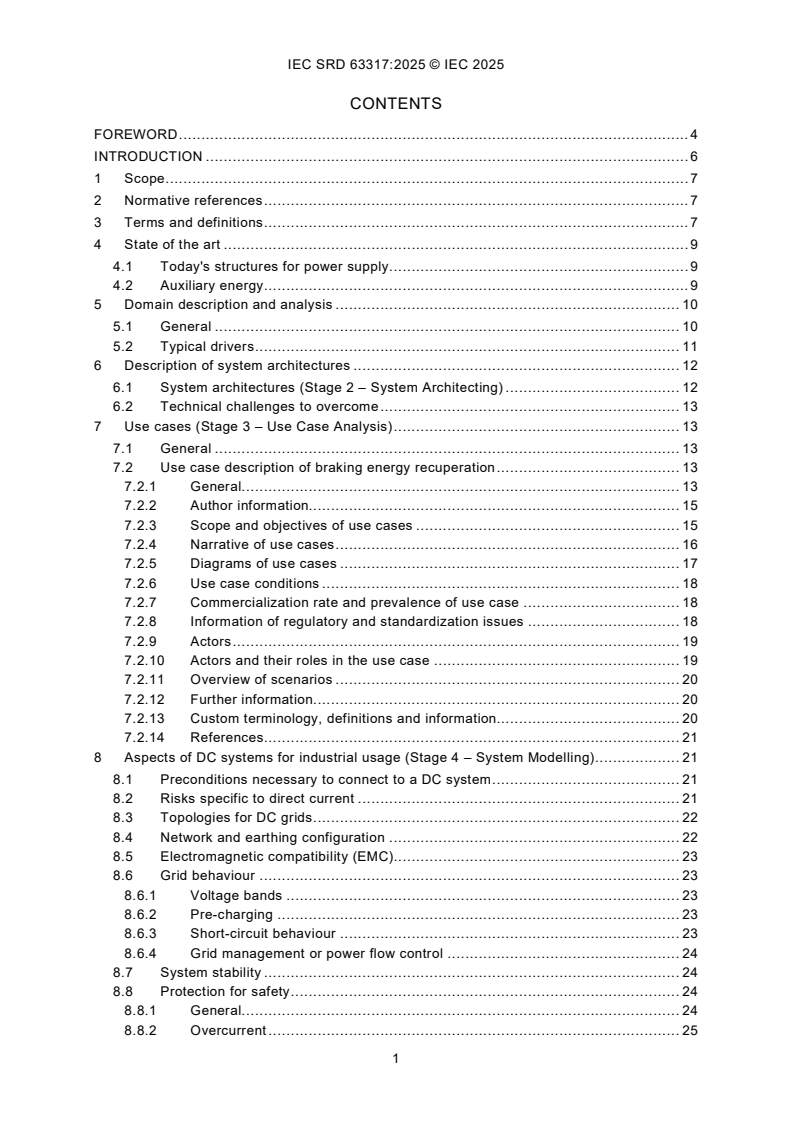
IEC SRD 63317 ®
Edition 1.0 2025-10
SYSTEMS REFERENCE
DELIVERABLE
Low-voltage direct current (LVDC) industry applications
ICS 29.020 ISBN 978-2-8327-0711-1
All rights reserved. Unless otherwise specified, no part of this publication may be reproduced or utilized in any form or
by any means, electronic or mechanical, including photocopying and microfilm, without permission in writing from either
IEC or IEC's member National Committee in the country of the requester. If you have any questions about IEC copyright
or have an enquiry about obtaining additional rights to this publication, please contact the address below or your local
IEC member National Committee for further information.
IEC Secretariat Tel.: +41 22 919 02 11
3, rue de Varembé info@iec.ch
CH-1211 Geneva 20 www.iec.ch
Switzerland
About the IEC
The International Electrotechnical Commission (IEC) is the leading global organization that prepares and publishes
International Standards for all electrical, electronic and related technologies.
About IEC publications
The technical content of IEC publications is kept under constant review by the IEC. Please make sure that you have the
latest edition, a corrigendum or an amendment might have been published.
IEC publications search - IEC Products & Services Portal - products.iec.ch
webstore.iec.ch/advsearchform Discover our powerful search engine and read freely all the
The advanced search enables to find IEC publications by a
publications previews, graphical symbols and the glossary.
variety of criteria (reference number, text, technical With a subscription you will always have access to up to date
committee, …). It also gives information on projects, content tailored to your needs.
replaced and withdrawn publications.
Electropedia - www.electropedia.org
IEC Just Published - webstore.iec.ch/justpublished The world's leading online dictionary on electrotechnology,
Stay up to date on all new IEC publications. Just Published containing more than 22 500 terminological entries in English
details all new publications released. Available online and and French, with equivalent terms in 25 additional languages.
once a month by email. Also known as the International Electrotechnical Vocabulary
(IEV) online.
IEC Customer Service Centre - webstore.iec.ch/csc
If you wish to give us your feedback on this publication or
need further assistance, please contact the Customer
Service Centre: sales@iec.ch.
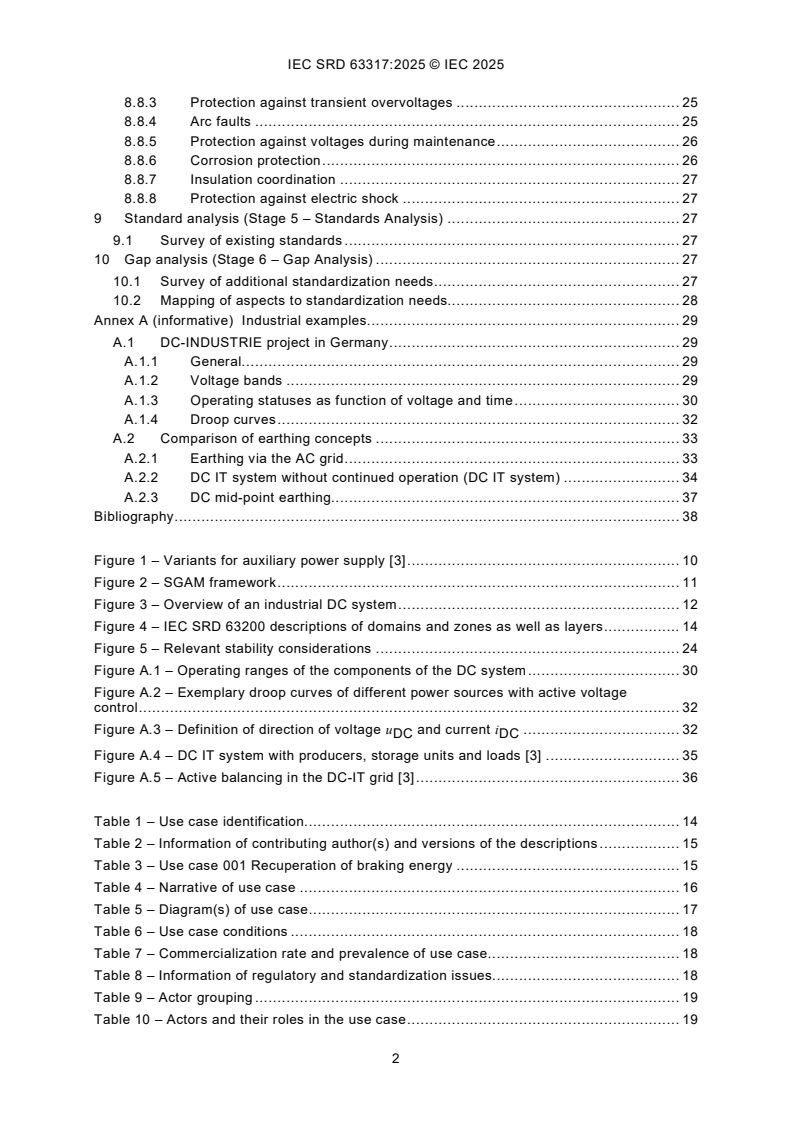
CONTENTS
FOREWORD . 4
INTRODUCTION . 6
1 Scope . 7
2 Normative references . 7
3 Terms and definitions . 7
4 State of the art . 9
4.1 Today's structures for power supply . 9
4.2 Auxiliary energy . 9
5 Domain description and analysis . 10
5.1 General . 10
5.2 Typical drivers . 11
6 Description of system architectures . 12
6.1 System architectures (Stage 2 – System Architecting) . 12
6.2 Technical challenges to overcome . 13
7 Use cases (Stage 3 – Use Case Analysis) . 13
7.1 General . 13
7.2 Use case description of braking energy recuperation . 13
7.2.1 General. 13
7.2.2 Author information. 15
7.2.3 Scope and objectives of use cases . 15
7.2.4 Narrative of use cases . 16
7.2.5 Diagrams of use cases . 17
7.2.6 Use case conditions . 18
7.2.7 Commercialization rate and prevalence of use case . 18
7.2.8 Information of regulatory and standardization issues . 18
7.2.9 Actors . 19
7.2.10 Actors and their roles in the use case . 19
7.2.11 Overview of scenarios . 20
7.2.12 Further information. 20
7.2.13 Custom terminology, definitions and information. 20
7.2.14 References. 21
8 Aspects of DC systems for industrial usage (Stage 4 – System Modelling) . 21
8.1 Preconditions necessary to connect to a DC system . 21
8.2 Risks specific to direct current . 21
8.3 Topologies for DC grids . 22
8.4 Network and earthing configuration . 22
8.5 Electromagnetic compatibility (EMC). 23
8.6 Grid behaviour . 23
8.6.1 Voltage bands . 23
8.6.2 Pre-charging . 23
8.6.3 Short-circuit behaviour . 23
8.6.4 Grid management or power flow control . 24
8.7 System stability . 24
8.8 Protection for safety . 24
8.8.1 General. 24
8.8.2 Overcurrent . 25
8.8.3 Protection against transient overvoltages . 25
8.8.4 Arc faults . 25
8.8.5 Protection against voltages during maintenance . 26
8.8.6 Corrosion protection . 26
8.8.7 Insulation coordination . 27
8.8.8 Protection against electric shock . 27
9 Standard analysis (Stage 5 – Standards Analysis) . 27
9.1 Survey of existing standards . 27
10 Gap analysis (Stage 6 – Gap Analysis) . 27
10.1 Survey of additional standardization needs . 27
10.2 Mapping of aspects to standardization needs. 28
Annex A (informative) Industrial examples. 29
A.1 DC-INDUSTRIE project in Germany . 29
A.1.1 General. 29
A.1.2 Voltage bands . 29
A.1.3 Operating statuses as function of voltage and time . 30
A.1.4 Droop curves . 32
A.2 Comparison of earthing concepts . 33
A.2.1 Earthing via the AC grid . 33
A.2.2 DC IT system without continued operation (DC IT system) . 34
A.2.3 DC mid-point earthing. 37
Bibliography . 38
Figure 1 – Variants for auxiliary power supply [3] . 10
Figure 2 – SGAM framework . 11
Figure 3 – Overview of an industrial DC system . 12
Figure 4 – IEC SRD 63200 descriptions of domains and zones as well as layers . 14
Figure 5 – Relevant stability considerations . 24
Figure A.1 – Operating ranges of the components of the DC system . 30
Figure A.2 – Exemplary droop curves of different power sources with active voltage
control . 32
Figure A.3 – Definition of direction of voltage u and current i . 32
DC DC
Figure A.4 – DC IT system with producers, storage units and loads [3] . 35
Figure A.5 – Active balancing in the DC-IT grid [3] . 36
Table 1 – Use case identification. 14
Table 2 – Information of contributing author(s) and versions of the descriptions . 15
Table 3 – Use case 001 Recuperation of braking energy . 15
Table 4 – Narrative of use case . 16
Table 5 – Diagram(s) of use case . 17
Table 6 – Use case conditions . 18
Table 7 – Commercialization rate and prevalence of use case . 18
Table 8 – Information of regulatory and standardization issues. 18
Table 9 – Actor grouping . 19
Table 10 – Actors and their roles in the use case . 19
Table 11 – Overview of scenarios . 20
Table 12 – Further information for classification and interconnections mapping . 20
(*
Table 13 – Custom terminology, definitions and information . 20
Table 14 – References . 21
Table A.1 – Operating status as a function of voltage and time. 31
INTERNATIONAL ELECTROTECHNICAL COMMISSION
___________
Low-voltage direct current (LVDC) industry applications
FOREWORD
1) The International Electrotechnical Commission (IEC) is a worldwide organization for standardization comprising
all national electrotechnical committees (IEC National Committees). The object of IEC is to promote international
co-operation on all questions concerning standardization in the electrical and electronic fields. To this end and
in addition to other activities, IEC publishes International Standards, Technical Specifications, Technical Reports,
Publicly Available Specifications (PAS) and Guides (hereafter referred to as "IEC Publication(s)"). Their
preparation is entrusted to technical committees; any IEC National Committee interested in the subject dealt with
may participate in this preparatory work. International, governmental and non-governmental organizations liaising
with the IEC also participate in this preparation. IEC collaborates closely with the International Organization for
Standardization (ISO) in accordance with conditions determined by agreement between the two organizations.
2) The formal decisions or agreements of IEC on technical matters express, as nearly as possible, an international
consensus of opinion on the relevant subjects since each technical committee has representation from all
interested IEC National Committees.
3) IEC Publications have the form of recommendations for international use and are accepted by IEC National
Committees in that sense. While all reasonable efforts are made to ensure that the technical content of IEC
Publications is accurate, IEC cannot be held responsible for the way in which they are used or for any
misinterpretation by any end user.
4) In order to promote international uniformity, IEC National Committees undertake to apply IEC Publications
transparently to the maximum extent possible in their national and regional publications. Any divergence between
any IEC Publication and the corresponding national or regional publication shall be clearly indicated in the latter.
5) IEC itself does not provide any attestation of conformity. Independent certification bodies provide conformity
assessment services and, in some areas, access to IEC marks of conformity. IEC is not responsible for any
services carried out by independent certification bodies.
6) All users should ensure that they have the latest edition of this publication.
7) No liability shall attach to IEC or its directors, employees, servants or agents including individual experts and
members of its technical committees and IEC National Committees for any personal injury, property damage or
other damage of any nature whatsoever, whether direct or indirect, or for costs (including legal fees) and
expenses arising out of the publication, use of, or reliance upon, this IEC Publication or any other IEC
Publications.
8) Attention is drawn to the Normative references cited in this publication. Use of the referenced publications is
indispensable for the correct application of this publication.
9) IEC draws attention to the possibility that the implementation of this document may involve the use of (a)
patent(s). IEC takes no position concerning the evidence, validity or applicability of any claimed patent rights in
respect thereof. As of the date of publication of this document, IEC had not received notice of (a) patent(s), which
may be required to implement this document. However, implementers are cautioned that this may not represent
the latest information, which may be obtained from the patent database available at https://patents.iec.ch. IEC
shall not be held responsible for identifying any or all such patent rights.
IEC SRD 63317 has been prepared by IEC systems committee LVDC: Low Voltage Direct
Current and Low Voltage Direct Current for Electricity Access. It is a Systems Reference
Deliverable.
The text of this Systems Reference Deliverable is based on the following documents:
Draft Report on voting
SyCLVDC/174/DTS SyCLVDC/182/RVDTS
Full information on the voting for its approval can be found in the report on voting indicated in
the above table.
The language used for the development of this Systems Reference Deliverable is English.
This document was drafted in accordance with ISO/IEC Directives, Part 2, and developed in
accordance with ISO/IEC Directives, Part 1 and ISO/IEC Directives, IEC Supplement, available
at www.iec.ch/members_experts/refdocs. The main document types developed by IEC are
described in greater detail at www.iec.ch/publications.
The committee has decided that the contents of this document will remain unchanged until the
stability date indicated on the IEC website under webstore.iec.ch in the data related to the
specific document. At this date, the document will be
• reconfirmed,
• withdrawn, or
• revised.
INTRODUCTION
The electrical distribution in industrial applications has a high number of motor drives and
machinery with high peak power demand. More and more production sites integrate photovoltaic
(PV) systems and battery storage systems. They reduce the peaks of infeed power which drive
the price of electrical energy up. Furthermore, energy storage can be used to increase the
availability of electrical energy supply and thus the security of supply within the system. Moving
to DC distribution can help to overcome those challenges and is expected to provide new
opportunities to increase efficiency. This can be achieved in low-voltage DC (LVDC) because
there are lower conversion losses and a cost-effective bidirectional integration of motor drives
and batteries is possible. LVDC is already used in many applications in industry, but not all
parts are compatible with a LVDC system since they do not have standardized interfaces.
This document harmonizes the system aspects of LVDC distribution systems in the application
of industrial production. This document will enable factories to implement an open, vendor-
independent industrial LVDC system with renewable sources, electrical energy storage systems,
bidirectional motor drives and other applications. It also defines necessary boundaries and
interfaces for connected devices or subsystems. As a Systems Reference Deliverable, it is
intended to harmonize between the different product standards of all involved technical
committees.
LVDC supports the following Sustainable Development Goals of the United Nations [1] :
– Goal 7: "Ensure access to affordable, reliable, sustainable and modern energy for all"
DC grids enable industry to easily integrate solar energy and renewable energy into their
production lines and makes the system more and more affordable. The DC nature of
electrical energy storage systems such as batteries and capacitors simplifies the integration
and increases the reliability of the factory grids.
– Goal 8: "Promote sustained, inclusive and sustainable economic growth, full and productive
employment and decent work for all"
– Goal 9: "Build resilient infrastructure, promote inclusive and sustainable industrialization
and foster innovation"
Storage devices like batteries or capacitors help to bridge power outages. This makes
production more robust and reduces waste from defective parts because of power failure.
– Goal 11: "Make cities and human settlements inclusive, safe, resilient and sustainable"
– Goal 12: "Ensure sustainable consumption and production patterns"
DC systems need fewer resources; less copper, housing materials, electronic equipment,
etc. Battery storage also reduces the in-feed power of the production line. This leads to
lower investment for transformers and energy distribution within the factory, as well as
reduced peak-power electricity rates. In AC the braking energy is dissipated in braking
resistors while DC enables the reuse of otherwise wasted energy by other devices.
– Goal 17: "Partnership for the Goals".
This document follows the IEC systems approach from the domain to the gap analysis and gives
guidance by describing reference implementation.
___________
Numbers in square brackets refer to the Bibliography.
1 Scope
This document describes certain aspects of standardization of LVDC industrial applications.
These industrial applications apply to the secondary economic sector where the processing of
resources applies to the production, distribution and storage of physical goods, typically in a
factory or similar areas.
The local LVDC distribution can be connected to the public grid (AC or DC) or can work
completely off-grid (intentional islanding).
This document provides a practical guideline for the design and planning of industrial LVDC
systems, aiming at interoperability amongst different devices.
IEC use case descriptions of the described industry application are part of this document.
NOTE This document is not intended for following applications: railway, ships, vehicles, aircraft, public distribution.
But wherever possible and practicable, compatibility of product requirements is considered favourable.
Included is equipment which is especially designed for and intended for use in industrial areas.
This includes everything that is concerned with with the commercial extraction, processing and
further processing of raw materials or intermediate products into material goods; in particular,
machines, plants, storage facilities and transport systems.
Not included is equipment which is especially designed for and intended for use in ordinary
buildings:
– supporting building equipment (e.g. lighting and HVAC) in buildings or parts of buildings in
which machines, plants, storage equipment and transport systems are installed;
– building equipment in buildings or parts of buildings in which supporting and administrative
production functions are performed (e.g. offices).
2 Normative references
The following documents are referred to in the text in such a way that some or all of their content
constitutes requirements of this document. For dated references, only the edition cited applies.
For undated references, the latest edition of the referenced document (including any
amendments) applies.
IEC 60364-4-41, Low-voltage electrical installations - Part 4-41: Protection for safety -
Protection against electric shock
IEC 60364-4-43, Low-voltage electrical installations - Part 4-43: Protection for safety -
Protection against overcurrent
3 Terms and definitions
For the purposes of this document, the following terms and definitions apply.
ISO and IEC maintain terminology databases for use in standardization at the following
addresses:
• IEC Electropedia: available at https://www.electropedia.org/
• ISO Online browsing platform: available at https://www.iso.org/obp
3.1
DC sector
group of DC devices which together form a functional unit and are connected to the DC system
via a sector breaker
3.2
DC sector circuit breaker
single device or combination of devices containing the functionality of a conventional circuit
breaker plus monitoring of the voltage bands and pre-charging of capacitive loads where
required
Note 1 to entry: Voltage bands are discussed in Annex A.
3.3
producer
participant that provides electrical energy from an external energy source to the DC system for
an unlimited period of time either by an external supply grid or generated by the conversion of
a non-electric energy source (e.g. photovoltaic system)
Note 1 to entry: If a source can feed back power, it is referred to as bidirectional. Producers that do not have that
capability are referred to as unidirectional.
3.4
electrical energy storage system
storage system that takes a limited amount of energy from the DC system and can return it
completely to the DC system with a time delay, minus internal losses
Note 1 to entry: Electrical energy storage systems serve the goals of consumption optimization as well as grid
failure bridging. The input and output of electrical energy is controlled by the grid management as well as a storage
management system. Electrical energy storage systems are always bidirectional.
3.5
consumer
participant that uses electrical energy for a production process
Note 1 to entry: Consumers draw energy from the DC system for an unlimited period of time. If the consumers are
capable of feeding back energy, they are called prosumers (3.8) and can feed back part of the energy they have
taken in. This energy output is usually much smaller than the amount of energy taken in. If the state of a consumer
can be influenced directly or indirectly by the network management, it can be used for optimized operation
management.
3.6
direct current system
DC system
electrical installation that uses direct current and "direct voltage" for the distribution of energy
3.7
systems approach
guideline that provides a systematic approach with tools and methodologies for committees
working on complex systems
Note 1 to entry: The intent of the approach is to walk users through various stages of analysis to build a
comprehensive understanding of the system, scope, and ultimately be able to identify gaps where standards are
needed.
Stage 1 – Domain Analysis: This initial stage is crucial in building an understanding of the mission, desired results,
or objective that is driven by the market and stakeholders' needs.
Stage 2 – System Architecting: The second stage extrapolates on the first with a purpose to build clarity on the
system through general use cases and reference architectures.
Stage 3 – Use Case Analysis: Stage three is focused primarily on developing detail understanding of use cases
identified in Stage 2. Using the use case methodology in IEC 62559-2 [2], this stage provides guidelines and
templates to collect and build thorough use cases.
Stage 4 – System Modelling: In the fourth stage, the Reference Architecture from Stage 2 is modelled in more detail
based on the outputs gathered from the previous stages. Here the system discrete parts, interfaces, communication
flow, environment factors, and such are modelled to help build a holistic perspective of the system.
Stage 5 – Standards Analysis: In this stage, the focus is on understanding and mapping what relevant standards
exist for all the various parts of the system and whether they are contributing or countering the objectives identified
in Stage 1. These standards can include IEC standards and standards from other standards development
organizations.
Stage 6 – Gap Analysis: In the final stage, gaps where standards are missing are identified based on the knowledge
of existing standards, desired system interaction, use cases and other information gathered from the previous stages.
This will then initiate the activities for the committees to move forward with development of new standards.
3.8
prosumer
network user that consumes and produces electrical energy
[SOURCE: IEC 60050-616:2017, 616-02-16]
4 State of the art
4.1 Today's structures for power supply
In industrial systems the three-phase AC power supply is most commonly used. Because of the
trend towards energy-efficient, variable-speed electric drives for the control of asynchronous
motors, frequency inverters with an intermediate DC circuit are increasingly used in systems.
Here the electrical energy must always be converted from alternating voltage to direct voltage
and from DC to the variable alternating frequency that controls the speed of the motors. In most
cases, the rectifiers required for this are integrated directly in the frequency inverter.
4.2 Auxiliary energy
Auxiliary energy is needed for communication as well as for powering certain devices. A voltage
of 24 V or 48 V DC is most common in industrial systems but other voltages are also used.
Figure 1 shows some variants for the provision of auxiliary power. Variants 1 and 2 are supplied
from the DC system directly, while variant 3 supplies power to a DC sector downstream of its
protective device ("DC sector circuit breaker" in the image). A supply from the AC side, as
shown as variant 4 in Figure 1 b), is also possible.
a) Variants 1, 2 and 3, powered by DC b) Variant 4, powered by AC
Figure 1 – Variants for auxiliary power supply [3]
5 Domain description and analysis
5.1 General
The use cases and systems considered in this document belong to the generic Smart energy
Grid Architecture Model (SGAM) domain of Customer Premises, and more specifically, under a
sub-domain of industrial premises. The premises (space where the equipment and installations
are located) are private. Other primal domain attributes are:
a) business purpose is manufacturing of products;
b) main purpose of the systems is to serve the manufacturing process;
c) there is a direct interface to public infrastructure (Distribution as well as Transmission
domains).
Figure 2 – SGAM framework
5.2 Typical drivers
Drivers for DC systems:
– Better resources usage: The converters needed for energy-efficient drives will become
simpler, smaller, and more affordable. Many of the components required for AC will not be
necessary for DC. Converters can be reduced in size by up to 25 %. Similar size reductions
will be possible for other electronic devices connected to the DC system. With DC it is
possible to conserve natural resources. As an example, electricity distribution in DC
compared to three-phase AC in industry for a motor driven by frequency converters only
uses half the conductor material (typically copper) and has 50 % lower power loss.
– Efficiency: A reduction in the number of AC–DC as well as DC–AC power converters and
their associated power losses, and the recovery of braking energy from moving masses, led
to energy savings of between 6 % and 10 %, depending on process dynamics.
– Easiness of power flow management (a DC system is a smart grid): Predefined voltage
droop curves in devices enable the continuous, immediate alignment of power demand with
supply. An overarching power management system to optimize the cost efficiency and
energy efficiency of the DC system can be easily integrated.
– Robust, fail-safe power supply: Local DC system management, featuring a number of basic
functions but not requiring a dedicated communications infrastructure, the simple integration
of energy storage, and connection to the public AC grid ensure a reliable, secure energy
supply.
– Supply-grid friendly: Reduction of peak power demand: Incorporating electrical energy
storage systems in DC is simple and straightforward since batteries and capacitors are
inherently DC. Peak power in processes is taken from these local energy sources rather
than drawn from the supply grid at that very instant. Several applications have shown
reduction in peak power by 85 %. This not only relieves pressure on the supply grid but also
reduces power rates for the commercial users since those are rising with the required peak
power.
– Easy integration of renewables: As solar energy generation systems supply direct current,
there is only a need for a DC–DC converter and not for a far more complex inverter. This
not only saves money, it also makes the system more dynamic and improves energy
efficiency.
– Motivation: The environmentally friendly generation and use of energy is one of the major
challenges currently facing the manufacturing industry. Increasing energy efficiency, the
right response to fluctuating energy supplies and robustness in the face of lower energy
supply quality are tasks that production will therefore face increasingly in the near future.
– Mission: Today, the generation of renewable energy and the use of energy-efficient
consumers is primarily based on the use of LVDC. Therefore, the environmentally friendly
generation and use of energy in industrial applications must also be designed with LVDC in
the future.
– Goal: Description of all aspects that it is important to consider when using LVDC in industrial
applications or that facilitate future use.
6 Description of system architectures
6.1 System architectures (Stage 2 – System Architecting)
Figure 3 shows an overview of an industrial DC system. It is typically connected to an AC grid
that supplies most of the energy via an AC–DC converter. Storage devices, producers
("Electricity generation" in Figure 3), and a multitude of consumers form DC sectors and are
connected to the DC system via DC sector circuit breakers.
Figure 3 – Overview of an industrial DC system
6.2 Technical challenges to overcome
Microgrids already have protection complexity because of the following:
– multiple sources make selective protection more challenging since many sources feed into
a fault;
– low available short-circuit energy in the system (traditional protection is dependent on the
high short circuit);
– steep rate of rise of short-circuit current – many ampères per microsecond (A/µs) are
observed – for the multitude of capacitors connected to the grid which feed into the fault;
– arcing, no current zero-crossing;
– corrosion in some conditions.
– lack of knowledge of DC system installation, protection and coordination.
– missing components on load side areas.
Consequently, this document helps and guides the installers.
7 Use cases (Stage 3 – Use Case Analysis)
7.1 General
This document contains only one use case. Further use cases and use case analysis will follow
in future editions of IEC SRD 63317.
7.2 Use case description of braking energy recuperation
7.2.1 General
Figure 4 shows a description of the "ecosystem" – this can be useful for the definitions in the
tables of 7.2.
Figure 4 – IEC SRD 63200 descriptions of domains and zones as well as layers
Table 1 – Use case identification
See Table 1.
Use Area / Domain(s) / Zone(s) Name of use case
a
case ID
001 Industrial Distribution / private / process Recuperation of braking energy
002 Distribution / private / process Reduction of peak power
003 Distribution / private / process Integration of energy storage for increased resilience
004 Distribution / private / process Integration of renewable energy to an industrial process
005 Distribution / private / process Reduction of power loss
006 Distribution / private / process Resource efficiency
Nature/type of the use case
High-level use case
a
Give each described use case a unique three-digit identification number (ID).
7.2.2 Author information
See Table 2.
Table 2 – Information of contributing author(s) and versions of the descriptions
Use Date Organization (e.g. company) Author(s) Version
a
case
no.
ID
001 2023-05-15 Project team Meeting participants 0.1
001 2023-05-26 German DKE AK221.6.4 Meeting participants 0.2
001 2023-06-16 German DKE AK221.6.4 Meeting participants 0.3
Manfred Heindl, Tero Kaipia, Uma
001 2023-08-21 IEC SyCLVDC PT63317 Manickam, Ludwig Rudel, Hartwig 0.4
Stammberger
001 2024-03-18 IEC SyCLVDC PT63317 Meeting participants 1.0B
a
Version information is tracked for later amendments and extensions.
7.2.3 Scope and objectives of use cases
See Table 3.
Table 3 – Use case 001 Recuperation of braking energy
Scope and objectives of use case Recuperation of braking energy
Scope Distribution circuits with mainly distributed electrical drives that are bidirectional with
dynamic response and braking needs.
Objective(s) Overview of use case objectives:
1) lower losses (e.g. no braking resistors);
2) higher energy efficiency;
3) support of UN Sustainable Development Goals 9, 12 and 13;
4) simplification of inverter systems (no active frontend for each drive).
Related business Cost effective manufacturing business:
case(s)
• Investment savings (CAPEX)
– no need of braking resistors
– no need of the AC/DC part of frequency converters
• OPEX
– better energy efficiency
– higher reliability
– less thermal stress
7.2.4 Narrative of use cases
See Table 4.
Table 4 – Narrative of use case
Narrative of use case
In traditional AC-fed installations, the energy of moving masses (e.g., motors, robots) is converted to heat in
braking resistors, effectively wasted. In DC systems, this energy is fed back to the DC grid – technically the
motors that drive the masses change from motor operation to generator operation. Thus, this energy can be
used in other applications or stored in electrical energy storage systems, e.g. batteries.
The benefit is two-fold: 1) The braking energy can be used for productive purposes and 2) There is no
requirement for the extra heat to be "cooled away".
7.2.5 Diagrams of use cases
See Table 5.
Table 5 – Diagram(s) of use case
Diagram(s) of use case
AC on the left → Braking energy is wasted to heat in a braking resistor.
DC on the right → Without change to the existing DC/AC part of the frequency converter or the actual motors in
the application, braking energy is fed back into the DC grid for instant use by other applications or for later use
in storage.
7.2.6 Use case conditions
See Table 6.
Table 6 – Use case conditions
Use case conditions
Assumptions (related to the use case)
– The application needs to have moved masses that are at least occasionally braked or reduced in speed.
(e.g. continuously running motors do not fulfil this requirement)
Prerequisites (what is required to deploy/exploit the use case)
List and describe what shall happen or what the actors shall do for the use case to be realized, e.g.:
– At least one motor and one storage unit is needed connected by a DC microgrid.
7.2.7 Commercialization rate and prevalence of use case
See Table 7.
Table 7 – Commercialization rate and prevalence of use case
a
Commercialization rate and prevalence of use case
Estimate the overall Commercial Readiness Level (CRL) of the use case at the 9
moment on a scale 1-9.
(1 = not commercialized, 9 = fully commercialized)
Estimate what the Commercial Readiness Level (CRL) will be five years from now 9
on a scale 1-9.
(1 = not commercialized, 9 = fully commercialized)
How prevalent is the use case in your market area at the moment on a scale 1-9? 2 (not common yet)
(1 = untapped, 9 = widespread)
Estimate how prevalent the use case will be five years from now on a scale 1-9? 6
(1 = untapped, 9 = widespread)
a
Commercial Readiness Level (CRL) and prevalence are used to describe the maturity of the business related
to a use case. CRL is an index developed by ARPA-E [4]. This information is given for the convenience of
users of this document and does not constitute an endorsement by IEC.
7.2.8 Information of regulatory and standardization issues
See Table 8.
Table 8 – Information of regulatory and standardization issues
Narrative of the regulatory issues and standardization
– For the components needed for this use case, no gaps exist
– However, gaps do exist for installing a complete DC microgrid, e.g. for semiconductor breakers
7.2.9 Actors
See Table 9.
Table 9 – Actor grouping
a
Group description
Grouping
Operator Instructed
Maintenance Trained and specialized
Visitors Unskilled / unknown skill level
Installer Trained and specialized
Planner Trained and specialized
Inspectors Trained and specialized
a
Indicate if some actors form a group, function as a group or both.
7.2.10 Actors and their roles in the use case
See Table 10.
Table 10 – Actors and their roles in the use case
a
Actor name Actor description Further information specific
Actor type
to this use case
Owner Provides the investment and benefits from
the savings
Planning service
Plans the layout
provider
Installer They install the complete system
Inspector Inspectors Needed for initial setup and inspection
Maintainer Maintenance Make sure that the system runs smoothly
Equipment
Provide the necessary components
manufacturer
When stopped, the kinetic energy of those
Inertia of moving
Equipment moving masses is recuperated to the DC
masses
grid
Automation Drive switches from motor
Controls the process, initiates braking
system operation to generator mode
Actively harvests the electric energy that Much like braking in an
the generator converted from the kinetic electric car when the driver
Controller of
DC/AC converter energy of the moving masses and supplies takes his or her foot off the
it to the DC grid "gas pedal"
a
See Table 9.
7.2.11 Overview of scenarios
See Table 11.
Table 11 – Overview of scenarios
No. Scenario name Scenario Primary actor Triggering Pre- Post-
description event condition(s) condition(s)
a moving mass stopped or
automation production step production step
1 Braking is stopped or slowed-down
system completed has started
slowed down mass
The overview of scenarios answers the questions: What processes and functions the considered system
execute/performs in the use cases and why? What is the outcome?
7.2.12 Further information
See Table 12.
Table 12 – Further information for classification and interconnections mapping
Relation to other use case(s) (e.g. relations between business and system use cases)
Use Case ID – 003, 005, 006, see Table 1
Generic, regional or national relation
Further keywords for classification
7.2.13 Custom terminology, definitions and information
See Table 13.
(*
Table 13 – Custom terminology, definitions and information
Term / key Definition / value
This includes, for example, definitions of terms deviating from IEC 60050 terms and definitions, architecture model
for use case identification, etc.
7.2.14 Re
...