

ISO/IEC 80079-34:2011
(Main)Explosive atmospheres - Part 34: Application of quality systems for equipment manufacture
General Information
- Abstract
ISO/IEC 80079-34:2011 specifies particular requirements and information for establishing and maintaining a quality system to manufacture Ex equipment including protective systems in accordance with the Ex certificate. It does not preclude the use of other quality systems that are compatible with the objectives of ISO 9001:2008 and which provide equivalent results. This publication is published as a double logo standard. This standard should be read in conjunction with ISO 9001:2008.
- Status
- Published
- Publication Date
- 25-Apr-2011
- Current Stage
- DELPUB - Deleted Publication
- Start Date
- 30-Aug-2018
- Completion Date
- 28-Aug-2026
Overview
ISO/IEC 80079-34:2011 is an international standard developed by the International Electrotechnical Commission (IEC) that defines the application of quality management systems for the manufacture of equipment intended for use in explosive atmospheres, known as Ex equipment. This standard provides specific requirements and guidance for establishing, implementing, and maintaining a quality system that assures the consistent production of safe and compliant Ex equipment, including protective systems.
The standard aligns with the principles of ISO 9001:2008, allowing for compatibility with other quality systems that achieve equivalent results. However, ISO/IEC 80079-34 focuses specifically on the unique challenges and critical safety aspects associated with manufacturing equipment for hazardous environments.
Key Topics
Quality Management System (QMS) Requirements
ISO/IEC 80079-34 outlines the essential components of a quality management system tailored for Ex equipment manufacturers. It addresses documentation, control of records, and process planning necessary to maintain safety and conformity.Management Responsibility
Emphasizes top management commitment, customer focus, quality policy development, and systematic management reviews to support continuous improvement of quality systems.Resource Management
Stresses competence, training, and awareness of personnel involved in designing and manufacturing Ex equipment. It also specifies infrastructure and work environment conditions to ensure product safety.Product Realization
Details requirements for planning, customer communication, design and development controls, purchasing processes, production control, and traceability to ensure quality at every stage of manufacturing.Monitoring, Measurement, and Improvement
Covers customer satisfaction evaluation, internal audits, process and product monitoring, control of nonconformities, and implementation of corrective and preventive actions to foster continual improvement.Compatibility with ISO 9001:2008
The standard complements ISO 9001 and should be used in conjunction with it, providing additional safety and quality controls specific to explosive atmospheres.
Applications
ISO/IEC 80079-34:2011 is indispensable for manufacturers of Ex equipment and protective systems used in hazardous locations across multiple industries, including:
Oil and Gas
Ensures equipment safety where flammable gases and vapors are present, preventing ignition sources.Chemical and Petrochemical Plants
Supports conformity for devices operating in chemically volatile environments.Mining Industry
Facilitates the production of non-electrical and electrical equipment suitable for explosive dust or gas atmospheres underground.Pharmaceutical Manufacturing
Maintains high safety standards for equipment exposed to combustible dust.Electrical Equipment Manufacturing
Provides specialized quality processes for electrical devices intended for explosive atmospheres.
By implementing the quality system requirements of ISO/IEC 80079-34, organizations minimize risks, comply with regulatory frameworks, and enhance the reliability and safety of products used in explosive environments.
Related Standards
ISO 9001:2008 – Quality Management Systems
The foundation standard for quality management, providing a generic framework complemented by ISO/IEC 80079-34 for Ex equipment manufacturing.IEC 60079 Series – Explosive Atmospheres
A set of standards covering the design, testing, and certification of equipment for hazardous areas.ISO/IEC 80079 Series
Expands on requirements for both electrical and non-electrical equipment in explosive atmospheres, including specialized parts on product safety and certification.IEC 31M Subcommittee Standards
Focused on the development of standards for non-electrical equipment and protective systems for explosive atmospheres, supporting the scope of ISO/IEC 80079-34.
Summary
ISO/IEC 80079-34:2011 is a vital standard for organizations involved in the manufacturing of equipment for explosive atmospheres. It provides a comprehensive quality system framework tailored to the stringent safety requirements of hazardous environments. Aligning with ISO 9001 principles, this standard facilitates compliance, enhances product safety, and supports continuous improvement in manufacturing processes, ultimately contributing to risk reduction and protection of personnel and infrastructure in volatile settings.
Relations
- Effective Date
- 05-Sep-2023
Get Certified
Connect with accredited certification bodies for this standard

BSI Group
BSI (British Standards Institution) is the business standards company that helps organizations make excellence a habit.

Bureau Veritas
Bureau Veritas is a world leader in laboratory testing, inspection and certification services.

DNV
DNV is an independent assurance and risk management provider.
Sponsored listings
Frequently Asked Questions
ISO/IEC 80079-34:2011 is a standard published by the International Electrotechnical Commission (IEC). Its full title is "Explosive atmospheres - Part 34: Application of quality systems for equipment manufacture". This standard covers: ISO/IEC 80079-34:2011 specifies particular requirements and information for establishing and maintaining a quality system to manufacture Ex equipment including protective systems in accordance with the Ex certificate. It does not preclude the use of other quality systems that are compatible with the objectives of ISO 9001:2008 and which provide equivalent results. This publication is published as a double logo standard. This standard should be read in conjunction with ISO 9001:2008.
ISO/IEC 80079-34:2011 specifies particular requirements and information for establishing and maintaining a quality system to manufacture Ex equipment including protective systems in accordance with the Ex certificate. It does not preclude the use of other quality systems that are compatible with the objectives of ISO 9001:2008 and which provide equivalent results. This publication is published as a double logo standard. This standard should be read in conjunction with ISO 9001:2008.
ISO/IEC 80079-34:2011 is classified under the following ICS (International Classification for Standards) categories: 03.120.01 - Quality in general; 29.260.20 - Electrical apparatus for explosive atmospheres. The ICS classification helps identify the subject area and facilitates finding related standards.
ISO/IEC 80079-34:2011 has the following relationships with other standards: It is inter standard links to ISO/IEC 80079-34:2018. Understanding these relationships helps ensure you are using the most current and applicable version of the standard.
ISO/IEC 80079-34:2011 is available in PDF format for immediate download after purchase. The document can be added to your cart and obtained through the secure checkout process. Digital delivery ensures instant access to the complete standard document.
Standards Content (Sample)
ISO/IEC 80079-34
Edition 1.0 2011-04
INTERNATIONAL
STANDARD
NORME
INTERNATIONALE
Explosive atmospheres –
Part 34: Application of quality systems for equipment manufacture
Atmosphères explosives –
Partie 34: Application des systèmes de qualité pour la fabrication d’équipements
All rights reserved. Unless otherwise specified, no part of this publication may be reproduced or utilized in any form
or by any means, electronic or mechanical, including photocopying and microfilm, without permission in writing from
either IEC or IEC's member National Committee in the country of the requester.
If you have any questions about ISO/IEC copyright or have an enquiry about obtaining additional rights to this
publication, please contact the address below or your local IEC member National Committee for further information.
IEC Central Office
3, rue de Varembé
CH-1211 Geneva 20
Switzerland
Email: inmail@iec.ch
Web: www.iec.ch
About the IEC
The International Electrotechnical Commission (IEC) is the leading global organization that prepares and publishes
International Standards for all electrical, electronic and related technologies.
About IEC publications
The technical content of IEC publications is kept under constant review by the IEC. Please make sure that you have the
latest edition, a corrigenda or an amendment might have been published.
Catalogue of IEC publications: www.iec.ch/searchpub
The IEC on-line Catalogue enables you to search by a variety of criteria (reference number, text, technical committee,…).
It also gives information on projects, withdrawn and replaced publications.
IEC Just Published: www.iec.ch/online_news/justpub
Stay up to date on all new IEC publications. Just Published details twice a month all new publications released. Available
on-line and also by email.
Electropedia: www.electropedia.org
The world's leading online dictionary of electronic and electrical terms containing more than 20 000 terms and definitions
in English and French, with equivalent terms in additional languages. Also known as the International Electrotechnical
Vocabulary online.
Customer Service Centre: www.iec.ch/webstore/custserv
If you wish to give us your feedback on this publication or need further assistance, please visit the Customer Service
Centre FAQ or contact us:
Email: csc@iec.ch
Tel.: +41 22 919 02 11
Fax: +41 22 919 03 00
A propos de la CEI
La Commission Electrotechnique Internationale (CEI) est la première organisation mondiale qui élabore et publie des
normes internationales pour tout ce qui a trait à l'électricité, à l'électronique et aux technologies apparentées.
A propos des publications CEI
Le contenu technique des publications de la CEI est constamment revu. Veuillez vous assurer que vous possédez
l’édition la plus récente, un corrigendum ou amendement peut avoir été publié.
Catalogue des publications de la CEI: www.iec.ch/searchpub/cur_fut-f.htm
Le Catalogue en-ligne de la CEI vous permet d’effectuer des recherches en utilisant différents critères (numéro de référence,
texte, comité d’études,…). Il donne aussi des informations sur les projets et les publications retirées ou remplacées.
Just Published CEI: www.iec.ch/online_news/justpub
Restez informé sur les nouvelles publications de la CEI. Just Published détaille deux fois par mois les nouvelles
publications parues. Disponible en-ligne et aussi par email.
Electropedia: www.electropedia.org
Le premier dictionnaire en ligne au monde de termes électroniques et électriques. Il contient plus de 20 000 termes et
définitions en anglais et en français, ainsi que les termes équivalents dans les langues additionnelles. Egalement appelé
Vocabulaire Electrotechnique International en ligne.
Service Clients: www.iec.ch/webstore/custserv/custserv_entry-f.htm
Si vous désirez nous donner des commentaires sur cette publication ou si vous avez des questions, visitez le FAQ du
Service clients ou contactez-nous:
Email: csc@iec.ch
Tél.: +41 22 919 02 11
Fax: +41 22 919 03 00
ISO/IEC 80079-34
Edition 1.0 2011-04
INTERNATIONAL
STANDARD
NORME
INTERNATIONALE
Explosive atmospheres –
Part 34: Application of quality systems for equipment manufacture
Atmosphères explosives –
Partie 34: Application des systèmes de qualité pour la fabrication d’équipements
INTERNATIONAL
ELECTROTECHNICAL
COMMISSION
COMMISSION
ELECTROTECHNIQUE
PRICE CODE
INTERNATIONALE
V
CODE PRIX
ICS 03.120.01; 29.260.20 ISBN 978-2-88912-459-6
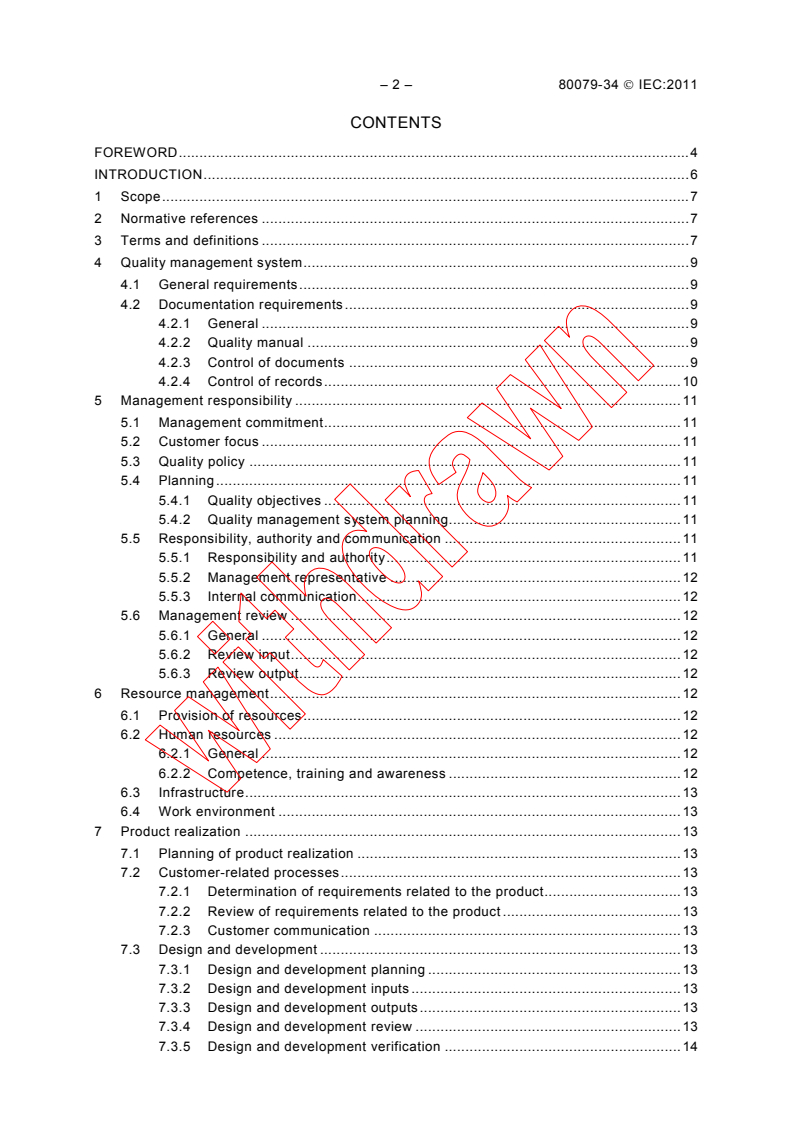
– 2 – 80079-34 IEC:2011
CONTENTS
FOREWORD . 4
INTRODUCTION . 6
1 Scope . 7
2 Normative references . 7
3 Terms and definitions . 7
4 Quality management system . 9
4.1 General requirements . 9
4.2 Documentation requirements . 9
4.2.1 General . 9
4.2.2 Quality manual . 9
4.2.3 Control of documents . 9
4.2.4 Control of records . 10
5 Management responsibility . 11
5.1 Management commitment . 11
5.2 Customer focus . 11
5.3 Quality policy . 11
5.4 Planning . 11
5.4.1 Quality objectives . 11
5.4.2 Quality management system planning. 11
5.5 Responsibility, authority and communication . 11
5.5.1 Responsibility and authority . 11
5.5.2 Management representative . 12
5.5.3 Internal communication . 12
5.6 Management review . 12
5.6.1 General . 12
5.6.2 Review input . 12
5.6.3 Review output . 12
6 Resource management . 12
6.1 Provision of resources . 12
6.2 Human resources . 12
6.2.1 General . 12
6.2.2 Competence, training and awareness . 12
6.3 Infrastructure . 13
6.4 Work environment . 13
7 Product realization . 13
7.1 Planning of product realization . 13
7.2 Customer-related processes . 13
7.2.1 Determination of requirements related to the product . 13
7.2.2 Review of requirements related to the product . 13
7.2.3 Customer communication . 13
7.3 Design and development . 13
7.3.1 Design and development planning . 13
7.3.2 Design and development inputs . 13
7.3.3 Design and development outputs . 13
7.3.4 Design and development review . 13
7.3.5 Design and development verification . 14
80079-34 IEC:2011 – 3 –
7.3.6 Design and development validation . 14
7.3.7 Control of design and development changes . 14
7.4 Purchasing . 14
7.4.1 Purchasing process . 14
7.4.2 Purchasing information . 15
7.4.3 Verification of purchased product . 15
7.5 Production and service provision . 16
7.5.1 Control of production and service provision . 16
7.5.2 Validation of processes for production and service provision . 16
7.5.3 Identification and traceability . 16
7.5.4 Customer property . 16
7.5.5 Preservation of product . 17
7.6 Control of monitoring and measuring equipment . 17
8 Measurement, analysis and improvement . 17
8.1 General . 17
8.2 Monitoring and measurement . 17
8.2.1 Customer satisfaction . 17
8.2.2 Internal audit . 17
8.2.3 Monitoring and measurement of processes . 18
8.2.4 Monitoring and measurement of product . 18
8.3 Control of nonconforming product . 18
8.4 Analysis of data . 19
8.5 Improvement . 19
8.5.1 Continual improvement . 19
8.5.2 Corrective action . 19
8.5.3 Preventive action . 19
Annex A (informative) Information relevant to particular types of protection and
specific products . 20
Annex B (informative) Verification criteria for elements with non-measurable paths
used as an integral part of a type of protection . 29
Bibliography . 32
Table A.1 – Component/feature compatibility . 22
– 4 – 80079-34 IEC:2011
INTERNATIONAL ELECTROTECHNICAL COMMISSION
_____________
EXPLOSIVE ATMOSPHERES –
Part 34: Application of quality systems
for equipment manufacture
FOREWORD
1) The International Electrotechnical Commission (IEC) is a worldwide organization for standardization comprising
all national electrotechnical committees (IEC National Committees). The object of IEC is to promote
international co-operation on all questions concerning standardization in the electrical and electronic fields. To
this end and in addition to other activities, IEC publishes International Standards, Technical Specifications,
Technical Reports, Publicly Available Specifications (PAS) and Guides (hereafter referred to as “IEC
Publication(s)”). Their preparation is entrusted to technical committees; any IEC National Committee interested
in the subject dealt with may participate in this preparatory work. International, governmental and non-
governmental organizations liaising with the IEC also participate in this preparation. IEC collaborates closely
with the International Organization for Standardization (ISO) in accordance with conditions determined by
agreement between the two organizations.
2) The formal decisions or agreements of IEC on technical matters express, as nearly as possible, an international
consensus of opinion on the relevant subjects since each technical committee has representation from all
interested IEC National Committees.
3) IEC Publications have the form of recommendations for international use and are accepted by IEC National
Committees in that sense. While all reasonable efforts are made to ensure that the technical content of IEC
Publications is accurate, IEC cannot be held responsible for the way in which they are used or for any
misinterpretation by any end user.
4) In order to promote international uniformity, IEC National Committees undertake to apply IEC Publications
transparently to the maximum extent possible in their national and regional publications. Any divergence
between any IEC Publication and the corresponding national or regional publication shall be clearly indicated in
the latter.
5) IEC itself does not provide any attestation of conformity. Independent certification bodies provide conformity
assessment services and, in some areas, access to IEC marks of conformity. IEC is not responsible for any
services carried out by independent certification bodies.
6) All users should ensure that they have the latest edition of this publication.
7) No liability shall attach to IEC or its directors, employees, servants or agents including individual experts and
members of its technical committees and IEC National Committees for any personal injury, property damage or
other damage of any nature whatsoever, whether direct or indirect, or for costs (including legal fees) and
expenses arising out of the publication, use of, or reliance upon, this IEC Publication or any other IEC
Publications.
8) Attention is drawn to the normative references cited in this publication. Use of the referenced publications is
indispensable for the correct application of this publication.
9) Attention is drawn to the possibility that some of the elements of this IEC Publication may be the subject of
patent rights. IEC shall not be held responsible for identifying any or all such patent rights.
International Standard ISO/IEC 80079-34 has been prepared by IEC subcommittee 31M: Non-
electrical equipment and protective systems for explosive atmospheres, of IEC 31: Equipment
for explosive atmospheres.
This publication is published as a double logo standard.
This standard should be read in conjunction with ISO 9001:2008.
80079-34 IEC:2011 – 5 –
The text of this particular standard is based on the following documents:
FDIS Report on voting
31M/45/FDIS 31M/48/RVD
Full information on the voting for the approval of this particular standard can be found in the
report on voting indicated in the above table. In ISO, the standard has been approved
because there were no negative votes out of the eleven votes cast.
This publication has been drafted in accordance with the ISO/IEC Directives, Part 2.
A list of all parts in the IEC 60079 series, under the general title Explosive atmospheres, as
well as the ISO/IEC 80079 series, can be found on the IEC website.
The committee has decided that the contents of this publication will remain unchanged until
the stability date indicated on the IEC web site under "http://webstore.iec.ch" in the data
related to the specific publication. At this date, the publication will be
• reconfirmed,
• withdrawn,
• replaced by a revised edition, or
• amended.
– 6 – 80079-34 IEC:2011
INTRODUCTION
This International Standard specifies requirements for a quality system that can be used by an
organization for the production of equipment and protective systems for explosive
atmosphere.
It can also be used by third parties, including certification bodies, to assess the organization’s
ability to meet conformity assessments system requirements and/or regulatory requirements.
The application of this standard is intended to cover both electrical and non-electrical
equipment and protective systems. The detailed content (e.g. annexes) is currently more
focused on the established equipment standards for electrical equipment, However, IEC sub-
committee 31M has recently been formed with the responsibility for the development of
standards for non-electrical equipment. It is anticipated that, where appropriate, these
standards, or requirements related to them, will be referenced within this standard in the
future.
Manufacturer’s quality requirements are an integral part of most certification schemes and as
such this Standard has been prepared with the IECEx equipment certification scheme
requirements in mind, is intended to support the ATEX scheme requirements for a
manufacturer’s quality system and can be applied in other national or regional certifications
schemes that relate to the manufacture of explosion-protected equipment.
80079-34 IEC:2011 – 7 –
EXPLOSIVE ATMOSPHERES –
Part 34: Application of quality systems
for equipment manufacture
1 Scope
This part of ISO/IEC 80079 specifies particular requirements and information for establishing
and maintaining a quality system to manufacture Ex equipment including protective systems
in accordance with the Ex certificate.
It does not preclude the use of other quality systems that are compatible with the objectives of
ISO 9001:2008 and which provide equivalent results.
2 Normative references
The following referenced documents are indispensable for the application of this document.
For dated references, only the edition cited applies. For undated references, the latest edition
of the referenced document (including any amendments) applies.
IEC 60050-426, International Electrotechnical Vocabulary – Part 426: Equipment for explosive
atmospheres
IEC 60079-0, Explosive atmospheres – Part 0: Equipment – General requirements
ISO/IEC 17050-1, Conformity assessment – Supplier's declaration of conformity – Part 1:
General requirements
ISO 9000:2005, Quality management systems – Fundamentals and vocabulary
ISO 9001:2008, Quality management systems – Requirements
3 Terms and definitions
For the purposes of this document, the terms and definitions given in IEC 60050-426,
IEC 60079-0 and ISO 9000:2005, as well as the following definitions, apply.
3.1
Ex Component
part of Ex equipment or a module (other than an Ex cable gland), marked with the symbol “U”,
which is not intended to be used alone and requires additional consideration when
incorporated into Ex equipment or systems for use in explosive atmospheres
NOTE This definition is identical to that of IEC 60079-0, except that the term “electrical” has been replaced by
“Ex” to allow a broader application of the definition.
3.2
Ex Equipment
machines, apparatus, fixed or mobile devices, control components and instrumentation
thereof and detection or prevention systems which, separately or jointly, are intended for the
generation, transfer, storage, measurement, control and conversion of energy for the
processing of material and which are capable of causing an explosion through their own
potential sources of ignition
– 8 – 80079-34 IEC:2011
NOTE This definition includes “equipment” as defined by IEC 60079-0.
3.3
Ex certificate
document that assures the conformity of a product with specified requirements for explosive
atmospheres
NOTE 1 The certificate may be either the supplier’s declaration of conformity or the purchaser’s recognition of
conformity or certification (as a result of action by a third party) as defined in the ISO/IEC 17000 series.
NOTE 2 This is equivalent to the term “certificate” as defined by IEC 60079-0.
3.4
manufacturer
organization, situated at a stated location or locations, that carries out or controls such stages
in the manufacture, assessment, handling and storage of a product that enables it to accept
responsibility for continued compliance of the product with the relevant requirements and
undertakes all obligations in that connection
NOTE The term "manufacturer" is used instead of "organization" as used in ISO 9001:2008. For the purposes of
this standard they are interchangeable.
3.5
contract
requirements forming an agreement between a manufacturer and a customer and transmitted
by any appropriate means
3.6
customer complaint
reported written or verbal allegation made by a customer which concerns the identity, quality,
durability, safety, security, conformity or performance of any equipment or protective system
or component as defined in the Ex certificate
3.7
product
Ex equipment, protective systems, safety devices, Ex Components and their combinations, as
well as software and service as defined in 3.4.2 of ISO 9000:2005
3.8
protective systems
design units which are intended to halt incipient explosions immediately and/or to limit the
effective range of explosion flames and explosion pressures
NOTE Protective systems may be integrated into equipment or separately placed on the market for use as
autonomous systems.
3.9
safety devices
devices intended for use inside or outside explosive atmospheres but required for or
contributing to the safe functioning of equipment and protective systems with respect to the
risks of explosion
3.10
schedule drawing
drawing or document listed in the Ex certificate and/or test report
3.11
related drawing
drawing or document not listed in the Ex certificate but linked to the schedule drawing, and
used for example, for detailed manufacture of component parts
80079-34 IEC:2011 – 9 –
3.12
technical documentation
documentation that enables the conformity of the product with the requirements of the
standard(s) to be assessed
NOTE 1 This may include schedule drawings when a certification body is involved.
NOTE 2 It covers the design, manufacture and operation of the product and contain:
– a general description;
– design and manufacturing drawings and layouts of components, sub-assemblies, circuits, etc.;
– descriptions and explanations necessary for the understanding of drawings and layouts and the operation of
the product;
– a list of the standards referred to in the Ex certificate, applied in full or in part, and descriptions of the
solutions adopted to meet the requirements of the Standards;
– results of design calculations made, examinations carried out, etc.;
– test reports.
3.13
manufacturer’s documentation
documents required by a manufacturer but not subject to assessment by body responsible for
verification when making an application for a test report or an Ex certificate
EXAMPLE Manufacturing instructions, related drawings, data sheets and sales literature.
3.14
Type of Protection
specific measures applied to Ex equipment to avoid ignition of a surrounding explosive
atmosphere
NOTE This definition is identical to that of IEC 60079-0, except that the term “electrical” has been replaced by
“Ex’ to allow a broader application of the definition.
3.15
body responsible for verification
body which conducts documentation review and periodical audit as appropriate
NOTE The body may be either a manufacturer, purchaser, third party or a certification body.
4 Quality management system
4.1 General requirements
Subclause 4.1 of ISO 9001:2008 applies, with the following addition:
The quality system shall ensure that the product conforms to the type described in the Ex
certificate and the technical documentation.
4.2 Documentation requirements
4.2.1 General
Subclause 4.2.1 of ISO 9001:2008 applies.
4.2.2 Quality manual
Subclause 4.2.2 of ISO 9001:2008 applies.
4.2.3 Control of documents
Subclause 4.2.3 of ISO 9001:2008 applies, with the following addition:
– 10 – 80079-34 IEC:2011
a) technical documentation and manufacturer’s documentation shall be controlled,
b) documented procedures shall ensure that information contained within manufacturer’s
documentations is compatible with the technical documentation. The manufacturer shall
not initially approve or subsequently amend related drawings unless they are in
compliance with the schedule drawings,
c) the quality system shall ensure that no factor (type, characteristic, position etc.) defined
within the Ex certificate and technical documentation (e.g. schedule drawings) is modified,
d) there shall be a documented system that refers all related drawings to the relevant
schedule drawings,
e) where there are common schedule drawings associated with more than one Ex certificate,
there shall be a documented system to ensure simultaneous supplementary action in the
event of an amendment to such drawings,
NOTE 1 Some manufacturers use common components with common drawing numbers on more than one
product. Some of these products may have different persons responsible for them. Therefore, if one product with a
common component and drawing number is revised to meet a need, and if the necessary supplementary certificate
is obtained, there needs to be a system for ensuring that any other certificates that call up such components are
also subject to supplementary certification. This is in order to avoid such products not being in compliance with
their technical documentation. The system should identify the component drawing version, and this version
shouldn’t be modified by anybody other than the person(s) responsible for the equipment.
f) where a manufacturer also has drawings for equipment not intended for use in explosive
atmospheres, the manufacturer shall have a system that enables both the related
drawings and schedule drawings to be clearly identified,
NOTE 2 The following examples indicate some methods of achieving this:
• the use of visual markers;
• the use of a unique series of drawing numbers, e.g. all drawings concerning a certified equipment have an Ex
prefix to the drawing number.
g) the manufacturer shall document who is responsible for the quality system of each Ex
certificate.
NOTE 3 In some certification schemes, the body responsible for the quality system associated with each Ex
certificate may be different from the body that issued the Ex certificate and therefore needs to be clearly identified.
h) where technical documentation or manufacturer’s documentation are passed to a third
party, they shall be provided in a way that is not misleading,
i) the manufacturer shall have a documented process to annually check the validity of all Ex
related certificates, standards, regulations and other external specifications.
4.2.4 Control of records
Subclause 4.2.4 of ISO 9001:2008 applies, with the following addition:
The manufacturer shall retain adequate quality records to demonstrate conformity of the
product and satisfy national regulation and legislation.
NOTE In the absence of specific national regulations and legislation, it is suggested that a minimum of 10 years
period be applied.
As a minimum, the list of documents requiring control and retention, as far as applicable, shall
be:
– those arising from regulatory requirements;
– customer order;
– contract review;
– training records;
– inspection and test data (per batch);
– calibration data;
– sub-contractor evaluation;
80079-34 IEC:2011 – 11 –
– delivery data (customer, delivery date and quantity, including serial numbers where
available).
5 Management responsibility
5.1 Management commitment
Subclause 5.1 of ISO 9001:2008 applies.
5.2 Customer focus
Subclause 5.2 of ISO 9001:2008 applies.
5.3 Quality policy
Subclause 5.3 of ISO 9001:2008 applies.
5.4 Planning
5.4.1 Quality objectives
Subclause 5.4.1 of ISO 9001:2008 applies.
5.4.2 Quality management system planning
Subclause 5.4.2 of ISO 9001:2008 applies, with the following addition:
All the elements, requirements and provisions adopted by the manufacturer in order to ensure
compliance of the product with its Ex certificate and technical documentation shall be
documented in a systematic and orderly manner in the form of written policies, procedures
and instructions. The quality system documentation shall permit a consistent interpretation of
quality programs, plans, manuals and records.
5.5 Responsibility, authority and communication
5.5.1 Responsibility and authority
Subclause 5.5.1 of ISO 9001:2008 applies, with the following addition:
Responsibilities and authority for the following shall be defined:
a) the effective coordination of activities with respect to equipment intended for use in
explosive atmospheres;
b) the liaison with the issuer of the Ex certificate (when not issued by the manufacturer) with
respect to any proposed change to the design defined in the Ex certificate and the
technical documentation;
c) the liaison with the body responsible for the verification of the quality system with respect
to intended updating of the quality system;
NOTE 1 It is not practicable for the manufacturer to inform the body responsible for the verification of the quality
system each time the quality system is updated. It is only practicable to inform them of "substantial" updating of the
quality system relevant to the type of protection. Similarly, it is not practicable to specify in general terms what
types of updating are or are not "substantial". It is therefore recommended that the manufacturer should inform the
body responsible for the verification of the quality system on any update of the quality system having
consequences on product compliance.
d) the authorization of initial approval and changes to related drawings, where appropriate;
e) the authorization of concessions (see 8.3 j));
f) the customers’ information of any applicable specific conditions of use and any schedules
of limitations;
– 12 – 80079-34 IEC:2011
NOTE 2 Certificate numbers with a suffix X contain specific conditions of use. Component certificates numbers,
(with a suffix U) may contain schedules of limitations.
NOTE 3 For each Ex certificate, it is recommended that an authorized person(s) is (are) appointed who should
have responsibility and authority for the above activities so providing an unambiguous focal point within the
manufacturer.
g) the reviewing of Ex certificate and technical documentation and identifying any changes
that effect product compliance with the certificate.
5.5.2 Management representative
Subclause 5.5.2 of ISO 9001:2008 applies.
5.5.3 Internal communication
Subclause 5.5.3 of ISO 9001:2008 applies.
5.6 Management review
5.6.1 General
Subclause 5.6.1 of ISO 9001:2008 applies, with the following addition:
a) the maximum intervals between reviews should normally be 12 months and shall not
exceed 14 months;
b) top management shall chair the review;
c) the person(s) responsible for the activities as detailed in 5.5.1 shall participate in the
review.
5.6.2 Review input
Subclause 5.6.2 of ISO 9001:2008 applies with the following addition:
The review shall include the overall effectiveness of the quality management system with
respect to equipment intended for use in explosive atmospheres.
NOTE Results of audits should include both internal audits and those conducted by other parties (e.g. a body
responsible for the verification of the quality system, if one is involved).
5.6.3 Review output
Subclause 5.6.3 of ISO 9001:2008 applies.
6 Resource management
6.1 Provision of resources
Subclause 6.1 of ISO 9001:2008 applies.
6.2 Human resources
6.2.1 General
Subclause 6.2.1 of ISO 9001:2008 applies.
6.2.2 Competence, training and awareness
Subclause 6.2.2 of ISO 9001:2008 applies, with the following addition:
80079-34 IEC:2011 – 13 –
The manufacturer shall ensure that all persons having an impact on Ex compliance receive
appropriate training.
EXAMPLE People having impact may include those concerned with manufacturing, inspecting, testing, sales,
marketing, supply management, calibration and control services and other services.
6.3 Infrastructure
Subclause 6.3 of ISO 9001:2008 applies.
6.4 Work environment
Subclause 6.4 of ISO 9001:2008 applies.
7 Product realization
7.1 Planning of product realization
Subclause 7.1 of ISO 9001:2008 applies.
NOTE Examples are given in Annexes A and B.
7.2 Customer-related processes
7.2.1 Determination of requirements related to the product
Subclause 7.2.1 of ISO 9001:2008 applies.
7.2.2 Review of requirements related to the product
Subclause 7.2.2 of ISO 9001:2008 applies with the following addition:
The review shall ensure that any stated customer requirement is compatible with the Ex
certificate e.g. equipment group, temperature class, type of protection, EPL and ambient
temperature range.
NOTE In some situations, such as internet sales, a formal review may be impractical. In such the information
made available to the customer and the order acknowledgement should include as a minimum the Ex marking.
7.2.3 Customer communication
Subclause 7.2.3 of ISO 9001:2008 applies.
7.3 Design and development
7.3.1 Design and development planning
Subclause 7.3.1 of ISO 9001:2008 is not within the scope of this standard.
7.3.2 Design and development inputs
Subclause 7.3.2 of ISO 9001:2008 is not within the scope of this standard.
7.3.3 Design and development outputs
Subclause 7.3.3 of ISO 9001:2008 is not within the scope of this standard.
7.3.4 Design and development review
Subclause 7.3.4 of ISO 9001:2008 is not within the scope of this standard.
– 14 – 80079-34 IEC:2011
7.3.5 Design and development verification
Subclause 7.3.5 of ISO 9001:2008 is not within the scope of this standard.
7.3.6 Design and development validation
Subclause 7.3.6 of ISO 9001:2008 is not within the scope of this standard.
7.3.7 Control of design and development changes
Subclause 7.3.7 of ISO 9001:2008 applies with the following addition:
The person identified in 5.5.1 a) shall approve any changes that could compromise Ex
compliance.
7.4 Purchasing
7.4.1 Purchasing process
Subclause 7.4.1 of ISO 9001:2008 applies, with the following addition:
a) while manufacture, testing and final inspection may be sub-contracted, the
responsibility for ensuring conformance with the Ex certificate shall not be sub-
contracted;
b) suppliers that provide a product, process or service that can affect the product's
compliance with the Ex certificate, shall only be selected after an evaluation has
demonstrated that they have the capability of ensuring compliance with all specified
requirements:
1) documented objective evidence that the supplier can provide a product, process or
service that is fit for its purpose shall be made by one or more of the following
methods:
– the supplier has an acceptable Ex quality system,
NOTE 1 A quality system in accordance with this standard is generally acceptable.
– the supplier has a quality system certificate in accordance to the appropriate
standard and with an acceptable scope,
NOTE 2 A certificate issued by an accredited body which can demonstrate that it operates in compliance
with ISO/IEC 17021 is generally acceptable; depending on the nature of the product, process, or service,
a quality system in accordance with ISO 9001:2008 may not be sufficient.
– a documented site assessment to ensure that all relevant controls are available,
documented, understood and effective.
NOTE 3 The evaluation should take the following into account:
– criticality of the product, process or service;
– degree of difficulty, or variability in the manufacturing process;
– location of the supplier and hence the effectiveness of communications;
– whether the supplier, in turn, sub-contracts the product, process or service.
2) suppliers providing calibration services (including verification on measuring devices by
comparison with calibrated equipment) shall be evaluated on their ability to meet
stated requirements, in addition to 7.6;
3) where the features affecting the type of protection cannot be verified at a later stage,
e.g. encapsulated intrinsically safe circuits, then the product, process or service shall
only be accepted by one of the following methods:
– the manufacturer can demonstrate that the control process implemented by the
subcontractor ensures Ex compliance,
– the body responsible for the verification of the quality system performs periodic
audits at the sub-contractors.
80079-34 IEC:2011 – 15 –
c) suppliers not used for a period exceeding one year shall be re-evaluated in
accordance with 7.4.1 b) prior to the placing of a contract or a purchase order;
d) requirements b) and c) are not mandatory for products, processes or services where
the manufacturer verifies conformance in accordance with 7.4.3;
e) the ongoing ability of the supplier to provide conforming product, process or service
shall be reviewed at periods not exceeding one year;
NOTE 4 "Review" is a process by which the manufacturer demonstrates the ongoing suitability of their suppliers,
e.g. receiving inspection report analysis.
NOTE 5 The terms "re-evaluation" and "review" have different meaning and should not be confused.
f) the manufacturer shall facilitate an arrangement whereby the body responsible for the
verification of the Ex quality system may also verify aspects of any supplier’s
operation that affects the type of protection.
7.4.2 Purchasing information
Subclause 7.4.2 of ISO 9001:2008 applies, with the following addition:
a) the purchasing documents shall clearly describe the specific requirements pertaining to
subcontracted product set out in the Ex certificate and the technical documentation (e.g.
for process control, testing or inspection);
b) for items where conformance cannot be verified after manufacture (e.g. encapsulated
intrinsically safe circuits), the purchasing information shall set out the specific quality
procedures, resources and sequence of activities relevant to the particular item;
c) the manufacturer shall define the method by which documents, e.g. technical
specifications, stated in a particular purchase order remain traceable to the order;
d) where the manufacturer does not provide such documents with subsequent orders, then
the manufacturer shall have procedures for ensuring that suppliers have current copies of
documents and that their integrity be maintained.
7.4.3 Verification of purchased product
Subclause 7.4.3 of ISO 9001:2008 applies, with the following addition:
a) for purchased products that can compromise the type of protection the manufacturer shall
determine and implement verification arrangements which demonstrate the product’s
compliance with the Ex certificate, taking into account the nature of the product and the
nature of the supplier;
b) when deciding what type of verification is required for a particular purchased product, the
manufacturer shall consider the nature of the purchased product, the supplier and how
critical it is to the type of protection.
NOTE In considering whether the supplier should carry out the verification, the manufacturer should take into
account the results of the evaluation carried out under 7.4.1. The decision should reflect the competence of
the supplier, including whether they have a quality system that covers the activity, the resources, e.g.
equipment, and personnel with sufficient skill and experience to do the job. This latter point is particularly
significant when judgement is required, such as when inspecting a flameproof casting. When the manufacturer
elects to have the supplier carry out tests or inspections relevant to the type of protection, the product should
be supplied with a declaration of conformity according to ISO/IEC 17050-1 that confirms it has been done.
c) where the supplier has been evaluated, and documented objective evidence has been
obtained to demonstrate that the supplier is fully capable of producing and verifying the
product or service, no further verification of the product or service is required, provided a
declaration of conformity according to ISO/IEC 17050-1 is supplied with each batch or
product;
d) where the Ex certificate specifies routine tests or inspections, these shall be carried out
on each product. They may be carried out by either the supplier or the manufacturer.
When carried out by the supplier, this shall be specified on the purchasing documents,
e.g. by a quality plan, and confirmed by the supplier, e.g. by a declaration of conformity
according to ISO/IEC 17050-1 including test results, if requ
...