


IEC 62973-1:2018
(Main)Railway applications - Rolling stock - Batteries for auxiliary power supply systems - Part 1: General requirements
Railway applications - Rolling stock - Batteries for auxiliary power supply systems - Part 1: General requirements
IEC 62973-1:2018 applies to various rechargeable battery technologies for auxiliary power supply systems used on rolling stock (e.g. light rail vehicles, tramways, streetcars, metros, commuter trains, regional trains, high speed trains, locomotives, etc.).
This document focuses on:
- the description of electrical interfaces for the following battery nominal voltages: 24 V, 32 V, 36 V, 48 V, 64 V, 72 V, 87 V, 96 V, 110 V;
- the description of electrical interfaces: considering battery load profile and battery capacity sizing parameters (e.g. operating voltage range and charging characteristics).
The main objective of this document is to achieve standardization of the electrical interfaces by considering various battery parameters in order to allow for calculating the battery capacity required for a specific load profile for the various battery technologies as detailed in the other parts of the standard.
Applications ferroviaires - Matériel roulant - Batteries pour systèmes d'alimentation auxiliaire - Partie 1: Exigences générales
L'IEC 62973-1:2018 s'applique aux différentes technologies de batteries rechargeables destinées aux systèmes d'alimentation auxiliaire utilisés sur le matériel roulant (par exemple, véhicules ferroviaires légers, tramways, métros, trains de banlieue, trains régionaux, TGV, locomotives, etc.). Le présent document porte sur:
- la description des interfaces électriques pour les tensions nominales de batterie suivantes: 24 V, 32 V, 36 V, 48 V, 64 V, 72 V, 87 V, 96 V et 110 V;
- la description des interfaces électriques selon le profil de décharge de la batterie et les paramètres de dimensionnement de la capacité de la batterie (par exemple, plage de tensions de service et caractéristiques de charge).
Le principal objectif du présent document est d'aboutir à la normalisation des interfaces électriques en étudiant différents paramètres de batteries dans le but de calculer la capacité de batterie exigée pour un profil de décharge donné et pour les différentes technologies de batteries abordées dans les autres parties de la norme.
General Information
- Status
- Published
- Publication Date
- 18-Mar-2018
- Technical Committee
- TC 9 - Electrical equipment and systems for railways
- Drafting Committee
- PT 62973-1 - TC 9/PT 62973-1
- Current Stage
- PPUB - Publication issued
- Start Date
- 19-Mar-2018
- Completion Date
- 06-Apr-2018
Overview
IEC 62973-1:2018 is an international standard established by the International Electrotechnical Commission (IEC) that defines the general requirements for batteries used in auxiliary power supply systems on railway rolling stock. This standard applies to various rechargeable battery technologies utilized across a wide range of train types, such as light rail vehicles, trams, metros, commuter trains, regional and high-speed trains, and locomotives. The primary goal of IEC 62973-1:2018 is to standardize electrical interfaces for batteries with different nominal voltages, facilitating consistent battery capacity sizing and performance evaluation for auxiliary power applications in railway operations.
Key Topics
Battery Voltage and Electrical Interfaces
IEC 62973-1:2018 specifies electrical interfaces for nominal battery voltages including 24 V, 32 V, 36 V, 48 V, 64 V, 72 V, 87 V, 96 V, and 110 V. The standard outlines requirements related to electrical parameters that consider battery load profiles, operating voltage ranges, and charging and discharging characteristics.Battery System Components and Design
The standard defines terms and provides schematics for key battery system components, such as cells, monobloc batteries, crates, trays, and battery boxes. Mechanical design guidelines cover interface mechanisms (fixed, roller, and slide types), real estate on the vehicle for battery installation, accessibility, and ventilation requirements to ensure system safety and reliability.Charging and Discharging Requirements
IEC 62973-1:2018 discusses battery charging parameters, including characteristics that optimize battery life and performance. Discharging requirements are detailed to support auxiliary loads with specific load profiles during normal and emergency operations, with emphasis on charge retention and prevention of deep discharge.Safety, Maintenance, and Fire Protection
The standard includes mandatory safety and protection measures to safeguard the battery system and personnel. Topics covered include temperature compensation during charging, measures against deep discharge, fire protection strategies, and guidelines for routine maintenance.Testing and Verification
Rigorous testing protocols such as type tests, dielectric tests, electrical characteristic tests, and load profile verification are specified. Tests ensure compliance with the standard, proper battery sizing, and operational reliability under shock and vibration conditions typical in railway environments.
Applications
IEC 62973-1:2018 applies to rolling stock auxiliary power supply batteries, critical for supporting electrical systems that cannot rely solely on the main traction power. Typical applications include:
- Emergency and backup power for onboard control, communication, and safety systems
- Auxiliary functions such as lighting, HVAC (heating, ventilation, and air conditioning), door operations, and onboard electronics
- Power resilience during main power interruptions or transitions through non-powered track sections (rail gaps)
- Maintenance and operational support for various train types including high-speed trains, commuter trains, trams, metros, and freight locomotives
Implementing the standard enables railway manufacturers, operators, and maintenance providers to ensure compatibility, safety, and performance consistency for battery systems regardless of battery technology or vehicle application.
Related Standards
IEC 62973-2 and Beyond
Subsequent parts of IEC 62973 focus on specific battery technologies and application-specific requirements, complementing the general framework provided in Part 1. These parts detail technology-specific parameters for lithium-ion, lead-acid, and other rechargeable battery chemistries used in rolling stock.Railway Electrical System Standards
IEC 62973-1 aligns with other IEC and international railway standards governing electrical safety, power supply systems, and rolling stock design, ensuring holistic integration into the railway ecosystem.Battery Safety and Transport Regulations
Standards governing battery transportation, storage, and safety (such as IEC 62133 and UN recommendations on the transport of dangerous goods) work alongside IEC 62973-1 to provide comprehensive battery management protocols.
Adoption of IEC 62973-1:2018 supports railway industry stakeholders in optimizing auxiliary battery systems through standardized design, testing, and operational guidelines. This standard promotes safer, more reliable, and interoperable battery solutions essential for modern railway rolling stock electrical systems.
Get Certified
Connect with accredited certification bodies for this standard

Bureau Veritas Railway Certification
Railway and transportation certification.

Deutsch Quality Systems (India) Pvt. Ltd. (DQS India)
Subsidiary of DQS Holding GmbH, founding member of IQNet. CDSCO Notified Body.

Excellence Ireland Quality Association (EIQA)
Irish quality certification organization.
Sponsored listings
Frequently Asked Questions
IEC 62973-1:2018 is a standard published by the International Electrotechnical Commission (IEC). Its full title is "Railway applications - Rolling stock - Batteries for auxiliary power supply systems - Part 1: General requirements". This standard covers: IEC 62973-1:2018 applies to various rechargeable battery technologies for auxiliary power supply systems used on rolling stock (e.g. light rail vehicles, tramways, streetcars, metros, commuter trains, regional trains, high speed trains, locomotives, etc.). This document focuses on: - the description of electrical interfaces for the following battery nominal voltages: 24 V, 32 V, 36 V, 48 V, 64 V, 72 V, 87 V, 96 V, 110 V; - the description of electrical interfaces: considering battery load profile and battery capacity sizing parameters (e.g. operating voltage range and charging characteristics). The main objective of this document is to achieve standardization of the electrical interfaces by considering various battery parameters in order to allow for calculating the battery capacity required for a specific load profile for the various battery technologies as detailed in the other parts of the standard.
IEC 62973-1:2018 applies to various rechargeable battery technologies for auxiliary power supply systems used on rolling stock (e.g. light rail vehicles, tramways, streetcars, metros, commuter trains, regional trains, high speed trains, locomotives, etc.). This document focuses on: - the description of electrical interfaces for the following battery nominal voltages: 24 V, 32 V, 36 V, 48 V, 64 V, 72 V, 87 V, 96 V, 110 V; - the description of electrical interfaces: considering battery load profile and battery capacity sizing parameters (e.g. operating voltage range and charging characteristics). The main objective of this document is to achieve standardization of the electrical interfaces by considering various battery parameters in order to allow for calculating the battery capacity required for a specific load profile for the various battery technologies as detailed in the other parts of the standard.
IEC 62973-1:2018 is classified under the following ICS (International Classification for Standards) categories: 45.060.01 - Railway rolling stock in general. The ICS classification helps identify the subject area and facilitates finding related standards.
IEC 62973-1:2018 is available in PDF format for immediate download after purchase. The document can be added to your cart and obtained through the secure checkout process. Digital delivery ensures instant access to the complete standard document.
Standards Content (Sample)
IEC 62973-1 ®
Edition 1.0 2018-03
INTERNATIONAL
STANDARD
NORME
INTERNATIONALE
colour
inside
Railway applications – Rolling stock –
Batteries for auxiliary power supply systems –
Part 1: General requirements
Applications ferroviaires – Matériel roulant –
Batteries pour systèmes d'alimentation auxiliaire –
Partie 1: Exigences générales
All rights reserved. Unless otherwise specified, no part of this publication may be reproduced or utilized in any form
or by any means, electronic or mechanical, including photocopying and microfilm, without permission in writing from
either IEC or IEC's member National Committee in the country of the requester. If you have any questions about IEC
copyright or have an enquiry about obtaining additional rights to this publication, please contact the address below or
your local IEC member National Committee for further information.
Droits de reproduction réservés. Sauf indication contraire, aucune partie de cette publication ne peut être reproduite
ni utilisée sous quelque forme que ce soit et par aucun procédé, électronique ou mécanique, y compris la photocopie
et les microfilms, sans l'accord écrit de l'IEC ou du Comité national de l'IEC du pays du demandeur. Si vous avez des
questions sur le copyright de l'IEC ou si vous désirez obtenir des droits supplémentaires sur cette publication, utilisez
les coordonnées ci-après ou contactez le Comité national de l'IEC de votre pays de résidence.
IEC Central Office Tel.: +41 22 919 02 11
3, rue de Varembé info@iec.ch
CH-1211 Geneva 20 www.iec.ch
Switzerland
About the IEC
The International Electrotechnical Commission (IEC) is the leading global organization that prepares and publishes
International Standards for all electrical, electronic and related technologies.
About IEC publications
The technical content of IEC publications is kept under constant review by the IEC. Please make sure that you have the
latest edition, a corrigenda or an amendment might have been published.
IEC Catalogue - webstore.iec.ch/catalogue Electropedia - www.electropedia.org
The stand-alone application for consulting the entire The world's leading online dictionary of electronic and
bibliographical information on IEC International Standards, electrical terms containing 21 000 terms and definitions in
Technical Specifications, Technical Reports and other English and French, with equivalent terms in 16 additional
documents. Available for PC, Mac OS, Android Tablets and languages. Also known as the International Electrotechnical
iPad. Vocabulary (IEV) online.
IEC publications search - webstore.iec.ch/advsearchform IEC Glossary - std.iec.ch/glossary
The advanced search enables to find IEC publications by a 67 000 electrotechnical terminology entries in English and
variety of criteria (reference number, text, technical French extracted from the Terms and Definitions clause of
committee,…). It also gives information on projects, replaced IEC publications issued since 2002. Some entries have been
and withdrawn publications. collected from earlier publications of IEC TC 37, 77, 86 and
CISPR.
IEC Just Published - webstore.iec.ch/justpublished
Stay up to date on all new IEC publications. Just Published IEC Customer Service Centre - webstore.iec.ch/csc
details all new publications released. Available online and If you wish to give us your feedback on this publication or
also once a month by email. need further assistance, please contact the Customer Service
Centre: sales@iec.ch.
A propos de l'IEC
La Commission Electrotechnique Internationale (IEC) est la première organisation mondiale qui élabore et publie des
Normes internationales pour tout ce qui a trait à l'électricité, à l'électronique et aux technologies apparentées.
A propos des publications IEC
Le contenu technique des publications IEC est constamment revu. Veuillez vous assurer que vous possédez l’édition la
plus récente, un corrigendum ou amendement peut avoir été publié.
Catalogue IEC - webstore.iec.ch/catalogue Electropedia - www.electropedia.org
Application autonome pour consulter tous les renseignements
Le premier dictionnaire en ligne de termes électroniques et
bibliographiques sur les Normes internationales,
électriques. Il contient 21 000 termes et définitions en anglais
Spécifications techniques, Rapports techniques et autres
et en français, ainsi que les termes équivalents dans 16
documents de l'IEC. Disponible pour PC, Mac OS, tablettes
langues additionnelles. Egalement appelé Vocabulaire
Android et iPad.
Electrotechnique International (IEV) en ligne.
Recherche de publications IEC -
Glossaire IEC - std.iec.ch/glossary
webstore.iec.ch/advsearchform
67 000 entrées terminologiques électrotechniques, en anglais
La recherche avancée permet de trouver des publications IEC et en français, extraites des articles Termes et Définitions des
en utilisant différents critères (numéro de référence, texte, publications IEC parues depuis 2002. Plus certaines entrées
comité d’études,…). Elle donne aussi des informations sur les antérieures extraites des publications des CE 37, 77, 86 et
projets et les publications remplacées ou retirées. CISPR de l'IEC.
IEC Just Published - webstore.iec.ch/justpublished Service Clients - webstore.iec.ch/csc
Restez informé sur les nouvelles publications IEC. Just Si vous désirez nous donner des commentaires sur cette
Published détaille les nouvelles publications parues. publication ou si vous avez des questions contactez-nous:
Disponible en ligne et aussi une fois par mois par email. sales@iec.ch.
IEC 62973-1 ®
Edition 1.0 2018-03
INTERNATIONAL
STANDARD
NORME
INTERNATIONALE
colour
inside
Railway applications – Rolling stock –
Batteries for auxiliary power supply systems –
Part 1: General requirements
Applications ferroviaires – Matériel roulant –
Batteries pour systèmes d'alimentation auxiliaire –
Partie 1: Exigences générales
INTERNATIONAL
ELECTROTECHNICAL
COMMISSION
COMMISSION
ELECTROTECHNIQUE
INTERNATIONALE
ICS 45.060.01 ISBN 978-2-8322-5459-2
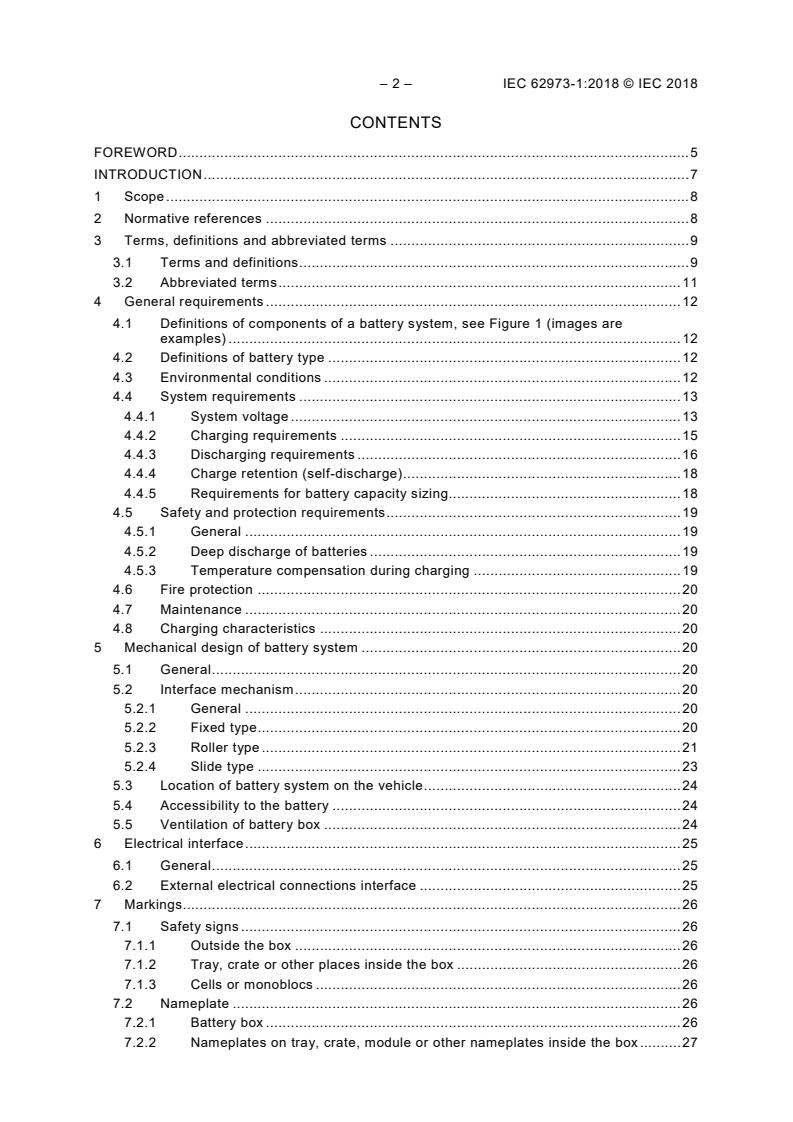
– 2 – IEC 62973-1:2018 © IEC 2018
CONTENTS
FOREWORD . 5
INTRODUCTION . 7
1 Scope . 8
2 Normative references . 8
3 Terms, definitions and abbreviated terms . 9
3.1 Terms and definitions . 9
3.2 Abbreviated terms . 11
4 General requirements . 12
4.1 Definitions of components of a battery system, see Figure 1 (images are
examples) . 12
4.2 Definitions of battery type . 12
4.3 Environmental conditions . 12
4.4 System requirements . 13
4.4.1 System voltage . 13
4.4.2 Charging requirements . 15
4.4.3 Discharging requirements . 16
4.4.4 Charge retention (self-discharge) . 18
4.4.5 Requirements for battery capacity sizing. 18
4.5 Safety and protection requirements . 19
4.5.1 General . 19
4.5.2 Deep discharge of batteries . 19
4.5.3 Temperature compensation during charging . 19
4.6 Fire protection . 20
4.7 Maintenance . 20
4.8 Charging characteristics . 20
5 Mechanical design of battery system . 20
5.1 General . 20
5.2 Interface mechanism . 20
5.2.1 General . 20
5.2.2 Fixed type . 20
5.2.3 Roller type . 21
5.2.4 Slide type . 23
5.3 Location of battery system on the vehicle . 24
5.4 Accessibility to the battery . 24
5.5 Ventilation of battery box . 24
6 Electrical interface . 25
6.1 General . 25
6.2 External electrical connections interface . 25
7 Markings. 26
7.1 Safety signs . 26
7.1.1 Outside the box . 26
7.1.2 Tray, crate or other places inside the box . 26
7.1.3 Cells or monoblocs . 26
7.2 Nameplate . 26
7.2.1 Battery box . 26
7.2.2 Nameplates on tray, crate, module or other nameplates inside the box . 27
7.2.3 Cells or monoblocs . 27
8 Storage and transportation conditions . 27
8.1 Transportation . 27
8.2 Storage of batteries . 27
9 Testing . 27
9.1 General . 27
9.2 Type test . 28
9.2.1 General . 28
9.2.2 Electrical characteristic tests . 28
9.2.3 Dielectric test . 28
9.2.4 Load profile test . 28
9.2.5 Shock and vibration test . 28
9.3 Routine test . 29
9.3.1 General . 29
9.3.2 Visual checks . 29
9.3.3 Dielectric test . 29
9.3.4 Electrical characteristics tests . 29
Annex A (informative) Examples of typical load profiles for emergency operation . 30
A.1 Example of load profile – High speed train (Figure A.1) . 30
A.2 Example of load profile – Regional train / EMU (Figure A.2) . 30
Annex B (normative) Load profile verification . 31
B.1 General . 31
B.2 General methodology . 31
B.3 Battery sizing documentation . 32
B.4 Operational verification (load profile test) . 32
B.5 Test report . 32
Annex C (informative) Example of functions during load profile . 34
Bibliography . 35
Figure 1 – Definition of cell(s), monobloc battery, crate, tray, and box . 12
Figure 2 – Example of discharge curves at various constant discharge currents based
on percentage of capacity . 14
Figure 3 – Examples of charge curves . 14
Figure 4 – Interfaces between battery and battery charging system . 15
Figure 5 – Example of load profile for emergency back-up for auxiliaries (train not
moving). 17
Figure 6 – Example of load profile during normal operation such as rail gaps (driving
without battery charging). 17
Figure 7 – Example of fixed solution without tray . 21
Figure 8 – Example of fixed solution with tray . 21
Figure 9 – Example of roller solution with folding beams . 22
Figure 10 – Example of roller solution with roller bearings . 23
Figure 11 – Example of slide solution . 24
Figure 12 – Typical schematic of an electrical interface of a battery system . 25
Figure A.1 – Example of load profile for high speed train (without starting up segment) . 30
Figure A.2 – Example of load profile for regional train / EMU (without starting up
segment) . 30
– 4 – IEC 62973-1:2018 © IEC 2018
Table 1 – Operating range of the equipment supplied by the battery system . 13
Table 2 – Requirements of the charging characteristics . 15
Table 3 – Parameters and responsibility for battery capacity sizing . 19
Table C.1 – Examples of functions during different steps of load profile . 34
INTERNATIONAL ELECTROTECHNICAL COMMISSION
____________
RAILWAY APPLICATIONS – ROLLING STOCK –
BATTERIES FOR AUXILIARY POWER SUPPLY SYSTEMS –
Part 1: General requirements
FOREWORD
1) The International Electrotechnical Commission (IEC) is a worldwide organization for standardization comprising
all national electrotechnical committees (IEC National Committees). The object of IEC is to promote
international co-operation on all questions concerning standardization in the electrical and electronic fields. To
this end and in addition to other activities, IEC publishes International Standards, Technical Specifications,
Technical Reports, Publicly Available Specifications (PAS) and Guides (hereafter referred to as “IEC
Publication(s)”). Their preparation is entrusted to technical committees; any IEC National Committee interested
in the subject dealt with may participate in this preparatory work. International, governmental and non-
governmental organizations liaising with the IEC also participate in this preparation. IEC collaborates closely
with the International Organization for Standardization (ISO) in accordance with conditions determined by
agreement between the two organizations.
2) The formal decisions or agreements of IEC on technical matters express, as nearly as possible, an international
consensus of opinion on the relevant subjects since each technical committee has representation from all
interested IEC National Committees.
3) IEC Publications have the form of recommendations for international use and are accepted by IEC National
Committees in that sense. While all reasonable efforts are made to ensure that the technical content of IEC
Publications is accurate, IEC cannot be held responsible for the way in which they are used or for any
misinterpretation by any end user.
4) In order to promote international uniformity, IEC National Committees undertake to apply IEC Publications
transparently to the maximum extent possible in their national and regional publications. Any divergence
between any IEC Publication and the corresponding national or regional publication shall be clearly indicated in
the latter.
5) IEC itself does not provide any attestation of conformity. Independent certification bodies provide conformity
assessment services and, in some areas, access to IEC marks of conformity. IEC is not responsible for any
services carried out by independent certification bodies.
6) All users should ensure that they have the latest edition of this publication.
7) No liability shall attach to IEC or its directors, employees, servants or agents including individual experts and
members of its technical committees and IEC National Committees for any personal injury, property damage or
other damage of any nature whatsoever, whether direct or indirect, or for costs (including legal fees) and
expenses arising out of the publication, use of, or reliance upon, this IEC Publication or any other IEC
Publications.
8) Attention is drawn to the Normative references cited in this publication. Use of the referenced publications is
indispensable for the correct application of this publication.
9) Attention is drawn to the possibility that some of the elements of this IEC Publication may be the subject of
patent rights. IEC shall not be held responsible for identifying any or all such patent rights.
International Standard IEC 62973-1 has been prepared by IEC technical committee 9:
Electrical equipment and systems for railways.
The text of this International Standard is based on the following documents:
FDIS Report on voting
9/2362/FDIS 9/2386/RVD
Full information on the voting for the approval of this International Standard can be found in
the report on voting indicated in the above table.
This document has been drafted in accordance with the ISO/IEC Directives, Part 2.
– 6 – IEC 62973-1:2018 © IEC 2018
A list of all parts in the IEC 62973 series, published under the general title Railway
applications – Rolling stock – Batteries for auxiliary power supply systems, can be found on
the IEC website.
The committee has decided that the contents of this document will remain unchanged until the
stability date indicated on the IEC website under "http://webstore.iec.ch" in the data related to
the specific document. At this date, the document will be
• reconfirmed,
• withdrawn,
• replaced by a revised edition, or
• amended.
IMPORTANT – The 'colour inside' logo on the cover page of this publication indicates
that it contains colours which are considered to be useful for the correct
understanding of its contents. Users should therefore print this document using a
colour printer.
INTRODUCTION
This document considers general requirements for all rechargeable battery technologies.
Details of each battery technology are described in other parts as follows:
Part 2: Nickel Cadmium (NiCd) batteries
Part 3: Lead Acid (LA) batteries
Future parts: Other battery technologies, such as Nickel metal hydride (NiMH), Lithium ion (Li-
ion), etc.
In this document the interface with a battery charger is specified and the battery charger itself
is out of scope.
– 8 – IEC 62973-1:2018 © IEC 2018
RAILWAY APPLICATIONS – ROLLING STOCK –
BATTERIES FOR AUXILIARY POWER SUPPLY SYSTEMS –
Part 1: General requirements
1 Scope
This part of IEC 62973 applies to various rechargeable battery technologies for auxiliary
power supply systems used on rolling stock.
This document applies to any rolling stock types (e.g. light rail vehicles, tramways, streetcars,
metros, commuter trains, regional trains, high speed trains, locomotives, etc.).
This document focuses on:
– the description of electrical interfaces for the following battery nominal voltages: 24 V,
32 V, 36 V, 48 V, 64 V, 72 V, 87 V, 96 V, 110 V;
– the description of electrical interfaces: considering battery load profile and battery capacity
sizing parameters (e.g. operating voltage range and charging characteristics).
This document with the other parts of the standard is used in conjunction with other related
IEC standards for auxiliary equipment used for railway rolling stock applications.
The main objective of this document is to achieve standardization of the electrical interfaces
by considering various battery parameters in order to allow for calculating the battery capacity
required for a specific load profile for the various battery technologies as detailed in the other
parts of the standard.
2 Normative references
The following documents are referred to in the text in such a way that some or all of their
content constitutes requirements of this document. For dated references, only the edition
cited applies. For undated references, the latest edition of the referenced document (including
any amendments) applies.
IEC 60077-1, Railway applications – Electric equipment for rolling stock – Part 1: General
service conditions and general rules
IEC 61373:2010, Railway applications – Rolling stock equipment – Shock and vibration test
IEC 62485-2, Safety requirements for secondary batteries and battery installations –
Part 2: Stationary batteries
IEC 62498-1:2010, Railway applications – Environmental conditions for equipment –
Part 1: Equipment on board rolling stock
IEC 62847, Railway applications – Rolling stock – Electrical connectors – Requirements and
test methods
ISO 7010, Graphical symbols – Safety colours and safety signs – Registered safety signs
3 Terms, definitions and abbreviated terms
3.1 Terms and definitions
For the purposes of this document, the following terms and definitions apply.
ISO and IEC maintain terminological databases for use in standardization at the following
addresses:
• IEC Electropedia: available at http://www.electropedia.org/
• ISO Online browsing platform: available at http://www.iso.org/obp
NOTE All typical battery related descriptions are defined in IEC 60050-482.
3.1.1
battery crate
container with frame walls for holding several cells or batteries
Note 1 to entry: See 4.1 and Clause 5.
[SOURCE: IEC 60050-482:2004/AMD1:2016, 482-05-10, modified – Note 1 to entry has been
added.]
3.1.2
battery tray
container with a base and walls for holding several cells or batteries
Note 1 to entry: See 4.1 and Clause 5.
[SOURCE: IEC 60050-482:2004/AMD1:2016, 482-02-35, modified – Note 1 to entry has been
added.]
3.1.3
cell
basic functional unit, consisting of an assembly of electrodes, electrolyte, container, terminals
and usually separators, that is a source of electric energy obtained by direct conversion of
chemical energy
[SOURCE: IEC 60050-482:2004/AMD1:2016, 482-01-01, modified – Note has been deleted.]
3.1.4
monobloc battery
battery with multiple separate but electrically connected cell compartments each of which is
designed to house an assembly of electrodes, electrolyte, terminals or interconnections and
possible separators
Note 1 to entry: The cells in a monobloc battery can be connected in series or in parallel.
Note 2 to entry: See 4.1.
[SOURCE: IEC 60050-482:2004, 482-02-17, modified – Note 2 to entry has been added.]
3.1.5
rated capacity
C
n
capacity value of a battery determined under specified conditions and declared by the battery
manufacturer
[SOURCE: IEC 60050-482:2004, 482-03-15]
– 10 – IEC 62973-1:2018 © IEC 2018
3.1.6
state of charge
SOC
remaining capacity to be discharged, normally expressed as a percentage of the full battery
rated capacity as expressed in relevant standards
Note 1 to entry: Practical definitions of SOC are dependent upon chosen technologies.
3.1.7
depth of discharge
DOD
capacity removed from a battery during discharge in relation to its full rated capacity
expressed as a percentage
Note 1 to entry: It is the complement of SOC.
Note 2 to entry: As one increases, the other decreases by the same amount.
Note 3 to entry: Practical definitions of DOD are dependent upon chosen technologies.
3.1.8
ageing factor
quantitative factor expressing the degradation in the ability of the battery, due to usage, to
deliver electrical energy under specified operating conditions such as, but not limited to,
operating ambient temperature, cycling considering depth of discharge (DOD), and
maintenance practices
3.1.9
battery module
group of cells connected together either in a series and/or parallel configuration with or
without protective devices (e.g. fuse or temperature sensor) and monitoring circuitry
3.1.10
battery system
battery
system that also includes battery tray(s), battery crate(s), monobloc(s), battery module(s),
electronic components and/or equipment and associated electromechanical connections
Note 1 to entry: This is a general definition. A more precise definition can be detailed for each battery technology
in the parts of the series if necessary.
3.1.11
end user
organization which operates the battery system
Note 1 to entry: The end user is normally an organization which operates the vehicle equipped with the battery
system, unless the responsibility is delegated to a main contractor or consultant.
3.1.12
system integrator
organization which has the technical responsibility of the complete battery system and
charging system
Note 1 to entry: The system integrator can be the end user or the train manufacturer, or none of them.
3.1.13
manufacturer
organization which has the technical responsibility for its scope of supply
Note 1 to entry: The manufacturer can be the train builder or the system integrator of a battery system, a cell
manufacturer, etc. If necessary to explicitly distinguish, “train manufacturer”, “battery system manufacturer” or “cell
manufacturer” is expressed.
3.2 Abbreviated terms
AC Alternating Current
C Capacity at the n-hour rate
n
CCTV Closed-Circuit Television
DC Direct Current
DOD Depth Of Discharge
EMU Electrical Multiple Unit
FEA Finite Element Analysis
HVAC Heating, Ventilation, Air Conditioning
LRU Line Replaceable Unit
NTC Negative Temperature Coefficient (temperature sensor)
PT 100 Temperature Sensor, Type PT 100
PT 1000 Temperature Sensor, Type PT 1000
SOC State Of Charge
– 12 – IEC 62973-1:2018 © IEC 2018
4 General requirements
4.1 Definitions of components of a battery system, see Figure 1 (images are
examples)
Monobloc battery Single cells / no LRU
Crate with single cells
Basic elements /
basic LRU's
Tray
Next higher level
of LRU
Battery box
Next higher level /
no LRU
IEC
Figure 1 – Definition of cell(s), monobloc battery, crate, tray, and box
Some batteries may not include all of the above components, e.g. single cells may be
installed in a tray without crates. Some battery technologies may include further components
(e.g. module) in the parts of this standard series if necessary.
4.2 Definitions of battery type
Refer to the relevant part of this standard series for the battery technology.
4.3 Environmental conditions
The battery has to ensure an appropriate function at the given requirements, but with respect
to lifetime and chargeability and discharge performance, the battery should not be operated
above or below the maximum or minimum operating temperature range of the respective
battery technology.
The battery cells/ monoblocs in the battery box shall be protected against direct solar
radiation, heat sources, rain, pollution, snow, hail and sandstorm.
• Temperature conditions:
– ambient battery temperature: according to IEC 62498-1:2010, Table 2
Deviations may be agreed between end user and / or
system integrator and cell / battery manufacturer.
– transport and storage: –30 °C to 70 °C
Deviations may be agreed between end user and / or
system integrator and cell / battery manufacturer.
• Humidity: according to IEC 62498-1:2010, 4.4
Deviations may be agreed between end user and / or
system integrator and cell / battery manufacturer.
• Shock and vibration: according to IEC 61373:2010,11.3
• Dielectric properties: according to IEC 60077-1
• Altitude: according to IEC 62498-1:2010, 4.2
4.4 System requirements
4.4.1 System voltage
The low voltage supply network has to allow operation of the connected equipment within the
minimum and maximum limits of the voltage range according to Table 1.
The battery nominal voltages are given only to identify or classify the system voltage
equipment types and should not be considered as equipment operating voltages or off-load
battery voltages. The number of cells in a battery can vary depending on the operating
conditions and battery load profile as long as the minimum and maximum equipment operating
voltage range is respected. The charging voltage for the battery is dependent on the number
of cells, temperature, and its technology.
Table 1 – Operating range of the equipment supplied by the battery system
Battery nominal voltage Minimum voltage at equipment Maximum voltage at equipment
V V V
a a
24 17 / 16,8 34 / 30
a a
32 23 42,5
a a
48 34 / 33,6 68 / 60
a a
64 46 85
72 50,4 90
b b
87 60,9 108,8
96 67,2 120
110 77 137,5
NOTE Values are based on IEC 60077-1.
a
IEEE 1476 (North America) – Refer to Bibliography.
b
JIS E 5004-1 (Japan) – Refer to Bibliography.
The battery nominal voltages and the discharge voltages are different. As an example, the
following Figure 2 shows typical discharges of a cell at different constant discharging currents
(shown in multiples of C or multiples of I , C and I are related, e.g. 0,2 C is equivalent to
n n n n 5
I ) that vary by battery technology. Typical discharge curves (discharge voltages relative to
– 14 – IEC 62973-1:2018 © IEC 2018
discharge capacities based on constant current discharges) with corresponding temperature
are provided for each battery technology in this standard series.
Fully charged, rest 1 hour at + 20 °C
0,2 C5 or I5 0,5 C5 or 2,5 I5
1 C5 or 5 I5 3 C5 or 15 I5
5 C5 or 25 I5 7 C5 or 35 I5
0 10 20 30 40 50 60 70 80 90 100 110
DOD (%)
IEC
Figure 2 – Example of discharge curves at various constant
discharge currents based on percentage of capacity
The following example, Figure 3a shows a typical charge of a cell at constant charging current
at 0,2 C (equivalent to I ) for the initial phase followed by Figure 3b constant charging
5 5
voltage for the last phase by battery technology. Typical charging methods (charge voltages
relative to capacities) with corresponding temperature are provided for each battery
technology in this standard series. Charging curves shall be available from battery
manufacturers.
0,25
1,5
0,2
1,45
0,15
1,4
0,1
1,35
0,05
1,3
1,25
0 5 10 15
0 5 10 15
Charge time (s)
Charge time (s)
IEC
IEC
Figure 3a – Example of charge current rate curve Figure 3b – Example of charge voltage curve
Figure 3 – Examples of charge curves
Charge current (A)
Cell or battery voltage (V)
Cell voltage (V)
4.4.2 Charging requirements
The required battery charging voltage and the optimum charging method are specified
according to Table 2.
Table 2 – Requirements of the charging characteristics
Requirements Characteristics
Normal condition Float charge by battery charger with temperature compensation as
required by the battery technology
Charging method Depending on battery technology
Steady state control tolerance of the The charge voltage tolerance refers to the voltage demand according
battery charge voltage output at the to the ideal charging characteristic that will be detailed for each battery
charging system technology in the parts of the series if applicable.
In case of temperature compensation ± 1,5 % or lower tolerance.
Without temperature compensation ± 1 % or lower tolerance
Charging voltage ripple ≤ 5 % (according to IEC 60077-1 with disconnected battery)
Charging current ripple The battery charging current shall be DC, as any superimposed AC
component in the charging current can lead to a temperature increase
of the battery. The AC content in the charging current should not
exceed values as per IEC 62485-2. The values will be detailed for each
battery technology in the parts of the series if applicable
Temperature compensation Temperature compensation as required by the battery technology. The
values will be detailed for each battery technology in the parts of the
series if applicable
Detection of temperature Signal from sensor on battery or battery compartment, detection inside
battery charging system
In some cases, in agreement between the end user and manufacturer, the temperature
compensation may not be required. This information should be agreed upon prior to
calculating the battery capacity required for a specific load profile. In such a case the battery
temperature sensor may be omitted.
Figure 4 below is a typical electrical schematic for a charger interface to the battery
installation. Other configurations may be possible with the same or additional battery
functions.
(2b)
Battery current
sensor
Data acquisition (2a)
and
To
(5) (4)
Voltage control (1)
Temperature
battery Voltage
sensor (3)
charger sensor (1)
module
Battery
Battery charger
IEC
Figure 4 – Interfaces between battery and battery charging system
– 16 – IEC 62973-1:2018 © IEC 2018
The interface system between battery charging system and battery as shown in Figure 4
consists of:
1) Battery voltage sensing and regulation: maximum ± 1 % tolerance (see (1) in Figure 4).
2) Temperature data acquisition (2a), including wiring (2b) to the sensor (3) typically, better
than ± 2,5 K tolerance (equivalent to ± 0,5 % of ideal charging voltage).
3) Temperature sensor (3): maximum tolerance ± 2 K for the specified temperature range
(equivalent to ± 0,4 % of ideal charging voltage) preferably attached to the battery,
minimum one sensor per battery system (see (3)). The choice of the temperature sensor
shall be agreed between the system integrator and the suppliers of the battery and battery
charging system. In case where a PT 100 is used a 4-cable wiring or active sensing is
necessary. Other typical sensors are available such as 2-wire PT 1000 or NTC (10 kΩ at
25 °C).
4) Position of the temperature sensor (3) within the battery compartment (4).
5) Cabling between battery and battery charger: part of system integration in the train (5).
The accuracy of the charging system is to be checked:
a) for a defined temperature range of less than 80 K,
b) at the battery charger interface.
The system integrator shall check if and how the effect of the wiring needs to be compensated,
considering voltage drop in the power cables and resistance in the temperature sensor wires.
The impact of the sensor wiring depends on the type of temperature sensor, data acquisition
system and/or location of the voltage sensor. If there are significant influences, it is possible
to compensate these influences in the battery charger control system upon agreement
between the system integrator and the manufacturer of the battery charging system.
With the recommended temperature sensors, the influence of the wiring resistance on the
temperature acquisition can be neglected.
4.4.3 Discharging requirements
4.4.3.1 General
There are different discharging requirements for batteries while in service or storage:
– load profile (emergency back-up for auxiliaries and/or during normal operation such as
neutral section or power gaps);
– off line discharge when power is not present;
– low and high temperature discharging requirements;
– self-discharge.
The above discharging requirements are described in the following subclauses.
4.4.3.2 Load profile
Load profile to be considered shall be defined in agreement between the end user, system
integrator, and cell or battery manufacturer. The load profile needs to be clearly identified if it
is for the entire train along with the number of batteries supporting it or per vehicle equipped
with the battery.
Examples of two different types of load profiles are as follows:
– emergency back-up for auxiliaries (see Figure 5 showing a 1 to 5 step load profile),
– during normal operation such as neutral section or power gaps (see Figure 6 showing a 1
to 2 step load profile).
To optimize the battery sizing, the load profile shall be represented by three types of loads;
constant power load (W), resistive load (Ω), and constant current load (A) that may happen at
the same time for each discharge time interval. Sometimes not all three types of loads are
present.
Examples of load profiles for emergency operation for high speed trains and regional trains
are shown in Figure A.1 and Figure A.2.
All
loads
(1)
Important
loads
(2)
Emergency
loads
(3)
Longtime discharging
(4)
Time
IEC
Figure 5 – Example of load profile for emergency back-up for
auxiliaries (train not moving)
All
loads
(1) Important loads
(2)
Time
IEC
Figure 6 – Example of load profile during normal operation such as
rail gaps (driving without battery charging)
Loads
Loads
Start up (5)
– 18 – IEC 62973-1:2018 © IEC 2018
4.4.3.3 Extended discharge time
Extended discharge time is a small discharge load beyond the normal emergency load profile
period. For example, a discharge time longer than one day with a defined battery consumption.
Such discharge cannot entirely be excluded. The amount of this discharge load as well as the
discharge time should be specified by the end user and system integrator.
The battery shall be able to withstand the extended discharge without permanent damage.
Each battery technology in the parts of the series shall define the parameters such as
reconditioning to recover the battery performances after this extended discharge if required.
4.4.3.4 Low or high temperature performance
The admissible battery temperature should be the average low or high temperature of the city
or region as identified by websites such as www.weatherbase.com or as agreed by the
customer. At this temperature, the charged battery shall still be able to supply the load profile
as specified by the end user.
In addition, no permanent damage shall occur at this temperature.
4.4.4 Charge retention (self-discharge)
Normally batteries have a self-discharge, a lowering of the battery available capacity, while in
storage that is also affected by temperature. Each battery technology in the parts of the series
should provide the self-discharge characteristics or other effects while in storage for a period
of time and temperature. This lowered available capacity due to self-discharge is normally
reversible by a recharge as specified by the battery manufacturer.
For storage of batteries, see 8.2.
4.4.5 Requirements for battery capacity sizing
The train manufacturer or system integrator shall define the following parameters:
– discharging requirements per load profile (see 4.4.3),
– capacity reserve for future loads or safety,
– battery ambient temperature range in emergency condition (in agreement with the end
user),
– voltage drop from battery to equipment (loads) due to cable length and size or minimum
voltage at battery terminal
V = V + V
battery equipment drop
where
V is the voltage at the battery terminal;
battery
V is the voltage at the equipment (Table 1: at least the minimum v
...
Questions, Comments and Discussion
Ask us and Technical Secretary will try to provide an answer. You can facilitate discussion about the standard in here.
Loading comments...