

IEC TR 61000-4-35:2009
(Main)Electromagnetic compatibility (EMC) - Part 4-35: Testing and measurement techniques - HPEM simulator compendium
General Information
- Abstract
IEC/TR 61000-4-35:2009(E) provides information about extant system-level High-Power Electromagnetic (HPEM) simulators and their applicability as test facilities and validation tools for immunity test requirements in accordance with the IEC 61000 series of standards. HPEM simulators with the capability of conducted susceptibility or immunity testing will be included in a further stage of the project. In the sense of this report the group of HPEM simulators consists of narrow band microwave test facilities and wideband simulators for radiated high power electromagnetic fields. IEC 61000-2-13 defines high power electromagnetic (HPEM) radiated environments as those with a peak power density that exceeds 26 W/m2 (100 V/m or 0,27 A/m). This part of IEC 61000 focuses on a sub-set of HPEM simulators capable of achieving much higher fields. Therefore, the HPEM radiated environments used in this document are characterized by a peak power density exceeding 663 W/m2 (500 V/m or 1,33 A/m). The intention of this report is to provide the first detailed listing of both narrowband (hypoband) and wideband (mesoband, sub-hyperband and hyperband) simulators throughout the world. HEMP simulators are the subject of a separate compendium (IEC 61000-4-32) and thus are outside the scope of this Technical Report. After an introduction, a general description of HPEM simulators, as listed in this Technical Report, is presented. A database has been created by collecting information from simulator owners and operators and this data is presented for the technical characterization of the test facilities. In addition, some important commercial aspects, such as availability and operational status, are also addressed.
- Status
- Published
- Publication Date
- 22-Jul-2009
- Technical Committee
- SC 77C - High power transient phenomena
- Current Stage
- PPUB - Publication issued
- Start Date
- 23-Jul-2009
- Completion Date
- 31-Oct-2009

Overview
IEC TR 61000-4-35:2009 is a Technical Report published by the International Electrotechnical Commission (IEC) as part of the IEC 61000 series on Electromagnetic Compatibility (EMC), focusing specifically on testing and measurement techniques. This report assembles detailed information on system-level High-Power Electromagnetic (HPEM) simulators globally, highlighting their role as test facilities and validation tools for immunity testing against high field strengths. It distinguishes itself by cataloguing both narrowband (hypoband) and wideband (mesoband, sub-hyperband, and hyperband) simulators used for radiated HPEM environments, offering valuable data for professionals concerned with the robust design and testing of electronic systems under HPEM threats.
Key Topics
- HPEM Simulators: Documentation and classification of existing HPEM simulators, including facility details encompassing operational status, availability, and technical parameters.
- Types of Simulators: Coverage of narrowband (hypoband) and wideband (including mesoband, sub-hyperband, and hyperband) simulators capable of generating high-intensity electromagnetic fields for EMC testing.
- Test Facility Database: Establishment of a standardized database with technical, administrative, and commercial aspects provided by simulator owners and operators.
- Electromagnetic Field Classification: Differentiation based on peak power density, focusing on HPEM environments exceeding 663 W/m² (500 V/m or 1.33 A/m), which are significantly higher than traditional EMC and HEMP levels.
- Operating Conditions: Criteria including field strengths, bandwidth, pulse characteristics, test volumes, and availability for government and industry users.
- Immunity Assessment: Practical utility for validating immunity test requirements per the IEC 61000 series.
Applications
The compendium provided by IEC TR 61000-4-35 serves multiple stakeholders across various industries:
- Immunity Testing: Supports developers, engineers, and regulatory bodies in selecting suitable HPEM simulators to perform immunity testing on critical electronic systems.
- Facility Operators: Allows facility operators and owners to benchmark their test setups and promote transparency in HPEM testing capabilities.
- System Hardening: Assists manufacturers in identifying appropriate test environments for assessing and improving the robustness (hardening) of electronics against intentional electromagnetic interference (IEMI) and HPEM threats.
- Research and Development: Facilitates researchers and universities working on high-power electromagnetic field effects, EMC research, and validation of mitigation techniques.
- Civil and Industrial Sectors: Addresses increasing EMC concerns in sectors such as communication, transportation, healthcare, defense, and infrastructure due to the proliferation and sensitivity of advanced electronic systems.
Related Standards
IEC TR 61000-4-35:2009 references and complements several other important documents within the IEC 61000 series, including:
- IEC 61000-2-13: Defines high-power electromagnetic (HPEM) environments and forms the basis for simulator classification in this report.
- IEC 61000-2-9 / 2-10: Cover the description of high-altitude electromagnetic pulse (HEMP) environments for radiated and conducted disturbances.
- IEC 61000-4-21: Describes reverberation chamber test methods, relevant for a subset of HPEM simulators.
- IEC 61000-4-32: Offers a separate compendium dedicated to HEMP simulators, which are out of scope for this report.
- IEC 60050-161: International Electrotechnical Vocabulary for electromagnetic compatibility terminology.
Conclusion
IEC TR 61000-4-35:2009 delivers a comprehensive, structured overview of HPEM simulator test facilities worldwide, aiding those involved in EMC testing and the protection of critical electronic systems against high-power electromagnetic environments. By providing detailed facility data and standardized assessment criteria, it plays a crucial role in advancing EMC practices and ensuring the reliability and safety of modern electronics in both civilian and military applications. This document is an essential reference for professionals focused on EMC, HPEM immunity, and the ongoing development of robust electronic systems in the face of evolving electromagnetic risks.
Get Certified
Connect with accredited certification bodies for this standard

ANCE
Mexican certification and testing association.

Intertek Slovenia
Intertek testing, inspection, and certification services in Slovenia.

LNE (Laboratoire National de Métrologie et d'Essais)
French national laboratory for metrology and testing.
Sponsored listings
Frequently Asked Questions
IEC TR 61000-4-35:2009 is a technical report published by the International Electrotechnical Commission (IEC). Its full title is "Electromagnetic compatibility (EMC) - Part 4-35: Testing and measurement techniques - HPEM simulator compendium". This standard covers: IEC/TR 61000-4-35:2009(E) provides information about extant system-level High-Power Electromagnetic (HPEM) simulators and their applicability as test facilities and validation tools for immunity test requirements in accordance with the IEC 61000 series of standards. HPEM simulators with the capability of conducted susceptibility or immunity testing will be included in a further stage of the project. In the sense of this report the group of HPEM simulators consists of narrow band microwave test facilities and wideband simulators for radiated high power electromagnetic fields. IEC 61000-2-13 defines high power electromagnetic (HPEM) radiated environments as those with a peak power density that exceeds 26 W/m2 (100 V/m or 0,27 A/m). This part of IEC 61000 focuses on a sub-set of HPEM simulators capable of achieving much higher fields. Therefore, the HPEM radiated environments used in this document are characterized by a peak power density exceeding 663 W/m2 (500 V/m or 1,33 A/m). The intention of this report is to provide the first detailed listing of both narrowband (hypoband) and wideband (mesoband, sub-hyperband and hyperband) simulators throughout the world. HEMP simulators are the subject of a separate compendium (IEC 61000-4-32) and thus are outside the scope of this Technical Report. After an introduction, a general description of HPEM simulators, as listed in this Technical Report, is presented. A database has been created by collecting information from simulator owners and operators and this data is presented for the technical characterization of the test facilities. In addition, some important commercial aspects, such as availability and operational status, are also addressed.
IEC/TR 61000-4-35:2009(E) provides information about extant system-level High-Power Electromagnetic (HPEM) simulators and their applicability as test facilities and validation tools for immunity test requirements in accordance with the IEC 61000 series of standards. HPEM simulators with the capability of conducted susceptibility or immunity testing will be included in a further stage of the project. In the sense of this report the group of HPEM simulators consists of narrow band microwave test facilities and wideband simulators for radiated high power electromagnetic fields. IEC 61000-2-13 defines high power electromagnetic (HPEM) radiated environments as those with a peak power density that exceeds 26 W/m2 (100 V/m or 0,27 A/m). This part of IEC 61000 focuses on a sub-set of HPEM simulators capable of achieving much higher fields. Therefore, the HPEM radiated environments used in this document are characterized by a peak power density exceeding 663 W/m2 (500 V/m or 1,33 A/m). The intention of this report is to provide the first detailed listing of both narrowband (hypoband) and wideband (mesoband, sub-hyperband and hyperband) simulators throughout the world. HEMP simulators are the subject of a separate compendium (IEC 61000-4-32) and thus are outside the scope of this Technical Report. After an introduction, a general description of HPEM simulators, as listed in this Technical Report, is presented. A database has been created by collecting information from simulator owners and operators and this data is presented for the technical characterization of the test facilities. In addition, some important commercial aspects, such as availability and operational status, are also addressed.
IEC TR 61000-4-35:2009 is classified under the following ICS (International Classification for Standards) categories: 33.100.20 - Immunity. The ICS classification helps identify the subject area and facilitates finding related standards.
IEC TR 61000-4-35:2009 is available in PDF format for immediate download after purchase. The document can be added to your cart and obtained through the secure checkout process. Digital delivery ensures instant access to the complete standard document.
Standards Content (Sample)
IEC/TR 61000-4-35 ®
Edition 1.0 2009-07
TECHNICAL
REPORT
Electromagnetic compatibility (EMC) –
Part 4-35: Testing and measurement techniques – HPEM simulator compendium
IEC/TR 61000-4-35:2009(E)
All rights reserved. Unless otherwise specified, no part of this publication may be reproduced or utilized in any form or by
any means, electronic or mechanical, including photocopying and microfilm, without permission in writing from either IEC or
IEC's member National Committee in the country of the requester.
If you have any questions about IEC copyright or have an enquiry about obtaining additional rights to this publication,
please contact the address below or your local IEC member National Committee for further information.
Droits de reproduction réservés. Sauf indication contraire, aucune partie de cette publication ne peut être reproduite
ni utilisée sous quelque forme que ce soit et par aucun procédé, électronique ou mécanique, y compris la photocopie
et les microfilms, sans l'accord écrit de la CEI ou du Comité national de la CEI du pays du demandeur.
Si vous avez des questions sur le copyright de la CEI ou si vous désirez obtenir des droits supplémentaires sur cette
publication, utilisez les coordonnées ci-après ou contactez le Comité national de la CEI de votre pays de résidence.
IEC Central Office
3, rue de Varembé
CH-1211 Geneva 20
Switzerland
Email: inmail@iec.ch
Web: www.iec.ch
About IEC publications
The technical content of IEC publications is kept under constant review by the IEC. Please make sure that you have the
latest edition, a corrigenda or an amendment might have been published.
ƒ Catalogue of IEC publications: www.iec.ch/searchpub
The IEC on-line Catalogue enables you to search by a variety of criteria (reference number, text, technical committee,…).
It also gives information on projects, withdrawn and replaced publications.
ƒ IEC Just Published: www.iec.ch/online_news/justpub
Stay up to date on all new IEC publications. Just Published details twice a month all new publications released. Available
on-line and also by email.
ƒ Electropedia: www.electropedia.org
The world's leading online dictionary of electronic and electrical terms containing more than 20 000 terms and definitions
in English and French, with equivalent terms in additional languages. Also known as the International Electrotechnical
Vocabulary online.
ƒ Customer Service Centre: www.iec.ch/webstore/custserv
If you wish to give us your feedback on this publication or need further assistance, please visit the Customer Service
Centre FAQ or contact us:
Email: csc@iec.ch
Tel.: +41 22 919 02 11
Fax: +41 22 919 03 00
IEC/TR 61000-4-35 ®
Edition 1.0 2009-07
TECHNICAL
REPORT
Electromagnetic compatibility (EMC) –
Part 4-35: Testing and measurement techniques – HPEM simulator compendium
INTERNATIONAL
ELECTROTECHNICAL
COMMISSION
PRICE CODE
XC
ICS 33.100.20 ISBN 978-2-88910-394-2
– 2 – TR 61000-4-35 © IEC:2009(E)
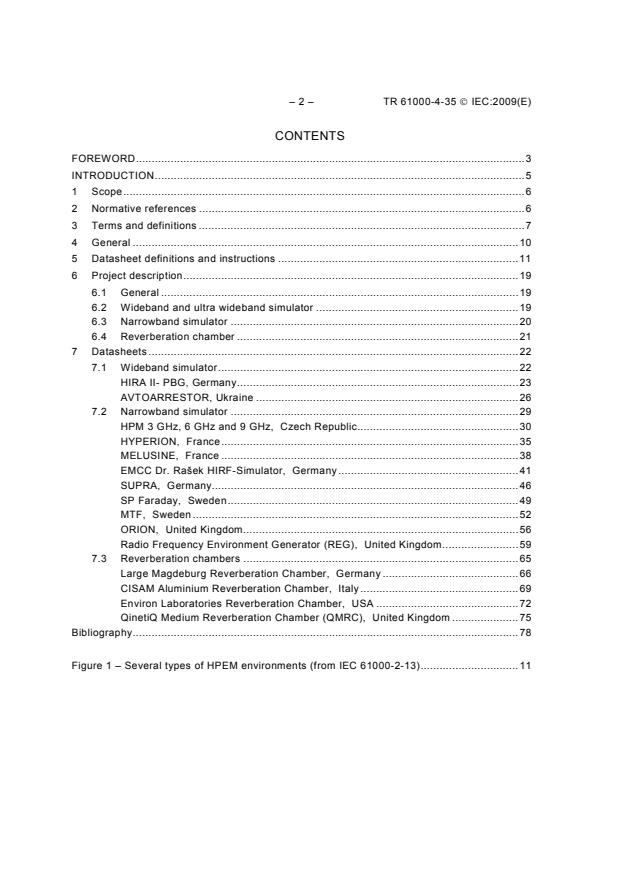
CONTENTS
FOREWORD.3
INTRODUCTION.5
1 Scope.6
2 Normative references .6
3 Terms and definitions .7
4 General .10
5 Datasheet definitions and instructions .11
6 Project description.19
6.1 General .19
6.2 Wideband and ultra wideband simulator .19
6.3 Narrowband simulator .20
6.4 Reverberation chamber .21
7 Datasheets .22
7.1 Wideband simulator.22
HIRA II- PBG, Germany.23
AVTOARRESTOR, Ukraine .26
7.2 Narrowband simulator .29
HPM 3 GHz, 6 GHz and 9 GHz, Czech Republic.30
HYPERION, France.35
MELUSINE, France .38
EMCC Dr. Rašek HIRF-Simulator, Germany.41
SUPRA, Germany.46
SP Faraday, Sweden.49
MTF, Sweden .52
ORION, United Kingdom.56
Radio Frequency Environment Generator (REG), United Kingdom.59
7.3 Reverberation chambers .65
Large Magdeburg Reverberation Chamber, Germany .66
CISAM Aluminium Reverberation Chamber, Italy.69
Environ Laboratories Reverberation Chamber, USA .72
QinetiQ Medium Reverberation Chamber (QMRC), United Kingdom .75
Bibliography.78
Figure 1 – Several types of HPEM environments (from IEC 61000-2-13).11
TR 61000-4-35 © IEC:2009(E) – 3 –
INTERNATIONAL ELECTROTECHNICAL COMMISSION
____________
ELECTROMAGNETIC COMPATIBILITY (EMC) –
Part 4-35: Testing and measurement techniques –
HPEM simulator compendium
FOREWORD
1) The International Electrotechnical Commission (IEC) is a worldwide organization for standardization comprising all
national electrotechnical committees (IEC National Committees). The object of IEC is to promote international co-
operation on all questions concerning standardization in the electrical and electronic fields. To this end and in
addition to other activities, IEC publishes International Standards, Technical Specifications, Technical Reports,
Publicly Available Specifications (PAS) and Guides (hereafter referred to as “IEC Publication(s)”). Their preparation
is entrusted to technical committees; any IEC National Committee interested in the subject dealt with may
participate in this preparatory work. International, governmental and non-governmental organizations liaising with
the IEC also participate in this preparation. IEC collaborates closely with the International Organization for
Standardization (ISO) in accordance with conditions determined by agreement between the two organizations.
2) The formal decisions or agreements of IEC on technical matters express, as nearly as possible, an international
consensus of opinion on the relevant subjects since each technical committee has representation from all interested
IEC National Committees.
3) IEC Publications have the form of recommendations for international use and are accepted by IEC National
Committees in that sense. While all reasonable efforts are made to ensure that the technical content of IEC
Publications is accurate, IEC cannot be held responsible for the way in which they are used or for any
misinterpretation by any end user.
4) In order to promote international uniformity, IEC National Committees undertake to apply IEC Publications
transparently to the maximum extent possible in their national and regional publications. Any divergence between
any IEC Publication and the corresponding national or regional publication shall be clearly indicated in the latter.
5) IEC provides no marking procedure to indicate its approval and cannot be rendered responsible for any equipment
declared to be in conformity with an IEC Publication.
6) All users should ensure that they have the latest edition of this publication.
7) No liability shall attach to IEC or its directors, employees, servants or agents including individual experts and
members of its technical committees and IEC National Committees for any personal injury, property damage or
other damage of any nature whatsoever, whether direct or indirect, or for costs (including legal fees) and expenses
arising out of the publication, use of, or reliance upon, this IEC Publication or any other IEC Publications.
8) Attention is drawn to the Normative references cited in this publication. Use of the referenced publications is
indispensable for the correct application of this publication.
9) Attention is drawn to the possibility that some of the elements of this IEC Publication may be the subject of patent
rights. IEC shall not be held responsible for identifying any or all such patent rights.
The main task of IEC technical committees is to prepare International Standards. However, a
technical committee may propose the publication of a technical report when it has collected data
of a different kind from that which is normally published as an International Standard, for example
"state of the art".
IEC 61000-4-35, which is a technical report, has been prepared by subcommittee 77C: High
power transient phenomena, of IEC technical committee 77: Electromagnetic compatibility.
The text of this technical report is based on the following documents:
Enquiry draft Report on voting
77C/189/DTR 77C/193/RVC
Full information on the voting for the approval of this technical report can be found in the report
on voting indicated in the above table.
– 4 – TR 61000-4-35 © IEC:2009(E)
This publication has been drafted in accordance with the ISO/IEC Directives, Part 2.
The committee has decided that the contents of this publication will remain unchanged until the
maintenance result date indicated on the IEC web site under "http://webstore.iec.ch" in the data
related to the specific publication. At this date, the publication will be
• reconfirmed,
• withdrawn,
• replaced by a revised edition, or
• amended.
A bilingual version of this publication may be issued at a later date.
TR 61000-4-35 © IEC:2009(E) – 5 –
INTRODUCTION
IEC 61000 is published in separate parts according to the following structure:
Part 1: General
General considerations (introduction, fundamental principles)
Definitions, terminology
Part 2: Environment
Description of the environment
Classification of the environment
Compatibility levels
Part 3: Limits
Emission limits
Immunity limits (in so far as they do not fall under responsibility of product
committees)
Part 4: Testing and measurement techniques
Measurement techniques
Testing techniques
Part 5: Installation and mitigation guidelines
Installation guidelines
Mitigation methods and devices
Part 6: Generic standards
Part 9: Miscellaneous
Each part is further subdivided into several parts published either as international standards,
technical specifications or technical reports, some of which have already been published as
sections. Others will be published with the part number followed by a dash and a second number
identifying the subdivision (example: IEC 61000-6-1).
– 6 – TR 61000-4-35 © IEC:2009(E)
ELECTROMAGNETIC COMPATIBILITY (EMC) –
Part 4-35: Testing and measurement techniques –
HPEM simulator compendium
1 Scope
This part of IEC 61000 provides information about extant system-level High-Power
Electromagnetic (HPEM) simulators and their applicability as test facilities and validation tools for
immunity test requirements in accordance with the IEC 61000 series of standards. HPEM
simulators with the capability of conducted susceptibility or immunity testing will be included in a
further stage of the project. In the sense of this report the group of HPEM simulators consists of
narrow band microwave test facilities and wideband simulators for radiated high power
electromagnetic fields. IEC 61000-2-13 defines high power electromagnetic (HPEM) radiated
environments as those with a peak power density that exceeds 26 W/m (100 V/m or 0,27 A/m).
This part of IEC 61000 focuses on a sub-set of HPEM simulators capable of achieving much
higher fields. Therefore, the HPEM radiated environments used in this document are
characterized by a peak power density exceeding 663 W/m (500 V/m or 1,33 A/m). The intention
of this report is to provide the first detailed listing of both narrowband (hypoband) and wideband
(mesoband, sub-hyperband and hyperband) simulators throughout the world.
HEMP simulators are the subject of a separate compendium (IEC 61000-4-32) and thus are
outside the scope of this Technical Report.
After an introduction, a general description of HPEM simulators, as listed in this Technical
Report, is presented. A database has been created by collecting information from simulator
owners and operators and this data is presented for the technical characterization of the test
facilities. In addition, some important commercial aspects, such as availability and operational
status, are also addressed.
2 Normative references
The following referenced documents are indispensable for the application of this document. For
dated references, only the edition cited applies. For undated references, the latest edition of the
referenced document (including any amendments) applies.
IEC 60050-161, International Electrotechnical Vocabulary – Chapter 161: Electromagnetic
compatibility
IEC 61000-2-9, Electromagnetic compatibility (EMC) – Part 2: Environment – Section 9:
Description of HEMP environment – Radiated disturbance
IEC 61000-2-10, Electromagnetic compatibility (EMC) – Part 2-10: Environment – Description of
HEMP environment – Conducted disturbance
IEC 61000-2-13, Electromagnetic compatibility (EMC) – Part 2-13: Environment – High-power
electromagnetic (HPEM) environments – Radiated and conducted
IEC 61000-4-21, Electromagnetic compatibility (EMC) – Part 4-21: Testing and measurement
techniques – Reverberation chamber test methods
TR 61000-4-35 © IEC:2009(E) – 7 –
3 Terms and definitions
For the purposes of this document, the following general definitions apply, as well as the terms
and definitions given in IEC 60050-161 (IEV) and IEC 61000-2-13.
3.1
bandratio
b
r
ratio of the high and low frequencies, which are given by the 90 % energy bandwidth (B ); if
90EB
the signal spectrum has a large d.c. content, the lower limit is nominally defined as 1 Hz.
f
h
b =
r
f
l
3.2
energy bandwidth
B
90EB
if A is the collection of non-negative pairs {f ,f } of real numbers that satisfy the equation
0,9 l h
f
h
ˆ
Sf()df
∫
f
l
= 0,9. (1)
∞
ˆ
Sf()df
∫
where Ŝ(f) denotes the signal spectrum. The 90 % fractional energy bandwidth (B ) is then
90EB
defined as the infimum of all intervals f to f that satisfy Equation 1
l h
Bf=−inf f : ,ff in A . (2)
{() { } }
90EB h l l h 0.9
where inf{M} denotes the infimum (or smallest element) of a given set M
NOTE Although more than one pair of {f , f } might satisfy Equation 1, that is A contains more than a single pair of
l h 0,9
frequencies, B is unique. For example, if the spectral magnitude is a rectangular function, the 90 % fractional
90EB
bandwidth is a single value, even though A contains an infinite number of distinct pairs {f , f }. The 90 % fractional
0,9 l h
energy bandwidth provides good information on how the signal energy is distributed in the frequency domain. This
quality makes B a useful measure for characterizing signals in terms of their spectral occupancy and
90EB
electromagnetic interference on other sources.
3.3
far field
region, where the angular field distribution and the waveform is essentially independent of the
distance from the source [1] . In the far field region the power flux density approximately obeys
an inverse square law of the distance
NOTE The far field region of an antenna, radiating into free space, is characterized by a transverse electromagnetic
field and that the ratio between the electric and magnetic field strength equals the characteristic wave impedance of
free space:
E μ
Ω
= η = = 120 ⋅π ≈ 377
H ε
—————————
The number in square brackets refers to the bibliography.
– 8 – TR 61000-4-35 © IEC:2009(E)
3.4
fractional bandwidth
b
f
ratio of the 90 % energy bandwidth (B ) and the centre frequency (f ) of a waveform
90EB c
()ff−
B
h l
90EB
bf== 2
ff()+f
ch l
3.5
full width at half maximum
T
FWHM
duration of a signal; time difference at which the signal (e.g. electrical field strength) is equal to
half of its maximum value
3.6
high altitude electromagnetic pulse
HEMP
electromagnetic pulse produced by a nuclear explosion outside the Earth’s atmosphere
NOTE Typically above an altitude of 30 km. See IEC 61000-2-9 and IEC 61000-2-10 for details.
3.7
high power electromagnetic
HPEM
general area or technology involved in producing intense electromagnetic radiated fields or
conducted voltages and currents with a peak power which has the capability to damage or upset
electronic systems
3.8
high power electromagnetic radiated environment
a radiated environment with a peak power density that exceeds 26 W/m (100 V/m or
0,27 A/m)
NOTE In this Technical Report the HPEM radiated environment is used for an environment that is characterized by a
peak power density of more than 663 W/m (500 V/m or 1,33 A/m).
3.9
high power microwaves
HPM
narrowband signals, normally with peak power in a pulse, in excess of 100 MW at the source.
NOTE This is a historical definition that depended on the strength of the source. The interest in this Technical Report
is mainly on the EM field incident on an electronic system. Therefore in this Technical Report HPM is used for a
narrowband microwave field that is characterized by a peak power density of more than 663 W/m (500 V/m or 1,33
A/m).
3.10
hyperband signal
signal with a pbw value between 163,4 % and 200 % or a b of >10
r
3.11
hyperband simulator
simulator that radiates an electromagnetic field with a hyperband waveform
TR 61000-4-35 © IEC:2009(E) – 9 –
3.12
hypo- or narrowband signal
signal with a pbw of <1 % or a b of <1,01
r
3.13
hypo- or narrowband simulator
simulator that radiates an electromagnetic field with a hypoband waveform
3.14
mesoband signal
signal with a pbw value between 1 % and 100 % or a b between 1,01 and 3
r
3.15
mesoband simulator
simulator that radiates an electromagnetic field with a mesoband waveform
3.16
percentage bandwidth
pbw
bandwidth of a waveform expressed as a percentage of the centre frequency of that waveform
2( f − f )
h l
pbw = × 100
( f + f )
h l
with pbw at a maximum value of 200 %
3.17
short pulse signal
pulse with a rise time in the picoseconds to nanosecond region and a duration (T ) of
FWHM
nanoseconds to tens of nanoseconds
3.18
simulator with spot frequencies
hypoband simulator that operates on dedicated frequencies (spot frequencies) within the
specified range
3.19
sub-hyperband signal
signal with a pbw value between 100 % and 163,4 % or a b between 3 and 10
r
3.20
sub-hyperband simulator
simulator that radiates an electromagnetic field with a sub-hyperband waveform
3.21
transient
pertaining to or designating a phenomena or a quantity which varies between two consecutive
steady states during a time interval short compared with the time-scale of interest
[IEV 161-02-01]
NOTE A transient can be a unidirectional impulse of either polarity or a damped oscillatory wave with the first peak
occurring in either polarity.
– 10 – TR 61000-4-35 © IEC:2009(E)
3.22
tunable simulator
hypoband simulator that is able to operate at each frequency within the specified frequency range
3.23
ultra wideband signal
UWB
signal with a pbw value of more than 25 %
3.24
ultra wideband simulator
UWB
simulator that radiates a electromagnetic field with a ultra wideband waveform
3.25
wideband signal
WB
signal with a pbw value between 1 % and 25 %
3.26
wideband simulator
WB
simulator that radiates a electromagnetic field with a wideband waveform
4 General
Interest in High-Power Electromagnetics (HPEM), particularly the generation of high-power
electromagnetic fields and their effects on electronics appears to have increased in recent times.
As components for High-Power Microwave (HPM), wideband (WB) and ultra-wideband (UWB)
technologies have achieved notable progress, high-power generator systems difficult or
impossible to build ten years ago are now being used for an increasingly wide variety of
applications. With the advent of HPEM sources capable of producing output powers in the GW
range, there has been interest in using HPEM devices in military defence applications to disrupt
or destroy offensive electronic systems.
In numerous publications it has been reported that the technical capability to interrupt and/or
damage sensitive electronics by generating Intentional Electromagnetic Interference (IEMI) exists
and could be used for malicious purposes [2], [3], [4], [5].
The IEC recognises certain major trends in civilian electronic systems as follows:
a) increasing use of automated electronic systems in every aspect of civilized societies –
communication, navigation, medical equipment, etc.;
b) increasing susceptibility of electronic systems due to higher package densities, use of
monolithic integrated circuits (MIC) (system on a chip), multi-chip modules (MCM) (mixing
analogue, digital, microwave, etc.), and
c) increasing use of EM spectrum which include radio, TV, microwave ovens, aircraft electronics,
automobile electronics, cell phones, direct broadcast satellites, etc.
Since these electronic components began to control safety critical functions, concern grew over
the vulnerability of electronic systems. It is easy to envision a component failure leading to a
subsystem and consequently a system-level failure, due to an intense HPEM signal. Therefore
the susceptibility of critical systems is of vital interest since a setup or failure in these systems
could cause major accidents or economic disasters [6]. The increase of non-metallic materials
TR 61000-4-35 © IEC:2009(E) – 11 –
like carbon-fiber composite as well as the decrease of signal levels result in a decreased
susceptibility level of electronic systems. As a consequence, the investigation of the susceptibility
of electronic systems as well as their protection and hardening against HPEM threats is of great
interest.
Figure 1 compares qualitatively the emerging HPEM environments with classical EMC (EMI,
lightning) and HEMP environment. It can clearly be seen that the HPEM environment differs
significantly in amplitude and/or frequency from the traditional EMC and HEMP environment.
NOTE The magnitude of the electric field spectrum is plotted on the y-axis.
Figure 1 – Several types of HPEM environments (from IEC 61000-2-13)
Annex A of the IEC 61000-2-13 contains four types of intentional electromagnetic environment,
coupling and interference cases that can create system malfunctions. Annex B of IEC 61000-2-13
provides some examples of HPEM generators and their categorization on the basis of the
technical sophistication level involved in assembling and deploying them.
The recently developed IEC HPEM environment standard (IEC 61000-2-13) provides both
radiated and conducted HPEM environments that are possible and perhaps probable. This report
provides a logical support to IEC 61000-2-13 by listing data on facilities that can simulate some
of the radiated HPEM environment. These HPEM simulators may be useful for system-level in
addition to equipment-level immunity tests.
5 Datasheet definitions and instructions
The request for information that was sent to owners of worldwide High-Power Electromagnetic
(HPEM) simulators included the following definitions and general instructions. Owners were
asked to make sure that the provided information was cleared for public release and free to be
published in an IEC document.
– 12 – TR 61000-4-35 © IEC:2009(E)
Data sheets are structured as follows:
1. General Information
2. Administrative Information
3. Availability
4. Electromagnetic field characteristics
4.A. Wideband and Ultra Wideband Simulator
(mesoband, sub-hyperband and hyperband simulator)
4.B. Narrowband Simulator (hypoband simulator)
4.B.1 Tunable simulator
4.B.2 Simulator with spot frequencies
4.B.3 Reverberation Chamber
5.Other technical information
Clauses 1, 2, 3 and 5 are filled with data for all kinds of simulators. Under Clause 4 only the
specific subclause, which is applicable to the reported simulator, is filled with information. For
reasons of clarity, unused subclauses are represented by their headlines only.
The antanna and the impulse voltage source are essential (characterizing) components of a
wideband (mesoband, sub-hyperband and hyperband) simulator. Generally, changing one of
these components will result in a different waveform. In this report such change is treated like the
assembly of a different simulator, which is reported by a separate datasheet.
In case a specific parameter, for example carrier frequency, is not applicable to a specific
simulator one might check the not applicable (n/a) box. Further information or explanations to the
given data can be provided in the comment field at the end of each clause.
For simulators that are radiating narrowband (hypoband) pulses, peak power density and electric
field strength are characterized by its peak r.m.s. value (e.g. Maximum r.m.s. peak E-Field).
The following tables provide definitions and background information on the data provided. In data
sheets, blue coloured headlines are used. Therefore, clauses are numbered as on the data sheet.
TR 61000-4-35 © IEC:2009(E) – 13 –
1. General information
Name of the Specify the name of the simulator.
simulator
Country Specify the country where the simulator is located.
Simulator type
Select the simulator type with regard to the bandwidth classification as
provided in IEC 61000-2-13, (hypoband = narrowband, mesoband, sub-
hyperband and hyperband) from the drop down menu.
For a detailed description, see bandwidth classification in subclause 4.A.
Major simulator Specify the longest dimension of the simulator in meters
dimension(s) (e.g., 80 m long).
Maximum test Specify the dimensions in meters of the usable test volume
volume (e.g., 15 m (high) by 20 m (wide) by 50 m (long)).
dimensions
The maximum test volume, specified by height × width × length, is the volume
that can be occupied by the object under test without undesirable interactions.
Comments Space to provide extra information or explanations to the data you have
provided in the “General Information” clause.
2. Administrative information
Location Specify the location of the simulator (nearest city and country).
Mobile Specify if the simulator is mobile (e.g. has the capability to be transported to
another location).
Indoor Specify if the simulator operates indoor, that is the test area is located indoor.
Outdoor
Specify if the simulator operates outdoor, that is the test area is located outdoor.
Owner Specify the name of the company or agency that owns the simulator.
Type of Select the owners type of organization (government, industry, research
Organisation institute or university) from the drop down menu.
Point of Contact Specify the name and full address of the person to contact for more
information about the simulator.
Status Select the current status of the simulator (e.g., under development,
operational, stand-by, inoperative).
Initial operation Specify the year in which the simulator first became operational.
date (year)
– 14 – TR 61000-4-35 © IEC:2009(E)
Date of In case the simulator is inoperative and has been disassembled, specific
disassembly parameters of the simulator might still be of interest for the community. In
(year) this specific case specify the year in which the simulator was disassembled.
3. Availability
Government State availability of simulators for use by government agencies via drop down
users menu and any restrictions on this availability (e.g., available to government
agencies of any EU country).
Industry users State availability of simulators for use by private companies (via drop down
menu) and any restrictions on this availability (e.g., available to any private
company with endorsement of government agency).
Comments Space to provide extra information or explanations to the data you have
provided in the “General Information” clause.
4. Electromagnetic field characteristics
If a wideband simulator (e.g. mesoband, sub-hyperband or hyperband simulator) is reported,
please fill out subclause 4.A. In case of a narrowband (hypoband) simulator continue with
subclause 4.B.
4.A. Wideband simulator and ultra wideband
(mesoband, sub-hyperband and hyperband simulator)
Electric field Specify the electric field orientation with respect to the earth (e.g.,
polarisation vertical).
Far field range Specify the minimal distance to the antennas at which the electromagnetic
condition met at field met the far field conditions.
The far field region of an antenna, radiating into free space, is
characterized by a transverse electromagnetic field and that the ration
between the electric and magnetic field strength equals the characteristic
wave impedance of free space (Z = 120π Ω).
3 dB beam angle
Specify the 3 dB-beam width (e.g. ±5 m) in the a plane horizontal (hor)
at far field and vertical (ver) with respect to earth at the minimal distance at which
condition
the radiated field complies with the far field condition.
Far field radiated Specify the product of range and peak electric fields available in the test
voltage (rE) volume (e.g., 2 kV to 50 kV).
Maximum peak Specify the highest peak field level that can be achieved by the simulator
field level
and indicate the related distance to the antenna (e.g. 10 kV/m at 15 m).
at
TR 61000-4-35 © IEC:2009(E) – 15 –
Exposed area at Specify the area (plane perpendicular to the direction of radiation) which
maximum peak is exposed with the maximum peak E-field. (e.g. 9 m ).
E-field
Minimum peak Specify the lowest peak field level that can be achieved by the simulator
field level and indicate the related distance to the antenna (e.g. 10 kV/m at 15 m).
at
Exposed area at Specify the area (plane perpendicular to the direction of radiation) which
minimum peak E- )
is exposed with the min peak E-field. (e.g. 9 m
field
Minimum pulse Specify the 10 % to 90 % pulse rise time of the transient waveform.
rise time
Pulse width Specify the pulse width T at half maximum electric field (Full Width at
FWHM
Half Maximum) of the transient waveform.
Centre frequency Specify the center frequency (resonant frequency) of the field signal
(resonant radiated by the HPEM simulator.
frequency)
Energy-
Specify the Energy-Bandwidth as defined in IEC 61000-2-13.
bandwidth
(B )
90EB
The Energy-Bandwidth is the minimal distance between the high (f ) and
h
low (f ) edge frequencies, which encompasses 90 % of the signal energy.
l
Bandwidth Select the bandwidth classification as provided in IEC 61000-2-13.
classification
The bandratio (b) is the ratio of the high (f ) and low (f) edge
l
r h
frequencies. If the spectrum has a significant dc content, the lower edge
frequency is limited as 1 Hz.
b = f / f
r h l
hypoband = narrowband: b ≤ 1,01
r
mesoband: 1,01 < b ≤ 3
r
sub-hyperband: 3 < b ≤ 10
r
hyperband: b > 10
r
Maximum pulse Specify the maximum pulse repetition frequency that can be achieved
repetition within a burst. (e.g. 10 Hz)
frequency
(per burst)
Indicate if single shot operation is possible.
Length of bursts Specify the duration of bursts in time (seconds).
Minimum time Specify the minimum time interval which is required between two bursts.
between bursts
(e.g. 200 s)
– 16 – TR 61000-4-35 © IEC:2009(E)
Maximum Specify t
number of bursts
he maximum number of burst that can be delivered in a sequence. (e.g.
1 000). In case there is no limit on the number of bursts write in unlimited.
Other Describe any other pertinent technical features of the simulator not covered
above.
Comments Space to provide extra info or explanations to the data you have provided in
the “Electromagnetic Characteristics” section.
4.B. Narrowband simulator (hypoband simulator)
Frequency range Specify the frequency range (centre frequencies) of the HPEM simulator.
Coverage of Select how the simulator covers the specified frequency range (tunable
frequency range source, spot frequencies).
A simulator with a tunable source covers the whole specified frequency
range. Gaps or notches shall be noted under comments. If you report data of
a tunable simulator continue with subclause 4.B.1 Tunable simulator.
A simulator with spot frequencies operates on a dedicated set of frequencies
(spot frequencies) within the specified range. Data of a simulator with spot
frequencies should be reported using the table provided in subclause 4.B.2
Spot frequencies. If the simulator operates on more than five spot
frequencies additional 4.B.2 data table should be provided separately.
Number of spot In case of spot frequencies, provide the number of spot frequencies.
frequencies
4.B.1 Tunable simulator
Maximum pulse Specify the maximum pulse power of the radiated signal.
power
Electric field Specify the electric field orientation with respect to the earth; multiple
polarisation choices are possible. (e.g., vertical and horizontal).
Far field range
Specify the minimal distance to the antennas at which the electromagnetic
condition met at field met the far field conditions. The criterion is not applicable (n/a) for
reverberation chambers or TEM waveguides.
Nominal test Specify the nominal test distance to the antenna. The criterion is not
distance applicable (n/a) for reverberation chambers or TEM waveguides.
TR 61000-4-35 © IEC:2009(E) – 17 –
3 dB beam angle
Specify the 3 dB-beam width (e.g. ±5 m) in a plane horizontal (hor) and
- at
vertical (ver) with respect to earth.
Select the related distance (far field condition or nominal test distance).
Maximum r.m.s. Specify the maximum r.m.s. E-field of the simulator.
peak
E-Field - at
Select the related distance (far field condition or nominal test distance).
Exposed area - at Specify the plane perpendicular to the direction of radiation which is exposed
).
by the 3 dB beam (e.g. 9 m
Select the related distance (far field condition or nominal test distance).
Far field radiated Specify the product of range and peak electric fields available in the test
voltage (rE) volume (e.g., 2 kV to 50 kV).
Minimum pulse Specify the 10 % to 90 % pulse rise time of the transient waveform.
rise time
Maximum pulse Specify the pulse width T at half maximum electric field (Full Width Half
FWHM
width Maximum) of the radiated field signal.
Max. Pulse Specify the maximum pulse repetition frequency that can be achieved within
repetition a burst (e.g. 10 Hz).
frequency
Indicate if single shot operation is possible.
(per burst)
Length of bursts Specify the duration of bursts in time (seconds).
Min. time betw. Specify the minimum time interval which is required between two bursts
Bursts (e.g. 200 s).
Max. number of Specify the maximum number of burst that can be delivered in a sequence.
bursts (e.g. 1 000). In case there is no limit on the number of bursts write in
unlimited.
Antenna gain Specify the gain of used antenna (e.g. 30 dB)
Other Describe any other pertinent technical features of the simulator not covered
above.
Comments Space to provide extra info or explanations to the data you have provided in
the “Electromagnetic Characteristics” clause.
4.B.2 Simulator with spot frequencies
The data of a narrowband simulator that operates on a set of spot frequencies should be reported
in a table in which the columns providing the required parameter (see subclause 4.b.1) per spot
frequency (subclause 4.B.2 of the input data form).
– 18 – TR 61000-4-35 © IEC:2009(E)
4.B.3 Reverberation Chamber
Lowest Usable Specify the lowest usable frequency (LUF) of the chamber, as defined in
Frequency (LUF) IEC 61000-4-21.
in accordance
with
IEC 61000-4-21
Chamber Q - at
Specify the Q of the reverberation chamber and indicate the related frequency.
Min. Pulse Rise Specify the shortest 10 % to 90 % signal rise time that can be used in the
Time
reverberation chamber.
Modes of Specify the modes of operation of the mode stirrer (continuous,
operation stepped/tuning or both).
Other Describe any other pertinent technical features of the simulator not covered above.
Comments Space to provide extra info or explanations to the data you have provided in
the “Electromagnetic characteristics” clause.
5. Other technical information
Simulators Provide one or more high-quality color photographs of the facility that will
provide readers of the compendium with a basic understanding of the size
and scope of the simulator.
Typical time Provide a representative sample of a time-domain E-field or B-field
domain measurement from the simulator test volume.
waveform
NOTE Not applicable for reverberation chamber.
Typical Provide a Fourier transform of a representative signal from the simulator test
frequency volume.
domain spectrum
NOTE Not applicable for reverberation chambers.
Available E-field
Provide a graph that shows the normalized (to the square root of the input
per Watt input power) test E-field strength in the empty chamber. The test E-field strength is
power the positional average of the ensemble maximum (rotation of the tuner) of the
magnitude of the rectangular E-field components. [IEC 61000-4-21, Clause 7].
NOTE Only applicable for reverberation chambers.
General Provide any general, historical and descriptive information about the facility
description that you would like to present and can fit in the available space.
Available Describe the sensors and data acquisition equipment available for use with
instrumentation the HPEM simulator. Include information about the frequency ranges and/or
rise times of the instrumentation.
Auxiliary test Describe any auxiliary test equipment, such as direct drive (pulse or CW)
equipment equipment, associated with the HPEM simulator.
TR 61000-4-35 © IEC:2009(E) – 19 –
6 Project description
6.1 General
This Technical Report reviews worldwide system-level HPEM simulators in terms of their
characteristics, capabilities, and limitations. This clause provides a brief summary and update of
papers presented at international conferences and describes several HPEM simulators that
currently exist [9], [10].
Clause 7 consists of datasheets for individual HPEM simulators that remain in operation or could
be put back into operation for HPEM testing. Other simulators exist in US, Australia, Russia, and
probably elsewhere, but the authors were not able to obtain information about them in time for
this Technical Report.
6.2 Wideband and ultra wideband simulator
Wideband and ultra wideband (mesoband, sub-mesoband and hyperband) simulators are
characterized by a percentage bandwidth (pbw) value of more than 1 %. For this Technical
Report only Germany and Ukraine has reported information. In other publications other simulators
may be described. The authors hope that the first published edition of
IEC 61000-4-35 will motivate owners of those simulators to contribute data to a further edition.
Baum has described certain systems that integrate a switched oscillator into a wideband antenna.
The transmission line oscillator consists of a quarter wave section of a transmission line that is
charged by a high voltage source and employs a self-breaking switch across the transmission
line. When the switch closes, the system generates a damped sinusoidal signal, [11]. The
frequency and damping constant are adjustable. An initial working model of this source, called
the MATRIX, is due to begin full-scale testing at AFRL this year. It consists of quarter-wave
transmission lines charged to 150 kV with the frequency of oscillation adjustable between
180 MHz and 600 MHz. It is predicted to produce a damped sine waveform as shown in Figure 2
with a peak electric field of 30 kV/m and a percent bandwidth of about 10 % (band ratio of 1.1).
With the 300 kV charging supply that is planned, this source will radiate energy in the GW range
[12], [13].
The Impulse Radiating antenna (IRA) is a good example of a high power hyperband source. The
IRA produces a high power electromagnetic (HPEM) signal with a band ratio greater than two
decades. It operates from 200 MHz to 2 GHz and has a band ratio of 10. The Original IRA,
developed and fielded in 1994, used a high-pressure hydrogen switch, a focusing lens, and a
four-arm TEM horn to produce an extremely powerful UWB pulse from a 4 m reflector. With a
charge of only ±60 kV, this system generated a transient signal of 4,6 kV/m at 305 m at 200 Hz.
This gives a field-range product of and designated the IRA II [19], [20]. The power supply was
modified to increase the voltage to ±75 kV and 400 Hz. The radiated spectrum of the 2 m IRA has
been measured to be flat from 200 MHz to around 3 GHz.
In 2003 the US Air Force Research Laboratory, Kirtland AFB, NM released a note on the JOLT
system. The pulsed power system of JOLT centers around a very compact resonant transformer
capable of generating over 1 MV at a pulse repetition frequency (PRF) of 600 Hz. This is
switched via an integrated transfer capacitor and an oil peaking switch onto an 85-W Half-IRA
(Impulse Radiating Antenna). This unique system delivers a far radiated field with a full-width at
half maximum (T ) on the order of 100 ps, and a far radiated voltage (r E) of ~5,3 MV.
FWHM
FID Technology Corporation of St. Petersburg makes a wide variety of wideband sources featuring
much of the solid-state technology developed at the Ioffe Institute. They produce a line of pulse
generators designated FPG series that vary in outpu
...