

IEC 60763-2:2007
(Main)Specification for laminated pressboard - Part 2: Methods of test
General Information
- Abstract
IEC 60763-2:2007 gives methods of test applicable for the material classified in IEC 60763-1. This edition includes the following significant technical changes with respect to the previous edition:
The standard has generally been revised editorially and brought into line with IEC 60641-2;
The test method for the determination of the internal ply strength has been replaced with an alternative method; and
The test method for the determination of the thermal resistance has been enlarged in its scope.
- Status
- Published
- Publication Date
- 13-Nov-2023
- Technical Committee
- TC 15 - Solid electrical insulating materials
- Drafting Committee
- MT 14 - TC 15/MT 14
- Current Stage
- PPUB - Publication issued
- Start Date
- 15-Feb-2007
- Completion Date
- 31-Aug-2007
Buy Documents
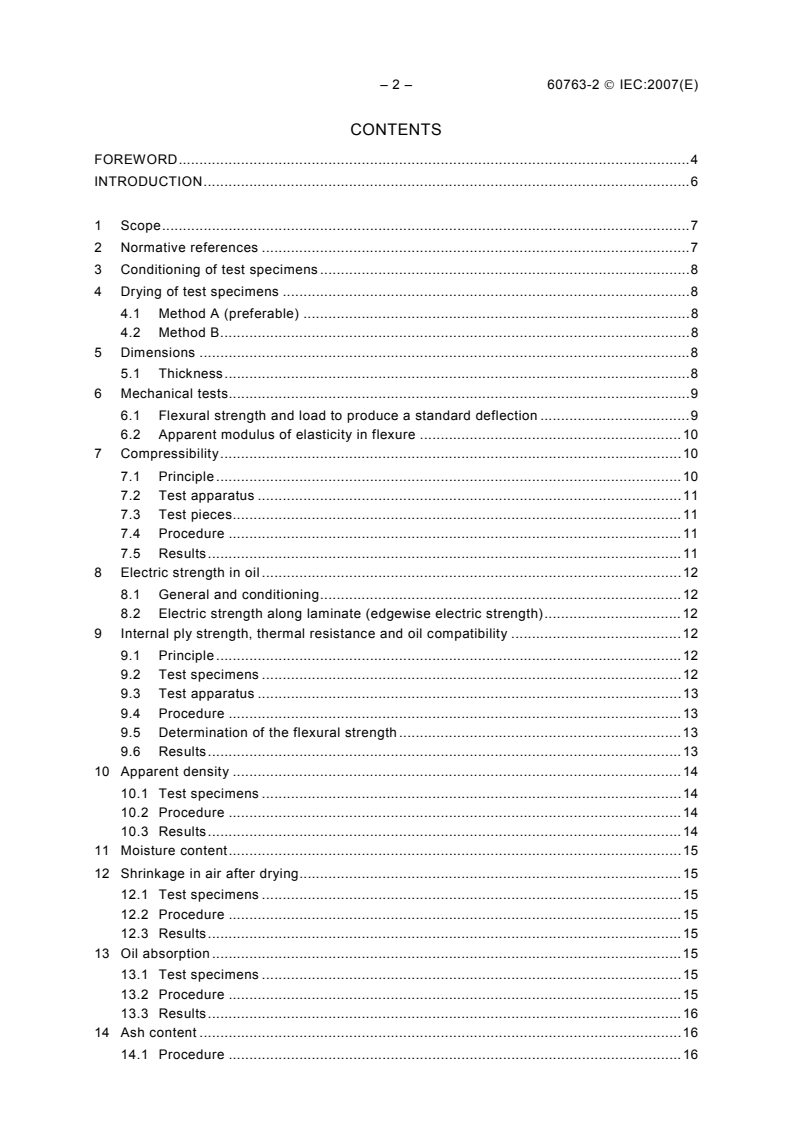
IEC 60763-2:2007 - Specification for laminated pressboard - Part 2: Methods of test Released:2/15/2007
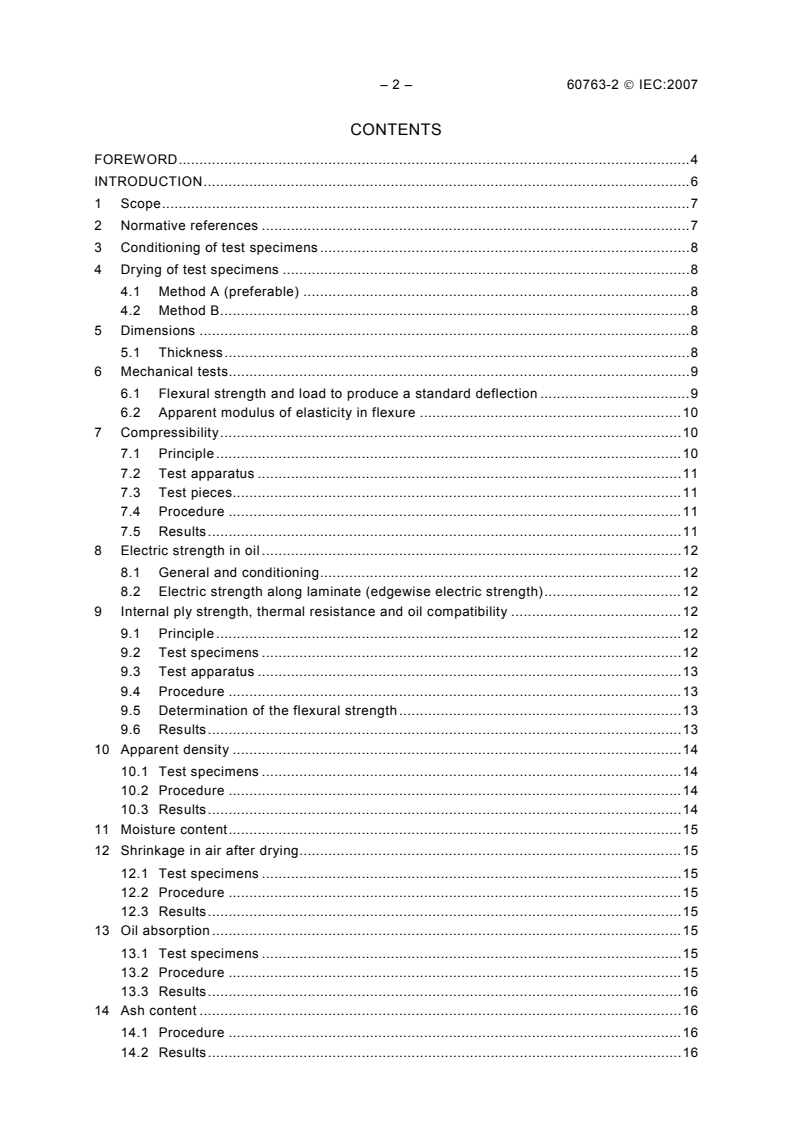
IEC 60763-2:2007 - Specification for laminated pressboard - Part 2: Methods of test Released:2/15/2007

IEC 60763-2:2007+AMD1:2023 CSV - Specification for laminated pressboard - Part 2: Methods of test Released:11/14/2023
Overview
IEC 60763-2:2007 - Specification for laminated pressboard - Part 2: Methods of test - defines standardized test methods for laminated pressboard used as an electrical insulating material. It applies to materials classified in IEC 60763-1 and provides reproducible procedures for mechanical, electrical, thermal and chemical characterization needed for quality control, type testing and specification compliance. This second edition (2007) was editorially revised to align with IEC 60641-2, replaces the internal ply strength test with an alternative method, and enlarges the scope of thermal resistance testing.
Key topics and technical requirements
The standard contains detailed, repeatable test procedures covering:
- Specimen conditioning and drying
- Conditioning: 23 °C ± 2 K, 50 % ± 5 % RH until moisture 5.5–8 % (approached from dry side).
- Drying Method A (preferred): 105 °C ± 2 K, 24 h in forced-air oven + 48 h at 105 °C ± 2 K in vacuum ≤ 1 kPa.
- Drying Method B: 105 °C ± 2 K, 168 h in ventilated oven (alternative).
- Dimensions and thickness measurement
- Defined micrometer requirements (measuring face diameter, flatness, graduation and applied pressure) and measurement points.
- Mechanical tests
- Flexural strength, load to produce standard deflection, apparent modulus of elasticity in flexure, compressibility.
- Electrical tests
- Electric strength in oil (including edgewise/along-laminate testing) and related conditioning.
- Interlaminar/internal ply strength, thermal resistance and oil compatibility
- Updated methods for internal ply strength and expanded thermal resistance testing scope.
- Physical and chemical properties
- Apparent density, moisture content, shrinkage after drying, oil absorption, ash content.
- Compatibility and contamination
- Methods to assess contamination of liquid dielectrics, conductivity and pH of aqueous extracts.
(The standard references related test methods in IEC 60243‑1, IEC 60641‑2, IEC 60296, ISO 287, ISO 2144, among others.)
Practical applications and users
IEC 60763-2 is essential for:
- Manufacturers of laminated pressboard and pressboard-based components (transformer spacers, barriers, insulating supports).
- Test laboratories performing type, acceptance and failure-analysis testing.
- Design and specification engineers in transformer, switchgear and electrical equipment industries who need validated material data (mechanical strength, dielectric performance, thermal resistance).
- Procurement and quality assurance teams ensuring supplier compliance and repeatability across batches.
Using these methods ensures consistent evaluation of mechanical integrity, dielectric behaviour in oil, thermal performance and chemical compatibility - critical for long-term reliability of high-voltage equipment.
Related standards
- IEC 60763-1 (definitions, classification, general requirements)
- IEC 60641-2 (pressboard/presspaper methods)
- IEC 60243-1 (electrical strength tests)
- IEC 60296 (insulating oils)
- ISO 287, ISO 2144 (moisture and ash test methods)
Keywords: IEC 60763-2:2007, laminated pressboard, methods of test, electrical insulation, transformer components, dielectric strength, thermal resistance, internal ply strength, pressboard testing.
Relations
- Effective Date
- 05-Sep-2023
Buy Documents
IEC 60763-2:2007 - Specification for laminated pressboard - Part 2: Methods of test Released:2/15/2007
IEC 60763-2:2007 - Specification for laminated pressboard - Part 2: Methods of test Released:2/15/2007
IEC 60763-2:2007+AMD1:2023 CSV - Specification for laminated pressboard - Part 2: Methods of test Released:11/14/2023
Get Certified
Connect with accredited certification bodies for this standard

IMQ S.p.A. (Certification)
Italian electrical product certification.

SLG Prüf- und Zertifizierungs GmbH
German testing and certification body.

UL Solutions
Global safety science company with testing, inspection and certification.
Sponsored listings
Frequently Asked Questions
IEC 60763-2:2007 is a standard published by the International Electrotechnical Commission (IEC). Its full title is "Specification for laminated pressboard - Part 2: Methods of test". This standard covers: IEC 60763-2:2007 gives methods of test applicable for the material classified in IEC 60763-1. This edition includes the following significant technical changes with respect to the previous edition: The standard has generally been revised editorially and brought into line with IEC 60641-2; The test method for the determination of the internal ply strength has been replaced with an alternative method; and The test method for the determination of the thermal resistance has been enlarged in its scope.
IEC 60763-2:2007 gives methods of test applicable for the material classified in IEC 60763-1. This edition includes the following significant technical changes with respect to the previous edition: The standard has generally been revised editorially and brought into line with IEC 60641-2; The test method for the determination of the internal ply strength has been replaced with an alternative method; and The test method for the determination of the thermal resistance has been enlarged in its scope.
IEC 60763-2:2007 is classified under the following ICS (International Classification for Standards) categories: 01 - GENERALITIES. TERMINOLOGY. STANDARDIZATION. DOCUMENTATION; 17.220.99 - Other standards related to electricity and magnetism; 29.035.10 - Paper and board insulating materials. The ICS classification helps identify the subject area and facilitates finding related standards.
IEC 60763-2:2007 has the following relationships with other standards: It is inter standard links to IEC 60763-2:2007/AMD1:2023. Understanding these relationships helps ensure you are using the most current and applicable version of the standard.
IEC 60763-2:2007 is available in PDF format for immediate download after purchase. The document can be added to your cart and obtained through the secure checkout process. Digital delivery ensures instant access to the complete standard document.
Standards Content (Sample)
INTERNATIONAL IEC
STANDARD 60763-2
Second edition
2007-02
Specification for laminated pressboard –
Part 2:
Methods of test
Reference number
Publication numbering
As from 1 January 1997 all IEC publications are issued with a designation in the
60000 series. For example, IEC 34-1 is now referred to as IEC 60034-1.
Consolidated editions
The IEC is now publishing consolidated versions of its publications. For example,
edition numbers 1.0, 1.1 and 1.2 refer, respectively, to the base publication, the
base publication incorporating amendment 1 and the base publication incorporating
amendments 1 and 2.
Further information on IEC publications
The technical content of IEC publications is kept under constant review by the IEC,
thus ensuring that the content reflects current technology. Information relating to
this publication, including its validity, is available in the IEC Catalogue of
publications (see below) in addition to new editions, amendments and corrigenda.
Information on the subjects under consideration and work in progress undertaken
by the technical committee which has prepared this publication, as well as the list
of publications issued, is also available from the following:
• IEC Web Site (www.iec.ch)
• Catalogue of IEC publications
The on-line catalogue on the IEC web site (www.iec.ch/searchpub) enables you to
search by a variety of criteria including text searches, technical committees
and date of publication. On-line information is also available on recently issued
publications, withdrawn and replaced publications, as well as corrigenda.
• IEC Just Published
This summary of recently issued publications (www.iec.ch/online_news/ justpub)
is also available by email. Please contact the Customer Service Centre (see
below) for further information.
• Customer Service Centre
If you have any questions regarding this publication or need further assistance,
please contact the Customer Service Centre:
Email: custserv@iec.ch
Tel: +41 22 919 02 11
Fax: +41 22 919 03 00
INTERNATIONAL IEC
STANDARD 60763-2
Second edition
2007-02
Specification for laminated pressboard –
Part 2:
Methods of test
© IEC 2007 ⎯ Copyright - all rights reserved
No part of this publication may be reproduced or utilized in any form or by any means, electronic or
mechanical, including photocopying and microfilm, without permission in writing from the publisher.
International Electrotechnical Commission, 3, rue de Varembé, PO Box 131, CH-1211 Geneva 20, Switzerland
Telephone: +41 22 919 02 11 Telefax: +41 22 919 03 00 E-mail: inmail@iec.ch Web: www.iec.ch
PRICE CODE
Commission Electrotechnique Internationale R
International Electrotechnical Commission
МеждународнаяЭлектротехническаяКомиссия
For price, see current catalogue
– 2 – 60763-2 © IEC:2007(E)
CONTENTS
FOREWORD.4
INTRODUCTION.6
1 Scope.7
2 Normative references .7
3 Conditioning of test specimens .8
4 Drying of test specimens .8
4.1 Method A (preferable) .8
4.2 Method B.8
5 Dimensions .8
5.1 Thickness.8
6 Mechanical tests.9
6.1 Flexural strength and load to produce a standard deflection .9
6.2 Apparent modulus of elasticity in flexure .10
7 Compressibility.10
7.1 Principle.10
7.2 Test apparatus .11
7.3 Test pieces.11
7.4 Procedure .11
7.5 Results.11
8 Electric strength in oil .12
8.1 General and conditioning.12
8.2 Electric strength along laminate (edgewise electric strength).12
9 Internal ply strength, thermal resistance and oil compatibility .12
9.1 Principle.12
9.2 Test specimens .12
9.3 Test apparatus .13
9.4 Procedure .13
9.5 Determination of the flexural strength.13
9.6 Results.13
10 Apparent density .14
10.1 Test specimens .14
10.2 Procedure .14
10.3 Results.14
11 Moisture content.15
12 Shrinkage in air after drying.15
12.1 Test specimens .15
12.2 Procedure .15
12.3 Results.15
13 Oil absorption.15
13.1 Test specimens .15
13.2 Procedure .15
13.3 Results.16
14 Ash content .16
14.1 Procedure .16
60763-2 © IEC:2007(E) – 3 –
14.2 Results.16
15 Contamination of liquid dielectrics .16
15.1 Apparatus.16
15.2 Test specimens .16
15.3 Procedure .17
15.4 Results.17
16 Conductivity of aqueous extract.17
16.1 Procedure .17
16.2 Results.17
17 pH of aqueous extract .17
Figure 1 – Position of test specimen in relation to length, width and thickness of sheet .17
Figure 2 – Size of the test specimens and arrangement of the electrodes for testing the
electric strength along laminae (edgewise electric strength).18
Figures 3 and 4 – Alternative forms of vented electrodes .19
Table 1 – Number of test specimens .13
– 4 – 60763-2 © IEC:2007(E)
INTERNATIONAL ELECTROTECHNICAL COMMISSION
___________
SPECIFICATION FOR LAMINATED PRESSBOARD –
Part 2: Methods of test
FOREWORD
1) The International Electrotechnical Commission (IEC) is a worldwide organization for standardization comprising
all national electrotechnical committees (IEC National Committees). The object of IEC is to promote
international co-operation on all questions concerning standardization in the electrical and electronic fields. To
this end and in addition to other activities, IEC publishes International Standards, Technical Specifications,
Technical Reports, Publicly Available Specifications (PAS) and Guides (hereafter referred to as “IEC
Publication(s)”). Their preparation is entrusted to technical committees; any IEC National Committee interested
in the subject dealt with may participate in this preparatory work. International, governmental and non-
governmental organizations liaising with the IEC also participate in this preparation. IEC collaborates closely
with the International Organization for Standardization (ISO) in accordance with conditions determined by
agreement between the two organizations.
2) The formal decisions or agreements of IEC on technical matters express, as nearly as possible, an international
consensus of opinion on the relevant subjects since each technical committee has representation from all
interested IEC National Committees.
3) IEC Publications have the form of recommendations for international use and are accepted by IEC National
Committees in that sense. While all reasonable efforts are made to ensure that the technical content of IEC
Publications is accurate, IEC cannot be held responsible for the way in which they are used or for any
misinterpretation by any end user.
4) In order to promote international uniformity, IEC National Committees undertake to apply IEC Publications
transparently to the maximum extent possible in their national and regional publications. Any divergence
between any IEC Publication and the corresponding national or regional publication shall be clearly indicated in
the latter.
5) IEC provides no marking procedure to indicate its approval and cannot be rendered responsible for any
equipment declared to be in conformity with an IEC Publication.
6) All users should ensure that they have the latest edition of this publication.
7) No liability shall attach to IEC or its directors, employees, servants or agents including individual experts and
members of its technical committees and IEC National Committees for any personal injury, property damage or
other damage of any nature whatsoever, whether direct or indirect, or for costs (including legal fees) and
expenses arising out of the publication, use of, or reliance upon, this IEC Publication or any other IEC
Publications.
8) Attention is drawn to the Normative references cited in this publication. Use of the referenced publications is
indispensable for the correct application of this publication.
9) Attention is drawn to the possibility that some of the elements of this IEC Publication may be the subject of
patent rights. IEC shall not be held responsible for identifying any or all such patent rights.
International Standard IEC 60763-2 has been prepared by IEC technical committee 15: Solid
electrical insulating materials.
This second edition cancels and replaces the first edition published in 1991 and constitutes a
technical revision.
This edition includes the following significant technical changes with respect to the previous
edition.
a) The standard has generally been revised editorially and brought into line with
IEC 60641-2.
b) The test method for the determination of the internal ply strength has been replaced with
an alternative method.
c) The test method for the determination of the thermal resistance has been enlarged in its
scope.
60763-2 © IEC:2007(E) – 5 –
The text of this standard is based on the following documents:
FDIS Report on voting
15/360/FDIS 15/373/RVD
Full information on the voting for the approval of this part can be found in the report on voting
indicated in the above table.
The list of all parts of the IEC 60763 series, under the general title Specification for laminated
pressboard, can be found on the IEC website.
The committee has decided that the contents of this publication will remain unchanged until
the maintenance result date indicated on the IEC web site under "http://webstore.iec.ch" in
the data related to the specific publication. At this date, the publication will be
• reconfirmed;
• withdrawn;
• replaced by a revised edition, or
• amended.
A bilingual version of this publication may be issued at a later date.
– 6 – 60763-2 © IEC:2007(E)
INTRODUCTION
This International Standard deals with laminated pressboard as defined in Clause 2 of
IEC 60763-1.
IEC 60641 applies to pressboard which is not laminated, and the material covered by this
International Standard is made from sheets conforming to the requirements of that
publication.
60763-2 © IEC:2007(E) – 7 –
SPECIFICATION FOR LAMINATED PRESSBOARD –
Part 2: Methods of test
1 Scope
This part of IEC 60763 gives methods of test applicable for the material classified in
IEC 60763-1.
2 Normative references
The following referenced documents are indispensable for the application of this document.
For dated references, only the edition cited applies. For undated references, the latest edition
of the referenced document (including any amendments) applies.
IEC 60243-1:1998, Electrical strength of insulating materials – Test methods – Part 1: Tests
at power frequencies
IEC 60247:2004, Insulating liquids – Measurement of relative permittivity, dielectric
dissipation factor (tan δ) and d.c. resistivity
IEC 60250:1969, Recommended methods for the determination of the permittivity and
dielectric dissipation factor of electrical insulating materials at power, audio and radio
frequencies including metre wavelengths.
IEC 60296:2003, Fluids for electrotechnical applications – Unused mineral insulating oils for
transformers and switchgear
IEC 60641-2:2004, Pressboard and presspaper for electrical purposes – Part 2: Methods of
tests
IEC 60763-1:1983, Specification for laminated pressboard – Part 1: Definitions, classification
and general requirements
IEC 61125:1992, Unused hydrocarbon-based insulating liquids – Test methods for evaluating
the oxidation stability
IEC 62021-1:2003, Insulating liquids – Determination of acidity – Part 1: Automatic
potentiometric titration
ISO 287:1985, Paper and board – Determination of moisture content – Oven-drying method
ISO 2144:1997, Paper, board and pulps – Determination of residue (ash) on ignition at 900
degrees C
– 8 – 60763-2 © IEC:2007(E)
3 Conditioning of test specimens
Since the conditioning of laminated pressboard is very time-consuming, the material is tested
either as received or dried. Only in case of dispute shall the material be conditioned according
to the following procedure.
The conditioning shall be made at 23 °C ± 2 K and (50 ± 5) % relative humidity until the
moisture content of the specimen reaches 5,5 % to 8 %. The conditioning shall be approached
from the dry side after drying at 70 °C ± 5 K for a period sufficient to ensure that the
conditioning atmosphere produces a mass increase in the specimen.
4 Drying of test specimens
4.1 Method A (preferable)
The test specimens shall be dried at 105 °C ± 2 K for (24 ± 1) h in an oven with forced air
circulation and subsequently at 105 °C ± 2 K for (48 ± 2) h in a vacuum chamber at a residual
pressure of not more than 1 kPa. The specimens shall then be removed and allowed to cool in
a desiccator before the test.
4.2 Method B
Test specimens shall be dried in a ventilated oven at 105 °C ± 2 K for (168 ± 8) h at
atmospheric pressure. When test pieces of the specified size are dried according to method
B, test results similar to the test results obtained after drying according to method A may be
expected.
5 Dimensions
5.1 Thickness
5.1.1 Test apparatus
An external screw-type micrometer having measuring faces of 6 mm to 8 mm diameter shall
be used for testing. The measuring faces shall be flat to within 0,001 mm and parallel to
within 0,003 mm. The micrometer shall be graduated in divisions of 0,01 mm and have an
accuracy of ± 0,005 mm. The pressure exerted on the specimens shall be 0,1 MPa to
0,3 MPa.
5.1.2 Procedure
The thickness of the laminated pressboard sheet shall be measured to the nearest 0,01 mm in
the as-received condition at eight points, two along each edge, but not less than 20 mm from
the edge.
In case of dispute, a strip (40 ± 1) mm wide shall be cut across the full width of the sheet and,
from this strip, at eight equally spaced positions eight test specimens shall be cut, each not
less than 40 mm long. The test specimens shall be conditioned in accordance with Clause 3
and the thickness of each measured at a point near the centre of each test specimen.
5.1.3 Result
The central value of the eight measurements shall be taken as the result, and the minimum
and maximum values obtained shall be reported.
60763-2 © IEC:2007(E) – 9 –
5.1.4 Flatness
When any laminated pressboard sheet is placed without restraint, concave side up, on a flat
surface, the departure at any point of the upper surface of the sheet from a light straight edge
of (1000 ± 10) mm or (500 ± 5) mm, laid in any direction upon it, shall not exceed the value
given in IEC 60763-3 appropriate to the material, its thickness and length of straight edge.
The mass of the straight edge shall not exceed (500 ± 5) g.
6 Mechanical tests
6.1 Flexural strength and load to produce a standard deflection
6.1.1 General
The test shall be carried out with the load applied perpendicular to the laminations.
6.1.2 Test specimens
Rectangular strips (20 ± 1) mm wide and of a length of not less than 20 times the measured
thickness shall be used. The thickness is that of the board under test except that, when the
measured thickness of a test piece exceeds 20 mm, the thickness shall be reduced to
(20 ± 1) mm, one face of the test piece being left intact.
Five tests shall be carried out on specimens cut in machine direction (direction A) and five in
cross-machine direction (direction B). (See definitions of directions A and B given in Figure 1.)
If the machine direction is not known, five
...
IEC 60763-2 ®
Edition 2.0 2007-02
INTERNATIONAL
STANDARD
NORME
INTERNATIONALE
Specification for laminated pressboard –
Part 2: Methods of test
Spécification pour cartons comprimés et contrecollés –
Partie 2: Méthodes d’essai
All rights reserved. Unless otherwise specified, no part of this publication may be reproduced or utilized in any form or by
any means, electronic or mechanical, including photocopying and microfilm, without permission in writing from either IEC or
IEC's member National Committee in the country of the requester.
If you have any questions about IEC copyright or have an enquiry about obtaining additional rights to this publication,
please contact the address below or your local IEC member National Committee for further information.
Droits de reproduction réservés. Sauf indication contraire, aucune partie de cette publication ne peut être reproduite
ni utilisée sous quelque forme que ce soit et par aucun procédé, électronique ou mécanique, y compris la photocopie
et les microfilms, sans l'accord écrit de la CEI ou du Comité national de la CEI du pays du demandeur.
Si vous avez des questions sur le copyright de la CEI ou si vous désirez obtenir des droits supplémentaires sur cette
publication, utilisez les coordonnées ci-après ou contactez le Comité national de la CEI de votre pays de résidence.
IEC Central Office
3, rue de Varembé
CH-1211 Geneva 20
Switzerland
Email: inmail@iec.ch
Web: www.iec.ch
About the IEC
The International Electrotechnical Commission (IEC) is the leading global organization that prepares and publishes
International Standards for all electrical, electronic and related technologies.
About IEC publications
The technical content of IEC publications is kept under constant review by the IEC. Please make sure that you have the
latest edition, a corrigenda or an amendment might have been published.
ƒ Catalogue of IEC publications: www.iec.ch/searchpub
The IEC on-line Catalogue enables you to search by a variety of criteria (reference number, text, technical committee,…).
It also gives information on projects, withdrawn and replaced publications.
ƒ IEC Just Published: www.iec.ch/online_news/justpub
Stay up to date on all new IEC publications. Just Published details twice a month all new publications released. Available
on-line and also by email.
ƒ Electropedia: www.electropedia.org
The world's leading online dictionary of electronic and electrical terms containing more than 20 000 terms and definitions
in English and French, with equivalent terms in additional languages. Also known as the International Electrotechnical
Vocabulary online.
ƒ Customer Service Centre: www.iec.ch/webstore/custserv
If you wish to give us your feedback on this publication or need further assistance, please visit the Customer Service
Centre FAQ or contact us:
Email: csc@iec.ch
Tel.: +41 22 919 02 11
Fax: +41 22 919 03 00
A propos de la CEI
La Commission Electrotechnique Internationale (CEI) est la première organisation mondiale qui élabore et publie des
normes internationales pour tout ce qui a trait à l'électricité, à l'électronique et aux technologies apparentées.
A propos des publications CEI
Le contenu technique des publications de la CEI est constamment revu. Veuillez vous assurer que vous possédez
l’édition la plus récente, un corrigendum ou amendement peut avoir été publié.
ƒ Catalogue des publications de la CEI: www.iec.ch/searchpub/cur_fut-f.htm
Le Catalogue en-ligne de la CEI vous permet d’effectuer des recherches en utilisant différents critères (numéro de référence,
texte, comité d’études,…). Il donne aussi des informations sur les projets et les publications retirées ou remplacées.
ƒ Just Published CEI: www.iec.ch/online_news/justpub
Restez informé sur les nouvelles publications de la CEI. Just Published détaille deux fois par mois les nouvelles
publications parues. Disponible en-ligne et aussi par email.
ƒ Electropedia: www.electropedia.org
Le premier dictionnaire en ligne au monde de termes électroniques et électriques. Il contient plus de 20 000 termes et
définitions en anglais et en français, ainsi que les termes équivalents dans les langues additionnelles. Egalement appelé
Vocabulaire Electrotechnique International en ligne.
ƒ Service Clients: www.iec.ch/webstore/custserv/custserv_entry-f.htm
Si vous désirez nous donner des commentaires sur cette publication ou si vous avez des questions, visitez le FAQ du
Service clients ou contactez-nous:
Email: csc@iec.ch
Tél.: +41 22 919 02 11
Fax: +41 22 919 03 00
IEC 60763-2 ®
Edition 2.0 2007-02
INTERNATIONAL
STANDARD
NORME
INTERNATIONALE
Specification for laminated pressboard –
Part 2: Methods of test
Spécification pour cartons comprimés et contrecollés –
Partie 2: Méthodes d’essai
INTERNATIONAL
ELECTROTECHNICAL
COMMISSION
COMMISSION
ELECTROTECHNIQUE
PRICE CODE
INTERNATIONALE
R
CODE PRIX
ICS 17.220.99; 29.035.10 ISBN 978-2-88910-287-7
– 2 – 60763-2 © IEC:2007
CONTENTS
FOREWORD.4
INTRODUCTION.6
1 Scope.7
2 Normative references .7
3 Conditioning of test specimens .8
4 Drying of test specimens .8
4.1 Method A (preferable) .8
4.2 Method B.8
5 Dimensions .8
5.1 Thickness.8
6 Mechanical tests.9
6.1 Flexural strength and load to produce a standard deflection .9
6.2 Apparent modulus of elasticity in flexure .10
7 Compressibility.10
7.1 Principle.10
7.2 Test apparatus .11
7.3 Test pieces.11
7.4 Procedure .11
7.5 Results.11
8 Electric strength in oil .12
8.1 General and conditioning.12
8.2 Electric strength along laminate (edgewise electric strength).12
9 Internal ply strength, thermal resistance and oil compatibility .12
9.1 Principle.12
9.2 Test specimens .12
9.3 Test apparatus .13
9.4 Procedure .13
9.5 Determination of the flexural strength.13
9.6 Results.13
10 Apparent density .14
10.1 Test specimens .14
10.2 Procedure .14
10.3 Results.14
11 Moisture content.15
12 Shrinkage in air after drying.15
12.1 Test specimens .15
12.2 Procedure .15
12.3 Results.15
13 Oil absorption.15
13.1 Test specimens .15
13.2 Procedure .15
13.3 Results.16
14 Ash content .16
14.1 Procedure .16
14.2 Results.16
60763-2 © IEC:2007 – 3 –
15 Contamination of liquid dielectrics .16
15.1 Apparatus.16
15.2 Test specimens .16
15.3 Procedure .17
15.4 Results.17
16 Conductivity of aqueous extract.17
16.1 Procedure .17
16.2 Results.17
17 pH of aqueous extract .17
Figure 1 – Position of test specimen in relation to length, width and thickness of sheet .17
Figure 2 – Size of the test specimens and arrangement of the electrodes for testing the
electric strength along laminae (edgewise electric strength).18
Figures 3 and 4 – Alternative forms of vented electrodes .19
Table 1 – Number of test specimens .13
– 4 – 60763-2 © IEC:2007
INTERNATIONAL ELECTROTECHNICAL COMMISSION
___________
SPECIFICATION FOR LAMINATED PRESSBOARD –
Part 2: Methods of test
FOREWORD
1) The International Electrotechnical Commission (IEC) is a worldwide organization for standardization comprising
all national electrotechnical committees (IEC National Committees). The object of IEC is to promote
international co-operation on all questions concerning standardization in the electrical and electronic fields. To
this end and in addition to other activities, IEC publishes International Standards, Technical Specifications,
Technical Reports, Publicly Available Specifications (PAS) and Guides (hereafter referred to as “IEC
Publication(s)”). Their preparation is entrusted to technical committees; any IEC National Committee interested
in the subject dealt with may participate in this preparatory work. International, governmental and non-
governmental organizations liaising with the IEC also participate in this preparation. IEC collaborates closely
with the International Organization for Standardization (ISO) in accordance with conditions determined by
agreement between the two organizations.
2) The formal decisions or agreements of IEC on technical matters express, as nearly as possible, an international
consensus of opinion on the relevant subjects since each technical committee has representation from all
interested IEC National Committees.
3) IEC Publications have the form of recommendations for international use and are accepted by IEC National
Committees in that sense. While all reasonable efforts are made to ensure that the technical content of IEC
Publications is accurate, IEC cannot be held responsible for the way in which they are used or for any
misinterpretation by any end user.
4) In order to promote international uniformity, IEC National Committees undertake to apply IEC Publications
transparently to the maximum extent possible in their national and regional publications. Any divergence
between any IEC Publication and the corresponding national or regional publication shall be clearly indicated in
the latter.
5) IEC provides no marking procedure to indicate its approval and cannot be rendered responsible for any
equipment declared to be in conformity with an IEC Publication.
6) All users should ensure that they have the latest edition of this publication.
7) No liability shall attach to IEC or its directors, employees, servants or agents including individual experts and
members of its technical committees and IEC National Committees for any personal injury, property damage or
other damage of any nature whatsoever, whether direct or indirect, or for costs (including legal fees) and
expenses arising out of the publication, use of, or reliance upon, this IEC Publication or any other IEC
Publications.
8) Attention is drawn to the Normative references cited in this publication. Use of the referenced publications is
indispensable for the correct application of this publication.
9) Attention is drawn to the possibility that some of the elements of this IEC Publication may be the subject of
patent rights. IEC shall not be held responsible for identifying any or all such patent rights.
International Standard IEC 60763-2 has been prepared by IEC technical committee 15: Solid
electrical insulating materials.
This second edition cancels and replaces the first edition published in 1991 and constitutes a
technical revision.
This edition includes the following significant technical changes with respect to the previous
edition.
a) The standard has generally been revised editorially and brought into line with
IEC 60641-2.
b) The test method for the determination of the internal ply strength has been replaced with
an alternative method.
c) The test method for the determination of the thermal resistance has been enlarged in its
scope.
60763-2 © IEC:2007 – 5 –
This bilingual version, published in 2009-06, corresponds to the English version.
The text of this standard is based on the following documents:
FDIS Report on voting
15/360/FDIS 15/373/RVD
Full information on the voting for the approval of this standard can be found in the report on
voting indicated in the above table.
The French version of this standard has not been voted upon.
The list of all parts of the IEC 60763 series, under the general title Specification for laminated
pressboard, can be found on the IEC website.
The committee has decided that the contents of this publication will remain unchanged until
the maintenance result date indicated on the IEC web site under "http://webstore.iec.ch" in
the data related to the specific publication. At this date, the publication will be
• reconfirmed;
• withdrawn;
• replaced by a revised edition, or
• amended.
– 6 – 60763-2 © IEC:2007
INTRODUCTION
This International Standard deals with laminated pressboard as defined in Clause 2 of
IEC 60763-1.
IEC 60641 applies to pressboard which is not laminated, and the material covered by this
International Standard is made from sheets conforming to the requirements of that
publication.
60763-2 © IEC:2007 – 7 –
SPECIFICATION FOR LAMINATED PRESSBOARD –
Part 2: Methods of test
1 Scope
This part of IEC 60763 gives methods of test applicable for the material classified in
IEC 60763-1.
2 Normative references
The following referenced documents are indispensable for the application of this document.
For dated references, only the edition cited applies. For undated references, the latest edition
of the referenced document (including any amendments) applies.
IEC 60243-1:1998, Electrical strength of insulating materials – Test methods – Part 1: Tests
at power frequencies
IEC 60247:2004, Insulating liquids – Measurement of relative permittivity, dielectric
dissipation factor (tan δ) and d.c. resistivity
IEC 60250:1969, Recommended methods for the determination of the permittivity and
dielectric dissipation factor of electrical insulating materials at power, audio and radio
frequencies including metre wavelengths.
IEC 60296:2003, Fluids for electrotechnical applications – Unused mineral insulating oils for
transformers and switchgear
IEC 60641-2:2004, Pressboard and presspaper for electrical purposes – Part 2: Methods of
tests
IEC 60763-1:1983, Specification for laminated pressboard – Part 1: Definitions, classification
and general requirements
IEC 61125:1992, Unused hydrocarbon-based insulating liquids – Test methods for evaluating
the oxidation stability
IEC 62021-1:2003, Insulating liquids – Determination of acidity – Part 1: Automatic
potentiometric titration
ISO 287:1985, Paper and board – Determination of moisture content – Oven-drying method
ISO 2144:1997, Paper, board and pulps – Determination of residue (ash) on ignition at 900
degrees C
– 8 – 60763-2 © IEC:2007
3 Conditioning of test specimens
Since the conditioning of laminated pressboard is very time-consuming, the material is tested
either as received or dried. Only in case of dispute shall the material be conditioned according
to the following procedure.
The conditioning shall be made at 23 °C ± 2 K and (50 ± 5) % relative humidity until the
moisture content of the specimen reaches 5,5 % to 8 %. The conditioning shall be approached
from the dry side after drying at 70 °C ± 5 K for a period sufficient to ensure that the
conditioning atmosphere produces a mass increase in the specimen.
4 Drying of test specimens
4.1 Method A (preferable)
The test specimens shall be dried at 105 °C ± 2 K for (24 ± 1) h in an oven with forced air
circulation and subsequently at 105 °C ± 2 K for (48 ± 2) h in a vacuum chamber at a residual
pressure of not more than 1 kPa. The specimens shall then be removed and allowed to cool in
a desiccator before the test.
4.2 Method B
Test specimens shall be dried in a ventilated oven at 105 °C ± 2 K for (168 ± 8) h at
atmospheric pressure. When test pieces of the specified size are dried according to method
B, test results similar to the test results obtained after drying according to method A may be
expected.
5 Dimensions
5.1 Thickness
5.1.1 Test apparatus
An external screw-type micrometer having measuring faces of 6 mm to 8 mm diameter shall
be used for testing. The measuring faces shall be flat to within 0,001 mm and parallel to
within 0,003 mm. The micrometer shall be graduated in divisions of 0,01 mm and have an
accuracy of ± 0,005 mm. The pressure exerted on the specimens shall be 0,1 MPa to
0,3 MPa.
5.1.2 Procedure
The thickness of the laminated pressboard sheet shall be measured to the nearest 0,01 mm in
the as-received condition at eight points, two along each edge, but not less than 20 mm from
the edge.
In case of dispute, a strip (40 ± 1) mm wide shall be cut across the full width of the sheet and,
from this strip, at eight equally spaced positions eight test specimens shall be cut, each not
less than 40 mm long. The test specimens shall be conditioned in accordance with Clause 3
and the thickness of each measured at a point near the centre of each test specimen.
5.1.3 Result
The central value of the eight measurements shall be taken as the result, and the minimum
and maximum values obtained shall be reported.
60763-2 © IEC:2007 – 9 –
5.1.4 Flatness
When any laminated pressboard sheet is placed without restraint, concave side up, on a flat
surface, the departure at any point of the upper surface of the sheet from a light straight edge
of (1000 ± 10) mm or (500 ± 5) mm, laid in any direction upon it, shall not exceed the value
given in IEC 60763-3 appropriate to the material, its thickness and length of straight edge.
The mass of the straight edge shall not exceed (500 ± 5) g.
6 Mechanical tests
6.1 Flexural strength and load to produce a standard deflection
6.1.1 General
The test shall be carried out with the load applied perpendicular to the laminations.
6.1.2 Test specimens
Rectangular strips (20 ± 1) mm wide and of a length of not less than 20 times the measured
thickness shall be used. The thickness is that of the board under test except that, when the
measured thickness of a test piece exceeds 20 mm, the thickness shall be reduced to
(20 ± 1) mm, one face of the test piece being left intact.
Five tests shall be carried out on specimens cut in machine direction (direction A) and five in
cross-machine direction (direction B). (See definitions of directions A and B given in Figure 1.)
If the machine direction is not known, five specimens shall be cut with their length parallel to
one of the edges of the sheet and five specimens at right angle thereto. The set of test
specimens giving the highest value of flexural strength is deemed to have been cut with the
length in machine direction.
6.1.3 Test apparatus
Universal testing apparatus designed to bend a test piece of given dimensions at an
appropriate constant rate of bending and to measure the force and the deflection at midpoint
of the test piece. A test rig for the determination of the three-point bending strength.
6.1.4 Conditioning
Test specimens shall be dried in accordance with Clause 4.
6.1.5 Procedure
After cooling in a desiccator, the width of the test specimen shall be immediately measured
with an accuracy of ± 0,1 mm and the thickness with an accuracy of ± 0,02 mm, and the test
specimen shall be immediately placed lengthwise symmetrically across two parallel supports.
Where one surface has been removed, the original, intact surface shall rest on the two
supports.
Where they are in contact with the test specimen, the surfaces of the supports shall have a
radius of (5 ± 0,2) mm. The distance between the supports shall be 16 times the nominal
thickness of the test specimen and shall be measured with an accuracy of ± 0,5 %. The load
shall be applied across the width of the test specimen by means of a loading member parallel
with, and mid-way between, the supports. The radius of the end of the loading member shall
be (5 ± 0,2) mm.
– 10 – 60763-2 © IEC:2007
The load shall be increased steadily from zero to rupture by relative movement of the loading
member and the supports at a constant rate. This rate of movement (which is the rate of
deflexion of midpoint of the test specimen) shall be (5 ± 0,5) mm/min.
The load at a standard deflection of 0,4 mm shall be noted.
The maximum load shall be noted.
6.1.6 Results
The flexural strength σ in MPa of the test specimen shall be calculated as follows:
f
1,5 ⋅ F ⋅ L
σ =
f
bh²
where
F is the maximum load (in N);
L is the distance between the supports (in mm);
b is the width of the test specimen (in mm);
h is the thickness of the test specimen (mm).
The flexural strength and load to produce the standard deflection in the machine and cross-
machine direction shall be reported, as the central value of the results from the five test
specimens, cut in each direction.
6.2 Apparent modulus of elasticity in flexure
The apparent modulus of elasticity in flexure E in MPa can be calculated from the load at
0,4 mm deflection according to 6.1.4 using the following formula:
L F
E = ⋅
B
0,4
4b ⋅ h
where
L is the distance between the supports (in mm);
b is the width of the test specimen (in mm);
h is the thickness of the test specimen (in mm);
F is the load at deflection of 0,4 mm (in N).
The apparent modulus of elasticity in flexure in the machine and cross-machine direction shall
be reported, as the central value of the results from the five test specimens, cut in each
direction.
7 Compressibility
7.1 Principle
To determine the compressibility of laminated pressboard, a stack of test pieces shall be
subjected to a low pressure (bedding pressure), followed by an increase of the pressure to a
defined value (final pressure). The percentage change in the thickness of the pad is a
measure of the compressibility of the material.
60763-2 © IEC:2007 – 11 –
Subsequently, the pressure shall be decreased again to the bedding pressure. The
percentage changes in the thickness of the pad allows the calculation of the
reversible/residual compressibility of the material.
7.2 Test apparatus
Universal testing apparatus designed to compress a test piece of given dimensions at an
appropriate constant rate of compression and to measure the compressive force and the
deflection of the test piece. A test rig with parallel steel plates, parallel within 0,2 mm, and an
area greater than the area of the test piece itself.
7.3 Test pieces
A sufficient number of square test pieces with an edge length of (25 ± 0,5) mm shall be cut.
The number of test pieces shall be chosen so that three stacks of a height of 25 mm to 85 mm
can be made. For materials of a thickness greater than 85 mm, the specimens shall be
machined only on one face to a thickness of (85 ± 0,25) mm. All edges of the test specimens
shall be free of burrs. The test pieces shall be dried in accordance with Clause 4.
7.4 Procedure
A stack of test pieces shall be placed between the plates of the test rig. A bedding pressure of
(1 ± 0,1) MPa shall be applied for at least 5 min and then the height h of the stack shall be
measured with an accuracy of ± 0,1 mm.
The pressure shall be increased to (20 ± 0,1) MPa. During this operation, the rate of
displacement of the moving plate shall be (5 ± 1) mm per minute. This pressure shall be
maintained for 5 min minimum.
The difference in height Δh from h of the stack shall be measured with an accuracy of
1 0
±0,01 mm.
The pressure shall be reduced to (1 ± 0,1) MPa and kept for not less than 5 min.
The difference in height Δh from h of the stack shall be measured with an accuracy of
2 0
± 0,01 mm after the bedding pressure has been restored.
7.5 Results
The following calculated values shall be reported.
Compressibility (in %):
Δh
C = ×100
h
Residual amount of the compressibility (in %):
Δh
C = ×100
res
Δh
Reversible amount of the compressibility (in %):
Δh − Δh
1 2
C = ×100
rev
Δh
– 12 – 60763-2 © IEC:2007
All three values shall be reported. The central value shall be taken as the result.
8 Electric strength in oil
8.1 General and conditioning
Electric strength shall be determined by the method specified in IEC 60243-1. The test shall
be carried out in mineral oil Class Il (see IEC 60296) at 23 °C ± 2 K. The specimens shall be
dried and oil-impregnated as described in the test for oil absorption (see Clause 13), except
that the vacuum drying time shall be (48 ± 4) h. Drying and impregnation shall be carried out
after machining. After drying and impregnation, the specimens shall be placed in position
between the electrodes. At no time between impregnation and testing the specimens shall be
exposed to the atmosphere.
8.2 Electric strength along laminate (edgewise electric strength)
8.2.1 Method 1 for materials with a thickness of more than 25 mm
Five specimens shall be tested. The size of the test specimens and the arrangements of the
electrodes shall be as shown in Figure 2.
The cylindrical electrodes shall be (6 ± 0,1) mm in diameter and have hemispherical ends.
Each hole shall be not more than 0,1 mm greater in diameter than each electrode diameter.
Alternative forms of vented electrodes are shown in Figure 3. When electrodes with slots are
used, these slots shall be diametrically opposed to the gap between the electrodes.
The holes shall be pre-drilled by a normal point-ground drill down to the outermost glue-layer.
By means of a specially ground, well-sharpened drill with a radius of (3 ± 0,1) mm, the final
drilling shall be carried out so that the outermost glue layer is broken through. The drilling
shall be done with great care so that the test specimen is not subjected to mechanical or
thermal stresses and the drill does not break through the outermost layer. The application of
voltage shall be in accordance with 9.1 of IEC 60243-1. The breakdown voltage shall be taken
as the result. The central value of the five tests and the lowest value shall be reported.
8.2.2 Method 2 for materials with a thickness between 10 mm and 25 mm
Five specimens shall be tested. Test specimens of full thickness with a width of (10 ± 0,2) mm
and a length of (50 ± 1) mm shall be cut so that exact parallel planes forming right angles to
the surface of the material are produced. The electrodes shall be in accordance with Figure 6
of IEC 60243-1. The application of voltage shall be in accordance with 9.1 of IEC 60243-1.
The breakdown voltage shall be taken as the result. The central value of the five tests and the
lowest value shall be reported.
9 Internal ply strength, thermal resistance and oil compatibility
9.1 Principle
The test consists of determining the change of flexural strength of the material at room
temperature and at 120 °C and before and after ageing in oil.
9.2 Test specimens
Rectangular strips (10 ± 1) mm wide and of a length of (10 ± 0,5) times the measured
thickness shall be used. The thickness shall be that of the board under test except that, when
the measured thickness of a test piece exceeds 15 mm, the thickness shall be reduced to
(15 ± 0,5) mm, one face of the test piece being left intact.
60763-2 © IEC:2007 – 13 –
Twenty test specimens cut in machine direction and 20 test specimens cut in cross- machine
direction shall be prepared.
9.3 Test apparatus
Universal testing apparatus designed to bend a test piece of given dimensions at an
appropriate constant rate of bending and to measure the force and the deflection at midpoint
of the test piece. A test rig for the determination of the three-point bending strength.
9.4 Procedure
All the specimens shall be dried according to Clause 4, Method A. Twenty of the dried
specimens shall be tested as indicated in Table 1.
The rest of the specimens shall be oil-impregnated according to 13.2. Ten oil-impregnated
specimens shall be tested according to Table 1.
The oil vessel with the remaining 10 test specimens shall be placed in an oven with forced air
circulation at 120 °C ± 2 K. The vessel shall be covered with aluminium foil. After (168 ± 4) h,
the heating shall be switched off and the oil allowed to cool down to ambient temperature. Ten
aged samples shall be tested according to Table 1.
Table 1 – Number of test specimens
Orientation of the board Dried Oil-impregnated Oil-impregnated and aged
Test temperature 23 °C 120 °C 23 °C 23 °C
± 2 K ± 2 K ± 2 K ± 2 K
Machine direction 5 5 5 5
Cross-machine direction 5 5 5 5
9.5 Determination of the flexural strength
The test shall be carried out with the load applied perpendicular to the laminations. After
cooling in a desiccator, the width of the test specimen shall be immediately measured with an
accuracy of ± 0,1 mm and the thickness with an accuracy of to ± 0,02 mm; the test specimen
shall be immediately placed symmetrically across two parallel supports. Where one surface
has been removed, the original, intact surface should rest on the two supports.
The surfaces of the supports where they are in contact with the test specimen shall have a
radius of (5 ± 0,2) mm. The distance between the supports shall be (6,6 ± 0,2) times the
nominal thickness of the test specimen and shall be measured to within 0,5 %. The load shall
be applied uniformly across the width of the test specimen by means of a loading member
parallel with, and mid-way between, the supports. The radius of the end of the loading
member shall be (5 ± 0,1) mm.
The load shall be increased steadily from zero by relative movement of the loading member
and the supports at a constant rate. This rate of movement (which is the rate of deflexion of
midpoint of the test specimen) shall be (5 ± 0,5) mm/min.
The maximum load shall be noted.
The location of the rupture – within pressboard, within glue line, interface board/glue – shall
be noted.
9.6 Results
The flexural strength σ in MPa of the test specimen shall be calculated as follows:
f
– 14 – 60763-2 © IEC:2007
⋅ ⋅
1,5 F L
σ =
f
bh²
where
F is the maximum load (in N);
L is the distance between the supports (in mm);
b is the width of the test specimen (in mm);
h is the thickness of the test specimen (in mm).
The internal ply adhesion is indicated by the location of the rupture.
The thermal resistance is expressed in terms of percentage retention of the measured flexural
strength of the dry samples tested at 120 °C relative to the strength at 23 °C.
The oil compatibility is expressed in terms of percentage retention of the measured properties
of the oil-impregnated samples tested at 23 °C relative to the properties of the dry samples
tested at 23 °C.
The resistance to ageing in oil is expressed in terms of percentage retention of the measured
properties of the samples aged at 120 °C relative to the properties of the oil-impregnated,
non-aged samples.
The central values of the thermal resistance, the oil compatibility and the resistance to ageing
shall be taken as the results.
10 Apparent density
10.1 Test specimens
The test shall be carried out on three conditioned test pieces; one determination shall be
made on each of the three test pieces.
Rectangular test pieces of an area not less than 100 cm shall be used.
10.2 Procedure
–4
The mass of the test specimen shall be measured to an accuracy of 10 × the mass of the
test piece.
Two measurements of the length and two of the width of each test piece to an accuracy of
0,1 mm shall be made at points at least 12 mm from the corners.
The thickness shall be determined by making eight measurements as indicated in 5.1 and the
mean value of the measurements calculated.
10.3 Results
The apparent density ρ (the mass to volume ratio) shall be expressed as g/cm .
m
ρ = ×10
s × l × w
where
m is the mass, in g;
60763-2 © IEC:2007 – 15 –
s is the mean of the eight thickness measurements (in mm);
l is the mean of the two length measurements (in mm);
w is the mean of the two width measurements (in mm)
All three values shall be reported. The central value shall be taken as the result.
11 Moisture content
The moisture content in the as-received condition shall be measured according to a method
based on ISO 287.
Three test specimens of at least 50 g mass, preferably measuring 100 mm × 25 mm × original
thickness in the as-received condition, shall be weighed with an accuracy of ±1 mg, then dried
and cooled in accordance with Clause 3 and reweighed to the same accuracy as before. The
moisture content is the loss of mass expressed as a percentage of the original mass. The
central value of the three measurements shall be taken as the result; the other two values
shall be reported.
12 Shrinkage in air after drying
12.1 Test specimens
Six specimens measuring approximatly 50 mm × 300 mm shall be cut, three being in machine
direction A and three in cross-direction B (see Figure 1).
12.2 Procedure
After the specimens have been conditioned in accordance with Clause 3, their lengths and
thicknesses shall be measured, one measurement being made of the length of each specimen
and one of the thickness which shall be made at a point not less than 20 mm from an edge.
The specimens shall then be dried in accordance with Clause 4.
After cooling to room temperature in a desiccator, the length and thickness shall be measured
again. The length before and after drying shall be measured with an accuracy of ± 0,05 mm;
the thickness with an accuracy of ± 0,01 mm.
12.3 Results
The shrinkage in length shall be calculated for the directions A and B as the percentage
change in dimensions of the original measurements of the conditioned test specimens. For
each direction, the central value shall be taken as the result; the other two values shall be
reported. For the shrinkage in thickness the central value shall be taken as the result; the
highest and lowest values shall be reported.
13 Oil absorption
13.1 Test specimens
The test shall be carried out on three specimens each 100 mm × 25 mm and of the same
thickness as the material under test.
13.2 Procedure
The specimens shall be dried in accordance with Clause 4, Method A, and the mass then
determined to the nearest milligram.
– 16 – 60763-2 © IEC:2007
The specimens shall be placed in a vacuum chamber, the temperature raised to 90 °C ± 2 K
and the pressure reduced to not more than 1 kPa.
This temperature and pressure shall be maintained for 1 h. Then oil conforming to the
requirements of Class II in IEC 60296, preheated to 90 °C ± 2 K, shall be admitted at a rate
slow enough to ensure that the pressure does not rise above 2,5 kPa.
When the specimens are completely submerged, using sinkers if necessary, the pressure
shall be allowed to rise slowly to atmospheric pressure and the heating switched off. The
specimens shall be left under oil for (24 ± 1) h. The specimens shall then be taken from the oil
and the surplus oil removed with blotting paper. The clean specimens shall then be weighed
to the same accuracy as before and the mass of the absorbed oil determined.
13.3 Results
The results shall be expressed as the percentage of the mass of oil absorbed in relation to the
original mass of the dried samples. The central value of the three determinations shall be
taken as the result and the other two shall be reported.
14 Ash content
14.1 Procedure
The amount of residue of material left after incineration of the material in the as-received
condition shall be determined according to the method described in ISO 2144. The mass of
the specimen shall be at least 5 g and the sample shall be taken so that the glue/cellulose
ratio is representative of the board under test. Three determinations shall be made.
14.2 Results
The central value obtained shall be taken as the result, based on oven-dry material
(calculated from determination of moisture content according to 9.3); the highest and lowest
values are reported.
15 Contamination of liquid dielectrics
15.1 Apparatus
– A conductivity cell according to IEC 60247.
– A cell for the determination of the dissipation factor of liquids according to IEC 60250.
– A vessel to contain oil, of neutral or borosilicate glass with a volume of at least 1 l in which
an atmosphere of dry nitrogen may be maintained above the oil.
– An oven with forced air circulation, controllable to 100 °C ± 1 K.
– Clean metal tongs.
– Dry oil (Class II of IEC 60296) whose neutralization value and dissipation factor at 90 °C
and 48 Hz to 62 Hz have been determined.
NOTE Cells of Figures 2 and 3 of IEC 60250 are also usable for resistivity measurement and accordingly
described in IEC 60247.
15.2 Test specimens
A sufficient amount of material finely cut into pieces thinner than 1 mm and with a surface
area of about 1 cm and that has been dried at 105 °C ± 2 K for a period of at least 16 h. The
specimens shall be handled by means of clean metal tongs.
60763-2 © IEC:2007 – 17 –
15.3 Procedure
In the vessel (75 ± 0,1) g of the specimens shall be immersed in (750 ± 5) cm of the oil. It is
advisable to check the cleanliness of the vessel. An atmosphere of dry nitrogen shall be
maintained above the oil. The vessel containing the oil with the specimens together with an
identical vessel containing the same oil as blank shall be heated at 100 °C ± 1 K for a period
of (168 ± 4) h.
After this period, the neutralization value according to IEC 62021-1, the sludge content
according to IEC 61125 and the dissipation factor according to IEC 60247 at 90 °C ±1 K and
48 Hz to 62 Hz shall be measured for both the test oil and the blank.
15.4 Results
The difference between the two values obtained shall be taken as the result.
16 Conductivity of aqueous extract
16.1 Procedure
The test shall be carried out as described in IEC 60641-2 but specimens shall be taken so
that the glue/cellulose ratio is representative of the whole thickness of the board. If strips are
used, these should be not larger than 20 mm × 3 mm but smaller subdivisions may be used
provided the glue/cellulose ratio is maintained.
16.2 Results
The conductivity shall be expressed in millisiemens per metre (mS/m).
17 pH of aqueous extract
The test shall be carried out as described in IEC 60641-2 but using an extract prepared as in
16.1.
b
B
h
Machine direction
A
Cross-machine
direction
h
b
IEC 288/07
Figure 1 – Position of test specimen in relation to length, width and thickness of sheet
– 18 – 60763-2 © IEC:2007
16 ± 1
10 ± 1
R3
∼100
IEC 289/07
Figure 2 – Size of the test specimens and arrangement of the electrodes for testing the
electric strength along laminae (edgewise electric strength)
2,25 ± 0,25
≥50
≥50
2,25 ± 0,25
∼25
∼50
60763-2 © IEC:2007 – 19 –
∅1 ± 0,1
Vent Holes
∅ ∅
Vent
∅1 ± 0,1
2 × 2
(Vent)
Section
16 ± 1 16 ± 1
10 ± 1 10 ± 1
Vent
Vent Holes
Figures 3 and 4 – Alternative forms of vented electrodes
___________
------------
...
IEC 60763-2 ®
Edition 2.1 2023-11
CONSOLIDATED VERSION
INTERNATIONAL
STANDARD
NORME
INTERNATIONALE
colour
inside
Specification for laminated pressboard –
Part 2: Methods of test
Spécification pour cartons comprimés et contrecollés –
Partie 2: Méthodes d'essai
All rights reserved. Unless otherwise specified, no part of this publication may be reproduced or utilized in any form
or by any means, electronic or mechanical, including photocopying and microfilm, without permission in writing from
either IEC or IEC's member National Committee in the country of the requester. If you have any questions about IEC
copyright or have an enquiry about obtaining additional rights to this publication, please contact the address below or
your local IEC member National Committee for further information.
Droits de reproduction réservés. Sauf indication contraire, aucune partie de cette publication ne peut être reproduite ni
utilisée sous quelque forme que ce soit et par aucun procédé, électronique ou mécanique, y compris la photocopie et
les microfilms, sans l'accord écrit de l'IEC ou du Comité national de l'IEC du pays du demandeur. Si vous avez des
questions sur le copyright de l'IEC ou si vous désirez obtenir des droits supplémentaires sur cette publication, utilisez
les coordonnées ci-après ou contactez le Comité national de l'IEC de votre pays de résidence.
IEC Secretariat Tel.: +41 22 919 02 11
3, rue de Varembé info@iec.ch
CH-1211 Geneva 20 www.iec.ch
Switzerland
About the IEC
The International Electrotechnical Commission (IEC) is the leading global organization that prepares and publishes
International Standards for all electrical, electronic and related technologies.
About IEC publications
The technical content of IEC publications is kept under constant review by the IEC. Please make sure that you have the
latest edition, a corrigendum or an amendment might have been published.
IEC publications search - webstore.iec.ch/advsearchform IEC Products & Services Portal - products.iec.ch
The advanced search enables to find IEC publications by a Discover our powerful search engine and read freely all the
variety of criteria (reference number, text, technical publications previews. With a subscription you will always have
committee, …). It also gives information on projects, replaced access to up to date content tailored to your needs.
and withdrawn publications.
Electropedia - www.electropedia.org
IEC Just Published - webstore.iec.ch/justpublished
The world's leading online dictionary on electrotechnology,
Stay up to date on all new IEC publications. Just Published
containing more than 22 300 terminological entries in English
details all new publications released. Available online and once
and French, with equivalent terms in 19 additional languages.
a month by email.
Also known as the International Electrotechnical Vocabulary
(IEV) online.
IEC Customer Service Centre - webstore.iec.ch/csc
If you wish to give us your feedback on this publication or need
further assistance, please contact the Customer Service
Centre: sales@iec.ch.
A propos de l'IEC
La Commission Electrotechnique Internationale (IEC) est la première organisation mondiale qui élabore et publie des
Normes internationales pour tout ce qui a trait à l'électricité, à l'électronique et aux technologies apparentées.
A propos des publications IEC
Le contenu technique des publications IEC est constamment revu. Veuillez vous assurer que vous possédez l’édition la
plus récente, un corrigendum ou amendement peut avoir été publié.
Recherche de publications IEC - Découvrez notre puissant moteur de recherche et consultez
webstore.iec.ch/advsearchform gratuitement tous les aperçus des publications. Avec un
La recherche avancée permet de trouver des publications IEC abonnement, vous aurez toujours accès à un contenu à jour
en utilisant différents critères (numéro de référence, texte, adapté à vos besoins.
comité d’études, …). Elle donne aussi des informations sur les
projets et les publications remplacées ou retirées. Electropedia - www.electropedia.org
Le premier dictionnaire d'électrotechnologie en ligne au monde,
IEC Just Published - webstore.iec.ch/justpublished
avec plus de 22 300 articles terminologiques en anglais et en
Restez informé sur les nouvelles publications IEC. Just
français, ainsi que les termes équivalents dans 19 langues
Published détaille les nouvelles publications parues.
additionnelles. Egalement appelé Vocabulaire
Disponible en ligne et une fois par mois par email.
Electrotechnique International (IEV) en ligne.
Service Clients - webstore.iec.ch/csc
Si vous désirez nous donner des commentaires sur cette
publication ou si vous avez des questions contactez-nous:
sales@iec.ch.
IEC Products & Services Portal - products.iec.ch
IEC 60763-2 ®
Edition 2.1 2023-11
CONSOLIDATED VERSION
INTERNATIONAL
STANDARD
NORME
INTERNATIONALE
colour
inside
Specification for laminated pressboard –
Part 2: Methods of test
Spécification pour cartons comprimés et contrecollés –
Partie 2: Méthodes d'essai
INTERNATIONAL
ELECTROTECHNICAL
COMMISSION
COMMISSION
ELECTROTECHNIQUE
INTERNATIONALE
ICS 17.220.99, 29.035.10 ISBN 978-2-8322-7876-5
IEC 60763-2 ®
Edition 2.1 2023-11
CONSOLIDATED VERSION
REDLINE VERSION
VERSION REDLINE
colour
inside
Specification for laminated pressboard –
Part 2: Methods of test
Spécification pour cartons comprimés et contrecollés –
Partie 2: Méthodes d'essai
– 2 – IEC 60763-2:2007+AMD1:2023 CSV
IEC 2023
CONTENTS
FOREWORD . 4
INTRODUCTION . 6
1 Scope . 7
2 Normative references . 7
3 Conditioning of test specimens . 8
4 Drying of test specimens . 8
4.1 Method A (preferable) . 8
4.2 Method B . 8
5 Dimensions . 8
5.1 Thickness . 8
6 Mechanical tests. 9
6.1 Flexural strength and load to produce a standard deflection . 9
6.2 Apparent modulus of elasticity in flexure . 10
7 Compressibility . 10
7.1 Principle . 10
7.2 Test apparatus . 11
7.3 Test pieces. 11
7.4 Procedure . 11
7.5 Results . 11
8 Electric strength in oil . 12
8.1 General and conditioning . 12
8.2 Electric strength along laminate (edgewise electric strength) . 12
9 Internal ply strength, thermal resistance and oil compatibility . 12
9.1 Principle . 12
9.2 Test specimens . 12
9.3 Test apparatus . 13
9.4 Procedure . 13
9.5 Determination of the flexural strength . 13
9.6 Results . 13
10 Apparent density . 14
10.1 Test specimens . 14
10.2 Procedure . 14
10.3 Results . 14
11 Moisture content . 15
12 Shrinkage in air after drying . 15
12.1 Test specimens .
12.2 Procedure .
12.3 Results .
12.1 Test apparatus . 15
12.2 Test pieces. 15
12.3 Procedure . 16
12.4 Results . 16
13 Oil absorption . 17
13.1 Test specimens . 17
13.2 Procedure . 17
IEC 2023
13.3 Results . 17
14 Ash content . 17
14.1 Procedure . 17
14.2 Results . 17
15 Contamination of liquid dielectrics . 17
15.1 Apparatus . 17
15.2 Test specimens . 18
15.3 Procedure . 18
15.4 Results . 18
16 Conductivity of aqueous extract . 18
16.1 Procedure . 18
16.2 Results . 18
17 pH of aqueous extract . 18
Figure 1 – Position of test specimen in relation to length, width and thickness of sheet . 19
Figure 2 – Size of the test specimens and arrangement of the electrodes for testing the
electric strength along laminae (edgewise electric strength) . 19
Figures 3 and 4 – Alternative forms of vented electrodes . 20
Table 1 – Number of test specimens . 13
– 4 – IEC 60763-2:2007+AMD1:2023 CSV
IEC 2023
INTERNATIONAL ELECTROTECHNICAL COMMISSION
___________
SPECIFICATION FOR LAMINATED PRESSBOARD –
Part 2: Methods of test
FOREWORD
1) The International Electrotechnical Commission (IEC) is a worldwide organization for standardization comprising
all national electrotechnical committees (IEC National Committees). The object of IEC is to promote
international co-operation on all questions concerning standardization in the electrical and electronic fields. To
this end and in addition to other activities, IEC publishes International Standards, Technical Specifications,
Technical Reports, Publicly Available Specifications (PAS) and Guides (hereafter referred to as “IEC
Publication(s)”). Their preparation is entrusted to technical committees; any IEC National Committee interested
in the subject dealt with may participate in this preparatory work. International, governmental and non-
governmental organizations liaising with the IEC also participate in this preparation. IEC collaborates closely
with the International Organization for Standardization (ISO) in accordance with conditions determined by
agreement between the two organizations.
2) The formal decisions or agreements of IEC on technical matters express, as nearly as possible, an international
consensus of opinion on the relevant subjects since each technical committee has representation from all
interested IEC National Committees.
3) IEC Publications have the form of recommendations for international use and are accepted by IEC National
Committees in that sense. While all reasonable efforts are made to ensure that the technical content of IEC
Publications is accurate, IEC cannot be held responsible for the way in which they are used or for any
misinterpretation by any end user.
4) In order to promote international uniformity, IEC National Committees undertake to apply IEC Publications
transparently to the maximum extent possible in their national and regional publications. Any divergence
between any IEC Publication and the corresponding national or regional publication shall be clearly indicated in
the latter.
5) IEC provides no marking procedure to indicate its approval and cannot be rendered responsible for any
equipment declared to be in conformity with an IEC Publication.
6) All users should ensure that they have the latest edition of this publication.
7) No liability shall attach to IEC or its directors, employees, servants or agents including individual experts and
members of its technical committees and IEC National Committees for any personal injury, property damage or
other damage of any nature whatsoever, whether direct or indirect, or for costs (including legal fees) and
expenses arising out of the publication, use of, or reliance upon, this IEC Publication or any other IEC
Publications.
8) Attention is drawn to the Normative references cited in this publication. Use of the referenced publications is
indispensable for the correct application of this publication.
9) Attention is drawn to the possibility that some of the elements of this IEC Publication may be the subject of
patent rights. IEC shall not be held responsible for identifying any or all such patent rights.
This consolidated version of the official IEC Standard and its amendment has been
prepared for user convenience.
IEC 60763-2 edition 2.1 contains the second edition (2007-02) [documents 15/360/FDIS
and 15/373/RVD] and its amendment 1 (2023-11) [documents 15/1018/FDIS and
15/1024/RVD].
In this Redline version, a vertical line in the margin shows where the technical content
is modified by amendment 1. Additions are in green text, deletions are in strikethrough
red text. A separate Final version with all changes accepted is available in this
publication.
IEC 2023
International Standard IEC 60763-2 has been prepared by IEC technical committee 15: Solid
electrical insulating materials.
This second edition constitutes a technical revision.
This edition includes the following significant technical changes with respect to the previous
edition.
a) The standard has generally been revised editorially and brought into line with
IEC 60641-2.
b) The test method for the determination of the internal ply strength has been replaced with
an alternative method.
c) The test method for the determination of the thermal resistance has been enlarged in its
scope.
The list of all parts of the IEC 60763 series, under the general title Specification for laminated
pressboard, can be found on the IEC website.
The committee has decided that the contents of this document and its amendment will remain
unchanged until the stability date indicated on the IEC website under webstore.iec.ch in the
data related to the specific document. At this date, the document will be
• reconfirmed,
• withdrawn,
• replaced by a revised edition, or
• amended.
IMPORTANT – The 'colour inside' logo on the cover page of this publication indicates
that it contains colours which are considered to be useful for the correct
understanding of its contents. Users should therefore print this document using a
colour printer.
– 6 – IEC 60763-2:2007+AMD1:2023 CSV
IEC 2023
INTRODUCTION
This International Standard deals with laminated pressboard as defined in Clause 2 of
IEC 60763-1.
IEC 60641 applies to pressboard which is not laminated, and the material covered by this
International Standard is made from sheets conforming to the requirements of that
publication.
IEC 2023
SPECIFICATION FOR LAMINATED PRESSBOARD –
Part 2: Methods of test
1 Scope
This part of IEC 60763 gives methods of test applicable for the material classified in
IEC 60763-1.
2 Normative references
The following referenced documents are indispensable for the application of this document.
For dated references, only the edition cited applies. For undated references, the latest edition
of the referenced document (including any amendments) applies.
IEC 60243-1:1998, Electrical strength of insulating materials – Test methods – Part 1: Tests
at power frequencies
IEC 60247:2004, Insulating liquids – Measurement of relative permittivity, dielectric
dissipation factor (tan δ) and d.c. resistivity
IEC 60250:1969, Recommended methods for the determination of the permittivity and
dielectric dissipation factor of electrical insulating materials at power, audio and radio
frequencies including metre wavelengths.
IEC 60296:2003, Fluids for electrotechnical applications – Unused mineral insulating oils for
transformers and switchgear
IEC 60641-2:2004, Pressboard and presspaper for electrical purposes – Part 2: Methods of
tests
IEC 60763-1:1983, Specification for laminated pressboard – Part 1: Definitions, classification
and general requirements
IEC 61125:1992, Unused hydrocarbon-based insulating liquids – Test methods for evaluating
the oxidation stability
IEC 62021-1:2003, Insulating liquids – Determination of acidity – Part 1: Automatic
potentiometric titration
ISO 287:1985, Paper and board – Determination of moisture content – Oven-drying method
ISO 2144:1997, Paper, board and pulps – Determination of residue (ash) on ignition at 900
degrees C
– 8 – IEC 60763-2:2007+AMD1:2023 CSV
IEC 2023
3 Conditioning of test specimens
Since the conditioning of laminated pressboard is very time-consuming, the material is tested
either as received or dried. Only in case of dispute shall the material be conditioned according
to the following procedure.
The conditioning shall be made at 23 °C ± 2 K and (50 ± 5) % relative humidity until the
moisture content of the specimen reaches 5,5 % to 8 %. The conditioning shall be approached
from the dry side after drying at 70 °C ± 5 K for a period sufficient to ensure that the
conditioning atmosphere produces a mass increase in the specimen.
4 Drying of test specimens
4.1 Method A (preferable)
The test specimens shall be dried at 105 °C ± 2 K for (24 ± 1) h in an oven with forced air
circulation and subsequently at 105 °C ± 2 K for (48 ± 2) h in a vacuum chamber at a residual
pressure of not more than 1 kPa. The specimens shall then be removed and allowed to cool in
a desiccator before the test.
4.2 Method B
Test specimens shall be dried in a ventilated oven at 105 °C ± 2 K for (168 ± 8) h at
atmospheric pressure. When test pieces of the specified size are dried according to method
B, test results similar to the test results obtained after drying according to method A may be
expected.
5 Dimensions
5.1 Thickness
5.1.1 Test apparatus
An external screw-type micrometer having measuring faces of 6 mm to 8 mm diameter shall
be used for testing. The measuring faces shall be flat to within 0,001 mm and parallel to
within 0,003 mm. The micrometer shall be graduated in divisions of 0,01 mm and have an
accuracy of ± 0,005 mm. The pressure exerted on the specimens shall be 0,1 MPa to
0,3 MPa.
5.1.2 Procedure
The thickness of the laminated pressboard sheet shall be measured to the nearest 0,01 mm in
the as-received condition at eight points, two along each edge, but not less than 20 mm from
the edge.
In case of dispute, a strip (40 ± 1) mm wide shall be cut across the full width of the sheet and,
from this strip, at eight equally spaced positions eight test specimens shall be cut, each not
less than 40 mm long. The test specimens shall be conditioned in accordance with Clause 3
and the thickness of each measured at a point near the centre of each test specimen.
5.1.3 Result
The central value of the eight measurements shall be taken as the result, and the minimum
and maximum values obtained shall be reported.
IEC 2023
5.1.4 Flatness
When any laminated pressboard sheet is placed without restraint, concave side up, on a flat
surface, the departure at any point of the upper surface of the sheet from a light straight edge
of (1000 ± 10) mm or (500 ± 5) mm, laid in any direction upon it, shall not exceed the value
given in IEC 60763-3 appropriate to the material, its thickness and length of straight edge.
The mass of the straight edge shall not exceed (500 ± 5) g.
6 Mechanical tests
6.1 Flexural strength and load to produce a standard deflection
6.1.1 General
The test shall be carried out with the load applied perpendicular to the laminations.
6.1.2 Test specimens
Rectangular strips (20 ± 1) mm wide and of a length of not less than 20 times the measured
thickness shall be used. The thickness is that of the board under test except that, when the
measured thickness of a test piece exceeds 20 mm, the thickness shall be reduced to
(20 ± 1) mm, one face of the test piece being left intact.
Five tests shall be carried out on specimens cut in machine direction (direction A) and five in
cross-machine direction (direction B). (See definitions of directions A and B given in Figure 1.)
If the machine direction is not known, five specimens shall be cut with their length parallel to
one of the edges of the sheet and five specimens at right angle thereto. The set of test
specimens giving the highest value of flexural strength is deemed to have been cut with the
length in machine direction.
6.1.3 Test apparatus
Universal testing apparatus designed to bend a test piece of given dimensions at an
appropriate constant rate of bending and to measure the force and the deflection at midpoint
of the test piece. A test rig for the determination of the three-point bending strength.
6.1.4 Conditioning
Test specimens shall be dried in accordance with Clause 4.
6.1.5 Procedure
After cooling in a desiccator, the width of the test specimen shall be immediately measured
with an accuracy of ± 0,1 mm and the thickness with an accuracy of ± 0,02 mm, and the test
specimen shall be immediately placed lengthwise symmetrically across two parallel supports.
Where one surface has been removed, the original, intact surface shall rest on the two
supports.
Where they are in contact with the test specimen, the surfaces of the supports shall have a
radius of (5 ± 0,2) mm. The distance between the supports shall be 16 times the nominal
thickness of the test specimen and shall be measured with an accuracy of ± 0,5 %. The load
shall be applied across the width of the test specimen by means of a loading member parallel
with, and mid-way between, the supports. The radius of the end of the loading member shall
be (5 ± 0,2) mm.
– 10 – IEC 60763-2:2007+AMD1:2023 CSV
IEC 2023
The load shall be increased steadily from zero to rupture by relative movement of the loading
member and the supports at a constant rate. This rate of movement (which is the rate of
deflexion of midpoint of the test specimen) shall be (5 ± 0,5) mm/min.
The load at a standard deflection of 0,4 mm shall be noted.
The maximum load shall be noted.
6.1.6 Results
The flexural strength σ in MPa of the test specimen shall be calculated as follows:
f
1,5 ⋅ F ⋅ L
σ =
f
bh²
where
F is the maximum load (in N);
L is the distance between the supports (in mm);
b is the width of the test specimen (in mm);
h is the thickness of the test specimen (mm).
The flexural strength and load to produce the standard deflection in the machine and cross-
machine direction shall be reported, as the central value of the results from the five test
specimens, cut in each direction.
6.2 Apparent modulus of elasticity in flexure
The apparent modulus of elasticity in flexure E in MPa can be calculated from the load at
0,4 mm deflection according to 6.1.4 using the following formula:
L F
E = ⋅
B
0,4
4b ⋅ h
where
L is the distance between the supports (in mm);
b is the width of the test specimen (in mm);
h is the thickness of the test specimen (in mm);
F is the load at deflection of 0,4 mm (in N).
The apparent modulus of elasticity in flexure in the machine and cross-machine direction shall
be reported, as the central value of the results from the five test specimens, cut in each
direction.
7 Compressibility
7.1 Principle
To determine the compressibility of laminated pressboard, a stack of test pieces shall be
subjected to a low pressure (bedding pressure), followed by an increase of the pressure to a
defined value (final pressure). The percentage change in the thickness of the pad is a
measure of the compressibility of the material.
IEC 2023
Subsequently, the pressure shall be decreased again to the bedding pressure. The
percentage changes in the thickness of the pad allows the calculation of the
reversible/residual compressibility of the material.
7.2 Test apparatus
Universal testing apparatus designed to compress a test piece of given dimensions at an
appropriate constant rate of compression and to measure the compressive force and the
deflection of the test piece. A test rig with parallel steel plates, parallel within 0,2 mm, and an
area greater than the area of the test piece itself.
7.3 Test pieces
A sufficient number of square test pieces with an edge length of (25 ± 0,5) mm shall be cut.
The number of test pieces shall be chosen so that three stacks of a height of 25 mm to 85 mm
can be made. For materials of a thickness greater than 85 mm, the specimens shall be
machined only on one face to a thickness of (85 ± 0,25) mm. All edges of the test specimens
shall be free of burrs. The test pieces shall be dried in accordance with Clause 4.
7.4 Procedure
A stack of test pieces shall be placed between the plates of the test rig. A bedding pressure of
(1 ± 0,1) MPa shall be applied for at least 5 min and then the height h of the stack shall be
measured with an accuracy of ± 0,1 mm.
The pressure shall be increased to (20 ± 0,1) MPa. During this operation, the rate of
displacement of the moving plate shall be (5 ± 1) mm per minute. This pressure shall be
maintained for 5 min minimum.
The difference in height ∆h from h of the stack shall be measured with an accuracy of
1 0
±0,01 mm.
The pressure shall be reduced to (1 ± 0,1) MPa and kept for not less than 5 min.
The difference in height ∆h from h of the stack shall be measured with an accuracy of
2 0
± 0,01 mm after the bedding pressure has been restored.
7.5 Results
The following calculated values shall be reported.
Compressibility (in %):
∆h
C = ×100
h
Residual amount of the compressibility (in %):
∆h
C = ×100
res
∆h
Reversible amount of the compressibility (in %):
∆h − ∆h
1 2
C = ×100
rev
∆h
– 12 – IEC 60763-2:2007+AMD1:2023 CSV
IEC 2023
All three values shall be reported. The central value shall be taken as the result.
8 Electric strength in oil
8.1 General and conditioning
Electric strength shall be determined by the method specified in IEC 60243-1. The test shall
be carried out in mineral oil Class Il (see IEC 60296) at 23 °C ± 2 K. The specimens shall be
dried and oil-impregnated as described in the test for oil absorption (see Clause 13), except
that the vacuum drying time shall be (48 ± 4) h. Drying and impregnation shall be carried out
after machining. After drying and impregnation, the specimens shall be placed in position
between the electrodes. At no time between impregnation and testing the specimens shall be
exposed to the atmosphere.
8.2 Electric strength along laminate (edgewise electric strength)
8.2.1 Method 1 for materials with a thickness of more than 25 mm
Five specimens shall be tested. The size of the test specimens and the arrangements of the
electrodes shall be as shown in Figure 2.
The cylindrical electrodes shall be (6 ± 0,1) mm in diameter and have hemispherical ends.
Each hole shall be not more than 0,1 mm greater in diameter than each electrode diameter.
Alternative forms of vented electrodes are shown in Figure 3. When electrodes with slots are
used, these slots shall be diametrically opposed to the gap between the electrodes.
The holes shall be pre-drilled by a normal point-ground drill down to the outermost glue-layer.
By means of a specially ground, well-sharpened drill with a radius of (3 ± 0,1) mm, the final
drilling shall be carried out so that the outermost glue layer is broken through. The drilling
shall be done with great care so that the test specimen is not subjected to mechanical or
thermal stresses and the drill does not break through the outermost layer. The application of
voltage shall be in accordance with 9.1 of IEC 60243-1. The breakdown voltage shall be taken
as the result. The central value of the five tests and the lowest value shall be reported.
8.2.2 Method 2 for materials with a thickness between 10 mm and 25 mm
Five specimens shall be tested. Test specimens of full thickness with a width of (10 ± 0,2) mm
and a length of (50 ± 1) mm shall be cut so that exact parallel planes forming right angles to
the surface of the material are produced. The electrodes shall be in accordance with Figure 6
of IEC 60243-1. The application of voltage shall be in accordance with 9.1 of IEC 60243-1.
The breakdown voltage shall be taken as the result. The central value of the five tests and the
lowest value shall be reported.
9 Internal ply strength, thermal resistance and oil compatibility
9.1 Principle
The test consists of determining the change of flexural strength of the material at room
temperature and at 120 °C and before and after ageing in oil.
9.2 Test specimens
Rectangular strips (10 ± 1) mm wide and of a length of (10 ± 0,5) times the measured
thickness shall be used. The thickness shall be that of the board under test except that, when
the measured thickness of a test piece exceeds 15 mm, the thickness shall be reduced to
(15 ± 0,5) mm, one face of the test piece being left intact.
IEC 2023
Twenty test specimens cut in machine direction and 20 test specimens cut in cross- machine
direction shall be prepared.
9.3 Test apparatus
Universal testing apparatus designed to bend a test piece of given dimensions at an
appropriate constant rate of bending and to measure the force and the deflection at midpoint
of the test piece. A test rig for the determination of the three-point bending strength.
9.4 Procedure
All the specimens shall be dried according to Clause 4, Method A. Twenty of the dried
specimens shall be tested as indicated in Table 1.
The rest of the specimens shall be oil-impregnated according to 13.2. Ten oil-impregnated
specimens shall be tested according to Table 1.
The oil vessel with the remaining 10 test specimens shall be placed in an oven with forced air
circulation at 120 °C ± 2 K. The vessel shall be covered with aluminium foil. After (168 ± 4) h,
the heating shall be switched off and the oil allowed to cool down to ambient temperature. Ten
aged samples shall be tested according to Table 1.
Table 1 – Number of test specimens
Orientation of the board Dried Oil-impregnated Oil-impregnated and aged
Test temperature 23 °C 120 °C 23 °C 23 °C
± 2 K ± 2 K ± 2 K ± 2 K
Machine direction 5 5 5 5
Cross-machine direction 5 5 5 5
9.5 Determination of the flexural strength
The test shall be carried out with the load applied perpendicular to the laminations. After
cooling in a desiccator, the width of the test specimen shall be immediately measured with an
accuracy of ± 0,1 mm and the thickness with an accuracy of to ± 0,02 mm; the test specimen
shall be immediately placed symmetrically across two parallel supports. Where one surface
has been removed, the original, intact surface should rest on the two supports.
The surfaces of the supports where they are in contact with the test specimen shall have a
radius of (5 ± 0,2) mm. The distance between the supports shall be (6,6 ± 0,2) times the
nominal thickness of the test specimen and shall be measured to within 0,5 %. The load shall
be applied uniformly across the width of the test specimen by means of a loading member
parallel with, and mid-way between, the supports. The radius of the end of the loading
member shall be (5 ± 0,1) mm.
The load shall be increased steadily from zero by relative movement of the loading member
and the supports at a constant rate. This rate of movement (which is the rate of deflexion of
midpoint of the test specimen) shall be (5 ± 0,5) mm/min.
The maximum load shall be noted.
The location of the rupture – within pressboard, within glue line, interface board/glue – shall
be noted.
9.6 Results
The flexural strength σf in MPa of the test specimen shall be calculated as follows:
– 14 – IEC 60763-2:2007+AMD1:2023 CSV
IEC 2023
1,5 ⋅ F ⋅ L
σ =
f
bh²
where
F is the maximum load (in N);
L is the distance between the supports (in mm);
b is the width of the test specimen (in mm);
h is the thickness of the test specimen (in mm).
The internal ply adhesion is indicated by the location of the rupture.
The thermal resistance is expressed in terms of percentage retention of the measured flexural
strength of the dry samples tested at 120 °C relative to the strength at 23 °C.
The oil compatibility is expressed in terms of percentage retention of the measured properties
of the oil-impregnated samples tested at 23 °C relative to the properties of the dry samples
tested at 23 °C.
The resistance to ageing in oil is expressed in terms of percentage retention of the measured
properties of the samples aged at 120 °C relative to the properties of the oil-impregnated,
non-aged samples.
The central values of the thermal resistance, the oil compatibility and the resistance to ageing
shall be taken as the results.
10 Apparent density
10.1 Test specimens
The test shall be carried out on three conditioned test pieces; one determination shall be
made on each of the three test pieces.
Rectangular test pieces of an area not less than 100 cm shall be used.
10.2 Procedure
–4
The mass of the test specimen shall be measured to an accuracy of 10 × the mass of the
test piece.
Two measurements of the length and two of the width of each test piece to an accuracy of
0,1 mm shall be made at points at least 12 mm from the corners.
The thickness shall be determined by making eight measurements as indicated in 5.1 and the
mean value of the measurements calculated.
10.3 Results
The apparent density ρ (the mass to volume ratio) shall be expressed as g/cm .
m
ρ = ×10
s × l × w
where
m is the mass, in g;
IEC 2023
s is the mean of the eight thickness measurements (in mm);
l is the mean of the two length measurements (in mm);
w is the mean of the two width measurements (in mm)
All three values shall be reported. The central value shall be taken as the result.
11 Moisture content
The moisture content in the as-received condition shall be measured according to a method
based on ISO 287.
Three test specimens of at least 50 g mass, preferably measuring 100 mm × 25 mm × original
thickness in the as-received condition, shall be weighed with an accuracy of ±1 mg, then dried
and cooled in accordance with Clause 3 and reweighed to the same accuracy as before. The
moisture content is the loss of mass expressed as a percentage of the original mass. The
central value of the three measurements shall be taken as the result; the other two values
shall be reported.
12 Shrinkage in air after drying
12.1 Test specimens
Six specimens measuring approximatly 50 mm × 300 mm shall be cut, three being in machine
direction A and three in cross-direction B (see Figure 1).
12.2 Procedure
After the specimens have been conditioned in accordance with Clause 3, their lengths and
thicknesses shall be measured, one measurement being made of the length of each specimen
and one of the thickness which shall be made at a point not less than 20 mm from an edge.
The specimens shall then be dried in accordance with Clause 4.
After cooling to room temperature in a desiccator, the length and thickness shall be measured
again. The length before and after drying shall be measured with an accuracy of ± 0,05 mm;
the thickness with an accuracy of ± 0,01 mm.
12.3 Results
The shrinkage in length shall be calculated for the directions A and B as the percentage
change in dimensions of the original measurements of the conditioned test specimens. For
each direction, the central value shall be taken as the result; the other two values shall be
reported. For the shrinkage in thickness the central value shall be taken as the result; the
highest and lowest values shall be reported.
12.1 Test apparatus
Calliper gauge with a measuring length of 300 mm and an accuracy of ± 0,03 mm.
Screw type micrometer as specified in 5.1.1.
12.2 Test pieces
Cut six test pieces measuring 30 mm × 250 mm with an accuracy of ± 1 mm, three being in
the machine direction and three in the cross-machine direction. The thickness is that of the
– 16 – IEC 60763-2:2007+AMD1:2023 CSV
IEC 2023
board under test except that, when the measured thickness of a test piece exceeds 20 mm,
the thickness shall be reduced to (20 ± 1) mm, one face of the test piece being left intact.
12.3 Procedure
Condition the test pieces according to Clause 3. Determine the moisture content of the
conditioned test piece according to Clause 11.
Weigh the test piece on a precision balance with an accuracy of 0,1 g.
Measure the length of the test piece with calliper gauge.
Measure the thickness of the test piece at three equally spaced, marked positions along the
length using a micrometer as specified in Clause 5.
Dry the test pieces as described in 4.1.
After cooling to room temperature in a desiccator, the length and thickness shall be measured
again. The test specimen is weighed. The length before and after drying shall be measured
with an accuracy of ± 0,05 mm; the thickness with an accuracy of ± 0,01 mm.
12.4 Results
The moisture content in % is calculated as follows:
mm−
Χ ⋅100
m
where
Χ = moisture content, in %;
m = mass of test specimen before drying, in g;
m = mass of test specimen after drying, in g.
The shrinkage in length for both directions and the shrinkage in thickness are calculated as
the difference in dimension before and after drying, taken as a percentage of the dimension
before drying of the conditioned test piece.
DD−
S ⋅100
D
where
S = shrinkage in %;
D = dimension before drying;
D = dimension after drying.
Report all three values for each three directions together with the moisture content of the test
pieces before drying. The central value shall be taken as the result.
=
=
IEC 2023
13 Oil absorption
13.1 Test specimens
The test shall be carried out on three specimens each 100 mm × 25 mm and of the same
thickness as the material under test.
13.2 Procedure
The specimens shall be dried in accordance with Clause 4, Method A, and the mass then
determined to the nearest milligram.
The specimens shall be placed in a vacuum chamber, the temperature raised to 90 °C ± 2 K
and the pressure reduced to not more than 1 kPa.
This temperature and pressure shall be maintained for 1 h. Then oil conforming to the
requirements of Class II in IEC 60296, preheated to 90 °C ± 2 K, shall be admitted at a rate
slow enough to ensure that the pressure does not rise above 2,5 kPa.
When the specimens are completely submerged, using sinkers if necessary, the pressure
shall be allowed to rise slowly to atmospheric pressure and the heating switched off. The
s
...