

IEC 63028:2017
(Main)Wireless power transfer - Airfuel Alliance resonant baseline system specification (BSS)
General Information
- Abstract
IEC 63028:2017 defines technical requirements, behaviors and interfaces used for ensuring interoperability for flexibly coupled wireless power transfer (WPT) systems for AirFuel Resonant WPT. This document is based on AirFuel Wireless Power Transfer System Baseline System Specification (BSS) v1.3.
- Status
- Published
- Publication Date
- 18-Jun-2017
- Technical Committee
- TA 15 - Wireless Power Transfer
- Drafting Committee
- WG 1 - TC 100/TA 15/WG 1
- Current Stage
- PPUB - Publication issued
- Start Date
- 19-Jun-2017
- Completion Date
- 30-Jun-2017
Buy Documents
IEC 63028:2017 - Wireless power transfer - Airfuel Alliance resonant baseline system specification (BSS) Released:6/19/2017
IEC 63028:2017 - Wireless power transfer - Airfuel Alliance resonant baseline system specification (BSS) Released:10/14/2020
Overview - IEC 63028:2017 (Wireless power transfer, AirFuel Resonant BSS)
IEC 63028:2017 specifies the technical requirements, behaviors and interfaces that ensure interoperability of flexibly coupled resonant wireless power transfer (WPT) systems based on the AirFuel Resonant Baseline System Specification (BSS v1.3). The standard defines system architecture, device types, power-transfer and control behaviors, signaling (including Bluetooth Low Energy profiles), and conformance/backwards compatibility provisions to enable reliable, interoperable charging between Power Transmitting Units (PTUs) and Power Receiving Units (PRUs).
Key topics and technical requirements
- System description and device classification: Defines PTU (transmitter) and PRU (receiver) types, categories and co‑existence considerations.
- Power transfer specifications: Equivalent circuits, resonator requirements, resonator coupling efficiency (RCE), load parameter limits and stability expectations.
- Power control and state models: PTU and PRU state machines (Power Save, Low Power, Power Transfer, Fault states), state transitions and power-sharing behavior.
- Signaling and communications: BLE requirements, GATT/WPT service characteristics, advertising payloads, security considerations and charge procedure flow - designed for robust discovery, negotiation and control.
- Test and conformance: Procedures for conformance, reference PRUs for PTU acceptance testing, and backwards compatibility rules.
- Informative annexes: User experience and indication requirements, lost-power handling, and RCE calculation methods (S-parameters and Z-parameters).
Practical applications and who uses this standard
IEC 63028:2017 is intended for organizations and professionals involved in the design, manufacture, testing, deployment and certification of resonant WPT systems, including:
- Consumer electronics and accessory manufacturers (wireless chargers, wearable chargers, mats)
- OEMs and system integrators embedding resonant charging into furniture or appliances
- IoT and industrial device designers seeking contactless power or battery-less sensor options
- Test laboratories and certification bodies validating interoperability, safety and performance
- Standards developers and system architects aligning product ecosystems to AirFuel Resonant specifications
Adopting IEC 63028 helps product teams ensure interoperable, reliable and user-friendly wireless charging solutions across vendors and device classes.
Related standards and references
- AirFuel Wireless Power Transfer System Baseline System Specification (BSS v1.3) - basis for IEC 63028
- Bluetooth Low Energy (BLE) profiles and GATT specifications - used for signaling and control
- Other IEC WPT standards and test methods for electromagnetic compatibility and safety
Keywords: IEC 63028:2017, wireless power transfer, AirFuel Resonant, BSS, WPT interoperability, PTU PRU, resonator coupling efficiency, Bluetooth Low Energy, wireless charging.
Buy Documents
IEC 63028:2017 - Wireless power transfer - Airfuel Alliance resonant baseline system specification (BSS) Released:6/19/2017
IEC 63028:2017 - Wireless power transfer - Airfuel Alliance resonant baseline system specification (BSS) Released:10/14/2020
Get Certified
Connect with accredited certification bodies for this standard

BSI Group
BSI (British Standards Institution) is the business standards company that helps organizations make excellence a habit.

IMQ S.p.A. (Certification)
Italian electrical product certification.

SLG Prüf- und Zertifizierungs GmbH
German testing and certification body.
Sponsored listings
Frequently Asked Questions
IEC 63028:2017 is a standard published by the International Electrotechnical Commission (IEC). Its full title is "Wireless power transfer - Airfuel Alliance resonant baseline system specification (BSS)". This standard covers: IEC 63028:2017 defines technical requirements, behaviors and interfaces used for ensuring interoperability for flexibly coupled wireless power transfer (WPT) systems for AirFuel Resonant WPT. This document is based on AirFuel Wireless Power Transfer System Baseline System Specification (BSS) v1.3.
IEC 63028:2017 defines technical requirements, behaviors and interfaces used for ensuring interoperability for flexibly coupled wireless power transfer (WPT) systems for AirFuel Resonant WPT. This document is based on AirFuel Wireless Power Transfer System Baseline System Specification (BSS) v1.3.
IEC 63028:2017 is classified under the following ICS (International Classification for Standards) categories: 29.240.99 - Other equipment related to power transmission and distribution networks; 33.160.99 - Other audio, video and audiovisual equipment; 35.200 - Interface and interconnection equipment. The ICS classification helps identify the subject area and facilitates finding related standards.
IEC 63028:2017 is available in PDF format for immediate download after purchase. The document can be added to your cart and obtained through the secure checkout process. Digital delivery ensures instant access to the complete standard document.
Standards Content (Sample)
IEC 63028 ®
Edition 1.0 2017-06
INTERNATIONAL
STANDARD
colour
inside
Wireless power transfer – Airfuel alliance resonant baseline system specification
(BSS)
All rights reserved. Unless otherwise specified, no part of this publication may be reproduced or utilized in any form
or by any means, electronic or mechanical, including photocopying and microfilm, without permission in writing from
either IEC or IEC's member National Committee in the country of the requester. If you have any questions about IEC
copyright or have an enquiry about obtaining additional rights to this publication, please contact the address below or
your local IEC member National Committee for further information.
IEC Central Office Tel.: +41 22 919 02 11
3, rue de Varembé Fax: +41 22 919 03 00
CH-1211 Geneva 20 info@iec.ch
Switzerland www.iec.ch
About the IEC
The International Electrotechnical Commission (IEC) is the leading global organization that prepares and publishes
International Standards for all electrical, electronic and related technologies.
About IEC publications
The technical content of IEC publications is kept under constant review by the IEC. Please make sure that you have the
latest edition, a corrigenda or an amendment might have been published.
IEC Catalogue - webstore.iec.ch/catalogue Electropedia - www.electropedia.org
The stand-alone application for consulting the entire The world's leading online dictionary of electronic and
bibliographical information on IEC International Standards, electrical terms containing 20 000 terms and definitions in
Technical Specifications, Technical Reports and other English and French, with equivalent terms in 16 additional
documents. Available for PC, Mac OS, Android Tablets and languages. Also known as the International Electrotechnical
iPad. Vocabulary (IEV) online.
IEC publications search - www.iec.ch/searchpub IEC Glossary - std.iec.ch/glossary
The advanced search enables to find IEC publications by a 65 000 electrotechnical terminology entries in English and
variety of criteria (reference number, text, technical French extracted from the Terms and Definitions clause of
committee,…). It also gives information on projects, replaced IEC publications issued since 2002. Some entries have been
and withdrawn publications. collected from earlier publications of IEC TC 37, 77, 86 and
CISPR.
IEC Just Published - webstore.iec.ch/justpublished
Stay up to date on all new IEC publications. Just Published IEC Customer Service Centre - webstore.iec.ch/csc
details all new publications released. Available online and If you wish to give us your feedback on this publication or
also once a month by email. need further assistance, please contact the Customer Service
Centre: csc@iec.ch.
IEC 63028 ®
Edition 1.0 2017-06
INTERNATIONAL
STANDARD
colour
inside
Wireless power transfer – Airfuel alliance resonant baseline system specification
(BSS)
INTERNATIONAL
ELECTROTECHNICAL
COMMISSION
ICS 29.240.99; 33.160.99; 35.200 ISBN 978-2-8322-4429-6
– 2 – IEC 63028:2017 IEC:2017
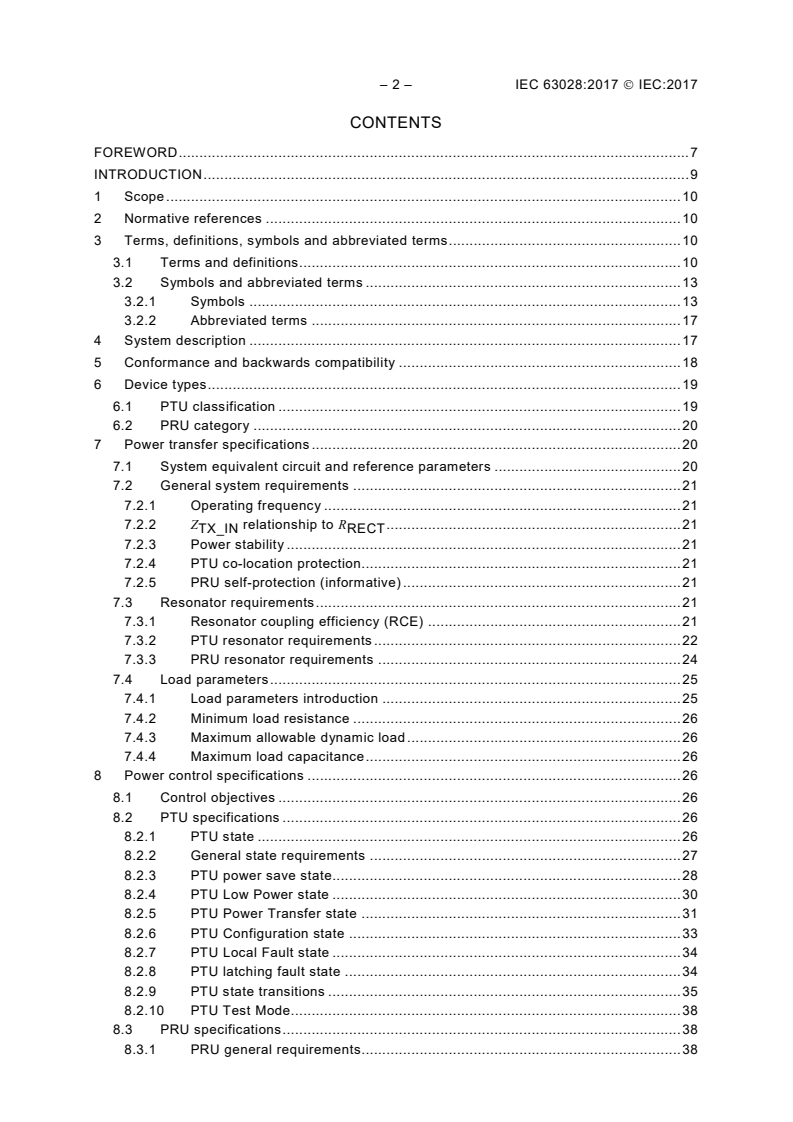
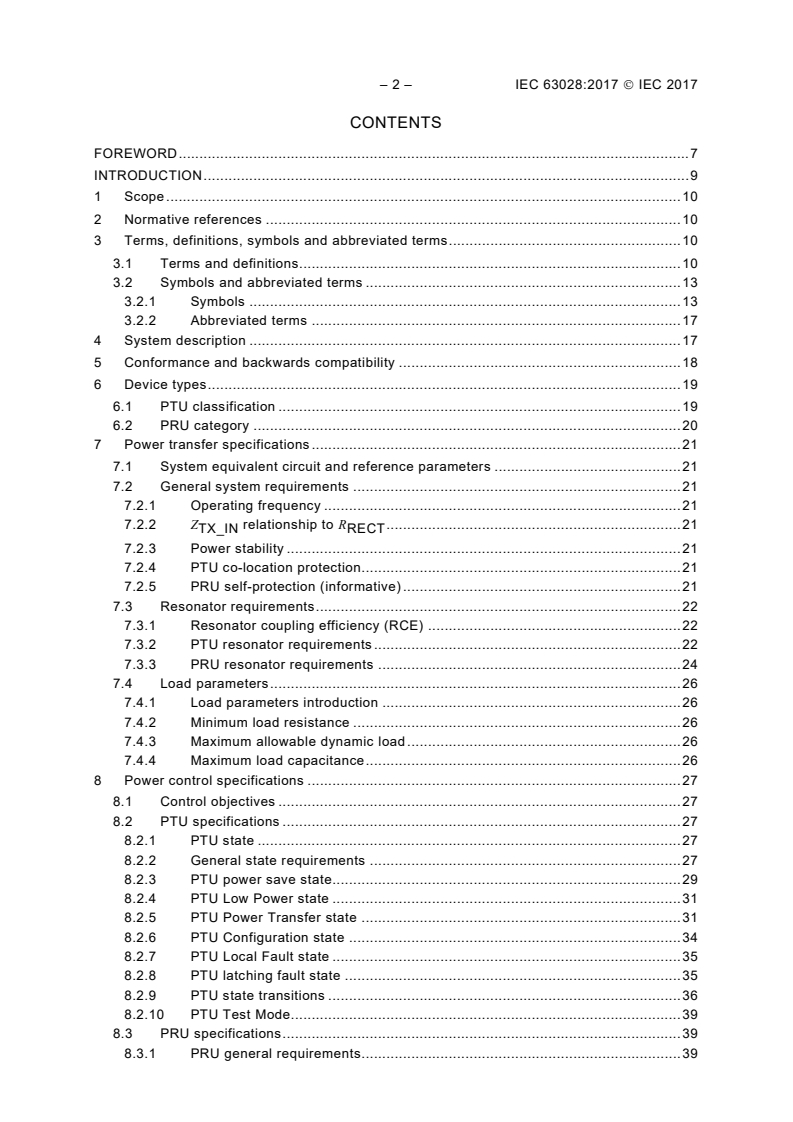
CONTENTS
FOREWORD . 7
INTRODUCTION . 9
1 Scope . 10
2 Normative references . 10
3 Terms, definitions, symbols and abbreviated terms . 10
3.1 Terms and definitions . 10
3.2 Symbols and abbreviated terms . 13
3.2.1 Symbols . 13
3.2.2 Abbreviated terms . 17
4 System description . 17
5 Conformance and backwards compatibility . 18
6 Device types . 19
6.1 PTU classification . 19
6.2 PRU category . 20
7 Power transfer specifications . 20
7.1 System equivalent circuit and reference parameters . 20
7.2 General system requirements . 21
7.2.1 Operating frequency . 21
7.2.2 Z relationship to R . 21
TX_IN RECT
7.2.3 Power stability . 21
7.2.4 PTU co-location protection. 21
7.2.5 PRU self-protection (informative) . 21
7.3 Resonator requirements . 21
7.3.1 Resonator coupling efficiency (RCE) . 21
7.3.2 PTU resonator requirements . 22
7.3.3 PRU resonator requirements . 24
7.4 Load parameters . 25
7.4.1 Load parameters introduction . 25
7.4.2 Minimum load resistance . 26
7.4.3 Maximum allowable dynamic load . 26
7.4.4 Maximum load capacitance . 26
8 Power control specifications . 26
8.1 Control objectives . 26
8.2 PTU specifications . 26
8.2.1 PTU state . 26
8.2.2 General state requirements . 27
8.2.3 PTU power save state. 28
8.2.4 PTU Low Power state . 30
8.2.5 PTU Power Transfer state . 31
8.2.6 PTU Configuration state . 33
8.2.7 PTU Local Fault state . 34
8.2.8 PTU latching fault state . 34
8.2.9 PTU state transitions . 35
8.2.10 PTU Test Mode. 38
8.3 PRU specifications . 38
8.3.1 PRU general requirements . 38
8.3.2 PRU state model . 41
8.3.3 Null state . 42
8.3.4 PRU boot . 42
8.3.5 PRU On state . 42
8.3.6 PRU System Error state . 43
8.3.7 PRU state transitions . 44
9 Signaling specifications . 45
9.1 Architecture and state diagrams . 45
9.1.1 Architecture . 45
9.1.2 Overall charge process . 46
9.2 Charge procedure and requirements . 48
9.2.1 Removing PRU from WPT network . 48
9.2.2 Power Sharing mode . 48
9.3 Bluetooth low energy requirements . 49
9.3.1 Bluetooth low energy requirements introduction . 49
9.3.2 Bluetooth low energy objectives . 49
9.3.3 PTU hardware requirement . 49
9.3.4 PRU hardware requirement . 49
9.3.5 Basic network structure . 49
9.3.6 RF requirements . 49
9.3.7 Timing and sequencing requirements . 50
9.3.8 Profile structure . 53
9.4 BLE profile definition . 53
9.4.1 GATT sub-procedure . 53
9.4.2 Configuration . 53
9.4.3 PRU requirements . 54
9.4.4 PTU requirements . 55
9.4.5 Connection establishment . 55
9.4.6 Security considerations . 57
9.4.7 Charge completion . 57
9.5 WPT service characteristics . 58
9.5.1 WPT service characteristics introduction. 58
9.5.2 PRU advertising payload . 58
9.5.3 WPT service . 60
9.5.4 PRU control . 62
9.5.5 PTU static parameter . 64
9.5.6 PRU static parameter characteristic . 69
9.5.7 PRU dynamic parameter characteristic . 72
9.5.8 PRU alert characteristic . 76
9.6 Cross connection algorithm . 78
9.6.1 Cross connection algorithm introduction . 78
9.6.2 Definitions . 78
9.6.3 Acceptance of advertisement . 78
9.6.4 Impedance shift sensing . 78
9.6.5 Reboot bit handling . 79
9.6.6 Time set handling . 79
9.7 Mode transition . 80
9.7.1 Mode transition introduction . 80
9.7.2 Mode transition procedure . 80
– 4 – IEC 63028:2017 IEC:2017
9.7.3 BLE reconnection procedure . 81
10 PTU resonators . 83
10.1 PTU resonators introduction . 83
10.2 Class n design template . 83
10.2.1 Class n design template introduction. 83
10.2.2 Table of specifications . 83
10.2.3 PTU resonator structure . 83
10.3 Approved PTU resonators . 83
Annex A (informative) Reference PRU for PTU acceptance testing . 84
A.1 Category 1 . 84
A.2 Category 2 . 84
A.3 Category 3 . 84
A.3.1 PRU design 3-1 . 84
A.3.2 Geometry. 84
A.4 Category 4 . 87
A.5 Category 5 . 87
Annex B (informative) Lost power . 88
B.1 Overview. 88
B.2 General . 88
B.3 Cross connection issues . 88
B.4 Handoff issues . 88
B.5 Power noise issues . 89
B.6 PTU lost power calculation . 89
B.6.1 Lost power detection threshold . 89
B.6.2 Lost power detection speed . 89
B.6.3 PTU lost power calculation . 89
B.6.4 PTU power transmission detection accuracy . 89
B.6.5 PRU lost power reports . 89
B.6.6 Accuracy of reported power . 90
B.6.7 Other PRU lost power reports . 90
Annex C (normative) User experience requirements . 91
C.1 General . 91
C.2 User indication . 91
C.2.1 PRU user indication . 91
C.2.2 PTU user indication . 91
Annex D (informative) RCE calculations . 92
D.1 RCE calculation (using S-parameters) . 92
D.2 RCE calculation (using Z-parameters) . 93
D.2.1 Series tuned case . 94
D.2.2 Other RCE calculations. 94
D.3 Conversion between S-parameters and Z-parameters . 94
Figure 1 – Wireless power transfer system . 18
Figure 2 – PTU-PRU resonator P . 19
TX_IN
Figure 3 – PTU-PRU resonator P . 20
RX_OUT
Figure 4 – Equivalent circuit and system parameters . 20
Figure 5 – PTU resonator-load considerations . 24
Figure 6 – PTU state model . 27
Figure 7 – Beacon sequences . 29
Figure 8 – Load variation detection . 29
Figure 9 – Discovery . 30
Figure 10 – PTU I transition responses. 31
TX
Figure 11 – PRU state model . 41
Figure 12 – V operating regions . 42
RECT
Figure 13 – Basic architecture of WPT system . 45
Figure 14 – Basic state procedure (informative) . 47
Figure 15 – Registration period timeline example (informative) . 52
Figure 16 – PTU/PRU services/characteristics communication . 54
Figure 17 – PRU mode transition – Device Address field set to a non-zero value . 81
Figure 18 – PRU mode transition – Device Address field set to all zeros . 82
Figure A.1 – PRU design 3 block diagram . 84
Figure A.2 – Front view . 85
Figure A.3 – Back view . 85
Figure A.4 – Side view . 86
Figure A.5 – Front view, coil only . 86
Figure A.6 – Side view, coil only . 86
Table 1 – PTU classification. 19
Table 2 – PRU category . 20
Table 3 – Minimum RCE (percent and dB) between PRU and PTU. 22
Table 4 – Maximum load capacitance . 26
Table 5 – Time requirement to enter PTU Power Transfer state . 28
Table 6 – Sub-state of PTU Power Transfer . 32
Table 7 – PTU latching faults . 37
Table 8 – Example of accuracy of reported current . 41
Table 9 – PRU system errors . 45
Table 10 – RF budget (informative) . 50
Table 11 – Timing constraints . 52
Table 12 – BLE profile characteristics . 53
Table 13 – GATT sub-procedure . 53
Table 14 – PRU advertising payload . 58
Table 15 – Impedance shift bit . 60
Table 16 – WPT service UUID . 60
Table 17 – WPT service . 61
Table 18 – GAP service . 62
Table 19 – GATT service . 62
Table 20 – PRU Control Characteristic . 63
Table 21 – Detail: bit field for enables . 63
Table 22 – Detail: bit field for permission . 64
Table 23 – Detail: bit field for time set . 64
– 6 – IEC 63028:2017 IEC:2017
Table 24 – PTU reporting static values to PRU . 65
Table 25 – Detail: bit field for optional fields validity . 65
Table 26 – PTU power . 66
Table 27 – Max source impedance . 67
Table 28 – Max load resistance . 68
Table 29 – AirFuel protocol revision field . 69
Table 30 – PTU number of devices . 69
Table 31 – PRU reporting static values to the PTU . 70
Table 32 – Detail: bit field for optional fields validity . 70
Table 33 – Detail: bit field for PRU information . 71
Table 34 – PRU dynamic parameter characteristic . 73
Table 35 – Detail: bit field for optional fields validity . 73
Table 36 – Detail: bit field for PRU alert . 75
Table 37 – Detail: bit field for PRU alert . 76
Table 38 – Test mode commands . 76
Table 39 – PRU alert fields . 77
Table 40 – Detail: bit field for PRU alert notification . 77
Table 41 – Mode transition . 78
Table A.1 – PRU table of specifications . 84
INTERNATIONAL ELECTROTECHNICAL COMMISSION
____________
WIRELESS POWER TRANSFER – AIRFUEL ALLIANCE RESONANT
BASELINE SYSTEM SPECIFICATION (BSS)
FOREWORD
1) The International Electrotechnical Commission (IEC) is a worldwide organization for standardization comprising
all national electrotechnical committees (IEC National Committees). The object of IEC is to promote
international co-operation on all questions concerning standardization in the electrical and electronic fields. To
this end and in addition to other activities, IEC publishes International Standards, Technical Specifications,
Technical Reports, Publicly Available Specifications (PAS) and Guides (hereafter referred to as "IEC
Publication(s)"). Their preparation is entrusted to technical committees; any IEC National Committee interested
in the subject dealt with may participate in this preparatory work. International, governmental and non-
governmental organizations liaising with the IEC also participate in this preparation. IEC collaborates closely
with the International Organization for Standardization (ISO) in accordance with conditions determined by
agreement between the two organizations.
2) The formal decisions or agreements of IEC on technical matters express, as nearly as possible, an international
consensus of opinion on the relevant subjects since each technical committee has representation from all
interested IEC National Committees.
3) IEC Publications have the form of recommendations for international use and are accepted by IEC National
Committees in that sense. While all reasonable efforts are made to ensure that the technical content of IEC
Publications is accurate, IEC cannot be held responsible for the way in which they are used or for any
misinterpretation by any end user.
4) In order to promote international uniformity, IEC National Committees undertake to apply IEC Publications
transparently to the maximum extent possible in their national and regional publications. Any divergence
between any IEC Publication and the corresponding national or regional publication shall be clearly indicated in
the latter.
5) IEC itself does not provide any attestation of conformity. Independent certification bodies provide conformity
assessment services and, in some areas, access to IEC marks of conformity. IEC is not responsible for any
services carried out by independent certification bodies.
6) All users should ensure that they have the latest edition of this publication.
7) No liability shall attach to IEC or its directors, employees, servants or agents including individual experts and
members of its technical committees and IEC National Committees for any personal injury, property damage or
other damage of any nature whatsoever, whether direct or indirect, or for costs (including legal fees) and
expenses arising out of the publication, use of, or reliance upon, this IEC Publication or any other IEC
Publications.
8) Attention is drawn to the Normative references cited in this publication. Use of the referenced publications is
indispensable for the correct application of this publication.
9) Attention is drawn to the possibility that some of the elements of this IEC Publication may be the subject of
patent rights. IEC shall not be held responsible for identifying any or all such patent rights.
International Standard IEC 63028 has been prepared by technical area 15: Wireless power
transfer, of IEC technical committee 100: Audio, video and multimedia systems and
equipment.
The text of this International Standard is based on the following documents:
FDIS Report on voting
100/2901/FDIS 100/2941/RVD
Full information on the voting for the approval of this International Standard can be found in
the report on voting indicated in the above table.
This document has been drafted in accordance with the ISO/IEC Directives, Part 2.
– 8 – IEC 63028:2017 IEC:2017
The committee has decided that the contents of this document will remain unchanged until the
stability date indicated on the IEC website under "http://webstore.iec.ch" in the data related to
the specific document. At this date, the document will be
• reconfirmed,
• withdrawn,
• replaced by a revised edition, or
• amended.
A bilingual version of this publication may be issued at a later date.
IMPORTANT – The 'colour inside' logo on the cover page of this publication indicates
that it contains colours which are considered to be useful for the correct
understanding of its contents. Users should therefore print this document using a
colour printer.
INTRODUCTION
In today’s world, mainstream consumer mobile devices are ubiquitously supported by wireless
technologies for data communication and connectivity functions while charging function is
primarily supported by wired technologies. The development of wireless power transfer
technologies offers increased user convenience for charging mobile devices; technologies
include inductive, resonant, uncoupled (RF, ultrasonic, laser) methods.
IEC 63028 defines a specific wireless charging approach based on resonant technology and
TM
specifies technical requirements for the AirFuel resonant wireless power transfer (WPT)
systems.
___________
TM
AirFuel is the trade name of a product supplied by AirFuel Alliance. This information is given for the
convenience of users of this document and does not constitute an endorsement by IEC of the product named.
– 10 – IEC 63028:2017 IEC:2017
WIRELESS POWER TRANSFER – AIRFUEL ALLIANCE RESONANT
BASELINE SYSTEM SPECIFICATION (BSS)
1 Scope
This document defines technical requirements, behaviors and interfaces used for ensuring
interoperability for flexibly coupled wireless power transfer (WPT) systems for AirFuel
Resonant WPT. This document is based on AirFuel Wireless Power Transfer System Baseline
System Specification (BSS) v1.3.
Products implementing this document are expected to follow applicable regulations and global
standards.
2 Normative references
The following documents are referred to in the text in such a way that some or all of their
content constitutes requirements of this document. For dated references, only the edition
cited applies. For undated references, the latest edition of the referenced document (including
any amendments) applies.
AirFuel Wireless Power Transfer System Baseline System Specification (BSS) v1.3 [viewed
2017-03-13]. Available at: http://www.airfuel.org/technologies/specification-download
AirFuel Wireless Power Transfer System Baseline System Specification (BSS) v1.2.1 [viewed
2017-03-13]. Available at: http://www.airfuel.org/technologies/specification-download
Bluetooth core specification v4.0, or later versions as they are available [viewed 2017-03-13].
Available at: https://www.bluetooth.org/docman/handlers/downloaddoc.ashx?doc_id=229737
CSA4, or later versions as they are available [viewed 2017-03-13]. Available at:
https://www.bluetooth.org/docman/handlers/DownloadDoc.ashx?doc_id=269452
3 Terms, definitions, symbols and abbreviated terms
3.1 Terms and definitions
For the purposes of this document, the following terms and definitions apply.
ISO and IEC maintain terminological databases for use in standardization at the following
addresses:
• IEC Electropedia: available at http://www.electropedia.org/
• ISO Online browsing platform: available at http://www.iso.org/obp
3.1.1
advertisement
connectable, undirected advertising event where the device transmits three WPT service
specific ADV_IND packets and accepts both scan requests and connect requests
Note 1 to entry: There is one ADV_IND packet transmitted on each of the advertising channels.
Note 2 to entry: Receipt of an advertisement is defined to be receipt of one of the three advertisement packets.
3.1.2
category
type of power receiving unit (PRU)
Note 1 to entry: Refer also to the definition of power receiving unit (3.1.17).
3.1.3
charge area
region of maximum overlap between the PTU charge area
and the PRU resonator
Note 1 to entry: The charge area is provided by the vendor, the PRU is the entire device, and the test area is the
charge area in tests.
3.1.4
charge area
region of maximum overlap between the PTU charge area
and the PRU
Note 1 to entry: The charge area is provided by the vendor, and the test area is the charge area in tests.
Note 2 to entry: This does not preclude the PRU resonator being larger than the PTU resonator.
Note 3 to entry: Additionally, "within the charge area" is equated to mean "within the test area".
Note 4 to entry: The charge area includes the specification of the Z heights intended for the final product, from
the surface of resonator coil.
3.1.5
class
type of power transmitting unit (PTU)
Note 1 to entry: Refer also to the definition of power transmitting unit (3.1.18).
3.1.6
concurrent multiple charging
transmission of power from one transmitting resonator to multiple receiving resonators
Note 1 to entry: Magnetic resonant coupling can occur among one transmitting resonator and many receiving
resonators, while tight coupling is restricted to only one transmitting coil and one receiving coil. Thus, tightly
coupled technology only allows one-to-one power transmission.
3.1.7
delta R1
change in a PTU resonator’s measured resistance when a PRU is placed at the center of
PTU’s charge area as compared to the resistance when no objects are in the charge area
Note 1 to entry: This measurement refers to the use of a PRU with an open-circuit resonator.
3.1.8
device registry
list of active PRU’s maintained by the PTU
3.1.9
dominant PRU
PRU consuming the highest percentage of its rated output power (V x I / P )
RECT RECT RECT_MAX
3.1.10
flexibly coupled wireless power transfer
power transfer system that provides power through magnetic induction between a transmitter
coil and a receiver coil, where the coupling factor (k) between the coils can be within a range
between large and very small (e.g., less than 0,025)
– 12 – IEC 63028:2017 IEC:2017
Note 1 to entry: Also, in a flexibly coupled system, the transmitter (i.e., the primary) coil can be of the same size,
or much larger than the receiver (i.e., secondary) coil. The allowable difference in coil size enables concurrent
charging of multiple devices as well as more flexible placement of receiver coils within the charge area.
3.1.11
high voltage region
PRU region in which V levels result in high power dissipation without damaging the PRU
RECT
3.1.12
keep-out volume
volume outside of the charge area in which no testing is performed
Note 1 to entry: This parameter is defined by the PTU vendor.
3.1.13
low voltage region
V voltages below the operational range
RECT
3.1.14
normal operation
range of all specified WPT states other than PRU System Error state for over-voltage
3.1.15
over-voltage
V voltages greater than V
RECT RECT_MAX
Note 1 to entry: Over-voltage can permanently damage PRU components if the PRU does not correct the
condition (see 8.3.6).
3.1.16
OVP switch
switch in the PRU that opens or closes to protect the PRU
3.1.17
power receiving unit
unit receiving electrical power wirelessly from a power transmitting unit
3.1.18
power transmitting unit
unit transferring electrical power wirelessly to each power receiving unit
3.1.19
rectifier efficiency
ratio of rectified power to PRU received power (P / P )
RECT RX_OUT
3.1.20
resonance
condition of a body or system when it is subjected to a periodic disturbance of the same
frequency as the natural frequency of the body or system
Note 1 to entry: At this frequency, the system displays an enhanced oscillation or vibration.
3.1.21
resonator
magnetic field generator that satisfies the resonance condition for efficiently transferring
electrical power from a PTU to a PRU
Note 1 to entry: Both a coil and an electrical conducting wire are examples of a resonator.
3.1.22
wireless power transfer
processes and methods that take place in any system where electrical power is transmitted
from a power source to an electrical load without interconnecting wires
3.2 Symbols and abbreviated terms
3.2.1 Symbols
For the purposes of this document, the following symbols for variable parameters apply.
3.2.1.1
η
RECT
rectifier efficiency (P / P )
RECT RX_OUT
3.2.1.2
I
RECT
DC current out of the PRU’s rectifier
3.2.1.3
I
RECT_REPORT
I value reported by a PRU to a PTU
RECT
3.2.1.4
I
RX_IN
RMS current out of the resonator/into the rectifier, while in the PRU on state
3.2.1.5
I
TX
RMS current into the PTU resonator coil
3.2.1.6
I
TX_LONG_BEACON
RMS current into the PTU resonator during the long beacon period in the PTU power save
state
Note 1 to entry: This current is used to provide minimum power for waking up a PRU signaling module and MCU,
and to initiate communication.
3.2.1.7
I
TX_SHORT_BEACON
RMS current into the PTU resonator while in the PTU power save state
Note 1 to entry: This current is used to detect the PTU impedance change caused by the placement of an object
in the charge area.
3.2.1.8
I
TX_START
RMS current into the PTU resonator that provides minimum power for waking up a PRU
signaling module and MCU
Note 1 to entry: This current is also used to initiate communication and registration.
3.2.1.9
P
IN
DC power into the PTU
3.2.1.10
P
TX_IN
input power to the PTU resonator
– 14 – IEC 63028:2017 IEC:2017
3.2.1.11
P
TX_IN_MAX
maximum input power to the PTU resonator
3.2.1.12
P
RECT
average power out of the PRU’s rectifier AVG (V x I )
RECT RECT
3.2.1.13
P
RECT_BOOT
maximum average power out of the PRU’s rectifier as declared by the vendor
Note 1 to entry: The rectifier power is measured over a 1 ms interval.
3.2.1.14
P
RECT_IN
average power into the PRU rectifier
3.2.1.15
P
RX_REPORTED
product of reported rectified voltage and current (V x I )
RECT_REPORT RECT_REPORT
3.2.1.16
P
RX_OUT
power out of the PRU resonator
3.2.1.17
R
RECT
effective load resistance at the output of the PRU’s rectifier
3.2.1.18
R
RECT_MP
maximum power point resistance
3.2.1.19
R
RX_IN
parasitic resistance of the PRU resonator
3.2.1.20
V
PAa
DC input voltage to the PTU’s power amplifier
3.2.1.21
V
RECT
DC voltage at the output of a PRU’s rectifier
3.2.1.22
V
RECT_REPORT
V value which a PRU reports to a PTU
RECT
3.2.1.23
Z
RX_IN
input impedance of the PRU resonator and matching network
For the purposes of this document, the following symbols for PTU/PRU design dependent
variable parameters apply.
3.2.1.24
ADV_PWR_MIN
minimum BLE advertisement power as seen at the PTU BLE antenna
3.2.1.25
I
TX_ABS_MAX
absolute maximum PTU current
3.2.1.26
I
TX_LONG_BEACON_MIN
minimum allowed current during PTU long beacon
3.2.1.27
I
TX_SHORT_BEACON_MIN
minimum allowed current during PTU short beacon
3.2.1.28
I
TX_MAX
operational maximum PTU current
3.2.1.29
I
TX_MIN
operational minimum PTU current
3.2.1.30
I
TX_NOMINAL
nominal PTU resonator current driving all PRUs to operate in the optimum voltage region
3.2.1.31
P
RECT_MAX
PRU’s maximum rated P power
RECT
3.2.1.32
P
RECT_MIN
PRU’s minimum rated P power
RECT
3.2.1.33
P
RX_OUT_MAX
maximum output power of the PRU resonator
3.2.1.34
R
RX_MIN
minimum resistance presented to the PRU resonator terminals during normal operation
3.2.1.35
R
RECT_MP
R resistance that achieves maximum P power
RECT RECT
3.2.1.36
R
TX_IN
real part of Z
TX_IN
3.2.1.37
V
RECT_BOOT
boot V voltage
RECT
Note 1 to entry: Below this level, the PRU cannot enter the PRU boot state.
– 16 – IEC 63028:2017 IEC:2017
3.2.1.38
V
RECT_HIGH
maximum operat
...
IEC 63028 ®
Edition 1.0 2017-06
INTERNATIONAL
STANDARD
NORME
INTERNATIONALE
colour
inside
Wireless power transfer – AirFuel Alliance resonant baseline system specification
(BSS)
Transfert d'énergie sans fil – Spécification du système de référence (BSS) pour le
système résonant d'AirFuel Alliance
All rights reserved. Unless otherwise specified, no part of this publication may be reproduced or utilized in any form
or by any means, electronic or mechanical, including photocopying and microfilm, without permission in writing from
either IEC or IEC's member National Committee in the country of the requester. If you have any questions about IEC
copyright or have an enquiry about obtaining additional rights to this publication, please contact the address below or
your local IEC member National Committee for further information.
Droits de reproduction réservés. Sauf indication contraire, aucune partie de cette publication ne peut être reproduite
ni utilisée sous quelque forme que ce soit et par aucun procédé, électronique ou mécanique, y compris la photocopie
et les microfilms, sans l'accord écrit de l'IEC ou du Comité national de l'IEC du pays du demandeur. Si vous avez des
questions sur le copyright de l'IEC ou si vous désirez obtenir des droits supplémentaires sur cette publication, utilisez
les coordonnées ci-après ou contactez le Comité national de l'IEC de votre pays de résidence.
IEC Central Office Tel.: +41 22 919 02 11
3, rue de Varembé info@iec.ch
CH-1211 Geneva 20 www.iec.ch
Switzerland
About the IEC
The International Electrotechnical Commission (IEC) is the leading global organization that prepares and publishes
International Standards for all electrical, electronic and related technologies.
About IEC publications
The technical content of IEC publications is kept under constant review by the IEC. Please make sure that you have the
latest edition, a corrigendum or an amendment might have been published.
IEC publications search - webstore.iec.ch/advsearchform Electropedia - www.electropedia.org
The advanced search enables to find IEC publications by a The world's leading online dictionary on electrotechnology,
variety of criteria (reference number, text, technical containing more than 22 000 terminological entries in English
committee,…). It also gives information on projects, replaced and French, with equivalent terms in 16 additional languages.
and withdrawn publications. Also known as the International Electrotechnical Vocabulary
(IEV) online.
IEC Just Published - webstore.iec.ch/justpublished
Stay up to date on all new IEC publications. Just Published IEC Glossary - std.iec.ch/glossary
details all new publications released. Available online and 67 000 electrotechnical terminology entries in English and
once a month by email. French extracted from the Terms and Definitions clause of
IEC publications issued since 2002. Some entries have been
IEC Customer Service Centre - webstore.iec.ch/csc collected from earlier publications of IEC TC 37, 77, 86 and
If you wish to give us your feedback on this publication or CISPR.
need further assistance, please contact the Customer Service
Centre: sales@iec.ch.
A propos de l'IEC
La Commission Electrotechnique Internationale (IEC) est la première organisation mondiale qui élabore et publie des
Normes internationales pour tout ce qui a trait à l'électricité, à l'électronique et aux technologies apparentées.
A propos des publications IEC
Le contenu technique des publications IEC est constamment revu. Veuillez vous assurer que vous possédez l’édition la
plus récente, un corrigendum ou amendement peut avoir été publié.
Recherche de publications IEC - Electropedia - www.electropedia.org
webstore.iec.ch/advsearchform Le premier dictionnaire d'électrotechnologie en ligne au
La recherche avancée permet de trouver des publications IEC monde, avec plus de 22 000 articles terminologiques en
en utilisant différents critères (numéro de référence, texte, anglais et en français, ainsi que les termes équivalents dans
comité d’études,…). Elle donne aussi des informations sur les 16 langues additionnelles. Egalement appelé Vocabulaire
projets et les publications remplacées ou retirées. Electrotechnique International (IEV) en ligne.
IEC Just Published - webstore.iec.ch/justpublished Glossaire IEC - std.iec.ch/glossary
Restez informé sur les nouvelles publications IEC. Just 67 000 entrées terminologiques électrotechniques, en anglais
Published détaille les nouvelles publications parues. et en français, extraites des articles Termes et Définitions des
Disponible en ligne et une fois par mois par email. publications IEC parues depuis 2002. Plus certaines entrées
antérieures extraites des publications des CE 37, 77, 86 et
Service Clients - webstore.iec.ch/csc CISPR de l'IEC.
Si vous désirez nous donner des commentaires sur cette
publication ou si vous avez des questions contactez-nous:
sales@iec.ch.
IEC 63028 ®
Edition 1.0 2017-06
INTERNATIONAL
STANDARD
NORME
INTERNATIONALE
colour
inside
Wireless power transfer – AirFuel Alliance resonant baseline system specification
(BSS)
Transfert d'énergie sans fil – Spécification du système de référence (BSS) pour le
système résonant d'AirFuel Alliance
INTERNATIONAL
ELECTROTECHNICAL
COMMISSION
COMMISSION
ELECTROTECHNIQUE
INTERNATIONALE
ICS 29.240.99; 33.160.99; 35.200 ISBN 978-2-8322-8732-3
– 2 – IEC 63028:2017 IEC 2017
CONTENTS
FOREWORD . 7
INTRODUCTION . 9
1 Scope . 10
2 Normative references . 10
3 Terms, definitions, symbols and abbreviated terms . 10
3.1 Terms and definitions . 10
3.2 Symbols and abbreviated terms . 13
3.2.1 Symbols . 13
3.2.2 Abbreviated terms . 17
4 System description . 17
5 Conformance and backwards compatibility . 18
6 Device types . 19
6.1 PTU classification . 19
6.2 PRU category . 20
7 Power transfer specifications . 21
7.1 System equivalent circuit and reference parameters . 21
7.2 General system requirements . 21
7.2.1 Operating frequency . 21
7.2.2 Z relationship to R . 21
TX_IN RECT
7.2.3 Power stability . 21
7.2.4 PTU co-location protection. 21
7.2.5 PRU self-protection (informative) . 21
7.3 Resonator requirements . 22
7.3.1 Resonator coupling efficiency (RCE) . 22
7.3.2 PTU resonator requirements . 22
7.3.3 PRU resonator requirements . 24
7.4 Load parameters . 26
7.4.1 Load parameters introduction . 26
7.4.2 Minimum load resistance . 26
7.4.3 Maximum allowable dynamic load . 26
7.4.4 Maximum load capacitance . 26
8 Power control specifications . 27
8.1 Control objectives . 27
8.2 PTU specifications . 27
8.2.1 PTU state . 27
8.2.2 General state requirements . 27
8.2.3 PTU power save state. 29
8.2.4 PTU Low Power state . 31
8.2.5 PTU Power Transfer state . 31
8.2.6 PTU Configuration state . 34
8.2.7 PTU Local Fault state . 35
8.2.8 PTU latching fault state . 35
8.2.9 PTU state transitions . 36
8.2.10 PTU Test Mode. 39
8.3 PRU specifications . 39
8.3.1 PRU general requirements . 39
8.3.2 PRU state model . 42
8.3.3 Null state . 43
8.3.4 PRU boot . 43
8.3.5 PRU On state . 44
8.3.6 PRU System Error state . 44
8.3.7 PRU state transitions . 45
9 Signaling specifications . 46
9.1 Architecture and state diagrams . 46
9.1.1 Architecture . 46
9.1.2 Overall charge process . 47
9.2 Charge procedure and requirements . 49
9.2.1 Removing PRU from WPT network . 49
9.2.2 Power Sharing mode . 49
9.3 Bluetooth low energy requirements . 50
9.3.1 Bluetooth low energy requirements introduction . 50
9.3.2 Bluetooth low energy objectives . 50
9.3.3 PTU hardware requirement . 50
9.3.4 PRU hardware requirement . 50
9.3.5 Basic network structure . 50
9.3.6 RF requirements . 50
9.3.7 Timing and sequencing requirements . 51
9.3.8 Profile structure . 54
9.4 BLE profile definition . 54
9.4.1 GATT sub-procedure . 54
9.4.2 Configuration . 54
9.4.3 PRU requirements . 55
9.4.4 PTU requirements . 56
9.4.5 Connection establishment . 56
9.4.6 Security considerations . 58
9.4.7 Charge completion . 58
9.5 WPT service characteristics . 59
9.5.1 WPT service characteristics introduction. 59
9.5.2 PRU advertising payload . 59
9.5.3 WPT service . 61
9.5.4 PRU control . 63
9.5.5 PTU static parameter . 65
9.5.6 PRU static parameter characteristic . 70
9.5.7 PRU dynamic parameter characteristic . 73
9.5.8 PRU alert characteristic . 77
9.6 Cross connection algorithm . 79
9.6.1 Cross connection algorithm introduction . 79
9.6.2 Definitions . 79
9.6.3 Acceptance of advertisement . 79
9.6.4 Impedance shift sensing . 79
9.6.5 Reboot bit handling . 80
9.6.6 Time set handling . 80
9.7 Mode transition . 81
9.7.1 Mode transition introduction . 81
9.7.2 Mode transition procedure . 81
– 4 – IEC 63028:2017 IEC 2017
9.7.3 BLE reconnection procedure . 81
10 PTU resonators . 84
10.1 PTU resonators introduction . 84
10.2 Class n design template . 84
10.2.1 Class n design template introduction. 84
10.2.2 Table of specifications . 84
10.2.3 PTU resonator structure . 84
10.3 Approved PTU resonators . 84
Annex A (informative) Reference PRU for PTU acceptance testing . 85
A.1 Category 1 . 85
A.2 Category 2 . 85
A.3 Category 3 . 85
A.3.1 PRU design 3-1 . 85
A.3.2 Geometry. 85
A.4 Category 4 . 88
A.5 Category 5 . 88
Annex B (informative) Lost power . 89
B.1 Overview. 89
B.2 General . 89
B.3 Cross connection issues . 89
B.4 Handoff issues . 89
B.5 Power noise issues . 90
B.6 PTU lost power calculation . 90
B.6.1 Lost power detection threshold . 90
B.6.2 Lost power detection speed . 90
B.6.3 PTU lost power calculation . 90
B.6.4 PTU power transmission detection accuracy . 90
B.6.5 PRU lost power reports . 91
B.6.6 Accuracy of reported power . 91
B.6.7 Other PRU lost power reports . 91
Annex C (normative) User experience requirements . 92
C.1 General . 92
C.2 User indication . 92
C.2.1 PRU user indication . 92
C.2.2 PTU user indication . 92
Annex D (informative) RCE calculations . 93
D.1 RCE calculation (using S-parameters) . 93
D.2 RCE calculation (using Z-parameters) . 94
D.2.1 Series tuned case . 95
D.2.2 Other RCE calculations. 95
D.3 Conversion between S-parameters and Z-parameters . 95
Figure 1 – Wireless power transfer system . 18
Figure 2 – PTU-PRU resonator P . 19
TX_IN
Figure 3 – PTU-PRU resonator P . 20
RX_OUT
Figure 4 – Equivalent circuit and system parameters . 21
Figure 5 – PTU resonator-load considerations . 24
Figure 6 – PTU state model . 27
Figure 7 – Beacon sequences . 29
Figure 8 – Load variation detection . 30
Figure 9 – Discovery . 31
Figure 10 – PTU I transition responses. 32
TX
Figure 11 – PRU state model . 42
Figure 12 – V operating regions . 43
RECT
Figure 13 – Basic architecture of WPT system . 47
Figure 14 – Basic state procedure (informative) . 48
Figure 15 – Registration period timeline example (informative) . 53
Figure 16 – PTU/PRU services/characteristics communication . 55
Figure 17 – PRU mode transition – Device Address field set to a non-zero value . 82
Figure 18 – PRU mode transition – Device Address field set to all zeros . 83
Figure A.1 – PRU design 3 block diagram . 85
Figure A.2 – Front view . 86
Figure A.3 – Back view . 86
Figure A.4 – Side view . 87
Figure A.5 – Front view, coil only . 87
Figure A.6 – Side view, coil only . 87
Table 1 – PTU classification. 20
Table 2 – PRU category . 20
Table 3 – Minimum RCE (percent and dB) between PRU and PTU. 22
Table 4 – Maximum load capacitance . 26
Table 5 – Time requirement to enter PTU Power Transfer state . 28
Table 6 – Sub-state of PTU Power Transfer . 32
Table 7 – PTU latching faults . 38
Table 8 – Example of accuracy of reported current . 42
Table 9 – PRU system errors . 46
Table 10 – RF budget (informative) . 51
Table 11 – Timing constraints . 53
Table 12 – BLE profile characteristics . 54
Table 13 – GATT sub-procedure . 54
Table 14 – PRU advertising payload . 59
Table 15 – Impedance shift bit . 61
Table 16 – WPT service UUID . 61
Table 17 – WPT service . 62
Table 18 – GAP service . 63
Table 19 – GATT service . 63
Table 20 – PRU Control Characteristic . 64
Table 21 – Detail: bit field for enables . 64
Table 22 – Detail: bit field for permission . 65
Table 23 – Detail: bit field for time set . 65
– 6 – IEC 63028:2017 IEC 2017
Table 24 – PTU reporting static values to PRU . 66
Table 25 – Detail: bit field for optional fields validity . 66
Table 26 – PTU power . 67
Table 27 – Max source impedance . 68
Table 28 – Max load resistance . 69
Table 29 – AirFuel protocol revision field . 70
Table 30 – PTU number of devices . 70
Table 31 – PRU reporting static values to the PTU . 71
Table 32 – Detail: bit field for optional fields validity . 71
Table 33 – Detail: bit field for PRU information . 72
Table 34 – PRU dynamic parameter characteristic . 74
Table 35 – Detail: bit field for optional fields validity . 74
Table 36 – Detail: bit field for PRU alert . 76
Table 37 – Detail: bit field for PRU alert . 77
Table 38 – Test mode commands . 77
Table 39 – PRU alert fields . 78
Table 40 – Detail: bit field for PRU alert notification . 78
Table 41 – Mode transition . 79
Table A.1 – PRU table of specifications . 85
INTERNATIONAL ELECTROTECHNICAL COMMISSION
____________
WIRELESS POWER TRANSFER – AIRFUEL ALLIANCE RESONANT
BASELINE SYSTEM SPECIFICATION (BSS)
FOREWORD
1) The International Electrotechnical Commission (IEC) is a worldwide organization for standardization comprising
all national electrotechnical committees (IEC National Committees). The object of IEC is to promote international
co-operation on all questions concerning standardization in the electrical and electronic fields. To this end and
in addition to other activities, IEC publishes International Standards, Technical Specifications, Technical Reports,
Publicly Available Specifications (PAS) and Guides (hereafter referred to as "IEC Publication(s)"). Their
preparation is entrusted to technical committees; any IEC National Committee interested in the subject dealt with
may participate in this preparatory work. International, governmental and non-governmental organizations liaising
with the IEC also participate in this preparation. IEC collaborates closely with the International Organization for
Standardization (ISO) in accordance with conditions determined by agreement between the two organizations.
2) The formal decisions or agreements of IEC on technical matters express, as nearly as possible, an international
consensus of opinion on the relevant subjects since each technical committee has representation from all
interested IEC National Committees.
3) IEC Publications have the form of recommendations for international use and are accepted by IEC National
Committees in that sense. While all reasonable efforts are made to ensure that the technical content of IEC
Publications is accurate, IEC cannot be held responsible for the way in which they are used or for any
misinterpretation by any end user.
4) In order to promote international uniformity, IEC National Committees undertake to apply IEC Publications
transparently to the maximum extent possible in their national and regional publications. Any divergence between
any IEC Publication and the corresponding national or regional publication shall be clearly indicated in the latter.
5) IEC itself does not provide any attestation of conformity. Independent certification bodies provide conformity
assessment services and, in some areas, access to IEC marks of conformity. IEC is not responsible for any
services carried out by independent certification bodies.
6) All users should ensure that they have the latest edition of this publication.
7) No liability shall attach to IEC or its directors, employees, servants or agents including individual experts and
members of its technical committees and IEC National Committees for any personal injury, property damage or
other damage of any nature whatsoever, whether direct or indirect, or for costs (including legal fees) and
expenses arising out of the publication, use of, or reliance upon, this IEC Publication or any other IEC Publications.
8) Attention is drawn to the Normative references cited in this publication. Use of the referenced publications is
indispensable for the correct application of this publication.
9) Attention is drawn to the possibility that some of the elements of this IEC Publication may be the subject of patent
rights. IEC shall not be held responsible for identifying any or all such patent rights.
International Standard IEC 63028 has been prepared by technical area 15: Wireless power
transfer, of IEC technical committee 100: Audio, video and multimedia systems and equipment.
The text of this International Standard is based on the following documents:
FDIS Report on voting
100/2901/FDIS 100/2941/RVD
Full information on the voting for the approval of this International Standard can be found in the
report on voting indicated in the above table.
This document has been drafted in accordance with the ISO/IEC Directives, Part 2.
– 8 – IEC 63028:2017 IEC 2017
The committee has decided that the contents of this document will remain unchanged until the
stability date indicated on the IEC website under "http://webstore.iec.ch" in the data related to
the specific document. At this date, the document will be
• reconfirmed,
• withdrawn,
• replaced by a revised edition, or
• amended.
IMPORTANT – The 'colour inside' logo on the cover page of this publication indicates
that it contains colours which are considered to be useful for the correct understanding
of its contents. Users should therefore print this document using a colour printer.
INTRODUCTION
In today’s world, mainstream consumer mobile devices are ubiquitously supported by wireless
technologies for data communication and connectivity functions while charging function is
primarily supported by wired technologies. The development of wireless power transfer
technologies offers increased user convenience for charging mobile devices; technologies
include inductive, resonant, uncoupled (RF, ultrasonic, laser) methods.
IEC 63028 defines a specific wireless charging approach based on resonant technology and
TM
specifies technical requirements for the AirFuel resonant wireless power transfer (WPT)
systems.
___________
TM
AirFuel is the trade name of a product supplied by AirFuel Alliance. This information is given for the
convenience of users of this document and does not constitute an endorsement by IEC of the product named.
– 10 – IEC 63028:2017 IEC 2017
WIRELESS POWER TRANSFER – AIRFUEL ALLIANCE RESONANT
BASELINE SYSTEM SPECIFICATION (BSS)
1 Scope
This document defines technical requirements, behaviors and interfaces used for ensuring
interoperability for flexibly coupled wireless power transfer (WPT) systems for AirFuel Resonant
WPT. This document is based on AirFuel Wireless Power Transfer System Baseline System
Specification (BSS) v1.3.
Products implementing this document are expected to follow applicable regulations and global
standards.
2 Normative references
The following documents are referred to in the text in such a way that some or all of their content
constitutes requirements of this document. For dated references, only the edition cited applies.
For undated references, the latest edition of the referenced document (including any
amendments) applies.
AirFuel Wireless Power Transfer System Baseline System Specification (BSS) v1.3 [viewed
2017-03-13]. Available at: http://www.airfuel.org/technologies/specification-download
AirFuel Wireless Power Transfer System Baseline System Specification (BSS) v1.2.1 [viewed
2017-03-13]. Available at: http://www.airfuel.org/technologies/specification-download
Bluetooth core specification v4.0, or later versions as they are available [viewed 2017-03-13].
Available at: https://www.bluetooth.org/docman/handlers/downloaddoc.ashx?doc_id=229737
CSA4, or later versions as they are available [viewed 2017-03-13]. Available at:
https://www.bluetooth.org/docman/handlers/DownloadDoc.ashx?doc_id=269452
3 Terms, definitions, symbols and abbreviated terms
3.1 Terms and definitions
For the purposes of this document, the following terms and definitions apply.
ISO and IEC maintain terminological databases for use in standardization at the following
addresses:
• IEC Electropedia: available at http://www.electropedia.org/
• ISO Online browsing platform: available at http://www.iso.org/obp
3.1.1
advertisement
connectable, undirected advertising event where the device transmits three WPT service
specific ADV_IND packets and accepts both scan requests and connect requests
Note 1 to entry: There is one ADV_IND packet transmitted on each of the advertising channels.
Note 2 to entry: Receipt of an advertisement is defined to be receipt of one of the three advertisement packets.
3.1.2
category
type of power receiving unit (PRU)
Note 1 to entry: Refer also to the definition of power receiving unit (3.1.17).
3.1.3
charge area
region of maximum overlap between the PTU charge area and
the PRU resonator
Note 1 to entry: The charge area is provided by the vendor, the PRU is the entire device, and the test area is the
charge area in tests.
3.1.4
charge area
region of maximum overlap between the PTU charge area
and the PRU
Note 1 to entry: The charge area is provided by the vendor, and the test area is the charge area in tests.
Note 2 to entry: This does not preclude the PRU resonator being larger than the PTU resonator.
Note 3 to entry: Additionally, "within the charge area" is equated to mean "within the test area".
Note 4 to entry: The charge area includes the specification of the Z heights intended for the final product, from the
surface of resonator coil.
3.1.5
class
type of power transmitting unit (PTU)
Note 1 to entry: Refer also to the definition of power transmitting unit (3.1.18).
3.1.6
concurrent multiple charging
transmission of power from one transmitting resonator to multiple receiving resonators
Note 1 to entry: Magnetic resonant coupling can occur among one transmitting resonator and many receiving
resonators, while tight coupling is restricted to only one transmitting coil and one receiving coil. Thus, tightly coupled
technology only allows one-to-one power transmission.
3.1.7
delta R1
change in a PTU resonator’s measured resistance when a PRU is placed at the center of PTU’s
charge area as compared to the resistance when no objects are in the charge area
Note 1 to entry: This measurement refers to the use of a PRU with an open-circuit resonator.
3.1.8
device registry
list of active PRU’s maintained by the PTU
3.1.9
dominant PRU
PRU consuming the highest percentage of its rated output power (V x I / P )
RECT RECT RECT_MAX
3.1.10
flexibly coupled wireless power transfer
power transfer system that provides power through magnetic induction between a transmitter
coil and a receiver coil, where the coupling factor (k) between the coils can be within a range
between large and very small (e.g., less than 0,025)
– 12 – IEC 63028:2017 IEC 2017
Note 1 to entry: Also, in a flexibly coupled system, the transmitter (i.e., the primary) coil can be of the same size,
or much larger than the receiver (i.e., secondary) coil. The allowable difference in coil size enables concurrent
charging of multiple devices as well as more flexible placement of receiver coils within the charge area.
3.1.11
high voltage region
PRU region in which V levels result in high power dissipation without damaging the PRU
RECT
3.1.12
keep-out volume
volume outside of the charge area in which no testing is performed
Note 1 to entry: This parameter is defined by the PTU vendor.
3.1.13
low voltage region
V voltages below the operational range
RECT
3.1.14
normal operation
range of all specified WPT states other than PRU System Error state for over-voltage
3.1.15
over-voltage
V voltages greater than V
RECT RECT_MAX
Note 1 to entry: Over-voltage can permanently damage PRU components if the PRU does not correct the condition
(see 8.3.6).
3.1.16
OVP switch
switch in the PRU that opens or closes to protect the PRU
3.1.17
power receiving unit
unit receiving electrical power wirelessly from a power transmitting unit
3.1.18
power transmitting unit
unit transferring electrical power wirelessly to each power receiving unit
3.1.19
rectifier efficiency
ratio of rectified power to PRU received power (P / P )
RECT RX_OUT
3.1.20
resonance
condition of a body or system when it is subjected to a periodic disturbance of the same
frequency as the natural frequency of the body or system
Note 1 to entry: At this frequency, the system displays an enhanced oscillation or vibration.
3.1.21
resonator
magnetic field generator that satisfies the resonance condition for efficiently transferring
electrical power from a PTU to a PRU
Note 1 to entry: Both a coil and an electrical conducting wire are examples of a resonator.
3.1.22
wireless power transfer
processes and methods that take place in any system where electrical power is transmitted
from a power source to an electrical load without interconnecting wires
3.2 Symbols and abbreviated terms
3.2.1 Symbols
For the purposes of this document, the following symbols for variable parameters apply.
3.2.1.1
η
RECT
rectifier efficiency (P / P )
RECT RX_OUT
3.2.1.2
I
RECT
DC current out of the PRU’s rectifier
3.2.1.3
I
RECT_REPORT
I value reported by a PRU to a PTU
RECT
3.2.1.4
I
RX_IN
RMS current out of the resonator/into the rectifier, while in the PRU on state
3.2.1.5
I
TX
RMS current into the PTU resonator coil
3.2.1.6
I
TX_LONG_BEACON
RMS current into the PTU resonator during the long beacon period in the PTU power save state
Note 1 to entry: This current is used to provide minimum power for waking up a PRU signaling module and MCU,
and to initiate communication.
3.2.1.7
I
TX_SHORT_BEACON
RMS current into the PTU resonator while in the PTU power save state
Note 1 to entry: This current is used to detect the PTU impedance change caused by the placement of an object in
the charge area.
3.2.1.8
I
TX_START
RMS current into the PTU resonator that provides minimum power for waking up a PRU
signaling module and MCU
Note 1 to entry: This current is also used to initiate communication and registration.
3.2.1.9
P
IN
DC power into the PTU
– 14 – IEC 63028:20
...