

IEC TR 60919-1:2010
(Main)Performance of high-voltage direct current (HVDC) systems with line-commutated converters - Part 1: Steady-state conditions
General Information
- Abstract
IEC/TR 60919-1:2010(E) provides general guidance on the steady-state performance requirements of HVDC systems. It concerns the steady-state performance of two-terminal HVDC systems utilizing 12-pulse converter units comprised of three-phase bridge (double- way) connections, but it does not cover multi-terminal HVDC transmission systems. Both terminals are assumed to use thyristor valves as the main semiconductor valves and to have power flow capability in both directions. Diode valves are not considered in this report. This edition includes the following significant technical changes with respect to the previous edition:
a) the changes have been made to the description of multi 12-pulse groups per pole, especially for a large scale ultra high-voltage direct current (UHVDC) converter arrangement;
b) the different arrangements of d.c. smoothing reactors have been included;
c) the figures depicting two 12-pulse groups per pole arrangement have been added.
- Status
- Published
- Publication Date
- 22-May-2017
- Drafting Committee
- JMT 5 - TC 22/SC 22F/JMT 5
- Current Stage
- DELPUB - Deleted Publication
- Start Date
- 16-Apr-2020
- Completion Date
- 30-Nov-2018
Buy Documents
IEC TR 60919-1:2010 - Performance of high-voltage direct current (HVDC) systems with line-commutated converters - Part 1: Steady-state conditions Released:5/31/2010
IEC TR 60919-1:2010+AMD1:2013 CSV - Performance of high-voltage direct current (HVDC) systems withline-commutated converters - Part 1: Steady-state conditions Released:4/30/2013

IEC TR 60919-1:2010+AMD1:2013+AMD2:2017 CSV - Performance of high-voltage direct current (HVDC) systems with line-commutated converters - Part 1: Steady-state conditions Released:5/23/2017
Overview
IEC TR 60919-1:2010 is a Technical Report from the IEC that gives general guidance on the steady‑state performance of two‑terminal high‑voltage direct current (HVDC) transmission systems using line‑commutated converters (LCC). It specifically addresses systems built from 12‑pulse converter units formed by three‑phase bridge connections and assumes thyristor valves at both terminals with bidirectional power flow capability. The report does not cover multi‑terminal HVDC schemes or arrangements using diode valves. The consolidated edition includes amendments addressing multi 12‑pulse groups per pole (relevant to UHVDC), different d.c. smoothing reactor arrangements, and added figures for two 12‑pulse groups per pole.
Key topics and technical requirements
The report focuses on practical steady‑state aspects that affect design, specification and operation:
- Types of HVDC systems (bipolar, monopolar, back‑to‑back, two 12‑pulse groups per pole) and converter transformer arrangements
- Rated power, current and voltage definitions and steady‑state ranges
- Overload capability and equipment rating considerations (valves, transformers, filters, switchgear)
- Minimum power transfer / no‑load standby operation requirements
- AC system interaction: voltage, frequency ranges, system impedance and harmonic sources
- Reactive power balance, converter reactive consumption and VAR compensation needs
- HVDC transmission line and earth electrode parameters (overhead or cable lines, electrode lines)
- Reliability metrics (outage definitions, capacity, energy availability/unavailability)
- HVDC control objectives and control structure (converter firing, pole/master control, limits)
- Telecommunications and auxiliary power requirements for secure operation
Practical applications
IEC TR 60919-1 is valuable for real‑world HVDC projects where steady‑state performance is critical:
- Preparing technical specifications for HVDC procurements and tenders
- Engineering design and sizing of converters, transformers, reactors, filters and electrode systems
- Grid‑integration studies and AC/HVDC interaction assessments (harmonics, reactive support)
- Operational procedures for minimum transfer and standby conditions
- Reliability and availability planning for HVDC links including UHVDC arrangements
Who uses this report
- HVDC system designers and electrical engineers
- Transmission utilities and grid planners
- Equipment manufacturers (converters, transformers, reactors, filters)
- Consultants and project managers working on HVDC contracts and system studies
- Regulators and asset owners setting performance and reliability criteria
Related standards
For complete system procurement and implementation, this Technical Report is typically used alongside IEC standards for equipment (transformers, switchgear, protection), grid connection and HVDC control practice, and other international standards addressing converter technologies and testing.
Relations
- Effective Date
- 05-Sep-2023
- Effective Date
- 05-Sep-2023
- Effective Date
- 05-Sep-2023
- Effective Date
- 05-Sep-2023
Buy Documents
IEC TR 60919-1:2010 - Performance of high-voltage direct current (HVDC) systems with line-commutated converters - Part 1: Steady-state conditions Released:5/31/2010
IEC TR 60919-1:2010+AMD1:2013 CSV - Performance of high-voltage direct current (HVDC) systems withline-commutated converters - Part 1: Steady-state conditions Released:4/30/2013
IEC TR 60919-1:2010+AMD1:2013+AMD2:2017 CSV - Performance of high-voltage direct current (HVDC) systems with line-commutated converters - Part 1: Steady-state conditions Released:5/23/2017
Get Certified
Connect with accredited certification bodies for this standard

IMQ S.p.A. (Certification)
Italian electrical product certification.

SLG Prüf- und Zertifizierungs GmbH
German testing and certification body.

UL Solutions
Global safety science company with testing, inspection and certification.
Sponsored listings
Frequently Asked Questions
IEC TR 60919-1:2010 is a technical report published by the International Electrotechnical Commission (IEC). Its full title is "Performance of high-voltage direct current (HVDC) systems with line-commutated converters - Part 1: Steady-state conditions". This standard covers: IEC/TR 60919-1:2010(E) provides general guidance on the steady-state performance requirements of HVDC systems. It concerns the steady-state performance of two-terminal HVDC systems utilizing 12-pulse converter units comprised of three-phase bridge (double- way) connections, but it does not cover multi-terminal HVDC transmission systems. Both terminals are assumed to use thyristor valves as the main semiconductor valves and to have power flow capability in both directions. Diode valves are not considered in this report. This edition includes the following significant technical changes with respect to the previous edition: a) the changes have been made to the description of multi 12-pulse groups per pole, especially for a large scale ultra high-voltage direct current (UHVDC) converter arrangement; b) the different arrangements of d.c. smoothing reactors have been included; c) the figures depicting two 12-pulse groups per pole arrangement have been added.
IEC/TR 60919-1:2010(E) provides general guidance on the steady-state performance requirements of HVDC systems. It concerns the steady-state performance of two-terminal HVDC systems utilizing 12-pulse converter units comprised of three-phase bridge (double- way) connections, but it does not cover multi-terminal HVDC transmission systems. Both terminals are assumed to use thyristor valves as the main semiconductor valves and to have power flow capability in both directions. Diode valves are not considered in this report. This edition includes the following significant technical changes with respect to the previous edition: a) the changes have been made to the description of multi 12-pulse groups per pole, especially for a large scale ultra high-voltage direct current (UHVDC) converter arrangement; b) the different arrangements of d.c. smoothing reactors have been included; c) the figures depicting two 12-pulse groups per pole arrangement have been added.
IEC TR 60919-1:2010 is classified under the following ICS (International Classification for Standards) categories: 29.200 - Rectifiers. Convertors. Stabilized power supply; 29.240.99 - Other equipment related to power transmission and distribution networks. The ICS classification helps identify the subject area and facilitates finding related standards.
IEC TR 60919-1:2010 has the following relationships with other standards: It is inter standard links to IEC TR 60919-1:2010/AMD1:2013, IEC TR 60919-1:2010/AMD2:2017, IEC TR 60919-1:2005, IEC TR 60919-1:2020. Understanding these relationships helps ensure you are using the most current and applicable version of the standard.
IEC TR 60919-1:2010 is available in PDF format for immediate download after purchase. The document can be added to your cart and obtained through the secure checkout process. Digital delivery ensures instant access to the complete standard document.
Standards Content (Sample)
IEC/TR 60919-1 ®
Edition 3.0 2010-05
TECHNICAL
REPORT
colour
inside
Performance of high-voltage direct current (HVDC) systems with line-commutated
converters –
Part 1: Steady-state conditions
IEC/TR 60919-1:2010(E)
All rights reserved. Unless otherwise specified, no part of this publication may be reproduced or utilized in any form or by
any means, electronic or mechanical, including photocopying and microfilm, without permission in writing from either IEC or
IEC's member National Committee in the country of the requester.
If you have any questions about IEC copyright or have an enquiry about obtaining additional rights to this publication,
please contact the address below or your local IEC member National Committee for further information.
Droits de reproduction réservés. Sauf indication contraire, aucune partie de cette publication ne peut être reproduite
ni utilisée sous quelque forme que ce soit et par aucun procédé, électronique ou mécanique, y compris la photocopie
et les microfilms, sans l'accord écrit de la CEI ou du Comité national de la CEI du pays du demandeur.
Si vous avez des questions sur le copyright de la CEI ou si vous désirez obtenir des droits supplémentaires sur cette
publication, utilisez les coordonnées ci-après ou contactez le Comité national de la CEI de votre pays de résidence.
IEC Central Office
3, rue de Varembé
CH-1211 Geneva 20
Switzerland
Email: inmail@iec.ch
Web: www.iec.ch
About IEC publications
The technical content of IEC publications is kept under constant review by the IEC. Please make sure that you have the
latest edition, a corrigenda or an amendment might have been published.
ƒ Catalogue of IEC publications: www.iec.ch/searchpub
The IEC on-line Catalogue enables you to search by a variety of criteria (reference number, text, technical committee,…).
It also gives information on projects, withdrawn and replaced publications.
ƒ IEC Just Published: www.iec.ch/online_news/justpub
Stay up to date on all new IEC publications. Just Published details twice a month all new publications released. Available
on-line and also by email.
ƒ Electropedia: www.electropedia.org
The world's leading online dictionary of electronic and electrical terms containing more than 20 000 terms and definitions
in English and French, with equivalent terms in additional languages. Also known as the International Electrotechnical
Vocabulary online.
ƒ Customer Service Centre: www.iec.ch/webstore/custserv
If you wish to give us your feedback on this publication or need further assistance, please visit the Customer Service
Centre FAQ or contact us:
Email: csc@iec.ch
Tel.: +41 22 919 02 11
Fax: +41 22 919 03 00
IEC/TR 60919-1 ®
Edition 3.0 2010-05
TECHNICAL
REPORT
colour
inside
Performance of high-voltage direct current (HVDC) systems with line-commutated
converters –
Part 1: Steady-state conditions
INTERNATIONAL
ELECTROTECHNICAL
COMMISSION
PRICE CODE
XC
ICS 29.200; 29.240.99 ISBN 978-2-88910-968-5
– 2 – TR 60919-1 © IEC:2010(E)
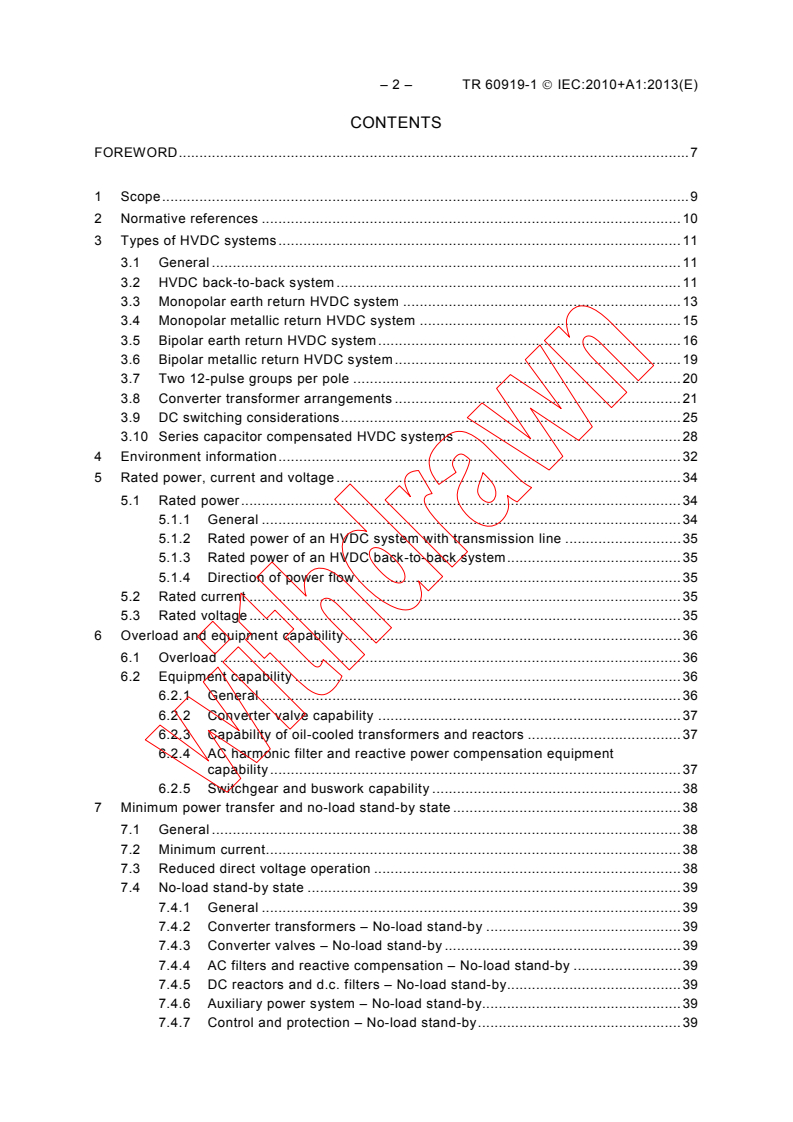
CONTENTS
FOREWORD.7
1 Scope.9
2 Normative references .10
3 Types of HVDC systems.11
3.1 General .11
3.2 HVDC back-to-back system .11
3.3 Monopolar earth return HVDC system .13
3.4 Monopolar metallic return HVDC system .15
3.5 Bipolar earth return HVDC system.16
3.6 Bipolar metallic return HVDC system.19
3.7 Two 12-pulse groups per pole .20
3.8 Converter transformer arrangements .20
3.9 DC switching considerations.22
3.10 Series capacitor compensated HVDC systems .25
4 Environment information.29
5 Rated power, current and voltage .31
5.1 Rated power.31
5.1.1 General .31
5.1.2 Rated power of an HVDC system with transmission line .32
5.1.3 Rated power of an HVDC back-to-back system.32
5.1.4 Direction of power flow .32
5.2 Rated current .32
5.3 Rated voltage.32
6 Overload and equipment capability.33
6.1 Overload .33
6.2 Equipment capability .33
6.2.1 General .33
6.2.2 Converter valve capability .34
6.2.3 Capability of oil-cooled transformers and reactors .34
6.2.4 AC harmonic filter and reactive power compensation equipment
capability.
6.2.5 Switchgear and buswork capability .35
7 Minimum power transfer and no-load stand-by state .35
7.1 General .35
7.2 Minimum current.35
7.3 Reduced direct voltage operation .35
7.4 No-load stand-by state .36
7.4.1 General .36
7.4.2 Converter transformers – No-load stand-by .36
7.4.3 Converter valves – No-load stand-by .36
7.4.4 AC filters and reactive compensation – No-load stand-by .36
7.4.5 DC reactors and d.c. filters – No-load stand-by.36
7.4.6 Auxiliary power system – No-load stand-by.36
7.4.7 Control and protection – No-load stand-by.36
8 AC system.36
8.1 General .36
TR 60919-1 © IEC:2010(E) – 3 –
8.2 AC voltage .37
8.2.1 Rated a.c. voltage .37
8.2.2 Steady-state voltage range .37
8.2.3 Negative sequence voltage.38
8.3 Frequency .38
8.3.1 Rated frequency .38
8.3.2 Steady-state frequency range.38
8.3.3 Short-term frequency variation.38
8.3.4 Frequency variation during emergency .38
8.4 System impedance at fundamental frequency.38
8.5 System impedance at harmonic frequencies.38
8.6 Positive and zero-sequence surge impedance .39
8.7 Other sources of harmonics.39
8.8 Subsynchronous torsional interaction (SSTI) .39
9 Reactive power.39
9.1 General .39
9.2 Conventional HVDC systems.39
9.3 Series capacitor compensated HVDC schemes .41
9.4 Converter reactive power consumption.41
9.5 Reactive power balance with the a.c. system.41
9.6 Reactive power supply .42
9.7 Maximum size of switchable VAR banks.42
10 HVDC transmission line, earth electrode line and earth electrode.42
10.1 General .42
10.2 Overhead line(s).42
10.2.1 General .42
10.2.2 Electrical parameters.43
10.3 Cable line(s).43
10.3.1 General .43
10.3.2 Electrical parameters.43
10.4 Earth electrode line .44
10.5 Earth electrode.44
11 Reliability .44
11.1 General .44
11.2 Outage .44
11.2.1 General .44
11.2.2 Scheduled outage.44
11.2.3 Forced outage .44
11.3 Capacity.45
11.3.1 General .45
11.3.2 Maximum continuous capacity P .45
m
11.3.3 Outage capacity P .45
o
11.3.4 Outage derating factor (ODF) .45
11.4 Outage duration terms.45
11.4.1 Actual outage duration (AOD).45
11.4.2 Equivalent outage duration (EOD) .45
11.4.3 Period hours (PH).46
11.4.4 Actual outage hours (AOH).46
11.4.5 Equivalent outage hours (EOH) .46
– 4 – TR 60919-1 © IEC:2010(E)
11.5 Energy unavailability (EU) .46
11.5.1 General .46
11.5.2 Forced energy unavailability (FEU).47
11.5.3 Scheduled energy unavailability (SEU) .47
11.6 Energy availability (EA) .47
11.7 Maximum permitted number of forced outages .47
11.8 Statistical probability of outages .47
11.8.1 Component faults .47
11.8.2 External faults .47
12 HVDC control .47
12.1 Control objectives.47
12.2 Control structure .48
12.2.1 General .48
12.2.2 Converter unit firing control .48
12.2.3 Pole control .50
12.2.4 HVDC substation control .52
12.2.5 Master control .52
12.3 Control order settings.53
12.4 Current limits.53
12.5 Control circuit redundancy.53
12.6 Measurements.53
13 Telecommunication .54
13.1 Types of telecommunication links .54
13.2 Telephone .54
13.3 Power line carrier (PLC) .55
13.4 Microwave.55
13.5 Radio link .55
13.6 Optical fibre telecommunication.55
13.7 Classification of data to be transmitted.56
13.8 Fast response telecommunication .56
13.9 Reliability .57
14 Auxiliary power supplies .57
14.1 General .57
14.2 Reliability and load classification.57
14.3 AC auxiliary supplies .58
14.4 Batteries and uninterruptible power supplies (UPS) .58
14.5 Emergency supply.59
15 Audible noise.59
15.1 General .59
15.2 Public nuisance .60
15.2.1 General .60
15.2.2 Valves and valve coolers .60
15.2.3 Converter transformers.60
15.2.4 DC reactors .60
15.2.5 AC filter reactors .61
15.3 Noise in working areas .61
16 Harmonic interference – AC.61
16.1 AC side harmonic generation.61
TR 60919-1 © IEC:2010(E) – 5 –
16.2 Filters.61
16.3 Interference disturbance criteria .65
16.4 Levels for interference.66
16.5 Filter performance .67
17 Harmonic interference – DC .67
17.1 DC side interference.67
17.1.1 Harmonic currents in HVDC transmission line.67
17.1.2 Characteristic and non-characteristic harmonics.67
17.1.3 Groups of harmonics .68
17.1.4 Calculation of harmonic currents .68
17.1.5 Calculation of induced voltages .68
17.1.6 Personnel safety.68
17.1.7 DC filters .68
17.2 DC filter performance .69
17.2.1 Requirements for voice communication circuits .69
17.2.2 Levels of interference .69
17.2.3 Safety.70
17.3 Specification requirements .70
17.3.1 Economic level of filtering.70
17.3.2 General criteria.71
17.3.3 Factors to be taken into account for calculations .71
17.3.4 Calculation of currents.72
18 Power line carrier interference (PLC).73
18.1 General .73
18.2 Performance specification .73
19 Radio interference .74
19.1 Radio interference (RI) from HVDC systems.74
19.1.1 RI sources .74
19.1.2 RI characteristics.75
19.2 RI performance specification .75
20 Power losses.76
20.1 General .76
20.2 Main contributing sources.76
20.2.1 General .76
20.2.2 AC filters and reactive power compensation .77
20.2.3 Converter bridges.77
20.2.4 Converter transformer .77
20.2.5 DC reactor.77
20.2.6 DC filter.77
20.2.7 Auxiliary equipment .77
20.2.8 Other components .77
21 Provision for extensions to the HVDC systems .77
21.1 General .77
21.2 Specification for extensions.78
Bibliography.80
Figure 1 – Twelve-pulse converter unit .9
Figure 2 – Examples of back-to-back HVDC systems.12
– 6 – TR 60919-1 © IEC:2010(E)
Figure 3 – Monopolar earth return system.13
Figure 4 – Two 12-pulse units in series.14
Figure 5 – Two 12-pulse units in parallel.15
Figure 6 – Monopolar metallic return system.16
Figure 7 – Bipolar system .17
Figure 8 – Metallic return operation of the unfaulted pole in a bipolar system.18
Figure 9 – Bipolar metallic return HVDC system.19
Figure 10 – Bipolar system with two 12-pulse units in series per pole .21
Figure 11 – Bipolar system with two 12-pulse units in parallel per pole .22
Figure 12 – DC switching of line conductors .23
Figure 13 – DC switching of converter poles .24
Figure 14 – DC switching – Overhead line to cable .25
Figure 15 – DC switching – Two-bipolar converters and lines.26
Figure 16 – DC switching – Intermediate.27
Figure 17 – Capacitor commutated converter configurations .28
Figure 18 – Variations of reactive power Q with active power P of an HVDC converter .40
Figure 19 – Control hierarchy.50
Figure 20 – Converter voltage-current characteristic .52
Figure 21 – Examples of a.c. filter connections for a bipole HVDC system .63
Figure 22 – Circuit diagrams for different filter types .64
Figure 23 – RY COM noise meter results averaged – Typical plot of converter noise
levels on the d.c. line corrected and normalized to 3 kHz bandwidth –0 dBm = 0,775 V .74
Figure 24 – Extension methods for HVDC systems .79
Table 1 – Information supplied for HVDC substation .29
Table 2 – Performance parameters for voice communication circuits: Subscribers and
trunk circuits .69
TR 60919-1 © IEC:2010(E) – 7 –
INTERNATIONAL ELECTROTECHNICAL COMMISSION
______________
PERFORMANCE OF HIGH-VOLTAGE DIRECT CURRENT
(HVDC) SYSTEMS WITH LINE-COMMUTATED CONVERTERS –
Part 1: Steady-state conditions
FOREWORD
1) The International Electrotechnical Commission (IEC) is a worldwide organization for standardization comprising
all national electrotechnical committees (IEC National Committees). The object of IEC is to promote
international co-operation on all questions concerning standardization in the electrical and electronic fields. To
this end and in addition to other activities, IEC publishes International Standards, Technical Specifications,
Technical Reports, Publicly Available Specifications (PAS) and Guides (hereafter referred to as “IEC
Publication(s)”). Their preparation is entrusted to technical committees; any IEC National Committee interested
in the subject dealt with may participate in this preparatory work. International, governmental and non-
governmental organizations liaising with the IEC also participate in this preparation. IEC collaborates closely
with the International Organization for Standardization (ISO) in accordance with conditions determined by
agreement between the two organizations.
2) The formal decisions or agreements of IEC on technical matters express, as nearly as possible, an international
consensus of opinion on the relevant subjects since each technical committee has representation from all
interested IEC National Committees.
3) IEC Publications have the form of recommendations for international use and are accepted by IEC National
Committees in that sense. While all reasonable efforts are made to ensure that the technical content of IEC
Publications is accurate, IEC cannot be held responsible for the way in which they are used or for any
misinterpretation by any end user.
4) In order to promote international uniformity, IEC National Committees undertake to apply IEC Publications
transparently to the maximum extent possible in their national and regional publications. Any divergence
between any IEC Publication and the corresponding national or regional publication shall be clearly indicated in
the latter.
5) IEC itself does not provide any attestation of conformity. Independent certification bodies provide conformity
assessment services and, in some areas, access to IEC marks of conformity. IEC is not responsible for any
services carried out by independent certification bodies.
6) All users should ensure that they have the latest edition of this publication.
7) No liability shall attach to IEC or its directors, employees, servants or agents including individual experts and
members of its technical committees and IEC National Committees for any personal injury, property damage or
other damage of any nature whatsoever, whether direct or indirect, or for costs (including legal fees) and
expenses arising out of the publication, use of, or reliance upon, this IEC Publication or any other IEC
Publications.
8) Attention is drawn to the Normative references cited in this publication. Use of the referenced publications is
indispensable for the correct application of this publication.
9) Attention is drawn to the possibility that some of the elements of this IEC Publication may be the subject of
patent rights. IEC shall not be held responsible for identifying any or all such patent rights.
The main task of IEC technical committees is to prepare International Standards. However, a
technical committee may propose the publication of a technical report when it has collected
data of a different kind from that which is normally published as an International Standard, for
example "state of the art".
IEC 60919-1, which is a technical report, has been prepared by subcommittee 22F: Power
electronics for electrical transmission and distribution systems, of IEC technical committee 22:
Power electronic systems and equipment.
This third edition cancels and replaces the second edition, published in 2005. This edition
constitutes a technical revision.
This edition includes the following significant technical changes with respect to the previous
edition:
– 8 – TR 60919-1 © IEC:2010(E)
a) the changes have been made to the description of multi 12-pulse groups per pole,
especially for a large scale ultra high-voltage direct current (UHVDC) converter
arrangement;
b) the different arrangements of d.c. smoothing reactors have been included;
c) the figures depicting two 12-pulse groups per pole arrangement have been added.
The text of this technical report is based on the following documents:
Draft of Technical Report Report on voting
22F/213/DTR 22F/218/RVC
Full information on the voting for the approval of this technical report can be found in the
report on voting indicated in the above table.
This publication has been drafted in accordance with the ISO/IEC Directives, Part 2.
A list of all parts of the IEC 60919 series, published under the general title Performance of
high-voltage direct current (HVDC) systems with line-commutated converters, can be found on
the IEC website
The committee has decided that the contents of this publication will remain unchanged until
the stability date indicated on the IEC web site under "http://webstore.iec.ch" in the data
related to the specific publication. At this date, the publication will be
• reconfirmed;
• withdrawn;
• replaced by a revised edition, or
• amended.
A bilingual version of this document may be issued at a later date.
IMPORTANT – The 'colour inside' logo on the cover page of this publication indicates
that it contains colours which are considered to be useful for the correct
understanding of its contents. Users should therefore print this document using a
colour printer.
TR 60919-1 © IEC:2010(E) – 9 –
PERFORMANCE OF HIGH-VOLTAGE DIRECT CURRENT
(HVDC) SYSTEMS WITH LINE-COMMUTATED CONVERTERS –
Part 1: Steady-state conditions
1 Scope
This part of the IEC 60919 provides general guidance on the steady-state performance
requirements of high-voltage direct current (HVDC) systems. It concerns the steady-state
performance of two-terminal HVDC systems utilizing 12-pulse converter units comprised of
three-phase bridge (double- way) connections (see Figure 1), but it does not cover multi-
terminal HVDC transmission systems. Both terminals are assumed to use thyristor valves as
the main semiconductor valves and to have power flow capability in both directions. Diode
valves are not considered in this report.
IEC 385/05
Key
1 Transformer valve windings
Figure 1 – Twelve-pulse converter unit
Only line-commutated converters are covered in this report, which includes capacitor
commutated converter circuit configurations. General requirements for semiconductor line-
commutated converters are given in IEC 60146-1-1, IEC/TR 60146-1-2 and IEC 60146-1-3.
Voltage-sourced converters are not considered.
This technical report, which covers steady-state performance, is followed by additional
documents on dynamic performance and transient performance. All three aspects should be
considered when preparing two-terminal HVDC system specifications.
The difference between system performance specifications and equipment design
specifications for individual components of a system should be realized. Equipment
specifications and testing requirements are not defined in this report. Also excluded from this
report are detailed seismic performance requirements. In addition, because there are many
variations between different possible HVDC systems, this report does not consider these in
detail; consequently, it should not be used directly as a specification for a particular project,
– 10 – TR 60919-1 © IEC:2010(E)
but rather to provide the basis for an appropriate specification tailored to fit actual system
requirements.
Frequently, performance specifications are prepared as a single package for the two HVDC
substations in a particular system. Alternatively, some parts of the HVDC system can be
separately specified and purchased. In such cases, due consideration should be given to co-
ordination of each part with the overall HVDC system performance objectives and the
interface of each with the system should be clearly defined. Typical of such parts, listed in the
appropriate order of relative ease for separate treatment and interface definition, are:
a) d.c. line, electrode line and earth electrode;
b) telecommunication system;
c) converter building, foundations and other civil engineering work;
d) reactive power supply including a.c. shunt capacitor banks, shunt reactors, synchronous
and static reactive power (VAR) compensators;
e) a.c. switchgear;
f) d.c. switchgear;
g) auxiliary systems;
h) a.c. filters;
i) d.c. filters;
j) d.c. reactors;
k) converter transformers;
l) surge arresters;
m) series commutation capacitors;
n) valves and their ancillaries;
o) control and protection systems.
NOTE The last four items are the most difficult to separate, and, in fact, separation of these four may be
inadvisable.
A complete steady-state performance specification for a HVDC system should consider
Clauses 3 to 21 of this report.
Terms and definitions for high-voltage direct current (HVDC) transmission used in this report
are given in IEC 60633.
Since the equipment items are usually separately specified and purchased, the HVDC
transmission line, earth electrode line and earth electrode (see Clause 10) are included only
because of their influence on the HVDC system performance.
For the purpose of this report, an HVDC substation is assumed to consist of one or more
converter units installed in a single location together with buildings, reactors, filters, reactive
power supply, control, monitoring, protective, measuring and auxiliary equipment. While there
is no discussion of a.c. switching substations in this report, a.c. filters and reactive power
sources are included, although they may be connected to an a.c. bus separate from the HVDC
substation, as discussed in Clause 16.
2 Normative references
The following referenced documents are indispensable for the application of this document.
For dated references, only the edition cited applies. For undated references, the latest edition
of the referenced document (including any amendments) applies.
TR 60919-1 © IEC:2010(E) – 11 –
IEC 60146-1-1, Semiconductor converters – General requirements and line commutated
converters – Part 1-1: Specifications of basic requirements
IEC/TR 60146-1-2, Semiconductor convertors – General requirements and line commutated
convertors – Part 1-2: Application guide
IEC 60146-1-3, Semiconductor convertors – General requirements and line commutated
convertors – Part 1-3: Transformers and reactors
IEC 60633, Terminology for high-voltage direct current (HVDC) transmission
3 Types of HVDC systems
3.1 General
This part of the specification should include the following basic data:
a) general information on the location of the HVDC substations and the purpose of the
project;
b) type of system needed, including a simple one-line diagram;
c) number of 12-pulse converter units;
d) pertinent information derived from the discussion in this section.
Generally, in studies of projects of the types discussed in this report, economic considerations
should take into account the capital costs, the cost of losses, cost of outages and other
expected annual expenses.
In terms of the type of system, the relatively new development of “capacitor-commutated
converter (CCC)” and “controlled series capacitor converter (CSCC)” technology may be
suitable alternatives to a conventional HVDC scheme. These are described in 3.10.
3.2 HVDC back-to-back system
In this arrangement there is no d.c. transmission line and both converters are located at one
site. The valves for both converters may be located in one valve hall, or even in one
integrated structure or separately as outdoor valves. Similarly, many other items for the two
converters, such as the control system, cooling equipment, auxiliary system, etc., may be
located in one area or even integrated in layout into configurations common to the two
converters. Circuit configurations may vary. Examples are given in Figure 2. The performance
and economics of these configurations differ and must be evaluated. D.C. filters are not
needed.
– 12 – TR 60919-1 © IEC:2010(E)
I I
d d
a) b)
I
d
I
d
1 1
c) d)
IEC 386/05
Key
1 DC reactor
Figure 2 – Examples of back-to-back HVDC systems
The voltage and current ratings for a given power rating should be optimized to achieve the
lowest system cost, including the evaluated cost of losses. Ordinarily, the user does not need
to specify the direct voltage and current ratings, unless there are specific reasons to do so,
for example, for compatibility with an already existing station, to provide for a future extension
of for some other reason. Economics dictate that each converter will usually be a 12-pulse
converter unit, however it is not mandatory. Where operating criteria require that the loss of
one converter unit will not cause loss of full power capability, large HVDC substations could
be comprised of two or more back-to-back systems. For this, some of the equipment of the
back-to-back systems can, for economic reasons, be located in the same area or even
physically integrated, but events which could cause a failure of equipment required by all
TR 60919-1 © IEC:2010(E) – 13 –
back-to-back systems need to be carefully considered and preventive measures taken where
appropriate.
3.3 Monopolar earth return HVDC system
Cost considerations often lead to the adoption of a monopolar earth return system (Figure 3),
particularly for cable transmission which may be expensive.
I
d
1 (+) 1
(–)
2 F F 2
U
d
IEC 387/05
Key
1 DC reactor
2 DC filters
Figure 3 – Monopolar earth return system
The monopolar earth return configuration might also be the first stage in the development of a
bipolar scheme. Monopolar arrangements may include one or more 12-pulse units in series or
in parallel at the ends of the HVDC transmission (Figures 4 and 5). More than one 12-pulse
unit might be used for the following purposes:
a) to ensure partial transmission capacity during converter unit outages;
b) to complete the project in stages;
c) because of the physical limitations of transformer transport.
This arrangement requires one or more d.c. reactors at each end of the HVDC overhead line
or cable; these are usually located on the high-voltage side. However, the d.c. reactors may
be divided into two parts and located on the high-voltage side and the earth side respectively
if the resulting performance is acceptable, especially for a large scale ultra high voltage direct
current (UHVDC) converter arrangement.
If the line is overhead, d.c. filters are likely to be needed at each end (see Clause 17). It also
requires an earth electrode line and a continuously operable earth electrode at the two ends
of the transmission which involves consideration of issues
...
IEC/TR 60919-1 ®
Edition 3.1 2013-04
TECHNICAL
REPORT
colour
inside
Performance of high-voltage direct current (HVDC) systems with line-
commutated converters–
Part 1: Steady-state conditions
IEC/TR 60919-1:2010+A1:2013(E)
All rights reserved. Unless otherwise specified, no part of this publication may be reproduced or utilized in any form
or by any means, electronic or mechanical, including photocopying and microfilm, without permission in writing from
either IEC or IEC's member National Committee in the country of the requester.
If you have any questions about IEC copyright or have an enquiry about obtaining additional rights to this publication,
please contact the address below or your local IEC member National Committee for further information.
IEC Central Office Tel.: +41 22 919 02 11
3, rue de Varembé Fax: +41 22 919 03 00
CH-1211 Geneva 20 info@iec.ch
Switzerland www.iec.ch
About the IEC
The International Electrotechnical Commission (IEC) is the leading global organization that prepares and publishes
International Standards for all electrical, electronic and related technologies.
About IEC publications
The technical content of IEC publications is kept under constant review by the IEC. Please make sure that you have the
latest edition, a corrigenda or an amendment might have been published.
Useful links:
IEC publications search - www.iec.ch/searchpub Electropedia - www.electropedia.org
The advanced search enables you to find IEC publications The world's leading online dictionary of electronic and
by a variety of criteria (reference number, text, technical electrical terms containing more than 30 000 terms and
committee,…). definitions in English and French, with equivalent terms in
It also gives information on projects, replaced and additional languages. Also known as the International
withdrawn publications. Electrotechnical Vocabulary (IEV) on-line.
IEC Just Published - webstore.iec.ch/justpublished Customer Service Centre - webstore.iec.ch/csc
Stay up to date on all new IEC publications. Just Published If you wish to give us your feedback on this publication
details all new publications released. Available on-line and or need further assistance, please contact the
also once a month by email. Customer Service Centre: csc@iec.ch.
IEC/TR 60919-1 ®
Edition 3.1 2013-04
TECHNICAL
REPORT
colour
inside
Performance of high-voltage direct current (HVDC) systems with line-
commutated converters–
Part 1: Steady-state conditions
INTERNATIONAL
ELECTROTECHNICAL
COMMISSION
ICS 29.200; 29.240.99 ISBN 978-2-8322-0794-9
– 2 – TR 60919-1 IEC:2010+A1:2013(E)
CONTENTS
FOREWORD . 7
1 Scope . 9
2 Normative references . 10
3 Types of HVDC systems . 11
3.1 General . 11
3.2 HVDC back-to-back system . 11
3.3 Monopolar earth return HVDC system . 13
3.4 Monopolar metallic return HVDC system . 15
3.5 Bipolar earth return HVDC system . 16
3.6 Bipolar metallic return HVDC system . 19
3.7 Two 12-pulse groups per pole . 20
3.8 Converter transformer arrangements . 21
3.9 DC switching considerations . 25
3.10 Series capacitor compensated HVDC systems . 28
4 Environment information . 32
5 Rated power, current and voltage . 34
5.1 Rated power . 34
5.1.1 General . 34
5.1.2 Rated power of an HVDC system with transmission line . 35
5.1.3 Rated power of an HVDC back-to-back system . 35
5.1.4 Direction of power flow . 35
5.2 Rated current . 35
5.3 Rated voltage . 35
6 Overload and equipment capability . 36
6.1 Overload . 36
6.2 Equipment capability . 36
6.2.1 General . 36
6.2.2 Converter valve capability . 37
6.2.3 Capability of oil-cooled transformers and reactors . 37
6.2.4 AC harmonic filter and reactive power compensation equipment
capability . 37
6.2.5 Switchgear and buswork capability . 38
7 Minimum power transfer and no-load stand-by state . 38
7.1 General . 38
7.2 Minimum current. 38
7.3 Reduced direct voltage operation . 38
7.4 No-load stand-by state . 39
7.4.1 General . 39
7.4.2 Converter transformers – No-load stand-by . 39
7.4.3 Converter valves – No-load stand-by . 39
7.4.4 AC filters and reactive compensation – No-load stand-by . 39
7.4.5 DC reactors and d.c. filters – No-load stand-by . 39
7.4.6 Auxiliary power system – No-load stand-by. 39
7.4.7 Control and protection – No-load stand-by . 39
TR 60919-1 IEC:2010+A1:2013(E) – 3 –
8 AC system . 39
8.1 General . 39
8.2 AC voltage . 40
8.2.1 Rated a.c. voltage . 40
8.2.2 Steady-state voltage range . 40
8.2.3 Negative sequence voltage . 41
8.3 Frequency . 41
8.3.1 Rated frequency . 41
8.3.2 Steady-state frequency range . 41
8.3.3 Short-term frequency variation . 41
8.3.4 Frequency variation during emergency . 41
8.4 System impedance at fundamental frequency . 41
8.5 System impedance at harmonic frequencies . 41
8.6 Positive and zero-sequence surge impedance . 42
8.7 Other sources of harmonics . 42
8.8 Subsynchronous torsional interaction (SSTI) . 42
9 Reactive power . 42
9.1 General . 42
9.2 Conventional HVDC systems . 42
9.3 Series capacitor compensated HVDC schemes . 44
9.4 Converter reactive power consumption . 44
9.5 Reactive power balance with the a.c. system . 44
9.6 Reactive power supply . 45
9.7 Maximum size of switchable VAR banks . 45
10 HVDC transmission line, earth electrode line and earth electrode . 45
10.1 General . 45
10.2 Overhead line(s) . 45
10.2.1 General . 45
10.2.2 Electrical parameters . 46
10.3 Cable line(s) . 46
10.3.1 General . 46
10.3.2 Electrical parameters . 46
10.4 Earth electrode line . 47
10.5 Earth electrode . 47
11 Reliability . 47
11.1 General . 47
11.2 Outage . 47
11.2.1 General . 47
11.2.2 Scheduled outage . 47
11.2.3 Forced outage . 48
11.3 Capacity . 48
11.3.1 General . 48
11.3.2 Maximum continuous capacity P . 48
m
11.3.3 Outage capacity P . 48
o
11.3.4 Outage derating factor (ODF) . 48
11.4 Outage duration terms . 48
11.4.1 Actual outage duration (AOD) . 48
11.4.2 Equivalent outage duration (EOD) . 48
– 4 – TR 60919-1 IEC:2010+A1:2013(E)
11.4.3 Period hours (PH) . 49
11.4.4 Actual outage hours (AOH) . 49
11.4.5 Equivalent outage hours (EOH) . 49
11.5 Energy unavailability (EU) . 49
11.5.1 General . 49
11.5.2 Forced energy unavailability (FEU) . 50
11.5.3 Scheduled energy unavailability (SEU) . 50
11.6 Energy availability (EA) . 50
11.7 Maximum permitted number of forced outages . 50
11.8 Statistical probability of outages . 50
11.8.1 Component faults . 50
11.8.2 External faults . 50
12 HVDC control . 50
12.1 Control objectives . 50
12.2 Control structure . 51
12.2.1 General . 51
12.2.2 Converter unit firing control . 51
12.2.3 Pole control . 53
12.2.4 HVDC substation control . 55
12.2.5 Master control . 55
12.3 Control order settings . 55
12.4 Current limits . 56
12.5 Control circuit redundancy . 56
12.6 Measurements . 56
13 Telecommunication . 57
13.1 Types of telecommunication links . 57
13.2 Telephone . 57
13.3 Power line carrier (PLC) . 57
13.4 Microwave . 58
13.5 Radio link . 58
13.6 Optical fibre telecommunication . 58
13.7 Classification of data to be transmitted . 58
13.8 Fast response telecommunication . 59
13.9 Reliability . 59
14 Auxiliary power supplies . 60
14.1 General . 60
14.2 Reliability and load classification . 60
14.3 AC auxiliary supplies . 61
14.4 Batteries and uninterruptible power supplies (UPS) . 61
14.5 Emergency supply . 62
15 Audible noise. 62
15.1 General . 62
15.2 Public nuisance . 62
15.2.1 General . 62
15.2.2 Valves and valve coolers . 63
15.2.3 Converter transformers . 63
15.2.4 DC reactors . 63
15.2.5 AC filter reactors . 63
TR 60919-1 IEC:2010+A1:2013(E) – 5 –
15.3 Noise in working areas . 63
16 Harmonic interference – AC . 64
16.1 AC side harmonic generation. 64
16.2 Filters . 64
16.3 Interference disturbance criteria . 67
16.4 Levels for interference . 68
16.5 Filter performance . 69
17 Harmonic interference – DC . 69
17.1 DC side interference . 69
17.1.1 Harmonic currents in HVDC transmission line . 69
17.1.2 Characteristic and non-characteristic harmonics . 69
17.1.3 Groups of harmonics . 70
17.1.4 Calculation of harmonic currents . 70
17.1.5 Calculation of induced voltages . 70
17.1.6 Personnel safety . 70
17.1.7 DC filters . 70
17.2 DC filter performance . 71
17.2.1 Requirements for voice communication circuits . 71
17.2.2 Levels of interference . 72
17.2.3 Safety . 72
17.3 Specification requirements . 72
17.3.1 Economic level of filtering . 72
17.3.2 General criteria . 73
17.3.3 Factors to be taken into account for calculations . 73
17.3.4 Calculation of currents . 74
18 Power line carrier interference (PLC) . 75
18.1 General . 75
18.2 Performance specification . 75
19 Radio interference .
19.1 Radio interference (RI) from HVDC systems .
19.1.1 RI sources .
19.1.2 RI characteristics .
19.2 RI performance specification .
19 Radio frequency interference . 76
19.1 General . 78
19.2 RFI from HVDC systems . 78
19.2.1 RFI sources . 78
19.2.2 RFI propagation . 79
19.2.3 RFI characteristics . 79
19.3 RFI performance specification . 80
19.3.1 RFI risk assessment . 80
19.3.2 Specification RFI limit and its verification. 80
19.3.3 Design aspects . 81
20 Power losses . 81
20.1 General . 81
20.2 Main contributing sources . 82
20.2.1 General . 82
20.2.2 AC filters and reactive power compensation . 82
– 6 – TR 60919-1 IEC:2010+A1:2013(E)
20.2.3 Converter bridges . 82
20.2.4 Converter transformer . 82
20.2.5 DC reactor . 82
20.2.6 DC filter . 82
20.2.7 Auxiliary equipment . 83
20.2.8 Other components . 83
21 Provision for extensions to the HVDC systems . 83
21.1 General . 83
21.2 Specification for extensions . 83
Annex A (informative) Factors affecting reliability and availability of converter stations . 86
Bibliography . 93
Figure 1 – Twelve-pulse converter unit . 9
Figure 2 – Examples of back-to-back HVDC systems . 12
Figure 3 – Monopolar earth return system . 13
Figure 4 – Two 12-pulse units in series . 14
Figure 5 – Two 12-pulse units in parallel . 15
Figure 6 – Monopolar metallic return system . 16
Figure 7 – Bipolar system . 18
Figure 8 – Metallic return operation of the unfaulted pole in a bipolar system. 19
Figure 9 – Bipolar metallic return HVDC system . 20
Figure 10 – Bipolar system with two 12-pulse units in series per pole . 23
Figure 11 – Bipolar system with two 12-pulse units in parallel per pole . 25
Figure 12 – DC switching of line conductors . 26
Figure 13 – DC switching of converter poles . 27
Figure 14 – DC switching – Overhead line to cable . 28
Figure 15 – DC switching – Two-bipolar converters and lines. 29
Figure 16 – DC switching – Intermediate . 30
Figure 17 – Capacitor commutated converter configurations . 31
Figure 18 – Variations of reactive power Q with active power P of an HVDC converter . 43
Figure 19 – Control hierarchy . 52
Figure 20 – Converter voltage-current characteristic . 54
Figure 21 – Examples of a.c. filter connections for a bipole HVDC system . 65
Figure 22 – Circuit diagrams for different filter types . 66
Figure 23 – RY COM noise meter results averaged – Typical plot of converter noise
levels on the d.c. line corrected and normalized to 3 kHz bandwidth –0 dBm = 0,775 V
1 mW corresponding to 0,775 V at a pole-to-pole surge impedance of 600 Ω . 76
Figure 24 – Extension methods for HVDC systems . 85
Figure 25 – Recommended measurement procedure with definition of measuring point . 81
Table 1 – Information supplied for HVDC substation . 32
Table 2 – Performance parameters for voice communication circuits: Subscribers and
trunk circuits . 71
TR 60919-1 IEC:2010+A1:2013(E) – 7 –
INTERNATIONAL ELECTROTECHNICAL COMMISSION
______________
PERFORMANCE OF HIGH-VOLTAGE DIRECT CURRENT
(HVDC) SYSTEMS WITH LINE-COMMUTATED CONVERTERS –
Part 1: Steady-state conditions
FOREWORD
1) The International Electrotechnical Commission (IEC) is a worldwide organization for standardization comprising
all national electrotechnical committees (IEC National Committees). The object of IEC is to promote
international co-operation on all questions concerning standardization in the electrical and electronic fields. To
this end and in addition to other activities, IEC publishes International Standards, Technical Specifications,
Technical Reports, Publicly Available Specifications (PAS) and Guides (hereafter referred to as “IEC
Publication(s)”). Their preparation is entrusted to technical committees; any IEC National Committee interested
in the subject dealt with may participate in this preparatory work. International, governmental and non-
governmental organizations liaising with the IEC also participate in this preparation. IEC collaborates closely
with the International Organization for Standardization (ISO) in accordance with conditions determined by
agreement between the two organizations.
2) The formal decisions or agreements of IEC on technical matters express, as nearly as possible, an international
consensus of opinion on the relevant subjects since each technical committee has representation from all
interested IEC National Committees.
3) IEC Publications have the form of recommendations for international use and are accepted by IEC National
Committees in that sense. While all reasonable efforts are made to ensure that the technical content of IEC
Publications is accurate, IEC cannot be held responsible for the way in which they are used or for any
misinterpretation by any end user.
4) In order to promote international uniformity, IEC National Committees undertake to apply IEC Publications
transparently to the maximum extent possible in their national and regional publications. Any divergence
between any IEC Publication and the corresponding national or regional publication shall be clearly indicated in
the latter.
5) IEC itself does not provide any attestation of conformity. Independent certification bodies provide conformity
assessment services and, in some areas, access to IEC marks of conformity. IEC is not responsible for any
services carried out by independent certification bodies.
6) All users should ensure that they have the latest edition of this publication.
7) No liability shall attach to IEC or its directors, employees, servants or agents including individual experts and
members of its technical committees and IEC National Committees for any personal injury, property damage or
other damage of any nature whatsoever, whether direct or indirect, or for costs (including legal fees) and
expenses arising out of the publication, use of, or reliance upon, this IEC Publication or any other IEC
Publications.
8) Attention is drawn to the Normative references cited in this publication. Use of the referenced publications is
indispensable for the correct application of this publication.
9) Attention is drawn to the possibility that some of the elements of this IEC Publication may be the subject of
patent rights. IEC shall not be held responsible for identifying any or all such patent rights.
This consolidated version of IEC/TR 60919-1 consists of the third edition (2010)
[documents 22F/213/DTR and 22F/218/RVC] and its amendment 1 (2013) [documents
22F/277/DTR and 22F/286A/RVC]. It bears the edition number 3.1.
The technical content is therefore identical to the base edition and its amendment and
has been prepared for user convenience. A vertical line in the margin shows where the
base publication has been modified by amendment 1. Additions and deletions are
displayed in red, with deletions being struck through.
– 8 – TR 60919-1 IEC:2010+A1:2013(E)
The main task of IEC technical committees is to prepare International Standards. However, a
technical committee may propose the publication of a technical report when it has collected
data of a different kind from that which is normally published as an International Standard, for
example "state of the art".
IEC 60919-1, which is a technical report, has been prepared by subcommittee 22F: Power
electronics for electrical transmission and distribution systems, of IEC technical committee 22:
Power electronic systems and equipment.
This edition includes the following significant technical changes with respect to the previous
edition:
a) the changes have been made to the description of multi 12-pulse groups per pole,
especially for a large scale ultra high-voltage direct current (UHVDC) converter
arrangement;
b) the different arrangements of d.c. smoothing reactors have been included;
c) the figures depicting two 12-pulse groups per pole arrangement have been added.
This publication has been drafted in accordance with the ISO/IEC Directives, Part 2.
A list of all parts of the IEC 60919 series, published under the general title Performance of
high-voltage direct current (HVDC) systems with line-commutated converters, can be found on
the IEC website
The committee has decided that the contents of the base publication and its amendment will
remain unchanged until the stability date indicated on the IEC web site under
"http://webstore.iec.ch" in the data related to the specific publication. At this date, the
publication will be
• reconfirmed;
• withdrawn;
• replaced by a revised edition, or
• amended.
A bilingual version of this document may be issued at a later date.
IMPORTANT – The 'colour inside' logo on the cover page of this publication indicates
that it contains colours which are considered to be useful for the correct
understanding of its contents. Users should therefore print this document using a
colour printer.
TR 60919-1 IEC:2010+A1:2013(E) – 9 –
PERFORMANCE OF HIGH-VOLTAGE DIRECT CURRENT
(HVDC) SYSTEMS WITH LINE-COMMUTATED CONVERTERS –
Part 1: Steady-state conditions
1 Scope
This part of the IEC 60919 provides general guidance on the steady-state performance
requirements of high-voltage direct current (HVDC) systems. It concerns the steady-state
performance of two-terminal HVDC systems utilizing 12-pulse converter units comprised of
three-phase bridge (double- way) connections (see Figure 1), but it does not cover multi-
terminal HVDC transmission systems. Both terminals are assumed to use thyristor valves as
the main semiconductor valves and to have power flow capability in both directions. Diode
valves are not considered in this report.
IEC 385/05
Key
1 Transformer valve windings
Figure 1 – Twelve-pulse converter unit
Only line-commutated converters are covered in this report, which includes capacitor
commutated converter circuit configurations. General requirements for semiconductor line-
commutated converters are given in IEC 60146-1-1, IEC/TR 60146-1-2 and IEC 60146-1-3.
Voltage-sourced converters are not considered.
This technical report, which covers steady-state performance, is followed by additional
documents on dynamic performance and transient performance. All three aspects should be
considered when preparing two-terminal HVDC system specifications.
The difference between system performance specifications and equipment design
specifications for individual components of a system should be realized. Equipment
specifications and testing requirements are not defined in this report. Also excluded from this
report are detailed seismic performance requirements. In addition, because there are many
variations between different possible HVDC systems, this report does not consider these in
detail; consequently, it should not be used directly as a specification for a particular project,
but rather to provide the basis for an appropriate specification tailored to fit actual system
requirements.
– 10 – TR 60919-1 IEC:2010+A1:2013(E)
Frequently, performance specifications are prepared as a single package for the two HVDC
substations in a particular system. Alternatively, some parts of the HVDC system can be
separately specified and purchased. In such cases, due consideration should be given to co-
ordination of each part with the overall HVDC system performance objectives and the
interface of each with the system should be clearly defined. Typical of such parts, listed in the
appropriate order of relative ease for separate treatment and interface definition, are:
a) d.c. line, electrode line and earth electrode;
b) telecommunication system;
c) converter building, foundations and other civil engineering work;
d) reactive power supply including a.c. shunt capacitor banks, shunt reactors, synchronous
and static reactive power (VAR) compensators;
e) a.c. switchgear;
f) d.c. switchgear;
g) auxiliary systems;
h) a.c. filters;
i) d.c. filters;
j) d.c. reactors;
k) converter transformers;
l) surge arresters;
m) series commutation capacitors;
n) valves and their ancillaries;
o) control and protection systems.
NOTE The last four items are the most difficult to separate, and, in fact, separation of these four may be
inadvisable.
A complete steady-state performance specification for a HVDC system should consider
Clauses 3 to 21 of this report.
Terms and definitions for high-voltage direct current (HVDC) transmission used in this report
are given in IEC 60633.
Since the equipment items are usually separately specified and purchased, the HVDC
transmission line, earth electrode line and earth electrode (see Clause 10) are included only
because of their influence on the HVDC system performance.
For the purpose of this report, an HVDC substation is assumed to consist of one or more
converter units installed in a single location together with buildings, reactors, filters, reactive
power supply, control, monitoring, protective, measuring and auxiliary equipment. While there
is no discussion of a.c. switching substations in this report, a.c. filters and reactive power
sources are included, although they may be connected to an a.c. bus separate from the HVDC
substation, as discussed in Clause 16.
2 Normative references
The following referenced documents are indispensable for the application of this document.
For dated references, only the edition cited applies. For undated references, the latest edition
of the referenced document (including any amendments) applies.
IEC 60146-1-1, Semiconductor converters – General requirements and line commutated
converters – Part 1-1: Specifications of basic requirements
TR 60919-1 IEC:2010+A1:2013(E) – 11 –
IEC/TR 60146-1-2, Semiconductor convertors – General requirements and line commutated
convertors – Part 1-2: Application guide
IEC 60146-1-3, Semiconductor convertors – General requirements and line commutated
convertors – Part 1-3: Transformers and reactors
IEC 60633, Terminology for high-voltage direct current (HVDC) transmission
3 Types of HVDC systems
3.1 General
This part of the specification should include the following basic data:
a) general information on the location of the HVDC substations and the purpose of the
project;
b) type of system needed, including a simple one-line diagram;
c) number of 12-pulse converter units;
d) pertinent information derived from the discussion in this section.
Generally, in studies of projects of the types discussed in this report, economic considerations
should take into account the capital costs, the cost of losses, cost of outages and other
expected annual expenses.
In terms of the type of system, the relatively new development of “capacitor-commutated
converter (CCC)” and “controlled series capacitor converter (CSCC)” technology may be
suitable alternatives to a conventional HVDC scheme. These are described in 3.10.
3.2 HVDC back-to-back system
In this arrangement there is no d.c. transmission line and both converters are located at one
site. The valves for both converters may be located in one valve hall, or even in one
integrated structure or separately as outdoor valves. Similarly, many other items for the two
converters, such as the control system, cooling equipment, auxiliary system, etc., may be
located in one area or even integrated in layout into configurations common to the two
converters. Circuit configurations may vary. Examples are given in Figure 2. The performance
and economics of these configurations differ and must be evaluated. D.C. filters are not
needed.
– 12 – TR 60919-1 IEC:2010+A1:2013(E)
I I
d d
a) b)
I
d
I
d
1 1
c) d)
IEC 386/05
Key
1 DC reactor
Figure 2 – Examples of back-to-back HVDC systems
The voltage and current ratings for a given power rating should be optimized to achieve the
lowest system cost, including the evaluated cost of losses. Ordinarily, the user does not need
to specify the direct voltage and current ratings, unless there are specific reasons to do so,
for example, for compatibility with an already existing station, to provide for a future extension
of for some other reason. Economics dictate that each converter will usually be a 12-pulse
, however it is not mandatory. Where operating criteria require that the loss of
converter unit
one converter unit will not cause loss of full power capability, large HVDC substations could
be comprised of two or more back-to-back systems. For this, some of the equipment of the
back-to-back systems can, for economic reasons, be located in
...
IEC TR 60919-1 ®
Edition 3.2 2017-05
CONSOLIDATED VERSION
TECHNICAL
REPORT
colour
inside
Performance of high-voltage direct current (HVDC) systems with line-
commutated converters –
Part 1: Steady-state conditions
All rights reserved. Unless otherwise specified, no part of this publication may be reproduced or utilized in any form
or by any means, electronic or mechanical, including photocopying and microfilm, without permission in writing from
either IEC or IEC's member National Committee in the country of the requester. If you have any questions about IEC
copyright or have an enquiry about obtaining additional rights to this publication, please contact the address below or
your local IEC member National Committee for further information.
IEC Central Office Tel.: +41 22 919 02 11
3, rue de Varembé Fax: +41 22 919 03 00
CH-1211 Geneva 20 info@iec.ch
Switzerland www.iec.ch
About the IEC
The International Electrotechnical Commission (IEC) is the leading global organization that prepares and publishes
International Standards for all electrical, electronic and related technologies.
About IEC publications
The technical content of IEC publications is kept under constant review by the IEC. Please make sure that you have the
latest edition, a corrigenda or an amendment might have been published.
IEC Catalogue - webstore.iec.ch/catalogue Electropedia - www.electropedia.org
The stand-alone application for consulting the entire The world's leading online dictionary of electronic and
bibliographical information on IEC International Standards, electrical terms containing 20 000 terms and definitions in
Technical Specifications, Technical Reports and other English and French, with equivalent terms in 16 additional
documents. Available for PC, Mac OS, Android Tablets and languages. Also known as the International Electrotechnical
iPad. Vocabulary (IEV) online.
IEC publications search - www.iec.ch/searchpub IEC Glossary - std.iec.ch/glossary
The advanced search enables to find IEC publications by a 65 000 electrotechnical terminology entries in English and
variety of criteria (reference number, text, technical French extracted from the Terms and Definitions clause of
committee,…). It also gives information on projects, replaced IEC publications issued since 2002. Some entries have been
and withdrawn publications. collected from earlier publications of IEC TC 37, 77, 86 and
CISPR.
IEC Just Published - webstore.iec.ch/justpublished
Stay up to date on all new IEC publications. Just Published IEC Customer Service Centre - webstore.iec.ch/csc
details all new publications released. Available online and If you wish to give us your feedback on this publication or
also once a month by email. need further assistance, please contact the Customer Service
Centre: csc@iec.ch.
IEC TR 60919-1 ®
Edition 3.2 2017-05
CONSOLIDATED VERSION
TECHNICAL
REPORT
colour
inside
Performance of high-voltage direct current (HVDC) systems with line-
commutated converters –
Part 1: Steady-state conditions
INTERNATIONAL
ELECTROTECHNICAL
COMMISSION
ICS 29.200; 29.240.99 ISBN 978-2-8322-4412-8
IEC TR 60919-1 ®
Edition 3.2 2017-05
CONSOLIDATED VERSION
REDLINE VERSION
colour
inside
Performance of high-voltage direct current (HVDC) systems with line-
commutated converters –
Part 1: Steady-state conditions
– 2 – IEC TR 60919-1:2010+AMD1:2013
+AMD2:2017 CSV IEC 2017
CONTENTS
FOREWORD . 7
1 Scope . 9
2 Normative references . 10
3 Types of HVDC systems . 11
3.1 General . 11
3.2 HVDC back-to-back system . 11
3.3 Monopolar HVDC system with earth return HVDC system . 13
3.4 Monopolar HVDC system with metallic return HVDC system . 15
3.5 Bipolar earth return HVDC system . 16
3.6 Bipolar HVDC system with metallic return HVDC system . 20
3.7 Two 12-pulse groups per pole . 22
3.8 Converter transformer arrangements . 22
3.9 DC switching considerations . 27
3.10 Series capacitor compensated HVDC systems . 29
3.11 LCC/VSC hybrid bipolar system . 33
4 Environment information . 34
5 Rated power, current and voltage . 37
5.1 Rated power . 37
5.1.1 General . 37
5.1.2 Rated power of an HVDC system with transmission line . 37
5.1.3 Rated power of an HVDC back-to-back system . 37
5.1.4 Direction of power flow . 38
5.2 Rated current . 38
5.3 Rated voltage . 38
6 Overload and equipment capability . 38
6.1 Overload . 38
6.2 Equipment capability . 39
6.2.1 General . 39
6.2.2 Converter valve capability . 39
6.2.3 Capability of oil-cooled transformers and reactors . 40
6.2.4 AC harmonic filter and reactive power compensation equipment
capability . 40
6.2.5 Switchgear and buswork capability . 40
7 Minimum power transfer and no-load stand-by state . 40
7.1 General . 40
7.2 Minimum current. 40
7.3 Reduced direct voltage operation . 41
7.4 No-load stand-by state . 41
7.4.1 General . 41
7.4.2 Converter transformers – No-load stand-by . 41
7.4.3 Converter valves – No-load stand-by . 41
7.4.4 AC filters and reactive compensation – No-load stand-by . 42
7.4.5 DC reactors and d.c. filters – No-load stand-by . 42
7.4.6 Auxiliary power system – No-load stand-by. 42
7.4.7 Control and protection – No-load stand-by . 42
8 AC system . 42
+AMD2:2017 CSV IEC 2017
8.1 General . 42
8.2 AC voltage . 42
8.2.1 Rated a.c. voltage . 42
8.2.2 Steady-state voltage range . 42
8.2.3 Negative sequence voltage . 43
8.3 Frequency . 43
8.3.1 Rated frequency . 43
8.3.2 Steady-state frequency range . 43
8.3.3 Short-term frequency variation . 44
8.3.4 Frequency variation during emergency . 44
8.4 System impedance at fundamental frequency . 44
8.5 System impedance at harmonic frequencies . 44
8.6 Positive and zero-sequence surge impedance . 44
8.7 Other sources of harmonics . 44
8.8 Subsynchronous torsional interaction (SSTI) . 45
9 Reactive power . 45
9.1 General . 45
9.2 Conventional HVDC systems . 45
9.3 Series capacitor compensated HVDC schemes . 47
9.4 Converter reactive power consumption . 47
9.5 Reactive power balance with the a.c. system . 47
9.6 Reactive power supply . 48
9.7 Maximum size of switchable VAR banks . 48
10 HVDC transmission line, earth electrode line and earth electrode . 48
10.1 General . 48
10.2 Overhead line(s) . 48
10.2.1 General . 48
10.2.2 Electrical parameters . 49
10.3 Cable line(s) . 49
10.3.1 General . 49
10.3.2 Electrical parameters . 49
10.4 Earth electrode line . 50
10.5 Earth electrode . 50
11 Reliability . 50
11.1 General . 50
11.2 Outage . 50
11.2.1 General . 50
11.2.2 Scheduled outage . 50
11.2.3 Forced outage . 51
11.3 Capacity . 51
11.3.1 General . 51
11.3.2 Maximum continuous capacity P . 51
m
11.3.3 Outage capacity P . 51
o
11.3.4 Outage derating factor (ODF) . 51
11.4 Outage duration terms . 51
11.4.1 Actual outage duration (AOD) . 51
11.4.2 Equivalent outage duration (EOD) . 51
11.4.3 Period hours (PH) . 52
11.4.4 Actual outage hours (AOH) . 52
– 4 – IEC TR 60919-1:2010+AMD1:2013
+AMD2:2017 CSV IEC 2017
11.4.5 Equivalent outage hours (EOH) . 52
11.5 Energy unavailability (EU) . 52
11.5.1 General . 52
11.5.2 Forced energy unavailability (FEU) . 53
11.5.3 Scheduled energy unavailability (SEU) . 53
11.6 Energy availability (EA) . 53
11.7 Maximum permitted number of forced outages . 53
11.8 Statistical probability of outages . 53
11.8.1 Component faults . 53
11.8.2 External faults . 53
12 HVDC control . 53
12.1 Control objectives . 53
12.2 Control structure . 54
12.2.1 General . 54
12.2.2 Converter unit firing control . 54
12.2.3 Pole control . 57
12.2.4 HVDC substation control . 59
12.2.5 Master control . 59
12.3 Control order settings . 59
12.4 Current limits . 60
12.5 Control circuit redundancy . 60
12.6 Measurements . 60
13 Telecommunication . 61
13.1 Types of telecommunication links . 61
13.2 Telephone . 61
13.3 Power line carrier (PLC) . 61
13.4 Microwave . 62
13.5 Radio link . 62
13.6 Optical fibre telecommunication . 62
13.7 Classification of data to be transmitted . 63
13.8 Fast response telecommunication . 63
13.9 Reliability . 63
14 Auxiliary power supplies . 64
14.1 General . 64
14.2 Reliability and load classification . 64
14.3 AC auxiliary supplies . 65
14.4 Batteries and uninterruptible power supplies (UPS) . 65
14.5 Emergency supply . 66
15 Audible noise. 66
15.1 General . 66
15.2 Public nuisance . 67
15.2.1 General . 67
15.2.2 Valves and valve coolers . 67
15.2.3 Converter transformers . 67
15.2.4 DC reactors . 67
15.2.5 AC filter reactors . 67
15.3 Noise in working areas . 68
16 Harmonic interference – AC . 68
+AMD2:2017 CSV IEC 2017
16.1 AC side harmonic generation. 68
16.2 Filters . 68
16.3 Interference disturbance criteria . 72
16.4 Levels for interference . 73
16.5 Filter performance . 74
17 Harmonic interference – DC . 74
17.1 DC side interference . 74
17.1.1 Harmonic currents in HVDC transmission line . 74
17.1.2 Characteristic and non-characteristic harmonics . 74
17.1.3 Groups of harmonics . 75
17.1.4 Calculation of harmonic currents . 75
17.1.5 Calculation of induced voltages . 75
17.1.6 Personnel safety . 75
17.1.7 DC filters . 76
17.2 DC filter performance . 76
17.2.1 Requirements for voice communication circuits . 76
17.2.2 Levels of interference . 77
17.2.3 Safety . 77
17.3 Specification requirements . 77
17.3.1 Economic level of filtering . 77
17.3.2 General criteria . 78
17.3.3 Factors to be taken into account for calculations . 79
17.3.4 Calculation of currents . 79
18 Power line carrier interference (PLC) . 81
18.1 General . 81
18.2 Performance specification . 81
19 Radio frequency interference . 82
19.1 General . 84
19.2 RFI from HVDC systems . 84
19.2.1 RFI sources . 84
19.2.2 RFI propagation . 85
19.2.3 RFI characteristics . 85
19.3 RFI performance specification . 86
19.3.1 RFI risk assessment . 86
19.3.2 Specification RFI limit and its verification. 86
19.3.3 Design aspects . 87
20 Power losses . 87
20.1 General . 87
20.2 Main contributing sources . 88
20.2.1 General . 88
20.2.2 AC filters and reactive power compensation . 88
20.2.3 Converter bridges . 88
20.2.4 Converter transformer . 88
20.2.5 DC reactor . 88
20.2.6 DC filter . 88
20.2.7 Auxiliary equipment . 89
20.2.8 Other components . 89
21 Provision for extensions to the HVDC systems . 89
– 6 – IEC TR 60919-1:2010+AMD1:2013
+AMD2:2017 CSV IEC 2017
21.1 General . 89
21.2 Specification for extensions . 89
Annex A (informative) Factors affecting reliability and availability of converter stations . 92
Bibliography . 99
Figure 1 – Twelve-pulse converter unit . 9
Figure 2 – Examples of back-to-back HVDC systems . 12
Figure 3 – Monopolar HVDC system with earth return system . 13
Figure 4 – Two 12-pulse units in series . 14
Figure 5 – Two 12-pulse units in parallel . 15
Figure 6 – Monopolar HVDC system with metallic return system . 16
Figure 7 – Bipolar system . 19
Figure 8 – Metallic return operation of the unfaulted pole in a bipolar system. 20
Figure 9 – Bipolar HVDC system with metallic return HVDC system . 21
Figure 10 – Bipolar system with two 12-pulse units in series per pole . 24
Figure 11 – Bipolar system with two 12-pulse units in parallel per pole . 26
Figure 12 – DC switching of line conductors . 27
Figure 13 – DC switching of converter poles . 28
Figure 14 – DC switching – Overhead line to cable . 29
Figure 15 – DC switching – Two-bipolar converters and lines. 30
Figure 16 – DC switching – Intermediate . 31
Figure 17 – Capacitor commutated converter configurations . 32
Figure 18 – Variations of reactive power Q with active power P of an HVDC converter . 46
Figure 19 – Control hierarchy . 56
Figure 20 – Converter voltage-current characteristic . 58
Figure 21 – Examples of a.c. filter connections for a bipole HVDC system . 70
Figure 22 – Circuit diagrams for different filter types . 71
Figure 23 – RY COM noise meter results averaged – Typical plot of converter noise
levels on the d.c. line corrected and normalized to 3 kHz bandwidth –0 dBm = 0,775 V
1 mW corresponding to 0,775 V at a pole-to-pole surge impedance of 600 Ω . 82
Figure 24 – Extension methods for HVDC systems . 91
Figure 25 – Recommended measurement procedure with definition of measuring point . 87
Figure 26 – LCC/VSC hybrid bipolar system . 34
Table 1 – Information supplied for HVDC substation . 35
Table 2 – Performance parameters for voice communication circuits: Subscribers and
trunk circuits . 77
+AMD2:2017 CSV IEC 2017
INTERNATIONAL ELECTROTECHNICAL COMMISSION
______________
PERFORMANCE OF HIGH-VOLTAGE DIRECT CURRENT
(HVDC) SYSTEMS WITH LINE-COMMUTATED CONVERTERS –
Part 1: Steady-state conditions
FOREWORD
1) The International Electrotechnical Commission (IEC) is a worldwide organization for standardization comprising
all national electrotechnical committees (IEC National Committees). The object of IEC is to promote
international co-operation on all questions concerning standardization in the electrical and electronic fields. To
this end and in addition to other activities, IEC publishes International Standards, Technical Specifications,
Technical Reports, Publicly Available Specifications (PAS) and Guides (hereafter referred to as “IEC
Publication(s)”). Their preparation is entrusted to technical committees; any IEC National Committee interested
in the subject dealt with may participate in this preparatory work. International, governmental and non-
governmental organizations liaising with the IEC also participate in this preparation. IEC collaborates closely
with the International Organization for Standardization (ISO) in accordance with conditions determined by
agreement between the two organizations.
2) The formal decisions or agreements of IEC on technical matters express, as nearly as possible, an international
consensus of opinion on the relevant subjects since each technical committee has representation from all
interested IEC National Committees.
3) IEC Publications have the form of recommendations for international use and are accepted by IEC National
Committees in that sense. While all reasonable efforts are made to ensure that the technical content of IEC
Publications is accurate, IEC cannot be held responsible for the way in which they are used or for any
misinterpretation by any end user.
4) In order to promote international uniformity, IEC National Committees undertake to apply IEC Publications
transparently to the maximum extent possible in their national and regional publications. Any divergence
between any IEC Publication and the corresponding national or regional publication shall be clearly indicated in
the latter.
5) IEC itself does not provide any attestation of conformity. Independent certification bodies provide conformity
assessment services and, in some areas, access to IEC marks of conformity. IEC is not responsible for any
services carried out by independent certification bodies.
6) All users should ensure that they have the latest edition of this publication.
7) No liability shall attach to IEC or its directors, employees, servants or agents including individual experts and
members of its technical committees and IEC National Committees for any personal injury, property damage or
other damage of any nature whatsoever, whether direct or indirect, or for costs (including legal fees) and
expenses arising out of the publication, use of, or reliance upon, this IEC Publication or any other IEC
Publications.
8) Attention is drawn to the Normative references cited in this publication. Use of the referenced publications is
indispensable for the correct application of this publication.
9) Attention is drawn to the possibility that some of the elements of this IEC Publication may be the subject of
patent rights. IEC shall not be held responsible for identifying any or all such patent rights.
This consolidated version of the official IEC Standard and its amendments has been prepared
for user convenience.
IEC TR 60919-1 edition 3.2 contains the third edition (2010-05) [documents 22F/213/DTR and
22F/218/RVC], its amendment 1 (2013-04) [documents 22F/277/DTR and 22F/286A/RVC] and its
amendment 2 (2017-05) [documents 22F/447/DTR and 22F/452/RVDTR].
In this Redline version, a vertical line in the margin shows where the technical content is
modified by amendments 1 and 2. Additions are in green text, deletions are in
strikethrough red text. A separate Final version with all changes accepted is available in this
publication.
– 8 – IEC TR 60919-1:2010+AMD1:2013
+AMD2:2017 CSV IEC 2017
The main task of IEC technical committees is to prepare International Standards. However, a
technical committee may propose the publication of a technical report when it has collected
data of a different kind from that which is normally published as an International Standard, for
example "state of the art".
IEC 60919-1, which is a technical report, has been prepared by subcommittee 22F: Power
electronics for electrical transmission and distribution systems, of IEC technical committee 22:
Power electronic systems and equipment.
This edition includes the following significant technical changes with respect to the previous
edition:
a) the changes have been made to the description of multi 12-pulse groups per pole,
especially for a large scale ultra high-voltage direct current (UHVDC) converter
arrangement;
b) the different arrangements of d.c. smoothing reactors have been included;
c) the figures depicting two 12-pulse groups per pole arrangement have been added.
This publication has been drafted in accordance with the ISO/IEC Directives, Part 2.
A list of all parts of the IEC 60919 series, published under the general title Performance of
high-voltage direct current (HVDC) systems with line-commutated converters, can be found on
the IEC website
The committee has decided that the contents of the base publication and its amendments will
remain unchanged until the stability date indicated on the IEC web site under
"http://webstore.iec.ch" in the data related to the specific publication. At this date, the
publication will be
• reconfirmed,
• withdrawn,
• replaced by a revised edition, or
• amended.
IMPORTANT – The 'colour inside' logo on the cover page of this publication indicates
that it contains colours which are considered to be useful for the correct
understanding of its contents. Users should therefore print this document using a
colour printer.
+AMD2:2017 CSV IEC 2017
PERFORMANCE OF HIGH-VOLTAGE DIRECT CURRENT
(HVDC) SYSTEMS WITH LINE-COMMUTATED CONVERTERS –
Part 1: Steady-state conditions
1 Scope
This part of the IEC 60919 provides general guidance on the steady-state performance
requirements of high-voltage direct current (HVDC) systems. It concerns the steady-state
performance of two-terminal HVDC systems utilizing 12-pulse converter units comprised of
three-phase bridge (double- way) connections (see Figure 1), but it does not cover multi-
terminal HVDC transmission systems. Both terminals are assumed to use thyristor valves as
the main semiconductor valves and to have power flow capability in both directions. Diode
valves are not considered in this report.
IEC 385/05
Key
1 Transformer valve windings
Figure 1 – Twelve-pulse converter unit
Only line-commutated converters are covered in this report, which includes capacitor
commutated converter circuit configurations. General requirements for semiconductor line-
commutated converters are given in IEC 60146-1-1, IEC/TR 60146-1-2 and IEC 60146-1-3.
Voltage-sourced converters are not considered.
This technical report, which covers steady-state performance, is followed by additional
documents on dynamic performance and transient performance. All three aspects should be
considered when preparing two-terminal HVDC system specifications.
The difference between system performance specifications and equipment design
specifications for individual components of a system should be realized. Equipment
specifications and testing requirements are not defined in this report. Also excluded from this
report are detailed seismic performance requirements. In addition, because there are many
variations between different possible HVDC systems, this report does not consider these in
detail; consequently, it should not be used directly as a specification for a particular project,
but rather to provide the basis for an appropriate specification tailored to fit actual system
requirements.
– 10 – IEC TR 60919-1:2010+AMD1:2013
+AMD2:2017 CSV IEC 2017
Frequently, performance specifications are prepared as a single package for the two HVDC
substations in a particular system. Alternatively, some parts of the HVDC system can be
separately specified and purchased. In such cases, due consideration should be given to co-
ordination of each part with the overall HVDC system performance objectives and the
interface of each with the system should be clearly defined. Typical of such parts, listed in the
appropriate order of relative ease for separate treatment and interface definition, are:
a) d.c. line, electrode line and earth electrode;
b) telecommunication system;
c) converter building, foundations and other civil engineering work;
d) reactive power supply including a.c. shunt capacitor banks, shunt reactors, synchronous
and static reactive power (VAR) compensators;
e) a.c. switchgear;
f) d.c. switchgear;
g) auxiliary systems;
h) a.c. filters;
i) d.c. filters;
j) d.c. reactors;
k) converter transformers;
l) surge arresters;
m) series commutation capacitors;
n) valves and their ancillaries;
o) control and protection systems.
NOTE The last four items are the most difficult to separate, and, in fact, separation of these four may be
inadvisable.
A complete steady-state performance specification for a HVDC system should consider
Clauses 3 to 21 of this report.
Terms and definitions for high-voltage direct current (HVDC) transmission used in this report
are given in IEC 60633.
Since the equipment items are usually separately specified and purchased, the HVDC
transmission line, earth electrode line and earth electrode (see Clause 10) are included only
because of their influence on the HVDC system performance.
For the purpose of this report, an HVDC substation is assumed to consist of one or more
converter units installed in a single location together with buildings, reactors, filters, reactive
power supply, control, monitoring, protective, measuring and auxiliary equipment. While there
is no discussion of a.c. switching substations in this report, a.c. filters and reactive power
sources are included, although they may be connected to an a.c. bus separate from the HVDC
substation, as discussed in Clause 16.
2 Normative references
The following referenced documents are indispensable for the application of this document.
For dated references, only the edition cited applies. For undated references, the latest edition
of the referenced document (including any amendments) applies.
IEC 60146-1-1, Semiconductor converters – General requirements and line commutated
converters – Part 1-1: Specifications of basic requirements
+AMD2:2017 CSV IEC 2017
IEC/TR 60146-1-2, Semiconductor convertors – General requirements and line commutated
convertors – Part 1-2: Application guide
IEC 60146-1-3, Semiconductor convertors – General requirements and line commutated
convertors – Part 1-3: Transformers and reactors
IEC 60633, Terminology for high-voltage direct current (HVDC) transmission
3 Types of HVDC systems
3.1 General
This part of the specification should include the following basic data:
a) general information on the location of the HVDC substations and the purpose of the
project;
b) type of system needed, including a simple one-line diagram;
c) number of 12-pulse converter units;
d) pertinent information derived from the discussion in this section.
Generally, in studies of projects of the types discussed in this report, economic considerations
should take into account the capital costs, the cost of losses, cost of outages and other
expected annual expenses.
In terms of the type of system, the relatively new development of “capacitor-commutated
converter (CCC)” and “controlled series capacitor converter (CSCC)” technology may be
suitable alternatives to a conventional HVDC scheme. These are described in 3.10.
3.2 HVDC back-to-back system
In this arrangement there is no d.c. transmission line and both converters are located at one
site. The valves for both converters may be located in one valve hall, or even in one
integrated structure or separately as outdoor valves. Similarly, many other items for the two
converters, such as the control system, cooling equipment, auxiliary system, etc., may be
located in one area or even integrated in layout into configurations common to the two
converters. Circuit configurations may vary. Examples are given in Figure 2. The performance
and economics of these configurations differ and must be evaluated. D.C. filters are not
needed.
– 12 – IEC TR 60919-1:2010+AMD1:2013
+AMD2:2017 CSV IEC 2017
I I
d d
a) b)
I
d
I
d
1 1
c) d)
IEC 386/05
Key
1 DC reactor
Figure 2 – Examples of back-to-back HVDC systems
The voltage and current ratings for a given power rating should be optimized to achieve the
lowest system cost, including the evaluated cost of losses. Ordinarily, the user does not need
to specify the direct voltage and current ratings, unless there are specific reasons to do so,
for example, for compatibility with
...