

IEC 61400-5:2020
(Main)Wind energy generation systems - Part 5: Wind turbine blades
General Information
- Abstract
IEC 61400-5:2020 specifies requirements to ensure the engineering integrity of wind turbine blades as well as an appropriate level of operational safety throughout the design lifetime. It includes requirements for:
- aerodynamic and structural design,
- material selection, evaluation and testing,
- manufacture (including associated quality management),
- transportation, installation, operation and maintenance of the blades.
The purpose of this document is to provide a technical reference for designers, manufacturers, purchasers, operators, third party organizations and material suppliers, as well as to define requirements for certification.
- Status
- Published
- Publication Date
- 27-Aug-2025
- Technical Committee
- TC 88 - Wind energy generation systems
- Drafting Committee
- PT 61400-5 - TC 88/PT 61400-5
- Current Stage
- PPUB - Publication issued
- Start Date
- 16-Jun-2020
- Completion Date
- 12-Jun-2020
Buy Documents


IEC 61400-5:2020+AMD1:2025 CSV - Wind energy generation systems - Part 5: Wind turbine blades Released:8/28/2025
IEC 61400-5:2020 - Wind energy generation systems - Part 5: Wind turbine blades Released:6/16/2020
Overview
IEC 61400-5:2020 - "Wind energy generation systems - Part 5: Wind turbine blades" - is an international standard published by the International Electrotechnical Commission (IEC), addressing the engineering integrity and safety of wind turbine blades throughout their lifecycle. The standard outlines requirements for blade design, material selection, manufacturing, transportation, installation, operation, and maintenance. Its goal is to provide a unified technical reference for all stakeholders-designers, manufacturers, operators, purchasers, and certification bodies-ensuring wind turbine blades achieve a high level of operational safety and reliability.
Key Topics
Aerodynamic and Structural Design:
IEC 61400-5 specifies criteria for both the aerodynamic efficiency and structural integrity of wind turbine blades. It includes methodologies for creating reliable aerodynamic profiles and defines processes for structural testing and analysis, ensuring blades perform safely under various operational loads.Material Selection and Evaluation:
The standard details requirements for evaluating and testing materials used in blade construction, focusing on properties such as durability, fatigue resistance, and environmental sustainability. It encourages a building-block approach starting from material coupons to full blade validation.Manufacturing and Quality Management:
Guidelines are provided for manufacturing processes, facility requirements, tooling, and equipment. Quality management is central, including the need for robust documentation, non-conformity handling, and corrective actions to maintain blade integrity and consistency.Transportation, Installation, and Maintenance:
IEC 61400-5 addresses the challenges of handling, transporting, and installing large rotor blades. It also emphasizes regular maintenance and inspection programs to minimize lifecycle risk and extend operational lifespan.Certification and Compliance:
The standard is designed to support certification schemes such as the IECRE system. It defines the technical basis for fulfilling certification requirements, covering design, manufacture, and ongoing operational safety.
Applications
Design and Engineering:
Blade designers use IEC 61400-5 to develop robust, high-performing wind turbine blades. The building block testing approach helps ensure that aerodynamic and structural innovations are validated and reliable.Manufacturing and Procurement:
Manufacturers benefit from clear quality management systems and workshop requirements, while procurement teams utilize the standard to specify blade requirements and monitor supplier compliance.Operators and Maintenance Providers:
Operators reference this standard for routine maintenance schedules and inspections, reducing operational risks and ensuring safety across wind farms.Certification Bodies and Regulatory Compliance:
Third-party organizations rely on IEC 61400-5 to assess and certify blade designs and manufacturing processes, supporting global market access and regulatory compliance.
Related Standards
IEC 61400-1:
Design requirements for wind energy generation systems, providing a broader context within which IEC 61400-5 is applied.IEC 61400-2:
Tailored requirements for small wind turbines, relevant when working with smaller-scale blades.IEC 61400-3-1 / IEC 61400-3-2:
Design requirements for fixed and floating offshore wind turbines, respectively, complementing blade-specific provisions.IEC 61400-23:
Provides testing protocols for full-scale structural testing of rotor blades.IEC 61400-24:
Covers lightning protection for wind energy systems, particularly relevant for blade safety.
Implementing IEC 61400-5:2020 supports safety, reliability, and efficiency in wind turbine blade development, promoting best practices and international acceptance in wind energy projects. For manufacturers, operators, and certification authorities in the wind industry, adherence to this standard is crucial for ensuring operational excellence and meeting certification requirements.
Relations
- Effective Date
- 12-Apr-2024
Buy Documents
IEC 61400-5:2020+AMD1:2025 CSV - Wind energy generation systems - Part 5: Wind turbine blades Released:8/28/2025
IEC 61400-5:2020 - Wind energy generation systems - Part 5: Wind turbine blades Released:6/16/2020
Get Certified
Connect with accredited certification bodies for this standard

DNV
DNV is an independent assurance and risk management provider.

Lloyd's Register
Lloyd's Register is a global professional services organisation specialising in engineering and technology.
DNV Energy Systems
Energy and renewable energy certification.
Sponsored listings
Frequently Asked Questions
IEC 61400-5:2020 is a standard published by the International Electrotechnical Commission (IEC). Its full title is "Wind energy generation systems - Part 5: Wind turbine blades". This standard covers: IEC 61400-5:2020 specifies requirements to ensure the engineering integrity of wind turbine blades as well as an appropriate level of operational safety throughout the design lifetime. It includes requirements for: - aerodynamic and structural design, - material selection, evaluation and testing, - manufacture (including associated quality management), - transportation, installation, operation and maintenance of the blades. The purpose of this document is to provide a technical reference for designers, manufacturers, purchasers, operators, third party organizations and material suppliers, as well as to define requirements for certification.
IEC 61400-5:2020 specifies requirements to ensure the engineering integrity of wind turbine blades as well as an appropriate level of operational safety throughout the design lifetime. It includes requirements for: - aerodynamic and structural design, - material selection, evaluation and testing, - manufacture (including associated quality management), - transportation, installation, operation and maintenance of the blades. The purpose of this document is to provide a technical reference for designers, manufacturers, purchasers, operators, third party organizations and material suppliers, as well as to define requirements for certification.
IEC 61400-5:2020 is classified under the following ICS (International Classification for Standards) categories: 27.180 - Wind turbine energy systems. The ICS classification helps identify the subject area and facilitates finding related standards.
IEC 61400-5:2020 has the following relationships with other standards: It is inter standard links to IEC 61400-5:2020/AMD1:2025. Understanding these relationships helps ensure you are using the most current and applicable version of the standard.
IEC 61400-5:2020 is available in PDF format for immediate download after purchase. The document can be added to your cart and obtained through the secure checkout process. Digital delivery ensures instant access to the complete standard document.
Standards Content (Sample)
IEC 61400-5 ®
Edition 1.1 2025-08
INTERNATIONAL
STANDARD
CONSOLIDATED VERSION
Wind energy generation systems -
Part 5: Wind turbine blades
ICS 27.180 ISBN 978-2-8327-0700-5
All rights reserved. Unless otherwise specified, no part of this publication may be reproduced or utilized in any form or
by any means, electronic or mechanical, including photocopying and microfilm, without permission in writing from either
IEC or IEC's member National Committee in the country of the requester. If you have any questions about IEC copyright
or have an enquiry about obtaining additional rights to this publication, please contact the address below or your local
IEC member National Committee for further information.
IEC Secretariat Tel.: +41 22 919 02 11
3, rue de Varembé info@iec.ch
CH-1211 Geneva 20 www.iec.ch
Switzerland
About the IEC
The International Electrotechnical Commission (IEC) is the leading global organization that prepares and publishes
International Standards for all electrical, electronic and related technologies.
About IEC publications
The technical content of IEC publications is kept under constant review by the IEC. Please make sure that you have the
latest edition, a corrigendum or an amendment might have been published.
IEC publications search - IEC Products & Services Portal - products.iec.ch
webstore.iec.ch/advsearchform Discover our powerful search engine and read freely all the
The advanced search enables to find IEC publications by a publications previews, graphical symbols and the glossary.
variety of criteria (reference number, text, technical With a subscription you will always have access to up to date
committee, …). It also gives information on projects, content tailored to your needs.
replaced and withdrawn publications.
Electropedia - www.electropedia.org
The world's leading online dictionary on electrotechnology,
IEC Just Published - webstore.iec.ch/justpublished
Stay up to date on all new IEC publications. Just Published containing more than 22 500 terminological entries in English
details all new publications released. Available online and and French, with equivalent terms in 25 additional languages.
once a month by email. Also known as the International Electrotechnical Vocabulary
(IEV) online.
IEC Customer Service Centre - webstore.iec.ch/csc
If you wish to give us your feedback on this publication or
need further assistance, please contact the Customer
Service Centre: sales@iec.ch.
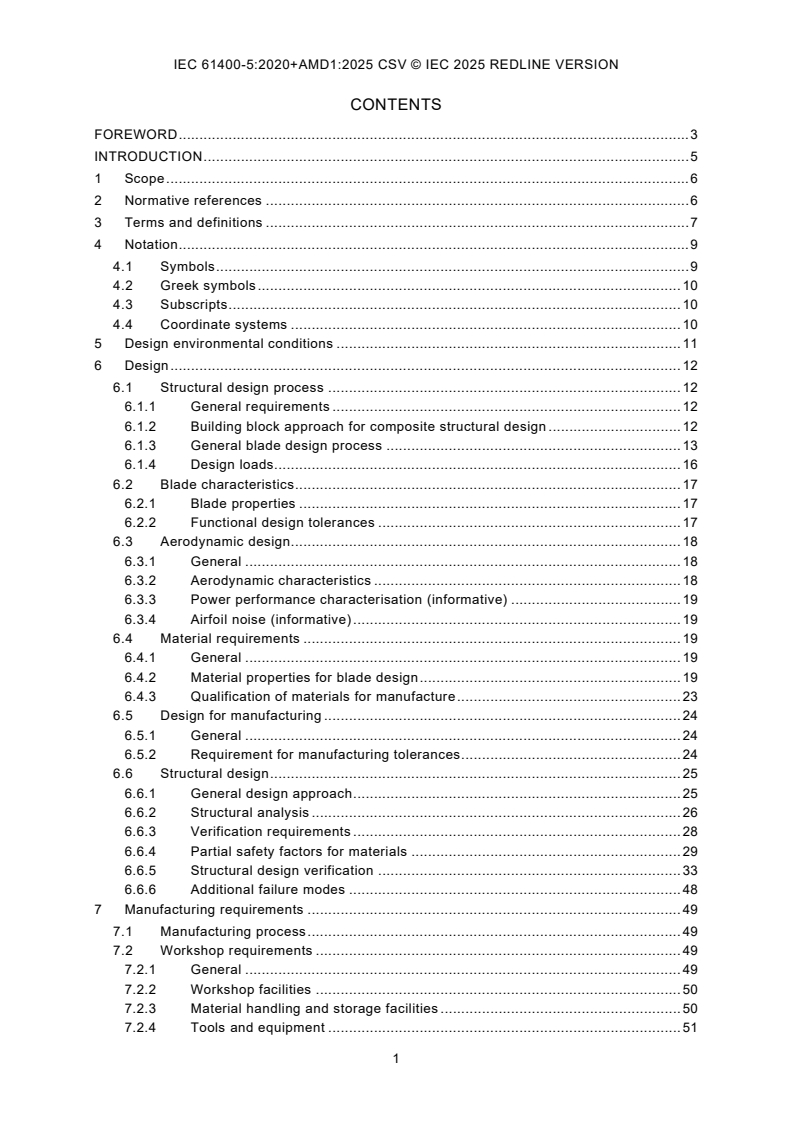
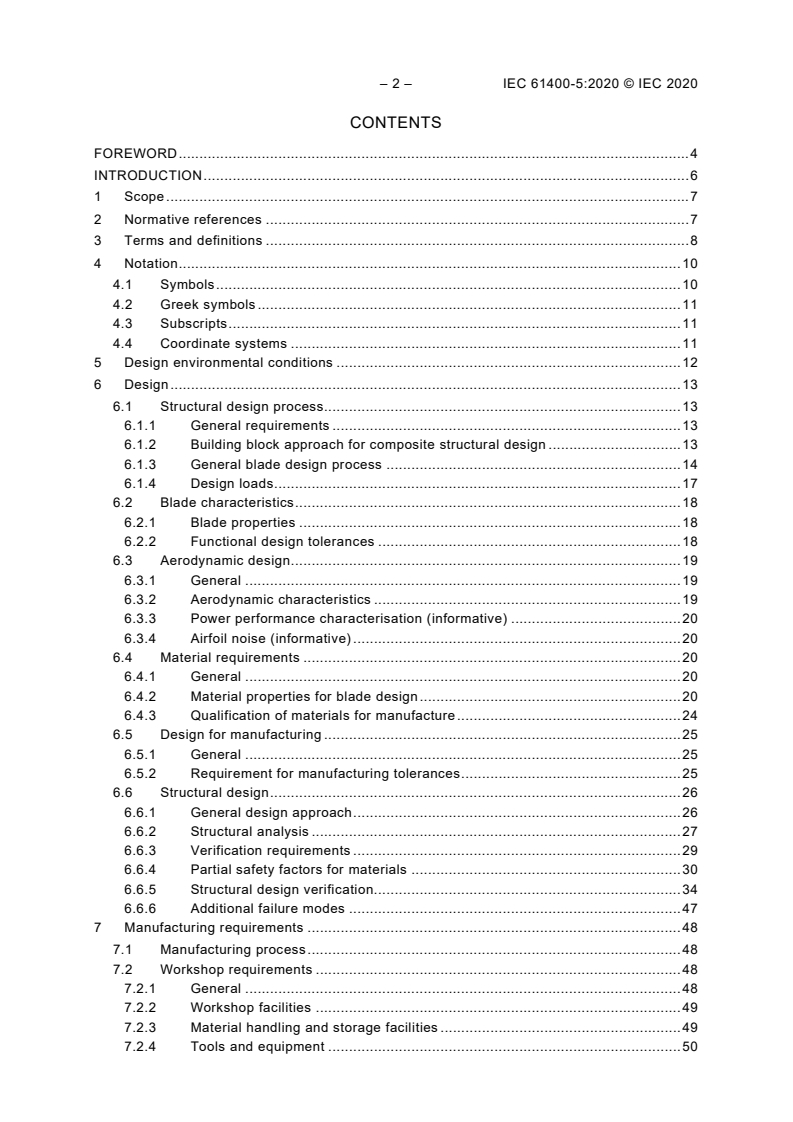
CONTENTS
FOREWORD . 3
INTRODUCTION . 5
1 Scope . 6
2 Normative references . 6
3 Terms and definitions . 7
4 Notation . 9
4.1 Symbols . 9
4.2 Greek symbols . 10
4.3 Subscripts . 10
4.4 Coordinate systems . 10
5 Design environmental conditions . 11
6 Design . 12
6.1 Structural design process . 12
6.1.1 General requirements . 12
6.1.2 Building block approach for composite structural design . 12
6.1.3 General blade design process . 13
6.1.4 Design loads. 16
6.2 Blade characteristics . 17
6.2.1 Blade properties . 17
6.2.2 Functional design tolerances . 17
6.3 Aerodynamic design. 18
6.3.1 General . 18
6.3.2 Aerodynamic characteristics . 18
6.3.3 Power performance characterisation (informative) . 19
6.3.4 Airfoil noise (informative) . 19
6.4 Material requirements . 19
6.4.1 General . 19
6.4.2 Material properties for blade design . 19
6.4.3 Qualification of materials for manufacture . 23
6.5 Design for manufacturing . 24
6.5.1 General . 24
6.5.2 Requirement for manufacturing tolerances . 24
6.6 Structural design . 25
6.6.1 General design approach . 25
6.6.2 Structural analysis . 26
6.6.3 Verification requirements . 28
6.6.4 Partial safety factors for materials . 29
6.6.5 Structural design verification . 33
6.6.6 Additional failure modes . 48
7 Manufacturing requirements . 49
7.1 Manufacturing process . 49
7.2 Workshop requirements . 49
7.2.1 General . 49
7.2.2 Workshop facilities . 50
7.2.3 Material handling and storage facilities . 50
7.2.4 Tools and equipment . 51
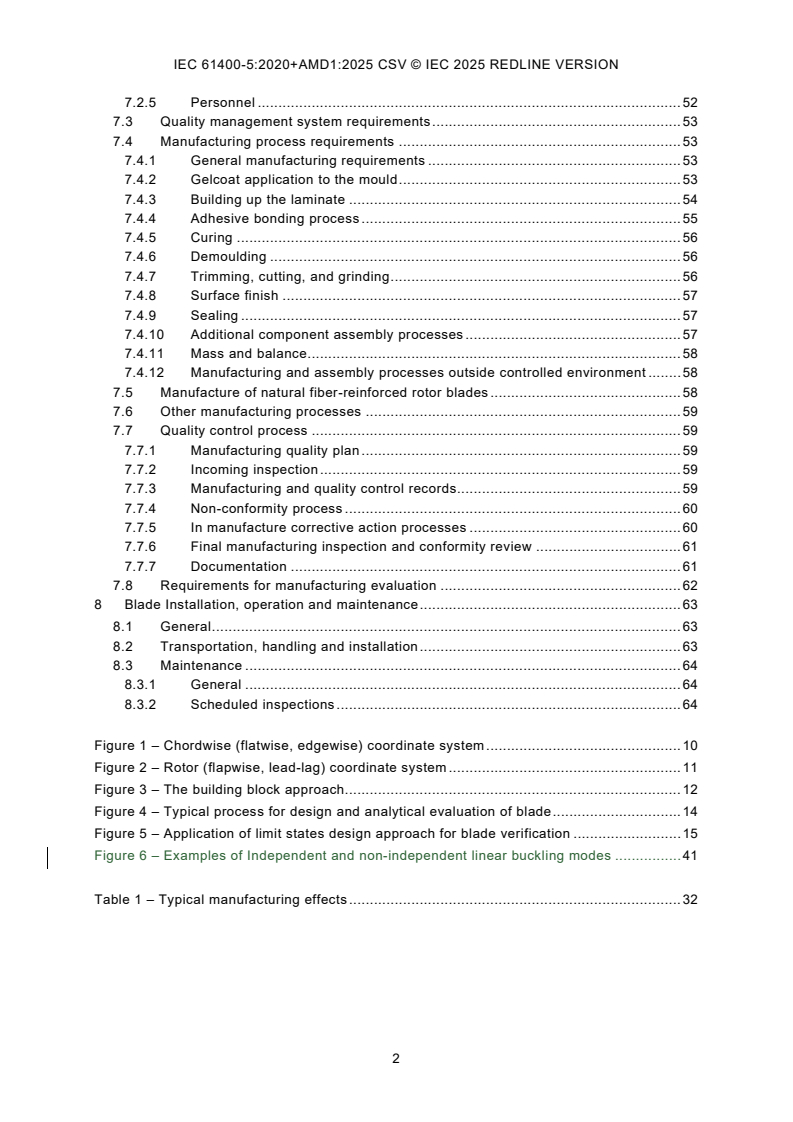
7.2.5 Personnel . 52
7.3 Quality management system requirements . 53
7.4 Manufacturing process requirements . 53
7.4.1 General manufacturing requirements . 53
7.4.2 Gelcoat application to the mould . 53
7.4.3 Building up the laminate . 54
7.4.4 Adhesive bonding process . 55
7.4.5 Curing . 56
7.4.6 Demoulding . 56
7.4.7 Trimming, cutting, and grinding . 56
7.4.8 Surface finish . 57
7.4.9 Sealing . 57
7.4.10 Additional component assembly processes . 57
7.4.11 Mass and balance. 58
7.4.12 Manufacturing and assembly processes outside controlled environment . 58
7.5 Manufacture of natural fiber-reinforced rotor blades . 58
7.6 Other manufacturing processes . 59
7.7 Quality control process . 59
7.7.1 Manufacturing quality plan . 59
7.7.2 Incoming inspection . 59
7.7.3 Manufacturing and quality control records. 59
7.7.4 Non-conformity process . 60
7.7.5 In manufacture corrective action processes . 60
7.7.6 Final manufacturing inspection and conformity review . 61
7.7.7 Documentation . 61
7.8 Requirements for manufacturing evaluation . 62
8 Blade Installation, operation and maintenance . 63
8.1 General . 63
8.2 Transportation, handling and installation . 63
8.3 Maintenance . 64
8.3.1 General . 64
8.3.2 Scheduled inspections . 64
Figure 1 – Chordwise (flatwise, edgewise) coordinate system . 10
Figure 2 – Rotor (flapwise, lead-lag) coordinate system . 11
Figure 3 – The building block approach. 12
Figure 4 – Typical process for design and analytical evaluation of blade . 14
Figure 5 – Application of limit states design approach for blade verification . 15
Figure 6 – Examples of Independent and non-independent linear buckling modes . 41
Table 1 – Typical manufacturing effects . 32
INTERNATIONAL ELECTROTECHNICAL COMMISSION
____________
Wind energy generation systems -
Part 5: Wind turbine blades
FOREWORD
1) The International Electrotechnical Commission (IEC) is a worldwide organization for standardization comprising
all national electrotechnical committees (IEC National Committees). The object of IEC is to promote
international co-operation on all questions concerning standardization in the electrical and electronic fields. To
this end and in addition to other activities, IEC publishes International Standards, Technical Specifications,
Technical Reports, Publicly Available Specifications (PAS) and Guides (hereafter referred to as "IEC
Publication(s)"). Their preparation is entrusted to technical committees; any IEC National Committee interested
in the subject dealt with may participate in this preparatory work. International, governmental and non-
governmental organizations liaising with the IEC also participate in this preparation. IEC collaborates closely
with the International Organization for Standardization (ISO) in accordance with conditions determined by
agreement between the two organizations.
2) The formal decisions or agreements of IEC on technical matters express, as nearly as possible, an international
consensus of opinion on the relevant subjects since each technical committee has representation from all
interested IEC National Committees.
3) IEC Publications have the form of recommendations for international use and are accepted by IEC National
Committees in that sense. While all reasonable efforts are made to ensure that the technical content of IEC
Publications is accurate, IEC cannot be held responsible for the way in which they are used or for any
misinterpretation by any end user.
4) In order to promote international uniformity, IEC National Committees undertake to apply IEC Publications
transparently to the maximum extent possible in their national and regional publications. Any divergence
between any IEC Publication and the corresponding national or regional publication shall be clearly indicated in
the latter.
5) IEC itself does not provide any attestation of conformity. Independent certification bodies provide conformity
assessment services and, in some areas, access to IEC marks of conformity. IEC is not responsible for any
services carried out by independent certification bodies.
6) All users should ensure that they have the latest edition of this publication.
7) No liability shall attach to IEC or its directors, employees, servants or agents including individual experts and
members of its technical committees and IEC National Committees for any personal injury, property damage or
other damage of any nature whatsoever, whether direct or indirect, or for costs (including legal fees) and
expenses arising out of the publication, use of, or reliance upon, this IEC Publication or any other IEC
Publications.
8) Attention is drawn to the Normative references cited in this publication. Use of the referenced publications is
indispensable for the correct application of this publication.
9) IEC draws attention to the possibility that the implementation of this document may involve the use of (a)
patent(s). IEC takes no position concerning the evidence, validity or applicability of any claimed patent rights in
respect thereof. As of the date of publication of this document, IEC had not received notice of (a) patent(s),
which may be required to implement this document. However, implementers are cautioned that this may not
represent the latest information, which may be obtained from the patent database available at
https://patents.iec.ch. IEC shall not be held responsible for identifying any or all such patent rights.
This consolidated version of the official IEC Standard and its amendment has been prepared
for user convenience.
IEC 61400-5 edition 1.1 contains the first edition (2020-06) [documents 88/759/FDIS and
88/767/RVD] and its amendment 1 (2025-08) [documents 88/1086/FDIS and 88/1107/RVD].
In this Redline version, a vertical line in the margin shows where the technical content is
modified by amendment 1. Additions are in green text, deletions are in strikethrough red text.
A separate Final version with all changes accepted is available in this publication.
International Standard IEC 61400-5 has been prepared by IEC technical committee 88: Wind
energy generation systems.
The text of this International Standard is based on the following documents:
FDIS Report on voting
88/759/FDIS 88/767/RVD
Full information on the voting for the approval of this International Standard can be found in
the report on voting indicated in the above table.
This document has been drafted in accordance with the ISO/IEC Directives, Part 2.
Future standards in this series will carry the new general title as cited above. Titles of existing
standards in this series will be updated at the time of the next edition.
A list of all parts of the IEC 61400 series, under the general title Wind energy generation
systems, can be found on the IEC website.
The committee has decided that the contents of this document and its amendment will remain
unchanged until the stability date indicated on the IEC website under webstore.iec.ch in the
data related to the specific document. At this date, the document will be
– reconfirmed,
– withdrawn, or
– revised.
INTRODUCTION
The blades of a wind turbine rotor are generally regarded as one of the most critical
components of the wind turbine system. In this International Standard, a minimum set of
requirements for the design and manufacturing of wind turbine blades are defined.
An approach to a structural design process for the blade is set forth in the general areas of
blade characteristics, aerodynamic design, material requirements and structural design.
Furthermore, in order to efficiently facilitate the transfer of a blade design to the production
environment, this document includes demands for designing for manufacturing.
The requirements for structural design of the wind turbine blade have been developed in a
manner to reward innovation, validation, quality and testing. Specifically, the designer will be
able claim lower partial safety factors based on, among other items, the diligence of the
validation of models and the correlation to testing results.
To ensure a production environment that can facilitate the manufacturing of a blade in
accordance with the design, the manufacturing requirements included in this document
provide a minimum basis for a quality management system and workshop requirements. In
addition, requirements for blade handling, operation and maintenance are described in the
close of this document.
WIND ENERGY GENERATION SYSTEMS –
Part 5: Wind turbine blades
1 Scope
This part of IEC 61400 specifies requirements to ensure the engineering integrity of wind
turbine blades as well as an appropriate level of operational safety throughout the design
lifetime. It includes requirements for:
• aerodynamic and structural design,
• material selection, evaluation and testing,
• manufacture (including associated quality management),
• transportation, installation, operation and maintenance of the blades.
The purpose of this document is to provide a technical reference for designers,
manufacturers, purchasers, operators, third party organizations and material suppliers, as
well as to define requirements for certification.
With respect to certification, this document provides the detailed basis for fulfilling the current
requirements of the IECRE system, as well as other IEC standards relevant to wind turbine
blades. When used for certification, the applicability of each portion of this document should
be determined based on the extent of certification, and associated certification modules per
the IECRE system.
The rotor blade is defined as all components integrated in the blade design, excluding
removable bolts in the blade root connection and support structures for installation.
This document is intended to be applied to rotor blades for all wind turbines. For rotor blades
used on small wind turbines according to IEC 61400-2, the requirements in that document are
applicable.
At the time this document was written, most blades were produced for horizontal axis wind
turbines. The blades were mostly made of fiber reinforced plastics. However, most principles
given in this document would be applicable to any rotor blade configuration, size and material.
2 Normative references
The following documents are referred to in the text in such a way that some or all of their
content constitutes requirements of this document. For dated references, only the edition
cited applies. For undated references, the latest edition of the referenced document (including
any amendments) applies.
IEC 60050-415, International Electrotechnical Vocabulary (IEV) – Part 415: Wind turbine
generator systems
IEC 61400-1, Wind energy generation systems – Part 1: Design requirements
IEC 61400-2, Wind turbines – Part 2: Small wind turbines
IEC 61400-3-1, Wind energy generation systems – Part 3-1: Design requirements for fixed
offshore wind turbines
IEC 61400-3-2, Wind energy generation systems – Part 3-2: Design requirements for floating
offshore wind turbines
IEC 61400-23, Wind turbines – Part 23: Full-scale structural testing of rotor blades
IEC 61400-24, Wind energy generation systems – Part 24: Lightning protection
ISO/IEC 17021-1, Conformity assessment – Requirements for bodies providing audit and
certification of management systems – Part 1: Requirements
ISO 10474, Steel and steel products – Inspection documents
ISO 2394, General principles on reliability for structures
ISO 9000, Quality management systems – Fundamentals and vocabulary
ISO 9001, Quality management systems – Requirements
EN 10204, Metallic products – Types of inspection documents
ISO 16269-6, Statistical interpretation of data – Part 6: Determination of statistical tolerance
intervals
3 Terms and definitions
For the purposes of this document, the terms and definitions given in
IEC 60050-415 and the following apply.
ISO and IEC maintain terminological databases for use in standardization at the following
addresses:
• IEC Electropedia: available at http://www.electropedia.org/
• ISO Online browsing platform: available at http://www.iso.org/obp
3.1
blade root
that part of the rotor blade that is connected to the hub/pitch-bearing of the rotor
3.2
blade subsystem
integrated set of items that accomplish a defined objective or function within the blade (e.g.,
lightning protection subsystem, aerodynamic braking subsystem, monitoring subsystem,
aerodynamic control subsystem, etc.)
3.3
buckling
instability characterized by a non-linear increase in out of plane deflection with a change in
local compressive load
3.4
characteristic value
value having a prescribed probability of not being attained (i.e. an exceedance probability of
less than or equal to a prescribed amount)
Note 1 to entry: See 61400-1.
3.5
chord
length of a reference straight line that joins the leading and trailing edges of a blade aerofoil
cross-section at a given spanwise location
3.6
creep
time-dependant increase in strain under a sustained load
3.7
design limits
maximum or minimum values used in a design
3.8
design loads
loads the blade is designed to withstand, including appropriate partial safety factors
3.9
design properties
material and geometric properties (including design limits)
3.10
edgewise
direction that is parallel to the local chord
3.11
environmental conditions
characteristics of the environment (wind, altitude, temperature, humidity, etc.) which may
affect the wind turbine blade behaviour
3.12
flapwise
direction that is perpendicular to the surface swept by the undeformed rotor blade axis
3.13
flatwise
direction that is perpendicular to the local chord, and spanwise blade axis
3.14
inboard
towards the blade root
3.15
lead-lag
direction that is parallel to the plane of the swept surface and perpendicular to the longitudinal
axis of the undeformed rotor blade
3.16
limit state
state of a structure and the loads acting upon it, beyond which the structure no longer
satisfies the design requirement
3.17
load envelope
collection of maximum design loads in all directions and spanwise positions
3.18
natural frequency
eigen frequency
frequency at which a structure will vibrate when perturbed and allowed to vibrate freely
3.19
partial safety factors
factors that are applied to loads and material strengths to account for uncertainties in the
representative (characteristic) values
3.20
prebend
blade curvature in the flapwise plane in the unloaded condition
3.21
spanwise
direction parallel to the longitudinal axis of a rotor blade
3.22
stiffness
ratio of change of force to the corresponding change in displacement of an elastic body
3.23
strain
ratio of the elongation (or shear displacement) of a material subjected to stress to the original
length of the material
3.24
sweep
blade curvature in the lead-lag plane in the unloaded condition
3.25
twist
spanwise variation in angle of the chord lines of blade cross-sections
3.26
critical to quality
CTQ
process or design value that is measurable and specifies critical acceptance criteria
4 Notation
4.1 Symbols
F load
F design value for the load
d
F characteristic value for the load
k
R resistance of material or structure against the corresponding limit state
R characteristic material resistance
k
PSF Partial Safety Factor
S() function for structural response to the load
T glass transition temperature
g
p (−) negative Puck inclination parameter
┴║
p (+) positive Puck inclination parameter
┴║
4.2 Greek symbols
γ Partial safety factor
4.3 Subscripts
m materials
m0 materials as a “base” material factor (to be included in all analyses)
m1 materials for environmental degradation (non-reversible effects)
m2 materials for temperature effects (reversible effects)
m3 materials for manufacturing effects
m4 materials for calculation accuracy and validation of method
m5 materials for load characterization
n consequence of failure
f factor for loads
4.4 Coordinate systems
Coordinate systems for loads and design reference are shown in Figure 1 and Figure 2.
Loads are along and perpendicular to the local blade chord directions.
Key
M edgewise bending moment
a
M flatwise bending moment
b
M torsion moment
c
F flatwise shear force
a
F edgewise shear force
b
F axial force
c
1 torsion angle
2 flapwise translation
3 lead-lag translation
Figure 1 – Chordwise (flatwise, edgewise) coordinate system
Loads are along the rotor plane reference directions.
Key
M lead-lag bending moment
x
M flapwise bending moment
y
M torsion moment
z
F flapwise shear force
x
F lead-lag shear force
y
F spanwise force
z
1 flapwise translation
2 lead-lag translation
Figure 2 – Rotor (flapwise, lead-lag) coordinate system
5 Design environmental conditions
Wind turbine blades are subjected to environmental conditions that may affect their loading,
durability and operation. To ensure the appropriate level of safety and reliability, the design
environmental conditions shall be taken into account and explicitly stated in the design
documentation. This shall include but is not limited to the environmental conditions specified
in IEC 61400-1, IEC 61400-3-1 or IEC 61400-3-2, and IEC 61400-24 (for lightning).
The environmental conditions are divided into normal and extreme categories. The normal
environmental conditions generally concern recurrent structural loading conditions, while the
extreme environmental conditions represent infrequent external design conditions. The design
load cases defined in IEC 61400-1, IEC 61400-3-1 or IEC 61400-3-2 include combinations of
these environmental conditions with wind turbine operational modes and other design
situations.
When additional environmental conditions not listed in the above references are specified by
the designer, the parameters and their values shall be stated in the design documentation.
It shall be taken into account that these environmental conditions may vary for different
phases of the product lifecycle (manufacturing, transport/storage, installation, operation or
dismantling).
6 Design
6.1 Structural design process
6.1.1 General requirements
The structural design process shall ensure that the required operation safety levels are met
for the entire design lifetime and loading of the blade.
The design shall be sufficiently described and specified to ensure that assumptions made
during the design process can be met and complied with during the manufacturing process.
The allowable manufacturing tolerances and acceptance criteria shall be defined by the
designer and specified in the design documentation.
Any of the requirements of this document may be altered if it can be suitably demonstrated
that the safety of the wind turbine system is not compromised.
6.1.2 Building block approach for composite structural design
The traditional detailed design (analytic and numerical calculation together with validated
material data and full blade testing) of FRP structures can be enhanced by a building-block
approach, starting with coupon-level tests, analysis and testing of more complicated
structures; and culminating in a full blade test. This relationship is shown in Figure 3, where
increasingly more complex tests are developed to evaluate more complicated loading
conditions and failure modes.
Figure 3 – The building block approach
The approach can be summarized as follows:
Coupons: A number of tests are conducted at the coupon level, where confidence in
repeatable physical properties is developed. Procurement specifications are developed for the
individual constituents, and allowable design variables developed for lamina/laminate
combinations.
Elements and details: Critical areas from the design analysis identify elements for further
testing and analysis at the design conditions with representative specimens. This may include
such tests as the spar cap to web bond line or ply drops in the spar cap laminate.
Sub-components: Parts and sections representative of the blade design are tested to evaluate
specific loading conditions and failure modes. Examples include spars, shells and root
sections. The test components may be full or partial scale where demonstrated to be
representative.
Full blade: A full blade or significant part of a blade, representative of the blade design is
tested to evaluate specific loading conditions and failure modes. The blade may be full or
partial scale where demonstrated to be representative.
The number of tests required for each level should be tailored for each design activity, with
the blade designer responsible for the development of a reasonable number of tests at each
stage.
Tests on the element and detail as well as sub-component level will increase the confidence
in the structural design.
For design values (strength, stiffness, etc.) developed from test at any building block level
(material sample, sub-component, etc.), the validity of such design values shall be described
and limited by acceptance criteria and tolerances to be met in the final design.
6.1.3 General blade design process
A typical process, provided for informative guidance only, for the design and analytical
evaluation of a blade is illustrated in Figure 4. In addition to the steps shown, the design
process can include the development of critical inputs, such as establishing aerodynamic
characteristics of airfoils, and characterization of materials properties.
The iteration loops shown are only indicative and may not represent all specific design
processes. For example, if an aerodynamic design evaluation is not found satisfactory, the
designer may re-consider the airfoils used (as shown in the figure), or iterate at another step
of the aerodynamic design process.
___________
Note on acceptance criteria (example only): for a laminate coupon sample tested for fatigue strength, the
acceptance criteria may amongst other include definition of raw materials (reference to material specifications),
fiber volume fraction, fiber alignment angles, manufacturing and curing process, etc.
Figure 4 – Typical process for design and analytical evaluation of blade
As noted in Figure 4, the blade structural integrity is to be evaluated for avoidance of specific
failure modes. Evaluations can be based on analysis or tests or a combination of analysis and
tests (see building block approach, Subclause 6.1.2). This is in conformity with IEC standards
(e.g., IEC 61400-1, IEC 61400-3-1, IEC 61400-3-2) which require the use of the limit states
design approach.
In the most general sense, the limit states design approach involves the characterization of
structural responses resulting from loads (e.g., stress, strain or deflection) and resistance to
those responses (e.g., strength, stiffness). Partial safety factors (PSFs), γ, are applied to
account for uncertainties in the calculated response and resistances so that the probability of
exceeding limit states is acceptably low.
Characteristic loads are those predicted to occur with a specified probability. The design
values for loads are determined by multiplying by loads partial safety factors, γ .
f
Resistance is normally a function of material properties. Characteristic resistance is
calculated from test results, where the default is 95 % exceedance with 95 % confidence level
according to ISO 16269-6. It should be stated if statistical tolerance limit factors for known or
unknown population standard deviation are used.
The resistance of the structural materials as embodied in the full blade structure may be
different than as measured at the coupon level. In some cases, this may be due to predictable
effects of scale, geometry, and load-introduction. Other effects could include variations in
material properties (e.g., composition, mechanical properties, orientation). The material partial
safety factor, γ , is intended to cover combined uncertainties in the relationship between
m
coupon-based resistance and the resistance in the as-built blade. Subclause 6.6.4 gives
detailed definition of how γ is defined.
m
According to IEC 61400-1, partial safety factors for consequences of failure, γ , shall also be
n
included. In principle, γ can be applied either as an increase in the response, or a decrease
n
in resistance as shown in Figure 5.
In all verifications, the design value of response shall not exceed the design value of
resistance. Figure 5 shows these two values being separated by a safety margin. Verification
requires safety margin values greater than or equal to zero.
For some limit states, the relationship between material properties and resistance against
failure in the limit state is not linear (e.g., in a fracture mechanics and buckling analyses). For
such cases, the PSFs shall be applied in such way that they have a linear relation with the
load carrying capability as in the following equation:
R
k
SF()γ ×≤
fk
γγ
mn
where S is a function for the structural response to the load and R is the characteristic
k
material resistance.
This general formulation is shown in Figure 5, where partial safety factors are introduced in a
relationship between the structural response due to loads and the resistance for the
corresponding limit state.
Figure 5 – Application of limit states design approach for blade verification
Material resistance may be expressed either in stress or strain.
As discussed in 6.6, γ is derived by consideration of numerous contributions to the overall
m
resistance uncertainty. At the time this document was written, typical industry practice was
consistent with the illustration in Figure 3, with material resistance developed by coupon-level
testing to determine material properties which are then translated to blade-level using a value
of γ that covers a wide number of uncertainties. Numerous strategies are possible by which
m
uncertainties in the transfer of material-level properties to the resistance in the as-built blade
can be reduced.
For example, by using the building block approach, a combination of failure modes and limit
states are taken into account with a lower uncertainty with increased size and complexity of
the building block tested. Obtained strength and stability values will define failure modes for
material samples and sub-components, and shall be compared with analytical methods for
validation.
6.1.4 Design loads
6.1.4.1 Design envelope
The design loads for a blade can be specified for a single wind turbine design, or it can be
given as a wider load envelope intended to cover a range of wind turbine designs.
The defined loads/load envelope may be based on the design load cases specified in
IEC 61400-1, including non-operational situations (e.g., transportation, handling, installation,
maintenance, loading of attachment points). For offshore turbines, the requirements in
IEC 61400-3-1 and IEC 61400-3-2 should be considered.
6.1.4.2 Load interaction
The structural characteristic of the blade interacts with its aerodynamic loading and the
turbine controller. For a safe operation of the blade in rotational and stand still conditions, it
shall be assured that any instability (e.g., flutter) or resonance as a result of the interaction of
aerodynamic loading, blade structural design, turbine control (rotational speed, pitch angle,
etc.) and support structure has been considered in the load calculation.
The structural design of the blade shall reflect the defined operational, transportation and
handling load envelope, and the structural verification shall prove that the blade can withstand
the specified ultimate and fatigue design loads.
6.1.4.3 Load envelopes
Due to the asymmetry of rotor blade structures, the assumed loads in the analysis may not
reflect the most critical loading direction for any given failure mode. There are two
approaches to account for the critical loading direction.
• Basic approach: Usage of four matched sets of loads (moments and forces) corresponding
to the extremes of flatwise and edgewise loads. The angle of the resulting load vector
shall be considered. For certain verifications, this may be insufficient to cover the most
critical load directions for combined loading. This shall be considered in the design.
• Advanced approach: Consideration of all potentially critical loading directions within a
cross section. Without further analysis of load criticality, a set of loads distributed evenly
in at least twelve directions is considered sufficient for this approach.
The components of an extreme load envelope are not generally contemporaneous (happening
at the same time) and therefore this loads envelope represents a conservative condition. This
conservatism may be reduced by evaluating the structure for each of the contemporaneous
loads that comprise the extreme load.
In general, it is sufficient to design for the resultant bending moments. However, this may not
always be the most critical loading type for all failure modes. For example, the highest shear
forces represent the most critical loads for the verification of bond strength. Torsional loading
should also be considered.
To ensure that loads are calculated at a sufficient number of spanwise sections, loads shall
be available at minimum 12 cross sections along the blade length (spanwise).
The spanwise distance between load definition sections shall not be larger than 2,0 × the
smallest chord length for the given section, for the sections from root to 85 % of blade length.
Geometry or stiffness variations shall be considered during section selection.
6.2 Blade characteristics
6.2.1 Blade properties
Structural and aerodynamic properties of the blades are critical to the aero-elastic loading of
the blade and turbine.
The characteristics of the blade shall be defined for use as input for loads calculation. These
characteristics shall include mechanical and physical properties at discrete sections along the
length of the blade, for the relevant degrees of freedom that are related to the relevant design
states:
• distribution of aerodynamic profiles, chord, aerodynamic twist, and thickness;
• aerodynamic characteristics (i.e., lift, drag, and pitching moment coefficients as a function
of angle of attack) associated with the aerodynamic profiles;
• elastic stiffness properties (e.g., flatwise and edgewise stiffness and if significant to the
design, torsional and extensional stiffness) and their reference axes;
• distributions of mass and mass moments of inertia and the reference axis;
• elastic coupling (e.g., flatwise vs. edgewise, flatwise vs. torsion or similar, if significant to
the design);
• structural damping.
Structural properties shall be defined for a minimum number of sections along the blade.
These shall not be less than those specified for structural verification according to 6.6.3.1.
6.2.2 Functional design tolerances
Tolerances shall be defined for the following parameters:
• shape of the aerodynamic profiles, including but not limited to:
– radius of the profile leading edge;
– relative thickness of the profile;
– local chord length;
• roughness of the profile surface;
• aerodynamic twist angle;
• blade length;
• geometric position of blade aerodynamic profiles relative to blade root reference;
• geometry and position of any static or moveable aerodynamic device (vortex generator,
flaps, etc.);
• the nominal 0° pitch marking;
• blade mass;
• blade static moment (for each individual blade and relative to blades in a blade set);
• blade natural frequencies;
• angular a
...
IEC 61400-5 ®
Edition 1.0 2020-06
INTERNATIONAL
STANDARD
NORME
INTERNATIONALE
colour
inside
Wind energy generation systems –
Part 5: Wind turbine blades
Systèmes de génération d’énergie éolienne –
Partie 5: Pales d’éoliennes
All rights reserved. Unless otherwise specified, no part of this publication may be reproduced or utilized in any form
or by any means, electronic or mechanical, including photocopying and microfilm, without permission in writing from
either IEC or IEC's member National Committee in the country of the requester. If you have any questions about IEC
copyright or have an enquiry about obtaining additional rights to this publication, please contact the address below or
your local IEC member National Committee for further information.
Droits de reproduction réservés. Sauf indication contraire, aucune partie de cette publication ne peut être reproduite
ni utilisée sous quelque forme que ce soit et par aucun procédé, électronique ou mécanique, y compris la photocopie
et les microfilms, sans l'accord écrit de l'IEC ou du Comité national de l'IEC du pays du demandeur. Si vous avez des
questions sur le copyright de l'IEC ou si vous désirez obtenir des droits supplémentaires sur cette publication, utilisez
les coordonnées ci-après ou contactez le Comité national de l'IEC de votre pays de résidence.
IEC Central Office Tel.: +41 22 919 02 11
3, rue de Varembé info@iec.ch
CH-1211 Geneva 20 www.iec.ch
Switzerland
About the IEC
The International Electrotechnical Commission (IEC) is the leading global organization that prepares and publishes
International Standards for all electrical, electronic and related technologies.
About IEC publications
The technical content of IEC publications is kept under constant review by the IEC. Please make sure that you have the
latest edition, a corrigendum or an amendment might have been published.
IEC publications search - webstore.iec.ch/advsearchform Electropedia - www.electropedia.org
The advanced search enables to find IEC publications by a The world's leading online dictionary on electrotechnology,
variety of criteria (reference number, text, technical containing more than 22 000 terminological entries in English
committee,…). It also gives information on projects, replaced and French, with equivalent terms in 16 additional languages.
and withdrawn publications. Also known as the International Electrotechnical Vocabulary
(IEV) online.
IEC Just Published - webstore.iec.ch/justpublished
Stay up to date on all new IEC publications. Just Published IEC Glossary - std.iec.ch/glossary
details all new publications released. Available online and 67 000 electrotechnical terminology entries in English and
once a month by email. French extracted from the Terms and Definitions clause of
IEC publications issued since 2002. Some entries have been
IEC Customer Service Centre - webstore.iec.ch/csc collected from earlier publications of IEC TC 37, 77, 86 and
If you wish to give us your feedback on this publication or CISPR.
need further assistance, please contact the Customer Service
Centre: sales@iec.ch.
A propos de l'IEC
La Commission Electrotechnique Internationale (IEC) est la première organisation mondiale qui élabore et publie des
Normes internationales pour tout ce qui a trait à l'électricité, à l'électronique et aux technologies apparentées.
A propos des publications IEC
Le contenu technique des publications IEC est constamment revu. Veuillez vous assurer que vous possédez l’édition la
plus récente, un corrigendum ou amendement peut avoir été publié.
Recherche de publications IEC - Electropedia - www.electropedia.org
webstore.iec.ch/advsearchform Le premier dictionnaire d'électrotechnologie en ligne au
La recherche avancée permet de trouver des publications IEC monde, avec plus de 22 000 articles terminologiques en
en utilisant différents critères (numéro de référence, texte, anglais et en français, ainsi que les termes équivalents dans
comité d’études,…). Elle donne aussi des informations sur les 16 langues additionnelles. Egalement appelé Vocabulaire
projets et les publications remplacées ou retirées. Electrotechnique International (IEV) en ligne.
IEC Just Published - webstore.iec.ch/justpublished Glossaire IEC - std.iec.ch/glossary
Restez informé sur les nouvelles publications IEC. Just 67 000 entrées terminologiques électrotechniques, en anglais
Published détaille les nouvelles publications parues. et en français, extraites des articles Termes et Définitions des
Disponible en ligne et une fois par mois par email. publications IEC parues depuis 2002. Plus certaines entrées
antérieures extraites des publications des CE 37, 77, 86 et
Service Clients - webstore.iec.ch/csc CISPR de l'IEC.
Si vous désirez nous donner des commentaires sur cette
publication ou si vous avez des questions contactez-nous:
sales@iec.ch.
IEC 61400-5 ®
Edition 1.0 2020-06
INTERNATIONAL
STANDARD
NORME
INTERNATIONALE
colour
inside
Wind energy generation systems –
Part 5: Wind turbine blades
Systèmes de génération d’énergie éolienne –
Partie 5: Pales d’éoliennes
INTERNATIONAL
ELECTROTECHNICAL
COMMISSION
COMMISSION
ELECTROTECHNIQUE
INTERNATIONALE
ICS 27.180 ISBN 978-2-8322-8335-6
– 2 – IEC 61400-5:2020 © IEC 2020
CONTENTS
FOREWORD . 4
INTRODUCTION . 6
1 Scope . 7
2 Normative references . 7
3 Terms and definitions . 8
4 Notation . 10
4.1 Symbols . 10
4.2 Greek symbols . 11
4.3 Subscripts . 11
4.4 Coordinate systems . 11
5 Design environmental conditions . 12
6 Design . 13
6.1 Structural design process. 13
6.1.1 General requirements . 13
6.1.2 Building block approach for composite structural design . 13
6.1.3 General blade design process . 14
6.1.4 Design loads . 17
6.2 Blade characteristics . 18
6.2.1 Blade properties . 18
6.2.2 Functional design tolerances . 18
6.3 Aerodynamic design . 19
6.3.1 General . 19
6.3.2 Aerodynamic characteristics . 19
6.3.3 Power performance characterisation (informative) . 20
6.3.4 Airfoil noise (informative) . 20
6.4 Material requirements . 20
6.4.1 General . 20
6.4.2 Material properties for blade design . 20
6.4.3 Qualification of materials for manufacture . 24
6.5 Design for manufacturing . 25
6.5.1 General . 25
6.5.2 Requirement for manufacturing tolerances . 25
6.6 Structural design . 26
6.6.1 General design approach . 26
6.6.2 Structural analysis . 27
6.6.3 Verification requirements . 29
6.6.4 Partial safety factors for materials . 30
6.6.5 Structural design verification. 34
6.6.6 Additional failure modes . 47
7 Manufacturing requirements . 48
7.1 Manufacturing process . 48
7.2 Workshop requirements . 48
7.2.1 General . 48
7.2.2 Workshop facilities . 49
7.2.3 Material handling and storage facilities . 49
7.2.4 Tools and equipment . 50
7.2.5 Personnel . 51
7.3 Quality management system requirements . 52
7.4 Manufacturing process requirements. 52
7.4.1 General manufacturing requirements . 52
7.4.2 Gelcoat application to the mould . 52
7.4.3 Building up the laminate . 53
7.4.4 Adhesive bonding process . 54
7.4.5 Curing . 55
7.4.6 Demoulding . 55
7.4.7 Trimming, cutting, and grinding . 55
7.4.8 Surface finish . 56
7.4.9 Sealing . 56
7.4.10 Additional component assembly processes . 56
7.4.11 Mass and balance . 57
7.4.12 Manufacturing and assembly processes outside controlled environment . 57
7.5 Manufacture of natural fiber-reinforced rotor blades . 57
7.6 Other manufacturing processes . 58
7.7 Quality control process . 58
7.7.1 Manufacturing quality plan . 58
7.7.2 Incoming inspection . 58
7.7.3 Manufacturing and quality control records . 58
7.7.4 Non-conformity process . 59
7.7.5 In manufacture corrective action processes . 59
7.7.6 Final manufacturing inspection and conformity review . 60
7.7.7 Documentation . 60
7.8 Requirements for manufacturing evaluation . 61
8 Blade Installation, operation and maintenance . 62
8.1 General . 62
8.2 Transportation, handling and installation . 62
8.3 Maintenance . 63
8.3.1 General . 63
8.3.2 Scheduled inspections . 63
Figure 1 – Chordwise (flatwise, edgewise) coordinate system . 11
Figure 2 – Rotor (flapwise, lead-lag) coordinate system . 12
Figure 3 – The building block approach . 13
Figure 4 – Typical process for design and analytical evaluation of blade . 15
Figure 5 – Application of limit states design approach for blade verification . 16
Table 1 – Typical manufacturing effects . 33
– 4 – IEC 61400-5:2020 © IEC 2020
INTERNATIONAL ELECTROTECHNICAL COMMISSION
____________
WIND ENERGY GENERATION SYSTEMS –
Part 5: Wind turbine blades
FOREWORD
1) The International Electrotechnical Commission (IEC) is a worldwide organization for standardization comprising
all national electrotechnical committees (IEC National Committees). The object of IEC is to promote
international co-operation on all questions concerning standardization in the electrical and electronic fields. To
this end and in addition to other activities, IEC publishes International Standards, Technical Specifications,
Technical Reports, Publicly Available Specifications (PAS) and Guides (hereafter referred to as “IEC
Publication(s)”). Their preparation is entrusted to technical committees; any IEC National Committee interested
in the subject dealt with may participate in this preparatory work. International, governmental and non-
governmental organizations liaising with the IEC also participate in this preparation. IEC collaborates closely
with the International Organization for Standardization (ISO) in accordance with conditions determined by
agreement between the two organizations.
2) The formal decisions or agreements of IEC on technical matters express, as nearly as possible, an international
consensus of opinion on the relevant subjects since each technical committee has representation from all
interested IEC National Committees.
3) IEC Publications have the form of recommendations for international use and are accepted by IEC National
Committees in that sense. While all reasonable efforts are made to ensure that the technical content of IEC
Publications is accurate, IEC cannot be held responsible for the way in which they are used or for any
misinterpretation by any end user.
4) In order to promote international uniformity, IEC National Committees undertake to apply IEC Publications
transparently to the maximum extent possible in their national and regional publications. Any divergence
between any IEC Publication and the corresponding national or regional publication shall be clearly indicated in
the latter.
5) IEC itself does not provide any attestation of conformity. Independent certification bodies provide conformity
assessment services and, in some areas, access to IEC marks of conformity. IEC is not responsible for any
services carried out by independent certification bodies.
6) All users should ensure that they have the latest edition of this publication.
7) No liability shall attach to IEC or its directors, employees, servants or agents including individual experts and
members of its technical committees and IEC National Committees for any personal injury, property damage or
other damage of any nature whatsoever, whether direct or indirect, or for costs (including legal fees) and
expenses arising out of the publication, use of, or reliance upon, this IEC Publication or any other IEC
Publications.
8) Attention is drawn to the Normative references cited in this publication. Use of the referenced publications is
indispensable for the correct application of this publication.
9) Attention is drawn to the possibility that some of the elements of this IEC Publication may be the subject of
patent rights. IEC shall not be held responsible for identifying any or all such patent rights.
International Standard IEC 61400-5 has been prepared by IEC technical committee 88: Wind
energy generation systems.
The text of this International Standard is based on the following documents:
FDIS Report on voting
88/759/FDIS 88/767/RVD
Full information on the voting for the approval of this International Standard can be found in
the report on voting indicated in the above table.
This document has been drafted in accordance with the ISO/IEC Directives, Part 2.
Future standards in this series will carry the new general title as cited above. Titles of existing
standards in this series will be updated at the time of the next edition.
A list of all parts of the IEC 61400 series, under the general title Wind energy generation
systems, can be found on the IEC website.
The committee has decided that the contents of this document will remain unchanged until the
stability date indicated on the IEC website under "http://webstore.iec.ch" in the data related to
the specific document. At this date, the document will be
• reconfirmed,
• withdrawn,
• replaced by a revised edition, or
• amended.
IMPORTANT – The 'colour inside' logo on the cover page of this publication indicates
that it contains colours which are considered to be useful for the correct
understanding of its contents. Users should therefore print this document using a
colour printer.
– 6 – IEC 61400-5:2020 © IEC 2020
INTRODUCTION
The blades of a wind turbine rotor are generally regarded as one of the most critical
components of the wind turbine system. In this International Standard, a minimum set of
requirements for the design and manufacturing of wind turbine blades are defined.
An approach to a structural design process for the blade is set forth in the general areas of
blade characteristics, aerodynamic design, material requirements and structural design.
Furthermore, in order to efficiently facilitate the transfer of a blade design to the production
environment, this document includes demands for designing for manufacturing.
The requirements for structural design of the wind turbine blade have been developed in a
manner to reward innovation, validation, quality and testing. Specifically, the designer will be
able claim lower partial safety factors based on, among other items, the diligence of the
validation of models and the correlation to testing results.
To ensure a production environment that can facilitate the manufacturing of a blade in
accordance with the design, the manufacturing requirements included in this document
provide a minimum basis for a quality management system and workshop requirements. In
addition, requirements for blade handling, operation and maintenance are described in the
close of this document.
WIND ENERGY GENERATION SYSTEMS –
Part 5: Wind turbine blades
1 Scope
This part of IEC 61400 specifies requirements to ensure the engineering integrity of wind
turbine blades as well as an appropriate level of operational safety throughout the design
lifetime. It includes requirements for:
• aerodynamic and structural design,
• material selection, evaluation and testing,
• manufacture (including associated quality management),
• transportation, installation, operation and maintenance of the blades.
The purpose of this document is to provide a technical reference for designers,
manufacturers, purchasers, operators, third party organizations and material suppliers, as
well as to define requirements for certification.
With respect to certification, this document provides the detailed basis for fulfilling the current
requirements of the IECRE system, as well as other IEC standards relevant to wind turbine
blades. When used for certification, the applicability of each portion of this document should
be determined based on the extent of certification, and associated certification modules per
the IECRE system.
The rotor blade is defined as all components integrated in the blade design, excluding
removable bolts in the blade root connection and support structures for installation.
This document is intended to be applied to rotor blades for all wind turbines. For rotor blades
used on small wind turbines according to IEC 61400-2, the requirements in that document are
applicable.
At the time this document was written, most blades were produced for horizontal axis wind
turbines. The blades were mostly made of fiber reinforced plastics. However, most principles
given in this document would be applicable to any rotor blade configuration, size and material.
2 Normative references
The following documents are referred to in the text in such a way that some or all of their
content constitutes requirements of this document. For dated references, only the edition
cited applies. For undated references, the latest edition of the referenced document (including
any amendments) applies.
IEC 60050-415, International Electrotechnical Vocabulary (IEV) – Part 415: Wind turbine
generator systems
IEC 61400-1, Wind energy generation systems – Part 1: Design requirements
IEC 61400-2, Wind turbines – Part 2: Small wind turbines
IEC 61400-3-1, Wind energy generation systems – Part 3-1: Design requirements for fixed
offshore wind turbines
– 8 – IEC 61400-5:2020 © IEC 2020
IEC 61400-3-2, Wind energy generation systems – Part 3-2: Design requirements for floating
offshore wind turbines
IEC 61400-23, Wind turbines – Part 23: Full-scale structural testing of rotor blades
IEC 61400-24, Wind energy generation systems – Part 24: Lightning protection
ISO/IEC 17021-1, Conformity assessment – Requirements for bodies providing audit and
certification of management systems – Part 1: Requirements
ISO 10474, Steel and steel products – Inspection documents
ISO 2394, General principles on reliability for structures
ISO 9000, Quality management systems – Fundamentals and vocabulary
ISO 9001, Quality management systems – Requirements
EN 10204, Metallic products – Types of inspection documents
ISO 16269-6, Statistical interpretation of data – Part 6: Determination of statistical tolerance
intervals
3 Terms and definitions
For the purposes of this document, the terms and definitions given in
IEC 60050-415 and the following apply.
ISO and IEC maintain terminological databases for use in standardization at the following
addresses:
• IEC Electropedia: available at http://www.electropedia.org/
• ISO Online browsing platform: available at http://www.iso.org/obp
3.1
blade root
that part of the rotor blade that is connected to the hub/pitch-bearing of the rotor
3.2
blade subsystem
integrated set of items that accomplish a defined objective or function within the blade (e.g.,
lightning protection subsystem, aerodynamic braking subsystem, monitoring subsystem,
aerodynamic control subsystem, etc.)
3.3
buckling
instability characterized by a non-linear increase in out of plane deflection with a change in
local compressive load
3.4
characteristic value
value having a prescribed probability of not being attained (i.e. an exceedance probability of
less than or equal to a prescribed amount)
3.5
chord
length of a reference straight line that joins the leading and trailing edges of a blade aerofoil
cross-section at a given spanwise location
3.6
creep
time-dependant increase in strain under a sustained load
3.7
design limits
maximum or minimum values used in a design
3.8
design loads
loads the blade is designed to withstand, including appropriate partial safety factors
3.9
design properties
material and geometric properties (including design limits)
3.10
edgewise
direction that is parallel to the local chord
3.11
environmental conditions
characteristics of the environment (wind, altitude, temperature, humidity, etc.) which may
affect the wind turbine blade behaviour
3.12
flapwise
direction that is perpendicular to the surface swept by the undeformed rotor blade axis
3.13
flatwise
direction that is perpendicular to the local chord, and spanwise blade axis
3.14
inboard
towards the blade root
3.15
lead-lag
direction that is parallel to the plane of the swept surface and perpendicular to the longitudinal
axis of the undeformed rotor blade
3.16
limit state
state of a structure and the loads acting upon it, beyond which the structure no longer
satisfies the design requirement
3.17
load envelope
collection of maximum design loads in all directions and spanwise positions
– 10 – IEC 61400-5:2020 © IEC 2020
3.18
natural frequency
eigen frequency
frequency at which a structure will vibrate when perturbed and allowed to vibrate freely
3.19
partial safety factors
factors that are applied to loads and material strengths to account for uncertainties in the
representative (characteristic) values
3.20
prebend
blade curvature in the flapwise plane in the unloaded condition
3.21
spanwise
direction parallel to the longitudinal axis of a rotor blade
3.22
stiffness
ratio of change of force to the corresponding change in displacement of an elastic body
3.23
strain
ratio of the elongation (or shear displacement) of a material subjected to stress to the original
length of the material
3.24
sweep
blade curvature in the lead-lag plane in the unloaded condition
3.25
twist
spanwise variation in angle of the chord lines of blade cross-sections
3.26
critical to quality
CTQ
process or design value that is measurable and specifies critical acceptance criteria
4 Notation
4.1 Symbols
F load
F design value for the load
d
F characteristic value for the load
k
R resistance of material or structure against the corresponding limit state
R characteristic material resistance
k
PSF Partial Safety Factor
S() function for structural response to the load
T glass transition temperature
g
p (−) negative Puck inclination parameter
┴║
p (+) positive Puck inclination parameter
┴║
4.2 Greek symbols
γ Partial safety factor
4.3 Subscripts
m materials
m0 materials as a “base” material factor (to be included in all analyses)
m1 materials for environmental degradation (non-reversible effects)
m2 materials for temperature effects (reversible effects)
m3 materials for manufacturing effects
m4 materials for calculation accuracy and validation of method
m5 materials for load characterization
n consequence of failure
f factor for loads
4.4 Coordinate systems
Coordinate systems for loads and design reference are shown in Figure 1 and Figure 2.
Loads are along and perpendicular to the local blade chord directions.
Key
M edgewise bending moment
a
M flatwise bending moment
b
M torsion moment
c
F flatwise shear force
a
edgewise shear force
F
b
F axial force
c
1 torsion angle
2 flapwise translation
3 lead-lag translation
Figure 1 – Chordwise (flatwise, edgewise) coordinate system
– 12 – IEC 61400-5:2020 © IEC 2020
Loads are along the rotor plane reference directions.
Key
M lead-lag bending moment
x
M flapwise bending moment
y
M torsion moment
z
F flapwise shear force
x
F lead-lag shear force
y
F spanwise force
z
1 flapwise translation
2 lead-lag translation
Figure 2 – Rotor (flapwise, lead-lag) coordinate system
5 Design environmental conditions
Wind turbine blades are subjected to environmental conditions that may affect their loading,
durability and operation. To ensure the appropriate level of safety and reliability, the design
environmental conditions shall be taken into account and explicitly stated in the design
documentation. This shall include but is not limited to the environmental conditions specified
in IEC 61400-1, IEC 61400-3-1 or IEC 61400-3-2, and IEC 61400-24 (for lightning).
The environmental conditions are divided into normal and extreme categories. The normal
environmental conditions generally concern recurrent structural loading conditions, while the
extreme environmental conditions represent infrequent external design conditions. The design
load cases defined in IEC 61400-1, IEC 61400-3-1 or IEC 61400-3-2 include combinations of
these environmental conditions with wind turbine operational modes and other design
situations.
When additional environmental conditions not listed in the above references are specified by
the designer, the parameters and their values shall be stated in the design documentation.
It shall be taken into account that these environmental conditions may vary for different
phases of the product lifecycle (manufacturing, transport/storage, installation, operation or
dismantling).
6 Design
6.1 Structural design process
6.1.1 General requirements
The structural design process shall ensure that the required operation safety levels are met
for the entire design lifetime and loading of the blade.
The design shall be sufficiently described and specified to ensure that assumptions made
during the design process can be met and complied with during the manufacturing process.
The allowable manufacturing tolerances and acceptance criteria shall be defined by the
designer and specified in the design documentation.
Any of the requirements of this document may be altered if it can be suitably demonstrated
that the safety of the wind turbine system is not compromised.
6.1.2 Building block approach for composite structural design
The traditional detailed design (analytic and numerical calculation together with validated
material data and full blade testing) of FRP structures can be enhanced by a building-block
approach, starting with coupon-level tests, analysis and testing of more complicated
structures; and culminating in a full blade test. This relationship is shown in Figure 3, where
increasingly more complex tests are developed to evaluate more complicated loading
conditions and failure modes.
Figure 3 – The building block approach
The approach can be summarized as follows:
Coupons: A number of tests are conducted at the coupon level, where confidence in
repeatable physical properties is developed. Procurement specifications are developed for the
individual constituents, and allowable design variables developed for lamina/laminate
combinations.
– 14 – IEC 61400-5:2020 © IEC 2020
Elements and details: Critical areas from the design analysis identify elements for further
testing and analysis at the design conditions with representative specimens. This may include
such tests as the spar cap to web bond line or ply drops in the spar cap laminate.
Sub-components: Parts and sections representative of the blade design are tested to evaluate
specific loading conditions and failure modes. Examples include spars, shells and root
sections. The test components may be full or partial scale where demonstrated to be
representative.
Full blade: A full blade or significant part of a blade, representative of the blade design is
tested to evaluate specific loading conditions and failure modes. The blade may be full or
partial scale where demonstrated to be representative.
The number of tests required for each level should be tailored for each design activity, with
the blade designer responsible for the development of a reasonable number of tests at each
stage.
Tests on the element and detail as well as sub-component level will increase the confidence
in the structural design.
For design values (strength, stiffness, etc.) developed from test at any building block level
(material sample, sub-component, etc.), the validity of such design values shall be described
and tolerances to be met in the final design.
and limited by acceptance criteria
6.1.3 General blade design process
A typical process, provided for informative guidance only, for the design and analytical
evaluation of a blade is illustrated in Figure 4. In addition to the steps shown, the design
process can include the development of critical inputs, such as establishing aerodynamic
characteristics of airfoils, and characterization of materials properties.
The iteration loops shown are only indicative and may not represent all specific design
processes. For example, if an aerodynamic design evaluation is not found satisfactory, the
designer may re-consider the airfoils used (as shown in the figure), or iterate at another step
of the aerodynamic design process.
___________
Note on acceptance criteria (example only): for a laminate coupon sample tested for fatigue strength, the
acceptance criteria may amongst other include definition of raw materials (reference to material specifications),
fiber volume fraction, fiber alignment angles, manufacturing and curing process, etc.
Figure 4 – Typical process for design and analytical evaluation of blade
As noted in Figure 4, the blade structural integrity is to be evaluated for avoidance of specific
failure modes. Evaluations can be based on analysis or tests or a combination of analysis and
tests (see building block approach, Subclause 6.1.2). This is in conformity with IEC standards
(e.g., IEC 61400-1, IEC 61400-3-1, IEC 61400-3-2) which require the use of the limit states
design approach.
In the most general sense, the limit states design approach involves the characterization of
structural responses resulting from loads (e.g., stress, strain or deflection) and resistance to
those responses (e.g., strength, stiffness). Partial safety factors (PSFs), γ, are applied to
account for uncertainties in the calculated response and resistances so that the probability of
exceeding limit states is acceptably low.
Characteristic loads are those predicted to occur with a specified probability. The design
values for loads are determined by multiplying by loads partial safety factors, γ .
f
Resistance is normally a function of material properties. Characteristic resistance is
calculated from test results, where the default is 95 % exceedance with 95 % confidence level
according to ISO 16269-6. It should be stated if statistical tolerance limit factors for known or
unknown population standard deviation are used.
The resistance of the structural materials as embodied in the full blade structure may be
different than as measured at the coupon level. In some cases, this may be due to predictable
effects of scale, geometry, and load-introduction. Other effects could include variations in
material properties (e.g., composition, mechanical properties, orientation). The material partial
safety factor, γ , is intended to cover combined uncertainties in the relationship between
m
coupon-based resistance and the resistance in the as-built blade. Subclause 6.6.4 gives
detailed definition of how γ is defined.
m
According to IEC 61400-1, partial safety factors for consequences of failure, γ , shall also be
n
included. In principle, γ can be applied either as an increase in the response, or a decrease
n
in resistance as shown in Figure 5.
– 16 – IEC 61400-5:2020 © IEC 2020
In all verifications, the design value of response shall not exceed the design value of
resistance. Figure 5 shows these two values being separated by a safety margin. Verification
requires safety margin values greater than or equal to zero.
For some limit states, the relationship between material properties and resistance against
failure in the limit state is not linear (e.g., in a fracture mechanics and buckling analyses). For
such cases, the PSFs shall be applied in such way that they have a linear relation with the
load carrying capability as in the following equation:
R
k
SF()γ ×≤
fk
γγ
mn
where S is a function for the structural response to the load and R is the characteristic
k
material resistance.
This general formulation is shown in Figure 5, where partial safety factors are introduced in a
relationship between the structural response due to loads and the resistance for the
corresponding limit state.
Figure 5 – Application of limit states design approach for blade verification
Material resistance may be expressed either in stress or strain.
As discussed in 6.6, γ is derived by consideration of numerous contributions to the overall
m
resistance uncertainty. At the time this document was written, typical industry practice was
consistent with the illustration in Figure 3, with material resistance developed by coupon-level
testing to determine material properties which are then translated to blade-level using a value
of γ that covers a wide number of uncertainties. Numerous strategies are possible by which
m
uncertainties in the transfer of material-level properties to the resistance in the as-built blade
can be reduced.
For example, by using the building block approach, a combination of failure modes and limit
states are taken into account with a lower uncertainty with increased size and complexity of
the building block tested. Obtained strength and stability values will define failure modes for
material samples and sub-components, and shall be compared with analytical methods for
validation.
6.1.4 Design loads
6.1.4.1 Design envelope
The design loads for a blade can be specified for a single wind turbine design, or it can be
given as a wider load envelope intended to cover a range of wind turbine designs.
The defined loads/load envelope may be based on the design load cases specified in
IEC 61400-1, including non-operational situations (e.g., transportation, handling, installation,
maintenance, loading of attachment points). For offshore turbines, the requirements in
IEC 61400-3-1 and IEC 61400-3-2 should be considered.
6.1.4.2 Load interaction
The structural characteristic of the blade interacts with its aerodynamic loading and the
turbine controller. For a safe operation of the blade in rotational and stand still conditions, it
shall be assured that any instability (e.g., flutter) or resonance as a result of the interaction of
aerodynamic loading, blade structural design, turbine control (rotational speed, pitch angle,
etc.) and support structure has been considered in the load calculation.
The structural design of the blade shall reflect the defined operational, transportation and
handling load envelope, and the structural verification shall prove that the blade can withstand
the specified ultimate and fatigue design loads.
6.1.4.3 Load envelopes
Due to the asymmetry of rotor blade structures, the assumed loads in the analysis may not
reflect the most critical loading direction for any given failure mode. There are two approaches
to account for the critical loading direction.
• Basic approach: Usage of four matched sets of loads (moments and forces) corresponding
to the extremes of flatwise and edgewise loads. The angle of the resulting load vector
shall be considered. For certain verifications, this may be insufficient to cover the most
critical load directions for combined loading. This shall be considered in the design.
• Advanced approach: Consideration of all potentially critical loading directions within a
cross section. Without further analysis of load criticality, a set of loads distributed evenly
in at least twelve directions is considered sufficient for this approach.
The components of an extreme load envelope are not generally contemporaneous (happening
at the same time) and therefore this loads envelope represents a conservative condition. This
conservatism may be reduced by evaluating the structure for each of the contemporaneous
loads that comprise the extreme load.
In general, it is sufficient to design for the resultant bending moments. However, this may not
always be the most critical loading type for all failure modes. For example, the highest shear
forces represent the most critical loads for the verification of bond strength. Torsional loading
should also be considered.
To ensure that loads are calculated at a sufficient number of spanwise sections, loads shall
be available at minimum 12 cross sections along the blade length (spanwise).
The spanwise distance between load definition sections shall not be larger than 2,0 × the
smallest chord length for the given section, for the sections from root to 85 % of blade length.
Geometry or stiffness variations shall be considered during section selection.
– 18 – IEC 61400-5:2020 © IEC 2020
6.2 Blade characteristics
6.2.1 Blade properties
Structural and aerodynamic properties of
...