

IEC 60746-2:2003
(Main)Expression of performance of electrochemical analyzers - Part 2: pH value
General Information
- Abstract
IEC 60746-2:2003 specifies terminology, definitions and requirements for statements by manufacturers for analyzers, sensor units and electronic units used for the determination of the pH of aqueous solutions; to establish performance tests for such analyzers, sensor units and electronic units. It provides basic documents to support the applications of quality assurance standards ISO 9001, ISO 9002 and ISO 9003.
This publication is to be read in conjunction with IEC 60746-1:2003.
- Status
- Published
- Publication Date
- 21-Jan-2003
- Technical Committee
- SC 65B - Measurement and control devices
- Drafting Committee
- WG 14 - TC 65/SC 65B/WG 14
- Current Stage
- PPUB - Publication issued
- Start Date
- 22-Jan-2003
- Completion Date
- 31-Jan-2003
Buy Documents

IEC 60746-2:2003 - Expression of performance of electrochemical analyzers - Part 2: pH value Released:1/22/2003

IEC 60746-2:2003 - Expression of performance of electrochemical analyzers - Part 2: pH value Released:1/22/2003
Overview
IEC 60746-2:2003 - "Expression of performance of electrochemical analyzers - Part 2: pH value" is an international standard that defines terminology, performance criteria and verification tests for pH analyzers, sensor units and electronic units used to determine the pH of aqueous solutions. This second edition (2003) is designed to be read together with IEC 60746-1:2003 and supports quality-assurance applications under ISO 9001/9002/9003 by specifying how manufacturers should state and verify pH performance.
Key SEO keywords: IEC 60746-2:2003, pH measurement, electrochemical analyzers, sensor units, performance tests, calibration, pH sensors.
Key Topics
- Terminology and definitions for pH measurement components: pH sensor (e.g., glass electrode), reference electrode, temperature compensator, sensor unit and electronic unit.
- Measurement principle: pH derived from electrode e.m.f. differences and the Nernstian (theoretical) slope; practical slope and Percentage Theoretical Slope (PTS) are defined for real sensors.
- Performance statements manufacturers must declare, including uncertainties expressed in pH units.
- Verification and test procedures for:
- Zero point pH, isopotential pH and percentage theoretical slope (PTS)
- Temperature compensation and sample temperature effects
- Analyzer performance metrics: intrinsic uncertainty, linearity, repeatability, drift, warm-up time, response times and output fluctuation
- Tests for sensor units, electronic units and complete analyzers
- Reference materials and tools: use of standardized reference buffer solutions (Annex B, updated with IUPAC recommendations) and pH simulators for instrument testing.
- Influence quantities: recommended standard values and ranges for environmental and sample influence parameters that affect performance.
Applications
Who uses IEC 60746-2:2003 and why:
- Manufacturers of pH analyzers and sensor units - to specify product performance, produce datasheets and meet quality assurance requirements.
- Calibration and test laboratories - to perform repeatable verification of pH instruments against standardized procedures and buffer solutions.
- Process control engineers and QA managers in water treatment, chemical, pharmaceutical, food & beverage and environmental monitoring - to select instruments and interpret manufacturer performance claims.
- Procurement and certification bodies - to evaluate compliance with declared pH measurement performance.
Practical benefits include consistent instrument specifications, comparable test results across labs, and support for ISO-based quality systems.
Related Standards
- IEC 60746-1:2003 (General requirements for electrochemical analyzers)
- ISO 9001 / ISO 9002 / ISO 9003 (Quality management and assurance standards)
For implementation, read IEC 60746-2 alongside IEC 60746-1 and follow the Annexes (buffer solution data, simulator specs and response-time alternatives) for accurate, traceable pH performance evaluation.
Relations
- Effective Date
- 05-Sep-2023
- Effective Date
- 05-Sep-2023
Buy Documents
IEC 60746-2:2003 - Expression of performance of electrochemical analyzers - Part 2: pH value Released:1/22/2003
IEC 60746-2:2003 - Expression of performance of electrochemical analyzers - Part 2: pH value Released:1/22/2003
Get Certified
Connect with accredited certification bodies for this standard

ECOCERT
Organic and sustainability certification.

Eurofins Food Testing Global
Global leader in food, environment, and pharmaceutical product testing.

IMP NDT d.o.o.
Non-destructive testing services. Radiography, ultrasonic, magnetic particle, penetrant, visual inspection.
Sponsored listings
Frequently Asked Questions
IEC 60746-2:2003 is a standard published by the International Electrotechnical Commission (IEC). Its full title is "Expression of performance of electrochemical analyzers - Part 2: pH value". This standard covers: IEC 60746-2:2003 specifies terminology, definitions and requirements for statements by manufacturers for analyzers, sensor units and electronic units used for the determination of the pH of aqueous solutions; to establish performance tests for such analyzers, sensor units and electronic units. It provides basic documents to support the applications of quality assurance standards ISO 9001, ISO 9002 and ISO 9003. This publication is to be read in conjunction with IEC 60746-1:2003.
IEC 60746-2:2003 specifies terminology, definitions and requirements for statements by manufacturers for analyzers, sensor units and electronic units used for the determination of the pH of aqueous solutions; to establish performance tests for such analyzers, sensor units and electronic units. It provides basic documents to support the applications of quality assurance standards ISO 9001, ISO 9002 and ISO 9003. This publication is to be read in conjunction with IEC 60746-1:2003.
IEC 60746-2:2003 is classified under the following ICS (International Classification for Standards) categories: 19.040 - Environmental testing; 71.040.40 - Chemical analysis. The ICS classification helps identify the subject area and facilitates finding related standards.
IEC 60746-2:2003 has the following relationships with other standards: It is inter standard links to IEC 60746-2:2003/COR2:2003, IEC 60746-2:2003/COR1:2003. Understanding these relationships helps ensure you are using the most current and applicable version of the standard.
IEC 60746-2:2003 is available in PDF format for immediate download after purchase. The document can be added to your cart and obtained through the secure checkout process. Digital delivery ensures instant access to the complete standard document.
Standards Content (Sample)
INTERNATIONAL IEC
STANDARD
60746-2
Second edition
2003-01
Expression of performance of
electrochemical analyzers –
Part 2:
pH value
Expression des qualités de fonctionnement
des analyseurs électrochimiques –
Partie 2:
Mesure du pH
Reference number
Publication numbering
As from 1 January 1997 all IEC publications are issued with a designation in the
60000 series. For example, IEC 34-1 is now referred to as IEC 60034-1.
Consolidated editions
The IEC is now publishing consolidated versions of its publications. For example,
edition numbers 1.0, 1.1 and 1.2 refer, respectively, to the base publication, the
base publication incorporating amendment 1 and the base publication incorporating
amendments 1 and 2.
Further information on IEC publications
The technical content of IEC publications is kept under constant review by the IEC,
thus ensuring that the content reflects current technology. Information relating to
this publication, including its validity, is available in the IEC Catalogue of
publications (see below) in addition to new editions, amendments and corrigenda.
Information on the subjects under consideration and work in progress undertaken
by the technical committee which has prepared this publication, as well as the list
of publications issued, is also available from the following:
• IEC Web Site (www.iec.ch)
• Catalogue of IEC publications
The on-line catalogue on the IEC web site (http://www.iec.ch/searchpub/cur_fut.htm)
enables you to search by a variety of criteria including text searches, technical
committees and date of publication. On-line information is also available on
recently issued publications, withdrawn and replaced publications, as well as
corrigenda.
• IEC Just Published
This summary of recently issued publications (http://www.iec.ch/online_news/
justpub/jp_entry.htm) is also available by email. Please contact the Customer
Service Centre (see below) for further information.
• Customer Service Centre
If you have any questions regarding this publication or need further assistance,
please contact the Customer Service Centre:
Email: custserv@iec.ch
Tel: +41 22 919 02 11
Fax: +41 22 919 03 00
INTERNATIONAL IEC
STANDARD
60746-2
Second edition
2003-01
Expression of performance of
electrochemical analyzers –
Part 2:
pH value
Expression des qualités de fonctionnement
des analyseurs électrochimiques –
Partie 2:
Mesure du pH
IEC 2003 Copyright - all rights reserved
No part of this publication may be reproduced or utilized in any form or by any means, electronic or
mechanical, including photocopying and microfilm, without permission in writing from the publisher.
International Electrotechnical Commission, 3, rue de Varembé, PO Box 131, CH-1211 Geneva 20, Switzerland
Telephone: +41 22 919 02 11 Telefax: +41 22 919 03 00 E-mail: inmail@iec.ch Web: www.iec.ch
PRICE CODE
Commission Electrotechnique Internationale
S
International Electrotechnical Commission
Международная Электротехническая Комиссия
For price, see current catalogue
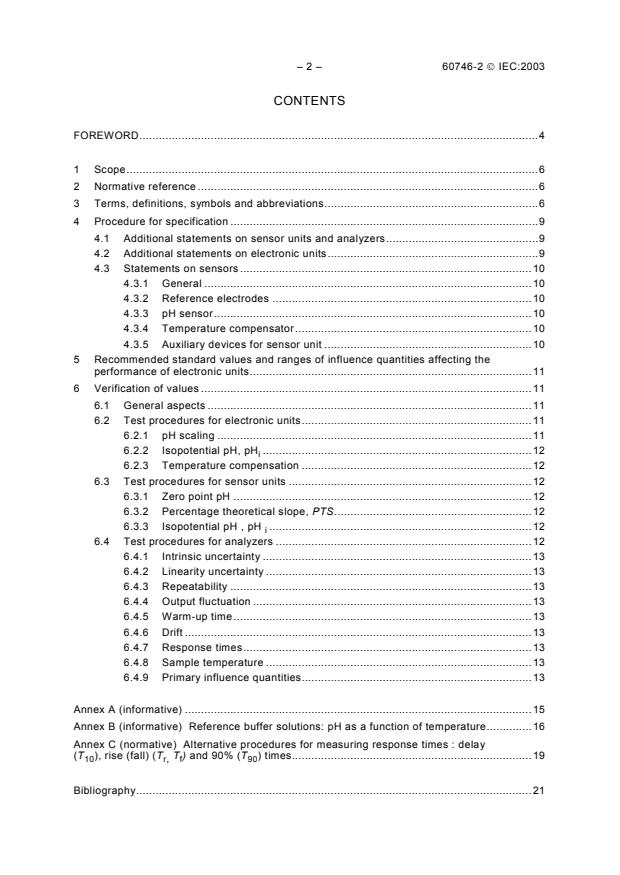
– 2 – 60746-2 IEC:2003(E)
CONTENTS
FOREWORD . 4
1 Scope . 6
2 Normative reference . 6
3 Definitions . 6
4 Procedure for specification . 8
4.1 Additional statements on sensor units and analyzers. . 9
4.2 Additional statements on electronic units . 9
4.3 Statements on sensors .10
4.3.1 General.10
4.3.2 Reference electrodes.10
4.3.3 pH sensor .10
4.3.4 Temperature compensator .10
4.3.5 Auxiliary devices for sensor unit.10
5 Recommended standard values and ranges of influence quantities affecting the
performance of electronic units .11
6 Verification of values .11
6.1 General aspects .11
6.2 Test procedures for electronic units .11
6.2.1 pH scaling.11
6.2.2 Isopotential pH, pH .12
i
6.2.3 Temperature compensation.12
6.3 Test procedures for sensor units.12
6.3.1 Zero point pH.12
6.3.2 Percentage theoretical slope, PTS .12
6.3.3 Isopotential pH , pH .12
i
6.4 Test procedures for analyzers.12
6.4.1 Intrinsic uncertainty.13
6.4.2 Linearity uncertainty.13
6.4.3 Repeatability.13
6.4.4 Output fluctuation .13
6.4.5 Warm-up time .13
6.4.6 Drift .13
6.4.7 Response times .13
6.4.8 Sample temperature.13
6.4.9 Primary influence quantities.13
Bibliography.21
Annex A (informative).15
Annex B (informative) Reference buffer solutions: pH as a function of temperature .16
Annex C (normative) Alternative procedures for measuring response times: delay
(T ), rise (fall) (T T ) and 90% (T ) times .19
10 r , f 90
60746-2 IEC:2003(E) – 3 –
Figure C.1 – Relation between T , T (T ) and T .19
10 r f 90
Table A.1 – Values of the slope factor, k = 2,3026 R.T/F.15
Table B.1 – Values of reference pH buffer solutions at various temperatures .17
Table B.2 – Composition of reference pH buffer solutions .18
– 4 – 60746-2 IEC:2003(E)
INTERNATIONAL ELECTROTECHNICAL COMMISSION
___________
EXPRESSION OF PERFORMANCE OF
ELECTROCHEMICAL ANALYZERS –
Part 2: pH value
FOREWORD
1) The IEC (International Electrotechnical Commission) is a worldwide organization for standardization comprising
all national electrotechnical committees (IEC National Committees). The object of the IEC is to promote
international co-operation on all questions concerning standardization in the electrical and electronic fields. To
this end and in addition to other activities, the IEC publishes International Standards. Their preparation is
entrusted to technical committees; any IEC National Committee interested in the subject dealt with may
participate in this preparatory work. International, governmental and non-governmental organizations liaising
with the IEC also participate in this preparation. The IEC collaborates closely with the International
Organization for Standardization (ISO) in accordance with conditions determined by agreement between the two
organizations.
2) The formal decisions or agreements of the IEC on technical matters express, as nearly as possible, an
international consensus of opinion on the relevant subjects since each technical committee has representation
from all interested National Committees.
3) The documents produced have the form of recommendations for international use and are published in the form
of standards, technical specifications, technical reports or guides and they are accepted by the National
Committees in that sense.
4) In order to promote international unification, IEC National Committees undertake to apply IEC International
Standards transparently to the maximum extent possible in their national and regional standards. Any
divergence between the IEC Standard and the corresponding national or regional standard shall be clearly
indicated in the latter.
5) The IEC provides no marking procedure to indicate its approval and cannot be rendered responsible for any
equipment declared to be in conformity with one of its standards.
6) Attention is drawn to the possibility that some of the elements of this International Standard may be the subject
of patent rights. The IEC shall not be held responsible for identifying any or all such patent rights.
International Standard IEC 60746-2 has been prepared by subcommittee 65D: Analysing
equipment, of IEC technical committee 65: Industrial-process measurement and control.
This second edition cancels and replaces the first edition published in 1982 and constitutes a
technical revision.
The text of this standard is based on the following documents:
FDIS Report on voting
65D/90A/FDIS 65D/94/RVD
Full information on the voting for the approval of this standard can be found in the report on
voting indicated in the above table.
The contents of this second edition remain substantially unchanged.
The major change is that Annex B has been updated in line with recent IUPAC
Recommendations for the measurement of pH.
This part of IEC 60746 shall be used in conjunction with IEC 60746-1, which includes further
definition of the scope and provides for the general aspects of all electrochemical analyzers.
This publication has been drafted in accordance with the ISO/IEC Directives, Part 2.
60746-2 IEC:2003(E) – 5 –
The committee has decided that the contents of this publication will remain unchanged
until 2007. At this date, the publication will be
• reconfirmed;
• withdrawn;
• replaced by a revised edition, or
• amended.
The contents of the corrigendum of May 2003 and July 2003 have been included in this
copy.
– 6 – 60746-2 IEC:2003(E)
EXPRESSION OF PERFORMANCE OF
ELECTROCHEMICAL ANALYZERS –
Part 2: pH value
1 Scope
This International Standard is intended:
– to specify terminology, definitions and requirements for statements by manufacturers for
analyzers, sensor units and electronic units used for the determination of the pH of
aqueous solutions;
– to establish performance tests for such analyzers, sensor units and electronic units;
– to provide basic documents to support the applications of quality assurance standards ISO
9001, ISO 9002 and ISO 9003.
2 Normative reference
The following referenced documents are indispensable for the application of this document.
For dated references, only the edition cited applies. For undated references, the latest edition
of the referenced document (including any amendments) applies.
IEC 60746-1:2002, Expression of performance of electrochemical analyzers – Part 1: General
ISO 9001, Quality management systems – Requirements
ISO 9002, Quality systems – Model for quality assurance in production, installation and
servicing
ISO 9003, Quality systems – Model for quality assurance in final inspection and test
3 Terms, definitions, symbols and abbreviations
3.1 Terms and definitions
For the purposes of this part of IEC 60746, the definitions given in Clause 3 of IEC 60746-1,
as well as the following apply.
3.1.1
pH value
A measure of the conventional hydrogen ion activity a (see equation (1)), in an aqueous
H+
solution given by the expression:
pH = –log a
H+
It is measured with respect to pH values assigned to certain reference pH buffer solutions.
The measurement is performed by determining the e.m.f., E, between a pair of electrodes
immersed in the sample to be measured, according to the cell scheme:
Reference electrode I Sample I pH electrode E
and a measurement with the same electrode pair at the same temperature in a reference
buffer solution of pH (S ) according to
60746-2 IEC:2003(E) – 7 –
Reference electrode I Buffer (S ) I pH electrode E(S )
1 1
The e.m.f.s E(S ), etc. are defined as the difference of the potential of the right-hand (pH)
electrode minus the potential of the left-hand (reference) electrode.
The pH of the sample is then given ideally by:
E − E(S )
pH = pH(S ) − (1)
k
where k = 2,3026 R.T/F, the theoretical, Nernstian, slope (see 3.1.2) .
Numerical values for k, the theoretical slope factor, at temperatures from 0 °C to 95 °C, are
given in Annex A.
NOTE Measurements in non or partially aqueous media are beyond the scope of this document; the reader should
refer to specialist texts.
3.1.2
practical slope factor and percentage theoretical slope
PTS
performance of the electrode pair may fall below the theoretical slope k exhibiting the practical
slope k′ which may be determined by replacing the sample with a second reference buffer
solution of pH value pH (S ) with an e.m.f. E(S ), then:
2 2
E()S − E(S)
2 1
k ′ = (2)
pH()S − pH(S )
1 2
NOTE The difference in pH value between the two reference buffer solutions should be as large as possible,
however, solutions above pH 10 and below pH 3 should not generally be used (see Annex B).
The percentage theoretical slope (PTS) is given by:
′
100 k
PTS =
k
Equations (1) and (2) can be combined by substituting k′ for k in equation (1) where:
[]E − E()S ⋅[]pH()S − pH(S )
1 1 2
pH = pH()S − (3)
E()S − E(S)
2 1
and the two reference buffers are usually chosen to bracket the pH of the sample.
3.1.3
pH sensor
the most commonly used pH sensor is the glass electrode, other potentiometric sensors, for
example, the antimony electrode only being adopted when its use is precluded. The pH isfet
(ion selective field effect transistor) sensor is an alternative to potentiometric sensors,
necessitating manufacturer-specific instrumentation.
3.1.4
reference electrode
appropriate half-cell providing a stable potential at constant temperature against which the
potential of the pH sensor is measured. Electrical contact with the sample is made at a liquid-
junction with the reference electrolyte or an interposed bridge solution.
– 8 – 60746-2 IEC:2003(E)
3.1.5
temperature compensator
electrical sensor in thermal contact with the sample providing the means for temperature
compensation
3.1.6
sensor unit
insertion or flow-through housing into which pH and reference sensors, as well as usually, a
temperature compensator (see 4.3.4) and possibly auxiliary devices (see 4.3.5) are fitted.
3.1.7
zero point pH
pH value at which the e.m.f. of the electrode pair (sensor unit) is 0 V at a given temperature,
unless otherwise stated, understood to be 25 °C.
3.1.8
isopotential pH, pH , of the electrode pair (sensor unit)
i
pH, pH , at which the e.m.f., E , of the electrode pair is temperature invariant. It is a function
i i
of the temperature coefficients of the individual electrodes and provides temperature
compensation for the electrode pair zero shift with appropriate instrumentation.
3.1.9
alkaline (or sodium) error of the glass electrode
error of the e.m.f. caused by sensitivity of pH glass electrodes to alkali ions at high pH
+ + + 2+.
resulting in apparent low pH values. Major interferences are Na > Li > K > Ba Errors
increase with increasing alkali concentration, pH and temperature. The magnitude is
dependent on the glass membrane composition.
3.1.10
reference buffer solution
aqueous solution prepared according to a specific formula using recognized analytical grade
–1
chemicals and water having a conductivity no greater than 2 μS·cm at 25 °C (see Annex B)
3.1.11
solution ground (earth) electrode
inert metal electrode required for differential input instrumentation as a comparison point
against which glass and reference electrode potentials are determined. For other applications,
it establishes the sample potential at instrument ground (earth)
3.1.12
simulator
simulator providing Nernstian values of e.m.f.s (see 3.1.1 and Table A.1), representing pH
values at selected temperatures through a high value series resistor representative of pH
sensors.
The simulator comprises a stepped voltage source followed by a selectable series resistor.
The network is such that output voltage steps represent multiples, and may provide sub-
multiples, of e.m.f. representing unit pH steps for selectable temperatures. The resistance of
the voltage divider network should not exceed 10 kΩ and the selectable series resistor shoul
...
IEC 60746-2 ®
Edition 2.0 2003-01
INTERNATIONAL
STANDARD
NORME
INTERNATIONALE
Expression of performance of electrochemical analyzers –
Part 2: pH value
Expression des qualités de fonctionnement des analyseurs électrochimiques –
Partie 2: Mesure du pH
All rights reserved. Unless otherwise specified, no part of this publication may be reproduced or utilized in any form
or by any means, electronic or mechanical, including photocopying and microfilm, without permission in writing from
either IEC or IEC's member National Committee in the country of the requester.
If you have any questions about IEC copyright or have an enquiry about obtaining additional rights to this publication,
please contact the address below or your local IEC member National Committee for further information.
Droits de reproduction réservés. Sauf indication contraire, aucune partie de cette publication ne peut être reproduite ni
utilisée sous quelque forme que ce soit et par aucun procédé, électronique ou mécanique, y compris la photocopie et les
microfilms, sans l'accord écrit de la CEI ou du Comité national de la CEI du pays du demandeur.
Si vous avez des questions sur le copyright de la CEI ou si vous désirez obtenir des droits supplémentaires sur cette
publication, utilisez les coordonnées ci-après ou contactez le Comité national de la CEI de votre pays de résidence.
IEC Central Office Tel.: +41 22 919 02 11
3, rue de Varembé Fax: +41 22 919 03 00
CH-1211 Geneva 20 info@iec.ch
Switzerland www.iec.ch
About the IEC
The International Electrotechnical Commission (IEC) is the leading global organization that prepares and publishes
International Standards for all electrical, electronic and related technologies.
About IEC publications
The technical content of IEC publications is kept under constant review by the IEC. Please make sure that you have the
latest edition, a corrigenda or an amendment might have been published.
Useful links:
IEC publications search - www.iec.ch/searchpub Electropedia - www.electropedia.org
The advanced search enables you to find IEC publications The world's leading online dictionary of electronic and
by a variety of criteria (reference number, text, technical electrical terms containing more than 30 000 terms and
committee,…). definitions in English and French, with equivalent terms in
It also gives information on projects, replaced and additional languages. Also known as the International
withdrawn publications. Electrotechnical Vocabulary (IEV) on-line.
IEC Just Published - webstore.iec.ch/justpublished Customer Service Centre - webstore.iec.ch/csc
Stay up to date on all new IEC publications. Just Published If you wish to give us your feedback on this publication
details all new publications released. Available on-line and or need further assistance, please contact the
also once a month by email. Customer Service Centre: csc@iec.ch.
A propos de la CEI
La Commission Electrotechnique Internationale (CEI) est la première organisation mondiale qui élabore et publie des
Normes internationales pour tout ce qui a trait à l'électricité, à l'électronique et aux technologies apparentées.
A propos des publications CEI
Le contenu technique des publications de la CEI est constamment revu. Veuillez vous assurer que vous possédez
l’édition la plus récente, un corrigendum ou amendement peut avoir été publié.
Liens utiles:
Recherche de publications CEI - www.iec.ch/searchpub Electropedia - www.electropedia.org
La recherche avancée vous permet de trouver des Le premier dictionnaire en ligne au monde de termes
publications CEI en utilisant différents critères (numéro de électroniques et électriques. Il contient plus de 30 000
référence, texte, comité d’études,…). termes et définitions en anglais et en français, ainsi que
Elle donne aussi des informations sur les projets et les les termes équivalents dans les langues additionnelles.
publications remplacées ou retirées. Egalement appelé Vocabulaire Electrotechnique
International (VEI) en ligne.
Just Published CEI - webstore.iec.ch/justpublished
Service Clients - webstore.iec.ch/csc
Restez informé sur les nouvelles publications de la CEI.
Just Published détaille les nouvelles publications parues. Si vous désirez nous donner des commentaires sur
Disponible en ligne et aussi une fois par mois par email. cette publication ou si vous avez des questions
contactez-nous: csc@iec.ch.
IEC 60746-2 ®
Edition 2.0 2003-01
INTERNATIONAL
STANDARD
NORME
INTERNATIONALE
Expression of performance of electrochemical analyzers –
Part 2: pH value
Expression des qualités de fonctionnement des analyseurs électrochimiques –
Partie 2: Mesure du pH
INTERNATIONAL
ELECTROTECHNICAL
COMMISSION
COMMISSION
ELECTROTECHNIQUE
PRICE CODE
INTERNATIONALE
CODE PRIX S
ICS 19.040; 71.040 ISBN 978-2-83220-372-9
– 2 – 60746-2 IEC:2003
CONTENTS
FOREWORD . 4
1 Scope . 6
2 Normative reference . 6
3 Terms, definitions, symbols and abbreviations . 6
4 Procedure for specification . 9
4.1 Additional statements on sensor units and analyzers . 9
4.2 Additional statements on electronic units . 9
4.3 Statements on sensors . 10
4.3.1 General . 10
4.3.2 Reference electrodes . 10
4.3.3 pH sensor . 10
4.3.4 Temperature compensator . 10
4.3.5 Auxiliary devices for sensor unit . 10
5 Recommended standard values and ranges of influence quantities affecting the
performance of electronic units . 11
6 Verification of values . 11
6.1 General aspects . 11
6.2 Test procedures for electronic units . 11
6.2.1 pH scaling . 11
6.2.2 Isopotential pH, pH . 12
i
6.2.3 Temperature compensation . 12
6.3 Test procedures for sensor units . 12
6.3.1 Zero point pH . 12
6.3.2 Percentage theoretical slope, PTS . 12
6.3.3 Isopotential pH , pH . 12
i
6.4 Test procedures for analyzers . 12
6.4.1 Intrinsic uncertainty . 13
6.4.2 Linearity uncertainty . 13
6.4.3 Repeatability . 13
6.4.4 Output fluctuation . 13
6.4.5 Warm-up time . 13
6.4.6 Drift . 13
6.4.7 Response times . 13
6.4.8 Sample temperature . 13
6.4.9 Primary influence quantities . 13
Annex A (informative) . 15
Annex B (informative) Reference buffer solutions: pH as a function of temperature . 16
Annex C (normative) Alternative procedures for measuring response times : delay
(T ), rise (fall) (T T ) and 90% (T ) times. 19
10 r, f 90
Bibliography . 21
60746-2 IEC:2003 – 3 –
Figure C.1 – Relation between T , T (T ) and T . . 19
10 r f 90
Table A.1 – Values of the slope factor, k = 2,3026 R.T/F . 15
Table B.1 – Values of reference pH buffer solutions at various temperatures . 17
Table B.2 – Composition of reference pH buffer solutions . 18
– 4 – 60746-2 IEC:2003
INTERNATIONAL ELECTROTECHNICAL COMMISSION
___________
EXPRESSION OF PERFORMANCE OF
ELECTROCHEMICAL ANALYZERS –
Part 2: pH value
FOREWORD
1) The IEC (International Electrotechnical Commission) is a worldwide organization for standardization comprising
all national electrotechnical committees (IEC National Committees). The object of the IEC is to promote
international co-operation on all questions concerning standardization in the electrical and electronic fields. To
this end and in addition to other activities, the IEC publishes International Standards. Their preparation is
entrusted to technical committees; any IEC National Committee interested in the subject dealt with may
participate in this preparatory work. International, governmental and non-governmental organizations liaising
with the IEC also participate in this preparation. The IEC collaborates closely with the International
Organization for Standardization (ISO) in accordance with conditions determined by agreement between the two
organizations.
2) The formal decisions or agreements of the IEC on technical matters express, as nearly as possible, an
international consensus of opinion on the relevant subjects since each technical committee has representation
from all interested National Committees.
3) The documents produced have the form of recommendations for international use and are published in the form
of standards, technical specifications, technical reports or guides and they are accepted by the National
Committees in that sense.
4) In order to promote international unification, IEC National Committees undertake to apply IEC International
Standards transparently to the maximum extent possible in their national and regional standards. Any
divergence between the IEC Standard and the corresponding national or regional standard shall be clearly
indicated in the latter.
5) The IEC provides no marking procedure to indicate its approval and cannot be rendered responsible for any
equipment declared to be in conformity with one of its standards.
6) Attention is drawn to the possibility that some of the elements of this International Standard may be the subject
of patent rights. The IEC shall not be held responsible for identifying any or all such patent rights.
International Standard IEC 60746-2 has been prepared by subcommittee 65D: Analysing
equipment, of IEC technical committee 65: Industrial-process measurement and control.
This second edition cancels and replaces the first edition published in 1982 and constitutes a
technical revision.
This bilingual version (2012-12) corresponds to the monolingual English version, published in
2003-01.
The text of this standard is based on the following documents:
FDIS Report on voting
65D/90A/FDIS 65D/94/RVD
Full information on the voting for the approval of this standard can be found in the report on
voting indicated in the above table.
The French version of this standard has not been voted upon.
The contents of this second edition remain substantially unchanged.
The major change is that Annex B has been updated in line with recent IUPAC
Recommendations for the measurement of pH.
60746-2 IEC:2003 – 5 –
This part of IEC 60746 shall be used in conjunction with IEC 60746-1, which includes further
definition of the scope and provides for the general aspects of all electrochemical analyzers.
This publication has been drafted in accordance with the ISO/IEC Directives, Part 2.
The committee has decided that the contents of this publication will remain unchanged
until 2007. At this date, the publication will be
• reconfirmed;
• withdrawn;
• replaced by a revised edition, or
• amended.
The contents of the corrigendum of May 2003 and July 2003 have been included in this copy.
– 6 – 60746-2 IEC:2003
EXPRESSION OF PERFORMANCE OF
ELECTROCHEMICAL ANALYZERS –
Part 2: pH value
1 Scope
This International Standard is intended:
– to specify terminology, definitions and requirements for statements by manufacturers for
analyzers, sensor units and electronic units used for the determination of the pH of
aqueous solutions;
– to establish performance tests for such analyzers, sensor units and electronic units;
– to provide basic documents to support the applications of quality assurance standards ISO
9001, ISO 9002 and ISO 9003.
2 Normative reference
The following referenced documents are indispensable for the application of this document.
For dated references, only the edition cited applies. For undated references, the latest edition
of the referenced document (including any amendments) applies.
IEC 60746-1:2002, Expression of performance of electrochemical analyzers – Part 1: General
ISO 9001, Quality management systems – Requirements
ISO 9002, Quality systems – Model for quality assurance in production, installation and
servicing
ISO 9003, Quality systems – Model for quality assurance in final inspection and test
3 Terms, definitions, symbols and abbreviations
3.1 Terms and definitions
For the purposes of this part of IEC 60746, the definitions given in Clause 3 of IEC 60746-1,
as well as the following apply.
3.1.1
pH value
A measure of the conventional hydrogen ion activity a (see equation (1)), in an aqueous
H+
solution given by the expression:
pH = –log a
H+
It is measured with respect to pH values assigned to certain reference pH buffer solutions.
The measurement is performed by determining the e.m.f., E, between a pair of electrodes
immersed in the sample to be measured, according to the cell scheme:
Reference electrode I Sample I pH electrode E
60746-2 IEC:2003 – 7 –
and a measurement with the same electrode pair at the same temperature in a reference
buffer solution of pH (S ) according to
Reference electrode I Buffer (S ) I pH electrode E(S )
1 1
The e.m.f.s E(S ), etc. are defined as the difference of the potential of the right-hand (pH)
electrode minus the potential of the left-hand (reference) electrode.
The pH of the sample is then given ideally by:
E− E(S )
pH= pH(S )− (1)
k
where k = 2,3026 R.T/F, the theoretical, Nernstian, slope (see 3.1.2) .
Numerical values for k, the theoretical slope factor, at temperatures from 0 °C to 95 °C, are
given in Annex A.
NOTE Measurements in non or partially aqueous media are beyond the scope of this document; the reader should
refer to specialist texts.
3.1.2
practical slope factor and percentage theoretical slope
PTS
performance of the electrode pair may fall below the theoretical slope k exhibiting the practical
slope k′ which may be determined by replacing the sample with a second reference buffer
solution of pH value pH (S ) with an e.m.f. E(S ), then:
2 2
E(S )− E(S )
2 1
k′= (2)
pH(S )− pH(S )
1 2
NOTE The difference in pH value between the two reference buffer solutions should be as large as possible,
however, solutions above pH 10 and below pH 3 should not generally be used (see Annex B).
The percentage theoretical slope (PTS) is given by:
′
100 k
PTS=
k
Equations (1) and (2) can be combined by substituting k′ for k in equation (1) where:
( ) ( ) ( )
[E− E S ]⋅[pH S − pH S ]
1 1 2
pH= pH(S )− (3)
E(S )− E(S )
2 1
and the two reference buffers are usually chosen to bracket the pH of the sample.
3.1.3
pH sensor
the most commonly used pH sensor is the glass electrode, other potentiometric sensors, for
example, the antimony electrode only being adopted when its use is precluded. The pH isfet
(ion selective field effect transistor) sensor is an alternative to potentiometric sensors,
necessitating manufacturer-specific instrumentation.
3.1.4
reference electrode
appropriate half-cell providing a stable potential at constant temperature against which the
potential of the pH sensor is measured. Electrical contact with the sample is made at a liquid-
junction with the reference electrolyte or an interposed bridge solution.
– 8 – 60746-2 IEC:2003
3.1.5
temperature compensator
electrical sensor in thermal contact with the sample providing the means for temperature
compensation
3.1.6
sensor unit
insertion or flow-through housing into which pH and reference sensors, as well as usually, a
temperature compensator (see 4.3.4) and possibly auxiliary devices (see 4.3.5) are fitted.
3.1.7
zero point pH
pH value at which the e.m.f. of the electrode pair (sensor unit) is 0 V at a given temperature,
unless otherwise stated, understood to be 25 °C.
3.1.8
isopotential pH, pH , of the electrode pair (sensor unit)
i
pH, pH , at which the e.m.f., E , of the electrode pair is temperature invariant. It is a function
i i
of the temperature coefficients of the individual electrodes and provides temperature
compensation for the electrode pair zero shift with appropriate instrumentation.
3.1.9
alkaline (or sodium) error of the glass electrode
error of the e.m.f. caused by sensitivity of pH glass electrodes to alkali ions at high pH
+ + + 2+.
resulting in apparent low pH values. Major interferences are Na > Li > K > Ba Errors
increase with increasing alkali concentration, pH and temperature. The magnitude is
dependent on the glass membrane composition.
3.1.10
reference buffer solution
aqueous solution prepared according to a specific formula using recognized analytical grade
–1
chemicals and water having a conductivity no greater than 2 µS·cm at 25 °C (see Annex B)
3.1.11
solution ground (earth) electrode
inert metal electrode required for differential input instrumentation as a comparison point
against which glass and reference electrode potentials are determined. For other applications,
it establishes the sample potential at instrument ground (earth)
3.1.12
simulator
simulator providing Nernstian values of e.m.f.s (see 3.1.1 and Table A.1), representing pH
values at selected temperatures through a high value series resistor representative of pH
sensors.
The simulator comprises a stepped voltage source followed by a selectable series resistor.
The network is such that output voltage steps represent multiples, and may provide sub-
multiples, of e.m.f. representing unit pH steps for selectable temperatures. The resistance of
the voltage divider network should not exceed 10 kΩ and the selectable series resistor should
be 1 000MΩ (±10%).
3.2 Symbols
a = hydrogen ion activity
H+
pH = pH of the solution measured at temperature t
pH(S ) = pH of the first reference buffer solution at temperature t
pH(S ) = pH of the second reference buffer solution at temperature t
60746-2 IEC:2003 – 9 –
pH = pH at the isopotential point
i
E = e.m.f. in the measured sample at temperature t
E(S ) = e.m.f. in the first reference buffer solution at temperature t
E(S ) = e.m.f. in the second reference buffer solution at temperature t
E = e.m.f. at the isopotential point
i
F = the Faraday constant
R = the molar gas constant
t = temperature in degrees celsius
T = the temperature in kelvin of sample
k = the theoretical, Nernstian, slope of the electrode pair at temperature t
/
k = the practical slope of the electrode pair at temperature t
4 Procedure for specification
See Clause 5 of IEC 60746-1, plus the following:
NOTE Uncertainties and uncertainty limits should be stated in pH values.
4.1 Additional statements on sensor units and analyzers
4.1.1 Type of sensor unit (i.e., flow-through or insertion unit).
4.1.2 Sensor unit dimensions, including mounting and connections.
4.2 Additional statements on electronic units
4.2.1 Number of digits and size of display, or for analogue instruments, scale width.
4.2.2 Output signal/signals, if adjustable, whether isolated from input and/or ground (earth)
and permitted output load.
4.2.3 Temperature compensation range, compensator type and maximum permitted
resistance of compensator plus connection cable; if only manual compensation available, it
should be stated.
4.2.4 Percentage theoretical slope adjustment.
4.2.5 Zero point pH adjustment if provided and sensor pair zero point pH acceptance range.
, and adjustment, if provided.
4.2.6 Isopotential pH, pH
i
4.2.7 Range of sample pH temperature coefficient adjustment, if provided.
4.2.8 Maximum allowable common mode input voltage.
4.2.9 If preamplifier may be separately mounted.
4.2.10 Input resistance
– 10 – 60746-2 IEC:2003
4.3 Statements on sensors
4.3.1 General
4.3.1.1 Dimensions, including as appropriate, attached cable and/or connector type.
4.3.1.2 Rated temperature range.
4.3.1.3 Suitability of sensor pair for specific applications, for example, acidic fluoride
samples, low conductivity and natural waters.
NOTE Combined sensors incorporating pH and reference electrodes are common, they may also include a
temperature compensator.
4.3.2 Reference electrodes
4.3.2.1 Type of reference electrode, whether single or double junction variety and if sealed,
gelled or refillable.
4.3.2.2 Reference electrolyte composition.
4.3.2.3 Type of junction between reference electrolyte or interposed bridge solution and
sample.
4.3.2.4 If refillable, volume of reservoir and flow rate under stated hydrostatic pressure.
4.3.2.5 Nominal resistance at 25 °C.
4.3.3 pH sensor
4.3.3.1 Type, i.e., glass electrode, isfet or other.
NOTE For isfet sensor, state if preamplifier is available permitting its use with a conventional pH meter.
4.3.3.2 Zero point pH and isopotential pH, pH , with stated reference electrode.
i
4.3.3.3 Rated pH range.
+
4.3.3.4 Nominal sodium error at 25 °C in, for example, 1 M Na solution at a stated pH in the
upper region of the rated pH range.
4.3.3.5 Nominal resistance at 25 °C.
4.3.4 Temperature compensator
Type of compensator (for example, Pt 100).
4.3.5 Auxiliary devices for sensor unit
For example, devices for cleaning, pressurization of reference electrolyte.
4.3.5.1 Required power supply and consumption; compressed air pressure and consumption.
4.3.5.2 Volume and consumption of, for example, cleaning solutions.
60746-2 IEC:2003 – 11 –
5 Recommended standard values and ranges of influence quantities affecting
the performance of electronic units
See Annex A of IEC 60746-1.
6 Verification of values
See Clause 6 of IEC 6046-1, plus the following:
6.1 General aspects
6.1.1 Glass electrodes shall be conditioned according to the manufacturer’s instructions. At
least 12 h hydration in a neutral or mildly acidic buffer solution shall be allowed for initial
equilibration of new electrodes.
6.1.2 Reference pH buffer solutions shall be used for all tests unless otherwise agreed upon
with the manufacturer (see 3.5 of IEC 60746-1 and Annex B) .
NOTE IUPAC recommended reference buffer solutions are tabulated in Annex B. Other reference pH buffer
solutions may be used .
6.1.3 Test solutions shall be applied in a manner suited to the sensor unit.
6.1.3.1 Flow-through sensor units
Solutions shall be applied at a flow rate within the manufacturer’s rated range.
6.1.3.2 Insertion sensor units
For measurements with more than one solution, unless otherwise indicated, the electrode pair
(sensor unit) shall be rinsed with deionized water, thereafter pre-rinsing with the new solution
prior to immersion. It is recommended that measurements shall be made in continuously
stirred solutions to ensure homogeneity.
6.2 Test procedures for electronic units
Prior to testing the analyzer, the electronic unit shall be separately tested with a simulator
such as that described in 3.1.12 and using either manual temperature control or a suitable
resistor connected to the temperature compensator input.
6.2.1 pH scaling
If adjustable, set the isopotential control to the zero point pH, usually both are pH 7, and, if
provided, cancel or adjust the sample pH temperature compensation to zero. If manually
adjustable, set the percentage slope control to 100%. Adjust the manual or simulated
temperature to 25°C or other reference temperature. Connect a simulator and check the
scaling throughout pH 0 to pH 14 or the test pH range. At the scale length extremes, switch-in
the series high resistance simulating that of the glass electrode as a check of the instrument’s
input impedance, an immediate transient should rapidly dissipate. Repeat the procedure for
other temperatures within the test range (see Table A.1).
With the simulator, impose a lower percentage slope output (for example, at 25 °C for 90 %
slope, 53,24 mV per pH unit) at 25 °C or other reference temperature to assess the
percentage slope facility.
– 12 – 60746-2 IEC:2003
6.2.2 Isopotential pH, pH
i
The electrode terminals, including solution earth if applicable, are shorted and the
temperature set to 25°C, either manually or with a suitable variable resistance . The display
will indicate the zero point, usually pH 7 and identical to the isopotential pH, pH . Change the
i
temperature setting from 0° to 50°C, ideally there will be no display variation.
6.2.3 Temperature compensation
Connect a simulator and adjust the temperature control to 25°C. Apply the appropriate
simulated pH values for pH 0 and pH 14, or the test pH span. Repeat the procedure for other
temperatures within the test temperature range.
NOTE For instruments with manually adjustable buffer control, repeat the test given in 6.2.2 before performing
this test then readjust the buffer control so that no discernible variation is observed on repeating the test.
6.3 Test procedures for sensor units
6.3.1 Zero point pH
Standardize the analyzer in accordance with the manufacturer’s instructions. If the instrument
does not incorporate zero point pH registration, short the sensor inputs and the zero point pH
of the electrode pair is displayed.
6.3.2 Percentage theoretical slope, PTS
100∆ pH
observed
PTS=
∆ pH
actual
Standardize the analyzer in accordance with the manufacturer’s instructions. Generally, two
buffer solutions are required and the PTS of the electrode pair is registered. Alternatively, with
the sensors in a buffer solution at about pH 4 and the percentage slope control, if fitted, set at
100 %, set the display to the appropriate value. Replace the buffer solution with a buffer
solution at about pH 9 or pH 10. For those instruments with PTS adjustment, adjust to the
appropriate pH value. For those instruments without PTS control, it may be calculated from
the ratio of observed to actual pH buffer values by the above equation.
See also 3.1.2 for instruments with manually adjustable buffer control.
6.3.3 Isopotential pH , pH
i
For this test, the electronic unit is switched to voltage mode.
The e.m.f.s of the electrode pair in two buffer solutions, preferably bracketing the nominal
isopotential pH, at two or more temperatures at least 20 °C apart. Plot the e.m.f.s against pH,
the intersection point is the isopotential pH, pH of the electrode pair.
i,
6.4 Test procedures for analyzers
For applications where these tests are inappropriate, additional procedures may be agreed
upon with the manufacturer.
___________
For instruments with manually adjustable buffer control, set the display to the isopotential point, which may be
adjustable.
60746-2 IEC:2003 – 13 –
6.4.1 Intrinsic uncertainty
6.4.2 Linearity uncertainty
Dependent upon the pH test range, this test procedure may have to be performed with fewer
than five test solutions (see 6.2.2 of IEC 60746-1).
6.4.3 Repeatability
6.4.4 Output fluctuation
6.4.5 Warm-up time
6.4.6 Drift
NOTE Drift is usually reported as a linear regression in two ways, short term over a period in the range 1 h to 24h
and for a longer period in the range of 30 days to 100 days.
6.4.7 Response times
Procedures are given in Annex C, where Procedure A is the preferred and for flow-through
sensor units, the only appropriate method.
6.4.8 Sample temperature
Errors caused by the variation of sample temperature shall be determined at two points in the
measurement range near the lower and upper limits. Measurements shall be made at the
reference sample temperature, then at the lowest temperature and repeated at the highest
temperature of the test range.
–1
NOTE The pH of solutions vary with temperature from approximately (–0,04 to +0,01) pH°C . Some
electronic units incorporate solution temperature coefficient compensation.
6.4.9 Primary influence quantities
Response to the following influence quantities will generally need to be determined using test
solutions near the upper and lower limits of the range. Influence quantities shall first be
applied at the reference value, then near the lower and upper rated values. The final
measurement shall be made when the quantity is returned to the reference value.
Variation in electrical supply characteristics usually affect the electronic unit only and may be
tested with only one solution at the mid point of the span. These tests may be carried out on
the electronics unit alone using a simulator.
− Vibration
− Supply voltage
− a.c. supply frequency or,
− d.c. supply ripple and impedance
− Electromagnetic compatibility
− Ambient temperature
− Humidity
− Sample flow-rate
− Sample pressure
− Sample outlet pressure
NOTE Sample pressure variation may affect the reference electrode. Pressure change results in an immediate
offset, the magnitude a function of both the differential pressure across the liquid junction and the latter’s nature.
With non-refillable and gel-filled electrodes, the offset quickly dissipates. For reservoir-fed electrodes with pressure
– 14 – 60746-2 IEC:2003
equilibration between the reservoir and the sample line, the effect is eliminated: without such equilibration the
offset will persist.
Additional influence quantities which may require verification are listed in IEC 60746-1.
60746-2 IEC:2003 – 15 –
Annex A
(informative)
Table A.1 – Values of the slope factor, k = 2,3026 R.T/F
t t
k k
°C mV °C mV
0 54,199 50 64,120
5 55,191 55 65,112
10 56,183 60 66,104
15 57,175 65 67,096
20 58,167 70 68,088
25 59,159 75 69,081
30 60,152 80 70,073
35 61,144 85 71,065
40 62,136 90 72,057
45 63,128 95 73,049
–1 –1
R = 8,314 41 J.K .mol
–1
F = 96 493,1 C.mol
T = temperature in kelvin
– 16 – 60746-2 IEC:2003
Annex B
(informative)
Reference buffer solutions: pH as a function of temperature
Reference buffer solution data to 50 ºC are selected from the IUPAC 2002 Recommendations
for the measurement of pH [1] .
Data for higher temperatures are from [2] .
Values were determined in cells without liquid junction.
Buffers and solutions A and J are useful at low and high pH, however, because of liquid
junction errors, should not be used when measurements are made within the pH 3 to pH 10
range.
Other reference buffer solutions may be used for calibration and test solutions.
NOTE 1 For highest accuracy, solutions may be prepared with chemicals certified by a national metrological
institution
NOTE 2 The IUPAC 2002 Recommendations replace those of 1985 and form the basis on which to provide
traceability to SI that must include consideration of all uncertainties of pH measurement [1].
___________
Values are presented in Table B.1 and compositions in Table B.2.
Numbers in square brackets refer to the bibliography.
60746-2 IEC:2003 – 17–
Table B.1 – Values of reference pH buffer solutions at various temperatures
Buffer 0 °C 5 °C 10 °C 15 °C 20 °C 25 °C 30 °C 35 °C 37 °C 40 °C 50 °C 60 °C 70 °C 80 °C 90 °C 95 °C
A 1,67 1,67 1,67 1,67 1,68 1,68 1,68 1,68 1,69 1,69 1,71 1,72 1,74 1,77 1,75 1,81
B -- -- -- -- -- 3,557 3,552 3,549 3,548 3,547 3,549 3,55 3,57 3,60 3,63 3,65
C 4,000 3,998 3,997 3,998 4,000 4,005 4,011 4,018 4,022 4,027 4,050 4,06 4,12 4,16 4,21 4,24
D 6,984 6,951 6,923 6,900 6,881 6,865 6,853 6,844 6,841 6,838 6,833 6,84 6,85 6,86 6,88 6,89
E 7,534 7,500 7,472 7,448 7,429 7,413 7,400 7,389 7,386 7,380 7,367 -- -- -- -- --
F 8,47 8,30 8,14 7,99 7,84 7,70 7,56 7,43 7,38 7,31 7,07 -- -- -- -- --
G 9,51 9,43 9,36 9,30 9,25 9,19 9,15 -- 9,09 9,07 9,01 8,93 8,90 8,88 8,84 8,89
H 9,464 9,395 9,332 9,276 9,225 9,180 9,139 9,102 9,088 9,068 9,011 8,97 8,93 8,91 8,90 8,89
I 10,317 10,245 10,179 10,118 10,062 10,012 9,966 9,926 9,910 9,889 9,828 9,75 9,73 9,73 9,75 9,77
J 13,42 13,21 13,00 12,81 12,63 12,45 12,29 12,13 12,07 11,98 11,71 11,45 -- -- -- --
Primary pH (PS) standard , 0° – 50° C [1] .
Secondary pH (SS) standard , 0° – 50° C [1] .
– 18– 60746-2 IEC:2003
Table B.2 – Composition of reference pH buffer solutions
Molality Mass
Buffer
Substance Molecular formula
Solution
–1 –3
mol. kg g.dm
A Potassium tetroxalate KH C O .2H O 0,05 12,620
3 4 8 2
Saturated at
Potassium hydrogen
B KHC H 0 6,4
4 4 6
tartrate
25°C
Potassium hydrogen
C KHC H O 0,05 10,12
8 4 4
phthalate
Disodium hydrogen Na HPO 0,025 3,533
2 4
phosphate
D +
Potassium dihydrogen KH PO 0,025 3,388
2 4
phosphate
Disodium hydrogen Na HPO 0,030 43 4,302
2 4
phosphate
E +
Potassium dihydrogen KH PO 0,008 69 1,179
2 4
phosphate
†
Tris
OH) CNH
(CH 0,016 67
1,999
2 3 2
+
F
Tris hydrochloride
(CH OH) CNH .HCl 0,05
7,800
2 3 2
G Disodium tetraborate Na B O .10H O 0,05 19,012
2 4 7 2
H Disodium
Na B O .10H O 0,01 3,806
2 4 7 2
tetraborate
Sodium hydrogen NaHCO 0,025 2,092
carbonate
I
+
Sodium carbonate Na CO 0,025 2,640
2 3
J Calcium hydroxide Ca (OH) Saturated at 25 °C 1,5
†
tris (hydroxymethyl) aminomethane
–1
NOTE All reagents shall be of analytical grade and the conductivity of the water shall be no greater than 2µS cm
(at 25 °C).
60746-2 IEC:2003 – 19 –
Annex C
(normative)
Alternative procedures for measuring response times :
delay (T ), rise (fall) (T T ) and 90% (T ) times
10 r, f 90
C.1 Procedure A
A recorder is connected to the output terminals of the analyzer. The sensor unit is placed in a
flow-through cell (as similar as possible to that cell used in the application) and equipped with
a two-way stopcock to supply alternately reference buffer solutions with low and high pH
values. A reference buffer solution close to the minimum rated pH value is supplied until a
constant reading on the recorder is obtained, then the two-way stopcock is switched to supply
a reference buffer solution close to the maximum rated pH value and a mark made on the
recorder chart. The maximum pH buffer solution is supplied until a constant reading is
obtained. The stopcock is switched back to the minimum pH buffer solution and a second
mark is made on the recorder chart. Again, the minimum pH buffer solution is supplied until a
constant reading is obtained.
The flow rate of the solutions may be adjusted to the maximum specified by the manufacturer
for the analyzer. The temperature of the solutions and sensor unit shall be constant within
+1 ºC and shall be reported with other results.
The values for delay time (T ) and 90% time (T ), for both increasing and decreasing step
10 90
changes, rise time (T ) and fall time (T ) are determined from the chart speed. The larger of
r f
the two delay, rise or fall and 90% times are reported.
T
T T
10 f
100 %
90 % 10 %
Step
Step
change change
10 % 90 %
100 %
T
T
10 r
T
IEC 3026/02
Figure C.1 – Relation between T , T (T ) and T
10 r f 90
– 20– 60746-2 IEC:2003
C.2 Procedure B
Similar to that described in C.1, except that the sensor unit is immersed alternately in two
different tanks, one containing a stirred buffer solution close to the minimum rated pH value
and the other containing a stirred buffer solution close to the maximum rated pH value. When
transferring the sensor unit from one tank to the other, the sensor unit is shaken, not wiped or
rinsed. The sensor unit is left in the tanks until constant readings are obtained.
60746-2 IEC:2003 – 21 –
Bibliography
[1] Buck, R.P., Rondinini, S., Covington, A.K., Baucke, F.G.K., Camoes, M.F., Milton,
M.J.T., Mussini, T., Naumann, R., Pratt, K.W., Spitzer, P., Wilson, G.S., Recom-
mendations for the measurement of pH, J. Pure. Appl. Chem., 2002, 74, 2169-2200
[2] Bates, R.G., Determination of pH , 2nd ed. J. Wiley, New York, 1973.
___________
– 22 – 60746-2 CEI:2003
SOMMAIRE
AVANT-PROPOS . 24
1 Domaine d’application . 26
2 Références normatives . 26
3 Termes, définitions, symboles et abréviations . 26
3.1 Termes et définitions . 26
3.2 Symboles . 29
4 Procédure pour la spécification . 29
4.1 Informations complémentaires concernant les détecteurs et les analyseurs . 29
4.2 Informations complémentaires concernant les unités électroniques . 29
4.3 Informations concernant les détecteurs . 30
4.3.1 Généralités . 30
4.3.2 Électrodes de référence . 30
4.3.3 Détecteur de pH . 30
4.3.4 Compensateur de température . 31
4.3.5 Dispositifs auxiliaires pour détecteur . 31
5 Valeurs et domaines normalisés recommandés pour les grandeurs d’influence
affectant les qualités de fonctionnement des unités électroniques . 31
6 Vérification des valeurs . 31
6.1 Considérations générales . 31
6.2 Procédures d'essai des unités électroniques . 32
6.2.1 Mise à l'échelle du pH . 32
6.2.2 pH isopotentiel, pH . 32
i
6.2.3 Compensation en température . 32
6.3 Procédures d'essai des détecteurs . 32
6.3.1 Point zéro pH . 32
6.3.2 Pourcentage de la pente théorique (PPT) . 33
6.3.3 pH isopotentiel, pH . 33
i
6.4 Procédures d'essai des analyseurs . 33
6.4.1 Incertitude intrinsèque . 33
6.4.2 Incertitude de linéarité . 33
6.4.3 Répétabilité . 33
6.4.4 Fluctuation du signal de sortie . 33
6.4.5 Temps de préchauffage . 33
6.4.6 Dérive . 33
6.4.7 Temps de réponse . 33
6.4.8 Température de l'échantillon . 33
6.4.9 Principales grandeurs d'influence . 34
Annexe A (informative) . 35
Annexe B (informative) Solutions tampons de référence: pH en fonction de la
température .
...