

IEC 61084-2-3:2017
(Main)Cable trunking systems and cable ducting systems for electrical installations - Part 2-3: Particular requirements - Slotted cable trunking systems intended for installation in cabinets
General Information
- Abstract
IEC 61084-2-3:2017 specifies requirements and tests for cable trunking systems (CTS) and cable ducting systems (CDS) intended for the accommodation, and where necessary for the electrically protective separation, of insulated conductors, cables and possibly other electrical equipment in electrical and/or communication systems installations. The maximum voltage of these installations is 1 000 V AC and 1 500 V DC.
Slotted cable trunking systems are intended for mounting inside cabinets in electrical and/or communication system installations.
This document does not apply to conduit systems, cable tray systems, cable ladder systems, power track systems or equipment covered by other standards.
This International standard is to be used in conjunction with IEC 61084-1:2017.
- Status
- Published
- Publication Date
- 25-Feb-2024
- Technical Committee
- SC 23A - Cable management systems
- Drafting Committee
- MT 5 - TC 23/SC 23A/MT 5
- Current Stage
- PPUB - Publication issued
- Start Date
- 22-Mar-2017
- Completion Date
- 07-Apr-2017
Buy Documents
IEC 61084-2-3:2017 - Cable trunking systems and cable ducting systems for electrical installations - Part 2-3: Particular requirements - Slotted cable trunking systems intended for installation in cabinets Released:3/22/2017

IEC 61084-2-3:2017+AMD1:2024 CSV - Cable trunking systems and cable ducting systems for electrical installations - Part 2-3: Particular requirements - Slotted cable trunking systems intended for installation in cabinets Released:2/26/2024
Overview
IEC 61084-2-3:2017 is an internationally recognized standard published by the International Electrotechnical Commission (IEC) that defines particular requirements for slotted cable trunking systems intended for installation inside cabinets in electrical and communication system installations. Slotted cable trunking systems are essential for organizing, protecting, and separating insulated conductors and cables, accommodating electrical equipment safely within enclosures. This standard applies to systems designed for use in installations with a maximum voltage of 1,000 V AC and 1,500 V DC.
Unlike other cable management systems such as conduit systems, cable trays, or ladder systems, IEC 61084-2-3 focuses specifically on slotted cable trunking systems installed inside cabinets to ensure efficient space utilization and compliance with electrical installation safety regulations.
Key Topics
Scope and Application
The document specifies requirements and testing procedures for slotted cable trunking systems (CTS) for electrical and communication systems, ensuring they provide reliable accommodation and protection of insulated conductors and cables.System Components
Defined components include:- Slotted trunking lengths with slotted walls and covers
- Trunking fittings and accessories
- Fixing devices to secure trunking within cabinets
Design and Construction
Systems must be designed to provide mechanical robustness and maintain electrical separation where required. The standard emphasizes support, accommodation, and segregation of conductors to avoid potential hazards.Testing and Performance Measures
Includes tests for:- Mechanical properties ensuring durability and impact resistance
- Electrical properties aligned with insulation and safety requirements
- Thermal properties to withstand operational temperatures
- Fire hazard assessments such as needle-flame testing
- Resistance to external influences and electromagnetic compatibility
Marking and Documentation
Clear indications of system classifications, voltage ratings, and product documentation are required to ensure proper use and regulatory compliance.Compatibility
The standard is designed to be used in conjunction with IEC 61084-1:2017, which covers general requirements for cable trunking and ducting systems.
Applications
IEC 61084-2-3 is crucial for:
- Electrical Cabinets and Enclosures: Proper cable management inside control panels, switchgear, and communication cabinets.
- Industrial Installations: Secure routing and protection of power and signal cables within machinery enclosures.
- Telecommunication Systems: Organizing and segregating communication cables inside distribution cabinets.
- Low-Voltage Electrical Systems: Installations operating up to 1,000 V AC or 1,500 V DC requiring dependable cable support and separation.
By following this standard, manufacturers and installers can ensure improved safety, reduced fire risk, easier maintenance, and compliance with international electrical safety regulations.
Related Standards
- IEC 61084-1:2017 – General requirements for cable trunking and ducting systems for electrical installations. It provides the foundational principles and definitions that IEC 61084-2-3 builds upon.
- IEC 60228:2004 – Conductors of insulated cables; referenced for conductor specifications in cable installations.
- IEC 60695-11-5:2016 – Fire hazard testing methods, including the needle-flame test used to assess fire performance of trunking systems.
These related standards support the comprehensive framework needed for ensuring quality and safety in cable management solutions for electrical installations.
Keywords: IEC 61084-2-3, cable trunking systems, slotted cable trunking, cable ducting systems, electrical installations, cable management, cable segregation, electrical safety standards, IEC standards, cable trunking installation, electrical cabinets.
Relations
- Effective Date
- 05-Sep-2023
Buy Documents
IEC 61084-2-3:2017 - Cable trunking systems and cable ducting systems for electrical installations - Part 2-3: Particular requirements - Slotted cable trunking systems intended for installation in cabinets Released:3/22/2017
IEC 61084-2-3:2017+AMD1:2024 CSV - Cable trunking systems and cable ducting systems for electrical installations - Part 2-3: Particular requirements - Slotted cable trunking systems intended for installation in cabinets Released:2/26/2024
Get Certified
Connect with accredited certification bodies for this standard

IMQ S.p.A. (Certification)
Italian electrical product certification.

SLG Prüf- und Zertifizierungs GmbH
German testing and certification body.

UL Solutions
Global safety science company with testing, inspection and certification.
Sponsored listings
Frequently Asked Questions
IEC 61084-2-3:2017 is a standard published by the International Electrotechnical Commission (IEC). Its full title is "Cable trunking systems and cable ducting systems for electrical installations - Part 2-3: Particular requirements - Slotted cable trunking systems intended for installation in cabinets". This standard covers: IEC 61084-2-3:2017 specifies requirements and tests for cable trunking systems (CTS) and cable ducting systems (CDS) intended for the accommodation, and where necessary for the electrically protective separation, of insulated conductors, cables and possibly other electrical equipment in electrical and/or communication systems installations. The maximum voltage of these installations is 1 000 V AC and 1 500 V DC. Slotted cable trunking systems are intended for mounting inside cabinets in electrical and/or communication system installations. This document does not apply to conduit systems, cable tray systems, cable ladder systems, power track systems or equipment covered by other standards. This International standard is to be used in conjunction with IEC 61084-1:2017.
IEC 61084-2-3:2017 specifies requirements and tests for cable trunking systems (CTS) and cable ducting systems (CDS) intended for the accommodation, and where necessary for the electrically protective separation, of insulated conductors, cables and possibly other electrical equipment in electrical and/or communication systems installations. The maximum voltage of these installations is 1 000 V AC and 1 500 V DC. Slotted cable trunking systems are intended for mounting inside cabinets in electrical and/or communication system installations. This document does not apply to conduit systems, cable tray systems, cable ladder systems, power track systems or equipment covered by other standards. This International standard is to be used in conjunction with IEC 61084-1:2017.
IEC 61084-2-3:2017 is classified under the following ICS (International Classification for Standards) categories: 29.060.01 - Electrical wires and cables in general; 29.120.10 - Conduits for electrical purposes. The ICS classification helps identify the subject area and facilitates finding related standards.
IEC 61084-2-3:2017 has the following relationships with other standards: It is inter standard links to IEC 61084-2-3:2017/AMD1:2024. Understanding these relationships helps ensure you are using the most current and applicable version of the standard.
IEC 61084-2-3:2017 is available in PDF format for immediate download after purchase. The document can be added to your cart and obtained through the secure checkout process. Digital delivery ensures instant access to the complete standard document.
Standards Content (Sample)
IEC 61084-2-3 ®
Edition 1.0 2017-03
INTERNATIONAL
STANDARD
NORME
INTERNATIONALE
Cable trunking systems and cable ducting systems for electrical installations –
Part 2-3: Particular requirements – Slotted cable trunking systems intended for
installation in cabinets
Systèmes de goulottes et systèmes de conduits-profilés pour installations
électriques –
Partie 2-3: Exigences particulières – Systèmes de goulottes de câblage pour
installation dans les armoires
All rights reserved. Unless otherwise specified, no part of this publication may be reproduced or utilized in any form
or by any means, electronic or mechanical, including photocopying and microfilm, without permission in writing from
either IEC or IEC's member National Committee in the country of the requester. If you have any questions about IEC
copyright or have an enquiry about obtaining additional rights to this publication, please contact the address below or
your local IEC member National Committee for further information.
Droits de reproduction réservés. Sauf indication contraire, aucune partie de cette publication ne peut être reproduite
ni utilisée sous quelque forme que ce soit et par aucun procédé, électronique ou mécanique, y compris la photocopie
et les microfilms, sans l'accord écrit de l'IEC ou du Comité national de l'IEC du pays du demandeur. Si vous avez des
questions sur le copyright de l'IEC ou si vous désirez obtenir des droits supplémentaires sur cette publication, utilisez
les coordonnées ci-après ou contactez le Comité national de l'IEC de votre pays de résidence.
IEC Central Office Tel.: +41 22 919 02 11
3, rue de Varembé Fax: +41 22 919 03 00
CH-1211 Geneva 20 info@iec.ch
Switzerland www.iec.ch
About the IEC
The International Electrotechnical Commission (IEC) is the leading global organization that prepares and publishes
International Standards for all electrical, electronic and related technologies.
About IEC publications
The technical content of IEC publications is kept under constant review by the IEC. Please make sure that you have the
latest edition, a corrigenda or an amendment might have been published.
IEC Catalogue - webstore.iec.ch/catalogue Electropedia - www.electropedia.org
The stand-alone application for consulting the entire The world's leading online dictionary of electronic and
bibliographical information on IEC International Standards, electrical terms containing 20 000 terms and definitions in
Technical Specifications, Technical Reports and other English and French, with equivalent terms in 16 additional
documents. Available for PC, Mac OS, Android Tablets and languages. Also known as the International Electrotechnical
iPad. Vocabulary (IEV) online.
IEC publications search - www.iec.ch/searchpub IEC Glossary - std.iec.ch/glossary
The advanced search enables to find IEC publications by a 65 000 electrotechnical terminology entries in English and
variety of criteria (reference number, text, technical French extracted from the Terms and Definitions clause of
committee,…). It also gives information on projects, replaced IEC publications issued since 2002. Some entries have been
and withdrawn publications. collected from earlier publications of IEC TC 37, 77, 86 and
CISPR.
IEC Just Published - webstore.iec.ch/justpublished
Stay up to date on all new IEC publications. Just Published IEC Customer Service Centre - webstore.iec.ch/csc
details all new publications released. Available online and If you wish to give us your feedback on this publication or
also once a month by email. need further assistance, please contact the Customer Service
Centre: csc@iec.ch.
A propos de l'IEC
La Commission Electrotechnique Internationale (IEC) est la première organisation mondiale qui élabore et publie des
Normes internationales pour tout ce qui a trait à l'électricité, à l'électronique et aux technologies apparentées.
A propos des publications IEC
Le contenu technique des publications IEC est constamment revu. Veuillez vous assurer que vous possédez l’édition la
plus récente, un corrigendum ou amendement peut avoir été publié.
Catalogue IEC - webstore.iec.ch/catalogue Electropedia - www.electropedia.org
Application autonome pour consulter tous les renseignements
Le premier dictionnaire en ligne de termes électroniques et
bibliographiques sur les Normes internationales,
électriques. Il contient 20 000 termes et définitions en anglais
Spécifications techniques, Rapports techniques et autres
et en français, ainsi que les termes équivalents dans 16
documents de l'IEC. Disponible pour PC, Mac OS, tablettes
langues additionnelles. Egalement appelé Vocabulaire
Android et iPad.
Electrotechnique International (IEV) en ligne.
Recherche de publications IEC - www.iec.ch/searchpub
Glossaire IEC - std.iec.ch/glossary
65 000 entrées terminologiques électrotechniques, en anglais
La recherche avancée permet de trouver des publications IEC
en utilisant différents critères (numéro de référence, texte, et en français, extraites des articles Termes et Définitions des
comité d’études,…). Elle donne aussi des informations sur les publications IEC parues depuis 2002. Plus certaines entrées
projets et les publications remplacées ou retirées. antérieures extraites des publications des CE 37, 77, 86 et
CISPR de l'IEC.
IEC Just Published - webstore.iec.ch/justpublished
Service Clients - webstore.iec.ch/csc
Restez informé sur les nouvelles publications IEC. Just
Published détaille les nouvelles publications parues. Si vous désirez nous donner des commentaires sur cette
Disponible en ligne et aussi une fois par mois par email. publication ou si vous avez des questions contactez-nous:
csc@iec.ch.
IEC 61084-2-3 ®
Edition 1.0 2017-03
INTERNATIONAL
STANDARD
NORME
INTERNATIONALE
Cable trunking systems and cable ducting systems for electrical installations –
Part 2-3: Particular requirements – Slotted cable trunking systems intended for
installation in cabinets
Systèmes de goulottes et systèmes de conduits-profilés pour installations
électriques –
Partie 2-3: Exigences particulières – Systèmes de goulottes de câblage pour
installation dans les armoires
INTERNATIONAL
ELECTROTECHNICAL
COMMISSION
COMMISSION
ELECTROTECHNIQUE
INTERNATIONALE
ICS 29.060.01; 29.120.10 ISBN 978-2-8322-4120-2
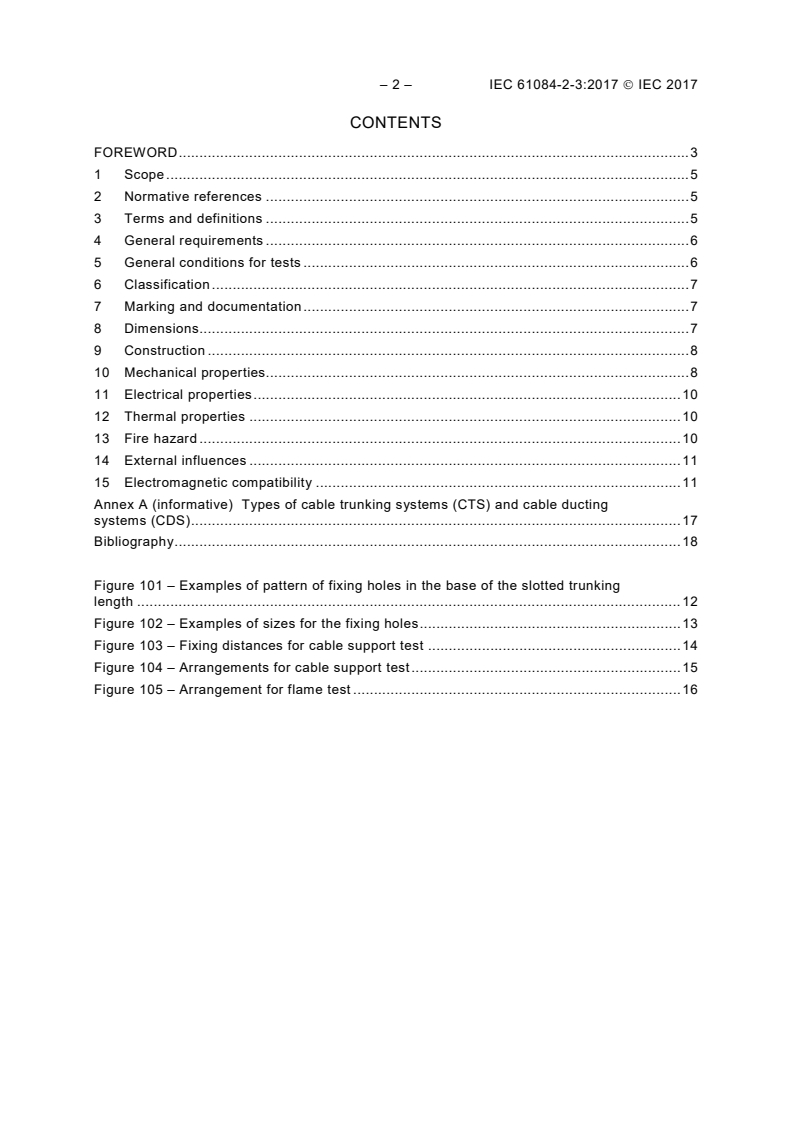
– 2 – IEC 61084-2-3:2017 IEC 2017
CONTENTS
FOREWORD . 3
1 Scope . 5
2 Normative references . 5
3 Terms and definitions . 5
4 General requirements . 6
5 General conditions for tests . 6
6 Classification . 7
7 Marking and documentation . 7
8 Dimensions. 7
9 Construction . 8
10 Mechanical properties. 8
11 Electrical properties . 10
12 Thermal properties . 10
13 Fire hazard . 10
14 External influences . 11
15 Electromagnetic compatibility . 11
Annex A (informative) Types of cable trunking systems (CTS) and cable ducting
systems (CDS) . 17
Bibliography . 18
Figure 101 – Examples of pattern of fixing holes in the base of the slotted trunking
length . 12
Figure 102 – Examples of sizes for the fixing holes . 13
Figure 103 – Fixing distances for cable support test . 14
Figure 104 – Arrangements for cable support test . 15
Figure 105 – Arrangement for flame test . 16
INTERNATIONAL ELECTROTECHNICAL COMMISSION
____________
CABLE TRUNKING SYSTEMS AND CABLE DUCTING
SYSTEMS FOR ELECTRICAL INSTALLATIONS –
Part 2-3: Particular requirements – Slotted cable
trunking systems intended for installation in cabinets
FOREWORD
1) The International Electrotechnical Commission (IEC) is a worldwide organization for standardization comprising
all national electrotechnical committees (IEC National Committees). The object of IEC is to promote
international co-operation on all questions concerning standardization in the electrical and electronic fields. To
this end and in addition to other activities, IEC publishes International Standards, Technical Specifications,
Technical Reports, Publicly Available Specifications (PAS) and Guides (hereafter referred to as “IEC
Publication(s)”). Their preparation is entrusted to technical committees; any IEC National Committee interested
in the subject dealt with may participate in this preparatory work. International, governmental and non-
governmental organizations liaising with the IEC also participate in this preparation. IEC collaborates closely
with the International Organization for Standardization (ISO) in accordance with conditions determined by
agreement between the two organizations.
2) The formal decisions or agreements of IEC on technical matters express, as nearly as possible, an international
consensus of opinion on the relevant subjects since each technical committee has representation from all
interested IEC National Committees.
3) IEC Publications have the form of recommendations for international use and are accepted by IEC National
Committees in that sense. While all reasonable efforts are made to ensure that the technical content of IEC
Publications is accurate, IEC cannot be held responsible for the way in which they are used or for any
misinterpretation by any end user.
4) In order to promote international uniformity, IEC National Committees undertake to apply IEC Publications
transparently to the maximum extent possible in their national and regional publications. Any divergence
between any IEC Publication and the corresponding national or regional publication shall be clearly indicated in
the latter.
5) IEC itself does not provide any attestation of conformity. Independent certification bodies provide conformity
assessment services and, in some areas, access to IEC marks of conformity. IEC is not responsible for any
services carried out by independent certification bodies.
6) All users should ensure that they have the latest edition of this publication.
7) No liability shall attach to IEC or its directors, employees, servants or agents including individual experts and
members of its technical committees and IEC National Committees for any personal injury, property damage or
other damage of any nature whatsoever, whether direct or indirect, or for costs (including legal fees) and
expenses arising out of the publication, use of, or reliance upon, this IEC Publication or any other IEC
Publications.
8) Attention is drawn to the Normative references cited in this publication. Use of the referenced publications is
indispensable for the correct application of this publication.
9) Attention is drawn to the possibility that some of the elements of this IEC Publication may be the subject of
patent rights. IEC shall not be held responsible for identifying any or all such patent rights.
International Standard IEC 61084-2-3 has been prepared by subcommittee 23A: Cable
management systems, of IEC technical committee 23: Electrical accessories.
This International standard is to be used in conjunction with IEC 61084-1:2017.
The text of this standard is based on the following documents:
FDIS Report on voting
23A/829/FDIS 23A/835/RVD
Full information on the voting for the approval of this standard can be found in the report on
voting indicated in the above table.
– 4 – IEC 61084-2-3:2017 IEC 2017
This publication has been drafted in accordance with the ISO/IEC Directives, Part 2.
This Part of the IEC 61084 series supplements or modifies the corresponding clauses of
IEC 61084-1:2017 as follows:
– where no particular clause or subclause of IEC 61084-1 is mentioned, the corresponding
clause or subclause applies as far as it is reasonable;
– where "addition", "modification" or “replacement” is stated, the relevant text of
IEC 61084-11 is to be adapted accordingly;
– subclauses, figures and tables which are additional to those in IEC 61084-1 are numbered
starting from 101.
In this standard, the following print types are used:
– requirements and definitions: roman type;
– compliance statements: italic type.
A list of all parts in the IEC 61084 series, published under the general title Cable trunking and
cable ducting systems for electrical installations, can be found on the IEC website.
The committee has decided that the contents of this publication will remain unchanged until
the stability date indicated on the IEC website under "http://webstore.iec.ch" in the data
related to the specific publication. At this date, the publication will be
• reconfirmed,
• withdrawn,
• replaced by a revised edition, or
• amended.
CABLE TRUNKING SYSTEMS AND CABLE DUCTING
SYSTEMS FOR ELECTRICAL INSTALLATIONS –
Part 2-3: Particular requirements – Slotted cable
trunking systems intended for installation in cabinets
1 Scope
This part of the IEC 61084 series specifies requirements and tests for cable trunking systems
(CTS) and cable ducting systems (CDS) intended for the accommodation, and where
necessary for the electrically protective separation, of insulated conductors, cables and
possibly other electrical equipment in electrical and/or communication systems installations.
The maximum voltage of these installations is 1 000 V AC and 1 500 V DC.
Slotted cable trunking systems are intended for mounting inside cabinets in electrical and/or
communication system installations.
This document does not apply to conduit systems, cable tray systems, cable ladder systems,
power track systems or equipment covered by other standards.
NOTE Wherever reference is made in this document to IEC 61084-1:2017, this does not apply to cable ducting
systems.
2 Normative references
This clause of Part 1 is applicable, except as follows:
Addition:
IEC 60228:2004, Conductors of insulated cables
IEC 60695-11-5:2004, Fire hazard testing – Part 11-5: Test flames – Needle-flame test
method – Apparatus, confirmatory test arrangement and guidance
IEC 61084-1:2017, Cable trunking systems and cable ducting systems for electrical
installations – Part 1: General requirements
3 Terms and definitions
This clause of Part 1 is applicable, except as follows:
Addition:
3.101
slotted cable trunking system
system comprising a slotted trunking length and possibly other slotted cable trunking system
components for the accommodation and laying in of insulated conductors or cables intended
for use in a cabinet or similar
___________
This publication was withdrawn.
– 6 – IEC 61084-2-3:2017 IEC 2017
3.102
slotted cable trunking system component
part of the system which includes
a) slotted trunking length;
b) trunking fitting;
c) fixing device;
d) system accessory
Note 1 to entry: The above mentioned system components are not necessarily included all together in a system.
Different combinations of system components can be used.
3.103
slotted trunking length
trunking length with slotted walls and with cover(s) which may be integral part of the base
and/or may be slotted
3.104
slotted wall
wall with openings allowing cables to pass through
Note 1 to entry: The openings can be with open or closed boundary and may have different shapes, normally
designed to maintain wiring in position.
3.105
wall finger
part of a slotted wall between two consecutive slots with open boundary
3.106
break-out line
line which may be available on the walls of a trunking length to facilitate the breaking of walls
or parts thereof, such as a wall finger
4 General requirements
This clause of Part 1 is applicable, except as follows:
Replacement:
Slotted cable trunking systems shall be so designed and constructed that where required they
ensure reliable support, accommodation and segregation of the insulated conductors and/or
cables contained therein.
Equipment associated with or incorporated in a system component but which is not a system
component, shall and need only comply with the relevant standard of this equipment, if any.
However it may be necessary to include such equipment in a test arrangement for the
purpose of testing its interface with the slotted cable trunking system.
Compliance is checked by carrying out all the tests specified.
5 General conditions for tests
This clause of Part 1 is applicable.
6 Classification
This clause of Part 1 is applicable, except as follows.
6.2 According to resistance to impact for installation and application
Not applicable.
6.1 According to temperatures
Table 2 of Part 1 is not applicable.
6.5 According to electrical continuity characteristic
Not applicable.
6.6 According to electrical insulating characteristic
Not applicable.
6.7 According to degrees of protection provided by enclosure according to
IEC 60529:1989
Not applicable.
6.9 According to the system access cover retention
Not applicable.
Additional subclauses:
6.101 According to the intended installation positions
6.101.1 Mounted on vertical or horizontal surface
6.101.2 Mounted on vertical or horizontal surface except in a cover down position
7 Marking and documentation
This clause of Part 1 is applicable.
8 Dimensions
This clause of Part 1 is applicable, except as follows.
Additional subclause:
8.101 The preferred solution for fixing holes, if any, in the base of the slotted trunking
lengths according to the different trunking widths as shown in Figure 101 is as follows:
– trunking lengths with a nominal width less or equal to 12,5 mm should preferably have one
row of small holes only, as shown in Figure 102 b);
– trunking lengths with a nominal width greater than 12,5 mm and less or equal to 62,5 mm,
should preferably have one row of holes only, alternately as shown in Figure 102 a) and in
Figure 102 b);
– trunking lengths with a nominal width greater than 62,5 mm should preferably have two or
more rows of holes alternately as shown in Figure 102 a) and in Figure 102 b), positioned
– 8 – IEC 61084-2-3:2017 IEC 2017
at a distance of 25 mm or 50 mm apart, symmetrically located from the trunking centre
line.
9 Construction
This clause of Part 1 is applicable, except as follows.
9.2 Apparatus mounting
Not applicable.
9.5 Accessible conductive parts
Not applicable.
9.6 Equipotential bonding
Not applicable.
9.7 Access to live parts
Not applicable.
9.8 Inlet openings
Not applicable.
9.9 Membranes
Not applicable.
9.10 Cable restrainer
Not applicable.
9.11 Cable anchorage
Not applicable.
10 Mechanical properties
This clause of Part 1 is applicable, except as follows.
10.2 Cable support test
Replacement by the following additional subclauses:
10.2.101 General test conditions
Each test is made on one new sample of slotted trunking length having a length of
(250 ± 5) mm.
Before the test non-metallic and composite slotted trunking lengths are aged at the
temperature declared according to Table 3 of Part 1 with a tolerance of ± 2°C for (168 ± 4) h
continuously.
The sample is securely fixed, using 10 mm external diameter flat metallic washers and
appropriate metallic screws to a rigid smooth support such as a plywood board 16 mm thick.
When 10 mm external diameter is too large, suitable smaller washer and appropriate screw
are used. Fixing(s) are positioned as shown in Figure 103 at (200 ± 5) mm centres along the
length of the sample.
Within the width of the sample:
– for trunking with a width less than 50 mm, one fixing is used as shown in Figure 103 a);
– for trunking with a width equal or greater than 50 mm, two fixings are used as shown in
Figure 103 b).
If the manufacturer's instructions require the use of cable retainers or dividers, these are fitted
according to the manufacturer's instructions. Cable retainers, if any, are symmetrically fixed
along the length.
The sample is subjected to an evenly distributed load of 0,8 g/mm of the declared usable
area for cables, per metre length. The load is distributed between the compartments
proportionally to the declared usable area. The load consists of copper insulated conductors
or cables complying with class 5, Table 3 of IEC 60228:2004, or flexible insulated conductors
or cables of similar mass per meter.
To allow for settlement of the sample, a pre-load of 10 % of the load is applied and removed
after (300 ± 30) s. The measurement apparatus is then calibrated to zero.
Insulated conductors or cables of 25 mm nominal cross section are placed in the sample so
that approximately 50 % of the load is achieved. Insulated conductors or cables of 2,5 mm
nominal cross section are placed on top of the larger cables to achieve the total load within a
tolerance of ± 5 g. If the dimensions of the compartment do not permit the accommodation of
2 2
25 mm insulated conductor or cable, 2,5 mm nominal cross section insulated conductors or
cables are used.
Non-metallic and composite slotted trunking lengths are tested at the maximum application
temperature declared by the manufacturer according to Table 3 of Part 1 with a tolerance of
± 2 °C.
10.2.102 Mounting arrangements for slotted trunking lengths
Slotted trunking lengths are mounted according to Figure 104 a).
+ 5/0) min with the load still applied the vertical deflection F is measured at
After (120
approximately the middle of the length.
F shall not exceed 10 % of the height H with a maximum of 10 mm (see Figure 104 a)).
10.2.103 Mounting arrangements for slotted trunking lengths classified according to
6.101.1
Slotted trunking lengths classified according to 6.101.1 are mounted according to
Figure 104 b).
After (120 + 5/0) min with the load still applied the vertical deflection F is measured at
approximately the middle of the length.
F shall not exceed 10 % of the width W with a maximum of 10 mm (see Figure 104 b)).
– 10 – IEC 61084-2-3:2017 IEC 2017
10.3 Impact test
This clause of Part 1 is applicable except as follows.
10.3.1.3 Replacement of the last paragraph by:
This test is not applied to wall fingers, knockouts, membranes and the like, and within 50 mm
of each end.
Break-out line, if any, is considered as knockout.
10.3.1.4 Addition of the following sentence at the end of the first paragraph:
Any cracks in or breaking of wall finger are ignored.
10.3.2 Impact test for installation and application
Not applicable.
10.4 Linear deflection test
Not applicable.
10.5 External load test
Not applicable.
10.6 System access cover retention
Not applicable.
11 Electrical properties
This clause of Part 1 is not applicable.
12 Thermal properties
This clause of Part 1 is applicable.
13 Fire hazard
This clause of Part 1 is applicable, except as follows.
13.1.3 Spread of fire
Replacement:
Slotted cable trunking systems shall either not ignite or if ignited, shall not continue to burn
when the source of ignition is removed.
Non-metallic system component or metallic system component coated in paint or any other
substance which is likely to affect its resistance to flame propagation is to be considered as a
composite system component and tested accordingly.
Compliance is checked as follows:
– for slotted trunking lengths of non-metallic or composite material by the following flame
test;
– for other system components of non-metallic or composite material by the test of 13.1.1 of
Part 1 at the temperature of 650 °C.
System components, which have already been tested at 650 °C or 850 °C according to 13.1.1
of Part 1, are not tested again at this temperature.
The test shall be performed according to Clauses 1 to 5, 8, 10, 11 and 13 of IEC 60695-11-
5:2004 and the following conditions:
– the test is carried out on two sets of samples (675 ± 10) mm long. If partitions are not
integral with the sample, a partition shall be mounted on the slotted trunking length. Other
parts may be added to the sample at the request of the manufacturer;
– the slotted trunking length is placed vertically with its lower extremity (100 ± 5) mm above
the tissue covered wooden board as shown in Figure 105 in a rectangular metal enclosure
with an open face as shown in Figure 4 of Part 1. It is securely fixed to a rigid support
through the fixing holes, if any, in the base of the slotted trunking length, according to the
manufacturer’s instructions;
– the burner is positioned on the samples of the first set in such a way that the axis forms an
angle of 45° ± 2° with the horizontal one and the flame is applied centrally to the boundary
of an opening of the wall approximately 200 mm above the wrapping tissue covered
wooden board, the end of the burner tube being distanced (5 ± 1) mm from the sample;
– the test is repeated on the samples of the second set but with the burner applied to one
extremity of the cover preferably on the edge with the thinnest wall thickness or to the
boundary of a slot, if there is any;
– a severity of 60 s is used.
13.2 Resistance to fire
Not applicable
14 External influences
This clause of Part 1 is applicable, except as follows.
14.1 Degree of protection provided by enclosure
Not applicable
15 Electromagnetic compatibility
This clause of Part 1 is applicable.
Addition:
– 12 – IEC 61084-2-3:2017 IEC 2017
Dimensions in mm
W ≤ 12,5
12,5 < W ≤ 62,5
25 ±1
W > 62,5
50 ±1
1 950 ±6
IEC
Key
W width of slotted trunking length
Figure 101 – Examples of pattern of fixing holes in the base
of the slotted trunking length
50 ±0,5
25 25
Dimensions in mm
14 ±0,5
IEC
Figure 102a) – Example of big hole
4,5 ±0,3
8 ±0,5
IEC
Figure 102b) – Example of small hole
Figure 102 – Examples of sizes for the fixing holes
6,50 ±0,3
– 14 – IEC 61084-2-3:2017 IEC 2017
Dimensions in mm
250 ±5
200 ±5
ø6,5
≥ 12,5
...
IEC 61084-2-3 ®
Edition 1.1 2024-02
CONSOLIDATED VERSION
INTERNATIONAL
STANDARD
NORME
INTERNATIONALE
colour
inside
Cable trunking systems and cable ducting systems for electrical installations –
Part 2-3: Particular requirements – Slotted cable trunking systems intended for
installation in cabinets
Systèmes de goulottes et systèmes de conduits-profilés pour installations
électriques –
Partie 2-3 : Exigences particulières – Systèmes de goulottes de câblage pour
installation dans les armoires
All rights reserved. Unless otherwise specified, no part of this publication may be reproduced or utilized in any form
or by any means, electronic or mechanical, including photocopying and microfilm, without permission in writing from
either IEC or IEC's member National Committee in the country of the requester. If you have any questions about IEC
copyright or have an enquiry about obtaining additional rights to this publication, please contact the address below or
your local IEC member National Committee for further information.
Droits de reproduction réservés. Sauf indication contraire, aucune partie de cette publication ne peut être reproduite ni
utilisée sous quelque forme que ce soit et par aucun procédé, électronique ou mécanique, y compris la photocopie et
les microfilms, sans l'accord écrit de l'IEC ou du Comité national de l'IEC du pays du demandeur. Si vous avez des
questions sur le copyright de l'IEC ou si vous désirez obtenir des droits supplémentaires sur cette publication, utilisez
les coordonnées ci-après ou contactez le Comité national de l'IEC de votre pays de résidence.
IEC Secretariat Tel.: +41 22 919 02 11
3, rue de Varembé info@iec.ch
CH-1211 Geneva 20 www.iec.ch
Switzerland
About the IEC
The International Electrotechnical Commission (IEC) is the leading global organization that prepares and publishes
International Standards for all electrical, electronic and related technologies.
About IEC publications
The technical content of IEC publications is kept under constant review by the IEC. Please make sure that you have the
latest edition, a corrigendum or an amendment might have been published.
IEC publications search - webstore.iec.ch/advsearchform IEC Products & Services Portal - products.iec.ch
The advanced search enables to find IEC publications by a Discover our powerful search engine and read freely all the
variety of criteria (reference number, text, technical publications previews, graphical symbols and the glossary.
committee, …). It also gives information on projects, replaced With a subscription you will always have access to up to date
and withdrawn publications. content tailored to your needs.
IEC Just Published - webstore.iec.ch/justpublished
Electropedia - www.electropedia.org
Stay up to date on all new IEC publications. Just Published
The world's leading online dictionary on electrotechnology,
details all new publications released. Available online and once
containing more than 22 500 terminological entries in English
a month by email.
and French, with equivalent terms in 25 additional languages.
Also known as the International Electrotechnical Vocabulary
IEC Customer Service Centre - webstore.iec.ch/csc
(IEV) online.
If you wish to give us your feedback on this publication or need
further assistance, please contact the Customer Service
Centre: sales@iec.ch.
A propos de l'IEC
La Commission Electrotechnique Internationale (IEC) est la première organisation mondiale qui élabore et publie des
Normes internationales pour tout ce qui a trait à l'électricité, à l'électronique et aux technologies apparentées.
A propos des publications IEC
Le contenu technique des publications IEC est constamment revu. Veuillez vous assurer que vous possédez l’édition la
plus récente, un corrigendum ou amendement peut avoir été publié.
Recherche de publications IEC - IEC Products & Services Portal - products.iec.ch
webstore.iec.ch/advsearchform Découvrez notre puissant moteur de recherche et consultez
La recherche avancée permet de trouver des publications IEC gratuitement tous les aperçus des publications, symboles
en utilisant différents critères (numéro de référence, texte, graphiques et le glossaire. Avec un abonnement, vous aurez
comité d’études, …). Elle donne aussi des informations sur les toujours accès à un contenu à jour adapté à vos besoins.
projets et les publications remplacées ou retirées.
Electropedia - www.electropedia.org
IEC Just Published - webstore.iec.ch/justpublished
Le premier dictionnaire d'électrotechnologie en ligne au monde,
Restez informé sur les nouvelles publications IEC. Just
avec plus de 22 500 articles terminologiques en anglais et en
Published détaille les nouvelles publications parues.
français, ainsi que les termes équivalents dans 25 langues
Disponible en ligne et une fois par mois par email.
additionnelles. Egalement appelé Vocabulaire
Electrotechnique International (IEV) en ligne.
Service Clients - webstore.iec.ch/csc
Si vous désirez nous donner des commentaires sur cette
publication ou si vous avez des questions contactez-nous:
sales@iec.ch.
IEC 61084-2-3 ®
Edition 1.1 2024-02
CONSOLIDATED VERSION
INTERNATIONAL
STANDARD
NORME
INTERNATIONALE
colour
inside
Cable trunking systems and cable ducting systems for electrical installations –
Part 2-3: Particular requirements – Slotted cable trunking systems intended for
installation in cabinets
Systèmes de goulottes et systèmes de conduits-profilés pour installations
électriques –
Partie 2-3 : Exigences particulières – Systèmes de goulottes de câblage pour
installation dans les armoires
INTERNATIONAL
ELECTROTECHNICAL
COMMISSION
COMMISSION
ELECTROTECHNIQUE
INTERNATIONALE
ICS 29.060.01, 29.120.10 ISBN 978-2-8322-8375-2
IEC 61084-2-3 ®
Edition 1.1 2024-02
CONSOLIDATED VERSION
REDLINE VERSION
VERSION REDLINE
colour
inside
Cable trunking systems and cable ducting systems for electrical installations –
Part 2-3: Particular requirements – Slotted cable trunking systems intended for
installation in cabinets
Systèmes de goulottes et systèmes de conduits-profilés pour installations
électriques –
Partie 2-3 : Exigences particulières – Systèmes de goulottes de câblage pour
installation dans les armoires
– 2 – IEC 61084-2-3:2017+AMD1:2024 CSV
IEC 2024
CONTENTS
FOREWORD . 3
1 Scope . 5
2 Normative references . 5
3 Terms and definitions . 5
4 General requirements . 6
5 General conditions for tests . 6
6 Classification . 7
7 Marking and documentation . 7
8 Dimensions. 7
9 Construction . 8
10 Mechanical properties. 8
11 Electrical properties . 10
12 Thermal properties . 10
13 Fire hazard . 10
14 External influences . 11
15 Electromagnetic compatibility . 11
Annex A (informative) Types of cable trunking systems (CTS) and cable ducting
systems (CDS) . 17
Annex B (normative) CTS/CDS IK code . 18
Bibliography . 19
Figure 101 – Examples of pattern of fixing holes in the base of the slotted trunking
length . 12
Figure 102 – Examples of sizes for the fixing holes . 13
Figure 103 – Fixing distances for cable support test . 14
Figure 104 – Arrangements for cable support test . 15
Figure 105 – Arrangement for flame test . 16
IEC 2024
INTERNATIONAL ELECTROTECHNICAL COMMISSION
____________
CABLE TRUNKING SYSTEMS AND CABLE DUCTING
SYSTEMS FOR ELECTRICAL INSTALLATIONS –
Part 2-3: Particular requirements – Slotted cable
trunking systems intended for installation in cabinets
FOREWORD
1) The International Electrotechnical Commission (IEC) is a worldwide organization for standardization comprising
all national electrotechnical committees (IEC National Committees). The object of IEC is to promote
international co-operation on all questions concerning standardization in the electrical and electronic fields. To
this end and in addition to other activities, IEC publishes International Standards, Technical Specifications,
Technical Reports, Publicly Available Specifications (PAS) and Guides (hereafter referred to as “IEC
Publication(s)”). Their preparation is entrusted to technical committees; any IEC National Committee interested
in the subject dealt with may participate in this preparatory work. International, governmental and non-
governmental organizations liaising with the IEC also participate in this preparation. IEC collaborates closely
with the International Organization for Standardization (ISO) in accordance with conditions determined by
agreement between the two organizations.
2) The formal decisions or agreements of IEC on technical matters express, as nearly as possible, an international
consensus of opinion on the relevant subjects since each technical committee has representation from all
interested IEC National Committees.
3) IEC Publications have the form of recommendations for international use and are accepted by IEC National
Committees in that sense. While all reasonable efforts are made to ensure that the technical content of IEC
Publications is accurate, IEC cannot be held responsible for the way in which they are used or for any
misinterpretation by any end user.
4) In order to promote international uniformity, IEC National Committees undertake to apply IEC Publications
transparently to the maximum extent possible in their national and regional publications. Any divergence
between any IEC Publication and the corresponding national or regional publication shall be clearly indicated in
the latter.
5) IEC itself does not provide any attestation of conformity. Independent certification bodies provide conformity
assessment services and, in some areas, access to IEC marks of conformity. IEC is not responsible for any
services carried out by independent certification bodies.
6) All users should ensure that they have the latest edition of this publication.
7) No liability shall attach to IEC or its directors, employees, servants or agents including individual experts and
members of its technical committees and IEC National Committees for any personal injury, property damage or
other damage of any nature whatsoever, whether direct or indirect, or for costs (including legal fees) and
expenses arising out of the publication, use of, or reliance upon, this IEC Publication or any other IEC
Publications.
8) Attention is drawn to the Normative references cited in this publication. Use of the referenced publications is
indispensable for the correct application of this publication.
9) Attention is drawn to the possibility that some of the elements of this IEC Publication may be the subject of
patent rights. IEC shall not be held responsible for identifying any or all such patent rights.
This consolidated version of the official IEC Standard and its amendment has been
prepared for user convenience.
IEC 61084-2-3 edition 1.1 contains the first edition (2017-03) [documents 23A/829/FDIS
and 23A/835/RVD] and its amendment 1 (2024-02) [documents 23A/1063/FDIS and
23A/1071/RVD].
In this Redline version, a vertical line in the margin shows where the technical content
is modified by amendment 1. Additions are in green text, deletions are in strikethrough
red text. A separate Final version with all changes accepted is available in this
publication.
– 4 – IEC 61084-2-3:2017+AMD1:2024 CSV
IEC 2024
International Standard IEC 61084-2-3 has been prepared by subcommittee 23A: Cable
management systems, of IEC technical committee 23: Electrical accessories.
This International standard is to be used in conjunction with IEC 61084-1:2017.
This publication has been drafted in accordance with the ISO/IEC Directives, Part 2.
This Part of the IEC 61084 series supplements or modifies the corresponding clauses of
IEC 61084-1:2017 as follows:
– where no particular clause or subclause of IEC 61084-1 is mentioned, the corresponding
clause or subclause applies as far as it is reasonable;
– where "addition", "modification" or “replacement” is stated, the relevant text of
IEC 61084-11 is to be adapted accordingly;
– subclauses, figures and tables which are additional to those in IEC 61084-1 are numbered
starting from 101.
In this standard, the following print types are used:
– requirements and definitions: roman type;
– compliance statements: italic type.
A list of all parts in the IEC 61084 series, published under the general title Cable trunking and
cable ducting systems for electrical installations, can be found on the IEC website.
The committee has decided that the contents of this document and its amendment will remain
unchanged until the stability date indicated on the IEC website under webstore.iec.ch in the
data related to the specific document. At this date, the document will be
• reconfirmed,
• withdrawn, or
• revised.
IMPORTANT – The 'colour inside' logo on the cover page of this publication indicates
that it contains colours which are considered to be useful for the correct
understanding of its contents. Users should therefore print this document using a
colour printer.
IEC 2024
CABLE TRUNKING SYSTEMS AND CABLE DUCTING
SYSTEMS FOR ELECTRICAL INSTALLATIONS –
Part 2-3: Particular requirements – Slotted cable
trunking systems intended for installation in cabinets
1 Scope
This part of the IEC 61084 series specifies requirements and tests for cable trunking systems
(CTS) and cable ducting systems (CDS) intended for the accommodation, and where
necessary for the electrically protective separation, of insulated conductors, cables and
possibly other electrical equipment in electrical and/or communication systems installations.
The maximum voltage of these installations is 1 000 V AC and 1 500 V DC.
Slotted cable trunking systems are intended for mounting inside cabinets in electrical and/or
communication system installations.
This document does not apply to conduit systems, cable tray systems, cable ladder systems,
power track systems or equipment covered by other standards.
NOTE Wherever reference is made in this document to IEC 61084-1:2017, this does not apply to cable ducting
systems.
2 Normative references
This clause of Part 1 is applicable, except as follows:
Addition:
IEC 60228:2004, Conductors of insulated cables
IEC 60695-11-5:20042016, Fire hazard testing – Part 11-5: Test flames – Needle-flame test
method – Apparatus, confirmatory test arrangement and guidance
IEC 61084-1:2017, Cable trunking systems and cable ducting systems for electrical
installations – Part 1: General requirements
3 Terms and definitions
This clause of Part 1 is applicable, except as follows:
Addition:
3.101
slotted cable trunking system
system comprising a slotted trunking length and possibly other slotted cable trunking system
components for the accommodation and laying in of insulated conductors or cables intended
for use in a cabinet or similar
___________
This publication was withdrawn.
– 6 – IEC 61084-2-3:2017+AMD1:2024 CSV
IEC 2024
3.102
slotted cable trunking system component
part of the system which includes
a) slotted trunking length;
b) trunking fitting;
c) fixing device;
d) system accessory
Note 1 to entry: The above mentioned system components are not necessarily included all together in a system.
Different combinations of system components can be used.
3.103
slotted trunking length
trunking length with slotted walls and with cover(s) which may be integral part of the base
and/or may be slotted
3.104
slotted wall
wall with openings allowing cables to pass through
Note 1 to entry: The openings can be with open or closed boundary and may have different shapes, normally
designed to maintain wiring in position.
3.105
wall finger
part of a slotted wall between two consecutive slots with open boundary
3.106
break-out line
line which may be available on the walls of a trunking length to facilitate the breaking of walls
or parts thereof, such as a wall finger
4 General requirements
This clause of Part 1 is applicable, except as follows:
Replacement:
Slotted cable trunking systems shall be so designed and constructed that where required they
ensure reliable support, accommodation and segregation of the insulated conductors and/or
cables contained therein.
Equipment associated with or incorporated in a system component but which is not a system
component, shall and need only comply with the relevant standard of this equipment, if any.
However it may be necessary to include such equipment in a test arrangement for the
purpose of testing its interface with the slotted cable trunking system.
Compliance is checked by carrying out all the tests specified.
5 General conditions for tests
This clause of Part 1 is applicable.
IEC 2024
6 Classification
This clause of Part 1 is applicable, except as follows.
6.2 According to resistance to impact for installation and application
Not applicable.
6.1 According to temperatures
Table 2 of Part 1 is not applicable.
6.5 According to electrical continuity characteristic
Not applicable.
6.6 According to electrical insulating characteristic
Not applicable.
6.7 According to degrees of protection provided by enclosure according to
IEC 60529:1989
Not applicable.
6.9 According to the system access cover retention
Not applicable.
Additional subclauses:
6.101 According to the intended installation positions
6.101.1 Mounted on vertical or horizontal surface
6.101.2 Mounted on vertical or horizontal surface except in a cover down position
7 Marking and documentation
This clause of Part 1 is applicable.
8 Dimensions
This clause of Part 1 is applicable, except as follows.
Additional subclause:
8.101 The preferred solution for fixing holes, if any, in the base of the slotted trunking
lengths according to the different trunking widths as shown in Figure 101 is as follows:
– trunking lengths with a nominal width less or equal to 12,5 mm should preferably have one
row of small holes only, as shown in Figure 102 b);
– trunking lengths with a nominal width greater than 12,5 mm and less or equal to 62,5 mm,
should preferably have one row of holes only, alternately as shown in Figure 102 a) and in
Figure 102 b);
– trunking lengths with a nominal width greater than 62,5 mm should preferably have two or
more rows of holes alternately as shown in Figure 102 a) and in Figure 102 b), positioned
– 8 – IEC 61084-2-3:2017+AMD1:2024 CSV
IEC 2024
at a distance of 25 mm or 50 mm apart, symmetrically located from the trunking centre
line.
9 Construction
This clause of Part 1 is applicable, except as follows.
9.2 Apparatus mounting
Not applicable.
9.5 Accessible conductive parts
Not applicable.
9.6 Equipotential bonding
Not applicable.
9.7 Access to live parts
Not applicable.
9.8 Inlet openings
Not applicable.
9.9 Membranes
Not applicable.
9.10 Cable restrainer
Not applicable.
9.11 Cable anchorage
Not applicable.
10 Mechanical properties
This clause of Part 1 is applicable, except as follows.
10.2 Cable support test
Replacement by the following additional subclauses:
10.2.101 General test conditions
Each test is made on one new sample of slotted trunking length having a length of
(250 ± 5) mm.
Before the test non-metallic and composite slotted trunking lengths are aged at the
temperature declared according to Table 3 of Part 1 with a tolerance of ± 2°C for (168 ± 4) h
continuously.
IEC 2024
The sample is securely fixed, using 10 mm external diameter flat metallic washers and
appropriate metallic screws to a rigid smooth support such as a plywood board 16 mm thick.
When 10 mm external diameter is too large, suitable smaller washer and appropriate screw
are used. Fixing(s) are positioned as shown in Figure 103 at (200 ± 5) mm centres along the
length of the sample.
Within the width of the sample:
– for trunking with a width less than 50 62,5 mm, one fixing is used as shown in
Figure 103 a);
– for trunking with a width equal or greater than 50 62,5 mm, two fixings are used as shown
in Figure 103 b).
If the manufacturer's instructions require the use of cable retainers or dividers, these are fitted
according to the manufacturer's instructions. Cable retainers, if any, are symmetrically fixed
along the length.
The sample is subjected to an evenly distributed load of 0,8 g/mm of the declared usable
area for cables, per metre length. The load is distributed between the compartments
proportionally to the declared usable area. The load consists of copper insulated conductors
or cables complying with class 5, Table 3 – class 5 of IEC 60228:2004, or flexible insulated
conductors or cables of similar mass per meter.
To allow for settlement of the sample, a pre-load of 10 % of the load is applied and removed
after (300 ± 30) s. The measurement apparatus is then calibrated to zero.
Insulated conductors or cables of 25 mm nominal cross section are placed in the sample so
that approximately 50 % of the load is achieved. Insulated conductors or cables of 2,5 mm
nominal cross section are placed on top of the larger cables to achieve the total load within a
tolerance of ± 5 g. If the dimensions of the compartment do not permit the accommodation of
2 2
25 mm insulated conductor or cable, 2,5 mm nominal cross section insulated conductors or
cables are used.
Non-metallic and composite slotted trunking lengths are tested at the maximum application
temperature declared by the manufacturer according to Table 3 of Part 1 with a tolerance of
± 2 °C.
10.2.102 Mounting arrangements for slotted trunking lengths
Slotted trunking lengths are mounted according to Figure 104 a).
After (120 + 5/0) min with the load still applied the vertical deflection F is measured at
approximately the middle of the length.
F shall not exceed 10 % of the height H with a maximum of 10 mm (see Figure 104 a)).
10.2.103 Mounting arrangements for slotted trunking lengths classified according to
6.101.1
Slotted trunking lengths classified according to 6.101.1 are mounted according to
Figure 104 b).
After (120 + 5/0) min with the load still applied the vertical deflection F is measured at
approximately the middle of the length.
F shall not exceed 10 % of the width W with a maximum of 10 mm (see Figure 104 b)).
– 10 – IEC 61084-2-3:2017+AMD1:2024 CSV
IEC 2024
10.3 Impact test
This clause of Part 1 is applicable except as follows.
10.3.1.3 Replacement of the last paragraph by:
This test is not applied to wall fingers, knockouts, membranes and the like, and within 50 mm
of each end.
Break-out line, if any, is considered as knockout.
10.3.1.4 Addition of the following sentence at the end of the first paragraph:
Any cracks in or breaking of wall finger are ignored.
10.3.2 Impact test for installation and application
Not applicable.
10.4 Linear deflection test
Not applicable.
10.5 External load test
Not applicable.
10.6 System access cover retention
Not applicable.
11 Electrical properties
This clause of Part 1 is not applicable.
12 Thermal properties
This clause of Part 1 is applicable.
13 Fire hazard
This clause of Part 1 is applicable, except as follows.
13.1.3 Spread of fire
Replacement:
Slotted cable trunking systems shall either not ignite or if ignited, shall not continue to burn
when the source of ignition is removed.
Non-metallic system component or metallic system component coated in paint or any other
substance which is likely to affect its resistance to flame propagation is to be considered as a
composite system component and tested accordingly.
Compliance is checked as follows:
– for slotted trunking lengths of non-metallic or composite material by the following flame
test;
IEC 2024
– for other system components of non-metallic or composite material by the test of 13.1.1 of
Part 1 at the temperature of 650 °C.
System components, which have already been tested at 650 °C or 850 °C according to 13.1.1
of Part 1, are not tested again at this temperature.
The test shall be performed according to Clauses 1 to 5, 8, 10, 11 and 13 of IEC 60695-11-
5:20042016 and the following conditions:
– the test is carried out on two sets of samples (675 ± 10) mm long. If partitions are not
integral with the sample, a partition shall be mounted on the slotted trunking length. Other
parts may be added to the sample at the request of the manufacturer;
– the slotted trunking length is placed vertically with its lower extremity (100 ± 5) mm above
the tissue covered wooden board as shown in Figure 105 in a rectangular metal enclosure
with an open face as shown in Figure 4 of Part 1. It is securely fixed to a rigid support
through the fixing holes, if any, in the base of the slotted trunking length, according to the
manufacturer’s instructions;
– the burner is positioned on the samples of the first set in such a way that the axis forms an
angle of 45° ± 2° with the horizontal one and the flame is applied centrally to the boundary
of an opening of the wall approximately 200 mm above the wrapping tissue covered
wooden board, the end of the burner tube being distanced (5 ± 1) mm from the sample;
– the test is repeated on the samples of the second set but with the burner applied to one
extremity of the cover preferably on the edge with the thinnest wall thickness or to the
boundary of a slot, if there is any;
– a severity of 60 s is used.
13.2 Resistance to fire
Not applicable
14 External influences
This clause of Part 1 is applicable, except as follows.
14.1 Degree of protection provided by enclosure
Not applicable
15 Electromagnetic compatibility
This clause of Part 1 is applicable.
Addition:
– 12 – IEC 61084-2-3:2017+AMD1:2024 CSV
IEC 2024
Dimensions in mm
W ≤ 12,5
12,5 < W ≤ 62,5
25 ±1
W > 62,5
50 ±1
1 950 ±6
IEC
Key
W width of slotted trunking length
Figure 101 – Examples of pattern of fixing holes in the base
of the slotted trunking length
50 ±0,5
25 25
IEC 2024
Dimensions in mm
14 ±0,5
IEC
Figure 102a) – Example of big hole
4,5 ±0,3
8 ±0,5
IEC
Figure 102b) – Example of small hole
Figure 102 – Examples of sizes for the fixing holes
6,50 ±0,3
– 14 – IEC 61084-2-3:2017+AMD1:2024 CSV
IEC 2024
Dimensions in mm
250 ±5
200 ±5
ø6,5
≥ 12,5 ≥ 12,5
IEC
Key
W external width of the slotted trunking
Figure 103 a) Fixing distances for cable support test for trunking with a width less than 50 62,5 mm
Dimensions in mm
250 ±5
200 ±5
ø6,5
≥ 12,5 ≥ 12,5
IEC
Key
W external width of the slotted trunking
Figure 103 b) Fixing distances for cable support test for trunking with a width equal or greater
than 50 62,5 mm
Figure 103 – Fixing distances for cable support test
≥ 12,5 ≥ 12,5
1/2 W
W
W
IEC 2024
H
IEC
Key
H external height of the slotted trunking
F vertical deflection
a) Arrangements for cable support test for slotted trunking lengths
W
IEC
Key
W external width of the slotted trunking
F vertical deflection
b) Arrangements for cable support test for slotted trunking lengths classified according to 6.101.1
Figure 104 – Arrangements for cable support test
F
F
– 16 – IEC 61084-2-3:2017+AMD1:2024 CSV
IEC 2024
Dimensions in mm
700 −25
45° ±2°
IEC
Key
1 sample centrally located
2 flame
3 back face
4 wrapping tissue
5 smooth wooden board
This drawing is not intended to govern design except as regards the dimensions shown.
Figure 105 – Arrangement for flame test
≤ 1 225
450 −25
675 ±10
100 ±5
IEC 2024
Annex A
(informative)
Types of cable trunking systems (CTS) and cable ducting systems (CDS)
This annex of Part 1 is not applicable.
– 18 – IEC 61084-2-3:2017+AMD1:2024 CSV
IEC 2024
Annex B
(normative)
CTS/CDS IK code
Annex B of IEC 61084-1:2017 and of IEC 61084-1:2017/AMD1:2024 is not applicable.
IEC 2024
Bibliography
ISO 2768-1:1989, General tolerances – Part 1: Tolerances for linear and angular dimensions
without individual tolerance indications
___________
– 20 – IEC 61084-2-3:2017+AMD1:2024 CSV
IEC 2024
SOMMAIRE
AVANT-PROPOS . 21
1 Domaine d’application . 23
2 Références normatives . 23
3 Termes et définitions . 23
4 Exigences générales . 24
5 Conditions générales d’essai . 25
6 Classification . 25
7 Marquage et documentation . 25
8 Dimensions. 25
9 Construction . 26
10 Propriétés mécaniques . 26
11 Propriétés électriques . 28
12 Propriétés thermiques. 28
13 Danger du feu . 28
14 Influences externes . 29
15 Compatibilité électromagnétique . 30
Annexe A (informative) Types de systèmes de goulottes (SG) et de systèmes de
conduits-profilés (SCP) . 35
Annexe B (normative) Code IK pour les SG/SCP . 36
Bibliographie . 37
Figure 101 – Exemples de dispositions des trous de fixation du socle des longueurs de
goulottes de câblage . 30
Figure 102 – Exemples de dimensions des trous de fixation . 31
Figure 103 – Distances de fixation pour l’essai de support de câble . 32
Figure 104 – Dispositions pour l’essai de support de câble . 33
Figure 105 – Disposition pour l’essai à la flamme . 34
IEC 2024
COMMISSION ÉLECTROTECHNIQUE INTERNATIONALE
____________
SYSTÈMES DE GOULOTTES ET SYSTÈMES DE
CONDUITS-PROFILÉS POUR INSTALLATIONS ÉLECTRIQUES –
Partie 2-3: Exigences particulières – Systèmes de goulottes
de câblage pour installation dans les armoires
AVANT-PROPOS
1) La Commission Electrotechnique Internationale (IEC) est une organisation mondiale de normalisation
composée de l'ensemble des comités électrotechniques nationaux (Comités nationaux de l’IEC). L’IEC a pour
objet de favoriser la coopération internationale pour toutes les questions de normalisation dans les domaines
de l'électricité et de l'électronique. A cet effet, l’IEC – entre autres activités – publie des Normes
internationales, des Spécifications techniques, des Rapports techniques, des Spécifications accessibles au
public (PAS) et des Guides (ci-après dénommés "Publication(s) de l’IEC"). Leur élaboration est confiée à des
comités d'études, aux travaux desquels tout Comité national intéressé par le sujet traité peut participer. Les
organisations internationales, gouvernementales et non gouvernementales, en liaison avec l’IEC, participent
également aux travaux. L’IEC collabore étroitement avec l'Organisation Internationale de Normalisation (ISO),
selon des conditions fixées par accord entre les deux organisations.
2) Les décisions ou accords officiels de l’IEC concernant les questions techniques représentent, dans la mesure
du possible, un accord international sur les sujets étudiés, étant donné que les Comités nationaux de l’IEC
intéressés sont représentés dans chaque comité d’études.
3) Les Publications de l’IEC se présentent sous la forme de recommandations internationales et sont agréées
comme telles par les Comités nationaux de l’IEC. Tous les efforts raisonnables sont entrepris afin que l’IEC
s'assure de l'exactitude du contenu technique de ses publications; l’IEC ne peut pas être tenue responsable de
l'éventuelle mauvaise utilisation ou interprétation qui en est faite par un quelconque utilisateur final.
4) Dans le but d'encourager l'uniformité internationale, les Comités nationaux de l’IEC s'engagent, dans toute la
mesure possible, à appliquer de façon transparente les Publications de l’IEC dans leurs publications nationales
et régionales. Toutes divergences entre toutes Publications de l’IEC et toutes publications nationales ou
régionales correspondantes doivent être indiquées en termes clairs dans ces dernières.
5) L’IEC elle-même ne fournit aucune attestation de conformité. Des organismes de certification indépendants
fournissent des services d'évaluation de conformité et, dans certains secteurs, accèdent aux marques de
conformité de l’IEC. L’IEC n'est responsable d'aucun des services effectués par les organismes de certification
indépendants.
6) Tous les utilisateurs doivent s'assurer qu'ils sont en possession de la dernière édition de cette publication.
7) Aucune responsabilité ne doit être imputée à l’IEC, à ses administrateurs, employés, auxiliaires ou
mandataires, y compris ses experts particuliers et les membres de ses comités d'études et des Comités
nationaux de l’IEC, pour tout préjudice causé en cas de dommages corporels et matériels, ou de tout autre
dommage de quelque nature que ce soit, directe ou indirecte, ou pour supporter les coûts (y compris les frais
de justice) et les dépenses découlant de la publication ou de l'utilisation de cette Publication de l’IEC ou de
toute autre Publication de l’IEC, ou au crédit qui lui est accordé.
8) L'attention est attirée sur les références normatives citées dans cette publication. L'utilisation de publications
référencées est obligatoire pour une application correcte de la présente publication.
9) L’attention est attirée sur le fait que certains des éléments de la présente Publication de l’IEC peuvent faire
l’objet de droits de brevet. L’IEC ne saurait être tenue pour responsable de ne pas avoir identifié de tels droits
de brevets et de ne pas avoir signalé leur existence.
Cette version consolidée de la Norme IEC officielle et de son amendement a été
préparée pour la commodité de l'utilisateur.
L’IEC 61084-2-3 édition 1.1 contient la première édition (2017-03) [documents
23A/829/FDIS et 23A/835/RVD] et son amendement 1 (2024-02) [documents
23A/1063/FDIS et 23A/1071/RVD].
Dans cette version Redline, une ligne verticale dans la marge indique où le contenu
technique est modifié par l'amendement 1. Les ajouts sont en vert, les suppressions
sont en rouge, barrées. Une version Finale avec toutes les modifications acceptées est
disponible dans cette publication.
– 22 – IEC 61084-2-3:2017+AMD1:2024 CSV
IEC 2024
La Norme internationale IEC 61084-2-3 a été établie par le sous-comité 23A: Systèmes de
câblage, du comité d’études 23 de l’IEC: Petit appareillage.
Cette Norme internationale doit être utilisée conjointement avec l’IEC 61084-1:2017.
Cette publication a été rédigée selon les Directives ISO/IEC, Partie 2.
La présente partie de la série IEC 61084 complète ou modifie les articles correspondants de
l’IEC 61084-1:2017 comme suit:
– lorsqu'un article ou un paragraphe particulier de l'IEC 61084-1 n'est pas mentionné,
l’article ou le paragraphe correspondant s’applique pour autant qu’il soit raisonnable;
– lorsque «addition», «modification» ou «remplacement» est mentionné, le texte
correspondant de l'IEC 61084-1 doit être adapté en conséquence;
les paragraphes, les figures et les tableaux qui sont ajoutés à ceux de l'IEC 61084-1 sont
numérotés à partir de 101.
Dans la présente Norme, les caractères d’imprimerie suivants sont utilisés:
– exigences et définitions: caractères romains;
– déclarations de conformité: caractères italiques.
Une liste de toutes les parties de la série IEC 61084, publiées sous le titre général Systèmes
de goulottes et systèmes de conduits-profilés pour installations électriques, peut être
consultée sur le site web de l'IEC.
Le comité a décidé que le contenu de ce document et de son amendement ne sera pas
modifié avant la date de stabilité indiquée sur le site web de l'IEC sous webstore.iec.ch dans
les données relatives au document recherché. À cette date, le document sera
• reconduit,
• supprimé, ou
• révisé.
IMPORTANT – Le logo "colour inside" qui se trouve sur la page de couverture de cette
publication indique qu'elle contient des couleurs qui sont considérées comme utiles à
une bonne compréhension de son contenu. Les utilisateurs devraient, par conséquent,
imprimer cette publication en utilisant une imprimante couleur.
IEC 2024
SYSTÈMES DE GOULOTTES ET SYSTÈMES DE
CONDUITS-PROFILÉS POUR INSTALLATIONS ÉLECTRIQUES –
Partie 2-3: Exigences particulières – Systèmes de goulottes
de câblage pour installation dans les armoires
1 Domaine d’application
La présente partie de la série IEC 61084 spécifie les exigences et les essais pour les
systèmes de goulottes (SG) et les systèmes de conduits-profilés (SCP) destinés au logement
de conducteurs isolés, câbles et éventuels autres équipements électriques et, si nécessaire, à
leur séparation de protection électrique, dans des installations électriques et/ou de systèmes
de communication. La tension maximale de ces installations est de 1 000 V en courant
alternatif et 1 500 V en courant continu.
Les systèmes de goulottes de câblage sont prévus pour être montés à l’intérieur d’armoires
dans des installations électriques et/ou de systèmes de communication.
Le présent document ne s’applique pas aux systèmes de conduits, systèmes de chemins de
câble, systèmes d’échelles à câble, systèmes de canalisations préfabriquées ou aux
équipements couverts par d’autres normes.
NOTE A chaque fois qu’il est fait référence dans le présent document à l’IEC 61084-1:2017, ceci ne s’applique
pas aux systèmes de conduits-profilés.
2 Références normatives
L’article de la Partie 1 est applicable, avec les exceptions suivantes:
Addition:
IEC 60228:2004, Âmes des câbles isolés
IEC 60695-11-5:20042016, Essais relatifs aux risques du feu – Partie 11-5: Flammes
d’essai – Méthode d’essai au brûleur-aiguille – Appareillage, dispositif d’essai de vérification
et lignes directrices
IEC 61084-1:2017, Systèmes de goulottes et systèmes de conduits-profilés pour installations
électriques – Partie 1: Exigences générales
3 Termes et définitions
L’article de la Partie 1 est applicable, avec les exceptions suivantes:
Addition:
___________
Cette publication a été supprimée.
– 24 – IEC 61084-2-3:2017+AMD1:2024 CSV
IEC 2024
3.10
...