

IEC 60335-2-72:2021
(Main)Household and similar electrical appliances - Safety - Part 2-72: Particular requirements for floor treatment machines with or without traction drive, for commercial use
General Information
- Abstract
IEC 60335-2-72:2021 deals with the safety of powered ride-on and powered walk-behind machines intended for commercial indoor or outdoor use for the following applications:
- sweeping,
- scrubbing,
- wet or dry pick-up,
- polishing,
- application of wax, sealing products and powder-based detergents,
- shampooing
of floors.
These machines have a cleaning motion which is more linear than lateral or periodic. This standard applies to machines for commercial use. The following list, although not comprehensive, gives an indication of locations that are included in the scope:
- public use areas such as hotels, schools, hospitals;
- industrial locations, for example factories and manufacturing shops;
- retail outlets, for example shops and supermarkets;
- business premises, for example offices and banks;
- all uses other than normal housekeeping purposes.
These machines may be equipped with a traction drive system. The following power systems are covered:
- internal combustion engines,
- mains powered motors up to a rated voltage of 250 V for single-phase appliances and 480 V for other appliances,
- battery-operated machines.
Battery-operated machines may be equipped with a built-in battery charger.
This standard does not apply to
- floor treatment appliances for household use (IEC 60335-2-10);
- floor treatment machines for commercial use (IEC 60335-2-67);
- spray extraction machines for commercial use (IEC 60335-2-68);
- wet and dry vacuum cleaners, including power brush, for commercial use (IEC 60335-2-69);
- road sweepers;
- machines designed for use on slopes with a gradient exceeding 20 %;
- machines equipped with a power take-off (PTO);
- machines designed for use in corrosive or explosive environments (dust, vapour or gas);
- machines designed for picking up hazardous dusts (as defined in IEC 60335-2-69), inflammable substances, or glowing particles;
- machines designed for use in vehicles or on board of ships or aircraft.
Attention is drawn to the fact that
- in many countries additional requirements on the safe use of the equipment covered can be specified by the national health authorities, the national authorities responsible for the protection of labour, the national water supply authorities and similar authorities;
- ride-on machines designed for transport over public roads can be subject to additional requirements (e.g. lighting, license plate etc.).
Requirements for fuel-cells are under consideration. This fifth edition cancels and replaces the fourth edition published in 2016. It constitutes a technical revision.
This edition includes the following significant technical changes with respect to the previous edition (minor changes are not listed):
- editorial and technical alignment with IEC 60335-1:2020;
- rearrangement of subclauses to consistent numbering 22.101 to 22.113.
This part 2 is to be used in conjunction with the latest edition of IEC 60335-1 and its amendments. It was established on the basis of the sixth edition (2020) of that standard.
- Status
- Published
- Publication Date
- 11-Jul-2021
- Technical Committee
- SC 61J - Safety of electrical motor-operated cleaning appliances for commercial use
- Drafting Committee
- MT 1 - TC 61/SC 61J/MT 1
- Current Stage
- PPUB - Publication issued
- Start Date
- 12-Jul-2021
- Completion Date
- 12-Aug-2021
Buy Documents
IEC 60335-2-72:2021 - Household and similar electrical appliances - Safety - Part 2-72: Particular requirements for floor treatment machines with or without traction drive, for commercial use Released:7/12/2021
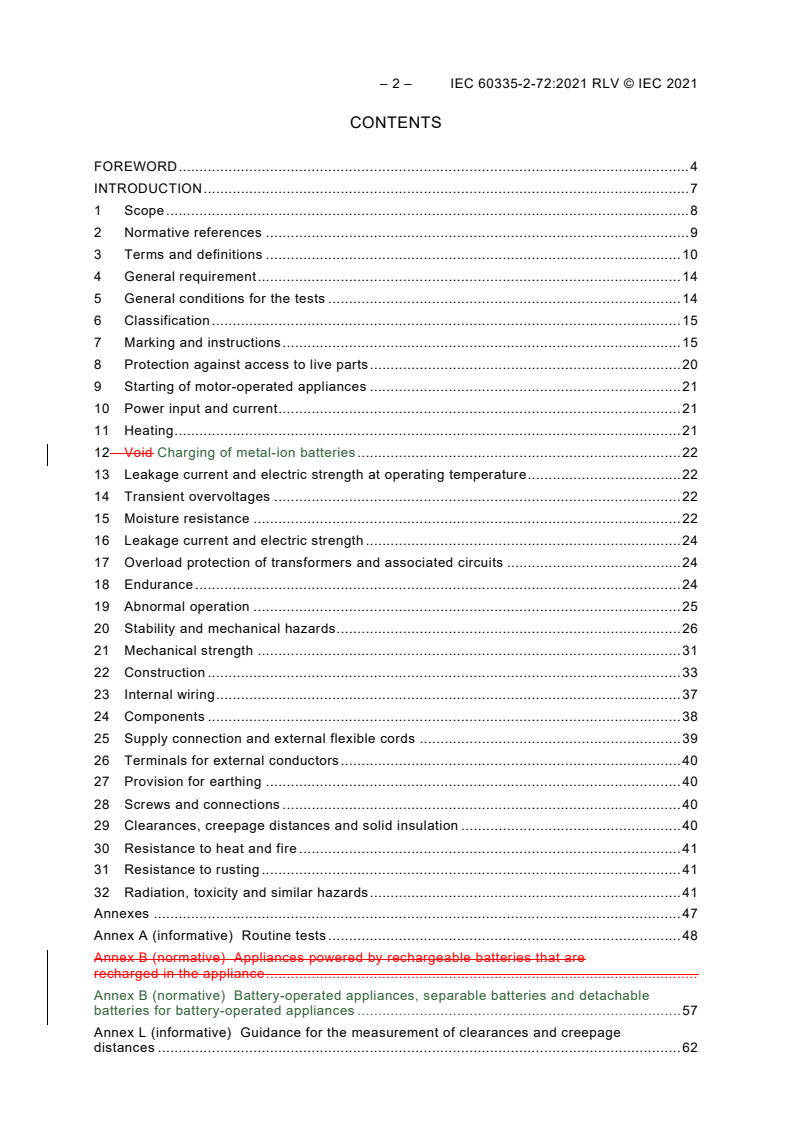
IEC 60335-2-72:2021 RLV - Household and similar electrical appliances - Safety - Part 2-72: Particular requirements for floor treatment machines with or without traction drive, for commercial use Released:7/12/2021
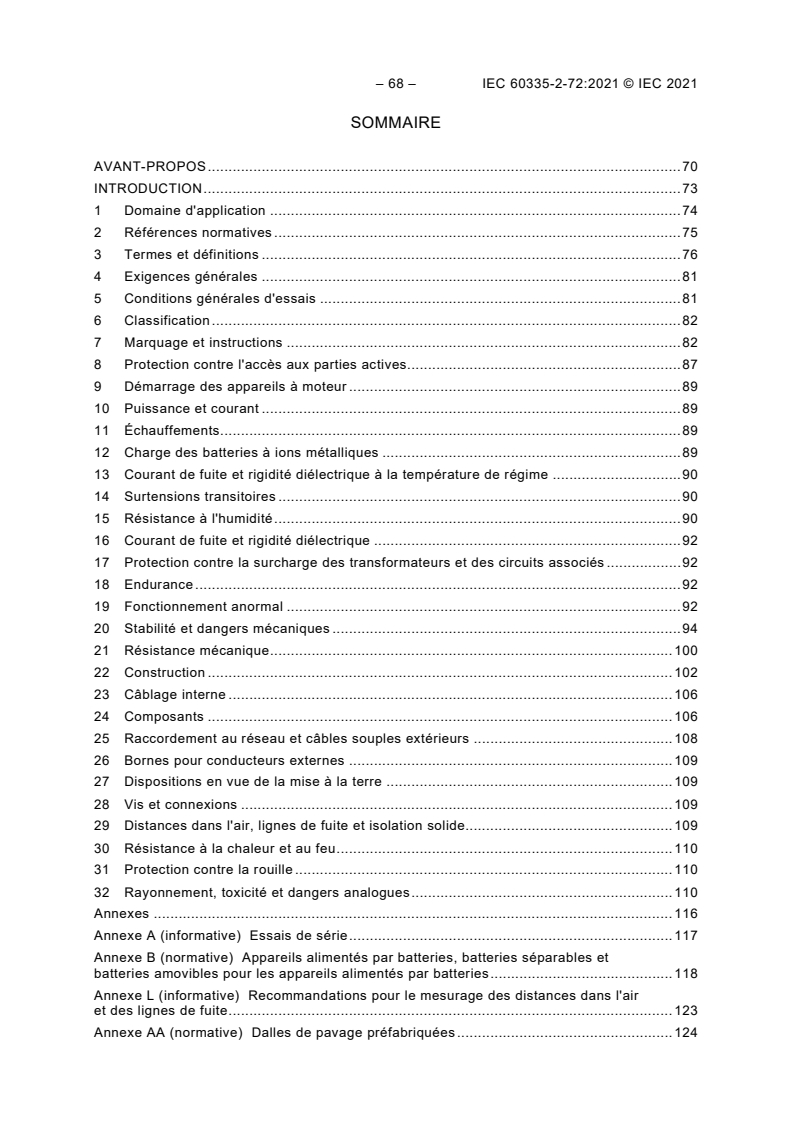
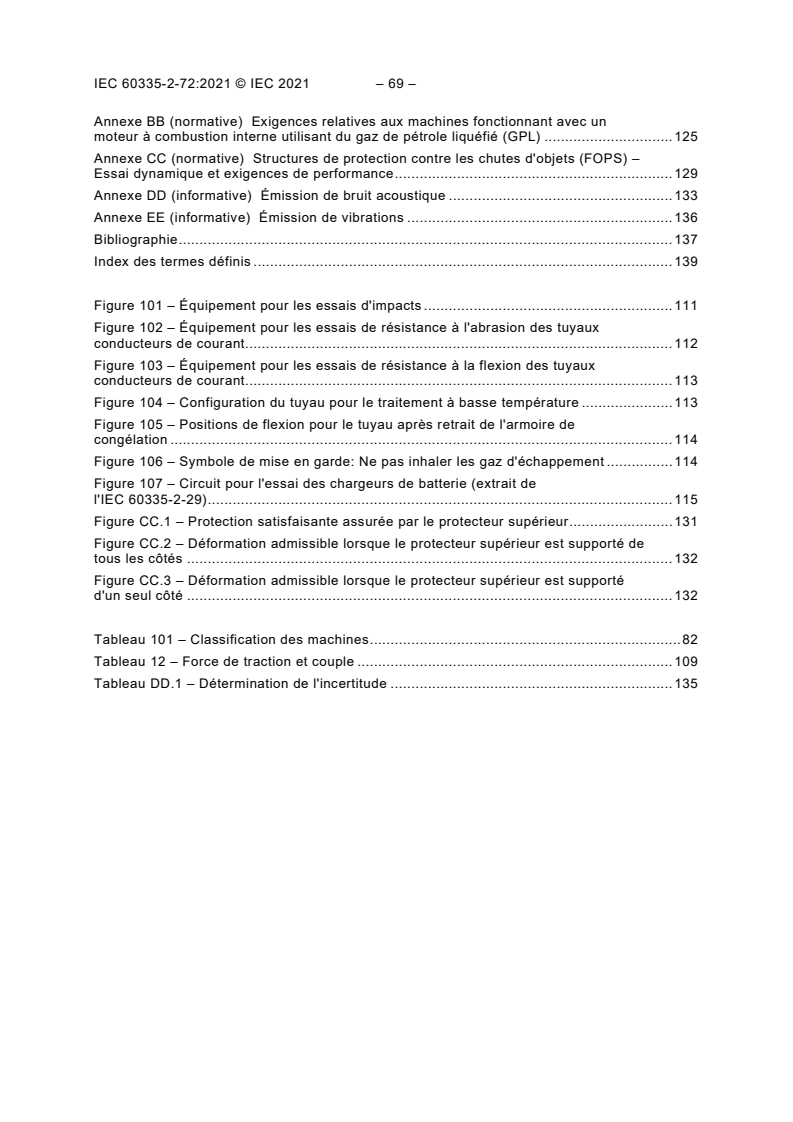
iec60335-2-72{ed5.0}fr - Appareils électrodomestiques et analogues - Sécurité - Partie 2-72: Exigences particulières pour les machines de traitement des sols avec ou sans commande de dispositif de déplacement, à usage commercial
Overview
IEC 60335-2-72:2021 (Edition 5.0) is the IEC safety standard for floor treatment machines with or without traction drive, for commercial use. It sets particular safety requirements for powered ride‑on and walk‑behind machines used for sweeping, scrubbing, wet/dry pick‑up, polishing, applying wax/sealants or powder detergents, and shampooing floors. This Part 2 standard is intended to be used together with the latest edition of IEC 60335-1 and reflects a technical revision aligned with IEC 60335-1:2020.
Key topics and technical requirements
- Scope and machine types: Covers commercial indoor/outdoor machines used in hotels, schools, hospitals, factories, retail outlets, offices and other non‑household uses.
- Power systems covered: Internal combustion engines, mains motors (≤ 250 V single‑phase; ≤ 480 V other types), and battery‑operated machines (including built‑in chargers).
- Safety areas addressed (supplements/modifies IEC 60335-1 clauses):
- Marking and user instructions; protection against access to live parts
- Starting and control of motor‑operated appliances; power input/current limits
- Heating, leakage current, electric strength and transient overvoltages
- Moisture resistance, endurance and abnormal operation tests
- Stability, mechanical hazards and mechanical strength
- Construction, internal wiring, components, earthing, clearances and creepage
- Resistance to heat, fire and rusting; radiation and toxic hazards
- Special annexes and tests: Battery charging and battery appliance guidance, LPG engine emissions (Annex BB), falling-object protective structures (FOPS), acoustical noise and vibration guidance.
- Exclusions: Not applicable to household floor machines (IEC 60335-2-10), certain other commercial machine parts (IEC 60335-2-67/68/69), road sweepers, machines for slopes >20%, PTO‑equipped machines, corrosive/explosive environments, pickup of hazardous/inflammable dust or glowing particles, or machines for on‑board vehicle/aircraft/ship use.
Practical applications - who uses it and why
- Manufacturers and product designers: To design compliant commercial floor treatment machines and integrate required safety features (controls, guards, battery systems, emissions).
- Test laboratories and conformity assessors: For type testing, endurance, electrical safety and mechanical hazard verification in line with the Part 2 requirements and IEC 60335-1.
- Compliance officers, procurement and facility managers: To specify safe equipment for hotels, hospitals, retail and industrial cleaning operations.
- Certification bodies and national authorities: To assess conformity, noting that some countries may impose additional regulatory or workplace safety requirements (e.g., road lighting/registration for ride‑on machines).
Related standards
- IEC 60335-1 (General requirements) - use in conjunction with this Part 2
- IEC 60335-2-10 (Household floor treatment)
- IEC 60335-2-67, -2-68, -2-69 (other commercial cleaning machines)
Using IEC 60335-2-72:2021 helps ensure commercial floor treatment machines meet internationally harmonized electrical and mechanical safety requirements, supporting safer design, testing and market access.
Relations
- Effective Date
- 05-Sep-2023
Buy Documents
IEC 60335-2-72:2021 - Household and similar electrical appliances - Safety - Part 2-72: Particular requirements for floor treatment machines with or without traction drive, for commercial use Released:7/12/2021
IEC 60335-2-72:2021 RLV - Household and similar electrical appliances - Safety - Part 2-72: Particular requirements for floor treatment machines with or without traction drive, for commercial use Released:7/12/2021
iec60335-2-72{ed5.0}fr - Appareils électrodomestiques et analogues - Sécurité - Partie 2-72: Exigences particulières pour les machines de traitement des sols avec ou sans commande de dispositif de déplacement, à usage commercial
Frequently Asked Questions
IEC 60335-2-72:2021 is a standard published by the International Electrotechnical Commission (IEC). Its full title is "Household and similar electrical appliances - Safety - Part 2-72: Particular requirements for floor treatment machines with or without traction drive, for commercial use". This standard covers: IEC 60335-2-72:2021 deals with the safety of powered ride-on and powered walk-behind machines intended for commercial indoor or outdoor use for the following applications: - sweeping, - scrubbing, - wet or dry pick-up, - polishing, - application of wax, sealing products and powder-based detergents, - shampooing of floors. These machines have a cleaning motion which is more linear than lateral or periodic. This standard applies to machines for commercial use. The following list, although not comprehensive, gives an indication of locations that are included in the scope: - public use areas such as hotels, schools, hospitals; - industrial locations, for example factories and manufacturing shops; - retail outlets, for example shops and supermarkets; - business premises, for example offices and banks; - all uses other than normal housekeeping purposes. These machines may be equipped with a traction drive system. The following power systems are covered: - internal combustion engines, - mains powered motors up to a rated voltage of 250 V for single-phase appliances and 480 V for other appliances, - battery-operated machines. Battery-operated machines may be equipped with a built-in battery charger. This standard does not apply to - floor treatment appliances for household use (IEC 60335-2-10); - floor treatment machines for commercial use (IEC 60335-2-67); - spray extraction machines for commercial use (IEC 60335-2-68); - wet and dry vacuum cleaners, including power brush, for commercial use (IEC 60335-2-69); - road sweepers; - machines designed for use on slopes with a gradient exceeding 20 %; - machines equipped with a power take-off (PTO); - machines designed for use in corrosive or explosive environments (dust, vapour or gas); - machines designed for picking up hazardous dusts (as defined in IEC 60335-2-69), inflammable substances, or glowing particles; - machines designed for use in vehicles or on board of ships or aircraft. Attention is drawn to the fact that - in many countries additional requirements on the safe use of the equipment covered can be specified by the national health authorities, the national authorities responsible for the protection of labour, the national water supply authorities and similar authorities; - ride-on machines designed for transport over public roads can be subject to additional requirements (e.g. lighting, license plate etc.). Requirements for fuel-cells are under consideration. This fifth edition cancels and replaces the fourth edition published in 2016. It constitutes a technical revision. This edition includes the following significant technical changes with respect to the previous edition (minor changes are not listed): - editorial and technical alignment with IEC 60335-1:2020; - rearrangement of subclauses to consistent numbering 22.101 to 22.113. This part 2 is to be used in conjunction with the latest edition of IEC 60335-1 and its amendments. It was established on the basis of the sixth edition (2020) of that standard.
IEC 60335-2-72:2021 deals with the safety of powered ride-on and powered walk-behind machines intended for commercial indoor or outdoor use for the following applications: - sweeping, - scrubbing, - wet or dry pick-up, - polishing, - application of wax, sealing products and powder-based detergents, - shampooing of floors. These machines have a cleaning motion which is more linear than lateral or periodic. This standard applies to machines for commercial use. The following list, although not comprehensive, gives an indication of locations that are included in the scope: - public use areas such as hotels, schools, hospitals; - industrial locations, for example factories and manufacturing shops; - retail outlets, for example shops and supermarkets; - business premises, for example offices and banks; - all uses other than normal housekeeping purposes. These machines may be equipped with a traction drive system. The following power systems are covered: - internal combustion engines, - mains powered motors up to a rated voltage of 250 V for single-phase appliances and 480 V for other appliances, - battery-operated machines. Battery-operated machines may be equipped with a built-in battery charger. This standard does not apply to - floor treatment appliances for household use (IEC 60335-2-10); - floor treatment machines for commercial use (IEC 60335-2-67); - spray extraction machines for commercial use (IEC 60335-2-68); - wet and dry vacuum cleaners, including power brush, for commercial use (IEC 60335-2-69); - road sweepers; - machines designed for use on slopes with a gradient exceeding 20 %; - machines equipped with a power take-off (PTO); - machines designed for use in corrosive or explosive environments (dust, vapour or gas); - machines designed for picking up hazardous dusts (as defined in IEC 60335-2-69), inflammable substances, or glowing particles; - machines designed for use in vehicles or on board of ships or aircraft. Attention is drawn to the fact that - in many countries additional requirements on the safe use of the equipment covered can be specified by the national health authorities, the national authorities responsible for the protection of labour, the national water supply authorities and similar authorities; - ride-on machines designed for transport over public roads can be subject to additional requirements (e.g. lighting, license plate etc.). Requirements for fuel-cells are under consideration. This fifth edition cancels and replaces the fourth edition published in 2016. It constitutes a technical revision. This edition includes the following significant technical changes with respect to the previous edition (minor changes are not listed): - editorial and technical alignment with IEC 60335-1:2020; - rearrangement of subclauses to consistent numbering 22.101 to 22.113. This part 2 is to be used in conjunction with the latest edition of IEC 60335-1 and its amendments. It was established on the basis of the sixth edition (2020) of that standard.
IEC 60335-2-72:2021 is classified under the following ICS (International Classification for Standards) categories: 97.080 - Cleaning appliances. The ICS classification helps identify the subject area and facilitates finding related standards.
IEC 60335-2-72:2021 has the following relationships with other standards: It is inter standard links to IEC 60335-2-72:2016. Understanding these relationships helps ensure you are using the most current and applicable version of the standard.
IEC 60335-2-72:2021 is available in PDF format for immediate download after purchase. The document can be added to your cart and obtained through the secure checkout process. Digital delivery ensures instant access to the complete standard document.
Standards Content (Sample)
IEC 60335-2-72 ®
Edition 5.0 2021-07
INTERNATIONAL
STANDARD
colour
inside
Household and similar electrical appliances – Safety –
Part 2-72: Particular requirements for floor treatment machines with or without
traction drive, for commercial use
All rights reserved. Unless otherwise specified, no part of this publication may be reproduced or utilized in any form
or by any means, electronic or mechanical, including photocopying and microfilm, without permission in writing from
either IEC or IEC's member National Committee in the country of the requester. If you have any questions about IEC
copyright or have an enquiry about obtaining additional rights to this publication, please contact the address below or
your local IEC member National Committee for further information.
IEC Central Office Tel.: +41 22 919 02 11
3, rue de Varembé info@iec.ch
CH-1211 Geneva 20 www.iec.ch
Switzerland
About the IEC
The International Electrotechnical Commission (IEC) is the leading global organization that prepares and publishes
International Standards for all electrical, electronic and related technologies.
About IEC publications
The technical content of IEC publications is kept under constant review by the IEC. Please make sure that you have the
latest edition, a corrigendum or an amendment might have been published.
IEC publications search - webstore.iec.ch/advsearchform IEC online collection - oc.iec.ch
The advanced search enables to find IEC publications by a Discover our powerful search engine and read freely all the
variety of criteria (reference number, text, technical publications previews. With a subscription you will always
committee, …). It also gives information on projects, replaced have access to up to date content tailored to your needs.
and withdrawn publications.
Electropedia - www.electropedia.org
IEC Just Published - webstore.iec.ch/justpublished
The world's leading online dictionary on electrotechnology,
Stay up to date on all new IEC publications. Just Published
containing more than 22 000 terminological entries in English
details all new publications released. Available online and
and French, with equivalent terms in 18 additional languages.
once a month by email.
Also known as the International Electrotechnical Vocabulary
(IEV) online.
IEC Customer Service Centre - webstore.iec.ch/csc
If you wish to give us your feedback on this publication or
need further assistance, please contact the Customer Service
Centre: sales@iec.ch.
IEC 60335-2-72 ®
Edition 5.0 2021-07
INTERNATIONAL
STANDARD
colour
inside
Household and similar electrical appliances – Safety –
Part 2-72: Particular requirements for floor treatment machines with or without
traction drive, for commercial use
INTERNATIONAL
ELECTROTECHNICAL
COMMISSION
ICS 97.080 ISBN 978-2-8322-9995-1
– 2 – IEC 60335-2-72:2021 © IEC 2021
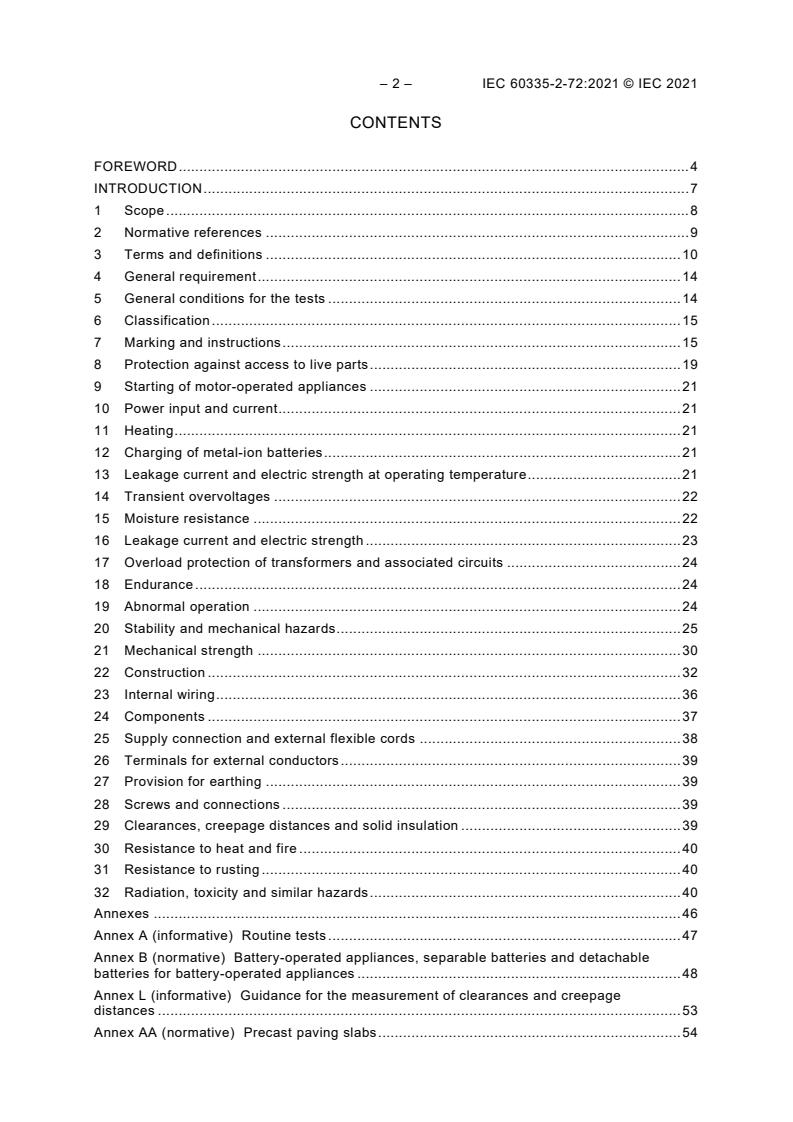
CONTENTS
FOREWORD . 4
INTRODUCTION . 7
1 Scope . 8
2 Normative references . 9
3 Terms and definitions . 10
4 General requirement . 14
5 General conditions for the tests . 14
6 Classification . 15
7 Marking and instructions . 15
8 Protection against access to live parts . 19
9 Starting of motor-operated appliances . 21
10 Power input and current . 21
11 Heating . 21
12 Charging of metal-ion batteries . 21
13 Leakage current and electric strength at operating temperature . 21
14 Transient overvoltages . 22
15 Moisture resistance . 22
16 Leakage current and electric strength . 23
17 Overload protection of transformers and associated circuits . 24
18 Endurance . 24
19 Abnormal operation . 24
20 Stability and mechanical hazards . 25
21 Mechanical strength . 30
22 Construction . 32
23 Internal wiring . 36
24 Components . 37
25 Supply connection and external flexible cords . 38
26 Terminals for external conductors . 39
27 Provision for earthing . 39
28 Screws and connections . 39
29 Clearances, creepage distances and solid insulation . 39
30 Resistance to heat and fire . 40
31 Resistance to rusting . 40
32 Radiation, toxicity and similar hazards . 40
Annexes . 46
Annex A (informative) Routine tests . 47
Annex B (normative) Battery-operated appliances, separable batteries and detachable
batteries for battery-operated appliances . 48
Annex L (informative) Guidance for the measurement of clearances and creepage
distances . 53
Annex AA (normative) Precast paving slabs . 54
Annex BB (normative) Requirements for internal combustion engine powered
machines using liquefied petroleum gas (LPG) . 55
Annex CC (normative) Falling-object protective structures (FOPS) – Dynamic test and
performance requirements . 58
Annex DD (informative) Emission of acoustical noise . 61
Annex EE (informative) Emission of vibration . 64
Bibliography . 65
Index of defined terms . 67
Figure 101 – Impact test apparatus . 41
Figure 102 – Apparatus for testing the abrasion resistance of current-carrying hoses . 42
Figure 103 – Apparatus for testing the resistance to flexing of current-carrying hoses . 43
Figure 104 – Configuration of the hose for the freezing treatment . 43
Figure 105 – Flexing positions for the hose after removal from the freezing cabinet . 44
Figure 106 – Warning symbol: Do not inhale exhaust fumes . 44
Figure 107 – Circuit for testing battery chargers (taken from IEC 60335-2-29) . 45
Figure CC.1 – Satisfactory protection by the overhead guard . 59
Figure CC.2 – Admissible deformation when the overhead guard is supported at all
sides . 60
Figure CC.3 – Admissible deformation when the overhead guard is supported at one
side . 60
Table 101 – Machine classification . 15
Table 12 – Pull force and torque . 39
Table DD.1 – Determination of uncertainty . 63
– 4 – IEC 60335-2-72:2021 © IEC 2021
INTERNATIONAL ELECTROTECHNICAL COMMISSION
____________
HOUSEHOLD AND SIMILAR ELECTRICAL APPLIANCES –
SAFETY –
Part 2-72: Particular requirements for floor treatment machines
with or without traction drive, for commercial use
FOREWORD
1) The International Electrotechnical Commission (IEC) is a worldwide organization for standardization comprising
all national electrotechnical committees (IEC National Committees). The object of IEC is to promote
international co-operation on all questions concerning standardization in the electrical and electronic fields. To
this end and in addition to other activities, IEC publishes International Standards, Technical Specifications,
Technical Reports, Publicly Available Specifications (PAS) and Guides (hereafter referred to as “IEC
Publication(s)”). Their preparation is entrusted to technical committees; any IEC National Committee interested
in the subject dealt with may participate in this preparatory work. International, governmental and non-
governmental organizations liaising with the IEC also participate in this preparation. IEC collaborates closely
with the International Organization for Standardization (ISO) in accordance with conditions determined by
agreement between the two organizations.
2) The formal decisions or agreements of IEC on technical matters express, as nearly as possible, an international
consensus of opinion on the relevant subjects since each technical committee has representation from all
interested IEC National Committees.
3) IEC Publications have the form of recommendations for international use and are accepted by IEC National
Committees in that sense. While all reasonable efforts are made to ensure that the technical content of IEC
Publications is accurate, IEC cannot be held responsible for the way in which they are used or for any
misinterpretation by any end user.
4) In order to promote international uniformity, IEC National Committees undertake to apply IEC Publications
transparently to the maximum extent possible in their national and regional publications. Any divergence
between any IEC Publication and the corresponding national or regional publication shall be clearly indicated in
the latter.
5) IEC itself does not provide any attestation of conformity. Independent certification bodies provide conformity
assessment services and, in some areas, access to IEC marks of conformity. IEC is not responsible for any
services carried out by independent certification bodies.
6) All users should ensure that they have the latest edition of this publication.
7) No liability shall attach to IEC or its directors, employees, servants or agents including individual experts and
members of its technical committees and IEC National Committees for any personal injury, property damage or
other damage of any nature whatsoever, whether direct or indirect, or for costs (including legal fees) and
expenses arising out of the publication, use of, or reliance upon, this IEC Publication or any other IEC
Publications.
8) Attention is drawn to the Normative references cited in this publication. Use of the referenced publications is
indispensable for the correct application of this publication.
9) Attention is drawn to the possibility that some of the elements of this IEC Publication may be the subject of
patent rights. IEC shall not be held responsible for identifying any or all such patent rights.
IEC 60335-2-72 has been prepared by subcommittee 61J: Electrical motor-operated cleaning
appliances for commercial use, of IEC technical committee 61: Safety of household and
similar electrical appliances. It is an International Standard.
This fifth edition cancels and replaces the fourth edition published in 2016. It constitutes a
technical revision.
This edition includes the following significant technical changes with respect to the previous
edition (minor changes are not listed):
– editorial and technical alignment with IEC 60335-1:2020;
– rearrangement of subclauses to consistent numbering 22.101 to 22.113.
The text of this International Standard is based on the following documents:
CDV Report on voting
61J/738/CDV 61J/744A/RVC
Full information on the voting for its approval can be found in the report on voting indicated in
the above table.
The language used for the development of this International Standard is English.
This document was drafted in accordance with ISO/IEC Directives, Part 2, and developed in
accordance with ISO/IEC Directives, Part 1 and ISO/IEC Directives, IEC Supplement,
available at www.iec.ch/members_experts/refdocs. The main document types developed by
IEC are described in greater detail at www.iec.ch/standardsdev/publications.
This part 2 is to be used in conjunction with the latest edition of IEC 60335-1 and its
amendments. It was established on the basis of the sixth edition (2020) of that standard.
NOTE 1 When “Part 1” is mentioned in this standard, it refers to IEC 60335-1.
This part 2 supplements or modifies the corresponding clauses in IEC 60335-1, so as to
convert that publication into the IEC standard: Particular requirements for floor treatment
machines with or without traction drive, for commercial use.
When a particular subclause of Part 1 is not mentioned in this part 2, that subclause applies
as far as is reasonable. When this standard states “addition”, “modification” or “replacement”,
the relevant text in Part 1 is to be adapted accordingly.
NOTE 2 The following numbering system is used:
– subclauses, tables and figures that are numbered starting from 101 are additional to those in Part 1;
– unless notes are in a new subclause or involve notes in Part 1, they are numbered starting from 101, including
those in a replaced clause or subclause;
– additional annexes are lettered AA, BB, etc.
NOTE 3 The following print types are used:
– requirements: in roman type;
– test specifications: in italic type;
– notes: in small roman type.
NOTE 4 The attention of National Committees is drawn to the fact that equipment manufacturers and testing
organizations may need a transitional period following publication of a new, amended or revised IEC publication in
which to make products in accordance with the new requirements and to equip themselves for conducting new or
revised tests.
It is the recommendation of the committee that the content of this publication be adopted for implementation
nationally not earlier than 12 months or later than 36 months from the date of publication.
The following differences exist in the countries indicated below.
– Annex AA: The CO-emission of LPG driven machines, intended to be used indoors, has to comply with the
value specified in Annex BB. The result shall be documented (Germany).
– Annex BB: For machines intended to be used indoors, except single cylinder engines, the exhaust gas shall
not contain more than 0,1 % volume of carbon monoxide (CO). If adjustments are necessary, the adjusting
means shall be easily accessible. The measurement shall be carried out with a warm engine, idling, using
98 % propane. The revolution speed of the engine shall be documented (Germany).
Words in bold in the text are defined in Clause 3. When a definition concerns an adjective, the adjective and the
associated noun are also in bold.
A list of all parts of the IEC 60335 series, under the general title: Household and similar
electrical appliances – Safety, can be found on the IEC website.
– 6 – IEC 60335-2-72:2021 © IEC 2021
The committee has decided that the contents of this document will remain unchanged until the
stability date indicated on the IEC website under webstore.iec.ch in the data related to the
specific document. At this date, the document will be
• reconfirmed,
• withdrawn,
• replaced by a revised edition, or
• amended.
IMPORTANT – The 'colour inside' logo on the cover page of this publication indicates that it
contains colours which are considered to be useful for the correct understanding of its
contents. Users should therefore print this document using a colour printer.
INTRODUCTION
It has been assumed in the drafting of this International Standard that the execution of its
provisions is entrusted to appropriately qualified and experienced persons.
This standard recognizes the internationally accepted level of protection against hazards such
as electrical, mechanical, thermal, fire and radiation of appliances when operated as in
normal use taking into account the manufacturer's instructions. It also covers abnormal
situations that can be expected in practice and takes into account the way in which
electromagnetic phenomena can affect the safe operation of appliances.
This standard takes into account the requirements of IEC 60364 as far as possible so that
there is compatibility with the wiring rules when the appliance is connected to the supply
mains. However, national wiring rules may differ.
If an appliance within the scope of this standard also incorporates functions that are covered
by another part 2 of IEC 60335, the relevant part 2 is applied to each function separately, as
far as is reasonable. If applicable, the influence of one function on the other is taken into
account.
When a part 2 standard does not include additional requirements to cover hazards dealt with
in Part 1, Part 1 applies.
NOTE 1 This means that the technical committees responsible for the part 2 standards have determined that it is
not necessary to specify particular requirements for the appliance in question over and above the general
requirements.
This standard is a product family standard dealing with the safety of appliances and takes
precedence over horizontal and generic standards covering the same subject.
NOTE 2 Horizontal and generic standards covering a hazard are not applicable since they have been taken into
consideration when developing the general and particular requirements for the IEC 60335 series of standards. For
example, in the case of temperature requirements for surfaces on many appliances, generic standards, such as
ISO 13732-1 for hot surfaces, are not applicable in addition to Part 1 or part 2 standards.
An appliance that complies with the text of this standard will not necessarily be considered to
comply with the safety principles of the standard if, when examined and tested, it is found to
have other features that impair the level of safety covered by these requirements.
An appliance employing materials or having forms of construction differing from those detailed
in the requirements of this standard may be examined and tested according to the intent of
the requirements and, if found to be substantially equivalent, may be considered to comply
with the standard.
– 8 – IEC 60335-2-72:2021 © IEC 2021
HOUSEHOLD AND SIMILAR ELECTRICAL APPLIANCES –
SAFETY –
Part 2-72: Particular requirements for floor treatment machines
with or without traction drive, for commercial use
1 Scope
This clause of Part 1 is replaced by the following.
This part of IEC 60335 deals with the safety of powered ride-on and powered walk-behind
machines intended for commercial indoor or outdoor use for the following applications:
– sweeping,
– scrubbing,
– wet or dry pick-up,
– polishing,
– application of wax, sealing products and powder-based detergents,
– shampooing
of floors.
These machines have a cleaning motion which is more linear than lateral or periodic.
NOTE 101 By contrast, the cleaning motion of machines covered by IEC 60335-2-67 is more lateral or periodic
than linear.
NOTE 102 This standard applies to machines for commercial use. The following list, although not
comprehensive, gives an indication of locations that are included in the scope:
– public use areas such as hotels, schools, hospitals;
– industrial locations, for example factories and manufacturing shops;
– retail outlets, for example shops and supermarkets;
– business premises, for example offices and banks;
– all uses other than normal housekeeping purposes.
These machines may be equipped with a traction drive system. The following power systems
are covered:
– internal combustion engines,
– mains powered motors up to a rated voltage of 250 V for single-phase appliances and
480 V for other appliances,
– battery-operated machines.
Battery-operated machines may be equipped with a built-in battery charger.
This standard does not apply to
– floor treatment appliances for household use (IEC 60335-2-10);
– floor treatment machines for commercial use (IEC 60335-2-67);
– spray extraction machines for commercial use (IEC 60335-2-68);
– wet and dry vacuum cleaners, including power brush, for commercial use
(IEC 60335-2-69);
NOTE 103 IEC 60335-2-67, IEC 60335-2-68 and IEC 60335-2-69 cover only machines without traction drive.
– road sweepers;
NOTE 104 In Europe, EN 13019 covers road sweepers.
– machines designed for use on slopes with a gradient exceeding 20 %;
– machines equipped with a power take-off (PTO);
– machines designed for use in corrosive or explosive environments (dust, vapour or gas);
– machines designed for picking up hazardous dusts (as defined in IEC 60335-2-69),
inflammable substances, or glowing particles;
– machines designed for use in vehicles or on board of ships or aircraft.
NOTE 105 Attention is drawn to the fact that
– in many countries additional requirements on the safe use of the equipment covered can be specified by the
national health authorities, the national authorities responsible for the protection of labour, the national water
supply authorities and similar authorities;
– ride-on machines designed for transport over public roads can be subject to additional requirements (e.g.
lighting, license plate etc.).
NOTE 106 Requirements for fuel-cells are under consideration.
2 Normative references
This clause of Part 1 is applicable except as follows.
Addition:
IEC 62061, Safety of machinery – Functional safety of safety-related control systems
IEC 62485-3:2014, Safety requirements for secondary batteries and battery installations –
Part 3: Traction batteries
IEC TS 62885-1, Surface cleaning appliances – Part 1: General requirements on test material
and test equipment
ISO 3411, Earth moving machinery – Physical dimensions of operators and minimum operator
space envelope
ISO 5353, Earth-moving machinery, and tractors and machinery for agriculture and forestry –
Seat index point
ISO 6344-2, Coated abrasives – Grain size analysis – Part 2: Determination of grain size
distribution of macrogrits P12 to P220
ISO 13849-1, Safety of machinery – Safety-related parts of control systems – Part 1: General
principles for design
ISO 13857:2019, Safety of machinery – Safety distances to prevent hazard zones being
reached by the upper and lower limbs
ISO 25119 (all parts), Tractors and machinery for agriculture and forestry – Safety-related
parts of control systems
Replacement:
IEC 60068-2-78:2012, Environmental testing – Part 2-78: Tests – Test Cab: Damp heat,
steady state
– 10 – IEC 60335-2-72:2021 © IEC 2021
3 Terms and definitions
This clause of Part 1 is applicable except as follows.
3.1.9 Replacement:
normal operation
conditions under which the machine is operated in normal use, as intended by the
manufacturer
It denotes the load corresponding to the rated power input or the highest obtainable load of
all particular loads of the various functions that can be operated at the same time in
accordance with the manufacturer’s instructions. For machines provided with a seat or an
operator platform, a mass of 75 kg secured in position at the appropriate height is used to
simulate the operator in the most unfavourable position. Internal combustion engine driven
machines are operated with the fuel specified by the manufacturer except where otherwise
stated in this standard.
Operational functions include all treatment and driving functions.
Operation of the machine under following conditions:
– the battery is charged, the battery being initially discharged to such an extent that the
appliance cannot operate;
– if possible, the appliance is supplied from the supply mains through its standalone battery
charger, the battery being initially discharged to such an extent that the appliance cannot
operate. The appliance is operated as specified in the main part of this standard;
– if possible, built-in battery chargers are connected to the circuit of Figure 107. The
variable resistor is adjusted so that the current in the circuit is the rated DC output
current when the battery charger is supplied at rated voltage. When the charging current
is controlled by the state of charge of the battery, the variable resistor and the capacitor
are replaced by a discharged battery of the type and having the largest capacity specified
in the instructions.
– if the appliance incorporates inductive coupling between two parts that are detachable
from each other, the appliance is supplied from the supply mains with the detachable part
removed.
The normal operation related to the operational functions is specified in 3.1.9.101 to
3.1.9.103:
3.1.9.101 Scrubbing and sweeping machines are operated on a surface of hydraulically
pressed concrete paving slabs (see normative Annex AA) intermittently at least 30 min
switched on, and for a period of 5 min switched off.
An alternative is a smooth concrete area of a surface consistency comparable with
hydraulically pressed concrete paving slabs.
3.1.9.102 Polishing and dry buffing machines are operated as follows.
PVC- or comparable flooring surfaces are considered to be suitable for establishing normal
operation. The peak of input occurring during the drying process of the chemical applied to
treat the surface is not taken as normal operation but is averaged by extending
measurements over a period of at least 10 min.
3.1.9.103 Carpet shampooers are operated on a test surface consisting of a carpet, in
accordance with IEC TS 62885-1, the carpet being fastened to the floor.
Prior to testing, the brush of the shampooing machine is conditioned by operating it for 15 min
on a clean, dry concrete surface. After running on the concrete surface, the brush is
immersed in a shampoo solution for at least 30 min.
The solution tank is filled and the machine is operated over a period of 10 min.
3.6.9 Addition:
Note 101 to entry: Sets of batteries are regarded as a single battery if they require tools to disconnect the
individual battery interconnections.
3.101
traction drive
system used to propel the machine, e.g. by powered wheels
Note 1 to entry: Traction by the effect of rotating brushes is not included.
3.102
walk-behind machine
machine with or without a traction drive designed to be controlled by the operator walking
behind the machine
It may be equipped with a detachable sulky.
3.103
ride-on machine
machine with a traction drive and with an operator seat or a platform on which the operator
is sitting/standing during operation
3.104
sulky (trailer)
removable trailing seat or stand-on platform with wheels or skids designed to carry an
operator in a sitting or standing position, while controlling a walk-behind machine with
traction drive
3.105
wet cleaning machine
machine for applying and sucking up liquids
3.106
water-suction cleaning machine
machine for sucking up liquids
3.107
motorized cleaning head
hand-held or hand-guided cleaning device connected to the machine, with an integrated
electrical motor
Note 1 to entry: The main cleaning head permanently attached is not regarded as a motorized cleaning head.
3.108
hopper
container to store picked up debris
3.109
parking brake
means, actuated by the operator in the normal operating position, to prevent a stationary
machine from moving
3.110
service brake
means for decelerating and stopping a machine, with a traction drive, from its ground travel
speed
– 12 – IEC 60335-2-72:2021 © IEC 2021
3.111
operator presence control
OPC
control device that automatically interrupts the power, e.g. to a drive or an engine, when the
operator's actuating force is removed
Note 1 to entry: Such devices can be, for example, continuous action controls ("hold-to-run" controls) or seat
switches.
3.112
guard
part of the machine specifically designed to provide protection by means of a physical barrier,
such as, for example, a casing, a shield, a cover, a screen, a door, an enclosure or a fence;
other parts of the machine that fulfil a primarily operational function, such as, for example, the
frame of the machine, may also fulfil a protective function but are not referred to as guards
Note 1 to entry: Three main kinds of guards can be distinguished: fixed guards, interlocking moveable guards
and adjustable guards. Interlocking movable guards are required where frequent access is envisaged, while fixed
guards can be used where frequent access is not envisaged.
3.113
operator
person in direct physical contact with the machine and performing one or more of the
following tasks: installing, operating, adjusting, cleaning, moving, or performing user
maintenance on the machine
3.114
gross vehicle weight
GVW
maximum allowable fully laden weight of the machine and its payload, as ready for use
Note 1 to entry: See 5.102 for further test conditions.
3.115
test solution
solution which consists of 20 g of NaCl and 1 ml of a solution of 28 % by mass of dodecyl
sodium sulphate in each 8 l of water
Note 1 to entry: The chemical designation of dodecyl sodium sulphate is C H NaSO .
12 25 4
3.116
level surface
plane with a gradient up to and including 2 %
3.117
slope
inclined plane with a gradient greater than 2 % but not exceeding 20 %
3.118
maximum cleaning gradeability
maximum gradient according to manufacturer's instruction and as indicated on the machine,
on which the machine can be used safely for cleaning purposes
3.119
maximum transport gradeability
maximum gradient according to manufacturer's instruction, on which the machine can be used
safely for transport purposes
3.120
built-in charger
charger mounted on or into the machine and designed to operate only on or into the machine
Note 1 to entry: Built-in battery chargers can also be called on-board chargers.
3.121
built-in charger with power supply function
component intended to provide power for charging, operation or both
3.122
commercial use
intended use of machines covered by this standard, i.e. not intended for normal housekeeping
purposes by private persons but which may be a source of danger to the public
I.e. in particular that
– the machines may be used by cleaning contractors, cleaning staff, etc.;
– they are used in commercial or public premises (i.e. offices, shops, hotels, hospitals,
schools, etc.) or in industrial (plants etc.) and light industrial (workshops etc.)
environments.
Note 1 to entry: Commercial use is also called professional use.
3.123
battery low voltage
BLV
battery-supplied floating DC working voltage in the range of >42 V and ≤60 V
Batteries of BLV systems may be charged with voltages up to 75 V DC. All voltages are
regarded as DC if the peak-to-peak value does not exceed 10 % of the average value.
Note 1 to entry: BLV is not considered to be of class I, class II, or class III.
3.124
hazardous voltage
voltage between parts having an average value exceeding 60 V DC or 42 V peak when the
peak-to-peak ripple exceeds 10 % of the average value
3.125
battery connector
plug connecting system applied for the connection of the battery either with the charging
system, or with the machine, which can be engaged and disengaged without the use of any
tools
3.126
BLV insulation
insulation applied to live parts to provide basic protection against electric shock and which is
identical with basic insulation in the voltage range defined by BLV
3.127
rated DC output voltage
output voltage assigned to the battery charger by the manufacturer
3.128
rated DC output current
output current assigned to the battery charger by the manufacturer
– 14 – IEC 60335-2-72:2021 © IEC 2021
4 General requirement
This clause of Part 1 is applicable except as follows:
Replacement of the first paragraph by the following:
Machines shall be constructed so that they function safely so as to cause no danger to
persons or surroundings during normal use, even in the event of carelessness, and during
installation, adjusting, maintenance, cleaning, repairing or transportation.
Addition:
For the purposes of this standard, the term ‘appliance’ as used in Part 1 is to be read as
‘machine’.
5 General conditions for the tests
This clause of Part 1 is applicable except as follows.
5.8.1 Addition:
When measuring voltage, the peak value of any superimposed ripple exceeding 10 % of the
average value shall be included. Transient voltages are ignored, such as a temporary
increase of voltage, for example after the battery is disconnected from the charging circuit.
5.17 Modification:
Built-in chargers in compliance with IEC 60335-2-29 do not need to be retested, except for
Clauses 6, 7, 11, 15, 19 and 22.
Clause 29 needs to be reevaluated if the pollution degree of the microenvironment for the
battery charger is 1 or 2 unless the insulation is enclosed or located so that it is unlikely to be
exposed to pollution due to normal use of the machine.
5.101 The test solution is to be stored in a cool atmosphere and used within seven days
after its preparation.
5.102 The GVW includes, if applicable, full clean water tanks, empty dirty water tanks (half
full for recycling systems), empty dust bags, hopper loaded at rated capacity, largest
recommended batteries, all options such as cords, hoses, wands, cleaning agents, brooms
and brushes.
For ride-on machines, the GVW includes a standard operator, weighing 75 kg.
5.103 Liquid containers of machines for wet scrubbing and shampooing are filled to the
highest level indicated by the manufacturer.
5.104 Machines that are designed to have a sulky are tested with the sulky including the
weight of a standard operator (75 kg) or without the sulky, whichever is the most
unfavourable condition.
5.105 Combustion engine-powered machines shall be supplied with the fuel as specified by
the manufacturer, except if stated elsewhere in this standard.
6 Classification
This clause of Part 1 is applicable except as follows.
6.1 Replacement:
Machines shall be one of the following classes with respect to the protection against electric
shock (see Table 101):
Table 101 – Machine classification
Working voltage DC Working voltage AC Classification Classification
mains-supplied circuits battery-supplied circuits
≤ 42 V (SELV) ≤ 42 V (SELV) Class III Not classified
≤ 42 V (ELV) ≤ 42 V (ELV) Class I or II Not classified
> 42 V and ≤ 60 V Class I or II BLV; special conditions
apply as given in
(≤75 V during
normative Annex B.
charging mode)
(BLV);
> 60 V (> 75 V during Class I or II Not classified
> 42 V
charging mode)
Compliance is checked by inspection and by the relevant tests.
6.2 Addition:
Mains supplied and battery powered machines for indoor use intended for dry cleaning only
shall be at least IPX0. Other machines shall be at least IPX3.
7 Marking and instructions
This clause of Part 1 is applicable except as follows.
7.1 Modification:
Replace the fourth dashed item as follows:
– the business name and address of the manufacturer and, if applicable, his authorized
representative; any address shall be sufficient to ensure postal contact;
Addition:
Machines shall be marked in addition with the following:
– serial number, if any;
– designation of the machine and series or type, allowing the technical identification of the
product. This may be achieved by a combination of letters and/or numbers;
NOTE 101 Designation of machine, series or type includes the model or type reference as required in Part 1.
– year of construction, i.e. the year in which the manufacturing process is completed;
NOTE 102 The year of construction can be part of the serial number.
– GVW of the machine, in kg;
– 16 – IEC 60335-2-72:2021 © IEC 2021
– the symbol indicating the maximum cleaning gradeability, with the value of x.
NOTE 103 I.e. the machine might be able to drive on a higher gradient (maximum transport gradeability). This
additional information can be given also in the instructions for use.
Machines intended to be used indoors and powered by internal combustion engines shall be
marked in addition with the symbol according to Figure 106. It is acceptable to show this
symbol in monochrome colour.
7.1.101 Motorized cleaning heads shall be marked with
– rated voltage or rated voltage range in volts;
– rated power input in watts;
– name, trademark or identification mark of the manufacturer or responsible vendor;
– model or type reference;
– mass of the most usual configuration in kg.
Motorized cleaning heads for water-suction cleaning appliances, except those of class III
construction having a working voltage up to 24 V shall be marked with symbol
IEC 60417-5935 (2012-09).
NOTE This symbol is an information sign and, except for the colours, the rules of ISO 3864-1 apply.
Compliance is checked by inspection.
7.6 Addition:
x %
maximum cleaning gradeability ‘x’
[symbol IEC 60417-5935 motorized cleaning head for water-
(2012-09)] suction cleaning
7.12 Modification:
Delete the first paragraph and the first warning.
Add after the Note the following new text:
NOTE 101 Alternative requirements for instructions in hard copy form are available in 7.12.9.
Replacement of the fourth paragraph by the following text.
This machine is not intended for use by persons (including children) with reduced physical,
sensory or mental capabilities, or lack of experience and knowledge.
Addition:
The front cover of the instructions shall include the substance of the following warning:
CAUTION Read the instructions before using the machine.
This wording may be replaced by symbols ISO 7000-0434A (2004-01) and ISO 7000-0790
(2004-01).
The instructions shall contain at least the following:
– the business name and full address of the manufacturer and, if applicable, his authorized
representative;
– designation of series or type of the machine as marked on the machine itself, except for
the serial number;
NOTE 101 The designation of series or type can be abstracted, as long as the identification of the product is
ensured.
– the general description of the machine;
– the GVW of the machine in kilograms;
– the transportation weight of the machine in kilograms, which includes the batteries but
excludes options (e.g. driver cabin, FOPS, second and third side broom, front mounted
sweeping attachment for scrubbers), fresh water (in case of scrubbers or combined
machines), and the weight of a standard operator (75 kg);
– the intended use of the machine and the auxiliary equipment as covered by the scope of
this standard;
NOTE 102 Examples of auxiliary equipment are suction nozzles, spray bars, and lights.
– the meaning of the symbols used on the machine and in the instructions;
– drawings, diagrams, descriptions and explanations necessary for the safe use,
maintenance and repair of the machine and for checking its correct functioning;
– technical data including the markings on the machine;
– information regarding putting into service, safe operation, handling, transportation, and
storage of the machine taking into account its GVW;
– instructions to enable adjustment and maintenance to be carried out safely, including the
protective measures that should be taken during these operations;
– the conditions in which the machine meets the requirement of stability during use,
transportation, assembly, dismantling when out of service, testing or foreseeable
breakdowns;
– the procedure to be followed to prevent unsafe situations in the event of accident (e.g.
contact with or spillage of detergents, battery acid, fuel or oil) or equipment breakdown
(such as flat tire or component failure);
– the substance of the following:
This machine is intended for commercial use, for example in hotels, schools, hospitals,
factories, shops, offices and rental busine
...
IEC 60335-2-72 ®
Edition 5.0 2021-07
REDLINE VERSION
INTERNATIONAL
STANDARD
colour
inside
Household and similar electrical appliances – Safety –
Part 2-72: Particular requirements for floor treatment machines with or without
traction drive, for commercial use
All rights reserved. Unless otherwise specified, no part of this publication may be reproduced or utilized in any form
or by any means, electronic or mechanical, including photocopying and microfilm, without permission in writing from
either IEC or IEC's member National Committee in the country of the requester. If you have any questions about IEC
copyright or have an enquiry about obtaining additional rights to this publication, please contact the address below or
your local IEC member National Committee for further information.
IEC Central Office Tel.: +41 22 919 02 11
3, rue de Varembé info@iec.ch
CH-1211 Geneva 20 www.iec.ch
Switzerland
About the IEC
The International Electrotechnical Commission (IEC) is the leading global organization that prepares and publishes
International Standards for all electrical, electronic and related technologies.
About IEC publications
The technical content of IEC publications is kept under constant review by the IEC. Please make sure that you have the
latest edition, a corrigendum or an amendment might have been published.
IEC publications search - webstore.iec.ch/advsearchform IEC online collection - oc.iec.ch
The advanced search enables to find IEC publications by a Discover our powerful search engine and read freely all the
variety of criteria (reference number, text, technical publications previews. With a subscription you will always
committee, …). It also gives information on projects, replaced have access to up to date content tailored to your needs.
and withdrawn publications.
Electropedia - www.electropedia.org
IEC Just Published - webstore.iec.ch/justpublished
The world's leading online dictionary on electrotechnology,
Stay up to date on all new IEC publications. Just Published
containing more than 22 000 terminological entries in English
details all new publications released. Available online and
and French, with equivalent terms in 18 additional languages.
once a month by email.
Also known as the International Electrotechnical Vocabulary
(IEV) online.
IEC Customer Service Centre - webstore.iec.ch/csc
If you wish to give us your feedback on this publication or
need further assistance, please contact the Customer Service
Centre: sales@iec.ch.
IEC 60335-2-72 ®
Edition 5.0 2021-07
REDLINE VERSION
INTERNATIONAL
STANDARD
colour
inside
Household and similar electrical appliances – Safety –
Part 2-72: Particular requirements for floor treatment machines with or without
traction drive, for commercial use
INTERNATIONAL
ELECTROTECHNICAL
COMMISSION
ICS 97.080 ISBN 978-2-8322-4108-0
– 2 – IEC 60335-2-72:2021 RLV © IEC 2021
CONTENTS
FOREWORD . 4
INTRODUCTION . 7
1 Scope . 8
2 Normative references . 9
3 Terms and definitions . 10
4 General requirement . 14
5 General conditions for the tests . 14
6 Classification . 15
7 Marking and instructions . 15
8 Protection against access to live parts . 20
9 Starting of motor-operated appliances . 21
10 Power input and current . 21
11 Heating . 21
12 Void Charging of metal-ion batteries . 22
13 Leakage current and electric strength at operating temperature . 22
14 Transient overvoltages . 22
15 Moisture resistance . 22
16 Leakage current and electric strength . 24
17 Overload protection of transformers and associated circuits . 24
18 Endurance . 24
19 Abnormal operation . 25
20 Stability and mechanical hazards . 26
21 Mechanical strength . 31
22 Construction . 33
23 Internal wiring . 37
24 Components . 38
25 Supply connection and external flexible cords . 39
26 Terminals for external conductors . 40
27 Provision for earthing . 40
28 Screws and connections . 40
29 Clearances, creepage distances and solid insulation . 40
30 Resistance to heat and fire . 41
31 Resistance to rusting . 41
32 Radiation, toxicity and similar hazards . 41
Annexes . 47
Annex A (informative) Routine tests . 48
Annex B (normative) Appliances powered by rechargeable batteries that are
recharged in the appliance .
Annex B (normative) Battery-operated appliances, separable batteries and detachable
batteries for battery-operated appliances . 57
Annex L (informative) Guidance for the measurement of clearances and creepage
distances . 62
Annex S (normative) Battery-operated appliances powered by batteries that are non-
rechargeable or not recharged in the appliance .
Annex AA (normative) Precast paving slabs . 67
Annex BB (normative) Requirements for internal combustion engine powered
machines using liquefied petroleum gas (LPG) . 68
Annex CC (normative) Falling-object protective structures (FOPS) – Dynamic test and
performance requirements . 71
Annex DD (informative) Emission of acoustical noise . 74
Annex EE (informative) Emission of vibration . 77
Bibliography . 78
Index of defined terms . 80
Figure 101 – Impact test apparatus . 42
Figure 102 – Apparatus for testing the abrasion resistance of current-carrying hoses . 43
Figure 103 – Apparatus for testing the resistance to flexing of current-carrying hoses . 44
Figure 104 – Configuration of the hose for the freezing treatment . 44
Figure 105 – Flexing positions for the hose after removal from the freezing cabinet . 45
Figure 106 – Warning symbol: Do not inhale exhaust fumes . 45
Figure 107 – Circuit for testing battery chargers (taken from IEC 60335-2-29) . 46
Figure CC.1 – Satisfactory protection by the overhead guard . 72
Figure CC.2 – Admissible deformation when the overhead guard is supported at all
sides . 73
Figure CC.3 – Admissible deformation when the overhead guard is supported at one
side . 73
Table 101 – Machine classification . 15
Table 12 – Pull force and torque . 40
Table DD.1 – Determination of uncertainty . 76
– 4 – IEC 60335-2-72:2021 RLV © IEC 2021
INTERNATIONAL ELECTROTECHNICAL COMMISSION
____________
HOUSEHOLD AND SIMILAR ELECTRICAL APPLIANCES –
SAFETY –
Part 2-72: Particular requirements for floor treatment machines
with or without traction drive, for commercial use
FOREWORD
1) The International Electrotechnical Commission (IEC) is a worldwide organization for standardization comprising
all national electrotechnical committees (IEC National Committees). The object of IEC is to promote
international co-operation on all questions concerning standardization in the electrical and electronic fields. To
this end and in addition to other activities, IEC publishes International Standards, Technical Specifications,
Technical Reports, Publicly Available Specifications (PAS) and Guides (hereafter referred to as “IEC
Publication(s)”). Their preparation is entrusted to technical committees; any IEC National Committee interested
in the subject dealt with may participate in this preparatory work. International, governmental and non-
governmental organizations liaising with the IEC also participate in this preparation. IEC collaborates closely
with the International Organization for Standardization (ISO) in accordance with conditions determined by
agreement between the two organizations.
2) The formal decisions or agreements of IEC on technical matters express, as nearly as possible, an international
consensus of opinion on the relevant subjects since each technical committee has representation from all
interested IEC National Committees.
3) IEC Publications have the form of recommendations for international use and are accepted by IEC National
Committees in that sense. While all reasonable efforts are made to ensure that the technical content of IEC
Publications is accurate, IEC cannot be held responsible for the way in which they are used or for any
misinterpretation by any end user.
4) In order to promote international uniformity, IEC National Committees undertake to apply IEC Publications
transparently to the maximum extent possible in their national and regional publications. Any divergence
between any IEC Publication and the corresponding national or regional publication shall be clearly indicated in
the latter.
5) IEC itself does not provide any attestation of conformity. Independent certification bodies provide conformity
assessment services and, in some areas, access to IEC marks of conformity. IEC is not responsible for any
services carried out by independent certification bodies.
6) All users should ensure that they have the latest edition of this publication.
7) No liability shall attach to IEC or its directors, employees, servants or agents including individual experts and
members of its technical committees and IEC National Committees for any personal injury, property damage or
other damage of any nature whatsoever, whether direct or indirect, or for costs (including legal fees) and
expenses arising out of the publication, use of, or reliance upon, this IEC Publication or any other IEC
Publications.
8) Attention is drawn to the Normative references cited in this publication. Use of the referenced publications is
indispensable for the correct application of this publication.
9) Attention is drawn to the possibility that some of the elements of this IEC Publication may be the subject of
patent rights. IEC shall not be held responsible for identifying any or all such patent rights.
This redline version of the official IEC Standard allows the user to identify the changes made to
the previous edition IEC 60335-2-72:2016. A vertical bar appears in the margin wherever a
change has been made. Additions are in green text, deletions are in strikethrough red text.
IEC 60335-2-72 has been prepared by subcommittee 61J: Electrical motor-operated cleaning
appliances for commercial use, of IEC technical committee 61: Safety of household and
similar electrical appliances. It is an International Standard.
This fifth edition cancels and replaces the fourth edition published in 2016. It constitutes a
technical revision.
This edition includes the following significant technical changes with respect to the previous
edition (minor changes are not listed):
– editorial and technical alignment with IEC 60335-1:2020;
– rearrangement of subclauses to consistent numbering 22.101 to 22.113.
The text of this International Standard is based on the following documents:
CDV Report on voting
61J/738/CDV 61J/744A/RVC
Full information on the voting for its approval can be found in the report on voting indicated in
the above table.
The language used for the development of this International Standard is English.
This document was drafted in accordance with ISO/IEC Directives, Part 2, and developed in
accordance with ISO/IEC Directives, Part 1 and ISO/IEC Directives, IEC Supplement,
available at www.iec.ch/members_experts/refdocs. The main document types developed by
IEC are described in greater detail at www.iec.ch/standardsdev/publications.
This part 2 is to be used in conjunction with the latest edition of IEC 60335-1 and its
amendments. It was established on the basis of the sixth edition (2020) of that standard.
NOTE 1 When “Part 1” is mentioned in this standard, it refers to IEC 60335-1.
This part 2 supplements or modifies the corresponding clauses in IEC 60335-1, so as to
convert that publication into the IEC standard: Particular requirements for floor treatment
machines with or without traction drive, for commercial use.
When a particular subclause of Part 1 is not mentioned in this part 2, that subclause applies
as far as is reasonable. When this standard states “addition”, “modification” or “replacement”,
the relevant text in Part 1 is to be adapted accordingly.
NOTE 2 The following numbering system is used:
– subclauses, tables and figures that are numbered starting from 101 are additional to those in Part 1;
– unless notes are in a new subclause or involve notes in Part 1, they are numbered starting from 101, including
those in a replaced clause or subclause;
– additional annexes are lettered AA, BB, etc.
NOTE 3 The following print types are used:
– requirements: in roman type;
– test specifications: in italic type;
– notes: in small roman type.
NOTE 4 The attention of National Committees is drawn to the fact that equipment manufacturers and testing
organizations may need a transitional period following publication of a new, amended or revised IEC publication in
which to make products in accordance with the new requirements and to equip themselves for conducting new or
revised tests.
– 6 – IEC 60335-2-72:2021 RLV © IEC 2021
It is the recommendation of the committee that the content of this publication be adopted for implementation
nationally not earlier than 12 months or later than 36 months from the date of publication.
The following differences exist in the countries indicated below.
– Annex AA: The CO-emission of LPG driven machines, intended to be used indoors, has to comply with the
value specified in Annex BB. The result shall be documented (Germany).
– Annex BB: For machines intended to be used indoors, except single cylinder engines, the exhaust gas shall
not contain more than 0,1 % volume of carbon monoxide (CO). If adjustments are necessary, the adjusting
means shall be easily accessible. The measurement shall be carried out with a warm engine, idling, using
98 % propane. The revolution speed of the engine shall be documented (Germany).
Words in bold in the text are defined in Clause 3. When a definition concerns an adjective, the adjective and the
associated noun are also in bold.
A list of all parts of the IEC 60335 series, under the general title: Household and similar
electrical appliances – Safety, can be found on the IEC website.
The committee has decided that the contents of this document will remain unchanged until the
stability date indicated on the IEC website under webstore.iec.ch in the data related to the
specific document. At this date, the document will be
• reconfirmed,
• withdrawn,
• replaced by a revised edition, or
• amended.
IMPORTANT – The 'colour inside' logo on the cover page of this publication indicates that it
contains colours which are considered to be useful for the correct understanding of its
contents. Users should therefore print this document using a colour printer.
INTRODUCTION
It has been assumed in the drafting of this International Standard that the execution of its
provisions is entrusted to appropriately qualified and experienced persons.
This standard recognizes the internationally accepted level of protection against hazards such
as electrical, mechanical, thermal, fire and radiation of appliances when operated as in
normal use taking into account the manufacturer's instructions. It also covers abnormal
situations that can be expected in practice and takes into account the way in which
electromagnetic phenomena can affect the safe operation of appliances.
This standard takes into account the requirements of IEC 60364 as far as possible so that
there is compatibility with the wiring rules when the appliance is connected to the supply
mains. However, national wiring rules may differ.
If an appliance within the scope of this standard also incorporates functions that are covered
by another part 2 of IEC 60335, the relevant part 2 is applied to each function separately, as
far as is reasonable. If applicable, the influence of one function on the other is taken into
account.
When a part 2 standard does not include additional requirements to cover hazards dealt with
in Part 1, Part 1 applies.
NOTE 1 This means that the technical committees responsible for the part 2 standards have determined that it is
not necessary to specify particular requirements for the appliance in question over and above the general
requirements.
This standard is a product family standard dealing with the safety of appliances and takes
precedence over horizontal and generic standards covering the same subject.
NOTE 2 Horizontal and generic standards covering a hazard are not applicable since they have been taken into
consideration when developing the general and particular requirements for the IEC 60335 series of standards. For
example, in the case of temperature requirements for surfaces on many appliances, generic standards, such as
ISO 13732-1 for hot surfaces, are not applicable in addition to Part 1 or part 2 standards.
An appliance that complies with the text of this standard will not necessarily be considered to
comply with the safety principles of the standard if, when examined and tested, it is found to
have other features that impair the level of safety covered by these requirements.
An appliance employing materials or having forms of construction differing from those detailed
in the requirements of this standard may be examined and tested according to the intent of
the requirements and, if found to be substantially equivalent, may be considered to comply
with the standard.
– 8 – IEC 60335-2-72:2021 RLV © IEC 2021
HOUSEHOLD AND SIMILAR ELECTRICAL APPLIANCES –
SAFETY –
Part 2-72: Particular requirements for floor treatment machines
with or without traction drive, for commercial use
1 Scope
This clause of Part 1 is replaced by the following.
This part of IEC 60335 deals with the safety of powered ride-on and powered walk-behind
machines intended for commercial indoor or outdoor use for the following applications:
– sweeping,
– scrubbing,
– wet or dry pick-up,
– polishing,
– application of wax, sealing products and powder-based detergents,
– shampooing
of floors with an artificial surface.
Their These machines have a cleaning motion which is more linear than lateral or periodic.
NOTE 101 By contrast, the cleaning motion of machines covered by IEC 60335-2-67 is more lateral or periodic
than linear.
NOTE 102 This standard applies to machines for commercial use. The following list, although not
comprehensive, gives an indication of locations that are included in the scope:
– public use areas such as hotels, schools, hospitals;
– industrial locations, for example factories and manufacturing shops;
– retail outlets, for example shops and supermarkets;
– business premises, for example offices and banks;
– all uses other than normal housekeeping purposes.
These machines may be equipped with a traction drive system. The following power systems
are covered:
– internal combustion engines,
– mains powered motors up to a rated voltage of 250 V for single-phase appliances and
480 V for other appliances,
– battery powered motors.
– battery-operated machines.
Battery powered machines Battery-operated machines may be equipped with a built-in
battery charger.
This standard does not apply to
– floor treatment appliances for household use (IEC 60335-2-10);
– floor treatment machines for commercial use (IEC 60335-2-67);
– spray extraction machines for commercial use (IEC 60335-2-68);
– wet and dry vacuum cleaners, including power brush, for commercial use
(IEC 60335-2-69);
NOTE 103 IEC 60335-2-67, IEC 60335-2-68 and IEC 60335-2-69 cover only machines without traction drive.
– road sweepers;
NOTE 103104 In Europe, EN 13019 covers road sweepers.
– machines designed for use on slopes with a gradient exceeding 20 %;
– machines equipped with a power take-off (PTO);
– machines designed for use in corrosive or explosive environments (dust, vapour or gas);
– machines designed for picking up hazardous dusts (as defined in IEC 60335-2-69),
inflammable substances, or glowing particles;
– machines designed for use in vehicles or on board of ships or aircraft.
NOTE 104105 Attention is drawn to the fact that
– in many countries additional requirements on the safe use of the equipment covered can be specified by the
national health authorities, the national authorities responsible for the protection of labour, the national water
supply authorities and similar authorities;
– ride-on machines designed for transport over public roads can be subject to additional requirements (e.g.
lighting, license plate etc.).
NOTE 105106 Requirements for fuel-cells are under consideration.
2 Normative references
This clause of Part 1 is applicable except as follows.
Addition:
IEC 60312-1, Vacuum cleaners for household use – Part 1: Dry vacuum cleaners – Methods
for measuring the performance
IEC 62061, Safety of machinery – Functional safety of safety-related electrical, electronic
and programmable electronic control systems
IEC 62485-3:2014, Safety requirements for secondary batteries and battery installations –
Part 3: Traction batteries
IEC TS 62885-1, Surface cleaning appliances – Part 1: General requirements on test material
and test equipment
ISO 3411, Earth moving machinery – Physical dimensions of operators and minimum operator
space envelope
ISO 5353, Earth-moving machinery, and tractors and machinery for agriculture and forestry –
Seat index point
ISO 6344-2, Coated abrasives – Grain size analysis – Part 2: Determination of grain size
distribution of macrogrits P12 to P220
ISO 13849-1, Safety of machinery – Safety-related parts of control systems – Part 1: General
principles for design
ISO 13857:2019, Safety of machinery – Safety distances to prevent hazard zones being
reached by the upper and lower limbs
– 10 – IEC 60335-2-72:2021 RLV © IEC 2021
ISO 25119 (all parts), Tractors and machinery for agriculture and forestry – Safety-related
parts of control systems
Replacement:
IEC 60068-2-78:2012, Environmental testing – Part 2-78: Tests – Test Cab: Damp heat,
steady state
IEC 60529:1989, Degrees of protection provided by enclosures (IP Code)
IEC 60529:1989/AMD1:1999
IEC 60529:1989/AMD2:2013
3 Terms and definitions
This clause of Part 1 is applicable except as follows.
3.1.9 Replacement:
normal operation
conditions under which the machine is operated in normal use, as intended by the
manufacturer
It denotes the load corresponding to the rated power input or the highest obtainable load of
all particular loads of the various functions that can be operated at the same time in
accordance with the manufacturer’s instructions. For machines provided with a seat or an
operator platform, a mass of 75 kg secured in position at the appropriate height is used to
simulate the operator in the most unfavourable position. Internal combustion engine driven
machines are operated with the fuel specified by the manufacturer except where otherwise
stated in this standard.
Socket-outlets for accessories are loaded with a resistive load in accordance with the
marking.
Operational functions include all treatment and driving functions.
Operation of the machine under following conditions:
– the battery is charged, the battery being initially discharged to such an extent that the
appliance cannot operate;
– if possible, the appliance is supplied from the supply mains through its standalone battery
charger, the battery being initially discharged to such an extent that the appliance cannot
operate. The appliance is operated as specified in the main part of this standard;
– if possible, built-in battery chargers are connected to the circuit of Figure 107. The
variable resistor is adjusted so that the current in the circuit is the rated DC output
current when the battery charger is supplied at rated voltage. When the charging current
is controlled by the state of charge of the battery, the variable resistor and the capacitor
are replaced by a discharged battery of the type and having the largest capacity specified
in the instructions.
– if the appliance incorporates inductive coupling between two parts that are detachable
from each other, the appliance is supplied from the supply mains with the detachable part
removed.
The normal operation related to the operational functions is specified in 3.1.9.101 to
3.1.9.103:
3.1.9.101 Scrubbing and sweeping machines are operated on a surface of hydraulically
pressed concrete paving slabs (see normative Annex AA) intermittently at least 30 min
switched on, and for a period of 5 min switched off.
An alternative is a smooth concrete area of a surface consistency comparable with
hydraulically pressed concrete paving slabs.
3.1.9.102 Polishing and dry buffing machines are operated as follows.
PVC- or comparable flooring surfaces are considered to be suitable for establishing normal
operation. The peak of input occurring during the drying process of the chemical applied to
treat the surface is not taken as normal operation but is averaged by extending
measurements over a period of at least 10 min.
3.1.9.103 Carpet shampooers are operated on a test surface consisting of a carpet, in
accordance with IEC 60312-1 IEC TS 62885-1, the carpet being fastened to the floor.
Prior to testing, the brush of the shampooing machine is conditioned by operating it for 15 min
on a clean, dry concrete surface. After running on the concrete surface, the brush is
immersed in a shampoo solution for at least 30 min.
The solution tank is filled and the machine is operated over a period of 10 min.
3.6.9 Addition:
Note 101 to entry: Sets of batteries are regarded as a single battery if they require tools to disconnect the
individual battery interconnections.
3.101
traction drive
system used to propel the machine, e.g. by powered wheels
Note 1 to entry: Traction by the effect of rotating brushes is not included.
3.102
walk-behind machine
machine with or without a traction drive designed to be controlled by the operator walking
behind the machine
It may be equipped with a detachable sulky.
3.103
ride-on machine
machine with a traction drive and with an operator seat or a platform on which the operator
is sitting/standing during operation
3.104
sulky (trailer)
removable trailing seat or stand-on platform with wheels or skids designed to carry an
operator in a sitting or standing position, while controlling a walk-behind machine with
traction drive
3.105
wet cleaning machine
machine for applying and sucking up liquids
3.106
water-suction cleaning machine
machine for sucking up liquids
3.107
motorized cleaning head
hand-held or hand-guided cleaning device connected to the machine, with an integrated
electrical motor
– 12 – IEC 60335-2-72:2021 RLV © IEC 2021
Note 1 to entry: The main cleaning head permanently attached is not regarded as a motorized cleaning head.
3.108
hopper
container to store picked up debris
3.109
parking brake
means, actuated by the operator in the normal operating position, to prevent a stationary
machine from moving
3.110
service brake
means for decelerating and stopping a machine, with a traction drive, from its ground travel
speed
3.111
operator presence control
OPC
control device that automatically interrupts the power, e.g. to a drive or an engine, when the
operator's actuating force is removed
Note 1 to entry: Such devices can be, for example, continuous action controls ("hold-to-run" controls) or seat
switches.
3.112
guard
part of the machine specifically designed to provide protection by means of a physical barrier,
such as, for example, a casing, a shield, a cover, a screen, a door, an enclosure or a fence;
other parts of the machine that fulfil a primarily operational function, such as, for example, the
frame of the machine, may also fulfil a protective function but are not referred to as guards
Note 1 to entry: Three main kinds of guards can be distinguished: fixed guards, interlocking moveable guards
and adjustable guards. Interlocking movable guards are required where frequent access is envisaged, while fixed
guards can be used where frequent access is not envisaged.
3.113
operator
person in direct physical contact with the machine and performing one or more of the
following tasks: installing, operating, adjusting, cleaning, moving, or performing user
maintenance on the machine
3.114
gross vehicle weight
GVW
maximum allowable fully laden weight of the machine and its payload, as ready for use
Note 1 to entry: See 5.102 for further test conditions.
3.115
test solution
solution which consists of 20 g of NaCl and 1 ml of a solution of 28 % by mass of dodecyl
sodium sulphate in each 8 l of water
Note 1 to entry: The chemical designation of dodecyl sodium sulphate is C H NaSO .
12 25 4
3.116
level surface
plane with a gradient up to and including 2 %
3.117
slope
inclined plane with a gradient greater than 2 % but not exceeding 20 %
3.118
maximum cleaning gradeability
maximum gradient according to manufacturer's instruction and as indicated on the machine,
on which the machine can be used safely for cleaning purposes
3.119
maximum transport gradeability
maximum gradient according to manufacturer's instruction, on which the machine can be used
safely for transport purposes
3.120
built-in charger
charger mounted on or into the machine and designed to operate only on or into the machine
Note 1 to entry: Built-in battery chargers can also be called on-board chargers.
3.121
built-in charger with power supply function
component intended to provide power for charging, operation or both
3.122
commercial use
intended use of machines covered by this standard, i.e. not intended for normal housekeeping
purposes by private persons but which may be a source of danger to the public
I.e. in particular that
– the machines may be used by cleaning contractors, cleaning staff, etc.;
– they are used in commercial or public premises (i.e. offices, shops, hotels, hospitals,
schools, etc.) or in industrial (plants etc.) and light industrial (workshops etc.)
environments.
Note 1 to entry: Commercial use is also called professional use.
3.123
battery low voltage
BLV
battery-supplied floating DC working voltage in the range of >42 V and ≤60 V
Batteries of BLV systems may be charged with voltages up to 75 V DC. All voltages are
regarded as DC if the peak-to-peak value does not exceed 10 % of the average value.
Note 1 to entry: BLV is not considered to be of class I, class II, or class III.
3.124
hazardous voltage
voltage between parts having an average value exceeding 60 V DC or 42 V peak when the
peak-to-peak ripple exceeds 10 % of the average value
3.125
battery connector
plug connecting system applied for the connection of the battery either with the charging
system, or with the machine, which can be engaged and disengaged without the use of any
tools
– 14 – IEC 60335-2-72:2021 RLV © IEC 2021
3.126
BLV insulation
insulation applied to live parts to provide basic protection against electric shock and which is
identical with basic insulation in the voltage range defined by BLV
3.127
rated DC output voltage
output voltage assigned to the battery charger by the manufacturer
3.128
rated DC output current
output current assigned to the battery charger by the manufacturer
4 General requirement
This clause of Part 1 is applicable except as follows:
Replacement of the first paragraph by the following:
Machines shall be constructed so that they function safely so as to cause no danger to
persons or surroundings during normal use, even in the event of carelessness, and during
installation, adjusting, maintenance, cleaning, repairing or transportation.
Addition:
For the purposes of this standard, the term ‘appliance’ as used in Part 1 is to be read as
‘machine’.
5 General conditions for the tests
This clause of Part 1 is applicable except as follows.
5.8.1 Addition:
When measuring voltage, the peak value of any superimposed ripple exceeding 10 % of the
average value shall be included. Transient voltages are ignored, such as a temporary
increase of voltage, for example after the battery is disconnected from the charging circuit.
5.17 Modification:
Appliances powered by rechargeable batteries that are recharged in the appliance by built-in
battery chargers are tested in accordance with Annex B.
Battery-operated appliances powered by batteries that are non-rechargeable or charged by
separate charger in or out of the machine are tested in accordance with Annex S.
Built-in chargers in compliance with IEC 60335-2-29 do not need to be retested, except for
Clauses 6, 7, 11, 15, 19 and 22.
Clause 29 needs to be reevaluated if the pollution degree of the microenvironment for the
battery charger is 1 or 2 unless the insulation is enclosed or located so that it is unlikely to be
exposed to pollution due to normal use of the machine.
5.101 The test solution is to be stored in a cool atmosphere and used within seven days
after its preparation.
5.102 The GVW includes, if applicable, full clean water tanks, empty dirty water tanks (half
full for recycling systems), empty dust bags, hopper loaded at rated capacity, largest
recommended batteries, all options such as cords, hoses, wands, cleaning agents, brooms
and brushes.
For ride-on machines, the GVW includes a standard operator, weighing 75 kg.
5.103 Liquid containers of machines for wet scrubbing and shampooing are filled to the
highest level indicated by the manufacturer.
5.104 Machines that are designed to have a sulky are tested with the sulky including the
weight of a standard operator (75 kg) or without the sulky, whichever is the most
unfavourable condition.
5.105 Combustion engine-powered machines shall be supplied with the fuel as specified by
the manufacturer, except if stated elsewhere in this standard.
6 Classification
This clause of Part 1 is applicable except as follows.
6.1 Replacement:
Machines shall be one of the following classes with respect to the protection against electric
shock (see Table 101):
Table 101 – Machine classification
Working voltage DC Working voltage AC Classification Classification
mains-supplied circuits battery-supplied circuits
≤ 42 V (SELV) ≤ 42 V (SELV) Class III Not classified
≤ 42 V (ELV) ≤ 42 V (ELV) Class I or II Not classified
> 42 V and ≤ 60 V Class I or II BLV; special conditions
apply as given in this
(≤75 V during
standard normative
charging mode)
Annex B.
(BLV);
Class I or II Not classified
> 60 V (> 75 V during > 42 V
charging mode)
Compliance is checked by inspection and by the relevant tests.
6.2 Addition:
Mains supplied and battery powered machines for indoor use intended for dry cleaning only
shall be at least IPX0. Other machines shall be at least IPX3.
7 Marking and instructions
This clause of Part 1 is applicable except as follows.
7.1 Modification:
– 16 – IEC 60335-2-72:2021 RLV © IEC 2021
Replace the fourth dashed item as follows:
– the business name and address of the manufacturer and, if applicable, his authorized
representative; any address shall be sufficient to ensure postal contact;
Addition:
Machines shall be marked in addition with the following:
– serial number, if any;
– designation of the machine and series or type, allowing the technical identification of the
product. This may be achieved by a combination of letters and/or numbers;
NOTE 101 Designation of machine, series or type includes the model or type reference as required in Part 1.
– year of construction, i.e. the year in which the manufacturing process is completed;
NOTE 102 The year of construction can be part of the serial number.
– GVW of the machine, in kg;
– the symbol indicating the maximum cleaning gradeability, with the value of x.
NOTE 103 I.e. the machine might be able to drive on a higher gradient (maximum transport gradeability). This
additional information can be given also in the instructions for use.
Machines intended to be used indoors and powered by internal combustion engines shall be
marked in addition with the symbol according to Figure 106. It is acceptable to show this
symbol in monochrome colour.
7.1.101 Motorized cleaning heads shall be marked with
– rated voltage or rated voltage range in volts;
– rated power input in watts;
– name, trademark or identification mark of the manufacturer or responsible vendor;
– model or type reference;
– mass of the most usual configuration in kg.
Motorized cleaning heads for water-suction cleaning appliances, except those of class III
construction having a working voltage up to 24 V shall be marked with symbol
IEC 60417-5935 (2012-09).
NOTE This symbol is an information sign and, except for the colours, the rules of ISO 3864-1 apply.
Compliance is checked by inspection.
7.1.102 Socket-outlets for accessories shall be marked with the maximum load in watts on
the socket-outlet or close to it.
Compliance is checked by inspection.
7.6 Addition:
x %
maximum cleaning gradeability ‘x’
[symbol IEC 60417-5935 motorized cleaning head for water-
(2012-09)] suction cleaning
7.12 Modification:
Delete the first paragraph and the first warning.
Add after the Note the following new text:
NOTE 101 Alternative requirements for instructions in hard copy form are available in 7.12.9.
Replacement of the fourth paragraph by the following text.
This machine is not intended for use by persons (including children) with reduced physical,
sensory or mental capabilities, or lack of experience and knowledge.
Addition:
The front cover of the instructions shall include the substance of the following warning:
CAUTION Read the instructions before using the machine.
This wording may be replaced by symbols ISO 7000-0434A (2004-01) and ISO 7000-0790
(2004-01).
The instructions shall contain at least the following:
– the business name and full address of the manufacturer and, if applicable, his authorized
representative;
– designation of series or type of the machine as marked on the machine itself, except for
the serial number;
NOTE 101 The designation of series or type can be abstracted, as long as the identification of the product is
ensured.
– the general description of the machine;
– the GVW of the machine in kilograms;
– the transportation weight of the
...
IEC 60335-2-72 ®
Edition 5.0 2021-07
NORME
INTERNATIONALE
Appareils électrodomestiques et analogues - Sécurité -
Partie 2-72: Exigences particulières pour les machines de traitement des sols
avec ou sans commande de dispositif de déplacement, à usage commercial
ICS 97.080 ISBN 978-2-8327-1465-2
Droits de reproduction réservés. Sauf indication contraire, aucune partie de cette publication ne peut être reproduite ni
utilisée sous quelque forme que ce soit et par aucun procédé, électronique ou mécanique, y compris la photocopie et
les microfilms, sans l'accord écrit de l'IEC ou du Comité national de l'IEC du pays du demandeur. Si vous avez des
questions sur le copyright de l'IEC ou si vous désirez obtenir des droits supplémentaires sur cette publication, utilisez
les coordonnées ci-après ou contactez le Comité national de l'IEC de votre pays de résidence.
IEC Secretariat Tel.: +41 22 919 02 11
3, rue de Varembé info@iec.ch
CH-1211 Geneva 20 www.iec.ch
Switzerland
A propos de l'IEC
La Commission Electrotechnique Internationale (IEC) est la première organisation mondiale qui élabore et publie des
Normes internationales pour tout ce qui a trait à l'électricité, à l'électronique et aux technologies apparentées.
A propos des publications IEC
Le contenu technique des publications IEC est constamment revu. Veuillez vous assurer que vous possédez l’édition la
plus récente, un corrigendum ou amendement peut avoir été publié.
Recherche de publications IEC - IEC Products & Services Portal - products.iec.ch
webstore.iec.ch/advsearchform Découvrez notre puissant moteur de recherche et consultez
La recherche avancée permet de trouver des publications gratuitement tous les aperçus des publications, symboles
IEC en utilisant différents critères (numéro de référence, graphiques et le glossaire. Avec un abonnement, vous aurez
texte, comité d’études, …). Elle donne aussi des toujours accès à un contenu à jour adapté à vos besoins.
informations sur les projets et les publications remplacées
ou retirées. Electropedia - www.electropedia.org
Le premier dictionnaire d'électrotechnologie en ligne au
IEC Just Published - webstore.iec.ch/justpublished monde, avec plus de 22 500 articles terminologiques en
Restez informé sur les nouvelles publications IEC. Just anglais et en français, ainsi que les termes équivalents
dans 25 langues additionnelles. Egalement appelé
Published détaille les nouvelles publications parues.
Disponible en ligne et une fois par mois par email. Vocabulaire Electrotechnique International (IEV) en ligne.
Service Clients - webstore.iec.ch/csc
Si vous désirez nous donner des commentaires sur cette
publication ou si vous avez des questions contactez-
nous: sales@iec.ch.
– 68 – IEC 60335-2-72:2021 © IEC 2021
SOMMAIRE
AVANT-PROPOS . 70
INTRODUCTION . 73
1 Domaine d'application . 74
2 Références normatives . 75
3 Termes et définitions . 76
4 Exigences générales . 81
5 Conditions générales d'essais . 81
6 Classification . 82
7 Marquage et instructions . 82
8 Protection contre l'accès aux parties actives. 87
9 Démarrage des appareils à moteur . 89
10 Puissance et courant . 89
11 Échauffements. 89
12 Charge des batteries à ions métalliques . 89
13 Courant de fuite et rigidité diélectrique à la température de régime . 90
14 Surtensions transitoires . 90
15 Résistance à l'humidité . 90
16 Courant de fuite et rigidité diélectrique . 92
17 Protection contre la surcharge des transformateurs et des circuits associés . 92
18 Endurance . 92
19 Fonctionnement anormal . 92
20 Stabilité et dangers mécaniques . 94
21 Résistance mécanique . 100
22 Construction . 102
23 Câblage interne . 106
24 Composants . 106
25 Raccordement au réseau et câbles souples extérieurs . 108
26 Bornes pour conducteurs externes . 109
27 Dispositions en vue de la mise à la terre . 109
28 Vis et connexions . 109
29 Distances dans l'air, lignes de fuite et isolation solide. 109
30 Résistance à la chaleur et au feu . 110
31 Protection contre la rouille . 110
32 Rayonnement, toxicité et dangers analogues . 110
Annexes . 116
Annexe A (informative) Essais de série . 117
Annexe B (normative) Appareils alimentés par batteries, batteries séparables et
batteries amovibles pour les appareils alimentés par batteries . 118
Annexe L (informative) Recommandations pour le mesurage des distances dans l'air
et des lignes de fuite . 123
Annexe AA (normative) Dalles de pavage préfabriquées . 124
Annexe BB (normative) Exigences relatives aux machines fonctionnant avec un
moteur à combustion interne utilisant du gaz de pétrole liquéfié (GPL) . 125
Annexe CC (normative) Structures de protection contre les chutes d'objets (FOPS) –
Essai dynamique et exigences de performance . 129
Annexe DD (informative) Émission de bruit acoustique . 133
Annexe EE (informative) Émission de vibrations . 136
Bibliographie . 137
Index des termes définis . 139
Figure 101 – Équipement pour les essais d'impacts . 111
Figure 102 – Équipement pour les essais de résistance à l'abrasion des tuyaux
conducteurs de courant. 112
Figure 103 – Équipement pour les essais de résistance à la flexion des tuyaux
conducteurs de courant. 113
Figure 104 – Configuration du tuyau pour le traitement à basse température . 113
Figure 105 – Positions de flexion pour le tuyau après retrait de l'armoire de
congélation . 114
Figure 106 – Symbole de mise en garde: Ne pas inhaler les gaz d'échappement . 114
Figure 107 – Circuit pour l'essai des chargeurs de batterie (extrait de
l'IEC 60335-2-29) . 115
Figure CC.1 – Protection satisfaisante assurée par le protecteur supérieur . 131
Figure CC.2 – Déformation admissible lorsque le protecteur supérieur est supporté de
tous les côtés . 132
Figure CC.3 – Déformation admissible lorsque le protecteur supérieur est supporté
d'un seul côté . 132
Tableau 101 – Classification des machines . 82
Tableau 12 – Force de traction et couple . 109
Tableau DD.1 – Détermination de l'incertitude . 135
– 70 – IEC 60335-2-72:2021 © IEC 2021
COMMISSION ÉLECTROTECHNIQUE INTERNATIONALE
____________
APPAREILS ÉLECTRODOMESTIQUES ET ANALOGUES –
SÉCURITÉ –
Partie 2-72: Exigences particulières pour les machines de traitement
des sols avec ou sans commande de dispositif de déplacement,
à usage commercial
AVANT-PROPOS
1) La Commission Électrotechnique Internationale (IEC) est une organisation mondiale de normalisation
composée de l'ensemble des comités électrotechniques nationaux (Comités nationaux de l'IEC). L'IEC a pour
objet de favoriser la coopération internationale pour toutes les questions de normalisation dans les domaines
de l'électricité et de l'électronique. À cet effet, l'IEC – entre autres activités – publie des Normes
internationales, des Spécifications techniques, des Rapports techniques, des Spécifications accessibles au
public (PAS) et des Guides (ci-après dénommés "Publication(s) de l'IEC"). Leur élaboration est confiée à des
comités d'études, aux travaux desquels tout Comité national intéressé par le sujet traité peut participer. Les
organisations internationales, gouvernementales et non gouvernementales, en liaison avec l'IEC, participent
également aux travaux. L'IEC collabore étroitement avec l'Organisation Internationale de Normalisation (ISO),
selon des conditions fixées par accord entre les deux organisations.
2) Les décisions ou accords officiels de l'IEC concernant les questions techniques représentent, dans la mesure
du possible, un accord international sur les sujets étudiés, étant donné que les Comités nationaux de l'IEC
intéressés sont représentés dans chaque comité d'études.
3) Les Publications de l'IEC se présentent sous la forme de recommandations internationales et sont agréées
comme telles par les Comités nationaux de l'IEC. Tous les efforts raisonnables sont entrepris afin que l'IEC
s'assure de l'exactitude du contenu technique de ses publications; l'IEC ne peut pas être tenue responsable de
l'éventuelle mauvaise utilisation ou interprétation qui en est faite par un quelconque utilisateur final.
4) Dans le but d'encourager l'uniformité internationale, les Comités nationaux de l'IEC s'engagent, dans toute la
mesure possible, à appliquer de façon transparente les Publications de l'IEC dans leurs publications nationales
et régionales. Toutes divergences entre toutes Publications de l'IEC et toutes publications nationales ou
régionales correspondantes doivent être indiquées en termes clairs dans ces dernières.
5) L'IEC elle-même ne fournit aucune attestation de conformité. Des organismes de certification indépendants
fournissent des services d'évaluation de conformité et, dans certains secteurs, accèdent aux marques de
conformité de l'IEC. L'IEC n'est responsable d'aucun des services effectués par les organismes de certification
indépendants.
6) Tous les utilisateurs doivent s'assurer qu'ils sont en possession de la dernière édition de cette publication.
7) Aucune responsabilité ne doit être imputée à l'IEC, à ses administrateurs, employés, auxiliaires ou
mandataires, y compris ses experts particuliers et les membres de ses comités d'études et des Comités
nationaux de l'IEC, pour tout préjudice causé en cas de dommages corporels et matériels, ou de tout autre
dommage de quelque nature que ce soit, directe ou indirecte, ou pour supporter les coûts (y compris les frais
de justice) et les dépenses découlant de la publication ou de l'utilisation de cette Publication de l'IEC ou de
toute autre Publication de l'IEC, ou au crédit qui lui est accordé.
8) L'attention est attirée sur les références normatives citées dans cette publication. L'utilisation de publications
référencées est obligatoire pour une application correcte de la présente publication.
9) L'attention est attirée sur le fait que certains des éléments de la présente Publication de l'IEC peuvent faire
l'objet de droits de brevet. L'IEC ne saurait être tenue pour responsable de ne pas avoir identifié de tels droits
de brevets.
L'IEC 60335-2-72 a été établie par le sous-comité 61J: Appareils de nettoyage à moteur
électrique pour usage commercial, du comité d'études 61 de l'IEC: Sécurité des appareils
électrodomestiques et analogues. Il s'agit d'une Norme internationale.
Cette cinquième édition annule et remplace la quatrième édition parue en 2016. Elle constitue
une révision technique.
Cette édition inclut les modifications techniques majeures suivantes par rapport à l'édition
précédente (les modifications mineures ne sont pas répertoriées):
– alignement rédactionnel et technique sur l'IEC 60335-1:2020;
– réorganisation des paragraphes afin d'assurer une numérotation cohérente du 22.101 au
22.113.
La présente version bilingue (2026-08) correspond à la version anglaise monolingue publiée
en 2021-07.
La version française de cette norme n'a pas été soumise au vote.
La langue employée pour l'élaboration de cette Norme internationale est l'anglais.
Ce document a été rédigé selon les Directives ISO/IEC, Partie 2, il a été développé selon les
Directives ISO/IEC, Partie 1 et les Directives ISO/IEC, Supplément IEC, disponibles sous
www.iec.ch/members_experts/refdocs. Les principaux types de documents développés par
l'IEC sont décrits plus en détail sous www.iec.ch/standardsdev/publications.
La présente Partie 2 doit être utilisée conjointement avec la dernière édition de l'IEC 60335-1
et ses amendements. Elle a été établie sur la base de la sixième édition (2020) de cette
norme.
NOTE 1 L'expression "Partie 1" utilisée dans la présente norme fait référence à l'IEC 60335-1.
La présente partie 2 complète ou modifie les articles correspondants de l'IEC 60335-1, de
façon à transformer cette publication en norme IEC: Exigences particulières pour les
machines de traitement des sols avec ou sans commande de dispositif de déplacement, à
usage commercial.
Lorsqu'un paragraphe particulier de la Partie 1 n'est pas mentionné dans cette partie 2, ce
paragraphe s'applique pour autant que cela soit raisonnable. Lorsque la présente norme
mentionne "addition", "modification" ou "remplacement", le texte correspondant de la Partie 1
doit être adapté en conséquence.
NOTE 2 Le système de numérotation suivant est utilisé:
– les paragraphes, tableaux et figures qui s'ajoutent à ceux de la Partie 1 sont numérotés à partir de 101;
– à l'exception de celles qui sont dans un nouveau paragraphe ou de celles qui concernent des notes de la
Partie 1, les notes sont numérotées à partir de 101, y compris celles des articles ou paragraphes qui sont
remplacés;
– les annexes qui sont ajoutées sont désignées AA, BB, etc.
NOTE 3 Les caractères d'imprimerie suivants sont utilisés:
– exigences: caractères romains;
– modalités d'essais: caractères italiques;
– notes: petits caractères romains.
NOTE 4 L'attention des Comités nationaux est attirée sur le fait que les fabricants d'appareils et les organismes
d'essai peuvent avoir besoin d'une période transitoire après la publication d'une nouvelle publication IEC, ou d'une
publication amendée ou révisée, pour fabriquer des produits conformes aux nouvelles exigences et pour adapter
leurs équipements aux nouveaux essais ou aux essais révisés.
Le comité recommande que le contenu de cette publication soit adopté pour application nationale (obligatoire) au
plus tôt 12 mois et au plus tard 36 mois après la date de publication.
– 72 – IEC 60335-2-72:2021 © IEC 2021
Les différences suivantes existent dans les pays indiqués ci-après.
– Annexe AA: Les émissions de monoxyde de carbone (CO) produites par les machines fonctionnant au GPL,
destinées à être utilisées à l'intérieur, doivent être conformes à la valeur spécifiée à l'Annexe BB. Le résultat
doit être documenté (Allemagne).
– Annexe BB: Pour les machines destinées à être utilisées à l'intérieur, à l'exception des moteurs
monocylindres, les gaz d'échappement ne doivent pas contenir plus de 0,1 % en volume de monoxyde de
carbone (CO). Si des réglages sont nécessaires, les dispositifs de réglage doivent être facilement accessibles.
Le mesurage doit être effectué avec un moteur chaud, au ralenti, en utilisant du propane à 98 %. La vitesse de
rotation du moteur doit être consignée (Allemagne).
Les termes en gras dans le texte sont définis à l'Article 3. Lorsqu'une définition concerne un adjectif, l'adjectif et le
nom associé figurent également en gras.
Une liste de toutes les parties de la série IEC 60335, publiées sous le titre général: Appareils
électrodomestiques et analogues – Sécurité, se trouve sur le site web de l'IEC.
Le comité a décidé que le contenu du présent document ne sera pas modifié avant la date de
stabilité indiquée sur le site web de l'IEC sous webstore.iec.ch dans les données relatives au
document recherché. À cette date, le document sera
• reconduit,
• supprimé,
• remplacé par une édition révisée, ou
• amendé.
IMPORTANT – Le logo "colour inside" qui se trouve sur la page de couverture de cette
publication indique qu'elle contient des couleurs qui sont considérées comme utiles à une
bonne compréhension de son contenu. Les utilisateurs devraient, par conséquent, imprimer
ce document en utilisant une imprimante couleur.
INTRODUCTION
Il a été considéré en établissant la présente Norme internationale que l'exécution de ses
dispositions était confiée à des personnes expérimentées et ayant une qualification
appropriée.
La présente norme reconnaît le niveau de protection internationalement accepté contre les
dangers électriques, mécaniques, thermiques, liés au feu et au rayonnement des appareils
lorsqu'ils fonctionnent comme en usage normal en tenant compte des instructions du
fabricant. Elle couvre également les situations anormales pouvant être attendues dans la
pratique et prend en considération la manière dont les phénomènes électromagnétiques
peuvent affecter la sécurité de fonctionnement des appareils.
Cette norme tient compte autant que possible des exigences de l'IEC 60364, de façon à
garantir la compatibilité avec les règles d'installation quand l'appareil est raccordé au réseau
d'alimentation. Cependant, des règles nationales d'installation peuvent être différentes.
Si un appareil compris dans le domaine d'application de la présente norme comporte
également des fonctions qui sont couvertes par une autre partie 2 de l'IEC 60335, la partie 2
correspondante est appliquée à chaque fonction séparément, pour autant qu'il est
raisonnable. Si cela est applicable, on tient compte de l'influence d'une fonction sur les autres
fonctions.
Lorsqu'une partie 2 ne comporte pas d'exigences complémentaires pour couvrir les risques
traités dans la Partie 1, la Partie 1 s'applique.
NOTE 1 Cela signifie que les comités d'études responsables pour les parties 2 ont déterminé que des exigences
particulières ne devaient pas être spécifiées pour l'appareil en question en plus des exigences générales.
Cette norme est une norme de famille de produits traitant de la sécurité d'appareils et a
préséance sur les normes horizontales et génériques couvrant le même sujet.
NOTE 2 Les normes horizontales et génériques couvrant un danger ne sont pas applicables puisqu'elles ont été
prises en considération lors du développement des exigences générales et particulières pour la série de normes
IEC 60335. Par exemple, dans le cas des exigences de température de surface pour de nombreux appareils, des
normes génériques, comme l'ISO 13732-1 pour les surfaces chaudes, ne sont pas applicables en plus de la
Partie 1 ou des parties 2.
Un appareil conforme au texte de la présente norme ne sera pas nécessairement jugé comme
satisfaisant aux principes de sécurité de la norme si, lorsqu'il est examiné et soumis aux
essais, il apparaît qu'il présente d'autres caractéristiques qui compromettent le niveau de
sécurité visé par ces exigences.
Un appareil utilisant des matériaux ou présentant des modes de construction différents de
ceux décrits dans les exigences de cette norme peut être examiné et essayé en fonction de
l'objectif poursuivi par ces exigences et, s'il est jugé pratiquement équivalent, il peut être
estimé conforme aux principes de sécurité de la norme.
– 74 – IEC 60335-2-72:2021 © IEC 2021
APPAREILS ÉLECTRODOMESTIQUES ET ANALOGUES –
SÉCURITÉ –
Partie 2-72: Exigences particulières pour les machines de traitement
des sols avec ou sans commande de dispositif de déplacement,
à usage commercial
1 Domaine d'application
L'article de la Partie 1 est remplacé par l'article ci-après.
La présente partie de l'IEC 60335 concerne la sécurité des machines à conducteur à pied et
des machines à conducteur porté à moteur, conçues pour l'utilisation commerciale en
extérieur ou en intérieur pour les applications suivantes:
– le balayage,
– le brossage,
– le ramassage à sec ou en présence d'eau,
– le polissage,
– l'application de cire, de produits d'étanchéité et de détergents à base de poudre,
– le nettoyage par shampouineuse
des sols.
Ces machines ont un mouvement de nettoyage plus linéaire que latéral ou périodique.
NOTE 101 Le mouvement de nettoyage des machines couvertes par l'IEC 60335-2-67 est au contraire plus latéral
ou périodique que linéaire.
NOTE 102 La présente norme s'applique aux machines destinées à un usage commercial. La liste suivante, bien
que non exhaustive, fournit une indication des lieux inclus dans le domaine d'application:
– lieux publics tels que des hôtels, des écoles, des hôpitaux;
– lieux industriels, par exemple des usines et des ateliers de fabrication;
– commerces de détail, tels que des boutiques et des supermarchés;
– locaux commerciaux, tels que des bureaux et des banques;
– toutes utilisations autres que l'entretien domestique normal.
Ces machines peuvent être équipées d'un système de commande de dispositif de
déplacement. Les systèmes d'alimentation suivants sont couverts:
– les moteurs à combustion interne,
– les moteurs alimentés par le réseau avec une tension assignée maximale de 250 V pour
les appareils monophasés et de 480 V pour les autres appareils,
– les machines alimentées par batteries.
Les machines alimentées par batteries peuvent être équipées d'un chargeur de batterie
intégré.
La présente norme ne s'applique pas
– aux appareils de traitement des sols à usage domestique (IEC 60335-2-10);
– aux machines de traitement des sols à usage commercial (IEC 60335-2-67);
– aux machines de nettoyage par pulvérisation et aspiration à usage commercial
(IEC 60335-2-68);
– aux aspirateurs fonctionnant en présence d'eau ou à sec, y compris les brosses
motorisées, à usage commercial (IEC 60335-2-69);
NOTE 103 L'IEC 60335-2-67, l'IEC 60335-2-68 et l'IEC 60335-2-69 couvrent uniquement les machines sans
commande de dispositif de déplacement.
– aux balayeuses de chaussée;
NOTE 104 En Europe, l'EN 13019 couvre les balayeuses de chaussée.
– aux machines conçues pour être utilisées sur des surfaces en pente dont l'inclinaison
dépasse 20 %;
– aux machines équipées d'une prise de force;
– aux machines destinées à être utilisées dans des environnements corrosifs ou explosifs
(poussière, vapeur ou gaz);
– aux machines conçues pour prélever des poussières dangereuses (au sens de
l'IEC 60335-2-69), des substances inflammables ou des particules incandescentes;
– aux machines destinées à être utilisées dans des véhicules ou à bord de navires ou
d'avions.
NOTE 105 L'attention est attirée sur le fait que
– dans de nombreux pays, de nombreux pays, des exigences supplémentaires relatives à l'utilisation en toute
sécurité de l'équipement couvert peuvent être spécifiées par les organismes nationaux de la santé, par les
organismes nationaux responsables de la protection des travailleurs, par les organismes nationaux
responsables de l'alimentation en eau et par des organismes similaires.
– les machines à conducteur porté conçues pour pouvoir être transportées sur la voie publique peuvent être
soumises à des exigences supplémentaires (p. ex. relatives à l'éclairage, aux plaques d'immatriculation, etc.).
NOTE 106 Les exigences relatives aux piles à combustible sont à l'étude.
2 Références normatives
L'article de la Partie 1 est applicable avec les exceptions suivantes.
Addition:
IEC 62061, Sécurité des machines – Sécurité fonctionnelle des systèmes de commande
relatifs à la sécurité
IEC 62485-3:2014, Exigences de sécurité pour les batteries d'accumulateurs et les
installations de batteries – Partie 3: Batteries de traction
IEC TS 62885-1, Surface cleaning appliances – Part 1: General requirements on test material
and test equipment (disponible en anglais seulement)
ISO 3411, Engins de terrassement – Dimensions des opérateurs et espace enveloppe
minimal pour les opérateurs
ISO 5353, Engins de terrassement, et tracteurs et matériels agricoles et forestiers – Point
repère du siège
ISO 6344-2, Abrasifs appliqués – Granulométrie – Partie 2: Détermination de la distribution
granulométrique des macrograins P12 à P220
ISO 13849-1, Sécurité des machines – Parties des systèmes de commande relatives à la
sécurité – Partie 1: Principes généraux de conception
– 76 – IEC 60335-2-72:2021 © IEC 2021
ISO 13857:2019, Sécurité des machines – Distances de sécurité empêchant les membres
supérieurs et inférieurs d'atteindre les zones dangereuses
ISO 25119 (toutes les parties), Tracteurs et matériels agricoles et forestiers – Parties des
systèmes de commande relatives à la sécurité
Remplacement:
IEC 60068-2-78:2012, Essais d'environnement – Partie 2-78: Essais – Essai Cab: Chaleur
humide, essai continu
3 Termes et définitions
L'article de la Partie 1 est applicable avec les exceptions suivantes.
3.1.9 Remplacement:
fonctionnement normal
conditions dans lesquelles la machine fonctionne en utilisation normale, telles qu'elles sont
prévues par le fabricant
Elles indiquent la charge correspondant à la puissance assignée ou la charge la plus élevée
susceptible de se présenter parmi toutes les charges particulières résultant des différentes
fonctions qui peuvent être appliquées simultanément, conformément aux instructions du
fabricant. Pour les machines munies d'un siège ou d'une plateforme pour l'opérateur,
l'opérateur est simulé par une masse de 75 kg, solidement maintenue en place à la hauteur
appropriée, dans la position la plus défavorable. Les machines à moteur à combustion interne
sont utilisées avec le combustible spécifié par le fabricant, sauf spécification contraire dans la
présente norme.
Les fonctions opérationnelles comprennent toutes les fonctions de traitement et de conduite.
Fonctionnement de la machine dans les conditions suivantes:
– la batterie est chargée, la batterie étant initialement déchargée de telle sorte que
l'appareil ne puisse pas fonctionner;
– si possible, l'appareil est alimenté par le réseau d'alimentation par le biais d'un chargeur
de batterie autonome, la batterie étant initialement déchargée de telle sorte que l'appareil
ne puisse pas fonctionner. L'appareil est utilisé comme spécifié dans la partie principale
de la présente norme;
– si possible, les chargeurs de batterie intégrés sont connectés au circuit de la
Figure 107. La résistance variable est réglée de telle façon que le courant traversant le
circuit soit égal au courant de sortie continu assigné lorsque le chargeur de batterie est
alimenté à la tension assignée. Lorsque le courant de charge est contrôlé par l'état de
charge de la batterie, la résistance variable et le condensateur sont remplacés par une
batterie déchargée du même type et ayant la capacité maximale spécifiée par les
instructions;
– si l'appareil comprend un couplage inductif entre deux parties qui sont détachables l'une
de l'autre, l'appareil est alimenté par le réseau d'alimentation avec la partie amovible
retirée.
Les conditions de fonctionnement normal relatives aux fonctions opérationnelles sont
spécifiées en 3.1.9.101 à 3.1.9.103:
3.1.9.101 Les machines de brossage et de balayage sont disposées sur une surface de
dalles de pavage en béton précontraint hydrauliquement (voir l'Annexe AA normative) et
mises en fonctionnement par intermittence avec 30 min de marche au moins, suivies de 5 min
d'arrêt.
En guise d'alternative, une surface en béton lisse d'une consistance comparable à celle des
dalles de pavage en béton précontraint hydrauliquement est utilisable.
3.1.9.102 Les machines de polissage et de lustrage à sec sont mises en fonctionnement de
la façon suivante.
Les surfaces en PVC et les surfaces de revêtement de sol similaires sont considérées comme
étant appropriées pour établir les conditions de fonctionnement normal. La crête de
puissance absorbée au cours du processus de séchage du produit chimique utilisé pour
traiter la surface n'est pas considérée comme étant une condition de fonctionnement
normal, mais une moyenne est établie en prolongeant les mesures pendant au moins 10 min.
3.1.9.103 Les shampouineuses pour tapis sont mises en fonctionnement sur une surface
d'essai constituée d'un tapis, conformément à l'IEC TS 62885-1, ce tapis étant fixé au sol.
Avant l'essai, la brosse de la machine est conditionnée en étant mise en fonctionnement
pendant 15 min sur une surface en béton propre et sèche. Après avoir été passée sur la
surface en béton, la brosse est immergée dans une solution de shampoing pendant au moins
30 min.
Le réservoir de shampoing est rempli et la machine mise en fonctionnement pendant une
durée de 10 min.
3.6.9 Addition:
Note 101 à l'article: Les ensembles de batteries sont considérés comme une batterie unique si l'utilisation d'outils
est nécessaire pour déconnecter les interconnexions des batteries individuelles.
3.101
commande de dispositif de déplacement
système utilisé pour propulser la machine, par exemple au moyen de roues motorisées
Note 1 à l'article: Le déplacement par l'effet des brosses rotatives n'en fait pas partie.
3.102
machine à conducteur à pied
machine avec ou sans commande de dispositif de déplacement, conçue pour être
commandée par l'opérateur en train de marcher derrière la machine.
Elle peut être équipée d'un sulky détachable.
3.103
machine à conducteur porté
machine comprenant une commande de dispositif de déplacement et un siège ou une
plateforme pour l'opérateur, sur lequel l'opérateur est assis ou debout durant le
fonctionnement
3.104
sulky (remorque)
remorque amovible faisant siège ou plateforme, équipée de roues ou de patins, conçue pour
supporter un opérateur en position assise ou debout, pendant que celui-ci commande une
machine à conducteur à pied avec commande de dispositif de déplacement
3.105
machine de nettoyage fonctionnant en présence d'eau
machine servant à appliquer et aspirer les liquides
3.106
machine de nettoyage à aspiration d'eau
machine servant à aspirer les liquides
– 78 – IEC 60335-2-72:2021 © IEC 2021
3.107
tête de nettoyage à moteur
dispositif de nettoyage portatif ou à guidage manuel raccordé à la machine, équipé d'un
moteur électrique intégré
Note 1 à l'article: La tête de nettoyage principale fixée de manière permanente n'est pas considérée comme une
tête de nettoyage à moteur.
3.108
trémie
conteneur servant à stocker les débris ramassés
3.109
frein de stationnement
moyen, actionné par l'opérateur dans la position de fonctionnement normal, pour empêcher
une machine stationnaire de se déplacer
3.110
frein de service
moyen pour ralentir et arrêter une machine en déplacement sur le sol, équipée d'une
commande de dispositif de déplacement
3.111
commande de présence de l'opérateur
OPC
dispositif de commande qui coupe automatiquement l'alimentation, p. ex. d'une commande ou
d'un moteur, lorsque la force d'actionnement de l'opérateur est supprimée
Note 1 à l'article: Ces dispositifs peuvent être, par exemple, des commandes à action continue (commandes à
maintenir enfoncées pour que la machine fonctionne) ou des contacts de siège.
Note 2 à l'article: L'abréviation "OPC" est dérivée du terme anglais développé correspondant "operator presence
control".
3.112
protecteur
partie de la machine spécialement conçue pour fournir une protection à l'aide d'une barrière
matérielle, telle qu'un boîtier, un blindage, un couvercle, un écran, une porte, une enceinte ou
une clôture; d'autres parties de la machine remplissant dont la fonction est essentiellement
opérationnelle, par exemple le cadre de la machine, peuvent également remplir une fonction
de protection mais ne sont pas considérées comme des protecteurs
Note 1 à l'article: Trois principaux types de protecteurs peuvent être distingués: les protecteurs fixes, les
protecteurs mobiles avec dispositif de verrouillage et les protecteurs réglables. Des protecteurs mobiles avec
dispositif de verrouillage sont exigés lorsqu'un accès fréquent est envisagé, alors que des protecteurs fixes
peuvent être utilisés si aucun accès fréquent n'est envisagé.
3.113
opérateur
personne en contact physique direct avec la machine et chargée de l'une ou de plusieurs des
tâches suivantes: installation, fonctionnement, réglage, nettoyage, déplacement ou entretien
par l'usager sur la machine
3.114
poids total en charge
GVW
poids maximal admissible à pleine charge de la machine et de sa charge utile, la machine
étant prête à l'emploi
Note 1 à l'article: Voir en 5.102 des conditions d'essais supplémentaires.
Note 2 à l'article: L'abréviation "GVW" est dérivée du terme anglais développé correspondant "gross vehicle
weight".
3.115
solution d'essai
solution qui contient 20 g de chlorure de sodium et 1 ml d'une solution contenant elle-même
28 % en masse de dodécylsulfate de sodium pour 8 l d'eau
Note 1 à l'article: La désignation chimique du dodécylsulfate de sodium est C H NaSO .
12 25 4
3.116
surface horizontale
plan dont l'inclinaison maximale est de 2 %
3.117
pente
plan incliné d'inclinaison supérieure à 2 %, mais ne dépassant pas 20 %
3.118
inclinaison maximale pour le nettoyage
inclinaison maximale selon les instructions du fabricant, telle qu'indiquée sur la machine, avec
laquelle la machine peut être utilisée sans danger pour les besoins du nettoyage
3.119
inclinaison maximale pour le transport
inclinaison maximale, selon les instructions du fabricant, avec laquelle la machine peut être
utilisée sans danger pour les besoins du transport
3.120
chargeur intégré
chargeur monté sur ou dans la machine et conçu pour ne fonctionner que sur ou dans la
machine
Note 1 à l'article: Les chargeurs de batteries intégrés peuvent également être appelés chargeurs embarqués.
3.121
chargeur intégré avec fonction d'alimentation électrique
composant conçu pour fournir une alimentation électrique pour la charge, le fonctionnement
ou les deux
– 80 – IEC 60335-2-72:2021 © IEC 2021
3.122
usage commercial
usage prévu des machines couvertes par la présente norme, c'est-à-dire des machines non
destinées à une utilisation domestique normale par des personnes privées, mais pouvant
représenter un danger pour le public
Cela signifie, en particulier
– que les machines peuvent être utilisées par le personnel des entreprises de nettoyage, le
personnel d'entretien, etc.;
– qu'elles sont utilisées dans les locaux publics ou commerciaux (c'est-à-dire les bureaux,
les magasins, les hôtels, les hôpitaux, les écoles, etc.) ou dans les environnements
industriels (usines, etc.) et dans l'industrie légère (ateliers, etc.).
Note 1 à l'article: L'usage commercial est également appelé utilisation professionnelle.
3.123
basse tension de batterie
BLV
tension de travail continue flottante fournie par une batterie dans la plage > 42 V et ≤ 60 V
Les batteries des systèmes BLV peuvent être chargées à des tensions allant jusqu'à 75 V en
courant continu. Toutes les tensions sont considérées comme continues si la valeur crête à
crête ne dépasse pas 10 % de la valeur moyenne.
Note 1 à l'article: Un circuit BLV n'est pas considéré comme étant de classe I, de classe II ou de classe III.
Note 2 à l'article: L'abréviation "BLV" est dérivée du terme anglais développé correspondant "battery low voltage".
3.124
tension dangereuse
tension entre les parties ayant une valeur moyenne supérieure à 60 V en courant continu ou
42 V en valeur de crête lorsque l'ondulation crête à crête dépasse 10 % de la valeur moyenne
3.125
connecteur de batterie
connecteur à fiche utilisé pour le branchement de la batterie avec le système de charge ou
avec la machine, qui peut être engagé et désengagé sans utiliser d'outils
3.126
isolation BLV
isolation appliquée aux parties actives pour fournir l'isolation principale contre les chocs
électriques et qui est identique à l'isolation principale dans la plage de tensions définie par
BLV
3.127
tension de sortie continue assignée
tension de sortie assignée au chargeur de batterie par le fabricant
3.128
courant de sortie continu assigné
courant de sortie assigné au chargeur de batterie par le fabricant
4 Exigences générales
L'article de la Partie 1 est applicable avec les exceptions suivantes.
Remplacement du premier alinéa par le suivant:
Les machines doivent être construites de façon à fonctionner en toute sécurité et ne
présenter aucun danger pour les personnes ou leur environnement durant une utilisation
normale, même en cas de négligence, et pendant l'installation, le réglage, l'entretien, le
nettoyage, la réparation ou le transport.
Addition:
Pour les besoins de la présente norme, le terme "appareil", tel qu'il est utilisé dans la
Partie 1, doit être compris comme "machine".
5 Conditions générales d'essais
L'article de la Partie 1 est applicable avec les exceptions suivantes.
5.8.1 Addition:
Lorsqu'une tension est mesurée, la valeur de crête de toute ondulation superposée
supérieure à 10 % de la valeur moyenne doit être incluse. Les tensions transitoires sont
ignorées, par exemple une augmentation temporaire de la tension, après avoir débranché la
batterie du circuit de charge.
5.17 Modification:
Il n'est pas nécessaire de soumettre à nouveau à l'essai les chargeurs intégrés conformes à
l'IEC 60335-2-29, sauf pour ceux des Articles 6, 7, 11, 15, 19 et 22.
Il est nécessaire de réévaluer l'Article 29 si le degré de pollution du microenvironnement du
chargeur de batterie est 1 ou 2, à moins que l'isolation ne soit enfermée ou située de sorte
qu'elle ne soit pas susceptible d'être exposée à la pollution produite par la machine en
utilisation normale.
5.101 La solution d'essai doit être stockée dans une atmosphère fraîche et utilisée dans un
délai de sept jours suivant sa préparation.
5.102 Le GVW comprend, si applicable, les réservoirs d'eau propre pleins, les réservoirs
d'eau sale vides (à moitié pleins pour les systèmes de recyclage), les sacs à poussière vides,
la trémie chargée à sa capacité assignée, les plus grosses batteries recommandées, toutes
les options telles que cordons, tuyaux, lances, produits de nettoyage, balais et brosses.
Pour les machines à conducteur porté, est inclus dans le GVW un opérateur normalisé d'un
point de 75 kg.
5.103 Les réservoirs de liquide des shampouineuses et des machines à brosser les sols
mouillés sont remplis jusqu'au niveau le plus élevé indiqué par le fabricant.
5.104 Les machines qui sont conçues pour avoir un sulky sont soumises à essai avec le
sulky supportant le poids d'un opérateur normalisé (75 kg) ou sans le sulky, selon ce qui
correspond à la situation la plus défavorable.
– 82 – IEC 60335-2-72:2021 © IEC 2021
5.105 Les machines fonctionnant avec un moteur à combustion doivent être alimentées en
combustible comme cela est spécifié par le fabricant, sauf spécification contraire dans la
présente norme.
6 Classification
L'article de la Partie 1 est applicable avec les exceptions suivantes.
6.1 Remplacement:
Les machines doivent appartenir à l'une des classes suivantes d'après la protection contre les
chocs électriques (voir le Tableau 101):
Tableau 101 – Classification des machines
Tension de Tension de Classification des circuits Classification des circuits
fonctionnement en fonctionnement en alimentés par le réseau
alimentés par batteries
courant continu courant alternatif électrique
Classe III Non classés
≤ 42 V (TBTS) ≤ 42 V (TBTS)
Classe I ou II Non classés
≤ 42 V (TBT) ≤ 42 V (TBT)
BLV; des conditions
> 42 V et ≤ 60 V Classe I ou II
(≤ 75 V pendant le spéciales s'appliquent,
comme cela est indiqué
mode de charge)
à l'Annexe B normative.
(BLV)
> 60 V (> 75 V pendant le > 42 V Classe I ou II Non classés
mode de charge)
La vérification est
...