

IEC 61158-5-12:2010
(Main)Industrial communication networks - Fieldbus specifications - Part 5-12: Application layer service definition - Type 12 elements
General Information
- Abstract
IEC 61158-5-12:2010(E) specifies the structure and services of the type 12 IEC fieldbus Application Layer, in conformance with the OSI Basic Reference Model (ISO/IEC 7498) and the OSI Application Layer Structure (ISO/IEC 9545). This second edition cancels and replaces the first edition published in 2007 and constitutes a technical revision. The main change with respect to the previous edition are: bug fixes and editorial improvements.
- Status
- Published
- Publication Date
- 04-Aug-2010
- Technical Committee
- SC 65C - Industrial networks
- Drafting Committee
- WG 9 - TC 65/SC 65C/WG 9
- Current Stage
- DELPUB - Deleted Publication
- Start Date
- 18-Aug-2014
- Completion Date
- 28-Aug-2026
Overview
IEC 61158-5-12:2010 is an important international standard developed by the International Electrotechnical Commission (IEC) for industrial communication networks, specifically for fieldbus systems. This part, titled Application layer service definition – Type 12 elements, outlines the structure and services of the Type 12 Application Layer (AL) within industrial fieldbus protocols. The standard aligns with the OSI Basic Reference Model (ISO/IEC 7498) and the OSI Application Layer Structure (ISO/IEC 9545), ensuring interoperability and consistency across automation networks.
Aimed at supporting both time-critical and non-time-critical communications, IEC 61158-5-12:2010 provides a robust framework for industrial automation environments. It enables diverse automation devices and systems to effectively exchange data, manage processes, and ensure reliable operation in complex industrial settings.
Key Topics
- Fieldbus Application Layer (FAL): Specifies how user programs gain access to the communication environment, serving as the interface or 'window' for data exchange between automation applications.
- Time-Critical Messaging: Supports deterministic communication by defining services capable of meeting strict timing requirements, crucial for industrial control and safety.
- Service Definitions: Establishes abstract service models, including the actions, events, and sequences involved in application data exchange.
- Object-Oriented Structure: Leverages Application Service Elements (ASEs) and management entities for flexible, modular service provisioning.
- Conformance and Flexibility: Focuses on service definitions rather than implementation specifics, allowing vendors and integrators to innovate while maintaining interoperability.
- Editorial Updates: This edition includes bug fixes and editorial refinements for clarity and improved usability compared to the previous release.
Applications
IEC 61158-5-12:2010 finds widespread application in modern industrial automation, process control, and factory environments. Key uses include:
- Industrial Process Automation: Enables seamless integration and communication between controllers, sensors, actuators, and enterprise systems.
- Distributed Control Systems (DCS): Facilitates reliable data transfer and deterministic operation in distributed automation and control architectures.
- Machine-to-Machine (M2M) Communication: Provides the foundational services for robust device interoperability, supporting predictive maintenance, batch automation, and high-availability systems.
- Migration and Integration: Offers clear migration paths from legacy industrial protocols, simplifying upgrades and enabling hybrid systems.
The standard helps to standardize the interactions between automation devices on a fieldbus network, reducing development time and cost, and increasing system reliability through standardized services and consistent interface definitions.
Related Standards
To ensure full compatibility and robust system design, IEC 61158-5-12:2010 works alongside other standards, including:
- IEC 61158-3-12: Defines the Data-Link Layer service specification for Type 12 fieldbus, complementing the AL services.
- IEC 61131-3: Specifies programming languages for programmable controllers, often operating over fieldbus networks.
- ISO/IEC 7498: The OSI Basic Reference Model, providing a common framework for layered communication.
- ISO/IEC 9545: OSI Application Layer Structure, informing the service definitions adopted in IEC 61158-5-12.
- Relevant Networking Standards: Such as IEEE 802.1D (MAC bridges), ISO/IEC 8802-3 (Ethernet), and related IETF RFCs for underlying network protocols.
In summary, IEC 61158-5-12:2010 is essential for manufacturers, integrators, and engineers involved in designing and implementing industrial communication systems using fieldbus technology. It delivers practical guidance for achieving compatibility, reliability, and scalability in demanding automation environments.
Relations
- Effective Date
- 05-Sep-2023
- Effective Date
- 05-Sep-2023
Get Certified
Connect with accredited certification bodies for this standard

BSI Group
BSI (British Standards Institution) is the business standards company that helps organizations make excellence a habit.

DVS-ZERT GmbH
German welding certification society.
CARES (UK Certification Authority for Reinforcing Steels)
UK certification for reinforcing steels and construction.
Sponsored listings
Frequently Asked Questions
IEC 61158-5-12:2010 is a standard published by the International Electrotechnical Commission (IEC). Its full title is "Industrial communication networks - Fieldbus specifications - Part 5-12: Application layer service definition - Type 12 elements". This standard covers: IEC 61158-5-12:2010(E) specifies the structure and services of the type 12 IEC fieldbus Application Layer, in conformance with the OSI Basic Reference Model (ISO/IEC 7498) and the OSI Application Layer Structure (ISO/IEC 9545). This second edition cancels and replaces the first edition published in 2007 and constitutes a technical revision. The main change with respect to the previous edition are: bug fixes and editorial improvements.
IEC 61158-5-12:2010(E) specifies the structure and services of the type 12 IEC fieldbus Application Layer, in conformance with the OSI Basic Reference Model (ISO/IEC 7498) and the OSI Application Layer Structure (ISO/IEC 9545). This second edition cancels and replaces the first edition published in 2007 and constitutes a technical revision. The main change with respect to the previous edition are: bug fixes and editorial improvements.
IEC 61158-5-12:2010 is classified under the following ICS (International Classification for Standards) categories: 25.040.40 - Industrial process measurement and control; 35.100.70 - Application layer; 35.110 - Networking. The ICS classification helps identify the subject area and facilitates finding related standards.
IEC 61158-5-12:2010 has the following relationships with other standards: It is inter standard links to IEC 61158-5-12:2007, IEC 61158-5-12:2014. Understanding these relationships helps ensure you are using the most current and applicable version of the standard.
IEC 61158-5-12:2010 is available in PDF format for immediate download after purchase. The document can be added to your cart and obtained through the secure checkout process. Digital delivery ensures instant access to the complete standard document.
Standards Content (Sample)
IEC 61158-5-12 ®
Edition 2.0 2010-08
INTERNATIONAL
STANDARD
Industrial communication networks – Fieldbus specifications –
Part 5-12: Application layer service definition – Type 12 elements
All rights reserved. Unless otherwise specified, no part of this publication may be reproduced or utilized in any form
or by any means, electronic or mechanical, including photocopying and microfilm, without permission in writing from
either IEC or IEC's member National Committee in the country of the requester.
If you have any questions about IEC copyright or have an enquiry about obtaining additional rights to this publication,
please contact the address below or your local IEC member National Committee for further information.
IEC Central Office
3, rue de Varembé
CH-1211 Geneva 20
Switzerland
Email: 0Hinmail@iec.ch
Web: 1Hwww.iec.ch
About the IEC
The International Electrotechnical Commission (IEC) is the leading global organization that prepares and publishes
International Standards for all electrical, electronic and related technologies.
About IEC publications
The technical content of IEC publications is kept under constant review by the IEC. Please make sure that you have the
latest edition, a corrigenda or an amendment might have been published.
ƒ Catalogue of IEC publications: 2Hwww.iec.ch/searchpub
The IEC on-line Catalogue enables you to search by a variety of criteria (reference number, text, technical committee,…).
It also gives information on projects, withdrawn and replaced publications.
ƒ IEC Just Published: 3Hwww.iec.ch/online_news/justpub
Stay up to date on all new IEC publications. Just Published details twice a month all new publications released. Available
on-line and also by email.
ƒ Electropedia: 4Hwww.electropedia.org
The world's leading online dictionary of electronic and electrical terms containing more than 20 000 terms and definitions
in English and French, with equivalent terms in additional languages. Also known as the International Electrotechnical
Vocabulary online.
ƒ Customer Service Centre: 5Hwww.iec.ch/webstore/custserv
If you wish to give us your feedback on this publication or need further assistance, please visit the Customer Service
Centre FAQ or contact us:
Email: 6Hcsc@iec.ch
Tel.: +41 22 919 02 11
Fax: +41 22 919 03 00
IEC 61158-5-12 ®
Edition 2.0 2010-08
INTERNATIONAL
STANDARD
Industrial communication networks – Fieldbus specifications –
Part 5-12: Application layer service definition – Type 12 elements
INTERNATIONAL
ELECTROTECHNICAL
COMMISSION
PRICE CODE
XE
ICS 25.04.40; 35.100.70; 35.110 ISBN 978-2-88912-108-3
– 2 – 61158-5-12 © IEC:2010(E)
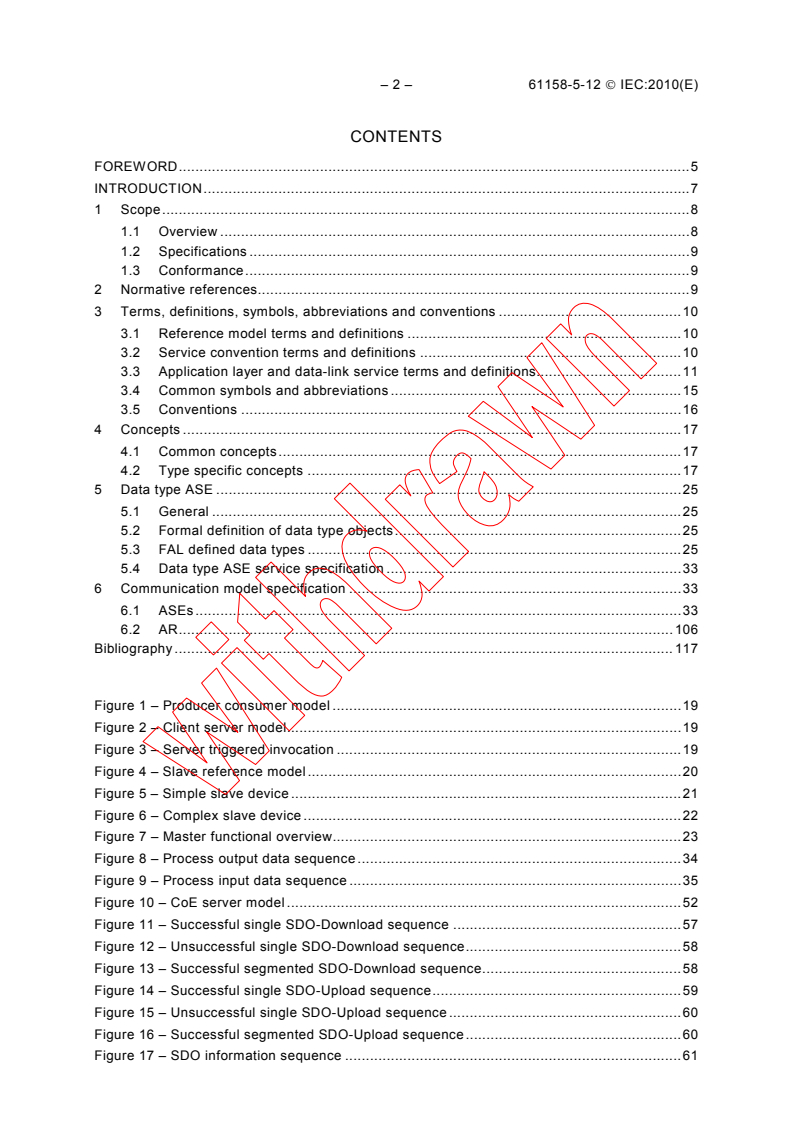
CONTENTS
FOREWORD.5
INTRODUCTION.7
1 Scope.8
1.1 Overview .8
1.2 Specifications .9
1.3 Conformance.9
2 Normative references.9
3 Terms, definitions, symbols, abbreviations and conventions .10
3.1 Reference model terms and definitions .10
3.2 Service convention terms and definitions .10
3.3 Application layer and data-link service terms and definitions.11
3.4 Common symbols and abbreviations .15
3.5 Conventions .16
4 Concepts .17
4.1 Common concepts.17
4.2 Type specific concepts .17
5 Data type ASE .25
5.1 General .25
5.2 Formal definition of data type objects.25
5.3 FAL defined data types .25
5.4 Data type ASE service specification .33
6 Communication model specification .33
6.1 ASEs .33
6.2 AR. 106
Bibliography . 117
Figure 1 – Producer consumer model .19
Figure 2 – Client server model.19
Figure 3 – Server triggered invocation .19
Figure 4 – Slave reference model.20
Figure 5 – Simple slave device .21
Figure 6 – Complex slave device .22
Figure 7 – Master functional overview.23
Figure 8 – Process output data sequence .34
Figure 9 – Process input data sequence .35
Figure 10 – CoE server model .52
Figure 11 – Successful single SDO-Download sequence .57
Figure 12 – Unsuccessful single SDO-Download sequence.58
Figure 13 – Successful segmented SDO-Download sequence.58
Figure 14 – Successful single SDO-Upload sequence.59
Figure 15 – Unsuccessful single SDO-Upload sequence .60
Figure 16 – Successful segmented SDO-Upload sequence.60
Figure 17 – SDO information sequence .61
61158-5-12 © IEC:2010(E) – 3 –
Figure 18 – Emergency service .62
Figure 19 – Command sequence .63
Figure 20 – PDO mapping .64
Figure 21 – Sync manager PDO assigment.65
Figure 22 – RxPDO service .66
Figure 23 – TxPDO service .67
Figure 24 – RxPDO remote transmission sequence .68
Figure 25 – TxPDO remote transmission sequence .68
Figure 26 – EoE sequence .88
Figure 27 – FoE read sequence with success .95
Figure 28 – FoE read sequence with error .96
Figure 29 – FoE write sequence with success.96
Figure 30 – FoE write sequence with error.97
Figure 31 – FoE write sequence with busy.97
Figure 32 – Successful AL control sequence . 107
Figure 33 – Unsuccessful AL control sequence. 108
Figure 34 – AL state changed sequence . 109
Table 1 – Process output data.37
Table 2 – Process input data .38
Table 3 – Update process input data .39
Table 4 – SII read .47
Table 5 – SII write .48
Table 6 – SII reload.49
Table 7 – Allocation of SDO areas.53
Table 8 – SDO download expedited.72
Table 9 – SDO download normal .73
Table 10 – Download SDO segment .74
Table 11 – SDO upload expedited .75
Table 12 – SDO upload normal.76
Table 13 – Upload SDO segment .77
Table 14 – Abort SDO transfer .77
Table 15 – Get OD list.78
Table 16 – OD list segment .79
Table 17 – Get object description .80
Table 18 – Get entry description.81
Table 19 – Object entry segment.83
Table 20 – Emergency .84
Table 21 – RxPDO .85
Table 22 – TxPDO .85
Table 23 – RxPDO remote transmission .86
Table 24 – TxPDO remote transmission .86
Table 25 – Initiate EoE .91
– 4 – 61158-5-12 © IEC:2010(E)
Table 26 – EoE fragment.92
Table 27 – Set IP parameter.93
Table 28 – Set address filter.94
Table 29 – FoE read.99
Table 30 – FoE write .99
Table 31 – FoE data. 100
Table 32 – FoE ack . 100
Table 33 – FoE busy . 101
Table 34 – FoE error . 101
Table 35 – MBX read .103
Table 36 – MBX write .104
Table 37 – MBX read upd.105
Table 38 – AL management and ESM service primitives . 106
Table 39 – AL control .115
Table 40 – AL state change. 116
61158-5-12 © IEC:2010(E) – 5 –
INTERNATIONAL ELECTROTECHNICAL COMMISSION
____________
INDUSTRIAL COMMUNICATION NETWORKS –
FIELDBUS SPECIFICATIONS –
Part 5-12: Application layer service definition –
Type 12 elements
FOREWORD
1) The International Electrotechnical Commission (IEC) is a worldwide organization for standardization comprising
all national electrotechnical committees (IEC National Committees). The object of IEC is to promote
international co-operation on all questions concerning standardization in the electrical and electronic fields. To
this end and in addition to other activities, IEC publishes International Standards, Technical Specifications,
Technical Reports, Publicly Available Specifications (PAS) and Guides (hereafter referred to as “IEC
Publication(s)”). Their preparation is entrusted to technical committees; any IEC National Committee interested
in the subject dealt with may participate in this preparatory work. International, governmental and non-
governmental organizations liaising with the IEC also participate in this preparation. IEC collaborates closely
with the International Organization for Standardization (ISO) in accordance with conditions determined by
agreement between the two organizations.
2) The formal decisions or agreements of IEC on technical matters express, as nearly as possible, an international
consensus of opinion on the relevant subjects since each technical committee has representation from all
interested IEC National Committees.
3) IEC Publications have the form of recommendations for international use and are accepted by IEC National
Committees in that sense. While all reasonable efforts are made to ensure that the technical content of IEC
Publications is accurate, IEC cannot be held responsible for the way in which they are used or for any
misinterpretation by any end user.
4) In order to promote international uniformity, IEC National Committees undertake to apply IEC Publications
transparently to the maximum extent possible in their national and regional publications. Any divergence
between any IEC Publication and the corresponding national or regional publication shall be clearly indicated in
the latter.
5) IEC itself does not provide any attestation of conformity. Independent certification bodies provide conformity
assessment services and, in some areas, access to IEC marks of conformity. IEC is not responsible for any
services carried out by independent certification bodies.
6) All users should ensure that they have the latest edition of this publication.
7) No liability shall attach to IEC or its directors, employees, servants or agents including individual experts and
members of its technical committees and IEC National Committees for any personal injury, property damage or
other damage of any nature whatsoever, whether direct or indirect, or for costs (including legal fees) and
expenses arising out of the publication, use of, or reliance upon, this IEC Publication or any other IEC
Publications.
8) Attention is drawn to the Normative references cited in this publication. Use of the referenced publications is
indispensable for the correct application of this publication.
9) Attention is drawn to the possibility that some of the elements of this IEC Publication may be the subject of
patent rights. IEC shall not be held responsible for identifying any or all such patent rights.
NOTE 1 Use of some of the associated protocol types is restricted by their intellectual-property-right holders. In all
cases, the commitment to limited release of intellectual-property-rights made by the holders of those rights permits
a particular data-link layer protocol type to be used with physical layer and application layer protocols in type
combinations as specified explicitly in the profile parts. Use of the various protocol types in other combinations may
require permission of their respective intellectual-property-right holders.
International Standard IEC 61158-5-12 has been prepared by subcommittee 65C: Industrial
networks, of IEC technical committee 65: Industrial-process measurement, control and
automation.
This second edition cancels and replaces the first edition published in 2007. This edition
constitutes a technical revision.
The main changes with respect to the previous edition are listed below:
• bug fixes and
– 6 – 61158-5-12 © IEC:2010(E)
• editorial improvements.
The text of this standard is based on the following documents:
FDIS Report on voting
65C/606/FDIS 65C/620/RVD
Full information on the voting for the approval of this standard can be found in the report on
voting indicated in the above table.
This publication has been drafted in accordance with ISO/IEC Directives, Part 2.
A list of all parts of the IEC 61158 series, published under the general title Industrial
communication networks – Fieldbus specifications, can be found on the IEC web site.
The committee has decided that the contents of this publication will remain unchanged until the
stability date indicated on the IEC web site under "http://webstore.iec.ch" in the data related to
the specific publication. At this date, the publication will be
• reconfirmed;
• withdrawn;
• replaced by a revised edition, or
• amended.
NOTE 2 The revision of this standard will be synchronized with the other parts of the IEC 61158 series.
61158-5-12 © IEC:2010(E) – 7 –
INTRODUCTION
This part of IEC 61158 is one of a series produced to facilitate the interconnection of
automation system components. It is related to other standards in the set as defined by the
“three-layer” fieldbus reference model described in IEC/TR 61158-1.
The application service is provided by the application protocol making use of the services
available from the data-link or other immediately lower layer. This standard defines the
application service characteristics that fieldbus applications and/or system management may
exploit.
Throughout the set of fieldbus standards, the term “service” refers to the abstract capability
provided by one layer of the OSI Basic Reference Model to the layer immediately above. Thus,
the application layer service defined in this standard is a conceptual architectural service,
independent of administrative and implementation divisions.
– 8 – 61158-5-12 © IEC:2010(E)
INDUSTRIAL COMMUNICATION NETWORKS –
FIELDBUS SPECIFICATIONS –
Part 5-12: Application layer service definition –
Type 12 elements
1 Scope
1.1 Overview
The fieldbus Application Layer (FAL) provides user programs with a means to access the
fieldbus communication environment. In this respect, the FAL can be viewed as a “window
between corresponding application programs.”
This standard provides common elements for basic time-critical and non-time-critical
messaging communications between application programs in an automation environment and
material specific to Type 12 fieldbus. The term “time-critical” is used to represent the presence
of a time-window, within which one or more specified actions are required to be completed with
some defined level of certainty. Failure to complete specified actions within the time window
risks failure of the applications requesting the actions, with attendant risk to equipment, plant
and possibly human life.
This standard defines in an abstract way the externally visible service provided by the different
Types of the fieldbus Application Layer in terms of
a) an abstract model for defining application resources (objects) capable of being manipulated
by users via the use of the FAL service,
b) the primitive actions and events of the service;
c) the parameters associated with each primitive action and event, and the form which they
take; and
d) the interrelationship between these actions and events, and their valid sequences.
The purpose of this standard is to define the services provided to
a) the FAL user at the boundary between the user and the Application Layer of the Fieldbus
Reference Model, and
b) Systems Management at the boundary between the Application Layer and Systems
Management of the Fieldbus Reference Model.
This standard specifies the structure and services of the IEC fieldbus Application Layer, in
conformance with the OSI Basic Reference Model (ISO/IEC 7498) and the OSI Application
Layer Structure (ISO/IEC 9545).
FAL services and protocols are provided by FAL application-entities (AE) contained within the
application processes. The FAL AE is composed of a set of object-oriented Application Service
Elements (ASEs) and a Layer Management Entity (LME) that manages the AE. The ASEs
provide communication services that operate on a set of related application process object
(APO) classes. One of the FAL ASEs is a management ASE that provides a common set of
services for the management of the instances of FAL classes.
Although these services specify, from the perspective of applications, how request and
responses are issued and delivered, they do not include a specification of what the requesting
and responding applications are to do with them. That is, the behavioral aspects of the
applications are not specified; only a definition of what requests and responses they can
61158-5-12 © IEC:2010(E) – 9 –
send/receive is specified. This permits greater flexibility to the FAL users in standardizing such
object behavior. In addition to these services, some supporting services are also defined in this
standard to provide access to the FAL to control certain aspects of its operation.
1.2 Specifications
The principal objective of this standard is to specify the characteristics of conceptual
application layer services suitable for time-critical communications, and thus supplement the
OSI Basic Reference Model in guiding the development of application layer protocols for time-
critical communications.
A secondary objective is to provide migration paths from previously-existing industrial
communications protocols. It is this latter objective which gives rise to the diversity of services
standardized as the various Types of IEC 61158, and the corresponding protocols standardized
in subparts of IEC 61158-6.
This specification may be used as the basis for formal Application Programming-Interfaces.
Nevertheless, it is not a formal programming interface, and any such interface will need to
address implementation issues not covered by this specification, including
a) the sizes and octet ordering of various multi-octet service parameters, and
b) the correlation of paired request and confirm, or indication and response, primitives.
1.3 Conformance
This standard does not specify individual implementations or products, nor does it constrain the
implementations of application layer entities within industrial automation systems.
There is no conformance of equipment to this application layer service definition standard.
Instead, conformance is achieved through implementation of conforming application layer
protocols that fulfill any given Type of application layer services as defined in this standard.
2 Normative references
The following referenced documents are indispensable for the application of this document. For
dated references, only the edition cited applies. For undated references, the latest edition of
the referenced document (including any amendments) applies.
IEC 61131-3, Programmable controllers – Part 3: Programming languages
IEC 61158-3-12, Industrial communication networks – Fieldbus specifications – Part 3-12:
Data-link layer service definition – Type 12 elements
ISO/IEC 646:1991, Information technology – ISO 7-bit coded character set for information
interchange
ISO/IEC 7498-1, Information technology – Open Systems Interconnection – Basic Reference
Model: The Basic Model
ISO/IEC 7498-3, Information technology – Open Systems Interconnection – Basic Reference
Model: Naming and addressing
ISO/IEC 8802-3, Information technology – Telecommunications and information exchange
between systems – Local and metropolitan area networks – Specific requirements – Part 3:
Carrier sense multiple access with collision detection (CSMA/CD) access method and physical
layer specifications
– 10 – 61158-5-12 © IEC:2010(E)
ISO/IEC 10646, Information technology – Universal Multiple-Octet Coded Character Set (UCS)
ISO/IEC 10731, Information technology – Open Systems Interconnection – Basic Reference
Model – Conventions for the definition of OSI services
IEEE 802.1D, IEEE standard for local and metropolitan area networks – Media access control
(MAC) Bridges; available at
IETF RFC 791, Internet Protocol darpa internet program protocol specification; available at
3 Terms, definitions, symbols, abbreviations and conventions
For the purposes of this document, the following terms, definitions, symbols, abbreviations and
conventions apply.
3.1 Reference model terms and definitions
This standard is based in part on the concepts developed in ISO/IEC 7498-1 and ISO/IEC
7498-3, and makes use of the following terms defined therein:
3.1.1 correspondent (N)-entities [ISO/IEC 7498-1]
correspondent AL-entities (N=7)
3.1.2 (N)-entity [ISO/IEC 7498-1]
AL-entity (N=7)
3.1.3 (N)-layer [ISO/IEC 7498-1]
AL-layer (N=7)
[ISO/IEC 7498-1]
3.1.4 layer-management
3.1.5 peer-entities [ISO/IEC 7498-1]
[ISO/IEC 7498-3]
3.1.6 primitive name
3.1.7 AL-protocol [ISO/IEC 7498-1]
[ISO/IEC 7498-1]
3.1.8 AL-protocol-data-unit
3.1.9 reset [ISO/IEC 7498-1]
[ISO/IEC 7498-1]
3.1.10 routing
3.1.11 segmenting [ISO/IEC 7498-1]
[ISO/IEC 7498-1]
3.1.12 (N)-service
AL-service (N=7)
3.1.13 AL-service-data-unit [ISO/IEC 7498-1]
3.1.14 AL-simplex-transmission [ISO/IEC 7498-1]
3.1.15 AL-subsystem [ISO/IEC 7498-1]
3.1.16 systems-management [ISO/IEC 7498-1]
3.1.17 AL-user-data [ISO/IEC 7498-1]
3.2 Service convention terms and definitions
This standard also makes use of the following terms defined in ISO/IEC 10731 as they apply to
the data-link layer:
61158-5-12 © IEC:2010(E) – 11 –
3.2.1 acceptor
3.2.2 asymmetrical service
3.2.3 confirm (primitive);
requestor.deliver (primitive)
3.2.4 deliver (primitive)
3.2.5 AL-service-primitive;
primitive
3.2.6 AL-service-provider
3.2.7 AL-service-user
3.2.8 indication (primitive);
acceptor.deliver (primitive)
3.2.9 request (primitive);
requestor.submit (primitive)
3.2.10 requestor
3.2.11 response (primitive);
acceptor.submit (primitive)
3.2.12 submit (primitive)
3.2.13 symmetrical service
3.3 Application layer and data-link service terms and definitions
3.3.1
application
function or data structure for which data is consumed or produced
3.3.2
application objects
multiple object classes that manage and provide a run time exchange of messages across the
network and within the network device]
3.3.3
basic slave
slave device that supports only physical addressing of data
3.3.4
bit
unit of information consisting of a 1 or a 0. This is the smallest data unit that can be
transmitted
3.3.5
client
1) object which uses the services of another (server) object to perform a task
2) initiator of a message to which a server reacts
3.3.6
communication object
component that manage and provide a run time exchange of messages across the network
3.3.7
connection
logical binding between two application objects within the same or different devices
– 12 – 61158-5-12 © IEC:2010(E)
3.3.8
cyclic
events which repeat in a regular and repetitive manner
3.3.9
data
generic term used to refer to any information carried over a fieldbus
3.3.10
data consistency
means for coherent transmission and access of the input- or output-data object between and
within client and server
3.3.11
data type
relation between values and encoding for data of that type. For this specification the data type
definitions of IEC 61131-3 apply.
3.3.12
data type object
Entry in the object dictionary indicating a data type
3.3.13
default gateway
device with at least two interfaces in two different IP subnets acting as router for a subnet.
3.3.14
device
physical entity connected to the fieldbus composed of at least one communication element (the
network element) and which may have a control element and/or a final element (transducer,
actuator, etc.)
3.3.15
device profile
collection of device dependent information and functionality providing consistency between
similar devices of the same device
3.3.16
diagnosis information
all data available at the server for maintenance purposes
3.3.17
distributed clocks
method to synchronize slaves and maintain a global time base
3.3.18
error
discrepancy between a computed, observed or measured value or condition and the specified
or theoretically correct value or condition
3.3.19
error class
general grouping for related error definitions and corresponding error codes
3.3.20
error code
identification of a specific type of error within an error class
61158-5-12 © IEC:2010(E) – 13 –
3.3.21
event
instance of a change of conditions
3.3.22
fieldbus memory management unit
function that establishes one or several correspondences between logical addresses and
physical memory
3.3.23
fieldbus memory management unit entity
single element of the fieldbus memory management unit: one correspondence between a
coherent logical address space and a coherent physical memory location
3.3.24
frame
denigrated synonym for DLPDU
3.3.25
full slave
slave device that supports both physical and logical addressing of data
3.3.26
index
address of an object within an application process
3.3.27
interface
shared boundary between two functional units, defined by functional characteristics, signal
characteristics, or other characteristics as appropriate
3.3.28
little endian
Method for data representation of numbers greater 8 bit where the least significant octet is
transmitted first.
3.3.29
master
device that controls the data transfer on the network and initiates the media access of the
slaves by sending messages and that constitutes the interface to the control system
3.3.30
mapping
correspondence between two objects in that way that one object is part of the other object
3.3.31
mapping parameters
set of values defining the correspondence between application objects and process data
objects
3.3.32
medium
cable, optical fibre, or other means by which communication signals are transmitted between
two or more points
NOTE "media" is used as the plural of medium.
– 14 – 61158-5-12 © IEC:2010(E)
3.3.33
message
ordered series of octets intended to convey information
NOTE Normally used to convey information between peers at the application layer.
3.3.34
network
set of nodes connected by some type of communication medium, including any intervening
repeaters, bridges, routers and lower-layer gateways
3.3.35
node
a) single DL-entity as it appears on one local link
b) end-point of a link in a network or a point at which two or more links meet [derived from
IEC 61158-2]
3.3.36
object
abstract representation of a particular component within a device
NOTE An object can be
a) an abstract representation of the capabilities of a device. Objects can be composed of any or all of the following
components:
1) data (information which changes with time);
2) configuration (parameters for behavior);
3) methods (things that can be done using data and configuration).
b) a collection of related data (in the form of variables) and methods (procedures) for operating on that data that
have clearly defined interface and behavior.
3.3.37
object dictionary
data structure addressed by Index and Sub-index that contains descriptions of data type
objects, communication objects and application objects
3.3.38
process data
collection of application objects designated to be transferred cyclically or acyclically for the
purpose of measurement and control
3.3.39
process data object
structure described by mapping parameters containing one or several process data entities
3.3.40
segment
collection of one real master with one or more slaves
3.3.41
server
object which provides services to another (client) object
3.3.42
service
operation or function that an object and/or object class performs upon request from another
object and/or object class
61158-5-12 © IEC:2010(E) – 15 –
3.3.43
slave
DL-entity accessing the medium only after being initiated by the preceding slave or
3.3.44
sub-index
subaddress of an object within the object dictionary
3.3.45
Sync Manager
collection of control elements to coordinate access to concurrently used objects.
3.3.46
Sync Manager channel
single control elements to coordinate access to concurrently used objects.
3.3.47
switch
MAC bridge as defined in IEEE 802.1D
3.4 Common symbols and abbreviations
AL- Application layer (as a prefix)
AL-entity (the local active instance of the application layer)
ALE
AL AL-layer
APDU AL-protocol-data-unit
ALM AL-management
ALME AL-management Entity (the local active instance of AL-management)
AL-management service
ALMS
ALS AL-service
AR Application relationship
ASE Application service element
CAN Controller Area Network
CAN in Automation
CiA
CoE CAN appliclication protocol over Type 12 services
CSMA/CD Carrier sense multiple access with collision detection
DC Distributed clocks
DL Data-link-layer
Domain name system (server for name resolution in IP networks)
DNS
E²PROM Electrically erasable programmable read only memory
Ethernet tunneled over Type 12 services
EoE
ESC Type 12 slave controller
FCS Frame check sequence
First-in first-out (queuing method)
FIFO
FMMU Fieldbus memory management unit
File access with Type 12 services
FoE
HDR Header
ID Identifier
Internet engineering task force
IETF
IP Internet protocol
– 16 – 61158-5-12 © IEC:2010(E)
LAN Local area network
MAC Medium access control
OD Object dictionary
OSI Open systems interconnection
Physical device internal interface (a set of elements that allows access to DL-services from the
PDI
AL)
PDO Process data object
Ph-layer
PhL
QoS Quality of service
RAM Random access memory
Receive
Rx
SDO Service data object
slave information interface
SII
SM Synchronization manager
SyncM Synchronization manager
Transmission control protocol
TCP
Tx Transmit
User datagram protocol
UDP
WKC Working counter
3.5 Conventions
This standard uses the descriptive conventions given in ISO/IEC 10731.
The service model, service primitives, and time-sequence diagrams used are entirely abstract
descriptions; they do not represent a specification for implementation.
Service primitives, used to represent service user/service provider interactions (see ISO/IEC
10731), convey parameters that indicate information available in the user/provider interaction.
This standard uses a tabular format to describe the component parameters of the service
primitives. The parameters that apply to each group of service primitives are set out in tables
throughout the remainder of this standard. Each table consists of up to five columns,
containing the name of the service parameter, and a column each for those primitives and
parameter-transfer directions used by the service:
⎯ the request primitive’s input parameters;
⎯ the indication primitive’s output parameters;
⎯ the response primitive’s input parameters; and
⎯ the confirm primitive’s output parameters.
NOTE The request, indication, response and confirm primitives are also known as requestor.submit,
acceptor.deliver, acceptor.submit, and requestor.deliver primitives, respectively (see ISO/IEC 10731).
61158-5-12 © IEC:2010(E) – 17 –
One parameter (or part of it) is listed in each row of each table. Under the appropriate service
primitive columns, a code is used to specify the type of usage of the parameter on the primitive
and parameter direction specified in the column:
M parameter is mandatory for the primitive.
parameter is a User option, and may or may not be provided depending on
U
the dynamic usage of the service-user. When not provided, a default value
for the parameter is assumed.
C parameter is conditional upon other parameters or upon the environment of
the service-user.
(blank) parameter is never present.
Some entries are further qualified by items in brackets. These may be a parameter-specific
constraint:
(=) indicates that the parameter is semantically equivalent to the parameter in the
service primitive to its immediate left in the table.
In any particular interface, not all parameters need be explicitly stated. Some may be implicitly
associated with the primitive.
In the diagrams which illustrate these interfaces, dashed lines indicate cause-and-effect or
time-sequence relationships, and wavy lines indicate that events are roughly
contemporaneous.
4 Concepts
4.1 Common concepts
All of IEC/TR 61158-1, Clause 9 is incorporated by reference, except as specifically overridden
in 4.2.
4.2 Type specific concepts
4.2.1 Operating principle
This standard and its companion Type 12 standards describe a real-time Ethernet technology
that aims to maximize the utilization of the full duplex Ethernet bandwidth. Medium access
control employs the master/slave principle, where the master node (typically the control
system) sends the Ethernet frames to the slave nodes, which extract data from and insert data
into these frames.
From an Ethernet point of view, a Type 12 segment is a single Ethernet device, which receives
and sends standard ISO/IEC 8802-3 Ethernet frames. However, this Ethernet device is not
limited to a single Ethernet controller with downstream microprocessor, but may consist of a
large number of Type 12 slave devices. These process the incoming frames directly and
extract the relevant user data, or insert data and transfer the frame to the next slave device.
The last slave device within the segment sends the fully processed frame back, so that it is
returned by the first slave device to the master as response frame.
This procedure utilizes the full duplex capability of Ethernet: both communication directions are
operated independently. Communication without switch between a master device and a
Type 12 segment consisting of one or several slave devices may be established.
– 18 – 61158-5-12 © IEC:2010(E)
Industrial communication systems have to meet different requirements in terms of the data
transmission characteristics. Parameter data is transferred acyclically and in large quantities,
whereby the timing requirements are relatively non-critical, and the transmission is usually
triggered by the control system. Diagnostic data is also transferred acyclically and event-driven,
but the timing requirements are more demanding, and the transmission is usually triggered by
a peripheral device.
Process data, on the other hand, is typically transferred cyclically with different cycle times.
The timing requirements are most stringent for process data communication. Type 12 AL
supports a variety of services and protocols to meet these differing requirements.
4.2.2 Communication model overview
The Type 12 application layer distinguishes between master and slave. The communication
relationship is always initiated by the master.
A Type 12 segment consists of at least one master device and one or many slave devices. All
slave devices support the Type 12 State Machine (ESM) and support the transmission of
Type 12 process data.
The application relationship can be modeled independent of communication relationship. The
master-slave relationship is the standard application relationship.
4.2.3 Application layer element description
4.2.3.1 Management
The mandatory management consists of a set of object to control the state of a slave. An
interface to DL provides read access to all DL registers.
4.2.3.2 Information interface
The mandatory slave information interface (SII) consists of all objects that can be stored
persistently.
4.2.3.3 Synchronization support
The optional support of isochronous operation consists of several attributes for synchronization
and timestamping of binary signals.
4.2.3.4 Access to slave
The real time entity consists of an interface for network triggered exchange of data and an
interface for user triggered access to slave objects. Objects mainly used for network triggered
access are called
...