

IEC 63203-402-2:2024
(Main)Wearable electronic devices and technologies - Part 402-2: Performance measurement of fitness wearables - Step counting
General Information
- Abstract
IEC 63203-402-2:2024 specifies test methods for measuring and evaluating the performance, reliability, and accuracy of the step counting feature in any wearable device that can count steps (e.g. activity and fitness trackers, smart bands, smart shoes, and smart insoles).
These standard test methods exclude the evaluation of data associated with travel distance or calorie consumption.
- Status
- Published
- Publication Date
- 30-Jan-2024
- Technical Committee
- TC 124 - Wearable electronic devices and technologies
- Drafting Committee
- WG 4 - TC 124/WG 4
- Current Stage
- PPUB - Publication issued
- Start Date
- 31-Jan-2024
- Completion Date
- 26-Jan-2024
Overview
IEC 63203-402-2:2024 is an international standard developed by the International Electrotechnical Commission (IEC) focusing on wearable electronic devices and technologies. Specifically, it addresses the performance measurement of fitness wearables with an emphasis on step counting accuracy. This standard defines standardized test methods for assessing the performance, reliability, and accuracy of the step counting function found in various devices such as fitness trackers, smart bands, smart shoes, and smart insoles. Notably, the scope excludes evaluations related to travel distance or calorie consumption metrics.
With the global proliferation of wearable fitness devices, reliable and accurate step counting is critical for consumer trust and health-related applications. Accurate step data not only enhances user engagement but also supports health improvement initiatives by providing dependable activity metrics.
Key Topics
Scope and Applicability: IEC 63203-402-2 applies to any wearable device capable of counting steps, covering common products including activity trackers and smart footwear. The standard strictly focuses on the step count feature, excluding other metrics like distance or calories.
Test Methods and Procedures: The standard outlines detailed methodologies for evaluating step counting accuracy. Testing involves controlled environments using apparatus such as treadmills and video recordings to validate steps counted against actual steps taken.
Test Environment Conditions: The standard specifies optimal testing conditions, addressing factors such as:
- Environmental temperature and humidity
- Ambient lighting for video analysis
- Balanced speed conditions for walking or running
- Requirements on device placement on the body
Subject Requirements: To ensure valid results, tests require a balanced selection of subjects based on gender, age, and Body Mass Index (BMI), enhancing representativeness.
Data Analysis and Accuracy Metrics: Guidance is provided on systematic data analysis and calculation of step count accuracy. The standard also sets accuracy benchmarks and requirements for device compliance.
Reporting: IEC 63203-402-2 specifies the format and content required for test reports ensuring consistency and transparency in documenting evaluation results.
Applications
This standard offers practical value for multiple stakeholders in the wearable technology ecosystem:
Manufacturers and Developers: By adhering to IEC 63203-402-2, designers can benchmark and enhance their step counting algorithms, ensuring products meet international performance criteria and thus improving user experience and device reliability.
Quality Assurance and Certification Bodies: Test labs and certification agencies can apply these standardized procedures when validating step counting features, facilitating consistent quality assurance across global markets.
Healthcare and Wellness Industries: Reliable step data is crucial for fitness programs, clinical studies, and health monitoring applications. This standard helps underpin data trustworthiness critical for health-related outcomes.
Consumers and End Users: Ensures transparency and confidence in wearable devices’ activity tracking capabilities, promoting wider acceptance and use of wearable fitness technology.
Related Standards
IEC 63203-402-2:2024 complements other international standards within the wearable technology domain, including:
- IEC 63203 series – Broader standards addressing various aspects of wearable electronic devices and technologies.
- ISO/IEC Directives – Provides rules for the preparation and management of international standards enabling harmonization.
- Standards related to data privacy and interoperability in wearables to ensure integrated, secure device ecosystems.
- Guidelines on health and safety in wearable electronics to protect users during device usage.
For comprehensive quality assessment of wearables, stakeholders should consider IEC 63203-402-2 in conjunction with related standards addressing performance, user safety, and data security.
Keywords: IEC 63203-402-2, step counting accuracy, fitness wearables, wearable devices standards, step count performance, wearable electronic devices, test methods for fitness trackers, wearable technology reliability, smart band testing, smart shoe step counting, fitness tracker evaluation, international wearable device standards.
Frequently Asked Questions
IEC 63203-402-2:2024 is a standard published by the International Electrotechnical Commission (IEC). Its full title is "Wearable electronic devices and technologies - Part 402-2: Performance measurement of fitness wearables - Step counting". This standard covers: IEC 63203-402-2:2024 specifies test methods for measuring and evaluating the performance, reliability, and accuracy of the step counting feature in any wearable device that can count steps (e.g. activity and fitness trackers, smart bands, smart shoes, and smart insoles). These standard test methods exclude the evaluation of data associated with travel distance or calorie consumption.
IEC 63203-402-2:2024 specifies test methods for measuring and evaluating the performance, reliability, and accuracy of the step counting feature in any wearable device that can count steps (e.g. activity and fitness trackers, smart bands, smart shoes, and smart insoles). These standard test methods exclude the evaluation of data associated with travel distance or calorie consumption.
IEC 63203-402-2:2024 is classified under the following ICS (International Classification for Standards) categories: 31.020 - Electronic components in general. The ICS classification helps identify the subject area and facilitates finding related standards.
IEC 63203-402-2:2024 is available in PDF format for immediate download after purchase. The document can be added to your cart and obtained through the secure checkout process. Digital delivery ensures instant access to the complete standard document.
Standards Content (Sample)
IEC 63203-402-2 ®
Edition 1.0 2024-01
INTERNATIONAL
STANDARD
NORME
INTERNATIONALE
colour
inside
Wearable electronic devices and technologies –
Part 402-2: Performance measurement of fitness wearables – Step counting
Technologies et dispositifs électroniques prêts-à-porter –
Partie 402-2: Mesure des performances des dispositifs prêts-à-porter d’activité
physique – Podomètres
All rights reserved. Unless otherwise specified, no part of this publication may be reproduced or utilized in any form
or by any means, electronic or mechanical, including photocopying and microfilm, without permission in writing from
either IEC or IEC's member National Committee in the country of the requester. If you have any questions about IEC
copyright or have an enquiry about obtaining additional rights to this publication, please contact the address below or
your local IEC member National Committee for further information.
Droits de reproduction réservés. Sauf indication contraire, aucune partie de cette publication ne peut être reproduite ni
utilisée sous quelque forme que ce soit et par aucun procédé, électronique ou mécanique, y compris la photocopie et
les microfilms, sans l'accord écrit de l'IEC ou du Comité national de l'IEC du pays du demandeur. Si vous avez des
questions sur le copyright de l'IEC ou si vous désirez obtenir des droits supplémentaires sur cette publication, utilisez
les coordonnées ci-après ou contactez le Comité national de l'IEC de votre pays de résidence.
IEC Secretariat Tel.: +41 22 919 02 11
3, rue de Varembé info@iec.ch
CH-1211 Geneva 20 www.iec.ch
Switzerland
About the IEC
The International Electrotechnical Commission (IEC) is the leading global organization that prepares and publishes
International Standards for all electrical, electronic and related technologies.
About IEC publications
The technical content of IEC publications is kept under constant review by the IEC. Please make sure that you have the
latest edition, a corrigendum or an amendment might have been published.
IEC publications search - webstore.iec.ch/advsearchform IEC Products & Services Portal - products.iec.ch
The advanced search enables to find IEC publications by a Discover our powerful search engine and read freely all the
variety of criteria (reference number, text, technical publications previews, graphical symbols and the glossary.
committee, …). It also gives information on projects, replaced With a subscription you will always have access to up to date
and withdrawn publications. content tailored to your needs.
IEC Just Published - webstore.iec.ch/justpublished
Electropedia - www.electropedia.org
Stay up to date on all new IEC publications. Just Published
The world's leading online dictionary on electrotechnology,
details all new publications released. Available online and once
containing more than 22 500 terminological entries in English
a month by email.
and French, with equivalent terms in 25 additional languages.
Also known as the International Electrotechnical Vocabulary
IEC Customer Service Centre - webstore.iec.ch/csc
(IEV) online.
If you wish to give us your feedback on this publication or need
further assistance, please contact the Customer Service
Centre: sales@iec.ch.
A propos de l'IEC
La Commission Electrotechnique Internationale (IEC) est la première organisation mondiale qui élabore et publie des
Normes internationales pour tout ce qui a trait à l'électricité, à l'électronique et aux technologies apparentées.
A propos des publications IEC
Le contenu technique des publications IEC est constamment revu. Veuillez vous assurer que vous possédez l’édition la
plus récente, un corrigendum ou amendement peut avoir été publié.
Recherche de publications IEC - IEC Products & Services Portal - products.iec.ch
webstore.iec.ch/advsearchform Découvrez notre puissant moteur de recherche et consultez
La recherche avancée permet de trouver des publications IEC gratuitement tous les aperçus des publications, symboles
en utilisant différents critères (numéro de référence, texte, graphiques et le glossaire. Avec un abonnement, vous aurez
comité d’études, …). Elle donne aussi des informations sur les toujours accès à un contenu à jour adapté à vos besoins.
projets et les publications remplacées ou retirées.
Electropedia - www.electropedia.org
IEC Just Published - webstore.iec.ch/justpublished
Le premier dictionnaire d'électrotechnologie en ligne au monde,
Restez informé sur les nouvelles publications IEC. Just
avec plus de 22 500 articles terminologiques en anglais et en
Published détaille les nouvelles publications parues.
français, ainsi que les termes équivalents dans 25 langues
Disponible en ligne et une fois par mois par email.
additionnelles. Egalement appelé Vocabulaire
Electrotechnique International (IEV) en ligne.
Service Clients - webstore.iec.ch/csc
Si vous désirez nous donner des commentaires sur cette
publication ou si vous avez des questions contactez-nous:
sales@iec.ch.
IEC 63203-402-2 ®
Edition 1.0 2024-01
INTERNATIONAL
STANDARD
NORME
INTERNATIONALE
colour
inside
Wearable electronic devices and technologies –
Part 402-2: Performance measurement of fitness wearables – Step counting
Technologies et dispositifs électroniques prêts-à-porter –
Partie 402-2: Mesure des performances des dispositifs prêts-à-porter d’activité
physique – Podomètres
INTERNATIONAL
ELECTROTECHNICAL
COMMISSION
COMMISSION
ELECTROTECHNIQUE
INTERNATIONALE
ICS 31.020 ISBN 978-2-8322-8128-4
– 2 – IEC 63203-402-2:2024 © IEC 2024
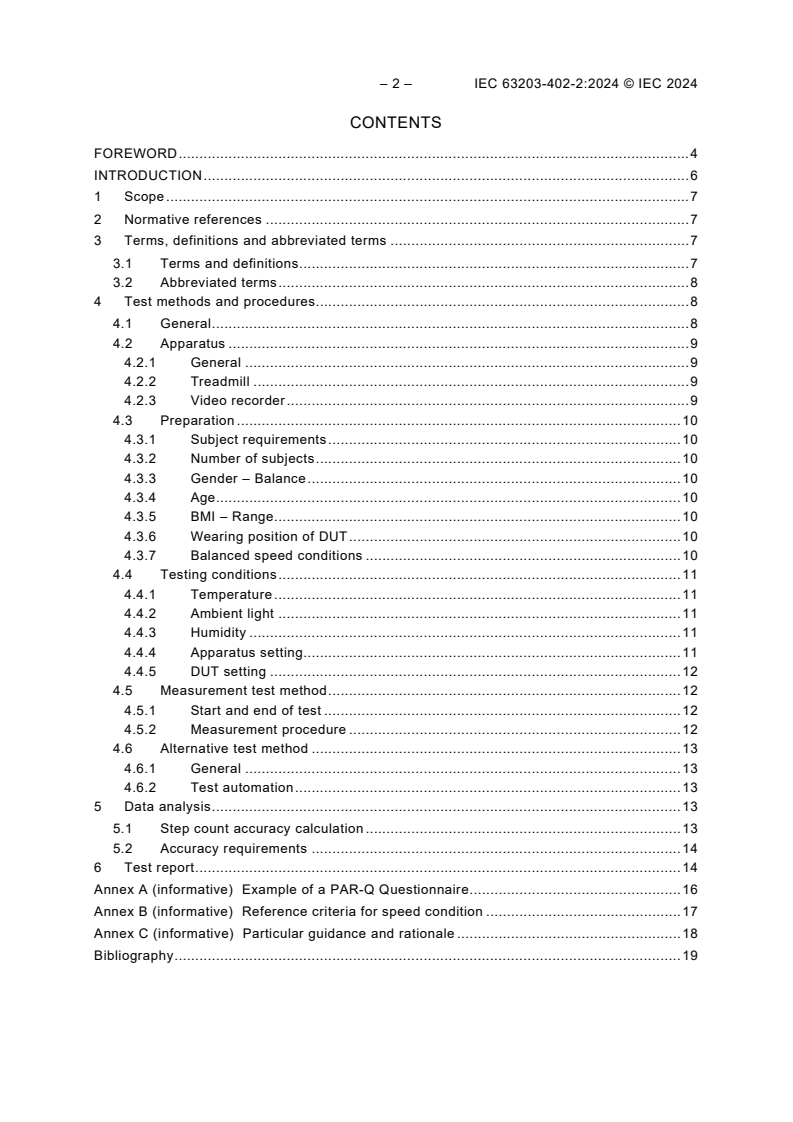
CONTENTS
FOREWORD . 4
INTRODUCTION . 6
1 Scope . 7
2 Normative references . 7
3 Terms, definitions and abbreviated terms . 7
3.1 Terms and definitions . 7
3.2 Abbreviated terms . 8
4 Test methods and procedures. 8
4.1 General . 8
4.2 Apparatus . 9
4.2.1 General . 9
4.2.2 Treadmill . 9
4.2.3 Video recorder . 9
4.3 Preparation . 10
4.3.1 Subject requirements . 10
4.3.2 Number of subjects . 10
4.3.3 Gender – Balance . 10
4.3.4 Age . 10
4.3.5 BMI – Range. 10
4.3.6 Wearing position of DUT . 10
4.3.7 Balanced speed conditions . 10
4.4 Testing conditions . 11
4.4.1 Temperature . 11
4.4.2 Ambient light . 11
4.4.3 Humidity . 11
4.4.4 Apparatus setting. 11
4.4.5 DUT setting . 12
4.5 Measurement test method . 12
4.5.1 Start and end of test . 12
4.5.2 Measurement procedure . 12
4.6 Alternative test method . 13
4.6.1 General . 13
4.6.2 Test automation . 13
5 Data analysis . 13
5.1 Step count accuracy calculation . 13
5.2 Accuracy requirements . 14
6 Test report . 14
Annex A (informative) Example of a PAR-Q Questionnaire . 16
Annex B (informative) Reference criteria for speed condition . 17
Annex C (informative) Particular guidance and rationale . 18
Bibliography . 19
Figure 1 – Overview of test environment and methods . 9
Figure B.1 – Running speed of the overall top ten per age group . 17
Table 1 – Conversion table of the speed unit . 11
Table B.1 – Difference in walking speeds by age . 17
– 4 – IEC 63203-402-2:2024 © IEC 2024
INTERNATIONAL ELECTROTECHNICAL COMMISSION
____________
WEARABLE ELECTRONIC DEVICES AND TECHNOLOGIES –
Part 402-2: Performance measurement of fitness wearables –
Step counting
FOREWORD
1) The International Electrotechnical Commission (IEC) is a worldwide organization for standardization comprising
all national electrotechnical committees (IEC National Committees). The object of IEC is to promote international
co-operation on all questions concerning standardization in the electrical and electronic fields. To this end and
in addition to other activities, IEC publishes International Standards, Technical Specifications, Technical Reports,
Publicly Available Specifications (PAS) and Guides (hereafter referred to as “IEC Publication(s)”). Their
preparation is entrusted to technical committees; any IEC National Committee interested in the subject dealt with
may participate in this preparatory work. International, governmental and non-governmental organizations liaising
with the IEC also participate in this preparation. IEC collaborates closely with the International Organization for
Standardization (ISO) in accordance with conditions determined by agreement between the two organizations.
2) The formal decisions or agreements of IEC on technical matters express, as nearly as possible, an international
consensus of opinion on the relevant subjects since each technical committee has representation from all
interested IEC National Committees.
3) IEC Publications have the form of recommendations for international use and are accepted by IEC National
Committees in that sense. While all reasonable efforts are made to ensure that the technical content of IEC
Publications is accurate, IEC cannot be held responsible for the way in which they are used or for any
misinterpretation by any end user.
4) In order to promote international uniformity, IEC National Committees undertake to apply IEC Publications
transparently to the maximum extent possible in their national and regional publications. Any divergence between
any IEC Publication and the corresponding national or regional publication shall be clearly indicated in the latter.
5) IEC itself does not provide any attestation of conformity. Independent certification bodies provide conformity
assessment services and, in some areas, access to IEC marks of conformity. IEC is not responsible for any
services carried out by independent certification bodies.
6) All users should ensure that they have the latest edition of this publication.
7) No liability shall attach to IEC or its directors, employees, servants or agents including individual experts and
members of its technical committees and IEC National Committees for any personal injury, property damage or
other damage of any nature whatsoever, whether direct or indirect, or for costs (including legal fees) and
expenses arising out of the publication, use of, or reliance upon, this IEC Publication or any other IEC
Publications.
8) Attention is drawn to the Normative references cited in this publication. Use of the referenced publications is
indispensable for the correct application of this publication.
9) IEC draws attention to the possibility that the implementation of this document may involve the use of (a)
patent(s). IEC takes no position concerning the evidence, validity or applicability of any claimed patent rights in
respect thereof. As of the date of publication of this document, IEC had not received notice of (a) patent(s), which
may be required to implement this document. However, implementers are cautioned that this may not represent
the latest information, which may be obtained from the patent database available at https://patents.iec.ch. IEC
shall not be held responsible for identifying any or all such patent rights.
IEC 63203-402-2 has been prepared by IEC technical committee 124: Wearable electronic
devices and technologies. It is an International Standard.
The text of this International Standard is based on the following documents:
Draft Report on voting
124/249/FDIS 124/262/RVD
Full information on the voting for its approval can be found in the report on voting indicated in
the above table.
The language used for the development of this International Standard is English.
This document was drafted in accordance with ISO/IEC Directives, Part 2, and developed in
accordance with ISO/IEC Directives, Part 1 and ISO/IEC Directives, IEC Supplement, available
at www.iec.ch/members_experts/refdocs. The main document types developed by IEC are
described in greater detail at www.iec.ch/publications.
A list of all parts in the IEC 63203 series, published under the general title Wearable electronic
devices and technologies, can be found on the IEC website.
The committee has decided that the contents of this document will remain unchanged until the
stability date indicated on the IEC website under webstore.iec.ch in the data related to the
specific document. At this date, the document will be
• reconfirmed,
• withdrawn, or
• revised.
IMPORTANT – The "colour inside" logo on the cover page of this document indicates
that it contains colours which are considered to be useful for the correct understanding
of its contents. Users should therefore print this document using a colour printer.
– 6 – IEC 63203-402-2:2024 © IEC 2024
INTRODUCTION
The step counting feature is a common functionality in wearable devices. The accurate
measurement and reporting of the step count is an important factor in the acceptance by
consumers of that step count. Data from wearable devices may be useful in helping to improve
the health and well-being of consumers that use wearable devices. The usability of the data to
improve health outcomes is dependent on the reliability of the data to facilitate their acceptance
by consumers and health improvement.
This document defines and provides standard test methods for evaluating the performance and
reliability of step counting in wearable devices. The benefit of using this document is that it
provides a method to compare the step counting function of a wearable device against the
actual step count, which can provide manufacturers with a method to improve the step count
functionality of their devices.
WEARABLE ELECTRONIC DEVICES AND TECHNOLOGIES –
Part 402-2: Performance measurement of fitness wearables –
Step counting
1 Scope
This part of IEC 63203 specifies test methods for measuring and evaluating the performance,
reliability, and accuracy of the step counting feature in any wearable device that can count
steps (e.g. activity and fitness trackers, smart bands, smart shoes, and smart insoles).
These standard test methods exclude the evaluation of data associated with travel distance or
calorie consumption.
2 Normative references
There are no normative references in this document.
3 Terms, definitions and abbreviated terms
3.1 Terms and definitions
For the purposes of this document, the following terms and definitions apply.
ISO and IEC maintain terminology databases for use in standardization at the following
addresses:
• IEC Electropedia: available at https://www.electropedia.org/
• ISO Online browsing platform: available at https://www.iso.org/obp
3.1.1
body mass index
BMI
value derived from the mass (weight in kilograms) and height (in metres) of an individual,
defined as the body mass divided by the square of the body length, expressed in units of kg/m ,
calculated by the following formula:
BMI = m/l
where
m is the mass in kg;
l is the length in m
[SOURCE: ISO 20342-1:2022, 3.7]
3.1.2
investigator
qualified person responsible for testing at a testing site
– 8 – IEC 63203-402-2:2024 © IEC 2024
3.1.3
jogging
raising and lowering each foot, with a period of time where neither foot is in contact with the
ground, with less intensity than running
3.1.4
running
action of moving faster than jogging with more vigorous intensity than jogging never having both
feet on the ground simultaneously with the express purpose of locomotion
3.1.5
step
action or movement of lifting and then placing one foot in front of the other during walking or
running with the goal of locomotion
3.1.6
subject
person wearing a DUT
3.1.7
treadmill
training equipment with a running surface on which walking or running activity can take place,
where the feet are free to leave the running surface
[SOURCE: ISO 20957-6:2021, 3.1]
3.1.8
walking
action of moving at a regular pace by lifting and setting down each foot in turn, never having
both feet off the ground simultaneously with the express purpose of locomotion
3.2 Abbreviated terms
DUT device under test
MAPE mean absolute percentage error
PAR-Q Physical Activity Readiness Questionnaire
REF reference
4 Test methods and procedures
4.1 General
A subject shall either walk, jog, or run on a motor-driven treadmill at a pre-set speed while the
activity is video-recorded. The recorded video shall be analysed by two investigators to acquire
the confirmed actual step counts. See Figure 1.
Figure 1 – Overview of test environment and methods
4.2 Apparatus
4.2.1 General
The usual laboratory apparatus and, in particular, the following apparatus described in 4.2.2
and 4.2.3 shall be used.
4.2.2 Treadmill
A motorized treadmill shall be used for testing.
A motorized treadmill should be capable of adjusting the speed from 0,56 m/s to 5,4 m/s and
tilt to 0° for at least 5 min.
4.2.3 Video recorder
A video recorder is configured securely and properly to capture the entire view of the test area
for each test. A video recorder should be affixed to a device that ensures it remains stationary
during the test (e.g. tripod, stand).
A video recorder should provide recording and monitoring capability, should be able to record
for at least 5 min, and should have sufficient camera angle and sensitivity to record the motion
of feet.
The recorded scene shall include the entire body of the subject and the treadmill without
obstructions. The video frame shall clearly show all the subject’s foot strikes on the treadmill
during the test.
– 10 – IEC 63203-402-2:2024 © IEC 2024
4.3 Preparation
4.3.1 Subject requirements
Subjects shall have no medical conditions that restrict them from completing the test. Prior to
testing, subjects shall complete a Physical Activity Readiness Questionnaire (PAR-Q) to
determine their eligibility to be included in testing. Any subject that answers "yes" to one or
more questions of the PAR-Q shall be excluded. See Annex A.
Clothing or shoes worn by the subject under test should not obstruct the ability to count steps.
Subjects shall not hold onto the treadmill during walking, jogging, or running tests on the
treadmill. The subjects’ arms shall be able to freely swing and move during testing.
For an effective test design, it is important to select test participants using the PAR-Q.
Unexpected errors can occur with a specific test subject resulting in unusual test results, in
which case additional subjects should be considered.
Any excluded test results can be explained in item 9) in the test report.
4.3.2 Number of subjects
Testing shall include at least 20 subjects.
4.3.3 Gender – Balance
At least 40 % of subjects shall be male. At least 40 % of subjects shall be female.
4.3.4 Age
All subjects shall be at least 18 years of age and not older than 69 years of age.
4.3.5 BMI – Range
The following percentage of subjects should be within the BMI range specified:
– at least 10 % of subjects should have a BMI below 20 kg/m and
– at least 10 % of subjects should have a BMI above 25 kg/m .
The height and weight of each subject are measured with the subject wearing light clothing and
without shoes. The BMI is calculated from these height and weight measurements.
4.3.6 Wearing position of DUT
For wrist-worn devices, all subjects should indicate on which wrist they prefer wearing the DUT
(i.e. left or right). Other DUTs should be worn following the manufacturer's recommendations.
The DUT shall be worn in the recommended position provided by the manufacturer. The
investigator shall assist the subject in the proper placement of the DUT according to the device
manufacturer’s instructions. This information shall be recorded in the test report.
4.3.7 Balanced speed conditions
For the testing of each activity, the balanced distribution of speed conditions should be
considered. See Annex B.
4.4 Testing conditions
4.4.1 Temperature
The temperature should be 23 °C ± 5 °C, which is typical of indoor environments. See Annex C.
4.4.2 Ambient light
The ambient light levels in the testing area should consist of typical lighting conditions for indoor
environments. See Annex C.
4.4.3 Humidity
Relative humidity conditions in the test room should be less than 70 % RH.
4.4.4 Apparatus setting
4.4.4.1 Treadmill
4.4.4.1.1 General
The treadmill shall be reset to its initial power-up state before the test.
4.4.4.1.2 Speed and slope conditions
The treadmill shall be set to the following speed and slope conditions based on the test being
performed. Table 1 shows the minimum speed condition and the maximum speed condition for
each activity under various speed units. See Annex B.
– Walking: minimum speed 0,56 m/s to maximum speed 1,8 m/s at minimal incline but not less
than 0 % (i.e. between 0 % to 10 %). The test speed for each subject should be chosen
within the walking speed condition range considering the subject’s physical activity
readiness.
– Jogging: minimum speed 1,8 m/s to maximum speed 2,5 m/s at minimal incline but not less
than 0 % (i.e. between 0 % to 10 %). The test speed for each subject should be chosen
within the jogging speed condition range considering the subject’s physical activity
readiness.
– Running: minimum speed 2,0 m/s to maximum speed 5,4 m/s at minimal incline but not less
than 0 % (i.e. between 0 % to 10 %). The test speed for each subject should be chosen
within the running speed condition range considering the subject’s physical activity
readiness.
Table 1 – Conversion table of the speed unit
m/s km/h mph
Min. Max. Min. Max. Min. Max.
Walking 0,56 1,8 2 6,5 1,2 4,0
Jogging 1,8 2,5 6,5 9 4,0 5,6
Running 2 5,4 7,2 19,5 4,5 12,1
4.4.4.2 Video recorder
The video recording device shall be set up with a full view of the testing area.
The video frame shall clearly show all the subject’s foot strikes on the treadmill during the test.
– 12 – IEC 63203-402-2:2024 © IEC 2024
4.4.5 DUT setting
The DUT should be fully updated with the latest commercial firmware version, calibrated, and
settings adjusted in accordance with the manufacturer’s specifications prior to testing. Any
future changes to the underlying algorithm or firmware that significantly impacts performance
shall require retesting.
NOTE The firmware version can depend on the test purpose.
The DUT shall be reset to its initial power-up state, preferably by power cycling the device, if
possible.
The DUT may be calibrated to the subject under test. For example, if stride length can be
configured on the device, then values relevant for the subject under test may be set prior to the
start of the test.
In the case of step counting devices which cannot indicate raw step counts, modify the DUT to
read or record the step readings at the starting and ending instants of the test period by
separating the display with an extension cable, storing the data in the memory, or another
appropriate method for the device.
If there are any other initial settings required by the device manufacturer, all required settings
shall be set before the test.
4.5 Measurement test method
4.5.1 Start and end of test
A subject shall be ready for the test, standing on the stationary treadmill.
The video recorder shall be powered up and ready to record.
The DUT will capture steps taken during acceleration to the desired speed of the test and during
deceleration from the end of the testing period to the treadmill coming to a stop. These steps
shall not be included in the test count. Testing shall follow the conditions below to ensure an
accurate and repeatable count.
a) If the starting value on the step counter of the device under test is not zero, the number of
steps taken when the subject is standing still prior to the test shall be recorded, and those
steps shall be subtracted from the final counted steps.
b) The test investigator shall program the treadmill to the speed and slope conditions as
outlined in 4.4.4.1.2. The test investigator shall start the treadmill.
c) The step counting commences once the treadmill has started, even as it accelerates to the
target speed, but these steps are not included in the test outcome as noted in 4.5.1 d).
d) When the treadmill reaches the target speed, the test time period starts. Only the steps
taken after the treadmill reaches the target speed and through to the end of the test time
period are included in the reported steps captured during the test time period.
4.5.2 Measurement procedure
The measurement procedure is as follows:
a) The unit of the test time period shall be at least 5 min for each test for each subject.
b) Walking – The treadmill is started and operated for the test time period at a comfortable
pace as defined in 4.4.4.1.2, speed and slope conditions. During this test time period, the
subject shall walk in a natural style as defined in 3.1.8.
c) Jogging or running – The treadmill is started and operated for the test time period at a
comfortable pace as defined in 4.4.4.1.2. During this test time period, the subject shall be
either jogging or running in a natural style and varying intensity as defined in 3.1.3 and 3.1.4.
d) The subject starts to walk, jog or run depending on the speed condition. The video recorder
for manual step counting starts simultaneously or immediately prior to the subject starting
to move. It is suggested that for recording purposes the video includes footage of the display
of the DUT to record the exact number of steps on the device prior to the start of the test
and recorded at the end of the test time period.
e) At the end of the test time period, the treadmill is stopped and the subject slows their
movement until the treadmill comes to a complete stop. Once the treadmill stops, the subject
stands perfectly still to allow the investigator to collect the DUT from the subject, and to
record any data from the test.
f) The step count measured by the wearable device is taken exclusively during the test time
period. The recorded video is reviewed by two investigators who manually count steps taken
exclusively during the test time period.
g) The step counts measured by two investigators shall match one another to be used as the
true step count. If the count of the two investigators do not match, a recount shall be
necessary. The recount will be defined as the true step count value.
h) If the difference in value between the measured DUT value and the REF value is abnormally
large, it is recommended to start the measurement again from the beginning.
NOTE An example of abnormal cases is when the number of differences between the measured DUT and REF
values is more than 100 (or less than −100).
4.6 Alternative test method
4.6.1 General
Alternative test methods using automated analysis systems may be selected as test methods.
4.6.2 Test automation
Regarding the measurement method of 4.5, if the step count measurement can be automated
without any error through a video analysis system with an embedded step count measurement
functionality, two automatic video analysis systems may be used.
– A video analysis system with a built-in automatic step counting functionality shall provide a
recorded video analysis function with start and end indications or signals (according to 4.5.2
step e)).
• If a real-time video analysis system has a built-in automatic step counting functionality,
then the system shall provide a real-time video analysis, as well as provide the
recognition function for start and end indications or signals (according to 4.5.2 step e)).
– The step counts by two video analysis systems shall match one another to be used as the
true step count. If the count of two video analysis systems do not match, a recount shall be
necessary and shall occur until two matching counts are confirmed (according to 4.5.2 step
g)).
5 Data analysis
5.1 Step count accuracy calculation
Calculate the mean absolute percentage error (MAPE) for each DUT, separately for walking,
jogging, and running. The MAPE is defined by the following Formula (1).
S − S
100 n DUT (ii) REF ( )
M × %
( ) (1)
∑
i=1
nS
DUT (i)
where
=
– 14 – IEC 63203-402-2:2024 © IEC 2024
M is the MAPE;
n is the total number of subjects;
S is the actual step count (from the device);
DUT
S is the measured step count (by the investigator).
REF
NOTE The MAPE for each activity type is calculated separately because step counting accuracy can be different
for each activity type in the DUT.
5.2 Accuracy requirements
For a wearable device to meet the requirements defined by this document, the test results shall
have a MAPE of less than 10 % separately for walking, jogging or running.
NOTE Lewis's (1982) interpretation of MAPE results is a means of judging the accuracy of the forecast: less than
10 % is a highly accurate forecast, 11 % to 20 % is a good forecast, 21 % to 50 % is a reasonable forecast, and 51 %
or more is an inaccurate forecast.
6 Test report
The test report shall include the following test results.
1) DUT and REF values for each activity type for each subject:
a) activity type (walking, jogging, and running);
i) DUT values (Step counts measured by the wearable device for each activity type
(walking, jogging, and running) for each subject);
ii) REF values (Manual counted steps from a video for each subject);
2) this standard number IEC 63203-402-2, and year of publication;
3) method used for each DUT:
a) specify the test conditions (e.g. speed, slope, manual or automatic testing) used for the
three activity types. If only one activity type is used, delete additional types or indicate
"not tested".
i) activity type1: walking;
ii) activity type2: jogging;
iii) activity type3: running;
b) if testing automation is used, the test facility should describe how the video analysis
system is used during test automation;
4) wearable device properties:
a) manufacturer name (if needed);
b) model number;
c) model update and revision number if available;
d) firmware version number;
e) any setting or configuration (if applicable);
f) manufacturer’s recommended wearing position of DUT;
g) any deviations from the manufacturer’s recommended wearing position and why;
5) description of subject characteristics:
a) subject number;
b) gender;
c) age;
d) weight;
e) height;
f) BMI;
g) preferred wearing position (right/left/no preference);
6) detailed description of test conditions:
a) date of test;
b) temperature;
c) relative humidity;
d) equipment;
e) speed and slope of each subject tested;
f) wearing position of the wearable device;
7) any relevant features observed during testing not covered elsewhere in the test report;
8) any deviations from the procedure;
9) results:
a) calculated MAPE values for activity types of each DUT:
i) MAPE value of walking condition;
ii) MAPE value of jogging condition;
iii) MAPE value of running condition.
– 16 – IEC 63203-402-2:2024 © IEC 2024
Annex A
(informative)
Example of a PAR-Q Questionnaire
Data collection sheet
NAME: ___________________________ DATE: ___________
Height: ___________ cm, Weight: ____________ kg
Age: ___________, BMI: ____________
PHYSICAL ACTIVITY READINESS QUESTIONNAIRE (PAR-Q)
Questions Yes No
1 Has your doctor ever said that you have a heart condition and that you should only
perform physical activity recommended by a doctor?
2 Do you feel pain in your chest when you perform a physical activity?
3 In the past month, have you had chest pain when you were not performing any physical
activity?
4 Do you lose your balance because of dizziness or have you ever lost consciousness?
5 Do you have a bone or joint problem that could be made worse by a change in your
physical activity?
6 Is your doctor currently prescribing any medication for your blood pressure or for a heart
condition?
7 Do you know of any other reason why you should not engage in physical activity?
(Optional)
Right- or left-handed: _________ Preferred wearing position (right/left/no preference):
________
Annex B
(informative)
Reference criteria for speed condition
Regarding the criteria of walking speed, the results of the paper [Satoh et al. 2006], which
measured the walking speed using the exercise ability index for each age class, are given in
Table B.1.
Table B.1 – Difference in walking speeds by age
Age Walking speed (km/h)
5 to 9 2,17
10 to 14 3,39
15 to 49 4,00
50 to 64 3,40
65 to 74 2,82
over 75 2,51
SOURCE: Satoh et al. Reproduced with the permission of the
authors.
Regarding the criteria of jogging and running speeds, the results of the paper [Zingg et al. 2013],
which measured the running speed of the overall top ten women and overall top ten men per
age group (pooled data from 1998 to 2011) using the index for each age class, are shown in
Figure B.1.
SOURCE: Zingg et al. under license to BioMed Central Ltd.
Figure B.1 – Running speed of the overall top ten per age group
– 18 – IEC 63203-402-2:2024 © IEC 2024
Annex C
(informative)
Particular guidance and rationale
The following are rationales for specific clauses and subclauses in this document, with clause
and subclause numbers corresponding to those in the body of the document.
Subclause 4.4.1 Temperature
The temperature condition of 23 °C ± 5 °C is typical and feasible in an indoor environment
worldwide however, it is not mandatory considering the condition of severe temperature areas.
Subclause 4.4.2 Ambient light
For checking the motion of feet with a general purpose camera with a normal sensitivity, the
room should be as bright as a typical indoor environment.
Subclause 4.4.4.1 Treadmill
Treadmill initialization (reset to initial power-up state) is required to initialize the inclination and
speed settings of the treadmill and start the treadmill under the same conditions.
Bibliography
ISO 20342-1:2022, Assistive products for tissue integrity when lying down – Part 1: General
requirements
ISO 20957-6:2021, Stationary training equipment – Part 6: Treadmills, additional specific safety
requirements and test methods
ANSI/CTA 2056-2016, Physical Activity Monitoring For Fitness Wearables: Step Counting, 2016
David R. Bassett, Jr., Lindsay P. Toth, Samuel R. LaMunion, and Scott E. Crouter, "Step
Counting: A Review of Measurement Considerations and Health-Related Applications", Sports
Med. 2017; 47(7): 1303–1315., Published online 2016 Dec 22. doi:
[10.1007/s40279-016-0663-1]
Saibene, Franco, and Alberto E. Minetti. "Biomechanical and Physiological Aspects of Legged
Locomotion in Humans." European Journal of Applied Physiology 88, no. 4 (January 2003):
297- 316. doi: 10.1007/s00421-002-0654-9
Meredith A. Case, BA1, Holland A. Burwick, Kevin G. Volpp, MD, PhD, "Accuracy of Smartphone
Applications and Wearable Devices for Tracking Physical Activity Data", JAMA.
2015;313(6):625-626. doi:10.1001/jama.2014.17841
Ministry of Culture, Sports and Tourism, Korean Adults and Elderly Healthy Fitness Standards
– Third Year Report, 2016.12
Sandra O’Connell, Gearoid OLaighin, Lisa Kelly, Elaine Murphy, Sorcha Beirne, Niall Burke,
Orlaith Kilgannon, and Leo R. Quinlan, "There Shoes Are Made for Walking: Sensitivity
Performance Evaluation of Commercial Activity Monitors under the Expected Conditions and
Circumstances Required to Achieve the International Daily Step Goal of 10,000 Steps", PLOS
One. 2016; doi: 10.1371/journal.pone.0154956
Marquell Johnson, "Activity Monitors Step Count Accuracy in Community-Dwelling Older Adults",
Gerontology & Geriatric Medicine. 2015: 1-9; doi: 10.1177/2333721415601303
Physical activity readiness questionnaire (Par-Q): Thomas, S., Reading, J., Shephard, R.J.,
(1992). Revision of the Physical Activity Readiness Questionnaire (PAR-Q). Can J Sport Sci.,
17(4), 338-45
Satoh, E., Yoshikawa, T., Yamada, A., 2006, Investigation of converted walking distance
considering resistance of topographical features and changes in physical strength by age,
Journal of Architecture Planning, Vol. 610, pp. 133-139
URL: https://www.jstage.jst.go.jp/article/aija/71/610/71_KJ00004432626/_article
(viewed 2023-09-25)
Matthias Zingg, Christoph Alexander Rüst, Romuald Lepers, Thomas Rosemann, and Beat
Knechtle, Master runners dominate 24-h ultramarathons worldwide – a retrospective data
analysis from 1998 to 2011, Extrem Physiol Med. 2013; 2: 21., doi: 10.1186/2046-7648-2-21
Lewis, C. D. (1982). Industrial and business forecasting methods: A practical guide to
exponential smoothing and curve fitting. London; Boston: Butterworth Scientific
___________
– 20 – IEC 63203-402-2:2024 © IEC 2024
SOMMAIRE
AVANT-PROPOS . 22
INTRODUCTION . 24
1 Domaine d'application . 25
2 Références normatives . 25
3 Termes, définitions et termes abréviations . 25
3.1 Termes et définitions . 25
3.2 Abréviations . 26
4 Méthodes et procédures d'essai . 26
4.1 Généralités . 26
4.2 Appareillage . 27
4.2.1 Généralités . 27
4.2.2 Tapis de course . 27
4.2.3 Enregistreur vidéo . 27
4.3 Préparation . 28
4.3.1 Exigences relatives au sujet . 28
4.3.2 Nombre de sujets . 28
4.3.3 Répartition par sexe . 28
4.3.4 Âge .
...