

IEC TS 60255-216-1:2025
(Main)Measuring relays and protection equipment - Part 216-1: Digital interface - General requirements and tests for protection functions using digital communication as input and output
General Information
- Abstract
IEC TS 60255-216-1:2025 covers protection functions with digital inputs and outputs complying with IEC 61850 series and IEC 61869 series, in particular regarding
- subscription to sampled values (SV) streams representing energising inputs instead of analog inputs (see Figure 1);
- subscription to GOOSE (e.g. circuit breaker position, circuit breaker failure);
- publication of GOOSE messages (e.g. trip signals);
- subscription to time synchronisation messages.
On this basis, this document formulates requirements for protection functions with digital inputs and outputs and for the IED hosting them. The document also covers tests related to the functional interoperability and functional requirements of these protection functions, in addition to the general conformance tests required by IEC 61850-10:2012 and test related requirements in IEC TR 61850‑10-3:2022.
- Status
- Published
- Publication Date
- 10-Aug-2025
- Technical Committee
- TC 95 - Measuring relays and protection equipment
- Drafting Committee
- WG 2 - TC 95/WG 2
- Current Stage
- PPUB - Publication issued
- Start Date
- 11-Aug-2025
- Completion Date
- 29-Aug-2025
Buy Documents
IEC TS 60255-216-1:2025 - Measuring relays and protection equipment - Part 216-1: Digital interface - General requirements and tests for protection functions using digital communication as input and output Released:8/11/2025
Overview
IEC TS 60255-216-1:2025 defines general requirements and tests for protection functions that use digital communication as inputs and outputs. It focuses on protection equipment and measuring relays (IEDs) that subscribe to Sampled Values (SV) and GOOSE messages and publish GOOSE, and that rely on network time synchronization. The technical specification complements IEC 61850-series and IEC 61869-series standards by specifying functional interoperability, supervision, and conformance testing for digitally interfaced protection functions.
Key topics and requirements
- Digital inputs and outputs
- Subscription to SV streams (replacing analog inputs) and handling of redundant SV streams.
- Subscription to and publication of GOOSE messages (e.g., breaker status, trip signals).
- Handling of time synchronization messages and supervision of time sources.
- Functional chain and performance
- Definition of the protection functional chain, operate time, buffering and entry-stage handling for SV.
- Requirements for accuracy, frequency transfer function, and resilience in non‑nominal conditions.
- Supervision, quality and attributes
- Quality attributes, source attributes, operatorBlocked, Test/Simulation flags, and reporting of SV/GOOSE supervision.
- Detection and reporting of inconsistent or delayed digital data.
- IED hosting requirements
- Time sync requirements and supervision, PICS/PIXIT declarations, MMS services, and cybersecurity considerations.
- Testing and verification
- Static/dynamic performance tests, functional tests, SV/GOOSE input tests, MMS and association tests.
- FAT and SAT recommendations and test sequences for factory and site acceptance.
- Annexes and guidance
- Informative annexes provide examples for expected behavior, redundancy, supervision criteria, overall error evaluation, and testing use cases.
Applications and who should use it
This technical specification is essential for:
- Protection engineers and system integrators designing digitized substation protection schemes.
- Relay and IED manufacturers implementing IEC 61850/61869 interfaces, SV/GOOSE handling, and time sync.
- Utilities and OEMs planning migration from hard-wired to digital inputs/outputs and validating interoperability.
- Testing labs and acceptance teams performing FAT/SAT, conformance and cyber-security tests.
Related standards
- IEC 61850 series (substation automation communication)
- IEC 61869 series (instrument transformers)
- IEC 61850-10:2012 and IEC TR 61850‑10-3:2022 (conformance and test guidance)
Keywords: IEC TS 60255-216-1:2025, digital interface, protection functions, IEC 61850, IEC 61869, Sampled Values, GOOSE, IED time synchronization, FAT, SAT, interoperability, testing.
Buy Documents
IEC TS 60255-216-1:2025 - Measuring relays and protection equipment - Part 216-1: Digital interface - General requirements and tests for protection functions using digital communication as input and output Released:8/11/2025
Get Certified
Connect with accredited certification bodies for this standard

IMQ S.p.A. (Certification)
Italian electrical product certification.

SLG Prüf- und Zertifizierungs GmbH
German testing and certification body.

UL Solutions
Global safety science company with testing, inspection and certification.
Sponsored listings
Frequently Asked Questions
IEC TS 60255-216-1:2025 is a technical specification published by the International Electrotechnical Commission (IEC). Its full title is "Measuring relays and protection equipment - Part 216-1: Digital interface - General requirements and tests for protection functions using digital communication as input and output". This standard covers: IEC TS 60255-216-1:2025 covers protection functions with digital inputs and outputs complying with IEC 61850 series and IEC 61869 series, in particular regarding - subscription to sampled values (SV) streams representing energising inputs instead of analog inputs (see Figure 1); - subscription to GOOSE (e.g. circuit breaker position, circuit breaker failure); - publication of GOOSE messages (e.g. trip signals); - subscription to time synchronisation messages. On this basis, this document formulates requirements for protection functions with digital inputs and outputs and for the IED hosting them. The document also covers tests related to the functional interoperability and functional requirements of these protection functions, in addition to the general conformance tests required by IEC 61850-10:2012 and test related requirements in IEC TR 61850‑10-3:2022.
IEC TS 60255-216-1:2025 covers protection functions with digital inputs and outputs complying with IEC 61850 series and IEC 61869 series, in particular regarding - subscription to sampled values (SV) streams representing energising inputs instead of analog inputs (see Figure 1); - subscription to GOOSE (e.g. circuit breaker position, circuit breaker failure); - publication of GOOSE messages (e.g. trip signals); - subscription to time synchronisation messages. On this basis, this document formulates requirements for protection functions with digital inputs and outputs and for the IED hosting them. The document also covers tests related to the functional interoperability and functional requirements of these protection functions, in addition to the general conformance tests required by IEC 61850-10:2012 and test related requirements in IEC TR 61850‑10-3:2022.
IEC TS 60255-216-1:2025 is classified under the following ICS (International Classification for Standards) categories: 29.120.70 - Relays. The ICS classification helps identify the subject area and facilitates finding related standards.
IEC TS 60255-216-1:2025 is available in PDF format for immediate download after purchase. The document can be added to your cart and obtained through the secure checkout process. Digital delivery ensures instant access to the complete standard document.
Standards Content (Sample)
IEC TS 60255-216-1 ®
Edition 1.0 2025-08
TECHNICAL
SPECIFICATION
Measuring relays and protection equipment -
Part 216-1: Digital interface - General requirements and tests for protection
functions using digital communication as input and output
ICS 29.120.70 ISBN 978-2-8327-0626-8
All rights reserved. Unless otherwise specified, no part of this publication may be reproduced or utilized in any form or
by any means, electronic or mechanical, including photocopying and microfilm, without permission in writing from either
IEC or IEC's member National Committee in the country of the requester. If you have any questions about IEC copyright
or have an enquiry about obtaining additional rights to this publication, please contact the address below or your local
IEC member National Committee for further information.
IEC Secretariat Tel.: +41 22 919 02 11
3, rue de Varembé info@iec.ch
CH-1211 Geneva 20 www.iec.ch
Switzerland
About the IEC
The International Electrotechnical Commission (IEC) is the leading global organization that prepares and publishes
International Standards for all electrical, electronic and related technologies.
About IEC publications
The technical content of IEC publications is kept under constant review by the IEC. Please make sure that you have the
latest edition, a corrigendum or an amendment might have been published.
IEC publications search - IEC Products & Services Portal - products.iec.ch
webstore.iec.ch/advsearchform Discover our powerful search engine and read freely all the
The advanced search enables to find IEC publications by a publications previews, graphical symbols and the glossary.
variety of criteria (reference number, text, technical With a subscription you will always have access to up to date
committee, …). It also gives information on projects, content tailored to your needs.
replaced and withdrawn publications.
Electropedia - www.electropedia.org
The world's leading online dictionary on electrotechnology,
IEC Just Published - webstore.iec.ch/justpublished
Stay up to date on all new IEC publications. Just Published containing more than 22 500 terminological entries in English
details all new publications released. Available online and and French, with equivalent terms in 25 additional languages.
once a month by email. Also known as the International Electrotechnical Vocabulary
(IEV) online.
IEC Customer Service Centre - webstore.iec.ch/csc
If you wish to give us your feedback on this publication or
need further assistance, please contact the Customer
Service Centre: sales@iec.ch.
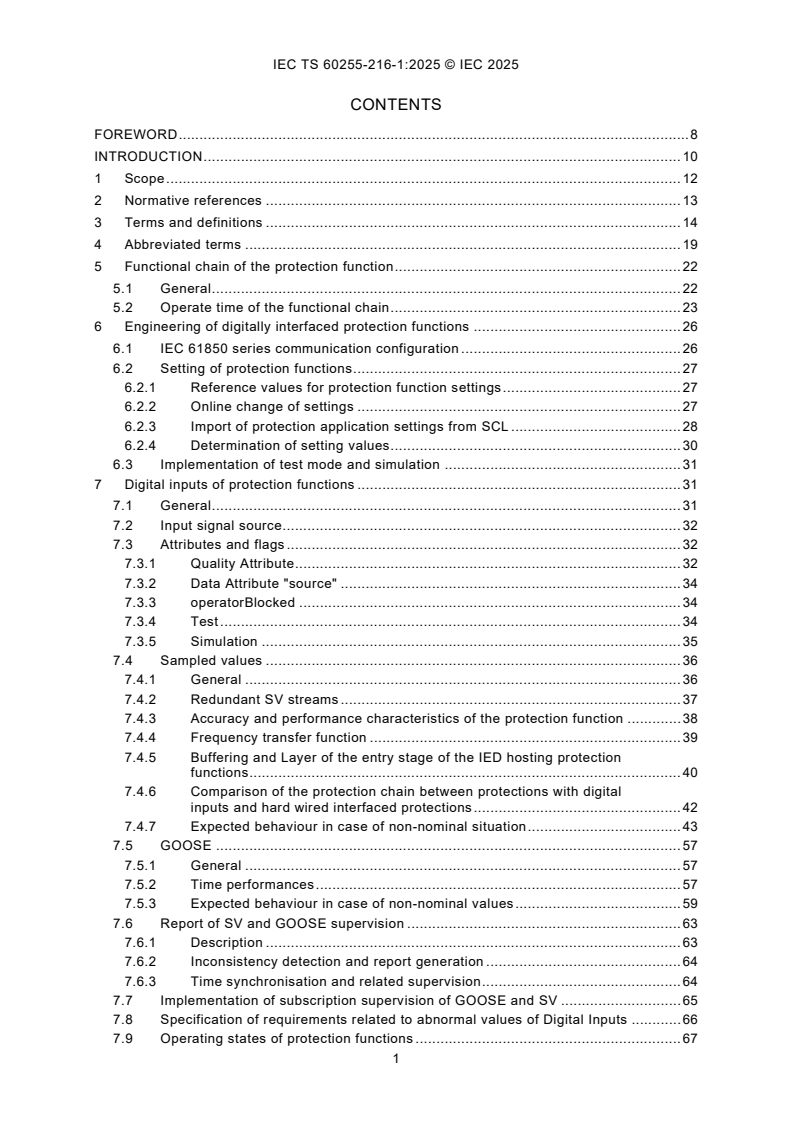
CONTENTS
FOREWORD . 8
INTRODUCTION . 10
1 Scope . 12
2 Normative references . 13
3 Terms and definitions . 14
4 Abbreviated terms . 19
5 Functional chain of the protection function . 22
5.1 General . 22
5.2 Operate time of the functional chain . 23
6 Engineering of digitally interfaced protection functions . 26
6.1 IEC 61850 series communication configuration . 26
6.2 Setting of protection functions . 27
6.2.1 Reference values for protection function settings . 27
6.2.2 Online change of settings . 27
6.2.3 Import of protection application settings from SCL . 28
6.2.4 Determination of setting values . 30
6.3 Implementation of test mode and simulation . 31
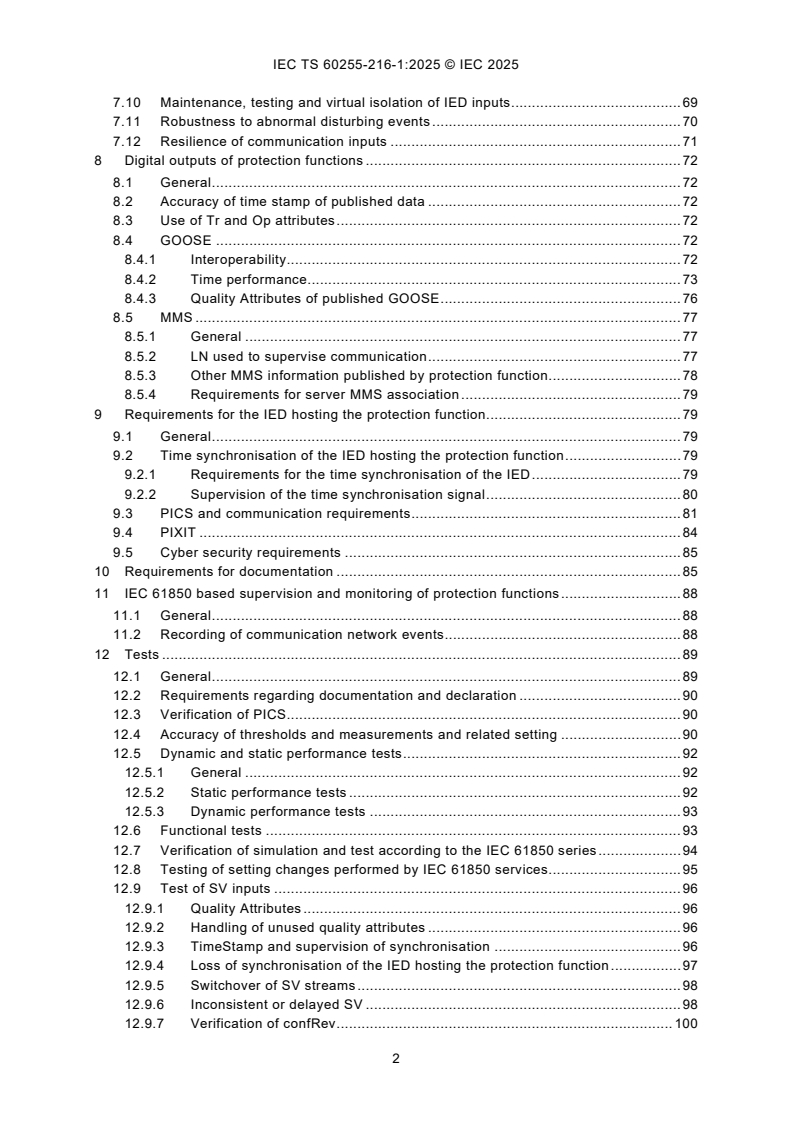
7 Digital inputs of protection functions . 31
7.1 General . 31
7.2 Input signal source. 32
7.3 Attributes and flags . 32
7.3.1 Quality Attribute . 32
7.3.2 Data Attribute "source" . 34
7.3.3 operatorBlocked . 34
7.3.4 Test . 34
7.3.5 Simulation . 35
7.4 Sampled values . 36
7.4.1 General . 36
7.4.2 Redundant SV streams . 37
7.4.3 Accuracy and performance characteristics of the protection function . 38
7.4.4 Frequency transfer function . 39
7.4.5 Buffering and Layer of the entry stage of the IED hosting protection
functions . 40
7.4.6 Comparison of the protection chain between protections with digital
inputs and hard wired interfaced protections . 42
7.4.7 Expected behaviour in case of non-nominal situation . 43
7.5 GOOSE . 57
7.5.1 General . 57
7.5.2 Time performances . 57
7.5.3 Expected behaviour in case of non-nominal values . 59
7.6 Report of SV and GOOSE supervision . 63
7.6.1 Description . 63
7.6.2 Inconsistency detection and report generation . 64
7.6.3 Time synchronisation and related supervision . 64
7.7 Implementation of subscription supervision of GOOSE and SV . 65
7.8 Specification of requirements related to abnormal values of Digital Inputs . 66
7.9 Operating states of protection functions . 67
7.10 Maintenance, testing and virtual isolation of IED inputs . 69
7.11 Robustness to abnormal disturbing events . 70
7.12 Resilience of communication inputs . 71
8 Digital outputs of protection functions . 72
8.1 General . 72
8.2 Accuracy of time stamp of published data . 72
8.3 Use of Tr and Op attributes . 72
8.4 GOOSE . 72
8.4.1 Interoperability. 72
8.4.2 Time performance. 73
8.4.3 Quality Attributes of published GOOSE . 76
8.5 MMS . 77
8.5.1 General . 77
8.5.2 LN used to supervise communication . 77
8.5.3 Other MMS information published by protection function . 78
8.5.4 Requirements for server MMS association . 79
9 Requirements for the IED hosting the protection function . 79
9.1 General . 79
9.2 Time synchronisation of the IED hosting the protection function . 79
9.2.1 Requirements for the time synchronisation of the IED . 79
9.2.2 Supervision of the time synchronisation signal . 80
9.3 PICS and communication requirements . 81
9.4 PIXIT . 84
9.5 Cyber security requirements . 85
10 Requirements for documentation . 85
11 IEC 61850 based supervision and monitoring of protection functions . 88
11.1 General . 88
11.2 Recording of communication network events. 88
12 Tests . 89
12.1 General . 89
12.2 Requirements regarding documentation and declaration . 90
12.3 Verification of PICS. 90
12.4 Accuracy of thresholds and measurements and related setting . 90
12.5 Dynamic and static performance tests . 92
12.5.1 General . 92
12.5.2 Static performance tests . 92
12.5.3 Dynamic performance tests . 93
12.6 Functional tests . 93
12.7 Verification of simulation and test according to the IEC 61850 series . 94
12.8 Testing of setting changes performed by IEC 61850 services . 95
12.9 Test of SV inputs . 96
12.9.1 Quality Attributes . 96
12.9.2 Handling of unused quality attributes . 96
12.9.3 TimeStamp and supervision of synchronisation . 96
12.9.4 Loss of synchronisation of the IED hosting the protection function . 97
12.9.5 Switchover of SV streams . 98
12.9.6 Inconsistent or delayed SV . 98
12.9.7 Verification of confRev . 100
12.9.8 Robustness to abnormal events . 101
12.10 Loss of client/server association . 102
12.10.1 General . 102
12.10.2 Server tests related to MMS association . 102
12.10.3 Communication recovery test . 103
12.10.4 Robustness to abnormal events . 103
12.11 Testing of GOOSE inputs . 104
12.11.1 Quality attributes . 104
12.11.2 Time stamp and supervision of synchronisation . 105
12.11.3 Loss of GoCB publisher and GOOSE recovery . 105
12.11.4 Robustness to abnormal events . 105
12.11.5 Verification of confRev . 106
12.12 GOOSE performance . 106
12.13 Verification of MMS report . 107
12.14 Tests related to cybersecurity . 107
12.15 Verification after the download of a CID . 107
12.16 Recommendations for FAT and SAT testing for digitally interfaced protection
functions . 107
12.16.1 General . 107
12.16.2 Verifications prior to FAT or SAT . 108
12.16.3 FAT (Factory Acceptance Test) . 109
12.16.4 SAT (Site Acceptance Test) . 110
Annex A (informative) Example of a specification of the expected behaviour of a
protection function depending on the quality of received data . 111
Annex B (informative) Redundant SV streams received by protection functions . 114
B.1 General . 114
B.2 Example of double A/D redundant mechanism . 114
Annex C (informative) Example for criteria for the function supervising the GOOSE
and SV. 116
C.1 General . 116
C.2 Sampled values . 116
C.3 GOOSE . 116
C.4 Advanced considerations . 117
C.4.1 General . 117
C.4.2 Monitoring of SV . 118
C.4.3 Monitoring of GOOSE . 118
Annex D (informative) Advantages and drawbacks of explicit and structured data sets . 120
D.1 Explanation of explicit and implicit datasets . 120
D.2 Implications related to the use of the two approaches . 121
Annex E (informative) Stand-alone network recording device . 123
Annex F (informative) Guidance for the evaluation of the overall error of the analog
acquisition chain . 124
Annex G (informative) General description of the digital processing of sampled values
in the protection function. 127
G.1 General . 127
G.2 Acquisition chains for analog data . 127
G.3 Frequency tracking . 128
Annex H (informative) Expected behaviour of protection functions for non-nominal
conditions . 131
Annex I (informative) Use case for functional testing of a blocking function . 135
Annex J (informative) Use case for detection of transmission time delay of SV
between MU and subscribing IED . 137
J.1 Description . 137
J.2 Operate time of the functional protection chain . 137
J.3 Post-fault analysis for events related to communication network . 139
Annex K (informative) Additional considerations for digitally interfaced protection
functions . 140
K.1 Characteristics of the analog acquisition IED . 140
K.1.1 Accuracy classes of analog values . 140
K.1.2 Sample rate . 146
K.1.3 Frequency response and accuracy requirements for harmonics . 147
K.1.4 Effects of electromagnetic interference . 151
K.1.5 Publication of the data quality . 152
K.1.6 Time synchronisation . 153
K.1.7 Jitter and time delay . 157
K.1.8 Robustness and start up . 158
K.2 System related aspects . 159
K.2.1 Architecture and configuration . 159
K.2.2 System redundancy features . 160
K.2.3 Time synchronisation . 162
K.2.4 Client – server MMS associations . 164
K.2.5 R-GOOSE and R-SV . 165
K.3 Grouping of Logical Nodes related to a protection function . 165
K.4 Version and consistency check of SCL configuration data . 166
K.4.1 Context . 166
K.4.2 ICD and IID file management . 168
K.4.3 SCD file management . 168
K.4.4 CID file management . 169
K.4.5 Consistency check of CID . 169
Annex L (informative) Role and responsibilities of the system integrator . 170
Bibliography . 172
Figure 1 – Functional chain of a digitally interfaced protection function . 12
Figure 2 – Operate time of the functional chain of a protection function (example: LPIT) . 23
Figure 3 – Time delay in case of two SV streams . 25
Figure 4 – Processing and transmission time and (symmetrical) jitter of SV . 26
Figure 5 – Workflow for import of settings in IED based on SCD (see
IEC 61850-6:2009 and IEC 61850-6:2009/AMD1:2018) . 30
Figure 6 – Data used for receiving simulation signals (IEC 61850-7-1:2011 and
IEC 61850-7-1:2011/AMD1:2020, Figure 40) . 36
Figure 7 – Operation of SV input buffer of a protection function . 42
Figure 8 – Comparison of Operate time of digitally interfaced protection chain and wire
terminal interfaced protection IED . 43
Figure 9 – Relation between quality attributes and range of analog energising values . 46
Figure 10 – GOOSE timing considering simple protection application . 58
Figure 11 – Process of reporting detection of abnormal SV or GOOSE data . 63
Figure A.1 – Example of a dynamic data model for the distance protection function . 111
Figure B.1 – Dataset for a current SV stream with redundant values . 114
Figure D.1 – Example of one member of a structured data set of DO Op. 120
Figure D.2 – Example of explicit and implicit data sets in SCL . 121
Figure D.3 – Content of the structured member of the dataset of DO Op . 121
Figure F.1 – Analog acquisition chain of an ECT (based on IEC 61869-9:2016) . 124
Figure F.2 – Analog acquisition chain represented as functional chain . 124
Figure F.3 – Combined error of the acquisition chain (based on IEC 61869-13:2021) . 125
Figure G.1 – Acquisition of analog data of a protection IED with analog inputs . 127
Figure G.2 – Acquisition chain for analog data of a MU . 128
Figure G.3 – Measurement chain of an IED based on process bus . 128
Figure G.4 – DFT window set for 50 Hz in a 43 Hz waveform . 129
Figure G.5 – Frequency response of sine and cosine filters . 129
Figure I.1 – Example of functional testing of a digitally interfaced protection function
implemented in an IED . 135
Figure K.1 – Dynamic range concept example according to IEC 61869-13:2021,
Figure 1305 . 143
Figure K.2 – Frequency response mask for measuring accuracy class 1
(f = 60 Hz, f = 4 800 Hz) IEC 61869-1:2023 with an additional bode plot of a realistic
r s
frequency response . 148
Figure K.3 – Tolerance scheme and a typical amplitude response of a SAMU . 150
Figure K.4 – Global Error of time synchronisation . 154
Figure K.5 – Time adjustment after reacquisition of synchronisation
(IEC 61869-9:2016) . 158
Figure K.6 – Protection function subscribing to redundant SV streams (example 1) . 161
Figure K.7 – Redundant Protection functions subscribing to single SV streams
(example 2) . 161
Figure K.8 – Time synchronisation states . 163
Figure K.9 – Inconsistent recovery of synchronisation of different MUs . 164
Figure K.10 – IED configuration procedure (based on IEC 61850-6:2009 and
IEC 61850-6:2009/AMD1:2018) . 166
Table 1 – List of acronyms . 19
Table 2 – Link between DA "detailQual" and validity (IEC 61850-7-2:2010 and
IEC 61850-7-2:2010/AMD1:2020, Table D.1) . 34
Table 3 – Interpretation of DA "detailQual" for Sampled Values and other analog
values received by Protection Functions . 44
Table 4 – Options for detailed specification for the expected behaviour of a protection
function in case of non-nominal input signal . 46
Table 5 – Definition of expected functional behaviour of a protection function . 47
Table 6 – Definition of warnings or alarms generated by a protection function . 47
Table 7 – Definition of propagation of the quality attribute by a protection function . 48
Table 8 – Template to specify the expected behaviour of a protection function
depending on the quality of received data . 49
Table 9 – Interpretation of detailQual of a DO containing discrete information (Boolean
or enumerate) received by Protection Functions . 59
Table 10 – Interpretation of signals of LGOS and LSVS [based on the simulation state
machine defined in IEC 61850-7-1:2011 and IEC 61850-7-1:2011/AMD1:2020 . 66
Table 11 – Interpretation of the combination of status of LGOS.St and LGOS.SimSt . 66
Table 12 ─ Overview of different operating states of protection functions . 68
Table 13 – Expected behaviour of protection and supervision functions in case of
abnormal disturbing events . 70
Table 14 – Value table for AND and OR default values for protection functions
subscribing to Boolean type inputs . 77
Table 15 – Required ACSI Basic Conformance functionality for IED hosting protection
functions based on Table A.1 of IEC 61850-7-2:2010 and
IEC 61850-7-2:2010/AMD1:2020. 81
Table 16 – Required ACSI Model Conformance functionality for IED hosting protection
functions based on Table A.2 of IEC 61850-7-2:2010 and
IEC 61850-7-2:2010/AMD1:2020. 82
Table 17 – Required ACSI services for IED hosting protection functions based on
Table A.3 of IEC 61850-7-2:2010 and IEC 61850-7-2:2010/AMD1:2020 . 83
Table 18 – Required PIXIT information for IED hosting protection functions . 84
Table 19 – Manufacturer declarations required for IED hosting protection functions . 86
Table 20 – Overview over specified tests and associated requirements . 89
Table 21 – Test cases for Sim flag and test bit in the received stream . 95
Table A.1 – Example for the specification of the expected behaviour for the operation
under non-nominal conditions for the distance protection function (The colours used in
this table are defined in Table 5) . 113
Table B.1 – Example of instance names of TCTR for redundant acquisition . 115
Table C.1 – SV abnormalities. 116
Table C.2 – GOOSE abnormalities . 117
Table F.1 – Combined accuracy class table (IEC 61869-13:2021) . 126
Table H.1 – Proposed requirements for digitally interfaced protection functions . 132
Table K.1 – Errors related to acquisition of analog signals in the functional protection
chain – overview and applicable standards . 140
Table K.2 – Limits of current error and phase error for SAMU measuring accuracy
current channels according to IEC 61869-13:2021, Table 1303 . 142
Table K.3 – Limits of current errors for SAMU protection accuracy current channels
according to IEC 61869-13:2021, Table 1304 . 144
Table K.4 – Limits of voltage ratio error and phase error for SAMU voltage channels
according to IEC 61869-13:2021, Table 1305, for voltages between 20 % and F of the
V
rated input voltage . 145
Table K.5 – Standard sample rates of MU according to IEC 61869-9:2016 (Table 902) . 147
Table K.6 – Requirements for protective accuracy classes according to
IEC 61869-1:2023, Table 9 . 149
Table K.7 – Requirements for anti-aliasing according to IEC 61869-1:2023, Table 10 . 149
Table K.8 – Overview of data attributes of packed list "Quality" according to
IEC 61850-7-2:2010 and IEC 61850-7-2:2010/AMD1:2020 . 152
Table K.9 – Limitation of quality attributes according to IEC 61869-9:2016 . 152
Table K.10 – Value of selected quality attributes for SV according to IEC 61869-9:2016 . 153
Table K.11 – Application of time synchronisation classes for time tagging or sampling
(IEC 61850-5:2013 and IEC 61850-5:2013/AMD1:2022, Table 3) . 155
Table K.12 – Values of synchronisation declaration of the merging unit (SmpSynch)
(see IEC 61850-9-2:2011 and IEC 61850-9-2:2011/AMD1:2020) . 156
Table K.13 – Maximum processing delay time limits according to
IEC 61869-9:2016, Table 901 . 157
Table L.1 – Responsibility of the system integrator . 170
INTERNATIONAL ELECTROTECHNICAL COMMISSION
____________
Measuring relays and protection equipment -
Part 216-1: Digital interface - General requirements and tests for
protection functions using digital communication as input and output
FOREWORD
1) The International Electrotechnical Commission (IEC) is a worldwide organization for standardization comprising
all national electrotechnical committees (IEC National Committees). The object of IEC is to promote international
co-operation on all questions concerning standardization in the electrical and electronic fields. To this end and
in addition to other activities, IEC publishes International Standards, Technical Specifications, Technical Reports,
Publicly Available Specifications (PAS) and Guides (hereafter referred to as “IEC Publication(s)”). Their
preparation is entrusted to technical committees; any IEC National Committee interested in the subject dealt with
may participate in this preparatory work. International, governmental and non-governmental organizations liaising
with the IEC also participate in this preparation. IEC collaborates closely with the International Organization for
Standardization (ISO) in accordance with conditions determined by agreement between the two organizations.
2) The formal decisions or agreements of IEC on technical matters express, as nearly as possible, an international
consensus of opinion on the relevant subjects since each technical committee has representation from all
interested IEC National Committees.
3) IEC Publications have the form of recommendations for international use and are accepted by IEC National
Committees in that sense. While all reasonable efforts are made to ensure that the technical content of IEC
Publications is accurate, IEC cannot be held responsible for the way in which they are used or for any
misinterpretation by any end user.
4) In order to promote international uniformity, IEC National Committees undertake to apply IEC Publications
transparently to the maximum extent possible in their national and regional publications. Any divergence between
any IEC Publication and the corresponding national or regional publication shall be clearly indicated in the latter.
5) IEC itself does not provide any attestation of conformity. Independent certification bodies provide conformity
assessment services and, in some areas, access to IEC marks of conformity. IEC is not responsible for any
services carried out by independent certification bodies.
6) All users should ensure that they have the latest edition of this publication.
7) No liability shall attach to IEC or its directors, employees, servants or agents including individual experts and
members of its technical committees and IEC National Committees for any personal injury, property damage or
other damage of any nature whatsoever, whether direct or indirect, or for costs (including legal fees) and
expenses arising out of the publication, use of, or reliance upon, this IEC Publication or any other IEC
Publications.
8) Attention is drawn to the Normative references cited in this publication. Use of the referenced publications is
indispensable for the correct application of this publication.
9) IEC draws attention to the possibility that the implementation of this document may involve the use of (a)
patent(s). IEC takes no position concerning the evidence, validity or applicability of any claimed patent rights in
respect thereof. As of the date of publication of this document, IEC had not received notice of (a) patent(s), which
may be required to implement this document. However, implementers are cautioned that this may not represent
the latest information, which may be obtained from the patent database available at https://patents.iec.ch. IEC
shall not be held responsible for identifying any or all such patent rights.
IEC TS 60255-216-1 has been prepared by IEC technical committee 95: Measuring relays and
protection equipment. It is a Technical Specification.
The text of this Technical Specification is based on the following documents:
Draft Report on voting
95/593/DTS 95/598/RVDTS
Full information on the voting for its approval can be found in the report on voting indicated in
the above table.
The language used for the development of this Technical Specification is English.
This document was drafted in accordance with ISO/IEC Directives, Part 2, and developed in
accordance with ISO/IEC Directives, Part 1 and ISO/IEC Directives, IEC Supplement, available
at www.iec.ch/members_experts/refdocs. The main document types developed by IEC are
described in greater detail at www.iec.ch/publications.
A list of all parts in the IEC 60255 series, published under the general title Measuring relays
and protection equipment, can be found on the IEC website.
The committee has decided that the contents of this document will remain unchanged until the
stability date indicated on the IEC website under webstore.iec.ch in the data related to the
specific document. At this date, the document will be
• reconfirmed,
• withdrawn, or
• revised.
INTRODUCTION
Process bus based on the IEC 61850 series (referred to as “IEC 61850” in this document) is
being introduced widely in the protection automation and control systems (PACS). There are
standards for digitally interfacing instrument transformers, in particular IEC 61869-9. In order
to ensure functional interoperability, the standards of protection functions are being adapted to
take this into account. The intention of this document is to define characteristics and
requirements to be implemented to reach functional interoperability and simplify Protection,
Automation and Control System (PACS) design and implementation for users.
This document describes the global framework for digitally interfaced protection functions,
namely the relevant features in IEC 61850 and the properties of the sampled values (SV)
defined in IEC 61869-1 and IEC 61869-9 used by protection functions. This is done in Annex K
(Clause K.1). Subclause K.1.1 covers SV published by Stand Alone Merging Units (SAMU)
(IEC 61869-13:2021) or Low Power Instrument Transformers (LPIT) (future IEC 61869-7 and
IEC 61850-8). Specific requirements for protection functions are defined on this base in the
clauses (Clauses 5 through 11). Sometimes this concerns an extension or a specific profile of
IEC 61850 (e.g. some requirements to be mandatory instead of optional) and sometimes new
requirements specific for protection functions are formulated. The associated tests are specified
in Clause 12.
Compared with wire terminal interfaced Intelligent Electronic Device (IED) hosting protection
functions, the digitally interfaced functional protection chain contains two or more IED types,
including the merging unit interfacing the instrument transformers and the IED with hard wired
binary inputs and outputs (BIOI) interfacing the circuit breaker (see Figure 1). This results in
advantages of sharing IEDs and data, but also uses transmission of data between the different
IEDs. This architecture is also considered for the overall operation time of the functional
protection chain.
Time synchronisation is a sensible aspect for some protection functions receiving multiple
sample value (SV) streams. This aspect is discussed in several clauses of this document.
Protection functions use data contained in generic object-oriented system event (GOOSE) and
SV messages. These messages are technically subscribed by the IED hosting the protection
function via its communication port and IEC 61850 stack. In this document, this chain is
referenced to as "GOOSE signals or SV received by a protection function".
It is clear that the use of digital technology also
– facilitates automatic preventive maintenance based on the available recorded data,
– allows for substation self-supervision where automatic warnings are given in case of failures
or abnormality, reducing the Mean Time To Restoration (MTTR),
– increases the availability, dependability and security of the protection system by detecting
communication failures and enabling countermeasures to minimise the number of unwanted
events (e.g. trips),
– facilitates simplified fault analysis and post event analysis.
The pick-up time, start time and other properties related to a specific protection function are
defined in the relevant functional protection standard and are extended to the digitally interfaced
protection function. See also Annex H “Expected behaviour of protection functions for
non-nominal conditions”, trying to anticipate indication of properties for different protection
functions.
Often the term "start" is used as synonym for "pick-up". The data object "operate" can be
published by several functional elements but does not always lead to a trip. This document uses
all of these terms.
This document is intended to serve as a basis for standards developed in the IEC 60255 series.
For this reason, details from other standards are included for informational clarity. For standards
referencing to this document, it is intended to reference the source standard in application of
the IEC editorial guidelines without reproducing them.
Future evolutions on several aspects of IEC 61850 are possible, including time synchronisation,
start-up, processing of quality packed list and in particular the detailed quality (detailQual). This
can have an impact on product standards,
...