

IEC 61243-1:2021
(Main)Live working - Voltage detectors - Part 1: Capacitive type to be used for voltages exceeding 1 kV AC
General Information
- Abstract
IEC 61243-1:2021 is applicable to portable voltage detectors, with or without built-in power sources, to be used on electrical systems for voltages of 1 kV to 800 kV AC, and frequencies of 50 Hz and/or 60 Hz.
This document applies only to voltage detectors of capacitive type used in contact with the bare part to be tested, as a complete device including its insulating element or as a separate device, adaptable to an insulating stick which, as a separate tool, is not covered by this document (see 4.4.2.1 for general design).
Other types of voltage detectors are not covered by this document.
Self ranging voltage detectors (formally "multi range voltage detectors") are not covered by this document.
Some restrictions or formal interdictions on their use are applicable in case of switchgear of IEC 62271 series design, due to insulation coordination, on overhead line systems of electrified railways (see Annex B) and systems without neutral reference. For systems without neutral reference, the insulating level is adapted to the maximum possible voltage to the earth (ground).
Products designed and manufactured according to this document contribute to the safety of users provided they are used by persons trained for the work, in accordance with the hot stick working method and the instructions for use.
Except where otherwise specified, all the voltages defined in this document refer to values of phase-to-phase voltages of three-phase systems. In other systems, the applicable phase-to-phase or phase-to-earth (ground) voltages are used to determine the operating voltage.
This third edition cancels and replaces the second edition published in 2003 and Amend-ment 1:2009. This edition constitutes a technical revision.
This edition includes the following significant technical changes with respect to the previous edition:
a) The scope is more precise, stating that only bare contact to the part to be tested is reliable for these contact voltage detectors. The rationale is that tests on painted or coated conductors have led to wrong indications, as this non-conductive paint or coat acts as a capacitor with different capacity according to the thickness. This capacity has an effect on the threshold voltage.
b) A contact probe is introduced as a new type of non-conductive contact electrode.
c) A new type "exclusively outdoor type" has been defined and implemented into the requirements and test procedure.
d) A selector for voltage and frequency is allowed if foreseeable misuse is excluded.
e) The marking for voltage detectors with low interference voltage has been made more precise.
f) The indication groups have been made more precise and requirements and tests for the "ready to operate state" and "stand-by state" added.
g) Requirements and tests for electromagnetic compatability have been implemented.
h) An example for good electrical connection for the tests is introduced.
- Status
- Published
- Publication Date
- 20-Apr-2021
- Technical Committee
- TC 78 - Live working
- Drafting Committee
- MT 61243-1 - TC 78/MT 61243-1
- Current Stage
- PPUB - Publication issued
- Start Date
- 21-Apr-2021
- Completion Date
- 26-Mar-2021
Overview
IEC 61243-1:2021 is an international standard published by the International Electrotechnical Commission (IEC) that specifies requirements for live working voltage detectors of the capacitive type. These portable voltage detectors are designed for use on electrical systems with alternating current (AC) voltages exceeding 1 kV, specifically from 1 kV up to 800 kV AC at frequencies of 50 Hz and 60 Hz. The standard focuses exclusively on capacitive voltage detectors used in direct contact with bare conductive parts to ensure accurate detection of voltage presence.
This third edition replaces the 2003 edition and 2009 amendment, reflecting technical revisions that enhance clarity, reliability, and safety. It includes updated provisions related to design, functionality, electromagnetic compatibility, and more, to better support safe live working practices.
Key Topics
Scope and Application
The standard applies only to capacitive voltage detectors that contact bare conductive parts directly or are adaptable as complete devices including insulating elements. It excludes multi-range (self-ranging) detectors and other types of voltage detectors.Design and Construction Requirements
Requirements cover mechanical strength, insulating materials, grip force, vibration and shock resistance, and protection against sparking or bridging faults. The standard introduces a new "contact probe" type and defines an "exclusively outdoor type" with tailored specifications.Functional Performance
Clear and perceptible indication systems (visual and audible), response times, frequency and temperature dependencies, and power source dependability are specified to ensure reliable live voltage detection.Electromagnetic Compatibility (EMC)
New EMC requirements and testing procedures ensure voltage detectors perform reliably in environments with electromagnetic interference.Marking and User Documentation
Clear markings for voltage levels, low interference voltage, and usage instructions are mandated to promote safe handling and user awareness. Instructions include guidelines on the correct use of selectors and precautions against foreseeable misuse.Testing Procedures
Comprehensive testing covers dielectric strength, leakage current, functional verification, mechanical durability, climatic conditions, and misuse scenarios to verify compliance and operational safety.Safety Considerations
The standard emphasizes that devices meeting its requirements enhance user safety only when used by trained personnel following established hot stick live working techniques and documented instructions.
Applications
IEC 61243-1:2021 voltage detectors are critical tools for electrical engineers, field technicians, and maintenance workers involved in live working on medium to high-voltage AC electrical systems such as:
- High voltage overhead transmission lines (up to 800 kV AC)
- Substation equipment and switchgear compliant with IEC 62271 series
- Electrical distribution networks requiring verification of voltage presence before or during maintenance
- Electrified railway systems with overhead lines, taking into account insulation design and neutral reference conditions
The standard supports safety by standardizing reliable detection devices used to prevent accidental contact with live conductors and reduce electrical hazards during live working operations.
Related Standards
- IEC 62271 series – High-voltage switchgear and controlgear requirements, referenced for insulation coordination and usage restrictions with voltage detectors.
- IEC 60417-5216 – Symbol for suitability in live working, referenced for marking voltage detectors approved for such use.
- Other IEC standards covering electrotechnical safety measures, insulating tools, portable electrical test instruments, and electromagnetic compatibility.
Summary
IEC 61243-1:2021 plays a vital role in ensuring the safety and reliability of capacitive voltage detectors used on AC electrical systems above 1 kV. By setting rigorous design, performance, marking, and testing requirements, this standard underpins safe live working practices to protect personnel from electrical hazards. Its implementation enables manufacturers and users to adhere to globally recognized safety benchmarks, promote operational consistency, and mitigate risks associated with voltage detection in high-voltage environments.
Relations
- Effective Date
- 05-Sep-2023
- Effective Date
- 05-Sep-2023
- Effective Date
- 05-Sep-2023
Get Certified
Connect with accredited certification bodies for this standard

IMQ S.p.A. (Certification)
Italian electrical product certification.

SLG Prüf- und Zertifizierungs GmbH
German testing and certification body.

UL Solutions
Global safety science company with testing, inspection and certification.
Sponsored listings
Frequently Asked Questions
IEC 61243-1:2021 is a standard published by the International Electrotechnical Commission (IEC). Its full title is "Live working - Voltage detectors - Part 1: Capacitive type to be used for voltages exceeding 1 kV AC". This standard covers: IEC 61243-1:2021 is applicable to portable voltage detectors, with or without built-in power sources, to be used on electrical systems for voltages of 1 kV to 800 kV AC, and frequencies of 50 Hz and/or 60 Hz. This document applies only to voltage detectors of capacitive type used in contact with the bare part to be tested, as a complete device including its insulating element or as a separate device, adaptable to an insulating stick which, as a separate tool, is not covered by this document (see 4.4.2.1 for general design). Other types of voltage detectors are not covered by this document. Self ranging voltage detectors (formally "multi range voltage detectors") are not covered by this document. Some restrictions or formal interdictions on their use are applicable in case of switchgear of IEC 62271 series design, due to insulation coordination, on overhead line systems of electrified railways (see Annex B) and systems without neutral reference. For systems without neutral reference, the insulating level is adapted to the maximum possible voltage to the earth (ground). Products designed and manufactured according to this document contribute to the safety of users provided they are used by persons trained for the work, in accordance with the hot stick working method and the instructions for use. Except where otherwise specified, all the voltages defined in this document refer to values of phase-to-phase voltages of three-phase systems. In other systems, the applicable phase-to-phase or phase-to-earth (ground) voltages are used to determine the operating voltage. This third edition cancels and replaces the second edition published in 2003 and Amend-ment 1:2009. This edition constitutes a technical revision. This edition includes the following significant technical changes with respect to the previous edition: a) The scope is more precise, stating that only bare contact to the part to be tested is reliable for these contact voltage detectors. The rationale is that tests on painted or coated conductors have led to wrong indications, as this non-conductive paint or coat acts as a capacitor with different capacity according to the thickness. This capacity has an effect on the threshold voltage. b) A contact probe is introduced as a new type of non-conductive contact electrode. c) A new type "exclusively outdoor type" has been defined and implemented into the requirements and test procedure. d) A selector for voltage and frequency is allowed if foreseeable misuse is excluded. e) The marking for voltage detectors with low interference voltage has been made more precise. f) The indication groups have been made more precise and requirements and tests for the "ready to operate state" and "stand-by state" added. g) Requirements and tests for electromagnetic compatability have been implemented. h) An example for good electrical connection for the tests is introduced.
IEC 61243-1:2021 is applicable to portable voltage detectors, with or without built-in power sources, to be used on electrical systems for voltages of 1 kV to 800 kV AC, and frequencies of 50 Hz and/or 60 Hz. This document applies only to voltage detectors of capacitive type used in contact with the bare part to be tested, as a complete device including its insulating element or as a separate device, adaptable to an insulating stick which, as a separate tool, is not covered by this document (see 4.4.2.1 for general design). Other types of voltage detectors are not covered by this document. Self ranging voltage detectors (formally "multi range voltage detectors") are not covered by this document. Some restrictions or formal interdictions on their use are applicable in case of switchgear of IEC 62271 series design, due to insulation coordination, on overhead line systems of electrified railways (see Annex B) and systems without neutral reference. For systems without neutral reference, the insulating level is adapted to the maximum possible voltage to the earth (ground). Products designed and manufactured according to this document contribute to the safety of users provided they are used by persons trained for the work, in accordance with the hot stick working method and the instructions for use. Except where otherwise specified, all the voltages defined in this document refer to values of phase-to-phase voltages of three-phase systems. In other systems, the applicable phase-to-phase or phase-to-earth (ground) voltages are used to determine the operating voltage. This third edition cancels and replaces the second edition published in 2003 and Amend-ment 1:2009. This edition constitutes a technical revision. This edition includes the following significant technical changes with respect to the previous edition: a) The scope is more precise, stating that only bare contact to the part to be tested is reliable for these contact voltage detectors. The rationale is that tests on painted or coated conductors have led to wrong indications, as this non-conductive paint or coat acts as a capacitor with different capacity according to the thickness. This capacity has an effect on the threshold voltage. b) A contact probe is introduced as a new type of non-conductive contact electrode. c) A new type "exclusively outdoor type" has been defined and implemented into the requirements and test procedure. d) A selector for voltage and frequency is allowed if foreseeable misuse is excluded. e) The marking for voltage detectors with low interference voltage has been made more precise. f) The indication groups have been made more precise and requirements and tests for the "ready to operate state" and "stand-by state" added. g) Requirements and tests for electromagnetic compatability have been implemented. h) An example for good electrical connection for the tests is introduced.
IEC 61243-1:2021 is classified under the following ICS (International Classification for Standards) categories: 13.260 - Protection against electric shock. Live working; 29.240.20 - Power transmission and distribution lines; 29.260.99 - Other electrical equipment for working in special conditions. The ICS classification helps identify the subject area and facilitates finding related standards.
IEC 61243-1:2021 has the following relationships with other standards: It is inter standard links to IEC 61243-1:2003/AMD1:2009, IEC 61243-1:2003, IEC 61243-1:2003/COR1:2005. Understanding these relationships helps ensure you are using the most current and applicable version of the standard.
IEC 61243-1:2021 is available in PDF format for immediate download after purchase. The document can be added to your cart and obtained through the secure checkout process. Digital delivery ensures instant access to the complete standard document.
Standards Content (Sample)
IEC 61243-1 ®
Edition 3.0 2021-04
INTERNATIONAL
STANDARD
NORME
INTERNATIONALE
colour
inside
Live working – Voltage detectors –
Part 1: Capacitive type to be used for voltages exceeding 1 kV AC
Travaux sous tension – Détecteurs de tension –
Partie 1: Type capacitif pour usage sur des tensions alternatives de plus de 1 kV
All rights reserved. Unless otherwise specified, no part of this publication may be reproduced or utilized in any form
or by any means, electronic or mechanical, including photocopying and microfilm, without permission in writing from
either IEC or IEC's member National Committee in the country of the requester. If you have any questions about IEC
copyright or have an enquiry about obtaining additional rights to this publication, please contact the address below or
your local IEC member National Committee for further information.
Droits de reproduction réservés. Sauf indication contraire, aucune partie de cette publication ne peut être reproduite
ni utilisée sous quelque forme que ce soit et par aucun procédé, électronique ou mécanique, y compris la photocopie
et les microfilms, sans l'accord écrit de l'IEC ou du Comité national de l'IEC du pays du demandeur. Si vous avez des
questions sur le copyright de l'IEC ou si vous désirez obtenir des droits supplémentaires sur cette publication, utilisez
les coordonnées ci-après ou contactez le Comité national de l'IEC de votre pays de résidence.
IEC Central Office Tel.: +41 22 919 02 11
3, rue de Varembé info@iec.ch
CH-1211 Geneva 20 www.iec.ch
Switzerland
About the IEC
The International Electrotechnical Commission (IEC) is the leading global organization that prepares and publishes
International Standards for all electrical, electronic and related technologies.
About IEC publications
The technical content of IEC publications is kept under constant review by the IEC. Please make sure that you have the
latest edition, a corrigendum or an amendment might have been published.
IEC publications search - webstore.iec.ch/advsearchform IEC online collection - oc.iec.ch
The advanced search enables to find IEC publications by a Discover our powerful search engine and read freely all the
variety of criteria (reference number, text, technical publications previews. With a subscription you will always
committee, …). It also gives information on projects, replaced have access to up to date content tailored to your needs.
and withdrawn publications.
Electropedia - www.electropedia.org
IEC Just Published - webstore.iec.ch/justpublished
The world's leading online dictionary on electrotechnology,
Stay up to date on all new IEC publications. Just Published
containing more than 22 000 terminological entries in English
details all new publications released. Available online and
and French, with equivalent terms in 18 additional languages.
once a month by email.
Also known as the International Electrotechnical Vocabulary
(IEV) online.
IEC Customer Service Centre - webstore.iec.ch/csc
If you wish to give us your feedback on this publication or
need further assistance, please contact the Customer Service
Centre: sales@iec.ch.
A propos de l'IEC
La Commission Electrotechnique Internationale (IEC) est la première organisation mondiale qui élabore et publie des
Normes internationales pour tout ce qui a trait à l'électricité, à l'électronique et aux technologies apparentées.
A propos des publications IEC
Le contenu technique des publications IEC est constamment revu. Veuillez vous assurer que vous possédez l’édition la
plus récente, un corrigendum ou amendement peut avoir été publié.
Recherche de publications IEC - IEC online collection - oc.iec.ch
webstore.iec.ch/advsearchform Découvrez notre puissant moteur de recherche et consultez
La recherche avancée permet de trouver des publications IEC gratuitement tous les aperçus des publications. Avec un
en utilisant différents critères (numéro de référence, texte, abonnement, vous aurez toujours accès à un contenu à jour
comité d’études, …). Elle donne aussi des informations sur adapté à vos besoins.
les projets et les publications remplacées ou retirées.
Electropedia - www.electropedia.org
IEC Just Published - webstore.iec.ch/justpublished
Le premier dictionnaire d'électrotechnologie en ligne au
Restez informé sur les nouvelles publications IEC. Just
monde, avec plus de 22 000 articles terminologiques en
Published détaille les nouvelles publications parues.
anglais et en français, ainsi que les termes équivalents dans
Disponible en ligne et une fois par mois par email.
16 langues additionnelles. Egalement appelé Vocabulaire
Electrotechnique International (IEV) en ligne.
Service Clients - webstore.iec.ch/csc
Si vous désirez nous donner des commentaires sur cette
publication ou si vous avez des questions contactez-nous:
sales@iec.ch.
IEC 61243-1 ®
Edition 3.0 2021-04
INTERNATIONAL
STANDARD
NORME
INTERNATIONALE
colour
inside
Live working – Voltage detectors –
Part 1: Capacitive type to be used for voltages exceeding 1 kV AC
Travaux sous tension – Détecteurs de tension –
Partie 1: Type capacitif pour usage sur des tensions alternatives de plus de 1 kV
INTERNATIONAL
ELECTROTECHNICAL
COMMISSION
COMMISSION
ELECTROTECHNIQUE
INTERNATIONALE
ICS 13.260; 29.240.20; 29.260.99 ISBN 978-2-8322-9513-7
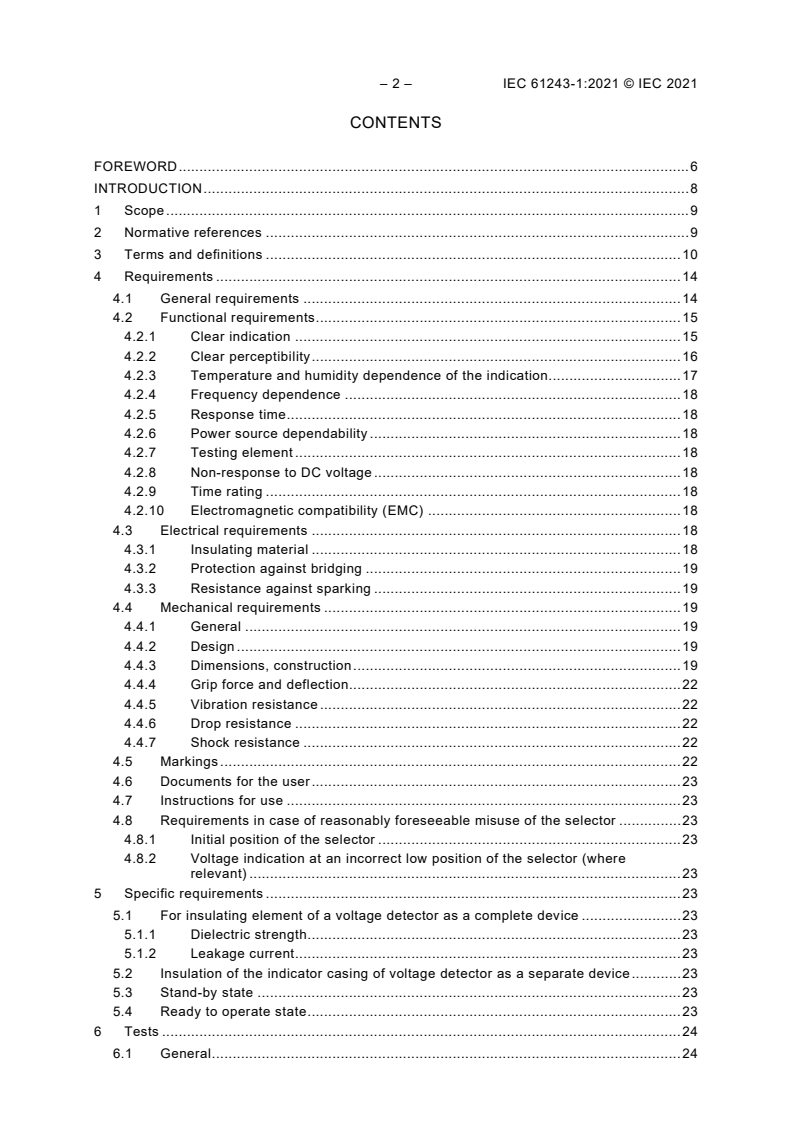
– 2 – IEC 61243-1:2021 © IEC 2021
CONTENTS
FOREWORD . 6
INTRODUCTION . 8
1 Scope . 9
2 Normative references . 9
3 Terms and definitions . 10
4 Requirements . 14
4.1 General requirements . 14
4.2 Functional requirements . 15
4.2.1 Clear indication . 15
4.2.2 Clear perceptibility . 16
4.2.3 Temperature and humidity dependence of the indication . 17
4.2.4 Frequency dependence . 18
4.2.5 Response time . 18
4.2.6 Power source dependability . 18
4.2.7 Testing element . 18
4.2.8 Non-response to DC voltage . 18
4.2.9 Time rating . 18
4.2.10 Electromagnetic compatibility (EMC) . 18
4.3 Electrical requirements . 18
4.3.1 Insulating material . 18
4.3.2 Protection against bridging . 19
4.3.3 Resistance against sparking . 19
4.4 Mechanical requirements . 19
4.4.1 General . 19
4.4.2 Design . 19
4.4.3 Dimensions, construction . 19
4.4.4 Grip force and deflection. 22
4.4.5 Vibration resistance . 22
4.4.6 Drop resistance . 22
4.4.7 Shock resistance . 22
4.5 Markings . 22
4.6 Documents for the user . 23
4.7 Instructions for use . 23
4.8 Requirements in case of reasonably foreseeable misuse of the selector . 23
4.8.1 Initial position of the selector . 23
4.8.2 Voltage indication at an incorrect low position of the selector (where
relevant) . 23
5 Specific requirements . 23
5.1 For insulating element of a voltage detector as a complete device . 23
5.1.1 Dielectric strength . 23
5.1.2 Leakage current . 23
5.2 Insulation of the indicator casing of voltage detector as a separate device . 23
5.3 Stand-by state . 23
5.4 Ready to operate state . 23
6 Tests . 24
6.1 General . 24
6.1.1 Testing provisions . 24
6.1.2 Atmospheric conditions . 24
6.1.3 Tests under wet conditions . 24
6.1.4 Type test . 24
6.1.5 Test methods . 25
6.2 Function tests . 26
6.2.1 Clear indication . 26
6.2.2 Electromagnetic compatibility (EMC) . 37
6.2.3 Clear perceptibility of visual indication . 38
6.2.4 Clear perceptibility of audible indication . 40
6.2.5 Frequency dependence . 42
6.2.6 Response time . 42
6.2.7 Power source dependability . 42
6.2.8 Check of testing element . 43
6.2.9 Non-response to DC voltage . 43
6.2.10 Time rating . 43
6.3 Dielectric tests . 44
6.3.1 Insulating material for tubes and rods for voltage detectors as a
complete device . 44
6.3.2 Protection against bridging for indoor and outdoor type voltage
detectors . 45
6.3.3 Protection against bridging for outdoor type voltage detector . 50
6.3.4 Spark resistance . 52
6.4 Mechanical tests . 52
6.4.1 Visual and dimensional inspection . 52
6.4.2 Grip force and deflection (only applicable for voltage detector as a
complete device) . 52
6.4.3 Vibration resistance . 53
6.4.4 Drop resistance . 54
6.4.5 Shock resistance . 54
6.4.6 Climatic dependence . 54
6.4.7 Durability of markings . 56
7 Specific tests . 56
7.1 Leakage current for voltage detector as a complete device . 56
7.1.1 General . 56
7.1.2 Leakage current under dry conditions . 56
7.1.3 Leakage current under wet conditions (outdoor type and exclusively
outdoor type) . 57
7.1.4 Alternative test for voltage detectors having completed the production
phase . 58
7.2 Test for stand-by state . 58
7.3 Test for ready to operate state . 58
8 Test for reasonably foreseeable misuse of the selector . 59
8.1 Initial position of the selector . 59
8.2 Voltage indication at incorrect low position of the selector (where relevant) . 59
9 Conformity assessment of voltage detectors having completed the production
phase . 59
10 Modifications . 59
Annex A (normative) Suitable for live working; double triangle
(IEC‑60417‑5216:2002‑10) . 60
– 4 – IEC 61243-1:2021 © IEC 2021
Annex B (normative) Instructions for use . 61
Annex C (normative) Chronology of type tests . 63
Annex D (informative) Classification of defects and tests to be allocated . 65
Annex E (informative) Rationale for the classification of defects . 67
Annex F (informative) Information and guidelines on the use of the limit mark and of a
contact electrode extension . 70
F.1 General . 70
F.2 Situation when using a voltage detector as a complete device . 70
F.3 Situation when using a voltage detector as a separate device . 72
Annex G (informative) In-service care . 74
G.1 General . 74
G.2 Testing . 74
Annex H (informative) Information for the next maintenance . 76
H.1 Overhead line test . 76
H.1.1 Rationale . 76
H.1.2 Proposal for an improved test (will be discussed within the next
maintenance) . 76
H.2 Threshold deviation ratio category (deviation category) for voltage detectors
of category L . 76
H.2.1 Rationale . 76
H.2.2 Proposal for a new requirement (will be discussed within the next
maintenance) . 76
H.3 Phase opposition test for voltage detectors of category L . 76
H.3.1 Rationale . 76
H.3.2 Proposal for an improved test (will be discussed within the next
maintenance) . 76
H.4 Non-contact behaviour of voltage detectors of category L . 77
H.4.1 Rationale . 77
H.4.2 Proposal for a new test (will be discussed within the next maintenance) . 77
Bibliography . 78
Figure 1 – Examples of designs of voltage detectors of capacitive type . 20
Figure 2 – Examples of suitable means for ensuring appropriate contact between a
contact electrode and the ball electrode . 27
Figure 3 – Ball and ring test set-up (see 6.2.1 and 6.2.5) . 29
Figure 4 – Test set-up with bars (see 6.2.1) . 31
Figure 5 – Circuit connections for clear indication tests (see 6.2.1) . 33
Figure 6 – Test set-up for measurement of clear perceptibility of visual indication
(see 6.2.3.1) . 39
Figure 7 – Test set-up for measurement of clear perceptibility of audible indication
(see 6.2.4.1) . 41
Figure 8 – Test set-up for protection against bridging and spark resistance (see 6.3.2
and 6.3.4) . 48
Figure 9 – Test for protection against bridging for outdoor type voltage detector . 51
Figure 10 – Test set-up for grip force . 53
Figure 11 – Drop resistance test – Diagonal position . 54
Figure 12 – Curve of test cycle for climatic dependence . 55
Figure 13 – Arrangement for leakage current tests under dry conditions for voltage
detector as a complete device. 57
Figure 14 – Arrangement for leakage current tests under wet conditions for outdoor
type voltage detector as a complete device . 58
Figure F.1 – Insulation element of a voltage detector as a complete device . 70
Figure F.2 – Example of positioning of a voltage detector in contact with a live part
without obstacles from other live parts . 71
Figure F.3 – Example of incorrect positioning of a voltage detector with the limit mark
between two live parts . 72
Figure F.4 – Usual way of managing the use of the voltage detector for maintaining
the insulation distance between the limit mark and the hand guard . 72
Figure F.5 – Usual ways of managing the use of the voltage detector as a separate
device for assuring the appropriate insulation for the user . 73
Table 1 – Indication group . 17
Table 2 – Climatic categories . 18
Table 3 – Minimum length of the insulating element (L ) of a voltage detector as a
i
complete device . 21
Table 4 – Selection of the test set-up for the influence of in-phase interference field . 34
Table 5 – Distance G (see Figure 5d) . 34
Table 6 – Selection of the test set-up for the influence of phase opposition
interference field . 35
Table 7 – Selection of the test set-up for the influence of interference voltage . 35
Table 8 – EMC parameters . 37
Table 9 – Performance criteria for all the EMC tests . 37
Table 10 – Test parameters for emission limit . 37
Table 11 – Selection of the test set-up and type of test . 45
Table 12 – Distance d for the bridging test set-up . 48
Table 13 – Dimensions for the concentric rings and band electrodes . 50
Table 14 – Selection of the test set-up for the spark resistance test . 52
Table C.1 – Sequential order for performing type tests . 63
Table C.2 – Type tests out of sequence . 64
Table D.1 – Classification of defects and associated requirements and tests . 65
Table E.1 – Rationale for the classification of defects . 67
Table G.1 – In-service testing . 75
Table H.1 – Maximum distances for early detection . 77
– 6 – IEC 61243-1:2021 © IEC 2021
INTERNATIONAL ELECTROTECHNICAL COMMISSION
____________
LIVE WORKING – VOLTAGE DETECTORS –
Part 1: Capacitive type to be used for voltages
exceeding 1 kV AC
FOREWORD
1) The International Electrotechnical Commission (IEC) is a worldwide organization for standardization comprising
all national electrotechnical committees (IEC National Committees). The object of IEC is to promote international
co-operation on all questions concerning standardization in the electrical and electronic fields. To this end and
in addition to other activities, IEC publishes International Standards, Technical Specifications, Technical Reports,
Publicly Available Specifications (PAS) and Guides (hereafter referred to as "IEC Publication(s)"). Their prepa-
ration is entrusted to technical committees; any IEC National Committee interested in the subject dealt with may
participate in this preparatory work. International, governmental and non-governmental organizations liaising with
the IEC also participate in this preparation. IEC collaborates closely with the International Organization for Stand-
ardization (ISO) in accordance with conditions determined by agreement between the two organizations.
2) The formal decisions or agreements of IEC on technical matters express, as nearly as possible, an international
consensus of opinion on the relevant subjects since each technical committee has representation from all inter-
ested IEC National Committees.
3) IEC Publications have the form of recommendations for international use and are accepted by IEC National
Committees in that sense. While all reasonable efforts are made to ensure that the technical content of IEC
Publications is accurate, IEC cannot be held responsible for the way in which they are used or for any misinter-
pretation by any end user.
4) In order to promote international uniformity, IEC National Committees undertake to apply IEC Publications trans-
parently to the maximum extent possible in their national and regional publications. Any divergence between any
IEC Publication and the corresponding national or regional publication shall be clearly indicated in the latter.
5) IEC itself does not provide any attestation of conformity. Independent certification bodies provide conformity
assessment services and, in some areas, access to IEC marks of conformity. IEC is not responsible for any
services carried out by independent certification bodies.
6) All users should ensure that they have the latest edition of this publication.
7) No liability shall attach to IEC or its directors, employees, servants or agents including individual experts and
members of its technical committees and IEC National Committees for any personal injury, property damage or
other damage of any nature whatsoever, whether direct or indirect, or for costs (including legal fees) and ex-
penses arising out of the publication, use of, or reliance upon, this IEC Publication or any other IEC Publications.
8) Attention is drawn to the Normative references cited in this publication. Use of the referenced publications is
indispensable for the correct application of this publication.
9) Attention is drawn to the possibility that some of the elements of this IEC Publication may be the subject of patent
rights. IEC shall not be held responsible for identifying any or all such patent rights.
International Standard IEC 61243-1 has been prepared by IEC technical committee 78: Live
working.
This third edition cancels and replaces the second edition published in 2003 and Amend-
ment 1:2009. This edition constitutes a technical revision.
This edition includes the following significant technical changes with respect to the previous
edition:
a) The scope is more precise, stating that only bare contact to the part to be tested is reliable
for these contact voltage detectors. The rationale is that tests on painted or coated
conductors have led to wrong indications, as this non-conductive paint or coat acts as a
capacitor with different capacity according to the thickness. This capacity has an effect on
the threshold voltage.
b) A contact probe is introduced as a new type of non-conductive contact electrode.
c) A new type "exclusively outdoor type" has been defined and implemented into the
requirements and test procedure.
d) A selector for voltage and frequency is allowed if foreseeable misuse is excluded.
e) The marking for voltage detectors with low interference voltage has been made more
precise.
f) The indication groups have been made more precise and requirements and tests for the
"ready to operate state" and "stand-by state" added.
g) Requirements and tests for electromagnetic compatability have been implemented.
h) An example for good electrical connection for the tests is introduced.
i) A new test set-up with one bar has been added for voltage detectors of category L for
overhead line configuration.
j) A dielectric test for tubes and rods has been implemented for those not covered by
IEC 60855-1 or IEC 61235.
k) Old Annex E (mechanical shock test – pendulum method) has been deleted
(see IEC 60068-2-75 pendulum method) and replaced by an information and a guideline on
the use of the limit mark and the contact electrode extension.
l) Annex E and Annex F have swapped places to make it easier for the reader to combine the
classification of defects (Annex D) and the rationale for this classification (new Annex E).
m) A new informative Annex H has been created to give information for further developments
of voltage detectors due to field experiences.
n) Editorial changes have been made to harmonize with other new published standards.
The text of this International Standard is based on the following documents:
CDV Report on voting
78/1253/CDV 78/1294/RVC
Full information on the voting for the approval of this International Standard can be found in the
report on voting indicated in the above table.
This document has been drafted in accordance with the ISO/IEC Directives, Part 2.
Terms defined in Clause 3 are given in italic print throughout this document.
A list of all parts in the IEC 61243 series, published under the general title Live working –
Voltage detectors, can be found on the IEC website.
The committee has decided that the contents of this document will remain unchanged until the
stability date indicated on the IEC website under "http://webstore.iec.ch" in the data related to
the specific document. At this date, the document will be
reconfirmed,
withdrawn,
replaced by a revised edition, or
amended.
IMPORTANT – The 'colour inside' logo on the cover page of this publication indicates
that it contains colours which are considered to be useful for the correct understanding
of its contents. Users should therefore print this document using a colour printer.
– 8 – IEC 61243-1:2021 © IEC 2021
INTRODUCTION
This document has been prepared according to the requirements of IEC 61477, where
applicable.
LIVE WORKING – VOLTAGE DETECTORS –
Part 1: Capacitive type to be used for voltages
exceeding 1 kV AC
1 Scope
This part of IEC 61243 is applicable to portable voltage detectors, with or without built-in power
sources, to be used on electrical systems for voltages of 1 kV to 800 kV AC, and frequencies
of 50 Hz and/or 60 Hz.
This document applies only to voltage detectors of capacitive type used in contact with the bare
part to be tested, as a complete device including its insulating element or as a separate device,
adaptable to an insulating stick which, as a separate tool, is not covered by this document
(see 4.4.2.1 for general design).
Other types of voltage detectors are not covered by this document.
NOTE Self ranging voltage detectors (formally "multi range voltage detectors") are not covered by this document.
Some restrictions or formal interdictions on their use are applicable in case of switchgear of
IEC 62271 series design, due to insulation coordination, on overhead line systems of electrified
railways (see Annex B) and systems without neutral reference. For systems without neutral
reference, the insulating level is adapted to the maximum possible voltage to the earth (ground).
Products designed and manufactured according to this document contribute to the safety of
users provided they are used by persons trained for the work, in accordance with the hot stick
working method and the instructions for use.
Except where otherwise specified, all the voltages defined in this document refer to values of
phase-to-phase voltages of three-phase systems. In other systems, the applicable phase-to-
phase or phase-to-earth (ground) voltages are used to determine the operating voltage.
2 Normative references
The following documents are referred to in the text in such a way that some or all of their content
constitutes requirements of this document. For dated references, only the edition cited applies.
For undated references, the latest edition of the referenced document (including any amend-
ments) applies.
IEC 60060-1:2010, High-voltage test techniques – Part 1: General definitions and test require-
ments
IEC 60068-1, Environmental testing – Part 1: General and guidance
IEC 60068-2-6, Environmental testing – Part 2-6: Tests – Test Fc: Vibration (sinusoidal)
IEC 60068-2-14, Environmental testing – Part 2-14: Tests – Test N: Change of temperature
IEC 60068-2-31, Environmental testing – Part 2-31: Tests – Test Ec: Rough handling shocks,
primarily for equipment-type specimens
IEC 60068-2-75, Environmental testing – Part 2-75: Tests – Test Eh: Hammer tests
– 10 – IEC 61243-1:2021 © IEC 2021
IEC 60071-1:2019, Insulation co-ordination – Part 1: Definitions, principles and rules
IEC 60417, Graphical symbols for use on equipment (Available from: http://www.graphical-sym-
bols.info/equipment)
IEC 60942, Electroacoustics – Sound calibrators
IEC 61000-6-2:2016 Electromagnetic compatibility (EMC) – Part 6-2: Generic standards – Im-
munity standard for industrial environments
IEC 61260 (all parts), Electroacoustics – Octave-band and fractional-octave-band filters
IEC 61318, Live working – Conformity assessment applicable to tools, devices and equipment
IEC 61326-1, Electrical equipment for measurement, control and laboratory use – EMC require-
ments – Part 1: General requirements
IEC 61477, Live working – Minimum requirements for the utilization of tools, devices and equip-
ment
IEC 61672-1, Electroacoustics – Sound level meters – Part 1: Specifications
IEC 62271 (all parts), High-voltage switchgear and controlgear
ISO 286-1, Geometrical product specifications (GPS) – ISO code system for tolerances on lin-
ear sizes – Part 1: Basis of tolerances, deviations and fits
ISO 286-2, Geometrical product specifications (GPS) – ISO code system for tolerances on lin-
ear sizes – Part 2: Tables of standard tolerance classes and limit deviations for holes and shafts
ISO 3744:2010, Acoustics – Determination of sound power levels and sound energy levels of
noise sources using sound pressure – Engineering method for an essentially free field over a
reflecting plane
CISPR 11, Industrial, scientific and medical equipment – Radio-frequency disturbance charac-
teristics – Limits and methods of measurement
CIE 015.2, Colorimetry
3 Terms and definitions
For the purposes of this document, the terms and definitions given in IEC 61318 and the
following apply.
ISO and IEC maintain terminological databases for use in standardization at the following
addresses:
• ISO Online browsing platform: available at https://www.iso.org/obp
• IEC Electropedia: available at http://www.electropedia.org/
3.1
accessory
item used to lengthen the handle or the contact electrode or contact probe, to improve the
efficiency of the contact electrode or contact probe or to enable the contact electrode or contact
probe to reach the part to be tested
3.2
active signal
audible or visual phenomenon whose presence, absence or variation is considered as
representing information on the condition "voltage present" or "voltage not present"
Note 1 to entry: A signal indicating that the voltage detector is ready to operate is not considered as an active
signal.
[SOURCE: IEC 60050-101:1998, 101-12-02, modified – The term "signal" has been replaced
by "active signal". In the definition, "physical" has been replaced by "audible or visual" and "on
the condition "voltage present" or "voltage not present"" has been added.]
3.3
adaptor
part of a voltage detector as a separate device which permits attachment of an insulating stick
3.4
clear indication
unambiguous detection and indication of the voltage state at the contact electrode or contact
probe
3.5
clear perceptibility
case where the indication is unmistakably discernible by the user under specific environmental
conditions when the voltage detector is in its operating position
3.6
contact electrode
bare conductive part of the conductive element which establishes the physical electric
connection to the component to be tested
Note 1 to entry: The task of the contact electrode is to give the user the feedback that he or she is in touch with the
part to be tested.
3.7
contact electrode extension
externally insulated conductive element between the indicator and the contact electrode,
intended to achieve the correct position of the indicator relative to the installation being tested
3.8
contact probe
part which establishes the physical contact with the bare part to be tested
Note 1 to entry: The contact of the contact probe with the part to be tested is conductive, all the other part of the
contact probe is non-conductive.
Note 2 to entry: The contact probe with non-conductive part establishes the mechanical positioning of the detector
in order to guarantee the contact between the component to be tested and the contact electrode.
3.9
design
different constructions of voltage detectors, either as a complete device with or without contact
electrode extension, or as a separate device intended to be equipped with an insulating stick,
with or without contact electrode extension
3.10
exclusively outdoor type
designed for outdoor use exclusively in wet and dry conditions
Note 1 to entry: It is a special type of voltage detector designed for outdoor installations when large contact elec-
trodes are required.
– 12 – IEC 61243-1:2021 © IEC 2021
3.11
family of voltage detectors
for testing purposes, a group of voltage detectors, delimited by a minimum and a maximum
rated voltage, that are identical in design (including dimensions) and only differ by their nominal
voltages or nominal voltage ranges
3.12
hand guard
distinctive physical guard separating the handle from the insulating element
Note 1 to entry: Its purpose is to prevent the hands from slipping and passing into contact with the insulating
element.
3.13
indicator
part of the voltage detector which indicates the presence or absence of the operating voltage
at the contact electrode or contact probe
3.14
indoor type
designed for use in dry conditions, normally indoors
3.15
insulating element
part of a voltage detector as a complete device that provides adequate safety distance and
insulation to the user
3.16
insulating stick
insulating tool essentially made of an insulating tube and/or rod with end fittings
[SOURCE: IEC 60050-651:2014, 651-22-01]
3.17
interference field
superposed electric field which may affect the indication
Note 1 to entry: It may result from the part to be tested or other adjacent parts and may have any phase relationship.
Note 2 to entry: The extreme cases for the tests areas follows.
– An in-phase interference field exists when a small change of potential in the direction of the voltage detector
axis results in an incorrect indication. This occurs as a result of the dimensions and/or configuration of the part
of the installation to be tested (or of adjacent parts of the installation having voltages in the same phase).
– An interference field in phase opposition exists when a strong change of potential in the direction of the voltage
detector axis results in an incorrect indication. This occurs as a result of the adjacent parts of the installation
having voltages in phase opposition.
3.18
interference voltage
voltage picked up inductively or capacitively by the part to be tested
3.19
limit mark
distinctive location or mark to indicate to the user the physical limit to which the voltage detector
may be inserted between live parts or may touch them
3.20
maintenance test
test carried out periodically on a voltage detector or parts of it to ascertain and ensure that its
performance remains within specified limits, after having made certain adjustments, if
necessary
[SOURCE: IEC 60050-151:2001, 151-16-25, modified – In the definition, "an item" is replaced
by "a voltage detector or parts of it", "to verify" is replaced by "to ascertain and ensure".]
3.21
nominal voltage
U
n
suitable approximate value of voltage used to designate or identify a system or device
Note 1 to entry: The nominal voltage of the voltage detector is the parameter associated with its clear indication.
[SOURCE: IEC 60050-601:1985, 601-01-21, modified – "or device" has been added at the end
of the definition.]
3.22
operating voltage
value of the voltage under normal conditions, at a given instant and a given point
of the system
Note 1 to entry: This value is measured (normally), estimated or expected.
[SOURCE: IEC 60050-601:
...