

IEC 61326-2-5:2020
(Main)Electrical equipment for measurement, control and laboratory use - EMC requirements - Part 2-5: Particular requirements - Test configurations, operational conditions and performance criteria for field devices with field bus interfaces according to IEC 61784-1
General Information
- Abstract
IEC 61326-2-5:2020 treats the particular features for EMC testing of field devices with field bus interfaces. This part of IEC 61326 covers only the field bus interface of the equipment. This part refers only to field devices intended for use in process control and process measuring. In this document, field devices with interfaces according to IEC 61784-1:2019, CP 3/2 and CP 1/1 as defined in IEC 61784 are covered. Other field bus interfaces may be included in future editions of this document.
- Status
- Published
- Publication Date
- 28-Oct-2020
- Technical Committee
- SC 65A - System aspects
- Drafting Committee
- WG 4 - TC 65/SC 65A/WG 4
- Current Stage
- PPUB - Publication issued
- Start Date
- 29-Oct-2020
- Completion Date
- 13-Nov-2020
Buy Documents
IEC 61326-2-5:2020 RLV - Electrical equipment for measurement, control and laboratory use - EMC requirements - Part 2-5: Particular requirements - Test configurations, operational conditions and performance criteria for field devices with field bus interfaces according to IEC 61784-1 Released:10/29/2020
IEC 61326-2-5:2020 - Electrical equipment for measurement, control and laboratory use - EMC requirements - Part 2-5: Particular requirements - Test configurations, operational conditions and performance criteria for field devices with field bus interfaces according to IEC 61784-1 Released:10/29/2020
Overview
IEC 61326-2-5:2020 is a part of the IEC 61326 series that defines EMC requirements specifically for the field bus interfaces of field devices used in process control and process measuring. This part focuses only on the communication interface (not the device’s other functions) and provides test configurations, operational conditions and performance criteria for devices with fieldbus profiles defined in IEC 61784-1 (notably CP 1/1 and CP 3/2 in this edition).
Key points:
- Applies to field devices with interfaces according to IEC 61784-1:2019 (CP 1/1 and CP 3/2).
- Supplements general requirements in IEC 61326-1:2020.
- Defines EMC test plan elements, immunity and emission considerations, and reporting requirements.
Key Technical Topics and Requirements
- Scope limitation: Only the fieldbus interface is covered; other device functions follow other IEC 61326 parts.
- EMC test plan: Specifies EUT (equipment under test) configuration, operational states during testing, and required functional performance definitions.
- Immunity testing: Uses the conditions and test types in IEC 61326-1 while adding requirements specific to fieldbus interfaces (see Annexes AA and BB).
- Emission requirements: Clause 7 of IEC 61326-1 applies; fieldbus-related emissions must be considered in the overall emissions assessment.
- Performance criteria: Functional performance criteria are detailed; failures or degradations are assessed against pre-defined functions.
- Test reporting: Test reports must include specifics such as the type of shield connection at the EUT and information on the host system when relevant.
- Annexes:
- Annex AA - test configurations and performance criteria for CP 1/1 interfaces.
- Annex BB - test configurations and performance criteria for CP 3/2 interfaces.
Practical Applications and Users
Who uses this standard:
- Device manufacturers designing field devices with fieldbus interfaces (Fieldbus/Profibus/Profinet profiles per IEC 61784).
- EMC test laboratories performing immunity and emission testing on process instrumentation.
- System integrators and plant engineers who need to verify device interoperability under electromagnetic stress.
- Compliance engineers and certification bodies assessing conformity to EMC requirements for process control devices.
Practical actions:
- Use IEC 61326-2-5 together with IEC 61326-1:2020 to create a complete EMC test plan.
- Configure the EUT per Annex AA/BB depending on the protocol profile.
- Document host system details and shielding connections in reports to support conformity decisions.
Related Standards
- IEC 61326-1:2020 - General EMC requirements for measurement, control and laboratory equipment
- IEC 61784-1:2019 - Fieldbus profiles (protocol-specific profiles)
- IEC 61158 (relevant parts) - Fieldbus physical, data-link and application layer specifications
Keywords: IEC 61326-2-5:2020, EMC testing, field devices, field bus interfaces, IEC 61784-1, immunity testing, emissions, process control, test configurations.
Relations
- Effective Date
- 05-Sep-2023
Buy Documents
IEC 61326-2-5:2020 RLV - Electrical equipment for measurement, control and laboratory use - EMC requirements - Part 2-5: Particular requirements - Test configurations, operational conditions and performance criteria for field devices with field bus interfaces according to IEC 61784-1 Released:10/29/2020
IEC 61326-2-5:2020 - Electrical equipment for measurement, control and laboratory use - EMC requirements - Part 2-5: Particular requirements - Test configurations, operational conditions and performance criteria for field devices with field bus interfaces according to IEC 61784-1 Released:10/29/2020
Get Certified
Connect with accredited certification bodies for this standard

DVS-ZERT GmbH
German welding certification society.

ANCE
Mexican certification and testing association.
BSMI (Bureau of Standards, Metrology and Inspection)
Taiwan's standards and inspection authority.
Sponsored listings
Frequently Asked Questions
IEC 61326-2-5:2020 is a standard published by the International Electrotechnical Commission (IEC). Its full title is "Electrical equipment for measurement, control and laboratory use - EMC requirements - Part 2-5: Particular requirements - Test configurations, operational conditions and performance criteria for field devices with field bus interfaces according to IEC 61784-1". This standard covers: IEC 61326-2-5:2020 treats the particular features for EMC testing of field devices with field bus interfaces. This part of IEC 61326 covers only the field bus interface of the equipment. This part refers only to field devices intended for use in process control and process measuring. In this document, field devices with interfaces according to IEC 61784-1:2019, CP 3/2 and CP 1/1 as defined in IEC 61784 are covered. Other field bus interfaces may be included in future editions of this document.
IEC 61326-2-5:2020 treats the particular features for EMC testing of field devices with field bus interfaces. This part of IEC 61326 covers only the field bus interface of the equipment. This part refers only to field devices intended for use in process control and process measuring. In this document, field devices with interfaces according to IEC 61784-1:2019, CP 3/2 and CP 1/1 as defined in IEC 61784 are covered. Other field bus interfaces may be included in future editions of this document.
IEC 61326-2-5:2020 is classified under the following ICS (International Classification for Standards) categories: 17.220.20 - Measurement of electrical and magnetic quantities; 25.040.40 - Industrial process measurement and control; 33.100.20 - Immunity. The ICS classification helps identify the subject area and facilitates finding related standards.
IEC 61326-2-5:2020 has the following relationships with other standards: It is inter standard links to IEC 61326-2-5:2012. Understanding these relationships helps ensure you are using the most current and applicable version of the standard.
IEC 61326-2-5:2020 is available in PDF format for immediate download after purchase. The document can be added to your cart and obtained through the secure checkout process. Digital delivery ensures instant access to the complete standard document.
Standards Content (Sample)
IEC 61326-2-5 ®
Edition 3.0 2020-10
REDLINE VERSION
INTERNATIONAL
STANDARD
colour
inside
Electrical equipment for measurement, control and laboratory use –
EMC requirements –
Part 2-5: Particular requirements – Test configurations, operational conditions
and performance criteria for field devices with field bus interfaces according to
IEC 61784-1
All rights reserved. Unless otherwise specified, no part of this publication may be reproduced or utilized in any form
or by any means, electronic or mechanical, including photocopying and microfilm, without permission in writing from
either IEC or IEC's member National Committee in the country of the requester. If you have any questions about IEC
copyright or have an enquiry about obtaining additional rights to this publication, please contact the address below or
your local IEC member National Committee for further information.
IEC Central Office Tel.: +41 22 919 02 11
3, rue de Varembé info@iec.ch
CH-1211 Geneva 20 www.iec.ch
Switzerland
About the IEC
The International Electrotechnical Commission (IEC) is the leading global organization that prepares and publishes
International Standards for all electrical, electronic and related technologies.
About IEC publications
The technical content of IEC publications is kept under constant review by the IEC. Please make sure that you have the
latest edition, a corrigendum or an amendment might have been published.
IEC publications search - webstore.iec.ch/advsearchform Electropedia - www.electropedia.org
The advanced search enables to find IEC publications by a The world's leading online dictionary on electrotechnology,
variety of criteria (reference number, text, technical containing more than 22 000 terminological entries in English
committee,…). It also gives information on projects, replaced and French, with equivalent terms in 16 additional languages.
and withdrawn publications. Also known as the International Electrotechnical Vocabulary
(IEV) online.
IEC Just Published - webstore.iec.ch/justpublished
Stay up to date on all new IEC publications. Just Published IEC Glossary - std.iec.ch/glossary
details all new publications released. Available online and 67 000 electrotechnical terminology entries in English and
once a month by email. French extracted from the Terms and Definitions clause of
IEC publications issued since 2002. Some entries have been
IEC Customer Service Centre - webstore.iec.ch/csc collected from earlier publications of IEC TC 37, 77, 86 and
If you wish to give us your feedback on this publication or CISPR.
need further assistance, please contact the Customer Service
Centre: sales@iec.ch.
IEC 61326-2-5 ®
Edition 3.0 2020-10
REDLINE VERSION
INTERNATIONAL
STANDARD
colour
inside
Electrical equipment for measurement, control and laboratory use –
EMC requirements –
Part 2-5: Particular requirements – Test configurations, operational conditions
and performance criteria for field devices with field bus interfaces according to
IEC 61784-1
INTERNATIONAL
ELECTROTECHNICAL
COMMISSION
ICS 17.220.20; 25.040.40; 33.100.20 ISBN 978-2-8322-9017-0
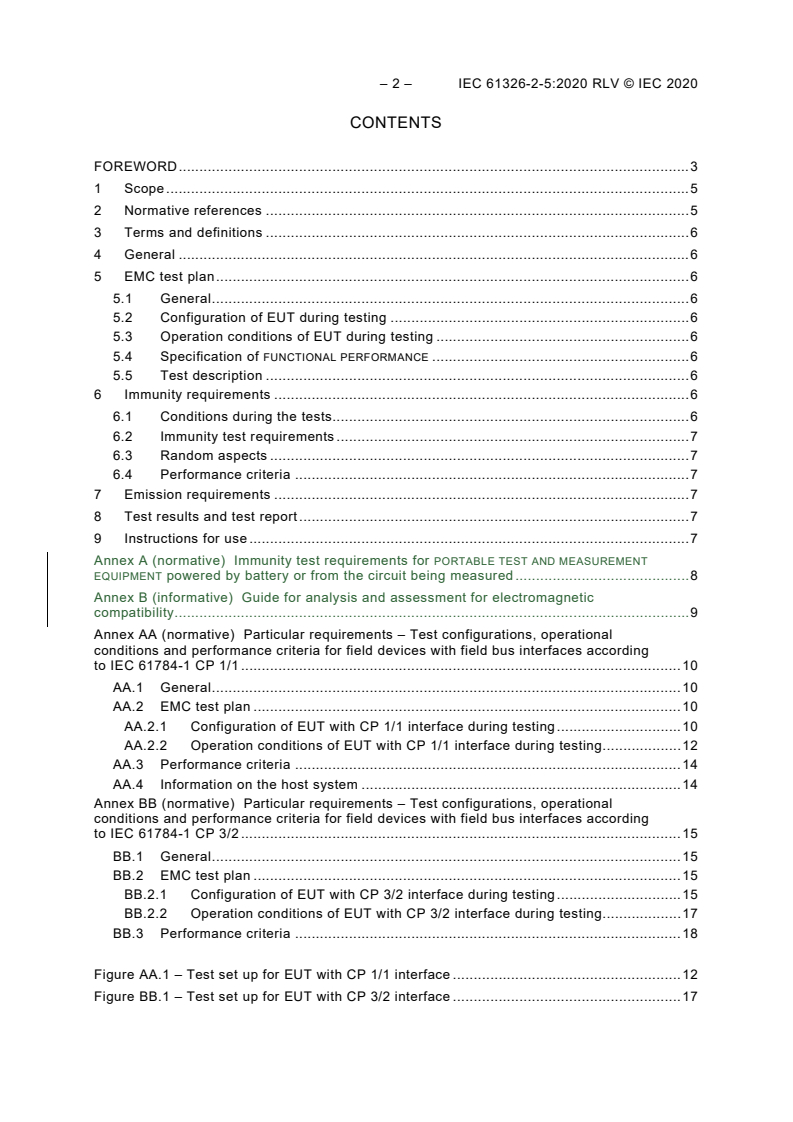
– 2 – IEC 61326-2-5:2020 RLV © IEC 2020
CONTENTS
FOREWORD . 3
1 Scope . 5
2 Normative references . 5
3 Terms and definitions . 6
4 General . 6
5 EMC test plan . 6
5.1 General . 6
5.2 Configuration of EUT during testing . 6
5.3 Operation conditions of EUT during testing . 6
5.4 Specification of FUNCTIONAL PERFORMANCE . 6
5.5 Test description . 6
6 Immunity requirements . 6
6.1 Conditions during the tests. 6
6.2 Immunity test requirements . 7
6.3 Random aspects . 7
6.4 Performance criteria . 7
7 Emission requirements . 7
8 Test results and test report . 7
9 Instructions for use . 7
Annex A (normative) Immunity test requirements for PORTABLE TEST AND MEASUREMENT
EQUIPMENT powered by battery or from the circuit being measured . 8
Annex B (informative) Guide for analysis and assessment for electromagnetic
compatibility. 9
Annex AA (normative) Particular requirements – Test configurations, operational
conditions and performance criteria for field devices with field bus interfaces according
to IEC 61784-1 CP 1/1 . 10
AA.1 General . 10
AA.2 EMC test plan . 10
AA.2.1 Configuration of EUT with CP 1/1 interface during testing . 10
AA.2.2 Operation conditions of EUT with CP 1/1 interface during testing . 12
AA.3 Performance criteria . 14
AA.4 Information on the host system . 14
Annex BB (normative) Particular requirements – Test configurations, operational
conditions and performance criteria for field devices with field bus interfaces according
to IEC 61784-1 CP 3/2 . 15
BB.1 General . 15
BB.2 EMC test plan . 15
BB.2.1 Configuration of EUT with CP 3/2 interface during testing . 15
BB.2.2 Operation conditions of EUT with CP 3/2 interface during testing . 17
BB.3 Performance criteria . 18
Figure AA.1 – Test set up for EUT with CP 1/1 interface . 12
Figure BB.1 – Test set up for EUT with CP 3/2 interface . 17
INTERNATIONAL ELECTROTECHNICAL COMMISSION
____________
ELECTRICAL EQUIPMENT FOR MEASUREMENT,
CONTROL AND LABORATORY USE –
EMC REQUIREMENTS –
Part 2-5: Particular requirements –
Test configurations, operational conditions and performance criteria
for field devices with field bus interfaces according to IEC 61784-1
FOREWORD
1) The International Electrotechnical Commission (IEC) is a worldwide organization for standardization comprising
all national electrotechnical committees (IEC National Committees). The object of IEC is to promote international
co-operation on all questions concerning standardization in the electrical and electronic fields. To this end and
in addition to other activities, IEC publishes International Standards, Technical Specifications, Technical Reports,
Publicly Available Specifications (PAS) and Guides (hereafter referred to as “IEC Publication(s)”). Their
preparation is entrusted to technical committees; any IEC National Committee interested in the subject dealt with
may participate in this preparatory work. International, governmental and non-governmental organizations liaising
with the IEC also participate in this preparation. IEC collaborates closely with the International Organization for
Standardization (ISO) in accordance with conditions determined by agreement between the two organizations.
2) The formal decisions or agreements of IEC on technical matters express, as nearly as possible, an international
consensus of opinion on the relevant subjects since each technical committee has representation from all
interested IEC National Committees.
3) IEC Publications have the form of recommendations for international use and are accepted by IEC National
Committees in that sense. While all reasonable efforts are made to ensure that the technical content of IEC
Publications is accurate, IEC cannot be held responsible for the way in which they are used or for any
misinterpretation by any end user.
4) In order to promote international uniformity, IEC National Committees undertake to apply IEC Publications
transparently to the maximum extent possible in their national and regional publications. Any divergence between
any IEC Publication and the corresponding national or regional publication shall be clearly indicated in the latter.
5) IEC itself does not provide any attestation of conformity. Independent certification bodies provide conformity
assessment services and, in some areas, access to IEC marks of conformity. IEC is not responsible for any
services carried out by independent certification bodies.
6) All users should ensure that they have the latest edition of this publication.
7) No liability shall attach to IEC or its directors, employees, servants or agents including individual experts and
members of its technical committees and IEC National Committees for any personal injury, property damage or
other damage of any nature whatsoever, whether direct or indirect, or for costs (including legal fees) and
expenses arising out of the publication, use of, or reliance upon, this IEC Publication or any other IEC
Publications.
8) Attention is drawn to the Normative references cited in this publication. Use of the referenced publications is
indispensable for the correct application of this publication.
9) Attention is drawn to the possibility that some of the elements of this IEC Publication may be the subject of patent
rights. IEC shall not be held responsible for identifying any or all such patent rights.
This redline version of the official IEC Standard allows the user to identify the changes
made to the previous edition. A vertical bar appears in the margin wherever a change has
been made. Additions are in green text, deletions are in strikethrough red text.
– 4 – IEC 61326-2-5:2020 RLV © IEC 2020
International Standard IEC 61326-2-5 has been prepared by subcommittee 65A: System
aspects, of IEC technical committee 65: Industrial-process measurement, control and
automation.
This third edition cancels and replaces the second edition published in 2012. This edition
constitutes a technical revision.
This edition includes the following significant technical change with respect to the previous
edition:
– update with respect to IEC 61326-1:2020.
The text of this International Standard is based on the following documents:
FDIS Report on voting
65A/978/FDIS 65A/989/RVD
Full information on the voting for the approval of this International Standard can be found in the
report on voting indicated in the above table.
This document has been drafted in accordance with the ISO/IEC Directives, Part 2.
This part of IEC 61326 series is to be used in conjunction with IEC 61326-1:2020 and follows
the same numbering of clauses, subclauses, tables and figures.
When a particular subclause of IEC 61326-1 is not mentioned in this part, that subclause applies
as far as is reasonable. When this standard states “addition”, “modification” or “replacement”,
the relevant text in IEC 61326-1 is to be adapted accordingly.
NOTE The following numbering system is used:
– subclauses, tables and figures that are numbered starting from 101 are additional to those in IEC 61326-1;
– unless notes are in a new subclause or involve notes in IEC 61326-1, they are numbered starting from 101
including those in a replaced clause or subclause;
– additional annexes are lettered AA, BB, etc.
A list of all parts of IEC 61326 series, under the general title Electrical equipment for
measurement, control and laboratory use – EMC requirements can be found on the IEC website.
The committee has decided that the contents of this document will remain unchanged until the
stability date indicated on the IEC website under "http://webstore.iec.ch" in the data related to
the specific document. At this date, the document will be
• reconfirmed,
• withdrawn,
• replaced by a revised edition, or
• amended.
IMPORTANT – The 'colour inside' logo on the cover page of this publication indicates
that it contains colours which are considered to be useful for the correct understanding
of its contents. Users should therefore print this document using a colour printer.
ELECTRICAL EQUIPMENT FOR MEASUREMENT,
CONTROL AND LABORATORY USE –
EMC REQUIREMENTS –
Part 2-5: Particular requirements –
Test configurations, operational conditions and performance criteria
for field devices with field bus interfaces according to IEC 61784-1
1 Scope
In addition to the requirements of IEC 61326-1, this part of IEC 61326 treats the particular
features for EMC testing of field devices with field bus interfaces. This part of IEC 61326 covers
only the field bus interface of the equipment.
NOTE The other functions of the equipment remain covered by other parts of IEC 61326 series.
This part refers only to field devices intended for use in process control and process measuring.
In this document, field devices with interfaces according to IEC 61784-1:2019, CP 3/2 and
CP 1/1 as defined in IEC 61784 are covered. Other field busses bus interfaces may be included
in future editions of this document.
IEC 61784-1:2019 specifies a set of protocol specific communication profiles based on
IEC 61158.
The manufacturer specifies the environment for which the product is intended to be used and/or
selects the appropriate test level specifications of IEC 61326-1.
2 Normative references
The following documents are referred to in the text in such a way that some or all of their content
constitutes requirements of this document. For dated references, only the edition cited applies.
For undated references, the latest edition of the referenced document (including any
amendments) applies.
Clause 2 of IEC 61326-1:2020 applies except as follows:
Addition:
IEC 61158-2:20102014, Industrial communication networks – Fieldbus specifications – Part 2:
Physical layer specification and service definition
IEC 61158-3-3:20072014, Industrial communication networks – Fieldbus specifications – Part
3-3: Data-link layer service definition – Type 3 elements
IEC 61158-5-5:20072014, Industrial communication networks – Fieldbus specifications – Part
5-5: Application layer service definition – Type 5 elements
IEC 61158-6-10:20102019, Industrial communication networks – Fieldbus specifications – Part
6-10: Application layer protocol specification – Type 10 elements
– 6 – IEC 61326-2-5:2020 RLV © IEC 2020
IEC 61326-1:2020, Electrical equipment for measurement, control and laboratory use – EMC
requirements – Part 1: General requirements
IEC 61784-1:20102019, Industrial communication networks – Profiles – Part 1: Fieldbus profiles
3 Terms and definitions
Clause 3 of IEC 61326-1:2020 applies.
ISO and IEC maintain terminological databases for use in standardization at the following
addresses:
• IEC Electropedia: available at http://www.electropedia.org/
• ISO Online browsing platform: available at http://www.iso.org/obp
4 General
Clause 4 of IEC 61326-1:2020 applies.
5 EMC test plan
5.1 General
Subclause 5.1 of IEC 61326-1:2020 applies.
5.2 Configuration of EUT during testing
Subclause 5.2 of IEC 61326-1:2020 applies, except as follows:
Addition:
Additional requirements: see Annex AA and Annex BB.
5.3 Operation conditions of EUT during testing
Subclause 5.3 of IEC 61326-1:2020 applies, except as follows:
Addition:
Additional requirements: see Annex AA and Annex BB.
5.4 Specification of FUNCTIONAL PERFORMANCE
Subclause 5.4 of IEC 61326-1:2020 applies.
5.5 Test description
Subclause 5.5 of IEC 61326-1:2020 applies.
6 Immunity requirements
6.1 Conditions during the tests
Subclause 6.1 of IEC 61326-1:2020 applies.
6.2 Immunity test requirements
Subclause 6.2 of IEC 61326-1:2020 applies.
6.3 Random aspects
Subclause 6.3 of IEC 61326-1:2020 applies.
6.4 Performance criteria
Subclause 6.4 of IEC 61326-1:2020 applies, except as follows:
Addition:
Additional requirements: see Annex AA and Annex BB.
7 Emission requirements
Clause 7 of IEC 61326-1:2020 applies.
8 Test results and test report
Clause 8 of IEC 61326-1:2020 applies, except as follows:
Addition:
The type of shield connection at the EUT shall be stated in the test report.
9 Instructions for use
Clause 9 of IEC 61326-1:2020 applies.
– 8 – IEC 61326-2-5:2020 RLV © IEC 2020
Annex A
(normative)
Immunity test requirements for PORTABLE TEST AND MEASUREMENT
EQUIPMENT powered by battery or from the circuit being measured
Annex A of IEC 61326-1:2020 does not apply.
Annex B
(informative)
Guide for analysis and assessment for electromagnetic compatibility
Annex B of IEC 61326-1:2020 applies.
Additional annexes:
– 10 – IEC 61326-2-5:2020 RLV © IEC 2020
Annex AA
(normative)
Particular requirements –
Test configurations, operational conditions and performance criteria
for field devices with field bus interfaces according
to IEC 61784-1 CP 1/1
AA.1 General
In connection with the main part of this document, this Annex AA describes specific test
configurations, operational conditions and performance criteria regarding the field bus interface
using the communication profile CP 1/1 according to IEC 61784-1:2019.
To prevent confusion with requirements of other annexes, the equipment under test (EUT) is
called “EUT with CP 1/1 interface” throughout this annex.
AA.2 EMC test plan
AA.2.1 Configuration of EUT with CP 1/1 interface during testing
Subclause 5.2 of IEC 61326-1:2020 applies, except as follows:
Addition:
AA.2.1.1 Test configuration for EUT with CP 1/1 interface
In order to assign any malfunction of the communication during the EMC-test to the EUT with
CP 1/1 interface, the configuration of field devices with interfaces according to
IEC 61784-1:2019, CP 1/1 shall be limited to the operation of one host system and one EUT
with CP 1/1 interface during EMC type tests.
Ports other than I/O ports covered by this part of the document are tested according to
IEC 61326-1:2020.
The connection plan is shown in Figure AA.1.
The field device is connected via a device coupler with the power conditioner and the host
system.
A standardised field bus terminator is attached at the third port of the device coupler.
The EUT with CP 1/1 interface, power conditioner, host system, device coupler(s) and
terminator are connected by means of a standard type A field bus cable (foil shield, foil
shield/mesh). Armoured cables or cables in conduit are not allowed for EMC testing.
Except for the connection at the EUT with CP 1/1 interface itself (see AA.2.1.3), the shield shall
be connected at any individual component by a low-impedance grounding strip (connection
between shield and the case with a large surface).
The individual cable lengths L1, L2, L3, L5 and L6 originate from a practice-adjusted set up,
preferred as given in Figure AA.1.
The cable length L4 should be 8 m ± 1 m, in case that the respective basic standards do not
specify other lengths. The cable installation shall be in accordance with the appropriate basic
standard.
The connection of the shield at the shield grounding point may be produced by partially
removing the insulation of the cable shield and fixing the cable shield with a metal clamp or by
means of conductive leading-in-conductors such as a metallic cable gland at the ground plane
or at the shielding metal wall respectively.
The location and execution of the shield grounding point depend on the given test facility, e.g.
by use of an anechoic chamber or a shielded cabin it is the metal wall penetration; and with
tests on tables with ground plane the shield grounding point is on the ground plane.
AA.2.1.2 Connection cable for EUT with CP 1/1 interface
A standard bus cable type A shall be used as communication cable (see IEC 61158-
2:20102014, 12.8.2). The cable lengths L1 to L4, are given in Figure AA.1 and additional
requirement for L4 is described in AA.2.1.1. The lengths of L5 and L6 are not specified and
depend on the installed equipment.
AA.2.1.3 Connections at the EUT with CP 1/1 interface
The grounding of the EUT with CP 1/1 interface shall be in accordance with the manufacturer’s
specification.
The shield of the cable shall be connected in the most sensitive method (for example with the
shield not connected at the EUT with CP 1/1 interface) if not otherwise specified by the
manufacturer.
NOTE If the manufacturer specifies the shield shall be connected at the EUT with CP 1/1 interface, the EUT with
CP 1/1 interface shall be tested in accordance with the manufacturer’s specification.
AA.2.1.4 Field bus network
The field bus network shall include the terminator of the bus, device coupler(s), the host system
and the EUT with CP 1/1 interface. For bus-powered devices, the field bus network includes
additionally the power conditioner and the power supply. The evaluation and conditioning of the
data in the host system are not the object of this part of the document. The device coupler(s)
and the bus terminator are passive components only.
– 12 – IEC 61326-2-5:2020 RLV © IEC 2020
Components Key
A host system 1 shield grounding point (SGP) of L4
B field device (EUT with CP 1/1 2 shield / housing connected with low
interface) impedance
C power conditioner (5 mH+50 Ω) 2a enclosure connected with low impedance
D EMC test place 3 cable from device coupler(s) to SGP
E1, E2 device coupler(s) 4 terminator, either direct at device coupler or
after a short cable (< 1 m)
T bus terminator 5 cable from SGP to field device
G power supply 6 connection of shield at field device (see
AA.2.1.3)
L1 8 m cable type A 7 A, C, G, E1 and T may be included in a single housing /
system / device
L2 2 m cable type A L3 2 m cable type A
L4 8 m cable type A (see AA.2.1.2) L5, L6 cable type A (see AA.2.1.2)
Figure AA.1 – Test set up for EUT with CP 1/1 interface
AA.2.2 Operation conditions of EUT with CP 1/1 interface during testing
Subclause 5.3 of IEC 61326-1:2020 applies, except as follows:
Addition:
AA.2.2.1 Operational conditions for EUT with CP 1/1 interface
a) The macrocycle of the field bus segment should be as short as possible to have as often as
possible communication on the bus and to have fast reaction of the system.
b) For a transmitter type device, there shall be a Publisher Subscriber communication
relationship for each process value and its status (e.g. output parameter of AI or DI) that
the EUT with CP 1/1 interface offers. The EUT with CP 1/1 interface has the role ‘Publisher’.
c) For a receiver type device there shall be:
– a Publisher Subscriber communication relationship for each setpoint/input value and its
status (e.g. input parameter of AO or DO) that the EUT with CP 1/1 interface accepts; in
this/these relationship(s) the EUT with CP 1/1 interface has the role ‘Subscriber’;
– and a Publisher Subscriber communication relationship for each output value and its
status (e.g. BKCAL_OUT/BKCAL_OUT_D) that the EUT with CP 1/1 interface offers; in
this/these relationship(s) the EUT with CP 1/1 interface has the role ‘Publisher’.
d) The “Stale Count Limit” has to be set to 2.
In cases where the “Stale count Limit” is not adjustable, the value (not equal to 2) shall be
stated in the test report.
e) The frequency of client-server communication has to shall be set to one service request
(e.g. read request) every other macrocycle.
AA.2.2.2 Status for EUT with CP 1/1 interface
The host system monitors the received data of the EUT with CP 1/1 interface. The received
data is of the data type QualifiedFloat32 or QualifiedUnsigned8 as defined in IEC 61158-5-
5:20072014, 5.3.3.12 respectively 5.3.3.13. Those data types are of the format STRUCTURE
and have a field named status.
For the automation system and the test evaluation, the quality in the status is significant.
In case of received data, only four qualities can appear (extract from IEC 61158-6-10:20102019,
5.1.1.3.2.2):
– "Good (Cascade)" means status is in the range between 192 and 255
– "Good (Non Cascade)" means status is in the range between 128 and 191
– "Uncertain" means status is in the range between 64 and 127
– "Bad" means status is in the range between 0 and 63
The equipment under test shall preferably be configured so that the value of the status is 128
or greater during normal operation without EMC disturbance.
Other values for the status are allowed if they enable the evaluation the function of the EUT
with CP 1/1 interface. However, values of the status indicating a disturbed communication shall
be avoided. If a status value deviating from 128 is chosen, the reasons for this decision have
to be reported in the test report.
AA.2.2.3 Monitoring for EUT with CP 1/1 interface
a) For transmitter type device:
The process value(s) and its status shall be monitored.
The requirements for pass / fail the EMC test with regard to the value(s) are given in the
specification of the manufacturer or in an appropriate part of IEC 61326 (all parts).
b) For receiver type device (Positioner, Displays):
The output value (e.g. BKCAL_OUT/BKCAL_OUT_D) and its status shall be monitored. For
devices like positioner or valves or displays, visual confirmation is required. The
requirements for pass / fail the EMC test with regard to the value(s) are given in the
specification of the manufacturer or in an appropriate part of IEC 61326 (all parts).
c) The number of consecutive non-responses of the client-server communications shall be
counted. Any count more than 2 consecutive non-responses shall be considered as a
communication failure.
– 14 – IEC 61326-2-5:2020 RLV © IEC 2020
d) Any overrun of the stale counter shall be considered as a failure.
AA.3 Performance criteria
Subclause 6.4 of IEC 61326-1:2020 applies, except as follows:
Performance criterion A is extended by the following:
Performance criteria criterion A
No communication failures are detected (see AA.2.2.3). The status value chosen according
to AA.2.2.2 shall remain unchanged during and after the test (see AA.2.2.2 and AA.2.2.3).
Performance criterion B is extended by the following:
Performance criteria criterion B
The status value (see AA.2.2.2 and AA.2.2.3) deviates during the test, but returns to normal
afterwards and/or communication failure is detected but after test the device returns with no
operator intervention to the expected operational state.
The status value (see AA.2.2.2 and AA.2.2.3) deviates during the test and/or communication
failure is detected. After test the device returns to the intended operational modes without
operator intervention.
Performance criterion C is extended by the following:
Performance criteria criterion C
The status value (see AA.2.2.2 and AA.2.2.3) deviates during the test, and/or
communication failures are detected, but. After test the device returns to the intended
operation mode only with operator intervention.
AA.4 Information on the host system
The host system includes the following functionality:
a) Configures the communication relationships as described in AA.2.2.1.
b) Monitors the communication, it detects / counts communication errors and violation of status
values as described in AA.2.2.3.
c) Initiates the communication in Client Server communication relationships.
d) Has the role of the LAS (Link Active Scheduler).
NOTE If the EUT with CP 1/1 interface is a transmitter type device, the host system needs to play the role of a
receiver type device (see AA.2.2.3 a)). If the EUT with CP 1/1 interface is a receiver type device, then the host
system needs to be the transmitter and also be able to monitor the output of the EUT with CP 1/1 interface (see
AA.2.2.3 b)).
Annex BB
(normative)
Particular requirements –
Test configurations, operational conditions and performance criteria
for field devices with field bus interfaces according
to IEC 61784-1 CP 3/2
BB.1 General
In connection with the main part of this document, this Annex BB describes specific test
configurations, operational conditions and performance criteria regarding the field bus interface
using the communication profile CP 3/2 according to IEC 61784-1.
To prevent confusion with requirements of other annexes, the equipment under test (EUT) is
called “EUT with CP 3/2 interface” throughout this annex.
BB.2 EMC test plan
BB.2.1 Configuration of EUT with CP 3/2 interface during testing
Subclause 5.2 of IEC 61326-1:2020 applies, except as follows:
Addition:
BB.2.1.1 Test configuration for EUT with CP 3/2 interface
In order to assign any malfunction of the communication during the EMC-test to the EUT with
CP 3/2 interface, the configuration of field devices with interfaces according to
IEC 61784-1:2019, CP 3/2 shall be limited to the operation of one master and one slave (EUT
with CP 3/2 interface) during EMC type tests.
Auxiliary connections for power supply or signalling are possible for the EUT with CP 3/2
interface.
The connection plan is shown in Figure BB.1.
The EUT with CP 3/2 interface is connected via a device coupler with the signal coupler. The
signal coupler is connected to the Automation system.
A standardised field bus terminator is attached at the third port of the field device coupler.
The components EUT with CP 3/2 interface, signal coupler, device coupler and terminator are
connected by standardised field bus cables.
The shield shall be connected at any individual component by a low-impedance grounding strip
(connection between shield and the case with a large surface).
The individual cable lengths L1, L2, L3 originate from a practice-adjusted set up, preferred as
given in Figure BB.1.
The cable length L4 should be 8 m ± 1 m, in case that the respective basic standards do not
specify other lengths. The cable installation shall be in accordance with the appropriate basic
standard.
– 16 – IEC 61326-2-5:2020 RLV © IEC 2020
The connection of the shield at the shield grounding point may be produced by partially
removing the isolation of the cable shield and fixing the cable shield with a metal clamp or by
means of conductive leading-in-conductors such as a metallic cable gland at the ground plane
or at the shielding metal wall respectively.
The location and execution of the shield grounding point depend on the given test facility, e.g.
by use of an anechoic chamber or a shielded cabin it is the metal wall penetration; and with
tests on tables with ground plane the shield grounding point is on the ground plane.
BB.2.1.2 Connection cable for EUT with CP 3/2 interface
A standard bus cable type A shall be used as communication cable (see IEC 61158-
2:20102014, 11.8.2). The cable lengths L1 to L3 are given in Figure BB.1 and L4 is described
in BB.2.1.1.
BB.2.1.3 Connections at the EUT with CP 3/2 interface
The grounding of the EUT with CP 3/2 interface and the shield connections shall be in
accordance with the manufacturer’s specification.
BB.2.1.4 Field bus network for EMC test for EUT with CP 3/2 interface
The field bus network includes the terminator of the bus, a device coupler, a signal coupler, the
automation system and the EUT with CP 3/2 interface.
The evaluation and conditioning of the data in the signal coupler and in the automation system
are not the object of this part of the document.
The device coupler and the bus terminator are passive components only.
Components Key
A automation system (master) 1 shield grounding point (SGP) of L4
B EUT with CP 3/2 interface (slave) 2 shield / housing connected with low impedance
C signal coupler 2a enclosure connected with low impedance
D EMC test place 3 connection (see BB.12.1.3)
E device coupler 4 terminator, either direct at device coupler or after a short
cable (< 1 m)
T bus terminator 5 cable from SGP to field device
L1 8 m cable type A 6 connection of shield at field device (see BB.2.1.3)
L2 2 m cable type A 7 A and C may be included in a single housing / system / device
L3 2 m cable type A L4 8 m cable type A (see BB.2.1.2)
L5 cable type A (see BB.2.1.2)
Figure BB.1 – Test set up for EUT with CP 3/2 interface
BB.2.2 Operation conditions of EUT with CP 3/2 interface during testing
Subclause 5.3 of IEC 61326-1:2020 applies, except as follows:
Addition:
BB.2.2.1 Operational conditions for EUT with CP 3/2 interface
The operating conditions describe the software settings at the EUT with CP 3/2 interface and
at the automation system. The master connected to the signal coupler is set as "master class
1", the EUT with CP 3/2 interface as "slave".
– 18 – IEC 61326-2-5:2020 RLV © IEC 2020
The cyclic operating mode shall be used.
The parameter "retry limit" shall be set to 2 at the master. This means after three consecutive
transmission errors (bus-line break down or slave not working), the master (automation system)
sets the status to "0".
The general bus parameters for the cyclic data exchange in IEC 61158-3-3:20072014,
5.5.2.3.3, Table 29 shall be taken into account.
BB.2.2.2 Status for EUT with CP 3/2 interface
The field bus controller in conjunction with the automation system monitors the received data
of the EUT with CP 3/2 interface. The received data is of the data type QualifiedFloat32 or
QualifiedUnsigned8 as defined in IEC 61158-5-5:20072014, 5.3.3.12 respectively 5.3.3.13.
Those data types are of the format STRUCTURE and have a field named status.
For the automation system and the test evaluation, the quality in the status is significant.
In case of received data, only four qualities can appear (extract from IEC 61158-6-10:2019,
5.1.1.3.2.2):
– "Good (Cascade)" means status is in the range between 192 and 255
– "Good (Non Cascade)" means status is in the range between 128 and 191
– "Uncertain" means status is in the range between 64 and 127
– "Bad" means status is in the range between 0 and 63
The equipment under test shall preferably be configured so that the value of the status is 128.
Other values for the status are allowed if they enable the evaluation the function of the EUT
with CP 3/2 interface. However, values of the status indicating a disturbed communication shall
be avoided. If a status value deviating from 128 is chosen, the reasons for this decision have
to be reported in the test report.
BB.2.2.3 Monitoring for EUT with CP 3/2 interface
a) The status shall be monitored.
b) The measuring value shall be monitored.
If the allowed tolerances are not specified in an appropriate part of this document, the values
specified by the manufacturer given in the user documentation may be used.
BB.3 Performance criteria
Subclause 6.4 of IEC 61326-1:2020 applies, except as follows:
Performance criterion A is extended by the following:
Performance criteria A
The status value as described in BB.2.2.2 shall remain unchanged during and after the test
(see BB.2.2.2 and BB.2.2.3).
Performance criterion B is extended by the following:
Performance criteria B
The status value (see BB.2.2.2 and BB.2.2.3) deviates during the test but returns to the
same status value as before the test without operator intervention.
Performance criterion C is extended by the following:
Performance criteria C
The status value (see BB.2.2.2 and BB.2.2.3) deviates during the test, but. After test, the
device only returns with operator intervention to the intended operation mode only with
operator intervention.
___________
IEC 61326-2-5 ®
Edition 3.0 2020-10
INTERNATIONAL
STANDARD
NORME
INTERNATIONALE
Electrical equipment for measurement, control and laboratory use –
EMC requirements –
Part 2-5: Particular requirements – Test configurations, operational conditions
and performance criteria for field devices with field bus interfaces according to
IEC 61784-1
Matériel électrique de mesure, de commande et de laboratoire –
Exigences relatives à la CEM –
Partie 2-5: Exigences particulières – Configurations d'essai, conditions de
fonctionnement et critères de performance pour les équipements de terrain avec
des interfaces utilisant des bus de terrain conformes à l’IEC 61784-1
– 2 – IEC 61326-2-5:2020 © IEC 2020
CONTENTS
FOREWORD . 3
1 Scope . 5
2 Normative references . 5
3 Terms and definitions . 6
4 General . 6
5 EMC test plan . 6
5.1 General . 6
5.2 Configuration of EUT during testing . 6
5.3 Operation conditions of EUT during testing . 6
5.4 Specification of FUNCTIONAL PERFORMANCE . 6
5.5 Test description . 6
6 Immunity requirements . 6
6.1 Conditions during the tests. 6
6.2 Immunity test requirements . 7
6.3 Random aspects . 7
6.4 Performance criteria . 7
7 Emission requirements . 7
8 Test results and test report . 7
9 Instructions for use . 7
Annex A (normative) Immunity test requirements for PORTABLE TEST AND MEASUREMENT
EQUIPMENT powered by battery or from the circuit being measured . 8
Annex B (informative) Guide for analysis and assessment for electromagnetic
compatibility. 9
Annex AA (normative) Particular requirements – Test configurations, operational
conditions and performance criteria for field devices with field bus interfaces according
to IEC 61784-1 CP 1/1 . 10
AA.1 General . 10
AA.2 EMC test plan . 10
AA.2.1 Configuration of EUT with CP 1/1 interface during testing . 10
AA.2.2 Operation conditions of EUT with CP 1/1 interface during testing . 12
AA.3 Performance criteria . 14
AA.4 Information on the host system . 14
Annex BB (normative) Particular requirements – Test configurations, operational
conditions and performance criteria for field devices with field bus interfaces according
to IEC 61784-1 CP 3/2 . 15
BB.1 General . 15
BB.2 EMC test plan .
...
IEC 61326-2-5 ®
Edition 3.0 2020-10
INTERNATIONAL
STANDARD
NORME
INTERNATIONALE
Electrical equipment for measurement, control and laboratory use –
EMC requirements –
Part 2-5: Particular requirements – Test configurations, operational conditions
and performance criteria for field devices with field bus interfaces according to
IEC 61784-1
Matériel électrique de mesure, de commande et de laboratoire –
Exigences relatives à la CEM –
Partie 2-5: Exigences particulières – Configurations d'essai, conditions de
fonctionnement et critères de performance pour les équipements de terrain avec
des interfaces utilisant des bus de terrain conformes à l’IEC 61784-1
All rights reserved. Unless otherwise specified, no part of this publication may be reproduced or utilized in any form
or by any means, electronic or mechanical, including photocopying and microfilm, without permission in writing from
either IEC or IEC's member National Committee in the country of the requester. If you have any questions about IEC
copyright or have an enquiry about obtaining additional rights to this publication, please contact the address below or
your local IEC member National Committee for further information.
Droits de reproduction réservés. Sauf indication contraire, aucune partie de cette publication ne peut être reproduite
ni utilisée sous quelque forme que ce soit et par aucun procédé, électronique ou mécanique, y compris la photocopie
et les microfilms, sans l'accord écrit de l'IEC ou du Comité national de l'IEC du pays du demandeur. Si vous avez des
questions sur le copyright de l'IEC ou si vous désirez obtenir des droits supplémentaires sur cette publication, utilisez
les coordonnées ci-après ou contactez le Comité national de l'IEC de votre pays de résidence.
IEC Central Office Tel.: +41 22 919 02 11
3, rue de Varembé info@iec.ch
CH-1211 Geneva 20 www.iec.ch
Switzerland
About the IEC
The International Electrotechnical Commission (IEC) is the leading global organization that prepares and publishes
International Standards for all electrical, electronic and related technologies.
About IEC publications
The technical content of IEC publications is kept under constant review by the IEC. Please make sure that you have the
latest edition, a corrigendum or an amendment might have been published.
IEC publications search - webstore.iec.ch/advsearchform Electropedia - www.electropedia.org
The advanced search enables to find IEC publications by a The world's leading online dictionary on electrotechnology,
variety of criteria (reference number, text, technical containing more than 22 000 terminological entries in English
committee,…). It also gives information on projects, replaced and French, with equivalent terms in 16 additional languages.
and withdrawn publications. Also known as the International Electrotechnical Vocabulary
(IEV) online.
IEC Just Published - webstore.iec.ch/justpublished
Stay up to date on all new IEC publications. Just Published IEC Glossary - std.iec.ch/glossary
details all new publications released. Available online and 67 000 electrotechnical terminology entries in English and
once a month by email. French extracted from the Terms and Definitions clause of
IEC publications issued since 2002. Some entries have been
IEC Customer Service Centre - webstore.iec.ch/csc collected from earlier publications of IEC TC 37, 77, 86 and
If you wish to give us your feedback on this publication or CISPR.
need further assistance, please contact the Customer Service
Centre: sales@iec.ch.
A propos de l'IEC
La Commission Electrotechnique Internationale (IEC) est la première organisation mondiale qui élabore et publie des
Normes internationales pour tout ce qui a trait à l'électricité, à l'électronique et aux technologies apparentées.
A propos des publications IEC
Le contenu technique des publications IEC est constamment revu. Veuillez vous assurer que vous possédez l’édition la
plus récente, un corrigendum ou amendement peut avoir été publié.
Recherche de publications IEC - Electropedia - www.electropedia.org
webstore.iec.ch/advsearchform Le premier dictionnaire d'électrotechnologie en ligne au
La recherche avancée permet de trouver des publications IEC monde, avec plus de 22 000 articles terminologiques en
en utilisant différents critères (numéro de référence, texte, anglais et en français, ainsi que les termes équivalents dans
comité d’études,…). Elle donne aussi des informations sur les 16 langues additionnelles. Egalement appelé Vocabulaire
projets et les publications remplacées ou retirées. Electrotechnique International (IEV) en ligne.
IEC Just Published - webstore.iec.ch/justpublished Glossaire IEC - std.iec.ch/glossary
Restez informé sur les nouvelles publications IEC. Just 67 000 entrées terminologiques électrotechniques, en anglais
Published détaille les nouvelles publications parues. et en français, extraites des articles Termes et Définitions des
Disponible en ligne et une fois par mois par email. publications IEC parues depuis 2002. Plus certaines entrées
antérieures extraites des publications des CE 37, 77, 86 et
Service Clients - webstore.iec.ch/csc CISPR de l'IEC.
Si vous désirez nous donner des commentaires sur cette
publication ou si vous avez des questions contactez-nous:
sales@iec.ch.
IEC 61326-2-5 ®
Edition 3.0 2020-10
INTERNATIONAL
STANDARD
NORME
INTERNATIONALE
Electrical equipment for measurement, control and laboratory use –
EMC requirements –
Part 2-5: Particular requirements – Test configurations, operational conditions
and performance criteria for field devices with field bus interfaces according to
IEC 61784-1
Matériel électrique de mesure, de commande et de laboratoire –
Exigences relatives à la CEM –
Partie 2-5: Exigences particulières – Configurations d'essai, conditions de
fonctionnement et critères de performance pour les équipements de terrain
avec des interfaces utilisant des bus de terrain conformes à l’IEC 61784-1
INTERNATIONAL
ELECTROTECHNICAL
COMMISSION
COMMISSION
ELECTROTECHNIQUE
INTERNATIONALE
ICS 17.220.20; 25.040.40; 33.100.20 ISBN 978-2-8322-8952-5
– 2 – IEC 61326-2-5:2020 © IEC 2020
CONTENTS
FOREWORD . 3
1 Scope . 5
2 Normative references . 5
3 Terms and definitions . 6
4 General . 6
5 EMC test plan . 6
5.1 General . 6
5.2 Configuration of EUT during testing . 6
5.3 Operation conditions of EUT during testing . 6
5.4 Specification of FUNCTIONAL PERFORMANCE . 6
5.5 Test description . 6
6 Immunity requirements . 6
6.1 Conditions during the tests. 6
6.2 Immunity test requirements . 7
6.3 Random aspects . 7
6.4 Performance criteria . 7
7 Emission requirements . 7
8 Test results and test report . 7
9 Instructions for use . 7
Annex A (normative) Immunity test requirements for PORTABLE TEST AND MEASUREMENT
EQUIPMENT powered by battery or from the circuit being measured . 8
Annex B (informative) Guide for analysis and assessment for electromagnetic
compatibility. 9
Annex AA (normative) Particular requirements – Test configurations, operational
conditions and performance criteria for field devices with field bus interfaces according
to IEC 61784-1 CP 1/1 . 10
AA.1 General . 10
AA.2 EMC test plan . 10
AA.2.1 Configuration of EUT with CP 1/1 interface during testing . 10
AA.2.2 Operation conditions of EUT with CP 1/1 interface during testing . 12
AA.3 Performance criteria . 14
AA.4 Information on the host system . 14
Annex BB (normative) Particular requirements – Test configurations, operational
conditions and performance criteria for field devices with field bus interfaces according
to IEC 61784-1 CP 3/2 . 15
BB.1 General . 15
BB.2 EMC test plan . 15
BB.2.1 Configuration of EUT with CP 3/2 interface during testing . 15
BB.2.2 Operation conditions of EUT with CP 3/2 interface during testing . 17
BB.3 Performance criteria . 18
Figure AA.1 – Test set up for EUT with CP 1/1 interface . 12
Figure BB.1 – Test set up for EUT with CP 3/2 interface . 17
INTERNATIONAL ELECTROTECHNICAL COMMISSION
____________
ELECTRICAL EQUIPMENT FOR MEASUREMENT,
CONTROL AND LABORATORY USE –
EMC REQUIREMENTS –
Part 2-5: Particular requirements –
Test configurations, operational conditions and performance criteria
for field devices with field bus interfaces according to IEC 61784-1
FOREWORD
1) The International Electrotechnical Commission (IEC) is a worldwide organization for standardization comprising
all national electrotechnical committees (IEC National Committees). The object of IEC is to promote international
co-operation on all questions concerning standardization in the electrical and electronic fields. To this end and
in addition to other activities, IEC publishes International Standards, Technical Specifications, Technical Reports,
Publicly Available Specifications (PAS) and Guides (hereafter referred to as “IEC Publication(s)”). Their
preparation is entrusted to technical committees; any IEC National Committee interested in the subject dealt with
may participate in this preparatory work. International, governmental and non-governmental organizations liaising
with the IEC also participate in this preparation. IEC collaborates closely with the International Organization for
Standardization (ISO) in accordance with conditions determined by agreement between the two organizations.
2) The formal decisions or agreements of IEC on technical matters express, as nearly as possible, an international
consensus of opinion on the relevant subjects since each technical committee has representation from all
interested IEC National Committees.
3) IEC Publications have the form of recommendations for international use and are accepted by IEC National
Committees in that sense. While all reasonable efforts are made to ensure that the technical content of IEC
Publications is accurate, IEC cannot be held responsible for the way in which they are used or for any
misinterpretation by any end user.
4) In order to promote international uniformity, IEC National Committees undertake to apply IEC Publications
transparently to the maximum extent possible in their national and regional publications. Any divergence between
any IEC Publication and the corresponding national or regional publication shall be clearly indicated in the latter.
5) IEC itself does not provide any attestation of conformity. Independent certification bodies provide conformity
assessment services and, in some areas, access to IEC marks of conformity. IEC is not responsible for any
services carried out by independent certification bodies.
6) All users should ensure that they have the latest edition of this publication.
7) No liability shall attach to IEC or its directors, employees, servants or agents including individual experts and
members of its technical committees and IEC National Committees for any personal injury, property damage or
other damage of any nature whatsoever, whether direct or indirect, or for costs (including legal fees) and
expenses arising out of the publication, use of, or reliance upon, this IEC Publication or any other IEC
Publications.
8) Attention is drawn to the Normative references cited in this publication. Use of the referenced publications is
indispensable for the correct application of this publication.
9) Attention is drawn to the possibility that some of the elements of this IEC Publication may be the subject of patent
rights. IEC shall not be held responsible for identifying any or all such patent rights.
International Standard IEC 61326-2-5 has been prepared by subcommittee 65A: System
aspects, of IEC technical committee 65: Industrial-process measurement, control and
automation.
This third edition cancels and replaces the second edition published in 2012. This edition
constitutes a technical revision.
This edition includes the following significant technical change with respect to the previous
edition:
– update with respect to IEC 61326-1:2020.
– 4 – IEC 61326-2-5:2020 © IEC 2020
The text of this International Standard is based on the following documents:
FDIS Report on voting
65A/978/FDIS 65A/989/RVD
Full information on the voting for the approval of this International Standard can be found in the
report on voting indicated in the above table.
This document has been drafted in accordance with the ISO/IEC Directives, Part 2.
This part of IEC 61326 series is to be used in conjunction with IEC 61326-1:2020 and follows
the same numbering of clauses, subclauses, tables and figures.
When a particular subclause of IEC 61326-1 is not mentioned in this part, that subclause applies
as far as is reasonable. When this standard states “addition”, “modification” or “replacement”,
the relevant text in IEC 61326-1 is to be adapted accordingly.
NOTE The following numbering system is used:
– subclauses, tables and figures that are numbered starting from 101 are additional to those in IEC 61326-1;
– unless notes are in a new subclause or involve notes in IEC 61326-1, they are numbered starting from 101
including those in a replaced clause or subclause;
– additional annexes are lettered AA, BB, etc.
A list of all parts of IEC 61326 series, under the general title Electrical equipment for
measurement, control and laboratory use – EMC requirements can be found on the IEC website.
The committee has decided that the contents of this document will remain unchanged until the
stability date indicated on the IEC website under "http://webstore.iec.ch" in the data related to
the specific document. At this date, the document will be
• reconfirmed,
• withdrawn,
• replaced by a revised edition, or
• amended.
ELECTRICAL EQUIPMENT FOR MEASUREMENT,
CONTROL AND LABORATORY USE –
EMC REQUIREMENTS –
Part 2-5: Particular requirements –
Test configurations, operational conditions and performance criteria
for field devices with field bus interfaces according to IEC 61784-1
1 Scope
In addition to the requirements of IEC 61326-1, this part of IEC 61326 treats the particular
features for EMC testing of field devices with field bus interfaces. This part of IEC 61326 covers
only the field bus interface of the equipment.
NOTE The other functions of the equipment remain covered by other parts of IEC 61326 series.
This part refers only to field devices intended for use in process control and process measuring.
In this document, field devices with interfaces according to IEC 61784-1:2019, CP 3/2 and
CP 1/1 as defined in IEC 61784 are covered. Other field bus interfaces may be included in
future editions of this document.
IEC 61784-1:2019 specifies a set of protocol specific communication profiles based on
IEC 61158.
The manufacturer specifies the environment for which the product is intended to be used and/or
selects the appropriate test level specifications of IEC 61326-1.
2 Normative references
The following documents are referred to in the text in such a way that some or all of their content
constitutes requirements of this document. For dated references, only the edition cited applies.
For undated references, the latest edition of the referenced document (including any
amendments) applies.
Clause 2 of IEC 61326-1:2020 applies except as follows:
Addition:
IEC 61158-2:2014, Industrial communication networks – Fieldbus specifications – Part 2:
Physical layer specification and service definition
IEC 61158-3-3:2014, Industrial communication networks – Fieldbus specifications – Part 3-3:
Data-link layer service definition – Type 3 elements
IEC 61158-5-5:2014, Industrial communication networks – Fieldbus specifications – Part 5-5:
Application layer service definition – Type 5 elements
IEC 61158-6-10:2019, Industrial communication networks – Fieldbus specifications – Part 6-10:
Application layer protocol specification – Type 10 elements
– 6 – IEC 61326-2-5:2020 © IEC 2020
IEC 61326-1:2020, Electrical equipment for measurement, control and laboratory use – EMC
requirements – Part 1: General requirements
IEC 61784-1:2019, Industrial communication networks – Profiles – Part 1: Fieldbus profiles
3 Terms and definitions
Clause 3 of IEC 61326-1:2020 applies.
ISO and IEC maintain terminological databases for use in standardization at the following
addresses:
• IEC Electropedia: available at http://www.electropedia.org/
• ISO Online browsing platform: available at http://www.iso.org/obp
4 General
Clause 4 of IEC 61326-1:2020 applies.
5 EMC test plan
5.1 General
Subclause 5.1 of IEC 61326-1:2020 applies.
5.2 Configuration of EUT during testing
Subclause 5.2 of IEC 61326-1:2020 applies, except as follows:
Addition:
Additional requirements: see Annex AA and Annex BB.
5.3 Operation conditions of EUT during testing
Subclause 5.3 of IEC 61326-1:2020 applies, except as follows:
Addition:
Additional requirements: see Annex AA and Annex BB.
5.4 Specification of FUNCTIONAL PERFORMANCE
Subclause 5.4 of IEC 61326-1:2020 applies.
5.5 Test description
Subclause 5.5 of IEC 61326-1:2020 applies.
6 Immunity requirements
6.1 Conditions during the tests
Subclause 6.1 of IEC 61326-1:2020 applies.
6.2 Immunity test requirements
Subclause 6.2 of IEC 61326-1:2020 applies.
6.3 Random aspects
Subclause 6.3 of IEC 61326-1:2020 applies.
6.4 Performance criteria
Subclause 6.4 of IEC 61326-1:2020 applies, except as follows:
Addition:
Additional requirements: see Annex AA and Annex BB.
7 Emission requirements
Clause 7 of IEC 61326-1:2020 applies.
8 Test results and test report
Clause 8 of IEC 61326-1:2020 applies, except as follows:
Addition:
The type of shield connection at the EUT shall be stated in the test report.
9 Instructions for use
Clause 9 of IEC 61326-1:2020 applies.
– 8 – IEC 61326-2-5:2020 © IEC 2020
Annex A
(normative)
Immunity test requirements for PORTABLE TEST AND MEASUREMENT
EQUIPMENT powered by battery or from the circuit being measured
Annex A of IEC 61326-1:2020 does not apply.
Annex B
(informative)
Guide for analysis and assessment for electromagnetic compatibility
Annex B of IEC 61326-1:2020 applies.
Additional annexes:
– 10 – IEC 61326-2-5:2020 © IEC 2020
Annex AA
(normative)
Particular requirements –
Test configurations, operational conditions and performance criteria for
field devices with field bus interfaces according to IEC 61784-1 CP 1/1
AA.1 General
In connection with the main part of this document, this Annex AA describes specific test
configurations, operational conditions and performance criteria regarding the field bus interface
using the communication profile CP 1/1 according to IEC 61784-1:2019.
To prevent confusion with requirements of other annexes, the equipment under test (EUT) is
called “EUT with CP 1/1 interface” throughout this annex.
AA.2 EMC test plan
AA.2.1 Configuration of EUT with CP 1/1 interface during testing
Subclause 5.2 of IEC 61326-1:2020 applies, except as follows:
Addition:
AA.2.1.1 Test configuration for EUT with CP 1/1 interface
In order to assign any malfunction of the communication during the EMC-test to the EUT with
CP 1/1 interface, the configuration of field devices with interfaces according to
IEC 61784-1:2019, CP 1/1 shall be limited to the operation of one host system and one EUT
with CP 1/1 interface during EMC type tests.
Ports other than I/O ports covered by this part of the document are tested according to
IEC 61326-1:2020.
The connection plan is shown in Figure AA.1.
The field device is connected via a device coupler with the power conditioner and the host
system.
A standardised field bus terminator is attached at the third port of the device coupler.
The EUT with CP 1/1 interface, power conditioner, host system, device coupler(s) and
terminator are connected by means of a standard type A field bus cable (foil shield, foil
shield/mesh). Armoured cables or cables in conduit are not allowed for EMC testing.
Except for the connection at the EUT with CP 1/1 interface itself (see AA.2.1.3), the shield shall
be connected at any individual component by a low-impedance grounding strip (connection
between shield and the case with a large surface).
The individual cable lengths L1, L2, L3, L5 and L6 originate from a practice-adjusted set up,
preferred as given in Figure AA.1.
The cable length L4 should be 8 m ± 1 m, in case that the respective basic standards do not
specify other lengths. The cable installation shall be in accordance with the appropriate basic
standard.
The connection of the shield at the shield grounding point may be produced by partially
removing the insulation of the cable shield and fixing the cable shield with a metal clamp or by
means of conductive leading-in-conductors such as a metallic cable gland at the ground plane
or at the shielding metal wall respectively.
The location and execution of the shield grounding point depend on the given test facility, e.g.
by use of an anechoic chamber or a shielded cabin it is the metal wall penetration; and with
tests on tables with ground plane the shield grounding point is on the ground plane.
AA.2.1.2 Connection cable for EUT with CP 1/1 interface
A standard bus cable type A shall be used as communication cable (see IEC 61158-2:2014,
12.8.2). The cable lengths L1 to L4, are given in Figure AA.1 and additional requirement for L4
is described in AA.2.1.1. The lengths of L5 and L6 are not specified and depend on the installed
equipment.
AA.2.1.3 Connections at the EUT with CP 1/1 interface
The grounding of the EUT with CP 1/1 interface shall be in accordance with the manufacturer’s
specification.
The shield of the cable shall be connected in the most sensitive method (for example with the
shield not connected at the EUT with CP 1/1 interface) if not otherwise specified by the
manufacturer.
AA.2.1.4 Field bus network
The field bus network shall include the terminator of the bus, device coupler(s), the host system
and the EUT with CP 1/1 interface. For bus-powered devices, the field bus network includes
additionally the power conditioner and the power supply. The evaluation and conditioning of the
data in the host system are not the object of this part of the document. The device coupler(s)
and the bus terminator are passive components only.
– 12 – IEC 61326-2-5:2020 © IEC 2020
Components Key
A host system 1 shield grounding point (SGP) of L4
B field device (EUT with CP 1/1 2 shield / housing connected with low
interface) impedance
C power conditioner (5 mH+50 Ω) 2a enclosure connected with low impedance
D EMC test place 3 cable from device coupler(s) to SGP
E1, E2 device coupler(s) 4 terminator, either direct at device coupler or
after a short cable (< 1 m)
T bus terminator 5 cable from SGP to field device
G power supply 6 connection of shield at field device (see
AA.2.1.3)
L1 8 m cable type A 7 A, C, G, E1 and T may be included in a single housing /
system / device
L2 2 m cable type A L3 2 m cable type A
L4 8 m cable type A (see AA.2.1.2) L5, L6 cable type A (see AA.2.1.2)
Figure AA.1 – Test set up for EUT with CP 1/1 interface
AA.2.2 Operation conditions of EUT with CP 1/1 interface during testing
Subclause 5.3 of IEC 61326-1:2020 applies, except as follows:
Addition:
AA.2.2.1 Operational conditions for EUT with CP 1/1 interface
a) The macrocycle of the field bus segment should be as short as possible to have as often as
possible communication on the bus and to have fast reaction of the system.
b) For a transmitter type device, there shall be a Publisher Subscriber communication
relationship for each process value and its status (e.g. output parameter of AI or DI) that
the EUT with CP 1/1 interface offers. The EUT with CP 1/1 interface has the role ‘Publisher’.
c) For a receiver type device there shall be:
– a Publisher Subscriber communication relationship for each setpoint/input value and its
status (e.g. input parameter of AO or DO) that the EUT with CP 1/1 interface accepts; in
this/these relationship(s) the EUT with CP 1/1 interface has the role ‘Subscriber’;
– and a Publisher Subscriber communication relationship for each output value and its
status (e.g. BKCAL_OUT/BKCAL_OUT_D) that the EUT with CP 1/1 interface offers; in
this/these relationship(s) the EUT with CP 1/1 interface has the role ‘Publisher’.
d) The “Stale Count Limit” has to be set to 2.
In cases where the “Stale count Limit” is not adjustable, the value (not equal to 2) shall be
stated in the test report.
e) The frequency of client-server communication shall be set to one service request (e.g. read
request) every other macrocycle.
AA.2.2.2 Status for EUT with CP 1/1 interface
The host system monitors the received data of the EUT with CP 1/1 interface. The received
data is of the data type QualifiedFloat32 or QualifiedUnsigned8 as defined in IEC 61158-5-
5:2014, 5.3.3.12 respectively 5.3.3.13. Those data types are of the format STRUCTURE and
have a field named status.
For the automation system and the test evaluation, the quality in the status is significant.
In case of received data, only four qualities can appear (extract from IEC 61158-6-10:2019):
– "Good (Cascade)" means status is in the range between 192 and 255
– "Good (Non Cascade)" means status is in the range between 128 and 191
– "Uncertain" means status is in the range between 64 and 127
– "Bad" means status is in the range between 0 and 63
The equipment under test shall preferably be configured so that the value of the status is 128
or greater during normal operation without EMC disturbance.
Other values for the status are allowed if they enable the evaluation the function of the EUT
with CP 1/1 interface. However, values of the status indicating a disturbed communication shall
be avoided. If a status value deviating from 128 is chosen, the reasons for this decision have
to be reported in the test report.
AA.2.2.3 Monitoring for EUT with CP 1/1 interface
a) For transmitter type device:
The process value(s) and its status shall be monitored.
The requirements for pass / fail the EMC test with regard to the value(s) are given in the
specification or in an appropriate part of IEC 61326 (all parts).
b) For receiver type device (Positioner, Displays):
The output value (e.g. BKCAL_OUT/BKCAL_OUT_D) and its status shall be monitored. For
devices like positioner or valves or displays, visual confirmation is required. The
requirements for pass / fail the EMC test with regard to the value(s) are given in the
specification or in an appropriate part of IEC 61326 (all parts).
c) The number of consecutive non-responses of the client-server communications shall be
counted. Any count more than 2 consecutive non-responses shall be considered as a
communication failure.
d) Any overrun of the stale counter shall be considered as a failure.
– 14 – IEC 61326-2-5:2020 © IEC 2020
AA.3 Performance criteria
Subclause 6.4 of IEC 61326-1:2020 applies, except as follows:
Performance criterion A is extended by the following:
Performance criterion A
No communication failures are detected (see AA.2.2.3). The status value chosen according
to AA.2.2.2 shall remain unchanged during and after the test (see AA.2.2.2 and AA.2.2.3).
Performance criterion B is extended by the following:
Performance criterion B
The status value (see AA.2.2.2 and AA.2.2.3) deviates during the test and/or communication
failure is detected. After test the device returns to the intended operational modes without
operator intervention.
Performance criterion C is extended by the following:
Performance criterion C
The status value (see AA.2.2.2 and AA.2.2.3) deviates during the test, and/or
communication failures are detected. After test the device returns to the intended operation
mode only with operator intervention.
AA.4 Information on the host system
The host system includes the following functionality:
a) Configures the communication relationships as described in AA.2.2.1.
b) Monitors the communication, it detects / counts communication errors and violation of status
values as described in AA.2.2.3.
c) Initiates the communication in Client Server communication relationships.
d) Has the role of the LAS (Link Active Scheduler).
NOTE If the EUT with CP 1/1 interface is a transmitter type device, the host system needs to play the role of a
receiver type device (see AA.2.2.3 a)). If the EUT with CP 1/1 interface is a receiver type device, then the host
system needs to be the transmitter and also be able to monitor the output of the EUT with CP 1/1 interface (see
AA.2.2.3 b)).
Annex BB
(normative)
Particular requirements –
Test configurations, operational conditions and performance criteria for
field devices with field bus interfaces according to IEC 61784-1 CP 3/2
BB.1 General
In connection with the main part of this document, this Annex BB describes specific test
configurations, operational conditions and performance criteria regarding the field bus interface
using the communication profile CP 3/2 according to IEC 61784-1.
To prevent confusion with requirements of other annexes, the equipment under test (EUT) is
called “EUT with CP 3/2 interface” throughout this annex.
BB.2 EMC test plan
BB.2.1 Configuration of EUT with CP 3/2 interface during testing
Subclause 5.2 of IEC 61326-1:2020 applies, except as follows:
Addition:
BB.2.1.1 Test configuration for EUT with CP 3/2 interface
In order to assign any malfunction of the communication during the EMC-test to the EUT with
CP 3/2 interface, the configuration of field devices with interfaces according to
IEC 61784-1:2019, CP 3/2 shall be limited to the operation of one master and one slave (EUT
with CP 3/2 interface) during EMC type tests.
Auxiliary connections for power supply or signalling are possible for the EUT with CP 3/2
interface.
The connection plan is shown in Figure BB.1.
The EUT with CP 3/2 interface is connected via a device coupler with the signal coupler. The
signal coupler is connected to the Automation system.
A standardised field bus terminator is attached at the third port of the field device coupler.
The components EUT with CP 3/2 interface, signal coupler, device coupler and terminator are
connected by standardised field bus cables.
The shield shall be connected at any individual component by a low-impedance grounding strip
(connection between shield and the case with a large surface).
The individual cable lengths L1, L2, L3 originate from a practice-adjusted set up, preferred as
given in Figure BB.1.
The cable length L4 should be 8 m ± 1 m, in case that the respective basic standards do not
specify other lengths. The cable installation shall be in accordance with the appropriate basic
standard.
– 16 – IEC 61326-2-5:2020 © IEC 2020
The connection of the shield at the shield grounding point may be produced by partially
removing the isolation of the cable shield and fixing the cable shield with a metal clamp or by
means of conductive leading-in-conductors such as a metallic cable gland at the ground plane
or at the shielding metal wall respectively.
The location and execution of the shield grounding point depend on the given test facility, e.g.
by use of an anechoic chamber or a shielded cabin it is the metal wall penetration; and with
tests on tables with ground plane the shield grounding point is on the ground plane.
BB.2.1.2 Connection cable for EUT with CP 3/2 interface
A standard bus cable type A shall be used as communication cable (see IEC 61158-2:2014,
11.8.2). The cable lengths L1 to L3 are given in Figure BB.1 and L4 is described in BB.2.1.1.
BB.2.1.3 Connections at the EUT with CP 3/2 interface
The grounding of the EUT with CP 3/2 interface and the shield connections shall be in
accordance with the manufacturer’s specification.
BB.2.1.4 Field bus network for EMC test for EUT with CP 3/2 interface
The field bus network includes the terminator of the bus, a device coupler, a signal coupler, the
automation system and the EUT with CP 3/2 interface.
The evaluation and conditioning of the data in the signal coupler and in the automation system
are not the object of this part of the document.
The device coupler and the bus terminator are passive components only.
Components Key
A automation system (master) 1 shield grounding point (SGP) of L4
B EUT with CP 3/2 interface (slave) 2 shield / housing connected with low impedance
C signal coupler 2a enclosure connected with low impedance
D EMC test place 3 connection (see BB.2.1.3)
E device coupler 4 terminator, either direct at device coupler or after a short
cable (< 1 m)
T bus terminator 5 cable from SGP to field device
L1 8 m cable type A 6 connection of shield at field device (see BB.2.1.3)
L2 2 m cable type A 7 A and C may be included in a single housing / system / device
L3 2 m cable type A L4 8 m cable type A (see BB.2.1.2)
L5 cable type A (see BB.2.1.2)
Figure BB.1 – Test set up for EUT with CP 3/2 interface
BB.2.2 Operation conditions of EUT with CP 3/2 interface during testing
Subclause 5.3 of IEC 61326-1:2020 applies, except as follows:
Addition:
BB.2.2.1 Operational conditions for EUT with CP 3/2 interface
The operating conditions describe the software settings at the EUT with CP 3/2 interface and
at the automation system. The master connected to the signal coupler is set as "master class
1", the EUT with CP 3/2 interface as "slave".
– 18 – IEC 61326-2-5:2020 © IEC 2020
The cyclic operating mode shall be used.
The parameter "retry limit" shall be set to 2 at the master. This means after three consecutive
transmission errors (bus-line break down or slave not working), the master (automation system)
sets the status to "0".
The general bus parameters for the cyclic data exchange in IEC 61158-3-3:2014, 5.5.2.3.3,
Table 29 shall be taken into account.
BB.2.2.2 Status for EUT with CP 3/2 interface
The field bus controller in conjunction with the automation system monitors the received data
of the EUT with CP 3/2 interface. The received data is of the data type QualifiedFloat32 or
QualifiedUnsigned8 as defined in IEC 61158-5-5:2014, 5.3.3.12 respectively 5.3.3.13. Those
data types are of the format STRUCTURE and have a field named status.
For the automation system and the test evaluation, the quality in the status is significant.
In case of received data, only four qualities can appear (extract from IEC 61158-6-10:2019):
– "Good (Cascade)" means status is in the range between 192 and 255
– "Good (Non Cascade)" means status is in the range between 128 and 191
– "Uncertain" means status is in the range between 64 and 127
– "Bad" means status is in the range between 0 and 63
The equipment under test shall preferably be configured so that the value of the status is 128.
Other values for the status are allowed if they enable the evaluation the function of the EUT
with CP 3/2 interface. However, values of the status indicating a disturbed communication shall
be avoided. If a status value deviating from 128 is chosen, the reasons for this decision have
to be reported in the test report.
BB.2.2.3 Monitoring for EUT with CP 3/2 interface
a) The status shall be monitored.
b) The measuring value shall be monitored.
If the allowed tolerances are not specified in an appropriate part of this document, the values
given in the user documentation may be used.
BB.3 Performance criteria
Subclause 6.4 of IEC 61326-1:2020 applies, except as follows:
Performance criterion A is extended by the following:
Performance criteria A
The status value as described in BB.2.2.2 shall remain unchanged during and after the test
(see BB.2.2.2 and BB.2.2.3).
Performance criterion B is extended by the following:
Performance criteria B
The status value (see BB.2.2.2 and BB.2.2.3) deviates during the test but returns to the
same status value as before the test without operator intervention.
Performance criterion C is extended by the following:
Performance criteria C
The status value (see BB.2.2.2 and BB.2.2.3) deviates during the test. After test, the device
returns to the intended operation mode only with operator intervention.
___________
– 20 – IEC 61326-2-5:2020 © IEC 2020
SOMMAIRE
AVANT-PROPOS . 21
1 Domaine d’application . 23
2 Références normatives . 23
3 Termes et définitions . 24
4 Généralités . 24
5 Plan d’essai de CEM . 24
5.1 Généralités . 24
5.2 Configuration de l'EST lors des essais . 24
5.3 Conditions de fonctionnement de l'EST lors des essais . 24
5.4 Spécification des PERFORMANCES FONCTIONNELLES . 24
5.5 Description de l’essai . 24
6 Exigences relatives à l'immunité . 25
6.1 Conditions lors des essais . 25
6.2 Exigences pour les essais d’immunité . 25
6.3 Aspects aléatoires . 25
6.4 Critères de performance . 25
7 Exigences relatives à l'émission . 25
8 Résultats d’essai et rapport d’essai . 25
9 Instructions d’utilisation . 25
Annexe A (normative) Exigences concernant les essais d’immunité pour le MATERIEL
D’ESSAI ET DE MESURE PORTABLE alimenté par batterie ou par le circuit mesuré . 26
Annexe B (informative) Guide destiné à l’analyse et à l’évaluation de la compatibilité
électromagnétique . 27
Annexe AA (normative) Exigences particulières – Configurations d’essai, conditions
de fonctionnement et critères de performance pour les équipements de terrain utilisant
des interfaces de bus de terrain conformes à l’IEC 61784-1 CP 1/1 . 28
AA.1 Généralités . 28
AA.2 Plan d'essai de CEM .
...