

IEC 60794-2-24:2024
(Main)Optical fibre cables - Part 2-24: Indoor cables - Detail specification for multiple multi-fibre unit cables for use in MPO connector terminated breakout cable assemblies
General Information
- Abstract
IEC 60794-2-24:2024 is a detail specification and specifies indoor multiple multi-fibre unit cables for use in MPO (multi-fibre push on) connector terminated breakout cable assemblies.
- Status
- Published
- Publication Date
- 25-Jan-2024
- Technical Committee
- SC 86A - Fibres and cables
- Current Stage
- PPUB - Publication issued
- Start Date
- 26-Jan-2024
- Completion Date
- 02-Feb-2024
Buy Documents
IEC 60794-2-24:2024 - Optical fibre cables - Part 2-24: Indoor cables - Detail specification for multiple multi-fibre unit cables for use in MPO connector terminated breakout cable assemblies Released:1/26/2024
Overview
IEC 60794-2-24:2024 is an international standard published by the International Electrotechnical Commission (IEC) that defines detailed specifications for indoor optical fibre cables. Specifically, it covers multiple multi-fibre unit cables designed for use in MPO (Multi-fibre Push On) connector terminated breakout cable assemblies. This standard provides precise guidelines on the construction, testing, performance, and marking of these cables to ensure consistent quality and compatibility in high-density indoor fibre optic networks.
By addressing the needs of MPO breakout cable assemblies, IEC 60794-2-24:2024 helps manufacturers and network designers deliver reliable, scalable solutions that optimize indoor fibre infrastructure for data centers, enterprise networks, and other high-performance applications.
Key Topics
Scope and Application
Defines the scope focused on indoor environments, detailing multiple multi-fibre units for use with MPO connectors in breakout assemblies.Cable Construction
Specifies components including optical fibres, multi-fibre unit design, stranded cores, strength and anti-buckling members, ripcords, and cable sheaths, emphasizing robust yet flexible assemblies for indoor use.Mechanical and Environmental Testing
Includes requirements for dimensions, impact resistance, bending (including repeated bending), torsion, abrasion resistance of cable markings, and temperature cycling to guarantee durability under various operational and environmental conditions.Transmission Requirements
Addresses optical performance criteria, including attenuation and transmittance stability, ensuring high data integrity and minimal signal loss in fibre optic systems.Fire Performance
Sets fire safety standards vital for indoor cables, helping comply with building codes and safety regulations.Normative References
Links to related IEC fibre optic standards (e.g., IEC 60793 series for optical fibres, IEC 60794-1 series for generic cable specifications) that complement this document’s requirements.
Applications
This standard is essential for organizations involved in the design, manufacture, testing, and deployment of fibre optic cabling within buildings and other indoor infrastructures. Typical practical applications include:
Data Centers
Facilitates high-density, high-performance optical backbone and horizontal cabling assemblies using MPO connectors for scalable network growth.Telecommunications Facilities
Ensures compliant indoor fibre cables for structured cabling systems that support high bandwidth and reliability.Enterprise Networks
Used in offices and corporate environments for optical breakout cables that enable efficient space use and simplified connection architectures.Broadcast and Media Installations
Delivers reliable fibre assemblies for high-speed data transport in indoor production environments.
By following IEC 60794-2-24:2024, manufacturers can standardize breakout cable constructions, helping integrators deploy robust and future-proof fibre optic cabling solutions.
Related Standards
For comprehensive fibre optic cable design and testing, IEC 60794-2-24:2024 is used alongside several related standards:
- IEC 60794-1 Series: Generic specifications and test methods for optical fibre cables.
- IEC 60793 Series: Product specifications and measurement methods for various types of optical fibres.
- IEC 60793-2-10 and IEC 60793-2-50: Specifications for multimode and single-mode optical fibres respectively.
- Additional IEC 60794-2 Parts: Detail specifications for different indoor and outdoor cable types.
Leveraging the full IEC fibre optics suite ensures end-to-end compliance, interoperability, and quality across fibre optic networks.
Keywords: IEC 60794-2-24, optical fibre cables, MPO connector, indoor cables, breakout cable assemblies, multi-fibre unit cables, fibre optic standards, MPO breakout cables, IEC standards, fibre optic cable testing, indoor fibre infrastructure.
Buy Documents
IEC 60794-2-24:2024 - Optical fibre cables - Part 2-24: Indoor cables - Detail specification for multiple multi-fibre unit cables for use in MPO connector terminated breakout cable assemblies Released:1/26/2024
Get Certified
Connect with accredited certification bodies for this standard

ANCE
Mexican certification and testing association.

Intertek Slovenia
Intertek testing, inspection, and certification services in Slovenia.

LNE (Laboratoire National de Métrologie et d'Essais)
French national laboratory for metrology and testing.
Sponsored listings
Frequently Asked Questions
IEC 60794-2-24:2024 is a standard published by the International Electrotechnical Commission (IEC). Its full title is "Optical fibre cables - Part 2-24: Indoor cables - Detail specification for multiple multi-fibre unit cables for use in MPO connector terminated breakout cable assemblies". This standard covers: IEC 60794-2-24:2024 is a detail specification and specifies indoor multiple multi-fibre unit cables for use in MPO (multi-fibre push on) connector terminated breakout cable assemblies.
IEC 60794-2-24:2024 is a detail specification and specifies indoor multiple multi-fibre unit cables for use in MPO (multi-fibre push on) connector terminated breakout cable assemblies.
IEC 60794-2-24:2024 is classified under the following ICS (International Classification for Standards) categories: 33.180.10 - Fibres and cables. The ICS classification helps identify the subject area and facilitates finding related standards.
IEC 60794-2-24:2024 is available in PDF format for immediate download after purchase. The document can be added to your cart and obtained through the secure checkout process. Digital delivery ensures instant access to the complete standard document.
Standards Content (Sample)
IEC 60794-2-24 ®
Edition 1.0 2024-01
INTERNATIONAL
STANDARD
NORME
INTERNATIONALE
colour
inside
Optical fibre cables –
Part 2-24: Indoor cables – Detail specification for multiple multi-fibre unit cables
for use in MPO connector terminated breakout cable assemblies
Câbles à fibres optiques –
Partie 2-24: Câbles intérieurs – Spécification particulière pour les câbles à
plusieurs unités multifibres utilisés dans les câbles assemblés épanouis
équipés de connecteurs MPO
All rights reserved. Unless otherwise specified, no part of this publication may be reproduced or utilized in any form
or by any means, electronic or mechanical, including photocopying and microfilm, without permission in writing from
either IEC or IEC's member National Committee in the country of the requester. If you have any questions about IEC
copyright or have an enquiry about obtaining additional rights to this publication, please contact the address below or
your local IEC member National Committee for further information.
Droits de reproduction réservés. Sauf indication contraire, aucune partie de cette publication ne peut être reproduite ni
utilisée sous quelque forme que ce soit et par aucun procédé, électronique ou mécanique, y compris la photocopie et
les microfilms, sans l'accord écrit de l'IEC ou du Comité national de l'IEC du pays du demandeur. Si vous avez des
questions sur le copyright de l'IEC ou si vous désirez obtenir des droits supplémentaires sur cette publication, utilisez
les coordonnées ci-après ou contactez le Comité national de l'IEC de votre pays de résidence.
IEC Secretariat Tel.: +41 22 919 02 11
3, rue de Varembé info@iec.ch
CH-1211 Geneva 20 www.iec.ch
Switzerland
About the IEC
The International Electrotechnical Commission (IEC) is the leading global organization that prepares and publishes
International Standards for all electrical, electronic and related technologies.
About IEC publications
The technical content of IEC publications is kept under constant review by the IEC. Please make sure that you have the
latest edition, a corrigendum or an amendment might have been published.
IEC publications search - webstore.iec.ch/advsearchform IEC Products & Services Portal - products.iec.ch
The advanced search enables to find IEC publications by a Discover our powerful search engine and read freely all the
variety of criteria (reference number, text, technical publications previews, graphical symbols and the glossary.
committee, …). It also gives information on projects, replaced With a subscription you will always have access to up to date
and withdrawn publications. content tailored to your needs.
IEC Just Published - webstore.iec.ch/justpublished
Electropedia - www.electropedia.org
Stay up to date on all new IEC publications. Just Published
The world's leading online dictionary on electrotechnology,
details all new publications released. Available online and once
containing more than 22 500 terminological entries in English
a month by email.
and French, with equivalent terms in 25 additional languages.
Also known as the International Electrotechnical Vocabulary
IEC Customer Service Centre - webstore.iec.ch/csc
(IEV) online.
If you wish to give us your feedback on this publication or need
further assistance, please contact the Customer Service
Centre: sales@iec.ch.
A propos de l'IEC
La Commission Electrotechnique Internationale (IEC) est la première organisation mondiale qui élabore et publie des
Normes internationales pour tout ce qui a trait à l'électricité, à l'électronique et aux technologies apparentées.
A propos des publications IEC
Le contenu technique des publications IEC est constamment revu. Veuillez vous assurer que vous possédez l’édition la
plus récente, un corrigendum ou amendement peut avoir été publié.
Recherche de publications IEC - IEC Products & Services Portal - products.iec.ch
webstore.iec.ch/advsearchform Découvrez notre puissant moteur de recherche et consultez
La recherche avancée permet de trouver des publications IEC gratuitement tous les aperçus des publications, symboles
en utilisant différents critères (numéro de référence, texte, graphiques et le glossaire. Avec un abonnement, vous aurez
comité d’études, …). Elle donne aussi des informations sur les toujours accès à un contenu à jour adapté à vos besoins.
projets et les publications remplacées ou retirées.
Electropedia - www.electropedia.org
IEC Just Published - webstore.iec.ch/justpublished
Le premier dictionnaire d'électrotechnologie en ligne au monde,
Restez informé sur les nouvelles publications IEC. Just
avec plus de 22 500 articles terminologiques en anglais et en
Published détaille les nouvelles publications parues.
français, ainsi que les termes équivalents dans 25 langues
Disponible en ligne et une fois par mois par email.
additionnelles. Egalement appelé Vocabulaire
Electrotechnique International (IEV) en ligne.
Service Clients - webstore.iec.ch/csc
Si vous désirez nous donner des commentaires sur cette
publication ou si vous avez des questions contactez-nous:
sales@iec.ch.
IEC 60794-2-24 ®
Edition 1.0 2024-01
INTERNATIONAL
STANDARD
NORME
INTERNATIONALE
colour
inside
Optical fibre cables –
Part 2-24: Indoor cables – Detail specification for multiple multi-fibre unit cables
for use in MPO connector terminated breakout cable assemblies
Câbles à fibres optiques –
Partie 2-24: Câbles intérieurs – Spécification particulière pour les câbles à
plusieurs unités multifibres utilisés dans les câbles assemblés épanouis
équipés de connecteurs MPO
INTERNATIONAL
ELECTROTECHNICAL
COMMISSION
COMMISSION
ELECTROTECHNIQUE
INTERNATIONALE
ICS 33.180.10 ISBN 978-2-8322-8150-5
– 2 – IEC 60794-2-24:2024 © IEC 2024
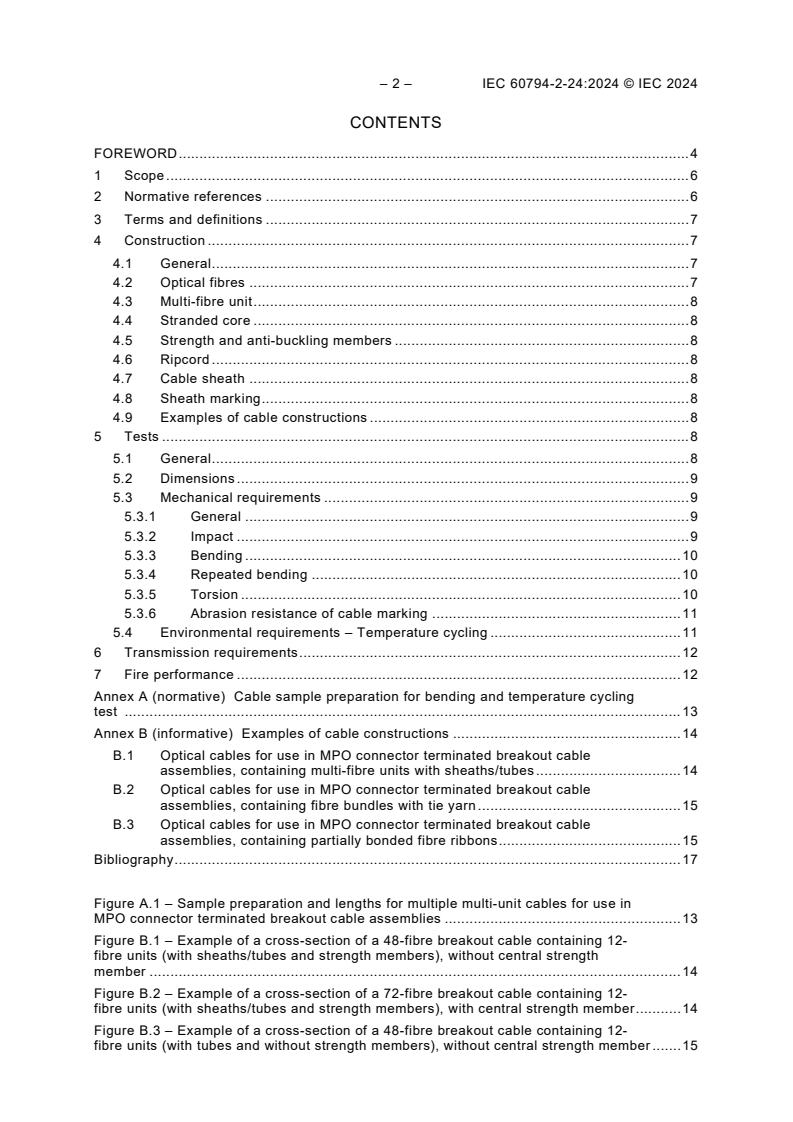
CONTENTS
FOREWORD . 4
1 Scope . 6
2 Normative references . 6
3 Terms and definitions . 7
4 Construction . 7
4.1 General . 7
4.2 Optical fibres . 7
4.3 Multi-fibre unit . 8
4.4 Stranded core . 8
4.5 Strength and anti-buckling members . 8
4.6 Ripcord . 8
4.7 Cable sheath . 8
4.8 Sheath marking . 8
4.9 Examples of cable constructions . 8
5 Tests . 8
5.1 General . 8
5.2 Dimensions . 9
5.3 Mechanical requirements . 9
5.3.1 General . 9
5.3.2 Impact . 9
5.3.3 Bending . 10
5.3.4 Repeated bending . 10
5.3.5 Torsion . 10
5.3.6 Abrasion resistance of cable marking . 11
5.4 Environmental requirements – Temperature cycling . 11
6 Transmission requirements . 12
7 Fire performance . 12
Annex A (normative) Cable sample preparation for bending and temperature cycling
test . 13
Annex B (informative) Examples of cable constructions . 14
B.1 Optical cables for use in MPO connector terminated breakout cable
assemblies, containing multi-fibre units with sheaths/tubes . 14
B.2 Optical cables for use in MPO connector terminated breakout cable
assemblies, containing fibre bundles with tie yarn . 15
B.3 Optical cables for use in MPO connector terminated breakout cable
assemblies, containing partially bonded fibre ribbons . 15
Bibliography . 17
Figure A.1 – Sample preparation and lengths for multiple multi-unit cables for use in
MPO connector terminated breakout cable assemblies . 13
Figure B.1 – Example of a cross-section of a 48-fibre breakout cable containing 12-
fibre units (with sheaths/tubes and strength members), without central strength
member . 14
Figure B.2 – Example of a cross-section of a 72-fibre breakout cable containing 12-
fibre units (with sheaths/tubes and strength members), with central strength member . 14
Figure B.3 – Example of a cross-section of a 48-fibre breakout cable containing 12-
fibre units (with tubes and without strength members), without central strength member . 15
Figure B.4 – Example of a cross-section of a 48-fibre cable containing 12-fibre bundles
with tie yarn, without central strength member . 15
Figure B.5 – Example of a cross-section of a 48-fibre cable containing 12-fibre partially
bonded fibre ribbons, without central strength member . 16
Table 1 – Preferred low and high temperatures . 11
– 4 – IEC 60794-2-24:2024 © IEC 2024
INTERNATIONAL ELECTROTECHNICAL COMMISSION
____________
OPTICAL FIBRE CABLES –
Part 2-24: Indoor cables –
Detail specification for multiple multi-fibre unit cables for use
in MPO connector terminated breakout cable assemblies
FOREWORD
1) The International Electrotechnical Commission (IEC) is a worldwide organization for standardization comprising
all national electrotechnical committees (IEC National Committees). The object of IEC is to promote international
co-operation on all questions concerning standardization in the electrical and electronic fields. To this end and
in addition to other activities, IEC publishes International Standards, Technical Specifications, Technical Reports,
Publicly Available Specifications (PAS) and Guides (hereafter referred to as “IEC Publication(s)”). Their
preparation is entrusted to technical committees; any IEC National Committee interested in the subject dealt with
may participate in this preparatory work. International, governmental and non-governmental organizations liaising
with the IEC also participate in this preparation. IEC collaborates closely with the International Organization for
Standardization (ISO) in accordance with conditions determined by agreement between the two organizations.
2) The formal decisions or agreements of IEC on technical matters express, as nearly as possible, an international
consensus of opinion on the relevant subjects since each technical committee has representation from all
interested IEC National Committees.
3) IEC Publications have the form of recommendations for international use and are accepted by IEC National
Committees in that sense. While all reasonable efforts are made to ensure that the technical content of IEC
Publications is accurate, IEC cannot be held responsible for the way in which they are used or for any
misinterpretation by any end user.
4) In order to promote international uniformity, IEC National Committees undertake to apply IEC Publications
transparently to the maximum extent possible in their national and regional publications. Any divergence between
any IEC Publication and the corresponding national or regional publication shall be clearly indicated in the latter.
5) IEC itself does not provide any attestation of conformity. Independent certification bodies provide conformity
assessment services and, in some areas, access to IEC marks of conformity. IEC is not responsible for any
services carried out by independent certification bodies.
6) All users should ensure that they have the latest edition of this publication.
7) No liability shall attach to IEC or its directors, employees, servants or agents including individual experts and
members of its technical committees and IEC National Committees for any personal injury, property damage or
other damage of any nature whatsoever, whether direct or indirect, or for costs (including legal fees) and
expenses arising out of the publication, use of, or reliance upon, this IEC Publication or any other IEC
Publications.
8) Attention is drawn to the Normative references cited in this publication. Use of the referenced publications is
indispensable for the correct application of this publication.
9) IEC draws attention to the possibility that the implementation of this document may involve the use of (a)
patent(s). IEC takes no position concerning the evidence, validity or applicability of any claimed patent rights in
respect thereof. As of the date of publication of this document, IEC had not received notice of (a) patent(s), which
may be required to implement this document. However, implementers are cautioned that this may not represent
the latest information, which may be obtained from the patent database available at https://patents.iec.ch. IEC
shall not be held responsible for identifying any or all such patent rights.
IEC 60794-2-24 has been prepared by subcommittee 86A: Fibres and cables, of IEC technical
committee 86: Fibre optics. It is an International Standard.
The text of this International Standard is based on the following documents:
Draft Report on voting
86A/2391/FDIS 86A/2413/RVD
Full information on the voting for its approval can be found in the report on voting indicated in
the above table.
The language used for the development of this International Standard is English.
This document was drafted in accordance with ISO/IEC Directives, Part 2, and developed in
accordance with ISO/IEC Directives, Part 1 and ISO/IEC Directives, IEC Supplement, available
at www.iec.ch/members_experts/refdocs. The main document types developed by IEC are
described in greater detail at www.iec.ch/publications.
A list of all the parts in the IEC 60794 series, published under the general title Optical fibre
cables, can be found on the IEC website.
The committee has decided that the contents of this document will remain unchanged until the
stability date indicated on the IEC website under webstore.iec.ch in the data related to the
specific document. At this date, the document will be
• reconfirmed,
• withdrawn, or
• revised.
IMPORTANT – The "colour inside" logo on the cover page of this document indicates
that it contains colours which are considered to be useful for the correct understanding
of its contents. Users should therefore print this document using a colour printer.
– 6 – IEC 60794-2-24:2024 © IEC 2024
OPTICAL FIBRE CABLES –
Part 2-24: Indoor cables –
Detail specification for multiple multi-fibre unit cables for use
in MPO connector terminated breakout cable assemblies
1 Scope
This part of IEC 60794 is a detail specification and specifies indoor multiple multi-fibre unit
cables for use in MPO (multi-fibre push on) connector terminated breakout cable assemblies.
2 Normative references
The following documents are referred to in the text in such a way that some or all of their content
constitutes requirements of this document. For dated references, only the edition cited applies.
For undated references, the latest edition of the referenced document (including any
amendments) applies.
IEC 60793-1-20, Optical fibres – Part 1-20: Measurement methods and test procedures – Fibre
geometry
IEC 60793-1-21, Optical fibres – Part 1-21: Measurement methods and test procedures –
Coating geometry
IEC 60793-1-40, Optical fibres – Part 1-40: Attenuation measurement methods
IEC 60793-1-46, Optical fibres – Part 1-46: Measurement methods and test procedures –
Monitoring of changes in optical transmittance
IEC 60793-2-10, Optical fibres – Part 2-10: Product specifications – Sectional specification for
category A1 multimode fibres
IEC 60793-2-50, Optical fibres – Part 2-50: Product specifications – Sectional specification for
class B single-mode fibres
IEC 60794-1-1, Optical fibre cables – Part 1-1: Generic specification – General
IEC 60794-1-2, Optical fibre cables – Part 1-2: Generic specification – Basic optical cable test
procedures – General guidance
IEC 60794-1-21, Optical fibre cables – Part 1-21: Generic specification – Basic optical cable
test procedures – Mechanical tests methods
IEC 60794-1-22, Optical fibre cables – Part 1-22: Generic specification – Basic optical cable
test procedures – Environmental test methods
IEC 60794-1-31, Optical fibre cables – Part 1-31: Generic specification – Optical cable elements
– Optical fibre ribbon
IEC 60794-2, Optical fibre cables – Part 2: Indoor cables – Sectional specification
IEC 60794-2-20, Optical fibre cables – Part 2-20: Indoor cables – Family specification for multi-
fibre optical cables
IEC 60794-2-23, Optical fibre cables – Part 2-23: Indoor cables – Detailed specification for
multi-fibre cables for use in MPO connector terminated cable assemblies
IEC 60811-202, Electric and optical fibre cables – Test methods for non-metallic materials –
Part 202: General tests – Measurement of thickness of non-metallic sheath
IEC 60811-203, Electric and optical fibre cables – Test methods for non-metallic materials –
Part 203: General tests – Measurement of overall dimensions
3 Terms and definitions
For the purposes of this document, the terms and definitions given in IEC 60794-1-1 apply.
ISO and IEC maintain terminology databases for use in standardization at the following
addresses:
• IEC Electropedia: available at https://www.electropedia.org/
• ISO Online browsing platform: available at https://www.iso.org/obp
3.1
multi-fibre unit
cable element in cable core that contains and packages multiple coated fibres
Note 1 to entry: A multi-fibre unit might be
• a sheath/tube construction, loosely or not,
• a fibre bundle with tie yarn,
• a ribbon structure, in accordance with IEC 60794-1-31, or
• other possible constructions.
4 Construction
4.1 General
In addition to the constructional requirements in IEC 60794-2 and IEC 60794-2-20, the following
considerations apply to multiple multi-fibre unit cables for use in MPO connector terminated
breakout cable assemblies.
It is not the intention of this document to specify the finished terminated cable assembly
complete with terminations.
There shall be no fibre splice in any delivery length unless otherwise agreed by the customer
and the supplier.
It shall be possible to identify each individual fibre throughout the length of the cable.
4.2 Optical fibres
Multimode or single-mode optical fibres shall meet the requirements of IEC 60793-2-10
sub-categories A1-OM1 or A1-OM2 to A1-OM5, or IEC 60793-2-50 class B.
NOTE The linear coefficient of optical fibre attenuation and attenuation point discontinuity might be affected by the
cable manufacturing process. Maximum values for these optical characteristics can be agreed between the customer
and the supplier.
– 8 – IEC 60794-2-24:2024 © IEC 2024
4.3 Multi-fibre unit
A multi-fibre unit contains a number of primary coated fibres and can be used as a breakout
branch directly or with some further protections. The fibre number in a multi-fibre unit shall be
in accordance with fibre number of the connector which the unit is to be terminated with.
A multiple multi-fibre unit cable can contain several multi-fibre units. The multi-fibre units in the
cable core shall be identifiable by appropriate means (e.g., numbers, rings, colour, etc.).
If the multi-fibre units are to be directly used as breakout branches, the dimensions of the multi-
fibre units and tolerance values shall be specified in relevant specification. The multi-fibre units
shall meet the requirements of cables for cords in IEC 60794-2-23.
4.4 Stranded core
The multi-fibre units can be stranded together with or without a central member. For the sake
of preserving cable geometry, some units may be "filler" or "empty" elements not containing
optical fibres.
4.5 Strength and anti-buckling members
The cable shall be designed with enough strength members to meet installation and service
conditions so that the fibres are not subjected to strain in excess of the limits agreed between
the customer and the supplier.
The strength and/or anti-buckling members may be either metallic or non-metallic and may be
located in the cable core and/or under the sheath and/or in the sheath. A multi-fibre unit which
has a sheath/tube and to be used directly as a breakout branch should contain enough strength
members.
4.6 Ripcord
If required, a ripcord may be provided beneath the cable sheath. The functionality of the ripcord
shall be tested according to IEC 60794-1-21, method E25.
4.7 Cable sheath
The cable shall have an overall protective sheath. The outer dimensions, sheath thickness of
the cable and tolerance values shall be specified in relevant specification.
4.8 Sheath marking
If required, the cable shall be marked as agreed between the customer and the supplier.
4.9 Examples of cable constructions
Examples of cable constructions are shown in Annex B. Other configurations are not precluded
if they meet the mechanical, environmental and transmission requirements given in this
document.
5 Tests
5.1 General
Compliance with the specification requirements shall be verified by carrying out tests selected
from 5.2 to 5.4. It is not intended that all tests be carried out in all cases. The tests to be applied
and the frequency of testing need to be agreed between the customer and the supplier.
As a general requirement for the tests specified in this document, unless otherwise specified,
the spirit is to keep "no change in attenuation" criteria at the end of each evaluation, although
the parameters specified in this document may be affected by measurement uncertainty arising
either from measurement errors or calibration errors. The optical total uncertainty of
measurement for this document shall be ±0,05 dB for single-mode fibres and ±0,2 dB for
multi-mode fibres. Any measured value within this range shall be considered as "no change in
attenuation".
Single-mode fibre cables are measured at 1 550 nm or 1 625 nm and the measuring wavelength
shall be agreed between the customer and supplier. Multimode fibre cables are measured at
850 nm or 1 300 nm and the measuring wavelength shall be agreed between the customer and
supplier. Measurements of attenuation shall be carried out according to IEC 60793-1-40.
Measurements of changes in attenuation shall be carried out according to IEC 60793-1-46.
NOTE The optimized wavelength for multimode fibres A1-OM3 and A1-OM4 is 850 nm and for A1-OM5 fibre, the
targeted operational wavelength range is in the vicinity of 850 nm to 950 nm.
If cable loops are used within a test to fix the ends of a cable, the loop diameter shall be equal
or greater than the specified minimum cable bend diameter to avoid cable damage and
excessive mode filtering in multi-mode fibre.
Unless otherwise specified, all tests shall be carried out at expanded test conditions, as
described in IEC 60794-1-2.
The following tests can be performed on a short sample length of cable which is still a part of a
longer length. Thus, it becomes possible to detect permanent changes in attenuation. The
measuring wavelength and maximum value of the attenuation change for longer lengths shall
be agreed between the customer and the supplier.
5.2 Dimensions
The fibre dimensions and tolerances shall be verified in accordance with IEC 60793-1-20 or
IEC 60793-1-21. The diameter of the tube, the outer dimensions of the cable, as well as the
thickness of the sheaths/tubes of the multi-fibre units and the cable sheath, shall be measured
in accordance with the methods of IEC 60811-202 and IEC 60811-203.
5.3 Mechanical requirements
5.3.1 General
The cable shall fulfil the mechanical requirements of tensile and crush according to
IEC 60794‑2‑20. Other mechanical requirements are defined in 5.3.2 to 5.3.6.
5.3.2 Impact
Method: IEC 60794-1-21, E4
Radius of striking surface: 300 mm, minimum
Impact energy: 0,5 J for cables with diameter ≤ 2,0 mm;
1,0 J for cables with diameter > 2,0 mm
Number of impacts: 3, each one impact per test location
Length between test locations: 500 mm
Requirements: no change in attenuation after the test. There shall be no
visible damage to the cable elements. Any flattening of
cable elements is not considered as damage.
– 10 – IEC 60794-2-24:2024 © IEC 2024
5.3.3 Bending
Method: IEC 60794-1-21, E11A
Mandrel diameter: 20 times cable diameter, but not less than 60 mm
Number of turns: 6
Number of cycles: 10
Cable sample: See Annex A for details
Prior to bending: at both ends of the sample, elements of the cable shall be
fixed together at certain positions, e.g. with clamps or
glue. See Annex A.
Bend location: the section in the middle of the cable length shall be bent.
Requirements for cabled single- maximum attenuation change during the test ≤ 0,20 dB.
mode fibres: No change in attenuation after the test.
Requirements for cabled multi- maximum attenuation change during the test ≤ 0,4 dB. No
mode fibres: change in attenuation after the test.
Requirements for cable: there shall be no damage to the cable elements. Any
flattening of cable elements is not considered as damage.
5.3.4 Repeated bending
Method: IEC 60794-1-21, E6
Bending radius: 20 times cable diameter, but not less than 30 mm
Number of cycles: 25
Mass of weights: sufficient to contour the apparatus, e.g., 40 N
Requirements: no change in attenuation after the test. There shall be no
damage to the cable elements. Any flattening of cable
elements is not considered as damage.
5.3.5 Torsion
Method: IEC 60794-1-21, E7
Number of cycles: 10
Distance between fixed and 125 times cable diameter but not less than 0,3 m and not
rotation clamp: greater than 2,0 m
Tension load: sufficient to keep the sample straight, e.g.,40 N
Requirements for cabled single- maximum attenuation change during the test ≤ 0,20 dB,
mode fibres: No change in attenuation after the test
Requirements for cabled multi- maximum attenuation change during the test ≤ 0,4 dB, No
mode fibres: change in attenuation after the test.
Requirements for cable: there shall be no damage to the cable elements.
5.3.6 Abrasion resistance of cable marking
Method: IEC 60794-1-21, E2B, method 2
Number of cycles: 50
the marking shall be legible on completion of the test, after
Requirements:
the number of specified cycles.
5.4 Environmental requirements – Temperature cycling
Method: IEC 60794-1-22, F12
Temperatures: Temperatures shall be in accordance with Table 1.
Soak time: 1 h
Number of cycles: 5
Table 1 – Preferred low and high temperatures
Low High
Sources of temperatures (informative) Remark
temperature temperature
Performance
Environmental
T T categories of
A B
classification of
connectors,
customer premises
°C °C components and
b
cabling
a
protective housings
M I C E
−10 +60 C Recommended
x x 1 x
HD
–10 +70 -
C
M I C E
–25 +70 OP
x x 2 x
HD
–25 +85 -
OP
A suitable operating service environment (performance category) or environmental classification should be
selected according to the application. A complete list of operating service environments can be found in
IEC 60794-1-1.
a
Included in IEC 61753-1. The abbreviations represent:
C: indoor controlled environment;
OP: outdoor protected environment;
HD
: extended upper temperature necessary due to additional dissipation by active electronics.
b
Included in ISO/IEC 11801-1. For an introduction to the MICE environmental classification system use
ISO/IEC TR 29106. The abbreviation MICE represents: mechanical, ingress, climatic, electromagnetic.
Cable sample: See Annex A for details
Prior to temperature cycling: at both ends of the sample, elements of the cable shall be
fixed together e.g., with clamps or glue. See Annex A.
Requirements: the maximum change in attenuation during the test shall
be specified in the relevant specification;
there shall be no change in attenuation after the test; other
attenuation requirements may be agreed between the
customer and the supplier.
– 12 – IEC 60794-2-24:2024 © IEC 2024
6 Transmission requirements
The transmission requirements shall be in accordance with IEC 60793-2-10 or IEC 60793-2-50
and shall be agreed between the customer and the supplier. The maximum cable attenuation
shall comply with IEC 60794-1-1.
7 Fire performance
All cables according to this document shall pass fire performance specifications. The
requirements may differ in different regions (e.g., North America, EU). But they also can differ
from country to country.
NOTE 1 IEC TR 62222 provides guidance and recommendations for the requirements and test methods for the fire
performance of communication cables when installed in buildings. The recommendations relate to typical applications
and installation practices, and an assessment of the fire hazards presented. Account is also taken of applicable
legislation and regulation.
IEC TR 62222 references several IEC fire performance test methods and also other test methods that can be required
by local or national legislation and regulation. It is important that the tests to be applied fulfil the national legislation
and regulation and the specific requirements by its intended use.
NOTE 2 Products placed on the EU or UK market would be determined whether EN 50575 is applicable after
checking with local regulations.
Annex A
(normative)
Cable sample preparation for bending and temperature cycling test
The sample of cables shall be prepared as shown in Figure A.1. Elements of each cable unit
shall be fixed together at the illustrated positions, for example with clamps or glue, complying
to their arrangements in the cable assembly. Fibres in each sub-units are glued together for the
test.
Dimensions in metres
l l
1 2
10,0 1,00
Key
1 primary coated optical fibres
2 element fixing point at sheath/tube end
3 cable sheath
4 sheath/tube of multi-fibre unit, or simulated protections of the multi-fibre unit made as in the cable assembly
5 optional elements fixing point at sheath end, depending on whether relative displacements of the elements are
prevented at the breakout points in the cable assembly or whether relative displacements are not critical in the
application
NOTE Elements of the cable are fixed complying to their arrangements in the cable assembly.
Figure A.1 – Sample preparation and lengths for multiple multi-unit cables
for use in MPO connector terminated breakout cable assemblies
– 14 – IEC 60794-2-24:2024 © IEC 2024
Annex B
(informative)
Examples of cable constructions
B.1 Optical cables for use in MPO connector terminated breakout cable
assemblies, containing multi-fibre units with sheaths/tubes
Cable design examples with overall protective sheath and multiple multi-fibre units which have
sheaths/tubes and can be used directly as breakout branches, are shown in Figure B.1 and
Figure B.2. The full cables are used for trunk cabling and the multi-fibre unit branches are to
be terminated with connectors and used for fibre distribution in housings/frames.
Figure B.1 – Example of a cross-section of a 48-fibre breakout cable containing 12-fibre
units (with sheaths/tubes and strength members), without central strength member
Figure B.2 – Example of a cross-section of a 72-fibre breakout cable containing 12-fibre
units (with sheaths/tubes and strength members), with central strength member
A cable design example with overall protective sheath and multiple multi-fibre units which have
sheaths/tubes and can be used as branches with some further protections is shown in
Figure B.3. The full cables are used for trunk cabling and the further protected multi-fibre units
are to be terminated with connectors and used for fibre distribution in housings/frames.
Figure B.3 – Example of a cross-section of a 48-fibre breakout cable containing 12-fibre
units (with tubes and without strength members), without central strength member
B.2 Optical cables for use in MPO connector terminated breakout cable
assemblies, containing fibre bundles with tie yarn
A cable design example with overall protective sheath and multiple multi-fibre bundles with tie
yarn, is shown in Figure B.4.,This design offers a high fibre density. The fibre bundles can be
used as branches with some further protections. The full cables are used for trunk cabling and
the further protected fibre bundles are to be terminated with connectors and used for fibre
distribution in housings/frames.
Figure B.4 – Example of a cross-section of a 48-fibre cable containing 12-fibre bundles
with tie yarn, without central strength member
B.3 Optical cables for use in MPO connector terminated breakout cable
assemblies, containing partially bonded fibre ribbons
A cable design example with overall protective sheath and partially bonded fibre ribbons is
shown in Figure B.5. This design offers a high fibre density. The fibre ribbons can be used as
branches with some further protections. The full cables are used for trunk cabling and the further
protected fibre ribbons are to be terminated with connectors and used for fibre distribution in
housings/frames.
– 16 – IEC 60794-2-24:2024 © IEC 2024
Figure B.5 – Example of a cross-section of a 48-fibre cable containing 12-fibre partially
bonded fibre ribbons, without central strength member
Bibliography
IEC 61753-1, Fibre optic interconnecting devices and passive components – Performance
standard – Part 1: General and guidance
IEC TR 62222, Fire performance of communication cables installed in buildings
IEC TR 62959, Optical fibre cables – Shrinkage effects on cable and cable element end
termination – Guidance
ISO/IEC 11801-1, Information technology – Generic cabling for customer premises – Part 1:
General requirements
ISO/IEC TR 29106, Information technology – Generic cabling – Introduction to the MICE
environmental classification
EN 50575, Power, control and communication cables – Cables for general applications in
construction works subject to reaction to fire requirements
___________
– 18 – IEC 60794-2-24:2024 © IEC 2024
SOMMAIRE
AVANT-PROPOS . 20
1 Domaine d'application . 22
2 Références normatives . 22
3 Termes et définitions . 23
4 Construction . 23
4.1 Généralités . 23
4.2 Fibres optiques . 23
4.3 Unité multifibre . 24
4.4 Âme câblée . 24
4.5 Éléments de renfort et d’antidéformation . 24
4.6 Filin de déchirement . 24
4.7 Gaine de câble . 24
4.8 Marquage de la gaine . 24
4.9 Exemples de constructions de câbles . 24
5 Essais . 25
5.1 Généralités . 25
5.2 Dimensions . 25
5.3 Exigences mécaniques . 25
5.3.1 Généralités . 25
5.3.2 Chocs . 26
5.3.3 Courbures. 26
5.3.4 Courbures répétées . 27
5.3.5 Torsion . 27
5.3.6 Résistance à l'abrasion du marquage du câble . 27
5.4 Exigences environnementales – Cycles de température . 27
6 Exigences de transmission . 29
7 Comportement au feu . 29
Annexe A (normative) Préparation d’échantillons de câble pour les essais de courbure
et de cycles de température . 30
Annexe B (informative) Exemples de constructions de câbles . 31
B.1 Câbles optiques utilisés dans les câbles assemblés épanouis équipés de
connecteurs MPO, contenant des unités multifibres avec des gaines/tubes . 31
B.2 Câbles optiques utilisés dans les câbles assemblés épanouis équipés de
connecteurs MPO, contenant des faisceaux de fibres avec un fil d’attache . 32
B.3 Câbles optiques utilisés dans les câbles assemblés épanouis équipés de
connecteurs MPO, contenant des rubans de fibres partiellement collés . 33
Bibliographie . 34
Figure A.1 – Préparation et longueur des échantillons pour les câbles à plusieurs
unités multifibres utilisés dans les câbles assemblés épanouis équipés de connecteurs
MPO . 30
Figure B.1 – Exemple de section d’un câble épanoui à 48 fibres contenant des unités
de 12 fibres (avec des gaines/tubes et des éléments de renfort), sans élément de
renfort central . 31
Figure B.2 – Exemple de section d’un câble épanoui à 72 fibres contenant des unités
de 12 fibres (avec des gaines/tubes et des éléments de renfort), avec élément de
renfort central . 31
Figure B.3 – Exemple de section d’un câble épanoui à 48 fibres contenant des unités
de 12 fibres (avec des tubes et sans élément de renfort), sans élément de renfort
central . 32
Figure B.4 – Exemple de section d’un câble à 48 fibres contenant des faisceaux de
12 fibres avec un fil d’attache, sans élément de renfort central . 32
Figure B.5 – Exemple de section d’un câble à 48 fibres contenant des rubans de
12 fibres partiellement collés, sans élément de renfort central . 33
Tableau 1 – Températures b
...