


IEC 60335-2-17:1998
(Main)Safety of household and similar electrical appliances - Part 2-17: Particular requirements for blankets, pads and similar flexible heating appliances
General Information
- Abstract
Deals with the safety of electric blankets, pads and other flexible heaters which heat the bed or human body. It also deals with control units supplied with the appliance. It covers appiances with a rated voltage less than 250 V. For heaters for medical use, see IEC 60601-2-35. For heaters for animals, see IEC 60335-2-71. For water bed heaters, see IEC 60335-2-66. For foot warmers and heating mats, see IEC 60335-2-81.
- Status
- Published
- Publication Date
- 23-Nov-1998
- Technical Committee
- TC 61 - Safety of household and similar electrical appliances
- Current Stage
- DELPUB - Deleted Publication
- Start Date
- 22-Oct-2002
- Completion Date
- 28-Aug-2026
Buy Documents
IEC 60335-2-17:1998 - Safety of household and similar electrical appliances - Part 2-17: Particular requirements for blankets, pads and similar flexible heating appliances Released:11/24/1998
IEC 60335-2-17:1998 - Safety of household and similar electrical appliances - Part 2-17: Particular requirements for blankets, pads and similar flexible heating appliances Released:11/24/1998
Overview
IEC 60335-2-17:1998 is the IEC safety standard that sets particular requirements for electric blankets, pads and similar flexible heating appliances for household and similar use (rated voltage up to 250 V). Issued as Part 2-17 to be used in conjunction with IEC 60335-1, it addresses common electrical and thermal hazards associated with flexible heating products and the control units supplied with them. The standard includes normative annexes for thermal insulation (Annex AA) and mechanical strength testing apparatus (Annex BB).
Key topics and technical requirements
The standard supplements IEC 60335-1 with requirements and tests specific to flexible heating appliances. Major topics include:
- Heating performance and temperature control: requirements for heating elements, thermostats, PTC elements and temperature limits to avoid burns and overheating.
- Construction and materials: rules for the flexible part (layers, enclosure), insulation and protection of live parts.
- Electrical safety tests: leakage current, electric strength at operating temperature, and insulation resistance checks.
- Moisture resistance and durability: tests for use in humid conditions and endurance/aging under normal and abnormal operation.
- Abnormal operation and overload protection: evaluation of failure modes, transformer protection and thermal cut-outs.
- Mechanical safety: ruck-resistance, flexing, tear resistance, impact and mechanical strength testing (including specific apparatus in Annex BB).
- Fire, heat and tracking resistance: assessments for resistance to ignition and tracking under stress.
- Marking and instructions: mandatory labeling, user instructions and safety symbols (e.g., do not fold, read instructions).
- Definitions and classifications: terms such as underblanket, overblanket, ruck‑resistant blanket, pad and controlled appliance are clarified.
Practical applications
IEC 60335-2-17 is used to ensure the safe design, testing and certification of flexible heating appliances. Typical uses include:
- Product design and materials selection to meet electrical and thermal safety criteria.
- Type and routine testing by manufacturers and independent test laboratories.
- Preparation of user instructions, labeling and compliance documentation.
- Regulatory conformity assessment and market approval for household heating products.
- Risk assessment and corrective actions for existing products in service.
Who should use this standard
- Appliance designers and OEMs (electric blankets, heating pads, mattress heaters)
- Safety engineers and compliance officers
- Test laboratories and certification bodies
- Regulatory authorities and procurement teams
Related standards
- IEC 60335-1 (general safety requirements for household appliances)
- IEC 60601-2-35 (medical heating blankets/pads)
- IEC 60335-2-71 (animal heaters)
- IEC 60335-2-66 (water bed heaters)
- IEC 60335-2-81 (foot warmers and heating mats)
Keywords: IEC 60335-2-17, electric blankets, flexible heating appliances, safety standard, electrical safety, thermal insulation, leakage current, overload protection, ruck-resistant blanket.
Relations
- Effective Date
- 05-Sep-2023
Buy Documents
IEC 60335-2-17:1998 - Safety of household and similar electrical appliances - Part 2-17: Particular requirements for blankets, pads and similar flexible heating appliances Released:11/24/1998
IEC 60335-2-17:1998 - Safety of household and similar electrical appliances - Part 2-17: Particular requirements for blankets, pads and similar flexible heating appliances Released:11/24/1998
Get Certified
Connect with accredited certification bodies for this standard

CIS Institut d.o.o.
Personal Protective Equipment (PPE) certification body. Notified Body NB-2890 for EU Regulation 2016/425 PPE.

Kiwa BDA Testing
Building and construction product certification.
Kmetijski inštitut Slovenije
Agricultural Institute of Slovenia. Soil testing, plant health, agricultural product analysis.
Sponsored listings
Frequently Asked Questions
IEC 60335-2-17:1998 is a standard published by the International Electrotechnical Commission (IEC). Its full title is "Safety of household and similar electrical appliances - Part 2-17: Particular requirements for blankets, pads and similar flexible heating appliances". This standard covers: Deals with the safety of electric blankets, pads and other flexible heaters which heat the bed or human body. It also deals with control units supplied with the appliance. It covers appiances with a rated voltage less than 250 V. For heaters for medical use, see IEC 60601-2-35. For heaters for animals, see IEC 60335-2-71. For water bed heaters, see IEC 60335-2-66. For foot warmers and heating mats, see IEC 60335-2-81.
Deals with the safety of electric blankets, pads and other flexible heaters which heat the bed or human body. It also deals with control units supplied with the appliance. It covers appiances with a rated voltage less than 250 V. For heaters for medical use, see IEC 60601-2-35. For heaters for animals, see IEC 60335-2-71. For water bed heaters, see IEC 60335-2-66. For foot warmers and heating mats, see IEC 60335-2-81.
IEC 60335-2-17:1998 is classified under the following ICS (International Classification for Standards) categories: 13.120 - Domestic safety; 97.040.50 - Small kitchen appliances. The ICS classification helps identify the subject area and facilitates finding related standards.
IEC 60335-2-17:1998 has the following relationships with other standards: It is inter standard links to IEC 60335-2-17:2002. Understanding these relationships helps ensure you are using the most current and applicable version of the standard.
IEC 60335-2-17:1998 is available in PDF format for immediate download after purchase. The document can be added to your cart and obtained through the secure checkout process. Digital delivery ensures instant access to the complete standard document.
Standards Content (Sample)
INTERNATIONAL
IEC
STANDARD
60335-2-17
First edition
1998-11
Safety of household and similar
electrical appliances –
Part 2-17:
Particular requirements for blankets, pads
and similar flexible heating appliances
Sécurité des appareils électrodomestiques
et analogues –
Partie 2-17:
Règles particulières pour les couvertures, coussins
et appareils chauffants souples analogues
Reference number
Numbering
As from 1 January 1997 all IEC publications are issued with a designation in the
60000 series.
Consolidated publications
Consolidated versions of some IEC publications including amendments are
available. For example, edition numbers 1.0, 1.1 and 1.2 refer, respectively, to the
base publication, the base publication incorporating amendment 1 and the base
publication incorporating amendments 1 and 2.
Validity of this publication
The technical content of IEC publications is kept under constant review by the IEC,
thus ensuring that the content reflects current technology.
Information relating to the date of the reconfirmation of the publication is available
in the IEC catalogue.
Information on the subjects under consideration and work in progress undertaken by
the technical committee which has prepared this publication, as well as the list of
publications issued, is to be found at the following IEC sources:
• IEC web site*
• Catalogue of IEC publications
Published yearly with regular updates
(On-line catalogue)*
• IEC Bulletin
Available both at the IEC web site* and as a printed periodical
Terminology, graphical and letter symbols
For general terminology, readers are referred to IEC 60050: International Electro-
technical Vocabulary (IEV).
For graphical symbols, and letter symbols and signs approved by the IEC for
general use, readers are referred to publications IEC 60027: Letter symbols to be
used in electrical technology, IEC 60417: Graphical symbols for use on equipment.
Index, survey and compilation of the single sheets and IEC 60617: Graphical symbols
for diagrams.
* See web site address on title page.
INTERNATIONAL
IEC
STANDARD
60335-2-17
First edition
1998-11
Safety of household and similar
electrical appliances –
Part 2-17:
Particular requirements for blankets, pads
and similar flexible heating appliances
Sécurité des appareils électrodomestiques
et analogues –
Partie 2-17:
Règles particulières pour les couvertures, coussins
et appareils chauffants souples analogues
IEC 1998 Copyright - all rights reserved
No part of this publication may be reproduced or utilized in any form or by any means, electronic or
mechanical, including photocopying and microfilm, without permission in writing from the publisher.
International Electrotechnical Commission 3, rue de Varembé Geneva, Switzerland
Telefax: +41 22 919 0300 e-mail: inmail@iec.ch IEC web site http: //www.iec.ch
Commission Electrotechnique Internationale
PRICE CODE
X
International Electrotechnical Commission
For price, see current catalogue
– 2 – 60335-2-17 IEC:1998(E)
CONTENTS
Page
FOREWORD . 4
Clause
1 Scope . 6
2 Definitions. 6
3 General requirement . 9
4 General conditions for the tests . 9
5 Void . 10
6 Classification . 10
7 Marking and instructions . 10
8 Protection against access to live parts. 13
9 Starting of motor-operated appliances . 13
10 Power input and current . 13
11 Heating . 13
12 Void .15
13 Leakage current and electric strength at operating temperature . 15
14 Void .16
15 Moisture resistance . 16
16 Leakage current and electric strength. 17
17 Overload protection of transformers and associated circuits. 17
18 Endurance . 17
19 Abnormal operation . 18
20 Stability and mechanical hazards. 21
21 Mechanical strength . 21
22 Construction. 27
23 Internal wiring . 30
24 Components. 30
25 Supply connection and external flexible cords. 30
26 Terminals for external conductors. 31
27 Provision for earthing . 31
28 Screws and connections. 31
29 Creepage distances, clearances and distances through insulation . 31
30 Resistance to heat, fire and tracking. 32
31 Resistance to rusting. 34
32 Radiation, toxicity and similar hazards . 34
Annexes
AA (normative) Specification for the thermal insulation. 47
BB (normative) Apparatus for the mechanical strength test for blankets . 48
60335-2-17 IEC:1998(E) – 3 –
Page
Figures
101 Symbol for "Read the instruction" . 35
102 Symbol for "Do not use folded or rucked". 35
103 Symbol for "Do not insert pins" . 35
104 Grid for the heatstroke test. 36
105 Arrangement for measuring leakage current of the flexible part. 36
106 Arrangement for the three-thickness fold test. 37
107 Positioning of the thermal insulation on flexible parts incorporating thermostats . 38
108 Examples of the position of the thermal insulation on folded pads . 39
109 Tumbling barrel for testing the mechanical strength of pads. 40
110 Impact apparatus for testing enclosures of moisture-proof appliances. 41
111 Shape of sample for the tear resistance test . 42
112 Apparatus for flexing heating elements and internal wiring . 42
113 Arrangement for the rigidity test of ruck-resistance blankets . 43
114 Apparatus for the spark ignition test . 44
114a Details of the mask . 45
BB.1 Apparatus for the mechanical strength test . 49
BB.2 Detail of the drum and cylinders . 50
BB.3 Detail of the clamping bar. 50
Tables
101 Maximum temperatures. 14
102 Maximum temperature rises . 14
– 4 – 60335-2-17 IEC:1998(E)
INTERNATIONAL ELECTROTECHNICAL COMMISSION
___________
SAFETY OF HOUSEHOLD AND SIMILAR ELECTRICAL APPLIANCES –
Part 2-17: Particular requirements for blankets, pads and
similar flexible heating appliances
FOREWORD
1) The IEC (International Electrotechnical Commission) is a worldwide organization for standardization comprising
all national electrotechnical committees (IEC National Committees). The object of the IEC is to promote
international co-operation on all questions concerning standardization in the electrical and electronic fields. To
this end and in addition to other activities, the IEC publishes International Standards. Their preparation is
entrusted to technical committees; any IEC National Committee interested in the subject dealt with may
participate in this preparatory work. International, governmental and non-governmental organizations liaising
with the IEC also participate in this preparation. The IEC collaborates closely with the International Organization
for Standardization (ISO) in accordance with conditions determined by agreement between the two
organizations.
2) The formal decisions or agreements of the IEC on technical matters express, as nearly as possible, an
international consensus of opinion on the relevant subjects since each technical committee has representation
from all interested National Committees.
3) The documents produced have the form of recommendations for international use and are published in the form
of standards, technical reports or guides and they are accepted by the National Committees in that sense.
4) In order to promote international unification, IEC National Committees undertake to apply IEC International
Standards transparently to the maximum extent possible in their national and regional standards. Any
divergence between the IEC Standard and the corresponding national or regional standard shall be clearly
indicated in the latter.
5) The IEC provides no marking procedure to indicate its approval and cannot be rendered responsible for any
equipment declared to be in conformity with one of its standards.
6) Attention is drawn to the possibility that some of the elements of this International Standard may be the subject
of patent rights. The IEC shall not be held responsible for identifying any or all such patent rights.
International Standard IEC 60335-2-17 has been prepared by IEC technical committee 61:
Safety of household and similar electrical appliances.
This first edition of IEC 60335-2-17 cancels and replaces IEC 60967 published in 1988,
including its amendment 1 (1991) and amendment 2 (1995).
IEC 60967 cancelled and replaced IEC 335-17 published in 1974.
The text of this standard is based on the following documents:
FDIS Report on voting
61/1483/FDIS 61/1524/RVD
Full information on the voting for the approval of this standard can be found in the report on
voting indicated in the above table.
This part 2 is to be used in conjunction with the latest edition of IEC 60335-1 and its
amendments. It was established on the basis of the third edition (1991) of that standard.
A bilingual version of this standard may be issued at a later date.
60335-2-17 IEC:1998(E) – 5 –
This part 2 supplements or modifies the corresponding clauses of IEC 60335-1, so as to
convert that publication into the IEC standard: Safety requirements for electric blankets, pads
and similar flexible heating appliances.
When a particular subclause of part 1 is not mentioned in this part 2, that subclause applies as
far as is reasonable. When this standard states "addition", "modification" or "replacement", the
relevant text in part 1 is to be adapted accordingly.
NOTE 1 – The following print types are used:
– requirements: in roman type;
– test specifications: in italic type;
– notes: in small roman type.
Words in bold in the text are defined in clause 2. When a definition of part 1 concerns an
adjective, the adjective and the associated noun are also in bold.
NOTE 2 – Subclauses, figures and tables which are additional to those in part 1 are numbered starting from 101.
Additional annexes to those in part 1 are lettered AA, BB, etc.
The following additional differences exist in some countries:
– 6.1: Class 0 products are allowed (Japan and USA).
– 19.108: The fuse is not required to rupture (Australia).
– 22.102: Thermostats and thermal cut-outs are not allowed in the flexible part of underblankets (Australia and
New Zealand).
– Annex AA: Felt is used for the thermal insulation (USA).
– 6 – 60335-2-17 IEC:1998(E)
SAFETY OF HOUSEHOLD AND SIMILAR ELECTRICAL APPLIANCES –
Part 2-17: Particular requirements for blankets, pads and
similar flexible heating appliances
1 Scope
This clause of part 1 is replaced by:
This standard deals with the safety of electric blankets, pads and other flexible appliances
which heat the bed or human body, for household and similar purposes, their rated voltage
being not more than 250 V. It also applies to control units supplied with the appliance.
So far as is practicable, this standard deals with the common hazards presented by appliances
which are encountered by all persons in and around the home.
This standard does not in general take into account
– the use of appliances by young children or infirm persons without supervision;
– playing with the appliance by young children.
NOTE 1 – Children are considered to be old enough to use an appliance without supervision when they have been
adequately instructed by a parent or guardian and are deemed competent to use the appliance safely.
NOTE 2 – Attention is drawn to the fact that
– for appliances intended to be used in vehicles or on board ships or aircraft, additional requirements may be
necessary;
– for appliances intended to be used in tropical countries, special requirements may be necessary;
– in many countries additional requirements are specified by the national health authorities, the national
authorities responsible for the protection of labour and similar authorities.
NOTE 3 – This standard does not apply to
– appliances intended to be used in locations where special conditions prevail, such as the presence of a
corrosive or explosive atmosphere (dust, vapour or gas);
– rigid bed warmers, such as those of metal or ceramic material;
1)
– appliances specifically intended for use under medical supervision (IEC 60601-2-35) ;
– heating appliances for breeding and rearing of animals (IEC 60335-2-71);
– water bed heaters (IEC 60335-2-66);
– foot warmers and heating mats (IEC 60335-2-81).
2 Definitions
This clause of part 1 is applicable except as follows.
________
1)
IEC 60335-2-35; Medical electrical equipment – Part 2: Particular requirements for the safety of blankets, pads
and mattresses intended for heating in medical use
60335-2-17 IEC:1998(E) – 7 –
2.2.9 Replacement:
normal operation
operation of the appliance under the following condition
The flexible part is supported by a piece of plywood, 20 mm thick, situated not less than
300 mm above the floor.
Mattresses are covered by a sheet of thermal insulation.
Duvets are placed on a sheet of thermal insulation but not covered.
Other appliances are placed between sheets of thermal insulation.
The size of the plywood is such that the thermal insulation can be fully supported over its entire
area. Unless otherwise specified, the size of the sheets of thermal insulation is such that the
edges extend at least 100 mm beyond the outline of the heated area.
NOTE – The specification for the thermal insulation is given in annex AA.
2.10.4 Replacement
PTC heating element
heating element consisting of two conductors separated by a conductive material which has a
rapid non-linear increase in resistance when the temperature is raised through a particular
range
2.101
flexible part
all layers of material forming the permanent enclosure of the appliance together with the
heating element, thermostats and all other current-carrying parts contained within it
NOTE – The flexible part may be inside a detachable cover.
2.102
blanket
appliance comprising a substantially flat flexible part, which is intended to form part of the
bedding, for heating the bed
2.103
underblanket
blanket intended to be used under the occupant of the bed
2.104
ruck-resistant blanket
underblanket which has sufficient rigidity to prevent rucking of the flexible part
2.105
overblanket
blanket intended to be used over the occupant of the bed
2.106
duvet
quilted overblanket intended to be used without additional bedding over the occupant of the
bed and in which a heating element provides supplementary heat
– 8 – 60335-2-17 IEC:1998(E)
2.107
pad
appliance comprising a flexible part having a heated area not exceeding 0,2 m on each face
and which is intended to heat part of the human body
2.108
mattress
appliance for supporting the bedding and which incorporates an upholstered flexible part for
heating the bed
2.109
controlled appliance
appliance incorporating means in the flexible part for sensing changes in temperature when
the appliance is operated under normal operation, thus automatically controlling the average
power input
2.110
heating element
heating conductor, including the core on which it is wound and the insulation, together with any
other integrated conductor
2.111
heated area
area of the flexible part enclosed within the outer perimeter of the heating element. It
includes a margin outside the perimeter that has a width equal to 0,5 times the average
distance between adjacent runs of the heating element.
NOTE 1 – The heated area includes the return length of the heating element if the average distance between this
part and the adjacent heating element does not exceed the average distance between adjacent runs of the heating
element.
NOTE 2 – If a blanket or mattress has two separate heated areas, the surface between the two areas is
considered to be part of the heated areas, if at any place the distance between the two heating elements does not
exceed 1,5 times the average distance between adjacent runs of the heating element.
2.112
moisture-proof appliance
appliance having a flexible part which is suitable for use under moist conditions
2.113
bonded enclosure
enclosure of the flexible part which has the opposite faces joined together by means of an
adhesive or by welding
NOTE – The bonded enclosure may include several bonded layers of material.
2.114
control unit
device, external to the flexible part, by means of which the average power input of the
appliance can be adjusted or regulated
NOTE 1 – Control units may be incorporated in the supply cord or at the end of an interconnection cord.
NOTE 2 – Multi-position cord switches are not considered to be control units unless they incorporate components
for regulating the power input.
60335-2-17 IEC:1998(E) – 9 –
3 General requirement
This clause of part 1 is applicable.
4 General conditions for the tests
This clause of part 1 is applicable except as follows.
4.2 Modification:
The tests are carried out on two appliances which are named appliance A and appliance B.
For appliances having a bonded enclosure, an additional appliance is required for the tests
of 21.108 and 21.111. For other appliances, a length of 15 m of heating element is required
for the tests of 21.111.
If heat-shrink material is used to insulate connections in the flexible part, a sample at least
150 mm in length is required for the test of 30.102.
For moisture-proof pads subjected to the tests of 21.110, five additional appliances and 1 m
of enclosure material are required.
NOTE 1 – An additional appliance may be required for the test of 19.110.
NOTE 2 – Additional samples of pads may be required for the test of 30.101.
NOTE 3 – If a further appliance is required in order to continue testing after a test of clause 19, it has to be
adequately preconditioned taking into account 21.102 to 21.107.
NOTE 4 – Duvets are tested as overblankets.
4.3 Replacement:
The order in which the tests are carried out is as follows:
Appliance A: 7, 22.11, 8, 22.114, 10, 11.101, 21.102 to 21.107, 22.108, 13, 15, 16, 17, 20,
25.15, 25.16, 19, 21.108, 22.18, 30, 31 and 32.
Appliance B: 10, 11 (remainder), 21, 21.101, 22 (remainder), 23, 24, 25 (remainder), 26, 27, 28
and 29.
The flexible part of washable appliances is laundered twice in accordance with instructions for
use before testing is started.
If it is evident from the construction of the appliance that a particular test is not applicable, the
test is not carried out.
4.5 Addition:
If the flexible part of the appliance is provided with a detachable cover, the tests are carried
out with or without this cover, whichever is more unfavourable.
– 10 – 60335-2-17 IEC:1998(E)
Duvets are tested without a detachable cover.
If the heating element can move in the channels, it is manipulated so that the individual runs
are placed in the most unfavourable position.
4.6 Addition:
When testing appliances for d.c. only, the possible influence of polarity on the operation of the
appliance is taken into account.
4.7 Addition:
The tests of clauses 10, 11 and 19 performed on flexible parts incorporating PTC heating
elements are carried out at the most unfavourable ambient temperature within the range of
0 °C to 25 °C.
For other controlled blankets and mattresses, the tests of clauses 10, 11 and 19 are carried
out at the most unfavourable ambient temperature within the range of 0 °C to 15 °C.
4.8.1 Addition:
Appliances for d.c. only are tested with d.c.
4.8.2 Addition:
Controlled appliances are supplied as specified for motor-operated appliances.
NOTE – Appliances incorporating within the are considered to be
PTC heating elements flexible part controlled
appliances.
5 Void
6 Classification
This clause of part 1 is applicable except as follows.
6.1 Modification:
Appliances shall be of class II or class III. Class III appliances shall have a rated voltage not
exceeding 24 V.
7 Marking and instructions
This clause of part 1 is applicable except as follows.
7.1 Modification:
Appliances shall be marked with the rated power input.
60335-2-17 IEC:1998(E) – 11 –
Addition:
Flexible parts and detachable covers shall be marked with the name, trademark or
identification mark of the manufacturer or responsible vendor.
Detachable covers shall be marked with the model or type reference of the appliance with
which they are intended to be used.
The flexible part of appliances to be used with a detachable control unit shall be marked
with the reference of the control unit to be used.
The flexible part of appliances to be used with a detachable transformer shall be marked
with the reference of the transformer to be used.
Flexible parts and detachable covers shall be marked with the substance of the following:
– read the instructions;
NOTE 1 – This marking may be replaced by symbol 1641 of ISO 7000 (see figure 101).
– do not use folded (this marking is not required for duvets, mattresses and appliances with
PTC heating elements);
– do not use rucked (this marking is required only for underblankets, other than those with
PTC heating elements);
– do not insert pins;
NOTE 2 – These markings may be replaced by the relevant symbols shown in figures 101 to 103 for which the rules
of ISO 3864 apply.
– underblanket or overblanket, as appropriate;
– do not use if wet (this marking is not required for moisure-proof appliances);
– do not use with a helpless person, an infant or a person insensitive to heat;
– overlong application at high setting can result in skin burns (this marking is required only for
pads, other than those having a timer which switches off the supply after a period not
exceeding 1 h).
NOTE 3 – The words "at high setting" are not required on pads without temperature adjustment.
The flexible part of blankets and detachable covers shall be marked with the appropriate
laundering symbols specified in ISO 3758.
Detachable control units shall be marked with a reference number or by other means of
identification.
Parts of class III construction shall not be marked with the rated voltage of the appliance.
7.12 Addition:
The instructions for use shall contain the following:
Important instructions
Retain for future use
The instructions for use shall contain the substance of the instructions required in 7.1. If
symbols are used, they shall be explained.
– 12 – 60335-2-17 IEC:1998(E)
The instructions for use for underblankets, other than blankets having a ruck-resistance
greater than 1,2 as determined in 22.106, shall state how the blanket is to be secured to the
bed.
The instructions for use shall specify the appropriate settings of the control for all night use of
the appliance.
The instructions for use for pads shall contain a warning that the user should not fall asleep
when the appliance is in use.
NOTE – The requirement does not apply to pads fitted with a timer which switches off the supply after a period not
exceeding 1 h.
The instructions for use for appliances provided with detachable control units or detachable
transformers shall state that the appliance is only to be used with the types which are marked
on the appliance.
The instructions for use for duvets shall state the length and width of the detachable cover.
The instructions for use for appliances containing a fuse link or thermal link, shall state that
the appliance must be returned to the manufacturer or his agent if the link has ruptured.
The instructions for use shall state the substance of the following:
– when not in use, store as follows (quote necessary instructions);
– avoid creasing the appliance (for blankets and pads only);
– examine the appliance frequently for signs of wear or damage. If there are such signs or if
the appliance has been misused, return it to the supplier prior to any further use;
– this appliance is not intended for medical use in hospitals.
The instructions for use for blankets shall state the substance of the following:
– do not tuck in;
– do not use on an adjustable bed, or if used on an adjustable bed, check that the blanket or
cord cannot become trapped or rucked;
– this blanket is not to be used by young children unless the controls have been preset by a
parent or guardian or unless the child has been adequately instructed on how to operate the
controls safely.
7.14 Addition:
The height of lettering on the flexible part shall be at least 2,5 mm.
The words "Important instructions – Retain for future use" shall be in lettering having a height
of at least 6 mm.
Modification:
Instead of petroleum spirit, liquid detergent is used to check the marking on flexible parts and
detachable covers.
60335-2-17 IEC:1998(E) – 13 –
8 Protection against access to live parts
This clause of part 1 is applicable.
9 Starting of motor-operated appliances
This clause of part 1 is not applicable.
10 Power input and current
This clause of part 1 is applicable except as follows.
10.1 Addition:
The negative deviation is increased to 20 %.
10.101 The power input of appliances incorporating PTC heating elements shall significantly
decrease with an increase in temperature.
Compliance is checked by the following test:
The appliance is supplied at rated voltage and operated under normal operation. The power
input shall have decreased by at least 50 % from the initial value when steady conditions are
established, any control operating during this period being rendered inoperative.
11 Heating
This clause of part 1 is applicable except as follows.
11.2 Modification:
The appliance is placed away from the walls of the test corner.
Control units held in the hand when they are actuated and cord switches are allowed to hang
in still air, away from the test bed. Other control units are placed on a supporting surface.
Addition:
Duvets, other than those with PTC heating elements, are also tested folded. A single fold
across the complete width of the duvet is made at a quarter of the length from one end.
Controls are set to the maximum position intended for all night use.
11.3 Addition:
Thermocouples used for determining the temperature of a heating element are tied to it with
textile thread over a length of at least 10 mm.
– 14 – 60335-2-17 IEC:1998(E)
Thermocouples used for determining the temperature of the surface of pads are soldered to
plates of copper or brass measuring 65 mm × 65 mm × 0,5 mm. The plates are positioned to
cover as many heating element runs as possible, with one side parallel to the direction of the
run. The temperatures are determined at least at six places, three on each outer surface of the
flexible part.
11.4 Addition:
Controlled appliances and appliances having a flexible part of class III construction are
supplied with the most unfavourable voltage between 0,94 and 1,06 times rated voltage.
11.7 Replacement:
Appliances are operated until steady conditions are established.
11.8 Addition:
For controlled appliances, the temperatures shall not exceed the values shown in table 101.
Table 101 – Maximum temperatures
Temperature
Part
°C
Heating element of blankets and mattresses
– before second operation of the thermal control 115
– under steady conditions 95
of
Heating element pads
1)
– before second operation of the thermal control 120
– under steady conditions 100
2)
Surface of pads 60
1)
A maximum temperature of 140 °C is allowed for a period of 10 min.
2)
A maximum temperature of 85 °C is permitted if the surface
temperature does not exceed 60 °C at a lower setting of the control.
For other appliances, the temperature rises specified shall not exceed the values shown in
table 102.
Table 102 – Maximum temperature rises
Temperature rise
Part
1)
K
Heating element 80
Surface of pads 45
1)
These values are based on the normal ambient temperature of
the appliance and take into consideration the maximum permitted
ambient temperatures during the test.
NOTE – If the ends of the heating element of pads are contained in a plastic sheath attached to the flexible part,
the temperature or temperature rise specified for the surface also applies to the accessible surface of the sheath.
60335-2-17 IEC:1998(E) – 15 –
11.101 It shall be possible to operate blankets and mattresses without risk of heatstroke to
the user.
Compliance is checked by the following test:
The appliance is operated under normal operation supplied as specified in 11.4. The ambient
temperature is maintained at the most unfavourable temperature in the range from 0 °C to
15 °C. Any control unit or cord switch is adjusted to the highest setting recommended for all
night use.
When steady conditions are established, but at least 1 h after switching on the appliance, the
temperature of the surface of the flexible part is measured. The measurements are made
using the resistance method by means of the grid shown in figure 104. The grid is 300 mm wide
and of sufficient length to cover four runs of the heating element, but not less than 300 mm.
The grid is placed in contact with the flexible part so that the wires of the grid are
perpendicular to the runs of the heating element. For overblankets the grid is placed under
the flexible part. For underblankets and mattresses, the grid is placed over the flexible part.
The temperature shall not exceed 37 °C.
NOTE – If the ends of the heating element are contained in a plastic sheath attached to the flexible part, the
temperature limit specified also applies to the accessible surface of the sheath.
12 Void
13 Leakage current and electric strength at operating temperature
This clause of part 1 is applicable except as follows.
13.1 Modification:
Controlled appliances are supplied at 1,06 times the rated voltage.
Addition:
For mattresses, a sheet of metal foil, approximately 0,1 mm thick and of sufficient size to
cover the area of that part of the mattress incorporating the current-carrying parts, is inserted
between the mattress and the sheet of thermal insulation. For other appliances, two such
sheets of metal foil are inserted, one above and one below the flexible part, these sheets
being electrically connected together. A uniformly distributed load of approximately 35 kg/m is
placed on the top sheet of thermal insulation.
The arrangement is shown in figure 105.
13.2 Modification:
For the flexible part, the leakage current is measured between any pole of the supply and the
sheets of metal foil.
Instead of the values specified, the leakage current for the flexible part shall not exceed:
– for pads 0,5 mA
–for blankets and mattresses 1 mA/m of the heated area with a maximum of 2,5 mA
– 16 – 60335-2-17 IEC:1998(E)
13.3 Modification:
For the flexible part, the test voltage is applied between live parts and the metal foil.
14 Void
15 Moisture resistance
This clause of part 1 is applicable except as follows.
15.1 Addition:
For the flexible part, compliance is checked without the appliance being connected to the
supply as follows:
–for blankets and pads, by the test of 15.101;
–for moisture-proof appliances, by the tests of 15.101 and 15.102. However pads
subjected to the tests of 21.109 and 21.110 are not subjected to the tests of 15.102;
–for mattresses, by the tests of 15.103.
NOTE 1 – The tests of clause 16 are carried out with the appliance still immersed or in contact with the saline
solution.
NOTE 2 – Flexble parts of class III construction are not subjected to the tests.
15.3 Addition:
The flexible part is not subjected to the test.
15.101 Washable appliances are laundered according to the instructions for use.
The flexible part is then immersed for 1 h in water containing approximately 1 % NaCl at a
temperature of 20 °C ± 5 °C after removing detachable parts. All of the flexible part is
immersed except appliance inlets. The point of entry of the flexible cord is not immersed unless
it is a moisure-proof appliance.
NOTE 1 – The connections of the heating element or internal wiring to the appliance inlet are not immersed,
however during laundering all parts are immersed.
After the tests of clause 16, inspection shall show that there is no trace of water on insulation
which could result in a reduction of clearances and creepage distances below the values
specified in clause 29.
NOTE 2 – The inspection is not carried out on appliances subjected to the test of 15.102.
15.102 An incision is made in the outer layer of the permanent enclosure and the appliance is
then immersed in the saline solution which is allowed to penetrate freely into the interior.
After a period of 1 h, the electric strength test of 16.3 is carried out, the test voltage being
1 250 V. Inspection shall show that water has not penetrated into the flexible part to such an
extent that it could come into contact with heating elements and other current-carrying parts.
60335-2-17 IEC:1998(E) – 17 –
15.103 Mattresses are supported on a piece of plywood. A quantity of water, containing
approximately 1 % NaCl, corresponding to 1 l/m of the upper surface area, is poured uniformly
over the mattress at the rate of 1 l/min.
The saline solution is allowed to soak into the mattress for a period of 30 min.
16 Leakage current and electric strength
This clause of part 1 is applicable except as follows.
16.2 Addition:
The flexible part of blankets and pads is tested with the voltage applied between live parts
and an electrode immersed in the saline solution.
The flexible part of mattresses is covered with metal foil.
The leakage current of flexible parts shall not exceed:
–for pads 1 mA
–for blankets and mattresses 5 mA
16.3 Modification:
The flexible part of blankets and pads is tested with the voltage applied between live parts
and an electrode immersed in the saline solution. However, when the test is carried out on
blankets and pads without first carrying out the tests of clause 15, the flexible part is covered
with metal foil.
Addition:
After the test, the flexible part of blankets and pads is thoroughly rinsed in water and then
allowed to dry for at least 24 h at a temperature between 20 °C and 40 °C. During the drying
period, the appliance is stretched in an attempt to regain the original dimensions.
Mattresses are rinsed with a quantity of water corresponding to 0,5 l/m of the upper surface.
The water is poured evenly over the upper surface and then wiped with a sponge, soaking up
as much water as possible. This treatment is carried out three times and the mattress is then
wiped with a dry cloth.
17 Overload protection of transformers and associated circuits
This clause of part 1 is applicable.
18 Endurance
This clause of part 1 is not applicable.
– 18 – 60335-2-17 IEC:1998(E)
19 Abnormal operation
This clause of part 1 is applicable except as follows.
19.1 Modification:
Instead of the tests specified, the following applies:
Blankets, other than ruck-resistant blankets, are subjected to the tests of 19.101 to 19.103
and 19.107.
Ruck-resistant blankets are subjected to the tests of 19.104, 19.105 and 19.107.
Pads are subjected to the tests of 19.104, 19.106 and 19.107.
Mattresses are subjected to the tests of 19.104 and 19.107.
Appliances incorporating a fuse-link or intentionally weak part which ruptures due to a short
circuit are also subjected to the test of 19.108.
NOTE – Fuse-links which are incorporated in an appliance for compliance with 19.102 to 19.107 are not subjected
to the tests of 19.12.
Appliances incorporating electronic circuits are also subjected to the tests of 19.11 and 19.12.
Unless otherwise specified, the appliance is supplied with a voltage
– between 0,9 times and 1,1 times the rated voltage, for controlled appliances,
– resulting in a power input between 0,85 times and 1,24 times the rated power input, for
other appliances.
19.13 Addition:
NOTE – The test of 15.101 is carried out before the test of 16.3.
The temperature of the flexible part in contact with the thermal insulation shall not exceed
165 °C for controlled appliances and for other appliances, the temperature rise shall not
exceed 150 K.
Unless the appliance is no longer in an operating condition after the tests, the temperature of
heating elements shall not exceed 160 °C for controlled appliances and for other
appliances, the temperature rise shall not exceed 145 K.
19.101 Blankets, other than ruck-resistant blankets, incorporating thermostats or thermal
cut-outs are operated under normal operation except that the flexible part is folded at the
most unfavourable place with a three-thickness fold. The fold is 40 mm wide, 400 mm long and
is fanned out at the ends, as shown in figure 106. The upper sheet of thermal insulation having
dimensions 300 mm × 450 mm × 36 mm is placed on the folded blanket at the most
unfavourable location.
For all underblankets, other than ruck-resistant blankets, the test is also carried out with the
flexible part completely covered, as specified for normal operation.
60335-2-17 IEC:1998(E) – 19 –
19.102 Underblankets, other than ruck-resistant blankets, are operated under normal
operation except that the flexible part is folded at the most unfavourable place with a five-
thickness fold. The fold is 100 mm wide, 400 mm long and is fanned out at the ends. The upper
sheet of thermal insulation having dimensions 300 mm × 450 mm × 90 mm is placed on the
folded blanket at the most unfavourable location. An evenly distributed mass of 5 kg is placed
on the upper sheet of thermal insulation.
NOTE – A sandbag may be used as the mass.
The appliance is supplied with a voltage at the upper limit of the range specified in 19.1.
19.103 Overblankets are operated under normal operation except that the flexible part is
folded at the most unfavourable place with a five-thickness fold. The fold is of any equal width
up to 75 mm, it is 400 mm long and is fanned out at the ends. The upper sheet of thermal
insulation having dimensions 300 mm × 450 mm × 36 mm is placed on the folded blanket at
the most unfavourable location.
The test is carried out with the flexible part uncovered, if this is more unfavourable.
19.104 If thermostats are incorporated in ruck-resistant blankets, pads and mattresses,
the appliance is operated under normal operation except that the upper sheet of thermal
insulation covers only one-third of the flexible part. This test is carried out eight times, the
boundary of the area covered being in turn parallel to each of the sides and to the diagonals of
the flexible part, as shown in figure 107.
19.105 Ruck-resistant blankets are operated under normal operation except that the
flexible part is folded at the most unfavourable place with a three-thickness fold having the
most unfavourable dimensions. The upper sheet of thermal insulation having dimensions
300 mm × 450 mm × 90 mm is placed on the folded blanket at the most unfavourable location.
An evenly distributed mass of 5 kg is placed on the upper sheet of thermal insulation.
NOTE – A sandbag may be used as the mass.
19.106 Pads are operated under normal operation except that the flexible part is folded
with a double-thickness fold. The fold is parallel to one of the edges of the flexible part, the
place and the width of the fold being chosen to produce the most unfavourable result. The
upper surface of the flexible part is uncovered or partially covered by a sheet of thermal
insulation whichever is more unfavourable. The thermal insulation is 36 mm thick, has a length
equal to the length of that edge which is parallel to the fold and a width equal to one-third of the
length of the adjacent edge. The thermal insulation is placed in the most unfavourable position
that completely covers the flexible part in the direction parallel to the fold and partially covers
it in the direction across the fold.
NOTE – Examples of the position of the thermal insulation on pads are shown in
...
NORME CEI
INTERNATIONALE IEC
60335-2-17
INTERNATIONAL
Première édition
STANDARD
First edition
1998-11
Sécurité des appareils électrodomestiques
et analogues –
Partie 2-17:
Règles particulières pour les couvertures,
coussins et appareils chauffants souples
analogues
Safety of household and similar
electrical appliances –
Part 2-17:
Particular requirements for blankets,
pads and similar flexible heating appliances
Numéro de référence
Reference number
CEI/IEC 60335-2-17:1998
Numéros des publications Numbering
Depuis le 1er janvier 1997, les publications de la CEI As from 1 January 1997 all IEC publications are
sont numérotées à partir de 60000. issued with a designation in the 60000 series.
Publications consolidées Consolidated publications
Les versions consolidées de certaines publications de Consolidated versions of some IEC publications
la CEI incorporant les amendements sont disponibles. including amendments are available. For example,
Par exemple, les numéros d’édition 1.0, 1.1 et 1.2 edition numbers 1.0, 1.1 and 1.2 refer, respectively, to
indiquent respectivement la publication de base, la the base publication, the base publication incor-
publication de base incorporant l’amendement 1, et la porating amendment 1 and the base publication
publication de base incorporant les amendements 1 incorporating amendments 1 and 2.
et 2.
Validité de la présente publication Validity of this publication
Le contenu technique des publications de la CEI est The technical content of IEC publications is kept
constamment revu par la CEI afin qu'il reflète l'état under constant review by the IEC, thus ensuring that
actuel de la technique. the content reflects current technology.
Des renseignements relatifs à la date de reconfir- Information relating to the date of the reconfirmation
mation de la publication sont disponibles dans le of the publication is available in the IEC catalogue.
Catalogue de la CEI.
Les renseignements relatifs à des questions à l’étude et Information on the subjects under consideration and
des travaux en cours entrepris par le comité technique work in progress undertaken by the technical
qui a établi cette publication, ainsi que la liste des committee which has prepared this publication, as well
publications établies, se trouvent dans les documents ci- as the list of publications issued, is to be found at the
dessous: following IEC sources:
• «Site web» de la CEI* • IEC web site*
• Catalogue des publications de la CEI • Catalogue of IEC publications
Publié annuellement et mis à jour Published yearly with regular updates
régulièrement (On-line catalogue)*
(Catalogue en ligne)*
• IEC Bulletin
• Bulletin de la CEI Available both at the IEC web site* and
Disponible à la fois au «site web» de la CEI* as a printed periodical
et comme périodique imprimé
Terminology, graphical and letter
Terminologie, symboles graphiques
symbols
et littéraux
For general terminology, readers are referred to
En ce qui concerne la terminologie générale, le lecteur IEC 60050: International Electrotechnical Vocabulary
se reportera à la CEI 60050: Vocabulaire Electro- (IEV).
technique International (VEI).
For graphical symbols, and letter symbols and signs
Pour les symboles graphiques, les symboles littéraux approved by the IEC for general use, readers are
et les signes d'usage général approuvés par la CEI, le referred to publications IEC 60027: Letter symbols to
lecteur consultera la CEI 60027: Symboles littéraux à be used in electrical technology, IEC 60417: Graphical
utiliser en électrotechnique, la CEI 60417: Symboles symbols for use on equipment. Index, survey and
graphiques utilisables sur le matériel. Index, relevé et compilation of the single sheets and IEC 60617:
compilation des feuilles individuelles, et la CEI 60617: Graphical symbols for diagrams.
Symboles graphiques pour schémas.
* See web site address on title page.
* Voir adresse «site web» sur la page de titre.
NORME CEI
INTERNATIONALE IEC
60335-2-17
INTERNATIONAL
Première édition
STANDARD
First edition
1998-11
Sécurité des appareils électrodomestiques
et analogues –
Partie 2-17:
Règles particulières pour les couvertures,
coussins et appareils chauffants souples
analogues
Safety of household and similar
electrical appliances –
Part 2-17:
Particular requirements for blankets,
pads and similar flexible heating appliances
IEC 1998 Droits de reproduction réservés Copyright - all rights reserved
Aucune partie de cette publication ne peut être reproduite ni No part of this publication may be reproduced or utilized in
utilisée sous quelque forme que ce soit et par aucun procédé, any form or by any means, electronic or mechanical,
électronique ou mécanique, y compris la photo-copie et les including photocopying and microfilm, without permission in
microfilms, sans l'accord écrit de l'éditeur. writing from the publisher.
International Electrotechnical Commission 3, rue de Varembé Geneva, Switzerland
Telefax: +41 22 919 0300 e-mail: inmail@iec.ch IEC web site http://www.iec.ch
CODE PRIX
Commission Electrotechnique Internationale
XA
PRICE CODE
International Electrotechnical Commission
Pour prix, voir catalogue en vigueur
For price, see current catalogue
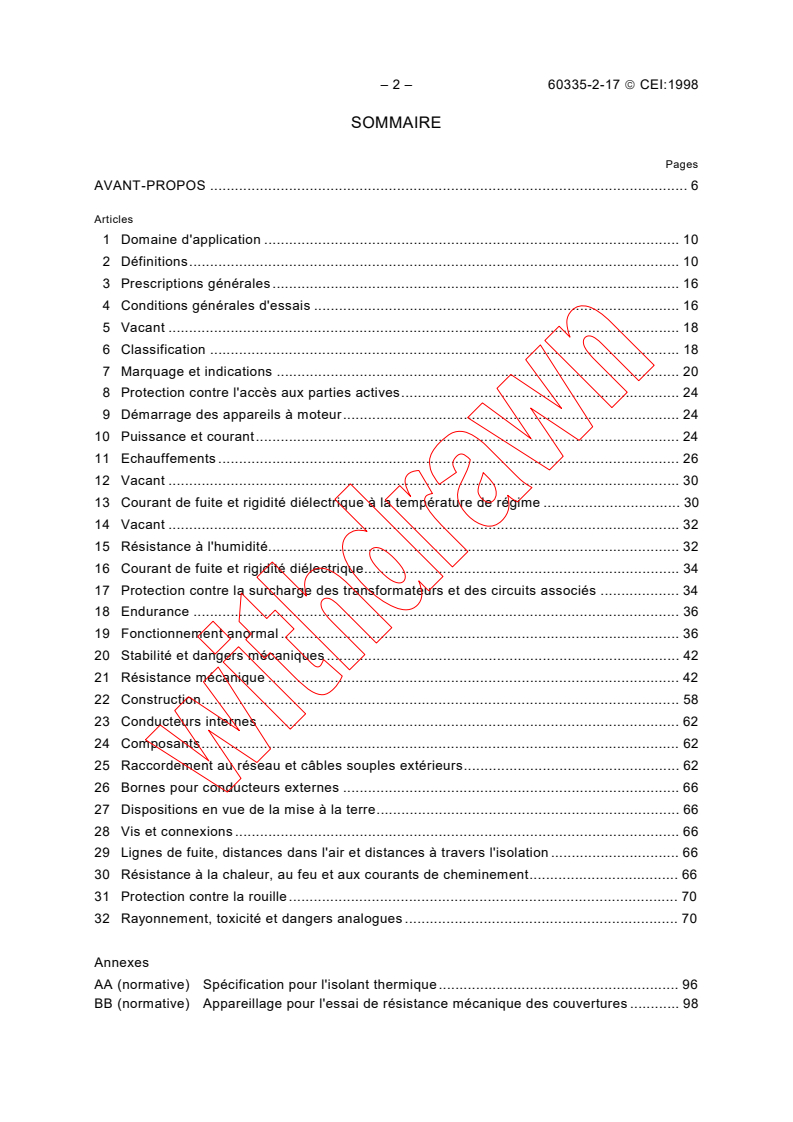
– 2 – 60335-2-17 CEI:1998
SOMMAIRE
Pages
AVANT-PROPOS . 6
Articles
1 Domaine d'application . 10
2 Définitions. 10
3 Prescriptions générales . 16
4 Conditions générales d'essais . 16
5 Vacant . 18
6 Classification . 18
7 Marquage et indications . 20
8 Protection contre l'accès aux parties actives. 24
9 Démarrage des appareils à moteur. 24
10 Puissance et courant. 24
11 Echauffements . 26
12 Vacant . 30
13 Courant de fuite et rigidité diélectrique à la température de régime . 30
14 Vacant . 32
15 Résistance à l'humidité. 32
16 Courant de fuite et rigidité diélectrique. 34
17 Protection contre la surcharge des transformateurs et des circuits associés . 34
18 Endurance .36
19 Fonctionnement anormal . 36
20 Stabilité et dangers mécaniques . 42
21 Résistance mécanique . 42
22 Construction. 58
23 Conducteurs internes . 62
24 Composants. 62
25 Raccordement au réseau et câbles souples extérieurs. 62
26 Bornes pour conducteurs externes . 66
27 Dispositions en vue de la mise à la terre. 66
28 Vis et connexions . 66
29 Lignes de fuite, distances dans l'air et distances à travers l'isolation . 66
30 Résistance à la chaleur, au feu et aux courants de cheminement. 66
31 Protection contre la rouille. 70
32 Rayonnement, toxicité et dangers analogues . 70
Annexes
AA (normative) Spécification pour l'isolant thermique. 96
BB (normative) Appareillage pour l'essai de résistance mécanique des couvertures . 98
60335-2-17 IEC:1998 – 3 –
CONTENTS
Page
FOREWORD . 7
Clause
1 Scope . 11
2 Definitions. 11
3 General requirement . 17
4 General conditions for the tests . 17
5 Void . 19
6 Classification . 19
7 Marking and instructions. 21
8 Protection against access to live parts. 25
9 Starting of motor-operated appliances . 25
10 Power input and current . 25
11 Heating . 27
12 Void . 31
13 Leakage current and electric strength at operating temperature . 31
14 Void . 33
15 Moisture resistance . 33
16 Leakage current and electric strength. 35
17 Overload protection of transformers and associated circuits. 35
18 Endurance .37
19 Abnormal operation . 37
20 Stability and mechanical hazards. 43
21 Mechanical strength . 43
22 Construction. 59
23 Internal wiring . 63
24 Components. 63
25 Supply connection and external flexible cords. 63
26 Terminals for external conductors. 67
27 Provision for earthing . 67
28 Screws and connections. 67
29 Creepage distances, clearances and distances through insulation . 67
30 Resistance to heat, fire and tracking. 67
31 Resistance to rusting. 71
32 Radiation, toxicity and similar hazards . 71
Annexes
AA (normative) Specification for the thermal insulation. 97
BB (normative) Apparatus for the mechanical strength test for blankets . 99
– 4 – 60335-2-17 CEI:1998
Pages
Figures
101 Symbole pour «Lire les instructions» . 72
102 Symbole pour «Ne pas utiliser plié ou froissé». 72
103 Symbole pour «Ne pas insérer d'épingles» . 72
104 Grille pour l'essai de choc thermique . 74
105 Montage de mesure du courant de fuite de la partie souple. 74
106 Montage pour l'essai de pli en trois épaisseurs . 76
107 Positionnement de l'isolant thermique sur les parties souples incorporant
des thermostats . 78
108 Exemples d'emplacement de l'isolant thermique sur les coussins pliés . 80
109 Tambour tournant pour les essais de résistance mécanique des coussins . 82
110 Dispositif de chocs pour l'essai des enveloppes des appareils
à l'épreuve de l'humidité. 84
111 Forme de l'échantillon pour l'essai de résistance au déchirement. 86
112 Appareil de pliage des éléments chauffants et du câblage interne. 86
113 Montage pour l'essai de rigidité des couvertures résistant au froissage. 88
114 Appareil pour l'essai d'amorçage d'étincelles . 90
114a Détails du masque . 92
BB.1 Appareil pour l'essai de résistance mécanique. 100
BB.2 Détail du tambour et des cylindres. 102
BB.3 Détail de la barre de serrage . 102
Tableaux
101 Températures maximales . 28
102 Echauffements maximaux . 28
60335-2-17 IEC:1998 – 5 –
Page
Figures
101 Symbol for "Read the instructions". 73
102 Symbol for "Do not use folded or rucked". 73
103 Symbol for "Do not insert pins" . 73
104 Grid for the heatstroke test. 75
105 Arrangement for measuring leakage current of the flexible part. 75
106 Arrangement for the three-thickness fold test. 77
107 Positioning of the thermal insulation on flexible parts incorporating thermostats . 79
108 Examples of the position of the thermal insulation on folded pads . 81
109 Tumbling barrel for testing the mechanical strength of pads. 83
110 Impact apparatus for testing enclosures of moisture-proof appliances. 85
111 Shape of sample for the tear resistance test . 87
112 Apparatus for flexing heating elements and internal wiring . 87
113 Arrangement for the rigidity test of ruck-resistant blankets . 89
114 Apparatus for the spark ignition test . 91
114a Details of the mask . 93
BB.1 Apparatus for the mechanical strength test .101
BB.2 Detail of the drum and cylinders .103
BB.3 Detail of the clamping bar.103
Tables
101 Maximum temperatures. 29
102 Maximum temperature rises . 29
– 6 – 60335-2-17 CEI:1998
COMMISSION ÉLECTROTECHNIQUE INTERNATIONALE
___________
SÉCURITÉ DES APPAREILS ÉLECTRODOMESTIQUES ET ANALOGUES –
Partie 2-17: Règles particulières pour les couvertures, coussins et
appareils chauffants souples analogues
AVANT-PROPOS
1) La CEI (Commission Électrotechnique Internationale) est une organisation mondiale de normalisation composée
de l'ensemble des comités électrotechniques nationaux (Comités nationaux de la CEI). La CEI a pour objet de
favoriser la coopération internationale pour toutes les questions de normalisation dans les domaines de
l'électricité et de l'électronique. A cet effet, la CEI, entre autres activités, publie des Normes internationales.
Leur élaboration est confiée à des comités d'études, aux travaux desquels tout Comité national intéressé par le
sujet traité peut participer. Les organisations internationales, gouvernementales et non gouvernementales, en
liaison avec la CEI, participent également aux travaux. La CEI collabore étroitement avec l'Organisation
Internationale de Normalisation (ISO), selon des conditions fixées par accord entre les deux organisations.
2) Les décisions ou accords officiels de la CEI concernant les questions techniques représentent, dans la mesure
du possible, un accord international sur les sujets étudiés, étant donné que les Comités nationaux intéressés
sont représentés dans chaque comité d’études.
3) Les documents produits se présentent sous la forme de recommandations internationales. Ils sont publiés
comme normes, spécifications techniques, rapports techniques ou guides et agréés comme tels par les Comités
nationaux.
4) Dans le but d'encourager l'unification internationale, les Comités nationaux de la CEI s'engagent à appliquer de
façon transparente, dans toute la mesure possible, les Normes internationales de la CEI dans leurs normes
nationales et régionales. Toute divergence entre la norme de la CEI et la norme nationale ou régionale
correspondante doit être indiquée en termes clairs dans cette dernière.
5) La CEI n’a fixé aucune procédure concernant le marquage comme indication d’approbation et sa responsabilité
n’est pas engagée quand un matériel est déclaré conforme à l’une de ses normes.
6) L’attention est attirée sur le fait que certains des éléments de la présente Norme internationale peuvent faire
l’objet de droits de propriété intellectuelle ou de droits analogues. La CEI ne saurait être tenue pour
responsable de ne pas avoir identifié de tels droits de propriété et de ne pas avoir signalé leur existence.
La Norme internationale CEI 60335-2-17 a été établie par le comité d'études 61 de la CEI:
Sécurité des appareils électrodomestiques et analogues.
La première édition de la CEI 60335-2-17 annule et remplace la CEI 60967 parue en 1988 ainsi
que son amendement 1 (1991) et amendement 2 (1995).
La CEI 60967 avait annulé et remplacé la CEI 60335-17 parue en 1974.
Cette version bilingue (1999-05) remplace la version monolingue anglaise.
Le texte anglais de cette norme est basé sur les documents 61/1483/FDIS et 61/1524/RVD.
Le rapport de vote 61/1524/RVD donne toute information sur le vote ayant abouti à
l'approbation de cette norme.
La version française de cette norme n'a pas été soumise au vote.
Cette partie 2 doit être lue conjointement avec la dernière édition de la CEI 60335-1 et ses
amendements. Elle a été établie sur la base de la troisième édition (1991) de cette norme.
60335-2-17 IEC:1998 – 7 –
INTERNATIONAL ELECTROTECHNICAL COMMISSION
___________
SAFETY OF HOUSEHOLD AND SIMILAR ELECTRICAL APPLIANCES –
Part 2-17: Particular requirements for blankets, pads and
similar flexible heating appliances
FOREWORD
1) The IEC (International Electrotechnical Commission) is a worldwide organization for standardization comprising
all national electrotechnical committees (IEC National Committees). The object of the IEC is to promote
international co-operation on all questions concerning standardization in the electrical and electronic fields. To
this end and in addition to other activities, the IEC publishes International Standards. Their preparation is
entrusted to technical committees; any IEC National Committee interested in the subject dealt with may
participate in this preparatory work. International, governmental and non-governmental organizations liaising
with the IEC also participate in this preparation. The IEC collaborates closely with the International Organization
for Standardization (ISO) in accordance with conditions determined by agreement between the two
organizations.
2) The formal decisions or agreements of the IEC on technical matters express, as nearly as possible, an
international consensus of opinion on the relevant subjects since each technical committee has representation
from all interested National Committees.
3) The documents produced have the form of recommendations for international use and are published in the form
of standards, technical reports or guides and they are accepted by the National Committees in that sense.
4) In order to promote international unification, IEC National Committees undertake to apply IEC International
Standards transparently to the maximum extent possible in their national and regional standards. Any
divergence between the IEC Standard and the corresponding national or regional standard shall be clearly
indicated in the latter.
5) The IEC provides no marking procedure to indicate its approval and cannot be rendered responsible for any
equipment declared to be in conformity with one of its standards.
6) Attention is drawn to the possibility that some of the elements of this International Standard may be the subject
of patent rights. The IEC shall not be held responsible for identifying any or all such patent rights.
International Standard IEC 60335-2-17 has been prepared by IEC technical committee 61:
Safety of household and similar electrical appliances.
This first edition of IEC 60335-2-17 cancels and replaces IEC 60967 published in 1988,
including its amendment 1 (1991) and amendment 2 (1995).
IEC 60967 cancelled and replaced IEC 60335-17 published in 1974.
This bilingual version (1999-05) replaces the English version.
The text of this standard is based on the following documents:
FDIS Report on voting
61/1483/FDIS 61/1524/RVD
Full information on the voting for the approval of this standard can be found in the report on
voting indicated in the above table.
This part 2 is to be used in conjunction with the latest edition of IEC 60335-1 and its
amendments. It was established on the basis of the third edition (1991) of that standard.
– 8 – 60335-2-17 CEI:1998
La présente partie 2 complète ou modifie les articles correspondants de la CEI 60335-1 de
façon à la transformer en norme CEI: Règles particulières pour les couvertures, coussins et
appareils chauffants souples analogues
Lorsqu'un paragraphe particulier de la partie 1 n'est pas mentionné dans cette partie 2, ce
paragraphe s'applique pour autant que cela est raisonnable. Lorsque la présente norme
spécifie «addition», «modification» ou «remplacement», le texte correspondant de la partie 1
doit être adapté en conséquence.
NOTE 1 – Les caractères d'imprimerie suivants sont utilisés:
– prescriptions: caractères romains;
– modalités d'essais: caractères italiques;
– notes: petits caractères romains.
Les termes figurant en caractères gras dans le texte sont définis à l'article 2. Lorsqu'une
définition de la partie 1 concerne un adjectif, l'adjectif et le nom associé figurent également en
gras.
NOTE 2 – Les paragraphes, les figures et les tableaux complémentaires à ceux de la partie 1 sont numérotés à
partir de 101. Les annexes complémentaires à celles de la partie 1 sont appelées AA, BB etc.
Les différences complémentaires suivantes existent dans certains pays:
– 6.1: Les produits de la classe 0 sont autorisés (Japon et U.S.A.)
– 19.108: Il n'est pas requis que le fusible se rompe (Australie).
– 22.102: Les thermostats et les coupe-circuit thermiques ne sont pas autorisés dans les parties souples des
couvertures de dessous (Australie et Nouvelle-Zélande).
– Annexe AA: Du feutre est utilisé pour l'isolation thermique (U.S.A.).
60335-2-17 IEC:1998 – 9 –
This part 2 supplements or modifies the corresponding clauses of IEC 60335-1, so as to
convert that publication into the IEC standard: Safety requirements for electric blankets, pads
and similar flexible heating appliances.
When a particular subclause of part 1 is not mentioned in this part 2, that subclause applies as
far as is reasonable. When this standard states "addition", "modification" or "replacement", the
relevant text in part 1 is to be adapted accordingly.
NOTE 1 – The following print types are used:
– requirements: in roman type;
– test specifications: in italic type;
– notes: in small roman type.
Words in bold in the text are defined in clause 2. When a definition of part 1 concerns an
adjective, the adjective and the associated noun are also in bold.
NOTE 2 – Subclauses, figures and tables which are additional to those in part 1 are numbered starting from 101.
Additional annexes to those in part 1 are lettered AA, BB, etc.
The following additional differences exist in some countries:
– 6.1: Class 0 products are allowed (Japan and USA).
– 19.108: The fuse is not required to rupture (Australia).
– 22.102: Thermostats and thermal cut-outs are not allowed in the flexible part of underblankets (Australia and
New Zealand).
– Annex AA: Felt is used for the thermal insulation (USA).
– 10 – 60335-2-17 CEI:1998
SÉCURITÉ DES APPAREILS ÉLECTRODOMESTIQUES ET ANALOGUES –
Partie 2-17: Règles particulières pour les couvertures, coussins et
appareils chauffants souples analogues
1 Domaine d'application
L'article de la partie 1 est remplacé par:
La présente norme traite de la sécurité des couvertures, coussins et autres appareils souples
électriques destinés à chauffer un lit ou le corps humain, pour usages domestiques et
analogues et dont la tension assignée n'est pas supérieure à 250 V. Elle s'applique
également aux unités de commande fournies avec les appareils.
Dans la mesure du possible, la présente norme traite des risques ordinaires présentés par les
appareils, encourus par tous les individus à l'intérieur et autour de l'habitation.
Cette norme ne tient en général pas compte de
– l'utilisation des appareils par de jeunes enfants ou des personnes handicapées, sans
surveillance;
– l'emploi de l'appareil comme jouet par de jeunes enfants.
NOTE 1 – On considère que les enfants sont assez âgés pour utiliser un appareil sans surveillance lorsque qu'un
des parents ou une personne qui en a la garde leur a expliqué les instructions et qu'on considère qu'ils sont aptes à
utiliser l'appareil en toute sécurité.
NOTE 2 – L'attention est attirée sur le fait que
– pour les appareils destinés à être utilisés dans des véhicules ou à bord de navires ou d'avions, des
prescriptions supplémentaires peuvent être nécessaires;
– pour les appareils destinés à être utilisés dans les pays tropicaux, des prescriptions spéciales peuvent être
nécessaires;
– dans de nombreux pays, des prescriptions supplémentaires sont imposées par les organismes nationaux de la
santé publique, par les organismes nationaux responsables de la protection des travailleurs et par des
organismes analogues.
NOTE 3 – La présente norme ne s'applique pas
– aux appareils destinés à être utilisés dans des locaux présentant des conditions particulières, telles que la
présence d'une atmosphère corrosive ou explosive (poussière, vapeur ou gaz),
– aux dispositifs de chauffage rigides des lits, tels que ceux en métal ou en céramique,
1)
– aux appareils spécifiquement destinés à être utilisés sous surveillance médicale (CEI 60601-2-35) ,
– aux appareils de chauffage destinés à la reproduction et à l'élevage des animaux (CEI 60335-2-71),
– aux dispositifs de chauffage pour matelas à eau (CEI 60335-2-66),
– aux chancelières et tapis chauffants (CEI 60335-2-81).
2 Définitions
L'article de la partie 1 est applicable avec les exceptions suivantes.
________
1)
CEI 60601-2-35; Appareils électromédicaux – Partie 2: Règles particulières de sécurité pour couvertures,
coussins et matelas chauffants destinés au réchauffage des patients en usage médical
60335-2-17 IEC:1998 – 11 –
SAFETY OF HOUSEHOLD AND SIMILAR ELECTRICAL APPLIANCES –
Part 2-17: Particular requirements for blankets, pads and
similar flexible heating appliances
1 Scope
This clause of part 1 is replaced by:
This standard deals with the safety of electric blankets, pads and other flexible appliances
which heat the bed or human body, for household and similar purposes, their rated voltage
being not more than 250 V. It also applies to control units supplied with the appliance.
So far as is practicable, this standard deals with the common hazards presented by appliances
which are encountered by all persons in and around the home.
This standard does not in general take into account
– the use of appliances by young children or infirm persons without supervision;
– playing with the appliance by young children.
NOTE 1 – Children are considered to be old enough to use an appliance without supervision when they have been
adequately instructed by a parent or guardian and are deemed competent to use the appliance safely.
NOTE 2 – Attention is drawn to the fact that
– for appliances intended to be used in vehicles or on board ships or aircraft, additional requirements may be
necessary;
– for appliances intended to be used in tropical countries, special requirements may be necessary;
– in many countries additional requirements are specified by the national health authorities, the national
authorities responsible for the protection of labour and similar authorities.
NOTE 3 – This standard does not apply to
– appliances intended to be used in locations where special conditions prevail, such as the presence of a
corrosive or explosive atmosphere (dust, vapour or gas);
– rigid bed warmers, such as those of metal or ceramic material;
1)
– appliances specifically intended for use under medical supervision (IEC 60601-2-35) ;
– heating appliances for breeding and rearing of animals (IEC 60335-2-71);
– water bed heaters (IEC 60335-2-66);
– foot warmers and heating mats (IEC 60335-2-81).
2 Definitions
This clause of part 1 is applicable except as follows.
________
1)
IEC 60601-2-35; Medical electrical equipment – Part 2: Particular requirements for the safety of blankets, pads
and mattresses intended for heating in medical use
– 12 – 60335-2-17 CEI:1998
2.2.9 Remplacement:
conditions de fonctionnement normal
fonctionnement des appareils dans les conditions suivantes.
La partie souple est supportée par une planche de contre-plaqué de 20 mm d'épaisseur,
placée à 300 mm au moins au-dessus du sol.
Les matelas sont recouverts d'une feuille d'isolant thermique.
Les couettes sont placées sur une feuille d'isolant thermique mais ne sont pas recouvertes.
Les autres appareils sont placés entre deux feuilles d'isolant thermique.
Les dimensions de la planche de contre-plaqué sont telles que l'isolant thermique puisse être
complètement supporté sur toute sa surface. Sauf spécification contraire, les dimensions des
feuilles d'isolant thermique sont telles que les bords dépassent d'au moins 100 mm la zone
chauffée.
NOTE – Les spécifications concernant l'isolant thermique sont données à l'annexe AA.
2.10.4 Remplacement:
élément chauffant CTP
élément chauffant constitué de deux conducteurs séparés par un matériau conducteur qui
présente un accroissement rapide non linéaire de résistance lorsque la température s'élève à
l'intérieur d'une plage particulière
2.101
partie souple
ensemble des couches de matériau formant l'enveloppe permanente de l'appareil, y compris
l'élément chauffant, les thermostats et toutes les parties transportant le courant qui y sont
contenues
NOTE – La partie souple peut être dans une housse amovible.
2.102
couverture
appareil comportant une partie souple pratiquement plate, destinée à faire partie de la literie
et à chauffer le lit
2.103
couverture de dessous
couverture destinée à être utilisée sous l'occupant du lit
2.104
couverture résistant au froissement
couverture de dessous ayant une rigidité suffisante pour empêcher que la partie souple ne
soit froissée
2.105
couverture de dessus
couverture destinée à être utilisée sur l'occupant du lit
60335-2-17 IEC:1998 – 13 –
2.2.9 Replacement:
normal operation
operation of the appliance under the following condition.
The flexible part is supported by a piece of plywood, 20 mm thick, situated not less than
300 mm above the floor.
Mattresses are covered by a sheet of thermal insulation.
Duvets are placed on a sheet of thermal insulation but not covered.
Other appliances are placed between sheets of thermal insulation.
The size of the plywood is such that the thermal insulation can be fully supported over its entire
area. Unless otherwise specified, the size of the sheets of thermal insulation is such that the
edges extend at least 100 mm beyond the outline of the heated area.
NOTE – The specification for the thermal insulation is given in annex AA.
2.10.4 Replacement:
PTC heating element
heating element consisting of two conductors separated by a conductive material which has a
rapid non-linear increase in resistance when the temperature is raised through a particular
range
2.101
flexible part
all layers of material forming the permanent enclosure of the appliance together with the
heating element, thermostats and all other current-carrying parts contained within it
NOTE – The flexible part may be inside a detachable cover.
2.102
blanket
appliance comprising a substantially flat flexible part, which is intended to form part of the
bedding, for heating the bed
2.103
underblanket
blanket intended to be used under the occupant of the bed
2.104
ruck-resistant blanket
underblanket which has sufficient rigidity to prevent rucking of the flexible part
2.105
overblanket
blanket intended to be used over the occupant of the bed
– 14 – 60335-2-17 CEI:1998
2.106
couette
couverture de dessus piquée, destinée à être utilisée, sans autre élément de literie, sur
l'occupant du lit et dans laquelle un élément chauffant fournit de la chaleur supplémentaire
2.107
coussin
appareil comportant une partie souple ayant une zone chauffée ne dépassant pas 0,2 m sur
chacune des faces et qui est destiné à chauffer une partie du corps humain
2.108
matelas
appareil destiné à supporter la literie et comportant une partie souple capitonnée pour
chauffer le lit
2.109
appareil à auto-commande
appareil comportant, dans la partie souple, des moyens pour déceler les changements de
température lorsque l'appareil est utilisé dans les conditions de fonctionnement normal,
contrôlant ainsi automatiquement la puissance moyenne
2.110
élément chauffant
conducteur chauffant, y compris l'âme éventuelle autour de laquelle il est enroulé, ainsi que
l'isolation et tout autre conducteur qui y est incorporé
2.111
zone chauffée
zone de la partie souple située à l'intérieur du périmètre externe de l'élément chauffant. Elle
inclut, à l'extérieur de ce périmètre, une marge dont la largeur est égale à 0,5 fois la distance
moyenne entre deux trajets parallèles adjacents de l'élément chauffant
NOTE 1 – La zone chauffée comprend la partie de retour de l'élément chauffant si la distance moyenne entre
cette partie et l'élément chauffant adjacent n'est pas supérieure à la distance moyenne entre deux trajets
parallèles adjacents de l'élément chauffant.
NOTE 2 – Si une couverture ou un matelas comporte deux zones chauffées séparées, la surface entre les deux
zones est considérée comme faisant partie de la zone chauffée, si en tout point, la distance entre les deux
éléments chauffants n'est pas supérieure à 1,5 fois la distance moyenne entre deux trajets parallèles adjacents de
l'élément chauffant.
2.112
appareil résistant à l'humidité
appareil dont la partie souple est appropriée pour une utilisation dans des conditions humides
2.113
enveloppe collée
enveloppe de la partie souple dont les faces opposées sont jointes au moyen d'un adhésif ou
par soudage
NOTE – L'enveloppe collée peut être constituée de plusieurs couches de matériau collées.
60335-2-17 IEC:1998 – 15 –
2.106
duvet
quilted overblanket intended to be used without additional bedding over the occupant of the
bed and in which a heating element provides supplementary heat
2.107
pad
appliance comprising a flexible part having a heated area not exceeding 0,2 m on each face
and which is intended to heat part of the human body
2.108
mattress
appliance for supporting the bedding and which incorporates an upholstered flexible part for
heating the bed
2.109
controlled appliance
appliance incorporating means in the flexible part for sensing changes in temperature when
the appliance is operated under normal operation, thus automatically controlling the average
power input
2.110
heating element
heating conductor, including the core on which it is wound and the insulation, together with any
other integrated conductor
2.111
heated area
area of the flexible part enclosed within the outer perimeter of the heating element. It
includes a margin outside the perimeter that has a width equal to 0,5 times the average
distance between adjacent runs of the heating element
NOTE 1 – The heated area includes the return length of the heating element if the average distance between this
part and the adjacent heating element does not exceed the average distance between adjacent runs of the heating
.
element
NOTE 2 – If a blanket or mattress has two separate heated areas, the surface between the two areas is
considered to be part of the heated areas, if at any place the distance between the two heating elements does not
exceed 1,5 times the average distance between adjacent runs of the heating element.
2.112
moisture-proof appliance
appliance having a flexible part which is suitable for use under moist conditions
2.113
bonded enclosure
enclosure of the flexible part which has the opposite faces joined together by means of an
adhesive or by welding
NOTE – The bonded enclosure may include several bonded layers of material.
– 16 – 60335-2-17 CEI:1998
2.114
unité de commande
dispositif, extérieur à la partie souple, au moyen duquel la puissance moyenne de l'appareil
peut être réglée ou régulée
NOTE 1 – Les unités de commande peuvent être montées dans le câble d'alimentation ou à l'extrémité d'un câble
d'interconnexion.
NOTE 2 – Les interrupteurs multipositions insérés dans les câbles ne sont pas considérés comme étant des unités
de commande, à moins qu'ils n'incorporent des composants pour réguler la puissance.
3 Prescriptions générales
L'article de la partie 1 est applicable.
4 Conditions générales d'essais
L'article de la partie 1 est applicable, avec les exceptions suivantes:
4.2 Modification:
Les essais sont effectués sur deux appareils qui sont appelés appareil A et appareil B.
Pour les appareils ayant une enveloppe collée, un appareil supplémentaire est nécessaire
pour les essais de 21.108 et 21.111. Pour les autres appareils, un morceau d'élément
chauffant de 15 m de long est nécessaire pour l'essai de 21.111.
Si un matériau thermo-rétractable est utilisé pour isoler les connexions dans la partie souple,
un échantillon d'au moins 150 mm de long est nécessaire pour l'essai de 30.102.
Pour les coussins résistant à l'humidité soumis aux essais de 21.110, cinq appareils
supplémentaires et 1 m² du matériau de l'enveloppe sont nécessaires.
NOTE 1 – Un appareil supplémentaire peut être nécessaire pour l'essai de 19.110.
NOTE 2 – Des échantillons supplémentaires de coussins peuvent être nécessaires pour l'essai de 30.101.
NOTE 3 – Si un appareil supplémentaire est nécessaire pour poursuivre les essais après l'un des essais de
l'article 19, il faut qu'il soit préconditionné de façon appropriée, 21.102 à 21.107 étant pris en considération.
NOTE 4 – Les couettes sont essayées comme des couvertures de dessus.
4.3 Remplacement:
L'ordre dans lequel les essais sont effectués est le suivant:
Appareil A: 7, 22.11, 8, 22.112, 10, 11.101, 21.102 à 21.107, 22.108, 13, 15, 16, 17, 20, 25.15,
25.16, 19, 21.108, 22.18, 30, 31 et 32.
Appareil B: 10, 11 (ce qui reste), 21, 21.101, 22 (ce qui reste), 23, 24, 25 (ce qui reste), 26, 27,
28 et 29.
Avant d'être soumise aux essais, la partie souple des appareils lavables est lavée deux fois
conformément aux instructions d'emploi.
S'il est évident d'après la conception de l'appareil qu'un essai spécifique n'est pas applicable,
l'essai n'est pas effectué.
---------
...