

IEC TR 62240-1:2013
(Main)Process management for avionics - Electronic components capability in operation - Part 1: Temperature uprating
General Information
- Abstract
IEC/TR 62240-1:2013(E) provides information for the use of semiconductor devices in wider temperature ranges than those specified by the device manufacturer. The uprating solutions described herein are considered exceptions, when no reasonable alternatives are available; otherwise devices are utilized within the manufacturers' specifications. This technical report describes the methods and processes for implementing this special case. All of the elements of these methods and processes employ existing, commonly used best engineering practices. IEC/TR 62240-1 includes the following significant changes with respect to IEC/TR 62240:
- revised wording, clarifications and corrections;
- removal of all requirements;
- updated paragraphs, including addition of references to the utilization of samples from a single lot, and the fact that performance of uprating is repeated if significant changes are implemented by device manufacturer, as well as the reference that the manufacturer's warranty may be eliminated if uprating is performed.
- Status
- Published
- Publication Date
- 22-Apr-2013
- Technical Committee
- TC 107 - Process management for avionics
- Drafting Committee
- MT 2 - TC 107/MT 2
- Current Stage
- DELPUB - Deleted Publication
- Start Date
- 13-Mar-2018
- Completion Date
- 28-Aug-2026
Overview
IEC TR 62240-1:2013 - "Process management for avionics - Electronic components capability in operation - Part 1: Temperature uprating" is a Technical Report from IEC TC 107 that provides guidance for using semiconductor devices beyond the temperature ranges specified by the device manufacturer. It documents temperature uprating (thermal uprating) as an exceptional, documented practice when no reasonable alternatives exist, and describes methods, processes and best engineering practices to assess, verify and manage component capability in wider temperature ranges. The report is advisory (requirements removed; “shall” language withdrawn) and notes that manufacturer warranty may be lost and that uprating should be repeated if the device manufacturer implements significant changes.
Key topics and technical focus
- Device selection and alternatives - guidance on selecting candidate components and identifying alternatives before considering uprating.
- Device capability assessment - evaluation of package, internal construction and assembly-level risks for operation in wider temperature ranges.
- Temperature uprating methods - documented methods for implementing thermal uprating as an exception to manufacturer ratings.
- Device quality assurance - re-characterisation of electrical parameters, parameter conformance testing and monitoring for devices used outside manufacturer-specified temperatures.
- Stress balancing - techniques to estimate dissipated power vs ambient temperature and balance thermal stresses across device usage.
- Higher assembly level testing - recommendations for validating assemblies and systems at temperature extremes.
- Documentation and traceability - reporting forms, sample lot considerations (use of samples from a single lot), failure data collection and record keeping.
- Annexes with practical procedures - informative annexes cover parameter re-characterisation (Annex A), stress balancing (Annex B), parameter conformance assessment (Annex C) and higher assembly testing (Annex D).
Practical applications and users
This technical report is intended for professionals involved in avionics and high-reliability electronics where temperature margins are critical and component availability is constrained:
- Avionics design and systems engineers
- Component engineers and procurement specialists
- Reliability, test and qualification teams
- Manufacturing and quality assurance personnel
- Program managers responsible for electronic component selection and risk mitigation
Use cases include selecting COTS or industrial/commercial semiconductors for ADHP (aerospace, defence, high-performance) equipment, documenting justified exceptions when military-grade parts are unavailable, and implementing controlled processes to verify device behavior outside manufacturer temperature ratings.
Related standards (if applicable)
- Part of the IEC 62240 series - see the IEC catalogue for other parts in the "Process management for avionics – Electronic components capability in operation" series.
- This Technical Report complements industry qualification practices and mission assurance processes by providing structured guidance on temperature uprating rather than mandatory requirements.
Keywords: IEC TR 62240-1, temperature uprating, thermal uprating, avionics, semiconductor devices, device re-characterisation, stress balancing, parameter conformance, electronic components capability.
Relations
- Effective Date
- 05-Sep-2023
- Effective Date
- 05-Sep-2023
Get Certified
Connect with accredited certification bodies for this standard

BSI Group
BSI (British Standards Institution) is the business standards company that helps organizations make excellence a habit.

Bureau Veritas
Bureau Veritas is a world leader in laboratory testing, inspection and certification services.

DNV
DNV is an independent assurance and risk management provider.
Sponsored listings
Frequently Asked Questions
IEC TR 62240-1:2013 is a technical report published by the International Electrotechnical Commission (IEC). Its full title is "Process management for avionics - Electronic components capability in operation - Part 1: Temperature uprating". This standard covers: IEC/TR 62240-1:2013(E) provides information for the use of semiconductor devices in wider temperature ranges than those specified by the device manufacturer. The uprating solutions described herein are considered exceptions, when no reasonable alternatives are available; otherwise devices are utilized within the manufacturers' specifications. This technical report describes the methods and processes for implementing this special case. All of the elements of these methods and processes employ existing, commonly used best engineering practices. IEC/TR 62240-1 includes the following significant changes with respect to IEC/TR 62240: - revised wording, clarifications and corrections; - removal of all requirements; - updated paragraphs, including addition of references to the utilization of samples from a single lot, and the fact that performance of uprating is repeated if significant changes are implemented by device manufacturer, as well as the reference that the manufacturer's warranty may be eliminated if uprating is performed.
IEC/TR 62240-1:2013(E) provides information for the use of semiconductor devices in wider temperature ranges than those specified by the device manufacturer. The uprating solutions described herein are considered exceptions, when no reasonable alternatives are available; otherwise devices are utilized within the manufacturers' specifications. This technical report describes the methods and processes for implementing this special case. All of the elements of these methods and processes employ existing, commonly used best engineering practices. IEC/TR 62240-1 includes the following significant changes with respect to IEC/TR 62240: - revised wording, clarifications and corrections; - removal of all requirements; - updated paragraphs, including addition of references to the utilization of samples from a single lot, and the fact that performance of uprating is repeated if significant changes are implemented by device manufacturer, as well as the reference that the manufacturer's warranty may be eliminated if uprating is performed.
IEC TR 62240-1:2013 is classified under the following ICS (International Classification for Standards) categories: 03.100.50 - Production. Production management; 31.020 - Electronic components in general; 49.060 - Aerospace electric equipment and systems. The ICS classification helps identify the subject area and facilitates finding related standards.
IEC TR 62240-1:2013 has the following relationships with other standards: It is inter standard links to IEC TR 62240:2005, IEC TR 62240-1:2018. Understanding these relationships helps ensure you are using the most current and applicable version of the standard.
IEC TR 62240-1:2013 is available in PDF format for immediate download after purchase. The document can be added to your cart and obtained through the secure checkout process. Digital delivery ensures instant access to the complete standard document.
Standards Content (Sample)
IEC/TR 62240-1 ®
Edition 1.0 2013-04
TECHNICAL
REPORT
colour
inside
Process management for avionics – Electronic components capability in
operation –
Part 1: Temperature uprating
IEC/TR 62240-1:2013(E)
All rights reserved. Unless otherwise specified, no part of this publication may be reproduced or utilized in any form
or by any means, electronic or mechanical, including photocopying and microfilm, without permission in writing from
either IEC or IEC's member National Committee in the country of the requester.
If you have any questions about IEC copyright or have an enquiry about obtaining additional rights to this publication,
please contact the address below or your local IEC member National Committee for further information.
IEC Central Office Tel.: +41 22 919 02 11
3, rue de Varembé Fax: +41 22 919 03 00
CH-1211 Geneva 20 info@iec.ch
Switzerland www.iec.ch
About the IEC
The International Electrotechnical Commission (IEC) is the leading global organization that prepares and publishes
International Standards for all electrical, electronic and related technologies.
About IEC publications
The technical content of IEC publications is kept under constant review by the IEC. Please make sure that you have the
latest edition, a corrigenda or an amendment might have been published.
Useful links:
IEC publications search - www.iec.ch/searchpub Electropedia - www.electropedia.org
The advanced search enables you to find IEC publications The world's leading online dictionary of electronic and
by a variety of criteria (reference number, text, technical electrical terms containing more than 30 000 terms and
committee,…). definitions in English and French, with equivalent terms in
It also gives information on projects, replaced and additional languages. Also known as the International
withdrawn publications. Electrotechnical Vocabulary (IEV) on-line.
IEC Just Published - webstore.iec.ch/justpublished Customer Service Centre - webstore.iec.ch/csc
Stay up to date on all new IEC publications. Just Published If you wish to give us your feedback on this publication
details all new publications released. Available on-line and or need further assistance, please contact the
also once a month by email. Customer Service Centre: csc@iec.ch.
IEC/TR 62240-1 ®
Edition 1.0 2013-04
TECHNICAL
REPORT
colour
inside
Process management for avionics – Electronic components capability in
operation –
Part 1: Temperature uprating
INTERNATIONAL
ELECTROTECHNICAL
COMMISSION
PRICE CODE
XA
ICS 03.100.50; 31.020; 49.060 ISBN 978-2-83220-739-0
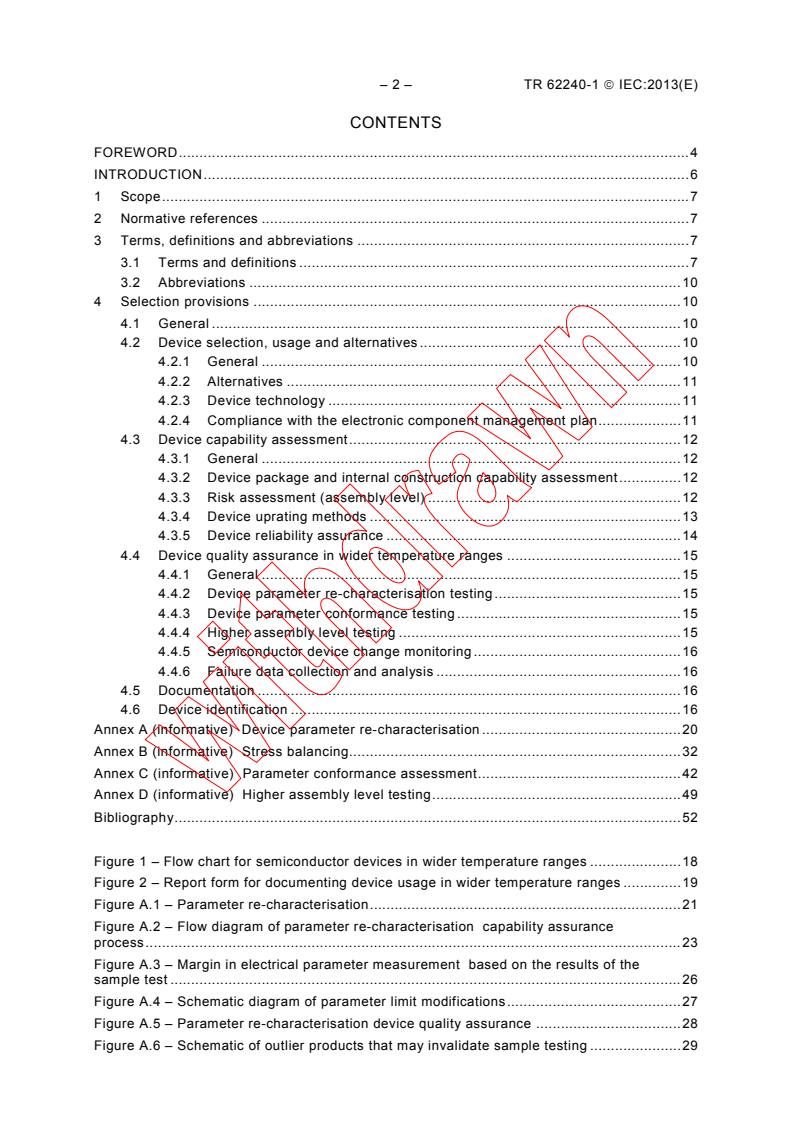
– 2 – TR 62240-1 IEC:2013(E)
CONTENTS
FOREWORD . 4
INTRODUCTION . 6
1 Scope . 7
2 Normative references . 7
3 Terms, definitions and abbreviations . 7
3.1 Terms and definitions . 7
3.2 Abbreviations . 10
4 Selection provisions . 10
4.1 General . 10
4.2 Device selection, usage and alternatives . 10
4.2.1 General . 10
4.2.2 Alternatives . 11
4.2.3 Device technology . 11
4.2.4 Compliance with the electronic component management plan . 11
4.3 Device capability assessment . 12
4.3.1 General . 12
4.3.2 Device package and internal construction capability assessment . 12
4.3.3 Risk assessment (assembly level) . 12
4.3.4 Device uprating methods . 13
4.3.5 Device reliability assurance . 14
4.4 Device quality assurance in wider temperature ranges . 15
4.4.1 General . 15
4.4.2 Device parameter re-characterisation testing . 15
4.4.3 Device parameter conformance testing . 15
4.4.4 Higher assembly level testing . 15
4.4.5 Semiconductor device change monitoring . 16
4.4.6 Failure data collection and analysis . 16
4.5 Documentation . 16
4.6 Device identification . 16
Annex A (informative) Device parameter re-characterisation . 20
Annex B (informative) Stress balancing. 32
Annex C (informative) Parameter conformance assessment . 42
Annex D (informative) Higher assembly level testing . 49
Bibliography . 52
Figure 1 – Flow chart for semiconductor devices in wider temperature ranges . 18
Figure 2 – Report form for documenting device usage in wider temperature ranges . 19
Figure A.1 – Parameter re-characterisation . 21
Figure A.2 – Flow diagram of parameter re-characterisation capability assurance
process . 23
Figure A.3 – Margin in electrical parameter measurement based on the results of the
sample test . 26
Figure A.4 – Schematic diagram of parameter limit modifications . 27
Figure A.5 – Parameter re-characterisation device quality assurance . 28
Figure A.6 – Schematic of outlier products that may invalidate sample testing . 29
TR 62240-1 IEC:2013(E) – 3 –
Figure A.7 – Example of intermediate peak of an electrical parameter: voltage
feedback input threshold change for Motorola MC34261 power factor controller. . 30
Figure A.8 – Report form for documenting device parameter re-characterisation . 31
Figure B.1 – Iso-T curve: the relationship between ambient temperature and
J
dissipated power . 34
Figure B.2 – Graph of electrical parameters versus dissipated power. 35
Figure B.3 – Iso-T curve for the Fairchild MM74HC244 . 38
J
Figure B.4 – Power versus frequency curve for the Fairchild MM74HC244 . 39
Figure B.5 – Flow chart for stress balancing . 40
Figure B.6 – Report form for documenting stress balancing . 41
Figure C.1 – Relationship of temperature ratings, requirements and margins . 43
Figure C.2 – Typical fallout distribution versus T . 45
req-max
Figure C.3 – Parameter conformance assessment flow . 47
Figure C.4 – Report form for documenting parameter conformance testing . 48
Figure D.1 – Flow chart of higher level assembly testing . 50
Figure D.2 – Report form for documenting higher level assembly test at temperature
extremes . 51
Table A.1 – Example of sample size calculation . 24
Table A.2 – Parameter re-characterisation example: SN74ALS244 Octal Buffer/Driver . 27
– 4 – TR 62240-1 IEC:2013(E)
INTERNATIONAL ELECTROTECHNICAL COMMISSION
____________
PROCESS MANAGEMENT FOR AVIONICS –
ELECTRONIC COMPONENTS CAPABILITY IN OPERATION –
Part 1: Temperature uprating
FOREWORD
1) The International Electrotechnical Commission (IEC) is a worldwide organization for standardization comprising
all national electrotechnical committees (IEC National Committees). The object of IEC is to promote
international co-operation on all questions concerning standardization in the electrical and electronic fields. To
this end and in addition to other activities, IEC publishes International Standards, Technical Specifications,
Technical Reports, Publicly Available Specifications (PAS) and Guides (hereafter referred to as “IEC
Publication(s)”). Their preparation is entrusted to technical committees; any IEC National Committee interested
in the subject dealt with may participate in this preparatory work. International, governmental and non-
governmental organizations liaising with the IEC also participate in this preparation. IEC collaborates closely
with the International Organization for Standardization (ISO) in accordance with conditions determined by
agreement between the two organizations.
2) The formal decisions or agreements of IEC on technical matters express, as nearly as possible, an international
consensus of opinion on the relevant subjects since each technical committee has representation from all
interested IEC National Committees.
3) IEC Publications have the form of recommendations for international use and are accepted by IEC National
Committees in that sense. While all reasonable efforts are made to ensure that the technical content of IEC
Publications is accurate, IEC cannot be held responsible for the way in which they are used or for any
misinterpretation by any end user.
4) In order to promote international uniformity, IEC National Committees undertake to apply IEC Publications
transparently to the maximum extent possible in their national and regional publications. Any divergence
between any IEC Publication and the corresponding national or regional publication shall be clearly indicated in
the latter.
5) IEC itself does not provide any attestation of conformity. Independent certification bodies provide conformity
assessment services and, in some areas, access to IEC marks of conformity. IEC is not responsible for any
services carried out by independent certification bodies.
6) All users should ensure that they have the latest edition of this publication.
7) No liability shall attach to IEC or its directors, employees, servants or agents including individual experts and
members of its technical committees and IEC National Committees for any personal injury, property damage or
other damage of any nature whatsoever, whether direct or indirect, or for costs (including legal fees) and
expenses arising out of the publication, use of, or reliance upon, this IEC Publication or any other IEC
Publications.
8) Attention is drawn to the Normative references cited in this publication. Use of the referenced publications is
indispensable for the correct application of this publication.
9) Attention is drawn to the possibility that some of the elements of this IEC Publication may be the subject of
patent rights. IEC shall not be held responsible for identifying any or all such patent rights.
The main task of IEC technical committees is to prepare International Standards. However, a
technical committee may propose the publication of a technical report when it has collected
data of a different kind from that which is normally published as an International Standard, for
example "state of the art".
IEC/TR 62240-1, which is a technical report, has been prepared by IEC technical committee
107: Process management for avionics.
This first edition cancels and replaces IEC/TR 62240 published in 2005. This edition
constitutes a technical revision.
This edition includes the following significant changes:
a) Document is revised from IEC/TR 62240 to IEC/TR 62240-1.
b) Revised wording in clauses/subclauses: Introduction and Clauses 1 to 4 including
paragraph clarifications and corrections.
TR 62240-1 IEC:2013(E) – 5 –
c) Removed all “shall” terms from document.
d) Updated paragraphs, including addition of references to the utilization of samples from a
single lot, and the fact that performance of uprating is repeated if significant changes are
implemented by device manufacturer, as well as the reference that the manufacturer’s
warranty may be eliminated if uprating is performed.
e) Added an abbreviations subclause, 3.2.
f) Reworded 4.3.5, item b), reference pertaining to default margin of 20 °C below the
absolute maximum junction temperature.
The text of this technical report is based on the following documents:
Enquiry draft Report on voting
107/199/DTR 107/203/RVC
Full information on the voting for the approval of this technical report can be found in the
report on voting indicated in the above table.
This publication has been drafted in accordance with the ISO/IEC Directives, Part 2.
A list of all parts in the IEC 62240 series, published under the general title Process
management for avionics – Electronic components capability in operation, can be found on
the IEC website.
Future standards in this series will carry the new general title as cited above. Titles of existing
standards in this series will be updated at the time of the next edition.
The committee has decided that the contents of this publication will remain unchanged until
the stability date indicated on the IEC web site under "http://webstore.iec.ch" in the data
related to the specific publication. At this date, the publication will be
• reconfirmed,
• withdrawn,
• replaced by a revised edition, or
• amended.
A bilingual version of this publication may be issued at a later date.
IMPORTANT – The “colour inside” logo on the cover page of this publication indicates
that it contains colours which are considered to be useful for the correct understanding
of its contents. Users should therefore print this publication using a colour printer.
– 6 – TR 62240-1 IEC:2013(E)
INTRODUCTION
Traditionally, industries that produced electronic equipment for ADHP (aerospace, defence
and high performance) applications have relied on the military specification system for
semiconductor device standards and upon manufacturers of military-specified devices as
device sources. This assured the availability of semiconductor devices specified to operate
over the temperature ranges required for electronic equipment in ADHP applications. In the
past, several device manufacturers have exited the military market, resulting in the decreased
availability of devices specified to operate over wide temperature ranges. Following are some
typical ambient temperature ranges at which devices are marketed:
Military: –55 °C to + 125 °C
Automotive:
–40 °C to + 125 °C
Industrial: –40 °C to + 85 °C
Commercial:
0 °C to + 70 °C
If there are no reasonable or practical alternatives, then a potential response is for equipment
manufacturers to use devices at temperature ranges that are wider than those specified by
the device manufacturer.
This technical report provides information to select semiconductor devices, to assess their
capability to operate, and to assure their intended quality in the wider temperature ranges. It
also reports the need for documentation of such usage.
This can be supported by exchanging technical information with the original device
manufacturer.
Operation of the device beyond the manufacturer’s limits may result normally in loss of
warranty by the device manufacturer.
TR 62240-1 IEC:2013(E) – 7 –
PROCESS MANAGEMENT FOR AVIONICS –
ELECTRONIC COMPONENTS CAPABILITY IN OPERATION –
Part 1: Temperature uprating
1 Scope
This Technical Report provides information when using semiconductor devices in wider
temperature ranges than those specified by the device manufacturer. The uprating solutions
described herein are considered exceptions, when no reasonable alternatives are available;
otherwise devices are utilized within the manufacturers’ specifications.
The terms “uprating” and “thermal uprating” are being used increasingly in avionics industry
discussions and meetings, and clear definitions are included in Clause 3. They were coined
as shorthand references to a special case of methods commonly used in selecting
components for circuit design.
This technical report describes the methods and processes for implementing this special case.
All of the elements of these methods and processes employ existing, commonly used best
engineering practices. No new or unique engineering knowledge is needed to follow these
processes: only a rigorous application of the overall approach.
Even though the device is used at wider temperatures, the wider temperatures usage will be
limited to those that do not compromise applications performance and reliability, particularly
for devices with narrow feature size geometries (e.g., 90 nm and less). This technical report
does not imply that applications use the device to function beyond the absolute maximum
rating limits of the device specified by the original device manufacturer and assumes that:
– device usage outside the original device manufacturers’ specified temperature ranges is
done only when no reasonable alternative approach is available and is performed with
appropriate justification;
– if it is necessary to use devices outside the original device manufacturers’ specified
temperature ranges, it is done with documented and controlled processes that assure
integrity of the equipment.
2 Normative references
The following documents, in whole or in part, are normatively referenced in this document and
are indispensable for its application. For dated references, only the edition cited applies. For
undated references, the latest edition of the referenced document (including any
amendments) applies.
IEC/TS 62239-1, Process management for avionics – Management plan – Part 1: Preparation
and maintenance of an electronic components management plan
3 Terms, definitions and abbreviations
3.1 Terms and definitions
For the purposes of this document, the following terms and definitions apply.
– 8 – TR 62240-1 IEC:2013(E)
3.1.1
absolute maximum ratings
limiting values of operating and environmental conditions applicable to any semiconductor
device of a specific type as defined by its published specification data, which should not be
exceeded under the worst possible conditions
[SOURCE: IEC 60134:1961, Clause 4]
3.1.2
ambient temperature
temperature of the environment in which a semiconductor device is operating
3.1.3
case temperature
temperature of the surface of a semiconductor device package during operation
3.1.4
circuit element functional mode analysis
documented analysis that determines minimum ranges and maximums of all functional
characteristics of the assembly with respect to the related functional parameters of devices
being uprated
3.1.5
device capability assessment
process of demonstrating that the device design is capable of providing the specified
functionality and operation over the wider temperature range, for the required length of time
Note 1 to entry: It assumes that the device has been qualified to operate within its specified temperature range,
and includes additional testing or analysis to evaluate expected performance at the wider temperature range.
Device capability assessment includes both performance and application-specific reliability.
3.1.6
device quality assurance over the wider temperature range
additional testing or analysis required to assure that each individual device is capable of
operating successfully in the required wider temperature range
3.1.7
semiconductor device
device
electrical or electronic device that is not subject to disassembly without destruction or
impairment of design use
Note 1 to entry: It is sometimes called electronic part or piece part or component. Examples are diodes,
integrated circuits, and transistors.
3.1.8
electronic equipment
any item, for example end item, sub-assembly, line-replaceable unit, shop-replaceable unit, or
system produced by an electronic equipment manufacturer
3.1.9
junction temperature
temperature of the active region of the device in which the major part of the heat is generated
[SOURCE: SEMATECH Dictionary of Semiconductor Terms:2012]
3.1.10
manufacturer-specified parameter limits
electrical parameter limits that are guaranteed by the device manufacturer when a device is
used within the recommended operating conditions
TR 62240-1 IEC:2013(E) – 9 –
SEE: Rating.
3.1.11
manufacturer-specified temperature range
operating temperature range over which the component specifications, based on the
component data sheet, are guaranteed by the component manufacturer
SEE: Rating.
Note 1 to entry: Manufacturer-specified temperature range is a subset of the recommended operating conditions.
3.1.12
parameter conformance assessment
process for thermal uprating in which devices are tested to assess their conformance to the
manufacturer-specified parameter limits over the target wider temperature range
3.1.13
parameter temperature characterisation
process of determining the specification values of electrical parameters by testing samples
over the manufacturer’s specified temperature range
3.1.14
parameter temperature re-characterisation
process for thermal uprating in which the device parameters are re-defined as a result of
testing performed
3.1.15
rating
value that establishes either a limiting capability or a limiting condition for a semiconductor
device
3.1.16
recommended operating conditions
conditions for use of the component for which the component specifications, based on the
component data sheet, are identified by the component manufacturer
SEE: Rating.
3.1.17
stress balancing
process for thermal uprating in which at least one of the device’s electrical parameters is kept
below its maximum allowable limit to reduce heat generation, thereby allowing operation at a
higher ambient temperature than that specified by the device manufacturer
3.1.18
target temperature range
operating temperature range of the device in its required application
3.1.19
thermal uprating
uprating
process to assess the capability of a part to meet the performance requirements of the
application in which the device is used outside the manufacturer’s specified temperature
range
Note 1 to entry: Terms such as “upscreening”, “retest”, “up-temperature testing” and other similar variations are
subsets of or encompassed by the overall uprating process.
– 10 – TR 62240-1 IEC:2013(E)
3.1.20
wider temperature range
target temperature range outside the manufacturer-specified temperature range
Note 1 to entry: It may include temperatures that are higher or lower than the manufacturer-specified temperature
range, or both.
3.2 Abbreviations
ADHP Aerospace, defence and high performance
ATP Acceptance test procedure
CAGE Commercial and government entity
CMOS Complementary metal-oxide-semiconductor
ECMP Electronic components management plan
ESS Environmental stress screening
ID Identification
LRU Line replaceable unit
PCN Process change notice
SD Sigma deviation
QA Quality assurance
4 Selection provisions
4.1 General
Selection provisions are described below.
Devices used outside the manufacturer’s specified temperature range are selected (4.2), their
capability assessed (4.3), their quality assured (4.4) and documented (4.5), as illustrated by
the flow chart of Figure 1.
The use of devices that operate outside the temperature ranges specified by the device
manufacturer is discouraged; however, such usage may occur if other options prove to be
impossible, unreasonable, or impractical. Justification for such usage may be based on
availability, functionality, or other relevant criteria.
Such operation is not cause for unstable part operation or loss of equipment function nor is
the device to be operated beyond its absolute maximum data sheet ranges (e.g., maximum
junction temperature).
The equipment manufacturer uprating the component utilizes a process to demonstrate that
the component will meet reliability and lifetime requirements of the ADHP application.
Additionally, operation of the device beyond the manufacturer’s limits may result normally in
loss of warranty by the device manufacturer.
NOTE The headings of Clause 4 are keyed to the actions and decisions of Figure 1.
4.2 Device selection, usage and alternatives
4.2.1 General
The equipment is designed so that, initially and throughout equipment life, no absolute
maximum value for the intended service is exceeded for any device under the worst probable
operating conditions.
TR 62240-1 IEC:2013(E) – 11 –
Operating condition examples include the following: supply voltage variation, equipment
device variation, equipment control adjustment, load variations, signal variation,
environmental conditions, and variation in characteristics of the device under consideration
and of all other electronic devices in the equipment.
4.2.2 Alternatives
A review of alternatives is to be performed prior to using a device outside the manufacturer’s
specified temperature range. If an alternative can be shown to be reasonable and practical
then it is selected. The results of this evaluation are then documented.
Examples of potential alternatives include:
– using a device specified over the required temperature range, with the identical function,
but from a different manufacturer;
– using a device specified over the required temperature range, with the identical function,
but a wider specified temperature range;
– using a device specified over the required temperature range, with the identical function,
but a different package;
– using a device specified over the required temperature range, that has slightly different
specified parameter limits, but which still meets the equipment design goals;
– using a device with the identical function, but a specified temperature range that still
meets the application requirement;
– using a device specified over the required temperature range, but a different function, and
compensating by making changes elsewhere in the equipment design;
– modifying the device’s local operating environment, for example, adding cooling, etc.;
– modifying the equipment specified ambient temperature requirement, in co-operation with
the customer;
– modifying the equipment operating or maintenance procedures, in co-operation with the
customer; and
– negotiating with the device manufacturer to provide assurance over the wider temperature
range.
For most applications, the preferred device for use in a wider temperature range is the one for
which the extension beyond the specified range is the least, i.e., upon making the decision to
uprate a given manufacturer’s part and if the manufacturer offers the device in various
temperature ranges, then the widest temperature range is selected. For example, given the
choice to uprate a manufacturer part available in commercial temperature range (0 °C to
70 °C) versus the same device available in industrial grade (–40 °C to 85 °C) or automotive
grade (–40 °C to 125 °C), then the device having the widest range is selected.
4.2.3 Device technology
The technology of a device and its package are to be identified and understood in sufficient
detail to assess the likelihood and consequences of potential failure mechanisms. If available,
manufacturer data, information and/or guidance are collected at the onset.
4.2.4 Compliance with the electronic component management plan
All devices considered for use in wider temperature ranges are to be compliant with the
equipment manufacturer’s ECMP.
NOTE IEC/TS 62239-1 is a resource for an ECMP.
– 12 – TR 62240-1 IEC:2013(E)
4.3 Device capability assessment
4.3.1 General
The assessment of device capability needs to assure that not only are device parameters
acceptable, but also that device functionality and functionality of the related circuit application
are acceptable as well. Therefore, functional testing at the application or higher levels is
recommended.
4.3.2 Device package and internal construction capability assessment
Device qualification test data and other applicable data when available are to be analysed to
assure that:
a) They support the operation of the device over the end use temperature range and that the
package and internal construction type used in device qualification is the same as that to
be used in the end application.
b) The package and internal construction can withstand the stresses resulting from wider
temperature cycling ranges, and that the package materials do not undergo deleterious
phase changes or changes in material properties in the wider temperatures.
If data are not available, then relevant testing based on the application is to be considered.
4.3.3 Risk assessment (assembly level)
A preliminary risk assessment is to be performed to help guide decisions regarding the
method(s) of capability assessment to be used, as well as how and when they are applied.
Understanding the risks on an application-specific basis enables “risk informed” decision-
making and thereby a prediction of the impact of critical decisions.
The process for assessing risks considers applicable factors associated with the use of
devices beyond the manufacturer’s specified temperature range. Risk factors in this
assessment may include:
– application criticality into which the device will be used;
– consequences of failure at device, circuit assembly and system level;
– type or technology of device under consideration – manufacturer data available for the
device;
– quality/reliability monitors employed by the manufacturer including lot-to-lot variation;
– comprehensiveness of production assembly-level screens performed at extended
temperature;
– identification of both managed and unmanaged risks.
Details about the likelihood of occurrence, consequences of occurrence, and acceptable
mitigation approaches for each identified risk are generated. Each risk normally falls into one
of the following categories:
– functionality risks: risks for which the consequences of occurrence are loss of equipment,
loss of mission, or unacceptable performance. Functionality risks impair the product’s
capability to operate to the customer’s specification;
– “productibility” risks: risks for which the consequences of occurrence are schedule impacts.
“Productibility” risks determine the probability of successfully manufacturing/fabricating the
product (where “successfully” refers to some combination of schedule, manufacturing yield,
quantity and other factors).
Several approaches are possible, and each approach constitutes a unique mixture of risk
mitigation factors. The results of a preliminary risk assessment should provide insight and
assistance to the selection of a viable approach or approaches for establishing the capability
of devices being used outside the manufacturer’s specified temperature range.
TR 62240-1 IEC:2013(E) – 13 –
Where possible, devices for uprating are taken from a single lot. The use of additional lots (or
samples) may be utilized to undergo testing as part of the initial characterization if it is
determined that lot variations may exist.
NOTE Uprating can be supported by exchanging technical information with the original device manufacturer.
4.3.4 Device uprating methods
4.3.4.1 General
Devices are to be reviewed to determine the optimum method of uprating based on risk
assessment. Options include:
a) device parameter re-characterisation, see 4.3.4.2;
b) device stress balancing, see 4.3.4.3;
c) device parameter conformance assessment , see 4.3.4.4;
d) higher assembly level testing, see 4.3.4.5.
4.3.4.2 Device parameter re-characterisation
Device parameter re-characterisation consists of characterising the device parameters over a
temperature range beyond that specified by the device manufacturer and, as a result, re-
specifying the data sheet parameters targeted for uprated values or tolerances in the wider
temperature range. The device then may be used in applications in which the newly specified
parameters provide the required functionality. To effectively assess device manufacturing
variability, multiple date codes need to be considered, with the recognition that this may be
application and usage rate dependent.
If device parameter re-characterisation is chosen for capability assessment, then the process
described in Annex A is followed and is used in conjunction with a quality assurance process
that includes device testing, as described in 4.4.2.
4.3.4.3 Device stress balancing
Device stress balancing consists of operating the device at an ambient temperature above
that specified by the device manufacturer and compensating by reducing at least one of the
other operating parameters, for example, power or speed, to the extent that the junction
temperature remains below its maximum rating, with an acceptable specified margin.
If device stress balancing is chosen for capability assessment, then the process described in
Annex B is followed.
4.3.4.4 Device parameter conformance assessment
If device parameter conformance is chosen for capability assessment, then the devices are
tested over the entire wider temperature range using the original specification parameters,
according to the process described in Annex C.
Sampling procedures and failure criteria for device testing are according to Annex C. Where
less than 100 % are sampled, then device testing also includes testing at a higher level of
assembly over the entire wider temperature range.
4.3.4.5 Higher assembly level testing at temperature extremes
Higher assembly level testing at temperature extremes consists of testing the device over the
entire wider assembly ambient temperature range, while the device is incorporated into a
higher level of assembly.
– 14 – TR 62240-1 IEC:2013(E)
This method applies to one device type in one or multiple locations or several devices types
candidate to uprating in a same assembly.
If higher assembly level testing is chosen for capability assessment, then the process
described in Annex D is followed.
NOTE 1 A higher level of assembly can include a module, a printed circuit card, another sub-assembly, or the end
item.
NOTE 2 The intent of 4.3.4.4 and 4.3.4.5 is to ensure that, if testing is used to assess device capability, then
each device is tested at least once over its entire wider operating ambient temperature range.
Higher-assembly level testing results are applicable only to the current design revision of the
assembly. For further assembly revisions, additional testing or analysis should be performed.
The following steps are followed:
a) Perform a circuit element functional mode analysis for each location of the device
candidate for uprating to determine the device functions/parameters to be tested in order
to assure assembly functionality across the target ambient temperature range.
b) Review the assembly level test plan to determine its capability to test the parameters
required for successful operation in the assembly. If the test plan is not capable, and
cannot be modified to be capable, then this method of uprating is rejected for the
application.
c) Conduct the test, analyse the results, and document the conclusions.
d) Insert instructions in the maintenance procedures to require full acceptance test over the
target ambient temperature range. This testing applies after every maintenance action that
involves replacement of an electronic device at the assembly level for which the original
capability assessment was performed, unless the maintenance manual provides adequate
alternate procedures. This test should be conducted at an assembly level at which the
original capability assessment was done, or higher.
4.3.5 Device reliability assurance
Device manufacturers generally qualify devices (including reliability assessment) using the
same processes, regardless of the temperature ranges for which they are specified. Generally,
they do not represent their products as having a guarantee of lifetime in any application,
because they do not know what the use conditions will be. Caution is exercised when using
past experience of the device within the manufacturer’s specified temperature range to infer
reliability outside of the manufacturer’s specified temperature range.
The application of each device and any related impacts on reliability should be assessed. New
and/or accelerated failure mechanisms, which might be evident at the wider temperature
range, are to be clearly identified and their effects on reliability established. If deemed
necessary, additional testing can be implemented to address application reliability concerns.
The distribution of time that a device is actually operating beyond a device manufacturer’s
specified temperature range and the related impact on reliability need to be considered.
NOTE 1 Uprating conditions often occur only as “corner conditions” or for specified extreme environments which
are seldom experienced.
The following steps apply:
a) Qualify the devices according to the requirements of the user’s electronic component
management plan, as specified in 4.2.4. Also, qualify electrical performance of the devices
over the intended range of operating and environmental conditions after a reliability stress
conditioning exposure that reflects the life cycle of the application; and determine a
margin, supported by analysis using adequate data from the intended application,
between the maximum operating junction temperature and the absolute maximum rated
junction temperature.
TR 62240-1 IEC:2013(E) – 15 –
b) The absolute maximum rating of the junction temperature of the device as defined in 3.1.1
of this technical report, where a default margin of 20 °C below the absolute maximum
junction temperature is considered to be best practice. Other margins may be used if the
device user has data to justify them.
If the junction temperature average, T , of the device is expected to approach maximum in the
j
application, the reliability impact is to be addressed.
NOTE 2 Device reliability can decrease as junction temperature, T , approaches maximum. This is a function of
j
time in application at that temperature.
NOTE 3 Many avionics applications specify a high temperature environment in which the device is required to
operate. Thermal conditions which are rarely experienced do not significantly affect device reliability assurance in
wider temperature ranges.
4.4 Device quality assurance in wider temperature ranges
4.4.1 General
Regardless of the process used to assure device capability, the quality assurance processes
documented in the equipment manufacturer’s ECMP are applied to the device.
4.4.2 Device parameter re-characterisation testing
If device parameter re-characterisation (4.3.4.2) is used for capability assessment, then the
device quality is assured by testing incoming devices according to a defined sampling plan
and effective supplier change notice monitoring.
NOTE The intent of this guideline is to monitor the devices to assure that, subsequent to the capability assurance
activity, no changes are made in the design or manufacturing processes of the device that will adversely affect its
capability in the wider temperature range.
4.4.3 Device parameter conformance testing
If device parameter conformance assessment (4.3.4.4) or higher assembly level testing at
temperature extremes (4.3.4.5) is used for capability assessment, then the device quality is
assured through device parameter conformance testing (4.4.3), higher level assembly testing
(4.4.4) or both, depending on the results of the risk assessment in 4.3.3. (See Figure 1 for a
flow chart of this process.) If this method is used for quality assurance, the device
assessment process is done initially by testing all individual devices before use in production
equipment or by temperature testing all production equipment at the ambient temperature
extremes.
Based on data derived from such testing, testing may be reduced or eliminated by satisfactory
test history and by effective supplier change notice monitoring. The sampling rate, confidence
limits, and decision criteria are as stated in Annex C.
4.4.4 Higher assembly level testing
If higher assembly level testing at temperature extremes (4.3.4.5) or device parameter
conformance assessment (4.3.4.4) is used for capability assessment, then the device quality
is assured through device parameter conformance testing (4.4.3), or higher level assembly
testing (4.4.4), or both, depending on the results of the risk assessment in 4.3.3. (See
Figure 1 for a flow chart showing this process.) If 4.4.4 is chosen for quality assurance, a
process similar to tha
...