

IEC 61439-4:2012
(Main)Low-voltage switchgear and controlgear assemblies - Part 4: Particular requirements for assemblies for construction sites (ACS)
General Information
- Abstract
IEC 61439-4:2012 defines the specific requirements of ACS as follows:
- ASSEMBLIES for which the rated voltage does not exceed 1 000 V in case of a.c. or 1 500 V in case of d.c.;
- ASSEMBLIES where the nominal primary voltage and the nominal secondary voltage of transformers incorporated in ACS are within the limits specified above;
- ASSEMBLIES intended for use on construction sites, both indoors and outdoors, i.e. temporary places of work to which the public do not generally have access and where building construction, installation, repairs, alteration or demolition of property (buildings) or civil engineering (public works) or excavation or any other similar operations are carried out;
- transportable (semi-fixed) or mobile ASSEMBLIES with enclosure. The manufacture and/or assembly may be carried out other than by the original manufacturer. This first edition of IEC 61439-4 cancels and replaces the second edition of IEC 60439-4 (2004), and constitutes a technical revision. This edition includes the following significant technical changes with respect to the last edition of IEC 60439-4:
- modification of the title as "Part 4: Particular requirements for assemblies for construction sites (ACS)";
- alignment on IEC 61439-1 regarding the structure and technical content, as applicable;
- to allow comparison with tested ACS.
This publication is to be read in conjunction with IEC 61439-1:2011.
- Status
- Published
- Publication Date
- 14-Nov-2012
- Technical Committee
- SC 121B - Low-voltage switchgear and controlgear assemblies
- Drafting Committee
- MT 5 - TC 121/SC 121B/MT 5
- Current Stage
- DELPUB - Deleted Publication
- Start Date
- 17-Oct-2023
- Completion Date
- 30-Sep-2021
Overview
IEC 61439-4:2012 is an international standard published by the International Electrotechnical Commission (IEC) that defines particular requirements for low-voltage switchgear and controlgear assemblies (ACS) designed specifically for construction sites. This standard applies to assemblies with rated voltages up to 1,000 V AC or 1,500 V DC and covers transportable, semi-fixed, or mobile units used in temporary work environments on construction sites.
The scope includes assemblies incorporating transformers with nominal voltages within these limits and intended for diverse on-site applications, both indoors and outdoors. The standard excludes individual components like motor starters or fuse switches, which are subject to separate standards.
IEC 61439-4:2012 updates and replaces IEC 60439-4:2004, aligning its structure and content with IEC 61439-1, and introduces key modifications to better suit construction site-specific conditions and facilitate comparison with tested ACS designs.
Key Topics
Voltage Ratings and Scope
Limits assemblies to a rated voltage ceiling of 1,000 V AC or 1,500 V DC and to temporary construction sites accessible only to authorized personnel.Assembly Types
Focus on transportable and mobile enclosed assemblies, including box-type units mountable on surfaces or standing on feet.Construction Site Environments
Designed for rough, temporary workplaces such as building construction, civil engineering, installation, repairs, and demolition sites, ensuring assemblies withstand harsh conditions.Safety and Performance Requirements
Specifies performance under mechanical shocks, sulfur dioxide exposure, temperature rise, and protection against electric shock, referencing related IEC standards such as IEC 60068-2 environmental tests and IEC 60364-7-704 safety requirements.Verification and Testing
Includes design verification, routine verification, and guidance on assessing short-circuit withstand strength and temperature rise to guarantee safety and functionality under typical on-site stresses.User Information and Manufacturer Obligations
Emphasizes the importance of providing comprehensive user information, and documents items subject to agreement between manufacturers and users to ensure proper application and customization.
Applications
IEC 61439-4:2012 assemblies are critical in facilitating safe and reliable electrical distribution on construction sites, where temporary power supply and control are necessary. Typical applications include:
- Power distribution for heavy machinery and tools during building and civil works.
- Controlgear for lighting, safety systems, and temporary installations in site offices and shelters.
- Mobile electrical units that require transportability and robust protection against environmental factors.
- Protection and switching assemblies near excavation, demolition, or modification sites, helping secure electrical installations under aggressive conditions.
This standard ensures these assemblies perform reliably despite mechanical shocks, chemical exposure, and varying weather conditions encountered on construction sites.
Related Standards
IEC 61439-4 is part of the broader IEC 61439 series governing low-voltage switchgear and controlgear assemblies. Key related standards include:
- IEC 61439-1:2011 – General rules and common requirements for low-voltage switchgear and controlgear assemblies; essential companion document to IEC 61439-4.
- IEC 60068-2-27:2008 – Environmental testing focusing on shock resistance, crucial for construction site assemblies facing rough handling.
- IEC 60068-2-42:2003 – Sulfur dioxide testing to ensure contact and connection durability under corrosive atmospheres found in some site locations.
- IEC 60364-7-704:2005 – Requirements for electrical installations in construction and demolition sites, ensuring overall system safety compliance.
- IEC 61558-2-23 – Safety of transformers and power supply units for construction site assemblies, relevant to incorporated transformer units.
Compliance with IEC 61439-4:2012 ensures assemblies meet rigorous safety, durability, and performance requirements tailored to the challenging environments encountered on construction sites, supporting secure and efficient electrical distribution.
Relations
- Effective Date
- 05-Sep-2023
- Effective Date
- 25-Aug-2026
- Effective Date
- 05-Sep-2023
Get Certified
Connect with accredited certification bodies for this standard

IMQ S.p.A. (Certification)
Italian electrical product certification.

SLG Prüf- und Zertifizierungs GmbH
German testing and certification body.

UL Solutions
Global safety science company with testing, inspection and certification.
Sponsored listings
Frequently Asked Questions
IEC 61439-4:2012 is a standard published by the International Electrotechnical Commission (IEC). Its full title is "Low-voltage switchgear and controlgear assemblies - Part 4: Particular requirements for assemblies for construction sites (ACS)". This standard covers: IEC 61439-4:2012 defines the specific requirements of ACS as follows: - ASSEMBLIES for which the rated voltage does not exceed 1 000 V in case of a.c. or 1 500 V in case of d.c.; - ASSEMBLIES where the nominal primary voltage and the nominal secondary voltage of transformers incorporated in ACS are within the limits specified above; - ASSEMBLIES intended for use on construction sites, both indoors and outdoors, i.e. temporary places of work to which the public do not generally have access and where building construction, installation, repairs, alteration or demolition of property (buildings) or civil engineering (public works) or excavation or any other similar operations are carried out; - transportable (semi-fixed) or mobile ASSEMBLIES with enclosure. The manufacture and/or assembly may be carried out other than by the original manufacturer. This first edition of IEC 61439-4 cancels and replaces the second edition of IEC 60439-4 (2004), and constitutes a technical revision. This edition includes the following significant technical changes with respect to the last edition of IEC 60439-4: - modification of the title as "Part 4: Particular requirements for assemblies for construction sites (ACS)"; - alignment on IEC 61439-1 regarding the structure and technical content, as applicable; - to allow comparison with tested ACS. This publication is to be read in conjunction with IEC 61439-1:2011.
IEC 61439-4:2012 defines the specific requirements of ACS as follows: - ASSEMBLIES for which the rated voltage does not exceed 1 000 V in case of a.c. or 1 500 V in case of d.c.; - ASSEMBLIES where the nominal primary voltage and the nominal secondary voltage of transformers incorporated in ACS are within the limits specified above; - ASSEMBLIES intended for use on construction sites, both indoors and outdoors, i.e. temporary places of work to which the public do not generally have access and where building construction, installation, repairs, alteration or demolition of property (buildings) or civil engineering (public works) or excavation or any other similar operations are carried out; - transportable (semi-fixed) or mobile ASSEMBLIES with enclosure. The manufacture and/or assembly may be carried out other than by the original manufacturer. This first edition of IEC 61439-4 cancels and replaces the second edition of IEC 60439-4 (2004), and constitutes a technical revision. This edition includes the following significant technical changes with respect to the last edition of IEC 60439-4: - modification of the title as "Part 4: Particular requirements for assemblies for construction sites (ACS)"; - alignment on IEC 61439-1 regarding the structure and technical content, as applicable; - to allow comparison with tested ACS. This publication is to be read in conjunction with IEC 61439-1:2011.
IEC 61439-4:2012 is classified under the following ICS (International Classification for Standards) categories: 29.130.20 - Low voltage switchgear and controlgear; 29.140.10 - Lamp caps and holders. The ICS classification helps identify the subject area and facilitates finding related standards.
IEC 61439-4:2012 has the following relationships with other standards: It is inter standard links to IEC 60439-4:2004, EN ISO 19225:2017, IEC 61439-4:2023. Understanding these relationships helps ensure you are using the most current and applicable version of the standard.
IEC 61439-4:2012 is available in PDF format for immediate download after purchase. The document can be added to your cart and obtained through the secure checkout process. Digital delivery ensures instant access to the complete standard document.
Standards Content (Sample)
IEC 61439-4 ®
Edition 1.0 2012-11
INTERNATIONAL
STANDARD
NORME
INTERNATIONALE
Low-voltage switchgear and controlgear assemblies –
Part 4: Particular requirements for assemblies for construction sites (ACS)
Ensembles d'appareillage à basse tension –
Partie 4: Exigences particulières pour ensembles de chantiers (EC)
All rights reserved. Unless otherwise specified, no part of this publication may be reproduced or utilized in any form
or by any means, electronic or mechanical, including photocopying and microfilm, without permission in writing from
either IEC or IEC's member National Committee in the country of the requester.
If you have any questions about IEC copyright or have an enquiry about obtaining additional rights to this publication,
please contact the address below or your local IEC member National Committee for further information.
Droits de reproduction réservés. Sauf indication contraire, aucune partie de cette publication ne peut être reproduite ni
utilisée sous quelque forme que ce soit et par aucun procédé, électronique ou mécanique, y compris la photocopie et les
microfilms, sans l'accord écrit de la CEI ou du Comité national de la CEI du pays du demandeur.
Si vous avez des questions sur le copyright de la CEI ou si vous désirez obtenir des droits supplémentaires sur cette
publication, utilisez les coordonnées ci-après ou contactez le Comité national de la CEI de votre pays de résidence.
IEC Central Office Tel.: +41 22 919 02 11
3, rue de Varembé Fax: +41 22 919 03 00
CH-1211 Geneva 20 info@iec.ch
Switzerland www.iec.ch
About the IEC
The International Electrotechnical Commission (IEC) is the leading global organization that prepares and publishes
International Standards for all electrical, electronic and related technologies.
About IEC publications
The technical content of IEC publications is kept under constant review by the IEC. Please make sure that you have the
latest edition, a corrigenda or an amendment might have been published.
Useful links:
IEC publications search - www.iec.ch/searchpub Electropedia - www.electropedia.org
The advanced search enables you to find IEC publications The world's leading online dictionary of electronic and
by a variety of criteria (reference number, text, technical electrical terms containing more than 30 000 terms and
committee,…). definitions in English and French, with equivalent terms in
It also gives information on projects, replaced and additional languages. Also known as the International
withdrawn publications. Electrotechnical Vocabulary (IEV) on-line.
IEC Just Published - webstore.iec.ch/justpublished Customer Service Centre - webstore.iec.ch/csc
Stay up to date on all new IEC publications. Just Published If you wish to give us your feedback on this publication
details all new publications released. Available on-line and or need further assistance, please contact the
also once a month by email. Customer Service Centre: csc@iec.ch.
A propos de la CEI
La Commission Electrotechnique Internationale (CEI) est la première organisation mondiale qui élabore et publie des
Normes internationales pour tout ce qui a trait à l'électricité, à l'électronique et aux technologies apparentées.
A propos des publications CEI
Le contenu technique des publications de la CEI est constamment revu. Veuillez vous assurer que vous possédez
l’édition la plus récente, un corrigendum ou amendement peut avoir été publié.
Liens utiles:
Recherche de publications CEI - www.iec.ch/searchpub Electropedia - www.electropedia.org
La recherche avancée vous permet de trouver des Le premier dictionnaire en ligne au monde de termes
publications CEI en utilisant différents critères (numéro de électroniques et électriques. Il contient plus de 30 000
référence, texte, comité d’études,…). termes et définitions en anglais et en français, ainsi que
Elle donne aussi des informations sur les projets et les les termes équivalents dans les langues additionnelles.
publications remplacées ou retirées. Egalement appelé Vocabulaire Electrotechnique
International (VEI) en ligne.
Just Published CEI - webstore.iec.ch/justpublished
Service Clients - webstore.iec.ch/csc
Restez informé sur les nouvelles publications de la CEI.
Just Published détaille les nouvelles publications parues. Si vous désirez nous donner des commentaires sur
Disponible en ligne et aussi une fois par mois par email. cette publication ou si vous avez des questions
contactez-nous: csc@iec.ch.
IEC 61439-4 ®
Edition 1.0 2012-11
INTERNATIONAL
STANDARD
NORME
INTERNATIONALE
Low-voltage switchgear and controlgear assemblies –
Part 4: Particular requirements for assemblies for construction sites (ACS)
Ensembles d'appareillage à basse tension –
Partie 4: Exigences particulières pour ensembles de chantiers (EC)
INTERNATIONAL
ELECTROTECHNICAL
COMMISSION
COMMISSION
ELECTROTECHNIQUE
PRICE CODE
INTERNATIONALE
CODE PRIX U
ICS 29.130.20 ISBN 978-2-83220-466-5
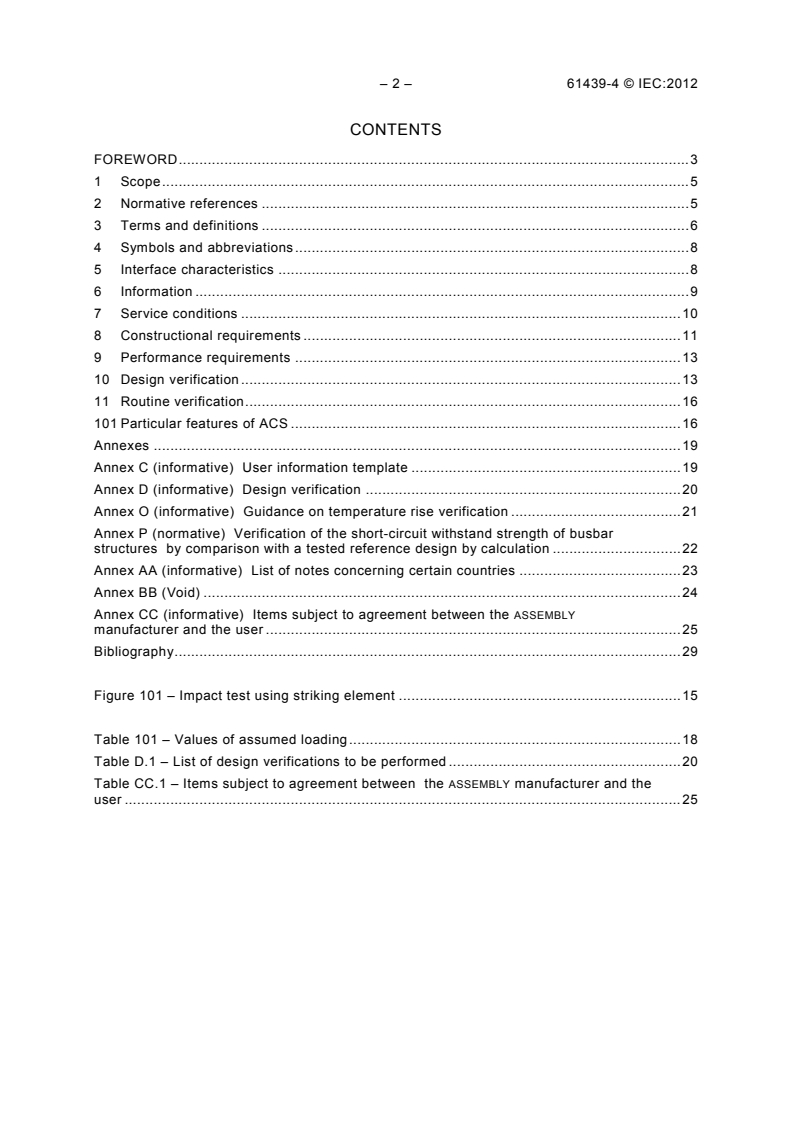
– 2 – 61439-4 © IEC:2012
CONTENTS
FOREWORD . 3
1 Scope . 5
2 Normative references . 5
3 Terms and definitions . 6
4 Symbols and abbreviations . 8
5 Interface characteristics . 8
6 Information . 9
7 Service conditions . 10
8 Constructional requirements . 11
9 Performance requirements . 13
10 Design verification . 13
11 Routine verification . 16
101 Particular features of ACS . 16
Annexes . 19
Annex C (informative) User information template . 19
Annex D (informative) Design verification . 20
Annex O (informative) Guidance on temperature rise verification . 21
Annex P (normative) Verification of the short-circuit withstand strength of busbar
structures by comparison with a tested reference design by calculation . 22
Annex AA (informative) List of notes concerning certain countries . 23
Annex BB (Void) . 24
Annex CC (informative) Items subject to agreement between the ASSEMBLY
manufacturer and the user . 25
Bibliography . 29
Figure 101 – Impact test using striking element . 15
Table 101 – Values of assumed loading . 18
Table D.1 – List of design verifications to be performed . 20
Table CC.1 – Items subject to agreement between the ASSEMBLY manufacturer and the
user . 25
61439-4 © IEC:2012 – 3 –
INTERNATIONAL ELECTROTECHNICAL COMMISSION
____________
LOW-VOLTAGE SWITCHGEAR AND
CONTROLGEAR ASSEMBLIES –
Part 4: Particular requirements for assemblies
for construction sites (ACS)
FOREWORD
1) The International Electrotechnical Commission (IEC) is a worldwide organization for standardization comprising
all national electrotechnical committees (IEC National Committees). The object of IEC is to promote
international co-operation on all questions concerning standardization in the electrical and electronic fields. To
this end and in addition to other activities, IEC publishes International Standards, Technical Specifications,
Technical Reports, Publicly Available Specifications (PAS) and Guides (hereafter referred to as “IEC
Publication(s)”). Their preparation is entrusted to technical committees; any IEC National Committee interested
in the subject dealt with may participate in this preparatory work. International, governmental and non-
governmental organizations liaising with the IEC also participate in this preparation. IEC collaborates closely
with the International Organization for Standardization (ISO) in accordance with conditions determined by
agreement between the two organizations.
2) The formal decisions or agreements of IEC on technical matters express, as nearly as possible, an international
consensus of opinion on the relevant subjects since each technical committee has representation from all
interested IEC National Committees.
3) IEC Publications have the form of recommendations for international use and are accepted by IEC National
Committees in that sense. While all reasonable efforts are made to ensure that the technical content of IEC
Publications is accurate, IEC cannot be held responsible for the way in which they are used or for any
misinterpretation by any end user.
4) In order to promote international uniformity, IEC National Committees undertake to apply IEC Publications
transparently to the maximum extent possible in their national and regional publications. Any divergence
between any IEC Publication and the corresponding national or regional publication shall be clearly indicated in
the latter.
5) IEC itself does not provide any attestation of conformity. Independent certification bodies provide conformity
assessment services and, in some areas, access to IEC marks of conformity. IEC is not responsible for any
services carried out by independent certification bodies.
6) All users should ensure that they have the latest edition of this publication.
7) No liability shall attach to IEC or its directors, employees, servants or agents including individual experts and
members of its technical committees and IEC National Committees for any personal injury, property damage or
other damage of any nature whatsoever, whether direct or indirect, or for costs (including legal fees) and
expenses arising out of the publication, use of, or reliance upon, this IEC Publication or any other IEC
Publications.
8) Attention is drawn to the Normative references cited in this publication. Use of the referenced publications is
indispensable for the correct application of this publication.
9) Attention is drawn to the possibility that some of the elements of this IEC Publication may be the subject of
patent rights. IEC shall not be held responsible for identifying any or all such patent rights.
International Standard IEC 61439-4 has been prepared by subcommittee 17D: Low-voltage
switchgear and controlgear assemblies, of IEC technical committee 17: Switchgear and
controlgear.
This first edition of IEC 61439-4 cancels and replaces the second edition of IEC 60439-4
(2004), and constitutes a technical revision.
This edition includes the following significant technical changes with respect to the last edition
of IEC 60439-4:
• modification of the title as “Part 4: Particular requirements for assemblies for construction
sites (ACS)”
• alignment on IEC 61439-1 regarding the structure and technical content, as applicable;
• to allow comparison with tested ACS.
– 4 – 61439-4 © IEC:2012
The text of this standard is based on the following documents:
FDIS Report on voting
17D/460/FDIS 17D/469/RVD
Full information on the voting for the approval of this standard can be found in the report on
voting indicated in the above table.
This publication has been drafted in accordance with the ISO/IEC Directives, Part 2.
This standard is to be read in conjunction with IEC 61439-1. The provisions of the general
rules dealt with in IEC 61439-1 (hereinafter referred to as Part 1) are only applicable to this
standard insofar as they are specifically cited. When this standard states “addition”,
“modification” or “replacement”, the relevant text in Part 1 is to be adapted accordingly.
Subclauses that are numbered with a 101 (102, 103, etc.) suffix are additional to the same
subclause in Part 1.
Tables and figures in this Part 4 that are new are numbered starting with 101.
New annexes in this Part 4 are lettered AA, BB, etc.
In this standard, terms written in small capitals are defined in Clause 3.
The reader’s attention is drawn to the fact that Annex AA lists all of the “in-some-country”
clauses on differing practices of a less permanent nature relating to the subject of this
standard.
A list of all parts of the IEC 61439 series, under the general title Low-voltage switchgear and
controlgear assemblies, can be found on the IEC website.
The committee has decided that the contents of this publication will remain unchanged until
the stability date indicated on the IEC web site under "http://webstore.iec.ch" in the data
related to the specific publication. At this date, the publication will be
• reconfirmed,
• withdrawn,
• replaced by a revised edition, or
• amended.
61439-4 © IEC:2012 – 5 –
LOW-VOLTAGE SWITCHGEAR AND
CONTROLGEAR ASSEMBLIES –
Part 4: Particular requirements for assemblies
for construction sites (ACS)
1 Scope
NOTE Throughout this standard, the abbreviation ACS (ASSEMBLY for construction site, see 3.1.101) is used for
a low-voltage switchgear and controlgear assembly intended for use on construction and similar sites.
This part of 61439 defines the specific requirements of ACS as follows:
– ASSEMBLIES for which the rated voltage does not exceed 1 000 V in case of a.c. or 1 500 V
in case of d.c.;
– ASSEMBLIES where the nominal primary voltage and the nominal secondary voltage of
transformers incorporated in ACS are within the limits specified above;
– ASSEMBLIES intended for use on construction sites, both indoors and outdoors, i.e.
temporary places of work to which the public do not generally have access and where
building construction, installation, repairs, alteration or demolition of property (buildings)
or civil engineering (public works) or excavation or any other similar operations are carried
out;
– transportable (semi-fixed) or mobile ASSEMBLIES with enclosure.
The manufacture and/or assembly may be carried out other than by the original manufacturer.
This standard does not apply to individual devices and self-contained components, such as
motor starters, fuse switches, electronic equipment, etc. which will comply with the relevant
product standards.
This standard does not apply to ASSEMBLIES for use in the administrative centres of
construction sites (offices, cloakrooms, ASSEMBLY rooms, canteens, restaurants, dormitories,
toilets, etc.).
Requirements for electrical protection provided by equipment manufactured according to this
International Standard are given in IEC 60364-7-704.
2 Normative references
This clause of Part 1 is applicable except as follows:
Addition:
IEC 60068-2-27:2008, Environmental testing − Part 2-27: Tests – Test Ea and guidance:
Shock
IEC 60068-2-42:2003, Environmental testing − Part 2-42: Tests – Test Kc: Sulphur dioxide
test for contacts and connections
IEC 60364-7-704:2005, Low-voltage electrical installations − Part 7-704: Requirements for
special installations or locations – Construction and demolition site installations
– 6 – 61439-4 © IEC:2012
IEC 61140:2001, Protection against electric shock – Common aspects for installation and
equipment
IEC 61439-1:2011, Low-voltage switchgear and controlgear assemblies – Part 1: General
rules
IEC 61558-2-23, Safety of transformers, reactors, power supply units and combinations
thereof – Part 2-23: Particular requirements and tests for transformers and power supply units
for construction sites
3 Terms and definitions
This clause of Part 1 is applicable except as follows:
Additional terms:
3.1 General terms
3.1.101
low-voltage switchgear and controlgear assembly for construction sites
ACS
combination of one or several transforming or low voltage switching devices with associated
control, measuring, signalling, protective and regulating equipment complete with all their
internal electrical and mechanical connections and structural parts, designed and built for use
on all construction sites, indoors and outdoors
3.2 Constructional units of ASSEMBLIES
3.2.101
metering unit
functional unit equipped with apparatus for metering electrical energy
3.2.102
transformer unit
functional unit consisting mainly of one or several transformers
Modifications:
3.3 External design of ASSEMBLIES
3.3.1
open-type ASSEMBLY
This term of Part 1 does not apply.
3.3.2
dead-front ASSEMBLY
This term of Part 1 does not apply.
Replacements:
3.3.3
enclosed ACS
ACS which is enclosed on all sides with the possible exception of its mounting surface in such
a manner as to provide a defined degree of protection
61439-4 © IEC:2012 – 7 –
3.3.7
box-type ACS
enclosed ACS intended:
– either to be mounted on a vertical surface;
– or to stand on a horizontal surface supported by feet or legs (articulated or not) or by a
mounting not forming part of the ACS (see 3.4.2 of Part 1)
Modifications:
3.5 Conditions of installation of ASSEMBLIES
3.5.1
ASSEMBLY for indoor installation
This term of Part 1 does not apply (see 3.1.101).
3.5.2
ASSEMBLY for outdoor installation
This term of Part 1 does not apply (see 3.1.101).
3.5.3
stationary ASSEMBLY
This term of Part 1 does not apply.
3.5.4
movable ASSEMBLY
This term of Part 1 does not apply.
Additional terms:
3.5.101
transportable ACS
semi-fixed ACS
ACS intended for use in a place where it is not permanently fixed; its location may vary during
work on the same site. When the equipment is to be moved to another place, it is first
disconnected from the supply
3.5.102
mobile ACS
ACS capable of being moved as work advances on the site, without being disconnected from
the supply
Additional terms:
3.101 Function of the ACS
3.101.1
incoming supply function
suitability for connection of the ACS either to electricity public supply network or to the
transformer substation or to on site generator
3.101.2
metering function
suitability for the metering of electrical energy consumed on the site
– 8 – 61439-4 © IEC:2012
3.101.3
distribution function
suitability to provide the distribution and protection of electrical supply on the construction site
by means of terminal connection or socket-outlets
3.101.4
transformer function
suitability to provide means for transformer voltages or to provide measures of electrical
protection
Note 1 to entry: Details for their requirements are given in 101.1.
4 Symbols and abbreviations
This clause of Part 1 is applicable.
5 Interface characteristics
This clause of Part 1 is applicable except as follows.
5.3.1 Rated current of the ASSEMBLY (I )
nA
Replacement of title and text:
5.3.1 Rated current of an ACS (I )
nA
The rated current of an ACS is that of its incoming circuit.
This current shall be carried without the temperature rise of the individual parts exceeding the
limits specified in 9.2 of Part 1.
5.4 Rated diversity factor (RDF)
Addition:
ACS or group of outgoing circuits shall be
The assumed loading of the outgoing circuits of the
declared by the ASSEMBLY manufacturer, and may be based on the values in Table 101.
When the manufacturer does not declare any RDF the values of Table 101 apply.
5.6 Other characteristics
Replacement:
The following characteristics shall be declared:
a) the function(s) assigned by the manufacturer (see 3.101);
b) the external design (see 3.3);
c) the mobility (see 3.5.101 and 3.5.102);
d) the degree of protection (see 8.2);
e) the method of mounting, for example fixed or removable parts (see 8.5.1 and 8.5.2);
f) protection against electric shock (see 8.4);
g) the resistance to corrosion (see 10.2.2.101);
h) special service conditions, if applicable (see 7.2);
61439-4 © IEC:2012 – 9 –
i) electromagnetic compatibility (EMC) classification (see Annex J of Part 1).
6 Information
This clause of Part 1 is applicable except as follows.
6.1 ASSEMBLY designation marking
Replacement of title and text:
6.1 ACS designation marking
The ASSEMBLY manufacturer shall provide each ACS with one or more labels, marked in a
durable manner and located in a place such that they are visible and legible when the ACS is
installed and in operation.
Compliance is checked according to the test of 10.2.7 and by inspection.
The following information regarding the ACS shall be provided on the label(s):
a) ASSEMBLY manufacturer's name or trade mark (see 3.10.2);
b) type designation or identification number or any other means of identification, making it
possible to obtain relevant information from the ASSEMBLY manufacturer;
c) means of identifying date of manufacture;
d) IEC 61439-4;
e) type of current (and the frequency in the case of a.c.);
f) rated voltage (U ) (of the ACS) (see 5.2.1);
n
g) rated current of the ACS (I ) (see 5.3.1);
nA
h) degree of protection (see 8.2);
i) the weight where this exceeds 30 kg.
If the indication of the name or trademark of the manufacturer appears on the ACS it need not
be given on the nameplate.
ASSEMBLY
6.2.1 Information relating to the
Replacement of title and text:
6.2.1 Information relating to the ACS
The following additional information, where applicable, shall be provided in the ASSEMBLY
manufacturer’s technical documentation supplied with the ACS:
a) rated operational voltage (U ) (of a circuit) (see 5.2.2);
e
b) rated impulse withstand voltage (U ) (see 5.2.4);
imp
c) rated insulation voltage (U ) (see 5.2.3);
i
d) rated current of each circuit (I ) (see 5.3.2);
nc
e) rated peak withstand current (I ) (see 5.3.4);
pk
f) rated short-time withstand current (I ) together with its duration (see 5.3.4);
cw
g) rated conditional short-circuit current (I ) (see 5.3.5);
cc
h) rated frequency (f ) (see 5.5);
n
i) rated diversity factor(s) (RDF) (see 5.4);
j) functions (see 3.101);
– 10 – 61439-4 © IEC:2012
k) all necessary information relating to the other declared classifications and characteristics
(see 5.6);
l) the short-circuit withstand strength and characteristics of short-circuit protective device(s)
(see 9.3.2);
m) overall dimensions (including projections e.g handles, covers, doors).
6.2.2 Instructions for handling, installation, operation and maintenance
Addition:
The manufacturer of the ACS should specify in its technical documentation supplied with the
ACS the other types of assemblies which may be connected to it. This information should
indicate whether the compatibility is based upon the type of system earthing employed and/or
on the need for co-ordination of the electrical protection within the complete installation.
The manufacturer should furnish the appropriate documentation for the purpose to maintain
the protective measures and the co-ordination of the protective devices within the complete
installation.
7 Service conditions
This clause of Part 1 is applicable except as follows.
Modifications:
7.1.1 Ambient air temperature
This subclause of Part 1 is not applicable.
Replacement of title and text:
7.1.1 Ambient air temperature for ACS installations
The ambient air temperature does not exceed +40 °C and its average over a period of 24 h
does not exceed +35 °C.
The lower limit of the ambient air temperature is –25 °C.
7.1.2 Humidity conditions
This subclause of Part 1 is not applicable.
Replacement of title and text:
7.1.2 Humidity conditions for ACS installations
The relative humidity may temporarily be as high as 100 % at a maximum temperature of
+25 °C.
7.1.3 Pollution degree
Replacement of the last paragraph with:
Only pollution degrees 3 and 4 are applicable.
The micro environment may be reduced to pollution degree 2 if the degree of protection of the
enclosure is at least IP5X and care is taken to avoid condensation.
61439-4 © IEC:2012 – 11 –
7.2 Special service conditions
Addition of the following new item:
m) heavily polluted atmosphere.
8 Constructional requirements
This clause of Part 1 is applicable except as follows.
8.1.1 General
Addition:
All the apparatus shall be placed inside the enclosure fitted with such removable panels,
cover plates or doors as may be required for connection or maintenance with the possible
exception of the items mentioned in 8.101 provided that they withstand the service conditions
of Clause 7 and the requirements of 8.1.2 and 8.1.6.
8.1.2 Protection against corrosion
Replacement:
Protection against corrosion shall be ensured by the use of suitable materials or by protective
coatings to the exposed surface taking account of the normal service conditions (see 7.1)
and/or special service condition (see 7.2). Compliance to this requirement is checked by the
test of 10.2.2.
8.1.4 Resistance to ultra-violet radiation
Replacement:
For enclosures and external parts made of insulating materials, resistance to ultra-violet
radiation shall be verified according to 10.2.4.
For external parts made of insulating material of components covered by other IEC standard
(for examples socket-outlets, handles of switch, push buttons etc) this test is not required.
8.1.5 Mechanical strength
Addition:
The ACS shall be constructed to withstand mechanical shocks having an acceleration of
500 m/s , a pulse shape of a half-sine wave of 11 ms duration (commensurate with equipment
being carried loose in normal road or rail vehicles for long periods).
Compliance is verified according to 10.2.6.
8.1.6 Lifting provision
Replacement:
Lifting rings and/or handles (or any other equivalent system) shall be provided on the ACS
and be firmly attached to the enclosure or supporting framework.
Compliance is checked according to the test of 10.2.5.
– 12 – 61439-4 © IEC:2012
8.2.1 Protection against mechanical impact
Additional paragraph:
The ACS shall also withstand impacts of 6 joules energy representing collisions with site
construction mechanical handling equipment (see IEC 60068-2-27).
For protection against mechanical impact refer to 10.2.6.
8.2.2 Protection against contact with live parts, ingress of solid foreign bodies and
water
Replacement:
The degree of protection provided by an ACS against contact with live parts, ingress of solid
foreign bodies and water is indicated by the IP code according to IEC 60529 and verified
according to 10.3.
The degree of protection of the ACS shall be at least IP 44, with all doors closed and all
removable panels and cover plates fitted.
Ventilation and drainage holes shall not reduce this degree of protection.
The degree of protection for an operating face inside a door shall be not less than IP 21
provided that the door can be closed under all conditions of use. Where the door cannot be
closed the degree of protection for the operating face shall be at least IP 44.
Unless otherwise specified, the degree of protection indicated by the original manufacturer
applies to the complete ACS, when it is installed in accordance with the original
manufacturer's instructions.
Socket-outlets not protected by the enclosure of the ACS shall have a degree of protection at
least equivalent to IP 44, both when the plug is removed or fully inserted.
Where the ACS does not have the same IP rating throughout, the original manufacturer shall
declare in its technical documentation supplied with the ACS the IP rating for the separate
parts.Example: IP 44, operating face IP 21.
No IP codes may be given unless the appropriate verifications have been made according to
10.3.
8.4.3.1 Installation conditions
Replacement of the first two paragraphs:
The ACS shall include protective measures and be suitable for installations designed to be in
accordance with IEC 60364-7-704.
8.4.4 Protection by total insulation
e) This item of Part 1 is not applicable.
8.4.6.2 Requirements related to accessibility in service by authorized persons
This subclause of Part 1 is not applicable.
61439-4 © IEC:2012 – 13 –
8.5.3 Selection of switching devices and components
Additional paragraphs:
Plugs of different rated currents or voltages shall not be interchangeable, so as to avoid
errors in connecting (see IEC 60309-1 and IEC 60309-2).
Connections for three-phase socket-outlets shall be made in such a way as to retain the same
order of phases.
Additional subclause:
8.5.101 Accessible parts of ACS
Only the socket-outlets, operating handles and control buttons may be accessible without the
use of a key or tool. The actuator of the main switch shall be easily accessible (see
704.536.2.2 of IEC 60364-7-704:2005).
8.8 Terminals for external conductors
Addition after the third paragraph:
All connections for external cables shall be re-wireable or shall be socket-outlets. Socket-
outlets shall conform with the relevant standards and have a current rating of at least 16 A.
Additional subclauses:
8.101 Supports and securing devices of ACS
Every ACS shall be fitted with supports enabling it to stand on a horizontal surface (e.g. feet
or legs, articulated or not) and/or a system for fixing it to a vertical wall, attached to the
enclosure or supporting framework.
These various supports or securing devices shall be external to the enclosure but firmly
attached to it. They shall be appropriate to the constructional features (weight, environment,
etc.) and service characteristics of the ACS and shall be tested together with the ACS
(Clause 10).
8.102 Cable outlet
The cable outlet shall be at a minimum distance from the ground compatible with the bending
radius of the largest cable that may be connected to the ACS.
Compliance is checked by inspection.
9 Performance requirements
This clause of Part 1 is applicable except as follows.
9.3.2 Information concerning short-circuit withstand strength
The last two paragraphs of this subclause of Part 1 are not applicable.
10 Design verification
This clause of Part 1 is applicable except as follows.
– 14 – 61439-4 © IEC:2012
10.2.1 General
Replacement of second paragraph:
Where an empty enclosure in accordance with IEC 62208 is used, and it has not been
modified so as to degrade the performance of the enclosure, no repetition of the enclosure
testing to 10.2, with the exception of 10.2.6, is required unless the ACS is declared for heavily
polluted atmosphere (see 7.2 item m)).
Additional subclause:
10.2.2.101 Verification of resistance to corrosion in a heavily polluted atmosphere
a) Principle
This test is intended to assess the corrosive effects of an industrial atmosphere, i.e. an
atmosphere polluted with sulphur dioxide.
The complete and fully equipped ACS shall be continuously exposed to this atmosphere
for ten days.
b) Method of test and test atmosphere
The complete and fully equipped ACS shall be tested in accordance with IEC 60068-2-42.
c) Results to be obtained
The ACS is declared satisfactory, if
– no trace of corrosion is found either inside or outside (except for the sharp edges) and;
– no damaging effect appears in the ACS, verified by applying the tests of 10.9.1 of Part
1, between 24 h and 36 h after the ACS has been removed from the test chamber.
10.2.6 Mechanical impact
Replacement of title and text:
10.2.6 Verification of mechanical strength
10.2.6.1 General
a) These tests shall be applied to the ACS, the test sample being in working order but
disconnected from the sample supply.
The test sample shall be completely unpackaged.
b) The tests include two distinct procedures:
– impact test;
– shock test.
Tests shall be carried out at an ambient air temperature of (20 ± 5) °C after the ACS has been
kept at this temperature for at least 12 h.
10.2.6.2 Impact test
a) Principle
The complete ACS (with all components mounted inside and fitted on suitable supports
and securing devices (see 8.101) if these form part of the ACS) shall be subjected to a
series of impacts of 6 joules applied to the enclosure (not to the components inside it)
(see 8.1.6).
b) Method of test
The equipment to be tested shall be fixed on a support of adequate rigidity to restrict
movement of the ACS to 0,1 mm under the effect of the prescribed impact. Three
61439-4 © IEC:2012 – 15 –
successive impacts shall be applied to each face of the ACS under test by means of
either:
1) a solid smooth steel sphere approximately 50 mm in diameter and with a mass of
(500 ± 25) g, which shall be allowed to fall freely from rest through a vertical height of
1,2 m onto the enclosure surface held in a horizontal plane. The hardness of the
sphere shall be not less than 50 HR and not more than 58 HR, or
2) a similar steel sphere, shall be suspended by a cord and swing as a pendulum in order
to apply a horizontal impact, falling through a vertical distance of 1,2 m.
See Figure 101 for the test setup.
Sloping surfaces may be tested using the pendulum but if this is not convenient the
surface will be aligned in the horizontal plane by turning the unit on the support and the
test 1) is used. Before each test an inspection of the sphere shall be made to ensure that
it is free of burrs and defects.
The test shall be so arranged that the impacts are applied at positions where weaknesses
are most likely to be revealed. A total of 18 impacts shall be applied to the ACS.
The test is not applicable to components such as socket-outlets, operating handles,
illuminating lights, pushbuttons, actuators, etc., when these components are mounted in
recesses with respect to the main surfaces, so that the distance between the most
exposed parts of these components and the said surfaces is at least 1 cm.
Striking element
start position
Rigid backing
Striking element
support
start position
Striking element
Test
impact position
sample
Test
sample
Striking element
impact position
Rigid supporting surface Rigid supporting surface
IEC 2088/12
Figure 101 – Impact test using striking element
10.2.6.3 Shock test
a) Principle
The ACS shall be subjected to a single pulse half-sine wave, the shock test having a
severity of 500 m/s (50 g) peak acceleration and a duration of 11 ms.
b) Method of test
The ACS in working order shall be tested according to IEC 60068-2-27. Subject to
agreement between manufacturer and user, the test may be carried out at separate
sections of the ACS.
10.2.6.4 Results to be obtained
After the test, the enclosure shall continue to provide the degrees of protection specified in
8.2.2; any distortions or deformations of the enclosure and components shall neither be
detrimental to the proper functioning of the ACS nor decrease creepage distances and
clearances to below the required values; actuators, handles, etc., shall still be operable.
H = 1, 2 m
H = 1, 2 m
– 16 – 61439-4 © IEC:2012
Distortion or deformation of plastic parts that can return in correct position by simple action
(such as opening and reclosing of the cover) are not considered to be detrimental to the
proper functioning of the ACS.
Superficial damage, paint removals, small indentations, cracks not visible with normal or
corrected vision without further magnification, or surface cracks shall not constitute failure of
the test.
10.9.3.1 General
Replacement of first paragraph:
Verification shall be made by test.
10.10.1 General
Modification:
Item c) of this subclause of Part 1 is not applicable.
10.10.4 Verification assessment
This subclause of Part 1 is not applicable.
11 Routine verification
This clause of Part 1 is applicable.
Additional clause:
101 Particular features of ACS
101.1 General requirements and functions
An ACS consists of one incoming unit and one or more outgoing units and may incorporate
metering unit(s) and transformer unit(s).
Outgoing unit(s) may provide different functions such as: supply other ACS, lighting,
machines or electric tools or other construction site equipment.
An ACS may be intended to be interconnected to form an installation or part of an installation
in the form of a series of ACS. Apart from all their characteristics, they are covered by the
same rules for protection against electric shock and provide, if possible, selective protection
by a suitable choice, for example of breaking capacity, current setting and operating time.
These various characteristics are laid down by the manufacturer or are the subject of an
agreement between manufacturer and user taking into account the nature of supply and/or
distribution network and relevant installation requirements.
According to the relevant installation standards IEC 60364 series SPDs should be considered
to protect against overvoltages.
101.2 Incoming unit
The cable connection facilities (terminals, connecting devices, connectors or plug and socket-
outlet accessory) shall be compatible with the current rating of the ACS.
61439-4 © IEC:2012 – 17 –
An isolating device and an over-current protective device shall be provided.
There shall be means for securing the isolating device in the open position.
However, the over-current protective device may be omitted if the ACS is adequately
protected by an over-current protective device located in an upstream (supplying) ACS. In this
case the ASSEMBLY manufacturer shall provide the relevant information to the user for the
correct choice of the upstream device.
According to IEC 60364-5-53, plug and socket-outlet arrangements may be used as isolating
devices.
101.3 Metering unit
The metering unit is to be designed by or in agreement with the energy suppliers if it is
intended to accept metering device(s) to measure the energy consumed for the purpose of
payment of energy to the said suppliers.
Metering units not intended for the purpose of payment of energy to the suppliers need not be
designed by or in agreement with those suppliers.
101.4 Transformer unit
101.4.1 General
This unit may include a low-voltage/extra low-voltage (LV/ELV) transformer and/or low-
voltage/low-voltage transformer units (LV/LV).
101.4.2 LV/ELV unit
This unit may be either of the LV/SELV or of the LV/PELV type.
The requirements of IEC 61140, IEC 60364-4-41:2005, Clause 441 and IEC/TS 61201 apply.
NOTE IEC/TR 61200-704 recommends the use of PELV only for heating concrete.
This type of unit essentially consists of:
a) the protective and control devices in the primary circuit;
b) the transformer, which shall be in accordance with IEC 61558-2-23;
c) the protective and control devices for the output circuit(s).
101.4.3 LV/LV units
The requirements of IEC 60364-4-41:2005, Clause 413 apply.
Each LV/LV unit consists essentially of:
a) the protective and control devices on the primary circuit;
b) the LV/LV transformer, which shall be an isolating transformer in accordance with
IEC 61558-2-23;
c) the protective and control devices for the output circuit(s);
d) the outlets, either terminals or socket-outlets. Socket-outlets shall be protected as
required in 101.5 d).
Notwithstanding item b), the transformer need not to be an isolating transformer if the neutral
point is connected by a cable to an earthing terminal outside the enclosure. This cable shall
– 18 – 61439-4 © IEC:2012
be identified by a label placed inside the enclosure as close as possible to the terminal. Also
in this case requirements a), c) and d) apply.
101.5 Outgoing units
Each unit consists of one or several outgoing circuits.
a) There shall be means for isolation, load switching, over-current protection and protection
against indirect contact. These functions may be provided by one or more devices.
b) The load switching device shall be easily accessible without the use of a key or tool in
normal use.
NOTE This means that an ACS may have doors closed by key or tools for other purposes ( e.g. closing at the
end of working time) and they are opened during the normal use.
c) The switching device shall operate simultaneously on all poles and involve all the phase
conductors. For switching the neutral conductor see IEC 60364-5-53:2001, Clause 536.
d) The connection of the outgoing circuits may made with socket outlets or by terminals for
direct connection.
e) Socket-outlets shall be protected:
– against direct contact or indirect contact according to IEC 60364-7-704:2005,
Clause 704-4;
Where RCD’s are used as means of protection, one RCD may protect several socket-
outlets. However, consideration should be given to the effects of unintended tripping
e.g. when the RCD protects more than 6 socket outlet.
Where RCD are used consideration should be given to the nature of the load e.g. the
presence of high frequency and/or d.c. components.
– against overcurrent with protective devices with a rated current not exceeding the
rated current of the socket-outlet. A protective device may protect more than one
socket-outlet (not applicable to IT systems).
Consideration should be given to effects of unintended tripping e.g. when an
overcurrent protective device protects more than one socket outlet.
Addition:
Table 101 – Values of assumed loading
Type of load Assumed loading factor
Distribution – 2 and 3 circuits 0,9
Distribution – 4 and 5 circuits 0,8
Distribution – 6 to 9 circuits 0,7
Distribution – 10 or more circuits 0,6
61439-4 © IEC:2012 – 19 –
Annexes
The annexes of Part 1 are applicable except as follows:
Annex C
(informative)
User information template
This annex of Part 1 is not applicable.
– 20 – 61439-4 © IEC:2012
Annex D
(
...