

IEC 60092-201:2019
(Main)Electrical installations in ships - Part 201: System design - General
General Information
- Abstract
IEC 60092-201:2019 is applicable to the main features of system design of electrical installations for use in ships.This fifth edition cancels and replaces the fourth edition, published in 1994. It constitutes a technical revision.
This edition includes the following significant technical changes with respect to the previous edition:
a) a new subclause regarding studies and calculations has been added;
b) a new subclause regarding documentation has been added;
c) the clause regarding distribution systems has been rewritten;
d) a clause regarding system earthing has been added;
e) the clause regarding sources of electrical power has been rewritten;
f) the clause regarding distribution system requirements has been rewritten;
g) the clause regarding cables has been deleted and transferred to IEC 60092-401;
h) a new subclause regarding electric and electrohydraulic steering gear has been added.
- Status
- Published
- Publication Date
- 15-Sep-2019
- Drafting Committee
- MT 2 - TC 18/MT 2
- Current Stage
- PPUB - Publication issued
- Start Date
- 16-Sep-2019
- Completion Date
- 23-Aug-2019
Overview - IEC 60092-201:2019 (Electrical installations in ships - System design: General)
IEC 60092-201:2019 is the fifth edition of the IEC guidance for system design of shipboard electrical installations. It updates and replaces the 1994 edition and provides general requirements for the design, safe operation and documentation of electrical power systems used in ships. The standard addresses core aspects such as system studies and calculations, distribution system arrangements, sources of electrical power, system earthing and specific shipboard functions (for example electric/electrohydraulic steering gear).
Key topics and technical requirements
- System studies and calculations: requirements for electrical load studies, short‑circuit studies, protection and discrimination studies, load‑flow and harmonic assessments.
- Documentation: minimum documentation expected (apparatus descriptions, single‑line diagrams, overview drawings, protection settings, circuit diagrams, FAT/HAT/SAT reports).
- Distribution systems: rewritten clauses covering DC and AC distribution topologies, primary and secondary systems, control voltages and methods of distribution.
- System earthing: new clause on neutral earthing methods, generator/transformer earthing and connection of earthing resistors to hull/structure.
- Sources of electrical power: reorganized guidance on arrangement, operability, bus‑tie breakers, starting from dead ship conditions, load shedding and emergency/additional power provisions.
- Distribution system requirements: practical rules for final sub‑circuits (lighting, heating, control), socket‑outlets, shore connections, motor circuits, luminaries, communication, navigation and permanently installed bilge pumps.
- Steering gear: new subclause addressing electric and electrohydraulic steering gear design, separation, controls and communications.
- Cables: clause removed and transferred to IEC 60092-401 (see Related Standards).
Practical applications - who uses IEC 60092-201
- Marine electrical engineers and ship designers relying on best practices for shipboard power system layout and safety.
- Shipyards and integrators preparing system studies, documentation and factory/harbour acceptance testing (FAT/HAT/SAT).
- Classification societies, flag administrations and certifying bodies assessing compliance of electrical system design.
- Owners/operators and naval architects planning redundancy, emergency power and load‑shedding strategies.
Using IEC 60092-201 helps ensure safe, interoperable, and code‑compliant ship electrical systems that support reliable operation at sea and in port.
Related standards
- IEC 60092 series (shipboard electrical installations)
- IEC 60092-401 (cables for ships) - cables clause transferred here
- IEC 60529 (degrees of protection / IP coding) - referenced for enclosure protection levels
Keywords: IEC 60092-201:2019, electrical installations in ships, ship electrical system design, system earthing, distribution systems, sources of electrical power, marine electrical standards.
Get Certified
Connect with accredited certification bodies for this standard

DNV
DNV is an independent assurance and risk management provider.

Lloyd's Register
Lloyd's Register is a global professional services organisation specialising in engineering and technology.

FSC International
Forest Stewardship Council certification.
Sponsored listings
Frequently Asked Questions
IEC 60092-201:2019 is a standard published by the International Electrotechnical Commission (IEC). Its full title is "Electrical installations in ships - Part 201: System design - General". This standard covers: IEC 60092-201:2019 is applicable to the main features of system design of electrical installations for use in ships.This fifth edition cancels and replaces the fourth edition, published in 1994. It constitutes a technical revision. This edition includes the following significant technical changes with respect to the previous edition: a) a new subclause regarding studies and calculations has been added; b) a new subclause regarding documentation has been added; c) the clause regarding distribution systems has been rewritten; d) a clause regarding system earthing has been added; e) the clause regarding sources of electrical power has been rewritten; f) the clause regarding distribution system requirements has been rewritten; g) the clause regarding cables has been deleted and transferred to IEC 60092-401; h) a new subclause regarding electric and electrohydraulic steering gear has been added.
IEC 60092-201:2019 is applicable to the main features of system design of electrical installations for use in ships.This fifth edition cancels and replaces the fourth edition, published in 1994. It constitutes a technical revision. This edition includes the following significant technical changes with respect to the previous edition: a) a new subclause regarding studies and calculations has been added; b) a new subclause regarding documentation has been added; c) the clause regarding distribution systems has been rewritten; d) a clause regarding system earthing has been added; e) the clause regarding sources of electrical power has been rewritten; f) the clause regarding distribution system requirements has been rewritten; g) the clause regarding cables has been deleted and transferred to IEC 60092-401; h) a new subclause regarding electric and electrohydraulic steering gear has been added.
IEC 60092-201:2019 is classified under the following ICS (International Classification for Standards) categories: 47.020.60 - Electrical equipment of ships and of marine structures. The ICS classification helps identify the subject area and facilitates finding related standards.
IEC 60092-201:2019 is available in PDF format for immediate download after purchase. The document can be added to your cart and obtained through the secure checkout process. Digital delivery ensures instant access to the complete standard document.
Standards Content (Sample)
IEC 60092-201 ®
Edition 5.0 2019-09
INTERNATIONAL
STANDARD
Electrical installations in ships –
Part 201: System design – General
All rights reserved. Unless otherwise specified, no part of this publication may be reproduced or utilized in any form
or by any means, electronic or mechanical, including photocopying and microfilm, without permission in writing from
either IEC or IEC's member National Committee in the country of the requester. If you have any questions about IEC
copyright or have an enquiry about obtaining additional rights to this publication, please contact the address below or
your local IEC member National Committee for further information.
IEC Central Office Tel.: +41 22 919 02 11
3, rue de Varembé info@iec.ch
CH-1211 Geneva 20 www.iec.ch
Switzerland
About the IEC
The International Electrotechnical Commission (IEC) is the leading global organization that prepares and publishes
International Standards for all electrical, electronic and related technologies.
About IEC publications
The technical content of IEC publications is kept under constant review by the IEC. Please make sure that you have the
latest edition, a corrigendum or an amendment might have been published.
IEC publications search - webstore.iec.ch/advsearchform Electropedia - www.electropedia.org
The advanced search enables to find IEC publications by a The world's leading online dictionary on electrotechnology,
variety of criteria (reference number, text, technical containing more than 22 000 terminological entries in English
committee,…). It also gives information on projects, replaced and French, with equivalent terms in 16 additional languages.
and withdrawn publications. Also known as the International Electrotechnical Vocabulary
(IEV) online.
IEC Just Published - webstore.iec.ch/justpublished
Stay up to date on all new IEC publications. Just Published IEC Glossary - std.iec.ch/glossary
details all new publications released. Available online and 67 000 electrotechnical terminology entries in English and
once a month by email. French extracted from the Terms and Definitions clause of
IEC publications issued since 2002. Some entries have been
IEC Customer Service Centre - webstore.iec.ch/csc collected from earlier publications of IEC TC 37, 77, 86 and
If you wish to give us your feedback on this publication or CISPR.
need further assistance, please contact the Customer Service
Centre: sales@iec.ch.
IEC 60092-201 ®
Edition 5.0 2019-09
INTERNATIONAL
STANDARD
Electrical installations in ships –
Part 201: System design – General
INTERNATIONAL
ELECTROTECHNICAL
COMMISSION
ICS 47.020.60 ISBN 978-2-8322-7201-5
– 2 – IEC 60092-201:2019 © IEC 2019
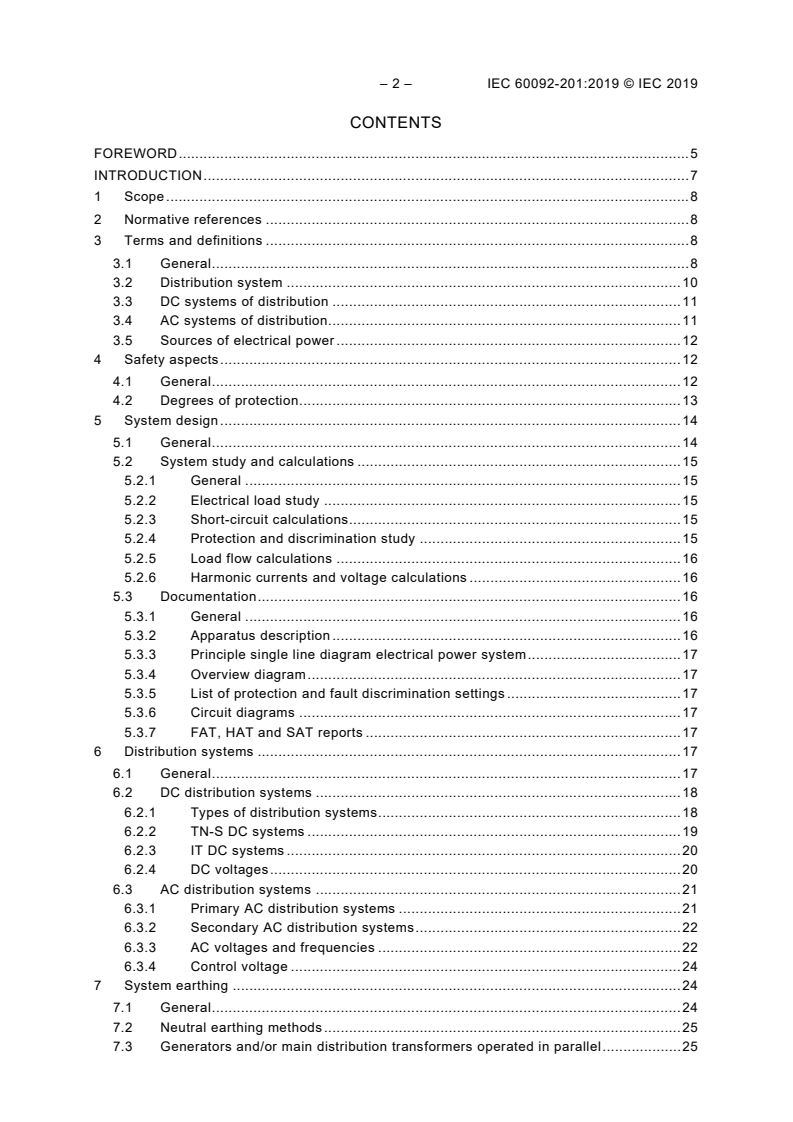
CONTENTS
FOREWORD . 5
INTRODUCTION . 7
1 Scope . 8
2 Normative references . 8
3 Terms and definitions . 8
3.1 General . 8
3.2 Distribution system . 10
3.3 DC systems of distribution . 11
3.4 AC systems of distribution. 11
3.5 Sources of electrical power . 12
4 Safety aspects . 12
4.1 General . 12
4.2 Degrees of protection . 13
5 System design . 14
5.1 General . 14
5.2 System study and calculations . 15
5.2.1 General . 15
5.2.2 Electrical load study . 15
5.2.3 Short-circuit calculations . 15
5.2.4 Protection and discrimination study . 15
5.2.5 Load flow calculations . 16
5.2.6 Harmonic currents and voltage calculations . 16
5.3 Documentation . 16
5.3.1 General . 16
5.3.2 Apparatus description . 16
5.3.3 Principle single line diagram electrical power system . 17
5.3.4 Overview diagram . 17
5.3.5 List of protection and fault discrimination settings . 17
5.3.6 Circuit diagrams . 17
5.3.7 FAT, HAT and SAT reports . 17
6 Distribution systems . 17
6.1 General . 17
6.2 DC distribution systems . 18
6.2.1 Types of distribution systems . 18
6.2.2 TN-S DC systems . 19
6.2.3 IT DC systems . 20
6.2.4 DC voltages . 20
6.3 AC distribution systems . 21
6.3.1 Primary AC distribution systems . 21
6.3.2 Secondary AC distribution systems . 22
6.3.3 AC voltages and frequencies . 22
6.3.4 Control voltage . 24
7 System earthing . 24
7.1 General . 24
7.2 Neutral earthing methods . 25
7.3 Generators and/or main distribution transformers operated in parallel . 25
7.4 Earthing resistors, connection to hull/structure . 26
8 Sources of electrical power . 27
8.1 Sources of electrical power for auxiliary services . 27
8.1.1 General . 27
8.1.2 Arrangement . 29
8.1.3 Operability . 29
8.1.4 Load shedding and automatic restoration of power . 30
8.2 Bus-tie breakers. 30
8.3 Starting from a dead ship condition . 31
8.4 Consequences of a busbar failure or a control system failure . 31
8.5 Additional source of electrical power . 32
8.6 Emergency source of electrical power . 32
9 Distribution system requirements . 32
9.1 General . 32
9.2 Distribution systems for electrically powered containers or temporary loads . 32
9.3 Methods of distribution . 33
9.4 Balance of loads . 33
9.4.1 Balance of load on three-wire DC systems . 33
9.4.2 Balance of loads in three- or four-wire AC systems . 33
9.5 Final sub-circuits . 33
9.5.1 General . 33
9.5.2 Final sub-circuits for lighting . 33
9.5.3 Final sub-circuits for heating . 34
9.5.4 Control circuits . 34
9.6 Socket-outlets . 35
9.7 Lighting circuits . 35
9.8 Shore connections . 36
9.8.1 Shore connection during docking . 36
9.8.2 Shore connections during port . 36
9.9 Electric and electrohydraulic steering gear . 36
9.9.1 General . 36
9.9.2 Motors . 37
9.9.3 Circuit design . 37
9.9.4 Controls and indications . 38
9.9.5 Separation . 39
9.9.6 Communication . 39
9.10 Navigation lights . 39
9.11 Navigation installations . 39
9.12 Radio installations . 39
9.13 Permanently installed bilge-pumps . 40
9.14 Motor circuits . 40
9.14.1 Starting of motors . 40
9.14.2 Means of disconnection . 40
9.14.3 Motor starters . 40
9.15 Luminaries . 41
9.15.1 Discharge lamp luminaries of voltages above 250 V . 41
9.15.2 Searchlights and arc lamps . 41
9.16 Internal communication circuits . 41
9.16.1 Voice communication . 41
– 4 – IEC 60092-201:2019 © IEC 2019
9.16.2 General emergency alarm system . 41
9.16.3 Engine-room telegraphs or similar devices. 41
10 Cables . 41
Bibliography . 42
Figure 1 – TN-S DC system . 19
Figure 2 – IT DC system . 20
Figure 3 – IT AC system . 21
Figure 4 – TN-S AC system . 22
Figure 5 – Typical ship generation and distribution system . 28
Table 1 – Minimum requirements for the degree of protection (in accordance with
IEC 60529 coding) . 13
Table 2 – Voltages for DC systems . 20
Table 3 – AC voltages and frequencies for ship's service systems of supply . 23
Table 4 – Summary of principal features of the neutral earthing methods . 26
Table 5 – Typical distribution of loads . 28
Table 6 – Maximum number of lighting points . 33
INTERNATIONAL ELECTROTECHNICAL COMMISSION
____________
ELECTRICAL INSTALLATIONS IN SHIPS –
Part 201: System design – General
FOREWORD
1) The International Electrotechnical Commission (IEC) is a worldwide organization for standardization comprising
all national electrotechnical committees (IEC National Committees). The object of IEC is to promote
international co-operation on all questions concerning standardization in the electrical and electronic fields. To
this end and in addition to other activities, IEC publishes International Standards, Technical Specifications,
Technical Reports, Publicly Available Specifications (PAS) and Guides (hereafter referred to as "IEC
Publication(s)"). Their preparation is entrusted to technical committees; any IEC National Committee interested
in the subject dealt with may participate in this preparatory work. International, governmental and non-
governmental organizations liaising with the IEC also participate in this preparation. IEC collaborates closely
with the International Organization for Standardization (ISO) in accordance with conditions determined by
agreement between the two organizations.
2) The formal decisions or agreements of IEC on technical matters express, as nearly as possible, an international
consensus of opinion on the relevant subjects since each technical committee has representation from all
interested IEC National Committees.
3) IEC Publications have the form of recommendations for international use and are accepted by IEC National
Committees in that sense. While all reasonable efforts are made to ensure that the technical content of IEC
Publications is accurate, IEC cannot be held responsible for the way in which they are used or for any
misinterpretation by any end user.
4) In order to promote international uniformity, IEC National Committees undertake to apply IEC Publications
transparently to the maximum extent possible in their national and regional publications. Any divergence
between any IEC Publication and the corresponding national or regional publication shall be clearly indicated in
the latter.
5) IEC itself does not provide any attestation of conformity. Independent certification bodies provide conformity
assessment services and, in some areas, access to IEC marks of conformity. IEC is not responsible for any
services carried out by independent certification bodies.
6) All users should ensure that they have the latest edition of this publication.
7) No liability shall attach to IEC or its directors, employees, servants or agents including individual experts and
members of its technical committees and IEC National Committees for any personal injury, property damage or
other damage of any nature whatsoever, whether direct or indirect, or for costs (including legal fees) and
expenses arising out of the publication, use of, or reliance upon, this IEC Publication or any other IEC
Publications.
8) Attention is drawn to the Normative references cited in this publication. Use of the referenced publications is
indispensable for the correct application of this publication.
9) Attention is drawn to the possibility that some of the elements of this IEC Publication may be the subject of
patent rights. IEC shall not be held responsible for identifying any or all such patent rights.
International Standard IEC 60092-201 has been prepared by IEC technical committee 18:
Electrical installations of ships and of mobile and fixed offshore units.
This fifth edition cancels and replaces the fourth edition, published in 1994. It constitutes a
technical revision.
This edition includes the following significant technical changes with respect to the previous
edition:
a) a new subclause regarding studies and calculations has been added;
b) a new subclause regarding documentation has been added;
c) the clause regarding distribution systems has been rewritten;
d) a clause regarding system earthing has been added;
e) the clause regarding sources of electrical power has been rewritten;
f) the clause regarding distribution system requirements has been rewritten;
– 6 – IEC 60092-201:2019 © IEC 2019
g) the clause regarding cables has been deleted and transferred to IEC 60092-401;
h) a new subclause regarding electric and electrohydraulic steering gear has been added.
NOTE IEC 60092-204, Electrical installations in ships – Part 204: System design – Electric and electrohydraulic
steering gear, has been withdrawn.
The text of this International Standard is based on the following documents:
FDIS Report on voting
18/1673/FDIS 18/1674/RVD
Full information on the voting for the approval of this International Standard can be found in
the report on voting indicated in the above table.
This document has been drafted in accordance with the ISO/IEC Directives, Part 2.
A list of all parts of the IEC 60092 series, published under the general title Electrical
installations in ships, can be found on the IEC website.
The committee has decided that the contents of this document will remain unchanged until the
stability date indicated on the IEC website under "http://webstore.iec.ch" in the data related to
the specific document. At this date, the document will be
• reconfirmed,
• withdrawn,
• replaced by a revised edition, or
• amended.
A bilingual version of this publication may be issued at a later date.
INTRODUCTION
IEC 60092 (all parts) forms a series of international standards for electrical installations in
sea-going ships, incorporating good practice and co-ordinating as far as possible existing
rules.
These standards form a code of practical interpretation and amplification of the requirements
of the International Convention on Safety of Life at Sea, a guide for future regulations which
may be prepared and a statement of practice for use by shipowners, shipbuilders and
appropriate organizations.
– 8 – IEC 60092-201:2019 © IEC 2019
ELECTRICAL INSTALLATIONS IN SHIPS –
Part 201: System design – General
1 Scope
This document is applicable to the main features of system design of electrical installations
for use in ships.
2 Normative references
The following documents are referred to in the text in such a way that some or all of their
content constitutes requirements of this document. For dated references, only the edition
cited applies. For undated references, the latest edition of the referenced document (including
any amendments) applies.
IEC 60092-101, Electrical installations in ships – Part 101: Definitions and general
requirements
IEC 60092-202, Electrical installations in ships – Part 202: System design – Protection
IEC 60092-401, Electrical installations in ships – Part 401: Installation and test of completed
installation
IEC 60364-1, Low-voltage electrical installations – Part 1: Fundamental principles,
assessment of general characteristics, definitions
IEC/IEEE 80005 (all parts), Utility connections in port
IMO, International Convention for the Safety of Life at Sea (SOLAS):1974, consolidated
edition 2009
3 Terms and definitions
For the purpose of this document, the following terms and definitions apply.
ISO and IEC maintain terminological databases for use in standardization at the following
addresses:
• IEC Electropedia: available at http://www.electropedia.org/
• ISO Online browsing platform: available at http://www.iso.org/obp
3.1 General
3.1.1
dead ship
condition where the entire machinery installation, including the power supply, is out of
operation and where auxiliary services such as compressed air, starting current from batteries
etc., for bringing the main propulsion into operation and for the restoration of the main power
supply, are not available
3.1.2
arc-flash hazard
dangerous condition associated with the release of energy caused by an electric arc
TM
[SOURCE: IEEE Std 1584 :2002, 3.1.2]
3.1.3
availability
state of an item of being able to perform its required function
[SOURCE: IEC 60050-603:1986, 603-05-04]
3.1.4
function
elementary operation performed by the system which, in conjunction with other elementary
operations (system functions), enables the system to perform a task
3.1.5
main steering gear
machinery, rudder actuators, steering gear power units and ancillary equipment and the
means of applying torque to the rudder stock (e.g. tiller or quadrant) necessary for effecting
movement of the rudder for the purpose of steering the ship under normal service conditions
3.1.6
auxiliary steering gear
equipment, other than any part of the main steering gear, necessary to steer the ship in the
event of failure of the main steering gear but not including the tiller, quadrant or components
serving the same purpose
3.1.7
electric steering gear
power-operated steering gear where an electric motor applies torque to the rudder stock
through mechanical means only
3.1.8
electrohydraulic steering gear
power-operated steering gear where a hydraulic pump, driven by an electric motor, applies
torque to the rudder stock through hydraulic and mechanical means
3.1.9
steering gear power unit
a) in the case of electric steering gear, an electric motor and its associated electrical
equipment;
b) in the case of electrohydraulic steering gear, an electric motor and its associated electrical
equipment and connected pump
3.1.10
steering gear control system
equipment by which orders are transmitted from the navigating bridge to the steering gear
power units
Note 1 to entry: Steering gear control systems include transmitters, receivers, hydraulic control pumps and their
associated motors, motor controllers, piping and cables, etc.
3.1.11
high voltage
HV
set of voltage levels in excess of low voltage
– 10 – IEC 60092-201:2019 © IEC 2019
[SOURCE: IEC 60050-601:1985, 601-01-27, modified – The words "in a general sense" have
been deleted, as well as entry 2 of the definition.]
3.1.12
low voltage
LV
set of voltage levels used for the distribution of electricity and whose upper limits are
generally accepted to be 1 000 V AC and 1 500 V DC
[SOURCE: IEC 60050-601:1985, 601-01-26, modified – The words "for alternating current"
have been replaced by "AC and 1 500 V DC".]
3.1.13
voltage drop
change of the voltage between two given terminals of an electric circuit due to the change of
the operating conditions
[SOURCE: IEC 60050-151:2001, 151-15-09]
3.2 Distribution system
3.2.1
branch
electrical line intended for connecting a current-consuming installation to the distribution
network
3.2.2
branch system
assembly of branches
3.2.3
meshed network
ring-main
set of conductors that connect feeding points (nodes) and form a closed circuit
3.2.4
diversity factor
demand factor
ratio of the estimated total load of a group of consumers under their normal working
conditions to the sum of their nominal ratings
3.2.5
power supply ship high voltage interface
interface between HV shore connection and the ship's primary distribution system
Note 1 to entry: Located at the ship-shore connection switchboard.
3.2.6
essential services
services essential for propulsion and steering, and safety of the ship, which are made up of
"primary essential services" and "secondary essential services"
[SOURCE: IACS SC134]
3.2.7
primary essential services
services that need to be in continuous operation to maintain propulsion and steering
[SOURCE: IACS SC134]
3.2.8
secondary essential services
services that need not necessarily be in continuous operation to maintain propulsion and
steering but which are necessary for maintaining the vessel's safety
[SOURCE: IACS SC134]
3.2.9
load shedding
automatic disconnection of users
Note 1 to entry: Where the load consists of essential services and non-essential services, consideration shall be
given to an arrangement which will automatically exclude non-essential services when any one generator becomes
overload by power or current. This load shedding may be carried out in one or more stages, according to the
overload ability of the generating sets.
3.2.10
primary distribution system
system having an electrical connection with the main source of electrical power
3.2.11
secondary distribution system
system having no electrical connection with the main source of electrical power, e.g. isolated
therefrom by a double-wound transformer, static convertor including galvanic separation or
motor-generator
3.2.12
hull return system
system in which insulated conductors are provided for connection to one pole or phase of the
supply, the hull of the ship or other permanently earthed structure being used for effecting
connections to the other pole or phase
3.3 DC systems of distribution
3.3.1
two-wire DC system
DC system comprising two conductors only, between which the load is connected
3.3.2
three-wire DC system
DC system comprising two conductors and a middle wire, the supply being taken from the two
outer conductors or from the middle wire and either outer conductor, the middle wire carrying
only the difference-current
3.4 AC systems of distribution
NOTE 1 AC systems are normally designed as an earthed system (TN) or an unearthed system (IT)
NOTE 2 In some countries, "unearthed systems" are also defined as "isolated systems".
3.4.1
single-phase two-wire AC system
single-phase AC system comprising two conductors only, between which the load is
connected
– 12 – IEC 60092-201:2019 © IEC 2019
3.4.2
single-phase three-wire AC system
single-phase AC system comprising two conductors and a neutral wire, the supply being taken
from the two outer conductors or from the neutral wire and either outer conductor, the neutral
wire carrying only the difference-current
3.4.3
three-phase three-wire system
system comprising three conductors connected to a three-phase supply
3.4.4
three-phase four-wire system
system comprising four conductors of which three are connected to a three-phase supply and
the fourth to a neutral point in the source of supply
3.5 Sources of electrical power
3.5.1
dead-ship condition
condition under which the main propulsion, boilers and ship auxiliaries are not in operation
owing to the absence of power and no stored energy for starting the propulsion plant, and the
main source of electrical power, is available
3.5.2
main source of electrical power
source intended to supply electrical power for distribution to all services necessary for
maintaining the ship in normal operational and habitable condition
3.5.3
emergency source of electrical power
source of electrical power intended to supply the emergency switchboard in the event of
failure of the supply from the main source of electrical power
4 Safety aspects
4.1 General
Electrical installations in ships shall be such that:
– services essential for safety shall be maintained under emergency conditions;
– the safety of passengers, crew and ship from electrical hazards shall be ensured;
– the requirements with respect to safety in this publication shall be at least in accordance
with this publication;
– the IMO resolutions and SOLAS regulations are met as far as is applicable.
The choice of materials and components of construction, as well as the design, location and
ship installation, are to be made in accordance with the environmental, maintenance and
operating conditions in order to ensure the continued function of the equipment during all
normal and reasonably foreseeable abnormal operating and fault conditions and to reduce the
risk of:
• injury to crew and passengers;
• damage to the equipment the system is contained within, or adjacent equipment and
systems;
• damage to adjacent equipment and systems;
• damage to the ship.
4.2 Degrees of protection
Depending on its location, electrical equipment shall as a minimum have the degree of
protection as given in Table 1, which is in accordance with IEC 60529.
Table 1 – Minimum requirements for the degree of protection
(in accordance with IEC 60529 coding)
(1) (2) (3) (4)
Equipment
Example of Condition in Design
Switch- Gene- Motors Trans- Lumi- Heating Cooking Accessories
location location according
boards rators fomers naires applian- appli- (e.g.
to degree
Control Semi- ces ances switches,
of
gear conduc- branch
protection
Motor tors boxes)
starters Conver-
tors
c
a
Tankers Danger of Certified
b
explosion safe-type
X
Ammonia plant - - - - X - -
rooms
Battery rooms - - - - X - - X
Paint stores - - - - X - - X
Stores for - - - - X - - X
welding-gas
bottles
Holds classified - - - - X - - X
as hazardous
Tunnels for pipes - - - - X - - X
containing oil
with a flash-point
of 60 °C of below
Dry Danger of IP20 X - X X X X X X
accommodation touching live
spaces
Dry control Parts only X - X X X X X X
rooms
Control rooms Danger of IP22 X - X X X X X X
(navigation dripping
bridge) liquid and/or
Engine and boiler moderate X X X X X X X IP44
rooms above mechanical
floor damage
Steering-gear X X X X X X - IP44
rooms
Refrigerating X - X X X X - IP44
machinery rooms
(excluding
ammonia plants)
Emergency X X X X X X - IP44
machinery rooms
General store X - X X X X - X
rooms
Pantries X - X X X X X IP44
Provision rooms X - X X X X - X
– 14 – IEC 60092-201:2019 © IEC 2019
(1) (2) (3) (4)
Equipment
Example of Condition in Design Switch- Gene- Motors Trans- Lumi- Heating Cooking Accessories
location location according boards rators fomers naires applian- appli- (e.g.
to degree Control Semi- ces ances switches,
of gear conduc- branch
protection
Motor tors boxes)
starters Conver-
tors
Bathrooms and Increased IP34 - - - - X IP44 - IP55
showers danger of
liquid and/or
Engine and boiler
mechnanical
- - IP44 - X IP44 - IP55
rooms below
damage
floor
Closed fuel oil IP44 - IP44 - X IP44 - IP55
separator rooms
Closed IP44 - IP44 - X IP44 - IP55
lubricating oil
separator rooms
Ballast pump Increased IP44 X - X X IP34 X - IP55
rooms danger of
- - X - IP34 X - IP55
liquid and
Refrigerated
mechanical
X - X X IP34 X X X
rooms
damage
Galleys and
laundries
Shaft or pipe Danger of IP55 X - X X X X - IP56
tunnels in double liquid
bottom spraying
d d
Holds for general Presence of - - - - X - - X
cargo cargo dust
Serious
- - - - X - - X
mechanical
damage
Aggressive
fumes
Open decks Danger of IP56 X - X - IP55 X - X
liquid in
massive
quantities
Key
X: complies with column (3)
-: not recommended
Where the protection is not achieved by the equipment itself, other means or the location where it is installed shall ensure
the degree of protection required in the table.
a
For tankers, see IEC 60092-502.
b
Certified safe-type equipment referred to in IEC 60079-0 may need additional enclosure requirements for spaces on
open decks or other spaces where wet conditions are expected. The examples above may be used as guidelines.
c
Socket-outlets shall not be installed in machinery spaces below the floor, closed fuel and lubricating oil separator
rooms or spaces requiring certified safe-type equipment.
d
For hazardous dust, an appropriate degree of protection is IP 66 or certified safe-type.
5 System design
5.1 General
There shall be one nominated body responsible for the integration of the complete electrical
plant. This body shall have the necessary expertise and resources enabling a controlled
integration process.
The ship builder is responsible for the system design unless agreed otherwise.
The design of the electrical system shall, wherever possible, consider the efficient use of
generated power due to the low energy equipment and application of energy-saving methods.
5.2 System study and calculations
5.2.1 General
Studies and calculations shall reflect the installed power rating and the complexity of the
electrical system.
The system studies and calculations shall be in accordance with the designed operating
modes of the vessel.
Additions and alterations to the existing electrical system, temporary or permanent, shall be
evaluated accordingly. The system studies and calculations are important operational
documents. They should be updated as necessary when changes are made to the installation.
As a minimum, the studies listed in IEC 60092-202 shall be carried out.
Additional studies can be considered if it is deemed necessary for the evaluation of the
system, or required by appropriate authorities, such as:
– arc-flash hazard risk assessment;
NOTE The objective of the flash hazard assessment is to increase personnel safety by determining the arc-flash.
– load flow and voltage loss calculations: to check voltage profiles, circuit loading under
steady-state conditions, transient conditions and power supply interfaces;
– calculation of harmonic currents and harmonic voltages: to analyse the magnitude and
location of harmonic distortions within the power system;
– Common mode network studies may be necessary if high-power non-linear loads and
filters are applied.
5.2.2 Electrical load study
The electrical load study should be in accordance with IEC 60092-202.
If load flow calculations are performed, these shall be carried out for the operational
conditions given.
The electrical load study shall include all electrical services necessary for maintaining the
ship in normal operational and habitable condition and preservation of the cargo, as far as
possible, over the entire lifetime of the installation.
5.2.3 Short-circuit calculations
See IEC 60092-202.
NOTE: IEC 61363 can be used for fault calculation for AC sources and IEC 61660-1 for DC sources.
5.2.4 Protection and discrimination study
See IEC 60092-202.
The voltage disturbance sustained during the faults and after fault clearance should be
ascertained to ensure that transient disturbances do not result in loss of supplies due to low
voltages or overstressing of plant insulation due to high voltages.
– 16 – IEC 60092-201:2019 © IEC 2019
5.2.5 Load flow calculations
Steady-state load flow calculations shall be carried out for the operational conditions giving
maximum peak load and minimum load based on loads determined in 5.2.1.
The following data should be calculated:
– magnitude of the busbar voltages;
– magnitude of voltage at the equipment terminal;
– active and reactive power production and load at the busbars;
– active and reactive power flow in cables and transformers;
– recommended setting of the transformers' tapping;
– voltage transients due to capacitive and inductive loading of the network (transformers,
motors, generators, filters, cabling, etc.).
Where specific loads require closer tolerances for voltages in order to maintain functionality or
performance, then specific calculations should be made to confirm values of voltage drop,
particularly in cables.
5.2.6 Harmonic currents and voltage calculations
The content of currents' harmonics and voltages' harmonics in the electric power system shall
be examined for installations with a high presence of power semiconductor systems. For the
voltage waveform, the limits indicated in IEC 60092-101 shall be verified.
NOTE 1 It can be necessary to feed sensitive equipment from a power system with a restricted content of
harmonics, for example from a maintained supply or separate secondary distribution system.
NOTE 2 For systems where semiconductors are connected having a total system rating which is a significant
portion of the total system rating, it may not be feasible to suppress the harmonics. Consideration should be given
to take appropriate measures to attenuate these effects of the distribution system so that safe operation is
assured. Care should be taken in selecting consumers supplied from an electric power supply system with a higher
harmonic content than specified in IEC 60092-101.
Electrical equipment that requires a higher power quality may need additional provisions to be
made locally. Where additional equipment is fitted to this higher power quality supply, it may
be required to be duplicated and segregated to the same degree as the electrical equipment it
supplies for the same level of continuity of electrical supply.
Special attention should be paid to the installation of electrical equipment that can influence
the quality of power supply on local basis or react with any harmonics present on the general
distribution system.
NOTE 3 For further information regarding harmonics, see IEC 61000-2-4 and IEC 60533.
5.3 Documentation
5.3.1 General
Documentation required in accordance with 5.3.2 to 5.3.6 is to be available onboard at all
times. The documentation is to be updated as required, see 5.2.1.
5.3.2 Apparatus description
For the primary distribution, main secondary distribution, primary essential, essential and
emergency loads, the manufacturer shall deliver sufficient information concerning the
principles of operation, technical specifications, mounting instructions, required starting up or
commissioning procedures, fault-finding procedures, maintenance and repair, as well as lists
of the necessary test facilities and replaceable parts.
Sufficient information shall be available to enable a complete system description to be
prepared.
5.3.3 Principle single line diagram electrical power system
General single line lay-out of the electric plant, power generation, power storage and power
distribution shall be aboard the ship.
5.3.4 Overview diagram
The overview diagram or list of circuits shall be:
– provided for each individual distribution switchboard; and
– permanently displayed in or near the switchboard to which it refers; and
– included in the ship's administrative documents.
Each overview diagram or list of circuits shall present at least the following information:
– circuit number;
– protections and controls;
– cable type;
– connected power and diversity factor for of each circuit, calculated taking into account the
diversity factor of the connected load (where applicable).
5.3.5 List of protection and fault discrimination settings
A list of protection and fault discrimination settings shall be available.
5.3.6 Circuit diagrams
Circuit diagrams for at least primary distribution, main secondary distribution, primary
essential, essential and emergency loads shall, for each individual control apparatus, be
permanently displayed in or near the apparatus to which it refers, or alternatively included in
the control system handbook.
5.3.7 FAT, HAT and SAT reports
A document comprising the factory acceptance tests (FAT) reports, harbour acceptance tests
(HAT) reports and sea acceptance tests (SAT) reports of the control, safety and power
systems, and shall be included in the ship's administrative documents.
6 Distribution systems
6.1 General
The current carrying distribution systems shall be in accordance with IEC 60364-1.
The requireme
...