

IEC 61535:2023
(Main)Installation couplers intended for permanent connection in fixed installations
General Information
- Abstract
IEC 61535:2023 applies to two-wire, up to five-wire installation couplers, with or without earthing contact, if provided, with a rated voltage up to and including 500 V AC or 500 V DC and a rated connecting capacity up to and including 10 mm2 and a rated current not exceeding 32 A for permanent connection in electrical installations. Installation couplers with additional contacts for voltages other than mains voltages are outside the scope of this document. This third edition cancels and replaces the second edition published in 2019. This edition constitutes a technical revision. This edition includes the following significant technical changes with respect to the previous edition:
a) inclusion of a definition for "live part" based on IEC 61140;
b) additional optional cross medial documentation, e.g. marking with QR-Code;
c) corrections on the consistent use of the expressions "earth", "earthing contact", "earthing circuit" and "protective earth(ing)" throughout the document;
d) addition of missing compliance provisions to 13.3;
e) update of Figure D.1 of Annex D;
f) inclusion of new Annex F for cold climate requirements.
- Status
- Published
- Publication Date
- 23-Mar-2023
- Technical Committee
- TC 23 - Electrical accessories
- Drafting Committee
- MT 6 - TC 23/MT 6
- Current Stage
- PPUB - Publication issued
- Start Date
- 24-Mar-2023
- Completion Date
- 28-Apr-2023
Buy Documents
IEC 61535:2023 RLV - Installation couplers intended for permanent connection in fixed installations Released:3/24/2023
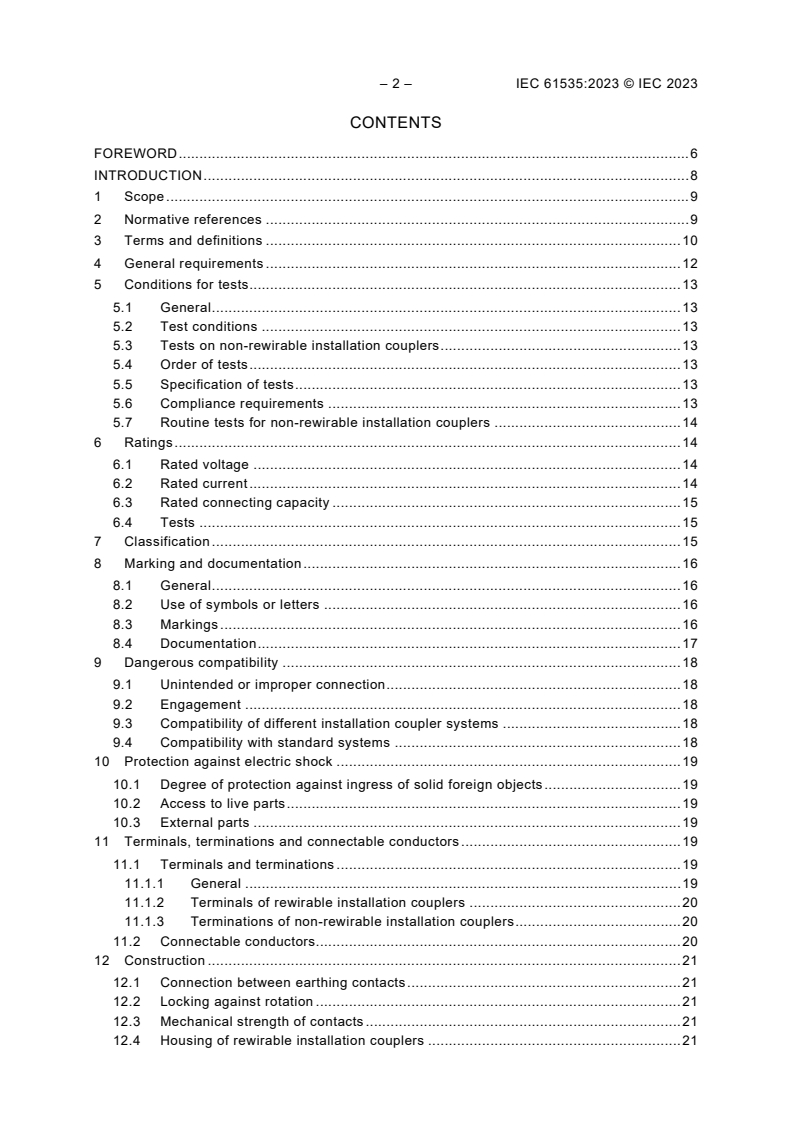
IEC 61535:2023 - Installation couplers intended for permanent connection in fixed installations Released:3/24/2023
IEC 61535:2023 - Overview
IEC 61535:2023 is the International Electrotechnical Commission standard for installation couplers intended for permanent connection in fixed installations. It applies to two‑wire up to five‑wire installation couplers, with or without an earthing contact, rated up to and including 500 V AC or 500 V DC, a rated connecting capacity up to 10 mm², and a rated current ≤ 32 A. This third edition (2023) replaces the 2019 edition and constitutes a technical revision.
Key editorial and technical updates include:
- Inclusion of a definition for “live part” aligned with IEC 61140
- Optional cross‑media documentation (e.g., marking with QR‑Code)
- Consistent terminology for earth/earthing/protective earth
- Additions and corrections in compliance clauses (e.g., Clause 13.3)
- Updates to informative figures and annexes, including a new Annex F for cold climate requirements
Key topics and technical requirements
The standard sets out requirements, tests and documentation for safe and reliable installation couplers used in permanent fixed wiring:
- Ratings and classification: rated voltage, current, and connecting capacity limits; classification rules
- Marking and documentation: required markings, symbol use and optional QR‑Code documentation for traceability
- Safety and protection: protection against electric shock, access to live parts, earthing continuity and dangerous compatibility prevention
- Mechanical and electrical construction: terminals, terminations, contact construction, locking and rotation protection, housing requirements
- Performance testing: insulation resistance, electric strength, temperature rise, breaking capacity, mechanical strength, resistance to heat, ageing and tracking
- Ingress protection: requirements for solid object and water protection (harmful ingress)
- Special tests: Annex F - additional tests and marking for ambient temperatures down to −45 °C; Annex A - routine PE continuity tests; Annex E - DC warning symbol
Practical applications
IEC 61535 is directly applicable to:
- Manufacturers of fixed installation couplers, distribution blocks and modular wiring products
- Design engineers specifying permanent connection couplers for buildings, industrial facilities, and modular installations
- Test laboratories and conformity assessment bodies performing type and routine tests
- Electrical contractors and installers who select compliant couplers for fixed wiring systems
- Specifiers and facility managers ensuring safe earthing continuity, compatibility and environmental suitability (including cold climate installations)
Related standards
- IEC 61140 (safety of persons - protection against electric shock): referenced for the definition of live part
- Use alongside other IEC wiring and connector standards and national wiring regulations for full compliance in installations
Keywords: IEC 61535, installation couplers, fixed installations, earthing contact, rated voltage 500 V, rated current 32 A, cold climate, QR‑Code marking, electrical safety.
Relations
- Revises
IEC 61535:2019 - Installation couplers intended for permanent connection in fixed installations - Effective Date
- 05-Sep-2023
Buy Documents
IEC 61535:2023 RLV - Installation couplers intended for permanent connection in fixed installations Released:3/24/2023
IEC 61535:2023 - Installation couplers intended for permanent connection in fixed installations Released:3/24/2023
Get Certified
Connect with accredited certification bodies for this standard

IMQ S.p.A. (Certification)
Italian electrical product certification.

SLG Prüf- und Zertifizierungs GmbH
German testing and certification body.

UL Solutions
Global safety science company with testing, inspection and certification.
Sponsored listings
Frequently Asked Questions
IEC 61535:2023 is a standard published by the International Electrotechnical Commission (IEC). Its full title is "Installation couplers intended for permanent connection in fixed installations". This standard covers: IEC 61535:2023 applies to two-wire, up to five-wire installation couplers, with or without earthing contact, if provided, with a rated voltage up to and including 500 V AC or 500 V DC and a rated connecting capacity up to and including 10 mm2 and a rated current not exceeding 32 A for permanent connection in electrical installations. Installation couplers with additional contacts for voltages other than mains voltages are outside the scope of this document. This third edition cancels and replaces the second edition published in 2019. This edition constitutes a technical revision. This edition includes the following significant technical changes with respect to the previous edition: a) inclusion of a definition for "live part" based on IEC 61140; b) additional optional cross medial documentation, e.g. marking with QR-Code; c) corrections on the consistent use of the expressions "earth", "earthing contact", "earthing circuit" and "protective earth(ing)" throughout the document; d) addition of missing compliance provisions to 13.3; e) update of Figure D.1 of Annex D; f) inclusion of new Annex F for cold climate requirements.
IEC 61535:2023 applies to two-wire, up to five-wire installation couplers, with or without earthing contact, if provided, with a rated voltage up to and including 500 V AC or 500 V DC and a rated connecting capacity up to and including 10 mm2 and a rated current not exceeding 32 A for permanent connection in electrical installations. Installation couplers with additional contacts for voltages other than mains voltages are outside the scope of this document. This third edition cancels and replaces the second edition published in 2019. This edition constitutes a technical revision. This edition includes the following significant technical changes with respect to the previous edition: a) inclusion of a definition for "live part" based on IEC 61140; b) additional optional cross medial documentation, e.g. marking with QR-Code; c) corrections on the consistent use of the expressions "earth", "earthing contact", "earthing circuit" and "protective earth(ing)" throughout the document; d) addition of missing compliance provisions to 13.3; e) update of Figure D.1 of Annex D; f) inclusion of new Annex F for cold climate requirements.
IEC 61535:2023 is classified under the following ICS (International Classification for Standards) categories: 29.120.99 - Other electrical accessories. The ICS classification helps identify the subject area and facilitates finding related standards.
IEC 61535:2023 has the following relationships with other standards: It is inter standard links to IEC 61535:2019. Understanding these relationships helps ensure you are using the most current and applicable version of the standard.
IEC 61535:2023 is available in PDF format for immediate download after purchase. The document can be added to your cart and obtained through the secure checkout process. Digital delivery ensures instant access to the complete standard document.
Standards Content (Sample)
IEC 61535 ®
Edition 3.0 2023-03
REDLINE VERSION
INTERNATIONAL
STANDARD
colour
inside
Installation couplers intended for permanent connection in fixed installations
All rights reserved. Unless otherwise specified, no part of this publication may be reproduced or utilized in any form
or by any means, electronic or mechanical, including photocopying and microfilm, without permission in writing from
either IEC or IEC's member National Committee in the country of the requester. If you have any questions about IEC
copyright or have an enquiry about obtaining additional rights to this publication, please contact the address below or
your local IEC member National Committee for further information.
IEC Secretariat Tel.: +41 22 919 02 11
3, rue de Varembé info@iec.ch
CH-1211 Geneva 20 www.iec.ch
Switzerland
About the IEC
The International Electrotechnical Commission (IEC) is the leading global organization that prepares and publishes
International Standards for all electrical, electronic and related technologies.
About IEC publications
The technical content of IEC publications is kept under constant review by the IEC. Please make sure that you have the
latest edition, a corrigendum or an amendment might have been published.
IEC publications search - webstore.iec.ch/advsearchform IEC Products & Services Portal - products.iec.ch
The advanced search enables to find IEC publications by a Discover our powerful search engine and read freely all the
variety of criteria (reference number, text, technical publications previews. With a subscription you will always have
committee, …). It also gives information on projects, replaced access to up to date content tailored to your needs.
and withdrawn publications.
Electropedia - www.electropedia.org
IEC Just Published - webstore.iec.ch/justpublished
The world's leading online dictionary on electrotechnology,
Stay up to date on all new IEC publications. Just Published
containing more than 22 300 terminological entries in English
details all new publications released. Available online and once
and French, with equivalent terms in 19 additional languages.
a month by email.
Also known as the International Electrotechnical Vocabulary
(IEV) online.
IEC Customer Service Centre - webstore.iec.ch/csc
If you wish to give us your feedback on this publication or need
further assistance, please contact the Customer Service
Centre: sales@iec.ch.
IEC 61535 ®
Edition 3.0 2023-03
REDLINE VERSION
INTERNATIONAL
STANDARD
colour
inside
Installation couplers intended for permanent connection in fixed installations
INTERNATIONAL
ELECTROTECHNICAL
COMMISSION
ICS 29.120.99 ISBN 978-2-8322-6728-8
– 2 – IEC 61535:2023 RLV © IEC 2023
CONTENTS
FOREWORD . 6
INTRODUCTION . 2
1 Scope . 9
2 Normative references . 9
3 Terms and definitions . 10
4 General requirements . 12
5 Conditions for tests . 13
5.1 General . 13
5.2 Test conditions . 13
5.3 Tests on non-rewirable installation couplers . 13
5.4 Order of tests . 13
5.5 Specification of tests . 13
5.6 Compliance requirements . 13
5.7 Routine tests for non-rewirable installation couplers . 14
6 Ratings . 14
6.1 Rated voltage . 14
6.2 Rated current . 14
6.3 Rated connecting capacity . 15
6.4 Tests . 15
7 Classification . 15
8 Marking and documentation . 16
8.1 General . 16
8.2 Use of symbols or letters . 16
8.3 Markings . 16
8.4 Documentation . 17
9 Dangerous compatibility . 18
9.1 Unintended or improper connection . 18
9.2 Engagement . 18
9.3 Compatibility of different installation coupler systems . 18
9.4 Compatibility with standard systems . 19
10 Protection against electric shock . 19
10.1 Degree of protection against ingress of solid foreign objects . 19
10.2 Access to live parts . 19
10.3 External parts . 19
11 Terminals, terminations and connectable conductors . 20
11.1 Terminals and terminations . 20
11.1.1 General . 20
11.1.2 Terminals of rewirable installation couplers . 20
11.1.3 Terminations of non-rewirable installation couplers . 20
11.2 Connectable conductors. 20
12 Construction . 21
12.1 Earth Connection between earthing contacts . 21
12.2 Locking against rotation . 21
12.3 Mechanical strength of contacts . 21
12.4 Housing of rewirable installation couplers . 22
12.5 Housing of non-rewirable installation couplers . 22
12.6 Dismantling and opening of rewirable installation couplers . 22
12.7 Earthing contact and earthing terminal . 22
12.8 Loose conductor strands . 22
12.8.1 General . 22
12.8.2 Strand test for rewirable installation couplers . 23
12.8.3 Strand test for non-rewirable non-molded-on installation couplers . 23
12.8.4 Strand test for non-rewirable moulded-on installation couplers . 23
12.9 Incorporation of electrical devices . 24
12.10 Retaining means . 24
12.11 Distribution blocks . 24
12.12 Shrouds . 24
12.13 Factory wiring . 24
12.14 Stress test . 24
12.14.1 General . 24
12.14.2 Stress test of rewirable installation couplers . 24
12.14.3 Stress test of non-rewirable installation couplers . 25
12.15 Separation of non-rewirable installation couplers . 25
13 Protection against harmful ingress of solid foreign objects and against harmful
ingress of water . 25
13.1 General . 25
13.2 Protection against harmful ingress of solid foreign objects . 25
13.3 Protection against harmful ingress of water . 25
14 Insulation resistance and electric strength . 26
14.1 General . 26
14.2 Insulation resistance . 26
14.3 Electric strength . 27
15 Construction of contacts . 27
15.1 Resiliency . 27
15.2 Resistance of connections . 27
15.3 Contact pressure . 28
16 Temperature rise . 28
17 Breaking capacity . 29
18 Forces necessary to disengage the parts of the installation coupler . 30
19 Cables and their connection . 30
19.1 Capability of being fitted . 30
19.2 Relief from pull, thrust and torsion . 30
19.3 Relief Cable anchorage . 30
19.4 Capability to connect cables with different cross-sectional area . 31
19.5 Sharp edges . 33
20 Mechanical strength . 33
21 Resistance to heat and ageing. 34
21.1 Resistance to heat . 34
21.2 Dry heat storage . 34
21.3 Ball pressure test . 34
21.4 Ageing of elastomeric and thermoplastic material . 35
21.5 Current cycling test . 35
22 Screws, current-carrying parts and connections . 36
– 4 – IEC 61535:2023 RLV © IEC 2023
22.1 Screws and nuts . 36
22.2 Screws and insulating material . 37
22.3 Screws and rivets for electrical and mechanical connections. 38
22.4 Metals of current-carrying parts . 38
23 Clearances, creepage distances and distances through solid insulation . 38
24 Resistance to abnormal heat and to tracking . 42
24.1 Resistance to abnormal heat . 42
24.2 Resistance to tracking . 44
25 Resistance to rusting . 44
Annex A (normative) Routine protective earth (PE) continuity tests . 46
Annex B (normative) Test circuits for temperature rise test . 47
Annex C (normative) Number of sets of test samples used for the tests and sequence
of tests for each set . 55
Annex D (informative) Guide to use . 56
D.1 General . 56
D.2 Applications . 56
D.3 Examples of use of installation couplers . 56
Annex E (normative) Warning symbol used in DC applications . 60
Annex F (informative) Additional tests and requirements for installation couplers
intended to be used in ambient air temperature below −5 °C down to and including
−45 °C . 61
F.1 General . 61
F.2 General requirements on tests . 61
F.3 Additional marking and documentation . 61
F.3.1 Additional marking . 61
F.3.2 Additional documentation . 61
F.4 Mechanical strength at lower ambient air temperatures . 61
Bibliography . 63
Figure 1 – Apparatus for testing the cable anchorage . 32
Figure 2 – Apparatus for measuring the distortion (example) . 33
Figure 3 – Ball-pressure apparatus . 35
Figure 4 – Explanation of "small part" . 44
Figure B.1 – 1P + N + PE installation couplers, including N (left figure), including PE
(right figure) .
Figure B.2 – 3P + N + PE installation couplers, 3 phases loaded (left figure), N and PE
loaded (right figure) .
Figure B.3 – 1P + N + PE distribution block, phase and N loaded .
Figure B.4 – 1P + N + PE distribution block, phase and PE loaded .
Figure B.5 – 3P + N + PE to 1P + N + PE distribution block, 3 phases loaded .
Figure B.6 – 3P + N + PE to 1P + N + PE distribution block, N and PE loaded .
Figure B.1 – 1P + N + PE installation couplers, including N . 51
Figure B.2 – 1P + N + PE installation couplers, including PE . 51
Figure B.3 – 3P + N + PE installation couplers, 3 phases loaded . 51
Figure B.4 – 3P + N + PE installation couplers, N and PE loaded . 51
Figure B.5 – 1P + N + PE distribution block, phase and N loaded . 52
Figure B.6 – 1P + N + PE distribution block, phase and PE loaded . 52
Figure B.7 – 3P + N + PE to 1P + N + PE distribution block, 3 phases loaded . 53
Figure B.8 – 3P + N + PE to 1P + N + PE distribution block, N and PE loaded . 54
Figure D.1 – Examples of use of installation couplers . 58
Figure D.2 – Magnified area of Figure D.1 to show installation couplers . 59
Figure E.1 – Symbol "DO NOT CONNECT OR DISCONNECT UNDER LOAD" . 60
Table 1 – Voltage rating for installation couplers in AC application . 14
Table 2 – Voltage rating for installation couplers in DC application . 14
Table 3 – Classes Classification of installation couplers . 15
Table 4 – Test currents for installation couplers . 29
Table 5 – Forces to be applied to cable anchorages . 31
Table 6 – Torque applied for the tightening and loosening test . 37
Table 7 – Installation couplers intended for use in supply systems with a maximum
voltage to earth of 150 V AC, rated impulse voltage 2,5 kV . 38
Table 8 – Installation couplers intended for use in supply systems with a maximum
voltage to earth of 300 V AC, rated impulse voltage 4,0 kV . 39
Table 9 – Installation couplers intended for use in single-phase two-wire systems
50 V DC and single-phase three-wire systems 60 V DC, rated impulse voltage 0,8 kV . 40
Table 10 – Installation couplers intended for use in single-phase two-wire systems
120 V DC and single-phase three-wire systems 240 V DC, rated impulse voltage
2,5 kV . 41
Table 11 – Installation couplers intended for use in single-phase two-wire systems
220 V DC and single-phase three-wire systems 440 V DC, rated impulse voltage
4,0 kV . 42
Table C.1 – Sets of samples . 55
– 6 – IEC 61535:2023 RLV © IEC 2023
INTERNATIONAL ELECTROTECHNICAL COMMISSION
____________
INSTALLATION COUPLERS INTENDED FOR PERMANENT
CONNECTION IN FIXED INSTALLATIONS
FOREWORD
1) The International Electrotechnical Commission (IEC) is a worldwide organization for standardization comprising
all national electrotechnical committees (IEC National Committees). The object of IEC is to promote international
co-operation on all questions concerning standardization in the electrical and electronic fields. To this end and
in addition to other activities, IEC publishes International Standards, Technical Specifications, Technical Reports,
Publicly Available Specifications (PAS) and Guides (hereafter referred to as “IEC Publication(s)”). Their
preparation is entrusted to technical committees; any IEC National Committee interested in the subject dealt with
may participate in this preparatory work. International, governmental and non-governmental organizations liaising
with the IEC also participate in this preparation. IEC collaborates closely with the International Organization for
Standardization (ISO) in accordance with conditions determined by agreement between the two organizations.
2) The formal decisions or agreements of IEC on technical matters express, as nearly as possible, an international
consensus of opinion on the relevant subjects since each technical committee has representation from all
interested IEC National Committees.
3) IEC Publications have the form of recommendations for international use and are accepted by IEC National
Committees in that sense. While all reasonable efforts are made to ensure that the technical content of IEC
Publications is accurate, IEC cannot be held responsible for the way in which they are used or for any
misinterpretation by any end user.
4) In order to promote international uniformity, IEC National Committees undertake to apply IEC Publications
transparently to the maximum extent possible in their national and regional publications. Any divergence between
any IEC Publication and the corresponding national or regional publication shall be clearly indicated in the latter.
5) IEC itself does not provide any attestation of conformity. Independent certification bodies provide conformity
assessment services and, in some areas, access to IEC marks of conformity. IEC is not responsible for any
services carried out by independent certification bodies.
6) All users should ensure that they have the latest edition of this publication.
7) No liability shall attach to IEC or its directors, employees, servants or agents including individual experts and
members of its technical committees and IEC National Committees for any personal injury, property damage or
other damage of any nature whatsoever, whether direct or indirect, or for costs (including legal fees) and
expenses arising out of the publication, use of, or reliance upon, this IEC Publication or any other IEC
Publications.
8) Attention is drawn to the Normative references cited in this publication. Use of the referenced publications is
indispensable for the correct application of this publication.
9) Attention is drawn to the possibility that some of the elements of this IEC Publication may be the subject of patent
rights. IEC shall not be held responsible for identifying any or all such patent rights.
This redline version of the official IEC Standard allows the user to identify the changes
made to the previous edition IEC 61535:2019. A vertical bar appears in the margin
wherever a change has been made. Additions are in green text, deletions are in
strikethrough red text.
IEC 61535 has been prepared by IEC technical committee 23: Electrical accessories. It is an
International Standard.
This third edition cancels and replaces the second edition published in 2019. This edition
constitutes a technical revision.
This edition includes the following significant technical changes with respect to the previous
edition:
a) inclusion of a definition for "live part" based on IEC 61140;
b) additional optional cross medial documentation, e.g. marking with QR-Code;
c) corrections on the consistent use of the expressions "earth", "earthing contact", "earthing
circuit" and "protective earth(ing)" throughout the document;
d) addition of missing compliance provisions to 13.3;
e) update of Figure D.1 of Annex D;
f) inclusion of new Annex F for cold climate requirements.
The text of this International Standard is based on the following documents:
Draft Report on voting
23/1062/FDIS 23/1066/RVD
Full information on the voting for its approval can be found in the report on voting indicated in
the above table.
The language used for the development of this International Standard is English.
In this standard, the following print types are used:
• requirements proper: in roman type;
• test specifications: in italic type;
• explanatory matter: in smaller roman type.
This document was drafted in accordance with ISO/IEC Directives, Part 2, and developed in
accordance with ISO/IEC Directives, Part 1 and ISO/IEC Directives, IEC Supplement, available
at www.iec.ch/members_experts/refdocs. The main document types developed by IEC are
described in greater detail at www.iec.ch/publications.
The committee has decided that the contents of this document will remain unchanged until the
stability date indicated on the IEC website under webstore.iec.ch in the data related to the
specific document. At this date, the document will be
• reconfirmed,
• withdrawn,
• replaced by a revised edition, or
• amended.
IMPORTANT – The "colour inside" logo on the cover page of this document indicates that it
contains colours which are considered to be useful for the correct understanding of its
contents. Users should therefore print this document using a colour printer.
– 8 – IEC 61535:2023 RLV © IEC 2023
INTRODUCTION
AC and DC installation couplers according to this document may be used, for example, in
prefabricated buildings, commercial showrooms, installation cavities, such as suspended floors
and ceilings, in partition walls and in any similar applications, or cable tray systems, cable
ladder systems, cable ducting systems and cable trunking systems or in furniture complying
with IEC 60364-7-713.
This document may be used as a guide for installation couplers with additional contacts for
voltages other than mains voltages.
Particular requirements for installation couplers, for example, for use at higher or lower ambient
temperatures, with higher mechanical durability (e.g. metal housings), with higher fire
resistance and for use in control circuits (e.g. SELV), are under consideration.
National rules can have requirements concerning the accessibility of installation couplers.
National rules can specify who is allowed to carry out the connection and disconnection of
installation couplers.
National rules can have requirements concerning installation couplers with metal conduits.
INSTALLATION COUPLERS INTENDED FOR PERMANENT
CONNECTION IN FIXED INSTALLATIONS
1 Scope
This document applies to two-wire, up to five-wire installation couplers, including earth with or
without earthing contact, if provided, with a rated voltage up to and including 500 V AC or 500 V
DC and a rated connecting capacity up to and including 10 mm and a rated current not
exceeding 32 A for permanent connection in electrical installations. Installation couplers with
additional contacts for voltages other than mains voltages are outside the scope of this
document.
An installation coupler consists of an installation female connector and an installation male
connector for permanent connection not intended to be engaged or disengaged under load nor
to be engaged or disengaged other than during first installation or during reconfiguration or
maintenance of the wiring system in which installation couplers have been installed. This means
that installation couplers are intended for infrequent use only.
Installation couplers are not suitable for use in place of socket-outlet systems. Installation
couplers are not suitable for use in place of devices for connecting luminaires (DCLs) according
to IEC 61995 (all parts) or in place of luminaire supporting couplers (LSCs).
Installation couplers complying with this document are suitable for use at ambient temperatures
not normally exceeding +40 °C, but their average over a period of 24 h does not exceed +35 °C,
with a lower limit of the ambient air temperature of −5 °C, either for indoor or outdoor use.
NOTE 1 Additional tests for use in cold climates are under consideration shown in Annex F, which is normative in
following countries: FI. Necessary information can be given in the manufacturer's installation instructions.
NOTE 2 For other temperatures, necessary information can be given in the manufacturer's installation instructions.
In locations where special conditions prevail, as in ships, vehicles and the like and in hazardous
locations, for example where explosions are liable to occur, special constructions can be
required.
NOTE 3 Installation couplers are intended to be installed by instructed or skilled persons.
NOTE 4 As a guide to using installation coupler systems, see Annex D.
2 Normative references
The following documents are referred to in the text in such a way that some or all of their content
constitutes requirements of this document. For dated references, only the edition cited applies.
For undated references, the latest edition of the referenced document (including any
amendments) applies.
IEC 60068-2-31:2008, Environmental testing – Part 2-31: Tests – Test Ec: Rough handling
shocks, primarily for equipment-type specimens
IEC 60112, Method for the determination of the proof and the comparative tracking indices of
solid insulating materials
IEC 60529:1989, Degrees of protection provided by enclosures (IP Code)
IEC 60529:1989/AMD1:1999
IEC 60529:1989/AMD2:2013
– 10 – IEC 61535:2023 RLV © IEC 2023
IEC 60664-1:20072020, Insulation coordination for equipment within low-voltage supply
systems – Part 1: Principles, requirements and tests
IEC 60695-2-11, Fire hazard testing – Part 2-11: Glowing/hot-wire based test methods –
Glow-wire flammability test method for end products (GWEPT)
IEC 60998-2-3, Connecting devices for low-voltage circuits for household and similar purposes
– Part 2-3: Particular requirements for connecting devices as separate entities with
insulation-piercing clamping units
IEC 60999-1:1999, Connecting devices – Electrical copper conductors – Safety requirements
for screw-type and screwless-type clamping units – Part 1: General requirements and particular
2 2
requirements for clamping units for conductors from 0,2 mm up to 35 mm (included)
IEC 61032:1997, Protection of persons and equipment by enclosures – Probes for verification
3 Terms and definitions
For the purposes of this document, the following terms and definitions apply.
ISO and IEC maintain terminology databases for use in standardization at the following
addresses:
• IEC Electropedia: available at https://www.electropedia.org/
• ISO Online browsing platform: available at https://www.iso.org/obp
Where the terms "voltage" and "current" are used in this document, they are RMS values, unless
otherwise specified.
3.1
rated voltage
voltage assigned to the installation coupler by the manufacturer
3.2
rated current
maximum current assigned to the installation coupler by the manufacturer
Note 1 to entry: Rated current refers to the installation coupler itself and not to an electric circuit.
3.3
rated connecting capacity
cross-sectional area of the largest conductor(s) to be connected as stated by the manufacturer
of the installation coupler
3.4
permanent connection
connecting method in an installation which is only opened for maintenance or wiring system
re-configuration
Note 1 to entry: The expression "permanent connection" is to be understood as a connection which is maintained
as long as an installation exists.
3.5
installation coupler
connecting device consisting of an installation female connector and an installation male
connector provided with retaining means for permanent connection not intended to be engaged
or disengaged under load nor to be engaged or disengaged other than during first installation,
during maintenance of the wiring system or during re-configuration of the wiring system
3.6
installation male connector
load side portion of an installation coupler which contains the male contacts
3.7
installation female connector
supply side portion of an installation coupler which contains the female contacts
3.8
installation coupler system
family of installation couplers consisting of one or more installation female connectors
compatible by mechanical coding features with one or more installation male connectors, with
the same ratings produced according to the specification of one manufacturer
Note 1 to entry: The meaning of "one manufacturer" in this case, is "one and the same manufacturer".
3.9
wiring system
assembly made up of a cable or cables or busbars and the parts which secure and if necessary
enclose the cables or busbars
[SOURCE: IEC 60364-5-52:2009, 520.3.1, modified – "bare or insulated conductors" has been
replaced with "a cable".]
3.10
rewirable installation coupler
installation coupler so constructed that the cable can be replaced
3.11
non-rewirable installation coupler
installation coupler so constructed that it forms a complete unit with the cable after connection
and assembly by the manufacturer
Note 1 to entry: See also 12.15.
3.12
non-rewirable moulded-on installation coupler
non-rewirable installation coupler so constructed that the contacts, terminals or connections
and the attached cable ends are surrounded by insulating material manufactured by a moulding
process
3.13
non-rewirable non-moulded-on installation coupler
non-rewirable installation coupler so constructed that the contacts, terminals or connections
and the attached cable ends are surrounded by separate parts of insulating material
3.14
distribution block
device intended for branching of circuits
3.15
retaining means
arrangement by which an installation female connector and an installation male connector are
held in position when they are properly engaged and prevents unintentional disengagement
Note 1 to entry: The disengagement may be done by hand or by the use of a tool.
– 12 – IEC 61535:2023 RLV © IEC 2023
3.16
cap
removable barrier to prevent ready accessibility to an unused installation female connector
3.17
routine test
test to which each device is subjected during and/or after manufacture to ascertain whether it
complies with certain criteria
3.18
type test
test of one or more devices made to a certain design to show that the design meets certain
requirements
3.19
readily accessible, adj
accessibility accessible to touch extending from any point on a surface where persons usually
stand or move about to the limits which a person can reach with the hand, in any direction
without assistance
Note 1 to entry: See IEC 60364-4-41:2005, Annex B.
3.20
terminal
part of an accessory to which a conductor is attached, providing a reusable connection
3.21
termination
part of an accessory to which a conductor is permanently attached
[SOURCE: IEC 60050-442:1998, 442-06-06]
3.22
live part
conductive part intended to be energized in normal conditions, including a neutral conductor or
mid-point conductor, but by convention not a PEN conductor or PEM conductor or PEL
conductor
Note 1 to entry: This concept does not necessarily imply a risk of electric shock.
[SOURCE: IEC 61140:2016, 3.4]
4 General requirements
Installation couplers shall be so designed and constructed that, in normal use, their
performance is reliable and without danger to the user or damage to the surroundings.
Compliance is checked by carrying out all the relevant tests specified in this document.
NOTE In the USA, these some countries, installation couplers are not permitted to be used where they will not be
visible after installation: CA, US.
5 Conditions for tests
5.1 General
Tests shall be carried out to check compliance with the relevant requirements of this document.
Only connectors (male and female) of one installation coupler system according to the
specification of one and the same manufacturer shall be mated together for carrying out the
test.
Tests are as follows:
– type tests shall be made on representative specimens of each type of installation coupler;
– routine tests shall be made on each installation coupler as required in this document.
Tests of 5.2 to 5.6 are applicable to type tests and 5.7 to routine tests.
NOTE In the UK, where installation couplers have more than 5 wires, they shall meet the requirements of IEC 61535
as though they were included in the scope and shall be tested in such a way that all of the mains voltage pins are
subjected to the same level of testing.
5.2 Test conditions
Unless otherwise specified, the tests shall be carried out on specimens as delivered and under
conditions of normal use at an ambient temperature between 15 °C and 35 °C.
Where the value of the temperature is of importance, the test shall be carried out at
20 °C ± 5 °C.
5.3 Tests on non-rewirable installation couplers
For testing purposes, non-rewirable installation couplers shall be provided with cables of at
least 1 m length unless otherwise specified in this document.
5.4 Order of tests
If not otherwise specified in this document, the tests shall be carried out in the order of the
clauses/subclauses as specified in Annex C, Table C.1.
5.5 Specification of tests
Installation male connectors, caps, installation female connectors and distribution blocks shall
be tested in connection with their matching counterparts complying with this document.
The sets of test specimens shall undergo the tests as specified in Annex C, Table C.1.
5.6 Compliance requirements
Specimens are deemed not to comply with this document if there is more than one specimen
failure in any one of the tests.
If one specimen of a given set fails in a test due to an assembly or manufacturing fault, that
test and those preceding it, which may have influenced the result of that test, are repeated on
another set of specimens of the same set number as specified in Annex C, Table C.1, all of
which shall then comply with the repeated tests.
NOTE The applicant can submit, together with the specified number of specimens, the additional set of specimens
which can be required should if one specimen fails. The testing station will then, without further request, test
additional specimens and will reject only if a further failure occurs. If the additional set of specimens is not submitted
at the same time as the specified number of specimens, the failure of one specimen will entail rejection.
– 14 – IEC 61535:2023 RLV © IEC 2023
5.7 Routine tests for non-rewirable installation couplers
Routine tests for non-rewirable installation couplers are specified in Annex A.
6 Ratings
6.1 Rated voltage
Installation couplers should preferably have a rated voltage chosen either from Table 1 for AC
application or from Table 2 for DC application.
All components of the same installation coupler system shall have the same phase to neutral
voltage rating.
Table 1 – Voltage rating for installation couplers in AC application
Nominal voltage of Rated voltage Rated impulse voltage
power supply system
V V kV
100 125 2,5
100/200 125/250 2,5
230 250 4,0
230/400 250/400 4,0
277/480 320/500 4,0
Table 2 – Voltage rating for installation couplers in DC application
Nominal voltage of
Rated voltage Rated impulse voltage
power supply system
V V kV
12 12 to be defined 0,8
60 60 to be defined 1,5
a b
125/250 2,5
120 to 240
a b
250/500 4,0
220 to 440
NOTE For DC applications up to 60 V, due to load switching, much higher voltages than the rated voltage are
also possible, therefore the complete circuit has to can be considered when defining the rating for impulse voltage.
a
Voltage live conductor against reference conductor / earth.
b
Voltage live conductor (+ / − polarity).
6.2 Rated current
Installation couplers should preferably have a rated current chosen from the following values:
– 10 A
– 13 A
– 16 A
– 20 A
– 25 A
– 32 A.
6.3 Rated connecting capacity
Installation couplers should preferably have a rated connecting capacity chosen from the
following values:
– 1,5 mm
– 2,5 mm
– 4 mm
– 6 mm
– 10 mm
6.4 Tests
Compliance with 6.1, 6.2 and 6.3 is checked by inspection of markings according to Clause 8.
7 Classification
Installation couplers are classified according to Table 3.
Table 3 – Classes Classification of installation couplers
Criterion Classification criteria Possible classes of installation couplers
7.1.1 2,5 kV
7.1 Rated impulse voltage
7.1.2 4 kV
7.2.1 Rewirable
7.2.2 Non-rewirable
7.2 Method of connecting the cable
7.2.2.1 Non-rewirable moulded-on
7.2.2.2 Non-rewirable non-moulded-on
7.3 Degree of protection against ingress of solid
foreign objects and ingress of water according to
IEC 60529 (IP-Code)
a
7.4.1 Readily accessible
7.4 Location where installation couplers will be
insta
...
IEC 61535 ®
Edition 3.0 2023-03
INTERNATIONAL
STANDARD
NORME
INTERNATIONALE
Installation couplers intended for permanent connection in fixed installations
Coupleurs d'installation pour connexions permanentes dans les installations
fixes
All rights reserved. Unless otherwise specified, no part of this publication may be reproduced or utilized in any form
or by any means, electronic or mechanical, including photocopying and microfilm, without permission in writing from
either IEC or IEC's member National Committee in the country of the requester. If you have any questions about IEC
copyright or have an enquiry about obtaining additional rights to this publication, please contact the address below or
your local IEC member National Committee for further information.
Droits de reproduction réservés. Sauf indication contraire, aucune partie de cette publication ne peut être reproduite ni
utilisée sous quelque forme que ce soit et par aucun procédé, électronique ou mécanique, y compris la photocopie et
les microfilms, sans l'accord écrit de l'IEC ou du Comité national de l'IEC du pays du demandeur. Si vous avez des
questions sur le copyright de l'IEC ou si vous désirez obtenir des droits supplémentaires sur cette publication, utilisez
les coordonnées ci-après ou contactez le Comité national de l'IEC de votre pays de résidence.
IEC Secretariat Tel.: +41 22 919 02 11
3, rue de Varembé info@iec.ch
CH-1211 Geneva 20 www.iec.ch
Switzerland
About the IEC
The International Electrotechnical Commission (IEC) is the leading global organization that prepares and publishes
International Standards for all electrical, electronic and related technologies.
About IEC publications
The technical content of IEC publications is kept under constant review by the IEC. Please make sure that you have the
latest edition, a corrigendum or an amendment might have been published.
IEC publications search - webstore.iec.ch/advsearchform IEC Products & Services Portal - products.iec.ch
The advanced search enables to find IEC publications by a Discover our powerful search engine and read freely all the
variety of criteria (reference number, text, technical publications previews. With a subscription you will always have
committee, …). It also gives information on projects, replaced access to up to date content tailored to your needs.
and withdrawn publications.
Electropedia - www.electropedia.org
IEC Just Published - webstore.iec.ch/justpublished
The world's leading online dictionary on electrotechnology,
Stay up to date on all new IEC publications. Just Published
containing more than 22 300 terminological entries in English
details all new publications released. Available online and once
and French, with equivalent terms in 19 additional languages.
a month by email.
Also known as the International Electrotechnical Vocabulary
(IEV) online.
IEC Customer Service Centre - webstore.iec.ch/csc
If you wish to give us your feedback on this publication or need
further assistance, please contact the Customer Service
Centre: sales@iec.ch.
A propos de l'IEC
La Commission Electrotechnique Internationale (IEC) est la première organisation mondiale qui élabore et publie des
Normes internationales pour tout ce qui a trait à l'électricité, à l'électronique et aux technologies apparentées.
A propos des publications IEC
Le contenu technique des publications IEC est constamment revu. Veuillez vous assurer que vous possédez l’édition la
plus récente, un corrigendum ou amendement peut avoir été publié.
Recherche de publications IEC - IEC Products & Services Portal - products.iec.ch
webstore.iec.ch/advsearchform Découvrez notre puissant moteur de recherche et consultez
La recherche avancée permet de trouver des publications IEC gratuitement tous les aperçus des publications. Avec un
en utilisant différents critères (numéro de référence, texte, abonnement, vous aurez toujours accès à un contenu à jour
comité d’études, …). Elle donne aussi des informations sur les adapté à vos besoins.
projets et les publications remplacées ou retirées.
Electropedia - www.electropedia.org
IEC Just Published - webstore.iec.ch/justpublished
Le premier dictionnaire d'électrotechnologie en ligne au monde,
Restez informé sur les nouvelles publications IEC. Just
avec plus de 22 300 articles terminologiques en anglais et en
Published détaille les nouvelles publications parues.
français, ainsi que les termes équivalents dans 19 langues
Disponible en ligne et une fois par mois par email.
additionnelles. Egalement appelé Vocabulaire
Electrotechnique International (IEV) en ligne.
Service Clients - webstore.iec.ch/csc
Si vous désirez nous donner des commentaires sur cette
publication ou si vous avez des questions contactez-nous:
sales@iec.ch.
IEC 61535 ®
Edition 3.0 2023-03
INTERNATIONAL
STANDARD
NORME
INTERNATIONALE
Installation couplers intended for permanent connection in fixed installations
Coupleurs d'installation pour connexions permanentes dans les installations
fixes
INTERNATIONAL
ELECTROTECHNICAL
COMMISSION
COMMISSION
ELECTROTECHNIQUE
INTERNATIONALE
ICS 29.120.99 ISBN 978-2-8322-6700-4
– 2 – IEC 61535:2023 © IEC 2023
CONTENTS
FOREWORD . 6
INTRODUCTION . 8
1 Scope . 9
2 Normative references . 9
3 Terms and definitions . 10
4 General requirements . 12
5 Conditions for tests . 13
5.1 General . 13
5.2 Test conditions . 13
5.3 Tests on non-rewirable installation couplers . 13
5.4 Order of tests . 13
5.5 Specification of tests . 13
5.6 Compliance requirements . 13
5.7 Routine tests for non-rewirable installation couplers . 14
6 Ratings . 14
6.1 Rated voltage . 14
6.2 Rated current . 14
6.3 Rated connecting capacity . 15
6.4 Tests . 15
7 Classification . 15
8 Marking and documentation . 16
8.1 General . 16
8.2 Use of symbols or letters . 16
8.3 Markings . 16
8.4 Documentation . 17
9 Dangerous compatibility . 18
9.1 Unintended or improper connection . 18
9.2 Engagement . 18
9.3 Compatibility of different installation coupler systems . 18
9.4 Compatibility with standard systems . 18
10 Protection against electric shock . 19
10.1 Degree of protection against ingress of solid foreign objects . 19
10.2 Access to live parts . 19
10.3 External parts . 19
11 Terminals, terminations and connectable conductors . 19
11.1 Terminals and terminations . 19
11.1.1 General . 19
11.1.2 Terminals of rewirable installation couplers . 20
11.1.3 Terminations of non-rewirable installation couplers . 20
11.2 Connectable conductors. 20
12 Construction . 21
12.1 Connection between earthing contacts . 21
12.2 Locking against rotation . 21
12.3 Mechanical strength of contacts . 21
12.4 Housing of rewirable installation couplers . 21
12.5 Housing of non-rewirable installation couplers . 22
12.6 Dismantling and opening of rewirable installation couplers . 22
12.7 Earthing contact and earthing terminal . 22
12.8 Loose conductor strands . 22
12.8.1 General . 22
12.8.2 Strand test for rewirable installation couplers . 23
12.8.3 Strand test for non-rewirable non-molded-on installation couplers . 23
12.8.4 Strand test for non-rewirable moulded-on installation couplers . 23
12.9 Incorporation of electrical devices . 23
12.10 Retaining means . 24
12.11 Distribution blocks . 24
12.12 Shrouds . 24
12.13 Factory wiring . 24
12.14 Stress test . 24
12.14.1 General . 24
12.14.2 Stress test of rewirable installation couplers . 24
12.14.3 Stress test of non-rewirable installation couplers . 25
12.15 Separation of non-rewirable installation couplers . 25
13 Protection against harmful ingress of solid foreign objects and against harmful
ingress of water . 25
13.1 General . 25
13.2 Protection against harmful ingress of solid foreign objects . 25
13.3 Protection against harmful ingress of water . 25
14 Insulation resistance and electric strength . 26
14.1 General . 26
14.2 Insulation resistance . 26
14.3 Electric strength . 26
15 Construction of contacts . 27
15.1 Resiliency . 27
15.2 Resistance of connections . 27
15.3 Contact pressure . 28
16 Temperature rise . 28
17 Breaking capacity . 29
18 Forces necessary to disengage the parts of the installation coupler . 30
19 Cables and their connection . 30
19.1 Capability of being fitted . 30
19.2 Relief from pull, thrust and torsion . 30
19.3 Cable anchorage . 30
19.4 Capability to connect cables with different cross-sectional area . 31
19.5 Sharp edges . 33
20 Mechanical strength . 33
21 Resistance to heat and ageing. 34
21.1 Resistance to heat . 34
21.2 Dry heat storage . 34
21.3 Ball pressure test . 34
21.4 Ageing of elastomeric and thermoplastic material . 35
21.5 Current cycling test . 35
22 Screws, current-carrying parts and connections . 36
– 4 – IEC 61535:2023 © IEC 2023
22.1 Screws and nuts . 36
22.2 Screws and insulating material . 37
22.3 Screws and rivets for electrical and mechanical connections. 38
22.4 Metals of current-carrying parts . 38
23 Clearances, creepage distances and distances through solid insulation . 38
24 Resistance to abnormal heat and to tracking . 42
24.1 Resistance to abnormal heat . 42
24.2 Resistance to tracking . 44
25 Resistance to rusting . 44
Annex A (normative) Routine protective earth continuity tests . 46
Annex B (normative) Test circuits for temperature rise test . 47
Annex C (normative) Number of sets of test samples used for the tests and sequence
of tests for each set . 50
Annex D (informative) Guide to use . 51
D.1 General . 51
D.2 Applications . 51
D.3 Examples of use of installation couplers . 51
Annex E (normative) Warning symbol used in DC applications . 54
Annex F (informative) Additional tests and requirements for installation couplers
intended to be used in ambient air temperature below −5 °C down to and including
−45 °C . 55
F.1 General . 55
F.2 General requirements on tests . 55
F.3 Additional marking and documentation . 55
F.3.1 Additional marking . 55
F.3.2 Additional documentation . 55
F.4 Mechanical strength at lower ambient air temperatures . 55
Bibliography . 57
Figure 1 – Apparatus for testing the cable anchorage . 32
Figure 2 – Apparatus for measuring the distortion (example) . 33
Figure 3 – Ball-pressure apparatus . 35
Figure 4 – Explanation of "small part" . 44
Figure B.1 – 1P + N + PE installation couplers, including N . 47
Figure B.2 – 1P + N + PE installation couplers, including PE . 47
Figure B.3 – 3P + N + PE installation couplers, 3 phases loaded . 47
Figure B.4 – 3P + N + PE installation couplers, N and PE loaded . 47
Figure B.5 – 1P + N + PE distribution block, phase and N loaded . 48
Figure B.6 – 1P + N + PE distribution block, phase and PE loaded . 48
Figure B.7 – 3P + N + PE to 1P + N + PE distribution block, 3 phases loaded . 49
Figure B.8 – 3P + N + PE to 1P + N + PE distribution block, N and PE loaded . 49
Figure D.1 – Examples of use of installation couplers . 52
Figure D.2 – Magnified area of Figure D.1 to show installation couplers . 53
Figure E.1 – Symbol "DO NOT CONNECT OR DISCONNECT UNDER LOAD" . 54
Table 1 – Voltage rating for installation couplers in AC application . 14
Table 2 – Voltage rating for installation couplers in DC application . 14
Table 3 – Classification of installation couplers . 15
Table 4 – Test currents for installation couplers . 29
Table 5 – Forces to be applied to cable anchorages . 31
Table 6 – Torque applied for the tightening and loosening test . 37
Table 7 – Installation couplers intended for use in supply systems with a maximum
voltage to earth of 150 V AC, rated impulse voltage 2,5 kV . 38
Table 8 – Installation couplers intended for use in supply systems with a maximum
voltage to earth of 300 V AC, rated impulse voltage 4,0 kV . 39
Table 9 – Installation couplers intended for use in single-phase two-wire systems
50 V DC and single-phase three-wire systems 60 V DC, rated impulse voltage 0,8 kV . 40
Table 10 – Installation couplers intended for use in single-phase two-wire systems
120 V DC and single-phase three-wire systems 240 V DC, rated impulse voltage
2,5 kV . 41
Table 11 – Installation couplers intended for use in single-phase two-wire systems
220 V DC and single-phase three-wire systems 440 V DC, rated impulse voltage
4,0 kV . 42
Table C.1 – Sets of samples . 50
– 6 – IEC 61535:2023 © IEC 2023
INTERNATIONAL ELECTROTECHNICAL COMMISSION
____________
INSTALLATION COUPLERS INTENDED FOR PERMANENT
CONNECTION IN FIXED INSTALLATIONS
FOREWORD
1) The International Electrotechnical Commission (IEC) is a worldwide organization for standardization comprising
all national electrotechnical committees (IEC National Committees). The object of IEC is to promote international
co-operation on all questions concerning standardization in the electrical and electronic fields. To this end and
in addition to other activities, IEC publishes International Standards, Technical Specifications, Technical Reports,
Publicly Available Specifications (PAS) and Guides (hereafter referred to as “IEC Publication(s)”). Their
preparation is entrusted to technical committees; any IEC National Committee interested in the subject dealt with
may participate in this preparatory work. International, governmental and non-governmental organizations liaising
with the IEC also participate in this preparation. IEC collaborates closely with the International Organization for
Standardization (ISO) in accordance with conditions determined by agreement between the two organizations.
2) The formal decisions or agreements of IEC on technical matters express, as nearly as possible, an international
consensus of opinion on the relevant subjects since each technical committee has representation from all
interested IEC National Committees.
3) IEC Publications have the form of recommendations for international use and are accepted by IEC National
Committees in that sense. While all reasonable efforts are made to ensure that the technical content of IEC
Publications is accurate, IEC cannot be held responsible for the way in which they are used or for any
misinterpretation by any end user.
4) In order to promote international uniformity, IEC National Committees undertake to apply IEC Publications
transparently to the maximum extent possible in their national and regional publications. Any divergence between
any IEC Publication and the corresponding national or regional publication shall be clearly indicated in the latter.
5) IEC itself does not provide any attestation of conformity. Independent certification bodies provide conformity
assessment services and, in some areas, access to IEC marks of conformity. IEC is not responsible for any
services carried out by independent certification bodies.
6) All users should ensure that they have the latest edition of this publication.
7) No liability shall attach to IEC or its directors, employees, servants or agents including individual experts and
members of its technical committees and IEC National Committees for any personal injury, property damage or
other damage of any nature whatsoever, whether direct or indirect, or for costs (including legal fees) and
expenses arising out of the publication, use of, or reliance upon, this IEC Publication or any other IEC
Publications.
8) Attention is drawn to the Normative references cited in this publication. Use of the referenced publications is
indispensable for the correct application of this publication.
9) Attention is drawn to the possibility that some of the elements of this IEC Publication may be the subject of patent
rights. IEC shall not be held responsible for identifying any or all such patent rights.
IEC 61535 has been prepared by IEC technical committee 23: Electrical accessories. It is an
International Standard.
This third edition cancels and replaces the second edition published in 2019. This edition
constitutes a technical revision.
This edition includes the following significant technical changes with respect to the previous
edition:
a) inclusion of a definition for "live part" based on IEC 61140;
b) additional optional cross medial documentation, e.g. marking with QR-Code;
c) corrections on the consistent use of the expressions "earth", "earthing contact", "earthing
circuit" and "protective earth(ing)" throughout the document;
d) addition of missing compliance provisions to 13.3;
e) update of Figure D.1 of Annex D;
f) inclusion of new Annex F for cold climate requirements.
The text of this International Standard is based on the following documents:
Draft Report on voting
23/1062/FDIS 23/1066/RVD
Full information on the voting for its approval can be found in the report on voting indicated in
the above table.
The language used for the development of this International Standard is English.
In this standard, the following print types are used:
• requirements proper: in roman type;
• test specifications: in italic type;
• explanatory matter: in smaller roman type.
This document was drafted in accordance with ISO/IEC Directives, Part 2, and developed in
accordance with ISO/IEC Directives, Part 1 and ISO/IEC Directives, IEC Supplement, available
at www.iec.ch/members_experts/refdocs. The main document types developed by IEC are
described in greater detail at www.iec.ch/publications.
The committee has decided that the contents of this document will remain unchanged until the
stability date indicated on the IEC website under webstore.iec.ch in the data related to the
specific document. At this date, the document will be
• reconfirmed,
• withdrawn,
• replaced by a revised edition, or
• amended.
– 8 – IEC 61535:2023 © IEC 2023
INTRODUCTION
AC and DC installation couplers according to this document may be used, for example, in
prefabricated buildings, commercial showrooms, installation cavities, such as suspended floors
and ceilings, in partition walls and in any similar applications, or cable tray systems, cable
ladder systems, cable ducting systems and cable trunking systems or in furniture complying
with IEC 60364-7-713.
This document may be used as a guide for installation couplers with additional contacts for
voltages other than mains voltages.
Particular requirements for installation couplers, for example, for use at higher or lower ambient
temperatures, with higher mechanical durability (e.g. metal housings), with higher fire
resistance and for use in control circuits (e.g. SELV), are under consideration.
National rules can have requirements concerning the accessibility of installation couplers.
National rules can specify who is allowed to carry out the connection and disconnection of
installation couplers.
National rules can have requirements concerning installation couplers with metal conduits.
INSTALLATION COUPLERS INTENDED FOR PERMANENT
CONNECTION IN FIXED INSTALLATIONS
1 Scope
This document applies to two-wire, up to five-wire installation couplers, with or without earthing
contact, if provided, with a rated voltage up to and including 500 V AC or 500 V DC and a rated
connecting capacity up to and including 10 mm and a rated current not exceeding 32 A for
permanent connection in electrical installations. Installation couplers with additional contacts
for voltages other than mains voltages are outside the scope of this document.
An installation coupler consists of an installation female connector and an installation male
connector for permanent connection not intended to be engaged or disengaged under load nor
to be engaged or disengaged other than during first installation or during reconfiguration or
maintenance of the wiring system in which installation couplers have been installed. This means
that installation couplers are intended for infrequent use only.
Installation couplers are not suitable for use in place of socket-outlet systems. Installation
couplers are not suitable for use in place of devices for connecting luminaires (DCLs) according
to IEC 61995 (all parts) or in place of luminaire supporting couplers (LSCs).
Installation couplers complying with this document are suitable for use at ambient temperatures
not normally exceeding +40 °C, but their average over a period of 24 h does not exceed +35 °C,
with a lower limit of the ambient air temperature of −5 °C, either for indoor or outdoor use.
NOTE 1 Additional tests for use in cold climates are shown in Annex F, which is normative in following countries:
FI. Necessary information can be given in the manufacturer's installation instructions.
NOTE 2 For other temperatures, necessary information can be given in the manufacturer's installation instructions.
In locations where special conditions prevail, as in ships, vehicles and the like and in hazardous
locations, for example where explosions are liable to occur, special constructions can be
required.
NOTE 3 Installation couplers are intended to be installed by instructed or skilled persons.
NOTE 4 As a guide to using installation coupler systems, see Annex D.
2 Normative references
The following documents are referred to in the text in such a way that some or all of their content
constitutes requirements of this document. For dated references, only the edition cited applies.
For undated references, the latest edition of the referenced document (including any
amendments) applies.
IEC 60068-2-31:2008, Environmental testing – Part 2-31: Tests – Test Ec: Rough handling
shocks, primarily for equipment-type specimens
IEC 60112, Method for the determination of the proof and the comparative tracking indices of
solid insulating materials
IEC 60529:1989, Degrees of protection provided by enclosures (IP Code)
IEC 60529:1989/AMD1:1999
IEC 60529:1989/AMD2:2013
– 10 – IEC 61535:2023 © IEC 2023
IEC 60664-1:2020, Insulation coordination for equipment within low-voltage supply systems –
Part 1: Principles, requirements and tests
IEC 60695-2-11, Fire hazard testing – Part 2-11: Glowing/hot-wire based test methods –
Glow-wire flammability test method for end products (GWEPT)
IEC 60998-2-3, Connecting devices for low-voltage circuits for household and similar purposes
– Part 2-3: Particular requirements for connecting devices as separate entities with
insulation-piercing clamping units
IEC 60999-1:1999, Connecting devices – Electrical copper conductors – Safety requirements
for screw-type and screwless-type clamping units – Part 1: General requirements and particular
2 2
requirements for clamping units for conductors from 0,2 mm up to 35 mm (included)
IEC 61032:1997, Protection of persons and equipment by enclosures – Probes for verification
3 Terms and definitions
For the purposes of this document, the following terms and definitions apply.
ISO and IEC maintain terminology databases for use in standardization at the following
addresses:
• IEC Electropedia: available at https://www.electropedia.org/
• ISO Online browsing platform: available at https://www.iso.org/obp
Where the terms "voltage" and "current" are used in this document, they are RMS values, unless
otherwise specified.
3.1
rated voltage
voltage assigned to the installation coupler by the manufacturer
3.2
rated current
maximum current assigned to the installation coupler by the manufacturer
Note 1 to entry: Rated current refers to the installation coupler itself and not to an electric circuit.
3.3
rated connecting capacity
cross-sectional area of the largest conductor(s) to be connected as stated by the manufacturer
of the installation coupler
3.4
permanent connection
connecting method in an installation which is only opened for maintenance or wiring system
re-configuration
Note 1 to entry: The expression "permanent connection" is to be understood as a connection which is maintained
as long as an installation exists.
3.5
installation coupler
connecting device consisting of an installation female connector and an installation male
connector provided with retaining means for permanent connection not intended to be engaged
or disengaged under load nor to be engaged or disengaged other than during first installation,
during maintenance of the wiring system or during re-configuration of the wiring system
3.6
installation male connector
load side portion of an installation coupler which contains the male contacts
3.7
installation female connector
supply side portion of an installation coupler which contains the female contacts
3.8
installation coupler system
family of installation couplers consisting of one or more installation female connectors
compatible by mechanical coding features with one or more installation male connectors, with
the same ratings produced according to the specification of one manufacturer
Note 1 to entry: The meaning of "one manufacturer" in this case, is "one and the same manufacturer".
3.9
wiring system
assembly made up of a cable or cables or busbars and the parts which secure and if necessary
enclose the cables or busbars
[SOURCE: IEC 60364-5-52:2009, 520.3.1, modified – "bare or insulated conductors" has been
replaced with "a cable".]
3.10
rewirable installation coupler
installation coupler so constructed that the cable can be replaced
3.11
non-rewirable installation coupler
installation coupler so constructed that it forms a complete unit with the cable after connection
and assembly by the manufacturer
Note 1 to entry: See also 12.15.
3.12
non-rewirable moulded-on installation coupler
non-rewirable installation coupler so constructed that the contacts, terminals or connections
and the attached cable ends are surrounded by insulating material manufactured by a moulding
process
3.13
non-rewirable non-moulded-on installation coupler
non-rewirable installation coupler so constructed that the contacts, terminals or connections
and the attached cable ends are surrounded by separate parts of insulating material
3.14
distribution block
device intended for branching of circuits
3.15
retaining means
arrangement by which an installation female connector and an installation male connector are
held in position when they are properly engaged and prevents unintentional disengagement
Note 1 to entry: The disengagement may be done by hand or by the use of a tool.
– 12 – IEC 61535:2023 © IEC 2023
3.16
cap
removable barrier to prevent ready accessibility to an unused installation female connector
3.17
routine test
test to which each device is subjected during and/or after manufacture to ascertain whether it
complies with certain criteria
3.18
type test
test of one or more devices made to a certain design to show that the design meets certain
requirements
3.19
readily accessible, adj
accessible to touch from any point on a surface where persons usually stand or move about to
the limits which a person can reach with the hand, in any direction without assistance
Note 1 to entry: See IEC 60364-4-41:2005, Annex B.
3.20
terminal
part of an accessory to which a conductor is attached, providing a reusable connection
3.21
termination
part of an accessory to which a conductor is permanently attached
[SOURCE: IEC 60050-442:1998, 442-06-06]
3.22
live part
conductive part intended to be energized in normal conditions, including a neutral conductor or
mid-point conductor, but by convention not a PEN conductor or PEM conductor or PEL
conductor
Note 1 to entry: This concept does not necessarily imply a risk of electric shock.
[SOURCE: IEC 61140:2016, 3.4]
4 General requirements
Installation couplers shall be so designed and constructed that, in normal use, their
performance is reliable and without danger to the user or damage to the surroundings.
Compliance is checked by carrying out all the relevant tests specified in this document.
NOTE In some countries, installation couplers are not permitted to be used where they will not be visible after
installation: CA, US.
5 Conditions for tests
5.1 General
Tests shall be carried out to check compliance with the relevant requirements of this document.
Only connectors (male and female) of one installation coupler system according to the
specification of one and the same manufacturer shall be mated together for carrying out the
test.
Tests are as follows:
– type tests shall be made on representative specimens of each type of installation coupler;
– routine tests shall be made on each installation coupler as required in this document.
Tests of 5.2 to 5.6 are applicable to type tests and 5.7 to routine tests.
NOTE In the UK, where installation couplers have more than 5 wires, they shall meet the requirements of IEC 61535
as though they were included in the scope and shall be tested in such a way that all of the mains voltage pins are
subjected to the same level of testing.
5.2 Test conditions
Unless otherwise specified, the tests shall be carried out on specimens as delivered and under
conditions of normal use at an ambient temperature between 15 °C and 35 °C.
Where the value of the temperature is of importance, the test shall be carried out at
20 °C ± 5 °C.
5.3 Tests on non-rewirable installation couplers
For testing purposes, non-rewirable installation couplers shall be provided with cables of at
least 1 m length unless otherwise specified in this document.
5.4 Order of tests
If not otherwise specified in this document, the tests shall be carried out in the order of the
clauses/subclauses as specified in Annex C, Table C.1.
5.5 Specification of tests
Installation male connectors, caps, installation female connectors and distribution blocks shall
be tested in connection with their matching counterparts complying with this document.
The sets of test specimens shall undergo the tests as specified in Annex C, Table C.1.
5.6 Compliance requirements
Specimens are deemed not to comply with this document if there is more than one specimen
failure in any one of the tests.
If one specimen of a given set fails in a test due to an assembly or manufacturing fault, that
test and those preceding it, which may have influenced the result of that test, are repeated on
another set of specimens of the same set number as specified in Annex C, Table C.1, all of
which shall then comply with the repeated tests.
NOTE The applicant can submit, together with the specified number of specimens, the additional set of specimens
which can be required if one specimen fails. The testing station will then, without further request, test additional
specimens and will reject only if a further failure occurs. If the additional set of specimens is not submitted at the
same time as the specified number of specimens, the failure of one specimen will entail rejection.
– 14 – IEC 61535:2023 © IEC 2023
5.7 Routine tests for non-rewirable installation couplers
Routine tests for non-rewirable installation couplers are specified in Annex A.
6 Ratings
6.1 Rated voltage
Installation couplers should preferably have a rated voltage chosen either from Table 1 for AC
application or from Table 2 for DC application.
All components of the same installation coupler system shall have the same phase to neutral
voltage rating.
Table 1 – Voltage rating for installation couplers in AC application
Nominal voltage of Rated voltage Rated impulse voltage
power supply system
V V kV
100 125 2,5
100/200 125/250 2,5
230 250 4,0
230/400 250/400 4,0
277/480 320/500 4,0
Table 2 – Voltage rating for installation couplers in DC application
Nominal voltage of
Rated voltage Rated impulse voltage
power supply system
V V kV
12 12 0,8
60 60 1,5
a b
125/250 2,5
120 to 240
a b
250/500 4,0
220 to 440
NOTE For DC applications up to 60 V, due to load switching, much higher voltages than the rated voltage are
also possible, therefore the complete circuit can be considered when defining the rating for impulse voltage.
a
Voltage live conductor against reference conductor / earth.
b
Voltage live conductor (+ / − polarity).
6.2 Rat
...