

IEC 60974-4:2025
(Main)Arc welding equipment - Part 4: Periodic inspection and testing
General Information
- Abstract
IEC 60974-4:2025 specifies test procedures for periodic inspection and, after repair, to ensure electrical safety. These test procedures are also applicable for maintenance. This document is applicable to power sources for arc welding and allied processes designed in accordance with IEC 60974-1 or IEC 60974-6. Stand-alone ancillary equipment designed in accordance with other parts of IEC 60974 can be tested in accordance with relevant requirements of this part of IEC 60974. This document includes requirements for battery-powered arc welding power sources, which are given in Annex D.
NOTE 1 The welding power source can be tested with any ancillary equipment fitted that can affect the test results.
This document is not applicable to testing of new power sources or engine-driven power sources.
NOTE 2 For a power source not built in accordance with IEC 60974-1, see Annex C.
This fourth edition cancels and replaces the third edition published in 2016. This edition constitutes a technical revision. This edition includes the following significant technical changes with respect to the previous edition:
- examples for the measurements in respect of EN 50699,
- consideration of measuring equipment in respect of IEC 61557 series,
- more determinations of no-load voltage for welding equipment built according to IEC 60974-1:1998 and IEC 60974-1:1998/AMD1:2000 or earlier,
- new Annex D providing additional information to be considered when testing battery-powered welding power sources and connected chargers.
- Status
- Published
- Publication Date
- 02-Jun-2025
- Technical Committee
- TC 26 - Electric welding
- Drafting Committee
- WG 1 - TC 26/WG 1
- Current Stage
- PPUB - Publication issued
- Start Date
- 03-Jun-2025
- Completion Date
- 27-Jun-2025
Buy Documents
REDLINE IEC 60974-4:2025 RLV - Arc welding equipment - Part 4: Periodic inspection and testing/3/2025
IEC 60974-4:2025 - Arc welding equipment - Part 4: Periodic inspection and testing Released:6/3/2025
Overview
IEC 60974-4:2025, published by the International Electrotechnical Commission (IEC), sets forth comprehensive test procedures for the periodic inspection and testing of arc welding equipment to ensure electrical safety. This fourth edition supersedes the 2016 version, incorporating significant technical revisions to address evolving safety and maintenance requirements. The standard specifically applies to power sources used in arc welding and allied processes, designed under IEC 60974-1 or IEC 60974-6, and also extends its testing framework to stand-alone ancillary welding equipment. Unique to this edition is the inclusion of requirements for battery-powered arc welding power sources, detailed in Annex D.
IEC 60974-4:2025 is vital for stakeholders responsible for routine inspection, maintenance, and repair testing of welding power sources, thereby safeguarding operational safety and compliance with international regulations. It excludes testing of new or engine-driven power sources, focusing instead on in-service equipment to sustain electrical safety standards.
Key Topics
Scope and Applicability
The standard targets periodic inspection and testing after repairs and during maintenance, focusing on ensuring electrical safety across various arc welding power sources, including battery-powered units.Test Procedures
Detailed procedures include visual inspections, insulation resistance tests, continuity checks of protective circuits, touch current measurements, and no-load voltage determinations to identify potential electrical hazards.Safety Measures
It emphasizes protection against electrical shock, requiring specific testing of welding circuits and ancillary equipment linked to the power source.Personnel and Equipment Qualifications
IEC 60974-4 mandates qualified personnel to conduct tests using calibrated measuring instruments, aligning with IEC 61557 series for electrical safety measurements and referencing EN 50699 for measurement examples.Functional Testing
Beyond safety checks, the standard outlines functional tests on supply-circuit switches, voltage-reducing devices, magnetic gas valves, and control lamps to confirm overall equipment reliability and operational integrity.Documentation and Reporting
The standard requires comprehensive test reports post-inspection or repair, including labelling that reflects compliance status and test outcomes, ensuring traceability and accountability.Special Considerations for Battery-Powered Equipment
Annex D provides additional testing guidelines tailored for battery-powered welding power sources, including charger testing and safety protocols unique to portable and rechargeable units.
Applications
IEC 60974-4:2025 is essential for industries and organizations utilizing arc welding equipment, focusing on:
Manufacturers and Maintenance Services
Ensuring their welding power sources and ancillary equipment undergo thorough periodic inspections and safety testing to comply with international safety standards.Industrial Safety Programs
Integrating these test procedures into regular safety audits and preventive maintenance schedules to reduce equipment-related electrical hazards.Quality Assurance and Compliance
Supporting certification bodies and compliance officers in verifying adherence to global electrical safety standards for welding equipment.Battery-Powered Welding Equipment Users
Addressing the growing use of portable and battery-powered power sources in welding, the standard guides safe maintenance and inspection practices, enhancing operator safety and equipment longevity.
Related Standards
Key related IEC standards complementing IEC 60974-4:2025 include:
IEC 60974-1:2021 – Arc welding equipment – Part 1: Welding power sources
Defines the general requirements for welding power sources, forming the foundation for the inspection and testing procedures in Part 4.IEC 60974-6:2015 – Arc welding equipment – Part 6: Limited duty equipment
Covers testing standards specific to limited-duty welding equipment, used in conjunction with Part 4 for ancillary devices.IEC 61557 Series – Electrical safety in low voltage distribution and industrial systems
Provides guidelines on measuring instruments and methods for ensuring electrical safety, referenced extensively in IEC 60974-4.IEC 61140 – Protection against electric shock
Outlines common aspects for installation and equipment safety, underpinning the protective measures mandated in the standard.EN 50699 – European Standard offering measurement examples adopted in this edition for enhanced testing accuracy.
Adherence to IEC 60974-4:2025 and its related standards promotes operational safety, compliance, and reliability in the management of arc welding equipment across global industrial sectors.
Relations
- Effective Date
- 05-Sep-2023
Buy Documents
REDLINE IEC 60974-4:2025 RLV - Arc welding equipment - Part 4: Periodic inspection and testing/3/2025
IEC 60974-4:2025 - Arc welding equipment - Part 4: Periodic inspection and testing Released:6/3/2025
Get Certified
Connect with accredited certification bodies for this standard

DVS-ZERT GmbH
German welding certification society.
CARES (UK Certification Authority for Reinforcing Steels)
UK certification for reinforcing steels and construction.
EWF/IIW (European/International Welding Federation)
International welding personnel certification.
Sponsored listings
Frequently Asked Questions
IEC 60974-4:2025 is a standard published by the International Electrotechnical Commission (IEC). Its full title is "Arc welding equipment - Part 4: Periodic inspection and testing". This standard covers: IEC 60974-4:2025 specifies test procedures for periodic inspection and, after repair, to ensure electrical safety. These test procedures are also applicable for maintenance. This document is applicable to power sources for arc welding and allied processes designed in accordance with IEC 60974-1 or IEC 60974-6. Stand-alone ancillary equipment designed in accordance with other parts of IEC 60974 can be tested in accordance with relevant requirements of this part of IEC 60974. This document includes requirements for battery-powered arc welding power sources, which are given in Annex D. NOTE 1 The welding power source can be tested with any ancillary equipment fitted that can affect the test results. This document is not applicable to testing of new power sources or engine-driven power sources. NOTE 2 For a power source not built in accordance with IEC 60974-1, see Annex C. This fourth edition cancels and replaces the third edition published in 2016. This edition constitutes a technical revision. This edition includes the following significant technical changes with respect to the previous edition: - examples for the measurements in respect of EN 50699, - consideration of measuring equipment in respect of IEC 61557 series, - more determinations of no-load voltage for welding equipment built according to IEC 60974-1:1998 and IEC 60974-1:1998/AMD1:2000 or earlier, - new Annex D providing additional information to be considered when testing battery-powered welding power sources and connected chargers.
IEC 60974-4:2025 specifies test procedures for periodic inspection and, after repair, to ensure electrical safety. These test procedures are also applicable for maintenance. This document is applicable to power sources for arc welding and allied processes designed in accordance with IEC 60974-1 or IEC 60974-6. Stand-alone ancillary equipment designed in accordance with other parts of IEC 60974 can be tested in accordance with relevant requirements of this part of IEC 60974. This document includes requirements for battery-powered arc welding power sources, which are given in Annex D. NOTE 1 The welding power source can be tested with any ancillary equipment fitted that can affect the test results. This document is not applicable to testing of new power sources or engine-driven power sources. NOTE 2 For a power source not built in accordance with IEC 60974-1, see Annex C. This fourth edition cancels and replaces the third edition published in 2016. This edition constitutes a technical revision. This edition includes the following significant technical changes with respect to the previous edition: - examples for the measurements in respect of EN 50699, - consideration of measuring equipment in respect of IEC 61557 series, - more determinations of no-load voltage for welding equipment built according to IEC 60974-1:1998 and IEC 60974-1:1998/AMD1:2000 or earlier, - new Annex D providing additional information to be considered when testing battery-powered welding power sources and connected chargers.
IEC 60974-4:2025 is classified under the following ICS (International Classification for Standards) categories: 25.160 - Welding, brazing and soldering. The ICS classification helps identify the subject area and facilitates finding related standards.
IEC 60974-4:2025 has the following relationships with other standards: It is inter standard links to IEC 60974-4:2016. Understanding these relationships helps ensure you are using the most current and applicable version of the standard.
IEC 60974-4:2025 is available in PDF format for immediate download after purchase. The document can be added to your cart and obtained through the secure checkout process. Digital delivery ensures instant access to the complete standard document.
Standards Content (Sample)
IEC 60974-4 ®
Edition 4.0 2025-06
REDLINE VERSION
INTERNATIONAL
STANDARD
Arc welding equipment –
Part 4: Periodic inspection and testing
ICS 25.160 ISBN 978-2-8327-0481-3
All rights reserved. Unless otherwise specified, no part of this publication may be reproduced or utilized in any form or
by any means, electronic or mechanical, including photocopying and microfilm, without permission in writing from either
IEC or IEC's member National Committee in the country of the requester. If you have any questions about IEC copyright
or have an enquiry about obtaining additional rights to this publication, please contact the address below or your local
IEC member National Committee for further information.
IEC Secretariat Tel.: +41 22 919 02 11
3, rue de Varembé info@iec.ch
CH-1211 Geneva 20 www.iec.ch
Switzerland
About the IEC
The International Electrotechnical Commission (IEC) is the leading global organization that prepares and publishes
International Standards for all electrical, electronic and related technologies.
About IEC publications
The technical content of IEC publications is kept under constant review by the IEC. Please make sure that you have the
latest edition, a corrigendum or an amendment might have been published.
IEC publications search - IEC Products & Services Portal - products.iec.ch
webstore.iec.ch/advsearchform Discover our powerful search engine and read freely all the
The advanced search enables to find IEC publications by a publications previews, graphical symbols and the glossary.
variety of criteria (reference number, text, technical With a subscription you will always have access to up to date
committee, …). It also gives information on projects, content tailored to your needs.
replaced and withdrawn publications.
Electropedia - www.electropedia.org
The world's leading online dictionary on electrotechnology,
IEC Just Published - webstore.iec.ch/justpublished
Stay up to date on all new IEC publications. Just Published containing more than 22 500 terminological entries in English
details all new publications released. Available online and and French, with equivalent terms in 25 additional languages.
once a month by email. Also known as the International Electrotechnical Vocabulary
(IEV) online.
IEC Customer Service Centre - webstore.iec.ch/csc
If you wish to give us your feedback on this publication or
need further assistance, please contact the Customer
Service Centre: sales@iec.ch.
– 2 – IEC 60974-4:2025 RLV © IEC 2025
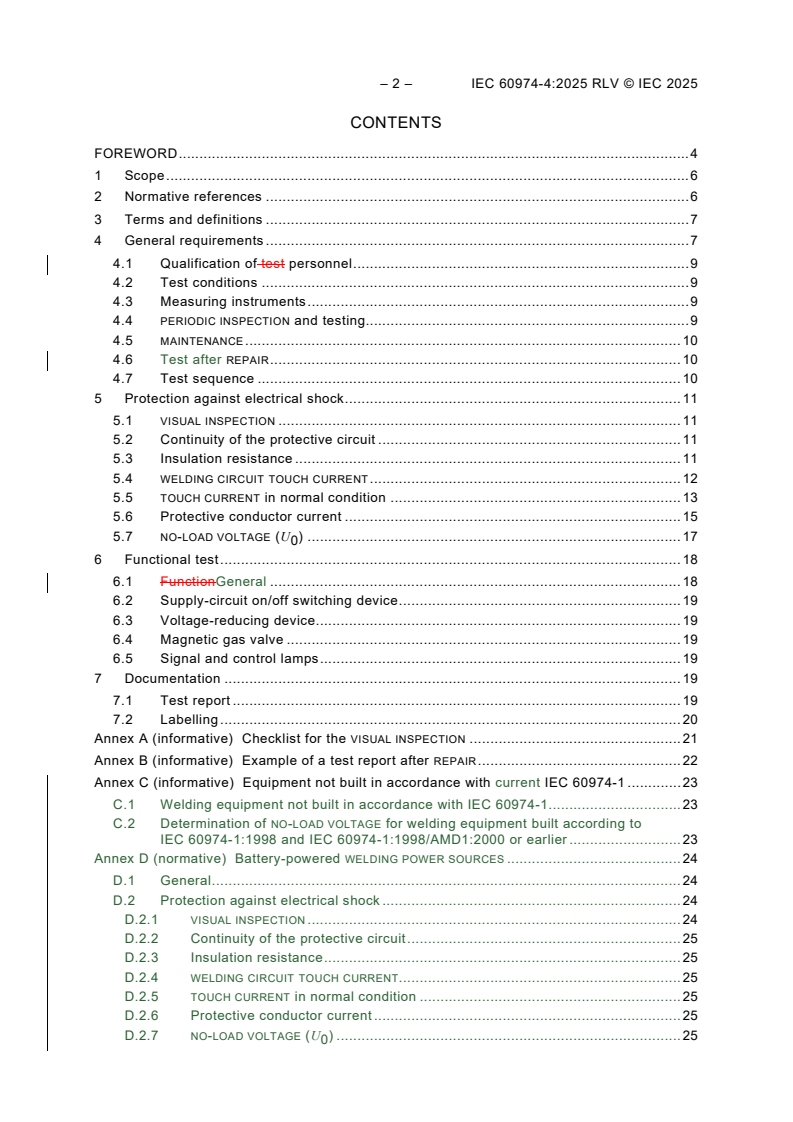
CONTENTS
FOREWORD . 4
1 Scope . 6
2 Normative references . 6
3 Terms and definitions . 7
4 General requirements . 7
4.1 Qualification of test personnel . 9
4.2 Test conditions . 9
4.3 Measuring instruments . 9
4.4 PERIODIC INSPECTION and testing. 9
4.5 MAINTENANCE . 10
4.6 Test after REPAIR . 10
4.7 Test sequence . 10
5 Protection against electrical shock . 11
5.1 VISUAL INSPECTION . 11
5.2 Continuity of the protective circuit . 11
5.3 Insulation resistance . 11
5.4 WELDING CIRCUIT TOUCH CURRENT . 12
5.5 TOUCH CURRENT in normal condition . 13
5.6 Protective conductor current . 15
5.7 NO-LOAD VOLTAGE (U ) . 17
6 Functional test . 18
6.1 FunctionGeneral . 18
6.2 Supply-circuit on/off switching device . 19
6.3 Voltage-reducing device. 19
6.4 Magnetic gas valve . 19
6.5 Signal and control lamps . 19
7 Documentation . 19
7.1 Test report . 19
7.2 Labelling . 20
Annex A (informative) Checklist for the VISUAL INSPECTION . 21
Annex B (informative) Example of a test report after REPAIR . 22
Annex C (informative) Equipment not built in accordance with current IEC 60974-1 . 23
C.1 Welding equipment not built in accordance with IEC 60974-1 . 23
C.2 Determination of NO-LOAD VOLTAGE for welding equipment built according to
IEC 60974-1:1998 and IEC 60974-1:1998/AMD1:2000 or earlier . 23
Annex D (normative) Battery-powered WELDING POWER SOURCES . 24
D.1 General . 24
D.2 Protection against electrical shock . 24
D.2.1 VISUAL INSPECTION . 24
D.2.2 Continuity of the protective circuit . 25
D.2.3 Insulation resistance . 25
D.2.4 WELDING CIRCUIT TOUCH CURRENT. 25
D.2.5 TOUCH CURRENT in normal condition . 25
D.2.6 Protective conductor current . 25
D.2.7 NO-LOAD VOLTAGE (U ) . 25
D.3 Functional tests . 25
Bibliography . 26
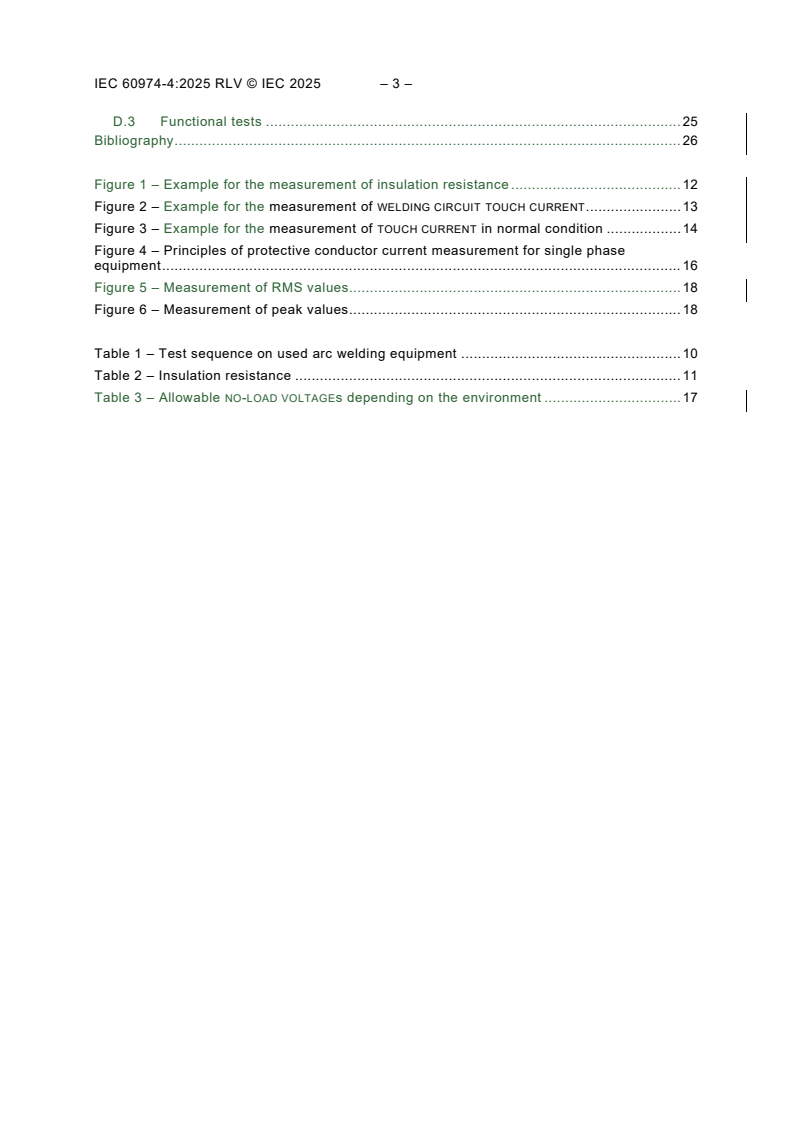
Figure 1 – Example for the measurement of insulation resistance . 12
Figure 2 – Example for the measurement of WELDING CIRCUIT TOUCH CURRENT . 13
Figure 3 – Example for the measurement of TOUCH CURRENT in normal condition . 14
Figure 4 – Principles of protective conductor current measurement for single phase
equipment . 16
Figure 5 – Measurement of RMS values. 18
Figure 6 – Measurement of peak values . 18
Table 1 – Test sequence on used arc welding equipment . 10
Table 2 – Insulation resistance . 11
Table 3 – Allowable NO-LOAD VOLTAGEs depending on the environment . 17
– 4 – IEC 60974-4:2025 RLV © IEC 2025
INTERNATIONAL ELECTROTECHNICAL COMMISSION
____________
ARC WELDING EQUIPMENT –
Part 4: Periodic inspection and testing
FOREWORD
1) The International Electrotechnical Commission (IEC) is a worldwide organization for standardization comprising
all national electrotechnical committees (IEC National Committees). The object of IEC is to promote international
co-operation on all questions concerning standardization in the electrical and electronic fields. To this end and
in addition to other activities, IEC publishes International Standards, Technical Specifications, Technical Reports,
Publicly Available Specifications (PAS) and Guides (hereafter referred to as "IEC Publication(s)"). Their
preparation is entrusted to technical committees; any IEC National Committee interested in the subject dealt with
may participate in this preparatory work. International, governmental and non-governmental organizations liaising
with the IEC also participate in this preparation. IEC collaborates closely with the International Organization for
Standardization (ISO) in accordance with conditions determined by agreement between the two organizations.
2) The formal decisions or agreements of IEC on technical matters express, as nearly as possible, an international
consensus of opinion on the relevant subjects since each technical committee has representation from all
interested IEC National Committees.
3) IEC Publications have the form of recommendations for international use and are accepted by IEC National
Committees in that sense. While all reasonable efforts are made to ensure that the technical content of IEC
Publications is accurate, IEC cannot be held responsible for the way in which they are used or for any
misinterpretation by any end user.
4) In order to promote international uniformity, IEC National Committees undertake to apply IEC Publications
transparently to the maximum extent possible in their national and regional publications. Any divergence between
any IEC Publication and the corresponding national or regional publication shall be clearly indicated in the latter.
5) IEC itself does not provide any attestation of conformity. Independent certification bodies provide conformity
assessment services and, in some areas, access to IEC marks of conformity. IEC is not responsible for any
services carried out by independent certification bodies.
6) All users should ensure that they have the latest edition of this publication.
7) No liability shall attach to IEC or its directors, employees, servants or agents including individual EXPERTS and
members of its technical committees and IEC National Committees for any personal injury, property damage or
other damage of any nature whatsoever, whether direct or indirect, or for costs (including legal fees) and
expenses arising out of the publication, use of, or reliance upon, this IEC Publication or any other IEC
Publications.
8) Attention is drawn to the Normative references cited in this publication. Use of the referenced publications is
indispensable for the correct application of this publication.
9) IEC draws attention to the possibility that the implementation of this document may involve the use of (a)
patent(s). IEC takes no position concerning the evidence, validity or applicability of any claimed patent rights in
respect thereof. As of the date of publication of this document, IEC had not received notice of (a) patent(s), which
may be required to implement this document. However, implementers are cautioned that this may not represent
the latest information, which may be obtained from the patent database available at https://patents.iec.ch. IEC
shall not be held responsible for identifying any or all such patent rights.
This redline version of the official IEC Standard allows the user to identify the changes
made to the previous edition IEC 60974-4:2016. A vertical bar appears in the margin
wherever a change has been made. Additions are in green text, deletions are in
strikethrough red text.
IEC 60974-4 has been prepared by IEC technical committee 26: Electric welding. It is an
International Standard.
This fourth edition cancels and replaces the third edition published in 2016. This edition
constitutes a technical revision.
This edition includes the following significant technical changes with respect to the previous
edition:
• examples for the measurements in respect of EN 50699,
• consideration of measuring equipment in respect of IEC 61557 series,
• more determinations of NO-LOAD VOLTAGE for welding equipment built according to
IEC 60974-1:1998 and IEC 60974-1:1998/AMD1:2000 or earlier,
• new Annex D providing additional information to be considered when testing battery-
powered WELDING POWER SOURCES and connected chargers.
The text of this International Standard is based on the following documents:
Draft Report on voting
26/769/FDIS 26/777/RVD
Full information on the voting for its approval can be found in the report on voting indicated in
the above table.
The language used for the development of this International Standard is English.
This document was drafted in accordance with ISO/IEC Directives, Part 2, and developed in
accordance with ISO/IEC Directives, Part 1 and ISO/IEC Directives, IEC Supplement, available
at www.iec.ch/members_experts/refdocs. The main document types developed by IEC are
described in greater detail at www.iec.ch/publications.
The list of all the parts of the IEC 60974 series, under the general title Arc welding equipment,
can be found on the IEC website.
In this document, the following print types are used:
• conformity statements: in italic type.
• terms defined in Clause 3: in SMALL ROMAN CAPITALS.
The committee has decided that the contents of this document will remain unchanged until the
stability date indicated on the IEC website under webstore.iec.ch in the data related to the
specific document. At this date, the document will be
• reconfirmed,
• withdrawn, or
• revised.
– 6 – IEC 60974-4:2025 RLV © IEC 2025
ARC WELDING EQUIPMENT –
Part 4: Periodic inspection and testing
1 Scope
This part of IEC 60974 specifies test procedures for PERIODIC INSPECTION and, after REPAIR, to
ensure electrical safety. These test procedures are also applicable for MAINTENANCE.
cument is applicable to power sources for arc welding and allied processes designed in
This do
accordance with IEC 60974-1 or IEC 60974-6. Stand-alone ancillary equipment designed in
accordance with other parts of IEC 60974 may can be tested in accordance with relevant
requirements of this part of IEC 60974.
This document includes requirements for battery-powered ARC WELDING POWER SOURCES, which
are given in Annex D.
NOTE 1 The WELDING POWER SOURCE can be tested with any ancillary equipment fitted that can affect the test
results.
This document is not applicable to testing of new power sources or engine-driven power
sources.
NOTE 2 For a power source not built in accordance with IEC 60974-1, see Annex C.
2 Normative references
The following documents are referred to in the text in such a way that some or all of their content
constitutes requirements of this document. For dated references, only the edition cited applies.
For undated references, the latest edition of the referenced document (including any
amendments) applies.
IEC 60050-151, International Electrotechnical Vocabulary (IEV) – Part 151: Electrical and
magnetic devices
IEC 60050-195, International Electrotechnical Vocabulary – Part 195: Earthing and protection
against electric shock
IEC 60050-851, International Electrotechnical Vocabulary – Part 851: Electric welding
IEC 60974-1:20122021, Arc welding equipment – Part 1: Welding power sources
IEC 60974-6:2015, Arc welding equipment – Part 6: Limited duty equipment
IEC 61140, Protection against electric shock – Common aspects for installation and equipment
IEC 61557-2:2019, Electrical safety in low voltage distribution systems up to 1 000 V AC and
1 500 V DC – Equipment for testing, measuring or monitoring of protective measures – Part 2:
Insulation resistance
IEC 61557-4:2019, Electrical safety in low voltage distribution systems up to 1 000 V AC and
1 500 V DC – Equipment for testing, measuring or monitoring of protective measures – Part 4:
Resistance of earth connection and equipotential bonding
IEC 61557-16:2023, Electrical safety in low voltage distribution systems up to 1 000 V AC and
1 500 V DC – Equipment for testing, measuring or monitoring of protective measures – Part 16:
Equipment for testing the effectiveness of the protective measures of electrical equipment
and/or medical electrical equipment
3 Terms and definitions
For the purposes of this document, the terms and definitions given in IEC 60050-151, the
IEC 60050-195, the IEC 60050-851, the IEC 60974-1 and the following apply.
ISO and IEC maintain terminology databases for use in standardization at the following
addresses:
• IEC Electropedia: available at https://www.electropedia.org/
• ISO Online browsing platform: available at https://www.iso.org/obp
3.1
WELDING POWER SOURCE
ARC WELDING POWER SOURCE
equipment for supplying current and voltage and having the required characteristics suitable
for arc welding and allied processes
Note 1 to entry: A WELDING POWER SOURCE can also supply services to other equipment and auxiliaries for example
auxiliary power, cooling liquid, consumable arc welding electrode and gas to shield the arc and the welding area.
[SOURCE: IEC 60050-851:2008, 851-13-01]
3.2
EXPERT
competent person
skilled person
person who can judge the work assigned and recognize possible hazards on the basis of
professional training, knowledge, experience and knowledge of the relevant equipment
Note 1 to entry: Several years of practice in the relevant technical field may be taken into consideration in
assessment of professional training.
[SOURCE: IEC 60974-1:2012, 3.3 IEC 60050-851:2008, 851-11-10]
3.3
INSTRUCTED PERSON
person informed about the tasks assigned and about the possible hazards involved in neglectful
behaviour
Note 1 to entry: If necessary, the person has undergone some training.
[SOURCE: IEC 60974-1:2012, 3.4 IEC 60050-851:2008, 851-11-13]
3.4
PERIODIC INSPECTION and test
examination carried out at specified intervals to reduce the risk of hazard
inspection of all equipment, systems and installations carried out on a routine basis
[SOURCE: IEC 60050-426:2020, 426-14-07]
3.5
MAINTENANCE
service carried out at specified intervals to reduce the risk of hazard and failure
– 8 – IEC 60974-4:2025 RLV © IEC 2025
combination of all technical and management actions intended to retain an item in, or restore it
to, a state in which it can perform as required
Note 1 to entry: Management is assumed to include supervision activities.
[SOURCE: IEC 60050-192:2015, 192-06-01]
3.6
REPAIR
restore to a safe and intended operating condition
direct action taken to effect restoration
Note 1 to entry: REPAIR includes fault localization (192-06-19), fault diagnosis (192-06-20); fault correction (192-06-
21); and function checkout (192-06-22).
[SOURCE: IEC 60050-192:2015, 192-06-14]
3.6
test personnel
instructed person or expert that has been trained and authorized to perform periodic inspection
and testing
3.7
NO-LOAD VOLTAGE
voltage, exclusive of any arc striking or arc stabilizing voltage, between the accessible output
terminals of a WELDING POWER SOURCE when the WELDING CIRCUIT is open but energized
[SOURCE: IEC 60050-851:2008, 851-12-24, modified – "but energized" has been added.]
3.8
TOUCH CURRENT
electric current passing through a human body or through livestock when it touches one or
more accessible parts of an installation or of equipment
Note 1 to entry: TOUCH CURRENT is measured by using a measuring network that simulates the impedance of the
human body.
[SOURCE: IEC 60050-195:2021, 195-05-21, modified – A note to entry has been added.]
3.9
VISUAL INSPECTION
inspection by eye to verify that there are no apparent discrepancies with respect to provisions
of the standard concerned
[SOURCE: IEC 60050-851:2008, 851-11-11]
3.10
WELDING CIRCUIT
conductive material through which the WELDING CURRENT is intended to flow
Note 1 to entry: In arc welding, the arc is a part of the WELDING CIRCUIT.
Note 2 to entry: In certain arc welding processes, the welding arc can be established between two electrodes. In
such a case, the workpiece is not necessarily a part of the WELDING CIRCUIT.
[SOURCE: IEC 60050-851:2008, 851-14-10, modified – "may" has been changed to "can".]
3.11
WELDING CURRENT
current delivered by a WELDING POWER SOURCE during welding
Note 1 to entry: This entry revises IEC 60050-851:2008, 851-12-28, which will be updated.
3.12
ENVIRONMENT WITH INCREASED RISK OF ELECTRIC SHOCK
environment where the probability of electric shock by arc welding is increased in relation to
normal arc welding conditions
Note 1 to entry: Such environments are found, for example:
a) in locations in which freedom of movement is restricted, so that the operator is forced to perform the welding in
a cramped (for example kneeling, sitting, lying) position with physical contact with conductive parts,
b) in locations which are fully or partially limited by conductive elements, and in which there is a high probability of
unavoidable or accidental contact by the operator,
c) in wet or damp or hot locations where humidity or perspiration considerably reduces the skin resistance of the
human body and the insulating properties of accessories.
Note 2 to entry: This entry revises IEC 60050-851:2008, 851-15-09, which will be updated.
4 General requirements
4.1 Qualification of test personnel
Tests of welding equipment can be hazardous and shall be carried out by an EXPERT or an
INSTRUCTED PERSON or expert in the field of electrical REPAIR, preferably also familiar with
welding, cutting and allied processes.
NOTE INSTRUCTED PERSONS should be are considered qualified for simple periodic testing and MAINTENANCE
provided the equipment enclosure does not have to be opened can remain closed. Hazardous voltages and currents
inside the equipment enclosure can cause shock, burn or death. Only an EXPERT test personnel can open the
equipment.
4.2 Test conditions
Tests shall be carried out at an ambient air temperature between 10 °C and 40 °C on dry and
cleaned welding equipment. Other temperatures may be used when environmental limit
requirements are met by both the test equipment and the WELDING POWER SOURCE.
Unless otherwise specified by the manufacturer, the equipment shall be supplied by a rated
supply voltage with a tolerance of ±10 %.
4.3 Measuring instruments
The accuracy of measuring instruments shall be class 2.5 (±2,5 % of full-scale reading) as a
minimum, except for the measurement of insulation resistance, where the accuracy of the
instruments is not specified but shall be taken into account for the measurement.
The test equipment used for the tests shall be calibrated in regular intervals taking into account
the information given by the manufacturer.
4.4 PERIODIC INSPECTION and testing
The PERIODIC INSPECTION and testing specified in Table 1 shall be carried out.
Tests shall be documented in a test report in accordance with 7.1.
During the tests, complementary instructions from the manufacturer shall be followed.
– 10 – IEC 60974-4:2025 RLV © IEC 2025
4.5 MAINTENANCE
MAINTENANCE schedule and instructions shall be followed.
The manufacturer's
Tests shall be documented in a test report in accordance with 7.1.
4.6 Test after REPAIR
After REPAIR or replacement of a component which restores a welding or cutting function, an
EXPERT shall select appropriate tests to be carried out, as specified in Table 1.
NOTE After a minor repair such as replacement of a lamp, wheel or under carriage, the tests given in Table 1 may
not be necessary.
Tests shall be documented in a test report in accordance with 7.1.
During the tests, complementary instructions from the manufacturer shall be observed (for
example, circuit diagrams, spare part list, functional test of WELDING POWER SOURCE and
ancillary equipment, etc.).
4.7 Test sequence
The test sequence is given in Table 1.
Table 1 – Test sequence on used arc welding equipment
PERIODIC INSPECTION and testing Test after REPAIR
a) VISUAL INSPECTION in accordance with 5.1 a) VISUAL INSPECTION in accordance with 5.1
b) Electrical test: b) Electrical test:
– protective conductor resistance in accordance – protective conductor resistance in accordance
with 5.2 with 5.2
– insulation resistance in accordance with 5.3 – insulation resistance in accordance with 5.3
(Optional Additionally, the following tests are (Optional Additionally, the following tests are
recommended: WELDING CIRCUIT TOUCH CURRENT recommended: WELDING CIRCUIT TOUCH CURRENT
in accordance with 5.4, TOUCH CURRENT in in accordance with 5.4, TOUCH CURRENT in
a a
normal condition in accordance with 5.5 and normal condition in accordance with 5.5 and
protective conductor current in accordance with protective conductor current in accordance with
a a
5.6) 5.6)
– NO-LOAD VOLTAGE in accordance with 5.7 – NO-LOAD VOLTAGE in accordance with 5.7
c) Functional test: c) Functional test:
– no requirement – function in accordance with 6.1
– supply-circuit on/off switching device in
accordance with 6.2
– voltage-reducing device in accordance with 6.3
– magnetic gas valve in accordance with 6.4
– signal and control lamps in accordance with 6.5
d) Documentation in accordance with Clause 7 d) Documentation in accordance with Clause 7
a
If the insulation resistance test cannot be carried out for without disconnection of any component of the
equipment to be tested (e.g. interference suppression networks, protection capacitors or surge protection
component), the insulation resistance test may be replaced by the optional tests specified in item b).
a
b
Only if there are accessible conductive surfaces not connected to the protective circuit.
5 Protection against electrical shock
5.1 VISUAL INSPECTION
VISUAL INSPECTION shall be carried out in accordance with the conditions of use of welding
equipment and the manufacturer's instructions.
An example of items for a VISUAL INSPECTION is given in Annex A.
NOTE Accessible conductive parts can be identified for testing during VISUAL INSPECTION.
5.2 Continuity of the protective circuit
For mains-powered welding equipment of protection class I, including ancillary equipment (for
example, cooling system) having mains connecting cables up to a length of 5,0 m, the maximum
measured protective conductor resistance shall not exceed 0,3 Ω.
For cables longer than 5,0 m, the permissible value of the protective conductor resistance is
increased by 0,1 Ω per additional 7,5 m cable. The maximum permissible value of the protective
conductor resistance is 1 Ω.
Conformity shall be checked by measuring the resistance between the protective conductor
contact at the plug and exposed conductive parts with testing equipment according to
IEC 61557-4 or IEC 61557-16.
During the measurement, the cables shall be bent, flexed or twisted along the whole length,
especially in the vicinity of cable entries into the enclosure, in order to detect interruptions in
the protective conductor.
NOTE Flexing is not required for permanently connected equipment where the conductor is not accessible. A
minimum measuring current of 10 A, can be utilized instead of bending and flexing to identify faults.
5.3 Insulation resistance
The insulation resistance shall not be less than the values given in Table 2.
Table 2 – Insulation resistance
a
Resistance Insulation
Measurement
Supply circuit to WELDING CIRCUIT 5,0 MΩ Double or reinforced
WELDING CIRCUIT to protective circuit 2,5 MΩ Basic
Supply circuit to protective circuit 2,5 MΩ Basic
b
Supply circuit of Class II equipment to 5,0 MΩ Double or reinforced
accessible surfaces
a
Control circuits are tested together with the circuit to which they are galvanically connected. Accessible control
circuits separated from all other circuits are tested according to the manufacturer's specification.
b
For measurement to accessible non-conductive surfaces, such surfaces shall be considered to be covered by
metal foil.
Conformity shall be checked by the stabilized measurement of the insulation resistance by
application of a DC voltage of 500 V at room temperature with a circuit as shown in Figure 1
with testing equipment according to IEC 61557-2 or IEC 61557-16.
During the measurement, torches shall be disconnected, solid-state electronic components and
their protective devices may be short-circuited, and liquid cooling units shall be tested without
liquid.
– 12 – IEC 60974-4:2025 RLV © IEC 2025
SOURCE: EN 50699:2020. Reproduced with the permission of © CENELEC.
Figure 1 – Example for the measurement of insulation resistance
5.4 WELDING CIRCUIT TOUCH CURRENT
The TOUCH CURRENT between the WELDING CIRCUIT connections and the protective conductor
terminal shall not exceed 10 mA RMS.
Conformity shall be checked by VISUAL INSPECTION and measurement of the TOUCH CURRENT
with a circuit as shown in Figure 2 at the rated supply voltage(s) and no-load condition.
The measuring network shall be connected as shown in Figure 2 separately to each WELDING
connection.
CIRCUIT
mA
2kΩ
IEC
SOURCE: EN 50699:2020. Reproduced with the permission of © CENELEC.
NOTE For class II equipment, the PE-terminal of earthed supply network is used.
Figure 2 – Example for the measurement of WELDING CIRCUIT TOUCH CURRENT
5.5 TOUCH CURRENT in normal condition
TOUCH CURRENT for accessible conductive surfaces, not connected to the protective circuit,
The
shall not exceed 0,5 mA RMS under normal conditions.
– 14 – IEC 60974-4:2025 RLV © IEC 2025
2kΩ
mA
L N PE
IEC
SOURCE: EN 50699:2020. Reproduced with the permission of © CENELEC.
Figure 3 – Example for the measurement of TOUCH CURRENT in normal condition
Conformity shall be checked as shown in Figure 3 with testing equipment according to
IEC 61557-16.
a) The WELDING POWER SOURCE is:
– isolated from the ground plane,
– supplied by the highest rated supply voltage,
b) the WELDING CIRCUIT is in the no-load condition,
c) interference suppression capacitors are not disconnected.
5.6 Protective conductor current
For class I equipment, the protective conductor current shall not exceed 10 mA RMS except for
equipment with permanent connection by a reinforced protective conductor in accordance with
IEC 61140.
Equipment for permanent connection with a reinforced protective conductor may have a leakage
current up to 5 % of the rated supply current per phase.
Conformity shall be checked using the measuring circuit as shown in Figure 4 with testing
equipment according to IEC 61557-16 under the following conditions:
a) the WELDING POWER SOURCE is:
– isolated from the ground plane for direct measurement,
– supplied by the highest rated supply voltage,
– not connected to the protective earth except through measurement components,
b) the WELDING CIRCUIT is in the no-load condition,
c) interference suppression capacitors shall not be disconnected.
The measurement of the protective conductor current may be performed directly or in the form
of a difference current measurement (see Figure 4a) and Figure 4b)). The tolerance of the
component values in the measurement circuit shall not exceed ±5 %.
Equipment for permanent connection with a reinforced protective conductor shall be tested
according to the manufacturer's specification.
– 16 – IEC 60974-4:2025 RLV © IEC 2025
L N PE
L N PE
mA mA
L N PE L N PE
IEC IEC
a) Principle of direct measurement b) Principle of measurement according to the difference
current procedure with possible earth connection
Figure 4 – Principles of protective conductor current measurement
for single phase equipment
NOTE Caution! This test is performed by a qualified person.
5.7 NO-LOAD VOLTAGE (U )
The peak values of the maximum NO-LOAD VOLTAGE at all possible settings of the power source
should not be higher than ±15 % of no-load voltage U and shall not exceed the values given
in Table 13 of IEC 60974-1 when the power source is supplied at rated supply voltage and
frequency.
The measured NO-LOAD VOLTAGE shall not exceed the values given in Table 3 when the power
source is supplied at rated supply voltage and frequency. The measured NO-LOAD VOLTAGE
should not be outside of a range of ±15 % of rated NO-LOAD VOLTAGE U (e. g. given in rating
plate) unless otherwise specified in the instructions.
Table 3 – Allowable NO-LOAD VOLTAGEs depending on the environment
Working conditions NO-LOAD VOLTAGE
ENVIRONMENT WITH INCREASED RISK OF ELECTRIC SHOCK marked by DC 113 V peak
AC 68 V peak and 48 V RMS
Environment without increased risk of electric shock DC 113 V peak
AC 113 V peak and 80 V RMS
Mechanically held torches with increased protection for the operator DC 141 V peak
AC 141 V peak and 100 V RMS
Plasma cutting DC 500 V peak
Before testing, arc striking and stabilizing devices shall, if necessary, be removed or by-passed
according to the manufacturer's instructions (see also instructions for use or manufacturer's
testing instructions).
The NO-LOAD VOLTAGE is measured between welding output terminals. If this is not possible for
safety or control reasons, the NO-LOAD VOLTAGE is measured between the torch and WELDING
CURRENT return cable connection. This test is not required for plasma cutting power sources.
If rated reduced NO-LOAD VOLTAGE (U ) or rated switched NO-LOAD VOLTAGE (U ) are defined on
R S
the rating plate, U or U shall be measured instead of U .
R S 0
If the power source in question was built according to IEC 60974-1:1998 (withdrawn) and
IEC 60974-1:1998/AMD1:2000 (withdrawn) or earlier, the procedure according to Annex C can
be considered.
Conformity shall be checked with testing equipment by measurement of
a) RMS values
A true RMS meter is shall be used together with a resistance of the external welding circuit
of 5 kΩ resistor of (5 ± 0,25) kΩ, connected across the WELDING CIRCUIT terminals as shown
in Figure 5:
– 18 – IEC 60974-4:2025 RLV © IEC 2025
Key
U NO-LOAD VOLTAGE
V true RMS voltmeter
Figure 5 – Measurement of RMS values
b) peak values
To obtain reproducible measurements of peak values, omitting impulses which are not
dangerous, a stabilized measurement with a circuit as shown in Figure 6 is used.
Key
U NO-LOAD VOLTAGE
V voltmeter
1 diode 1N4007 or similar
Figure 6 – Measurement of peak values
The voltmeter shall indicate mean values. The measurement range chosen shall be as near as
possible to the actual value of the NO-LOAD VOLTAGE. The voltmeter shall have an internal
resistance of at least 1 MΩ.
The tolerance of the component values in the measurement circuit shall not exceed ±5 %. The
minimum power for the resistor of 0,2 kΩ is 65 W. The rheostat shall withstand a current value
of 0,6 A. The capacitors shall have a minimum voltage rating of 200 V.
6 Functional test
6.1 FunctionGeneral
Each safety-related function judged as relevant by the test personnel EXPERT or INSTRUCTED
PERSON shall be checked for correct operation.
Conformity shall be checked by operating the device and by checking whether the WELDING
POWER SOURCE operates correctly.
6.2 Supply-circuit on/off switching device
Where an integral supply-circuit on/off switching device (for example, switch, contactor or
circuit-breaker) is fitted, this shall:
a) open or close all ungrounded mains conductors,
b) clearly indicates whether the circuit is open or closed.
Conformity shall be checked by VISUAL INSPECTION and measurement.
6.3 Voltage-reducing device
Where a voltage-reducing device is fitted, it shall be checked for correct operation.
Conformity shall be checked by measurement of reduced NO-LOAD VOLTAGE (see 5.7) and VISUAL
INSPECTION of indicator in load and no-load condition.
6.4 Magnetic gas valve
Each magnetic gas valve (for example, TIG, MIG/MAG, plasma power sources), shall be
checked for correct operation.
Conformity shall be checked by VISUAL INSPECTION and the following operations or by a test
specified by the manufacturer.
a) Function
Operate the trigger of the torch and check by means of the gas flow whether the magnetic
gas valve operates.
b) Leakage
Pressurize the system and verify there is no leak, for example, there is no pressure drop.
NOTE Flexible gas tubes and their connections can be sources of leaks.
6.5 Signal and control lamps
Signal or control lamps shall be checked for correct operation if possible.
Conformity shall be checked by VISUAL INSPECTION.
7 Documentation
7.1 Test report
The test report shall include
a) identification of tested arc welding equipment,
b) date of testing,
c) supply voltage,
d) test results,
e) signature, identification of the test performing personnel and his organization,
f) identification of testing equipment.
The test report, after REPAIR, shall include all the tests given in Table 1 and an indication shall
be made if a particular test has not been carried out.
An example of a test report is given in Annex B.
– 20 – IEC 60974-4:2025 RLV © IEC 2025
7.2 Labelling
A label shall be attached to the equipment to indicate that it has passed the test.
The label shall state the date of testing or recommended date for next inspection depending on
local regulation.
Annex A
(informative)
Checklist for the visual inspection
During VISUAL INSPECTION, the following listed items should be checked.
a) Torch/electrode holder, welding clamp
– missing or defective insulation,
– defective connections,
– defective, damaged switches,
– other damage.
b) Mains supply
– defective, damaged cable,
– deformed, faulty plug,
– broken or thermally damaged plug pins,
– ineffective cable anchorage,
– cables and plugs unsuitable for the intended use and performance.
C) WELDING CIRCUIT
– defective, damaged cable,
– deformed, faulty or thermally damaged coupler/sockets,
– ineffective cable anchorage,
– cables and couplers unsuitable for the intended use and performance.
d) Enclosure
– missing or damaged parts,
– unauthorized modifications,
– cooling openings blocked or missing air filters,
– signs of overload and improper use,
– missing or defective protective devices, for example, gas cylinder holder,
– missing or defective wheels, lifting means, holder, etc.,
– defective wire reel mounting means,
– conductive objects placed in the enclosure.
e) Controls and indicators
– defective switches, meters and lamps,
– defective pressure regulator or flowmeter,
– incorrect fuses accessible from outside the enclosure.
f) General condition
– excessive dust or pollution,
– cooling liquid circuit leaking or incorrect cooling liquid level,
– defective gas hoses and connections,
– poor legibility of markings and labelling,
– other damage or signs of improper use.
– 22 – IEC 60974-4:2025 RLV © IEC 2025
Annex B
(informative)
Example of a test report after repair
Test report
Company: Sample Ltd. Location: London Torchham WH15 B4
Equipment: ARC WELDING POWER SOURCE Type: Freefried S/N: 123456
Manufacturer: Freefried Electric Ltd. Protection class: I
Testing equipment: TEST DEVICE D6, Metaframe, measuring circuits as given in IEC 60974-4.
Mains voltage V 230
RMS
Test point: Limit Measured values
VISUAL INSPECTION --- OK
Protective conductor resistance ---
R 0,02 Ω
≤ 0,3 Ω
PE
Insulation resistance ---
– Supply circuit/ R
≥ 2,5 MΩ ≥ 20 MΩ
S-P
Protective circuit (500 V)
– WELDING CIRCUIT, control R ≥ 2,5 MΩ ≥ 20 MΩ
W, C-P
circuit/
Protective circuit (500 V)
– Supply circuit/ R
≥ 5 MΩ ≥ 20 MΩ
S,-W-C
WELDING CIRCUIT, control
circuit (500 V)
Protective conductor I 2 mA
≤ 10 mA
PE
RMS
a
current
TOUCH CURRENT in normal I ≤ 0,5 mA
T RMS
a
condition
0,04 mA
– Equipment with I N/A
≤ 0,05 I A
T
1max
reinforced protective
a
conductor
a
WELDING CIRCUIT TOUCH CURRENT
I 0,056 mA
≤ 10 mA
T
RMS
NO-LOAD VOLTAGE ---
U ≤ 68 V N/A
S 0 peak
With mark
N/A
U
≤ 113 V
peak
U 110 V
≤ 113 V
S 0
peak
Without mark
N/A
U
≤ 113 V
peak
Functional test --- ok
Test passed
Test performing personnel name --- Myself
Test performing personnel signature --- Me
Date --- 03-03-14
Remarks (result of VISUAL INSPECTION or functional test): None _______________________________________________
Testing company: Checkmates Limited ___________________________________________________________________
Address: London Weldshire WG3 A7 _____________________________________________________________________
REPAIR: replacement of broken main switch ________________________________________________________________
N/A: Not applicable to the REPAIR according to the investigator ______________________________________________
a
optional Additional measurements
Annex C
(informative)
Equipment not built in accordance with current IEC 60974-1
C.1 Welding equipment not built in accordance with IEC 60974-1
There is a possibility that welding equipment not built in accordance with IEC 60974-1 (for
example, built prior to the publicati
...
IEC 60974-4 ®
Edition 4.0 2025-06
INTERNATIONAL
STANDARD
NORME
INTERNATIONALE
Arc welding equipment –
Part 4: Periodic inspection and testing
Matériel de soudage à l'arc –
Partie 4: Inspection et essais périodiques
ICS 25.160 ISBN 978-2-8327-0462-2
All rights reserved. Unless otherwise specified, no part of this publication may be reproduced or utilized in any form or
by any means, electronic or mechanical, including photocopying and microfilm, without permission in writing from either
IEC or IEC's member National Committee in the country of the requester. If you have any questions about IEC copyright
or have an enquiry about obtaining additional rights to this publication, please contact the address below or your local
IEC member National Committee for further information.
Droits de reproduction réservés. Sauf indication contraire, aucune partie de cette publication ne peut être reproduite ni
utilisée sous quelque forme que ce soit et par aucun procédé, électronique ou mécanique, y compris la photocopie et
les microfilms, sans l'accord écrit de l'IEC ou du Comité national de l'IEC du pays du demandeur. Si vous avez des
questions sur le copyright de l'IEC ou si vous désirez obtenir des droits supplémentaires sur cette publication, utilisez
les coordonnées ci-après ou contactez le Comité national de l'IEC de votre pays de résidence.
IEC Secretariat Tel.: +41 22 919 02 11
3, rue de Varembé info@iec.ch
CH-1211 Geneva 20 www.iec.ch
Switzerland
About the IEC
The International Electrotechnical Commission (IEC) is the leading global organization that prepares and publishes
International Standards for all electrical, electronic and related technologies.
About IEC publications
The technical content of IEC publications is kept under constant review by the IEC. Please make sure that you have the
latest edition, a corrigendum or an amendment might have been published.
IEC publications search - IEC Products & Services Portal - products.iec.ch
webstore.iec.ch/advsearchform Discover our powerful search engine and read freely all the
The advanced search enables to find IEC publications by a publications previews, graphical symbols and the glossary.
variety of criteria (reference number, text, technical With a subscription you will always have access to up to date
committee, …). It also gives information on projects, content tailored to your needs.
replaced and withdrawn publications.
Electropedia - www.electropedia.org
IEC Just Published - webstore.iec.ch/justpublished The world's leading online dictionary on electrotechnology,
Stay up to date on all new IEC publications. Just Published containing more than 22 500 terminological entries in English
details all new publications released. Available online and and French, with equivalent terms in 25 additional languages.
once a month by email. Also known as the International Electrotechnical Vocabulary
(IEV) online.
IEC Customer Service Centre - webstore.iec.ch/csc
If you wish to give us your feedback on this publication or
need further assistance, please contact the Customer
Service Centre: sales@iec.ch.
A propos de l'IEC
La Commission Electrotechnique Internationale (IEC) est la première organisation mondiale qui élabore et publie des
Normes internationales pour tout ce qui a trait à l'électricité, à l'électronique et aux technologies apparentées.
A propos des publications IEC
Le contenu technique des publications IEC est constamment revu. Veuillez vous assurer que vous possédez l’édition la
plus récente, un corrigendum ou amendement peut avoir été publié.
Recherche de publications IEC - IEC Products & Services Portal - products.iec.ch
webstore.iec.ch/advsearchform Découvrez notre puissant moteur de recherche et consultez
La recherche avancée permet de trouver des publications gratuitement tous les aperçus des publications, symboles
IEC en utilisant différents critères (numéro de référence, graphiques et le glossaire. Avec un abonnement, vous aurez
texte, comité d’études, …). Elle donne aussi des toujours accès à un contenu à jour adapté à vos besoins.
informations sur les projets et les publications remplacées
ou retirées. Electropedia - www.electropedia.org
Le premier dictionnaire d'électrotechnologie en ligne au
IEC Just Published - webstore.iec.ch/justpublished monde, avec plus de 22 500 articles terminologiques en
Restez informé sur les nouvelles publications IEC. Just anglais et en français, ainsi que les termes équivalents
Published détaille les nouvelles publications parues. dans 25 langues additionnelles. Egalement appelé
Disponible en ligne et une fois par mois par email. Vocabulaire Electrotechnique International (IEV) en ligne.
Service Clients - webstore.iec.ch/csc
Si vous désirez nous donner des commentaires sur cette
publication ou si vous avez des questions contactez-
nous: sales@iec.ch.
– 2 – IEC 60974-4:2025 © IEC 2025
CONTENTS
FOREWORD . 4
1 Scope . 6
2 Normative references . 6
3 Terms and definitions . 7
4 General requirements . 9
4.1 Qualification of personnel . 9
4.2 Test conditions . 9
4.3 Measuring instruments . 9
4.4 PERIODIC INSPECTION and testing. 9
4.5 MAINTENANCE . 9
4.6 Test after REPAIR . 10
4.7 Test sequence . 10
5 Protection against electrical shock . 10
5.1 VISUAL INSPECTION . 10
5.2 Continuity of the protective circuit . 11
5.3 Insulation resistance . 11
5.4 WELDING CIRCUIT TOUCH CURRENT . 12
5.5 TOUCH CURRENT in normal condition . 13
5.6 Protective conductor current . 14
5.7 NO-LOAD VOLTAGE (U ) . 15
6 Functional test . 17
6.1 General . 17
6.2 Supply-circuit on/off switching device . 17
6.3 Voltage-reducing device. 17
6.4 Magnetic gas valve . 17
6.5 Signal and control lamps . 17
7 Documentation . 18
7.1 Test report . 18
7.2 Labelling . 18
Annex A (informative) Checklist for the VISUAL INSPECTION . 19
Annex B (informative) Example of a test report after REPAIR . 20
Annex C (informative) Equipment not built in accordance with current IEC 60974-1 . 21
C.1 Welding equipment not built in accordance with IEC 60974-1 . 21
C.2 Determination of NO-LOAD VOLTAGE for welding equipment built according to
IEC 60974-1:1998 and IEC 60974-1:1998/AMD1:2000 or earlier . 21
Annex D (normative) Battery-powered WELDING POWER SOURCES . 22
D.1 General . 22
D.2 Protection against electrical shock . 22
D.2.1 VISUAL INSPECTION . 22
D.2.2 Continuity of the protective circuit . 23
D.2.3 Insulation resistance . 23
D.2.4 WELDING CIRCUIT TOUCH CURRENT. 23
D.2.5 TOUCH CURRENT in normal condition . 23
D.2.6 Protective conductor current . 23
D.2.7 NO-LOAD VOLTAGE (U ) . 23
D.3 Functional tests . 23
Bibliography . 24
Figure 1 – Example for the measurement of insulation resistance . 12
Figure 2 – Example for the measurement of WELDING CIRCUIT TOUCH CURRENT . 13
Figure 3 – Example for the measurement of TOUCH CURRENT in normal condition . 13
Figure 4 – Principles of protective conductor current measurement for single phase
equipment . 15
Figure 5 – Measurement of RMS values. 16
Figure 6 – Measurement of peak values . 16
Table 1 – Test sequence on used arc welding equipment . 10
Table 2 – Insulation resistance . 11
Table 3 – Allowable NO-LOAD VOLTAGEs depending on the environment . 15
– 4 – IEC 60974-4:2025 © IEC 2025
INTERNATIONAL ELECTROTECHNICAL COMMISSION
____________
ARC WELDING EQUIPMENT –
Part 4: Periodic inspection and testing
FOREWORD
1) The International Electrotechnical Commission (IEC) is a worldwide organization for standardization comprising
all national electrotechnical committees (IEC National Committees). The object of IEC is to promote international
co-operation on all questions concerning standardization in the electrical and electronic fields. To this end and
in addition to other activities, IEC publishes International Standards, Technical Specifications, Technical Reports,
Publicly Available Specifications (PAS) and Guides (hereafter referred to as "IEC Publication(s)"). Their
preparation is entrusted to technical committees; any IEC National Committee interested in the subject dealt with
may participate in this preparatory work. International, governmental and non-governmental organizations liaising
with the IEC also participate in this preparation. IEC collaborates closely with the International Organization for
Standardization (ISO) in accordance with conditions determined by agreement between the two organizations.
2) The formal decisions or agreements of IEC on technical matters express, as nearly as possible, an international
consensus of opinion on the relevant subjects since each technical committee has representation from all
interested IEC National Committees.
3) IEC Publications have the form of recommendations for international use and are accepted by IEC National
Committees in that sense. While all reasonable efforts are made to ensure that the technical content of IEC
Publications is accurate, IEC cannot be held responsible for the way in which they are used or for any
misinterpretation by any end user.
4) In order to promote international uniformity, IEC National Committees undertake to apply IEC Publications
transparently to the maximum extent possible in their national and regional publications. Any divergence between
any IEC Publication and the corresponding national or regional publication shall be clearly indicated in the latter.
5) IEC itself does not provide any attestation of conformity. Independent certification bodies provide conformity
assessment services and, in some areas, access to IEC marks of conformity. IEC is not responsible for any
services carried out by independent certification bodies.
6) All users should ensure that they have the latest edition of this publication.
7) No liability shall attach to IEC or its directors, employees, servants or agents including individual EXPERTS and
members of its technical committees and IEC National Committees for any personal injury, property damage or
other damage of any nature whatsoever, whether direct or indirect, or for costs (including legal fees) and
expenses arising out of the publication, use of, or reliance upon, this IEC Publication or any other IEC
Publications.
8) Attention is drawn to the Normative references cited in this publication. Use of the referenced publications is
indispensable for the correct application of this publication.
9) IEC draws attention to the possibility that the implementation of this document may involve the use of (a)
patent(s). IEC takes no position concerning the evidence, validity or applicability of any claimed patent rights in
respect thereof. As of the date of publication of this document, IEC had not received notice of (a) patent(s), which
may be required to implement this document. However, implementers are cautioned that this may not represent
the latest information, which may be obtained from the patent database available at https://patents.iec.ch. IEC
shall not be held responsible for identifying any or all such patent rights.
IEC 60974-4 has been prepared by IEC technical committee 26: Electric welding. It is an
International Standard.
This fourth edition cancels and replaces the third edition published in 2016. This edition
constitutes a technical revision.
This edition includes the following significant technical changes with respect to the previous
edition:
• examples for the measurements in respect of EN 50699,
• consideration of measuring equipment in respect of IEC 61557 series,
• more determinations of NO-LOAD VOLTAGE for welding equipment built according to
IEC 60974-1:1998 and IEC 60974-1:1998/AMD1:2000 or earlier,
• new Annex D providing additional information to be considered when testing battery-
powered WELDING POWER SOURCES and connected chargers.
The text of this International Standard is based on the following documents:
Draft Report on voting
26/769/FDIS 26/777/RVD
Full information on the voting for its approval can be found in the report on voting indicated in
the above table.
The language used for the development of this International Standard is English.
This document was drafted in accordance with ISO/IEC Directives, Part 2, and developed in
accordance with ISO/IEC Directives, Part 1 and ISO/IEC Directives, IEC Supplement, available
at www.iec.ch/members_experts/refdocs. The main document types developed by IEC are
described in greater detail at www.iec.ch/publications.
The list of all the parts of the IEC 60974 series, under the general title Arc welding equipment,
can be found on the IEC website.
In this document, the following print types are used:
• conformity statements: in italic type.
• terms defined in Clause 3: in SMALL ROMAN CAPITALS.
The committee has decided that the contents of this document will remain unchanged until the
stability date indicated on the IEC website under webstore.iec.ch in the data related to the
specific document. At this date, the document will be
• reconfirmed,
• withdrawn, or
• revised.
– 6 – IEC 60974-4:2025 © IEC 2025
ARC WELDING EQUIPMENT –
Part 4: Periodic inspection and testing
1 Scope
This part of IEC 60974 specifies test procedures for PERIODIC INSPECTION and, after REPAIR, to
ensure electrical safety. These test procedures are also applicable for MAINTENANCE.
This document is applicable to power sources for arc welding and allied processes designed in
accordance with IEC 60974-1 or IEC 60974-6. Stand-alone ancillary equipment designed in
accordance with other parts of IEC 60974 can be tested in accordance with relevant
requirements of this part of IEC 60974.
This document includes requirements for battery-powered ARC WELDING POWER SOURCES, which
are given in Annex D.
NOTE 1 The WELDING POWER SOURCE can be tested with any ancillary equipment fitted that can affect the test
results.
This document is not applicable to testing of new power sources or engine-driven power
sources.
NOTE 2 For a power source not built in accordance with IEC 60974-1, see Annex C.
2 Normative references
The following documents are referred to in the text in such a way that some or all of their content
constitutes requirements of this document. For dated references, only the edition cited applies.
For undated references, the latest edition of the referenced document (including any
amendments) applies.
IEC 60050-151, International Electrotechnical Vocabulary (IEV) – Part 151: Electrical and
magnetic devices
IEC 60974-1:2021, Arc welding equipment – Part 1: Welding power sources
IEC 60974-6:2015, Arc welding equipment – Part 6: Limited duty equipment
IEC 61140, Protection against electric shock – Common aspects for installation and equipment
IEC 61557-2:2019, Electrical safety in low voltage distribution systems up to 1 000 V AC and
1 500 V DC – Equipment for testing, measuring or monitoring of protective measures – Part 2:
Insulation resistance
IEC 61557-4:2019, Electrical safety in low voltage distribution systems up to 1 000 V AC and
1 500 V DC – Equipment for testing, measuring or monitoring of protective measures – Part 4:
Resistance of earth connection and equipotential bonding
IEC 61557-16:2023, Electrical safety in low voltage distribution systems up to 1 000 V AC and
1 500 V DC – Equipment for testing, measuring or monitoring of protective measures – Part 16:
Equipment for testing the effectiveness of the protective measures of electrical equipment
and/or medical electrical equipment
3 Terms and definitions
For the purposes of this document, the terms and definitions given in IEC 60050-151,
IEC 60974-1 and the following apply.
ISO and IEC maintain terminology databases for use in standardization at the following
addresses:
• IEC Electropedia: available at https://www.electropedia.org/
• ISO Online browsing platform: available at https://www.iso.org/obp
3.1
WELDING POWER SOURCE
ARC WELDING POWER SOURCE
equipment for supplying current and voltage and having the required characteristics suitable
for arc welding and allied processes
Note 1 to entry: A WELDING POWER SOURCE can also supply services to other equipment and auxiliaries for example
auxiliary power, cooling liquid, consumable arc welding electrode and gas to shield the arc and the welding area.
[SOURCE: IEC 60050-851:2008, 851-13-01]
3.2
EXPERT
person who can judge the work assigned and recognize possible hazards on the basis of
professional training, knowledge, experience and knowledge of the relevant equipment
Note 1 to entry: Several years of practice in the relevant technical field may be taken into consideration in
assessment of professional training.
[SOURCE: IEC 60050-851:2008, 851-11-10]
3.3
INSTRUCTED PERSON
person informed about the tasks assigned and about the possible hazards involved in neglectful
behaviour
Note 1 to entry: If necessary, the person has undergone some training.
[SOURCE: IEC 60050-851:2008, 851-11-13]
3.4
PERIODIC INSPECTION
inspection of all equipment, systems and installations carried out on a routine basis
[SOURCE: IEC 60050-426:2020, 426-14-07]
3.5
MAINTENANCE
combination of all technical and management actions intended to retain an item in, or restore it
to, a state in which it can perform as required
Note 1 to entry: Management is assumed to include supervision activities.
[SOURCE: IEC 60050-192:2015, 192-06-01]
– 8 – IEC 60974-4:2025 © IEC 2025
3.6
REPAIR
direct action taken to effect restoration
Note 1 to entry: REPAIR includes fault localization (192-06-19), fault diagnosis (192-06-20); fault correction (192-06-
21); and function checkout (192-06-22).
[SOURCE: IEC 60050-192:2015, 192-06-14]
3.7
NO-LOAD VOLTAGE
voltage, exclusive of any arc striking or arc stabilizing voltage, between the accessible output
terminals of a WELDING POWER SOURCE when the WELDING CIRCUIT is open but energized
[SOURCE: IEC 60050-851:2008, 851-12-24, modified – "but energized" has been added.]
3.8
TOUCH CURRENT
electric current passing through a human body or through livestock when it touches one or
more accessible parts of an installation or of equipment
Note 1 to entry: TOUCH CURRENT is measured by using a measuring network that simulates the impedance of the
human body.
[SOURCE: IEC 60050-195:2021, 195-05-21, modified – A note to entry has been added.]
3.9
VISUAL INSPECTION
inspection by eye to verify that there are no apparent discrepancies with respect to provisions
of the standard concerned
[SOURCE: IEC 60050-851:2008, 851-11-11]
3.10
WELDING CIRCUIT
conductive material through which the WELDING CURRENT is intended to flow
Note 1 to entry: In arc welding, the arc is a part of the WELDING CIRCUIT.
Note 2 to entry: In certain arc welding processes, the welding arc can be established between two electrodes. In
such a case, the workpiece is not necessarily a part of the WELDING CIRCUIT.
[SOURCE: IEC 60050-851:2008, 851-14-10, modified – "may" has been changed to "can".]
3.11
WELDING CURRENT
current delivered by a WELDING POWER SOURCE during welding
Note 1 to entry: This entry revises IEC 60050-851:2008, 851-12-28, which will be updated.
3.12
ENVIRONMENT WITH INCREASED RISK OF ELECTRIC SHOCK
environment where the probability of electric shock by arc welding is increased in relation to
normal arc welding conditions
Note 1 to entry: Such environments are found, for example:
a) in locations in which freedom of movement is restricted, so that the operator is forced to perform the welding in
a cramped (for example kneeling, sitting, lying) position with physical contact with conductive parts,
b) in locations which are fully or partially limited by conductive elements, and in which there is a high probability of
unavoidable or accidental contact by the operator,
c) in wet or damp or hot locations where humidity or perspiration considerably reduces the skin resistance of the
human body and the insulating properties of accessories.
Note 2 to entry: This entry revises IEC 60050-851:2008, 851-15-09, which will be updated.
4 General requirements
4.1 Qualification of personnel
Tests of welding equipment can be hazardous and shall be carried out by an EXPERT or an
INSTRUCTED PERSON in the field of electrical REPAIR, preferably also familiar with welding, cutting
and allied processes.
NOTE INSTRUCTED PERSONS are considered qualified for simple periodic testing and MAINTENANCE provided the
equipment enclosure can remain closed. Hazardous voltages and currents inside the equipment enclosure can cause
shock, burn or death. Only an EXPERT can open the equipment.
4.2 Test conditions
Tests shall be carried out at an ambient air temperature between 10 °C and 40 °C on dry and
cleaned welding equipment. Other temperatures may be used when environmental limit
requirements are met by both the test equipment and the WELDING POWER SOURCE.
Unless otherwise specified by the manufacturer, the equipment shall be supplied by a rated
supply voltage with a tolerance of ±10 %.
4.3 Measuring instruments
The accuracy of measuring instruments shall be class 2.5 (±2,5 % of full-scale reading) as a
minimum, except for the measurement of insulation resistance, where the accuracy of the
instruments is not specified but shall be taken into account for the measurement.
The test equipment used for the tests shall be calibrated in regular intervals taking into account
the information given by the manufacturer.
4.4 PERIODIC INSPECTION and testing
The PERIODIC INSPECTION and testing specified in Table 1 shall be carried out.
Tests shall be documented in a test report in accordance with 7.1.
During the tests, complementary instructions from the manufacturer shall be followed.
4.5 MAINTENANCE
The manufacturer's MAINTENANCE schedule and instructions shall be followed.
Tests shall be documented in a test report in accordance with 7.1.
– 10 – IEC 60974-4:2025 © IEC 2025
4.6 Test after REPAIR
After REPAIR or replacement of a component which restores a welding or cutting function, an
EXPERT shall select appropriate tests, as specified in Table 1.
Tests shall be documented in a test report in accordance with 7.1.
During the tests, complementary instructions from the manufacturer shall be observed (for
example, circuit diagrams, spare part list, functional test of WELDING POWER SOURCE and
ancillary equipment, etc.).
4.7 Test sequence
The test sequence is given in Table 1.
Table 1 – Test sequence on used arc welding equipment
PERIODIC INSPECTION and testing Test after REPAIR
a) VISUAL INSPECTION in accordance with 5.1 a) VISUAL INSPECTION in accordance with 5.1
b) Electrical test: b) Electrical test:
– protective conductor resistance in accordance – protective conductor resistance in accordance
with 5.2 with 5.2
– insulation resistance in accordance with 5.3 – insulation resistance in accordance with 5.3
(Additionally, the following tests are (Additionally, the following tests are
recommended: WELDING CIRCUIT TOUCH CURRENT recommended: WELDING CIRCUIT TOUCH CURRENT
in accordance with 5.4, TOUCH CURRENT in in accordance with 5.4, TOUCH CURRENT in
a a
in accordance with 5.5 and in accordance with 5.5 and
normal condition normal condition
protective conductor current in accordance with protective conductor current in accordance with
5.6) 5.6)
– NO-LOAD VOLTAGE in accordance with 5.7 – NO-LOAD VOLTAGE in accordance with 5.7
c) Functional test: c) Functional test:
– no requirement – function in accordance with 6.1
– supply-circuit on/off switching device in
accordance with 6.2
– voltage-reducing device in accordance with 6.3
– magnetic gas valve in accordance with 6.4
– signal and control lamps in accordance with 6.5
d) Documentation in accordance with Clause 7 d) Documentation in accordance with Clause 7
a
Only if there are accessible conductive surfaces not connected to the protective circuit.
5 Protection against electrical shock
5.1 VISUAL INSPECTION
VISUAL INSPECTION shall be carried out in accordance with the conditions of use of welding
equipment and the manufacturer's instructions.
An example of items for a VISUAL INSPECTION is given in Annex A.
NOTE Accessible conductive parts can be identified for testing during VISUAL INSPECTION.
5.2 Continuity of the protective circuit
For mains-powered welding equipment of protection class I, including ancillary equipment (for
example, cooling system) having mains connecting cables up to a length of 5,0 m, the maximum
measured protective conductor resistance shall not exceed 0,3 Ω.
For cables longer than 5,0 m, the permissible value of the protective conductor resistance is
increased by 0,1 Ω per additional 7,5 m cable. The maximum permissible value of the protective
conductor resistance is 1 Ω.
Conformity shall be checked by measuring the resistance between the protective conductor
contact at the plug and exposed conductive parts with testing equipment according to
IEC 61557-4 or IEC 61557-16.
During the measurement, the cables shall be bent, flexed or twisted along the whole length,
especially in the vicinity of cable entries into the enclosure, in order to detect interruptions in
the protective conductor.
NOTE Flexing is not required for permanently connected equipment where the conductor is not accessible. A
minimum measuring current of 10 A, can be utilized instead of bending and flexing to identify faults.
5.3 Insulation resistance
The insulation resistance shall not be less than the values given in Table 2.
Table 2 – Insulation resistance
a
Measurement Resistance Insulation
Supply circuit to WELDING CIRCUIT 5,0 MΩ Double or reinforced
WELDING CIRCUIT to protective circuit 2,5 MΩ Basic
Supply circuit to protective circuit 2,5 MΩ Basic
b
Supply circuit of Class II equipment to 5,0 MΩ Double or reinforced
accessible surfaces
a
Control circuits are tested together with the circuit to which they are galvanically connected. Accessible control
circuits separated from all other circuits are tested according to the manufacturer's specification.
b
For measurement to accessible non-conductive surfaces, such surfaces shall be considered to be covered by
metal foil.
Conformity shall be checked by the stabilized measurement of the insulation resistance by
application of a DC voltage of 500 V with a circuit as shown in Figure 1 with testing equipment
according to IEC 61557-2 or IEC 61557-16.
During the measurement, torches shall be disconnected, solid-state electronic components and
their protective devices may be short-circuited, and liquid cooling units shall be tested without
liquid.
– 12 – IEC 60974-4:2025 © IEC 2025
SOURCE: EN 50699:2020. Reproduced with the permission of © CENELEC.
Figure 1 – Example for the measurement of insulation resistance
5.4 WELDING CIRCUIT TOUCH CURRENT
The TOUCH CURRENT between the WELDING CIRCUIT connections and the protective conductor
terminal shall not exceed 10 mA RMS.
Conformity shall be checked by VISUAL INSPECTION and measurement of the TOUCH CURRENT
with a circuit as shown in Figure 2 at the rated supply voltage(s) and no-load condition.
The measuring network shall be connected as shown in Figure 2 separately to each WELDING
connection.
CIRCUIT
SOURCE: EN 50699:2020. Reproduced with the permission of © CENELEC.
NOTE For class II equipment, the PE-terminal of earthed supply network is used.
Figure 2 – Example for the measurement of WELDING CIRCUIT TOUCH CURRENT
5.5 TOUCH CURRENT in normal condition
The TOUCH CURRENT for accessible conductive surfaces, not connected to the protective circuit,
shall not exceed 0,5 mA RMS under normal conditions.
SOURCE: EN 50699:2020. Reproduced with the permission of © CENELEC.
Figure 3 – Example for the measurement of TOUCH CURRENT in normal condition
– 14 – IEC 60974-4:2025 © IEC 2025
Conformity shall be checked as shown in Figure 3 with testing equipment according to
IEC 61557-16.
a) The WELDING POWER SOURCE is:
– isolated from the ground plane,
– supplied by the highest rated supply voltage,
b) the WELDING CIRCUIT is in the no-load condition,
c) interference suppression capacitors are not disconnected.
5.6 Protective conductor current
For class I equipment, the protective conductor current shall not exceed 10 mA RMS except for
equipment with permanent connection by a reinforced protective conductor in accordance with
IEC 61140.
Equipment for permanent connection with a reinforced protective conductor may have a leakage
current up to 5 % of the rated supply current per phase.
Conformity shall be checked using the measuring circuit as shown in Figure 4 with testing
equipment according to IEC 61557-16 under the following conditions:
a) the WELDING POWER SOURCE is:
– isolated from the ground plane for direct measurement,
– supplied by the highest rated supply voltage,
– not connected to the protective earth except through measurement components,
b) the WELDING CIRCUIT is in the no-load condition,
c) interference suppression capacitors shall not be disconnected.
The measurement of the protective conductor current may be performed directly or in the form
of a difference current measurement (see Figure 4a) and Figure 4b)). The tolerance of the
component values in the measurement circuit shall not exceed ±5 %.
Equipment for permanent connection with a reinforced protective conductor shall be tested
according to the manufacturer's specification.
a) Principle of direct measurement b) Principle of measurement according to the difference
current procedure with possible earth connection
Figure 4 – Principles of protective conductor current measurement
for single phase equipment
5.7 NO-LOAD VOLTAGE (U )
The measured NO-LOAD VOLTAGE shall not exceed the values given in Table 3 when the power
source is supplied at rated supply voltage and frequency. The measured NO-LOAD VOLTAGE
NO-LOAD VOLTAGE U (e. g. given in rating
should not be outside of a range of ±15 % of rated
plate) unless otherwise specified in the instructions.
Table 3 – Allowable NO-LOAD VOLTAGEs depending on the environment
Working conditions NO-LOAD VOLTAGE
ENVIRONMENT WITH INCREASED RISK OF ELECTRIC SHOCK marked by DC 113 V peak
AC 68 V peak and 48 V RMS
Environment without increased risk of electric shock DC 113 V peak
AC 113 V peak and 80 V RMS
Mechanically held torches with increased protection for the operator DC 141 V peak
AC 141 V peak and 100 V RMS
Plasma cutting DC 500 V peak
Before testing, arc striking and stabilizing devices shall, if necessary, be removed or by-passed
according to the manufacturer's instructions (see also instructions for use or manufacturer's
testing instructions).
The NO-LOAD VOLTAGE is measured between welding output terminals. If this is not possible for
NO-LOAD VOLTAGE is measured between the torch and WELDING
safety or control reasons, the
CURRENT return cable connection. This test is not required for plasma cutting power sources.
– 16 – IEC 60974-4:2025 © IEC 2025
If rated reduced NO-LOAD VOLTAGE (U ) or rated switched NO-LOAD VOLTAGE (U ) are defined on
R S
the rating plate, U or U shall be measured instead of U .
R S 0
If the power source in question was built according to IEC 60974-1:1998 (withdrawn) and
IEC 60974-1:1998/AMD1:2000 (withdrawn) or earlier, the procedure according to Annex C can
be considered.
Conformity shall be checked with testing equipment by measurement of
a) RMS values
A true RMS meter shall be used together with a resistor of (5 ± 0,25) kΩ, connected across
the WELDING CIRCUIT terminals as shown in Figure 5:
Key
U NO-LOAD VOLTAGE
V true RMS voltmeter
Figure 5 – Measurement of RMS values
b) peak values
To obtain reproducible measurements of peak values, a stabilized measurement with a
circuit as shown in Figure 6 is used.
Key
U NO-LOAD VOLTAGE
V voltmeter
1 diode 1N4007 or similar
Figure 6 – Measurement of peak values
The voltmeter shall indicate mean values. The measurement range chosen shall be as near as
possible to the actual value of the NO-LOAD VOLTAGE. The voltmeter shall have an internal
resistance of at least 1 MΩ.
The tolerance of the component values in the measurement circuit shall not exceed ±5 %. The
minimum power for the resistor of 0,2 kΩ is 65 W. The rheostat shall withstand a current value
of 0,6 A. The capacitors shall have a minimum voltage rating of 200 V.
6 Functional test
6.1 General
Each safety-related function judged as relevant by the EXPERT or INSTRUCTED PERSON shall be
checked for correct operation.
WELDING
Conformity shall be checked by operating the device and by checking whether the
POWER SOURCE operates correctly.
6.2 Supply-circuit on/off switching device
Where an integral supply-circuit on/off switching device (for example, switch, contactor or
circuit-breaker) is fitted, this shall:
a) open or close all ungrounded mains conductors,
b) clearly indicates whether the circuit is open or closed.
Conformity shall be checked by VISUAL INSPECTION and measurement.
6.3 Voltage-reducing device
Where a voltage-reducing device is fitted, it shall be checked for correct operation.
Conformity shall be checked by measurement of reduced NO-LOAD VOLTAGE (see 5.7) and VISUAL
INSPECTION of indicator in load and no-load condition.
6.4 Magnetic gas valve
Each magnetic gas valve (for example, TIG, MIG/MAG, plasma power sources), shall be
checked for correct operation.
Conformity shall be checked by VISUAL INSPECTION and the following operations or by a test
specified by the manufacturer.
a) Function
Operate the trigger of the torch and check by means of the gas flow whether the magnetic
gas valve operates.
b) Leakage
Pressurize the system and verify there is no leak, for example, there is no pressure drop.
NOTE Flexible gas tubes and their connections can be sources of leaks.
6.5 Signal and control lamps
Signal or control lamps shall be checked for correct operation if possible.
Conformity shall be checked by VISUAL INSPECTION.
– 18 – IEC 60974-4:2025 © IEC 2025
7 Documentation
7.1 Test report
The test report shall include
a) identification of tested arc welding equipment,
b) date of testing,
c) supply voltage,
d) test results,
e) signature, identification of the test performing personnel and his organization,
f) identification of testing equipment.
REPAIR, shall include all the tests given in Table 1 and an indication shall
The test report, after
be made if a particular test has not been carried out.
An example of a test report is given in Annex B.
7.2 Labelling
A label shall be attached to the equipment to indicate that it has passed the test.
The label shall state the date of testing or recommended date for next inspection depending on
local regulation.
Annex A
(informative)
Checklist for the VISUAL INSPECTION
During VISUAL INSPECTION, the following listed items should be checked.
a) Torch/electrode holder, welding clamp
– missing or defective insulation,
– defective connections,
– defective, damaged switches,
– other damage.
b) Mains supply
– defective, damaged cable,
– deformed, faulty plug,
– broken or thermally damaged plug pins,
– ineffective cable anchorage,
– cables and plugs unsuitable for the intended use and performance.
c) WELDING CIRCUIT
– defective, damaged cable,
– deformed, faulty or thermally damaged coupler/sockets,
– ineffective cable anchorage,
– cables and couplers unsuitable for the intended use and performance.
d) Enclosure
– missing or damaged parts,
– unauthorized modifications,
– cooling openings blocked or missing air filters,
– signs of overload and improper use,
– missing or defective protective devices, for example, gas cylinder holder,
– missing or defective wheels, lifting means, holder, etc.,
– defective wire reel mounting means,
– conductive objects placed in the enclosure.
e) Controls and indicators
– defective switches, meters and lamps,
– defective pressure regulator or flowmeter,
– incorrect fuses accessible from outside the enclosure.
f) General condition
– excessive dust or pollution,
– cooling liquid circuit leaking or incorrect cooling liquid level,
– defective gas hoses and connections,
– poor legibility of markings and labelling,
– other damage or signs of improper use.
– 20 – IEC 60974-4:2025 © IEC 2025
Annex B
(informative)
Example of a test report after REPAIR
Test report
Company: Sample Ltd. Location: London Torchham WH15 B4
Equipment: ARC WELDING POWER SOURCE Type: Freefried S/N: 123456
Manufacturer: Freefried Electric Ltd. Protection class: I
Testing equipment: TEST DEVICE D6, Metaframe, measuring circuits as given in IEC 60974-4.
Mains voltage V 230
RMS
Test point: Limit Measured values
VISUAL INSPECTION --- OK
Protective conductor resistance ---
R 0,02 Ω
≤ 0,3 Ω
PE
Insulation resistance ---
– Supply circuit/ R
≥ 2,5 MΩ ≥ 20 MΩ
S-P
Protective circuit (500 V)
– WELDING CIRCUIT, control R ≥ 2,5 MΩ ≥ 20 MΩ
W, C-P
circuit/
Protective circuit (500 V)
– Supply circuit/ R
≥ 5 MΩ ≥ 20 MΩ
S,-W-C
WELDING CIRCUIT, control
circuit (500 V)
Protective conductor I 2 mA
≤ 10 mA
PE
RMS
current
TOUCH CURRENT in normal I ≤ 0,5 mA
T RMS
a
condition
0,04 mA
– Equipment with I N/A
≤ 0,05 I A
T
1max
reinforced protective
a
conductor
a
WELDING CIRCUIT TOUCH CURRENT
I 0,056 mA
≤ 10 mA
T
RMS
NO-LOAD VOLTAGE ---
U ≤ 68 V N/A
S
0 peak
With mark
N/A
U
≤ 113 V
peak
U 110 V
≤ 113 V
S
peak
Without mark
N/A
U
≤ 113 V
peak
Functional test --- ok
Test passed
Test performing personnel name --- Myself
Test performing personnel signature --- Me
Date --- 03-03-14
Remarks (result of VISUAL INSPECTION or functional test): None _______________________________________________
Testing company: Checkmates Limited ___________________________________________________________________
Address: London Weldshire WG3 A7 _____________________________________________________________________
REPAIR: replacement of broken main switch ________________________________________________________________
N/A: Not applicable to the REPAIR according to the investigator ______________________________________________
a
Additional measurements
Annex C
(informative)
Equipment not built in accordance with current IEC 60974-1
C.1 Welding equipment not built in accordance with IEC
...