


IEC 61881-1:2010
(Main)Railway applications - Rolling stock equipment - Capacitors for power electronics - Part 1: Paper/plastic film capacitors
Railway applications - Rolling stock equipment - Capacitors for power electronics - Part 1: Paper/plastic film capacitors
IEC 61881-1:2010 applies to capacitors for power electronics intended to be used on rolling stock. The rated voltage of capacitors is limited to 10 000 V. The operating frequency of the systems in which these capacitors are used is usually up to 15 kHz, while the pulse frequencies may be up to 5 to 10 times the operating frequency. Distinguishes between AC and DC capacitors.
Applications ferroviaires - Matériel roulant - Condensateurs pour électronique de puissance - Partie 1: Condensateurs papier et film plastique
La CEI 61881-1:2010 s'applique aux condensateurs pour électronique de puissance destinés à être utilisés sur le matériel roulant. La tension assignée des condensateurs est limitée à 10 000 V. La fréquence de fonctionnement des systèmes dans lesquels ces condensateurs sont utilisés atteint généralement jusqu'à 15 kHz, tandis que les fréquences d'impulsion peuvent atteindre de 5 à 10 fois la fréquence de fonctionnement. Une distinction est faite entre les condensateurs pour courant alternatif et ceux pour courant continu.
General Information
- Status
- Published
- Publication Date
- 05-Aug-2010
- Technical Committee
- TC 9 - Electrical equipment and systems for railways
- Drafting Committee
- MT 61881 - TC 9/MT 61881
- Current Stage
- PPUB - Publication issued
- Start Date
- 06-Aug-2010
- Completion Date
- 31-Aug-2010
Relations
- Replaces
IEC 61881:1999 - Railway applications - Rolling stock equipment - Capacitors for power electronics - Effective Date
- 05-Sep-2023
Overview
IEC 61881-1:2010 is an international standard issued by the International Electrotechnical Commission (IEC) specifically designed for the railway industry. It addresses capacitors for power electronics used in rolling stock equipment, focusing on paper/plastic film capacitors. With a rated voltage limit of up to 10,000 V, this standard supports capacitors operating predominantly at frequencies up to 15 kHz, including pulse frequencies that can reach 5 to 10 times the operating frequency.
The standard distinguishes between AC and DC capacitors, providing comprehensive technical specifications, testing regimes, safety requirements, and guidance for installation and operation in railway power electronic systems.
Key Topics
Scope and Application: IEC 61881-1 applies to capacitors utilized in power electronic modules on rolling stock, critical for energy storage, filtering, and voltage stabilization under both AC and DC conditions.
Service Conditions: Defines normal and unusual environmental conditions such as altitude, temperature, and ventilation affecting capacitor performance.
Quality and Testing Requirements: Contains rigorous procedures covering:
- Routine, type, acceptance, and endurance tests.
- Electrical tests like capacitance, loss tangent (tan δ), voltage withstand, and partial discharges.
- Mechanical tests including vibration, shock resistance, and terminal robustness.
- Environmental testing such as damp heat and temperature cycling.
- Safety-specific tests such as surge discharge, internal fuse disconnecting, and destruction testing.
Safety Considerations: Outlines essential safety features including discharge devices, case grounding, fire hazard minimization, and environmental protection.
Marking and Documentation: Specifies requirements for rating plates and datasheets to ensure traceability and correct application.
Installation and Operation Guidance: Offers practical advice on:
- Rated voltage selection and operating temperature management.
- Handling overvoltages and overload currents.
- Switching and protective devices compatibility.
- Connections in series and parallel arrangements.
- Selection of creepage distances and clearances for reliable insulation.
- Guidance on internal fuse protection and unprotected capacitor use.
Applications
IEC 61881-1 capacitors are critical components in railway rolling stock power electronics systems, including but not limited to:
- Traction inverters and converters regulating power flow.
- Auxiliary converters supplying onboard electrical systems.
- Filtering harmonic distortion in AC/DC power systems.
- Energy storage necessary for regenerative braking.
- Suppressing voltage spikes and pulses to protect semiconductors.
By adhering to this standard, manufacturers and system integrators ensure the capacitors maintain reliability, durability, and safety in demanding railway environments characterized by fluctuating loads, vibration, temperature extremes, and electrical noise.
Related Standards
- IEC 61881 series: Additional parts cover other types of capacitors and auxiliary equipment used in rolling stock.
- IEC 60068: Environmental testing standards relevant for validating capacitor robustness.
- IEC 60252: Specifications for general film capacitors, supporting design and testing methodologies.
- ISO/TS 22163: Railway industry quality management standards that complement IEC 61881-1 by ensuring quality processes.
- IEEE Standards for railway electrification: Cover broader electrical infrastructure interfacing with capacitor-equipped rolling stock systems.
Conclusion
IEC 61881-1:2010 serves as a vital reference for the design, testing, and application of paper/plastic film capacitors in railway power electronics. Ensuring compliance leads to enhanced operational reliability and safety of rolling stock electrical systems, supporting efficient, safe, and sustainable railway transportation worldwide.
By integrating IEC 61881-1 compliant capacitors, railway organizations optimize performance while meeting stringent international safety and quality benchmarks.
Get Certified
Connect with accredited certification bodies for this standard

Bureau Veritas Railway Certification
Railway and transportation certification.

Deutsch Quality Systems (India) Pvt. Ltd. (DQS India)
Subsidiary of DQS Holding GmbH, founding member of IQNet. CDSCO Notified Body.

Excellence Ireland Quality Association (EIQA)
Irish quality certification organization.
Sponsored listings
Frequently Asked Questions
IEC 61881-1:2010 is a standard published by the International Electrotechnical Commission (IEC). Its full title is "Railway applications - Rolling stock equipment - Capacitors for power electronics - Part 1: Paper/plastic film capacitors". This standard covers: IEC 61881-1:2010 applies to capacitors for power electronics intended to be used on rolling stock. The rated voltage of capacitors is limited to 10 000 V. The operating frequency of the systems in which these capacitors are used is usually up to 15 kHz, while the pulse frequencies may be up to 5 to 10 times the operating frequency. Distinguishes between AC and DC capacitors.
IEC 61881-1:2010 applies to capacitors for power electronics intended to be used on rolling stock. The rated voltage of capacitors is limited to 10 000 V. The operating frequency of the systems in which these capacitors are used is usually up to 15 kHz, while the pulse frequencies may be up to 5 to 10 times the operating frequency. Distinguishes between AC and DC capacitors.
IEC 61881-1:2010 is classified under the following ICS (International Classification for Standards) categories: 45.060.01 - Railway rolling stock in general. The ICS classification helps identify the subject area and facilitates finding related standards.
IEC 61881-1:2010 has the following relationships with other standards: It is inter standard links to IEC 61881:1999. Understanding these relationships helps ensure you are using the most current and applicable version of the standard.
IEC 61881-1:2010 is available in PDF format for immediate download after purchase. The document can be added to your cart and obtained through the secure checkout process. Digital delivery ensures instant access to the complete standard document.
Standards Content (Sample)
IEC 61881-1 ®
Edition 1.0 2010-08
INTERNATIONAL
STANDARD
NORME
INTERNATIONALE
Railway applications – Rolling stock equipment – Capacitors for power
electronics –
Part 1: Paper/plastic film capacitors
Applications ferroviaires – Matériel roulant – Condensateurs pour électronique
de puissance –
Partie 1: Condensateurs papier et film plastique
All rights reserved. Unless otherwise specified, no part of this publication may be reproduced or utilized in any form or by
any means, electronic or mechanical, including photocopying and microfilm, without permission in writing from either IEC or
IEC's member National Committee in the country of the requester.
If you have any questions about IEC copyright or have an enquiry about obtaining additional rights to this publication,
please contact the address below or your local IEC member National Committee for further information.
Droits de reproduction réservés. Sauf indication contraire, aucune partie de cette publication ne peut être reproduite
ni utilisée sous quelque forme que ce soit et par aucun procédé, électronique ou mécanique, y compris la photocopie
et les microfilms, sans l'accord écrit de la CEI ou du Comité national de la CEI du pays du demandeur.
Si vous avez des questions sur le copyright de la CEI ou si vous désirez obtenir des droits supplémentaires sur cette
publication, utilisez les coordonnées ci-après ou contactez le Comité national de la CEI de votre pays de résidence.
IEC Central Office
3, rue de Varembé
CH-1211 Geneva 20
Switzerland
Email: inmail@iec.ch
Web: www.iec.ch
About the IEC
The International Electrotechnical Commission (IEC) is the leading global organization that prepares and publishes
International Standards for all electrical, electronic and related technologies.
About IEC publications
The technical content of IEC publications is kept under constant review by the IEC. Please make sure that you have the
latest edition, a corrigenda or an amendment might have been published.
ƒ Catalogue of IEC publications: www.iec.ch/searchpub
The IEC on-line Catalogue enables you to search by a variety of criteria (reference number, text, technical committee,…).
It also gives information on projects, withdrawn and replaced publications.
ƒ IEC Just Published: www.iec.ch/online_news/justpub
Stay up to date on all new IEC publications. Just Published details twice a month all new publications released. Available
on-line and also by email.
ƒ Electropedia: www.electropedia.org
The world's leading online dictionary of electronic and electrical terms containing more than 20 000 terms and definitions
in English and French, with equivalent terms in additional languages. Also known as the International Electrotechnical
Vocabulary online.
ƒ Customer Service Centre: www.iec.ch/webstore/custserv
If you wish to give us your feedback on this publication or need further assistance, please visit the Customer Service
Centre FAQ or contact us:
Email: csc@iec.ch
Tel.: +41 22 919 02 11
Fax: +41 22 919 03 00
A propos de la CEI
La Commission Electrotechnique Internationale (CEI) est la première organisation mondiale qui élabore et publie des
normes internationales pour tout ce qui a trait à l'électricité, à l'électronique et aux technologies apparentées.
A propos des publications CEI
Le contenu technique des publications de la CEI est constamment revu. Veuillez vous assurer que vous possédez
l’édition la plus récente, un corrigendum ou amendement peut avoir été publié.
ƒ Catalogue des publications de la CEI: www.iec.ch/searchpub/cur_fut-f.htm
Le Catalogue en-ligne de la CEI vous permet d’effectuer des recherches en utilisant différents critères (numéro de référence,
texte, comité d’études,…). Il donne aussi des informations sur les projets et les publications retirées ou remplacées.
ƒ Just Published CEI: www.iec.ch/online_news/justpub
Restez informé sur les nouvelles publications de la CEI. Just Published détaille deux fois par mois les nouvelles
publications parues. Disponible en-ligne et aussi par email.
ƒ Electropedia: www.electropedia.org
Le premier dictionnaire en ligne au monde de termes électroniques et électriques. Il contient plus de 20 000 termes et
définitions en anglais et en français, ainsi que les termes équivalents dans les langues additionnelles. Egalement appelé
Vocabulaire Electrotechnique International en ligne.
ƒ Service Clients: www.iec.ch/webstore/custserv/custserv_entry-f.htm
Si vous désirez nous donner des commentaires sur cette publication ou si vous avez des questions, visitez le FAQ du
Service clients ou contactez-nous:
Email: csc@iec.ch
Tél.: +41 22 919 02 11
Fax: +41 22 919 03 00
IEC 61881-1 ®
Edition 1.0 2010-08
INTERNATIONAL
STANDARD
NORME
INTERNATIONALE
Railway applications – Rolling stock equipment – Capacitors for power
electronics –
Part 1: Paper/plastic film capacitors
Applications ferroviaires – Matériel roulant – Condensateurs pour électronique
de puissance –
Partie 1: Condensateurs papier et film plastique
INTERNATIONAL
ELECTROTECHNICAL
COMMISSION
COMMISSION
ELECTROTECHNIQUE
PRICE CODE
INTERNATIONALE
X
CODE PRIX
ICS 45.060 ISBN 978-2-88912-094-9
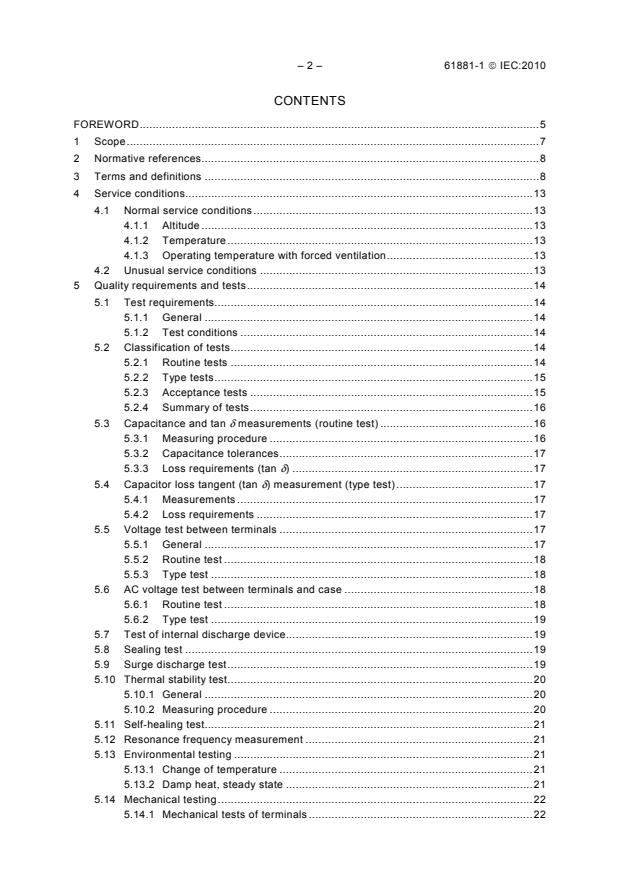
– 2 – 61881-1 © IEC:2010
CONTENTS
FOREWORD.5
1 Scope.7
2 Normative references.8
3 Terms and definitions .8
4 Service conditions.13
4.1 Normal service conditions.13
4.1.1 Altitude .13
4.1.2 Temperature.13
4.1.3 Operating temperature with forced ventilation.13
4.2 Unusual service conditions .13
5 Quality requirements and tests.14
5.1 Test requirements.14
5.1.1 General .14
5.1.2 Test conditions .14
5.2 Classification of tests.14
5.2.1 Routine tests .14
5.2.2 Type tests.15
5.2.3 Acceptance tests .15
5.2.4 Summary of tests.16
5.3 Capacitance and tan δ measurements (routine test) .16
5.3.1 Measuring procedure .16
5.3.2 Capacitance tolerances.17
5.3.3 Loss requirements (tan δ) .17
5.4 Capacitor loss tangent (tan δ) measurement (type test) .17
5.4.1 Measurements .17
5.4.2 Loss requirements .17
5.5 Voltage test between terminals .17
5.5.1 General .17
5.5.2 Routine test .18
5.5.3 Type test .18
5.6 AC voltage test between terminals and case .18
5.6.1 Routine test .18
5.6.2 Type test .19
5.7 Test of internal discharge device.19
5.8 Sealing test .19
5.9 Surge discharge test.19
5.10 Thermal stability test.20
5.10.1 General .20
5.10.2 Measuring procedure .20
5.11 Self-healing test.21
5.12 Resonance frequency measurement .21
5.13 Environmental testing .21
5.13.1 Change of temperature .21
5.13.2 Damp heat, steady state .21
5.14 Mechanical testing.22
5.14.1 Mechanical tests of terminals .22
61881-1 © IEC:2010 – 3 –
5.14.2 External inspection .23
5.14.3 Vibration and shocks.23
5.15 Endurance test .23
5.15.1 Conditioning of the units before the test .23
5.15.2 Initial capacitance and loss factor measurements.23
5.15.3 Endurance test .23
5.15.4 Final capacitance and tan δ measurement.24
5.15.5 Acceptance criteria .25
5.16 Destruction test .25
5.16.1 General .25
5.16.2 Test sequence for AC capacitors.26
5.16.3 Test sequence for DC capacitors .27
5.17 Disconnecting test on internal fuses.30
5.17.1 General .30
5.17.2 Disconnecting requirements .30
5.17.3 Withstand requirements .30
5.17.4 Test procedure .31
5.17.5 Capacitance measurement.32
5.17.6 Visual checking.32
5.17.7 Voltage test .32
5.18 Partial discharge measurements (optional type tests).32
6 Overloads.32
7 Safety requirements.33
7.1 Discharge device .33
7.2 Case connections .33
7.3 Protection of the environment .33
7.4 Fire hazard .33
7.5 Other safety requirements.33
8 Markings.34
8.1 Marking of the units .34
8.1.1 Rating plate .34
8.1.2 Data sheet .34
9 Guide to installation and operation .34
9.1 General .34
9.2 Choice of rated voltage.35
9.3 Operating temperature.35
9.3.1 Installation .35
9.3.2 Unusual cooling conditions.36
9.4 Special service conditions.36
9.5 Overvoltages .36
9.6 Overload currents .36
9.7 Switching and protective devices .37
9.8 Choice of creepage distance and clearance .37
9.9 Connections .37
9.10 Parallel connections of capacitors.37
9.11 Series connections of capacitors.37
9.12 Magnetic losses and eddy currents .38
9.13 Guide for internal fuse and disconnector protection in capacitors.38
9.14 Guide for unprotected capacitors .38
– 4 – 61881-1 © IEC:2010
Annex A (informative) Waveforms .39
Annex B (normative) Operational limits of capacitors with sinusoidal voltages as a
function of frequency and at maximum temperature (θ ) .41
max
Annex C (normative) Resonance frequency measuring methods – Examples .43
Bibliography .45
Figure 1 – Destruction test arrangement.27
Figure 2 – N source DC – type 1.29
Figure 3 – N source DC – type 2.29
Figure A.1a – Commutating waveform .39
Figure A.1b – Commutating circuit example.40
Figure A.1c – Damping capacitor for gate turn-off thyristors waveform .40
Figure A.1d – Damping circuit example .40
Figure B.1 – Supply conditions .41
Figure C.1 – Measuring circuit.43
Figure C.2 – Relation between the voltage across the capacitor and the supply
frequency.
Figure C.3 – Discharge current wave shape.44
Table 1 – Maximum temperature of cooling medium for unlimited time.13
Table 2 – Summary of tests.16
Table 3 – Test voltage between terminals.17
Table 4 – Damp heat test .22
Table 5 – Testing the robustness of terminals.22
Table 6 – Example of current-carrying capacities of screw terminals and bolts .23
Table 7 – Endurance test .24
Table 8 – Destruction test as a function of type of safety system.25
Table 9 – Maximum permissible voltage .32
61881-1 © IEC:2010 – 5 –
INTERNATIONAL ELECTROTECHNICAL COMMISSION
____________
RAILWAY APPLICATIONS –
ROLLING STOCK EQUIPMENT –
CAPACITORS FOR POWER ELECTRONICS –
Part 1: Paper/plastic film capacitors
FOREWORD
1) The International Electrotechnical Commission (IEC) is a worldwide organization for standardization comprising
all national electrotechnical committees (IEC National Committees). The object of IEC is to promote
international co-operation on all questions concerning standardization in the electrical and electronic fields. To
this end and in addition to other activities, IEC publishes International Standards, Technical Specifications,
Technical Reports, Publicly Available Specifications (PAS) and Guides (hereafter referred to as “IEC
Publication(s)”). Their preparation is entrusted to technical committees; any IEC National Committee interested
in the subject dealt with may participate in this preparatory work. International, governmental and non-
governmental organizations liaising with the IEC also participate in this preparation. IEC collaborates closely
with the International Organization for Standardization (ISO) in accordance with conditions determined by
agreement between the two organizations.
2) The formal decisions or agreements of IEC on technical matters express, as nearly as possible, an international
consensus of opinion on the relevant subjects since each technical committee has representation from all
interested IEC National Committees.
3) IEC Publications have the form of recommendations for international use and are accepted by IEC National
Committees in that sense. While all reasonable efforts are made to ensure that the technical content of IEC
Publications is accurate, IEC cannot be held responsible for the way in which they are used or for any
misinterpretation by any end user.
4) In order to promote international uniformity, IEC National Committees undertake to apply IEC Publications
transparently to the maximum extent possible in their national and regional publications. Any divergence
between any IEC Publication and the corresponding national or regional publication shall be clearly indicated in
the latter.
5) IEC itself does not provide any attestation of conformity. Independent certification bodies provide conformity
assessment services and, in some areas, access to IEC marks of conformity. IEC is not responsible for any
services carried out by independent certification bodies.
6) All users should ensure that they have the latest edition of this publication.
7) No liability shall attach to IEC or its directors, employees, servants or agents including individual experts and
members of its technical committees and IEC National Committees for any personal injury, property damage or
other damage of any nature whatsoever, whether direct or indirect, or for costs (including legal fees) and
expenses arising out of the publication, use of, or reliance upon, this IEC Publication or any other IEC
Publications.
8) Attention is drawn to the Normative references cited in this publication. Use of the referenced publications is
indispensable for the correct application of this publication.
9) Attention is drawn to the possibility that some of the elements of this IEC Publication may be the subject of
patent rights. IEC shall not be held responsible for identifying any or all such patent rights.
International Standard IEC 61881-1 has been prepared by IEC technical committee 9: Electrical
equipment and systems for railways.
IEC 61881-1 cancels and replaces IEC 61881 (1999).
The text of this standard is based on the following documents:
FDIS Report on voting
9/1405/FDIS 9/1454/RVD
Full information on the voting for the approval of this standard can be found in the report on
voting indicated in the above table.
This publication has been drafted in accordance with the ISO/IEC Directives, Part 2.
– 6 – 61881-1 © IEC:2010
The committee has decided that the contents of this publication will remain unchanged until the
stability date indicated on the IEC web site under "http://webstore.iec.ch" in the data related to
the specific publication. At this date, the publication will be
• reconfirmed,
• withdrawn,
• replaced by a revised edition, or
• amended.
61881-1 © IEC:2010 – 7 –
RAILWAY APPLICATIONS –
ROLLING STOCK EQUIPMENT –
CAPACITORS FOR POWER ELECTRONICS –
Part 1: Paper/plastic film capacitors
1 Scope
This part of IEC 61881 applies to capacitors for power electronics intended to be used on
rolling stock.
The rated voltage of capacitors covered by this part is limited to 10 000 V.
The operating frequency of the systems in which these capacitors are used is usually up to
15 kHz, while the pulse frequencies may be up to 5 to 10 times the operating frequency.
It distinguishes between AC and DC capacitors.
They are considered as components mounted in enclosures.
NOTE This standard covers an extremely wide range of capacitor technologies for numerous applications:
overvoltage protection, DC and AC filtering, switching circuits, DC energy storage, auxiliary inverters, etc.
Examples are given in Clause 9.
The following are excluded from this standard:
– capacitors for induction heat-generating plants operating at frequencies between 40 Hz and
24 000 Hz (see IEC 60110-1 and 60110-2);
– capacitors for motor applications and the like (see IEC 60252-1 and IEC 60252-2);
– capacitors to be used in circuits for blocking one or more harmonics in power supply
networks;
– small AC capacitors as used for fluorescent and discharge lamps (see IEC 61048 and
IEC 61049);
– capacitors for suppression of radio interference (see IEC 60384-14);
– shunt capacitors for AC power systems having a rated voltage above 1 000 V (see
IEC 60871-1 and IEC 60871-2);
– shunt power capacitors of the self-healing type for AC systems having a rated voltage up to
and including 1 000 V (see IEC 60831-1 and IEC 60831-2);
– shunt power capacitor of the non self-healing type for AC systems having a rated voltage up
to and including 1 000 V (see IEC 60931-1 and IEC 60931-2);
– series capacitors for power systems (see IEC 60143-1, IEC 60143-2 and IEC 60143-3);
– coupling capacitors and capacitors dividers (see IEC 60358);
– capacitors for applications requiring energy storage/high current discharge such as
photocopiers and lasers;
– capacitors for microwave ovens;
– capacitors for power electronics (see IEC 61071).
– 8 – 61881-1 © IEC:2010
2 Normative references
The following referenced documents are indispensable for the application of this document. For
dated references, only the edition cited applies. For undated references, the latest edition of
the referenced document (including any amendments) applies.
IEC 60068-2-14, Environmental testing – Part 2-14: Tests. Test N: Change of temperature
IEC 60068-2-20, Environmental testing – Part 2-20: Tests. Test T: Test methods for
solderability and resistance to soldering heat of devices with leads
IEC 60068-2-21, Environmental testing – Part 2-21: Tests. Test U: Robustness of terminations
and integral mounting devices
IEC 60068-2-78, Environmental testing – Part 2-78: Tests. Test Cab: Damp heat, steady state
IEC 60269-1, Low-voltage fuses – Part 1: General requirements
IEC 60695-2-11, Fire hazard testing – Part 2-11: Glowing/hot-wire based test methods – Glow-
wire flammability test method for end-products
IEC 60695-11-5, Fire hazard testing – Part 11-5: Test flames – Needle-flame test method –
Apparatus, confirmatory test arrangement and guidance
IEC 60721-3-5, Classification of environmental conditions – Part 3: Classification of groups of
environmental parameters and their severities – Section 5: Ground vehicles installations
IEC 61373, Railway applications – Rolling stock equipment – Shock and vibration tests
IEC 62491, Industrial systems, installations and equipment and industrial products – Labelling
of cables and cores
IEC 62497-1, Railway applications – Insulation coordination – Part 1: Basic requirements –
Clearances and creepage distance for all electrical and electronic equipment
3 Terms and definitions
For the purposes of this document, the following terms and definitions apply.
3.1
capacitor element (or element)
indivisible part of a capacitor consisting of two electrodes separated by a dielectric
3.2
capacitor unit (or unit)
assembly of one or more capacitor elements in the same case with terminals brought out
3.3
capacitor bank
assembly of two or more capacitor units, electrically connected to each other
3.4
capacitor
general term used when it is not necessary to state whether reference is made to an element, a
unit or a capacitor bank
61881-1 © IEC:2010 – 9 –
3.5
capacitor equipment
assembly of capacitor units and their accessories intended for connection to a network
3.6
capacitor for power electronics
power capacitor intended to be used in power electronic equipment and capable of operating
continuously under sinusoidal and non sinusoidal current and voltage
3.7
metal-foil capacitor (non self-healing)
capacitor in which the electrodes usually consist of metal foils separated by a dielectric, in the
event of a breakdown of the dielectric; the capacitor does not restore itself
3.8
self-healing metallized dielectric capacitor
capacitor, the electrodes of which are metallized (usually by evaporation); in the event of
dielectric breakdown, the capacitor restores itself
3.9
AC capacitor
capacitor essentially designed for operation with alternating voltage
NOTE AC capacitors may be used with DC voltage up to the rated voltage only when authorized by the capacitor
manufacturer.
3.10
DC capacitor
capacitor essentially designed for operation with direct voltage
NOTE DC capacitors may be used with a specified AC voltage only where authorized by the capacitor
manufacturer.
3.11
model capacitor
smaller unit which simulates a complete unit or element in an electrical test, without reducing
the severity of the electrical, thermal or mechanical conditions
NOTE The combined sum of stresses should always be considered, for instance the sum of temperature,
mechanical conditions and electrical stresses.
3.12
internal (element) fuse
device incorporated in the capacitor which disconnects an element or a group of elements in
the event of breakdown
3.13
safety devices
3.13.1
overpressure disconnector
disconnecting device inside a capacitor, designed to interrupt the current path in case of
capacitor failure
3.13.2
overpressure detector
device designed to detect abnormal increase of the internal pressure by an electrical
switch/signal and indirectly interrupt the current path
– 10 – 61881-1 © IEC:2010
3.13.3
segmented metallization design
design of the metal layer over the dielectric shaped in a way to allow a small part of it to be
isolated in case of local short circuit or breakdown, in order to restore the full functionality of
the unit with a negligible loss of capacitance
3.13.4
special unsegmented metallization design
design of the metal layer over the dielectric shaped in a way that safe self-healing features
operating at a voltage up to U guarantee the full functionality of the unit with a negligible loss
s
of capacitance
3.14
discharge device of a capacitor
a device which may be incorporated in a capacitor, capable of reducing the voltage between
the terminals practically to zero, within a given time, after the capacitor has been disconnected
from a network
3.15
rated AC voltage (U )
N
maximum operating peak recurrent voltage of either polarity of a reversing type waveform for
which the capacitor has been designed
NOTE 1 The waveform can have many shapes. Examples are given in Annex A.
NOTE 2 The mean value of the waveform may be positive or negative.
NOTE 3 It is important to note that the rated AC voltage is not an r.m.s. value.
NOTE 4 Definitions used in this standard can be different from those of IEC 60077-1.
3.16
rated DC voltage (U )
NDC
maximum operating peak voltage of either polarity but of a non-reversing type waveform, for
which the capacitor has been designed, for continuous operation
Damping capacitors, for gate turn-off thyristor (GTO) can be regarded as DC capacitors with a
ripple voltage equal to the rated DC voltage U = U .
NDC r
In the case of reversal voltage, the use should be agreed between user and manufacturer.
NOTE If the reversal voltage is small (less than 10 %), the voltage waveform can be considered to be not
reversing. For test purposes, U and U should be increased by U, the reversal voltage.
NDC r
3.17
ripple voltage (U )
r
peak-to-peak alternating component of the unidirectional voltage
3.18
non-recurrent surge voltage (U )
s
peak voltage induced by a switching or any other disturbance of the system which is allowed for
a limited number of times and for durations shorter than the basic period
3.19
insulation voltage (U )
i
r.m.s. value of the sine wave voltage designed for the insulation between terminals of
capacitors to case or earth. If not specified, the r.m.s. value of the insulating voltage is equi-
valent to the rated voltage divided by 2.
61881-1 © IEC:2010 – 11 –
3.20
maximum peak current (Î)
maximum peak current that can occur during continuous operation
3.21
maximum current (I )
max
maximum r.m.s. current for continuous operation
3.22
maximum surge current (Î
s )
peak non-repetitive current induced by switching or any other disturbance of the system which
is allowed for a limited number of times, for durations shorter than the basic period
3.23
pulse frequency (f )
p
repetition rate of periodic current pulses
3.24
current pulse width (τ)
time of current flow during charging or discharging from one voltage value to another, of the
capacitor
NOTE Pulse current waveform examples are shown in Annex A.
3.25
resonance frequency (f )
r
lowest frequency at which the impedance of the capacitor becomes minimum
3.26
duty cycle
3.26.1
continuous duty
operation time such that a capacitor is at thermal equilibrium for most of the time
3.26.2
intermittent duty
discontinuous working or operation with variable loads which should be described in terms of
ON/OFF or HIGH/LOW periods with their durations
3.27
operating temperature
temperature of the hottest point on the case of the capacitor when in thermal equilibrium
3.28
lowest operating temperature (θ )
min
lowest temperature at which the capacitor may be energized
3.29
case temperature rise (Δθ )
case
difference between the temperature of the hottest point of the case and the temperature of the
cooling air
3.30
cooling-air temperature (θ )
amb
temperature of the cooling air measured at the hottest position of the capacitor, under steady-
state conditions, midway between two units
– 12 – 61881-1 © IEC:2010
If only one unit is involved, it is the temperature measured at a point approximately 0,1 m away
from the capacitor case and at two-thirds of the height from its base.
3.30.1
outlet fluid temperature for forced-cooled capacitors
temperature of the cooling fluid as it leaves the capacitor, measured at the hottest point
3.30.2
inlet fluid temperature for forced-cooled capacitors
temperature of the cooling fluid measured in the middle of the inlet fluid channel at a point not
influenced by the heat dissipation of the capacitor
3.31
maximum operating temperature (θ )
max
highest temperature of the case at which the capacitor may be operated
3.32
steady-state conditions
thermal equilibrium attained by the capacitor at constant output and at constant cooling-air
temperature
3.33
capacitor losses
active power consumed by a capacitor
NOTE Unless otherwise stated, the capacitor losses are understood to include losses in fuses and discharge
resistors forming an integral part of the capacitor.
At high frequency, the capacitor losses are predominantly due to losses in connections, contacts and electrodes.
3.34
tangent of the loss angle of a capacitor tan δ
ratio between the equivalent series resistance and the capacitive reactance of a capacitor at a
specified sinusoidal alternating voltage, frequency and temperature
tan δ = R ωC = tan + R ωC
esr d s
tan = dielectric loss factor
d
3.35
equivalent series resistance of a capacitor R
esr
effective resistance which, if connected in series with an ideal capacitor of capacitance value
equal to that of the capacitor in question, would have a power loss equal to active power
dissipated in that capacitor under specified operating conditions
3.36
series resistance R
s
effective ohmic resistance of the conductors of a capacitor under specified operating conditions
3.37
maximum power loss (P )
max
maximum power loss with which the capacitor may be loaded at the maximum case
temperature
3.38
maximum frequency for maximum power loss and maximum current (f )
frequency at which the maximum current (I ) produces the maximum power loss (P ) in the
max
max
capacitor. For explanation of (f ) see Annex B.
61881-1 © IEC:2010 – 13 –
4 Service conditions
NOTE See IEC 60077-1.
4.1 Normal service conditions
This standard gives requirements for capacitors intended for use in the following conditions:
4.1.1 Altitude
Not exceeding 1 400 m (IEC 62491 class A1).
NOTE The effect of altitude on convection cooling and external insulation should be taken into consideration, if the
altitude exceeds 1400 m. In this case the derating or a proper design shall be agreed between manufacturer and
user
4.1.2 Temperature
The climatic ambient temperatures are derived from IEC 60721-3-5 class 5k2 which has a
range from –25 °C to +40 °C.
Where ambient temperature lies outside this range, it shall be agreed between the user and the
manufacturer.
The upper limit of case temperature θ at which the capacitor may be operated, shall be
max
chosen among the values 55 °C, 70 °C and 85 °C.
4.1.3 Operating temperature with forced ventilation
If capacitors are intended for forced cooling with a fluid medium, the operating temperature
conditions specified in 4.1.2 shall be observed.
The following Table 1 of preferred temperatures of cooling fluid shall be applied.
Table 1 – Maximum temperature of cooling medium for unlimited time
Inlet temperature Outlet temperature
°C °C
35 40
45 50
55 60
The lowest inlet temperature for the cooling fluid may be –25 °C.
There are two methods of specifying the upper temperature limit of the cooling medium using
either the inlet temperature or the outlet temperature.
Unless otherwise agreed, the choice of method shall be left to the capacitor manufacturer.
For the inlet method, the flow of cooling medium shall be specified.
4.2 Unusual service conditions
This standard does not apply to capacitors, whose service conditions are such as to be in
general incompatible with its requirements, unless otherwise agreed between the manufacturer
and the user.
– 14 – 61881-1 © IEC:2010
Unusual service conditions require additional measurements, which ensure that the conditions
of this standard are complied with even under these unusual service conditions.
If such unusual service conditions exist then they shall be notified to the manufacturer of
the capacitor.
Unusual service conditions can include:
– unusual mechanical shocks and vibrations,
– cooling water with corrosive or obstructing particles (sea water, very hard water),
– corrosive and abrasive particles in the cooling air,
– dust in the cooling air, particularly if conductive,
– explosive dust or gas,
– oil or water vapour or corrosive substances,
– nuclear radiation,
– unusual storage or transport temperature,
– unusual humidity (tropical or subtropical region),
– excessive and rapid changes of temperature (more than 5 °C/h) or of humidity (more than
5 %/h),
– service areas higher than 1 400 m above sea level,
– superimposed electromagnetic fields,
– excessive overvoltages, as far as they exceed the limits given in Clause 6,
– airtight (poor change of air) installations.
5 Quality requirements and tests
5.1 Test requirements
5.1.1 General
This subclause gives the test requirements for capacitor units.
5.1.2 Test conditions
Unless otherwise specified for a particular test or measurement, the temperature of the
capacitor dielectric shall be in the +5 °C to +35 °C range.
If corrections are necessary, the reference temperature shall be +20 °C, unless otherwise
agreed between the manufacturer and the user.
NOTE It may be assumed that the dielectric temperature is the same as the ambient temperature, provided that
the capacitor has been left in an unenergized state, in a constant ambient temperature, for an adequate period of
time in order to reach thermal equilibrium.
The AC tests and measurements shall be carried out with a sinusoidal voltage of 50 Hz or
60 Hz, unless otherwise specified.
5.2 Classification of tests
The test are classified as routine test, type tests and acceptance tests as follows:
5.2.1 Routine tests
Routine tests are the following:
61881-1 © IEC:2010 – 15 –
a) sealing test (5.8);
b) external inspection (5.14.2);
c) voltage test between terminals (5.5.2);
d) voltage test between terminals and case (5.6.1);
e) capacitance and tan δ measurements (5.3);
f) test of internal discharge device (5.7);
Routine tests shall be carried out by the manufacturer on every capacitor before delivery.
At his request, the user shall be supplied with a certificate detailing the results of such tests.
The sequence of the tests is as indicated.
5.2.2 Type tests
Unless otherwise specified, every capacitor sample to which it is intended to apply the type test
shall first have withstood satisfactorily the application of all the routine tests.
Type tests are the following:
a) voltage test between terminals (5.5.3);
b) voltage test between terminals and case (5.6.2);
c) surge discharge test (5.9);
d) self-healing test (5.11);
e) environmental testing (5.13);
f) mechanical testing (5.14);
g) capacitor tangent of the loss angle (tan δ) measurement (5.4);
h) thermal stability test (5.10);
i) test of internal discharge device (5.7);
j) resonance frequency measurement (5.12);
k) endurance test between terminals (5.15);
l) disconnection test on fuses (5.17);
m) destruction test (5.16).
Type tests are intended to prove the soundness of the design of the capacitor and its suitability
for operation under the considerations detailed in this standard.
The type tests shall be carried out by the manufacturer, and the user shall, on request, be
supplied with a certificate, detailing the results of such tests.
These tests shall be made upon a capacitor of a design identical to that of the capacitor under
contract, or on a capacitor of a design that gives during the test the same or more severe test
conditions.
It is not essential that all type tests be carried out on the same capacitor sample. The choice is
left to the manufacturer.
5.2.3 Acceptance tests
The routine and/or type test, or some of them, may be carried out by the manufacturer, on
agreement with the user.
– 16 – 61881-1 © IEC:2010
The number of samples that may be subjected to such repeat tests, the acceptance criteria, as
well as permission to deliver any of these units shall be subject to agreement between the
manufacturer and the user, and shall be stated in the contract.
5.2.4 Summary of tests
Table 2 lists the type and routine test for capacitor units.
Table 2 – Summary of tests
Test item Type Routine
1 Capacitance and tanδ measurements - 5.3
2 Capacitor loss tangent (tanδ ) measurement 5.4 -
3 Voltage test between terminals 5.5.3 5.5.2
4 Voltage test between terminals and case 5.6.2 5.6.1
5 Test of internal discharge device 5.7 5.7
6 Sealing test - 5.8
7 Surge discharge test 5.9 -
8 Thermal stability test 5.10 -
9 Self-healing test 5.11 -
10 Resonance frequency measurement 5.12 -
...
Questions, Comments and Discussion
Ask us and Technical Secretary will try to provide an answer. You can facilitate discussion about the standard in here.
Loading comments...