

IEC 60079-10-1:2008
(Main)Explosive atmospheres - Part 10-1: Classification of areas - Explosive gas atmospheres
General Information
- Abstract
IEC 60079-10-1:2008 is concerned with the classification of areas where flammable gas or vapour or mist hazards may arise and may then be used as a basis to support the proper selection and installation of equipment for use in a hazardous area. It is intended to be applied where there may be an ignition hazard due to the presence of flammable gas or vapour, mixed with air under normal atmospheric conditions, but it does not apply to
a) mines susceptible to firedamp;
b) the processing and manufacture of explosives;
c) areas where a hazard may arise due to the presence of combustible dusts or fibres;
d) catastrophic failures which are beyond the concept of abnormality;
e) rommos used for medial purposes;
f) domestic premises.
This first edition of IEC 60079-10-1 cancels and replaces the fourth edition of IEC 60079-10, published in 2002, and constitutes a technical revision. The significant technical changes with respect to the previous edition are:
- introduction of Annex D which deals with explosion hazard from flammable mists generated by the release under pressure of high flash point liquids;
- introduction of Clause A.3 (release rate) which gives thermodynamic equations for release rate with a number of examples for estimating release rate of fluids and gases.
- Status
- Published
- Publication Date
- 08-Dec-2008
- Technical Committee
- SC 31J - Classification of hazardous areas and installation requirements
- Drafting Committee
- MT 60079-10-1 - TC 31/SC 31J/MT 60079-10-1
- Current Stage
- DELPUB - Deleted Publication
- Start Date
- 08-Sep-2015
- Completion Date
- 28-Aug-2026
Overview
IEC 60079-10-1:2008 is an essential international standard developed by the International Electrotechnical Commission (IEC) that focuses on the classification of hazardous areas where explosive gas atmospheres may be present. It provides guidance for identifying zones with the potential presence of flammable gases, vapors, or mists mixed with air under normal atmospheric conditions. This classification is critical for ensuring safety by supporting the correct selection and installation of electrical and electronic equipment in potentially explosive environments.
The standard specifically excludes application in areas such as mines susceptible to firedamp, explosive manufacturing, dust or fiber hazards, catastrophic failures beyond abnormal conditions, medical rooms, and domestic premises. By establishing defined criteria for hazard assessment, IEC 60079-10-1 helps reduce the risk of ignition and explosions in industrial and commercial environments where flammable gases may be encountered.
Key Topics
- Area Classification Procedure: Defines methods to identify hazardous zones based on the presence, concentration, and likelihood of release of flammable gases or vapors.
- Sources of Release: Guidance to determine the origins and rates of gas or vapor release, including thermodynamic equations for estimating release rates.
- Types and Extent of Zones: Classification into zones based on frequency and duration of hazardous atmosphere presence, factoring in gas properties such as lower explosive limits (LEL) and relative density.
- Ventilation Influence: Evaluation of ventilation types and effectiveness in reducing hazardous area extents, critical to minimizing explosion risk.
- Flammable Mists: Introduction of considerations for explosive hazards from flammable mists generated by pressurized releases of liquids with high flash points (Annex D).
- Documentation: Requirements for recording classification results through drawings, data sheets, and tables to support ongoing safety management.
Applications
IEC 60079-10-1:2008 is widely used in industries where flammable gases or vapors are handled, such as:
- Chemical and Petrochemical Plants: Ensuring safe zone classification for gas processing and storage areas.
- Oil and Gas Industry: Applying hazardous area classifications on offshore platforms, refineries, and pipelines.
- Pharmaceutical Manufacturing: Managing risks where solvents or flammable gases might be present.
- Food and Beverage Processing: Protecting areas with flammable vapor generation in fermentation or storage zones.
- Industrial Facilities: Classifying electrical equipment installations in paint shops, fuel storage tanks, and ventilation systems.
By applying this standard, organizations can implement appropriate explosion protection measures, select compliant equipment, and comply with international safety regulations. This reduces the likelihood of ignition sources triggering catastrophic events, safeguarding personnel, assets, and the environment.
Related Standards
IEC 60079-10-1 works in conjunction with various complementary standards within the IEC 60079 series and related codes, including:
- IEC 60079-0: General requirements for equipment in explosive atmospheres.
- IEC 60079-14: Electrical installations design and selection for hazardous areas.
- IEC 60079-20: Data for flammable gases and vapors related to electrical apparatus.
- IEC 60079-10-2: Classification of areas with combustible dusts or fibers.
- IEC 61241-10: Explosive atmospheres related to combustible dust.
- ISO/IEC Directives: Framework guiding international standard development and consistency.
These standards collectively provide a comprehensive framework for managing explosive atmosphere risks, enabling consistent hazard classification and safe equipment integration worldwide.
Keywords: IEC 60079-10-1, explosive atmospheres, hazardous area classification, explosive gas atmospheres, flammable gases, ignition hazard, hazardous zones, industrial safety standards, IEC 60079, electrical equipment safety, ventilation in hazardous areas, explosive mist hazards.
Relations
- Effective Date
- 05-Sep-2023
- Effective Date
- 25-Aug-2026
- Effective Date
- 25-Aug-2026
- Effective Date
- 25-Aug-2026
- Effective Date
- 25-Aug-2026
- Effective Date
- 25-Aug-2026
- Effective Date
- 25-Aug-2026
- Effective Date
- 25-Aug-2026
- Effective Date
- 25-Aug-2026
- Effective Date
- 29-Jul-2026
- Effective Date
- 05-Sep-2023
Get Certified
Connect with accredited certification bodies for this standard

IMQ S.p.A. (Certification)
Italian electrical product certification.

SLG Prüf- und Zertifizierungs GmbH
German testing and certification body.

UL Solutions
Global safety science company with testing, inspection and certification.
Sponsored listings
Frequently Asked Questions
IEC 60079-10-1:2008 is a standard published by the International Electrotechnical Commission (IEC). Its full title is "Explosive atmospheres - Part 10-1: Classification of areas - Explosive gas atmospheres". This standard covers: IEC 60079-10-1:2008 is concerned with the classification of areas where flammable gas or vapour or mist hazards may arise and may then be used as a basis to support the proper selection and installation of equipment for use in a hazardous area. It is intended to be applied where there may be an ignition hazard due to the presence of flammable gas or vapour, mixed with air under normal atmospheric conditions, but it does not apply to a) mines susceptible to firedamp; b) the processing and manufacture of explosives; c) areas where a hazard may arise due to the presence of combustible dusts or fibres; d) catastrophic failures which are beyond the concept of abnormality; e) rommos used for medial purposes; f) domestic premises. This first edition of IEC 60079-10-1 cancels and replaces the fourth edition of IEC 60079-10, published in 2002, and constitutes a technical revision. The significant technical changes with respect to the previous edition are: - introduction of Annex D which deals with explosion hazard from flammable mists generated by the release under pressure of high flash point liquids; - introduction of Clause A.3 (release rate) which gives thermodynamic equations for release rate with a number of examples for estimating release rate of fluids and gases.
IEC 60079-10-1:2008 is concerned with the classification of areas where flammable gas or vapour or mist hazards may arise and may then be used as a basis to support the proper selection and installation of equipment for use in a hazardous area. It is intended to be applied where there may be an ignition hazard due to the presence of flammable gas or vapour, mixed with air under normal atmospheric conditions, but it does not apply to a) mines susceptible to firedamp; b) the processing and manufacture of explosives; c) areas where a hazard may arise due to the presence of combustible dusts or fibres; d) catastrophic failures which are beyond the concept of abnormality; e) rommos used for medial purposes; f) domestic premises. This first edition of IEC 60079-10-1 cancels and replaces the fourth edition of IEC 60079-10, published in 2002, and constitutes a technical revision. The significant technical changes with respect to the previous edition are: - introduction of Annex D which deals with explosion hazard from flammable mists generated by the release under pressure of high flash point liquids; - introduction of Clause A.3 (release rate) which gives thermodynamic equations for release rate with a number of examples for estimating release rate of fluids and gases.
IEC 60079-10-1:2008 is classified under the following ICS (International Classification for Standards) categories: 29.260.20 - Electrical apparatus for explosive atmospheres. The ICS classification helps identify the subject area and facilitates finding related standards.
IEC 60079-10-1:2008 has the following relationships with other standards: It is inter standard links to IEC 60079-10:2002, EN ISO 10439-1:2015, EN 14161:2011, EN 14161:2011+A1:2015, EN ISO 10440-1:2007, EN ISO 10437:2003, EN ISO 13705:2012, EN ISO 8311:2013, EN ISO 13631:2002, EN ISO 15589-1:2017, IEC 60079-10-1:2015. Understanding these relationships helps ensure you are using the most current and applicable version of the standard.
IEC 60079-10-1:2008 is available in PDF format for immediate download after purchase. The document can be added to your cart and obtained through the secure checkout process. Digital delivery ensures instant access to the complete standard document.
Standards Content (Sample)
IEC 60079-10-1
Edition 1.0 2008-12
INTERNATIONAL
STANDARD
NORME
INTERNATIONALE
Explosive atmospheres –
Part 10-1: Classification of areas – Explosive gas atmospheres
Atmosphères explosives –
Partie 10-1: Classement des emplacements – Atmosphères explosives gazeuses
All rights reserved. Unless otherwise specified, no part of this publication may be reproduced or utilized in any form or by
any means, electronic or mechanical, including photocopying and microfilm, without permission in writing from either IEC or
IEC's member National Committee in the country of the requester.
If you have any questions about IEC copyright or have an enquiry about obtaining additional rights to this publication,
please contact the address below or your local IEC member National Committee for further information.
Droits de reproduction réservés. Sauf indication contraire, aucune partie de cette publication ne peut être reproduite
ni utilisée sous quelque forme que ce soit et par aucun procédé, électronique ou mécanique, y compris la photocopie
et les microfilms, sans l'accord écrit de la CEI ou du Comité national de la CEI du pays du demandeur.
Si vous avez des questions sur le copyright de la CEI ou si vous désirez obtenir des droits supplémentaires sur cette
publication, utilisez les coordonnées ci-après ou contactez le Comité national de la CEI de votre pays de résidence.
IEC Central Office
3, rue de Varembé
CH-1211 Geneva 20
Switzerland
Email: inmail@iec.ch
Web: www.iec.ch
About the IEC
The International Electrotechnical Commission (IEC) is the leading global organization that prepares and publishes
International Standards for all electrical, electronic and related technologies.
About IEC publications
The technical content of IEC publications is kept under constant review by the IEC. Please make sure that you have the
latest edition, a corrigenda or an amendment might have been published.
ƒ Catalogue of IEC publications: www.iec.ch/searchpub
The IEC on-line Catalogue enables you to search by a variety of criteria (reference number, text, technical committee,…).
It also gives information on projects, withdrawn and replaced publications.
ƒ IEC Just Published: www.iec.ch/online_news/justpub
Stay up to date on all new IEC publications. Just Published details twice a month all new publications released. Available
on-line and also by email.
ƒ Electropedia: www.electropedia.org
The world's leading online dictionary of electronic and electrical terms containing more than 20 000 terms and definitions
in English and French, with equivalent terms in additional languages. Also known as the International Electrotechnical
Vocabulary online.
ƒ Customer Service Centre: www.iec.ch/webstore/custserv
If you wish to give us your feedback on this publication or need further assistance, please visit the Customer Service
Centre FAQ or contact us:
Email: csc@iec.ch
Tel.: +41 22 919 02 11
Fax: +41 22 919 03 00
A propos de la CEI
La Commission Electrotechnique Internationale (CEI) est la première organisation mondiale qui élabore et publie des
normes internationales pour tout ce qui a trait à l'électricité, à l'électronique et aux technologies apparentées.
A propos des publications CEI
Le contenu technique des publications de la CEI est constamment revu. Veuillez vous assurer que vous possédez
l’édition la plus récente, un corrigendum ou amendement peut avoir été publié.
ƒ Catalogue des publications de la CEI: www.iec.ch/searchpub/cur_fut-f.htm
Le Catalogue en-ligne de la CEI vous permet d’effectuer des recherches en utilisant différents critères (numéro de référence,
texte, comité d’études,…). Il donne aussi des informations sur les projets et les publications retirées ou remplacées.
ƒ Just Published CEI: www.iec.ch/online_news/justpub
Restez informé sur les nouvelles publications de la CEI. Just Published détaille deux fois par mois les nouvelles
publications parues. Disponible en-ligne et aussi par email.
ƒ Electropedia: www.electropedia.org
Le premier dictionnaire en ligne au monde de termes électroniques et électriques. Il contient plus de 20 000 termes et
définitions en anglais et en français, ainsi que les termes équivalents dans les langues additionnelles. Egalement appelé
Vocabulaire Electrotechnique International en ligne.
ƒ Service Clients: www.iec.ch/webstore/custserv/custserv_entry-f.htm
Si vous désirez nous donner des commentaires sur cette publication ou si vous avez des questions, visitez le FAQ du
Service clients ou contactez-nous:
Email: csc@iec.ch
Tél.: +41 22 919 02 11
Fax: +41 22 919 03 00
IEC 60079-10-1
Edition 1.0 2008-12
INTERNATIONAL
STANDARD
NORME
INTERNATIONALE
Explosive atmospheres –
Part 10-1: Classification of areas – Explosive gas atmospheres
Atmosphères explosives –
Partie 10-1: Classement des emplacements – Atmosphères explosives gazeuses
INTERNATIONAL
ELECTROTECHNICAL
COMMISSION
COMMISSION
ELECTROTECHNIQUE
PRICE CODE
INTERNATIONALE
XB
CODE PRIX
ICS 29.260.20 ISBN 978-2-88910-043-9
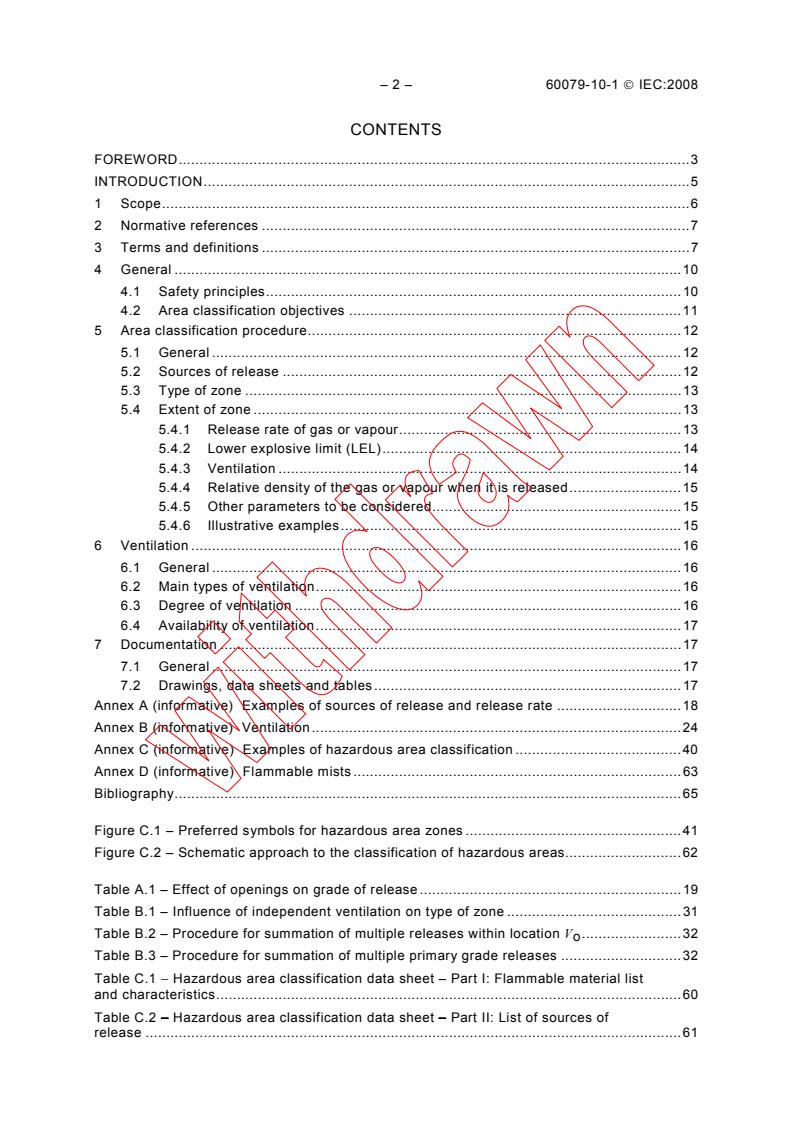
– 2 – 60079-10-1 © IEC:2008
CONTENTS
FOREWORD.3
INTRODUCTION.5
1 Scope.6
2 Normative references .7
3 Terms and definitions .7
4 General .10
4.1 Safety principles.10
4.2 Area classification objectives .11
5 Area classification procedure.12
5.1 General .12
5.2 Sources of release .12
5.3 Type of zone .13
5.4 Extent of zone .13
5.4.1 Release rate of gas or vapour.13
5.4.2 Lower explosive limit (LEL).14
5.4.3 Ventilation .14
5.4.4 Relative density of the gas or vapour when it is released.15
5.4.5 Other parameters to be considered.15
5.4.6 Illustrative examples.15
6 Ventilation .16
6.1 General .16
6.2 Main types of ventilation.16
6.3 Degree of ventilation .16
6.4 Availability of ventilation.17
7 Documentation .17
7.1 General .17
7.2 Drawings, data sheets and tables.17
Annex A (informative) Examples of sources of release and release rate .18
Annex B (informative) Ventilation.24
Annex C (informative) Examples of hazardous area classification .40
Annex D (informative) Flammable mists .63
Bibliography.65
Figure C.1 – Preferred symbols for hazardous area zones .41
Figure C.2 – Schematic approach to the classification of hazardous areas.62
Table A.1 – Effect of openings on grade of release .19
Table B.1 – Influence of independent ventilation on type of zone .31
Table B.2 – Procedure for summation of multiple releases within location V .32
o
Table B.3 – Procedure for summation of multiple primary grade releases .32
Table C.1 − Hazardous area classification data sheet – Part I: Flammable material list
and characteristics.60
Table C.2 − Hazardous area classification data sheet − Part II: List of sources of
release .61
60079-10-1 © IEC:2008 – 3 –
INTERNATIONAL ELECTROTECHNICAL COMMISSION
____________
EXPLOSIVE ATMOSPHERES –
Part 10-1: Classification of areas –
Explosive gas atmospheres
FOREWORD
1) The International Electrotechnical Commission (IEC) is a worldwide organization for standardization comprising
all national electrotechnical committees (IEC National Committees). The object of IEC is to promote
international co-operation on all questions concerning standardization in the electrical and electronic fields. To
this end and in addition to other activities, IEC publishes International Standards, Technical Specifications,
Technical Reports, Publicly Available Specifications (PAS) and Guides (hereafter referred to as “IEC
Publication(s)”). Their preparation is entrusted to technical committees; any IEC National Committee interested
in the subject dealt with may participate in this preparatory work. International, governmental and non-
governmental organizations liaising with the IEC also participate in this preparation. IEC collaborates closely
with the International Organization for Standardization (ISO) in accordance with conditions determined by
agreement between the two organizations.
2) The formal decisions or agreements of IEC on technical matters express, as nearly as possible, an international
consensus of opinion on the relevant subjects since each technical committee has representation from all
interested IEC National Committees.
3) IEC Publications have the form of recommendations for international use and are accepted by IEC National
Committees in that sense. While all reasonable efforts are made to ensure that the technical content of IEC
Publications is accurate, IEC cannot be held responsible for the way in which they are used or for any
misinterpretation by any end user.
4) In order to promote international uniformity, IEC National Committees undertake to apply IEC Publications
transparently to the maximum extent possible in their national and regional publications. Any divergence
between any IEC Publication and the corresponding national or regional publication shall be clearly indicated in
the latter.
5) IEC itself does not provide any attestation of conformity. Independent certification bodies provide conformity
assessment services and, in some areas, access to IEC marks of conformity. IEC is not responsible for any
services carried out by independent certification bodies.
6) All users should ensure that they have the latest edition of this publication.
7) No liability shall attach to IEC or its directors, employees, servants or agents including individual experts and
members of its technical committees and IEC National Committees for any personal injury, property damage or
other damage of any nature whatsoever, whether direct or indirect, or for costs (including legal fees) and
expenses arising out of the publication, use of, or reliance upon, this IEC Publication or any other IEC
Publications.
8) Attention is drawn to the Normative references cited in this publication. Use of the referenced publications is
indispensable for the correct application of this publication.
9) Attention is drawn to the possibility that some of the elements of this IEC Publication may be the subject of
patent rights. IEC shall not be held responsible for identifying any or all such patent rights.
International Standard IEC 60079-10-1 has been prepared by subcommittee 31J:
Classification of hazardous areas and installation requirements, of IEC technical committee
31: Equipment for explosive atmospheres.
This first edition of IEC 60079-10-1 cancels and replaces the fourth edition of IEC 60079-10,
published in 2002, and constitutes a technical revision.
The significant technical changes with respect to the previous edition are as follows:
• Introduction of Annex D which deals with explosion hazard from flammable mists
generated by the release under pressure of high flash point liquids.
• Introduction of Clause A.3 (release rate) which gives thermodynamic equations for release
rate with a number of examples for estimating release rate of fluids and gases.
– 4 – 60079-10-1 © IEC:2008
The text of this standard is based on the following documents:
FDIS Report on voting
31J/159/FDIS 31J/160/RVD
Full information on the voting for the approval of this standard can be found in the report on
voting indicated in the above table.
This publication has been drafted in accordance with the ISO/IEC Directives, Part 2.
A list of all parts of the IEC 60079 series, under the general title Explosive atmospheres, can
be found on the IEC website.
The committee has decided that the contents of this publication will remain unchanged until
the maintenance result date indicated on the IEC web site under "http://webstore.iec.ch" in
the data related to the specific publication. At this date, the publication will be
• reconfirmed;
• withdrawn;
• replaced by a revised edition, or
• amended.
60079-10-1 © IEC:2008 – 5 –
INTRODUCTION
In areas where dangerous quantities and concentrations of flammable gas or vapour may
arise, protective measures are to be applied in order to reduce the risk of explosions. This
part of IEC 60079 sets out the essential criteria against which the ignition hazards can be
assessed, and gives guidance on the design and control parameters which can be used in
order to reduce such a hazard.
– 6 – 60079-10-1 © IEC:2008
EXPLOSIVE ATMOSPHERES –
Part 10-1: Classification of areas –
Explosive gas atmospheres
1 Scope
This part of IEC 60079 is concerned with the classification of areas where flammable gas or
vapour or mist hazards (see Notes 1, 2 and 3) may arise and may then be used as a basis to
support the proper selection and installation of equipment for use in a hazardous area.
It is intended to be applied where there may be an ignition hazard due to the presence of
flammable gas or vapour, mixed with air under normal atmospheric conditions (see Note 4),
but it does not apply to
a) mines susceptible to firedamp;
b) the processing and manufacture of explosives;
c) areas where a hazard may arise due to the presence of combustible dusts or fibres (refer
to IEC 61241-10 / IEC 60079-10-2);
d) catastrophic failures which are beyond the concept of abnormality dealt with in this
standard (see Note 5);
e) rooms used for medical purposes;
f) domestic premises.
This standard does not take into account the effects of consequential damage.
Definitions and explanations of terms are given together with the main principles and
procedures relating to hazardous area classification.
For detailed recommendations regarding the extent of the hazardous areas in specific
industries or applications, reference may be made to national or industry codes relating to
those applications.
NOTE 1 Flammable mists may form or be present at the same time as flammable vapours. Liquids not considered
to be hazardous in terms of this standard (due to the flash point), when released under pressure may also generate
flammable mists. In such cases, the strict application of area classification for gases and vapours may not be
appropriate as the basis for selection of equipment.
Information on flammable mists is provided in Annex D.
NOTE 2 The use of IEC 60079-14 for selection of equipment and installations is not required for mist hazards.
NOTE 3 For the purpose of this standard, an area is a three-dimensional region or space.
NOTE 4 Atmospheric conditions include variations above and below reference levels of 101,3 kPa (1 013 mbar)
and 20 °C (293 K), provided that the variations have a negligible effect on the explosion properties of the
flammable materials.
NOTE 5 Catastrophic failure in this context is applied, for example, to the rupture of a process vessel or pipeline
and events that are not predictable.
NOTE 6 In any process plant, irrespective of size, there may be numerous sources of ignition apart from those
associated with equipment. Appropriate precautions will be necessary to ensure safety in this context. This
standard may be used with judgement for other ignition sources.
60079-10-1 © IEC:2008 – 7 –
2 Normative references
The following referenced documents are indispensable for the application of this document.
For dated references, only the edition cited applies. For undated references, the latest edition
of the referenced document (including any amendments) applies.
IEC 60050-426, International Electrotechnical Vocabulary (IEV) – Part 426: Equipment for
explosive atmospheres
IEC 60079-0, Explosive atmospheres – Part 0: Equipment – General requirements
IEC 60079-4, Electrical apparatus for explosive gas atmospheres – Part 4: Method of test for
ignition temperature
IEC 60079-4A, First supplement to IEC 60079-4 (1966), Electrical apparatus for explosive gas
atmospheres – Part 4: Method of test for ignition temperature
IEC 60079-20, Electrical apparatus for explosive gas atmospheres – Part 20: Data for
flammable gases and vapours, relating to the use of electrical apparatus
3 Terms and definitions
For the purposes of this document, the terms and definitions given in IEC 60079-0 and the
following apply.
NOTE Additional definitions applicable to explosive atmospheres can be found in the IEC 60050-426.
3.1
explosive atmosphere
mixture with air, under atmospheric conditions, of flammable substances in the form of gas,
vapour, dust, fibres, or flyings which, after ignition, permits self-sustaining propagation
[IEC 60079-0, definition 3.22]
3.2
explosive gas atmosphere
mixture with air, under atmospheric conditions, of flammable substances in the form of gas or
vapour, which, after ignition, permits self-sustaining flame propagation
[IEC 60079-0, definition 3.24]
NOTE 1 Although a mixture which has a concentration above the upper explosive limit (UEL) is not an explosive
gas atmosphere, it can readily become so and, in certain cases for area classification purposes, it is advisable to
consider it as an explosive gas atmosphere.
NOTE 2 There are some gases which are explosive with the concentration of 100 %.
3.3
hazardous area (on account of explosive gas atmospheres)
an area in which an explosive gas atmosphere is or may be expected to be present, in
quantities such as to require special precautions for the construction, installation and use of
equipment
3.4
non-hazardous area (on account of explosive gas atmospheres)
an area in which an explosive gas atmosphere is not expected to be present in quantities
such as to require special precautions for the construction, installation and use of equipment
– 8 – 60079-10-1 © IEC:2008
3.5
zones
hazardous areas are classified into zones based upon the frequency of the occurrence and
duration of an explosive gas atmosphere, as follows:
3.6
zone 0
an area in which an explosive gas atmosphere is present continuously or for long periods or
frequently
3.7
zone 1
an area in which an explosive gas atmosphere is likely to occur in normal operation
occasionally
3.8
zone 2
area in which an explosive gas atmosphere is not likely to occur in normal operation but, if it
does occur, will persist for a short period only
[IEV 426-03-05]
NOTE Indications of the frequency of the occurrence and duration may be taken from codes relating to specific
industries or applications.
3.9
source of release
a point or location from which a gas, vapour, mist or liquid may be released into the
atmosphere so that an explosive gas atmosphere could be formed
IEV 426-03-06, modified]
3.10
grades of release
there are three basic grades of release, as listed below in order of decreasing frequency and
likelihood of the explosive gas atmosphere being present:
a) continuous grade;
b) primary grade;
c) secondary grade.
A source of release may give rise to any one of these grades of release, or to a combination
of more than one
3.11
continuous grade of release
release which is continuous or is expected to occur frequently or for long periods
3.12
primary grade of release
release which can be expected to occur periodically or occasionally during normal operation
3.13
secondary grade of release
release which is not expected to occur in normal operation and, if it does occur, is likely to do
so only infrequently and for short periods
60079-10-1 © IEC:2008 – 9 –
3.14
release rate
quantity of flammable gas, vapour or mist emitted per unit time from the source of release
3.15
normal operation
situation when the equipment is operating within its designed parameters
NOTE 1 Minor releases of flammable material may be part of normal operation. For example, releases from seals
which rely on wetting by the fluid which is being pumped are considered to be minor releases.
NOTE 2 Failures (such as the breakdown of pump seals, flange gaskets or spillages caused by accidents) which
involve urgent repair or shut-down are not considered to be part of normal operation nor are they considered to be
catastrophic.
NOTE 3 Normal operation includes start-up and shut-down conditions.
3.16
ventilation
movement of air and its replacement with fresh air due to the effects of wind, temperature
gradients, or artificial means (for example, fans or extractors)
3.17
lower explosive limit (LEL)
concentration of flammable gas, vapour or mist in air below which an explosive gas
atmosphere will not be formed
[IEV 426-02-09]
3.18
upper explosive limit (UEL)
concentration of flammable gas, vapour or mist in air, above which an explosive gas
atmosphere will not be formed
[IEV 426-02-10]
3.19
relative density of a gas or a vapour
density of a gas or a vapour relative to the density of air at the same pressure and at the
same temperature (air is equal to 1,0)
3.20
flammable material (flammable substance)
material which is flammable of itself, or is capable of producing a flammable gas, vapour or
mist
3.21
flammable liquid
liquid capable of producing a flammable vapour under any foreseeable operating conditions
NOTE An example of a foreseeable operating condition is one in which the flammable liquid is handled at
temperatures close to or above its flash point.
3.22
flammable gas or vapour
gas or vapour which, when mixed with air in certain proportions, will form an explosive gas
atmosphere
3.23
flammable mist
droplets of liquid, dispersed in air so as to form an explosive atmosphere
– 10 – 60079-10-1 © IEC:2008
3.24
flashpoint
lowest liquid temperature at which, under certain standardized conditions, a liquid gives off
vapours in a quantity such as to be capable of forming an ignitable vapour/air mixture
3.25
boiling point
temperature of a liquid boiling at an ambient pressure of 101,3 kPa (1 013 mbar)
NOTE The initial boiling point that should be used for liquid mixtures is to indicate the lowest value of the boiling
point for the range of liquids present, as determined in a standard laboratory distillation without fractionation.
3.26
vapour pressure
pressure exerted when a solid or liquid is in equilibrium with its own vapour. It is a function of
the substance and of the temperature
3.27
ignition temperature of an explosive gas atmosphere
lowest temperature of a heated surface which, under specified conditions according to
IEC 60079-4, will ignite a flammable substance in the form of a gas or vapour mixture with air
[IEC 60079-0, definition 3.26]
3.28
extent of zone
distance in any direction from the source of release to the point where the gas/air mixture has
been diluted by air to a value below the lower explosive limit
3.29
liquefied flammable gas
flammable material which is stored or handled as a liquid and which at ambient temperature
and atmospheric pressure is a flammable gas
4 General
4.1 Safety principles
Installations in which flammable materials are handled or stored should be designed,
operated and maintained so that any releases of flammable material, and consequently the
extent of hazardous areas, are kept to a minimum, whether in normal operation or otherwise,
with regard to frequency, duration and quantity.
It is important to examine those parts of process equipment and systems from which release
of flammable material may arise and to consider modifying the design to minimise the
likelihood and frequency of such releases and the quantity and rate of release of material.
These fundamental considerations should be examined at an early stage of the design
development of any process plant and should also receive prime attention in carrying out the
area classification study.
In the case of activities other than those of normal operation, e.g. commissioning or
maintenance, the area classification may not be valid. It is expected that this would be dealt
with by a safe system of work.
In a situation in which there may be an explosive gas atmosphere, the following steps should
be taken:
60079-10-1 © IEC:2008 – 11 –
a) eliminate the likelihood of an explosive gas atmosphere occurring around the source of
ignition, or
b) eliminate the source of ignition.
Where this is not possible, protective measures, process equipment, systems and procedures
should be selected and prepared so the likelihood of the coincidence of a) and b) is so small
as to be acceptable. Such measures may be used singly, if they are recognized as being
highly reliable, or in combination to achieve the required level of safety.
4.2 Area classification objectives
Area classification is a method of analysing and classifying the environment where explosive
gas atmospheres may occur so as to facilitate the proper selection and installation of
equipment to be used safely in that environment. The classification also takes into account
the ignition characteristics of the gas or vapour such as ignition energy (gas group) and
ignition temperature (temperature class).
In most practical situations where flammable materials are used, it is difficult to ensure that an
explosive gas atmosphere will never occur. It may also be difficult to ensure that equipment
will never give rise to a source of ignition. Therefore, in situations where an explosive gas
atmosphere has a high likelihood of occurring, reliance is placed on using equipment which
has a low likelihood of creating a source of ignition. Conversely, where the likelihood of an
explosive gas atmosphere occurring is reduced, equipment constructed with less rigorous
requirements may be used.
Subsequent to the completion of the area classification, a risk assessment may be carried out
to assess whether the consequences of ignition of an explosive atmosphere requires the use
of equipment of a higher equipment protection level (EPL) or may justify the use of equipment
with a lower equipment protection level than normally required. The EPL requirements may be
recorded, as appropriate, on the area classification documents and drawings to allow proper
selection of equipment.
It is rarely possible by a simple examination of a plant or plant design to decide which parts of
the plant can be equated to the three zonal definitions (zones 0, 1 and 2). A more detailed
approach is therefore necessary and this involves the analysis of the basic possibility of an
explosive gas atmosphere occurring.
The first step is to assess the likelihood of this, in accordance with the definitions of zone 0,
zone 1 and zone 2. Once the likely frequency and duration of release (and hence the grade of
release), the release rate, concentration, velocity, ventilation and other factors which affect
the type and/or extent of the zone have been determined, there is then a firm basis on which
to determine the likely presence of an explosive gas atmosphere in the surrounding areas.
This approach therefore requires detailed consideration to be given to each item of process
equipment which contains a flammable material, and which could therefore be a source of
release.
In particular, zone 0 or zone 1 areas should be minimised in number and extent by design or
suitable operating procedures. In other words, plants and installations should be mainly
zone 2 or non-hazardous. Where release of flammable material is unavoidable, process
equipment items should be limited to those which give secondary grade releases or, failing
this (that is where primary or continuous grade releases are unavoidable), the releases should
be of very limited quantity and rate. In carrying out area classification, these principles should
receive prime consideration. Where necessary, the design, operation and location of process
equipment should ensure that, even when it is operating abnormally, the amount of flammable
material released into the atmosphere is minimised, so as to reduce the extent of the
hazardous area.
– 12 – 60079-10-1 © IEC:2008
Once a plant has been classified and all necessary records made, it is important that no
modification to equipment or operating procedures is made without discussion with those
responsible for the area classification. Unauthorised action may invalidate the area
classification. It is necessary to ensure that all equipment affecting the area classification
which has been subjected to maintenance is carefully checked during and after re-assembly
to ensure that the integrity of the original design, as it affects safety, has been maintained
before it is returned to service.
5 Area classification procedure
5.1 General
The area classification should be carried out by those who understand the relevance and
significance of properties of flammable materials and those who are familiar with the process
and the equipment along with safety, electrical, mechanical and other qualified engineering
personnel.
The following subclauses give guidance on the procedure for classifying areas in which there
may be an explosive gas atmosphere. An example of a schematic approach to the
classification of hazardous areas is given in Figure C.2.
The area classification should be carried out when the initial process and instrumentation line
diagrams and initial layout plans are available and confirmed before plant start-up. Reviews
should be carried out during the life of the plant.
5.2 Sources of release
The basic elements for establishing the hazardous zone types are the identification of the
source of release and the determination of the grade of release.
Since an explosive gas atmosphere can exist only if a flammable gas or vapour is present
with air, it is necessary to decide if any of these flammable materials can exist in the area
concerned. Generally speaking, such gases and vapours (and flammable liquids and solids
which may give rise to them) are contained within process equipment which may or may not
be totally enclosed. It is necessary to identify where a flammable atmosphere can exist inside
a process plant, or where a release of flammable materials can create a flammable
atmosphere outside a process plant.
Each item of process equipment (for example, tank, pump, pipeline, vessel, etc.) should be
considered as a potential source of release of flammable material. If the item cannot
foreseeably contain flammable material, it will clearly not give rise to a hazardous area
around it. The same will apply if the item contains a flammable material but cannot release it
into the atmosphere (for example, an all-welded pipeline is not considered to be a source of
release).
If it is established that the item may release flammable material into the atmosphere, it is
necessary, first of all, to determine the grade of release in accordance with the definitions, by
establishing the likely frequency and duration of the release. It should be recognized that the
opening-up of parts of enclosed process systems (for example, during filter changing or batch
filling) should also be considered as sources of release when developing the area
classification. By means of this procedure, each release will be graded either ‘continuous’,
‘primary’ or ’secondary’.
Having established the grade of the release, it is necessary to determine the release rate and
ot
her factors which may influence the type and extent of the zone.
60079-10-1 © IEC:2008 – 13 –
If the total quantity of flammable material available for release is “small”, for example, labo-
ratory use, whilst a potential hazard may exist, it may not be appropriate to use this area
classification procedure. In such cases, account shall be taken of the particular risks involved.
The area classification of process equipment in which flammable material is burned, for
example, fired heaters, furnaces, boilers, gas turbines etc., should take into account purge
cycle, start-up and shut-down conditions.
Mists which can form through leaks of liquid can be flammable even though the liquid
temperature is below the flash point. It is important therefore to ensure that clouds of mist do
not occur (see Annex D).
NOTE While mists are identified as a form of hazard, the assessment criteria used in this standard for gases and
vapours may not apply to mists.
5.3 Type of zone
The likelihood of the presence of an explosive gas atmosphere depends mainly on the grade
of release and the ventilation. This is identified as a zone. Zones are recognized as: zone 0,
zone 1, zone 2 and the non-hazardous area.
NOTE 1 A continuous grade of release normally leads to a zone 0, a primary grade to zone 1 and a secondary
grade to zone 2 (see Annex B).
NOTE 2 Where zones created by adjacent sources of release overlap and are of different zonal classification, the
higher classification criteria will apply in the area of overlap. Where overlapping zones are of the same
classification, this common classification will normally apply.
5.4 Extent of zone
The extent of the zone depends on the estimated or calculated distance over which an
explosive atmosphere exists before it disperses to a concentration in air below its lower
explosive limit with an appropriate safety factor. When assessing the area of spread of gas or
vapour before dilution to below its lower explosive limit, expert advice should be sought.
Consideration should always be given to the possibility that a gas which is heavier than air
may flow into areas below ground level (for example, pits or depressions) and that a gas
which is lighter than air may be retained at high level (for example, in a roof space).
Where the source of release is situated outside an area or in an adjoining area, the pene-
tration of a significant quantity of flammable gas or vapour into the area can be prevented by
suitable means such as:
a) physical barriers;
b) maintaining a sufficient overpressure in the area relative to the adjacent hazardous areas,
so preventing the ingress of the explosive gas atmosphere;
c) purging the area with sufficient flow of fresh air, so ensuring that the air escapes from all
openings where the flammable gas or vapour may enter.
The extent of the zone is mainly affected by the following chemical and physical parameters,
some of which are intrinsic properties of the flammable material; others are specific to the
process. For simplicity, the effect of each parameter listed below assumes that the other
parameters remain unchanged.
5.4.1 Release rate of gas or vapour
The greater the release rate, the larger the extent of the zone. The release rate depends itself
on other parameters, namely
a) Geometry of the source of release
– 14 – 60079-10-1 © IEC:2008
This is related to the physical characteristics of the source of release, for example, an
open surface, leaking flange, etc. (see Annex A).
b) Release velocity
For a given source of release, the release rate increases with the release velocity. In the
case of a product contained within process equipment, the release velocity is related to
the process pressure and the geometry of the source of release. The size of a cloud of
flammable gas or vapour is determined by the rate of flammable vapour release and the
rate of dispersion. Gas and vapour flowing from a leak at high velocity will develop a cone-
shaped jet which will entrain air and be self-diluting. The extent of the explosive gas
atmosphere will be almost independent of air flow. If the material is released at low
velocity or if its velocity is reduced by impingement on a solid object, it will be carried by
the air flow and its dilution and extent will depend on air flow.
c) Concentration
The release rate increases with the concentration of flammable vapour or gas in the
released mixture.
d) Volatility of a flammable liquid
This is related principally to the vapour pressure, and the enthalpy (“heat”) of vaporization.
If the vapour pressure is not known, the boiling point and flashpoint can be used as a
guide.
An explosive gas atmosphere cannot exist if the flashpoint is above the relevant maximum
temperature of the flammable liquid. The lower the flashpoint, the greater may be the
extent of the zone. However, if a flammable material is released in a way that forms a mist
(for example, by spraying) an explosive atmosphere may be formed below the flashpoint
of the material.
NOTE 1 Flashpoints of flammable liquids are not precise physical quantities, particularly where mixtures are
involved.
NOTE 2 Some liquids (for example, certain halogenated hydrocarbons) do not possess a flashpoint although
they are capable of producing an explosive gas atmosphere. In these cases, the equilibrium liquid temperature
which corresponds to the saturated concentration at the lower explosive limit should be compared with the
relevant maximum liquid temperature.
e) Liquid temperature
The vapour pressure increases with temperature, thus increasing the release rate due to
evaporation.
NOTE The temperature of the liquid after it has been released may be increased, for example, by a hot
surface or by a high ambient temperature.
5.4.2 Lower explosive limit (LEL)
For a given release volume, the lower the LEL the greater will be the extent of the zone.
NOTE Experience has shown that a release of ammonia, with an LEL of 15 % by volume, will often dissipate
rapidly in the open air, so an explosive gas atmosphere will, in most cases be of negligible extent.
5.4.3 Ventilation
With increased ventilation, the extent of the zone will normally be reduced. Obstacles which
impede the ventilation may increase the extent of the zone. On the other hand, some
obstacles, for example, dykes, walls or ceilings, may limit the extent.
NOTE 1 A shelter with a large roof-ventilator and with the sides open sufficient to allow free passage of air
through all parts of the building in many cases is considered well ventilated and should be treated as an open air
area (i.e. “medium” degree and “good” availability).
NOTE 2 Increased air movement may also increase the rate of release of vapour due to increased evaporation on
open liquid surfaces.
60079-10-1 © IEC:2008 – 15 –
5.4.4 Relative density of the gas or vapour when it is released
If the gas or vapour is significantly lighter than air, it will tend to move upwards. If significantly
heavier, it will tend to accumulate at ground level. The horizontal extent of the zone at ground
level will increase with increasing relative density and the vertical extent above the source will
increase with decreasing relative density.
NOTE 1 For practical applications, a gas or vapour which has a relative density below 0,8 is regarded as being
lighter than air. If the relative density is above 1, 2, it is regarded as being heavier than air. Between these values,
both of these possibilities should be considered.
NOTE 2 With gases or vapours lighter than air, an escape at low velocity will disperse fairly rapidly upwards; the
presence of a roof will, however, inevitably increase the area of spread under it. If the escape is at high velocity in
a free jet the action of the jet, although entraining air which dilutes the gas or vapour, may increase the distance
over which the gas/air mixture remains above its LEL. For gases that are lighter than air, a release at high
pressure may cool the gas thus increasing relative density. The release may initially behave as heavier than air
until normal buoyancy is returned.
NOTE 3 With gases or vapours heavier than air, an escape at low velocity will tend to flow downward and may
travel long distances over the ground before it is safely dispersed by atmospheric diffusion. Special regard
therefore needs to be paid to the topography of any site under consideration and also to surrounding areas in order
to determine where gases or vapours might collect in hollows or run down inclines to lower levels. If the escape is
at high velocity in a free jet the jet-mixing action by entraining air may well reduce the gas/air mixture to below its
LEL in a much shorter distance than in the case of a low-velocity escape.
NOTE 4 Care needs to be taken when classifying areas containing cryogenic flammable gases such as liquefied
natural gas. Vapours emitted can be heavier than air at low temperatures and become lighter than air on
approaching ambient temperature.
5.4.5 Other parameters to be considered
a) Climatic conditions
The rate of gas or vapour dispersion in the atmosphere increases with wind speed but
there is a minimum speed of 2 m/s – 3 m/s required to initiate turbulent diffusion; below
this, layering of the gas or vapour occurs and the d
...