

IEC TS 63528:2025
(Main)Multimedia systems - Haptics - Haptics stimuli descriptors
General Information
- Abstract
IEC TS 63528:2025 specifies descriptors for classifying and grouping the diverse and wide range of haptics events and functions in multimedia systems, which are already used in consumer electronics, computer interfaces, automobiles, amusements, and communications.
The scope of this document is to define descriptors for classifying various types of haptics systems from different perspectives. This will enable the consideration of standardization items such as compatibility, interoperability, performance, and evaluation and measurement methods for the classified haptics systems.
- Status
- Published
- Publication Date
- 25-Jun-2025
- Technical Committee
- TA 18 - Multimedia home systems and applications for end-user networks
- Drafting Committee
- PT 100-43 - TC 100/TA 18/PT 100-43
- Current Stage
- PPUB - Publication issued
- Start Date
- 26-Jun-2025
- Completion Date
- 04-Jul-2025


Overview
IEC TS 63528:2025 - "Multimedia systems - Haptics - Haptics stimuli descriptors" defines a structured set of haptic stimuli descriptors to classify and group the broad range of haptics events and functions used in consumer electronics, computer interfaces, automobiles, amusements and communications. The Technical Specification provides a taxonomy and minimal metadata to enable consistent consideration of compatibility, interoperability, performance, and evaluation and measurement methods across diverse haptic devices and content.
Key topics and requirements
- Scope and purpose: Establish descriptors that make haptic stimuli comparable across systems and use-cases so that standardization work (e.g., measurement methods and interoperability) can proceed on a common basis.
- Descriptor structure: Nine descriptors describe a haptics stimulus:
- Purpose
- Haptic event
- Perception(s)
- Reality class
- Interactivity
- Target body part(s)
- Modality
- Signal(s)
- Method(s)
- Descriptor categories: The specification defines four mandatory descriptors and five that are optional or conditional (two optional, three conditional). Mandatory descriptors express what the haptic target is; optional/conditional descriptors describe how it is realized.
- Classification aims: Enable grouping of haptic content by common characteristics to support standardized performance metrics, compatibility rules, and interoperability protocols.
- Examples and informative annexes: Practical examples include vibrotactile vests, vibrotactile TVs, button click sensations in vehicle centre information displays (CID), and 4D cinema theatres to illustrate descriptor application.
Applications
- Standardizing metadata for haptic content and device capability catalogs
- Defining test cases and evaluation and measurement methods for haptic performance
- Enabling interoperability between content producers (games, films, VR/AR) and haptic output devices (wearables, seats, controllers, vehicle HMI)
- Facilitating R&D and reproducibility by allowing researchers to classify and share haptic stimuli consistently
- Improving user experience design for tactile feedback in consumer electronics, automotive HMI, immersive cinema, and communications
Who will use this standard
- Haptic device manufacturers and component suppliers (actuators, drivers)
- Multimedia system integrators and platform vendors (TV, VR, AR, 4D cinema)
- Automotive HMI designers and ergonomics teams
- Content creators (games, immersive media) and middleware providers
- Test laboratories and standards bodies developing measurement and compliance methods
- R&D teams studying perception, haptics signal design, and interoperability
Related standards
- IEC TR 63344:2021 - discusses broader standardization needs for haptics and human factors and is cited in the introduction as complementary background for this TS.
By applying IEC TS 63528:2025 descriptors, organizations can classify haptic stimuli consistently, accelerate interoperability work, and develop measurable standards for next‑generation multimedia haptics.
Get Certified
Connect with accredited certification bodies for this standard

ANCE
Mexican certification and testing association.

Intertek Slovenia
Intertek testing, inspection, and certification services in Slovenia.

LNE (Laboratoire National de Métrologie et d'Essais)
French national laboratory for metrology and testing.
Sponsored listings
Frequently Asked Questions
IEC TS 63528:2025 is a technical specification published by the International Electrotechnical Commission (IEC). Its full title is "Multimedia systems - Haptics - Haptics stimuli descriptors". This standard covers: IEC TS 63528:2025 specifies descriptors for classifying and grouping the diverse and wide range of haptics events and functions in multimedia systems, which are already used in consumer electronics, computer interfaces, automobiles, amusements, and communications. The scope of this document is to define descriptors for classifying various types of haptics systems from different perspectives. This will enable the consideration of standardization items such as compatibility, interoperability, performance, and evaluation and measurement methods for the classified haptics systems.
IEC TS 63528:2025 specifies descriptors for classifying and grouping the diverse and wide range of haptics events and functions in multimedia systems, which are already used in consumer electronics, computer interfaces, automobiles, amusements, and communications. The scope of this document is to define descriptors for classifying various types of haptics systems from different perspectives. This will enable the consideration of standardization items such as compatibility, interoperability, performance, and evaluation and measurement methods for the classified haptics systems.
IEC TS 63528:2025 is classified under the following ICS (International Classification for Standards) categories: 33.160.60 - Multimedia systems and teleconferencing equipment. The ICS classification helps identify the subject area and facilitates finding related standards.
IEC TS 63528:2025 is available in PDF format for immediate download after purchase. The document can be added to your cart and obtained through the secure checkout process. Digital delivery ensures instant access to the complete standard document.
Standards Content (Sample)
IEC TS 63528 ®
Edition 1.0 2025-06
TECHNICAL
SPECIFICATION
Multimedia systems - Haptics - Haptics stimuli descriptors
ICS 33.160.60 ISBN 978-2-8327-0484-4
All rights reserved. Unless otherwise specified, no part of this publication may be reproduced or utilized in any form or
by any means, electronic or mechanical, including photocopying and microfilm, without permission in writing from either
IEC or IEC's member National Committee in the country of the requester. If you have any questions about IEC copyright
or have an enquiry about obtaining additional rights to this publication, please contact the address below or your local
IEC member National Committee for further information.
IEC Secretariat Tel.: +41 22 919 02 11
3, rue de Varembé info@iec.ch
CH-1211 Geneva 20 www.iec.ch
Switzerland
About the IEC
The International Electrotechnical Commission (IEC) is the leading global organization that prepares and publishes
International Standards for all electrical, electronic and related technologies.
About IEC publications
The technical content of IEC publications is kept under constant review by the IEC. Please make sure that you have the
latest edition, a corrigendum or an amendment might have been published.
IEC publications search - IEC Products & Services Portal - products.iec.ch
webstore.iec.ch/advsearchform Discover our powerful search engine and read freely all the
The advanced search enables to find IEC publications by a
publications previews, graphical symbols and the glossary.
variety of criteria (reference number, text, technical With a subscription you will always have access to up to date
committee, …). It also gives information on projects, content tailored to your needs.
replaced and withdrawn publications.
Electropedia - www.electropedia.org
IEC Just Published - webstore.iec.ch/justpublished The world's leading online dictionary on electrotechnology,
Stay up to date on all new IEC publications. Just Published containing more than 22 500 terminological entries in English
details all new publications released. Available online and and French, with equivalent terms in 25 additional languages.
once a month by email. Also known as the International Electrotechnical Vocabulary
(IEV) online.
IEC Customer Service Centre - webstore.iec.ch/csc
If you wish to give us your feedback on this publication or
need further assistance, please contact the Customer
Service Centre: sales@iec.ch.
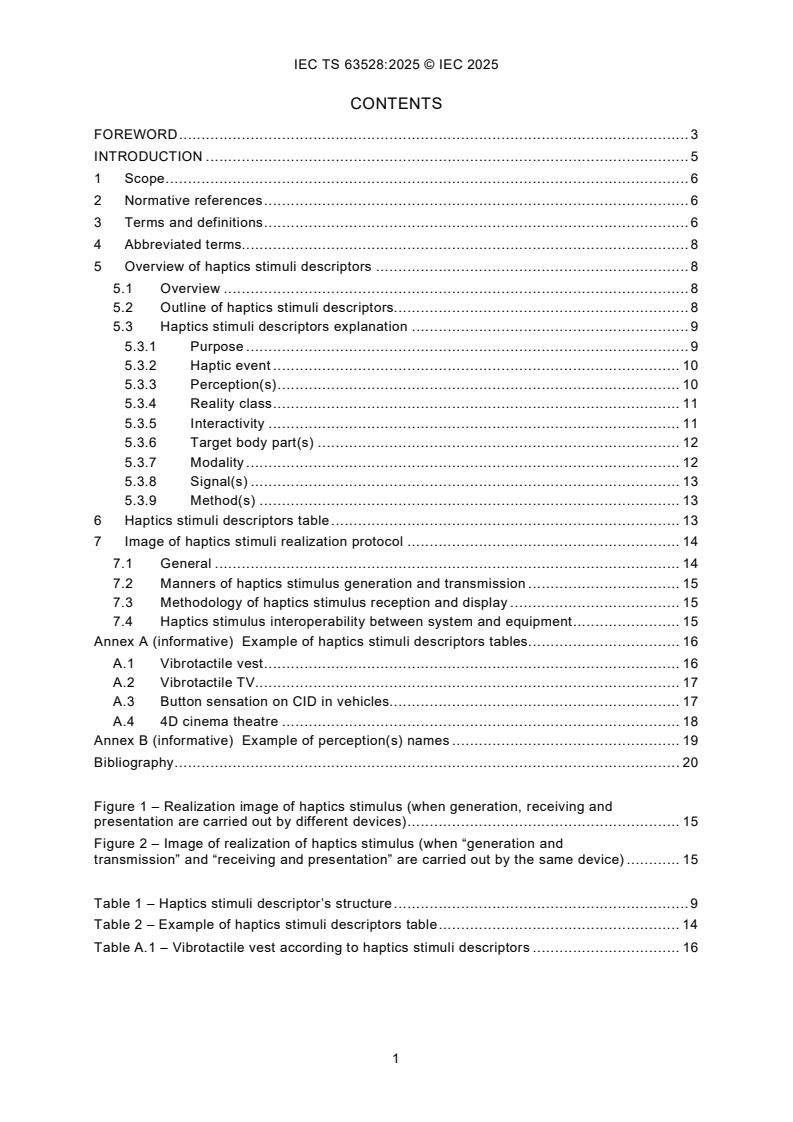
CONTENTS
FOREWORD . 3
INTRODUCTION . 5
1 Scope . 6
2 Normative references . 6
3 Terms and definitions . 6
4 Abbreviated terms. 8
5 Overview of haptics stimuli descriptors . 8
5.1 Overview . 8
5.2 Outline of haptics stimuli descriptors. 8
5.3 Haptics stimuli descriptors explanation . 9
5.3.1 Purpose . 9
5.3.2 Haptic event . 10
5.3.3 Perception(s) . 10
5.3.4 Reality class . 11
5.3.5 Interactivity . 11
5.3.6 Target body part(s) . 12
5.3.7 Modality . 12
5.3.8 Signal(s) . 13
5.3.9 Method(s) . 13
6 Haptics stimuli descriptors table . 13
7 Image of haptics stimuli realization protocol . 14
7.1 General . 14
7.2 Manners of haptics stimulus generation and transmission . 15
7.3 Methodology of haptics stimulus reception and display . 15
7.4 Haptics stimulus interoperability between system and equipment . 15
Annex A (informative) Example of haptics stimuli descriptors tables . 16
A.1 Vibrotactile vest . 16
A.2 Vibrotactile TV. 17
A.3 Button sensation on CID in vehicles. 17
A.4 4D cinema theatre . 18
Annex B (informative) Example of perception(s) names . 19
Bibliography . 20
Figure 1 – Realization image of haptics stimulus (when generation, receiving and
presentation are carried out by different devices) . 15
Figure 2 – Image of realization of haptics stimulus (when “generation and
transmission” and “receiving and presentation” are carried out by the same device) . 15
Table 1 – Haptics stimuli descriptor’s structure . 9
Table 2 – Example of haptics stimuli descriptors table . 14
Table A.1 – Vibrotactile vest according to haptics stimuli descriptors . 16
Table A.2 – Vibrotactile TV according to haptics stimuli descriptors . 17
Table A.3 – Button sensation on CID in vehicles according to haptics stimuli
descriptors . 17
Table A.4 – 4D cinema theatre according to haptics stimuli descriptors . 18
Table B.1 – Example of perception name . 19
INTERNATIONAL ELECTROTECHNICAL COMMISSION
____________
Multimedia systems - Haptics - Haptics stimuli descriptors
FOREWORD
1) The International Electrotechnical Commission (IEC) is a worldwide organization for standardization comprising
all national electrotechnical committees (IEC National Committees). The object of IEC is to promote international
co-operation on all questions concerning standardization in the electrical and electronic fields. To this end and
in addition to other activities, IEC publishes International Standards, Technical Specifications, Technical Reports,
Publicly Available Specifications (PAS) and Guides (hereafter referred to as “IEC Publication(s)”). Their
preparation is entrusted to technical committees; any IEC National Committee interested in the subject dealt with
may participate in this preparatory work. International, governmental and non-governmental organizations liaising
with the IEC also participate in this preparation. IEC collaborates closely with the International Organization for
Standardization (ISO) in accordance with conditions determined by agreement between the two organizations.
2) The formal decisions or agreements of IEC on technical matters express, as nearly as possible, an international
consensus of opinion on the relevant subjects since each technical committee has representation from all
interested IEC National Committees.
3) IEC Publications have the form of recommendations for international use and are accepted by IEC National
Committees in that sense. While all reasonable efforts are made to ensure that the technical content of IEC
Publications is accurate, IEC cannot be held responsible for the way in which they are used or for any
misinterpretation by any end user.
4) In order to promote international uniformity, IEC National Committees undertake to apply IEC Publications
transparently to the maximum extent possible in their national and regional publications. Any divergence between
any IEC Publication and the corresponding national or regional publication shall be clearly indicated in the latter.
5) IEC itself does not provide any attestation of conformity. Independent certification bodies provide conformity
assessment services and, in some areas, access to IEC marks of conformity. IEC is not responsible for any
services carried out by independent certification bodies.
6) All users should ensure that they have the latest edition of this publication.
7) No liability shall attach to IEC or its directors, employees, servants or agents including individual experts and
members of its technical committees and IEC National Committees for any personal injury, property damage or
other damage of any nature whatsoever, whether direct or indirect, or for costs (including legal fees) and
expenses arising out of the publication, use of, or reliance upon, this IEC Publication or any other IEC
Publications.
8) Attention is drawn to the Normative references cited in this publication. Use of the referenced publications is
indispensable for the correct application of this publication.
9) IEC draws attention to the possibility that the implementation of this document may involve the use of (a)
patent(s). IEC takes no position concerning the evidence, validity or applicability of any claimed patent rights in
respect thereof. As of the date of publication of this document, IEC had not received notice of (a) patent(s), which
may be required to implement this document. However, implementers are cautioned that this may not represent
the latest information, which may be obtained from the patent database available at https://patents.iec.ch. IEC
shall not be held responsible for identifying any or all such patent rights.
IEC TS 63528 has been prepared by technical area 18: Multimedia home systems and
applications for end-user networks, of IEC technical committee 100: Audio, video and
multimedia systems and equipment. It is a Technical Specification.
The text of this Technical Specification is based on the following documents:
Draft Report on voting
100/4313/DTS 100/4342/RVDTS
Full information on the voting for its approval can be found in the report on voting indicated in
the above table.
The language used for the development of this Technical Specification is English.
This document was drafted in accordance with ISO/IEC Directives, Part 2, and developed in
accordance with ISO/IEC Directives, Part 1 and ISO/IEC Directives, IEC Supplement, available
at www.iec.ch/members_experts/refdocs. The main document types developed by IEC are
described in greater detail at www.iec.ch/publications.
The committee has decided that the contents of this document will remain unchanged until the
stability date indicated on the IEC website under webstore.iec.ch in the data related to the
specific document. At this date, the document will be
• reconfirmed,
• withdrawn, or
• revised.
INTRODUCTION
Haptic stimulation is a sense of touch, which encompasses a wide range of perceptions and
responses to mechanical and thermal actions exerted on the surface of the body. In multimedia
systems, not only audiovisual systems but also systems that include haptics sensations are
beginning to spread.
IEC TR 63344:2021, a Technical Report, states that haptics, which is already used in various
scenes such as home, office, mobile, portable, and amusement, are required to have different
specifications from conventional systems. It also comprehensively discusses the need for
standardization at each level, from their physical configuration to human factors.
This document is a Technical Specification that defines the descriptors of haptics stimuli to
enable the grouping of the stimuli so that their functions, performance, interoperability, devices,
etc. can be considered in the same methodology to achieve the standardization described in
IEC TR 63344:2021.
This document will ensure the interoperability of haptic devices, enable the sharing of a wide
range of haptic content, and facilitate the sharing of R&D results, which will be of great benefit
to both users and developers.
1 Scope
This document specifies descriptors for classifying and grouping the diverse and wide range of
haptics events and functions in multimedia systems, which are already used in consumer
electronics, computer interfaces, automobiles, amusements, and communications.
The scope of this document is to define descriptors for classifying various types of haptics
systems from different perspectives. This will enable the consideration of standardization items
such as compatibility, interoperability, performance, and evaluation and measurement methods
for the classified haptics systems.
2 Normative references
There are no normative references in this document.
3 Terms and definitions
For the purposes of this document, the following terms and definitions apply.
ISO and IEC maintain terminological databases for use in standardization addresses:
• IEC Electropedia: available at http://www.electropedia.org/
• ISO Online browsing platform: available at http://www.iso.org/obp
3.1
button click sensation
reproduction of button click feeling like a real button
3.2
guided haptic sensation
reproduction of the "feeling of being pulled" in the specified direction
3.3
haptic event
haptic perception of specific sensations by the human brain, which, together with sensory
information previously experienced and accumulated by humans, are felt by humans through
their touch and passively received by their bodies
3.4
haptic perception
perception by intrinsic cutaneous sensory organs and by mechanoreceptors including tendon-,
muscle-, and semi-circular canal-related sensors
3.5
haptic sensation
sensation including tactile sensation and kinaesthetic sensation perceived by bathyesthesia
3.6
haptics stimuli descriptor
descriptive item for classifying haptics stimuli
3.7
imaginary presence
imaginary haptic sensation that has never and will never exist in reality
3.8
material sensation
reproduction of sensation of touch, including roughness, hardness or softness, warmth or
coldness, friction, and so on
3.9
modality
state of combination of five senses and haptics
3.10
physical presence
physical haptic sensation that exists in the present moment
3.11
reality class
class indicating the degree of reality that can be expressed
3.12
sense of presence
sensation experienced by a human of something being present in a space where in fact nothing
present
3.13
sense of pressure
reproduction of sensation that occurs when the surfaces of various human body organs are
subjected to pressure
3.14
shock sensation
reproduction of the sensation of an impact of shock as if something has impacted
3.15
target body part
human body part name to be displayed by haptics stimuli
3.16
vibrotactile experience
mechanical vibration to produce haptic experiences
3.17
vibrotactile TV
TV producing vibrotactile experience at home
3.18
vibrotactile vest
vest producing a vibrotactile experience at the cinema
3.19
4D cinema experience
technique adding a variety of practical effects to movies, including motion-eats, wind, simulated-
water splash, etc.
3.20
4D cinema theatre
theatre with “4D cinema experience”
4 Abbreviated terms
For the purposes of this document, the following abbreviated terms apply:
3D Three dimensions
4D Four dimensions
CID Centre information display
R&D Research and development
TV Television
VR Virtual reality
5 Overview of haptics stimuli descriptors
5.1 Overview
Unlike vision and audition, haptic sensation does not involve differentiated sensory organs but
is recognized by the simultaneous detection of multiple stimuli by various sensory nerves
throughout the body. Therefore, it is very difficult to define the performance and compatibility
of all haptic sensory stimuli, including tactile and kinaesthetic, without categorizing them.
Therefore, the stimulation of a wide variety of haptic sensations shall be defined and classified
by some descriptor before proceeding to a detailed standardization study.
This document describes the minimum necessary descriptors for defining and classifying haptic
stimuli and provides a framework for grouping haptic stimuli using these descriptors so that
more detailed and quantitative compatibility and other standardization can be studied on the
same basis.
5.2 Outline of haptics stimuli descriptors
The haptics stimulus descriptor consists of nine descriptors: four mandatory descriptors, two
optional descriptors, and three descriptors, that describe the target haptics according to three
conditions. Table 1 describes the nine descriptors.
The four mandatory descriptors indicate what the target haptics are, and shall be described to
express the target haptics. On the other hand, the five descriptors that are optional or
conditional describe how the target haptics are realized. The optional descriptors should be
described, while the conditional descriptors should preferably be described if possible.
From among the haptics expressed by these descriptors, haptics of the same base can be
specified, and this provides a framework for grouping.
However, considering the creation of new haptic stimuli in the future, it is expected that they
will be added to these descriptors' structure in future revisions.
Table 1 – Haptics stimuli descriptor’s structure
No. Descriptors Format Type
1 Purpose [Objective] + [Explanation] Mandatory
2 Haptic event [Haptic event name] Mandatory
3 Perception(s) [Perception #1], …, [Perception #n] Mandatory
4 Reality class [Presence] + [Reality class] Mandatory
5 Interactivity [Interactive type] + [Real-time] Optional
6 Target body part(s) [Body part #1], …, [Body part #n] Optional
7 Modality [Modality type] (with supplemental explanation) Conditional
8 Signal(s) [Signal #1], …, [Signal #n] Conditional
9 Method(s) [Method #1], …, [Method #n] Conditional
5.3 Haptics stimuli descriptors explanation
5.3.1 Purpose
5.3.1.1 General
The purpose of haptics stimuli descriptors is to indicate what the target haptics stimulus is, how
it is realized, and how it affects humans. The descriptors listed in Table 1 are described in detail
in 5.3.
For classifying various kinds of haptics stimuli, these descriptor items shall be described
(mandatory).
5.3.1.2 Objective
"Objective" expresses how the haptics will be used, which shall be a short name of a proper
noun and unique within the area/domain. The expression can be in accordance with the
description in "Annex B, 1.3 Scope and objective of use case" in IEC 62559-2 "Methodology of
use case". The following are examples of "Objective": "Vibrotactile vest", "Vibrotactile TV",
"Button sensation on CID in the vehicle", "Haptic feedback on interactive displays", and "4D
cinema theatre".
5.3.1.3 Explanation
The applications of haptics that already exist at the time of publication of this document are so
varied that their brief description as "explanation" shall be necessary, along with the "objective".
A description of "explanation" should include a scene and scenario of the use and what effect
it has on humans and can help classify the functions and effects of the target haptics. "Name
of use case" and "Area/Domain(s)/Zone(s)" in "Annex B, 1.1" use case identification and
Objective(s)" in IEC 62559-2 shall serve as a reference for the description.
For example, the "ex
...