

IEC 60349-2:2002
(Main)Electric traction - Rotating electrical machines for rail and road vehicles - Part 2: Electronic convertor-fed alternating current motors
General Information
- Abstract
Applies to convertor-fed alternating current motors forming part of the equipment of electrically propelled rail and road vehicles. The object of this part is to enable the performance of a motor to be confirmed by tests and to provide a basis for assessment of its suitability for a specified duty and for comparison with other motors. Where further testing is to be undertaken in accordance with IEC 61377, it may be preferable, to avoid duplication, that some type and investigation tests be carried out on the combined test bed.
- Status
- Published
- Publication Date
- 14-Aug-2002
- Technical Committee
- TC 9 - Electrical equipment and systems for railways
- Drafting Committee
- MT 30 - TC 9/MT 30
- Current Stage
- DELPUB - Deleted Publication
- Start Date
- 13-Oct-2010
- Completion Date
- 28-Aug-2026
Overview
IEC 60349-2:2002 is an international standard developed by the International Electrotechnical Commission (IEC) focusing on electric traction systems-specifically, rotating electrical machines used in rail and road vehicles. This part of the standard addresses electronic convertor-fed alternating current (AC) motors. It sets the criteria for testing these motors to verify their performance, ensuring reliability and suitability for the demanding environments of electrically propelled vehicles.
The standard enables manufacturers and operators to assess and compare AC traction motors accurately through defined tests, thereby assuring compliance with operational requirements. It also complements related IEC standards such as IEC 61377 to harmonize testing procedures.
Key Topics
Scope and Object: IEC 60349-2 applies to AC motors powered by electronic converters in traction applications for both rail and road vehicles. Its primary goal is to establish methods to confirm motor performance and suitability for specific duties.
Environmental Conditions: The document details conditions under which the motors must operate efficiently, including temperature reference points and vibration resistance, ensuring these machines withstand real-world operational stresses.
Performance Characteristics: It outlines critical motor characteristics, including:
- Temperature-rise limits for continuous and short-duration operation
- Efficiency and power performance parameters
- Traction-specific and auxiliary motor characteristics
Testing Protocols:
- Type Tests: Include temperature-rise, performance tolerance assessments, overspeed, and vibration tests.
- Routine Tests: Encompass short-duration heating runs, dielectric tests, and vibration checks to confirm each motor's conformity to standards.
Marking and Identification: Requirements for nameplates, cable, and terminal markings are detailed to ensure traceability and correct installation.
Noise and Losses: Annexes cover measurement and limits of operational noise, as well as conventional values for transmission losses in traction motors-important for environmental and efficiency considerations.
Applications
IEC 60349-2:2002 is essential for:
Rail and Road Vehicle Manufacturers: To design, produce, and verify electronic convertor-fed AC motors that meet international operational and safety standards.
Electric Traction System Integrators: For selecting motors that reliably perform under specified operational conditions including environmental stresses and load requirements.
Maintenance and Testing Facilities: To perform standardized tests that can validate motor condition, functionality, and compliance with contractual agreements.
Regulatory Authorities and Certification Bodies: Ensuring that traction motors used in public transportation and commercial vehicles meet harmonized international safety and performance standards.
By adhering to this standard, stakeholders ensure enhanced motor performance, longer service life, and reduced operational risks in electric propulsion systems.
Related Standards
IEC 60349-2 is part of a broader family of standards governing electric traction machines, including:
IEC 61377: Covers further testing of traction motors to avoid duplication and ensure comprehensive evaluation.
IEC 60034 Series: Defines general requirements and tests for rotating electrical machines, providing foundational guidelines applicable across motor types.
ISO/IEC Joint Guidelines: Collaborative documents between IEC and ISO that align electrical motor standards with broader industrial and safety principles.
Understanding and applying these related standards alongside IEC 60349-2 ensures a holistic approach to the development, assessment, and deployment of electric traction motors.
Keywords: IEC 60349-2, electronic convertor-fed AC motors, electric traction standard, rotating electrical machines, rail vehicle motors, road vehicle motors, traction motor testing, motor performance verification, IEC electrical motor standards, traction motor noise limits, electric vehicle propulsion systems.
Relations
- Effective Date
- 10-Feb-2026
- Effective Date
- 10-Feb-2026
- Effective Date
- 05-Sep-2023
Get Certified
Connect with accredited certification bodies for this standard

IMQ S.p.A. (Certification)
Italian electrical product certification.

IRIS Certification (UNIFE)
International Railway Industry Standard certification.

SLG Prüf- und Zertifizierungs GmbH
German testing and certification body.
Sponsored listings
Frequently Asked Questions
IEC 60349-2:2002 is a standard published by the International Electrotechnical Commission (IEC). Its full title is "Electric traction - Rotating electrical machines for rail and road vehicles - Part 2: Electronic convertor-fed alternating current motors". This standard covers: Applies to convertor-fed alternating current motors forming part of the equipment of electrically propelled rail and road vehicles. The object of this part is to enable the performance of a motor to be confirmed by tests and to provide a basis for assessment of its suitability for a specified duty and for comparison with other motors. Where further testing is to be undertaken in accordance with IEC 61377, it may be preferable, to avoid duplication, that some type and investigation tests be carried out on the combined test bed.
Applies to convertor-fed alternating current motors forming part of the equipment of electrically propelled rail and road vehicles. The object of this part is to enable the performance of a motor to be confirmed by tests and to provide a basis for assessment of its suitability for a specified duty and for comparison with other motors. Where further testing is to be undertaken in accordance with IEC 61377, it may be preferable, to avoid duplication, that some type and investigation tests be carried out on the combined test bed.
IEC 60349-2:2002 is classified under the following ICS (International Classification for Standards) categories: 29.280 - Electric traction equipment; 45.060.01 - Railway rolling stock in general. The ICS classification helps identify the subject area and facilitates finding related standards.
IEC 60349-2:2002 has the following relationships with other standards: It is inter standard links to EN 61287-1:2006, EN 61377-1:2006, IEC 60349-2:2010. Understanding these relationships helps ensure you are using the most current and applicable version of the standard.
IEC 60349-2:2002 is available in PDF format for immediate download after purchase. The document can be added to your cart and obtained through the secure checkout process. Digital delivery ensures instant access to the complete standard document.
Standards Content (Sample)
NORME CEI
INTERNATIONALE IEC
60349-2
INTERNATIONAL
Deuxième édition
STANDARD
Second edition
2002-08
Traction électrique –
Machines électriques tournantes
des véhicules ferroviaires et routiers –
Partie 2:
Moteurs à courant alternatif alimentés
par convertisseurs électroniques
Electric traction –
Rotating electrical machines
for rail and road vehicles –
Part 2:
Electronic convertor-fed alternating
current motors
Numéro de référence
Reference number
CEI/IEC 60349-2:2002
Numérotation des publications Publication numbering
Depuis le 1er janvier 1997, les publications de la CEI As from 1 January 1997 all IEC publications are
sont numérotées à partir de 60000. Ainsi, la CEI 34-1 issued with a designation in the 60000 series. For
devient la CEI 60034-1. example, IEC 34-1 is now referred to as IEC 60034-1.
Editions consolidées Consolidated editions
Les versions consolidées de certaines publications de la The IEC is now publishing consolidated versions of its
CEI incorporant les amendements sont disponibles. Par publications. For example, edition numbers 1.0, 1.1
exemple, les numéros d’édition 1.0, 1.1 et 1.2 indiquent and 1.2 refer, respectively, to the base publication,
respectivement la publication de base, la publication de the base publication incorporating amendment 1 and
base incorporant l’amendement 1, et la publication de the base publication incorporating amendments 1
base incorporant les amendements 1 et 2. and 2.
Informations supplémentaires Further information on IEC publications
sur les publications de la CEI
Le contenu technique des publications de la CEI est The technical content of IEC publications is kept
constamment revu par la CEI afin qu'il reflète l'état under constant review by the IEC, thus ensuring that
actuel de la technique. Des renseignements relatifs à the content reflects current technology. Information
cette publication, y compris sa validité, sont dispo- relating to this publication, including its validity, is
nibles dans le Catalogue des publications de la CEI available in the IEC Catalogue of publications
(voir ci-dessous) en plus des nouvelles éditions, (see below) in addition to new editions, amendments
amendements et corrigenda. Des informations sur les and corrigenda. Information on the subjects under
sujets à l’étude et l’avancement des travaux entrepris consideration and work in progress undertaken by the
par le comité d’études qui a élaboré cette publication, technical committee which has prepared this
ainsi que la liste des publications parues, sont publication, as well as the list of publications issued,
également disponibles par l’intermédiaire de: is also available from the following:
• Site web de la CEI (www.iec.ch) • IEC Web Site (www.iec.ch)
• Catalogue des publications de la CEI • Catalogue of IEC publications
Le catalogue en ligne sur le site web de la CEI The on-line catalogue on the IEC web site
(http://www.iec.ch/searchpub/cur_fut.htm) vous permet (http://www.iec.ch/searchpub/cur_fut.htm) enables
de faire des recherches en utilisant de nombreux you to search by a variety of criteria including text
critères, comprenant des recherches textuelles, par searches, technical committees and date of
comité d’études ou date de publication. Des publication. On-line information is also available
informations en ligne sont également disponibles sur on recently issued publications, withdrawn and
les nouvelles publications, les publications rempla- replaced publications, as well as corrigenda.
cées ou retirées, ainsi que sur les corrigenda.
• IEC Just Published • IEC Just Published
Ce résumé des dernières publications parues This summary of recently issued publications
(http://www.iec.ch/online_news/justpub/jp_entry.htm) (http://www.iec.ch/online_news/justpub/jp_entry.htm)
est aussi disponible par courrier électronique. is also available by email. Please contact the
Veuillez prendre contact avec le Service client Customer Service Centre (see below) for further
(voir ci-dessous) pour plus d’informations. information.
• Service clients • Customer Service Centre
Si vous avez des questions au sujet de cette If you have any questions regarding this
publication ou avez besoin de renseignements publication or need further assistance, please
supplémentaires, prenez contact avec le Service contact the Customer Service Centre:
clients:
Email: custserv@iec.ch Email: custserv@iec.ch
Tél: +41 22 919 02 11 Tel: +41 22 919 02 11
Fax: +41 22 919 03 00 Fax: +41 22 919 03 00
.
NORME CEI
INTERNATIONALE IEC
60349-2
INTERNATIONAL
Deuxième édition
STANDARD
Second edition
2002-08
Traction électrique –
Machines électriques tournantes
des véhicules ferroviaires et routiers –
Partie 2:
Moteurs à courant alternatif alimentés
par convertisseurs électroniques
Electric traction –
Rotating electrical machines
for rail and road vehicles –
Part 2:
Electronic convertor-fed alternating
current motors
IEC 2002 Droits de reproduction réservés Copyright - all rights reserved
Aucune partie de cette publication ne peut être reproduite ni No part of this publication may be reproduced or utilized in any
utilisée sous quelque forme que ce soit et par aucun procédé, form or by any means, electronic or mechanical, including
électronique ou mécanique, y compris la photocopie et les photocopying and microfilm, without permission in writing from
microfilms, sans l'accord écrit de l'éditeur. the publisher.
International Electrotechnical Commission, 3, rue de Varembé, PO Box 131, CH-1211 Geneva 20, Switzerland
Telephone: +41 22 919 02 11 Telefax: +41 22 919 03 00 E-mail: inmail@iec.ch Web: www.iec.ch
CODE PRIX
V
Commission Electrotechnique Internationale PRICE CODE
International Electrotechnical Commission
Международная Электротехническая Комиссия
Pour prix, voir catalogue en vigueur
For price, see current catalogue
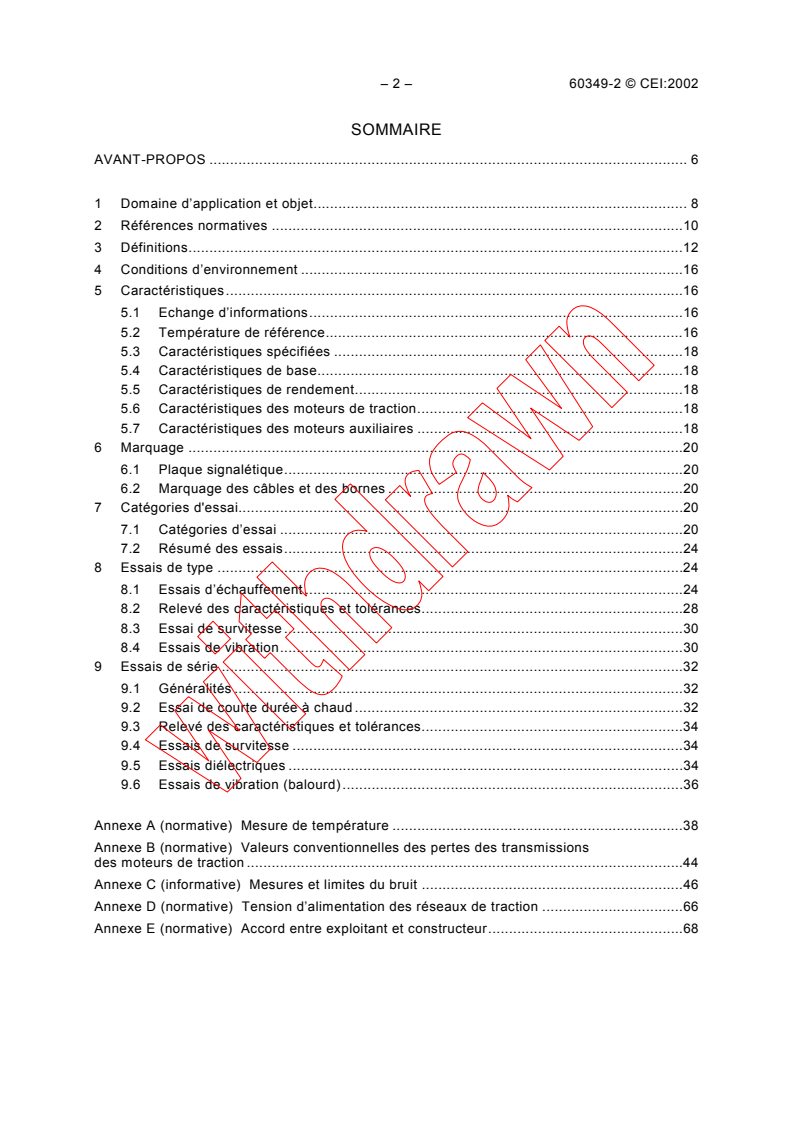
– 2 – 60349-2 © CEI:2002
SOMMAIRE
AVANT-PROPOS . 6
1 Domaine d’application et objet. 8
2 Références normatives .10
3 Définitions.12
4 Conditions d’environnement .16
5 Caractéristiques.16
5.1 Echange d’informations.16
5.2 Température de référence.16
5.3 Caractéristiques spécifiées .18
5.4 Caractéristiques de base.18
5.5 Caractéristiques de rendement.18
5.6 Caractéristiques des moteurs de traction.18
5.7 Caractéristiques des moteurs auxiliaires .18
6 Marquage .20
6.1 Plaque signalétique.20
6.2 Marquage des câbles et des bornes .20
7 Catégories d'essai.20
7.1 Catégories d’essai .20
7.2 Résumé des essais.24
8 Essais de type .24
8.1 Essais d’échauffement .24
8.2 Relevé des caractéristiques et tolérances.28
8.3 Essai de survitesse .30
8.4 Essais de vibration.30
9 Essais de série .32
9.1 Généralités .32
9.2 Essai de courte durée à chaud .32
9.3 Relevé des caractéristiques et tolérances.34
9.4 Essais de survitesse .34
9.5 Essais diélectriques .34
9.6 Essais de vibration (balourd) .36
Annexe A (normative) Mesure de température .38
Annexe B (normative) Valeurs conventionnelles des pertes des transmissions
des moteurs de traction .44
Annexe C (informative) Mesures et limites du bruit .46
Annexe D (normative) Tension d’alimentation des réseaux de traction .66
Annexe E (normative) Accord entre exploitant et constructeur.68
60349-2 IEC:2002 – 3 –
CONTENTS
FOREWORD . 7
1 Scope and object . 9
2 Normative references.11
3 Definitions.13
4 Environmental conditions .17
5 Characteristics.17
5.1 Exchange of information .17
5.2 Reference temperature .17
5.3 Specified characteristics .19
5.4 Declared characteristics.19
5.5 Efficiency characteristics.19
5.6 Traction motor characteristics .19
5.7 Auxiliary motor characteristics.19
6 Marking.21
6.1 Nameplate .21
6.2 Terminal and lead marking.21
7 Test categories .21
7.1 Test categories .21
7.2 Summary of tests.25
8 Type tests .25
8.1 Temperature-rise tests.25
8.2 Characteristic tests and tolerances.29
8.3 Overspeed test .31
8.4 Vibration tests.31
9 Routine tests.33
9.1 General .33
9.2 Short-time heating run.33
9.3 Characteristic tests and tolerances.35
9.4 Overspeed tests.35
9.5 Dielectric tests .35
9.6 Vibration tests (imbalance).37
Annex A (normative) Measurement of temperature .39
Annex B (normative) Conventional values of traction motor transmission losses.45
Annex C (informative) Noise measurement and limits .47
Annex D (normative) Supply voltages of traction systems.67
Annex E (normative) Agreement between user and manufacturer.69
– 4 – 60349-2 © CEI:2002
Figure B.1 – Valeurs conventionnelles des pertes dans les transmissions
des moteurs de traction .44
Figure C.1 – Limite de niveau de bruit aérien moyen généré par les moteurs de traction .60
Figure C.2 – Situation des points de mesure et contours prescrits
pour des machines à axe horizontal.62
Figure C.3 – Situation des points de mesure et contours
prescrits pour une machine à axe vertical .64
Tableau 1 – Liste des essais .24
Tableau 2 – Limites d’échauffement pour les régimes continus ou autres régimes assignés .26
Tableau 3 – Limites d’échauffement pour les régimes de surcharge de courte durée.28
Tableau 4 – Tensions d’essai diélectriques .36
Tableau C.1 – Corrections .50
Tableau C.2 – Corrections .56
Tableau C.3 – Correction concernant les fréquences pures.58
60349-2 IEC:2002 – 5 –
Figure B.1 – Conventional values of traction motor transmission losses .45
Figure C.1 – Limiting mean sound power level for airborne noise emitted by traction motors.61
Figure C.2 – Location of measuring points and prescribed paths for horizontal machines .63
Figure C.3 – Location of measuring points and prescribed paths for vertical machines .65
Table 1 – Summary of tests .25
Table 2 – Limits of temperature rise for continuous and other ratings .27
Table 3 – Temperature rises for short-time overload ratings.29
Table 4 – Dielectric test voltages .37
Table C.1 – Corrections.51
Table C.2 – Corrections.57
Table C.3 – Correction for pure tones .59
– 6 – 60349-2 © CEI:2002
COMMISSION ÉLECTROTECHNIQUE INTERNATIONALE
___________
TRACTION ÉLECTRIQUE –
MACHINES ÉLECTRIQUES TOURNANTES DES
VÉHICULES FERROVIAIRES ET ROUTIERS –
Partie 2: Moteurs à courant alternatif
alimentés par convertisseurs électroniques
AVANT-PROPOS
1) La CEI (Commission Electrotechnique Internationale) est une organisation internationale de normalisation
composée de tous les comités électrotechniques nationaux (Comités nationaux de la CEI). La CEI a pour but de
promouvoir la coopération internationale en matière de normalisation dans les domaines de l’électricité et
de l’électronique. A cette fin et en plus d’autres activités, la CEI publie des Normes Internationales. Leur
préparation est Confiée aux comités d’études: Il est permis à tout Comité national intéressé par le sujet traité de
participer à ces travaux préparatoires. Les organisations internationales, gouvernementales et non
gouvernementales qui assurent la liaison avec la CEI participent également à cette préparation. La CEI travaille
en collaboration étroite avec l’Organisation internationale de normalisation (ISO), conformément aux conditions
de l’accord passé entre les deux organisations.
2) Les décisions ou accords officiels de la CEI concernant les questions techniques, représentent, dans la mesure
du possible un accord international sur les sujets étudiés, étant donné que les Comités nationaux intéressés
sont représentés dans chaque comité d’études.
3) Les documents produits se présentent sous la forme de recommandations internationales, Ils sont publiés
comme normes, spécifications techniques, rapports techniques ou guides et agréés comme tels par les Comités
nationaux.
4) Dans le but d’encourager l’unification internationale, les Comités nationaux de la CEI s’engagent A appliquer de
façon transparente, dans toute la mesure du possible, les Normes internationales de la CEI dans leurs normes
nationales et régionales. Toute divergence entre la norme de la CEI et la norme nationale ou régionale
correspondante doit être Indiquée en termes clairs dans cette dernière.
5) La CEI n’a fixé aucune procédure concernant le marquage comme indication d’approbation et sa responsabilité
n’est pas engagée quand un matériel est déclaré conforme à une de ses normes.
6) L’attention est attirée sur le fait que certains éléments de la présente Norme internationale peuvent faire objet
de droits de propriété intellectuelle ou de droits analogues. La CEI ne saurait être tenue pour responsable de ne
pas avoir identifié de tels droits de propriété et de ne pas avoir signalé leur existence.
La Norme internationale CEI 60349-2 a été établie par le comité d'études 9 de la CEI: Matériel
de traction électrique.
Cette seconde édition annule et remplace la première édition parue en 1993. Elle constitue une
révision technique.
Le texte de cette norme est issu des documents suivants:
FDIS Rapport de vote
9/684/FDIS 9/701/RVD
Le rapport de vote indiqué dans le tableau ci-dessus donne toute information sur le vote ayant
abouti à l'approbation de cette norme.
Cette publication a été rédigée selon les Directives ISO/CEI, Partie 2.
Le comité a décidé que le contenu de cette publication ne sera pas modifié avant 2008. A cette
date, la publication sera
• reconduite;
• supprimée;
• remplacée par une édition révisée, ou
• amendée.
60349-2 IEC:2002 – 7 –
INTERNATIONAL ELECTROTECHNICAL COMMISSION
____________
ELECTRIC TRACTION –
ROTATING ELECTRICAL MACHINES FOR RAIL
AND ROAD VEHICLES –
Part 2: Electronic convertor-fed alternating current motors
FOREWORD
1) The IEC (International Electrotechnical Commission) is a worldwide organization for standardization comprising
all national electrotechnical committees (IEC National Committees). The object of the IEC is to promote
international co-operation on all questions concerning standardization in the electrical and electronic fields. To
this end and in addition to other activities, the IEC publishes International Standards. Their preparation is
entrusted to technical committees; any IEC National Committee interested in the subject dealt with may
participate in this preparatory work. International, governmental and non-governmental organizations liaising
with the IEC also participate in this preparation. The IEC collaborates closely with the International Organization
for Standardization (ISO) in accordance with conditions determined by agreement between the two
organizations.
2) The formal decisions or agreements of the IEC on technical matters express, as nearly as possible, an
international consensus of opinion on the relevant subjects since each technical committee has representation
from all interested National Committees.
3) The documents produced have the form of recommendations for international use and are published in the form
of standards, technical specifications, technical reports or guides and they are accepted by the National
Committees in that sense.
4) In order to promote international unification, IEC National Committees undertake to apply IEC International
Standards transparently to the maximum extent possible in their national and regional standards. Any
divergence between the IEC Standard and the corresponding national or regional standard shall be clearly
indicated in the latter.
5) The IEC provides no marking procedure to indicate its approval and cannot be rendered responsible for any
equipment declared to be in conformity with one of its standards.
6) Attention is drawn to the possibility that some of the elements of this International Standard may be the subject
of patent rights. The IEC shall not be held responsible for identifying any or all such patent rights.
International Standard IEC 60349-2 has been prepared IEC technical committee 9: Electric
railway equipment.
This second edition cancels and replaces the first edition published in 1993. It constitutes a
technical revision.
The text of this standard is based on the following documents:
FDIS Report on voting
9/684/FDIS 9/701/RVD
Full information on the voting for the approval of this standard can be found in the report on
voting indicated in the above table.
This publication has been drafted in accordance with the ISO/IEC Directives, Part 2.
The committee has decided that the contents of this publication will remain unchanged until 2008.
At this date, the publication will be
• reconfirmed;
• withdrawn;
• replaced by a revised edition, or
• amended.
– 8 – 60349-2 © CEI:2002
TRACTION ÉLECTRIQUE –
MACHINES ÉLECTRIQUES TOURNANTES DES
VÉHICULES FERROVIAIRES ET ROUTIERS –
Partie 2: Moteurs à courant alternatif
alimentés par convertisseurs électroniques
1 Domaine d’application et objet
1.1 La présente partie de la CEI 60349 s’applique aux moteurs à courant alternatif alimentés
par convertisseur qui font partie de l’équipement des véhicules ferroviaires et routiers à
propulsion électrique.
L’objet de cette partie est de permettre de vérifier, par des essais, les performances d’un
moteur, de servir de base à l’estimation de son aptitude à assurer un service donné, et de
fournir une base de comparaison avec d’autres moteurs.
Lorsque des essais supplémentaires doivent être réalisés conformément à la CEI 61377, il
peut être préférable de réaliser certains essais de type et d’étude sur le banc d’essai combiné
afin d’éviter des redondances.
L’attention est attirée sur la nécessité de collaboration entre les concepteurs du moteur et du
convertisseur qui lui est associé, comme cela est indiqué en détail en 5.1.
NOTE 1 La présente partie s’applique également aux moteurs installés sur les remorques attelées aux véhicules
moteurs.
NOTE 2 Les prescriptions de base de la présente partie peuvent s’appliquer aux moteurs des véhicules à usage
spéciaux comme les locomotives de mine, mais cette partie ne couvre pas les dispositifs antidéflagrants ou autres
équipements spéciaux qui pourraient être prescrits.
NOTE 3 Il n’est pas prévu que la présente partie s’applique aux moteurs de petits véhicules routiers, tels que les
camionnettes de livraison alimentées par batterie, les chariots d’usine, etc. Elle ne s’applique pas non plus aux très
petites machines telles que les moteurs d’essuie-glaces qui peuvent être utilisées sur tous les types de véhicules.
NOTE 4 Les moteurs industriels conformes à la CEI 60034 peuvent convenir pour certaines fonctions auxiliaires,
pourvu qu’il soit démontré que le fonctionnement en alimentation par convertisseur satisfasse aux prescriptions de
l’application considérée.
1.2 Le régime de moteurs de traction alimentés en parallèle par un convertisseur commun
devrait tenir compte des effets de la différence de diamètre des roues et des caractéristiques
des machines sur la répartition des charges entre elles, ainsi que du transfert de charge lors
d’un fonctionnement à fort coefficient d’adhérence. L’exploitant devrait être informé de la
différence maximale admissible de diamètre des roues pour l’application considérée.
1.3 L’alimentation électrique à l’entrée des moteurs concernés par la présente partie provient
d’un convertisseur électronique.
NOTE Au moment de la rédaction de la présente partie, seules les combinaisons de moteurs et de convertisseurs
dont la liste est donnée ci-dessous ont été utilisées pour des applications de traction, mais il se peut qu’elle
s’applique à d’autres combinaisons qui pourraient être utilisées à l’avenir:
– moteurs asynchrones alimentés par des convertisseurs source de tension;
– moteurs asynchrones alimentés par des convertisseurs source de courant;
– moteurs synchrones alimentés par des convertisseurs source de courant.
60349-2 IEC:2002 – 9 –
ELECTRIC TRACTION –
ROTATING ELECTRICAL MACHINES FOR RAIL
AND ROAD VEHICLES –
Part 2: Electronic convertor-fed alternating current motors
1 Scope and object
1.1 This part of IEC 60349 applies to convertor-fed alternating current motors forming part of
the equipment of electrically propelled rail and road vehicles.
The object of this part is to enable the performance of a motor to be confirmed by tests and to
provide a basis for assessment of its suitability for a specified duty and for comparison with
other motors.
Where further testing is to be undertaken in accordance with IEC 61377, it may be prefer-
able, to avoid duplication, that some type and investigation tests be carried out on the
combined test bed.
Particular attention is drawn to the need for collaboration between the designers of the motor
and its associated convertor as detailed in 5.1.
NOTE 1 This part also applies to motors installed on trailers hauled by powered vehicles.
NOTE 2 The basic requirements of this part may be applied to motors for special purpose vehicles such as mine
locomotives but this part does not cover flameproof or other special features that may be required.
NOTE 3 It is not intended that this part should apply to motors on small road vehicles, such as battery-fed delivery
vehicles, factory trucks, etc. This part also does not apply to minor machines such as windscreen wiper motors, etc.
that may be used on all types of vehicles.
NOTE 4 Industrial type motors complying with IEC 60034 may be suitable for some auxiliary drives, providing that
it is demonstrated that operation on a convertor supply will meet the requirements of the particular application.
1.2 The rating of traction motors fed in parallel by a common convertor has to take into
account the effect on load-sharing of differences of wheel diameter and of motor
characteristics as well as weight transfer when operating at high coefficients of adhesion.
The user is to be informed of the maximum permissible difference in wheel diameter for the
particular application.
1.3 The electrical input to motors covered by this part has to be from an electronic convertor.
NOTE At the time of drafting, only the following combinations of motors and convertors had been used for traction
applications, but it may also apply to other combinations which may be used in the future:
– asynchronous motors fed by voltage source convertors;
– asynchronous motors fed by current source convertors;
– synchronous motors fed by current source convertors.
– 10 – 60349-2 © CEI:2002
1.4 Les moteurs couverts par la présente partie sont classés comme suit:
1.4.1 Moteurs de traction
Moteurs utilisés pour la propulsion des véhicules ferroviaires ou routiers.
1.4.2 Moteurs auxiliaires non couverts par la CEI 60034
Moteurs utilisés pour l’entraînement de compresseurs, ventilateurs, générateurs auxiliaires et
autres machines auxiliaires.
2 Références normatives
Les documents de référence suivants sont indispensables pour l'application du présent
document. Pour les références datées, seule l'édition citée s'applique. Pour les références non
datées, la dernière édition du document de référence s'applique (y compris les éventuels
amendements).
CEI 60034-2, Machines électriques tournantes – Partie 2: Méthodes pour la détermination des
pertes et du rendement des machines électriques tournantes à partir d'essais (à l'exclusion des
machines pour véhicules de traction)
CEI 60034-5, Machines électriques tournantes – Partie 5: Degrés de protection procurés par
la conception intégrale des machines électriques tournantes (code IP) – Classification
CEI 60034-8, Machines électriques tournantes – Partie 8: Marques d'extrémités et sens de
rotation des machines tournantes
CEI 60034-9, Machines électriques tournantes – Partie 9: Limites de bruits
CEI 60034-14, Machines électriques tournantes – Partie 14: Vibration mécanique de certaines
machines de hauteur d'axe supérieure ou égale à 56 mm – Mesurage, évaluation et limites
de la vibration
CEI 60050(131), Vocabulaire Electrotechnique International (VEI) – Chapitre 131: Circuits
électriques et magnétiques
CEI 60050(151), Vocabulaire Electrotechnique International (VEI) – Chapitre 151: Dispositifs
électriques et magnétiques
CEI 60050(411), Vocabulaire Electrotechnique International (VEI) – Chapitre 411: Machines
tournantes
CEI 60050(811), Vocabulaire Electrotechnique International (VEI) – Chapitre 811: Traction
électrique
CEI 60085, Evaluation et classification thermiques de l'isolation électrique
CEI 60651, Sonomètres
CEI 60850, Applications ferroviaires – Tensions d'alimentation des systèmes de traction
CEI 61260, Electroacoustique – Filtres de bande d'octave et de bande d'une fraction d'octave
60349-2 IEC:2002 – 11 –
1.4 The motors covered by this part are classified as follows:
1.4.1 Traction motors
Motors for propelling rail or road vehicles.
1.4.2 Auxiliary motors not covered by IEC 60034
Motors for driving compressors, fans, auxiliary generators or other auxiliary machines.
2 Normative references
The following referenced documents are indispensable for the application of this document. For
dated references, only the edition cited applies. For undated references, the latest edition of
the referenced document (including any amendments) applies.
IEC 60034-2, Rotating electrical machines – Part 2: Methods for determining losses and
efficiency of rotating electrical machinery from tests (excluding machines for traction vehicles)
IEC 60034-5, Rotating electrical machines – Part 5: Degrees of protection provided by the
integral design of rotating electrical machines (IP code) – Classification
IEC 60034-8, Rotating electrical machines – Part 8: Terminal markings and direction of rotation
of rotating machines
IEC 60034-9, Rotating electrical machines – Part 9 – Noise limits
IEC 60034-14, Rotating electrical machines – Part 14: Mechanical vibration of certain machines
with shaft heights 56 mm and higher – Measurement, evaluation and limits of vibration
IEC 60050(131), International Electrotechnical Vocabulary – Chapter 131: Electric and
magnetic circuits
IEC 60050(151), International Electrotechnical Vocabulary – Chapter 151: Electrical and
magnetic devices
IEC 60050(411), International Electrotechnical Vocabulary – Chapter 411: Rotating machines
IEC 60050(811), International Electrotechnical Vocabulary – Chapter 811: Electric traction
IEC 60085, Thermal evaluation and classification of electrical insulation
IEC 60651, Sound level meters
IEC 60850, Railway applications – Supply voltages of traction systems
IEC 61260, Electroacoustics – Octave-band and fractional-octave-band filters
– 12 – 60349-2 © CEI:2002
CEI 61287, (toutes les parties) Applications ferroviaires – Convertisseurs de puissance
embarqués sur le matériel roulant ferroviaire
CEI 61373, Applications ferroviaires – Matériel roulant – Essais de chocs et vibrations
CEI 61377, Traction électrique – Matériel roulant – Essais combinés de moteurs à courant
alternatif alimentés par onduleur et de leur régulation
3 Définitions
Pour les besoins de la présente partie de la CEI 60349 les définitions données dans la
CEI 60050(131), la CEI 60050(151), la CEI 60050(411) et la CEI 60050(811), ainsi que les
suivantes s’appliquent:
3.1
régime assigné d’un moteur
ensemble des valeurs simultanées des grandeurs électriques et mécaniques, associées à leur
durée et à leur ordre de succession, attribuées au moteur par le constructeur
3.1.1
valeur assignée
valeur numérique de toute grandeur mentionnée dans un régime assigné
3.1.2
régime continu assigné
puissance mécanique que le moteur peut délivrer au banc d’essai pour une durée illimitée,
dans les conditions spécifiées en 8.1 sans dépasser les limites d’échauffement spécifiées
données au tableau 2, toutes les autres exigences de la présente partie étant également
satisfaites
NOTE Plusieurs régimes continus assignés peuvent être spécifiés.
3.1.3
régime de courte durée assigné (par exemple une heure)
puissance mécanique que le moteur peut délivrer au banc d’essai pendant la durée fixée, sans
dépasser les limites d’échauffement données au tableau 2. L’essai étant effectué dans les
conditions spécifiées en 8.1 avec le moteur froid au démarrage, toutes les autres exigences de
la présente partie étant également satisfaites
3.1.4
régime de surcharge de courte durée assigné
puissance mécanique que le moteur peut délivrer au banc d’essai pendant la durée fixée, sans
dépasser les limites d’échauffement indiquées au tableau 3, l’essai étant commencé et mené
dans les conditions spécifiées en 8.1.6
NOTE Les régimes de surcharge de courte durée concourent à déterminer l’aptitude des moteurs à assurer des
services qui comprennent des périodes d’utilisation de durées relativement longues à un régime inférieur au régime
continu assigné, suivies de périodes assignées à un régime supérieur à celui-ci. Ces fonctionnements sont
caractéristiques de ceux se produisant sur des locomotives. Ils ne sont pas applicables à des cycles répétitifs de
courte charge tels que ceux que l’on peut rencontrer dans les transports urbains et similaires. Ils ne doivent pas
être prescrits pour de telles applications.
3.1.5
régime intermittent assigné
cycle de charge pour lequel le moteur peut fonctionner sans que l’échauffement d’aucun point
ne dépasse les limites données au tableau 2
60349-2 IEC:2002 – 13 –
IEC 61287 (all parts), Power convertors installed on board rolling stock
IEC 61373, Railway applications – Rolling stock equipment – Shock and vibration tests
IEC 61377, Electric traction – Rolling stock – Combined testing of inverter-fed alternating
current motors and their control
3 Definitions
For the purposes of this part of IEC 60349, the definitions given in IEC 60050-131, 60050-151,
60050-411 and 60050-811, as well as the following, apply.
3.1
rating of a motor
combination of simultaneous values of electrical and mechanical quantities, with their duration
and sequence, assigned to the motor by the manufacturer
3.1.1
rated value
numerical value of any quantity included in a rating
3.1.2
continuous rating
mechanical output that the motor can deliver on the test bed for an unlimited time under the
conditions specified in 8.1 without exceeding the limits of temperature rise given in table 2, all
other appropriate requirements in this part also being satisfied
NOTE Several continuous ratings may be specified.
3.1.3
short-time rating (for example, one hour)
mechanical output that the motor can deliver on the test bed for the stated time without
exceeding the limits of temperature rise given in table 2. The test being carried out as specified
in 8.1 starting with the motor cold, all other appropriate requirements in this part being also
satisfied
3.1.4
short-time overload rating
mechanical output that the motor can deliver on the test bed for the stated time without
exceeding the limits of temperature rise given in table 3, the test being started and carried out
as specified in 8.1.6
NOTE Short-time overload ratings are of value in determining the suitability of motors for duties which involve
relatively long periods of operation below the continuous rating followed by a period above it. These are most likely
to occur in locomotive applications. They are not relevant to the repeated short load cycles of rapid transit and
similar duties, and should not be specified for such applications.
3.1.5
intermittent duty rating
duty cycle in which the motor may be operated without the temperature rises exceeding the
limits given in table 2 at any point
– 14 – 60349-2 © CEI:2002
3.1.6
régime assigné
régime continu assigné caractérisé par des valeurs constantes de la tension, du courant et de
la vitesse, et considéré, du point de vue échauffement, comme équivalent au cycle de charge
intermittent que le moteur doit supporter en service
NOTE Il convient que ce régime soit convenu entre l’exploitant et le constructeur.
3.1.7
régime garanti assigné
régime assigné garanti par le constructeur pour les besoins des essais
3.1.7.1
régime garanti assigné d’un moteur de traction
normalement le régime continu assigné mais, dans des cas spéciaux, un régime de courte
durée ou un régime intermittent assigné peuvent être utilisés comme régime garanti assigné
après accord entre exploitant et constructeur
3.1.7.2
régime garanti assigné d’un moteur auxiliaire
régime continu assigné sauf spécification contraire
3.2
tension assignée
valeur efficace du fondamental de la tension appliquée entre phases du moteur lorsqu’il
fonctionne à un régime garanti assigné. Pour les moteurs alimentés directement ou
indirectement à partir d’une ligne de contact, la tension assignée est en général la tension la
plus élevée (en excluant les transitoires) qui peut être appliquée au moteur quand il prélève
son courant assigné, sous la tension nominale de la ligne de contact, comme elle est définie
dans l’annexe D
3.3
vitesse assignée
vitesse à un régime garanti assigné
3.4
tension maximale
la plus grande valeur efficace du fondamental de la tension entre phases de l’alimentation que
le moteur est appelé à supporter en service
3.5
tension de crête répétitive
valeur de crête de la tension de sortie du convertisseur, sans prendre en considération les
crêtes aléatoires provenant de la tension de la ligne ou de toute autre cause
3.6
courant maximal
valeur maximale du courant porté sur la caractéristique spécifiée telle qu’elle est définie
en 5.3.
3.7
vitesse maximale d’utilisation
3.7.1
vitesse maximale d’utilisation d’un moteur de traction
plus grande vitesse de rotation du moteur attribuée par le constructeur
NOTE Si le moteur est destiné à équiper un véhicule dont les caractéristiques sont spécifiées, cette vitesse ne
devra pas être inférieure à celle qui correspond à la vitesse maximale en service du véhicule, en admettant que le
diamètre des roues motrices correspond à l’état usé dans le cas de roues métalliques ou est égal au diamètre
minimal de roulement dans le cas de pneumatiques.
60349-2 IEC:2002 – 15 –
3.1.6
equivalent rating
continuous rating with constant values of voltage, current and speed that, as far as
temperature rise is concerned, is equivalent to the intermittent duty cycle which the motor has
to withstand in service
NOTE This rating should be agreed between user and manufacturer.
3.1.7
guaranteed rating
rating assigned by the manufacturer for test purposes
3.1.7.1
guaranteed rating of a traction motor
normally the continuous rating but in special cases the user and manufacturer may agree that it
be a short-time or intermittent rating
3.1.7.2
guaranteed rating of an auxiliary motor
continuous rating unless otherwise specified
3.2
rated voltage
root-mean-square value of the fundamental component of the line-to-line voltage applied to a
motor when it is operating at a guaranteed rating. For motors fed directly or indirectly from a
contact system, it is normally the highest voltage (excluding transients) which can be applied to
the motor when it is drawing the rated current, with the contact system at its nominal voltage as
defined in annex D
3.3
rated speed
speed at a guaranteed rating
3.4
maximum voltage
highest root-mean-square value of the fundamental component of the line-to-line supply
voltage which can be applied to the motor in service
3.5
repetitive peak voltage
peak value of the waveform of the convertor output voltage, any random transient peaks arising
from line voltage transients or other causes being disregarded
3.6
maximum current
maximum current shown on the specified characteristic as defined in 5.3
3.7
maximum working speed
3.7.1
maximum working speed of a traction motor
highest rotational speed assigned to the motor by the manufacturer
NOTE When the characteristics of the vehicle for which a motor is intended are specified, this speed is not less
than that corresponding to the maximum service speed of the vehicle assuming fully worn metallic wheels or the
minimum rolling diameter of rubber tyres.
– 16 – 60349-2 © CEI:2002
3.7.2
vitesse maximale d’utilisation d’un moteur auxiliaire
plus grande vitesse de rotation fixée par le constructeur
NOTE Pour des applications spécifiques, il convient de tenir compte, pour fixer la vitesse maximale, des
conditions les plus défavorables de tension, fréquence, charge, etc. qui peuvent exister en service.
4 Con
...