

CISPR TR 18-1:2010
(Main)Radio interference characteristics of overhead power lines and high-voltage equipment - Part 1: Description of phenomena
General Information
- Abstract
CISPR 18-1:2010(E), which is a technical report, applies to radio noise from overhead power lines and high-voltage equipment which may cause interference to radio reception. The scope of this publication includes the causes, measurement and effects of radio interference, design aspects in relation to this interference, methods and examples for establishing limits and prediction of tolerable levels of interference from high voltage overhead power lines and associated equipment, to the reception of radio broadcast services. The frequency range covered is 0,15 MHz to 300 MHz. Radio frequency interference caused by the pantograph of overhead railway traction systems is not considered in this technical report. This second edition cancels and replaces the first edition published in 1982. It is a technical revision. This edition includes the following significant technical changes with respect to the previous edition:
- while the first edition of CISPR 18-1 only covered the direct distance D0 for the establishment of standard profiles for the lateral radio noise field emanating from HV overhead power lines,
- this second edition now also allows for use of the lateral distance y0 for these purposes. This way it allows for the establishment of standard profiles for the lateral radio noise field also from modern HV overhead power line constructions with tall suspension towers.
- Status
- Published
- Publication Date
- 23-Jun-2010
- Current Stage
- DELPUB - Deleted Publication
- Start Date
- 27-Oct-2017
- Completion Date
- 28-Aug-2026
Buy Documents
CISPR TR 18-1:2010 - Radio interference characteristics of overhead power lines and high-voltage equipment - Part 1: Description of phenomena Released:6/24/2010
CISPR TR 18-1:2010 - Radio interference characteristics of overhead power lines and high-voltage equipment - Part 1: Description of phenomena/24/2010
Overview
CISPR TR 18-1:2010 - Radio interference characteristics of overhead power lines and high-voltage equipment (Part 1: Description of phenomena) is an IEC technical report that documents the causes, measurement, effects and prediction methods for radio frequency interference (RFI) from overhead power lines and associated high‑voltage equipment. The report covers the 0.15 MHz to 300 MHz frequency range and is intended to help assess interference to radio broadcast services. It is a technical revision (second edition) that expands previous guidance by allowing both the direct distance (D0) and the lateral distance (y0) for establishing standard lateral radio-noise profiles - useful for modern lines with tall suspension towers. Note: RFI from railway pantographs is excluded.
Key Topics and Technical Scope
- Causes of RFI: detailed description of corona from conductors, insulator and hardware discharges, sparking from bad contacts, and DC-specific effects.
- Physical mechanisms: formation and characteristics of radio-noise fields, frequency spectra and statistical variability with weather and seasons.
- Measurement methods: use of test cages and test lines, field-strength measurement techniques, correlation between radio-noise voltage and emitted field strength.
- Profiles and prediction: catalogue of standard lateral profiles for noise fields, methods for establishing limits, semi‑empirical and analytical prediction methods (including CIGRÉ approaches).
- Design considerations: influence of conductor geometry, tower height and hardware on lateral field distribution; guidance for estimating tolerable interference levels.
- Supporting material: informative annexes (e.g., conductor surface voltage gradient calculations, profile catalogues, figure sets and example frequency spectra).
Practical Applications and Who Uses It
CISPR TR 18-1:2010 is practical for professionals involved in electromagnetic compatibility (EMC) and radio protection:
- Power utilities and transmission planners - evaluate and mitigate potential interference when designing or upgrading overhead lines.
- EMC engineers and consultants - measure, model and predict RFI to support compliance and mitigation strategies.
- Broadcast and telecom operators - assess exposure risk to radio broadcasting and plan site selection or shielding.
- Regulators and standards bodies - set tolerable emission limits and reference profiles for spectrum protection.
- Manufacturers of high‑voltage hardware - design insulators and fittings to reduce corona and RFI.
Keywords and SEO terms
CISPR TR 18-1:2010, overhead power lines radio interference, high-voltage equipment RFI, corona noise, lateral radio-noise profile, field-strength measurement, EMC for power lines, radio broadcast interference.
Related standards (indicative)
- Other CISPR/IEC documents and national EMC standards governing measurement methods and emission limits (consult IEC/CISPR catalogues for the most current references).
Relations
- Effective Date
- 05-Sep-2023
Buy Documents
CISPR TR 18-1:2010 - Radio interference characteristics of overhead power lines and high-voltage equipment - Part 1: Description of phenomena Released:6/24/2010
CISPR TR 18-1:2010 - Radio interference characteristics of overhead power lines and high-voltage equipment - Part 1: Description of phenomena/24/2010
Get Certified
Connect with accredited certification bodies for this standard

ANCE
Mexican certification and testing association.

Intertek Slovenia
Intertek testing, inspection, and certification services in Slovenia.

LNE (Laboratoire National de Métrologie et d'Essais)
French national laboratory for metrology and testing.
Sponsored listings
Frequently Asked Questions
CISPR TR 18-1:2010 is a technical report published by the International Electrotechnical Commission (IEC). Its full title is "Radio interference characteristics of overhead power lines and high-voltage equipment - Part 1: Description of phenomena". This standard covers: CISPR 18-1:2010(E), which is a technical report, applies to radio noise from overhead power lines and high-voltage equipment which may cause interference to radio reception. The scope of this publication includes the causes, measurement and effects of radio interference, design aspects in relation to this interference, methods and examples for establishing limits and prediction of tolerable levels of interference from high voltage overhead power lines and associated equipment, to the reception of radio broadcast services. The frequency range covered is 0,15 MHz to 300 MHz. Radio frequency interference caused by the pantograph of overhead railway traction systems is not considered in this technical report. This second edition cancels and replaces the first edition published in 1982. It is a technical revision. This edition includes the following significant technical changes with respect to the previous edition: - while the first edition of CISPR 18-1 only covered the direct distance D0 for the establishment of standard profiles for the lateral radio noise field emanating from HV overhead power lines, - this second edition now also allows for use of the lateral distance y0 for these purposes. This way it allows for the establishment of standard profiles for the lateral radio noise field also from modern HV overhead power line constructions with tall suspension towers.
CISPR 18-1:2010(E), which is a technical report, applies to radio noise from overhead power lines and high-voltage equipment which may cause interference to radio reception. The scope of this publication includes the causes, measurement and effects of radio interference, design aspects in relation to this interference, methods and examples for establishing limits and prediction of tolerable levels of interference from high voltage overhead power lines and associated equipment, to the reception of radio broadcast services. The frequency range covered is 0,15 MHz to 300 MHz. Radio frequency interference caused by the pantograph of overhead railway traction systems is not considered in this technical report. This second edition cancels and replaces the first edition published in 1982. It is a technical revision. This edition includes the following significant technical changes with respect to the previous edition: - while the first edition of CISPR 18-1 only covered the direct distance D0 for the establishment of standard profiles for the lateral radio noise field emanating from HV overhead power lines, - this second edition now also allows for use of the lateral distance y0 for these purposes. This way it allows for the establishment of standard profiles for the lateral radio noise field also from modern HV overhead power line constructions with tall suspension towers.
CISPR TR 18-1:2010 is classified under the following ICS (International Classification for Standards) categories: 33.100.01 - Electromagnetic compatibility in general. The ICS classification helps identify the subject area and facilitates finding related standards.
CISPR TR 18-1:2010 has the following relationships with other standards: It is inter standard links to CISPR TR 18-1:2017. Understanding these relationships helps ensure you are using the most current and applicable version of the standard.
CISPR TR 18-1:2010 is available in PDF format for immediate download after purchase. The document can be added to your cart and obtained through the secure checkout process. Digital delivery ensures instant access to the complete standard document.
Standards Content (Sample)
TR CISPR 18-1 ®
Edition 2.0 2010-06
TECHNICAL
REPORT
INTERNATIONAL SPECIAL COMMITTEE ON RADIO INTERFERENCE
Radio interference characteristics of overhead power lines and high-voltage
equipment –
Part 1: Description of phenomena
TR CISPR 18-1:2010(E)
All rights reserved. Unless otherwise specified, no part of this publication may be reproduced or utilized in any form
or by any means, electronic or mechanical, including photocopying and microfilm, without permission in writing from
either IEC or IEC's member National Committee in the country of the requester.
If you have any questions about IEC copyright or have an enquiry about obtaining additional rights to this publication,
please contact the address below or your local IEC member National Committee for further information.
IEC Central Office
3, rue de Varembé
CH-1211 Geneva 20
Switzerland
Email: inmail@iec.ch
Web: www.iec.ch
About the IEC
The International Electrotechnical Commission (IEC) is the leading global organization that prepares and publishes
International Standards for all electrical, electronic and related technologies.
About IEC publications
The technical content of IEC publications is kept under constant review by the IEC. Please make sure that you have the
latest edition, a corrigenda or an amendment might have been published.
ƒ Catalogue of IEC publications: www.iec.ch/searchpub
The IEC on-line Catalogue enables you to search by a variety of criteria (reference number, text, technical committee,…).
It also gives information on projects, withdrawn and replaced publications.
ƒ IEC Just Published: www.iec.ch/online_news/justpub
Stay up to date on all new IEC publications. Just Published details twice a month all new publications released. Available
on-line and also by email.
ƒ Electropedia: www.electropedia.org
The world's leading online dictionary of electronic and electrical terms containing more than 20 000 terms and definitions
in English and French, with equivalent terms in additional languages. Also known as the International Electrotechnical
Vocabulary online.
ƒ Customer Service Centre: www.iec.ch/webstore/custserv
If you wish to give us your feedback on this publication or need further assistance, please visit the Customer Service
Centre FAQ or contact us:
Email: csc@iec.ch
Tel.: +41 22 919 02 11
Fax: +41 22 919 03 00
TR CISPR 18-1 ®
Edition 2.0 2010-06
TECHNICAL
REPORT
INTERNATIONAL SPECIAL COMMITTEE ON RADIO INTERFERENCE
Radio interference characteristics of overhead power lines and high-voltage
equipment –
Part 1: Description of phenomena
INTERNATIONAL
ELECTROTECHNICAL
COMMISSION
PRICE CODE
XB
ICS 33.100.01 ISBN 978-2-88912-016-1
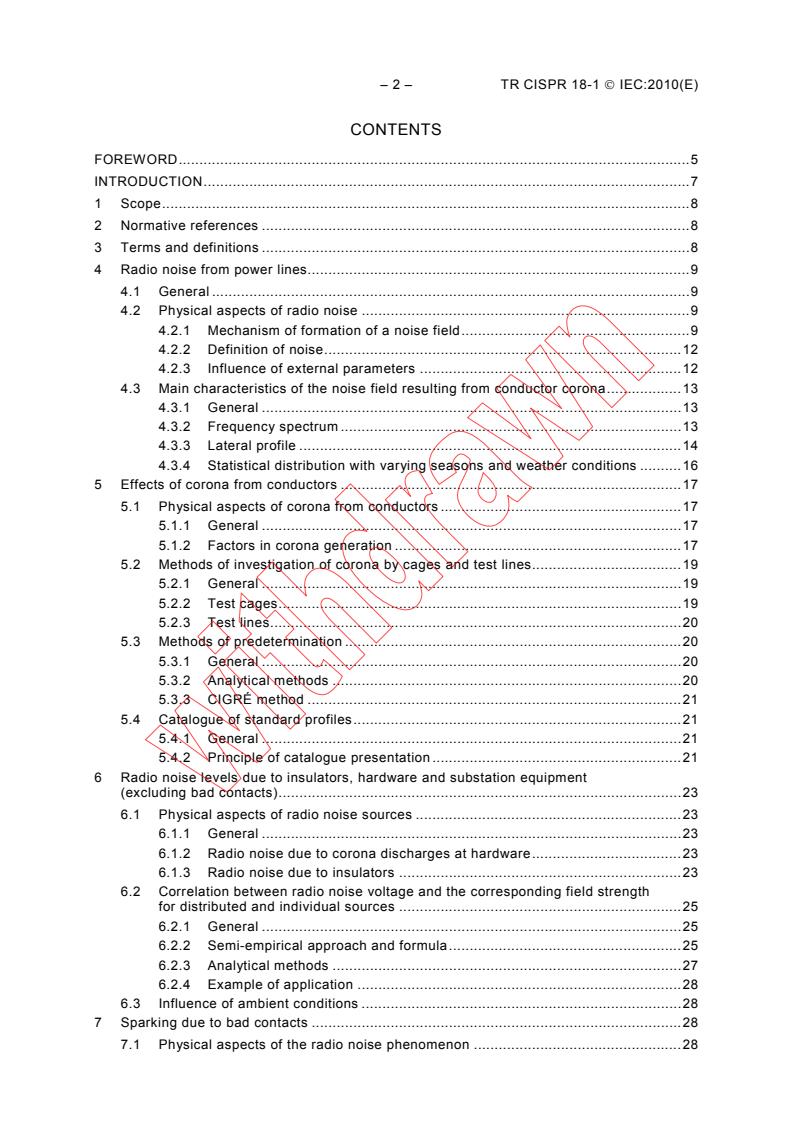
– 2 – TR CISPR 18-1 © IEC:2010(E)
CONTENTS
FOREWORD.5
INTRODUCTION.7
1 Scope.8
2 Normative references .8
3 Terms and definitions .8
4 Radio noise from power lines.9
4.1 General .9
4.2 Physical aspects of radio noise .9
4.2.1 Mechanism of formation of a noise field.9
4.2.2 Definition of noise.12
4.2.3 Influence of external parameters .12
4.3 Main characteristics of the noise field resulting from conductor corona.13
4.3.1 General .13
4.3.2 Frequency spectrum .13
4.3.3 Lateral profile .14
4.3.4 Statistical distribution with varying seasons and weather conditions .16
5 Effects of corona from conductors .17
5.1 Physical aspects of corona from conductors .17
5.1.1 General .17
5.1.2 Factors in corona generation .17
5.2 Methods of investigation of corona by cages and test lines.19
5.2.1 General .19
5.2.2 Test cages.19
5.2.3 Test lines.20
5.3 Methods of predetermination .20
5.3.1 General .20
5.3.2 Analytical methods .20
5.3.3 CIGRÉ method .21
5.4 Catalogue of standard profiles.21
5.4.1 General .21
5.4.2 Principle of catalogue presentation.21
6 Radio noise levels due to insulators, hardware and substation equipment
(excluding bad contacts).23
6.1 Physical aspects of radio noise sources .23
6.1.1 General .23
6.1.2 Radio noise due to corona discharges at hardware.23
6.1.3 Radio noise due to insulators .23
6.2 Correlation between radio noise voltage and the corresponding field strength
for distributed and individual sources .25
6.2.1 General .25
6.2.2 Semi-empirical approach and formula.25
6.2.3 Analytical methods .27
6.2.4 Example of application .28
6.3 Influence of ambient conditions .28
7 Sparking due to bad contacts .28
7.1 Physical aspects of the radio noise phenomenon .28
TR CISPR 18-1 © IEC:2010(E) – 3 –
7.2 Example of gap sources .29
8 Special d.c. effects .30
8.1 General .30
8.2 Effects of corona from conductors .30
8.3 Radio noise due to insulators, hardware and substation equipment .34
8.4 Valve firing effects.34
9 Figures .36
Annex A (informative) Calculation of the voltage gradient at the surface of a conductor
of an overhead line .46
Annex B (informative) Catalogue of profiles of radio noise field due to conductor
corona for certain types of power line .50
Annex C (informative) Summary of the catalogue of radio noise profiles according to
the recommendations of the CISPR .66
Bibliography.68
Figure 1 – Typical lateral attenuation curves for high voltage lines, normalized to a
lateral distance of y = 15 m, distance in linear scale.36
Figure 2 – Typical lateral attenuation curves for high voltage lines, normalized to a
direct distance of D = 20 m, distance in logarithmic scale.37
Figure 3 – Examples of statistical yearly distributions of radio-noise levels recorded
continuously under various overhead lines.38
Figure 4 – Examples of statistical yearly distributions of radio-noise levels recorded
continuously under various overhead lines.39
Figure 5 – Example of statistical yearly distributions of radio-noise levels recorded
continuously under various overhead lines.40
Figure 6 – Examples of statistical yearly distributions of radio-noise levels recorded
continuously under various overhead lines.41
Figure 7 – Equipotential lines for clean and dry insulation units .42
Figure 8 – Determination of the magnetic field strength from a perpendicular to a
section of a line, at a distance x from the point of injection of noise current I .43
Figure 9 – Longitudinal noise attenuation versus distance from noise source (from test
results of various experiments frequencies around 0,5 MHz).43
Figure 10 – Lateral profile of the radio noise field strength produced by distributed
discrete sources on a 420 kV line of infinite length.44
Figure 11 – Example of relative strength of radio noise field as a function of frequency .45
Figure 12 – Example of relative strength of radio noise field as a function of the
distance from the line.45
Figure B.1 – Triangular formation (1) .51
Figure B.2 – Triangular formation (2) .52
Figure B.3 – Flat formation .53
Figure B.4 – Arched formation .54
Figure B.5 – Flat wide formation .55
Figure B.6 – Vertical formation (480 (Rail) X 4B) .56
Figure B.7 – Flat formation .57
Figure B.8 – Flat formation .58
Figure B.9 – Arched formation .59
Figure B.10 – Flat formation .60
Figure B.11 – Arched formation .61
– 4 – TR CISPR 18-1 © IEC:2010(E)
Figure B.12 – Flat formation .62
Figure B.13 – Vertical formation (480 (Cardinal) X 6B).63
Figure B.14 – Typical frequency spectra for the radio noise fields of high voltage
power lines .64
Figure B.15 – Prediction of radio noise level of a transmission line for various types of
weather .65
Figure C.1 – Examples of transformations of the profiles of Figures B.1 to B.13 using
the direct distance of 20 m as reference .67
Table B.1 – List of profiles .50
TR CISPR 18-1 © IEC:2010(E) – 5 –
INTERNATIONAL ELECTROTECHNICAL COMMISSION
INTERNATIONAL SPECIAL COMMITTEE ON RADIO INTERFERENCE
____________
RADIO INTERFERENCE CHARACTERISTICS
OF OVERHEAD POWER LINES
AND HIGH-VOLTAGE EQUIPMENT –
Part 1: Description of phenomena
FOREWORD
1) The International Electrotechnical Commission (IEC) is a worldwide organization for standardization comprising
all national electrotechnical committees (IEC National Committees). The object of IEC is to promote
international co-operation on all questions concerning standardization in the electrical and electronic fields. To
this end and in addition to other activities, IEC publishes International Standards, Technical Specifications,
Technical Reports, Publicly Available Specifications (PAS) and Guides (hereafter referred to as “IEC
Publication(s)”). Their preparation is entrusted to technical committees; any IEC National Committee interested
in the subject dealt with may participate in this preparatory work. International, governmental and non-
governmental organizations liaising with the IEC also participate in this preparation. IEC collaborates closely
with the International Organization for Standardization (ISO) in accordance with conditions determined by
agreement between the two organizations.
2) The formal decisions or agreements of IEC on technical matters express, as nearly as possible, an international
consensus of opinion on the relevant subjects since each technical committee has representation from all
interested IEC National Committees.
3) IEC Publications have the form of recommendations for international use and are accepted by IEC National
Committees in that sense. While all reasonable efforts are made to ensure that the technical content of IEC
Publications is accurate, IEC cannot be held responsible for the way in which they are used or for any
misinterpretation by any end user.
4) In order to promote international uniformity, IEC National Committees undertake to apply IEC Publications
transparently to the maximum extent possible in their national and regional publications. Any divergence
between any IEC Publication and the corresponding national or regional publication shall be clearly indicated in
the latter.
5) IEC itself does not provide any attestation of conformity. Independent certification bodies provide conformity
assessment services and, in some areas, access to IEC marks of conformity. IEC is not responsible for any
services carried out by independent certification bodies.
6) All users should ensure that they have the latest edition of this publication.
7) No liability shall attach to IEC or its directors, employees, servants or agents including individual experts and
members of its technical committees and IEC National Committees for any personal injury, property damage or
other damage of any nature whatsoever, whether direct or indirect, or for costs (including legal fees) and
expenses arising out of the publication, use of, or reliance upon, this IEC Publication or any other IEC
Publications.
8) Attention is drawn to the Normative references cited in this publication. Use of the referenced publications is
indispensable for the correct application of this publication.
9) Attention is drawn to the possibility that some of the elements of this IEC Publication may be the subject of
patent rights. IEC shall not be held responsible for identifying any or all such patent rights.
The main task of IEC technical committees is to prepare International Standards. However, a
technical committee may propose the publication of a technical report when it has collected
data of a different kind from that which is normally published as an International Standard, for
example "state of the art".
CISPR 18-1, which is a technical report, has been prepared by CISPR subcommittee B:
Interference relating to industrial, scientific and medical radio-frequency apparatus, to other
(heavy) industrial equipment, to overhead power lines, to high voltage equipment and to
electric traction.
This second edition cancels and replaces the first edition published in 1982. It is a technical
revision.
– 6 – TR CISPR 18-1 © IEC:2010(E)
This edition includes the following significant technical changes with respect to the previous
edition: while the first edition of CISPR 18-1 only covered the direct distance D for the
establishment of standard profiles for the lateral radio noise field emanating from HV
overhead power lines, this second edition now also allows for use of the lateral distance y for
these purposes. This way it allows for the establishment of standard profiles for the lateral
radio noise field also from modern HV overhead power line constructions with tall suspension
towers.
The text of this technical report is based on the following documents:
DTR Report on voting
CISPR/B/493/DTR CISPR/B/501/RVC
Full information on the voting for the approval of this technical report can be found in the
report on voting indicated in the above table.
This technical report has been drafted in accordance with the ISO/IEC Directives, Part 2.
A list of all parts of the CISPR 18 series can be found, under the general title Radio
interference characteristics of overhead power lines and high-voltage equipment, on the IEC
website.
The committee has decided that the contents of this publication will remain unchanged until
the stability date indicated on the IEC web site under "http://webstore.iec.ch" in the data
related to the specific publication. At this date, the publication will be
• reconfirmed,
• withdrawn,
• replaced by a revised edition, or
• amended.
A bilingual version of this publication may be issued at a later date.
TR CISPR 18-1 © IEC:2010(E) – 7 –
INTRODUCTION
This technical report forms the first of a three-part publication dealing with radio noise
generated by electrical power transmission and distribution facilities (overhead lines and
substations). It contains information in relation of the physical phenomena involved in the
generation of electromagnetic noise fields. It also includes the main properties of such fields
and their numerical values. Its content was adjusted such as to allow for use of the lateral
distance y for the establishment of standard profiles for the lateral radio noise field emanating
from HV overhead power lines.
The technical data given in this part 1 of the CISPR 18 series are intended to be a useful aid
to overhead line designers and also to anyone concerned with checking the radio noise
performance of a line to ensure satisfactory protection of wanted radio signals. The data
should facilitate the use of the recommendations given in its parts 2 and 3 dealing with
– methods of measurement and procedures for determining limits, and a
– code of practice for minimizing the generation of radio noise.
The CISPR 18 series do not deal with biological effects on living matter or any issues related
to exposure in electromagnetic fields.
This technical report has been prepared in order to provide information on the many factors
involved in protecting the reception of radio and television broadcasting from interference due
to high voltage overhead power lines and associated equipment. The information given should
be of assistance when means of avoiding or abating radio noise are being considered.
Information is mainly given on the generation and characteristics of radio noise from a.c.
power lines and equipment operating at 1 kV and above, in the frequency ranges 0,15 MHz to
30 MHz (a.m. sound broadcasting) and 30 MHz to 300 MHz (f.m. sound broadcasting and
television broadcasting). The special aspect of spark discharges due to bad contacts is taken
into account. Some information is also given on interference due to d.c. overhead lines for
which corona and interference conditions are different from those of a.c. power lines.
The general procedure for establishing the limits of the radio noise from the power lines and
equipment is given, together with typical values as examples, and methods of measurement.
The clause on limits concentrates on the low frequency and medium frequency bands as it is
only in these where ample evidence, based on established practice, is available. No examples
of limits to protect reception in the frequency band 30 MHz to 300 MHz have been given, as
measuring methods and certain other aspects of the problems in this band have not yet been
fully resolved. Site measurements and service experience have shown that levels of noise
from power lines at frequencies higher than 300 MHz are so low that interference is unlikely to
be caused to television reception.
The values of limits given as examples are calculated to provide a reasonable degree of
protection to the reception of broadcasting at the edges of the recognized service areas of the
appropriate transmitters in the a.m. radio frequency bands, in the least favourable conditions
likely to be generally encountered. These limits are intended to provide guidance at the
planning stage of the line and national standards or other specifications against which the
performance of the line may be checked after construction and during its useful life.
Recommendations are made on the design, routing, construction and maintenance of the lines
and equipment forming part of the power distribution system to minimize interference and it is
hoped that this publication will aid other radio services in the consideration of the problems of
interference.
– 8 – TR CISPR 18-1 © IEC:2010(E)
RADIO INTERFERENCE CHARACTERISTICS
OF OVERHEAD POWER LINES
AND HIGH-VOLTAGE EQUIPMENT –
Part 1: Description of phenomena
1 Scope
This part of CISPR 18, which is a technical report, applies to radio noise from overhead power
lines and high-voltage equipment which may cause interference to radio reception. The scope
of this publication includes the causes, measurement and effects of radio interference, design
aspects in relation to this interference, methods and examples for establishing limits and
prediction of tolerable levels of interference from high voltage overhead power lines and
associated equipment, to the reception of radio broadcast services.
The frequency range covered is 0,15 MHz to 300 MHz.
Radio frequency interference caused by the pantograph of overhead railway traction systems
is not considered in this technical report.
2 Normative references
The following referenced documents are indispensable for the application of this document.
For dated references, only the edition cited applies. For undated references, the latest edition
of the referenced document (including any amendments) applies.
IEC 60050-161, International Electrotechnical Vocabulary (IEV) – Chapter 161:
Electromagnetic compatibility
CISPR 16-1-1, Specification for radio disturbance and immunity measuring apparatus and
methods – Part 1-1: Radio disturbance and immunity measuring apparatus – Measuring
apparatus
CISPR/TR 18-2:2010, Radio interference characteristics of overhead power lines and
high-voltage equipment – Part 2: Methods of measurement and procedure for determining
limits
ISO/IEC Guide 99, International vocabulary of metrology – Basic and general concepts and
associated terms (VIM)
NOTE Informative references are listed in the Bibliography.
3 Terms and definitions
For the purposes of this document, the terms and definitions given in the IEC 60050-161 and
the ISO/IEC Guide 99 apply.
TR CISPR 18-1 © IEC:2010(E) – 9 –
4 Radio noise from power lines
4.1 General
Radio noise from high voltage, which is to say above 1 kV, overhead power lines may be
generated over a wide band of frequencies by
a) corona discharges in the air at the surfaces of conductors, insulator assemblies and
hardware;
b) discharges and sparking at highly stressed areas of insulators;
c) sparking at loose or imperfect contacts of hardware.
The sources of a) and b) are usually distributed along the length of the line, but source c) is
usually local. For lines operating above about 100 kV, the electric stress in the air at the
surface of conductors and hardware can cause corona discharges. Sparking at bad contacts
or broken or cracked insulators can give rise to local sources of radio noise. High voltage
apparatus in substations may also generate radio noise which can be propagated along the
overhead lines.
If the field strength of the radio noise at the antennas used for receiving broadcast sound and
television services is too high, it can cause degradation of the sound output and, in the case
of television, the picture also.
The generation of radio noise is affected by weather conditions, for example, conductor
corona is more likely to occur in wet weather because of the water droplets which form on the
conductors whereas, under these conditions, bad contacts can become bridged with water
droplets and the generation of radio noise, by this process, ceases. Consequently, loose or
imperfect contacts are more likely to spark in dry weather conditions. Dry, clean insulators
may cause interference in fair weather, but prolonged sparking on the surfaces of insulators is
more likely to occur when they are polluted, particularly during wet, foggy or icy conditions.
For interference-free reception of radio and television signals it is important that a sufficiently
high ratio is available at the input to the receiver between the level of the wanted signal and
the level of the unwanted radio noise. Interference may therefore be experienced when the
signal strength is low and the weather conditions are conducive to the generation of radio
noise.
When investigating radio noise it should be borne in mind that the local field may be caused
by a distant source or sources as the noise may be propagated along the line over a
considerable distance.
4.2 Physical aspects of radio noise
4.2.1 Mechanism of formation of a noise field
4.2.1.1 General
Corona discharges on conductors, insulators or line hardware or sparking at bad contacts can
be the source of radio noise as they inject current pulses into the line conductors. These
propagate along the conductors in both directions from the injection point. The various
components of the frequency spectrum of these pulses have different effects.
In the frequency range 0,15 MHz to a few megahertz, the noise is largely the result of the
effect of propagation along the line. Direct electromagnetic radiation from the pulse sources
themselves does not materially contribute to the noise level. In this case the wavelength is
long in comparison with the clearances of the conductors and thus the line is not an efficient
radiator. However, associated with each spectral voltage and current component, an electric
and a magnetic field propagate along the line. In view of the relatively low attenuation of this
propagation, the noise field is determined by the aggregation of the effects of all the
– 10 – TR CISPR 18-1 © IEC:2010(E)
discharges spread over many kilometres along the line on either side of the reception point. It
should be noted that close to the line the guided field predominates, whereas further from the
line the radiated field predominates. The change-over is not abrupt and the phenomenon is
not well known. This effect is not important at low frequencies but is apparent at medium
frequencies.
However, for spectral components above 30 MHz where the wavelengths are close to or less
than the clearance of the line conductors, the noise effects can be largely explained by
antenna radiation theory applied to the source of noise, as there is no material propagation
along the line.
It should be appreciated, however, that 30 MHz does not represent a clear dividing line
between the two different mechanisms producing noise fields.
4.2.1.2 Longitudinal propagation
In the case of a single conductor line mounted above the ground there is a simultaneous
propagation of a voltage wave U(t) and a current wave I(t).
For a given frequency the two quantities are related by the expression U(ω) = Z(ω) × I(ω)
where Z, also a function of ω, is the surge impedance of the line.
During propagation the waves are attenuated by a common coefficient α where:
–αx
U = U e
x 0
–αx
I = I e
x 0
U and I are the amplitudes at the source and x is the distance of propagation along the line.
0 0
In case of multi-phase lines, experience shows that any system of voltages or currents
becomes distorted in propagation, that is to say, the attenuation varies with the distance
propagated and it differs for each conductor. Theory of propagation and actual measurements
on power lines have shown that noise voltages on the phase conductors can be considered as
being made up of a number of "modes", each one having components on every conductor.
One mode propagates between all conductors in parallel and earth. The others propagate
between conductors. Each mode has its own different propagation attenuation. The complete
theory of modal propagation is complex and involves matrix equations outside the scope of
this publication. Reference is made here to CIGRÉ and other published works. It is important
to note that the attenuation of the conductor-to-earth mode propagation is fairly high, that is to
say 2 dB/km to 4 dB/km, while the attenuation of the various conductor-to-conductor modes is
a small fraction of 1 dB/km at a frequency of 0,5 MHz.
4.2.1.3 Electromagnetic field
The radio noise voltages and currents propagating along the line produce an associated
propagating electromagnetic field near the line.
It should be noted here that in free space the electric and magnetic components of the field
associated with radiated electromagnetic waves are at right angles both to each other and to
the direction of propagation. The ratio of their amplitudes represents a constant value:
E
(V/m)
= 377Ω
H
(A/m)
and is called the intrinsic impedance or impedance of free space.
TR CISPR 18-1 © IEC:2010(E) – 11 –
On the other hand, the fields near the line are related to the radio frequency voltages and
currents propagating along the line and their ratio depends on the surge impedance of the line
for the various modes. Furthermore, the directions of the electric and magnetic field
components differ from those for radiated fields in free space as they are largely determined
by the geometrical arrangements of the line conductors. The matter is further complicated by
the fact that soil conditions affect differently the mirror image in the ground of the electric and
magnetic field components, respectively.
The electric field strength E(y) at ground level of a single conductor line, which is the vertical
component of the total electric field strength, can be predicted by the following empirical
formula that has, in a lot of cases, proven to give a good approximation:
h
E(y ) = 120 I
2 2
h + y
where
I is the radio noise current, in A, propagating in the conductor;
h is the height above ground, in metres, of the conductor;
y is the lateral distance, also in metres, from a point at ground level directly under the
conductor to the measuring point; and
E is the electric field strength in V/m.
Furthermore, for an infinitely long single conductor line, the induction zone, or near field, has
the same simple ratio of electric and magnetic field strength as the far field from a radio
transmitter, that is to say 377 Ω and this is approximately true for all values of ground
conductivity.
In the case of a multi-phase line the total electric field strength is the vectorial sum of the
individual field strength components associated with each phase conductor. A more
comprehensive treatment, together with practical methods of assessing the electromagnetic
field, is discussed in 5.2 of CISPR/TR 18-2. The formula given above is a simplified version
accurate for a distance of D = 20 m and f = 0,5 MHz where D is the direct distance, in metres,
between the measuring antenna and the nearest conductor of the line, and f is the
measurement frequency. For conventional power transmission lines (i.e. with a conductor
height above ground which is less than 15 m), this direct distance D approximately
corresponds to a lateral distance y of 15 m. For a wider range of D and f it would be
necessary to take into account all the parameters affecting the formula.
4.2.1.4 Aggregation effect
In the case of uniformly distributed noise sources, the field strength generated by a unit length
of a phase conductor can be expressed at any point along the line as a function of the
longitudinal distance x and the lateral distance y, that is to say, E(y,x). At a given lateral
distance of y,
−αx
E (y,x) = E (y)e
The random pulses on a long line with uniformly distributed noise sources combine together
to form the total field. The manner in which they combine is not unanimously agreed upon.
Some investigators consider that they combine quadratically:
∞
2 2 −2αx
E (y) = 2 E (y)e dx
∫
– 12 – TR CISPR 18-1 © IEC:2010(E)
E
or E (y) = .
α
Other investigators believe that, if a quasi-peak detector is used to measure the field strength,
the individual pulses do not add and others have obtained results between the two extremes.
This disagreement is only important in analytical prediction methods, the results obtained by
the different methods vary by only 1 dB or 2 dB.
In case of multi-phase lines, the calculation follows the sample principle but is complicated by
the presence of several modes, each mode having a different attenuation coefficient. A more
detailed discussion, with examples of calculation, is given in Clause 6.
4.2.2 Definition of noise
The instantaneous value of the noise varies continuously and in a random manner, but its
average power level over a sufficiently long period, for example, 1 s, gives a stationary
random quantity which can be measured. Another quantity suitable for measurement is the
peak or some weighted peak value of the noise level.
A noise measuring instrument is basically a tuneable selective and sensitive voltmeter with a
specified pass-band. When connecting to a suitable rod or loop antenna and properly
calibrated, it can measure the electric or magnetic component of the noise field. For
measurements of the magnetic component of the noise field in the frequency range up to
30 MHz, normally a loop antenna is used. For measurements of the electric component of the
noise field in the frequency range above 30 MHz, use of a biconical antenna is recommended.
Depending on the design of the measuring receiver, the noise level can be measured in terms
of r.m.s., peak or quasi-peak values. The r.m.s. value defines the noise in terms of energy.
Many types of noise from electrical equipment, as well as noise due to power-line corona,
consist of a succession of short pulses with approximately stable repetition frequencies. In
such cases the nuisance effect of the noise can be realistically indicated by a quasi-peak type
of voltmeter rather than by the r.m.s. type. The quasi-peak value is obtained from a circuit
which includes a diode and a capacitor with relatively short charge and long discharge time
constants. The voltage on the capacitor floats at a value somewhat below the peak value and
depends on the repetition rate, that is to say a weighting feature is included in the response.
This principle is adopted in the CISPR measuring receiver, details of which are given in
CISPR 16-1-1. The noise level is thus defined by the value measured by such an instrument
expressed in microvolts (μV) or microvolts per metre (μV/m). Using the ratio of the electric to
magnetic field components, E/H = 377 Ω, the measured values can also be expressed by
convention in μV/m even for instruments using a loop antenna responding to the magnetic
field component.
4.2.3 Influence of external parameters
To determine the corona inception gradient g of a cylindrical conductor with smooth surface,
c
Peek's formula is often used:
⎛ ⎞
0,308
g (kV/cm) = 31 δ ⎜1 + ⎟
c
⎜ ⎟
δ r
⎝ ⎠
For a.c. voltages, g is the peak value of the gradient, r is the radius of the conductor in
c
0,294p
centimetres, δ = is the relative air density (δ = 1 for p = 1 013 mbar and T = 25 °C).
273 +T
However, practical conditions on overhead lines do not agree with these idealized
assumptions. Stranding of the conductors, surface imperfections and irregularities lead to
local enhancements of the electric field strength and consequently to a lower corona inception
TR CISPR 18-1 © IEC:2010(E) – 13 –
voltage than is obtained from the above formula. This often means that the critical gradient for
initiating radio noise has, under foul weather conditions, about half the value given by Peek's
formula.
Atmospheric conditions likewise play an important part in occurrence of corona and spark
discharges. In conditions of rain, fog, snow or dew, drops of water form on the surface of the
conductor and at low temperatures ice can form. This further reduces the corona inception
voltage and increases the noise level as shown in Clauses 5 and 6.
With regard to bad contacts and the production of small sparks, the effect of rain and humidity
is to bridge the relevant gaps either by water droplets or by humid layers, thus reducing the
level of this type of noise.
Rain and humidity thus affect the corona noise from conductors in a way opposite to that due
to bad contacts. Hence when interference is observed during rain or fog, it can be concluded
that it is caused by corona. On the other hand, when interference is observed during fair
weather and disappears or decreases during rain or fog, it is due to bad contacts.
4.3 Main characteristics of the noise field resulting from conductor corona
4.3.1 General
To rationalize the measurement of radio noise from a transmission line and facilitate
comparisons between different lines, it is desirable to standardize the conditions under which
the measurement is to be carried out.
The main characteristics of the noise field are the frequency spectrum, its lateral field strength
profile and the statistical variation of the noise with weather conditions. It is assumed as a
first approximation that these characteristics are independent of each other.
4.3.2 Frequency spectrum
The frequency spectrum is the variation of the radio noise measured at a given point in the
vicinity of a line, as a function of the measurement frequency. Two phenomena are involved:
a) Current pulses
The current pulses generated in the conductors by the discharges show a particular
spectrum dependent on the pulse shape. For this type of discharge the measured noise
level decreases with an increase of the measurement frequency. In the range of
broadcasting frequencies, where the positive discharges have a predominant effect, the
spectrum is independent of the conductor diameter.
b) Attenuation along the line
The attenuation of noise propagating along the line increases with frequency. This effect
modifies the spectrum by reducing still further the noise level with increase in frequency.
The measured spectra are often fairly irregular because of the standing waves caused by
discontinuities such as angle or terminal towers or abrupt ground level variations. In addition,
the noise generation might vary whilst the measurements are being made.
To aid prediction calculations, "standard spectra" are used. Experience has shown that all
spectra can be put into two families, one applying to horizontal conductor configurations, the
other to double-circuit and triangular or vertical conductor configurations. The difference
between these two families originates from the phenomenon mentioned in item b) above, the
propagation differing slightly according to the type of line. However, as the difference is not
material in relation to the accuracy of such calculations, only one standard spectrum is given
in relative values, the reference point being taken at 0,5 MHz.
The following formula is a good representation of this spectrum:
– 14 – TR CISPR 18-1 © IEC:2010(E)
Δ E = 5[]1− 2()lg10f in dB
where
ΔE is the deviation of the radio noise level at a given frequency f which is different from the
reference frequency of 0,5 MHz; and
f is the numerical value of the given frequency, taken in megahertz, where the formula is
valid over the range 0,15 MHz to 4 MHz.
It should be noted that other investigators have developed different formulae which give
similar results.
At higher frequencies the noise spectra are more difficult to predict.
4.3.3 Lateral profile
The variation of the noise fields as a function of increasing lateral distance from the line is
characterized by a decrease depending on the frequency. Measurements are taken along a
perpendicular to a mid-span which is as close as possible to an average span of the line
under consideration. The proximity of substations or interconnections, sharp angles,
neighbouring lines and great variations in level of terrain shall be avoided.
Lateral profiles of the radio noise field can be determined either using the direct distance D or
the lateral distance y.
Conventions
(1) In order to allow for comparison of obtained profiles of the noise field, the profile is
determined at a height of 2 m ab
...
TR CISPR 18-1 ®
Edition 2.0 2010-06
TECHNICAL
REPORT
INTERNATIONAL SPECIAL COMMITTEE ON RADIO INTERFERENCE
Radio interference characteristics of overhead power lines and high-voltage
equipment –
Part 1: Description of phenomena
TR CISPR 18-1:2010(E)
All rights reserved. Unless otherwise specified, no part of this publication may be reproduced or utilized in any form
or by any means, electronic or mechanical, including photocopying and microfilm, without permission in writing from
either IEC or IEC's member National Committee in the country of the requester.
If you have any questions about IEC copyright or have an enquiry about obtaining additional rights to this publication,
please contact the address below or your local IEC member National Committee for further information.
IEC Central Office
3, rue de Varembé
CH-1211 Geneva 20
Switzerland
Email: inmail@iec.ch
Web: www.iec.ch
About the IEC
The International Electrotechnical Commission (IEC) is the leading global organization that prepares and publishes
International Standards for all electrical, electronic and related technologies.
About IEC publications
The technical content of IEC publications is kept under constant review by the IEC. Please make sure that you have the
latest edition, a corrigenda or an amendment might have been published.
ƒ Catalogue of IEC publications: www.iec.ch/searchpub
The IEC on-line Catalogue enables you to search by a variety of criteria (reference number, text, technical committee,…).
It also gives information on projects, withdrawn and replaced publications.
ƒ IEC Just Published: www.iec.ch/online_news/justpub
Stay up to date on all new IEC publications. Just Published details twice a month all new publications released. Available
on-line and also by email.
ƒ Electropedia: www.electropedia.org
The world's leading online dictionary of electronic and electrical terms containing more than 20 000 terms and definitions
in English and French, with equivalent terms in additional languages. Also known as the International Electrotechnical
Vocabulary online.
ƒ Customer Service Centre: www.iec.ch/webstore/custserv
If you wish to give us your feedback on this publication or need further assistance, please visit the Customer Service
Centre FAQ or contact us:
Email: csc@iec.ch
Tel.: +41 22 919 02 11
Fax: +41 22 919 03 00
TR CISPR 18-1 ®
Edition 2.0 2010-06
TECHNICAL
REPORT
INTERNATIONAL SPECIAL COMMITTEE ON RADIO INTERFERENCE
Radio interference characteristics of overhead power lines and high-voltage
equipment –
Part 1: Description of phenomena
INTERNATIONAL
ELECTROTECHNICAL
COMMISSION
PRICE CODE
XB
ICS 33.100.01 ISBN 978-2-88912-016-1
– 2 – TR CISPR 18-1 © IEC:2010(E)
CONTENTS
FOREWORD.5
INTRODUCTION.7
1 Scope.8
2 Normative references .8
3 Terms and definitions .8
4 Radio noise from power lines.9
4.1 General .9
4.2 Physical aspects of radio noise .9
4.2.1 Mechanism of formation of a noise field.9
4.2.2 Definition of noise.12
4.2.3 Influence of external parameters .12
4.3 Main characteristics of the noise field resulting from conductor corona.13
4.3.1 General .13
4.3.2 Frequency spectrum .13
4.3.3 Lateral profile .14
4.3.4 Statistical distribution with varying seasons and weather conditions .16
5 Effects of corona from conductors .17
5.1 Physical aspects of corona from conductors .17
5.1.1 General .17
5.1.2 Factors in corona generation .17
5.2 Methods of investigation of corona by cages and test lines.19
5.2.1 General .19
5.2.2 Test cages.19
5.2.3 Test lines.20
5.3 Methods of predetermination .20
5.3.1 General .20
5.3.2 Analytical methods .20
5.3.3 CIGRÉ method .21
5.4 Catalogue of standard profiles.21
5.4.1 General .21
5.4.2 Principle of catalogue presentation.21
6 Radio noise levels due to insulators, hardware and substation equipment
(excluding bad contacts).23
6.1 Physical aspects of radio noise sources .23
6.1.1 General .23
6.1.2 Radio noise due to corona discharges at hardware.23
6.1.3 Radio noise due to insulators .23
6.2 Correlation between radio noise voltage and the corresponding field strength
for distributed and individual sources .25
6.2.1 General .25
6.2.2 Semi-empirical approach and formula.25
6.2.3 Analytical methods .27
6.2.4 Example of application .28
6.3 Influence of ambient conditions .28
7 Sparking due to bad contacts .28
7.1 Physical aspects of the radio noise phenomenon .28
TR CISPR 18-1 © IEC:2010(E) – 3 –
7.2 Example of gap sources .29
8 Special d.c. effects .30
8.1 General .30
8.2 Effects of corona from conductors .30
8.3 Radio noise due to insulators, hardware and substation equipment .34
8.4 Valve firing effects.34
9 Figures .36
Annex A (informative) Calculation of the voltage gradient at the surface of a conductor
of an overhead line .46
Annex B (informative) Catalogue of profiles of radio noise field due to conductor
corona for certain types of power line .50
Annex C (informative) Summary of the catalogue of radio noise profiles according to
the recommendations of the CISPR .66
Bibliography.68
Figure 1 – Typical lateral attenuation curves for high voltage lines, normalized to a
lateral distance of y = 15 m, distance in linear scale.36
Figure 2 – Typical lateral attenuation curves for high voltage lines, normalized to a
direct distance of D = 20 m, distance in logarithmic scale.37
Figure 3 – Examples of statistical yearly distributions of radio-noise levels recorded
continuously under various overhead lines.38
Figure 4 – Examples of statistical yearly distributions of radio-noise levels recorded
continuously under various overhead lines.39
Figure 5 – Example of statistical yearly distributions of radio-noise levels recorded
continuously under various overhead lines.40
Figure 6 – Examples of statistical yearly distributions of radio-noise levels recorded
continuously under various overhead lines.41
Figure 7 – Equipotential lines for clean and dry insulation units .42
Figure 8 – Determination of the magnetic field strength from a perpendicular to a
section of a line, at a distance x from the point of injection of noise current I .43
Figure 9 – Longitudinal noise attenuation versus distance from noise source (from test
results of various experiments frequencies around 0,5 MHz).43
Figure 10 – Lateral profile of the radio noise field strength produced by distributed
discrete sources on a 420 kV line of infinite length.44
Figure 11 – Example of relative strength of radio noise field as a function of frequency .45
Figure 12 – Example of relative strength of radio noise field as a function of the
distance from the line.45
Figure B.1 – Triangular formation (1) .51
Figure B.2 – Triangular formation (2) .52
Figure B.3 – Flat formation .53
Figure B.4 – Arched formation .54
Figure B.5 – Flat wide formation .55
Figure B.6 – Vertical formation (480 (Rail) X 4B) .56
Figure B.7 – Flat formation .57
Figure B.8 – Flat formation .58
Figure B.9 – Arched formation .59
Figure B.10 – Flat formation .60
Figure B.11 – Arched formation .61
– 4 – TR CISPR 18-1 © IEC:2010(E)
Figure B.12 – Flat formation .62
Figure B.13 – Vertical formation (480 (Cardinal) X 6B).63
Figure B.14 – Typical frequency spectra for the radio noise fields of high voltage
power lines .64
Figure B.15 – Prediction of radio noise level of a transmission line for various types of
weather .65
Figure C.1 – Examples of transformations of the profiles of Figures B.1 to B.13 using
the direct distance of 20 m as reference .67
Table B.1 – List of profiles .50
TR CISPR 18-1 © IEC:2010(E) – 5 –
INTERNATIONAL ELECTROTECHNICAL COMMISSION
INTERNATIONAL SPECIAL COMMITTEE ON RADIO INTERFERENCE
____________
RADIO INTERFERENCE CHARACTERISTICS
OF OVERHEAD POWER LINES
AND HIGH-VOLTAGE EQUIPMENT –
Part 1: Description of phenomena
FOREWORD
1) The International Electrotechnical Commission (IEC) is a worldwide organization for standardization comprising
all national electrotechnical committees (IEC National Committees). The object of IEC is to promote
international co-operation on all questions concerning standardization in the electrical and electronic fields. To
this end and in addition to other activities, IEC publishes International Standards, Technical Specifications,
Technical Reports, Publicly Available Specifications (PAS) and Guides (hereafter referred to as “IEC
Publication(s)”). Their preparation is entrusted to technical committees; any IEC National Committee interested
in the subject dealt with may participate in this preparatory work. International, governmental and non-
governmental organizations liaising with the IEC also participate in this preparation. IEC collaborates closely
with the International Organization for Standardization (ISO) in accordance with conditions determined by
agreement between the two organizations.
2) The formal decisions or agreements of IEC on technical matters express, as nearly as possible, an international
consensus of opinion on the relevant subjects since each technical committee has representation from all
interested IEC National Committees.
3) IEC Publications have the form of recommendations for international use and are accepted by IEC National
Committees in that sense. While all reasonable efforts are made to ensure that the technical content of IEC
Publications is accurate, IEC cannot be held responsible for the way in which they are used or for any
misinterpretation by any end user.
4) In order to promote international uniformity, IEC National Committees undertake to apply IEC Publications
transparently to the maximum extent possible in their national and regional publications. Any divergence
between any IEC Publication and the corresponding national or regional publication shall be clearly indicated in
the latter.
5) IEC itself does not provide any attestation of conformity. Independent certification bodies provide conformity
assessment services and, in some areas, access to IEC marks of conformity. IEC is not responsible for any
services carried out by independent certification bodies.
6) All users should ensure that they have the latest edition of this publication.
7) No liability shall attach to IEC or its directors, employees, servants or agents including individual experts and
members of its technical committees and IEC National Committees for any personal injury, property damage or
other damage of any nature whatsoever, whether direct or indirect, or for costs (including legal fees) and
expenses arising out of the publication, use of, or reliance upon, this IEC Publication or any other IEC
Publications.
8) Attention is drawn to the Normative references cited in this publication. Use of the referenced publications is
indispensable for the correct application of this publication.
9) Attention is drawn to the possibility that some of the elements of this IEC Publication may be the subject of
patent rights. IEC shall not be held responsible for identifying any or all such patent rights.
The main task of IEC technical committees is to prepare International Standards. However, a
technical committee may propose the publication of a technical report when it has collected
data of a different kind from that which is normally published as an International Standard, for
example "state of the art".
CISPR 18-1, which is a technical report, has been prepared by CISPR subcommittee B:
Interference relating to industrial, scientific and medical radio-frequency apparatus, to other
(heavy) industrial equipment, to overhead power lines, to high voltage equipment and to
electric traction.
This second edition cancels and replaces the first edition published in 1982. It is a technical
revision.
– 6 – TR CISPR 18-1 © IEC:2010(E)
This edition includes the following significant technical changes with respect to the previous
edition: while the first edition of CISPR 18-1 only covered the direct distance D for the
establishment of standard profiles for the lateral radio noise field emanating from HV
overhead power lines, this second edition now also allows for use of the lateral distance y for
these purposes. This way it allows for the establishment of standard profiles for the lateral
radio noise field also from modern HV overhead power line constructions with tall suspension
towers.
The text of this technical report is based on the following documents:
DTR Report on voting
CISPR/B/493/DTR CISPR/B/501/RVC
Full information on the voting for the approval of this technical report can be found in the
report on voting indicated in the above table.
This technical report has been drafted in accordance with the ISO/IEC Directives, Part 2.
A list of all parts of the CISPR 18 series can be found, under the general title Radio
interference characteristics of overhead power lines and high-voltage equipment, on the IEC
website.
The committee has decided that the contents of this publication will remain unchanged until
the stability date indicated on the IEC web site under "http://webstore.iec.ch" in the data
related to the specific publication. At this date, the publication will be
• reconfirmed,
• withdrawn,
• replaced by a revised edition, or
• amended.
A bilingual version of this publication may be issued at a later date.
TR CISPR 18-1 © IEC:2010(E) – 7 –
INTRODUCTION
This technical report forms the first of a three-part publication dealing with radio noise
generated by electrical power transmission and distribution facilities (overhead lines and
substations). It contains information in relation of the physical phenomena involved in the
generation of electromagnetic noise fields. It also includes the main properties of such fields
and their numerical values. Its content was adjusted such as to allow for use of the lateral
distance y for the establishment of standard profiles for the lateral radio noise field emanating
from HV overhead power lines.
The technical data given in this part 1 of the CISPR 18 series are intended to be a useful aid
to overhead line designers and also to anyone concerned with checking the radio noise
performance of a line to ensure satisfactory protection of wanted radio signals. The data
should facilitate the use of the recommendations given in its parts 2 and 3 dealing with
– methods of measurement and procedures for determining limits, and a
– code of practice for minimizing the generation of radio noise.
The CISPR 18 series do not deal with biological effects on living matter or any issues related
to exposure in electromagnetic fields.
This technical report has been prepared in order to provide information on the many factors
involved in protecting the reception of radio and television broadcasting from interference due
to high voltage overhead power lines and associated equipment. The information given should
be of assistance when means of avoiding or abating radio noise are being considered.
Information is mainly given on the generation and characteristics of radio noise from a.c.
power lines and equipment operating at 1 kV and above, in the frequency ranges 0,15 MHz to
30 MHz (a.m. sound broadcasting) and 30 MHz to 300 MHz (f.m. sound broadcasting and
television broadcasting). The special aspect of spark discharges due to bad contacts is taken
into account. Some information is also given on interference due to d.c. overhead lines for
which corona and interference conditions are different from those of a.c. power lines.
The general procedure for establishing the limits of the radio noise from the power lines and
equipment is given, together with typical values as examples, and methods of measurement.
The clause on limits concentrates on the low frequency and medium frequency bands as it is
only in these where ample evidence, based on established practice, is available. No examples
of limits to protect reception in the frequency band 30 MHz to 300 MHz have been given, as
measuring methods and certain other aspects of the problems in this band have not yet been
fully resolved. Site measurements and service experience have shown that levels of noise
from power lines at frequencies higher than 300 MHz are so low that interference is unlikely to
be caused to television reception.
The values of limits given as examples are calculated to provide a reasonable degree of
protection to the reception of broadcasting at the edges of the recognized service areas of the
appropriate transmitters in the a.m. radio frequency bands, in the least favourable conditions
likely to be generally encountered. These limits are intended to provide guidance at the
planning stage of the line and national standards or other specifications against which the
performance of the line may be checked after construction and during its useful life.
Recommendations are made on the design, routing, construction and maintenance of the lines
and equipment forming part of the power distribution system to minimize interference and it is
hoped that this publication will aid other radio services in the consideration of the problems of
interference.
– 8 – TR CISPR 18-1 © IEC:2010(E)
RADIO INTERFERENCE CHARACTERISTICS
OF OVERHEAD POWER LINES
AND HIGH-VOLTAGE EQUIPMENT –
Part 1: Description of phenomena
1 Scope
This part of CISPR 18, which is a technical report, applies to radio noise from overhead power
lines and high-voltage equipment which may cause interference to radio reception. The scope
of this publication includes the causes, measurement and effects of radio interference, design
aspects in relation to this interference, methods and examples for establishing limits and
prediction of tolerable levels of interference from high voltage overhead power lines and
associated equipment, to the reception of radio broadcast services.
The frequency range covered is 0,15 MHz to 300 MHz.
Radio frequency interference caused by the pantograph of overhead railway traction systems
is not considered in this technical report.
2 Normative references
The following referenced documents are indispensable for the application of this document.
For dated references, only the edition cited applies. For undated references, the latest edition
of the referenced document (including any amendments) applies.
IEC 60050-161, International Electrotechnical Vocabulary (IEV) – Chapter 161:
Electromagnetic compatibility
CISPR 16-1-1, Specification for radio disturbance and immunity measuring apparatus and
methods – Part 1-1: Radio disturbance and immunity measuring apparatus – Measuring
apparatus
CISPR/TR 18-2:2010, Radio interference characteristics of overhead power lines and
high-voltage equipment – Part 2: Methods of measurement and procedure for determining
limits
ISO/IEC Guide 99, International vocabulary of metrology – Basic and general concepts and
associated terms (VIM)
NOTE Informative references are listed in the Bibliography.
3 Terms and definitions
For the purposes of this document, the terms and definitions given in the IEC 60050-161 and
the ISO/IEC Guide 99 apply.
TR CISPR 18-1 © IEC:2010(E) – 9 –
4 Radio noise from power lines
4.1 General
Radio noise from high voltage, which is to say above 1 kV, overhead power lines may be
generated over a wide band of frequencies by
a) corona discharges in the air at the surfaces of conductors, insulator assemblies and
hardware;
b) discharges and sparking at highly stressed areas of insulators;
c) sparking at loose or imperfect contacts of hardware.
The sources of a) and b) are usually distributed along the length of the line, but source c) is
usually local. For lines operating above about 100 kV, the electric stress in the air at the
surface of conductors and hardware can cause corona discharges. Sparking at bad contacts
or broken or cracked insulators can give rise to local sources of radio noise. High voltage
apparatus in substations may also generate radio noise which can be propagated along the
overhead lines.
If the field strength of the radio noise at the antennas used for receiving broadcast sound and
television services is too high, it can cause degradation of the sound output and, in the case
of television, the picture also.
The generation of radio noise is affected by weather conditions, for example, conductor
corona is more likely to occur in wet weather because of the water droplets which form on the
conductors whereas, under these conditions, bad contacts can become bridged with water
droplets and the generation of radio noise, by this process, ceases. Consequently, loose or
imperfect contacts are more likely to spark in dry weather conditions. Dry, clean insulators
may cause interference in fair weather, but prolonged sparking on the surfaces of insulators is
more likely to occur when they are polluted, particularly during wet, foggy or icy conditions.
For interference-free reception of radio and television signals it is important that a sufficiently
high ratio is available at the input to the receiver between the level of the wanted signal and
the level of the unwanted radio noise. Interference may therefore be experienced when the
signal strength is low and the weather conditions are conducive to the generation of radio
noise.
When investigating radio noise it should be borne in mind that the local field may be caused
by a distant source or sources as the noise may be propagated along the line over a
considerable distance.
4.2 Physical aspects of radio noise
4.2.1 Mechanism of formation of a noise field
4.2.1.1 General
Corona discharges on conductors, insulators or line hardware or sparking at bad contacts can
be the source of radio noise as they inject current pulses into the line conductors. These
propagate along the conductors in both directions from the injection point. The various
components of the frequency spectrum of these pulses have different effects.
In the frequency range 0,15 MHz to a few megahertz, the noise is largely the result of the
effect of propagation along the line. Direct electromagnetic radiation from the pulse sources
themselves does not materially contribute to the noise level. In this case the wavelength is
long in comparison with the clearances of the conductors and thus the line is not an efficient
radiator. However, associated with each spectral voltage and current component, an electric
and a magnetic field propagate along the line. In view of the relatively low attenuation of this
propagation, the noise field is determined by the aggregation of the effects of all the
– 10 – TR CISPR 18-1 © IEC:2010(E)
discharges spread over many kilometres along the line on either side of the reception point. It
should be noted that close to the line the guided field predominates, whereas further from the
line the radiated field predominates. The change-over is not abrupt and the phenomenon is
not well known. This effect is not important at low frequencies but is apparent at medium
frequencies.
However, for spectral components above 30 MHz where the wavelengths are close to or less
than the clearance of the line conductors, the noise effects can be largely explained by
antenna radiation theory applied to the source of noise, as there is no material propagation
along the line.
It should be appreciated, however, that 30 MHz does not represent a clear dividing line
between the two different mechanisms producing noise fields.
4.2.1.2 Longitudinal propagation
In the case of a single conductor line mounted above the ground there is a simultaneous
propagation of a voltage wave U(t) and a current wave I(t).
For a given frequency the two quantities are related by the expression U(ω) = Z(ω) × I(ω)
where Z, also a function of ω, is the surge impedance of the line.
During propagation the waves are attenuated by a common coefficient α where:
–αx
U = U e
x 0
–αx
I = I e
x 0
U and I are the amplitudes at the source and x is the distance of propagation along the line.
0 0
In case of multi-phase lines, experience shows that any system of voltages or currents
becomes distorted in propagation, that is to say, the attenuation varies with the distance
propagated and it differs for each conductor. Theory of propagation and actual measurements
on power lines have shown that noise voltages on the phase conductors can be considered as
being made up of a number of "modes", each one having components on every conductor.
One mode propagates between all conductors in parallel and earth. The others propagate
between conductors. Each mode has its own different propagation attenuation. The complete
theory of modal propagation is complex and involves matrix equations outside the scope of
this publication. Reference is made here to CIGRÉ and other published works. It is important
to note that the attenuation of the conductor-to-earth mode propagation is fairly high, that is to
say 2 dB/km to 4 dB/km, while the attenuation of the various conductor-to-conductor modes is
a small fraction of 1 dB/km at a frequency of 0,5 MHz.
4.2.1.3 Electromagnetic field
The radio noise voltages and currents propagating along the line produce an associated
propagating electromagnetic field near the line.
It should be noted here that in free space the electric and magnetic components of the field
associated with radiated electromagnetic waves are at right angles both to each other and to
the direction of propagation. The ratio of their amplitudes represents a constant value:
E
(V/m)
= 377Ω
H
(A/m)
and is called the intrinsic impedance or impedance of free space.
TR CISPR 18-1 © IEC:2010(E) – 11 –
On the other hand, the fields near the line are related to the radio frequency voltages and
currents propagating along the line and their ratio depends on the surge impedance of the line
for the various modes. Furthermore, the directions of the electric and magnetic field
components differ from those for radiated fields in free space as they are largely determined
by the geometrical arrangements of the line conductors. The matter is further complicated by
the fact that soil conditions affect differently the mirror image in the ground of the electric and
magnetic field components, respectively.
The electric field strength E(y) at ground level of a single conductor line, which is the vertical
component of the total electric field strength, can be predicted by the following empirical
formula that has, in a lot of cases, proven to give a good approximation:
h
E(y ) = 120 I
2 2
h + y
where
I is the radio noise current, in A, propagating in the conductor;
h is the height above ground, in metres, of the conductor;
y is the lateral distance, also in metres, from a point at ground level directly under the
conductor to the measuring point; and
E is the electric field strength in V/m.
Furthermore, for an infinitely long single conductor line, the induction zone, or near field, has
the same simple ratio of electric and magnetic field strength as the far field from a radio
transmitter, that is to say 377 Ω and this is approximately true for all values of ground
conductivity.
In the case of a multi-phase line the total electric field strength is the vectorial sum of the
individual field strength components associated with each phase conductor. A more
comprehensive treatment, together with practical methods of assessing the electromagnetic
field, is discussed in 5.2 of CISPR/TR 18-2. The formula given above is a simplified version
accurate for a distance of D = 20 m and f = 0,5 MHz where D is the direct distance, in metres,
between the measuring antenna and the nearest conductor of the line, and f is the
measurement frequency. For conventional power transmission lines (i.e. with a conductor
height above ground which is less than 15 m), this direct distance D approximately
corresponds to a lateral distance y of 15 m. For a wider range of D and f it would be
necessary to take into account all the parameters affecting the formula.
4.2.1.4 Aggregation effect
In the case of uniformly distributed noise sources, the field strength generated by a unit length
of a phase conductor can be expressed at any point along the line as a function of the
longitudinal distance x and the lateral distance y, that is to say, E(y,x). At a given lateral
distance of y,
−αx
E (y,x) = E (y)e
The random pulses on a long line with uniformly distributed noise sources combine together
to form the total field. The manner in which they combine is not unanimously agreed upon.
Some investigators consider that they combine quadratically:
∞
2 2 −2αx
E (y) = 2 E (y)e dx
∫
– 12 – TR CISPR 18-1 © IEC:2010(E)
E
or E (y) = .
α
Other investigators believe that, if a quasi-peak detector is used to measure the field strength,
the individual pulses do not add and others have obtained results between the two extremes.
This disagreement is only important in analytical prediction methods, the results obtained by
the different methods vary by only 1 dB or 2 dB.
In case of multi-phase lines, the calculation follows the sample principle but is complicated by
the presence of several modes, each mode having a different attenuation coefficient. A more
detailed discussion, with examples of calculation, is given in Clause 6.
4.2.2 Definition of noise
The instantaneous value of the noise varies continuously and in a random manner, but its
average power level over a sufficiently long period, for example, 1 s, gives a stationary
random quantity which can be measured. Another quantity suitable for measurement is the
peak or some weighted peak value of the noise level.
A noise measuring instrument is basically a tuneable selective and sensitive voltmeter with a
specified pass-band. When connecting to a suitable rod or loop antenna and properly
calibrated, it can measure the electric or magnetic component of the noise field. For
measurements of the magnetic component of the noise field in the frequency range up to
30 MHz, normally a loop antenna is used. For measurements of the electric component of the
noise field in the frequency range above 30 MHz, use of a biconical antenna is recommended.
Depending on the design of the measuring receiver, the noise level can be measured in terms
of r.m.s., peak or quasi-peak values. The r.m.s. value defines the noise in terms of energy.
Many types of noise from electrical equipment, as well as noise due to power-line corona,
consist of a succession of short pulses with approximately stable repetition frequencies. In
such cases the nuisance effect of the noise can be realistically indicated by a quasi-peak type
of voltmeter rather than by the r.m.s. type. The quasi-peak value is obtained from a circuit
which includes a diode and a capacitor with relatively short charge and long discharge time
constants. The voltage on the capacitor floats at a value somewhat below the peak value and
depends on the repetition rate, that is to say a weighting feature is included in the response.
This principle is adopted in the CISPR measuring receiver, details of which are given in
CISPR 16-1-1. The noise level is thus defined by the value measured by such an instrument
expressed in microvolts (μV) or microvolts per metre (μV/m). Using the ratio of the electric to
magnetic field components, E/H = 377 Ω, the measured values can also be expressed by
convention in μV/m even for instruments using a loop antenna responding to the magnetic
field component.
4.2.3 Influence of external parameters
To determine the corona inception gradient g of a cylindrical conductor with smooth surface,
c
Peek's formula is often used:
⎛ ⎞
0,308
g (kV/cm) = 31 δ ⎜1 + ⎟
c
⎜ ⎟
δ r
⎝ ⎠
For a.c. voltages, g is the peak value of the gradient, r is the radius of the conductor in
c
0,294p
centimetres, δ = is the relative air density (δ = 1 for p = 1 013 mbar and T = 25 °C).
273 +T
However, practical conditions on overhead lines do not agree with these idealized
assumptions. Stranding of the conductors, surface imperfections and irregularities lead to
local enhancements of the electric field strength and consequently to a lower corona inception
TR CISPR 18-1 © IEC:2010(E) – 13 –
voltage than is obtained from the above formula. This often means that the critical gradient for
initiating radio noise has, under foul weather conditions, about half the value given by Peek's
formula.
Atmospheric conditions likewise play an important part in occurrence of corona and spark
discharges. In conditions of rain, fog, snow or dew, drops of water form on the surface of the
conductor and at low temperatures ice can form. This further reduces the corona inception
voltage and increases the noise level as shown in Clauses 5 and 6.
With regard to bad contacts and the production of small sparks, the effect of rain and humidity
is to bridge the relevant gaps either by water droplets or by humid layers, thus reducing the
level of this type of noise.
Rain and humidity thus affect the corona noise from conductors in a way opposite to that due
to bad contacts. Hence when interference is observed during rain or fog, it can be concluded
that it is caused by corona. On the other hand, when interference is observed during fair
weather and disappears or decreases during rain or fog, it is due to bad contacts.
4.3 Main characteristics of the noise field resulting from conductor corona
4.3.1 General
To rationalize the measurement of radio noise from a transmission line and facilitate
comparisons between different lines, it is desirable to standardize the conditions under which
the measurement is to be carried out.
The main characteristics of the noise field are the frequency spectrum, its lateral field strength
profile and the statistical variation of the noise with weather conditions. It is assumed as a
first approximation that these characteristics are independent of each other.
4.3.2 Frequency spectrum
The frequency spectrum is the variation of the radio noise measured at a given point in the
vicinity of a line, as a function of the measurement frequency. Two phenomena are involved:
a) Current pulses
The current pulses generated in the conductors by the discharges show a particular
spectrum dependent on the pulse shape. For this type of discharge the measured noise
level decreases with an increase of the measurement frequency. In the range of
broadcasting frequencies, where the positive discharges have a predominant effect, the
spectrum is independent of the conductor diameter.
b) Attenuation along the line
The attenuation of noise propagating along the line increases with frequency. This effect
modifies the spectrum by reducing still further the noise level with increase in frequency.
The measured spectra are often fairly irregular because of the standing waves caused by
discontinuities such as angle or terminal towers or abrupt ground level variations. In addition,
the noise generation might vary whilst the measurements are being made.
To aid prediction calculations, "standard spectra" are used. Experience has shown that all
spectra can be put into two families, one applying to horizontal conductor configurations, the
other to double-circuit and triangular or vertical conductor configurations. The difference
between these two families originates from the phenomenon mentioned in item b) above, the
propagation differing slightly according to the type of line. However, as the difference is not
material in relation to the accuracy of such calculations, only one standard spectrum is given
in relative values, the reference point being taken at 0,5 MHz.
The following formula is a good representation of this spectrum:
– 14 – TR CISPR 18-1 © IEC:2010(E)
Δ E = 5[]1− 2()lg10f in dB
where
ΔE is the deviation of the radio noise level at a given frequency f which is different from the
reference frequency of 0,5 MHz; and
f is the numerical value of the given frequency, taken in megahertz, where the formula is
valid over the range 0,15 MHz to 4 MHz.
It should be noted that other investigators have developed different formulae which give
similar results.
At higher frequencies the noise spectra are more difficult to predict.
4.3.3 Lateral profile
The variation of the noise fields as a function of increasing lateral distance from the line is
characterized by a decrease depending on the frequency. Measurements are taken along a
perpendicular to a mid-span which is as close as possible to an average span of the line
under consideration. The proximity of substations or interconnections, sharp angles,
neighbouring lines and great variations in level of terrain shall be avoided.
Lateral profiles of the radio noise field can be determined either using the direct distance D or
the lateral distance y.
Conventions
(1) In order to allow for comparison of obtained profiles of the noise field, the profile is
determined at a height of 2 m ab
...