

IEC 62270:2013
(Main)Guide for computer-based control for hydroelectric power plant automation
General Information
- Abstract
IEC 62270:2013 addresses the application, design concepts, and implementation of computer-based control systems for hydroelectric plant automation. It addresses functional capabilities, performance requirements, interface requirements, hardware considerations, and operator training. It includes recommendations for system testing and acceptance. The electrical protective system (generator and step-up transformer) is beyond the scope of this guide. This second edition cancels and replaces the first edition published in 2004. This edition constitutes a technical revision. This edition includes the following significant technical changes with respect to the previous edition:
- update of system architecture aspects, with different process control system configurations;
- update of communications, user and plant interfaces aspects;
- suppression of case studies, because of the quickness of evolution of the technology;
- complete review of the bibliography, making mention of many IEC and IEEE standards as new references and addition of a new informative Annex B on legacy control systems. This publication is published as an IEC/IEEE Dual Logo standard. Key words: Hydroelectric, Automation, Computer-Based Control
- Status
- Published
- Publication Date
- 15-Sep-2013
- Technical Committee
- TC 4 - Hydraulic turbines
- Drafting Committee
- WG 14 - TC 4/WG 14
- Current Stage
- PPUB - Publication issued
- Start Date
- 16-Sep-2013
- Completion Date
- 30-Sep-2013
Overview
IEC 62270:2013, titled Guide for computer-based control for hydroelectric power plant automation, is an international standard developed by the International Electrotechnical Commission (IEC) in collaboration with the Institute of Electrical and Electronics Engineers (IEEE). It provides comprehensive guidance on the design, application, and implementation of computer-based control systems specifically for hydroelectric power plants. This second edition updates architectural aspects, communication and interface requirements, and includes new references to contemporary IEC and IEEE standards. However, it excludes electrical protective systems related to generators and step-up transformers.
The guide emphasizes functional capabilities, performance criteria, hardware considerations, operator training, system testing, and acceptance of automation systems. It also addresses multiple control system configurations including local, central, and off-site control levels. The standard targets engineers, system designers, and plant operators involved in hydroelectric plant automation, promoting secure, robust, and optimal plant operation through advanced computer-based controls.
Key Topics
System Architecture
The standard details various process control system configurations for hydroelectric plants, including hierarchical structures and interfaces between control systems and plant processes. It outlines options such as local individual control, local centralized control, and remote or off-site control to suit diverse operational needs.Control Functions
It covers essential control functionalities such as start/stop sequencing, synchronizing, synchronous condenser modes, pumped storage control, and turbine operation optimization. The guide also discusses centralized control of plant active and reactive power, spillways, switchyards, and black start control procedures.Data Acquisition and Processing
IEC 62270 highlights key data acquisition capabilities, stressing data integrity, analog and discrete input types, alarms, diagnostics, and the management of reports and data archiving. It also considers operator simulation training, forecasting, and secure data access.Communications and Databases
The publication promotes the use of open communication standards and digital communication systems at the field level. It elaborates on network topologies for local area networks, data communication functions, and real-time database designs crucial for reliable hydroelectric plant automation.User and Plant Interfaces
Adequate user interface design is emphasized, including ergonomic considerations, input/output devices, and interface security. The guide advocates for efficient communication between plant equipment and operators to enhance monitoring and control.System Performance & Backup
The standard addresses software and hardware performance requirements, maintenance considerations, availability, fail-over times, and system initialization. It also details backup control systems' design principles to ensure operational continuity in the event of failures.
Applications
IEC 62270:2013 is applicable to the automation of hydroelectric power plants of various sizes and configurations. Its guidance facilitates:
- Designing computer-based control systems tailored to hydroelectric plant operational requirements.
- Enhancing plant reliability through well-defined system architectures and redundant controls.
- Optimizing plant performance, including active and reactive power management, water resource optimization, and environmental control.
- Improving operator training programs using data acquisition and simulation tools.
- Integrating automated controls with ancillary systems such as fire detection, security, and maintenance management.
- Providing robust communication frameworks leveraging open standards to future-proof plant control systems.
The standard supports utilities, engineering firms, and manufacturers aiming to deploy efficient and secure hydroelectric automation solutions compliant with international best practices.
Related Standards
When implementing IEC 62270:2013, consider complementing it with other relevant standards for comprehensive system coverage:
- IEC 61131 - Programmable controllers - for automation programming standards.
- IEC 61850 - Communication networks and systems in substations - relevant for switchyard and substation automation interfaces.
- IEEE Std 1249 - Corresponding IEEE guide aligned with IEC 62270 for hydroelectric plant control automation.
- IEC 61508 - Functional safety of electrical/electronic systems - to ensure safety aspects beyond control automation.
- ISO/IEC 27001 - Information security management - for securing communication and control interfaces.
Adhering to these international standards ensures that hydroelectric power plant automation systems are designed with best-in-class safety, functionality, and interoperability, fostering sustainable and reliable energy production.
Relations
- Effective Date
- 05-Sep-2023
Get Certified
Connect with accredited certification bodies for this standard

DNV
DNV is an independent assurance and risk management provider.

Lloyd's Register
Lloyd's Register is a global professional services organisation specialising in engineering and technology.
DNV Energy Systems
Energy and renewable energy certification.
Sponsored listings
Frequently Asked Questions
IEC 62270:2013 is a standard published by the International Electrotechnical Commission (IEC). Its full title is "Guide for computer-based control for hydroelectric power plant automation". This standard covers: IEC 62270:2013 addresses the application, design concepts, and implementation of computer-based control systems for hydroelectric plant automation. It addresses functional capabilities, performance requirements, interface requirements, hardware considerations, and operator training. It includes recommendations for system testing and acceptance. The electrical protective system (generator and step-up transformer) is beyond the scope of this guide. This second edition cancels and replaces the first edition published in 2004. This edition constitutes a technical revision. This edition includes the following significant technical changes with respect to the previous edition: - update of system architecture aspects, with different process control system configurations; - update of communications, user and plant interfaces aspects; - suppression of case studies, because of the quickness of evolution of the technology; - complete review of the bibliography, making mention of many IEC and IEEE standards as new references and addition of a new informative Annex B on legacy control systems. This publication is published as an IEC/IEEE Dual Logo standard. Key words: Hydroelectric, Automation, Computer-Based Control
IEC 62270:2013 addresses the application, design concepts, and implementation of computer-based control systems for hydroelectric plant automation. It addresses functional capabilities, performance requirements, interface requirements, hardware considerations, and operator training. It includes recommendations for system testing and acceptance. The electrical protective system (generator and step-up transformer) is beyond the scope of this guide. This second edition cancels and replaces the first edition published in 2004. This edition constitutes a technical revision. This edition includes the following significant technical changes with respect to the previous edition: - update of system architecture aspects, with different process control system configurations; - update of communications, user and plant interfaces aspects; - suppression of case studies, because of the quickness of evolution of the technology; - complete review of the bibliography, making mention of many IEC and IEEE standards as new references and addition of a new informative Annex B on legacy control systems. This publication is published as an IEC/IEEE Dual Logo standard. Key words: Hydroelectric, Automation, Computer-Based Control
IEC 62270:2013 is classified under the following ICS (International Classification for Standards) categories: 27.140 - Hydraulic energy engineering. The ICS classification helps identify the subject area and facilitates finding related standards.
IEC 62270:2013 has the following relationships with other standards: It is inter standard links to IEC 62270:2004. Understanding these relationships helps ensure you are using the most current and applicable version of the standard.
IEC 62270:2013 is available in PDF format for immediate download after purchase. The document can be added to your cart and obtained through the secure checkout process. Digital delivery ensures instant access to the complete standard document.
Standards Content (Sample)
IEC 62270
Edition 2.0 2013-09
™
IEEE Std 1249
INTERNATIONAL
STANDARD
NORME
INTERNATIONALE
colour
inside
Guide for computer-based control for hydroelectric power plant automation
Guide pour l'automatisation des centrales hydroélectriques à l’aide de systèmes
de commande informatiques
All rights reserved. IEEE is a registered trademark in the U.S. Patent & Trademark Office, owned by the Institute of
Electrical and Electronics Engineers, Inc.
Unless otherwise specified, no part of this publication may be reproduced or utilized in any form or by any means,
electronic or mechanical, including photocopying and microfilm, without permission in writing from the IEC Central
Office.
Any questions about IEEE copyright should be addressed to the IEEE. Enquiries about obtaining additional rights to
this publication and other information requests should be addressed to the IEC or your local IEC member National
Committee.
IEC Central Office Institute of Electrical and Electronics Engineers, Inc.
3, rue de Varembé 3 Park Avenue
CH-1211 Geneva 20 New York, NY 10016-5997
Switzerland United States of America
Tel.: +41 22 919 02 11 stds.info@ieee.org
Fax: +41 22 919 03 00 www.ieee.org
info@iec.ch
www.iec.ch
About the IEC
The International Electrotechnical Commission (IEC) is the leading global organization that prepares and publishes
International Standards for all electrical, electronic and related technologies.
About IEC publications
The technical content of IEC publications is kept under constant review by the IEC. Please make sure that you have the
latest edition, a corrigendum or an amendment might have been published.
Useful links:
IEC publications search - www.iec.ch/searchpub Electropedia - www.electropedia.org
The advanced search enables you to find IEC publications The world's leading online dictionary of electronic and
by a variety of criteria (reference number, text, technical electrical terms containing more than 30 000 terms and
committee,…). definitions in English and French, with equivalent terms in
It also gives information on projects, replaced and additional languages. Also known as the International
withdrawn publications. Electrotechnical Vocabulary (IEV) on-line.
IEC Just Published - webstore.iec.ch/justpublished Customer Service Centre - webstore.iec.ch/csc
Stay up to date on all new IEC publications. Just Published If you wish to give us your feedback on this publication
details all new publications released. Available on-line and or need further assistance, please contact the
also once a month by email. Customer Service Centre: csc@iec.ch.
IEC 62270
Edition 2.0 2013-09
IEEE Std 1249™
INTERNATIONAL
STANDARD
NORME
INTERNATIONALE
colour
inside
Guide for computer-based control for hydroelectric power plant automation
Guide pour l'automatisation des centrales hydroélectriques à l’aide de systèmes
de commande informatiques
INTERNATIONAL
ELECTROTECHNICAL
COMMISSION
COMMISSION
ELECTROTECHNIQUE
PRICE CODE
INTERNATIONALE
CODE PRIX XB
ICS 27.140 ISBN 978-2-8322-1077-2
IEC 62270
IEEE Std1249 – i –
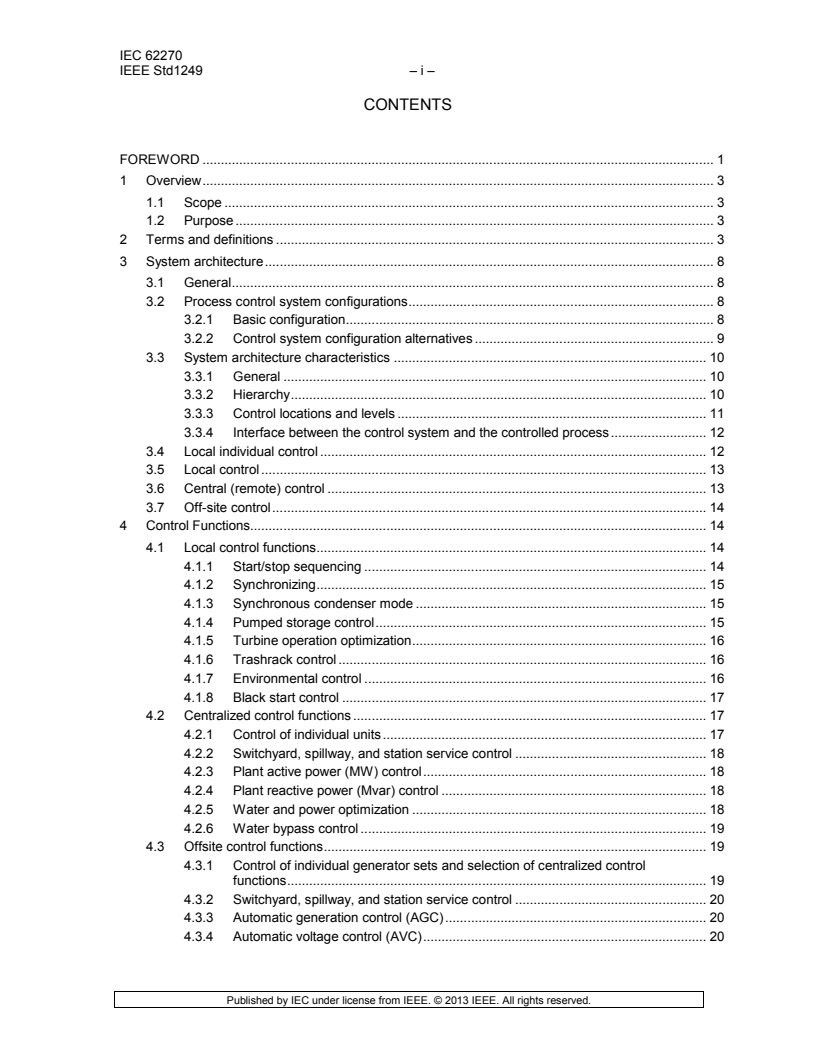
CONTENTS
FOREWORD . 1
1 Overview . 3
1.1 Scope . 3
1.2 Purpose . 3
2 Terms and definitions . 3
3 System architecture . 8
3.1 General . 8
3.2 Process control system configurations . 8
3.2.1 Basic configuration . 8
3.2.2 Control system configuration alternatives . 9
3.3 System architecture characteristics . 10
3.3.1 General . 10
3.3.2 Hierarchy . 10
3.3.3 Control locations and levels . 11
3.3.4 Interface between the control system and the controlled process . 12
3.4 Local individual control . 12
3.5 Local control . 13
3.6 Central (remote) control . 13
3.7 Off-site control . 14
4 Control Functions. 14
4.1 Local control functions . 14
4.1.1 Start/stop sequencing . 14
4.1.2 Synchronizing . 15
4.1.3 Synchronous condenser mode . 15
4.1.4 Pumped storage control . 15
4.1.5 Turbine operation optimization . 16
4.1.6 Trashrack control . 16
4.1.7 Environmental control . 16
4.1.8 Black start control . 17
4.2 Centralized control functions . 17
4.2.1 Control of individual units . 17
4.2.2 Switchyard, spillway, and station service control . 18
4.2.3 Plant active power (MW) control . 18
4.2.4 Plant reactive power (Mvar) control . 18
4.2.5 Water and power optimization . 18
4.2.6 Water bypass control . 19
4.3 Offsite control functions . 19
4.3.1 Control of individual generator sets and selection of centralized control
functions . 19
4.3.2 Switchyard, spillway, and station service control . 20
4.3.3 Automatic generation control (AGC) . 20
4.3.4 Automatic voltage control (AVC) . 20
Published by IEC under license from IEEE. © 2013 IEEE. All rights reserved.
IEC 62270
– ii – IEEE Std 1249
4.3.5 Remedial action schemes (RAS) . 21
4.4 Typical control parameters . 21
4.5 Interfaces to other computerized systems . 22
4.5.1 Fire detection data . 22
4.5.2 Plant security system . 23
4.5.3 Maintenance management system . 23
4.5.4 Plant conditioning monitoring . 23
5 Data acquisition and processing . 23
5.1 Data integrity . 23
5.2 Data acquisition capabilities . 24
5.3 Analog . 24
5.4 Discrete . 25
5.4.1 Status points . 25
5.4.2 Event points . 25
5.4.3 Calculated points. 25
5.4.4 Postmortem points . 25
5.5 Alarm processing and diagnostics . 25
5.6 Report generation . 26
5.7 Data archival and retrieval . 26
5.7.1 Operation scheduling and forecasting . 26
5.7.2 Data access and security . 27
5.7.3 Operator simulation training . 27
6 Communications and data bases . 27
6.1 Overview. 27
6.2 Communications . 27
6.2.1 General . 27
6.2.2 Open system standards . 27
6.2.3 Digital communication systems at the field level . 28
6.2.4 Hydroelectric plant automation classification . 28
6.2.5 Networking and communication considerations . 29
6.2.6 Data communication functions . 30
6.2.7 Control data communication requirements . 30
6.3 Control data networks . 33
6.3.1 General . 33
6.3.2 Local area network (LAN) topologies . 33
6.3.3 Physical transmission mode . 37
6.4 Data bases and software configuration . 37
6.4.1 Open systems and data bases . 37
6.4.2 Real-time vs. nonreal-time database designs . 38
6.4.3 Software configuration . 39
7 User and plant interfaces . 40
7.1 User interfaces . 40
7.1.1 Input devices . 40
7.1.2 Output devices . 40
7.2 Plant equipment interfaces . 40
Published by IEC under license from IEEE. © 2013 IEEE. All rights reserved.
IEC 62270
IEEE Std1249 – iii –
7.2.1 Types . 40
7.2.2 Sources . 42
7.2.3 Input/output protection . 42
7.2.4 Collection process . 43
7.3 Security considerations . 43
7.4 Ergonomic and maintenance considerations . 43
7.5 User interface considerations . 44
8 System performance . 44
8.1 General . 44
8.2 Software . 45
8.3 Hardware . 45
8.3.1 Input/output (I/O) subsystem . 45
8.3.2 Control processing subsystems . 46
8.4 Communications . 47
8.5 Maintenance performance . 47
8.6 Measuring performance . 48
8.6.1 Functionality . 48
8.6.2 Real time ability . 48
8.6.3 Availability . 49
8.6.4 System initialization and fail-over times . 50
9 System backup capabilities . 50
9.1 General . 50
9.2 Design principles . 50
9.3 Basic functions . 51
9.4 Design of equipment for backup control . 51
9.4.1 Turbine/generator units . 51
9.4.2 Circuit breakers and isolating switches (local control) . 51
9.4.3 Governor and excitation systems (local control) . 51
9.4.4 Spillways and intake gate/turbine isolation (shutoff) valve . 52
9.5 Alarm handling . 52
9.6 Protective function . 52
10 Site integration and support systems. 52
10.1 Overview. 52
10.2 Interface to other equipment . 52
10.3 Environmental considerations . 53
10.4 Power source . 53
10.5 Supervision of contact status points . 54
10.6 Supervision of transducers . 55
10.7 Supervision of IED or field bus devices . 55
10.8 Control output points . 55
10.9 Grounding . 55
10.10 Static control . 55
11 Recommended test and acceptance criteria . 56
11.1 Overview. 56
11.2 Specific test requirements . 56
Published by IEC under license from IEEE. © 2013 IEEE. All rights reserved.
IEC 62270
– iv – IEEE Std 1249
11.2.1 Factory acceptance test . 56
11.2.2 Field test. 57
11.3 Quality assurance . 57
11.4 Acceptance . 58
12 System management . 58
12.1 Maintenance . 58
12.2 Training . 58
12.2.1 Training plan . 58
12.2.2 Courses . 59
12.3 Documentation . 59
12.3.1 Design documentation . 59
12.3.2 System support documentation . 60
12.4 Archive . 60
Annex A (informative) Bibliography . 61
Annex B (informative) Legacy control systems . 65
Annex C (informative) IEEE list of participants . 68
Figure 1 – Generic control system configuration . 9
Figure 2 – System with dedicated unit control processors . 10
Figure 3 – Relationship of local, centralized and off-site control . 12
Figure 4 – Typical functions − Unit local control board . 13
Figure 5 – Multi-point data link versus LANs . 33
Figure 6 – Star topology . 35
Figure 7 – Ring topology . 35
Figure 8 – Bus topology . 36
Table 1 – Summary of control hierarchy for hydroelectric power plants . 11
Table 2 – Typical parameters necessary to implement automated control . 21
Table 3 – Classifications of hydroelectric power plant computer control systems . 29
Table 4 – Hydroelectric computer control systems data communications attributes . 36
Table 5 – Cable media characteristics. 37
Published by IEC under license from IEEE. © 2013 IEEE. All rights reserved.
IEC 62270
IEEE Std1249 – v –
Guide for Computer-Based Control
for Hydroelectric Power Plant
Automation
Sponsor
Energy Development and Power Generation Committee
of the
IEEE Power & Energy Society
IEEE-SA Standards Board
Published by IEC under license from IEEE. © 2013 IEEE. All rights reserved.
IEC 62270
– vi – IEEE Std 1249
Abstract: The application, design concepts and implementation of computer-based control
systems for hydroelectric power plant automation is addressed. Functional capabilities,
performance requirements, interface requirements, tradeoffs, and hardware considerations and
operator training are discussed, including typical application examples.
Keywords: 62270, applications, computer-based control systems, functional capabilities,
hardware considerations, hydroelectric power plant automation, hydroelectric power station, IEEE
1249™, interface requirements, operator training, performance requirements, recommendations
•
___________
Published by IEC under license from IEEE. © 2013 IEEE. All rights reserved.
IEC 62270
IEEE Std 1249 – vii –
IEEE Notice to users
Laws and regulations
Users of IEEE Standards documents should consult all applicable laws and regulations. Compliance with
the provisions of any IEEE Standards document does not imply compliance to any applicable regulatory
requirements. Implementers of the standard are responsible for observing or referring to the applicable
regulatory requirements. IEEE does not, by the publication of its standards, intend to urge action that is not
in compliance with applicable laws, and these documents may not be construed as doing so.
Copyrights
This document is copyrighted by the IEEE. It is made available for a wide variety of both public and private
uses. These include both use, by reference, in laws and regulations, and use in private self-regulation,
standardization, and the promotion of engineering practices and methods. By making this document
available for use and adoption by public authorities and private users, the IEEE does not waive any rights in
copyright to this document.
Updating of IEEE documents
Users of IEEE Standards documents should be aware that these documents may be superseded at any time
by the issuance of new editions or may be amended from time to time through the issuance of amendments,
corrigenda, or errata. An official IEEE document at any point in time consists of the current edition of the
document together with any amendments, corrigenda, or errata then in effect. In order to determine whether
a given document is the current edition and whether it has been amended through the issuance of
amendments, corrigenda, or errata, visit the IEEE-SA Website at http://standards.ieee.org/index.html or
contact the IEEE at the address listed previously. For more information about the IEEE Standards
Association or the IEEE standards development process, visit IEEE-SA Website at
http://standards.ieee.org/index.html.
Errata
Errata, if any, for this and all other standards can be accessed at the following URL:
http://standards.ieee.org/findstds/errata/index.html. Users are encouraged to check this URL for errata
periodically.
Patents
Attention is called to the possibility that implementation of this standard may require use of subject matter
covered by patent rights. By publication of this standard, no position is taken by the IEEE with respect to
the existence or validity of any patent rights in connection therewith. If a patent holder or patent applicant
has filed a statement of assurance via an Accepted Letter of Assurance, then the statement is listed on the
IEEE-SA Website at http://standards.ieee.org/about/sasb/patcom/patents.html. Letters of Assurance may
indicate whether the Submitter is willing or unwilling to grant licenses under patent rights without
Published by IEC under license from IEEE. © 2013 IEEE. All rights reserved.
IEC 62270
– viii – IEEE Std 1249
compensation or under reasonable rates, with reasonable terms and conditions that are demonstrably free of
any unfair discrimination to applicants desiring to obtain such licenses.
Essential Patent Claims may exist for which a Letter of Assurance has not been received. The IEEE is not
responsible for identifying Essential Patent Claims for which a license may be required, for conducting
inquiries into the legal validity or scope of Patents Claims, or determining whether any licensing terms or
conditions provided in connection with submission of a Letter of Assurance, if any, or in any licensing
agreements are reasonable or non-discriminatory. Users of this standard are expressly advised that
determination of the validity of any patent rights, and the risk of infringement of such rights, is entirely their
own responsibility. Further information may be obtained from the IEEE Standards Association.
Published by IEC under license from IEEE. © 2013 IEEE. All rights reserved.
IEC 62270
IEEE Std 1249 – ix –
IEEE INTRODUCTION
This introduction is not part of IEEE Std 1249, Guide for Computer-Based Control for Hydroelectric Power Plant
Automation
This document is a guide for the power industry for the automation of hydroelectric power plants
using computer-based controls. The document was prepared by the Working Group on
Computer-Based Control for Hydroelectric Power Plant Automation of the Hydroelectric Power
Subcommittee of the Energy Development and Power Generation Committee of the IEEE Power
and Energy Society (PES).
Automation of hydroelectric generating plants has been a proven technology for many years.
However due to the relative simplicity of the control logic for hydroelectric power plants, the
application of computer-based control on hydro power plants lagged, as compared to applications
on thermal generating stations. With the advent of economic, computer-based control systems in
the 1980s, installations of these systems in hydroelectric power plants has proceeded at a rapid
pace worldwide, for both new installations and rehabilitation of control systems in existing plants.
Since preparation of the original guide, significant changes in technology and application criteria
have occurred. The purpose of this revision is to address these changes and to harmonize this
guide with a companion document, IEEE Std 1010™, IEEE Guide for the Control of Hydroelectric
Power Plants.
The guide is directed to the practicing engineer who has some familiarity with computer-based
control systems. It contains references and definitions for use with the guide. Clauses addressing
functional capabilities, software, security, system integration, system architecture, data bases,
user and plant interfaces, system performance, back-up capabilities, support systems, testing and
acceptance criteria and system management are contained in the guide.
Published by IEC under license from IEEE. © 2013 IEEE. All rights reserved.
IEC 62270
– x – IEEE Std 1249
Published by IEC under license from IEEE. © 2013 IEEE. All rights reserved.
IEC 62270
IEEE Std 1249 – 1 –
GUIDE FOR COMPUTER-BASED CONTROL
FOR HYDROELECTRIC POWER PLANT AUTOMATION
FOREWORD
1) The International Electrotechnical Commission (IEC) is a worldwide organization for standardization comprising all
national electrotechnical committees (IEC National Committees). The object of IEC is to promote international co-
operation on all questions concerning standardization in the electrical and electronic fields. To this end and in addition
to other activities, IEC publishes International Standards, Technical Specifications, Technical Reports, Publicly
Available Specifications (PAS) and Guides (hereafter referred to as “IEC Publication(s)”). Their preparation is
entrusted to technical committees; any IEC National Committee interested in the subject dealt with may participate in
this preparatory work. International, governmental and non-governmental organizations liaising with the IEC also
participate in this preparation.
IEEE Standards documents are developed within IEEE Societies and Standards Coordinating Committees of the
IEEE Standards Association (IEEE-SA) Standards Board. IEEE develops its standards through a consensus
development process, approved by the American National Standards Institute, which brings together volunteers
representing varied viewpoints and interests to achieve the final product. Volunteers are not necessarily members of
IEEE and serve without compensation. While IEEE administers the process and establishes rules to promote fairness
in the consensus development process, IEEE does not independently evaluate, test, or verify the accuracy of any of
the information contained in its standards. Use of IEEE Standards documents is wholly voluntary. IEEE documents
are made available for use subject to important notices and legal disclaimers (see
http://standards.ieee.org/IPR/disclaimers.html for more information).
IEC collaborates closely with IEEE in accordance with conditions determined by agreement between the two
organizations. This Dual Logo International Standard was jointly developed by the IEC and IEEE under the terms of
that agreement.
2) The formal decisions of IEC on technical matters express, as nearly as possible, an international consensus of
opinion on the relevant subjects since each technical committee has representation from all interested IEC National
Committees. The formal decisions of IEEE on technical matters, once consensus within IEEE Societies and
Standards Coordinating Committees has been reached, is determined by a balanced ballot of materially interested
parties who indicate interest in reviewing the proposed standard. Final approval of the IEEE standards document is
given by the IEEE Standards Association (IEEE-SA) Standards Board.
3) IEC/IEEE Publications have the form of recommendations for international use and are accepted by IEC National
Committees/IEEE Societies in that sense. While all reasonable efforts are made to ensure that the technical content
of IEC/IEEE Publications is accurate, IEC or IEEE cannot be held responsible for the way in which they are used or
for any misinterpretation by any end user.
4) In order to promote international uniformity, IEC National Committees undertake to apply IEC Publications (including
IEC/IEEE Publications) transparently to the maximum extent possible in their national and regional publications. Any
divergence between any IEC/IEEE Publication and the corresponding national or regional publication shall be clearly
indicated in the latter.
5) IEC and IEEE do not provide any attestation of conformity. Independent certification bodies provide conformity
assessment services and, in some areas, access to IEC marks of conformity. IEC and IEEE are not responsible for
any services carried out by independent certification bodies.
6) All users should ensure that they have the latest edition of this publication.
7) No liability shall attach to IEC or IEEE or their directors, employees, servants or agents including individual experts
and members of technical committees and IEC National Committees, or volunteers of IEEE Societies and the
Standards Coordinating Committees of the IEEE Standards Association (IEEE-SA) Standards Board, for any
personal injury, property damage or other damage of any nature whatsoever, whether direct or indirect, or for costs
(including legal fees) and expenses arising out of the publication, use of, or reliance upon, this IEC/IEEE Publication
or any other IEC or IEEE Publications.
8) Attention is drawn to the normative references cited in this publication. Use of the referenced publications is
indispensable for the correct application of this publication.
9) Attention is drawn to the possibility that implementation of this IEC/IEEE Publication may require use of material
covered by patent rights. By publication of this standard, no position is taken with respect to the existence or validity
of any patent rights in connection therewith. IEC or IEEE shall not be held responsible for identifying Essential Patent
Claims for which a license may be required, for conducting inquiries into the legal validity or scope of Patent Claims
or determining whether any licensing terms or conditions provided in connection with submission of a Letter of
Assurance, if any, or in any licensing agreements are reasonable or non-discriminatory. Users of this standard are
expressly advised that determination of the validity of any patent rights, and the risk of infringement of such rights, is
entirely their own responsibility.
Published by IEC under license from IEEE. © 2013 IEEE. All rights reserved.
IEC 62270
– 2 – IEEE Std 1249
International Standard IEC 62270/IEEE Std 1249 has been jointly revised by the Energy
Development & Power Generation Committee of the IEEE Power & Energy Society, in cooperation
with IEC technical committee 4: Hydraulic turbines, under the terms of that agreement.
This second edition cancels and replaces the first edition published in 2004. This edition
constitutes a technical revision.
This edition includes the following significant technical changes with respect to the previous
edition:
a) update of system architecture aspects, with different process control system configurations;
b) update of communications, user and plant interfaces aspects;
c) suppression of case studies, because of the quickness of evolution of the technology;
d) complete review of the bibliography, making mention of many IEC and IEEE standards as new
references;
e) addition of a new informative Annex B on legacy control systems.
This publication is published as an IEC/IEEE Dual Logo standard.
The text of this standard is based on the following IEC documents:
FDIS Report on voting
4/284/FDIS 4/287/RVD
Full information on the voting for the approval of this standard can be found in the report on voting
indicated in the above table.
International standards are drafted in accordance with the rules given in the ISO/IEC Directives,
Part 2.
The IEC Technical Committee and IEEE Technical Committee have decided that the contents of
this publication will remain unchanged until the stability date indicated on the IEC web site under
"http://webstore.iec.ch" in the data related to the specific publication. At this date, the publication
will be
• reconfirmed,
• withdrawn,
• replaced by a revised edition, or
• amended.
IMPORTANT – The 'colour inside' logo on the cover page of this publication indicates that it
contains colours which are considered to be useful for the correct understanding of its
contents. Users should therefore print this document using a colour printer.
Published by IEC under license from IEEE. © 2013 IEEE. All rights reserved.
IEC 62270
IEEE Std 1249 – 3 –
GUIDE FOR COMPUTER-BASED CONTROL
FOR HYDROELECTRIC POWER PLANT AUTOMATION
1 Overview
The automation of control and data logging functions has relieved the plant operator of these
tasks, allowing the operator more time to concentrate on other duties. In many cases, the plant’s
operating costs can be significantly reduced by automation (primarily via staff reduction) while still
maintaining or increasing the plant reliability.
Automatic control systems for hydroelectric units based on electromechanical relay logic have
been in general use for many years and, in fact, were considered standard practice for the
industry. Within the past few decades, microprocessor-based controllers have been developed
that are suitable for operation in a power plant environment. These computer-based systems have
been applied for data logging, alarm monitoring, and unit and plant control. Advantages of
computer-based control include use of graphical user interfaces, the incorporation of sequence of
events and trending and automatic archiving and reporting into the control system and the
incorporation of artificial intelligence and expert system capabilities.
1.1 Scope
This guide addresses the application, design concepts, and implementation of computer-based
control systems for hydroelectric plant automation. It addresses functional capabilities,
performance requirements, interface requirements, hardware considerations, and operator
training. It includes recommendations for system testing and acceptance. The electrical protective
system (generator and step-up transformer) is beyond the scope of this guide.
1.2 Purpose
This guide is directed to the practicing engineer who has some familiarity with computer-based
control systems and who is designing or implementing hydroelectric unit or plant control systems,
either in a new project or as a retrofit to an existing one. Although this guide is aimed primarily
towards large hydroelectric power plants, many of the concepts are applicable for small
hydroelectric power plants (i.e. unit size 5 MVA or smaller). Further details on small hydroelectric
,
1 2
power plant control concepts can be found in IEEE Std 1020™ [B46]. Typical hydroelectric
system control logic upon on which this guide is based can be found in companion guide IEEE Std
1010™ [B45] or IEC 61362 [B22].
2 Terms and definitions
The terms and definitions provided here reflect common industry usage as related to automation
of hydroelectric power plants, and may not in all instances be in accordance with IEEE Standards
___________
1 IEEE publications are available from the Institute of Electrical and Electronics Engineers, 445 Hoes Lane,
Piscataway, NJ 08854, USA (http://standards.ieee.org/).
2 The number in square brackets refer to the references listed in the bibliography in Annex A.
3 IEC publications are available from the Sales Department of the International Electrotechnical Commission, PO Box
131, 3 rue de Varembé, CH-1211, Genève 20, Switzerland/Suisse (http://www.iec.ch/). IEC publications are also
available in the United States from the Sales Department, American national Standards Institute, 11 West 42nd
Street, 13th Floor, New York, NY 10036, USA.
Published by IEC under license from IEEE. © 2013 IEEE. All rights reserved.
IEC 62270
– 4 – IEEE Std 1249
Dictionary Online [B39], IEEE Std 610.12 [B41] or IEC 60050-351 [B2] or other applicable
standards. For more rigorous terms and definitions, or for terms and definitions not covered
herein, the reader is referred to the appropriate IEEE and IEC standards.
2.1 analog-to-digital (a/d) conversion
production of a digital output signal corresponding to the value of an analog input quantity
2.2 automatic control
an arrangement of electrical controls that provides for switching or controlling, or both, of
equipment in a specific sequence and under prede
...