

IEC TS 62773:2014
(Main)Railway applications - Procedure to determine the performance requirements for radio systems applied to radio-based train control systems
General Information
- Abstract
IEC TS 62773:2014 establishes a procedure to be used by rail transport authorities and/or radio suppliers to determine the appropriate performance requirements of radio system for a radio-based train control system, consistent with their specific business needs and existing conditions: the Technical Specification itself consists in defining a procedure linking preconditions to some radio parameters. Then, the appropriate performance requirements are deduced by the user of the Technical Specification from the radio parameters.
- Status
- Published
- Publication Date
- 09-Apr-2014
- Technical Committee
- TC 9 - Electrical equipment and systems for railways
- Drafting Committee
- PT 62773 - TC 9/PT 62773
- Current Stage
- PPUB - Publication issued
- Start Date
- 10-Apr-2014
- Completion Date
- 30-Jun-2014

Overview
IEC TS 62773:2014 - Railway applications: Procedure to determine the performance requirements for radio systems applied to radio‑based train control systems defines a structured procedure for deriving radio system performance requirements from operational and environmental preconditions. The Technical Specification is intended to help rail transport authorities and radio suppliers translate real‑world constraints (spectrum availability, track layout, climate, interference, operational profiles) into concrete radio parameters (latency, throughput, availability, security and transmission characteristics) suitable for radio‑based train control (TC) systems.
Key Topics
- Preconditions definition: environmental conditions (obstacles, climate, electromagnetic interference), regulatory constraints (spectrum allocation), and railway operational conditions (line speed, headway, station/track configuration).
- TC communication requirements: maximum tolerable loss of communication, network latency, TC transmission period, and throughput needs.
- Radio parameters: mapping of preconditions to measurable radio requirements such as availability, bit‑error rate, coverage, handover performance, security levels and transmission modes.
- Relationship matrices and tables: systematic matrices and tables linking specific preconditions to affected radio parameters to guide requirement derivation.
- Annex guidance: additional considerations including system continuity/in‑continuity, overlay on existing facilities, train localization and special operational cases.
Applications
IEC TS 62773:2014 is practical for:
- Rail transport authorities and infrastructure managers defining procurement specifications for radio systems used in train control.
- Radio suppliers and system integrators designing or validating radio solutions for safety‑critical TC applications.
- Signal engineers and network planners who must ensure that radio performance (coverage, latency, availability, security) meets operational headway and safety requirements.
- Regulators and spectrum managers assessing whether proposed radio solutions comply with spectrum and regulatory constraints.
Practical uses include producing tender requirements, assessing candidate radio technologies (continuous vs intermittent communication), dimensioning network capacity for expected train density, and identifying environmental mitigations to meet availability targets.
Related Standards (if applicable)
- Other IEC railway standards and national rail safety standards that govern signalling and train‑control interfaces.
- Relevant radio and spectrum regulations and commonly used rail radio systems and frameworks (e.g., regional or international train control system standards).
IEC TS 62773:2014 provides a reproducible, traceable method to convert operational needs and environmental constraints into quantifiable radio performance requirements - essential for deploying reliable, safety‑aware radio‑based train control systems.
Get Certified
Connect with accredited certification bodies for this standard

IRIS Certification (UNIFE)
International Railway Industry Standard certification.

TÜV SÜD Rail GmbH
TÜV SÜD railway certification services.

Bureau Veritas Railway Certification
Railway and transportation certification.
Sponsored listings
Frequently Asked Questions
IEC TS 62773:2014 is a technical specification published by the International Electrotechnical Commission (IEC). Its full title is "Railway applications - Procedure to determine the performance requirements for radio systems applied to radio-based train control systems". This standard covers: IEC TS 62773:2014 establishes a procedure to be used by rail transport authorities and/or radio suppliers to determine the appropriate performance requirements of radio system for a radio-based train control system, consistent with their specific business needs and existing conditions: the Technical Specification itself consists in defining a procedure linking preconditions to some radio parameters. Then, the appropriate performance requirements are deduced by the user of the Technical Specification from the radio parameters.
IEC TS 62773:2014 establishes a procedure to be used by rail transport authorities and/or radio suppliers to determine the appropriate performance requirements of radio system for a radio-based train control system, consistent with their specific business needs and existing conditions: the Technical Specification itself consists in defining a procedure linking preconditions to some radio parameters. Then, the appropriate performance requirements are deduced by the user of the Technical Specification from the radio parameters.
IEC TS 62773:2014 is classified under the following ICS (International Classification for Standards) categories: 01 - GENERALITIES. TERMINOLOGY. STANDARDIZATION. DOCUMENTATION; 45.060.01 - Railway rolling stock in general. The ICS classification helps identify the subject area and facilitates finding related standards.
IEC TS 62773:2014 is available in PDF format for immediate download after purchase. The document can be added to your cart and obtained through the secure checkout process. Digital delivery ensures instant access to the complete standard document.
Standards Content (Sample)
IEC TS 62773 ®
Edition 1.0 2014-04
TECHNICAL
SPECIFICATION
colour
inside
Railway applications – Procedure to determine the performance requirements
for radio systems applied to radio-based train control systems
All rights reserved. Unless otherwise specified, no part of this publication may be reproduced or utilized in any form
or by any means, electronic or mechanical, including photocopying and microfilm, without permission in writing from
either IEC or IEC's member National Committee in the country of the requester. If you have any questions about IEC
copyright or have an enquiry about obtaining additional rights to this publication, please contact the address below or
your local IEC member National Committee for further information.
IEC Central Office Tel.: +41 22 919 02 11
3, rue de Varembé Fax: +41 22 919 03 00
CH-1211 Geneva 20 info@iec.ch
Switzerland www.iec.ch
About the IEC
The International Electrotechnical Commission (IEC) is the leading global organization that prepares and publishes
International Standards for all electrical, electronic and related technologies.
About IEC publications
The technical content of IEC publications is kept under constant review by the IEC. Please make sure that you have the
latest edition, a corrigenda or an amendment might have been published.
IEC Catalogue - webstore.iec.ch/catalogue Electropedia - www.electropedia.org
The stand-alone application for consulting the entire The world's leading online dictionary of electronic and
bibliographical information on IEC International Standards, electrical terms containing more than 30 000 terms and
Technical Specifications, Technical Reports and other definitions in English and French, with equivalent terms in 14
documents. Available for PC, Mac OS, Android Tablets and additional languages. Also known as the International
iPad. Electrotechnical Vocabulary (IEV) online.
IEC publications search - www.iec.ch/searchpub IEC Glossary - std.iec.ch/glossary
The advanced search enables to find IEC publications by a More than 55 000 electrotechnical terminology entries in
variety of criteria (reference number, text, technical English and French extracted from the Terms and Definitions
committee,…). It also gives information on projects, replaced clause of IEC publications issued since 2002. Some entries
and withdrawn publications. have been collected from earlier publications of IEC TC 37,
77, 86 and CISPR.
IEC Just Published - webstore.iec.ch/justpublished
Stay up to date on all new IEC publications. Just Published IEC Customer Service Centre - webstore.iec.ch/csc
details all new publications released. Available online and If you wish to give us your feedback on this publication or
also once a month by email. need further assistance, please contact the Customer Service
Centre: csc@iec.ch.
IEC TS 62773 ®
Edition 1.0 2014-04
TECHNICAL
SPECIFICATION
colour
inside
Railway applications – Procedure to determine the performance requirements
for radio systems applied to radio-based train control systems
INTERNATIONAL
ELECTROTECHNICAL
COMMISSION
PRICE CODE
X
ICS 45.060 ISBN 978-2-8322-1519-7
– 2 – IEC TS 62773:2014 © IEC 2014
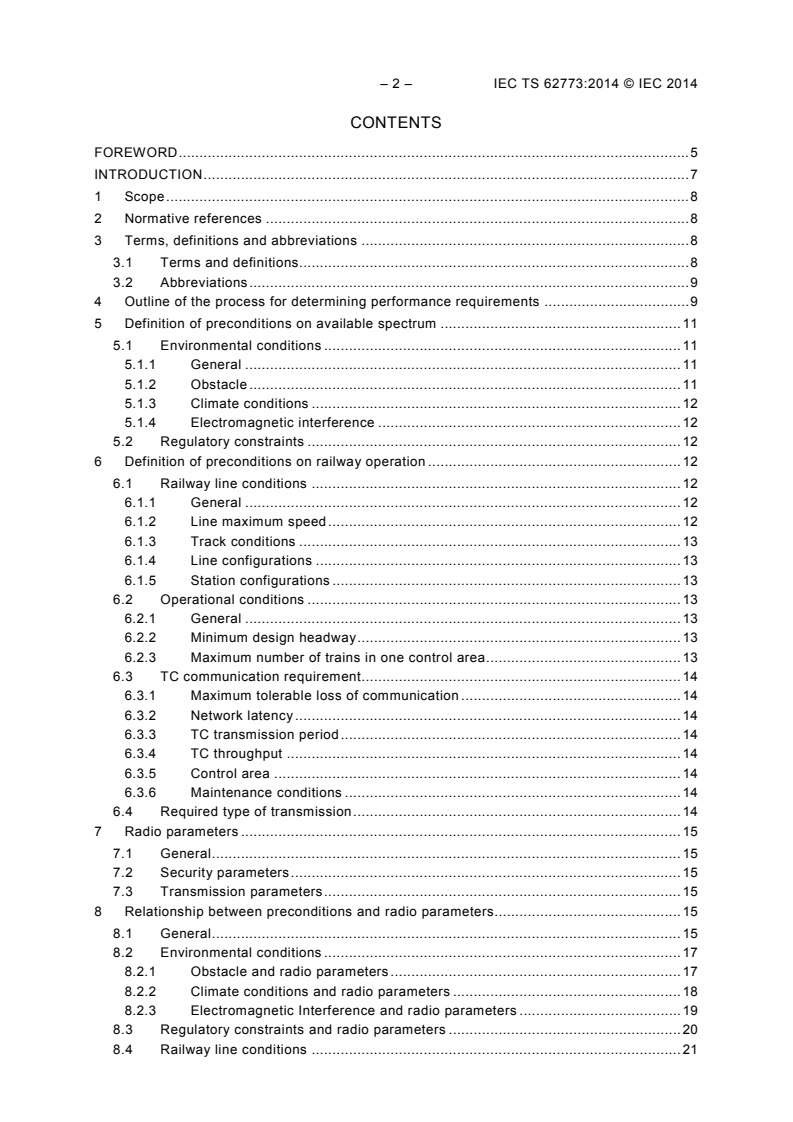
CONTENTS
FOREWORD . 5
INTRODUCTION . 7
1 Scope . 8
2 Normative references . 8
3 Terms, definitions and abbreviations . 8
3.1 Terms and definitions. 8
3.2 Abbreviations . 9
4 Outline of the process for determining performance requirements . 9
5 Definition of preconditions on available spectrum . 11
5.1 Environmental conditions . 11
5.1.1 General . 11
5.1.2 Obstacle . 11
5.1.3 Climate conditions . 12
5.1.4 Electromagnetic interference . 12
5.2 Regulatory constraints . 12
6 Definition of preconditions on railway operation . 12
6.1 Railway line conditions . 12
6.1.1 General . 12
6.1.2 Line maximum speed . 12
6.1.3 Track conditions . 13
6.1.4 Line configurations . 13
6.1.5 Station configurations . 13
6.2 Operational conditions . 13
6.2.1 General . 13
6.2.2 Minimum design headway . 13
6.2.3 Maximum number of trains in one control area . 13
6.3 TC communication requirement . 14
6.3.1 Maximum tolerable loss of communication . 14
6.3.2 Network latency . 14
6.3.3 TC transmission period . 14
6.3.4 TC throughput . 14
6.3.5 Control area . 14
6.3.6 Maintenance conditions . 14
6.4 Required type of transmission . 14
7 Radio parameters . 15
7.1 General . 15
7.2 Security parameters . 15
7.3 Transmission parameters . 15
8 Relationship between preconditions and radio parameters. 15
8.1 General . 15
8.2 Environmental conditions . 17
8.2.1 Obstacle and radio parameters . 17
8.2.2 Climate conditions and radio parameters . 18
8.2.3 Electromagnetic Interference and radio parameters . 19
8.3 Regulatory constraints and radio parameters . 20
8.4 Railway line conditions . 21
8.4.1 Line maximum speed and radio parameters . 21
8.4.2 Track conditions and radio parameters . 22
8.4.3 Line configurations and radio parameters . 23
8.4.4 Station configuration and radio parameters . 24
8.5 Operational conditions . 25
8.5.1 Minimum design headway and radio parameters . 25
8.5.2 Maximum number of trains in one control area and radio parameters. 26
8.6 TC communication requirement . 27
8.6.1 Maximum tolerable loss of communication and radio parameters . 27
8.6.2 Network latency and radio parameters . 28
8.6.3 TC transmission period and radio parameters . 29
8.6.4 TC throughput and radio parameters . 30
8.6.5 Control area and radio parameters . 31
8.6.6 Maintenance conditions and radio parameters . 32
8.7 Required type of transmission and radio parameters . 32
Annex A (informative) Additional preconditions . 33
A.1 Operational conditions . 33
A.1.1 Overlay on existing facilities . 33
A.1.2 Signal aspect . 33
A.1.3 Block . 33
A.2 System conditions . 33
A.2.1 General . 33
A.2.2 Train localization . 33
A.2.3 Continuous control/intermittent control . 34
A.2.4 Train protection profile . 34
A.2.5 System entry/exit . 34
A.2.6 Temporary speed restriction . 34
A.2.7 Emergency stop command . 34
A.2.8 Interlocking control/route control . 34
A.2.9 Level crossing control . 34
A.2.10 Couple and split a train . 34
A.2.11 Automatic train operation . 35
A.3 Relationship between preconditions and radio parameters . 35
A.3.1 General . 35
A.3.2 Operational conditions . 36
A.3.3 System conditions . 39
Annex B (informative) Considerations for in-continuity . 46
B.1 Communication in in-continuity . 46
B.2 Considerations for in-continuity in radio systems. 46
B.2.1 General issues . 46
B.2.2 Specific issues related to failure caused by external system factors . 46
B.2.3 Specific issues related to failure caused by internal system factors . 46
Bibliography . 48
Figure 1 – Factors influencing performance requirements . 10
Figure 2 – Maximum number of trains in case of divided area . 13
Table 1 – List of preconditions and radio parameters . 11
– 4 – IEC TS 62773:2014 © IEC 2014
Table 2 – Relationship matrix between preconditions and radio parameters . 16
Table 3 – Obstacle and radio parameters. 17
Table 4 – Climate conditions and radio parameters . 18
Table 5 – Electromagnetic interference and radio parameters . 19
Table 6 – Regulatory constraints and radio parameters . 20
Table 7 – Line maximum speed and radio parameters . 21
Table 8 – Track conditions and radio parameters . 22
Table 9 – Line configurations and radio parameters . 23
Table 10 – Station configuration and radio parameters . 24
Table 11 – Minimum design headway and radio parameters . 25
Table 12 – Maximum number of trains in one control area and radio parameters . 26
Table 13 – Maximum tolerable loss of communication and radio parameters . 27
Table 14 – Network latency and radio parameters . 28
Table 15 – TC transmission period and radio parameters. 29
Table 16 – TC throughput and radio parameters . 30
Table 17 – Control area and radio parameters . 31
Table 18 – Maintenance conditions and radio parameters . 32
Table 19 – Required type of transmission and radio parameters . 32
Table A.1 – Relationship matrix between preconditions and radio parameters . 35
Table A.2 – Overlay on existing facilities and radio parameters. 36
Table A.3 – Signal aspect and radio parameters . 37
Table A.4 – Block and radio parameters . 38
Table A.5 – Train localization and radio parameters . 39
Table A.6 – Train protection profile and radio parameters . 40
Table A.7 – System entry/exit and radio parameters . 41
Table A.8 – Temporary speed restriction and radio parameters . 42
Table A.9 – Emergency stop command and radio parameters . 43
Table A.10 – Interlocking control/route control and radio parameters . 43
Table A.11 – Level crossing control and radio parameters . 44
Table A.12 – Couple and split a train and radio parameters . 45
INTERNATIONAL ELECTROTECHNICAL COMMISSION
____________
RAILWAY APPLICATIONS – PROCEDURE TO DETERMINE
THE PERFORMANCE REQUIREMENTS FOR RADIO SYSTEMS
APPLIED TO RADIO-BASED TRAIN CONTROL SYSTEMS
FOREWORD
1) The International Electrotechnical Commission (IEC) is a worldwide organization for standardization comprising
all national electrotechnical committees (IEC National Committees). The object of IEC is to promote
international co-operation on all questions concerning standardization in the electrical and electronic fields. To
this end and in addition to other activities, IEC publishes International Standards, Technical Specifications,
Technical Reports, Publicly Available Specifications (PAS) and Guides (hereafter referred to as “IEC
Publication(s)”). Their preparation is entrusted to technical committees; any IEC National Committee interested
in the subject dealt with may participate in this preparatory work. International, governmental and non-
governmental organizations liaising with the IEC also participate in this preparation. IEC collaborates closely
with the International Organization for Standardization (ISO) in accordance with conditions determined by
agreement between the two organizations.
2) The formal decisions or agreements of IEC on technical matters express, as nearly as possible, an international
consensus of opinion on the relevant subjects since each technical committee has representation from all
interested IEC National Committees.
3) IEC Publications have the form of recommendations for international use and are accepted by IEC National
Committees in that sense. While all reasonable efforts are made to ensure that the technical content of IEC
Publications is accurate, IEC cannot be held responsible for the way in which they are used or for any
misinterpretation by any end user.
4) In order to promote international uniformity, IEC National Committees undertake to apply IEC Publications
transparently to the maximum extent possible in their national and regional publications. Any divergence
between any IEC Publication and the corresponding national or regional publication shall be clearly indicated in
the latter.
5) IEC itself does not provide any attestation of conformity. Independent certification bodies provide conformity
assessment services and, in some areas, access to IEC marks of conformity. IEC is not responsible for any
services carried out by independent certification bodies.
6) All users should ensure that they have the latest edition of this publication.
7) No liability shall attach to IEC or its directors, employees, servants or agents including individual experts and
members of its technical committees and IEC National Committees for any personal injury, property damage or
other damage of any nature whatsoever, whether direct or indirect, or for costs (including legal fees) and
expenses arising out of the publication, use of, or reliance upon, this IEC Publication or any other IEC
Publications.
8) Attention is drawn to the Normative references cited in this publication. Use of the referenced publications is
indispensable for the correct application of this publication.
9) Attention is drawn to the possibility that some of the elements of this IEC Publication may be the subject of
patent rights. IEC shall not be held responsible for identifying any or all such patent rights.
The main task of IEC technical committees is to prepare International Standards. In
exceptional circumstances, a technical committee may propose the publication of a technical
specification when
• the required support cannot be obtained for the publication of an International Standard,
despite repeated efforts, or
• the subject is still under technical development or where, for any other reason, there is the
future but no immediate possibility of an agreement on an International Standard.
Technical specifications are subject to review within three years of publication to decide
whether they can be transformed into International Standards.
IEC TS 62773, which is a technical specification, has been prepared by IEC technical
committee 9: Electrical equipment and systems for railways.
– 6 – IEC TS 62773:2014 © IEC 2014
The text of this technical specification is based on the following documents:
Enquiry draft Report on voting
9/1823/DTS 9/1899/RVC
Full information on the voting for the approval of this technical specification can be found in
the report on voting indicated in the above table.
This publication has been drafted in accordance with the ISO/IEC Directives, Part 2.
The committee has decided that the contents of this publication will remain unchanged until
the stability date indicated on the IEC web site under "http://webstore.iec.ch" in the data
related to the specific publication. At this date, the publication will be
• transformed into an International standard,
• reconfirmed,
• withdrawn,
• replaced by a revised edition, or
• amended.
A bilingual version of this publication may be issued at a later date.
IMPORTANT – The 'colour inside' logo on the cover page of this publication indicates
that it contains colours which are considered to be useful for the correct
understanding of its contents. Users should therefore print this document using a
colour printer.
INTRODUCTION
The purpose of this Technical Specification is to provide a guideline for the rail transport
authority and/or the supplier of the radio system to determine performance requirements of
the radio system from the conditions of the railway systems using the radio-based train
control systems.
This Technical Specification specifies the procedure to determine the performance
requirements for radio system applied to the radio-based train control systems. The
performance requirements are related to the radio parameters. Each radio parameter needs to
be set to an appropriate value to enable data exchange with quality of service that will meet
the requirements from the railway system as a whole and particularly the train control
functions. Radio parameters are then decided based on the analysis of the conditions of the
railway system using the train control system.
– 8 – IEC TS 62773:2014 © IEC 2014
RAILWAY APPLICATIONS – PROCEDURE TO DETERMINE
THE PERFORMANCE REQUIREMENTS FOR RADIO SYSTEMS
APPLIED TO RADIO-BASED TRAIN CONTROL SYSTEMS
1 Scope
The objective of this Technical Specification is to establish a procedure to be used by rail
transport authorities and/or radio suppliers to determine the appropriate performance
requirements of radio system for a radio-based train control system, consistent with their
specific business needs and existing conditions: the Technical Specification itself consists in
defining a procedure linking preconditions to some radio parameters. Then, the appropriate
performance requirements are deduced by the user of the Technical Specification from the
radio parameters.
2 Normative references
The following documents, in whole or in part, are normatively referenced in this document and
are indispensable for its application. For dated references, only the edition cited applies. For
undated references, the latest edition of the referenced document (including any
amendments) applies.
None.
3 Terms, definitions and abbreviations
3.1 Terms and definitions
For the purposes of this document, the following terms and definitions apply.
3.1.1
capacity
maximum amount of information transmitted and received per unit time on the radio link
3.1.2
data rate
amount of data transmitted over a given period of time (usually expressed in “bits per second”
or “bytes per second”)
Note 1 to entry: The minimum data rate needs to take into account the maximum amount of transmitted data per
unit time for the train control system.
3.1.3
encryption
method of transmitting information so that third parties cannot decode it
Note 1 to entry: It serves to enhance the secrecy of information transmitted and received within the system.
3.1.4
handover
shift of connection to an adjacent radio base station
3.1.5
measures against masquerading
measures involving the performance of electronic authentication or validity checks, providing
network firewalls, or physically isolating systems to prevent tampering or spoofing of
electronic messages
3.1.6
modulation method
method of varying one carrier signal to contain the information of a baseband signal
Note 1 to entry: It is determined in consideration of frequency, bandwidth, data rate and/or propagation
characteristics such as antenna parameters.
3.1.7
number of connections
number of mobile radios that can simultaneously communicate with one wayside radio
3.1.8
period
time between the start of transmission of two consecutive packets at the physical radio
interface
3.1.9
quality of service
quality of the communication service provided in terms of guaranteed throughput, jitter,
latency and packet loss
3.1.10
type of transmission
open or closed transmission based on IEC 62280
3.2 Abbreviations
ATP Automatic Train Protection
GOA1 Grade Of Automation 1
GOA2 Grade Of Automation 2
GOA4 Grade Of Automation 4
GPS Global Positioning System
QoS Quality of Service
TC Train Control
4 Outline of the process for determining performance requirements
The determination of performance requirements of a radio system for radio-based train control
systems requires specification of the conditions that may influence them, evaluation of these
individual circumstances, and judgment of whether or not to reflect them in the performance
requirements. An outline of the process is described in this clause, which helps specifying the
various conditions that may influence these requirements.
The following factors need to be taken into consideration when determining the performance
requirements of the radio system.
– Preconditions on available spectrum:
Environmental conditions and regulatory constraints
– Preconditions on railway operation:
– 10 – IEC TS 62773:2014 © IEC 2014
Railway line conditions, operating conditions, TC communication requirements and
required type of transmission
– Radio parameters:
Security parameters and transmission parameters
These factors have to be in line with the expression of performance requirements defined at
the level of the train control system as a whole.
Preconditions influence the radio parameters both directly and indirectly. Environmental
conditions, regulatory constraints, railway line conditions, operational conditions, and train
control communication requirements determine the transmission parameters. These
preconditions determine the performance requirements of the radio system.
The relationships that exist among them are shown in Figure 1, and items related to the
preconditions and radio parameters are listed in Table 1.
Individual preconditions are defined in Clause 5 and Clause 6, and radio parameters are
defined in Clause 7. Clause 8 outlines the correlation between them.
Performance requirement
International standards
Transmission
Security parameters
parameters
Operational
Regulatory
conditions
constraints
TC
Environmental Required type of
Railway line
communication
conditions
conditions transmission
requirement
IEC 1263/14
Figure 1 – Factors influencing performance requirements
Table 1 – List of preconditions and radio parameters
Major division Subclassification
Environmental Obstacle, climate conditions, electromagnetic interference, etc.
conditions
Preconditions
(5.1)
on available
Regulatory
spectrum
constraints
(5.2)
Railway line Line maximum speed, track conditions (tunnels, etc.), line
conditions configurations, station configurations, etc.
(6.1)
Operational Minimum design headway, maximum number of trains in one control
conditions area (number of trains controlled at any one time).
Preconditions
(6.2)
on railway
TC communication Maximum tolerable loss of communication, network latency, TC
operation
requirement transmission period, TC throughput, control area, maintenance
(6.3) conditions, etc.
Required type of
transmission
(6.4)
Security Encryption, measures against masquerading, etc.
parameters
(7.2)
Radio
parameters
Transmission Period, capacity (e.g. throughput), number of connections, handover,
parameters frequency, bandwidth, data rate, modulation method, type of
(7.3) propagation, etc.
NOTE Additional operational and system conditions for the train control systems can be found in Annex A and
Annex B.
5 Definition of preconditions on available spectrum
5.1 Environmental conditions
5.1.1 General
This subclause describes the environmental conditions which are the available spectrum
constraints for a radio system applied to a radio-based train control system considered by a
rail transport authority. Environment conditions are considered when transmission parameters
such as frequency, modulation method and capacity of the radio system applied to the train
control system are determined.
5.1.2 Obstacle
Obstacle described in this Technical Specification means structure (building, bridge, retaining
wall and topography of the land, etc.) which may affect the performance of a radio system
used for train control.
It is necessary for selecting the radio wave, the type of antenna and the placement of
antennas, to consider the shape and the placement of obstacles along the line for securing
the transmission and reception of radio waves. Multipath propagation from obstacles may
cause a weak electric field area as a result of fading and shadowing.
Conditions of buildings along the line may change by environs development in the future.
Geographic characteristic such as the existence and shape of hills and rivers may affect
range or absorption characteristic of radio waves.
– 12 – IEC TS 62773:2014 © IEC 2014
A geometric profile may change unexpectedly due to a change of natural environments (e.g.
growth of tree, natural disaster) over time.
These conditions affect the decision of characteristics, the placement and the number of
antennas as well as their installation and maintenance.
5.1.3 Climate conditions
Climate conditions described in this Technical Specification means climate conditions that
may affect the performance of a radio system used for train control.
In particular, rain (precipitation, squall or not), snowfall, lightning and fog may influence the
propagation of radio waves and impact the quality of received radio signal depending on the
frequency.
5.1.4 Electromagnetic interference
Electromagnetic interference from radio noise sources in neighbouring facilities (e.g. high
voltage equipment, power lines, high-frequency equipment, electric switching devices, etc.)
affects data transmission quality. Interference from radio equipment which is not used for train
control or mobile radios such as a radio communication system for business use should also
be considered.
This environment changes continually.
5.2 Regulatory constraints
This subclause describes legal conditions concerning radio systems which a rail transport
authority should consider when a radio-based train control system is used.
For example, legal conditions concerning radio systems include the height of antenna
installed on the ground, frequency, radiation power, type of antenna (gain and/or directivity),
kind of polarized wave, etc.
The application (e.g. design and operation) of the radio system should be compliant with laws
of the country or area that define the rules for radio transmission. Laws or regulations for
obstacle or landscape may be considered.
6 Definition of preconditions on railway operation
6.1 Railway line conditions
6.1.1 General
This subclause describes the line conditions impacting radio parameters that a rail transport
authority should ascertain when using a radio-based train control system.
6.1.2 Line maximum speed
The line maximum speed is the maximum speed in a particular section (referred to herein as
the line) on a railway network defined by the rail transport authority. The factors that
determine the line maximum speed include service limitations such as the type of service or
considerations regarding the ambient environment, in addition to physical limitations such as
track structure and vehicle performance.
6.1.3 Track conditions
Track conditions that affect radio communication include types of structures such as tunnels.
Taking a tunnel as an example, the track conditions include its location on the track, its length,
its structure (cross-sectional and three-dimensional shape considerations such as
curve/inclination/vertical curve), the material of the tunnel wall surface, and the
presence/absence of objects installed inside the tunnel. Other such structures include cut-
slopes and obstacles on curved lines.
6.1.4 Line configurations
Line configuration described in this Technical Specification means configuration of tracks
between stations such as single, double, or quadruple track. It is necessary to consider the
line configuration for deciding control area or transmission system, etc.
6.1.5 Station configurations
Station configuration conditions described in this Technical Specification means the scale of
the station and structure. Scale of the station described means conditions such as track
layout, the number of platforms and size (related to the number of trains that can be present
at the same time) of the station that may affect the capacity of system other than physical
area of station affecting the coverage of radio. Structure of the station means conditions such
as elevated structures, basement structures, multi-layer structures that may affect the electric
field strength of radios.
6.2 Operational conditions
6.2.1 General
This subclause describes the operation conditions that a rail transport authority should
ascertain when using a radio-based train control system. It should be noted that this
Technical Specification does not preclude the implementation of suggestions from system
suppliers or from a third party (e.g. consultant) for some conditions.
6.2.2 Minimum design headway
Minimum design headway is the minimum time interval between two successive trains
achievable regarding track profile, braking performance, train length and performance of train
control system.
6.2.3 Maximum number of trains in one control area
The maximum number of trains in one control area represents the number of trains in one
area which can be controlled simultaneously by a radio-based train control system. In case
that the area to be controlled is divided into more than one section for train control, it is
defined in each of the divisions. (see Figure 2)
An area to be controlled by a radio-based train control system.
Divided area (A) Divided area (B) Divided area (C)
Maximum number of trains in one control area is defined
in each of the divisions.
IEC 1264/14
Figure 2 – Maximum number of trains in case of divided area
– 14 – IEC TS 62773:2014 © IEC 2014
6.3 TC communication requirement
6.3.1 Maximum tolerable loss of communication
On a single instance, the maximum duration (seconds) without communication that does not
degrade the train control system performance.
6.3.2 Network latency
The elapsed time from the moment a network data packet is transmitted into the network from
a source node until it reaches the intended destination node.
6.3.3 TC transmission period
The minimum amount of time between two consecutive message transmissions issued by one
equipment of the TC.
6.3.4 TC throughput
The rate of data exchanged between the onboard and wayside components of a train control
system, measured on a per train basis. Throughput for the uplink direction is independent of
the throughput for the downlink direction.
6.3.5 Control area
Control areas are areas in which radio-based TC information is transmitted between the
wayside and the train, and are classified as whole line, sections or stations.
Whole line refers to the case where radio-based information transmission between the train
and the wayside is possible in all places along the line.
Sections refer to the case where radio-based information transmission between the train and
the wayside is possible in certain sections along the line.
Stations refer to the case where radio-based information transmission between the train and
the wayside is possible only at stations. Such areas include the vicinity of stations in a
condition that allows communication over a certain distance from, for example, an in-house
signal device or a departure signal device to the center of the station.
6.3.6 Maintenance conditions
When performing train speed control for ensuring safety with regard to vehicles or workers
involved in maintenance of tracks and trackside facilities, specific functions shall be
considered, e.g. the ability to communicate with trackside workers via radio transmission and
communicate work zone information to them.
6.4 Required type of transmission
Type of transmission is whether a transmission system is open or closed. Open and closed
transmission systems are to be considered as defined below.
A closed transmission system has fixed number or fixed maximum number of participants
linked by a transmission system with well known and fixed properties, and where the risk of
unauthorised access is considered negligible.
An open transmission system has an unknown number of participants, having unknown,
variable and non-trusted properties, used for unknown telecommunication services and having
the potential for unauthorised access.
7 Radio parameters
7.1 General
The following parameters determine the performance of radio systems.
7.2 Security parameters
Security parameters listed below deal with the steps taken to prevent intrusion into the system.
a) Encryption
b) Measures against masquerading
7.3 Transmission parameters
Transmission parameters listed below refer to the parameters to be chosen to satisfy the
conditions of the system among the variables that determine the performance of radio system.
a) Period
b) Capacity
c) Number of connections
d) Handover
e) Frequency
This is the frequency determined to be used for transmission and reception of information
between the wayside and the train.
f) Bandwidth
This refers to the frequency domain that can be ensured continually in the radio frequency
used for communication between the wayside and the train. The bandwidth is determined
in consideration of the maximum amount of data required to be transmitted by the train
control system.
g) Data rate
h) Modulation method
i) Type of propagation
The radio transmission can be ensured through guided propagation media (e.g. leaky
cables, waveguides, inductive loops) or through free propagation (free space radio and
associated antennas).
8 Relationship between preconditions and radio parameters
8.1 General
It is important to consider the relevance of the details of preconditions and radio parameters
to determine the specific performance requirements for radio systems applied to radio-based
train control systems. Here, the relationship between these factors is outlined in Table 2.
– 16 – IEC TS 62773:2014 © IEC 2014
Table 2 – Relationship matrix between preconditions and radio parameters
Security Transmission
Radio parameters –
OUTPUT
Preconditions –
INPUT 1 2 3 4 5 6 7 8 9 10 11
Obstacle 1 - - I - - I I - I I S
Climate
Environmental 2 - - I - - I I - I I I
conditions
conditions
Electromagnetic
3 - - I - - I I - I I S
Interference
Regulatory
4 - - - - - I S S - S S
constraints
Line maximum
5 - - - - - S I - - I -
speed
Track conditions 6 - - I I I I I - I I S
Railway line
Line
conditions
7 - - - S S - - - - - -
configurations
Station
8 - - I S S - - - - - S
configurations
Minimum design
9 - - - S S S - I - - -
headway
Operational
Maximum number
conditions
of trains in one 10 - - S S S - - I - - -
control area
Maximum
tolerable loss of 11 - - - - S S S - - S S
communication
Network latency 12 - - S S S I S - S S S
TC
TC transmission
13 - - S S S S S S S S S
communication
period
requirement
TC throughput 14 - - S S S S S S S S S
Control area 15 - - - - S - - - - - -
Maintenance
16 - - I I I - - - - - -
conditions
Required type of
17 S S - - - - - - - - -
transmission
S: Strong relation between precondition and performance condition.
I: Indirect relation between precondition and performance condition.
-: No relation between precondition and performance condition.
Encryption
Measures against
masquerading
Period
Capacity
Number of
connections
Handover
Frequency
Bandwidth
Data rate
Modulation
method
Type of
propagation
8.2 Environmental conditions
8.2.1 Obstacle and radio parameters
Table 3 provides the relationship between obstacle and radio parameters.
Table 3 – Obstacle and radio parameters
Radio parameters Relationship between obstacle and radio parameters
Security Encryption N/A
parameters
Measures N/A
against
masquerading
Transmission Period In sections where the electric field might be weak because of fading
parameters and/or shadowing due to shielding and multipath caused by obstacles,
the possibility of corruption of messages (e.g. packet loss, alterations)
may increase. A smaller packet size resulting in a shorter period could
mitigate this problem.
Capacity N/A
Number of N/A
connections
Handover In areas where the electric field might be weak depending on the
transmission parameters because of fading and/or shadowing due to
shielding and multipath caused by obstacles, the installation density of
antennas
...