

IEC 62135-2:2015
(Main)Resistance welding equipment - Part 2: Electromagnetic compatibility (EMC) requirements
General Information
- Abstract
IEC 62135-2:2015 is applicable to equipment for resistance welding and allied processes which are connected to mains supplies with rated voltages up to 1 000 V a.c. r.m.s. This standard does not define safety requirements. This second edition cancels and replaces the first edition published in 2007 and constitutes a technical revision. This edition includes the following significant technical changes with respect to the previous edition:
- update of the applicable limits related to the updated reference to CISPR 11;
- exclusion of the use of narrow band relaxations for RF emission limits;
- update of the applicable limits for harmonics and flicker related to the updated reference to IEC 61000-3-11 and IEC 61000-3-12;
- update of the requirements for voltage dips related to the updated reference to IEC 61000-4-11 and IEC 61000-4-34;
- inclusion of symbols to indicate the RF equipment class and restrictions for use;
- inclusion of EM field immunity test for frequency from 1,4 GHz to 2,7 GHz;
- inclusion of emission limits for class B resistance welding equipment magnetic fields between 150 kHz and 30 MHz.
- Status
- Published
- Publication Date
- 23-Feb-2015
- Technical Committee
- TC 26 - Electric welding
- Drafting Committee
- WG 1 - TC 26/WG 1
- Current Stage
- DELPUB - Deleted Publication
- Start Date
- 30-Mar-2020
- Completion Date
- 29-Jun-2018
Overview
IEC 62135-2:2015 is an international standard developed by the International Electrotechnical Commission (IEC) that specifies the electromagnetic compatibility (EMC) requirements for resistance welding equipment and related processes. This standard applies to equipment connected to mains supplies with rated voltages up to 1,000 V AC RMS. The second edition, published in 2015, updates and replaces the first edition released in 2007, introducing significant technical revisions to enhance EMC performance and compliance.
It is important to note that IEC 62135-2:2015 focuses exclusively on electromagnetic compatibility and does not define safety requirements for resistance welding equipment.
Key Topics
This standard covers essential EMC aspects critical for resistance welding equipment:
- Updated Emission Limits: Aligns with the latest reference standards such as CISPR 11, IEC 61000-3-11, and IEC 61000-3-12 for controlling electromagnetic emissions, including harmonics and flicker.
- Immunity Requirements: Specifies immunity tests for voltage dips and electromagnetic fields, including a new EM field immunity test within the 1.4 GHz to 2.7 GHz frequency range.
- Equipment Classification: Defines Class A and Class B equipment distinctions, incorporating specific emission limits and electromagnetic field considerations, particularly for magnetic fields between 150 kHz and 30 MHz in Class B devices.
- Symbols and Identification: Introduces symbols to indicate RF equipment class and use restrictions, enhancing clarity for manufacturers and users.
- Testing Procedures: Details structured test setups for emission and immunity assessments, including requirements for ancillary equipment, measuring instruments, and artificial mains networks.
- Performance Criteria: Outlines immunity performance criteria (A, B, and C) that validate equipment resilience to electromagnetic disturbances.
- Documentation: Specifies documentation requirements for manufacturers to inform users and purchasers about EMC characteristics and compliance.
Applications
IEC 62135-2:2015 is indispensable for manufacturers, designers, and quality assurance teams involved with resistance welding equipment and allied processes. The standard ensures that:
- Resistance welding machines operate reliably without causing electromagnetic interference or malfunctioning due to external electromagnetic disturbances.
- Equipment meets regulatory compliance for EMC in industrial environments, facilitating market access and user safety.
- End-users can trust in the electromagnetic compatibility of welding units, minimizing disruptions to other devices and communication systems.
- Suppliers provide clear product information regarding EMC performance, enhancing transparency and supporting conformity assessments.
Industries benefitting from adherence to this standard include automotive manufacturing, aerospace, heavy machinery production, and metal fabrication sectors relying on resistance welding technologies.
Related Standards
IEC 62135-2:2015 references and aligns with several key international standards related to electromagnetic compatibility and electrical equipment performance:
- CISPR 11: International standard for industrial, scientific, and medical equipment electromagnetic disturbance limits.
- IEC 61000-3-11 & IEC 61000-3-12: Standards addressing harmonic current emissions and voltage flicker limits for equipment connected to low-voltage public power systems.
- IEC 61000-4-11 & IEC 61000-4-34: Electromagnetic compatibility testing and measurement techniques, focusing on voltage dips, short interruptions, and immunity testing.
- IEC 62135-1: Covers the general requirements and safety aspects for resistance welding equipment.
- IEC 61000 series: Comprehensive suite of EMC standards widely used in electrical and electronic equipment certification.
Compliance with IEC 62135-2:2015 combined with relevant IEC EMC and safety standards ensures robust resistance welding equipment that meets international quality and performance benchmarks.
Adhering to IEC 62135-2:2015 helps manufacturers implement effective electromagnetic compatibility strategies for resistance welding equipment, reducing interference risks and promoting dependable industrial welding operations worldwide.
Relations
- Effective Date
- 05-Sep-2023
- Effective Date
- 05-Sep-2023
Get Certified
Connect with accredited certification bodies for this standard

DVS-ZERT GmbH
German welding certification society.
CARES (UK Certification Authority for Reinforcing Steels)
UK certification for reinforcing steels and construction.
EWF/IIW (European/International Welding Federation)
International welding personnel certification.
Sponsored listings
Frequently Asked Questions
IEC 62135-2:2015 is a standard published by the International Electrotechnical Commission (IEC). Its full title is "Resistance welding equipment - Part 2: Electromagnetic compatibility (EMC) requirements". This standard covers: IEC 62135-2:2015 is applicable to equipment for resistance welding and allied processes which are connected to mains supplies with rated voltages up to 1 000 V a.c. r.m.s. This standard does not define safety requirements. This second edition cancels and replaces the first edition published in 2007 and constitutes a technical revision. This edition includes the following significant technical changes with respect to the previous edition: - update of the applicable limits related to the updated reference to CISPR 11; - exclusion of the use of narrow band relaxations for RF emission limits; - update of the applicable limits for harmonics and flicker related to the updated reference to IEC 61000-3-11 and IEC 61000-3-12; - update of the requirements for voltage dips related to the updated reference to IEC 61000-4-11 and IEC 61000-4-34; - inclusion of symbols to indicate the RF equipment class and restrictions for use; - inclusion of EM field immunity test for frequency from 1,4 GHz to 2,7 GHz; - inclusion of emission limits for class B resistance welding equipment magnetic fields between 150 kHz and 30 MHz.
IEC 62135-2:2015 is applicable to equipment for resistance welding and allied processes which are connected to mains supplies with rated voltages up to 1 000 V a.c. r.m.s. This standard does not define safety requirements. This second edition cancels and replaces the first edition published in 2007 and constitutes a technical revision. This edition includes the following significant technical changes with respect to the previous edition: - update of the applicable limits related to the updated reference to CISPR 11; - exclusion of the use of narrow band relaxations for RF emission limits; - update of the applicable limits for harmonics and flicker related to the updated reference to IEC 61000-3-11 and IEC 61000-3-12; - update of the requirements for voltage dips related to the updated reference to IEC 61000-4-11 and IEC 61000-4-34; - inclusion of symbols to indicate the RF equipment class and restrictions for use; - inclusion of EM field immunity test for frequency from 1,4 GHz to 2,7 GHz; - inclusion of emission limits for class B resistance welding equipment magnetic fields between 150 kHz and 30 MHz.
IEC 62135-2:2015 is classified under the following ICS (International Classification for Standards) categories: 25.160.30 - Welding equipment. The ICS classification helps identify the subject area and facilitates finding related standards.
IEC 62135-2:2015 has the following relationships with other standards: It is inter standard links to IEC 62135-2:2007, IEC 62135-2:2020. Understanding these relationships helps ensure you are using the most current and applicable version of the standard.
IEC 62135-2:2015 is available in PDF format for immediate download after purchase. The document can be added to your cart and obtained through the secure checkout process. Digital delivery ensures instant access to the complete standard document.
Standards Content (Sample)
IEC 62135-2 ®
Edition 2.0 2015-02
INTERNATIONAL
STANDARD
NORME
INTERNATIONALE
Resistance welding equipment –
Part 2: Electromagnetic compatibility (EMC) requirements
Matériels de soudage par résistance –
Partie 2: Exigences de compatibilité électromagnétique (CEM)
All rights reserved. Unless otherwise specified, no part of this publication may be reproduced or utilized in any form
or by any means, electronic or mechanical, including photocopying and microfilm, without permission in writing from
either IEC or IEC's member National Committee in the country of the requester. If you have any questions about IEC
copyright or have an enquiry about obtaining additional rights to this publication, please contact the address below or
your local IEC member National Committee for further information.
Droits de reproduction réservés. Sauf indication contraire, aucune partie de cette publication ne peut être reproduite
ni utilisée sous quelque forme que ce soit et par aucun procédé, électronique ou mécanique, y compris la photocopie
et les microfilms, sans l'accord écrit de l'IEC ou du Comité national de l'IEC du pays du demandeur. Si vous avez des
questions sur le copyright de l'IEC ou si vous désirez obtenir des droits supplémentaires sur cette publication, utilisez
les coordonnées ci-après ou contactez le Comité national de l'IEC de votre pays de résidence.
IEC Central Office Tel.: +41 22 919 02 11
3, rue de Varembé Fax: +41 22 919 03 00
CH-1211 Geneva 20 info@iec.ch
Switzerland www.iec.ch
About the IEC
The International Electrotechnical Commission (IEC) is the leading global organization that prepares and publishes
International Standards for all electrical, electronic and related technologies.
About IEC publications
The technical content of IEC publications is kept under constant review by the IEC. Please make sure that you have the
latest edition, a corrigenda or an amendment might have been published.
IEC Catalogue - webstore.iec.ch/catalogue Electropedia - www.electropedia.org
The stand-alone application for consulting the entire The world's leading online dictionary of electronic and
bibliographical information on IEC International Standards, electrical terms containing more than 30 000 terms and
Technical Specifications, Technical Reports and other definitions in English and French, with equivalent terms in 15
documents. Available for PC, Mac OS, Android Tablets and additional languages. Also known as the International
iPad. Electrotechnical Vocabulary (IEV) online.
IEC publications search - www.iec.ch/searchpub IEC Glossary - std.iec.ch/glossary
The advanced search enables to find IEC publications by a More than 60 000 electrotechnical terminology entries in
variety of criteria (reference number, text, technical English and French extracted from the Terms and Definitions
committee,…). It also gives information on projects, replaced clause of IEC publications issued since 2002. Some entries
and withdrawn publications. have been collected from earlier publications of IEC TC 37,
77, 86 and CISPR.
IEC Just Published - webstore.iec.ch/justpublished
Stay up to date on all new IEC publications. Just Published IEC Customer Service Centre - webstore.iec.ch/csc
details all new publications released. Available online and If you wish to give us your feedback on this publication or
also once a month by email. need further assistance, please contact the Customer Service
Centre: csc@iec.ch.
A propos de l'IEC
La Commission Electrotechnique Internationale (IEC) est la première organisation mondiale qui élabore et publie des
Normes internationales pour tout ce qui a trait à l'électricité, à l'électronique et aux technologies apparentées.
A propos des publications IEC
Le contenu technique des publications IEC est constamment revu. Veuillez vous assurer que vous possédez l’édition la
plus récente, un corrigendum ou amendement peut avoir été publié.
Catalogue IEC - webstore.iec.ch/catalogue Electropedia - www.electropedia.org
Application autonome pour consulter tous les renseignements
Le premier dictionnaire en ligne de termes électroniques et
bibliographiques sur les Normes internationales,
électriques. Il contient plus de 30 000 termes et définitions en
Spécifications techniques, Rapports techniques et autres
anglais et en français, ainsi que les termes équivalents dans
documents de l'IEC. Disponible pour PC, Mac OS, tablettes
15 langues additionnelles. Egalement appelé Vocabulaire
Android et iPad.
Electrotechnique International (IEV) en ligne.
Recherche de publications IEC - www.iec.ch/searchpub
Glossaire IEC - std.iec.ch/glossary
Plus de 60 000 entrées terminologiques électrotechniques, en
La recherche avancée permet de trouver des publications IEC
en utilisant différents critères (numéro de référence, texte, anglais et en français, extraites des articles Termes et
comité d’études,…). Elle donne aussi des informations sur les Définitions des publications IEC parues depuis 2002. Plus
projets et les publications remplacées ou retirées. certaines entrées antérieures extraites des publications des
CE 37, 77, 86 et CISPR de l'IEC.
IEC Just Published - webstore.iec.ch/justpublished
Service Clients - webstore.iec.ch/csc
Restez informé sur les nouvelles publications IEC. Just
Published détaille les nouvelles publications parues. Si vous désirez nous donner des commentaires sur cette
Disponible en ligne et aussi une fois par mois par email. publication ou si vous avez des questions contactez-nous:
csc@iec.ch.
IEC 62135-2 ®
Edition 2.0 2015-02
INTERNATIONAL
STANDARD
NORME
INTERNATIONALE
Resistance welding equipment –
Part 2: Electromagnetic compatibility (EMC) requirements
Matériels de soudage par résistance –
Partie 2: Exigences de compatibilité électromagnétique (CEM)
INTERNATIONAL
ELECTROTECHNICAL
COMMISSION
COMMISSION
ELECTROTECHNIQUE
INTERNATIONALE
ICS 25.160 ISBN 978-2-8322-2257-7
– 2 – IEC 62135-2:2015 © IEC 2015
CONTENTS
FOREWORD . 4
1 Scope . 6
2 Normative references . 6
3 Terms and definitions . 8
4 General test requirements . 9
4.1 Test conditions . 9
4.2 Measuring instruments . 9
4.3 Artificial mains network . 9
4.4 Voltage probe . 9
4.5 Antennas . 9
5 Test set-up for emission and immunity . 9
5.1 General requirements . 9
5.2 Ancillary equipment . 10
6 Emission tests . 10
6.1 Classification of equipment . 10
6.1.1 Class A equipment . 10
6.1.2 Class B equipment . 11
6.2 Test conditions . 11
6.2.1 Test conditions for RF tests . 11
6.2.2 Test conditions for low-frequency tests . 11
6.3 Emission limits . 12
6.3.1 Mains terminal disturbance voltage . 12
6.3.2 Electromagnetic radiation disturbance . 13
6.3.3 Low-frequency emission limits . 13
7 Immunity tests . 13
7.1 Tests applicability . 13
7.2 Test conditions . 14
7.3 Immunity performance criteria . 14
7.3.1 Performance criteria A . 14
7.3.2 Performance criteria B . 14
7.3.3 Performance criteria C . 14
7.4 Immunity levels . 15
8 Documentation for the purchaser/user . 16
Annex A (informative) Limits . 18
A.1 General . 18
A.2 Mains terminal disturbance voltage limits . 18
A.3 Electromagnetic radiation disturbance limits . 18
A.4 Harmonic current limits . 20
A.5 Limits for voltage fluctuations and flicker . 22
Annex B (informative) Symbols . 24
Bibliography . 25
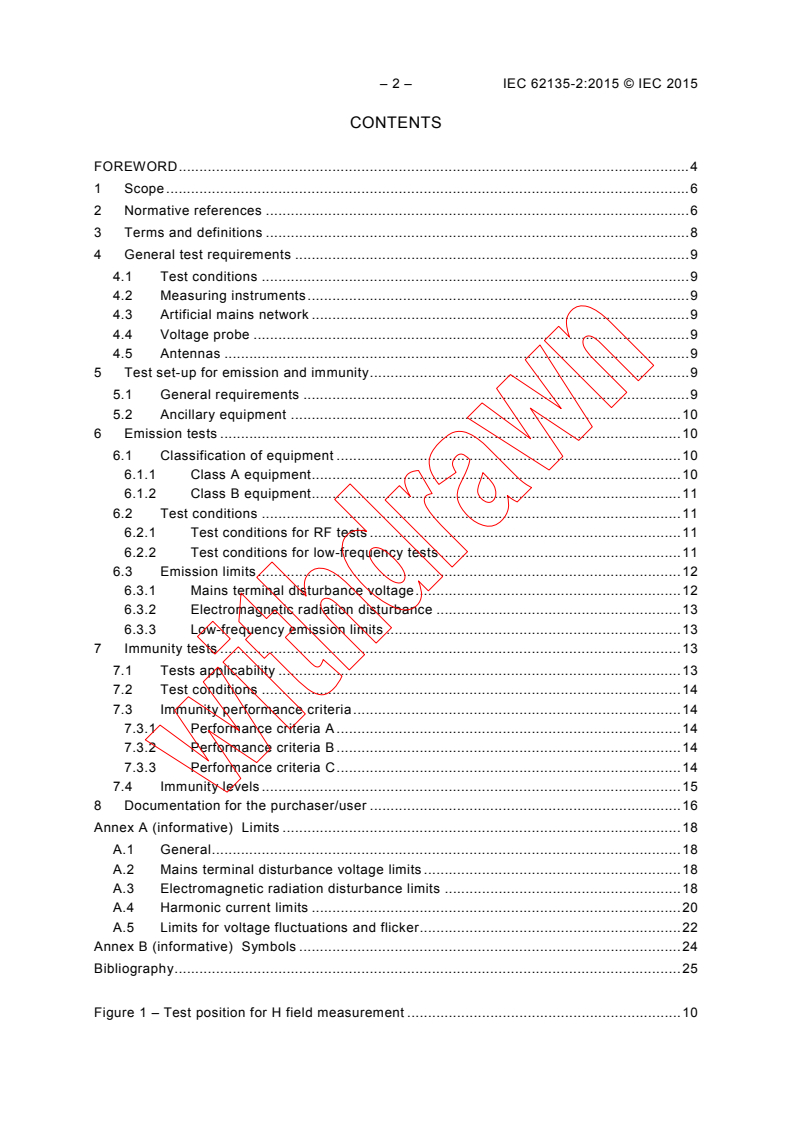
Figure 1 – Test position for H field measurement . 10
Table 1 – Immunity levels – Enclosure . 15
Table 2 – Immunity levels – AC input power port . 15
Table 3 – Immunity levels – Ports for measurement and control . 16
Table A.1 – Mains terminal disturbance voltage limits, idle state . 18
Table A.2 – Mains terminal disturbance voltage limits, load conditions . 18
Table A.3 – Electromagnetic radiation disturbance limits, idle state . 19
Table A.4 – Electromagnetic radiation disturbance limits, load conditions . 19
Table A.5 – Magnetic field emission limits for Class B equipment . 20
Table A.6 – Maximum permissible harmonic current for equipment with input current
I ≤ 16 A . 20
1cc
Table A.7 – Current emission limits for equipment with 16 A < I ≤ 75 A other than
1cc
balanced three-phase equipment . 21
Table A.8 – Current emission limits for balanced three-phase equipment with input
current 16 A < I ≤ 75 A . 21
1cc
Table A.9 – Current emission limits for balanced three-phase equipment with input
current 16 A < I ≤ 75 A under specified conditions . 21
1cc
Table A.10 – Current emission limits for balanced three-phase equipment with I ≤
1cc
75 A under specified conditions (d, e, f) . 22
Table A.11 – Limits for resistance welding equipment I ≤ 75 A . 23
1cc
Table B.1 – Symbols to describe EMC properties . 24
– 4 – IEC 62135-2:2015 © IEC 2015
INTERNATIONAL ELECTROTECHNICAL COMMISSION
____________
RESISTANCE WELDING EQUIPMENT –
Part 2: Electromagnetic compatibility (EMC) requirements
FOREWORD
1) The International Electrotechnical Commission (IEC) is a worldwide organization for standardization comprising
all national electrotechnical committees (IEC National Committees). The object of IEC is to promote
international co-operation on all questions concerning standardization in the electrical and electronic fields. To
this end and in addition to other activities, IEC publishes International Standards, Technical Specifications,
Technical Reports, Publicly Available Specifications (PAS) and Guides (hereafter referred to as “IEC
Publication(s)”). Their preparation is entrusted to technical committees; any IEC National Committee interested
in the subject dealt with may participate in this preparatory work. International, governmental and non-
governmental organizations liaising with the IEC also participate in this preparation. IEC collaborates closely
with the International Organization for Standardization (ISO) in accordance with conditions determined by
agreement between the two organizations.
2) The formal decisions or agreements of IEC on technical matters express, as nearly as possible, an international
consensus of opinion on the relevant subjects since each technical committee has representation from all
interested IEC National Committees.
3) IEC Publications have the form of recommendations for international use and are accepted by IEC National
Committees in that sense. While all reasonable efforts are made to ensure that the technical content of IEC
Publications is accurate, IEC cannot be held responsible for the way in which they are used or for any
misinterpretation by any end user.
4) In order to promote international uniformity, IEC National Committees undertake to apply IEC Publications
transparently to the maximum extent possible in their national and regional publications. Any divergence
between any IEC Publication and the corresponding national or regional publication shall be clearly indicated in
the latter.
5) IEC itself does not provide any attestation of conformity. Independent certification bodies provide conformity
assessment services and, in some areas, access to IEC marks of conformity. IEC is not responsible for any
services carried out by independent certification bodies.
6) All users should ensure that they have the latest edition of this publication.
7) No liability shall attach to IEC or its directors, employees, servants or agents including individual experts and
members of its technical committees and IEC National Committees for any personal injury, property damage or
other damage of any nature whatsoever, whether direct or indirect, or for costs (including legal fees) and
expenses arising out of the publication, use of, or reliance upon, this IEC Publication or any other IEC
Publications.
8) Attention is drawn to the Normative references cited in this publication. Use of the referenced publications is
indispensable for the correct application of this publication.
9) Attention is drawn to the possibility that some of the elements of this IEC Publication may be the subject of
patent rights. IEC shall not be held responsible for identifying any or all such patent rights.
International Standard IEC 62135-2 has been prepared by IEC technical committee 26:
Electric welding.
This second edition cancels and replaces the first edition published in 2007 and constitutes a
technical revision.
This edition includes the following significant technical changes with respect to the previous
edition:
– update of the applicable limits related to the updated reference to CISPR 11;
– exclusion of the use of narrow band relaxations for RF emission limits;
– update of the applicable limits for harmonics and flicker related to the updated reference
to IEC 61000-3-11 and IEC 61000-3-12;
– update of the requirements for voltage dips related to the updated reference to IEC 61000-
4-11 and IEC 61000-4-34;
– inclusion of symbols to indicate the RF equipment class and restrictions for use;
– inclusion of EM field immunity test for frequency from 1,4 GHz to 2,7 GHz;
– inclusion of emission limits for class B resistance welding equipment magnetic fields
between 150 kHz and 30 MHz.
The text of this standard is based on the following documents:
FDIS Report on voting
26/555FDIS 26/557/RVD
Full information on the voting for the approval of this standard can be found in the report on
voting indicated in the above table.
This publication has been drafted in accordance with the ISO/IEC Directives, Part 2.
The list of all the parts of the IEC 62135 series, under the general title Resistance welding
equipment, can be found on the IEC website.
The committee has decided that the contents of this publication will remain unchanged until
the stability date indicated on the IEC website under "http://webstore.iec.ch" in the data
related to the specific publication. At this date, the publication will be
• reconfirmed,
• withdrawn,
• replaced by a revised edition, or
• amended.
– 6 – IEC 62135-2:2015 © IEC 2015
RESISTANCE WELDING EQUIPMENT –
Part 2: Electromagnetic compatibility (EMC) requirements
1 Scope
This part of IEC 62135 is applicable to equipment for resistance welding and allied processes
which are connected to mains supplies with rated voltages up to 1 000 V a.c. r.m.s. This
standard does not define safety requirements.
Resistance welding equipment type tested in accordance with, and which has met the
requirements of, this standard, is deemed to be in compliance for all applications.
The frequency range covered is from 0 Hz to 400 GHz.
This product EMC standard for resistance welding equipment takes precedence over all
aspects of the generic standards and no additional EMC tests are required or necessary.
NOTE 1 Typical allied processes are resistance hard and soft soldering or resistance heating achieved by means
comparable to resistance welding equipment.
NOTE 2 Limit values are specified for only part of the frequency range.
Resistance welding equipment are classified as class A and class B equipment.
This part of IEC 62135 specifies
a) test methods to be used in conjunction with CISPR 11 to determine radiofrequency (RF)
emission;
b) relevant standards and test methods for harmonic current emission, voltage fluctuation
and flicker.
NOTE 3 The limits in this standard cannot, however, provide full protection against interference to radio and
television reception when the resistance welding equipment is used closer than 30 m to the receiving antenna(e).
NOTE 4 In special cases, when highly susceptible apparatus is being used in close proximity, additional
mitigation measures are sometimes employed to further reduce the electromagnetic emissions.
This part of IEC 62135 also defines immunity requirements and test methods for continuous
and transient, conducted and radiated disturbances including electrostatic discharges.
NOTE 5 These requirements do not, however, cover extreme cases which are extremely rare.
2 Normative references
The following documents, in whole or in part, are normatively referenced in this document and
are indispensable for its application. For dated references, only the edition cited applies. For
undated references, the latest edition of the referenced document (including any
amendments) applies.
IEC 60050-161, International Electrotechnical Vocabulary – Chapter 161: Electromagnetic
compatibility
IEC 60050-851, International Electrotechnical Vocabulary – Part 851: Electric welding
IEC 61000-3-2:2014, Electromagnetic compatibility (EMC) – Part 3-2: Limits – Limits for
harmonic current emissions (equipment input current ≤ 16 A per phase)
IEC 61000-3-3:2013, Electromagnetic compatibility (EMC) – Part 3: Limits – Limitation of
voltage changes, voltage fluctuations and flicker in public low-voltage supply systems, for
equipment with rated current ≤ 16 A per phase and not subject to conditional connection
IEC 61000-3-11:2000, Electromagnetic compatibility (EMC) – Part 3-11: Limits – Limitation of
voltage changes, voltage fluctuations and flicker in public low-voltage supply systems –
Equipment with rated current ≤ 75 A and subject to conditional connection
IEC 61000-3-12:2011, Electromagnetic compatibility (EMC) – Part 3-12: Limits for harmonic
currents produced by equipment connected to public low-voltage systems with input current >
16 A and ≤ 75 A per phase
IEC 61000-4-2, Electromagnetic compatibility (EMC) – Part 4-2: Testing and measurement
techniques – Electrostatic discharge immunity test
IEC 61000-4-3, Electromagnetic compatibility (EMC) – Part 4-3: Testing and measurement
techniques – Radiated, radio frequency, electromagnetic field immunity test
IEC 61000-4-4, Electromagnetic compatibility (EMC) – Part 4-4: Testing and measurement
techniques – Electrical fast transient/burst immunity test
IEC 61000-4-5, Electromagnetic compatibility (EMC) – Part 4-5: Testing and measurement
techniques – Surge immunity test
IEC 61000-4-6, Electromagnetic compatibility (EMC) – Part 4-6: Testing and measurement
techniques – Immunity to conducted disturbances, induced by radio-frequency fields
IEC 61000-4-11, Electromagnetic compatibility (EMC) – Part 4-11: Testing and measurement
techniques – Voltage dips, short interruptions and voltage variations immunity tests
IEC 61000-4-34, Electromagnetic compatibility (EMC) – Part 4-34: Testing and measurement
techniques – Voltage dips, short interruptions and voltage variations immunity tests for
equipment with input current more than 16 A per phase
IEC 62135-1, Resistance welding equipment – Part 1: Safety requirements for design,
manufacture and installation
CISPR 11:2009, Industrial, scientific and medical equipment – Radio-frequency disturbance
characteristics – Limits and methods of measurement
CISPR 11:2009/AMD 1:2010
CISPR 16-1-1, Specification for radio disturbance and immunity measuring apparatus and
methods – Part 1-1: Radio disturbance and immunity measuring apparatus – Measuring
apparatus
CISPR 16-1-2, Specification for radio disturbance and immunity measuring apparatus and
methods – Part 1-2: Radio disturbance and immunity measuring apparatus – Coupling devices
for conducted disturbance measurements
CISPR 16-1-4, Specification for radio disturbance and immunity measuring apparatus and
methods – Part 1-4: Radio disturbance and immunity measuring apparatus – Antennas and
test sites for radiated disturbance measurements
– 8 – IEC 62135-2:2015 © IEC 2015
ISO 669, Resistance welding – Resistance welding equipment – Mechanical and electrical
requirements
3 Terms and definitions
For the purposes of this document, the terms and definitions given in IEC 60050-161
concerning EMC and the relevant phenomena, given IEC 60050-851, IEC 62135-1 and
ISO 669 on resistance welding equipment, as well as the following, apply.
3.1
cable port
point at which a conductor or a cable is connected to the apparatus
Note 1 to entry: Examples are signal, control and power ports.
Note 2 to entry: The welding circuit of resistance welding equipment is not a cable port but is part of the
enclosure port.
3.2
conventional load
load condition with the electrodes short-circuiting as defined in ISO 669
3.3
conventional value
standardized value that is used as a measure of a parameter for the purposes of comparison,
calibration, testing, etc.
Note 1 to entry: Conventional values do not necessarily apply during the actual welding process.
3.4
enclosure port
physical boundary of the apparatus through which electro-magnetic fields may radiate or
impinge
3.5
EUT
equipment under test
3.6
idle state
operating mode in which the power is switched on, but the welding circuit is not energized
3.7
port
particular interface of the specified apparatus with the external electro-magnetic environment
3.8
small equipment
equipment, either positioned on a table top or standing on the floor which, including its cables
fits in a cylindrical test volume of 1,2 m in diameter and 1,5 m above the ground plane
[SOURCE: CISPR 11:2009/AMD1:2010, 3.10]
4 General test requirements
4.1 Test conditions
Tests shall be carried out on completely assembled equipment representative of the series
production. Tests shall be performed within the specified operating conditions for the
apparatus at its rated supply voltage and frequency as given in IEC 62135-1. Results obtained
for RF emission and immunity at 50 Hz are valid for the same model operating at 60 Hz and
vice versa.
4.2 Measuring instruments
The measuring equipment shall comply with the requirements of CISPR 16-1-1 and the
standards referred to in Tables 1, 2 and 3 as applicable.
4.3 Artificial mains network
Measurement of the mains terminal disturbance voltage shall be made using an artificial
mains network, if commercially available, consisting of 50 Ω/50 µH V-network as specified in
CISPR 16-1-2.
The artificial network is required to provide a defined impedance at RF across the mains
supply at the point of measurement and also to provide for isolation of the equipment under
test from ambient noise on the power lines.
4.4 Voltage probe
A voltage probe as specified in CISPR 16-1-2 shall be used when the artificial mains network
cannot be used. The probe is connected sequentially between each line and the reference
earth. The probe shall consist of a blocking capacitor and a resistor such that the total
resistance between the line and earth is at least 1 500 Ω. The effect on the accuracy of
measurement of the capacitor or any other device which may be used to protect the
measuring receiver against dangerous currents shall be either less than 1 dB or allowed for in
calibration.
4.5 Antennas
In the frequency range from 30 MHz to 1 GHz the antenna(s) used shall be as specified in
CISPR 16-1-4. Measurements shall be made for both horizontal and vertical polarization. The
nearest point of the antenna(s) to the ground shall be not less than 0,2 m.
5 Test set-up for emission and immunity
5.1 General requirements
Emission and immunity testing shall be carried out on a representative resistance welding
installation as described below. Resistance welding equipment tested in such an installation
shall be considered to have met the necessary requirements of this standard.
In any situation where it is necessary to re-test the equipment to show compliance with this
standard the test setup originally chosen shall be used in order to guarantee consistency of
the results, unless it is agreed by the manufacturer to do otherwise.
If the resistance welding equipment is part of an installation, or can be connected to auxiliary
equipment, then the resistance welding equipment shall be tested whilst connected to the
minimum configuration of auxiliary equipment necessary to exercise the ports. If the
resistance welding equipment has a large number of similar ports or ports with many similar
connections, then a sufficient number shall be selected to simulate actual operating
conditions and to ensure that all the different types of termination are covered.
– 10 – IEC 62135-2:2015 © IEC 2015
Measurements to determine compliance with the low-frequency emission limits shall be made
in accordance with the test procedures of relevant basic and referenced standards.
For electromagnetic radiation disturbance tests the separation between the antenna and the
equipment under test shall be as specified in Clause 6 of CISPR 11:2009.
For radiated emission test in the frequency range between 150 kHz and 1 MHz, the antenna
shall be positioned on the axis z, as given in Figure 1, perpendicular to the plane x,y of the
welding circuit.
y
x
I
z
a
IEC
Figure 1 – Test position for H field measurement
Specific test set-up geometries for immunity tests are found in the basic standards referred to
in Tables 1, 2 and 3.
Class A resistance welding equipment may be measured either on a test site or in situ as
preferred by the manufacturer.
NOTE Due to size, complexity or operating conditions, some resistance welding equipment are sometimes
measured in situ in order to show compliance with the radiation disturbance limits specified herein.
Class B resistance welding equipment shall be measured on a test site.
The configuration of the resistance welding equipment under test shall be precisely noted in
the test report.
5.2 Ancillary equipment
Ancillary equipment shall be tested in conjunction with the resistance welding equipment. It
shall be connected, installed, configured and operated as recommended by the manufacturer.
6 Emission tests
6.1 Classification of equipment
6.1.1 Class A equipment
Class A equipment is intended for use in locations other than residential locations where the
electrical power is provided by the public low-voltage supply system.
b
Class A equipment shall meet class A limits in accordance with 6.3.
6.1.2 Class B equipment
Class B equipment is suitable for use in all locations, including residential locations where the
electrical power is provided by the public low-voltage supply system.
Class B equipment shall meet class B limits in accordance with 6.3.
6.2 Test conditions
6.2.1 Test conditions for RF tests
Measurements to determine compliance with the emission limits shall be made in accordance
with the test procedures in CISPR 11 and as detailed below, using the test set-up given in
Clause 5.
Resistance welding equipment is extremely diverse in its design and working conditions. It
shall be tested under the following conditions:
a) idle state
b) loaded
– set up the welding circuit to minimize the impedance and to produce the highest flow of
current (i.e., using minimum arms length and gap);
– set up the electrodes in short-circuit condition;
– adjust the current to obtain the highest emission, if means of adjustment is provided;
NOTE For thyristor-controlled equipment, an ignition delay angle of 90° typically gives the highest
emission value.
– select a duty cycle and a welding heat time appropriate for the tested resistance
welding equipment and the requirements of the measuring instrumentation.
The test parameters chosen shall be fully documented.
6.2.2 Test conditions for low-frequency tests
Resistance welding equipment is extremely diverse in its design and working conditions. It
shall be tested under the following conditions:
– set up the welding circuit to minimize the impedance and to produce the highest flow of
current;
– set up the electrodes in short-circuit condition;
– adjust the current to obtain the highest emission, if means of adjustment is provided;
– calculate the equipment duty cycle X at the maximum welding current based on Formula
(1) and
(I )
2P
(1)
X=
(I )
2cc
where
I is the permanent output current;
2P
I is the maximum short circuit welding current;
2cc
– select an observation period and a welding heat time appropriate for the calculated duty
cycle, the tested resistance welding equipment and the requirements of the measuring
instrumentation.
– 12 – IEC 62135-2:2015 © IEC 2015
The test parameters chosen shall be fully documented.
The arithmetic average value of 1,5 s smoothed r.m.s. supply current values (I as per
ref
IEC 61000-3-12) shall be measured when the welding equipment is delivering its maximum
rated output current I ,
2cc
For welding equipment with a rated maximum supply current I below 16 A, the reference
1cc
current I for the definition of limits shall be 16 A.
ref
The maximum and arithmetic average values of 1,5 s smoothed r.m.s. harmonic current
values in each Discrete Fourier Transform (DFT) time window shall be determined over one or
more full thermal cycle(s) including the idle state period.
The same welding heat time shall be used for determination of I and the harmonic
ref
component values.
NOTE An idle state period of more than 10 % is not a stand-by mode as defined in IEC 61000-3-12, but an
operational mode of the welding equipment within its full thermal cycle.
6.3 Emission limits
6.3.1 Mains terminal disturbance voltage
6.3.1.1 Idle state
The mains terminal disturbance voltage limits for class A resistance welding equipment in idle
state, regardless of the rated input power, are given in Table 2 of CISPR 11:2009 in the
column for a rated input power less than or equal to 20 kVA.
The mains terminal disturbance voltage limits for class B resistance welding equipment in idle
state are given in Table 3 of CISPR 11:2009.
The EUT shall meet either both average and quasi-peak limits using the corresponding
detectors or the average limit when using the quasi-peak detector.
6.3.1.2 Loaded
The mains terminal disturbance voltage limits for class A resistance welding equipment are
the Group 2 limits given in Table 6 of CISPR 11:2009. The appropriate set of limits shall be
selected in accordance with the maximum rated input power of the equipment, calculated
using the rated maximum input current I .
1cc
The mains terminal disturbance voltage limits for class B resistance welding equipment are
the Group 2 limits given in Table 7 of CISPR 11:2009.
The EUT shall meet either both average and quasi-peak limits using the corresponding
detectors or the average limit when using the quasi-peak detector.
For class A equipment, impulse noise (clicks) which occurs less than 5 times per minute is not
considered.
For class B equipment, impulse noise (clicks) which occurs less than 0,2 times per minute, a
relaxation of the limits of 44 dB is allowed. For clicks appearing between 0,2 and 30 times per
minute, a relaxation of the limits is allowed of 20 log (30/N) dB (where N is the number of
clicks per minute). Criteria for separated clicks can be found in CISPR 14-1.
6.3.2 Electromagnetic radiation disturbance
6.3.2.1 Idle state
The electromagnetic radiation disturbance limits for class A resistance welding equipment in
idle state, regardless of the rated input power, are given in Table 4 of CISPR 11:2009 in the
columns for a rated input power less than or equal to 20 kVA.
The electromagnetic radiation disturbance limits for class B resistance welding equipment are
given in Table 5 of CISPR 11:2009/AMD1:2010.
6.3.2.2 Loaded
The electromagnetic radiation disturbance limits for class A resistance welding equipment in
the frequency band 30 MHz to 1 000 MHz are the limits given in Tables 9 (test site) and 18 (in
situ) of CISPR 11:2009/AMD1:2010.
The relaxations for class A limits in the frequency ranges 80,872 MHz to 81,848 MHz,
134,786 MHz to 136,414 MHz, 156 MHz to 174 MHz, 188,7 MHz to 190,979 MHz, 400 MHz to
470 MHz are not applicable to resistance welding equipment.
The electromagnetic radiation disturbance limits for class B resistance welding equipment are
the Group 2 limits given in Table 11 of CISPR 11:2009/AMD1:2010.
The 20 dB relaxations for class B limits in the frequency ranges 80,872 MHz to 81,848 MHz
and 134,786 MHz to 136,414 MHz are not applicable to resistance welding equipment.
6.3.3 Low-frequency emission limits
The limits for
a) harmonic current emissions are given in IEC 61000-3-2 and IEC 61000-3-12;
b) voltage fluctuations and flicker are given in IEC 61000-3-3 and IEC 61000-3-11;
and are applicable to resistance welding equipment, as far as covered by the scope of these
standards. The applicable standard shall be selected based on the maximum short-circuit
input current I value.
1cc
NOTE For other equipment, no requirements at manufacturing stage are specified. Connection conditions can
apply depending on local power supply conditions. IEC TS 61000-3-4, IEC TR 61000-3-6 and IEC TR 61000-3-7
are taken into consideration.
7 Immunity tests
7.1 Tests applicability
Resistance welding equipment that does not contain electronic control circuitry is deemed to
fulfil the necessary immunity requirements without testing.
Electric circuits consisting of passive components such as inductors, RF suppression
networks, mains frequency transformers, rectifiers, diodes and resistors are not considered to
be electronic control circuitry.
The tests for immunity levels for enclosure, a.c. input power port and ports for process
measurement and control lines are defined in Tables 1, 2 and 3.
– 14 – IEC 62135-2:2015 © IEC 2015
7.2 Test conditions
The resistance welding equipment shall be tested, using the set-up as given in Clause 5. The
resistance welding equipment shall be set up with a resistance of 1 kΩ between the
electrodes. The output voltage shall be monitored to evaluate the compliance with
performance criteria at an ignition delay angle of 90° electric if means of adjustment is
provided and the point with the duty cycle and the welding heat time typical of the resistance
welding equipment on test or with a continuously flowing output current.
For equipment that cannot operate under the given test conditions, the manufacturers
recommendations shall be followed.
Tests that cannot be performed on the complete resistance welding equipment can be
performed on its electronic constituent parts.
7.3 Immunity performance criteria
7.3.1 Performance criteria A
The following issues shall be met:
a) the resistance welding equipment shall continue to operate as intended;
b) variations of ± 10 % of the output voltage are admissible;
c) the pre-set heat time shall not be exceeded;
d) no interruptions are permitted in the heat time;
e) in the "single" operating mode, interruption of the welding cycle shall be properly
terminated;
f) in the "repeat", "seam" and "continuous" operating modes, interruption of the cycle by
releasing the start switch provided shall be possible;
g) all controls shall continue to function;
h) malfunctioning of the semiconductor power switches is inadmissible;
i) loss of stored data is inadmissible.
7.3.2 Performance criteria B
The following issues shall be met:
+50
a) variations of % of the output voltage are admissible.
−100
b) in the case of a current interruption during the intended heat time, the welding cycle is
terminated with "no current". Manual reset may be required;
c) the pre-set heat time shall not be exceeded;
d) in the "single" operation mode, the welding cycle shall be properly terminated;
e) in the "repeat", "seam" and "continuous" operating modes, interruption of the cycle by
releasing the start switch provided shall be possible;
f) malfunctioning of the semiconductor power switches is inadmissible;
g) loss of stored data is inadmissible.
7.3.3 Performance criteria C
The following issues shall be met:
a) temporary loss of function is allowed, provided that the loss of function is self-
recoverable or can be restored by the operator of the controls. This may require the
control voltage of the resistance welding equipment to be restored by means of an
appropriate switch;
b) malfunctioning of the semiconductor power switches is inadmissible; temporary loss of
function is allowed;
c) loss of stored programme data is inadmissible, unless it can be restored by the operation
of the controls.
7.4 Immunity levels
Immunity levels are given in Table 1 for the enclosure, Table 2 for the a.c. input power port
and Table 3 for ports for measurement and control lines.
Table 1 – Immunity levels – Enclosure
Test Performance
Phenomena Units Basic standard Remarks
specification criteria
MHz 80 to 1 000
The test level
Radiofrequency EM field, V/m (unmod. 10
IEC 61000-4-3 specified is prior to A
amplitude modulated r.m.s.)
modulation
% AM (1 kHz) 80
GHz 1,4 to 2,0
The test level
Radiofrequency EM field, V/m (unmod. 3
IEC 61000-4-3 specified is prior to A
amplitude modulated r.m.s.)
modulation
% AM (1 kHz) 80
GHz 2,0 to 2,7
The test level
Radiofrequency EM field, V/m (unmod. 1
IEC 61000-4-3 specified is prior to A
amplitude modulated r.m.s.)
modulation
% AM (1 kHz) 80
Contact kV (charge
a
±4 B
See basic standard
discharge voltage)
Electrostatic for applicability of
IEC 61000-4-2
discharge contact and/or air
Air kV (charge
a
discharge test.
B
±8
discharge voltage)
a
Testing is not required at lower levels than those specified.
Table 2 – Immunity levels – AC input power port
Test Performance
Phenomena Units Basic standard Remarks
specification criteria
kV (peak)
±2
Fast transients Repetition frequency kHz 5 IEC 61000-4-4 Direct injection B
Tr/Th ns 5/50
See note
Radio-
MHz 0,15 to 80
The test level
frequency IEC 61000-4-6 A
V (unmod. r.m.s.) 10
specified is prior to
common mode
% AM (1 kHz) 80
modulation
This test is not
required when
1,2/50 (8/20)
Surges Tr/Th µs
normal functioning
line-to-line kV (open circuit voltage) ±1 IEC 61000-4-5 cannot be achieved B
because of the
line-to-earth kV (open circuit voltage)
±2
impact of the CDN
on the EUT
% residual voltage 70
B
cycles at 50/60Hz 25/30
IEC 61000-4-11
Voltage shift at zero
Voltage dips
crossing
% residual voltage 0 IEC 61000-4-34
C
cycle 1
NOTE The
...