

IEC 60268-7:2025
(Main)Sound system equipment - Part 7: Headphones and earphones
General Information
- Abstract
IEC 60268-7:2025 is applicable to headphones, earphones, headsets and earsets, intended to be used on, or in, the human ear. It also applies to equipment, such as pre-amplifiers, passive networks and power supplies which form an integral part of the headphone system.
This document does not deal with:
- safety, for which reference is made to IEC 62368-1 or another appropriate standard;
- the characteristics of microphones of headsets, for which reference is made to IEC 60268‑4;
- earphones and other devices for hearing aids, for which reference is made to IEC 60118-0;
- headphones for audiometry;
- headphones and other devices which form part of an active ear-defender system, although some of the provisions of this document can be applicable;
- active noise cancelation characteristics as covered by IEC 60268-24.
This document specifies the characteristics which are included by the manufacturer in specifications, and relevant methods of measurement. It includes a classification of the different types of earphones, mainly characterized by the way in which the transducer is coupled acoustically to the ear, and a classification code which can also be used for marking. Rated conditions and characteristics in this document provided by the manufacturer are not generally intended for external verification. Measurement methods for rated characteristics are informative and are provided for the benefit of manufacturers for the purpose of test repeatability and data comparison. All other specifications and tests are provided for testing by the manufacturer and for external testing and verification. This fourth edition cancels and replaces the third edition published in 2010, and Amendment 1 of 2020. This edition constitutes a technical revision.
This edition includes the following significant technical changes with respect to the previous edition:
- consolidated with IEC 60268-7:2010/AMD1:2020;
- clause/subclause/annex reconstruction and renumbering;
- addition of effective frequency range of the free-field / diffuse-field compensated frequency response;
- update of measurement methods of modulation distortion and difference-frequency distortion;
- addition of details of two-tone distortion measurements, see Annex I;
- addition of details of left-right tracking response for stereo headphones, see Annex J.
- Status
- Published
- Publication Date
- 26-Jun-2025
- Technical Committee
- TA 20 - Analogue and digital audio
- Drafting Committee
- MT 60268-7 - TC 100/TA 20/MT 60268-7
- Current Stage
- PPUB - Publication issued
- Start Date
- 27-Jun-2025
- Completion Date
- 04-Jul-2025
Buy Documents
REDLINE IEC 60268-7:2025 CMV - Sound system equipment - Part 7: Headphones and earphones Released:6/27/2025
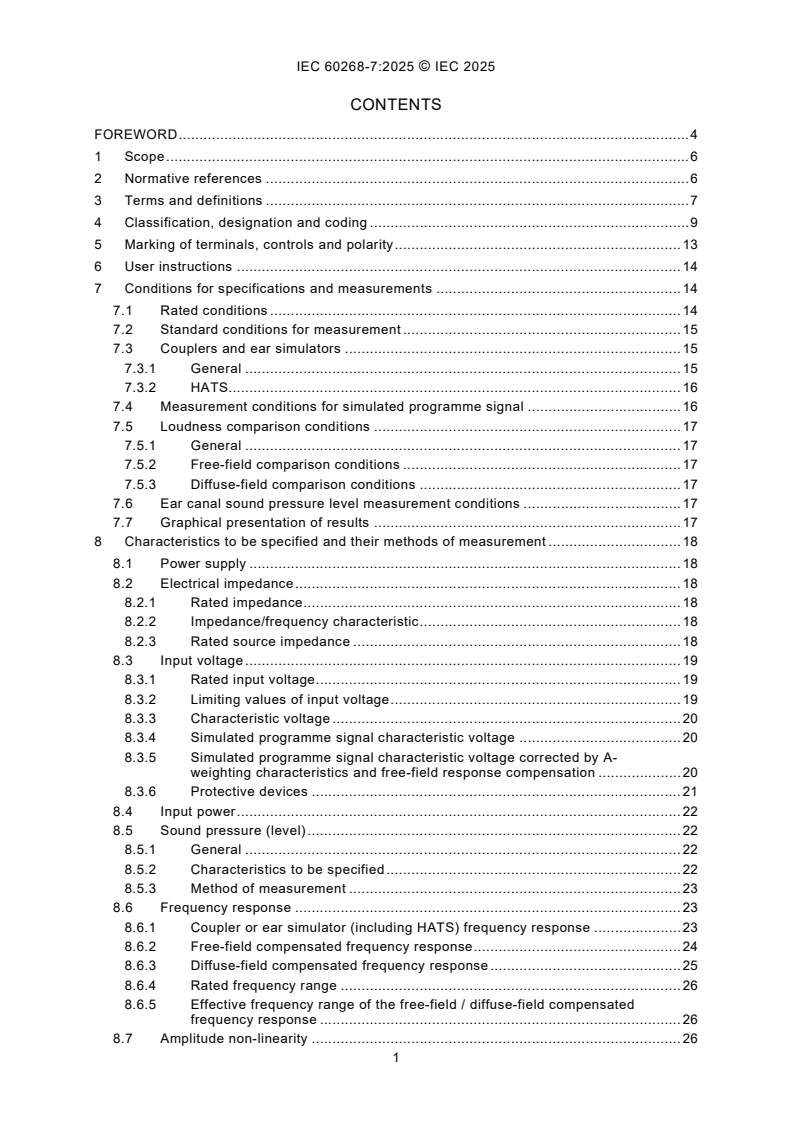
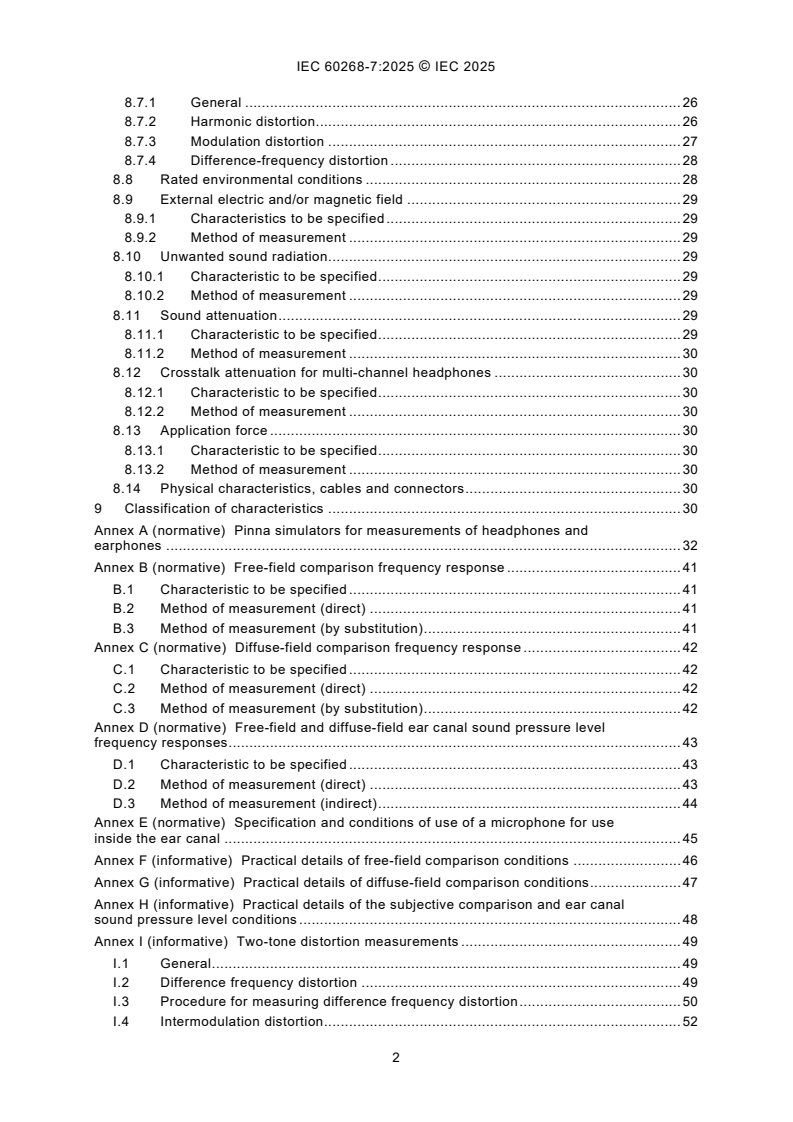
IEC 60268-7:2025 - Sound system equipment - Part 7: Headphones and earphones/27/2025
Overview
IEC 60268-7:2025 - Sound system equipment - Part 7: Headphones and earphones - is the 4th edition international standard that defines characteristics, classification and measurement methods for headphones, earphones, headsets and earsets intended to be used on or in the human ear. It also covers equipment that is an integral part of the headphone system (e.g., pre-amplifiers, passive networks, power supplies). The standard specifies what manufacturers should include in product specifications and provides measurement methods to improve test repeatability and data comparison.
Key updates in the 2025 edition include consolidation of earlier amendments, clause renumbering, the addition of an effective frequency range for free-field/diffuse-field compensated responses, updated methods for modulation and difference‑frequency distortion, and new Annexes for two‑tone distortion (Annex I) and left‑right tracking (Annex J).
Key topics
- Classification and coding of earphones by acoustic coupling (on-ear, in-ear, open/closed).
- Rated conditions vs. standard measurement conditions; guidance on how manufacturer rated data should be presented.
- Measurement methods for core electrical and acoustic characteristics:
- Electrical impedance, input voltage/power, rated source impedance
- Sound pressure level (SPL) and frequency response (free‑field and diffuse‑field compensated and comparison responses)
- Harmonic, modulation, difference‑frequency and intermodulation distortion (including two‑tone methods)
- Crosstalk attenuation, unwanted sound radiation, sound attenuation (for ear-defender related aspects), application force
- Environmental and external field influences, physical characteristics, cables and connectors
- Use of couplers and ear simulators (HATS and pinna simulators) for repeatable acoustic measurement.
- Guidance on graphical presentation of results and which characteristics are for verification versus manufacturer internal use.
Applications and who uses it
IEC 60268-7:2025 is essential for:
- Headphone and earphone manufacturers for specification drafting, product labeling and R&D testing.
- Test laboratories and quality assurance teams performing standardized acoustic and electrical measurements.
- Acoustic engineers and product designers optimizing frequency response, distortion and stereo matching.
- Procurement and certification bodies evaluating performance claims and ensuring comparable data across products.
Practical uses include creating product datasheets, verifying left/right tracking for stereo models, comparing loudness and tonal balance using free‑field/diffuse‑field compensation, and improving measurement repeatability with HATS/pinna simulators.
Related standards
- IEC 62368-1 - safety requirements (referenced; safety not covered here)
- IEC 60268-4 - microphones of headsets
- IEC 60118-0 - earphones/devices for hearing aids
- IEC 60268-24 - active noise cancellation characteristics (excluded from this document)
Keywords: IEC 60268-7:2025, headphone standard, earphone measurement, frequency response measurement, HATS, pinna simulator, harmonic distortion, two-tone distortion, headphone specifications.
Relations
- Effective Date
- 21-Jun-2024
- Revises
IEC 60268-7:2010/AMD1:2020 - Amendment 1 - Sound system equipment - Part 7: Headphones and earphones - Effective Date
- 21-Jun-2024
- Effective Date
- 05-Sep-2023
Buy Documents
REDLINE IEC 60268-7:2025 CMV - Sound system equipment - Part 7: Headphones and earphones Released:6/27/2025
IEC 60268-7:2025 - Sound system equipment - Part 7: Headphones and earphones/27/2025
Get Certified
Connect with accredited certification bodies for this standard

ANCE
Mexican certification and testing association.

Intertek Slovenia
Intertek testing, inspection, and certification services in Slovenia.

LNE (Laboratoire National de Métrologie et d'Essais)
French national laboratory for metrology and testing.
Sponsored listings
Frequently Asked Questions
IEC 60268-7:2025 is a standard published by the International Electrotechnical Commission (IEC). Its full title is "Sound system equipment - Part 7: Headphones and earphones". This standard covers: IEC 60268-7:2025 is applicable to headphones, earphones, headsets and earsets, intended to be used on, or in, the human ear. It also applies to equipment, such as pre-amplifiers, passive networks and power supplies which form an integral part of the headphone system. This document does not deal with: - safety, for which reference is made to IEC 62368-1 or another appropriate standard; - the characteristics of microphones of headsets, for which reference is made to IEC 60268‑4; - earphones and other devices for hearing aids, for which reference is made to IEC 60118-0; - headphones for audiometry; - headphones and other devices which form part of an active ear-defender system, although some of the provisions of this document can be applicable; - active noise cancelation characteristics as covered by IEC 60268-24. This document specifies the characteristics which are included by the manufacturer in specifications, and relevant methods of measurement. It includes a classification of the different types of earphones, mainly characterized by the way in which the transducer is coupled acoustically to the ear, and a classification code which can also be used for marking. Rated conditions and characteristics in this document provided by the manufacturer are not generally intended for external verification. Measurement methods for rated characteristics are informative and are provided for the benefit of manufacturers for the purpose of test repeatability and data comparison. All other specifications and tests are provided for testing by the manufacturer and for external testing and verification. This fourth edition cancels and replaces the third edition published in 2010, and Amendment 1 of 2020. This edition constitutes a technical revision. This edition includes the following significant technical changes with respect to the previous edition: - consolidated with IEC 60268-7:2010/AMD1:2020; - clause/subclause/annex reconstruction and renumbering; - addition of effective frequency range of the free-field / diffuse-field compensated frequency response; - update of measurement methods of modulation distortion and difference-frequency distortion; - addition of details of two-tone distortion measurements, see Annex I; - addition of details of left-right tracking response for stereo headphones, see Annex J.
IEC 60268-7:2025 is applicable to headphones, earphones, headsets and earsets, intended to be used on, or in, the human ear. It also applies to equipment, such as pre-amplifiers, passive networks and power supplies which form an integral part of the headphone system. This document does not deal with: - safety, for which reference is made to IEC 62368-1 or another appropriate standard; - the characteristics of microphones of headsets, for which reference is made to IEC 60268‑4; - earphones and other devices for hearing aids, for which reference is made to IEC 60118-0; - headphones for audiometry; - headphones and other devices which form part of an active ear-defender system, although some of the provisions of this document can be applicable; - active noise cancelation characteristics as covered by IEC 60268-24. This document specifies the characteristics which are included by the manufacturer in specifications, and relevant methods of measurement. It includes a classification of the different types of earphones, mainly characterized by the way in which the transducer is coupled acoustically to the ear, and a classification code which can also be used for marking. Rated conditions and characteristics in this document provided by the manufacturer are not generally intended for external verification. Measurement methods for rated characteristics are informative and are provided for the benefit of manufacturers for the purpose of test repeatability and data comparison. All other specifications and tests are provided for testing by the manufacturer and for external testing and verification. This fourth edition cancels and replaces the third edition published in 2010, and Amendment 1 of 2020. This edition constitutes a technical revision. This edition includes the following significant technical changes with respect to the previous edition: - consolidated with IEC 60268-7:2010/AMD1:2020; - clause/subclause/annex reconstruction and renumbering; - addition of effective frequency range of the free-field / diffuse-field compensated frequency response; - update of measurement methods of modulation distortion and difference-frequency distortion; - addition of details of two-tone distortion measurements, see Annex I; - addition of details of left-right tracking response for stereo headphones, see Annex J.
IEC 60268-7:2025 is classified under the following ICS (International Classification for Standards) categories: 33.160.50 - Accessories. The ICS classification helps identify the subject area and facilitates finding related standards.
IEC 60268-7:2025 has the following relationships with other standards: It is inter standard links to IEC 60268-7:2010/COR1:2012, IEC 60268-7:2010/AMD1:2020, IEC 60268-7:2010. Understanding these relationships helps ensure you are using the most current and applicable version of the standard.
IEC 60268-7:2025 is available in PDF format for immediate download after purchase. The document can be added to your cart and obtained through the secure checkout process. Digital delivery ensures instant access to the complete standard document.
Standards Content (Sample)
IEC 60268-7 ®
Edition 4.0 2025-06
COMMENTED VERSION
INTERNATIONAL
STANDARD
Sound system equipment –
Part 7: Headphones and earphones
ICS 33.160.50 ISBN 978-2-8327-0547-6
All rights reserved. Unless otherwise specified, no part of this publication may be reproduced or utilized in any form or
by any means, electronic or mechanical, including photocopying and microfilm, without permission in writing from either
IEC or IEC's member National Committee in the country of the requester. If you have any questions about IEC copyright
or have an enquiry about obtaining additional rights to this publication, please contact the address below or your local
IEC member National Committee for further information.
IEC Secretariat Tel.: +41 22 919 02 11
3, rue de Varembé info@iec.ch
CH-1211 Geneva 20 www.iec.ch
Switzerland
About the IEC
The International Electrotechnical Commission (IEC) is the leading global organization that prepares and publishes
International Standards for all electrical, electronic and related technologies.
About IEC publications
The technical content of IEC publications is kept under constant review by the IEC. Please make sure that you have the
latest edition, a corrigendum or an amendment might have been published.
IEC publications search - IEC Products & Services Portal - products.iec.ch
webstore.iec.ch/advsearchform Discover our powerful search engine and read freely all the
The advanced search enables to find IEC publications by a publications previews, graphical symbols and the glossary.
variety of criteria (reference number, text, technical With a subscription you will always have access to up to date
committee, …). It also gives information on projects, content tailored to your needs.
replaced and withdrawn publications.
Electropedia - www.electropedia.org
The world's leading online dictionary on electrotechnology,
IEC Just Published - webstore.iec.ch/justpublished
Stay up to date on all new IEC publications. Just Published containing more than 22 500 terminological entries in English
details all new publications released. Available online and and French, with equivalent terms in 25 additional languages.
once a month by email. Also known as the International Electrotechnical Vocabulary
(IEV) online.
IEC Customer Service Centre - webstore.iec.ch/csc
If you wish to give us your feedback on this publication or
need further assistance, please contact the Customer
Service Centre: sales@iec.ch.
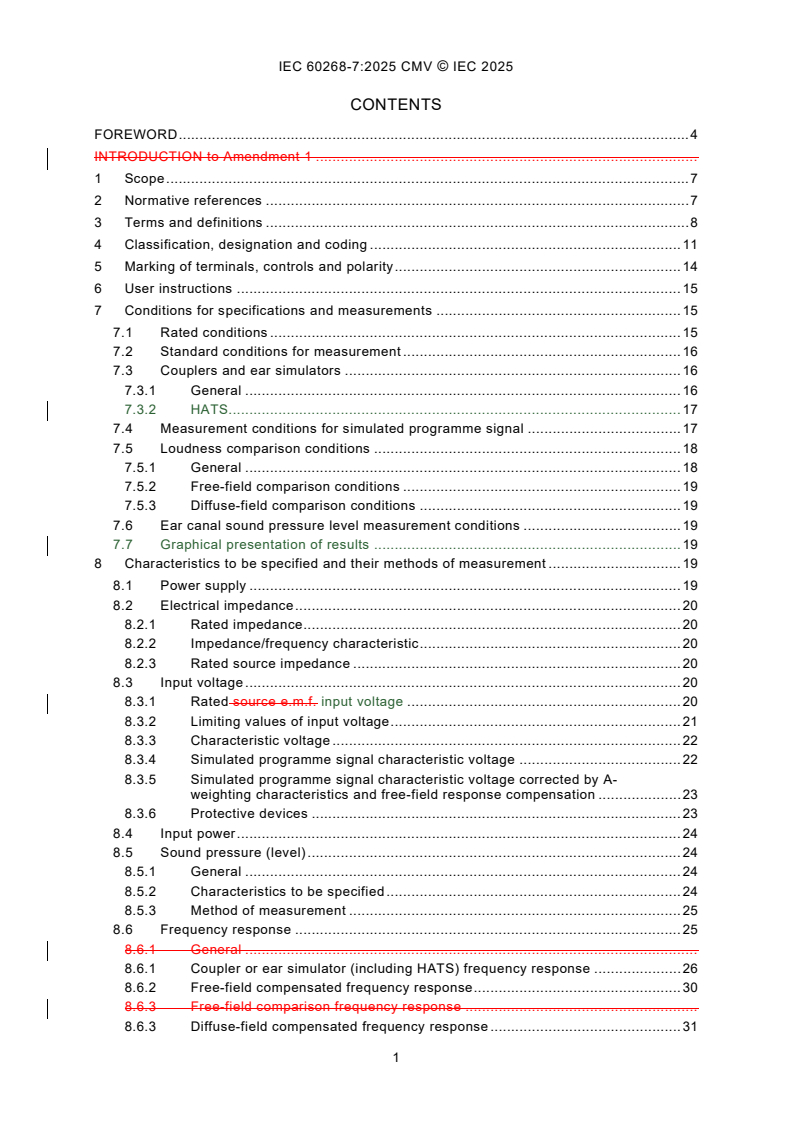
CONTENTS
FOREWORD . 4
INTRODUCTION to Amendment 1 .
1 Scope . 7
2 Normative references . 7
3 Terms and definitions . 8
4 Classification, designation and coding . 11
5 Marking of terminals, controls and polarity . 14
6 User instructions . 15
7 Conditions for specifications and measurements . 15
7.1 Rated conditions . 15
7.2 Standard conditions for measurement . 16
7.3 Couplers and ear simulators . 16
7.3.1 General . 16
7.3.2 HATS. 17
7.4 Measurement conditions for simulated programme signal . 17
7.5 Loudness comparison conditions . 18
7.5.1 General . 18
7.5.2 Free-field comparison conditions . 19
7.5.3 Diffuse-field comparison conditions . 19
7.6 Ear canal sound pressure level measurement conditions . 19
7.7 Graphical presentation of results . 19
8 Characteristics to be specified and their methods of measurement . 19
8.1 Power supply . 19
8.2 Electrical impedance . 20
8.2.1 Rated impedance . 20
8.2.2 Impedance/frequency characteristic . 20
8.2.3 Rated source impedance . 20
8.3 Input voltage . 20
8.3.1 Rated source e.m.f. input voltage . 20
8.3.2 Limiting values of input voltage . 21
8.3.3 Characteristic voltage . 22
8.3.4 Simulated programme signal characteristic voltage . 22
8.3.5 Simulated programme signal characteristic voltage corrected by A-
weighting characteristics and free-field response compensation . 23
8.3.6 Protective devices . 23
8.4 Input power . 24
8.5 Sound pressure (level) . 24
8.5.1 General . 24
8.5.2 Characteristics to be specified . 24
8.5.3 Method of measurement . 25
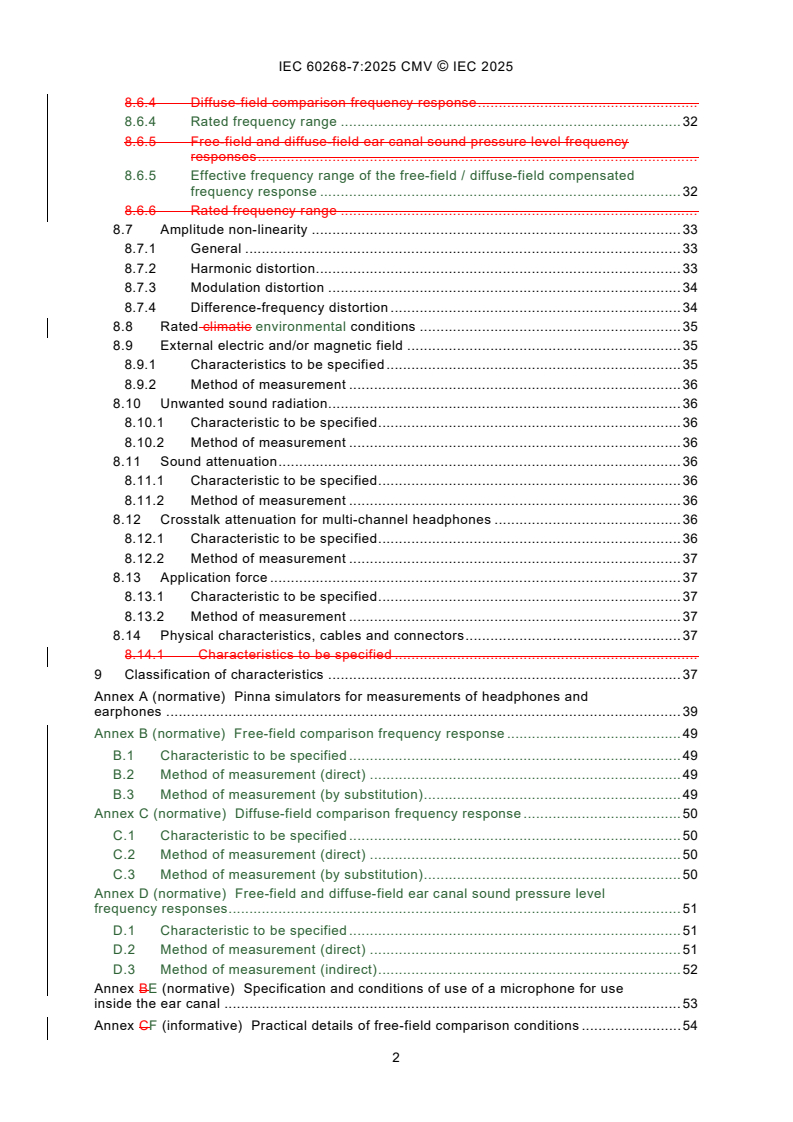
8.6 Frequency response . 25
8.6.1 General .
8.6.1 Coupler or ear simulator (including HATS) frequency response . 26
8.6.2 Free-field compensated frequency response . 30
8.6.3 Free-field comparison frequency response .
8.6.3 Diffuse-field compensated frequency response . 31
8.6.4 Diffuse-field comparison frequency response .
8.6.4 Rated frequency range . 32
8.6.5 Free-field and diffuse-field ear canal sound pressure level frequency
responses .
8.6.5 Effective frequency range of the free-field / diffuse-field compensated
frequency response . 32
8.6.6 Rated frequency range .
8.7 Amplitude non-linearity . 33
8.7.1 General . 33
8.7.2 Harmonic distortion . 33
8.7.3 Modulation distortion . 34
8.7.4 Difference-frequency distortion . 34
8.8 Rated climatic environmental conditions . 35
8.9 External electric and/or magnetic field . 35
8.9.1 Characteristics to be specified . 35
8.9.2 Method of measurement . 36
8.10 Unwanted sound radiation. 36
8.10.1 Characteristic to be specified . 36
8.10.2 Method of measurement . 36
8.11 Sound attenuation . 36
8.11.1 Characteristic to be specified . 36
8.11.2 Method of measurement . 36
8.12 Crosstalk attenuation for multi-channel headphones . 36
8.12.1 Characteristic to be specified . 36
8.12.2 Method of measurement . 37
8.13 Application force . 37
8.13.1 Characteristic to be specified . 37
8.13.2 Method of measurement . 37
8.14 Physical characteristics, cables and connectors . 37
8.14.1 Characteristics to be specified .
9 Classification of characteristics . 37
Annex A (normative) Pinna simulators for measurements of headphones and
earphones . 39
Annex B (normative) Free-field comparison frequency response . 49
B.1 Characteristic to be specified . 49
B.2 Method of measurement (direct) . 49
B.3 Method of measurement (by substitution) . 49
Annex C (normative) Diffuse-field comparison frequency response . 50
C.1 Characteristic to be specified . 50
C.2 Method of measurement (direct) . 50
C.3 Method of measurement (by substitution) . 50
Annex D (normative) Free-field and diffuse-field ear canal sound pressure level
frequency responses . 51
D.1 Characteristic to be specified . 51
D.2 Method of measurement (direct) . 51
D.3 Method of measurement (indirect) . 52
Annex BE (normative) Specification and conditions of use of a microphone for use
inside the ear canal . 53
Annex CF (informative) Practical details of free-field comparison conditions . 54
Annex DG (informative) Practical details of diffuse-field comparison conditions . 55
Annex EH (informative) Practical details of the subjective comparison and ear canal
sound pressure level conditions . 56
Annex I (informative) Two-tone distortion measurements . 57
I.1 General . 57
I.2 Difference frequency distortion . 57
I.3 Procedure for measuring difference frequency distortion . 58
I.4 Intermodulation distortion . 60
I.5 Procedure for measuring intermodulation distortion . 61
Annex J (informative) Left-right tracking response for stereo headphones . 63
Bibliography . 64
List of comments. 66
Figure 1 – Diagrammatic horizontal sections showing types of earphones and their
spatial relationships with the pinna and/or canal entrance . 13
Figure 2 – Diagrams showing the four possible constructions: Acoustically open or
closed, and closed- or open-back earphones . 14
Figure 3 – Illustrated measurement diagram by Measurement system using simulated
programme signal . 18
Figure 4 – Example of a setup for the measurement of free-field/diffuse-field
compensated frequency response . 32
Figure A.1 – Shape of the recommended pinna simulator . 41
Figure A.2 – Coordinate for the recommended pinna simulator . 42
Figure A.3 – Cross-sectional shapes and dimensions of the recommended pinna
simulator, horizontal section . 45
Figure A.4 – Cross-sectional shapes and dimensions of the recommended pinna
simulator, vertical section . 48
Figure I.1 – Definition of difference frequency distortion products and orders. 58
Figure I.2 – Example of difference frequency distortion of a headphone . 59
Figure I.3 – Example of total difference frequency distortion of a headphone . 60
Figure I.4 – Definition of intermodulation distortion products and orders . 60
Figure I.5 – Example of intermodulation distortion of a headphone . 61
Figure I.6 – Example of total Intermodulation distortion of a headphone . 62
Figure J.1 – Example of a left-right tracking response for a stereo headphone . 63
Table 1 – Classification of characteristics . 37
INTERNATIONAL ELECTROTECHNICAL COMMISSION
____________
Sound system equipment -
Part 7: Headphones and earphones
FOREWORD
1) The International Electrotechnical Commission (IEC) is a worldwide organization for standardization comprising
all national electrotechnical committees (IEC National Committees). The object of IEC is to promote international
co-operation on all questions concerning standardization in the electrical and electronic fields. To this end and
in addition to other activities, IEC publishes International Standards, Technical Specifications, Technical Reports,
Publicly Available Specifications (PAS) and Guides (hereafter referred to as "IEC Publication(s)"). Their
preparation is entrusted to technical committees; any IEC National Committee interested in the subject dealt with
may participate in this preparatory work. International, governmental and non-governmental organizations liaising
with the IEC also participate in this preparation. IEC collaborates closely with the International Organization for
Standardization (ISO) in accordance with conditions determined by agreement between the two organizations.
2) The formal decisions or agreements of IEC on technical matters express, as nearly as possible, an international
consensus of opinion on the relevant subjects since each technical committee has representation from all
interested IEC National Committees.
3) IEC Publications have the form of recommendations for international use and are accepted by IEC National
Committees in that sense. While all reasonable efforts are made to ensure that the technical content of IEC
Publications is accurate, IEC cannot be held responsible for the way in which they are used or for any
misinterpretation by any end user.
4) In order to promote international uniformity, IEC National Committees undertake to apply IEC Publications
transparently to the maximum extent possible in their national and regional publications. Any divergence between
any IEC Publication and the corresponding national or regional publication shall be clearly indicated in the latter.
5) IEC itself does not provide any attestation of conformity. Independent certification bodies provide conformity
assessment services and, in some areas, access to IEC marks of conformity. IEC is not responsible for any
services carried out by independent certification bodies.
6) All users should ensure that they have the latest edition of this publication.
7) No liability shall attach to IEC or its directors, employees, servants or agents including individual experts and
members of its technical committees and IEC National Committees for any personal injury, property damage or
other damage of any nature whatsoever, whether direct or indirect, or for costs (including legal fees) and
expenses arising out of the publication, use of, or reliance upon, this IEC Publication or any other IEC
Publications.
8) Attention is drawn to the Normative references cited in this publication. Use of the referenced publications is
indispensable for the correct application of this publication.
9) IEC draws attention to the possibility that the implementation of this document may involve the use of (a)
patent(s). IEC takes no position concerning the evidence, validity or applicability of any claimed patent rights in
respect thereof. As of the date of publication of this document, IEC had not received notice of (a) patent(s), which
may be required to implement this document. However, implementers are cautioned that this may not represent
the latest information, which may be obtained from the patent database available at https://patents.iec.ch. IEC
shall not be held responsible for identifying any or all such patent rights.
This commented version (CMV) of the official standard IEC 60268-7:2025 edition 4.0
allows the user to identify the changes made to the previous IEC 60268-
7:2010+AMD1:2020 CSV edition 3.1. Furthermore, comments from IEC TC 100 experts are
provided to explain the reasons of the most relevant changes, or to clarify any part of the
content.
A vertical bar appears in the margin wherever a change has been made. Additions are in
green text, deletions are in strikethrough red text. Experts' comments are identified by a
blue-background number. Mouse over a number to display a pop-up note with the
comment.
This publication contains the CMV and the official standard. The full list of comments is
available at the end of the CMV.
IEC 60268-7 has been prepared by technical area 20: Analog and digital audio, of IEC technical
committee 100: Audio, video and multimedia systems and equipment. It is an International
Standard.
This fourth edition cancels and replaces the third edition published in 2010, and Amendment 1
of 2020. This edition constitutes a technical revision.
This edition includes the following significant technical changes with respect to the previous
edition:
• consolidated with IEC 60268-7:2010/AMD1:2020;
• clause/subclause/annex reconstruction and renumbering;
• addition of effective frequency range of the free-field / diffuse-field compensated frequency
response;
• update of measurement methods of modulation distortion and difference-frequency
distortion;
• addition of details of two-tone distortion measurements, see Annex I;
• addition of details of left-right tracking response for stereo headphones, see Annex J.
The text of this International Standard is based on the following documents:
Draft Report on voting
100/4303/FDIS 100/4341/RVD
Full information on the voting for its approval can be found in the report on voting indicated in
the above table.
The language used for the development of this International Standard is English.
A list of all parts in the IEC 60268 series, published under the general title Sound system
equipment, can be found on the IEC website.
This document was drafted in accordance with ISO/IEC Directives, Part 2, and developed in
accordance with ISO/IEC Directives, Part 1 and ISO/IEC Directives, IEC Supplement, available
at www.iec.ch/members_experts/refdocs. The main document types developed by IEC are
described in greater detail at www.iec.ch/publications.
The committee has decided that the contents of this document will remain unchanged until the
stability date indicated on the IEC website under webstore.iec.ch in the data related to the
specific document. At this date, the document will be
• reconfirmed,
• withdrawn, or
• revised.
INTRODUCTION to Amendment 1
This Amendment 1 contains the following significant technical changes with respect to
IEC 60268-7:2010:
• evaluation of free-field compensated frequency response has been added;
• evaluation of diffuse-field compensated frequency response has been added;
• the Bibliography has been updated;
• some normative references have been updated;
• the term "HATS" and its definition has been added.
1 Scope
This part of IEC 60268 is applicable to headphones, earphones, headsets and earsets, intended
to be used on, or in, the human ear. It also applies to equipment, such as pre-amplifiers, passive
networks and power supplies which form an integral part of the headphone system.
This document does not deal with:
be is made to IEC 62368-1 or another appropriate
a) safety, for which reference should
standard;
b) the characteristics of microphones of headsets, for which reference should be is made to
IEC 60268-4;
c) earphones and other devices for hearing aids, for which reference should be is made to
IEC 60118-0;
d) headphones for audiometry;
e) headphones and other devices which form part of an active ear-defender system, although
some of the provisions of this document may can be applicable;
f) active noise cancelation characteristics as covered by IEC 60268-24.
This document specifies the characteristics which should be are included by the manufacturer
in specifications, and relevant methods of measurement. It includes a classification of the
different types of earphones, mainly characterized by the way in which the transducer is coupled
acoustically to the ear, and a classification code which may can also be used for marking.
Rated conditions and characteristics in this document provided by the manufacturer are not
generally intended for external verification. Measurement methods for rated characteristics are
informative and are provided for the benefit of manufacturers for the purpose of test
repeatability and data comparison. All other specifications and tests are provided for testing by
the manufacturer and for external testing and verification.
2 Normative references
The following documents are referred to in the text in such a way that some or all of their content
constitutes requirements of this document. For dated references, only the edition cited applies.
For undated references, the latest edition of the referenced document (including any
amendments) applies.
IEC 60038, IEC standard voltages
IEC 60050-801:1994, International Electrotechnical Vocabulary – Part 801: Acoustics and
electroacoustics, available at https://www.electropedia.org
IEC 60068-1, Environmental testing – Part 1: General and guidance
IEC 60086-1, Primary batteries – Part 1: General
IEC Guide 106, Guide for specifying environmental conditions for equipment performance
rating
IEC 60263, Scales and sizes for plotting frequency characteristics and polar diagrams
IEC 60268-1, Sound system equipment – Part 1: General
IEC 60268-2, Sound system equipment – Part 2: Explanation of general terms and calculation
methods
IEC 60268-11, Sound system equipment – Part 11: Application of connectors for the
interconnection of sound system components
IEC 60268-12, Sound system equipment – Part 12: Application of connectors for broadcast and
similar use
IEC 60318-4, Electroacoustics – Simulators of human head and ear – Part 4: Occluded-ear
simulator for the measurement of earphones coupled to the ear by means of ear inserts
IEC 60318-7, Electroacoustics – Simulators of human head and ear – Part 7: Head and torso
simulator for the measurement of sound sources close to the ear
IEC 60711, Occluded-ear simulator for the measurement of earphones coupled to the ear by
ear inserts
IEC TR 60959, Provisional head and torso simulator for acoustic measurements on air
conduction hearing aids
IEC TS 60318-7, Electroacoustics – Simulators of human head and ear – Part 7: Head and
torso simulator for the measurement of air-conduction hearing aids
IEC 61672-1, Electroacoustics – Sound level meters – Part 1: Specifications
ISO 266:1997, Acoustics – Preferred frequencies
ISO 48-4:2018, Rubber, vulcanized or thermoplastic – Determination of hardness – Part 4:
Indentation hardness by durometer method (Shore hardness)
ISO 3741, Acoustics – Determination of sound power levels and sound energy levels of noise
sources using sound pressure – Precision methods for reverberation test rooms
ISO 4869-1, Acoustics – Hearing protectors – Part 1: Subjective method for the measurement
of sound attenuation
ISO 4869-3, Acoustics – Hearing protectors – Part 3: Measurement of insertion loss of ear-
muff type protectors using an acoustic test fixture
ISO 7619-1, Rubber, vulcanized and thermoplastic – Determination of indentation hardness –
Part 1: Durometer method (Shore hardness)
3 Terms and definitions
For the purposes of this document, the terms and definitions given in IEC 60050-801 (IEV) and
the following apply.
ISO and IEC maintain terminology databases for use in standardization at the following
addresses:
• IEC Electropedia: available at https://www.electropedia.org/
• ISO Online browsing platform: available at https://www.iso.org/obp
___________
This publication will be replaced by future IEC 60318-4 (to be published).
This publication is planned to be replaced by future IEC 60318-7 (under consideration).
NOTE Any device defined in 3.1 to 3.15 and their connector(s) for electrical input should be
regarded as part of the transducer.
3.1
earphone
electroacoustic transducer by which acoustic oscillations are obtained from electric signals and
intended to be closely coupled acoustically to the ear
[IEV 801-27-18]
[SOURCE: IEC 60050-801:1994, 801-27-18, modified – Reference to acoustical oscillations has
been omitted from the definition.]
3.2
headphone
assembly of one or two earphones on a headband or chinband, the use of which may be optional
(e.g. with intra-concha earphones)
Note 1 to entry: The use of a headband (or chin-band) can be optional, e.g. in the case of intra-concha or insert
devices.
[SOURCE: IEC 60050-801:1994, 801-27-20, modified – Note to entry added.]
3.3
headset
headphones equipped with a microphone
3.4
earset
earphones equipped with a microphone
NOTE This definition is included because the term appears in the catalogue of IEC publications.
3.5
insert earphone
small earphone that is attached directly to a connecting element, for example an earmould,
inserted into the ear canal
[SOURCE: IEC 60050-801:1994, 801-27-22, modified – Reference to outer ear has been
omitted from the definition.]
3.6
intra-concha earphone
small earphone that fits in the concha cavity, with its acoustic exit close to the entrance of the
ear canal
3.7
supra-aural earphone
earphone applied externally to the outer ear and intended to rest on the pinna
[SOURCE: IEC 60050-801:1994, 801-27-23, modified – The wording "and intended to rest on
the pinna" has been added to the definition.]
3.8
supra-concha earphone
earphone intended to rest on the ridges of the concha cavity
3.9
circumaural earphone
earphone having a cavity large enough to cover the region of the head including the ear
[SOURCE: IEC 60050-801:1994, 801-27-24]
3.10
ear shell
circumaural type of earphone hanging on the ear
3.11
stethoscopic headphone
insert headphone by which the earphone or earphones are coupled to the ears by means of
a pair of rigid tubes, so that the assembly resembles a stethoscope
3.12
acoustically open earphone
earphone which intentionally provides an acoustic path between the external environment and
the ear canal
3.13
acoustically closed earphone
earphone which is intended to prevent acoustic coupling between the external environment
and the ear canal
3.14
closed-back earphone
earphone which does not emit significant sound radiation from the back of the transducer to
the external environment
3.15
open-back earphone
earphone which emits significant sound radiation from the back of the transducer to the external
environment
3.16
simulated programme signal
signal whose mean power spectral density closely resembles the average of the mean power
spectral densities of a wide range of programme material, in accordance with IEC 60268-1
Note 1 to entry: This signal is called a "wide band signal" in a few standards.
3.17
head and torso simulator
HATS
simulator of a median adult human head and part of the torso extending in total from the top of
the head to the waist and designed to simulate the sound pick-up characteristics and acoustic
diffraction
Note 1 to entry: The head and torso simulator includes two pinna simulators, and at least one occluded-ear
simulator.
[SOURCE: IEC TS 60318-7:20172022, 3.1, modified – The preferred term "manikin" has been
omitted, and the abbreviated term "HATS" added.]
4 Classification, designation and coding
The following designations and classification codes shall be used:
60268-7 – IEC – XXXX – NNRN – N
where
60268-7-IEC is the standard form of prefix.
• X (first letter) gives the principle of the transducer:
D - electrodynamic (moving coil);
E - electret (self-polarizing);
F - piezoelectric (polymer);
M - electromagnetic (moving armature or diaphragm);
P - piezoelectric (ceramic);
S - electrostatic (externally polarized).
• X (second letter) gives the type of earphone:
C - circumaural;
E - intra-concha;
H - ear shell;
I - insert;
M - supra-concha;
S - supra-aural;
T - stethoscopic.
An illustration of the types of earphones, except "H", is given in Figure 1.
• X (third letter) gives the intended nature of the acoustic coupling to the ear canal:
L - acoustically open (controlled leakage);
S - acoustically closed (minimum leakage).
• X (fourth letter) gives the intended nature of the radiation to the external environment:
C - closed-back (see 3.14);
O - open-back (see 3.15).
An illustration of the four possibilities defined in 3.12 to 3.15, and indicated by the third and
fourth classification letters, is given in Figure 2:
• NNRN (first number) gives the impedance in ohms in "mantissa and exponent" form. (For
example, 8 Ω as "08R0", 32 Ω as "32R0" and 600 Ω as "06R2".);
• N (second number) gives the number of channels.
The code, compiled in accordance with the above rules, may be used for marking.
NOTE The transducers shown in the schematics are not necessarily positioned in the centre of the housings or concentric to the ear canal.
a) Circumaural, supra-aural and supra-concha type earphone
b) Intra-concha, insert and insert with sound tube between transducer and earpiece type earphone
Figure 1 – Diagrammatic horizontal sections showing types of earphones and
their spatial relationships with the pinna and/or canal entrance
NOTE 1 Arrows show sound flow or sound leakage.
NOTE 2 The transducers shown in the schematics are not necessarily positioned in the centre of the housings or
concentric to the ear canal.
Figure 2 – Diagrams showing the four possible constructions:
Acoustically open or closed, and closed- or open-back earphones
5 Marking of terminals, controls and polarity
Requirements for marking terminals and controls are given in IEC 60268-1, and for polarity in
IEC 60268-2. In addition, headphones which are intended to be worn with a particular earphone
on each ear shall be marked to indicate the "left" and "right" earphones. If a colour marking is
used, the "right" earphone shall be indicated by a red marking. For the sake of visually-impaired
persons, it is recommended to indicate the left earphone by a projection of at least 1,5 mm
diameter and 0,3 mm to 0,5 mm height.
6 User instructions
The user instructions shall include information on:
• connector contact assignments, which shall be as shown in (see IEC 60268-11);
• controls and switches (if any);
• microphone (if any);
• diagram of the interconnections of the earphones (if more than one);
• classification code (see Clause 4);
• description of the type of headphone.
Information shall also be provided on the safe use of the headphone, using wording similar to
the following:
"To prevent possible hearing damage, do not listen at high volume levels for long periods, do
not use the headphones while driving or cycling, or in any situation where you should be able
to hear other sounds. As a guide to setting the volume level, check that you can still hear your
own voice, when speaking normally while listening with the headphones."
If the headphone is supplied with auxiliary equipment, information shall also be provided on:
• pre-amplifiers and/or passive networks;
• receivers (for cordless systems);
• power supplies;
• other parts, such as magnetic pick-up devices.
7 Conditions for specifications and measurements
7.1 Rated conditions
For an explanation of the meaning of "rated conditions" and "rated value of a characteristic",
reference shall be made to IEC 60268-2.
The rated conditions for a headphone are:
• rated impedance;
• rated source e.m.f. input voltage (or power, see 8.4);
• rated noise e.m.f. voltage (or power, see 8.4);
• rated source impedance (see Note to this Subclause 7.1 (below));
• rated frequency range;
• rated long-term maximum input voltage (or power);
• rated maximum permanent noise source e.m.f. voltage (or power);
• rated power supply voltage (if any);
• rated climatic conditions (temperature, humidity, air pressure);
• rated damage limited source e.m.f. input voltage;
• rated application force.
These values are taken from the manufacturer's specification, and are not subject to
measurement; they constitute the basis for measuring the other characteristics.
For climatic conditions, reference is made to IEC 60268-1, and further information is given in
IEC 60068-1 and IEC Guide 106.
NOTE The performance of most types of headphones depends very little on the source impedance. However, in
order to allow headphones of widely different impedances to be reasonably well-matched, in terms of the sound
pressure level produced, to a single headphone output on other equipment, IEC 61938 at present:2018 specifies a
source impedance of 120 Ω, intermediate between the lowest and highest likely impedances of available
headphones. It is thus important for the manufacturer to specify the rated source impedance, particularly if, for some
reason, it is not 120 Ω.
7.2 Standard conditions for measurement
A headphone is working under standard conditions for measurement when all of the following
conditions in a) and b) are fulfilled.
a) At least one earphone is applied to the appropriate coupler or ear simulator, with the rated
application force.
b) A sinusoidal voltage at the standard measuring frequency is applied, in series with the rated
source impedance. The voltage shall be such that a sound pressure level of 94 dB
(reference 20 µPa) is generated in the coupler or ear simulator. Unless otherwise stated
specified by the manufacturer, the standard measuring frequency shall be 500 Hz. The input
signal shall be applied at the point where the signal from an amplifier or other equipment is
applied when the headphone is in use. This point may be the input of a piece of auxiliary
equipment, such as a preamplifier.
As an alternative, the manufacturer may specify this condition as being a signal voltage
which dissipates a power of 1 mW in a pure resistance equal to the rated impedance of the
earphone being measured. The output impedance of the amplifier used for headphones
measurement shall be 2 Ω or less in order to keep the output voltage constant. 1
NOTE Electrostatic, piezoelectric, electret condenser and cordless headphones are within the scope of this
document. The signal may can be sent to the headphone by infra-red, radio, light or magnetic induction (either
directly to the transducers or to a magnetic pick-up device and amplifier). These types of headphone are more
easily dealt with by specifying the sound pressure level to be generated (the input signal being applied to the
transmitter unit), rather than by specifying the power in the rated impedance.
c) Unless otherwise specified by the manufacturer, volume controls are set at minimum
attenuation. For headphones supplied with a preamplifier, and for cordless headphones, the
manufacturer shall specify a reference position of the gain control for use in measurements.
Other controls shall be set at the designated "normal" positions, or at stated positions,. The
stated positions should preferably those giving give the greatest range of frequency
response. Balance controls shall be set for equal voltages at the terminals of the channels.
Crosstalk controls shall be set for minimum crosstalk.
d) If the headphone requires a power supply, the rated supply voltage and frequency are
applied.
7.3 Couplers and ear simulators
7.3.1 General
The manufacturer should use the coupler or ear simulator which is specified in the International
Standard for the measurement of the headphone or earphone, for which the manufacturer is
publishing results are to be published. The manufacturer shall state the type of coupler, ear
simulator, or HATS used in the results.
NOTE Examples of the international standards specifying the couplers and ear simulators are IEC 60318-1,
IEC 60318-2, IEC 60318-3, IEC 60318-5, IEC 60711 IEC 60318-4 2, ITU-T Recommendation P.57, 4.3 and the ear
part of HATS (head and torso simulator) in IEC 60959 IEC 60318-7.
For the measurement using the ear part of HATS (Head and Torso Simulator), the manufacturer
should use the model specified in IEC 60959 or equivalent, see ITU Recommendation P.58.
Hardness of the rubber pinna used shall be stated in the results, see ISO 7619-1 (2004).
Information for the pinna simulator suitable for measurements of headphones is given in
Annex A.
If the a different coupler or ear simulator except not specified in the international standards
listed in the abovementioned note was used, the manufacturer shall state its physical
parameters, shape, dimension, volume of the cavity, etc., to maintain repeatability of
measurement.
7.3.2 HATS
The HATS used for measurement shall comply with IEC 60318-7. The pinna simulator specified
in Annex A is preferred. If a different pinna simulator is used, this shall be stated with the
measurement results. 3
NOTE Use of HATS for measurements above 10 kHz is outside the scope of this document. For this, IEC 60318-7
recommends that a statistical analysis of the measurement data be carried out to determine the level of repeatability
that can be achieved. Detailed requirements for these are under consideration.
For the measurement using only the pinna and ear simulator of the HATS, the manufacturer
should use the pinna specified in IEC 60318-7 or equivalent, see ITU Recommendation P.58.
The shore hardness of the rubber pinna used shall be stated in the results in accordance with
ISO 48-4:2018.
Information for the pinna simulator suitable for measurements of headphones is given in
Annex A.
7.4 Measurement conditions for simulated programme signal
The conditions specified in 7.2 are applied except that the simulated programme signal
specified in IEC 60268-1 shall be applied. The following filters can be used to process the output
signal of the
...
IEC 60268-7 ®
Edition 4.0 2025-06
INTERNATIONAL
STANDARD
NORME
INTERNATIONALE
Sound system equipment –
Part 7: Headphones and earphones
Equipements pour systèmes électroacoustiques –
Partie 7: Casques et écouteurs
ICS 33.160.50 ISBN 978-2-8327-0478-3
All rights reserved. Unless otherwise specified, no part of this publication may be reproduced or utilized in any form or
by any means, electronic or mechanical, including photocopying and microfilm, without permission in writing from either
IEC or IEC's member National Committee in the country of the requester. If you have any questions about IEC copyright
or have an enquiry about obtaining additional rights to this publication, please contact the address below or your local
IEC member National Committee for further information.
Droits de reproduction réservés. Sauf indication contraire, aucune partie de cette publication ne peut être reproduite ni
utilisée sous quelque forme que ce soit et par aucun procédé, électronique ou mécanique, y compris la photocopie et
les microfilms, sans l'accord écrit de l'IEC ou du Comité national de l'IEC du pays du demandeur. Si vous avez des
questions sur le copyright de l'IEC ou si vous désirez obtenir des droits supplémentaires sur cette publication, utilisez
les coordonnées ci-après ou contactez le Comité national de l'IEC de votre pays de résidence.
IEC Secretariat Tel.: +41 22 919 02 11
3, rue de Varembé info@iec.ch
CH-1211 Geneva 20 www.iec.ch
Switzerland
About the IEC
The International Electrotechnical Commission (IEC) is the leading global organization that prepares and publishes
International Standards for all electrical, electronic and related technologies.
About IEC publications
The technical content of IEC publications is kept under constant review by the IEC. Please make sure that you have the
latest edition, a corrigendum or an amendment might have been published.
IEC publications search - IEC Products & Services Portal - products.iec.ch
webstore.iec.ch/advsearchform Discover our powerful search engine and read freely all the
The advanced search enables to find IEC publications by a publications previews, graphical symbols and the glossary.
variety of criteria (reference number, text, technical With a subscription you will always have access to up to date
committee, …). It also gives information on projects, content tailored to your needs.
replaced and withdrawn publications.
Electropedia - www.electropedia.org
IEC Just Published - webstore.iec.ch/justpublished The world's leading online dictionary on electrotechnology,
Stay up to date on all new IEC publications. Just Published containing more than 22 500 terminological entries in English
details all new publications released. Available online and and French, with equivalent terms in 25 additional languages.
once a month by email. Also known as the International Electrotechnical Vocabulary
(IEV) online.
IEC Customer Service Centre - webstore.iec.ch/csc
If you wish to give us your feedback on this publication or
need further assistance, please contact the Customer
Service Centre: sales@iec.ch.
A propos de l'IEC
La Commission Electrotechnique Internationale (IEC) est la première organisation mondiale qui élabore et publie des
Normes internationales pour tout ce qui a trait à l'électricité, à l'électronique et aux technologies apparentées.
A propos des publications IEC
Le contenu technique des publications IEC est constamment revu. Veuillez vous assurer que vous possédez l’édition la
plus récente, un corrigendum ou amendement peut avoir été publié.
Recherche de publications IEC - IEC Products & Services Portal - products.iec.ch
webstore.iec.ch/advsearchform Découvrez notre puissant moteur de recherche et consultez
La recherche avancée permet de trouver des publications gratuitement tous les aperçus des publications, symboles
IEC en utilisant différents critères (numéro de référence, graphiques et le glossaire. Avec un abonnement, vous aurez
texte, comité d’études, …). Elle donne aussi des toujours accès à un contenu à jour adapté à vos besoins.
informations sur les projets et les publications remplacées
ou retirées. Electropedia - www.electropedia.org
Le premier dictionnaire d'électrotechnologie en ligne au
IEC Just Published - webstore.iec.ch/justpublished monde, avec plus de 22 500 articles terminologiques en
Restez informé sur les nouvelles publications IEC. Just anglais et en français, ainsi que les termes équivalents
Published détaille les nouvelles publications parues. dans 25 langues additionnelles. Egalement appelé
Disponible en ligne et une fois par mois par email. Vocabulaire Electrotechnique International (IEV) en ligne.
Service Clients - webstore.iec.ch/csc
Si vous désirez nous donner des commentaires sur cette
publication ou si vous avez des questions contactez-
nous: sales@iec.ch.
CONTENTS
FOREWORD . 4
1 Scope . 6
2 Normative references . 6
3 Terms and definitions . 7
4 Classification, designation and coding . 9
5 Marking of terminals, controls and polarity . 13
6 User instructions . 14
7 Conditions for specifications and measurements . 14
7.1 Rated conditions . 14
7.2 Standard conditions for measurement . 15
7.3 Couplers and ear simulators . 15
7.3.1 General . 15
7.3.2 HATS. 16
7.4 Measurement conditions for simulated programme signal . 16
7.5 Loudness comparison conditions . 17
7.5.1 General . 17
7.5.2 Free-field comparison conditions . 17
7.5.3 Diffuse-field comparison conditions . 17
7.6 Ear canal sound pressure level measurement conditions . 17
7.7 Graphical presentation of results . 17
8 Characteristics to be specified and their methods of measurement . 18
8.1 Power supply . 18
8.2 Electrical impedance . 18
8.2.1 Rated impedance . 18
8.2.2 Impedance/frequency characteristic . 18
8.2.3 Rated source impedance . 18
8.3 Input voltage . 19
8.3.1 Rated input voltage . 19
8.3.2 Limiting values of input voltage . 19
8.3.3 Characteristic voltage . 20
8.3.4 Simulated programme signal characteristic voltage . 20
8.3.5 Simulated programme signal characteristic voltage corrected by A-
weighting characteristics and free-field response compensation . 20
8.3.6 Protective devices . 21
8.4 Input power . 22
8.5 Sound pressure (level) . 22
8.5.1 General . 22
8.5.2 Characteristics to be specified . 22
8.5.3 Method of measurement . 23
8.6 Frequency response . 23
8.6.1 Coupler or ear simulator (including HATS) frequency response . 23
8.6.2 Free-field compensated frequency response . 24
8.6.3 Diffuse-field compensated frequency response . 25
8.6.4 Rated frequency range . 26
8.6.5 Effective frequency range of the free-field / diffuse-field compensated
frequency response . 26
8.7 Amplitude non-linearity . 26
8.7.1 General . 26
8.7.2 Harmonic distortion . 26
8.7.3 Modulation distortion . 27
8.7.4 Difference-frequency distortion . 28
8.8 Rated environmental conditions . 28
8.9 External electric and/or magnetic field . 29
8.9.1 Characteristics to be specified . 29
8.9.2 Method of measurement . 29
8.10 Unwanted sound radiation. 29
8.10.1 Characteristic to be specified . 29
8.10.2 Method of measurement . 29
8.11 Sound attenuation . 29
8.11.1 Characteristic to be specified . 29
8.11.2 Method of measurement . 30
8.12 Crosstalk attenuation for multi-channel headphones . 30
8.12.1 Characteristic to be specified . 30
8.12.2 Method of measurement . 30
8.13 Application force . 30
8.13.1 Characteristic to be specified . 30
8.13.2 Method of measurement . 30
8.14 Physical characteristics, cables and connectors . 30
9 Classification of characteristics . 30
Annex A (normative) Pinna simulators for measurements of headphones and
earphones . 32
Annex B (normative) Free-field comparison frequency response . 41
B.1 Characteristic to be specified . 41
B.2 Method of measurement (direct) . 41
B.3 Method of measurement (by substitution) . 41
Annex C (normative) Diffuse-field comparison frequency response . 42
C.1 Characteristic to be specified . 42
C.2 Method of measurement (direct) . 42
C.3 Method of measurement (by substitution) . 42
Annex D (normative) Free-field and diffuse-field ear canal sound pressure level
frequency responses . 43
D.1 Characteristic to be specified . 43
D.2 Method of measurement (direct) . 43
D.3 Method of measurement (indirect) . 44
Annex E (normative) Specification and conditions of use of a microphone for use
inside the ear canal . 45
Annex F (informative) Practical details of free-field comparison conditions . 46
Annex G (informative) Practical details of diffuse-field comparison conditions . 47
Annex H (informative) Practical details of the subjective comparison and ear canal
sound pressure level conditions . 48
Annex I (informative) Two-tone distortion measurements . 49
I.1 General . 49
I.2 Difference frequency distortion . 49
I.3 Procedure for measuring difference frequency distortion . 50
I.4 Intermodulation distortion . 52
I.5 Procedure for measuring intermodulation distortion . 53
Annex J (informative) Left-right tracking response for stereo headphones . 55
Bibliography . 56
Figure 1 – Diagrammatic horizontal sections showing types of earphones and their
spatial relationships with the pinna and/or canal entrance . 12
Figure 2 – Diagrams showing the four possible constructions: Acoustically open or
closed, and closed- or open-back earphones . 13
Figure 3 – Measurement system using simulated programme signal . 16
Figure 4 – Example of a setup for the measurement of free-field/diffuse-field
compensated frequency response . 25
Figure A.1 – Shape of the recommended pinna simulator . 33
Figure A.2 – Coordinate for the recommended pinna simulator . 34
Figure A.3 – Cross-sectional shapes and dimensions of the recommended pinna
simulator, horizontal section . 37
Figure A.4 – Cross-sectional shapes and dimensions of the recommended pinna
simulator, vertical section . 40
Figure I.1 – Definition of difference frequency distortion products and orders. 50
Figure I.2 – Example of difference frequency distortion of a headphone . 51
Figure I.3 – Example of total difference frequency distortion of a headphone . 52
Figure I.4 – Definition of intermodulation distortion products and orders . 52
Figure I.5 – Example of intermodulation distortion of a headphone . 53
Figure I.6 – Example of total Intermodulation distortion of a headphone . 54
Figure J.1 – Example of a left-right tracking response for a stereo headphone . 55
Table 1 – Classification of characteristics . 31
INTERNATIONAL ELECTROTECHNICAL COMMISSION
____________
Sound system equipment -
Part 7: Headphones and earphones
FOREWORD
1) The International Electrotechnical Commission (IEC) is a worldwide organization for standardization comprising
all national electrotechnical committees (IEC National Committees). The object of IEC is to promote international
co-operation on all questions concerning standardization in the electrical and electronic fields. To this end and
in addition to other activities, IEC publishes International Standards, Technical Specifications, Technical Reports,
Publicly Available Specifications (PAS) and Guides (hereafter referred to as "IEC Publication(s)"). Their
preparation is entrusted to technical committees; any IEC National Committee interested in the subject dealt with
may participate in this preparatory work. International, governmental and non-governmental organizations liaising
with the IEC also participate in this preparation. IEC collaborates closely with the International Organization for
Standardization (ISO) in accordance with conditions determined by agreement between the two organizations.
2) The formal decisions or agreements of IEC on technical matters express, as nearly as possible, an international
consensus of opinion on the relevant subjects since each technical committee has representation from all
interested IEC National Committees.
3) IEC Publications have the form of recommendations for international use and are accepted by IEC National
Committees in that sense. While all reasonable efforts are made to ensure that the technical content of IEC
Publications is accurate, IEC cannot be held responsible for the way in which they are used or for any
misinterpretation by any end user.
4) In order to promote international uniformity, IEC National Committees undertake to apply IEC Publications
transparently to the maximum extent possible in their national and regional publications. Any divergence between
any IEC Publication and the corresponding national or regional publication shall be clearly indicated in the latter.
5) IEC itself does not provide any attestation of conformity. Independent certification bodies provide conformity
assessment services and, in some areas, access to IEC marks of conformity. IEC is not responsible for any
services carried out by independent certification bodies.
6) All users should ensure that they have the latest edition of this publication.
7) No liability shall attach to IEC or its directors, employees, servants or agents including individual experts and
members of its technical committees and IEC National Committees for any personal injury, property damage or
other damage of any nature whatsoever, whether direct or indirect, or for costs (including legal fees) and
expenses arising out of the publication, use of, or reliance upon, this IEC Publication or any other IEC
Publications.
8) Attention is drawn to the Normative references cited in this publication. Use of the referenced publications is
indispensable for the correct application of this publication.
9) IEC draws attention to the possibility that the implementation of this document may involve the use of (a)
patent(s). IEC takes no position concerning the evidence, validity or applicability of any claimed patent rights in
respect thereof. As of the date of publication of this document, IEC had not received notice of (a) patent(s), which
may be required to implement this document. However, implementers are cautioned that this may not represent
the latest information, which may be obtained from the patent database available at https://patents.iec.ch. IEC
shall not be held responsible for identifying any or all such patent rights.
IEC 60268-7 has been prepared by technical area 20: Analog and digital audio, of IEC technical
committee 100: Audio, video and multimedia systems and equipment. It is an International
Standard.
This fourth edition cancels and replaces the third edition published in 2010, and Amendment 1
of 2020. This edition constitutes a technical revision.
This edition includes the following significant technical changes with respect to the previous
edition:
• consolidated with IEC 60268-7:2010/AMD1:2020;
• clause/subclause/annex reconstruction and renumbering;
• addition of effective frequency range of the free-field / diffuse-field compensated frequency
response;
• update of measurement methods of modulation distortion and difference-frequency
distortion;
• addition of details of two-tone distortion measurements, see Annex I;
• addition of details of left-right tracking response for stereo headphones, see Annex J.
The text of this International Standard is based on the following documents:
Draft Report on voting
100/4303/FDIS 100/4341/RVD
Full information on the voting for its approval can be found in the report on voting indicated in
the above table.
The language used for the development of this International Standard is English.
A list of all parts in the IEC 60268 series, published under the general title Sound system
equipment, can be found on the IEC website.
This document was drafted in accordance with ISO/IEC Directives, Part 2, and developed in
accordance with ISO/IEC Directives, Part 1 and ISO/IEC Directives, IEC Supplement, available
at www.iec.ch/members_experts/refdocs. The main document types developed by IEC are
described in greater detail at www.iec.ch/publications.
The committee has decided that the contents of this document will remain unchanged until the
stability date indicated on the IEC website under webstore.iec.ch in the data related to the
specific document. At this date, the document will be
• reconfirmed,
• withdrawn, or
• revised.
1 Scope
This part of IEC 60268 is applicable to headphones, earphones, headsets and earsets, intended
to be used on, or in, the human ear. It also applies to equipment, such as pre-amplifiers, passive
networks and power supplies which form an integral part of the headphone system.
This document does not deal with:
a) safety, for which reference is made to IEC 62368-1 or another appropriate standard;
b) the characteristics of microphones of headsets, for which reference is made to IEC 60268-4;
c) earphones and other devices for hearing aids, for which reference is made to IEC 60118-0;
d) headphones for audiometry;
e) headphones and other devices which form part of an active ear-defender system, although
some of the provisions of this document can be applicable;
f) active noise cancelation characteristics as covered by IEC 60268-24.
This document specifies the characteristics which are included by the manufacturer in
specifications, and relevant methods of measurement. It includes a classification of the different
types of earphones, mainly characterized by the way in which the transducer is coupled
acoustically to the ear, and a classification code which can also be used for marking.
Rated conditions and characteristics in this document provided by the manufacturer are not
generally intended for external verification. Measurement methods for rated characteristics are
informative and are provided for the benefit of manufacturers for the purpose of test
repeatability and data comparison. All other specifications and tests are provided for testing by
the manufacturer and for external testing and verification.
2 Normative references
The following documents are referred to in the text in such a way that some or all of their content
constitutes requirements of this document. For dated references, only the edition cited applies.
For undated references, the latest edition of the referenced document (including any
amendments) applies.
IEC 60038, IEC standard voltages
IEC 60050-801, International Electrotechnical Vocabulary – Part 801: Acoustics and
electroacoustics, available at https://www.electropedia.org
IEC 60086-1, Primary batteries – Part 1: General
IEC 60263, Scales and sizes for plotting frequency characteristics and polar diagrams
IEC 60268-1, Sound system equipment – Part 1: General
IEC 60268-2, Sound system equipment – Part 2: Explanation of general terms and calculation
methods
IEC 60268-11, Sound system equipment – Part 11: Application of connectors for the
interconnection of sound system components
IEC 60268-12, Sound system equipment – Part 12: Application of connectors for broadcast and
similar use
IEC 60318-4, Electroacoustics – Simulators of human head and ear – Part 4: Occluded-ear
simulator for the measurement of earphones coupled to the ear by means of ear inserts
IEC 60318-7, Electroacoustics – Simulators of human head and ear – Part 7: Head and torso
simulator for the measurement of sound sources close to the ear
IEC 61672-1, Electroacoustics – Sound level meters – Part 1: Specifications
ISO 266:1997, Acoustics – Preferred frequencies
ISO 48-4:2018, Rubber, vulcanized or thermoplastic – Determination of hardness – Part 4:
Indentation hardness by durometer method (Shore hardness)
ISO 3741, Acoustics – Determination of sound power levels and sound energy levels of noise
sources using sound pressure – Precision methods for reverberation test rooms
ISO 4869-3, Acoustics – Hearing protectors – Part 3: Measurement of insertion loss of ear-muff
type protectors using an acoustic test fixture
3 Terms and definitions
For the purposes of this document, the terms and definitions given in IEC 60050-801 (IEV) and
the following apply.
ISO and IEC maintain terminology databases for use in standardization at the following
addresses:
• IEC Electropedia: available at https://www.electropedia.org/
• ISO Online browsing platform: available at https://www.iso.org/obp
Any device defined in 3.1 to 3.15 and their connector(s) for electrical input should be regarded
as part of the transducer.
3.1
earphone
electroacoustic transducer intended to be closely coupled to the ear
[SOURCE: IEC 60050-801:1994, 801-27-18, modified – Reference to acoustical oscillations has
been omitted from the definition.]
3.2
headphone
assembly of one or two earphones on a headband
Note 1 to entry: The use of a headband (or chin-band) can be optional, e.g. in the case of intra-concha or insert
devices.
[SOURCE: IEC 60050-801:1994, 801-27-20, modified – Note to entry added.]
3.3
headset
headphones equipped with a microphone
3.4
earset
earphones equipped with a microphone
3.5
insert earphone
small earphone that is attached directly to a connecting element, for example an earmould,
inserted into the ear canal
[SOURCE: IEC 60050-801:1994, 801-27-22, modified – Reference to outer ear has been
omitted from the definition.]
3.6
intra-concha earphone
small earphone that fits in the concha cavity, with its acoustic exit close to the entrance of the
ear canal
3.7
supra-aural earphone
earphone applied externally to the outer ear and intended to rest on the pinna
[SOURCE: IEC 60050-801:1994, 801-27-23, modified – The wording "and intended to rest on
the pinna" has been added to the definition.]
3.8
supra-concha earphone
earphone intended to rest on the ridges of the concha cavity
3.9
circumaural earphone
earphone having a cavity large enough to cover the region of the head including the ear
[SOURCE: IEC 60050-801:1994, 801-27-24]
3.10
ear shell
circumaural type of earphone hanging on the ear
3.11
stethoscopic headphone
insert headphone by which the earphone or earphones are coupled to the ears by means of
a pair of rigid tubes, so that the assembly resembles a stethoscope
3.12
acoustically open earphone
earphone which intentionally provides an acoustic path between the external environment and
the ear canal
3.13
acoustically closed earphone
earphone which is intended to prevent acoustic coupling between the external environment
and the ear canal
3.14
closed-back earphone
earphone which does not emit significant sound radiation from the back of the transducer to
the external environment
3.15
open-back earphone
earphone which emits significant sound radiation from the back of the transducer to the external
environment
3.16
simulated programme signal
signal whose mean power spectral density closely resembles the average of the mean power
spectral densities of a wide range of programme material, in accordance with IEC 60268-1
Note 1 to entry: This signal is called a "wide band signal" in a few standards.
3.17
head and torso simulator
HATS
simulator of a median adult human head and part of the torso extending in total from the top of
the head to the waist and designed to simulate the sound pick-up characteristics and acoustic
diffraction
Note 1 to entry: The head and torso simulator includes two pinna simulators, and at least one occluded-ear
simulator.
[SOURCE: IEC 60318-7:2022, 3.1, modified – The preferred term "manikin" has been omitted,
and the abbreviated term "HATS" added.]
4 Classification, designation and coding
The following designations and classification codes shall be used:
60268-7 – IEC – XXXX – NNRN – N
where
60268-7-IEC is the standard form of prefix.
• X (first letter) gives the principle of the transducer:
D - electrodynamic (moving coil);
E - electret (self-polarizing);
F - piezoelectric (polymer);
M - electromagnetic (moving armature or diaphragm);
P - piezoelectric (ceramic);
S - electrostatic (externally polarized).
• X (second letter) gives the type of earphone:
C - circumaural;
E - intra-concha;
H - ear shell;
I - insert;
M - supra-concha;
S - supra-aural;
T - stethoscopic.
An illustration of the types of earphones, except "H", is given in Figure 1.
• X (third letter) gives the intended nature of the acoustic coupling to the ear canal:
L - acoustically open (controlled leakage);
S - acoustically closed (minimum leakage).
• X (fourth letter) gives the intended nature of the radiation to the external environment:
C - closed-back (see 3.14);
O - open-back (see 3.15).
An illustration of the four possibilities defined in 3.12 to 3.15, and indicated by the third and
fourth classification letters, is given in Figure 2:
• NNRN (first number) gives the impedance in ohms in "mantissa and exponent" form. (For
example, 8 Ω as "08R0", 32 Ω as "32R0" and 600 Ω as "06R2".);
• N (second number) gives the number of channels.
The code, compiled in accordance with the above rules, may be used for marking.
NOTE The transducers shown in the schematics are not necessarily positioned in the centre of the housings or concentric to the ear canal.
a) Circumaural, supra-aural and supra-concha type earphone
b) Intra-concha, insert and insert with sound tube between transducer and earpiece type earphone
Figure 1 – Diagrammatic horizontal sections showing types of earphones and
their spatial relationships with the pinna and/or canal entrance
NOTE 1 Arrows show sound flow or sound leakage.
NOTE 2 The transducers shown in the schematics are not necessarily positioned in the centre of the housings or
concentric to the ear canal.
Figure 2 – Diagrams showing the four possible constructions:
Acoustically open or closed, and closed- or open-back earphones
5 Marking of terminals, controls and polarity
Requirements for marking terminals and controls are given in IEC 60268-1, and for polarity in
IEC 60268-2. In addition, headphones which are intended to be worn with a particular earphone
on each ear shall be marked to indicate the "left" and "right" earphones. If a colour marking is
used, the "right" earphone shall be indicated by a red marking. For the sake of visually-impaired
persons, it is recommended to indicate the left earphone by a projection of at least 1,5 mm
diameter and 0,3 mm to 0,5 mm height.
6 User instructions
The user instructions shall include information on:
• connector contact assignments, which shall be as shown in IEC 60268-11;
• controls and switches (if any);
• microphone (if any);
• diagram of the interconnections of the earphones (if more than one);
• classification code (see Clause 4);
• description of the type of headphone.
Information shall also be provided on the safe use of the headphone, using wording similar to
the following:
"To prevent possible hearing damage, do not listen at high volume levels for long periods, do
not use the headphones while driving or cycling, or in any situation where you should be able
to hear other sounds. As a guide to setting the volume level, check that you can still hear your
own voice, when speaking normally while listening with the headphones."
If the headphone is supplied with auxiliary equipment, information shall also be provided on:
• pre-amplifiers and/or passive networks;
• receivers (for cordless systems);
• power supplies;
• other parts, such as magnetic pick-up devices.
7 Conditions for specifications and measurements
7.1 Rated conditions
For an explanation of the meaning of "rated conditions" and "rated value of a characteristic",
reference shall be made to IEC 60268-2.
The rated conditions for a headphone are:
• rated impedance;
• rated input voltage (or power, see 8.4);
• rated noise voltage (or power, see 8.4);
• rated source impedance (see Note to this Subclause 7.1 (below));
• rated frequency range;
• rated long-term maximum input voltage (or power);
• rated maximum permanent noise voltage (or power);
• rated power supply voltage (if any);
• rated climatic conditions (temperature, humidity, air pressure);
• rated damage limited input voltage;
• rated application force.
These values are taken from the manufacturer's specification, and are not subject to
measurement; they constitute the basis for measuring the other characteristics.
For climatic conditions, reference is made to IEC 60268-1, and further information is given in
IEC 60068-1 and IEC Guide 106.
NOTE The performance of most types of headphones depends very little on the source impedance. However, in
order to allow headphones of widely different impedances to be reasonably well-matched, in terms of the sound
pressure level produced, to a single headphone output on other equipment, IEC 61938:2018 specifies a source
impedance of 120 Ω, intermediate between the lowest and highest likely impedances of available headphones.
7.2 Standard conditions for measurement
A headphone is working under standard conditions for measurement when all of the following
conditions in a) and b) are fulfilled.
a) At least one earphone is applied to the appropriate coupler or ear simulator, with the rated
application force.
b) A sinusoidal voltage at the standard measuring frequency is applied, in series with the rated
source impedance. The voltage shall be such that a sound pressure level of 94 dB
(reference 20 µPa) is generated in the coupler or ear simulator. Unless otherwise specified
by the manufacturer, the standard measuring frequency shall be 500 Hz. The input signal
shall be applied at the point where the signal from an amplifier or other equipment is applied
when the headphone is in use. This point may be the input of a piece of auxiliary equipment,
such as a preamplifier.
As an alternative, the manufacturer may specify this condition as being a signal voltage
which dissipates a power of 1 mW in a pure resistance equal to the rated impedance of the
earphone being measured. The output impedance of the amplifier used for headphones
measurement shall be 2 Ω or less in order to keep the output voltage constant.
NOTE Electrostatic, piezoelectric, electret condenser and cordless headphones are within the scope of this
document. The signal can be sent to the headphone by infra-red, radio, light or magnetic induction (either directly
to the transducers or to a magnetic pick-up device and amplifier). These types of headphone are more easily
dealt with by specifying the sound pressure level to be generated (the input signal being applied to the transmitter
unit), rather than by specifying the power in the rated impedance.
c) Unless otherwise specified by the manufacturer, volume controls are set at minimum
attenuation. For headphones supplied with a preamplifier, and for cordless headphones, the
manufacturer shall specify a reference position of the gain control for use in measurements.
Other controls shall be set at the designated "normal" positions, or at stated positions. The
stated positions should preferably give the greatest range of frequency response. Balance
controls shall be set for equal voltages at the terminals of the channels. Crosstalk controls
shall be set for minimum crosstalk.
d) If the headphone requires a power supply, the rated supply voltage and frequency are
applied.
7.3 Couplers and ear simulators
7.3.1 General
The manufacturer should use the coupler or ear simulator which is specified in the International
Standard for the measurement of the headphone or earphone, for which the manufacturer is
publishing results. The manufacturer shall state the type of coupler, ear simulator, or HATS
used in the results.
NOTE Examples of the international standards specifying the couplers and ear simulators are IEC 60318-1,
IEC 60318-2, IEC 60318-3, IEC 60318-5, IEC 60318-4, ITU-T Recommendation P.57, 4.3 and the ear part of HATS
(head and torso simulator) in IEC 60318-7.
If a different coupler or ear simulator not specified in the international standards listed in the
abovementioned note was used, the manufacturer shall state its physical parameters, shape,
dimension, volume of the cavity, etc., to maintain repeatability of measurement.
7.3.2 HATS
The HATS used for measurement shall comply with IEC 60318-7. The pinna simulator specified
in Annex A is preferred. If a different pinna simulator is used, this shall be stated with the
measurement results.
NOTE Use of HATS for measurements above 10 kHz is outside the scope of this document. For this, IEC 60318-7
recommends that a statistical analysis of the measurement data be carried out to determine the level of repeatability
that can be achieved. Detailed requirements for these are under consideration.
For the measurement using only the pinna and ear simulator of the HATS, the manufacturer
should use the pinna specified in IEC 60318-7 or equivalent, see ITU Recommendation P.58.
The shore hardness of the rubber pinna used shall be stated in the results in accordance with
ISO 48-4:2018.
Information for the pinna simulator suitable for measurements of headphones is given in
Annex A.
7.4 Measurement conditions for simulated programme signal
The conditions specified in 7.2 are applied except that the simulated programme signal
specified in IEC 60268-1 shall be applied. The following filters can be used to process the output
signal of the ear simulator:
• A-weighting filter specified in IEC 61672-1;
• Free-field compensating filter, that is the filter with inverse response of the free field
response of the HATS specified in IEC 60318-7.
A measurement system using the simulated program signal is illustrated in Figure 3.
NOTE The output signal correction can be done numerically without use of any filtering devices. Power summation
of the 1/3-octave-analized data multiplied by filtering coefficients given by IEC 61672-1 and/or IEC 60318-7 gives
the corrected voltage.
Figure 3 – Measurement system using simulated programme signal
7.5 Loudness comparison conditions
7.5.1 General
The response of a headphone to a given electrical signal may be determined by subjective
comparison of the loudness of the sound from the headphone with that of a reference sound
field derived from the same electrical signal. Headphones provided with earphones for both
ears shall be operated with uncorrelated signals, having the same spectrum and amplitude,
applied to both earphones simultaneously.
7.5.2 Free-field comparison conditions
A headphone is working under free-field comparison conditions when both of the following
conditions are fulfilled:
a) the headphone is worn by a test person in accordance with the manufacturer's instructions
or in the usual way for that type. It is necessary to fit the headphone in accordance with the
manufacturer's instructions, so that the earphones are correctly positioned, and the
application force is close to the rated value;
b) the reference sound field simulates a progressive plane wave. The acoustic signal shall
have a specified bandwidth and sound pressure level at a stated reference point, in the
absence of the test person.
The measurement method in free-field comparison conditions shall
...