

IEC 61326-2-7:2025
(Main)Electrical equipment for measurement, control and laboratory use - EMC requirements - Part 2-7: Particular requirements - Test configurations, operational conditions, test levels and performance criteria for devices with Ethernet-APL interfaces
General Information
- Abstract
IEC 61326-2-7:2025 specifies the EMC test requirements for process automation equipment using at least one Ethernet APL (Ethernet ADVANCED PHYSICAL LAYER) compliant port according IEC TS 63444. The type of equipment covered by this document includes INFRASTRUCTURE DEVICES such as switches as well as measurement and control devices. This document provides requirements for the EMC test setups of the APL interface for devices intended for use in process control and process measurement.
The other functions of the equipment remain covered by other parts of the IEC 61326 series.
NOTE Ethernet-APL uses IEEE Std. 802.3 2022 Ethernet Physical Layer 10BASE-T1L, suitable to be used for full-duplex communication over a single balanced pair of conductors.
The test levels are based on the intended environment as stated in the product’s specification or user documentation and selected appropriately from IEC 61326-1.
- Status
- Published
- Publication Date
- 03-Dec-2025
- Technical Committee
- SC 65A - System aspects
- Drafting Committee
- WG 4 - TC 65/SC 65A/WG 4
- Current Stage
- PPUB - Publication issued
- Start Date
- 04-Dec-2025
- Completion Date
- 26-Dec-2025
Buy Documents

IEC 61326-2-7:2025 - Electrical equipment for measurement, control and laboratory use - EMC requirements - Part 2-7: Particular requirements - Test configurations, operational conditions, test levels and performance criteria for devices with Ethernet-APL interfaces Released:12/4/2025
Overview
IEC 61326-2-7:2025 is a key international standard developed by the International Electrotechnical Commission (IEC) that specifies electromagnetic compatibility (EMC) requirements for electrical equipment used in measurement, control, and laboratory processes. This part of the IEC 61326 series specifically addresses the EMC test configurations, operational conditions, test levels, and performance criteria for devices equipped with Ethernet-APL (Advanced Physical Layer) interfaces. As process automation devices increasingly depend on advanced networked solutions, ensuring EMC compliance for Ethernet-APL interfaces is critical for reliable measurements and control in industrial environments.
Key Topics
Scope of the Standard:
IEC 61326-2-7:2025 applies to process automation equipment that includes at least one Ethernet-APL compliant port, as defined in IEC TS 63444. This covers both infrastructure devices (like switches) and measurement and control devices.EMC Requirements for Ethernet-APL:
- Defines EMC test setups specific to the APL interface.
- Addresses both emission and immunity requirements for different environmental scenarios.
- Provides performance criteria for evaluating the equipment under test (EUT) during exposure to electromagnetic disturbances.
Test Configurations and Setup:
- Standardized test setups using defined cable types and lengths ensure comparable results across laboratories.
- Includes requirements for both normal and worst-case operating modes, simulating typical field conditions.
Environmental Considerations:
- Test levels are selected based on the product's intended environment, including general industrial and specified electromagnetic process control environments (e.g., chemical, petrochemical, pharmaceutical plants).
Applications
IEC 61326-2-7:2025 is essential for manufacturers, integrators, and users of process automation systems that rely on Ethernet-APL for high-performance, robust communication in demanding industrial settings. Practical applications include:
Process Automation:
Equipment such as field measurement devices and process controllers in industries like oil and gas, chemical processing, and pharmaceuticals benefit from the standard's guidance on EMC robustness.Infrastructure Devices:
Switches and network devices with Ethernet-APL ports are validated for EMC performance, supporting reliable plant networking and system availability.Laboratory Testing:
EMC test laboratories utilize the outlined test setups, cable requirements, and performance criteria to ensure devices meet international regulatory and performance expectations.Product Design and Compliance:
R&D teams and compliance engineers reference IEC 61326-2-7:2025 throughout the design and certification process to demonstrate conformity with global EMC requirements specific to Ethernet-APL interfaces.
Related Standards
For comprehensive EMC testing and compliance in process automation, the following related international standards are referenced or complement IEC 61326-2-7:
- IEC 61326-1: General EMC requirements for measurement, control, and laboratory equipment.
- IEC TS 63444: Ethernet-APL port profile specification.
- IEC 61000 series: Includes various testing and measurement techniques (e.g., ESD, radiated RF, surge, conducted disturbances).
- CISPR 11: Limits and methods for measuring radio-frequency disturbances from industrial, scientific, and medical equipment.
- IEEE Std 802.3-2022: Defines the Ethernet physical layer, including 10BASE-T1L used by Ethernet-APL.
Conclusion
IEC 61326-2-7:2025 delivers a focused framework for EMC compliance of process automation and infrastructure equipment with Ethernet-APL interfaces, supporting seamless integration and reliable operation in complex industrial control environments. By adhering to its test configurations, operational conditions, and performance criteria, stakeholders can ensure product robustness, compliance, and sustained interoperability in the digitalized industrial landscape.
Buy Documents
IEC 61326-2-7:2025 - Electrical equipment for measurement, control and laboratory use - EMC requirements - Part 2-7: Particular requirements - Test configurations, operational conditions, test levels and performance criteria for devices with Ethernet-APL interfaces Released:12/4/2025
Get Certified
Connect with accredited certification bodies for this standard

DVS-ZERT GmbH
German welding certification society.

ANCE
Mexican certification and testing association.
BSMI (Bureau of Standards, Metrology and Inspection)
Taiwan's standards and inspection authority.
Sponsored listings
Frequently Asked Questions
IEC 61326-2-7:2025 is a standard published by the International Electrotechnical Commission (IEC). Its full title is "Electrical equipment for measurement, control and laboratory use - EMC requirements - Part 2-7: Particular requirements - Test configurations, operational conditions, test levels and performance criteria for devices with Ethernet-APL interfaces". This standard covers: IEC 61326-2-7:2025 specifies the EMC test requirements for process automation equipment using at least one Ethernet APL (Ethernet ADVANCED PHYSICAL LAYER) compliant port according IEC TS 63444. The type of equipment covered by this document includes INFRASTRUCTURE DEVICES such as switches as well as measurement and control devices. This document provides requirements for the EMC test setups of the APL interface for devices intended for use in process control and process measurement. The other functions of the equipment remain covered by other parts of the IEC 61326 series. NOTE Ethernet-APL uses IEEE Std. 802.3 2022 Ethernet Physical Layer 10BASE-T1L, suitable to be used for full-duplex communication over a single balanced pair of conductors. The test levels are based on the intended environment as stated in the product’s specification or user documentation and selected appropriately from IEC 61326-1.
IEC 61326-2-7:2025 specifies the EMC test requirements for process automation equipment using at least one Ethernet APL (Ethernet ADVANCED PHYSICAL LAYER) compliant port according IEC TS 63444. The type of equipment covered by this document includes INFRASTRUCTURE DEVICES such as switches as well as measurement and control devices. This document provides requirements for the EMC test setups of the APL interface for devices intended for use in process control and process measurement. The other functions of the equipment remain covered by other parts of the IEC 61326 series. NOTE Ethernet-APL uses IEEE Std. 802.3 2022 Ethernet Physical Layer 10BASE-T1L, suitable to be used for full-duplex communication over a single balanced pair of conductors. The test levels are based on the intended environment as stated in the product’s specification or user documentation and selected appropriately from IEC 61326-1.
IEC 61326-2-7:2025 is classified under the following ICS (International Classification for Standards) categories: 17.220.20 - Measurement of electrical and magnetic quantities; 25.040.40 - Industrial process measurement and control; 33.100.20 - Immunity. The ICS classification helps identify the subject area and facilitates finding related standards.
IEC 61326-2-7:2025 is available in PDF format for immediate download after purchase. The document can be added to your cart and obtained through the secure checkout process. Digital delivery ensures instant access to the complete standard document.
Standards Content (Sample)
IEC 61326-2-7 ®
Edition 1.0 2025-12
INTERNATIONAL
STANDARD
Electrical equipment for measurement, control and laboratory use - EMC
requirements -
Part 2-7: Particular requirements - Test configurations, operational conditions,
test levels and performance criteria for devices with Ethernet-APL interfaces
ICS 17.220.20; 25.040.40; 33.100.20 ISBN 978-2-8327-0892-7
All rights reserved. Unless otherwise specified, no part of this publication may be reproduced or utilized in any form or
by any means, electronic or mechanical, including photocopying and microfilm, without permission in writing from either
IEC or IEC's member National Committee in the country of the requester. If you have any questions about IEC copyright
or have an enquiry about obtaining additional rights to this publication, please contact the address below or your local
IEC member National Committee for further information.
IEC Secretariat Tel.: +41 22 919 02 11
3, rue de Varembé info@iec.ch
CH-1211 Geneva 20 www.iec.ch
Switzerland
About the IEC
The International Electrotechnical Commission (IEC) is the leading global organization that prepares and publishes
International Standards for all electrical, electronic and related technologies.
About IEC publications
The technical content of IEC publications is kept under constant review by the IEC. Please make sure that you have the
latest edition, a corrigendum or an amendment might have been published.
IEC publications search - IEC Products & Services Portal - products.iec.ch
webstore.iec.ch/advsearchform Discover our powerful search engine and read freely all the
The advanced search enables to find IEC publications by a
publications previews, graphical symbols and the glossary.
variety of criteria (reference number, text, technical With a subscription you will always have access to up to date
committee, …). It also gives information on projects, content tailored to your needs.
replaced and withdrawn publications.
Electropedia - www.electropedia.org
IEC Just Published - webstore.iec.ch/justpublished The world's leading online dictionary on electrotechnology,
Stay up to date on all new IEC publications. Just Published containing more than 22 500 terminological entries in English
details all new publications released. Available online and and French, with equivalent terms in 25 additional languages.
once a month by email. Also known as the International Electrotechnical Vocabulary
(IEV) online.
IEC Customer Service Centre - webstore.iec.ch/csc
If you wish to give us your feedback on this publication or
need further assistance, please contact the Customer
Service Centre: sales@iec.ch.
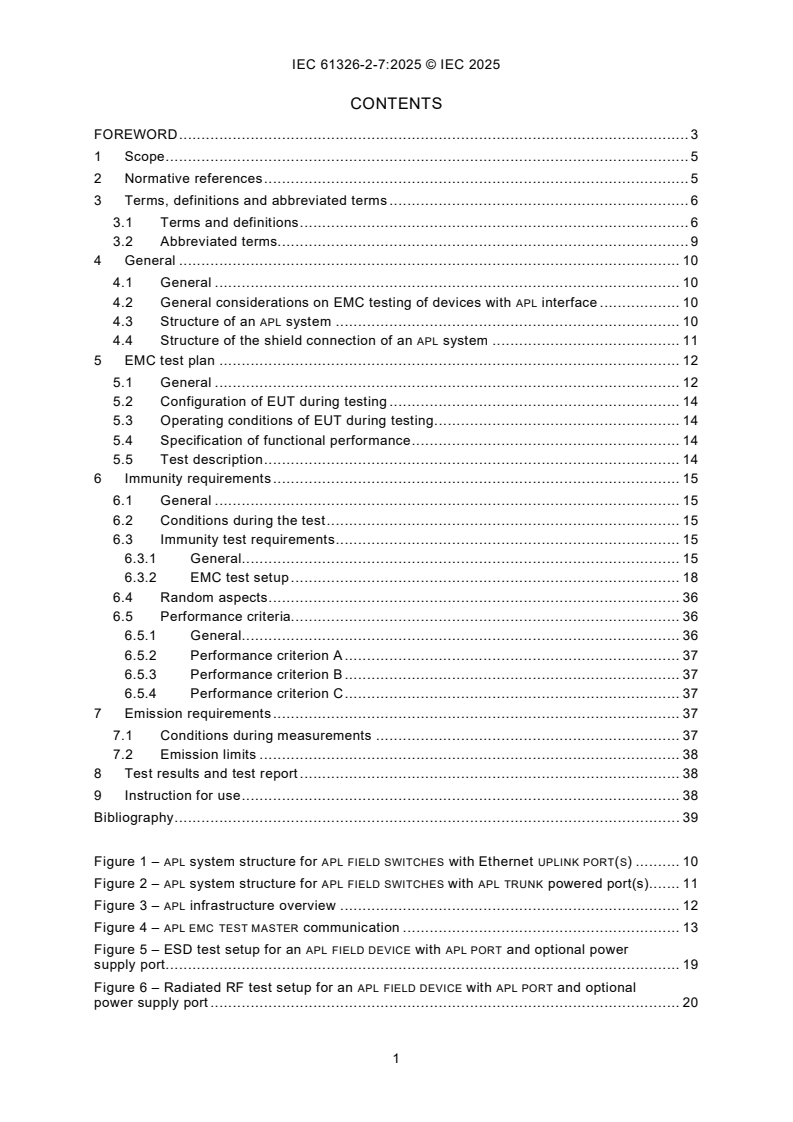
CONTENTS
FOREWORD . 3
1 Scope . 5
2 Normative references . 5
3 Terms, definitions and abbreviated terms . 6
3.1 Terms and definitions . 6
3.2 Abbreviated terms. 9
4 General . 10
4.1 General . 10
4.2 General considerations on EMC testing of devices with APL interface . 10
4.3 Structure of an APL system . 10
4.4 Structure of the shield connection of an APL system . 11
5 EMC test plan . 12
5.1 General . 12
5.2 Configuration of EUT during testing . 14
5.3 Operating conditions of EUT during testing . 14
5.4 Specification of functional performance . 14
5.5 Test description . 14
6 Immunity requirements . 15
6.1 General . 15
6.2 Conditions during the test . 15
6.3 Immunity test requirements . 15
6.3.1 General. 15
6.3.2 EMC test setup . 18
6.4 Random aspects . 36
6.5 Performance criteria. 36
6.5.1 General. 36
6.5.2 Performance criterion A . 37
6.5.3 Performance criterion B . 37
6.5.4 Performance criterion C . 37
7 Emission requirements . 37
7.1 Conditions during measurements . 37
7.2 Emission limits . 38
8 Test results and test report . 38
9 Instruction for use . 38
Bibliography . 39
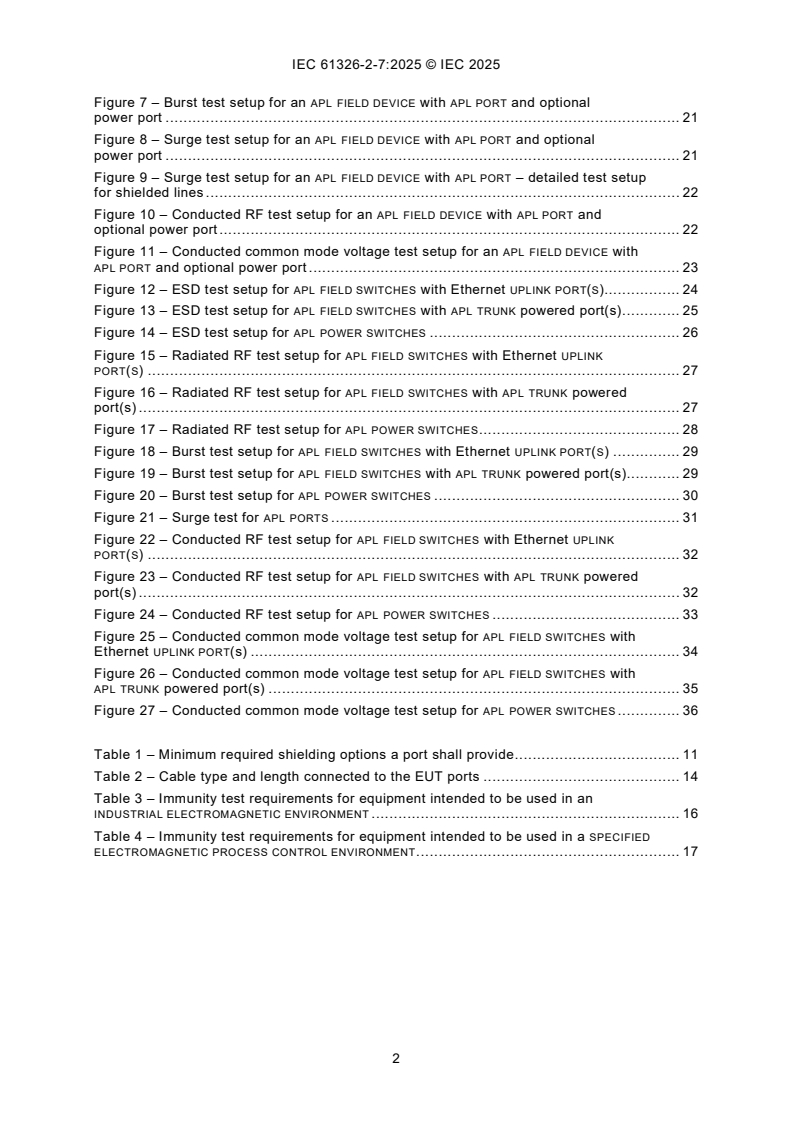
Figure 1 – APL system structure for APL FIELD SWITCHES with Ethernet UPLINK PORT(S) . 10
Figure 2 – APL system structure for APL FIELD SWITCHES with APL TRUNK powered port(s). 11
Figure 3 – APL infrastructure overview . 12
Figure 4 – APL EMC TEST MASTER communication . 13
Figure 5 – ESD test setup for an APL FIELD DEVICE with APL PORT and optional power
supply port . 19
Figure 6 – Radiated RF test setup for an APL FIELD DEVICE with APL PORT and optional
power supply port . 20
Figure 7 – Burst test setup for an APL FIELD DEVICE with APL PORT and optional
power port . 21
Figure 8 – Surge test setup for an APL FIELD DEVICE with APL PORT and optional
power port . 21
Figure 9 – Surge test setup for an APL FIELD DEVICE with APL PORT – detailed test setup
for shielded lines . 22
Figure 10 – Conducted RF test setup for an APL FIELD DEVICE with APL PORT and
optional power port . 22
Figure 11 – Conducted common mode voltage test setup for an APL FIELD DEVICE with
APL PORT and optional power port . 23
Figure 12 – ESD test setup for APL FIELD SWITCHES with Ethernet UPLINK PORT(S). 24
Figure 13 – ESD test setup for APL FIELD SWITCHES with APL TRUNK powered port(s) . 25
Figure 14 – ESD test setup for APL POWER SWITCHES . 26
Figure 15 – Radiated RF test setup for APL FIELD SWITCHES with Ethernet UPLINK
PORT(S) . 27
Figure 16 – Radiated RF test setup for APL FIELD SWITCHES with APL TRUNK powered
port(s) . 27
Figure 17 – Radiated RF test setup for APL POWER SWITCHES . 28
Figure 18 – Burst test setup for APL FIELD SWITCHES with Ethernet UPLINK PORT(S) . 29
Figure 19 – Burst test setup for APL FIELD SWITCHES with APL TRUNK powered port(s). 29
Figure 20 – Burst test setup for APL POWER SWITCHES . 30
Figure 21 – Surge test for APL PORTS . 31
Figure 22 – Conducted RF test setup for APL FIELD SWITCHES with Ethernet UPLINK
PORT(S) . 32
Figure 23 – Conducted RF test setup for APL FIELD SWITCHES with APL TRUNK powered
port(s) . 32
Figure 24 – Conducted RF test setup for APL POWER SWITCHES . 33
Figure 25 – Conducted common mode voltage test setup for APL FIELD SWITCHES with
Ethernet UPLINK PORT(s) . 34
Figure 26 – Conducted common mode voltage test setup for APL FIELD SWITCHES with
APL TRUNK powered port(s) . 35
Figure 27 – Conducted common mode voltage test setup for APL POWER SWITCHES . 36
Table 1 – Minimum required shielding options a port shall provide . 11
Table 2 – Cable type and length connected to the EUT ports . 14
Table 3 – Immunity test requirements for equipment intended to be used in an
INDUSTRIAL ELECTROMAGNETIC ENVIRONMENT . 16
Table 4 – Immunity test requirements for equipment intended to be used in a SPECIFIED
ELECTROMAGNETIC PROCESS CONTROL ENVIRONMENT . 17
INTERNATIONAL ELECTROTECHNICAL COMMISSION
____________
Electrical equipment for measurement, control and laboratory use -
EMC requirements -
Part 2-7: Particular requirements - Test configurations, operational
conditions, test levels and performance criteria
for devices with Ethernet-APL interfaces
FOREWORD
1) The International Electrotechnical Commission (IEC) is a worldwide organization for standardization comprising
all national electrotechnical committees (IEC National Committees). The object of IEC is to promote international
co-operation on all questions concerning standardization in the electrical and electronic fields. To this end and
in addition to other activities, IEC publishes International Standards, Technical Specifications, Technical Reports,
Publicly Available Specifications (PAS) and Guides (hereafter referred to as “IEC Publication(s)”). Their
preparation is entrusted to technical committees; any IEC National Committee interested in the subject dealt with
may participate in this preparatory work. International, governmental and non-governmental organizations liaising
with the IEC also participate in this preparation. IEC collaborates closely with the International Organization for
Standardization (ISO) in accordance with conditions determined by agreement between the two organizations.
2) The formal decisions or agreements of IEC on technical matters express, as nearly as possible, an international
consensus of opinion on the relevant subjects since each technical committee has representation from all
interested IEC National Committees.
3) IEC Publications have the form of recommendations for international use and are accepted by IEC National
Committees in that sense. While all reasonable efforts are made to ensure that the technical content of IEC
Publications is accurate, IEC cannot be held responsible for the way in which they are used or for any
misinterpretation by any end user.
4) In order to promote international uniformity, IEC National Committees undertake to apply IEC Publications
transparently to the maximum extent possible in their national and regional publications. Any divergence between
any IEC Publication and the corresponding national or regional publication shall be clearly indicated in the latter.
5) IEC itself does not provide any attestation of conformity. Independent certification bodies provide conformity
assessment services and, in some areas, access to IEC marks of conformity. IEC is not responsible for any
services carried out by independent certification bodies.
6) All users should ensure that they have the latest edition of this publication.
7) No liability shall attach to IEC or its directors, employees, servants or agents including individual experts and
members of its technical committees and IEC National Committees for any personal injury, property damage or
other damage of any nature whatsoever, whether direct or indirect, or for costs (including legal fees) and
expenses arising out of the publication, use of, or reliance upon, this IEC Publication or any other IEC
Publications.
8) Attention is drawn to the Normative references cited in this publication. Use of the referenced publications is
indispensable for the correct application of this publication.
9) IEC draws attention to the possibility that the implementation of this document may involve the use of (a)
patent(s). IEC takes no position concerning the evidence, validity or applicability of any claimed patent rights in
respect thereof. As of the date of publication of this document, IEC had not received notice of (a) patent(s), which
may be required to implement this document. However, implementers are cautioned that this may not represent
the latest information, which may be obtained from the patent database available at https://patents.iec.ch. IEC
shall not be held responsible for identifying any or all such patent rights.
IEC 61326-2-7 has been prepared by subcommittee 65A: System aspects, of IEC technical
committee 65: Industrial-process measurement, control and automation. It is an International
Standard.
The text of this International Standard is based on the following documents:
Draft Report on voting
65A/1190/FDIS 65A/1196/RVD
Full information on the voting for its approval can be found in the report on voting indicated in
the above table.
The language used for the development of this International Standard is English.
This document was drafted in accordance with ISO/IEC Directives, Part 2, and developed in
accordance with ISO/IEC Directives, Part 1 and ISO/IEC Directives, IEC Supplement, available
at www.iec.ch/members_experts/refdocs. The main document types developed by IEC are
described in greater detail at www.iec.ch/publications.
Words in SMALL CAPITALS in the text are defined in Clause 3.
A list of all parts of the IEC 61326 series, under the general title Electrical equipment for
measurement, control and laboratory use - EMC requirements, can be found on the IEC website.
The committee has decided that the contents of this document will remain unchanged until the
stability date indicated on the IEC website under webstore.iec.ch in the data related to the
specific document. At this date, the document will be
– reconfirmed,
– withdrawn, or
– revised.
1 Scope
In addition to the requirements of IEC 61326-1, this part of IEC 61326 specifies the EMC test
requirements for process automation equipment using at least one Ethernet-APL (Ethernet
ADVANCED PHYSICAL LAYER) compliant port according IEC TS 63444. The type of equipment
covered by this document includes INFRASTRUCTURE DEVICES such as switches as well as
measurement and control devices. This document provides requirements for the EMC test
setups of the APL interface for devices intended for use in process control and process
measurement.
The other functions of the equipment remain covered by other parts of the IEC 61326 series.
NOTE Ethernet-APL uses IEEE Std. 802.3-2022 Ethernet Physical Layer 10BASE-T1L, suitable to be used for full-
duplex communication over a single balanced pair of conductors.
The test levels are based on the intended environment as stated in the product’s specification
or user documentation and selected appropriately from IEC 61326-1.
2 Normative references
The following documents are referred to in the text in such a way that some or all of their content
constitutes requirements of this document. For dated references, only the edition cited applies.
For undated references, the latest edition of the referenced document (including any
amendments) applies.
IEC 60050-161:1990, International Electrotechnical Vocabulary (IEV) - Part 161:
Electromagnetic compatibility
IEC 61000-3-2, Electromagnetic compatibility (EMC) - Part 3-2: Limits - Limits for harmonic
current emissions (equipment input current ≤16 A per phase)
IEC 61000-3-3, Electromagnetic compatibility (EMC) - Part 3-3: Limits - Limitation of voltage
changes, voltage fluctuations and flicker in public low-voltage supply systems, for equipment
with rated current ≤16 A per phase and not subject to conditional connection
IEC 61000-3-11, Electromagnetic compatibility (EMC) - Part 3-11: Limits - Limitation of voltage
changes, voltage fluctuations and flicker in public low-voltage supply systems - Equipment with
rated current ≤ 75 A and subject to conditional connection
IEC 61000-3-12, Electromagnetic compatibility (EMC) - Part 3-12: Limits - Limits for harmonic
currents produced by equipment connected to public low-voltage systems with input current >16
A and ≤ 75 A per phase
IEC 61000-4-2:2025, Electromagnetic compatibility (EMC) - Part 4-2: Testing and measurement
techniques - Electrostatic discharge immunity test
IEC 61000-4-3:2020, Electromagnetic compatibility (EMC) - Part 4-3: Testing and measurement
techniques - Radiated, radio-frequency, electromagnetic field immunity test
IEC 61000-4-4:2012, Electromagnetic compatibility (EMC) - Part 4-4: Testing and measurement
techniques - Electrical fast transient/burst immunity test
IEC 61000-4-5:2014, Electromagnetic compatibility (EMC) - Part 4-5: Testing and measurement
techniques - Surge immunity test
IEC 61000-4-6:2023, Electromagnetic compatibility (EMC) - Part 4-6: Testing and measurement
techniques - Immunity to conducted disturbances, induced by radio-frequency fields
IEC 61000-4-8:2009, Electromagnetic compatibility (EMC) - Part 4-8: Testing and measurement
techniques - Power frequency magnetic field immunity test
IEC 61000-4-11:2020, Electromagnetic compatibility (EMC) - Part 4-11: Testing and
measurement techniques - Voltage dips, short interruptions and voltage variations immunity
tests for equipment with input current up to 16 A per phase
IEC 61000-4-16:2015, Electromagnetic compatibility (EMC) - Part 4-16: Testing and
measurement techniques - Test for immunity to conducted, common mode disturbances in the
frequency range 0 Hz to 150 kHz
IEC 61000-4-29:2000, Electromagnetic compatibility (EMC) - Part 4-29: Testing and
measurement techniques - Voltage dips, short interruptions and voltage variations on d.c. input
power port immunity tests
IEC 61326-1:2020, Electrical equipment for measurement, control and laboratory use - EMC
requirements - Part 1: General requirements
IEC TS 63444:2023, Industrial networks - Ethernet-APL port profile specification
CISPR 11:2024, Industrial, scientific and medical equipment - Radio-frequency disturbance
characteristics - Limits and methods of measurement
IEEE Std 802.3-2022, IEEE Standard for Ethernet
3 Terms, definitions and abbreviated terms
3.1 Terms and definitions
For the purposes of this document, the terms and definitions given in IEC 60050-161 and the
following apply.
ISO and IEC maintain terminology databases for use in standardization at the following
addresses:
– IEC Electropedia: available at https://www.electropedia.org/
– ISO Online browsing platform: available at https://www.iso.org/obp
3.1.1
advanced physical layer
APL
physical layer, specified in IEC TS 63444, based on 10BASE-T1L according to
IEEE Std 802.3-2022 with additional optional features like intrinsic safety, power over 2 wires
3.1.2
APL EMC test master
device used for testing the communication as well as for testing the process date integrity of a
FIELD DEVICE
Note 1 to entry: It is providing an Ethernet port, which can be directly connected to the EUT or connected to the
EUT using an APL FIELD SWITCH or APL POWER SWITCH. Additionally, the APL EMC TEST MASTER will provide at least one
failure output to indicate a disturbed communication.
3.1.3
APL field device
device with one SPUR load port which sends or receives process values
Note 1 to entry: In addition, it can have an optional power supply port.
3.1.4
APL segment
segment that consists of two F ports, each containing a 10BASE-T1L compatible PHY,
connected at each end of a two-wire, shielded cable
Note 1 to entry: An APL SEGMENT can optionally be equipped with a maximum of two AUXILIARY DEVICES and can
contain up to 10 inline terminal CONNECTIONS. An AUXILIARY DEVICE corresponds to one inline CONNECTION; for
example, having two AUXILIARY DEVICES connected to one APL SEGMENT will reduce the number of inline CONNECTIONS
by two.
Note 2 to entry: An APL SEGMENT is either a TRUNK or a SPUR.
3.1.5
APL switch
Ethernet switch including at least one APL compliant port
3.1.6
APL port
electrical and mechanical interface of a device to an APL SEGMENT
3.1.7
auxiliary device
device that is connected within an APL SEGMENT and does not include a 10BASE-T1L PHY, e.g.
it could comprise a power load or introduce communication signal insertion losses
Note 1 to entry: A surge protector is an example of an AUXILIARY DEVICE.
3.1.8
connection
inline connection
mated device or combination of devices used to connect cables or cable elements to other
cables or application specific equipment
3.1.9
cascade port
APL PORT used in powered daisy chain networks
Note 1 to entry: If the CASCADE PORT is used in a powered ring network, it shall be either a power source port or a
power load port depending on the status of the ring.
3.1.10
degradation (in performance)
undesired departure in the operational performance of any device, equipment or system from
its intended performance
Note 1 to entry: The term "DEGRADATION" can apply to temporary or permanent failure.
[SOURCE: IEC 60050-161:1990, 161-01-19]
3.1.11
field switch
APL SWITCH having at least one port to which a SPUR can be connected
3.1.12
infrastructure device
SPUR port and at least one ethernet UPLINK PORT
device with at least one
3.1.13
industrial electromagnetic environment
environment existing at locations characterized by a separate power network, in most cases
supplied from a high- or medium-voltage transformer, dedicated for the supply of installations
feeding manufacturing or similar plants with one or more of the following conditions:
– frequent switching of heavy inductive or capacitive loads,
– high currents and associated magnetic fields,
– presence of Industrial, Scientific and Medical (ISM) equipment (for example, welding
machines)
3.1.14
laboratory
test and measurement area that is specifically used for analysis, testing and servicing and
where equipment is operated by trained personnel
3.1.15
loss of function
operation of equipment with one (or more) of the equipment’s functions unusable
3.1.16
performance level
specified operation of equipment under conditions of intended use
3.1.17
long-distance line
line within a building which are longer than 30 m, or which leave the building (including lines of
outdoor installations)
3.1.18
loss of performance
operation of equipment outside a specified PERFORMANCE LEVEL
3.1.19
PHY
physical layer circuitry required to implement physical layer functions
3.1.20
power switch
switch including at least one port feeding power into a TRUNK
3.1.21
specified electromagnetic process control environment
environments encompassed both indoor and outdoor, that are based on the requirements of the
process industry, specifically chemical/petrochemical/pharmaceutical manufacturing plants
EXAMPLE The difference between this electromagnetic environment compared to the general industrial
environment (see 3.1.13) is due to the mitigation measures employed against electromagnetic phenomena leading
to a specified electromagnetic environment with test values that have been proven in practice to gain high availability.
The environment of industrial application with a specified electromagnetic environment typically includes the
following characteristics:
– industrial area with limited access,
– limited use of mobile transmitters,
– dedicated cables for power supply and control, signal or communication lines,
– separation between power supply and control, signal or communication cables,
– factory building mostly consisting of metal construction,
– overvoltage/lightning protection by appropriate measures (for example, metal construction of the building or use
of protection devices),
– pipe heating systems driven by AC main power,
– no high-voltage substation close to sensitive areas,
– presence of CISPR 11 Group 2 ISM equipment using ISM frequencies only with low power,
– competent staff,
– periodical maintenance of equipment and systems,
– mounting and installation guidelines for equipment and systems.
3.1.22
spur
APL SEGMENT which connects a field device to a FIELD SWITCH
Note 1 to entry: An APL SPUR segment can have a maximum cable length of 200 m.
Note 2 to entry: An APL SPUR segment can optionally be equipped with a maximum of two AUXILIARY DEVICES and
up to four inline terminal CONNECTIONS.
3.1.23
trunk
APL SEGMENT which connects a POWER SWITCH to a FIELD SWITCH or a FIELD SWITCH to a FIELD
SWITCH
Note 1 to entry: An APL TRUNK segment can have a maximum cable length of 1 000 m.
Note 2 to entry: An APL TRUNK segment can optionally be equipped with a maximum of two AUXILIARY DEVICES and
up to 10 inline terminal CONNECTIONS.
3.1.24
uplink port
ethernet port of an APL INFRASTRUCTURE DEVICE used for CONNECTION to the Ethernet network
3.2 Abbreviated terms
AE auxiliary equipment
APL advanced physical layer
CCC capacitive coupling clamp
CDN coupling/decoupling network
CN coupling network
EMC electromagnetic compatibility
ESD electrostatic discharge
EUT equipment under test
FIELD DEVICE
FD
HCP horizontal coupling plate
GRP ground reference plate
ICMP internet control message protocol
IP internet protocol
RF radio frequency
4 General
4.1 General
This document specifies the requirements and test setups for testing APL infrastructure and
FIELD DEVICES.
4.2 General considerations on EMC testing of devices with APL interface
The following general rules apply when testing APL devices:
– EMC testing of INFRASTRUCTURE DEVICES and field devices with APL interface is based on the
IEC 61326 series.
– Test levels and test requirements for industrial environments are provided in Table 3 of this
document. These levels are the minimum requirements for EMC testing for an APL device.
– For processing industry environments, such as chemical/petrochemical/pharmaceutical
manufacturing plants, additional tests can be required. The higher test levels required for
these environments are provided in Table 4 of this document.
All tests may either be performed on a single EUT or the tests may be split between several
EUTs. In the latter case, each test result shall be traceable to the tested EUT. The testing
sequence with multiple EUTs is optional.
4.3 Structure of an APL system
APL allows different system configurations, using 10/100/1 000 Mbit/s Ethernet network
CONNECTIONS with powered APL TRUNKS.
Figure 1 illustrates an example of an APL network connected to a control network using an
Ethernet network. In such a case, the 10/100/1 000 MBit/s Ethernet backbone is directly
connected to the APL FIELD SWITCHES. For an Ethernet network, an APL system also supports
redundant ring topologies.
Key
FD APL FIELD DEVICE
a
In case of a ring topology
Figure 1 – APL system structure for APL FIELD SWITCHES with Ethernet UPLINK PORT(S)
Figure 2 illustrates an example of an APL network connected to a control network using a
powered APL TRUNK. The communication link between the control network and the APL SEGMENT
is performed through an APL POWER SWITCH, which additionally powers the APL TRUNK. For a
powered APL TRUNK, an APL system currently does not support redundant ring topologies.
Key
FD APL FIELD DEVICE
Figure 2 – APL system structure for APL FIELD SWITCHES with APL TRUNK powered port(s)
Each APL SPUR finally terminates at a FIELD DEVICE, which can also be powered in accordance
with the applicable hazardous area classification, so that FIELD DEVICES, which will typically be
intrinsically safe certified, can be located in an appropriately assessed hazardous area.
Each TRUNK cable length can be up to 1 000 m long, depending on the type of the cable used,
the power loss through the cable and the power consumption of the components connected to
the TRUNK. The SPUR cable length can be up to 200 m, depending on the type of the cable used.
4.4 Structure of the shield connection of an APL system
The Ethernet- APL PORT profile specification specifies required shielding options depending on
the type of port (see Table 1). While it is recommended to make a low impedance connection
to the equipotential bonding system at both ends of a cable shield to guarantee the highest
rejection of electromagnetic disturbances, in some installations this can not be practical or could
lead to current loops. For this kind of installations, one end of the cable shall be capacitively
grounded and the other end shall be directly grounded.
Table 1 – Minimum required shielding options a port shall provide
Port class Segment class
TRUNK SPUR
P Power source Direct Capacitive
L Power load Capacitive and direct Direct
C CASCADE PORT Capacitive and direct Not applicable
Key
P power source
L power load
C CASCADE PORT power source
P
C CASCADE PORT power load
L
NOTE 1 If the equipotential bonding system is controlled and equalized, direct shield grounding on both sides can
be used.
NOTE 2 A C port is a CASCADE PORT operating as a source port, a C port is a CASCADE PORT operating as a power
p L
load port.
Figure 3 – APL infrastructure overview
5 EMC test plan
5.1 General
EMC tests of EUTs (APL INFRASTRUCTURE DEVICES and FIELD DEVICES) shall be applied using an
APL EMC TEST MASTER in combination with an APL FIELD SWITCH or APL POWER SWITCH, depending
on which EUT type is tested. Specific test setups for the different EUT types are provided in
6.3.2.
The APL EMC TEST MASTER shall provide an Ethernet port, which can be directly connected to the
EUT or connected to the EUT using an APL FIELD SWITCH or APL POWER SWITCH. Additionally, the
APL EMC TEST MASTER shall provide at least one failure output to indicate a disturbed
communication. Failure criteria for activating the failure output are provided in 6.5.
The APL EMC TEST MASTER may be used for testing the communication as well as for testing the
process data integrity of a FIELD DEVICE. Alternatively, two APL EMC TEST MASTERS may be used:
one for testing the communication and the second for testing the process data integrity.
To test communication, the APL EMC TEST MASTER shall continuously send ICMP ping request
packets to an IP-capable EUT and AUXILIARY EQUIPMENT devices (e.g. FIELD DEVICES or FIELD
SWITCHES) connected to the EUT to verify whether communication to these devices is valid or
disturbed. All connected APL communication ports of the EUT shall carry ICMP packets during
testing.
Figure 4 shows an example how the APL EMC TEST MASTER communicates with the EUT and the
AUXILIARY DEVICES sending ICMP ping request packets and receiving ICMP ping response
packets to check whether the communication links are active and continue to provide valid
communication during the EMC tests.
Key
Dashed lines:
ICMP ping request packets sent from APL test master to EUT and AUXILIARY DEVICES
ICMP ping response packets returned from EUT and AUXILIARY DEVICES to APL test master
Figure 4 – APL EMC TEST MASTER communication
The IPv4 ICMP ping request packets issued by the APL EMC TEST MASTER shall have a payload
data length of 1 472 bytes communicating with the EUT and each AUXILIARY DEVICE with a cycle
time of 16 ms (± 2 ms). The EUT and each AUXILIARY DEVICE shall respond with an IPv4 ICMP
response packet with a payload length of 1 472 bytes. This causes a link utilisation of minimum
7,6 %. If an alternative protocol is used, the same minimum link utilisation shall be reached.
The data packets should be equally distributed over time. If the minimum link utilisation cannot
be achieved, the test time or number of test events should be extended for all transient tests to
have the same statistical possibility to disturb the communication signal.
An IPv4 ICMP packet with a payload data length of 1 472 bytes results in the maximum allowed
Ethernet packet size of 1 518 bytes including Ethernet header and frame check sequence. For
IPv6 packets, the ICMP packet payload data length shall be reduced to 1 452 bytes, as the IPv6
IP header is 20 bytes longer than the IPv4 IP header.
In case a high number of AUXILIARY DEVICES (typically more than 10 to 12 devices) is used within
the EMC test setup, it can be necessary to reduce the ICMP packet length to get a link utilization
of less than 100 % for the APL EMC TEST MASTER. In such a case, reducing the ICMP packet
length complies with this specification.
For APL FIELD DEVICES, in addition to the ICMP ping packets, it is necessary to exchange
measurement or control data in a cyclic manner during the EMC tests. For this data exchange,
standard communication protocols may be used and shall be specified in the test plan.
An EMC test plan shall be established prior to testing. At a minimum, it shall contain the
elements specified in 5.2 to 5.5.
5.2 Configuration of EUT during testing
APL devices often are used in systems with no fixed configuration. Thus, it is reasonable to test
only a subset of possible arrangements.
To realistically simulate EMC conditions (related both to emission and immunity), the equipment
assembly shall represent a typical installation as specified by the manufacturer. Such tests shall
be carried out as type tests under normal conditions as specified in the test plan.
The detailed test setup during the EMC test shall be documented.
5.3 Operating conditions of EUT during testing
The EUT shall be used in normal operation. The estimated worst-case operating mode for
normal operation shall be selected.
5.4 Specification of functional performance
For immunity tests, the functional performance for each test shall be specified, where possible,
as quantitative values (e.g. communication error rate or allowed measurement tolerances).
5.5 Test description
Each test to be applied shall be specified in the EMC test plan. The description of the tests, the
test methods, the characteristics of the tests, and the test setups are given in the basic
standards, which are referred to in 6.2 and Clause 7. Additional information needed for the
practical implementation of the tests is given in this document. It is not necessary to reproduce
the contents of the referenced standards in the test plan. Where necessary, the EMC test plan
shall specify the application in detail.
The cable configurations in Table 2 shall apply for all test setups specified in 6.2 and Clause 7.
Table 2 – Cable type and length connected to the EUT ports
Port type Cable type, length
a
Ethernet port
CAT 6A S/FTP Ethernet cable, 20 m
Power supply Adequate cable type and length
a
APL TRUNK
IEC TS 63444 AWG 18 fieldbus cable, 20 m
a
APL SPUR
IEC TS 63444 AWG 18 fieldbus cable, 20 m
NOTE Instead of a cable defined in IEC TS 63444, an SPE cable in accordance with IEC 61156-13 can be used.
a
Background for these requirements is that a cable length of 20 m, especially if wound as 50 cm (± 5 cm) cable
coils, can be easily handled in EMC lab environments and be used for all the different test scenarios (including
surge test). By specifying a unified cable length for all APL-specific EMC tests, the test results between different
EMC test labs are expected to be better comparable.
If an EUT port provides both direct and capacitive shield grounding options, the correct
behaviour of the EUT shall be tested for both options.
IF the EUT provides only one port of a specific type (e.g. APL TRUNK port or APL SPUR port), the
tests shall be applied sequentially using the different shield grounding options.
If the EUT provides more than one port of a specific type, test efforts may be reduced by setting
up one port using direct shield grounding and another port of the same specific type using
capacitive shield grounding. For example, testing a FIELD SWITCH with at least two APL TRUNK
ports and at least two APL SPUR ports, a test setup can use one APL TRUNK port with direct shield
grounding, one APL TRUNK port with capacitive shield grounding, one APL SPUR port with direct
shield grounding and one APL SPUR port with capacitive shield grounding being configured.
The connection of the shield grounding for the AE (auxiliary equipment) used with a FIELD
SWITCH as an EUT shall be selected according to the test plan. See Figure 3. For other APL
devices (e.g. FIELD DEVICES), it shall be done according to Figure 3.
If the EUT has a DC power port, the EMC test setup shall be supplied by an isolated power
supply or a battery. There shall be no connection of the output of the power supply or battery
to ground. If the EUT has an AC power port, the EMC test setup shall be supplied directly from
the mains or from a power source that is not isolated from ground.
6 Immunity requirements
6.1 General
This clause specifies the immunity test requirements for APL infrastructure and FIELD DEVICES,
the conditions during the test and the given immunity test levels for the expected EMC
environment.
6.2 Conditions during the test
The configuration of the EUT and the modes of operation used during the execution of each
test shall be precisely noted in the test report. The tests shall be performed in accordance with
the basic standards listed in the relevant table for one phenomenon at a time. If additional test
conditions or configurations not described in the basic standards are required, these conditions
or configurations, and their rationale, shall be documented in the test report.
6.3 Immunity test requirements
6.3.1 General
The minimum immunity requirements for equipment intended to be used in an INDUSTRIAL
ELECTROMAGNETIC ENVIRONMENT are given in Table 3.
If required, Table 4 gives the immunity requirements for equipment intended to be used in a
SPECIFIED ELECTROMAGNETIC PROCESS CONTROL environment like
chemical/petrochemical/pharmaceutical manufacturing plants.
The performance criteria A, B and C that are mentioned in the following tables are specified in
6.5.
Table 3 – Immunity test requirements for equipment intended to be used in an
INDUSTRIAL ELECTROMAGNETIC ENVIRONMENT
Performance
Port Phenomenon Basic standard Test value
criterion
ENCLOSURE ESD IEC 61000-4-2 ± 4 kV contact discharge B
± 8 kV air discharge B
Electromagnetic field IEC 61000-4-3 10 V/m (80 MHz to 1 GHz) A
a
A
3 V/m (1,4 GHz to 6 GHz)
Power-frequency magnetic IEC 61000-4-8 30 A/m (50 Hz, 60 Hz) A
b
field
AC power Burst IEC 61000-4-4 ± 2 kV (5 kHz or 100 kHz) B
(including
Surge IEC 61000-4-5 ± 1 kV line-to-line B
protective earth)
± 2 kV line-to-ground B
Conducted RF IEC 61000-4-6 3 V (150 kHz to 80 MHz) A
See NOTE
Voltage dip IEC 61000-4-11 0 % during 1 cycle B
c
C
40 % during 10/12 cycles
c C
70 % during 25/30 cycles
c
Short interruptions IEC 61000-4-11 C
0 % during 250/300 cycles
d, e
Burst IEC 61000-4-4 ± 2 kV (5 kHz or 100 kHz) B
DC power
(including Surge IEC 61000-4-5 ± 1 kV line-to-line B
protective earth)
± 2 kV line-to-ground B
Conducted RF IEC 61000-4-6 3 V (150 kHz to 80 MHz) A
See NOTE
d
I/O signal / IEC 61000-4-4 ± 1 kV (5 kHz or 100 kHz) B
Burst
e, g
control / APL
f
IEC 61000-4-5 ± 1 kV line-to-ground B
Surge
(including
d
IEC 61000-4-6 3 V (150 kHz to 80 MHz) A
Conducted RF
functional earth)
See NOTE
d
I/O signal / IEC 61000-4-4 ± 2 kV (5 kHz or 100 kHz) B
Burst
e
control
f
IEC 61000-4-5 ± 1 kV line-to-line B
Surge
(connected
± 2 kV line-to-ground B
directly to mains
d
supply) IEC 61000-4-6 3 V (150 kHz to 80 MHz) A
Conducted RF
See NOTE
NOTE Equipment considered in this table is typically used in industrial installations with the cabling arranged on
metallic structures. This reduces coupling of electromagnetic fields into cables and hence justifies a lower immunity
level compared to that given in the generic immunity standard IEC 61000-6-2. The level of 3 V has been used for
more than 15 years without immunity issues and hence is considered to be sufficient.
a
In case testing is performed also in the frequency range from 1 GHz to 1,4 GHz, the same test level as above
1,4 GHz is recommended.
b
On
...