

IEC 60335-2-40:2002/AMD1:2005
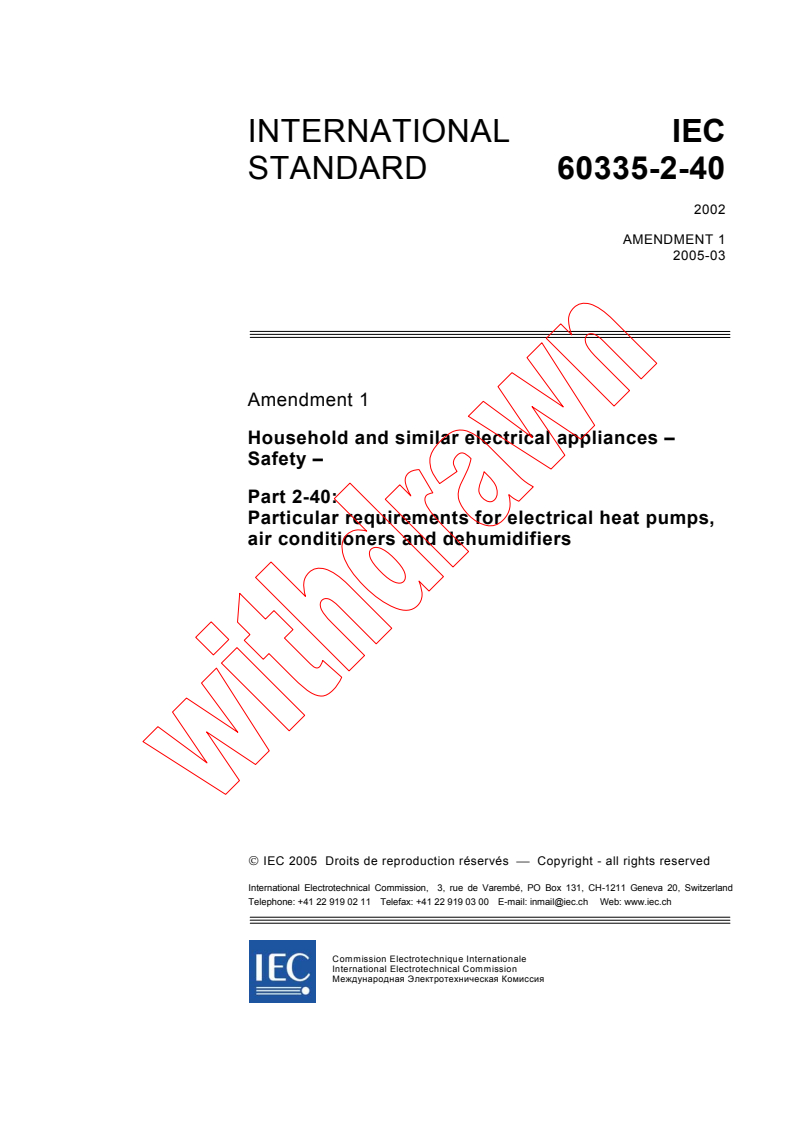
(Amendment)Amendment 1 - Household and similar electrical appliances - Safety - Part 2-40: Particular requirements for electrical heat pumps, air-conditioners and dehumidifiers
General Information
- Abstract
- Status
- Published
- Publication Date
- 23-Mar-2005
- Technical Committee
- SC 61D - Appliances for air-conditioning for household and similar purposes
- Current Stage
- DELPUB - Deleted Publication
- Start Date
- 03-Dec-2013
- Completion Date
- 28-Aug-2026
Buy Documents
IEC 60335-2-40:2002/AMD1:2005 - Amendment 1 - Household and similar electrical appliances - Safety - Part 2-40: Particular requirements for electrical heat pumps, air-conditioners and dehumidifiers Released:3/24/2005
IEC 60335-2-40:2002/AMD1:2005 - Amendment 1 - Household and similar electrical appliances - Safety - Part 2-40: Particular requirements for electrical heat pumps, air-conditioners and dehumidifiers Released:3/24/2005
Overview
IEC 60335-2-40:2002/AMD1:2005 (Amendment 1) updates the household‑appliance safety standard for electrical heat pumps, air‑conditioners and dehumidifiers, with specific emphasis on the safe use of flammable refrigerants. The amendment adds new normative and informative annexes, new definitions (including “flammable refrigerant” = ANSI/ASHRAE 34 class A2/A3), and technical requirements for construction, testing, marking, service and transport when flammable refrigerants are employed.
Key topics and requirements
- Flammable refrigerants allowed: The standard explicitly covers appliances using refrigerants classified A2 or A3 (ANSI/ASHRAE 34).
- New annexes (BB–GG):
- Annex BB – selected refrigerant data (auto‑ignition, LFL, density)
- Annex CC – transport, marking and storage guidance
- Annex DD – required service and installation information
- Annex EE – pressure tests (mechanical strength)
- Annex FF – leak simulation tests
- Annex GG – charge limits, ventilation requirements and secondary circuit rules
- Marking and instructions:
- Flame and manual symbols must be visible for appliances using flammable refrigerants.
- Minimum symbol heights specified (service/manual symbols: at least 10 mm; flame caution triangle: at least 30 mm).
- Service ports must be marked with refrigerant type; maximum allowable pressures for low‑ and high‑pressure sides must be stated.
- Construction and components:
- Refrigerant tubing must be protected/enclosed against mechanical damage.
- Low‑temperature solder alloys are not acceptable for flammable refrigerant pipe connections.
- Total refrigerant charge limits defined in Annex GG; designs must prevent refrigerant accumulation near ignition sources.
- Surface temperatures must be below the refrigerant auto‑ignition temperature reduced by 100 K (verified during tests).
- Electrical components that could be ignition sources must comply with IEC 60079‑15 / IEC 60079‑14 provisions or be located/enclosed to prevent flammable gas accumulation.
- Testing and service:
- Clause 21 and new annexes require pressure testing and leak simulation; tests may be carried out on separate samples and require temperature and pressure measurements.
- Appliances using flammable refrigerants are to be charged at the manufacturing site or per manufacturer’s instructions; onsite brazing rules and prohibitions on certain reusable connectors indoors are specified.
Applications and users
This amendment is essential for:
- Manufacturers of household heat pumps, air‑conditioners and dehumidifiers who intend to use low‑GWP but flammable refrigerants.
- Test laboratories and conformity assessors performing safety, pressure and leak tests.
- Installation and service technicians who must follow marking, charging and jointing rules.
- Regulatory bodies and compliance teams aligning product design with safety and transport rules.
Related standards (normative references)
The amendment cross‑references and integrates requirements from:
- IEC 60079‑14, IEC 60079‑15 (explosive atmospheres)
- ISO 5149 (refrigerating system safety)
- ISO 817 / ANSI/ASHRAE 34 (refrigerant designation/classification)
- ISO 3864 / ISO 7000 (safety signs and symbols)
Keywords: IEC 60335-2-40 Amendment 1, electrical heat pumps safety, air-conditioner safety, dehumidifier standard, flammable refrigerant requirements, pressure tests, leak simulation, marking and service instructions.
Relations
- Effective Date
- 05-Sep-2023
- Effective Date
- 05-Sep-2023
- Effective Date
- 05-Sep-2023
Buy Documents
IEC 60335-2-40:2002/AMD1:2005 - Amendment 1 - Household and similar electrical appliances - Safety - Part 2-40: Particular requirements for electrical heat pumps, air-conditioners and dehumidifiers Released:3/24/2005
IEC 60335-2-40:2002/AMD1:2005 - Amendment 1 - Household and similar electrical appliances - Safety - Part 2-40: Particular requirements for electrical heat pumps, air-conditioners and dehumidifiers Released:3/24/2005
Get Certified
Connect with accredited certification bodies for this standard

Institut za varilstvo d.o.o. (Welding Institute)
Slovenia's leading welding institute since 1952. ISO 3834, EN 1090, pressure equipment certification, NDT personnel, welder qualification. Only IIW Au
Sponsored listings
Frequently Asked Questions
IEC 60335-2-40:2002/AMD1:2005 is a standard published by the International Electrotechnical Commission (IEC). Its full title is "Amendment 1 - Household and similar electrical appliances - Safety - Part 2-40: Particular requirements for electrical heat pumps, air-conditioners and dehumidifiers". This standard covers: Amendment 1 - Household and similar electrical appliances - Safety - Part 2-40: Particular requirements for electrical heat pumps, air-conditioners and dehumidifiers
Amendment 1 - Household and similar electrical appliances - Safety - Part 2-40: Particular requirements for electrical heat pumps, air-conditioners and dehumidifiers
IEC 60335-2-40:2002/AMD1:2005 is classified under the following ICS (International Classification for Standards) categories: 23.120 - Ventilators. Fans. Air-conditioners. The ICS classification helps identify the subject area and facilitates finding related standards.
IEC 60335-2-40:2002/AMD1:2005 has the following relationships with other standards: It is inter standard links to IEC 60335-2-40:2002, IEC 60335-2-40:2002/AMD1:2005/COR1:2006, IEC 60335-2-40:2013. Understanding these relationships helps ensure you are using the most current and applicable version of the standard.
IEC 60335-2-40:2002/AMD1:2005 is available in PDF format for immediate download after purchase. The document can be added to your cart and obtained through the secure checkout process. Digital delivery ensures instant access to the complete standard document.
Standards Content (Sample)
INTERNATIONAL IEC
STANDARD 60335-2-40
AMENDMENT 1
–
2005-03
Amendment 1
Household and similar electrical appliances –
Safety –
Part 2-40:
Particular requirements for electrical heat pumps,
air conditioners and dehumidifiers
IEC 2005 Droits de reproduction réservés Copyright - all rights reserved
International Electrotechnical Commission, 3, rue de Varembé, PO Box 131, CH-1211 Geneva 20, Switzerland
Telephone: +41 22 919 02 11 Telefax: +41 22 919 03 00 E-mail: inmail@iec.ch Web: www.iec.ch
PRICE CODE
Commission Electrotechnique Internationale
U
International Electrotechnical Commission
Международная Электротехническая Комиссия
For price, see current catalogue
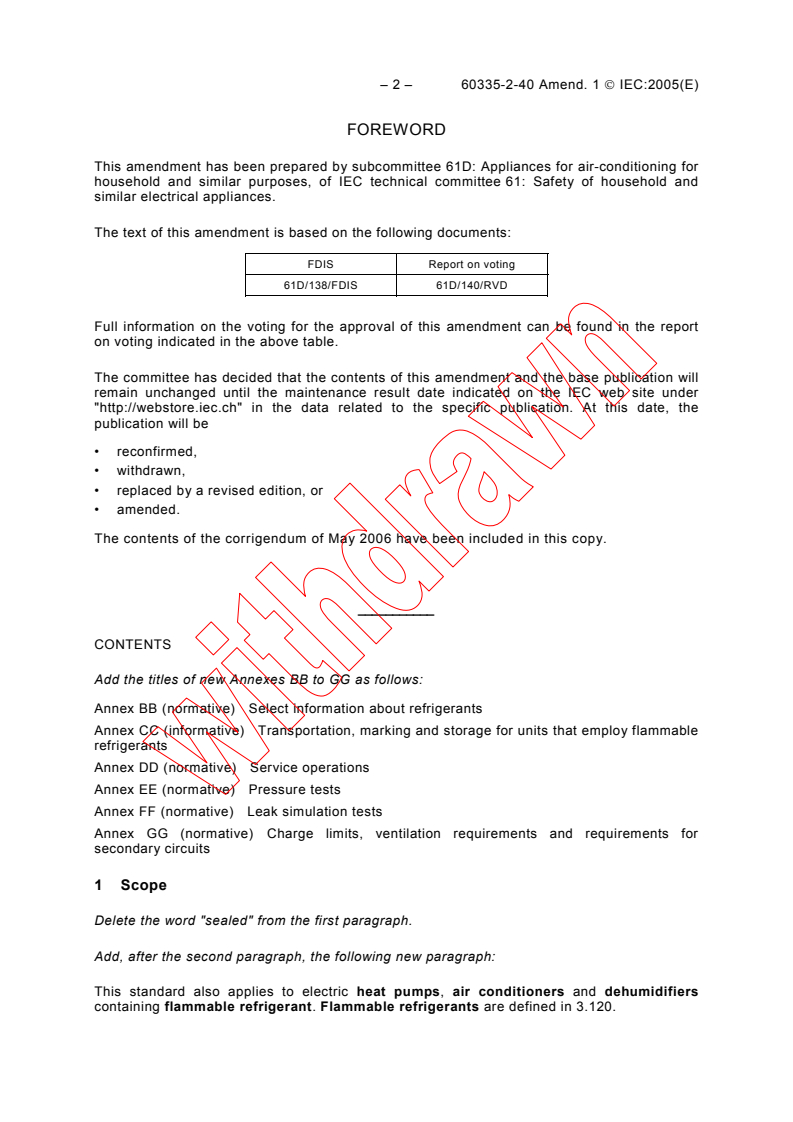
– 2 – 60335-2-40 Amend. 1 IEC:2005(E)
FOREWORD
This amendment has been prepared by subcommittee 61D: Appliances for air-conditioning for
household and similar purposes, of IEC technical committee 61: Safety of household and
similar electrical appliances.
The text of this amendment is based on the following documents:
FDIS Report on voting
61D/138/FDIS 61D/140/RVD
Full information on the voting for the approval of this amendment can be found in the report
on voting indicated in the above table.
The committee has decided that the contents of this amendment and the base publication will
remain unchanged until the maintenance result date indicated on the IEC web site under
"http://webstore.iec.ch" in the data related to the specific publication. At this date, the
publication will be
• reconfirmed,
• withdrawn,
• replaced by a revised edition, or
• amended.
The contents of the corrigendum of May 2006 have been included in this copy.
___________
CONTENTS
Add the titles of new Annexes BB to GG as follows:
Annex BB (normative) Select information about refrigerants
Annex CC (informative) Transportation, marking and storage for units that employ flammable
refrigerants
Annex DD (normative) Service operations
Annex EE (normative) Pressure tests
Annex FF (normative) Leak simulation tests
Annex GG (normative) Charge limits, ventilation requirements and requirements for
secondary circuits
1 Scope
Delete the word "sealed" from the first paragraph.
Add, after the second paragraph, the following new paragraph:
This standard also applies to electric heat pumps, air conditioners and dehumidifiers
containing flammable refrigerant. Flammable refrigerants are defined in 3.120.
60335-2-40 Amend. 1 IEC:2005(E) – 3 –
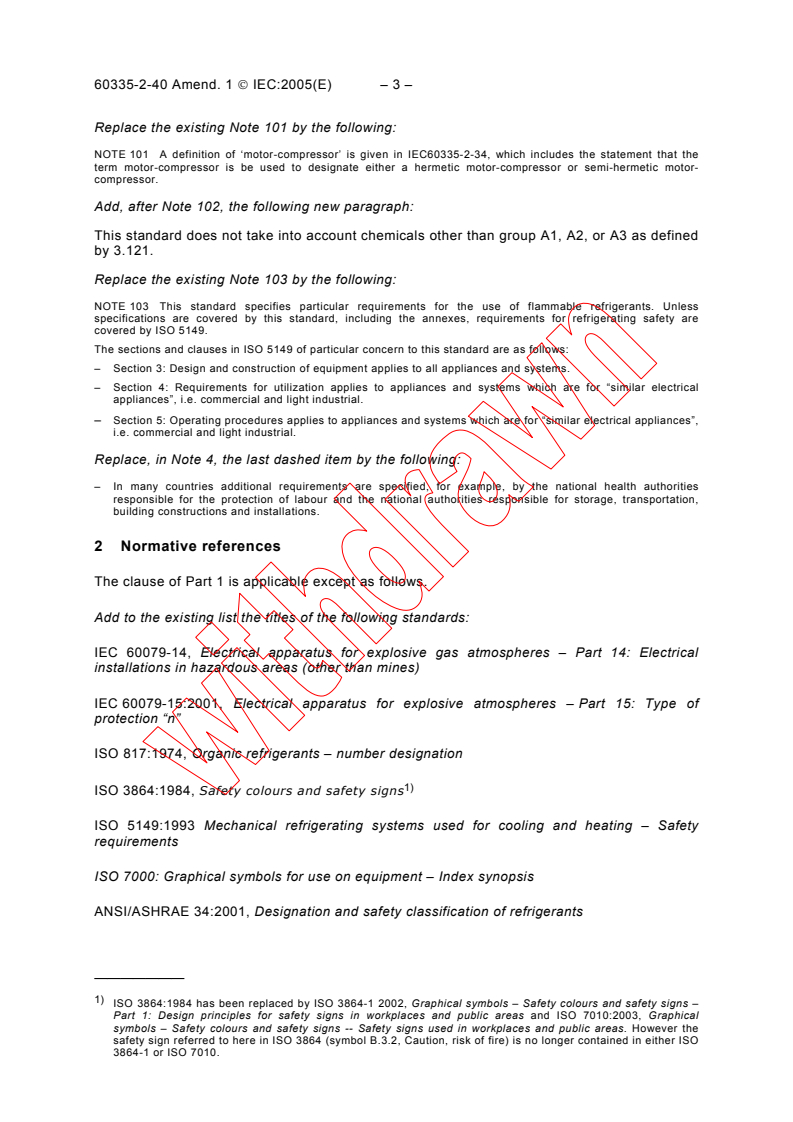
Replace the existing Note 101 by the following:
NOTE 101 A definition of ‘motor-compressor’ is given in IEC60335-2-34, which includes the statement that the
term motor-compressor is be used to designate either a hermetic motor-compressor or semi-hermetic motor-
compressor.
Add, after Note 102, the following new paragraph:
This standard does not take into account chemicals other than group A1, A2, or A3 as defined
by 3.121.
Replace the existing Note 103 by the following:
NOTE 103 This standard specifies particular requirements for the use of flammable refrigerants. Unless
specifications are covered by this standard, including the annexes, requirements for refrigerating safety are
covered by ISO 5149.
The sections and clauses in ISO 5149 of particular concern to this standard are as follows:
– Section 3: Design and construction of equipment applies to all appliances and systems.
– Section 4: Requirements for utilization applies to appliances and systems which are for “similar electrical
appliances”, i.e. commercial and light industrial.
– Section 5: Operating procedures applies to appliances and systems which are for “similar electrical appliances”,
i.e. commercial and light industrial.
Replace, in Note 4, the last dashed item by the following:
– In many countries additional requirements are specified, for example, by the national health authorities
responsible for the protection of labour and the national authorities responsible for storage, transportation,
building constructions and installations.
2 Normative references
The clause of Part 1 is applicable except as follows.
Add to the existing list the titles of the following standards:
IEC 60079-14, Electrical apparatus for explosive gas atmospheres – Part 14: Electrical
installations in hazardous areas (other than mines)
IEC 60079-15:2001, Electrical apparatus for explosive atmospheres – Part 15: Type of
protection “n”
ISO 817:1974, Organic refrigerants – number designation
1)
ISO 3864:1984, Safety colours and safety signs
ISO 5149:1993 Mechanical refrigerating systems used for cooling and heating – Safety
requirements
ISO 7000: Graphical symbols for use on equipment – Index synopsis
ANSI/ASHRAE 34:2001, Designation and safety classification of refrigerants
———————
1)
ISO 3864:1984 has been replaced by ISO 3864-1 2002, Graphical symbols – Safety colours and safety signs –
Part 1: Design principles for safety signs in workplaces and public areas and ISO 7010:2003, Graphical
symbols – Safety colours and safety signs -- Safety signs used in workplaces and public areas. However the
safety sign referred to here in ISO 3864 (symbol B.3.2, Caution, risk of fire) is no longer contained in either ISO
3864-1 or ISO 7010.
– 4 – 60335-2-40 Amend. 1 © IEC:2005(E)
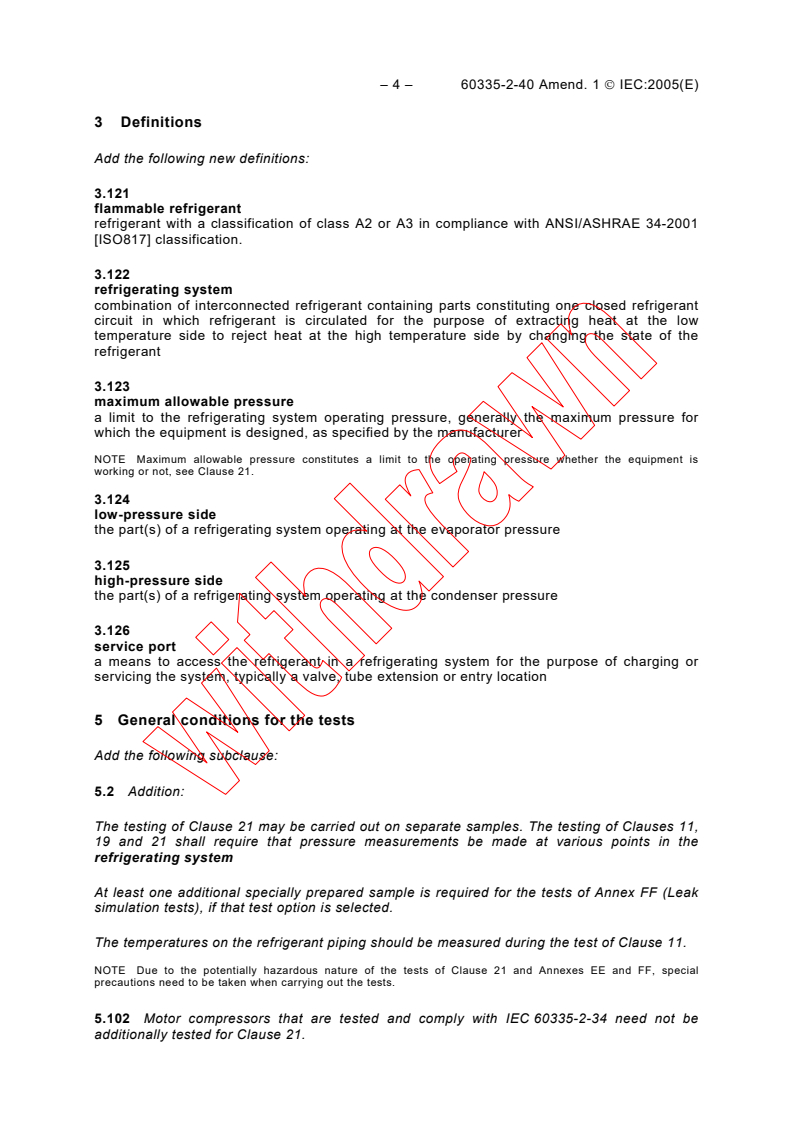
3 Definitions
Add the following new definitions:
3.121
flammable refrigerant
refrigerant with a classification of class A2 or A3 in compliance with ANSI/ASHRAE 34-2001
[ISO817] classification.
3.122
refrigerating system
combination of interconnected refrigerant containing parts constituting one closed refrigerant
circuit in which refrigerant is circulated for the purpose of extracting heat at the low
temperature side to reject heat at the high temperature side by changing the state of the
refrigerant
3.123
maximum allowable pressure
a limit to the refrigerating system operating pressure, generally the maximum pressure for
which the equipment is designed, as specified by the manufacturer
NOTE Maximum allowable pressure constitutes a limit to the operating pressure whether the equipment is
working or not, see Clause 21.
3.124
low-pressure side
the part(s) of a refrigerating system operating at the evaporator pressure
3.125
high-pressure side
the part(s) of a refrigerating system operating at the condenser pressure
3.126
service port
a means to access the refrigerant in a refrigerating system for the purpose of charging or
servicing the system, typically a valve, tube extension or entry location
5 General conditions for the tests
Add the following subclause:
5.2 Addition:
The testing of Clause 21 may be carried out on separate samples. The testing of Clauses 11,
19 and 21 shall require that pressure measurements be made at various points in the
refrigerating system
At least one additional specially prepared sample is required for the tests of Annex FF (Leak
simulation tests), if that test option is selected.
The temperatures on the refrigerant piping should be measured during the test of Clause 11.
NOTE Due to the potentially hazardous nature of the tests of Clause 21 and Annexes EE and FF, special
precautions need to be taken when carrying out the tests.
5.102 Motor compressors that are tested and comply with IEC 60335-2-34 need not be
additionally tested for Clause 21.
60335-2-40 Amend. 1 IEC:2005(E) – 5 –
7 Marking and instructions
7.1 Modification:
Add the following paragraphs to the existing addition:
The flame symbol and the instruction manual symbol of 7.6 shall be visible when a flammable
refrigerant is employed and the following conditions exist:
– accessing parts expected to be subjected to maintenance or repair;
– observing the appliance under sale or installed conditions;
– observing the appliance packaging, if the appliance is charged with refrigerant.
If a flammable refrigerant is used, the symbols for “read operator’s manual”, “operator’s
manual; operating instructions” and “service indicator; read technical manual” (symbols 0790,
1641 and 1659 of ISO 7000) shall be placed on the appliance in a location visible to the
persons required to know the information. The perpendicular height shall be at least 10 mm.
An additional warning symbol (flame symbol: B.3.2 of ISO 3864) shall be placed on the
nameplate of the unit near the declaration of the refrigerant type and charge information. The
perpendicular height shall be at least 10 mm, and the symbol need not be in colour.
NOTE 101 When installed, the marking should be visible after removing a detachable part.
The following warning shall also be applied to the appliance when a flammable refrigerant is
employed.
WARNING
Appliance shall be installed, operated and stored in a room with a floor area larger than
‘X’ m (only applies to appliances that are not fixed appliances).
For appliances, which are not fixed appliances, the minimum room size X shall be specified
on the appliance. The X in the marking shall be determined in m by the procedure described
in paragraph 2 of Annex GG for unventilated areas and the X in the marking shall be 4 if the
refrigerant charge of the appliance is less than m (see Annex GG, paragraph 1.1).
The maximum allowable pressure for the low-pressure side and the high-pressure side shall
be marked on the product.
NOTE 102 For the refrigerating system; if the maximum allowable pressure of the low-pressure side and the
high-pressure side is the same, a single indication is permitted.
If not already visible when accessing a service port and if a service port is provided, the
service port shall be marked to identify the type of refrigerant. If the refrigerant is flammable,
symbol B.3.2 of ISO 3864, shall be included, without specifying the colour.
Add the following subclause:
7.6 Addition:
When a flammable refrigerant is employed, a warning symbol B.3.2 of ISO 3864, including
colour and format, shall be permanently placed on the appliance. The perpendicular height of
the triangle containing the "Caution, risk of fire" symbol shall be at least 30 mm.
When a flammable refrigerant is employed, a symbol requiring reference to the manual [0790 of
ISO 7000], including colour and format, shall be permanently placed on the appliance.
– 6 – 60335-2-40 Amend. 1 IEC:2005(E)
7.12 Addition:
For appliances using flammable refrigerants, an installation, service and operation manual,
either separate or combined manuals, shall be provided and include the information given in
Annex DD.
19 Abnormal operation
Add the following subclause after subclause 19.10
19.10.1 The test of 19.10 is repeated on class 01 appliances and class 1 appliances
incorporating tubular sheathed or embedded heating elements. However, controls are not
short-circuited but one end of the element is connected to the sheath of the heating element.
The test is repeated with the polarity of the supply to the appliance reversed and with the
other end of the element connected to the sheath.
The test is not carried out on appliances intended to be permanently connected to fixed wiring
and on appliances where all-pole disconnection occurs during the test of 19.10.
19.14 Amend the opening of the first sentence to read:
"During the tests of 19.2 to 19.10.1 and 19.11."
21 Mechanical strength
Add the following paragraph:
Safety requirements specified in Annex EE shall apply. The pressure test in Annex EE applies
to parts other than pressure vessels.
22 Construction
Add the following new subclauses:
22.112 The construction of the refrigerating system shall comply with the requirements of
Section 3 of ISO 5149.
22.113 When a flammable refrigerant is used, refrigerant tubing shall be protected or
enclosed to avoid mechanical damage. The tubing shall be protected to the extent that it will
not be handled or used for carrying during moving of the product. Tubing located within the
confines of the cabinet is considered to be protected from mechanical damage.
Compliance is checked by inspection.
22.114 When a flammable refrigerant is used, low temperature solder alloys, such as
lead/tin alloys, are not acceptable for pipe connections.
22.115 The total refrigerant mass (M) of all refrigerating systems within the appliance
employing flammable refrigerants, shall not exceed m as defined in Annex GG.
22.116 Appliances using flammable refrigerants shall be constructed so that any leaked
refrigerant will not flow or stagnate so as to cause a fire or explosion hazard in areas within
the appliance where electrical components, which could be a source of ignition and which
could function under normal conditions or in the event of a leak, are fitted.
60335-2-40 Amend. 1 IEC:2005(E) – 7 –
Separate components, such as thermostats, which are charged with less than 0,5 g of a
flammable gas are not considered to cause a fire or explosion hazard in the event of leakage
of the gas within the component itself.
All electrical components that could be a source of ignition and which could function under
normal conditions or in the event of a leak, shall comply with one of the following.
– IEC 60079-15:2001, Clauses 9 to 26, for group IIA gases or the refrigerant used or an
applicable standard that makes electrical components suitable for use in Zone 2, 1 or 0 as
defined in IEC 60079-14.
– Not be located in an area where a potentially flammable gas mixture will accumulate as
demonstrated by the test of Annex FF
– Be located in an enclosure. The enclosure containing the electrical components shall
comply with IEC 60079-15:2001 for enclosures suitable for use with group IIA gases or the
refrigerant used.
NOTE The test current for a switching component is the rated current of the component or the actual load to be
switched, whichever is greater.
22.117 Temperatures on surfaces that may be exposed to leakage of flammable
refrigerants shall not exceed the auto-ignition temperature of the refrigerant reduced by
100 K; some typical values are given in Annex BB.
Compliance is checked by measuring the appropriate surface temperatures during the tests of
Clauses 11 and 19, except those which during the tests of Clause 19 are terminated in a non-
self-resetting way.
22.118 When a flammable refrigerant is used, all appliances shall be charged with
refrigerant at the manufacturing location or charged on site as recommended by the
manufacturer.
A part of an appliance that is charged on site, which requires brazing or welding in the
installation shall not be shipped with a flammable refrigerant charge. Joints made in the
installation between parts of the refrigerating system, with at least one part charged, shall
be made in accordance with the following.
– A brazed, welded, or mechanical connection shall be made before opening the valves to
permit refrigerant to flow between the refrigerating system parts. A vacuum valve shall be
provided to evacuate the interconnecting pipe and/or any uncharged refrigerating system
part.
– Reusable mechanical connectors and flared joints are not allowed indoors.
– Refrigerant tubing shall be protected or enclosed to avoid damage.
Flexible refrigerant connectors (such as connecting lines between the indoor and outdoor unit)
that may be displaced during normal operations shall be protected against mechanical
damage.
Compliance is checked according to the manufacturer’s installation instructions and a trial
installation if necessary.
Annexes
Add the following new annexes:
– 8 – 60335-2-40 Amend. 1 IEC:2005(E)
Annex BB
(normative)
Selected information about refrigerants
The normative component of this annex involves the “Lower limit” column of Table BB.1. The rest of the annex is informative.
(2)
Refrigerant Description Formula Auto-ignition Density Molar Lower flammability limit
(1) (3)
designation temperatures (2),(5) mass
3(4)
kg/m % v/v
°C kg/m kg/kmol
(7)
R32 Difluoromethane CH F 648 2,13 52,0 0,306 14,4
2 2
(8)
R50 Methane CH 645 0,65 16,0 0,032 4,9
(7)
R143a 1,1,1 – Trifluoroethane CF CH 750 3,43 84,0 0,282 8,2
3 3
(7)
R152a 1, 1 – Difluoroethane CHF CH 455 2,70 66,0 0,130 4,8
2 3
(7)
R170 Ethane CH CH 515 1,23 30,1 0,038 3,1
3 3
(7)
R290 Propane CH CH CH 470 1,80 44,1 0,038 2,1
3 2 3
(9)
R600 n-Butane CH CH CH CH 365 2,37 58,1 0,043 1,8
3 2 2 3
(10)
R600a Isobutane CH(CH ) 460 2,37 58,1 0,043 1,8
3 3
(7)
R1150 Ethylene CH =CH 425 1,15 28,1 0,036 3,1
2 2
(11)
R1270 Propylene CH =CHCH 455 1,72 42,1 0,040 2,3
2 3
(12)
E170 Dimethylether CH °CH 235 1,88 46,1 0,064 3,4
3 3
(6) (7)
R142b 1-chloro-1,1-difluoroethane CH CClF 750 4,11 100,5 0,329 8,0
3 2
(1) The refrigerant designations are in accordance with ISO 817
(2) These values are at 25°C and at 1013,2 mbar
(3) For comparison, the molecular mass of air is taken equal to 28,8 kg/kmol
(4) Multiply % v/v by the corresponding molar mass * 0,000409 to give the flammability limit in kg/m
(5) Divide molar mass by 24,465 to give the density in kg/m3
(6) Estimated from molecular structure
(7) WILSON, DP. and Richard, RG. Determination of Refrigerant Lower Flammability Limits in Compliance with Proposed Addendum p to Standard 34. ASHRAE
Transactions: 2002 V. 108, Pt. 2.
(8) BURRELL, GA. and OBERFELL, GG. U.S. Bur. Mines, Tech. Paper 119, (1915)
(9) LAFFITTE, P. and DELBOURGO, R. 4th Symp. on Combust., p.114(1953)
(10) ZABETAKIS, MG., SCOTT, GS., JONES, GW. Ind. Eng. Chem., 43, 2120, (1951)
(11) Estimated from LFL for propane analogs and data from JABBOUR, T., CLODIC, D. Burning Vel °City and Refrigerant Flammability Classification, Ecole de
Mines, Paris, France, ASHRAE Transactions 2004.
(12) Atofina application to ASHRAE for safety classification of R-E170, 13 December 2001
60335-2-40 Amend. 1 IEC:2005(E) – 9 –
Annex CC
(informative)
Transportation, marking and storage for units
that employ flammable refrigerants
The following information is provided for units that employ flammable refrigerants:
CC.1 Transport of equipment containing flammable refrigerants
Attention is drawn to the fact that additional transportation regulations may exist with respect
to equipment containing flammable gas. The maximum number of pieces of equipment or the
configuration of the equipment, permitted to be transported together will be determined by the
applicable transport regulations.
CC.2 Marking of equipment using signs
Signs for similar appliances used in a work area generally are addressed by local regulations
and give the minimum requirements for the provision of safety and/or health signs for a work
location.
All required signs are to be maintained and employers should ensure that employees receive
suitable and sufficient instruction and training on the meaning of appropriate safety signs and
the actions that need to be taken in connection with these signs.
The effectiveness of signs should not be diminished by too many signs being placed together.
Any pictograms used should be as simple as possible and contain only essential details.
CC.3 Disposal of equipment using flammable refrigerants
See National Regulations.
CC.4 Storage of equipment/appliances
The storage of equipment should be in accordance with the manufacturer’s instructions.
CC.5 Storage of packed (unsold) equipment
Storage package protection should be constructed such that mechanical damage to the
equipment inside the package will not cause a leak of the refrigerant charge.
The maximum number of pieces of equipment permitted to be stored together will be
determined by local regulations.
– 10 – 60335-2-40 Amend. 1 IEC:2005(E)
Annex DD
(normative)
Service operations
DD.1 General
For appliances using flammable refrigerants, an installation, service and operation manual,
in the form of either separate or combined manuals, shall be provided and shall include the
following information.
DD.2 Symbols
The symbol referred to in 7.6 (without colours is permitted) and the information of the warning
marking shall be provided as follows:
WARNING
Do not use means to accelerate the defrosting process or to clean, other than those recommended by
the manufacturer.
The appliance shall be stored in a room without continuously operating ignition sources (for
example: open flames, an operating gas appliance or an operating electric heater.
Do not pierce or burn.
Be aware that refrigerants may not contain an odour,
Appliance shall be installed, operated and stored in a room with a floor area larger than X m .
NOTE The manufacturer may provide other suitable examples or may provide additional information about the
refrigerant odour.
DD.3 Information in manual
DD.3.1 The following information shall be specified in the manual where the information is
needed for the function of the manual and as applicable to the appliance:
– information for spaces where pipes containing flammable refrigerant are allowed, including
statements
• that the installation of pipe-work shall be kept to a minimum;
• that pipe-work shall be protected from physical damage and shall not be installed in an
unventilated space, if that space is smaller than A in Annex GG;
min
• that compliance with national gas regulations shall be observed;
• that mechanical connections made in accordance with 22.118, shall be accessible for
maintenance purposes;
• that the minimum floor area of the room shall be mentioned in the form of a table or a
single figure without reference to a formula;
– the maximum refrigerant charge amount (M);
– the minimum rated airflow, if required by Annex GG;
– information for handling, installation, cleaning, servicing and disposal of refrigerant;
– the minimum floor area of the room or the special requirements for the room in which the
appliance can be located as defined in Annex GG, except where the refrigerant charge (M)
is less than or equal to m (M ≤ m );
1 1
60335-2-40 Amend. 1 IEC:2005(E) – 11 –
– a warning to keep ventilation openings clear of obstruction;
– a notice that servicing shall be performed only as recommended by the manufacturer.
DD.3.2 The manual shall include a statement advising that an unventilated area where the
appliance using flammable refrigerants is installed shall be so constructed that should any
refrigerant leak, it will not stagnate so as to create a fire or explosion hazard. This shall
include:
– a warning that the appliance shall be stored in a well-ventilated area where the room size
corresponds to the room area as specified for operation;
– a warning that the appliance shall be stored in a room without continuously operating open
flames (for example an operating gas appliance) and ignition sources (for example an
operating electric heater).
NOTE The manufacturer should specify other potential continuously operating sources known to cause ignition of
the refrigerant used.
The appliance shall be stored so as to prevent mechanical damage from occurring.
DD.3.3 The manual shall contain specific information about the credentials of qualified
service personnel as follows.
– Any person who is involved with working on or breaking into a refrigerant circuit should
hold a current valid certificate from an industry-accredited assessment authority, which
authorises their competence to handle refrigerants safely in accordance with an industry
recognised assessment specification.
– Servicing shall only be performed as recommended by the equipment manufacturer.
Maintenance and repair requiring the assistance of other skilled personnel shall be carried
out under the supervision of the person competent in the use of flammable refrigerants.
DD.4 Information on servicing
The manual shall contain specific information for service personnel who shall be instructed to
undertake the following when servicing an appliance that employs a flammable refrigerant.
DD.4.1 Checks to the area
Prior to beginning work on systems containing flammable refrigerants, safety checks are
necessary to ensure that the risk of ignition is minimised. For repair to the refrigerating system,
the following precautions shall be complied with prior to conducting work on the system.
DD.4.2 Work procedure
Work shall be undertaken under a controlled procedure so as to minimise the risk of a
flammable gas or vapour being present while the work is being performed.
DD.4.3 General work area
All maintenance staff and others working in the local area shall be instructed on the nature of
work being carried out. Work in confined spaces shall be avoided. The area around the
workspace shall be sectioned off. Ensure that the conditions within the area have been made
safe by control of flammable material.
DD.4.4 Checking for presence of refrigerant
The area shall be checked with an appropriate refrigerant detector prior to and during work, to
ensure the technician is aware of potentially flammable atmospheres. Ensure that the leak
detection equipment being used is suitable for use with flammable refrigerants, i.e. non-
sparking, adequately sealed or intrinsically safe.
– 12 – 60335-2-40 Amend. 1 IEC:2005(E)
DD.4.5 Presence of fire extinguisher
If any hot work is to be conducted on the refrigeration equipment or any associated parts,
appropriate fire extinguishing equipment shall be available to hand. Have a dry powder or
CO fire extinguisher adjacent to the charging area.
DD.4.6 No ignition sources
No person carrying out work in relation to a refrigeration system which involves exposing any
pipe work that contains or has contained flammable refrigerant shall use any sources of
ignition in such a manner that it may lead to the risk of fire or explosion. All possible ignition
sources, including cigarette smoking, should be kept sufficiently far away from the site of
installation, repairing, removing and disposal, during which flammable refrigerant can possibly
be released to the surrounding space. Prior to work taking place, the area around the
equipment is to be surveyed to make sure that there are no flammable hazards or ignition
risks. “No Smoking” signs shall be displayed.
DD.4.7 Ventilated area
Ensure that the area is in the open or that it is adequately ventilated before breaking into the
system or conducting any hot work. A degree of ventilation shall continue during the period
that the work is carried out. The ventilation should safely disperse any released refrigerant
and preferably expel it externally into the atmosphere.
DD.4.8 Checks to the refrigeration equipment
Where electrical components are being changed, they shall be fit for the purpose and to the
correct specification. At all times the manufacturer’s maintenance and service guidelines shall
be followed. If in doubt consult the manufacturer’s technical department for assistance.
The following checks shall be applied to installations using flammable refrigerants:
– the charge size is in accordance with the room size within which the refrigerant containing
parts are installed;
– the ventilation machinery and outlets are operating adequately and are not obstructed;
– if an indirect refrigerating circuit is being used, the secondary circuit shall be checked for
the presence of refrigerant;
– marking to the equipment continues to be visible and legible. Markings and signs that are
illegible shall be corrected;
– refrigeration pipe or components are installed in a position where they are unlikely to be
exposed to any substance which may corrode refrigerant containing components, unless
the components are constructed of materials which are inherently resistant to being
corroded or are suitably protected against being so corroded.
DD.4.9 Checks to electrical devices
Repair and maintenance to electrical components shall include initial safety checks and
component inspection procedures. If a fault exists that could compromise safety, then no
electrical supply shall be connected to the circuit until it is satisfactorily dealt with. If the fault
cannot be corrected immediately but it is necessary to continue operation, an adequate
temporary solution shall be used. This shall be reported to the owner of the equipment so all
parties are advised.
60335-2-40 Amend. 1 IEC:2005(E) – 13 –
Initial safety checks shall include:
• that capacitors are discharged: this shall be done in a safe manner to avoid possibility of
sparking;
• that there no live electrical components and wiring are exposed while charging, recovering
or purging the system;
• that there is continuity of earth bonding.
DD.5 Repairs to sealed components
DD.5.1 During repairs to sealed components, all electrical supplies shall be disconnected
from the equipment being worked upon prior to any removal of sealed covers, etc. If it is
absolutely necessary to have an electrical supply to equipment during servicing, then a
permanently operating form of leak detection shall be located at the most critical point to warn
of a potentially hazardous situation.
DD.5.2 Particular attention shall be paid to the following to ensure that by working on
electrical components, the casing is not altered in such a way that the level of protection is
affected. This shall include damage to cables, excessive number of connections, terminals not
made to original specification, damage to seals, incorrect fitting of glands, etc.
Ensure that apparatus is mounted securely.
Ensure that seals or sealing materials have not degraded such that they no longer serve the
purpose of preventing the ingress of flammable atmospheres. Replacement parts shall be in
accordance with the manufacturer’s specifications,
NOTE The use of silicon sealant may inhibit the effectiveness of some types of leak detection equipment.
Intrinsically safe components do not have to be isolated prior to working on them.
DD.6 Repair to intrinsically safe components
Do not apply any permanent inductive or capacitance loads to the circuit without ensuring that
this will not exceed the permissible voltage and current permitted for the equipment in use.
Intrinsically safe components are the only types that can be worked on while live in the
presence of a flammable atmosphere. The test apparatus shall be at the correct rating.
Replace components only with parts specified by the manufacturer. Other parts may result in
the ignition of refrigerant in the atmosphere from a leak.
DD.7 Cabling
Check that cabling will not be subject to wear, corrosion, excessive pressure, vibration, sharp
edges or any other adverse environmental effects. The check shall also take into account the
effects of aging or continual vibration from sources such as compressors or fans.
DD.8 Detection of flammable refrigerants
Under no circumstances shall potential sources of ignition be used in the searching for or
detection of refrigerant leaks. A halide torch (or any other detector using a naked flame) shall
not be used.
– 14 – 60335-2-40 Amend. 1 IEC:2005(E)
DD.9 Leak detection methods
The following leak detection methods are deemed acceptable for systems containing
flammable refrigerants.
Electronic leak detectors shall be use
...
IEC 60335-2-40
Edition 4.0 2005-03
INTERNATIONAL
STANDARD
NORME
INTERNATIONALE
AMENDMENT 1
AMENDEMENT 1
Household and similar electrical appliances – Safety –
Part 2-40: Particular requirements for electrical heat pumps, air-conditioners
and dehumidifiers
Appareils électrodomestiques et analogues – Sécurité –
Partie 2-40: Règles particulières pour les pompes à chaleur électriques, les
climatiseurs et les déshumidificateurs
IEC 60335-2-40:2002/A1:2005
All rights reserved. Unless otherwise specified, no part of this publication may be reproduced or utilized in any form or by
any means, electronic or mechanical, including photocopying and microfilm, without permission in writing from either IEC or
IEC's member National Committee in the country of the requester.
If you have any questions about IEC copyright or have an enquiry about obtaining additional rights to this publication,
please contact the address below or your local IEC member National Committee for further information.
Droits de reproduction réservés. Sauf indication contraire, aucune partie de cette publication ne peut être reproduite
ni utilisée sous quelque forme que ce soit et par aucun procédé, électronique ou mécanique, y compris la photocopie
et les microfilms, sans l'accord écrit de la CEI ou du Comité national de la CEI du pays du demandeur.
Si vous avez des questions sur le copyright de la CEI ou si vous désirez obtenir des droits supplémentaires sur cette
publication, utilisez les coordonnées ci-après ou contactez le Comité national de la CEI de votre pays de résidence.
IEC Central Office
3, rue de Varembé
CH-1211 Geneva 20
Switzerland
Email: inmail@iec.ch
Web: www.iec.ch
About the IEC
The International Electrotechnical Commission (IEC) is the leading global organization that prepares and publishes
International Standards for all electrical, electronic and related technologies.
About IEC publications
The technical content of IEC publications is kept under constant review by the IEC. Please make sure that you have the
latest edition, a corrigenda or an amendment might have been published.
ƒ Catalogue of IEC publications: www.iec.ch/searchpub
The IEC on-line Catalogue enables you to search by a variety of criteria (reference number, text, technical committee,…).
It also gives information on projects, withdrawn and replaced publications.
ƒ IEC Just Published: www.iec.ch/online_news/justpub
Stay up to date on all new IEC publications. Just Published details twice a month all new publications released. Available
on-line and also by email.
ƒ Electropedia: www.electropedia.org
The world's leading online dictionary of electronic and electrical terms containing more than 20 000 terms and definitions
in English and French, with equivalent terms in additional languages. Also known as the International Electrotechnical
Vocabulary online.
ƒ Customer Service Centre: www.iec.ch/webstore/custserv
If you wish to give us your feedback on this publication or need further assistance, please visit the Customer Service
Centre FAQ or contact us:
Email: csc@iec.ch
Tel.: +41 22 919 02 11
Fax: +41 22 919 03 00
A propos de la CEI
La Commission Electrotechnique Internationale (CEI) est la première organisation mondiale qui élabore et publie des
normes internationales pour tout ce qui a trait à l'électricité, à l'électronique et aux technologies apparentées.
A propos des publications CEI
Le contenu technique des publications de la CEI est constamment revu. Veuillez vous assurer que vous possédez
l’édition la plus récente, un corrigendum ou amendement peut avoir été publié.
ƒ Catalogue des publications de la CEI: www.iec.ch/searchpub/cur_fut-f.htm
Le Catalogue en-ligne de la CEI vous permet d’effectuer des recherches en utilisant différents critères (numéro de référence,
texte, comité d’études,…). Il donne aussi des informations sur les projets et les publications retirées ou remplacées.
ƒ Just Published CEI: www.iec.ch/online_news/justpub
Restez informé sur les nouvelles publications de la CEI. Just Published détaille deux fois par mois les nouvelles
publications parues. Disponible en-ligne et aussi par email.
ƒ Electropedia: www.electropedia.org
Le premier dictionnaire en ligne au monde de termes électroniques et électriques. Il contient plus de 20 000 termes et
définitions en anglais et en français, ainsi que les termes équivalents dans les langues additionnelles. Egalement appelé
Vocabulaire Electrotechnique International en ligne.
ƒ Service Clients: www.iec.ch/webstore/custserv/custserv_entry-f.htm
Si vous désirez nous donner des commentaires sur cette publication ou si vous avez des questions, visitez le FAQ du
Service clients ou contactez-nous:
Email: csc@iec.ch
Tél.: +41 22 919 02 11
Fax: +41 22 919 03 00
IEC 60335-2-40
Edition 4.0 2005-03
INTERNATIONAL
STANDARD
NORME
INTERNATIONALE
AMENDMENT 1
AMENDEMENT 1
Household and similar electrical appliances – Safety –
Part 2-40: Particular requirements for electrical heat pumps, air-conditioners
and dehumidifiers
Appareils électrodomestiques et analogues – Sécurité –
Partie 2-40: Règles particulières pour les pompes à chaleur électriques, les
climatiseurs et les déshumidificateurs
INTERNATIONAL
ELECTROTECHNICAL
COMMISSION
COMMISSION
ELECTROTECHNIQUE
PRICE CODE
INTERNATIONALE
V
CODE PRIX
ICS 23.120 ISBN 2-8318-8609-0
– 2 – 60335-2-40 Amend. 1 © CEI:2005
AVANT-PROPOS
Le présent amendement a été établi par le sous-comité 61D: Appareils de conditionnement
d’air pour usages domestiques et analogues, du comité d'études 61 de la CEI: Sécurité des
appareils électrodomestiques et analogues.
Cette version bilingue, publiée en 2006-05, correspond à la version anglaise.
Le texte anglais de cet amendement est issu des documents 61D/138/FDIS et 61D/140/RVD.
Le rapport de vote 61D/140/RVD donne toute information sur le vote ayant abouti à
l’approbation de cet amendement.
La version française de cet amendement n’a pas été soumise au vote.
Le comité a décidé que le contenu de cet amendement et de la publication de base ne seront
pas modifiés avant la date de maintenance indiquée sur le site web de la CEI sous
«http://webstore.iec.ch» dans les données relatives à la publication recherchée. A cette date,
la publication sera
• reconduite;
• supprimée;
• remplacée par une édition révisée, ou
• amendée.
___________
SOMMAIRE
Ajouter les titres des nouvelles Annexes BB à GG comme suit:
Annexe BB (normative) Sélection d'informations concernant les fluides frigorigènes
Annexe CC (informative) Transport, marquage et stockage des unités qui utilisent des
fluides frigorigènes inflammables
Annexe DD (normative) Opérations de service
Annexe EE (normative) Essais de pression
Annexe FF (normative) Essais de simulation de fuite
Annexe GG (normative) Limites de charge, exigences de ventilation et exigences pour les
circuits secondaires
1 Domaine d’application
Supprimer le terme "hermétiques" du premier alinéa.
Ajouter, après le deuxième alinéa, le nouvel alinéa suivant:
La présente norme s'applique également aux pompes à chaleur électriques, aux
climatiseurs et aux déshumidificateurs contenant un fluide frigorigène inflammable. Les
fluides frigorigènes inflammables sont définis en 3.121.
60335-2-40 Amend. 1 © IEC:2005 – 3 –
FOREWORD
This amendment has been prepared by subcommittee 61D: Appliances for air-conditioning for
household and similar purposes, of IEC technical committee 61: Safety of household and
similar electrical appliances.
This bilingual version, published in 2006-05, corresponds to the English version.
The text of this amendment is based on the following documents:
FDIS Report on voting
61D/138/FDIS 61D/140/RVD
Full information on the voting for the approval of this amendment can be found in the report
on voting indicated in the above table.
The French version of this standard has not been voted upon.
The committee has decided that the contents of this amendment and the base publication will
remain unchanged until the maintenance result date indicated on the IEC web site under
"http://webstore.iec.ch" in the data related to the specific publication. At this date, the
publication will be
• reconfirmed,
• withdrawn,
• replaced by a revised edition, or
• amended.
___________
CONTENTS
Add the titles of new Annexes BB to GG as follows:
Annex BB (normative) Selected information about refrigerants
Annex CC (informative) Transportation, marking and storage for units that employ flammable
refrigerants
Annex DD (normative) Service operations
Annex EE (normative) Pressure tests
Annex FF (normative) Leak simulation tests
Annex GG (normative) Charge limits, ventilation requirements and requirements for
secondary circuits
1 Scope
Delete the word "sealed" from the first paragraph.
Add, after the second paragraph, the following new paragraph:
This standard also applies to electric heat pumps, air conditioners and dehumidifiers
containing flammable refrigerant. Flammable refrigerants are defined in 3.121.
– 4 – 60335-2-40 Amend. 1 © CEI:2005
Remplacer la Note 101 existante par le texte suivant:
NOTE 101 Une définition du terme "moto-compresseur" est donnée dans la CEI 60335-2-34 qui indique que ce
terme de "moto-compresseur" doit être utilisé pour désigner soit un moto-compresseur hermétique, soit un moto-
compresseur semi-hermétique.
Ajouter, après la Note 102, le nouvel alinéa suivant:
La présente norme ne prend pas en compte les produits chimiques qui n'appartiennent pas
aux groupes A1, A2 ou A3 tels qu'ils sont définis en 3.121.
Remplacer la Note 103 existante par le texte suivant:
NOTE 103 La présente norme spécifie des exigences particulières pour l'utilisation des fluides frigorigènes
inflammables. A l'exception des spécifications couvertes par la présente norme, y compris ses annexes, les
exigences applicables à la sécurité des systèmes frigorifiques sont traitées dans l'ISO 5149.
Les sections et les articles de l'ISO 5149 qui concernent particulièrement la présente norme sont les suivants:
– Section 3: Conception et construction de l’équipement, s'applique à tous les appareils et à tous les systèmes.
– Section 4: Prescriptions d'utilisation, s'applique aux appareils et aux systèmes destinés aux "appareils
électriques analogues", c'est à dire à usage commercial et pour l'industrie légère.
– Section 5: Exigences d’exploitation, s'applique aux appareils et aux systèmes destinés aux "appareils
électriques analogues", c'est à dire à usage commercial et pour l'industrie légère.
Remplacer le dernier tiret de la Note 4 par le texte suivant:
– dans de nombreux pays, des exigences supplémentaires sont spécifiées, par exemple par les organismes
nationaux de la santé publique responsables de la protection des travailleurs et par les organismes nationaux
responsables du stockage, du transport, de la construction des bâtiments et des installations.
2 Références normatives
L’article de la Partie 1 est applicable avec les exceptions suivantes.
Ajouter les titres des normes suivantes à la liste existante:
CEI 60079-14, Matériel électrique pour atmosphères explosives gazeuses – Partie 14:
Installations électriques dans les emplacements dangereux (autres que les mines)
CEI 60079-15:2001, Matériel électrique pour atmosphères explosives gazeuses – Partie 15:
Mode de protection “n”
ISO 817:1974, Fluides frigorigènes organiques –Désignation numérique
)
ISO 3864:1984, Couleurs et signaux de sécurité
ISO 5149:1993, Systèmes frigorifiques mécaniques utilisés pour le refroidissement et le
chauffage – Prescriptions de sécurité
ISO 7000, Symboles graphiques utilisables sur le matériel – Index et tableau synoptique
ANSI/ASHRAE 34:2001, Designation and safety classification of refrigerants
———————
) L'ISO 3864:1984 a été remplacée par l'ISO 3864-1 2002, Symboles graphiques – Couleurs de sécurité et
signaux de sécurité – Partie 1: Principes de conception pour les signaux de sécurité sur les lieux de travail et
dans les lieux publics et par l'ISO 7010:2003, Symboles graphiques -- Couleurs de sécurité et signaux de
sécurité -- Signaux de sécurité utilisés sur les lieux de travail et dans les lieux publics. Toutefois, le signal de
sécurité auquel il est fait référence ici dans l'ISO 3864 (symbole B.3.2, Attention, risque d'incendie) ne figure
plus ni dans l'ISO 3864-1 ni dans l'ISO 7010.
60335-2-40 Amend. 1 © IEC:2005 – 5 –
Replace the existing Note 101 by the following:
NOTE 101 A definition of ‘motor-compressor’ is given in IEC 60335-2-34, which includes the statement that the
term motor-compressor is be used to designate either a hermetic motor-compressor or semi-hermetic motor-
compressor.
Add, after Note 102, the following new paragraph:
This standard does not take into account chemicals other than group A1, A2, or A3 as defined
by 3.121.
Replace the existing Note 103 by the following:
NOTE 103 This standard specifies particular requirements for the use of flammable refrigerants. Unless
specifications are covered by this standard, including the annexes, requirements for refrigerating safety are
covered by ISO 5149.
The sections and clauses in ISO 5149 of particular concern to this standard are as follows:
– Section 3: Design and construction of equipment applies to all appliances and systems.
– Section 4: Requirements for utilization applies to appliances and systems which are for “similar electrical
appliances”, i.e. commercial and light industrial.
– Section 5: Operating procedures applies to appliances and systems which are for “similar electrical appliances”,
i.e. commercial and light industrial.
Replace, in Note 4, the last dashed item by the following:
– in many countries additional requirements are specified, for example, by the national health authorities
responsible for the protection of labour and the national authorities responsible for storage, transportation,
building constructions and installations.
2 Normative references
The clause of Part 1 is applicable except as follows.
Add to the existing list the titles of the following standards:
IEC 60079-14, Electrical apparatus for explosive gas atmospheres – Part 14: Electrical
installations in hazardous areas (other than mines)
IEC 60079-15:2001, Electrical apparatus for explosive atmospheres – Part 15: Type of
protection “n”
ISO 817:1974, Organic refrigerants – number designation
1)
ISO 3864:1984, Safety colours and safety signs
ISO 5149:1993, Mechanical refrigerating systems used for cooling and heating – Safety
requirements
ISO 7000, Graphical symbols for use on equipment – Index synopsis
ANSI/ASHRAE 34:2001, Designation and safety classification of refrigerants
———————
1)
ISO 3864:1984 has been replaced by ISO 3864-1 2002, Graphical symbols – Safety colours and safety signs –
Part 1: Design principles for safety signs in workplaces and public areas and ISO 7010:2003, Graphical
symbols – Safety colours and safety signs -- Safety signs used in workplaces and public areas. However the
safety sign referred to here in ISO 3864 (symbol B.3.2, Caution, risk of fire) is no longer contained in either ISO
3864-1 or ISO 7010.
– 6 – 60335-2-40 Amend. 1 © CEI:2005
3 Définitions
Ajouter les nouvelles définitions suivantes:
3.121
fluide frigorigène inflammable
fluide frigorigène de classe A2 ou A3 selon la classification de la norme américaine
ANSI/ASHRAE 34-2001 [ISO 817]
3.122
système frigorifique
combinaison de parties interconnectées contenant des fluides frigorigènes qui constitue un
circuit frigorigène fermé dans lequel on fait circuler le fluide frigorigène dans le but d'enlever
de la chaleur du côté à basse température et de céder de la chaleur du côté à haute
température en modifiant l'état du fluide frigorigène
3.123
pression maximale admissible
limite de la pression de fonctionnement du système frigorifique, généralement la pression
maximale pour laquelle l'équipement est conçu, telle qu'elle est spécifiée par le fabricant
NOTE La pression maximale admissible constitue une limite pour la pression de fonctionnement que l'équipement
soit en fonctionnement ou non, voir l'Article 21.
3.124
côté basse pression
partie(s) d'un système frigorifique qui fonctionne(nt) à la pression de l'évaporateur
3.125
côté haute pression
partie(s) d'un système frigorifique qui fonctionne(nt) à la pression du condenseur
3.126
accès de service
moyen d'accès au fluide frigorigène dans un système frigorifique pour charger ou assurer les
opérations de service du système, il s'agit généralement d'une vanne, d'un branchement ou
d'un emplacement d'entrée
5 Conditions générales d’essais
Ajouter le paragraphe suivant:
5.2 Addition:
Les essais de l'Article 21 peuvent être effectués sur des échantillons séparés. Les essais des
Articles 11, 19 et 21 doivent exiger que les mesures de la pression soient réalisées en
différents points du système frigorifique.
Au moins un échantillon supplémentaire spécialement préparé est nécessaire pour les essais
de l'Annexe FF (Essais de simulation de fuite), si cette option d'essai est choisie.
Il convient que les températures des conduites du fluide frigorigène soient mesurées au cours
de l'essai de l'Article 11.
NOTE Compte tenu de la nature potentiellement dangereuse des essais de l'Article 21 et des Annexes EE et FF,
il est nécessaire de prendre des précautions particulières lors de leur exécution.
60335-2-40 Amend. 1 © IEC:2005 – 7 –
3 Definitions
Add the following new definitions:
3.121
flammable refrigerant
refrigerant with a classification of class A2 or A3 in compliance with ANSI/ASHRAE 34-2001
[ISO 817] classification.
3.122
refrigerating system
combination of interconnected refrigerant containing parts constituting one closed refrigerant
circuit in which refrigerant is circulated for the purpose of extracting heat at the low
temperature side to reject heat at the high temperature side by changing the state of the
refrigerant
3.123
maximum allowable pressure
a limit to the refrigerating system operating pressure, generally the maximum pressure for
which the equipment is designed, as specified by the manufacturer
NOTE Maximum allowable pressure constitutes a limit to the operating pressure whether the equipment is
working or not, see Clause 21.
3.124
low-pressure side
the part(s) of a refrigerating system operating at the evaporator pressure
3.125
high-pressure side
the part(s) of a refrigerating system operating at the condenser pressure
3.126
service port
a means to access the refrigerant in a refrigerating system for the purpose of charging or
servicing the system, typically a valve, tube extension or entry location
5 General conditions for the tests
Add the following subclause:
5.2 Addition:
The testing of Clause 21 may be carried out on separate samples. The testing of Clauses 11,
19 and 21 shall require that pressure measurements be made at various points in the
refrigerating system.
At least one additional specially prepared sample is required for the tests of Annex FF (Leak
simulation tests), if that test option is selected.
The temperatures on the refrigerant piping should be measured during the test of Clause 11.
NOTE Due to the potentially hazardous nature of the tests of Clause 21 and Annexes EE and FF, special
precautions need to be taken when carrying out the tests.
– 8 – 60335-2-40 Amend. 1 © CEI:2005
5.102 Les moto-compresseurs qui sont soumis aux essais et qui sont conformes à la
CEI 60335-2-34 n'ont pas à subir en plus les essais de l'Article 21.
7 Marquage et instructions
7.1 Modification:
Ajouter les alinéas suivants à l'addition existante:
Le symbole représentant une flamme et le symbole représentant le manuel d'utilisation de 7.6
doivent être visibles lorsqu'un fluide frigorigène inflammable est utilisé et que les conditions
suivantes existent:
– accès à des parties qui subiront des opérations d'entretien ou de réparation;
– observation de l'appareil dans les conditions de vente ou installé;
– observation de l'emballage de l'appareil, si l'appareil est chargé avec un fluide frigorigène.
Si un fluide frigorigène inflammable est utilisé, les symboles "lire le manuel de
l’opérateur/manuel d’utilisation", "manuel de l’utilisateur; mode d’emploi" et "indicateur de
service; lire le manuel d'entretien" (symboles 0790, 1641 et 1659 de l'ISO 7000) doivent être
apposés sur l'appareil à un emplacement visible pour les personnes qui doivent connaître
cette information. La hauteur perpendiculaire doit être d'au moins 10 mm.
Un symbole d'avertissement supplémentaire (symbole de flamme: B.3.2 de l'ISO 3864) doit
être placé sur la plaque signalétique de l'appareil à proximité de la déclaration du type de
fluide frigorigène et de l'information de charge. La hauteur perpendiculaire doit être d'au
moins 10 mm et il n'est pas nécessaire que le symbole soit en couleur.
NOTE 101 Après installation, il convient que le marquage soit visible après le retrait d'une partie amovible.
L'avertissement suivant doit également être apposé sur l'appareil lorsqu'un fluide frigorigène
inflammable est employé.
AVERTISSEMENT
Cet appareil doit être installé, utilisé et stocké dans un local dont la surface au plancher est
supérieure à ‘X’ m (ne s'applique qu'aux appareils qui ne sont pas des appareils installés à
poste fixe).
Pour les appareils autres que ceux installés à poste fixe, la taille minimale X du local doit être
spécifiée sur l'appareil. Le X du marquage doit être déterminé en m par la procédure décrite
en GG.2 pour les zones non ventilées et il est de 4 si la charge en fluide frigorigène de
l'appareil est inférieure à m (voir GG.1.1).
La pression maximale admissible du côté basse pression et du côté haute pression doit
être marquée sur le produit.
NOTE 102 Pour le système frigorifique; si la pression maximale admissible du côté basse pression et du
côté haute pression est la même, il est autorisé de ne mentionner qu'une seule indication.
Si le type de fluide frigorigène n'est pas visible dès l'accès de service, lorsqu'il en existe un,
l'accès de service doit porter un marquage d'identification en conséquence. Si le fluide
frigorigène est inflammable, le symbole B.3.2 de l'ISO 3864, doit être inclus, sans spécifier la
couleur.
60335-2-40 Amend. 1 © IEC:2005 – 9 –
5.102 Motor compressors that are tested and comply with IEC 60335-2-34 need not be
additionally tested for Clause 21.
7 Marking and instructions
7.1 Modification:
Add the following paragraphs to the existing addition:
The flame symbol and the instruction manual symbol of 7.6 shall be visible when a flammable
refrigerant is employed and the following conditions exist:
– accessing parts expected to be subjected to maintenance or repair;
– observing the appliance under sale or installed conditions;
– observing the appliance packaging, if the appliance is charged with refrigerant.
If a flammable refrigerant is used, the symbols for “read operator’s manual”, “operator’s
manual; operating instructions” and “service indicator; read technical manual” (symbols 0790,
1641 and 1659 of ISO 7000) shall be placed on the appliance in a location visible to the
persons required to know the information. The perpendicular height shall be at least 10 mm.
An additional warning symbol (flame symbol: B.3.2 of ISO 3864) shall be placed on the
nameplate of the unit near the declaration of the refrigerant type and charge information. The
perpendicular height shall be at least 10 mm, and the symbol need not be in colour.
NOTE 101 When installed, the marking should be visible after removing a detachable part.
The following warning shall also be applied to the appliance when a flammable refrigerant is
employed.
WARNING
Appliance shall be installed, operated and stored in a room with a floor area larger than
‘X’ m (only applies to appliances that are not fixed appliances).
For appliances which are not fixed appliances, the minimum room size X shall be specified
on the appliance. The X in the marking shall be determined in m by the procedure described
in Annex GG.2 for unventilated areas and the X in the marking shall be 4 if the refrigerant
charge of the appliance is less than m (see GG.1.1).
The maximum allowable pressure for the low-pressure side and the high-pressure side
shall be marked on the product.
NOTE 102 For the refrigerating system; if the maximum allowable pressure of the low-pressure side and the
high-pressure side is the same, a single indication is permitted.
If not already visible when accessing a service port and if a service port is provided, the
service port shall be marked to identify the type of refrigerant. If the refrigerant is flammable,
symbol B.3.2 of ISO 3864, shall be included, without specifying the colour.
– 10 – 60335-2-40 Amend. 1 © CEI:2005
Ajouter le paragraphe suivant:
7.6 Addition:
Lorsqu'un fluide frigorigène inflammable est employé, le symbole d'avertissement de B.3.2
de l'ISO 3864, respectant la couleur et le format, doit être apposé en permanence sur
l'appareil. La hauteur du triangle contenant le symbole "Attention, risque d'incendie" doit être
d'au moins 30 mm.
Lorsqu'un fluide frigorigène inflammable est employé, un symbole demandant de se
reporter au manuel [0790 de l'ISO 7000], respectant la couleur et le format, doit être apposé
en permanence sur l'appareil.
7.12 Addition:
Pour les appareils qui utilisent des fluides frigorigènes inflammables, un manuel
d'installation, un manuel de service et un manuel d'utilisation, séparés ou combinés doivent
être fournis et doivent inclure les informations données à l'Annexe DD.
19 Fonctionnement anormal
Ajouter le paragraphe suivant à la suite du Paragraphe 19.10:
19.10.1 L'essai de 19.10 est répété sur les appareils de la classe 01 et de la classe 1 qui
comportent des éléments chauffants tubulaires blindés ou enrobés. Toutefois, les dispositifs
de commande ne sont pas court-circuités mais l'une des extrémités de l'élément est reliée à
la gaine de l'élément chauffant.
L'essai est répété en inversant la polarité de l'alimentation de l'appareil et avec l'autre
extrémité de l'élément reliée à la gaine.
L'essai n'est pas effectué sur les appareils prévus pour être raccordés de façon permanente
aux canalisations fixes ni sur les appareils pour lesquels une coupure omnipolaire se produit
lors de l'essai de 19.10.
19.14 Modifier le début de la première phrase comme suit:
"Au cours des essais de 19.2 à 19.10.1 et 19.11."
21 Résistance mécanique
Ajouter l'alinéa suivant:
Les exigences de sécurité spécifiées à l'Annexe EE doivent s'appliquer. L'essai de pression
de l'Annexe EE s'applique aux parties autres que les réservoirs sous pression.
22 Construction
Ajouter les nouveaux paragraphes suivants:
22.112 La construction du système frigorifique doit être conforme aux exigences de la
Section 3 de l'ISO 5149.
22.113 Lorsqu'un fluide frigorigène inflammable est utilisé, ses tuyaux doivent être
protégés ou enfermés pour éviter tout dommage mécanique. Les tuyaux doivent être protégés
de manière à ne pas être manipulés ou utilisés pour le transport lors des déplacements du
produit. Les tuyaux situés à l'intérieur de l'enceinte sont considérés comme protégés contre
les dommages mécaniques.
60335-2-40 Amend. 1 © IEC:2005 – 11 –
Add the following subclause:
7.6 Addition:
When a flammable refrigerant is employed, a warning symbol B.3.2 of ISO 3864, including
colour and format, shall be permanently placed on the appliance. The perpendicular height of
the triangle containing the "Caution, risk of fire" symbol shall be at least 30 mm.
When a flammable refrigerant is employed, a symbol requiring reference to the manual
[0790 of ISO 7000], including colour and format, shall be permanently placed on the
appliance.
7.12 Addition:
For appliances using flammable refrigerants, an installation, service and operation manual,
either separate or combined manuals, shall be provided and include the information given in
Annex DD.
19 Abnormal operation
Add the following subclause after Subclause 19.10:
19.10.1 The test of 19.10 is repeated on class 01 appliances and class 1 appliances
incorporating tubular sheathed or embedded heating elements. However, controls are not
short-circuited but one end of the element is connected to the sheath of the heating element.
The test is repeated with the polarity of the supply to the appliance reversed and with the
other end of the element connected to the sheath.
The test is not carried out on appliances intended to be permanently connected to fixed wiring
and on appliances where all-pole disconnection occurs during the test of 19.10.
19.14 Amend the opening of the first sentence to read:
"During the tests of 19.2 to 19.10.1 and 19.11."
21 Mechanical strength
Add the following paragraph:
Safety requirements specified in Annex EE shall apply. The pressure test in Annex EE applies
to parts other than pressure vessels.
22 Construction
Add the following new subclauses:
22.112 The construction of the refrigerating system shall comply with the requirements of
Section 3 of ISO 5149.
22.113 When a flammable refrigerant is used, refrigerant tubing shall be protected or
enclosed to avoid mechanical damage. The tubing shall be protected to the extent that it will
not be handled or used for carrying during moving of the product. Tubing located within the
confines of the cabinet is considered to be protected from mechanical damage.
– 12 – 60335-2-40 Amend. 1 © CEI:2005
La vérification est effectuée par examen.
22.114 Lorsqu'un fluide frigorigène inflammable est utilisé, des alliages de brasage à
basse température, comme les alliages plomb/étain ne sont pas acceptables pour les
raccordements des tuyaux.
22.115 La masse totale de fluide frigorigène (M) de tous les systèmes frigorifiques à
l'intérieur d'un appareil employant des fluides frigorigènes inflammables, ne doit pas
dépasser m comme cela est défini à l'Annexe GG.
22.116 Les appareils qui utilisent des fluides frigorigènes inflammables doivent être
construits de telle façon qu'en cas de fuite, le fluide frigorigène, quel qu'il soit, ne s'écoule
pas ou ne stagne pas, ce qui évite tout risque d'incendie ou d'explosion dans les zones de
l'appareil où sont installés des composants électriques, qui pourraient constituer une source
d'inflammation et qui pourraient fonctionner dans les conditions normales ou en cas de fuite.
Les composants individuels, tels que les thermostats, qui sont chargés de moins de 0,5 g de
gaz inflammable ne sont pas considérés causer un risque d'incendie ou d'explosion en cas de
fuite du gaz à l'intérieur du composant lui-même.
Tous les composants électriques qui pourraient constituer une source d'inflammation et qui
pourraient fonctionner dans les conditions normales ou en cas de fuite doivent être conformes
à une des conditions suivantes.
– CEI 60079-15:2001, Articles 9 à 26 pour les gaz du groupe IIA ou le fluide frigorigène
utilisé ou une norme applicable qui rend les composants électriques adaptés à une
utilisation en Zone 2, 1 ou 0 comme défini dans la CEI 60079-14.
– Ne pas être situés dans une zone où un mélange gazeux potentiellement inflammable
s'accumulera comme cela est montré par l'essai de l'Annexe FF.
– Etre placés sous enveloppe. L'enveloppe contenant les composants électriques doit être
conforme à la CEI 60079-15:2001 pour les enveloppes adaptées à une utilisation avec les
gaz du groupe IIA ou le fluide frigorigène utilisé.
NOTE Le courant d'essai pour un composant de coupure est le courant assigné du composant ou la charge réelle
à couper, en prenant celle des deux valeurs qui est la plus élevée.
22.117 Les températures des surfaces qui peuvent être exposées à la fuite de fluides
frigorigènes inflammables ne doivent pas dépasser la température d'auto-inflammation du
fluide frigorigène moins 100 K; quelques valeurs types sont données à l'Annexe BB.
La vérification est effectuée en mesurant les températures de surface appropriées au cours
des essais des Articles 11 et 19 à l'exception des cas, au cours des essais de l'Article 19, qui
se terminent sans réarmement automatique.
22.118 Lorsqu'un fluide frigorigène inflammable est utilisé, tous les appareils doivent être
chargés en fluide frigorigène sur leur lieu de fabrication ou sur site selon les
recommandations faites par le fabricant.
Une partie d'un appareil qui est chargée sur site et qui nécessite une brasure ou une soudure
dans l'installation ne doit pas être transportée avec une charge de fluide frigorigène
inflammable. Les raccords réalisés dans l'installation entre des parties du système
frigorifique, avec au moins une partie chargée, doivent être réalisés comme suit.
– Un raccordement brasé, soudé ou mécanique doit être réalisé avant l'ouverture des
vannes pour permettre au fluide frigorigène de s'écouler entre les parties du système
frigorifique. Une vanne à dépression doit être prévue pour évacuer le tuyau de
raccordement et/ou toute partie non chargée du système frigorifique.
60335-2-40 Amend. 1 © IEC:2005 – 13 –
Compliance is checked by inspection.
22.114 When a flammable refrigerant is used, low temperature solder alloys, such as
lead/tin alloys, are not acceptable for pipe connections.
22.115 The total refrigerant mass (M) of all refrigerating systems within the appliance
employing flammable refrigerants, shall not exceed m as defined in Annex GG.
22.116 Appliances using flammable refrigerants shall be constructed so that any leaked
refrigerant will not flow or stagnate so as to cause a fire or explosion hazard in areas within
the appliance where electrical components, which could be a source of ignition and which
could function under normal conditions or in the event of a leak, are fitted.
Separate components, such as thermostats, which are charged with less than 0,5 g of a
flammable gas are not considered to cause a fire or explosion hazard in the event of leakage
of the gas within the component itself.
All electrical components that could be a source of ignition and which could function under
normal conditions or in the event of a leak, shall comply with one of the following.
– IEC 60079-15:2001, Clauses 9 to 26, for group IIA gases or the refrigerant used or an
applicable standard that makes electrical components suitable for use in Zone 2, 1 or 0 as
defined in IEC 60079-14.
– Not be located in an area where a potentially flammable gas mixture will accumulate as
demonstrated by the test of Annex FF.
– Be located in an enclosure. The enclosure containing the electrical components shall
comply with IEC 60079-15:2001 for enclosures suitable for use with group IIA gases or the
refrigerant used.
NOTE The test current for a switching component is the rated current of the component or the actual load to be
switched, whichever is greater.
22.117 Temperatures on surfaces that may be exposed to leakage of flammable
refrigerants shall not exceed the auto-ignition temperature of the refrigerant reduced by
100 K; some typical values are given in Annex BB.
Compliance is checked by measuring the appropriate surface temperatures during the tests of
Clauses 11 and 19, except those which during the tests of Clause 19 are terminated in a non-
self-resetting way.
22.118 When a flammable refrigerant is used, all appliances shall be charged with
refrigerant at the manufacturing location or charged on site as recommended by the
manufacturer.
A part of an appliance that is charged on site, which requires brazing or welding in the
installation shall not be shipped with a flammable refrigerant charge. Joints made in the
installation between parts of the refrigerating system, with at least one part charged, shall
be made in accordance with the following.
– A brazed, welded, or mechanical connection shall be made before opening the valves to
permit refrigerant to flow between the refrigerating system parts. A vacuum valve shall
be provided to evacuate the interconnecting pipe and/or any uncharged refrigerating
system part.
– 14 – 60335-2-40 Amend. 1 © CEI:2005
– Les connecteurs mécaniques réutilisables et les joints mandrinés ne sont pas autorisés à
l'intérieur.
– Les tuyaux de fluide frigorigène doivent être protégés ou placés sous enveloppe pour
éviter tout dommage.
Les connecteurs souples pour fluide frigorigène (comme les conduites entre unité intérieure et
unité extérieure) qu'il est permis de déplacer en fonctionnement normal doivent être protégés
contre les dommages mécaniques.
La vérification est effectuée conformément aux instructions d'installation du fabricant et avec
une installation d'essai si nécessaire.
Annexes
Ajouter les nouvelles annexes suivantes.
60335-2-40 Amend. 1 © IEC:2005 – 15 –
– Reusable mechanical connectors and flared joints are not allowed indoors.
– Refrigerant tubing shall be protected or enclosed to avoid damage.
Flexible refrigerant connectors (such as connecting lines between the indoor and outdoor unit)
that may be displaced during normal operations shall be protected against mechanical
damage.
Compliance is checked according to the manufacturer’s installation instructions and a trial
installation if necessary.
Annexes
Add the following new annexes:
– 16 – 60335-2-40 Amend. 1 © CEI:2005
Annexe BB
(normative)
Sélection d'informations concernant les fluides frigorigènes
L'élément normatif de cette annexe est la colonne “Limite inférieure” du Tableau BB.1. Le reste de l'annexe est informatif.
60335-2-40 Amend. 1 © IEC:2005 – 17 –
Annex BB
(normative)
Selected information about refrigerants
The normative component of this annex involves the “Lower limit” column of Table BB.1. The rest of the annex is informative.
– 18 – 60335-2-40 Amend. 1 © CEI:2005
Tableau BB.1 − Sélection d’informations concernant les fluides frigorigènes
(1)
Désignation Description Formule Températures Densité Masse Limite inférieure
(3) (2)
du fluide d'auto-inflammation (2),(5) molaire d'inflammabilité
frigorigène °C kg/m kg/kmol
3(4)
kg/m % v/v
(7)
R32 Difluorométhane CH F 648 2,13 52,0 0,306 14,4
2 2
(8)
R50 Méthane CH 645 0,65 16,0 0,032 4,9
(7)
R143a 1,1,1 – Trifluoroéthane CF CH 750 3,43 84,0 0,282 8,2
3 3
(7)
R152a 1, 1 – Difluoroéthane CHF CH 455 2,70 66,0 0,130 4,8
2 3
(7)
R170 Ethane CH CH 515 1,23 30,1 0,038 3,1
3 3
(7)
R290 Propane CH CH CH 470 1,80 44,1 0,038 2,1
3 2 3
(9)
R600 n-Butane CH CH CH CH 365 2,37 58,1 0,043 1,8
3 2 2 3
(10)
R600a Isobutane CH(CH ) 460 2,37 58,1 0,043 1,8
3 3
(7)
R1150 Ethylène CH =CH 425 1,15 28,1 0,036 3,1
2 2
(11)
R1270 Propylène CH =CHCH 455 1,72 42,1 0,040 2,3
2 3
(12)
E170 Ether diméthylique CH °CH 235 1,88 46,1 0,064 3,4
3 3
(6) (7)
R142b 1-chloro-1,1-difluoroéthane CH CClF 750 4,11 100,5 0,329 8,0
3 2
(1) Les désignations des fluides frigorigènes sont conformes à l'ISO 817.
(2) Ces valeurs sont à 25 °C et 1 013,2 mbar.
(3) A titre de comparaison, la masse moléculaire de l'air est prise comme étant égale à 28,8 kg/kmol.
(4) Multiplier % v/v par la masse molaire correspondante * 0,000 409 pour donner la limite d'inflammabilité en kg/m .
(5) Diviser la masse molaire par 24,465 pour donner la densité en kg/m .
(6) Estimé à partir de la structure moléculaire
(7) WILSON, DP. and Richard, RG. Determination of Refrigerant Lower Flammability Limits in Compliance with Proposed Addendum p to Standard 34. ASHRAE
Transactions: 2002 V. 108, Pt. 2
(8) BURRELL, GA. and OBERFELL, GG. U.S. Bur. Mines, Tech. Paper 119, (1915)
(9) LAFFITTE, P. and DELBOURGO, R. 4th Symp. on Combust., p.114 (1953)
(10) ZABETAKIS, MG., SCOTT, GS., JONES, GW. Ind. Eng. Chem., 43, 2120, (1951)
(11) Estimated from LFL for propane analogs and data from JABBOUR, T., CLODIC, D. Burning Vel °City and Refrigerant Flammability Classification, Ecole de
Mines, Paris, France, ASHRAE Transactions 2004.
(12) Atofina application to ASHRAE for safety classification of R-E170, 13 December 2001
60335-2-40 Amend. 1 © IEC:2005 – 19 –
Table BB.1 − Selected information about refrigerants
(2)
Refrigerant Description Formula Auto-ignition Density Molar Lower flammability limit
(1) (3)
designation temperatures (2),(5) mass
3(4)
3 kg/m % v/v
kg/m kg/kmol
°C
(7)
R32 Difluoromethane CH F 648 2,13 52,0 0,306 14,4
2 2
(8)
R50 Methane CH 645 0,65 16,0 0,032 4,9
(7)
R143a 1,1,1 – Trifluoroethane CF CH 750 3,43 84,0 0,282 8,2
3 3
(7)
R152a 1, 1 – Difluoroethane CHF CH 455 2,70 66,0 0,130 4,8
2 3
(7)
R170 Ethane CH CH 515 1,23 30,1 0,038 3,1
3 3
(7)
R290 Propane CH CH CH 470 1,80 44,1 0,038 2,1
3 2 3
(9)
R600 n-Butane CH CH CH CH 365 2,37 58,1 0,043 1,8
3 2 2 3
(10)
R600a Isobutane CH(CH ) 460 2,37 58,1 0,043 1,8
3 3
(7)
R1150 Ethylene CH =CH 425 1,15 28,1 0,036 3,1
2 2
(11)
R1270 Propylene CH =CHCH 455 1,72 42,1 0,040 2,3
2 3
(12)
E170 Dimethylether CH °CH 235 1,88 46,1 0,064 3,4
3 3
(6) (7)
R142b 1-chloro-1,1-difluoroethane CH CClF 750 4,11 100,5 0,329 8,0
3 2
(1) The refrigerant designations are in accordance with ISO 817.
(2) These values are at 25 °C and at 1 013,2 mbar.
(3) For comparison, the molecular mass of air is taken equal to 28,8 kg/kmol.
(4) Multiply % v/v by the corresponding molar mass * 0,000 409 to give the flammability limit in kg/m .
(5) Divide molar mass by 24,465 to give the density in kg/m3.
(6) Estimated from molecular structure
(7) WILSON, DP. and Richard, RG. Determination of Refrigerant Lower Flammability Limits in Compliance with Proposed Addendum p to Standard 34. ASHRAE
Transactions: 2002 V. 108, Pt. 2
(8) BURRELL, GA. and OBERFELL, GG. U.S. Bur. Mines, Tech. Paper 119, (1915)
(9) LAFFITTE, P. and DELBOURGO, R. 4th Symp. on Combust., p.114 (1953)
(10) ZABETAKIS, MG., SCOTT, GS., JONES, GW. Ind. Eng. Chem., 43, 2120, (1951)
(11) Estimated from LFL for propane analogs and data from JABBOUR, T., CLODIC, D. Burning Vel °City and Refrigerant Flammability Classification, Ecole de
Mines, Paris, France, ASHRAE Transactions 2004.
(12) Atofina application to ASHRAE for safety classification of R-E170, 13 December 2001
– 20 – 60335-2-40 Amend. 1 © CEI:2005
Annexe CC
(informative)
Transport, marquage et stockage des unités
qui utilisent des fluides frigorigènes inflammables
Les informations suivantes sont fournies pour les unités qui utilisent des fluides frigorigènes
inflammables:
CC.1 Transport des équipements contenant des fluides frigorigènes
inflammables
L'attention est attirée sur le fait que des règlements supplémentaires peuvent exister
concernant le transport des équipements contenant des gaz inflammables. Le nombre
maximal d'éléments d'équipement ou la configuration des équipements qu'il est autorisé de
transporter ensemble seront déterminés par les règlements de transport applicables.
CC.2 Marquage des équipements avec des symboles
Les symboles pour les appareils analogues utilisés dans une zone de travail sont en général
couverts par des règlements locaux qui donnent des exigences minimales concernant les
symboles de sécurité et/ou d'hygiène pour un lieu de travail.
Tous les symboles exigés doivent être entretenus et il con
...