

IEC TS 60034-24:2009
(Main)Rotating electrical machines - Part 24: Online detection and diagnosis of potential failures at the active parts of rotating electrical machines and of bearing currents - Application guide
General Information
- Abstract
IEC/TS 60034-24:2009 is applicable to the on-line detection and diagnosis of failures at the active parts of multi-phase rotating electrical machines (induction and synchronous machines) and of bearing currents. The failure analysis includes
- inter-turn faults;
- phase-to-phase short-circuits;
- double earth faults and single earth faults of motors with earth connection of the star-point;
- static and dynamic eccentricities;
- cage imperfection or defects (e.g. broken bars or end-rings);
- bearing currents.
- Status
- Published
- Publication Date
- 15-Sep-2009
- Technical Committee
- TC 2 - Rotating machinery
- Drafting Committee
- WG 12 - TC 2/WG 12
- Current Stage
- PPUB - Publication issued
- Start Date
- 16-Sep-2009
- Completion Date
- 30-Nov-2009
Buy Documents
IEC TS 60034-24:2009 - Rotating electrical machines - Part 24: Online detection and diagnosis of potential failures at the active parts of rotating electrical machines and of bearing currents - Application guide Released:9/16/2009
Overview
IEC TS 60034-24:2009 is a technical specification developed by the International Electrotechnical Commission (IEC) that serves as an application guide for the online detection and diagnosis of potential failures in the active parts of rotating electrical machines and the diagnosis of bearing currents. This part of the IEC 60034 series is specifically applicable to multi-phase rotating electrical machines, such as induction and synchronous machines. The focus is on real-time, non-invasive monitoring techniques aimed at detecting critical faults and ensuring optimal operational reliability.
As rotating electrical machines are widely used in industrial applications, their reliability and minimized downtime are essential. While technological improvements have increased machine robustness, early failure detection remains crucial to avoid unplanned stoppages and costly repairs. IEC TS 60034-24:2009 provides practical methods, guidelines, and requirements for the systematic online detection of key electrical and mechanical faults, helping asset managers and engineers improve machine condition monitoring.
Key Topics
Covered Faults
IEC TS 60034-24:2009 addresses the detection and diagnosis of:
- Inter-turn faults - Short circuits between turns in windings
- Phase-to-phase short-circuits - Faults between different winding phases
- Double earth faults and single earth faults (for motors with an earthed star-point)
- Static and dynamic eccentricities - Imbalances between rotor and stator alignment
- Cage imperfections or defects - Including broken bars or end-rings in induction motor rotors
- Bearing currents - Undesired current flow through motor bearings
Diagnostic Techniques
The standard describes several online diagnostic methods, including:
- Monitoring of stator current and voltage for identifying spectral signatures of faults
- Use of auxiliary turns or magnetic sensors embedded into stator slots to sense abnormal magnetic field components
- Application of search coils for field analysis
- Analysis of shaft voltages and bearing currents to pinpoint possible electrical discharges or insulation breakdowns
Exclusions
The standard does not cover:
- Vibration monitoring (covered by ISO 10816 and ISO 7919)
- Detection of partial discharges (covered by IEC 60034-27)
- Core imperfections
- Special methods for niche applications (e.g., turbo generators)
Applications
IEC TS 60034-24:2009 is relevant for a wide range of industrial sectors using multi-phase rotating electrical machines, including:
- Power generation plants
- Manufacturing facilities
- Petrochemical and process industries
- Water and wastewater treatment facilities
Key benefits of applying this standard include:
- Reduced downtime by enabling timely maintenance based on real-time machine condition
- Improved safety by detecting hazardous faults (like bearing currents and winding short circuits) before catastrophic failure occurs
- Lower maintenance costs due to early detection and targeted repairs
- Enhanced machine reliability and longevity by identifying and correcting issues proactively
Implementers such as maintenance engineers, reliability professionals, and OEMs use the guidelines to set up or improve online monitoring systems using appropriate sensors and analysis methods tailored for their rotating machine fleet.
Related Standards
For a comprehensive condition monitoring program, consider these related international standards:
- IEC 60034 Series – General standards for rotating electrical machines
- IEC 60034-27 – Measurement of partial discharges in rotating machines
- ISO 10816 / ISO 7919 – Mechanical vibration evaluation in machines
- IEC 60034-1 – General requirements for rotating electrical machines
These standards complement IEC TS 60034-24:2009 and together provide a robust framework for the effective monitoring, detection, and diagnosis of both electrical and mechanical faults in rotating machines. Adhering to international best practices ensures higher equipment reliability, safety, and operational efficiency.
Relations
- Effective Date
- 25-Aug-2026
Buy Documents
IEC TS 60034-24:2009 - Rotating electrical machines - Part 24: Online detection and diagnosis of potential failures at the active parts of rotating electrical machines and of bearing currents - Application guide Released:9/16/2009
Get Certified
Connect with accredited certification bodies for this standard

IMQ S.p.A. (Certification)
Italian electrical product certification.

SLG Prüf- und Zertifizierungs GmbH
German testing and certification body.

UL Solutions
Global safety science company with testing, inspection and certification.
Sponsored listings
Frequently Asked Questions
IEC TS 60034-24:2009 is a technical specification published by the International Electrotechnical Commission (IEC). Its full title is "Rotating electrical machines - Part 24: Online detection and diagnosis of potential failures at the active parts of rotating electrical machines and of bearing currents - Application guide". This standard covers: IEC/TS 60034-24:2009 is applicable to the on-line detection and diagnosis of failures at the active parts of multi-phase rotating electrical machines (induction and synchronous machines) and of bearing currents. The failure analysis includes - inter-turn faults; - phase-to-phase short-circuits; - double earth faults and single earth faults of motors with earth connection of the star-point; - static and dynamic eccentricities; - cage imperfection or defects (e.g. broken bars or end-rings); - bearing currents.
IEC/TS 60034-24:2009 is applicable to the on-line detection and diagnosis of failures at the active parts of multi-phase rotating electrical machines (induction and synchronous machines) and of bearing currents. The failure analysis includes - inter-turn faults; - phase-to-phase short-circuits; - double earth faults and single earth faults of motors with earth connection of the star-point; - static and dynamic eccentricities; - cage imperfection or defects (e.g. broken bars or end-rings); - bearing currents.
IEC TS 60034-24:2009 is classified under the following ICS (International Classification for Standards) categories: 29.160.01 - Rotating machinery in general. The ICS classification helps identify the subject area and facilitates finding related standards.
IEC TS 60034-24:2009 has the following relationships with other standards: It is inter standard links to EN ISO 13631:2002. Understanding these relationships helps ensure you are using the most current and applicable version of the standard.
IEC TS 60034-24:2009 is available in PDF format for immediate download after purchase. The document can be added to your cart and obtained through the secure checkout process. Digital delivery ensures instant access to the complete standard document.
Standards Content (Sample)
IEC/TS 60034-24 ®
Edition 1.0 2009-09
TECHNICAL
SPECIFICATION
SPÉCIFICATION
TECHNIQUE
Rotating electrical machines –
Part 24: Online detection and diagnosis of potential failures at the active parts of
rotating electrical machines and of bearing currents – Application guide
Machines électriques tournantes –
Partie 24: Détection et diagnostic en ligne de défaillances potentielles des
parties actives de machines électriques tournantes et de courants de palier –
Guide d'application
IEC/TS 60034-24:2009
All rights reserved. Unless otherwise specified, no part of this publication may be reproduced or utilized in any form or by
any means, electronic or mechanical, including photocopying and microfilm, without permission in writing from either IEC or
IEC's member National Committee in the country of the requester.
If you have any questions about IEC copyright or have an enquiry about obtaining additional rights to this publication,
please contact the address below or your local IEC member National Committee for further information.
Droits de reproduction réservés. Sauf indication contraire, aucune partie de cette publication ne peut être reproduite
ni utilisée sous quelque forme que ce soit et par aucun procédé, électronique ou mécanique, y compris la photocopie
et les microfilms, sans l'accord écrit de la CEI ou du Comité national de la CEI du pays du demandeur.
Si vous avez des questions sur le copyright de la CEI ou si vous désirez obtenir des droits supplémentaires sur cette
publication, utilisez les coordonnées ci-après ou contactez le Comité national de la CEI de votre pays de résidence.
IEC Central Office
3, rue de Varembé
CH-1211 Geneva 20
Switzerland
Email: inmail@iec.ch
Web: www.iec.ch
About the IEC
The International Electrotechnical Commission (IEC) is the leading global organization that prepares and publishes
International Standards for all electrical, electronic and related technologies.
About IEC publications
The technical content of IEC publications is kept under constant review by the IEC. Please make sure that you have the
latest edition, a corrigenda or an amendment might have been published.
ƒ Catalogue of IEC publications: www.iec.ch/searchpub
The IEC on-line Catalogue enables you to search by a variety of criteria (reference number, text, technical committee,…).
It also gives information on projects, withdrawn and replaced publications.
ƒ IEC Just Published: www.iec.ch/online_news/justpub
Stay up to date on all new IEC publications. Just Published details twice a month all new publications released. Available
on-line and also by email.
ƒ Electropedia: www.electropedia.org
The world's leading online dictionary of electronic and electrical terms containing more than 20 000 terms and definitions
in English and French, with equivalent terms in additional languages. Also known as the International Electrotechnical
Vocabulary online.
ƒ Customer Service Centre: www.iec.ch/webstore/custserv
If you wish to give us your feedback on this publication or need further assistance, please visit the Customer Service
Centre FAQ or contact us:
Email: csc@iec.ch
Tel.: +41 22 919 02 11
Fax: +41 22 919 03 00
A propos de la CEI
La Commission Electrotechnique Internationale (CEI) est la première organisation mondiale qui élabore et publie des
normes internationales pour tout ce qui a trait à l'électricité, à l'électronique et aux technologies apparentées.
A propos des publications CEI
Le contenu technique des publications de la CEI est constamment revu. Veuillez vous assurer que vous possédez
l’édition la plus récente, un corrigendum ou amendement peut avoir été publié.
ƒ Catalogue des publications de la CEI: www.iec.ch/searchpub/cur_fut-f.htm
Le Catalogue en-ligne de la CEI vous permet d’effectuer des recherches en utilisant différents critères (numéro de référence,
texte, comité d’études,…). Il donne aussi des informations sur les projets et les publications retirées ou remplacées.
ƒ Just Published CEI: www.iec.ch/online_news/justpub
Restez informé sur les nouvelles publications de la CEI. Just Published détaille deux fois par mois les nouvelles
publications parues. Disponible en-ligne et aussi par email.
ƒ Electropedia: www.electropedia.org
Le premier dictionnaire en ligne au monde de termes électroniques et électriques. Il contient plus de 20 000 termes et
définitions en anglais et en français, ainsi que les termes équivalents dans les langues additionnelles. Egalement appelé
Vocabulaire Electrotechnique International en ligne.
ƒ Service Clients: www.iec.ch/webstore/custserv/custserv_entry-f.htm
Si vous désirez nous donner des commentaires sur cette publication ou si vous avez des questions, visitez le FAQ du
Service clients ou contactez-nous:
Email: csc@iec.ch
Tél.: +41 22 919 02 11
Fax: +41 22 919 03 00
IEC/TS 60034-24 ®
Edition 1.0 2009-09
TECHNICAL
SPECIFICATION
SPÉCIFICATION
TECHNIQUE
Rotating electrical machines –
Part 24: Online detection and diagnosis of potential failures at the active parts of
rotating electrical machines and of bearing currents – Application guide
Machines électriques tournantes –
Partie 24: Détection et diagnostic en ligne de défaillances potentielles des
parties actives de machines électriques tournantes et de courants de palier –
Guide d'application
INTERNATIONAL
ELECTROTECHNICAL
COMMISSION
COMMISSION
ELECTROTECHNIQUE
PRICE CODE
INTERNATIONALE
S
CODE PRIX
ICS 29.160 ISBN 978-2-88910-021-7
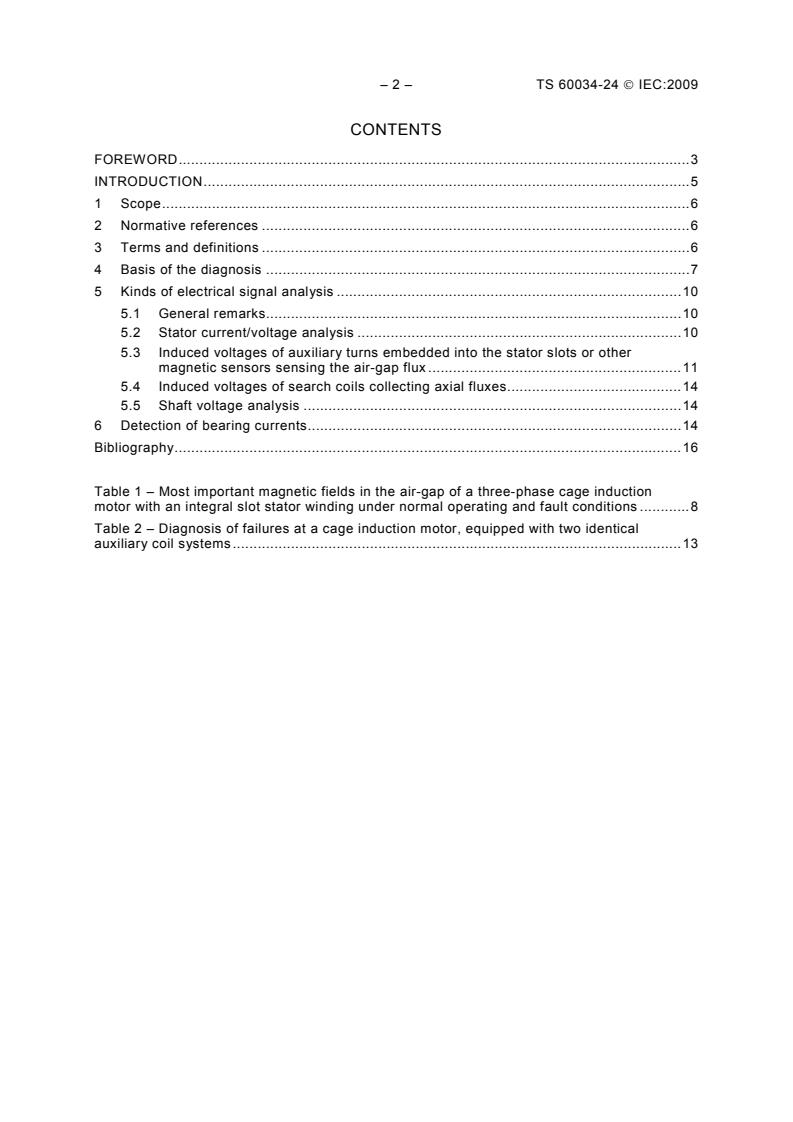
– 2 – TS 60034-24 © IEC:2009
CONTENTS
FOREWORD.3
INTRODUCTION.5
1 Scope.6
2 Normative references .6
3 Terms and definitions .6
4 Basis of the diagnosis .7
5 Kinds of electrical signal analysis .10
5.1 General remarks.10
5.2 Stator current/voltage analysis .10
5.3 Induced voltages of auxiliary turns embedded into the stator slots or other
magnetic sensors sensing the air-gap flux .11
5.4 Induced voltages of search coils collecting axial fluxes.14
5.5 Shaft voltage analysis .14
6 Detection of bearing currents.14
Bibliography.16
Table 1 – Most important magnetic fields in the air-gap of a three-phase cage induction
motor with an integral slot stator winding under normal operating and fault conditions .8
Table 2 – Diagnosis of failures at a cage induction motor, equipped with two identical
auxiliary coil systems.13
TS 60034-24 © IEC:2009 – 3 –
INTERNATIONAL ELECTROTECHNICAL COMMISSION
____________
ROTATING ELECTRICAL MACHINES –
Part 24: Online detection and diagnosis of potential failures
at the active parts of rotating electrical machines
and of bearing currents –
Application guide
FOREWORD
1) The International Electrotechnical Commission (IEC) is a worldwide organization for standardization comprising
all national electrotechnical committees (IEC National Committees). The object of IEC is to promote
international co-operation on all questions concerning standardization in the electrical and electronic fields. To
this end and in addition to other activities, IEC publishes International Standards, Technical Specifications,
Technical Reports, Publicly Available Specifications (PAS) and Guides (hereafter referred to as “IEC
Publication(s)”). Their preparation is entrusted to technical committees; any IEC National Committee interested
in the subject dealt with may participate in this preparatory work. International, governmental and non-
governmental organizations liaising with the IEC also participate in this preparation. IEC collaborates closely
with the International Organization for Standardization (ISO) in accordance with conditions determined by
agreement between the two organizations.
2) The formal decisions or agreements of IEC on technical matters express, as nearly as possible, an international
consensus of opinion on the relevant subjects since each technical committee has representation from all
interested IEC National Committees.
3) IEC Publications have the form of recommendations for international use and are accepted by IEC National
Committees in that sense. While all reasonable efforts are made to ensure that the technical content of IEC
Publications is accurate, IEC cannot be held responsible for the way in which they are used or for any
misinterpretation by any end user.
4) In order to promote international uniformity, IEC National Committees undertake to apply IEC Publications
transparently to the maximum extent possible in their national and regional publications. Any divergence
between any IEC Publication and the corresponding national or regional publication shall be clearly indicated in
the latter.
5) IEC provides no marking procedure to indicate its approval and cannot be rendered responsible for any
equipment declared to be in conformity with an IEC Publication.
6) All users should ensure that they have the latest edition of this publication.
7) No liability shall attach to IEC or its directors, employees, servants or agents including individual experts and
members of its technical committees and IEC National Committees for any personal injury, property damage or
other damage of any nature whatsoever, whether direct or indirect, or for costs (including legal fees) and
expenses arising out of the publication, use of, or reliance upon, this IEC Publication or any other IEC
Publications.
8) Attention is drawn to the Normative references cited in this publication. Use of the referenced publications is
indispensable for the correct application of this publication.
9) Attention is drawn to the possibility that some of the elements of this IEC Publication may be the subject of
patent rights. IEC shall not be held responsible for identifying any or all such patent rights.
The main task of IEC technical committees is to prepare International Standards. In
exceptional circumstances, a technical committee may propose the publication of a technical
specification when
• the required support cannot be obtained for the publication of an International Standard,
despite repeated efforts, or
• The subject is still under technical development or where, for any other reason, there is
the future but no immediate possibility of an agreement on an International Standard.
Technical specifications are subject to review within three years of publication to decide
whether they can be transformed into International Standards.
IEC 60034-24, which is a technical specification, has been prepared by IEC technical
committee 2: Rotating machinery.
– 4 – TS 60034-24 © IEC:2009
The text of this technical specification is based on the following documents:
Enquiry draft Report on voting
2/1537/DTS 2/1553A/RVC
Full information on the voting for the approval of this technical specification can be found in
the report on voting indicated in the above table.
This publication has been drafted in accordance with the ISO/IEC Directives, Part 2.
NOTE A table of cross-references of all IEC TC 2 publications can be found in the IEC TC 2 dashboard on the
IEC website.
The committee has decided that the contents of this publication will remain unchanged until
the maintenance result date indicated on the IEC web site under "http://webstore.iec.ch" in
the data related to the specific publication. At this date, the publication will be
• transformed into an International standard,
• reconfirmed,
• withdrawn,
• replaced by a revised edition, or
• amended.
TS 60034-24 © IEC:2009 – 5 –
INTRODUCTION
Progress in design and technology has resulted in an increasing reliability of rotating
electrical machines, but failures could not be eliminated completely. Since the demand for a
high availability is permanently increasing, it is essential to detect deficiencies at an early
stage and to recognize the origin and identify the severity of the fault in order to estimate the
risk of a continuation of operation.
It would be advantageous, if the signals which are obtained by the detection methods
presented in this guide, were suitable to distinguish the different failures from each other. By
this means, the signal analysis can be used as input data of a complete monitoring system.
The aim of this guide is to present possible tools which are available for the intended purpose
and to explain their advantages and disadvantages. The minimum requirements which shall
be met by the various sensors will be discussed, whereas the detailed design rules are
outside the scope of this technical specification.
This guide deals with the detection of failures at the active parts of multi-phase rotating
machines (all kinds of winding faults in stator and rotor, cage deficiencies, eccentricities) and
of bearing currents.
– 6 – TS 60034-24 © IEC:2009
ROTATING ELECTRICAL MACHINES –
Part 24: Online detection and diagnosis of potential failures
at the active parts of rotating electrical machines
and of bearing currents –
Application guide
1 Scope
This part of IEC 60034 is applicable to the on-line detection and diagnosis of failures at the
active parts of multi-phase rotating electrical machines (induction and synchronous machines)
and of bearing currents. The failure analysis includes:
– interturn faults;
– phase-to-phase short-circuits;
– double earth faults and single earth faults of motors with earth connection of the star-
point;
– static and dynamic eccentricities;
– cage imperfection or defects (e.g. broken bars or end-rings);
– bearing currents.
This can be achieved by tools like search coils or other magnetic sensors or partly by the
analysis of the terminal voltages and currents.
The detection of the following effects is excluded from the scope:
– vibration (covered by ISO standards, e.g. ISO 10816 and ISO 7919);
– partial discharge (covered by IEC 60034-27);
– single earth-faults of motors without earth connection of the star-point;
– core imperfection.
Also excluded are special methods applicable for specific applications only (e.g. turbo
generators).
2 Normative references
There are no normative references in this technical specification.
3 Terms and definitions
For the purposes of this document, the following terms and definitions apply.
3.1
distribution factor
the factor, related to a distributed winding, which takes into account the reduction in the
generated voltage due to the phase difference between the voltages generated in the coils in
different slots
[IEV 411-38-37]
TS 60034-24 © IEC:2009 – 7 –
3.2
chording (pitch) factor
the factor, related to a distributed winding, which takes into account the reduction in the
generated voltage, when the winding pitch is not 100 %
[IEV 411-38-38]
3.3
branch factor
the factor, related to a distributed winding, which takes into account the reduction in the
generated voltage due to the phase difference between the voltages generated in the series-
connected branches
4 Basis of the diagnosis
The ability of electrical machines to operate is based on the existence of a magnetic field in
the air-gap, which is looping in a cross-sectional area of the laminations of stator and rotor.
Flux components in the end-portions of the machine outside the cores are of a parasitic
nature. Therefore available signals suitable for the detection of potential faults originate from
the magnetic field in the air-gap, which shall be analyzed in order to distinguish between
those components which occur under regular operating conditions and those components
which are attributed to a specific failure and which do not exist in a healthy machine.
Since the winding producing the magnetic field consists of coils distributed symmetrically
around the circumference and since the sum of the supplying currents is usually zero, the air-
gap field forms also a periodic function along the circumference. The wave of the flux density
can be considered as the superposition of a sum of sinusoidally distributed waves, which are
characterized by the following features:
– amplitude,
– number of pole-pairs,
– angular velocity,
– phase-angle,
– type of wave (rotating or standing).
Table 1 shows the composition of the air-gap field in the case of a three-phase cage induction
motor, which is equipped with an integral slot winding. The table can easily be extended to be
valid also for fractional slot windings. Similar tables can be developed for slip-ring motors and
all kinds of synchronous machines.
– 8 – TS 60034-24 © IEC:2009
Table 1 – Most important magnetic fields in the air-gap of a three-phase cage induction motor with an integral
slot stator winding under normal operating and fault conditions
Origin of the field Stator fields Rotor fields Item
winding fields type: rotating type: rotating 1
(slot harmonics) frequency: f
g Q
1 ⎧ ⎫
⎪ ⎪
2 r
frequency: f 1+ ()1– s
number of
1⎨ ⎬
p
⎪ ⎪
⎩ ⎭
pole pairs: ν = p (1 + 6g )
1 1
g = 0; ± 1; ± 2; . g = 0; ± 1; ± 2; …
1 2
number of
(slot harmonics: ν = p + g Q )
1 1 s
pole pairs: ν = ν + g Q
2 1 2 r
saturation fields type: rotating type: rotating 2
frequency: 3f
⎧ g Q ⎫
⎪ ⎪
2 r
number of frequency: f 3 + ()1– s
⎨ ⎬
p
⎪ ⎪
⎩ ⎭
pole pairs: ν = 3p
g = 0; ± 1; ± 2; …
number of
pole pairs: ν = 3p + g Q
2 2 r
interturn faults type: superposition of reverse rotating type: superposition of reverse rotating 3
phase-to-phase faults fields of different amplitude fields of different amplitude
double earth faults frequency: f
g Q
1 ⎧ ⎫
⎪ ⎪
2 r
frequency: f ± 1+ ()1– s
number of
1⎨ ⎬
p
⎪ ⎪
⎩ ⎭
pole pairs: ν = 1; 2; 3; .
g = ± 1; ± 2; …
+ positive-sequence fields
– negative-sequence fields
number of
pole pairs: ν = ν + g Q
2 1 2 r
Additional fields under Fields under normal operating
fault conditions conditions
TS 60034-24 © IEC:2009 – 9 –
Origin of the field Stator fields Rotor fields Item
eccentricity type: 2 rotating fields type: 2 rotating fields 4
K
⎧ g Q ⎫
⎡ ⎤
⎪ K ⎪
2 r
frequency: f {1 ± (1 – s)}
frequency: f 1+ ± + ()1– s
1 ⎢ ⎥
1⎨ ⎬
p
p p
⎪ ⎢ ⎥ ⎪
⎣ ⎦
⎩ ⎭
K = 0: static eccentricity
number of
K = 1: dynamic eccentricity
pole pairs: ν = ν + g Q
2 1 2 r
number of
g = 0; ± 1; ± 2; …
pole pairs: ν = p ± 1
rotor asymmetry type: superposition of reverse rotating 5
fields of the same amplitude
⎧ ν ⎫
frequency: f ±s + ()1−s
⎨ ⎬
p
⎩ ⎭
number of
pole pairs: ν = 1; 2; 3; …
Symbols: f fundamental frequency Q number of stator slots
1 s
p number of pole pairs, Q number of rotor bars
r
for which the motor is designed s slip
ν number of pole pairs in general
– 10 – TS 60034-24 © IEC:2009
5 Kinds of electrical signal analysis
5.1 General
A valuable detection method shall be able to detect failures at an early stage. Therefore
signals disclosing a rapid change in the case of small deficiencies, are optimal for the
intended purpose. By contrast signals which vary only insignificantly should not be used as
the basis of the diagnosis.
The signal processing needs the availability of appropriate electronic equipment. Although the
resolution of modern devices is high, signals which do not need excessive precision should be
preferred in this respect.
5.2 Stator current/voltage analysis
The analysis of the terminal voltages or currents of a rotating machine allows identification of
– different frequencies,
– positive-, negative-, and zero-sequence components,
– different amplitudes of the components.
In general, all waves of induction in the air-gap field can induce voltages of certain
frequencies in the stator winding and can cause currents of the same frequencies. The
additional current components which are generated by a specific failure are superimposed to
the supply values during undisturbed operation. All details shall be taken from the relevant
table, that is Table 1 in the case of three-phase cage induction motors.
Table 1 is worded for one single supply frequency f . However, in case of a converter
supplied machine, it is valid for each voltage/frequency component, which is contained in the
output spectrum of the converter.
Table 1 shows the components of the air-gap field. Whether a specific component induces a
voltage in the stator winding, depends on its winding factor for the number of pole pairs under
consideration. The winding factor is the product of the following terms:
– the distribution factor,
– the chording factor,
– the branch factor.
The branch factor is not generally known amongst engineers, but of fundamental importance
for the problem under consideration. Each symmetrical three-phase integral slot winding
consists of p (in case of a single-layer winding) or 2p (in case of a double-layer winding)
identical coil groups (branches), which are distributed symmetrically around the
circumference. They can be series-connected or connected to form parallel branches with the
maximum number a = 2p. The connecting method considerably influences the branch factor of
a specific number of pole pairs.
It can be shown that the branch factor is zero for the eccentricity fields ν =
p + 1 and ν = p – 1 for all windings with series-connection of the coil-groups. Consequently
both types of eccentricity cannot be detected for such machines by stator current analysis.
The branch factor of the harmonic fields according to item 1 to 4 of Table 1 depends also on
the individual configuration and in addition on the number of rotor slots. The design of a given
case is selected by the manufacturer of the machine for different reasons (e.g. to suppress
unbalanced magnetic pull, to avoid nasty magnetic tones, etc.) and unknown to the user. It is
therefore not advisable to use the harmonic rotor fields of items 3 and 4 as the signal for a
stator current analysis.
TS 60034-24 © IEC:2009 – 11 –
The group of winding faults in item 3 marks the most severe deficiencies at the active parts.
They all produce magnetic fields of fundamental frequency. Thus winding faults cannot be
detected by a frequency analysis of the stator currents.
The field waves, produced by winding faults, are of elliptic nature, which means the
superposition of two reverse rotating waves, having the same number of poles and the same
frequency, but different amplitudes. In principle such failures can be detected by exploring the
negative sequence component of the current of fundamental frequency.
Especially in case of the most dangerous failure, an interturn fault of a high-voltage machine,
when the high currents flow in only one of many turns per phase, this component is very
small. A negative-sequence component of the current may also be caused by an unavoidable
small asymmetry of the supply voltages (a negative sequence component of the voltage
results in a negative sequence component of the currents, which is 6 to 10-times higher).
Summing up, it is not recommendable to detect winding faults by means of a voltage/current
analysis.
Reliable detection of cage imperfection or defects (e.g. broken bars or end-rings) is possible
by use of stator current analysis.
Another disadvantage of the stator current analysis cannot be neglected. Statistics of
insurance companies manifest that most of the winding faults occur during transient
phenomena such as starting of motors, short-circuits at the terminals, etc., and cause high
inrush currents. It is unfeasible to detect failures by current analysis during the interval of the
transients.
5.3 Induced voltages of auxiliary turns embedded into the stator slots or other
magnetic sensors sensing the air-gap flux
An ideal diagnostic signal would be zero during operation of a healthy machine under steady-
state and transient conditions, it would rise with the amount of the deficiency for all kinds of
failures according to items 3 to 5 of Table 1 and would be able to distinguish between the
failures. Solutions close to the optimum have been developed.
These solutions are based on turns made by insulated wire, the diameter of which can be
selected under solely mechanical aspects. Both coil-sides are incorporated in the stator slots
of the main winding, usually during manufacturing of the machine between the upper layer of
the winding and the slot wedge. The assembly at a later stage is possible. The end-
connections are led close to the end of the core.
The same insight into the magnetic field at specific locations at the stator bore can eventually
be achieved by other kinds of magnetic sensors instead of measuring turns.
Usually several turns of the same pitch are series-connected and shifted against each other
by a predetermined angle. It is aimed to get finally a system of auxiliary measuring coils, for
which the resulting winding factor is zero for all air-gap fields, which exist during normal
undisturbed operation, and for which the winding factor is maximum for a field with that
number of pole pairs, which is intended to be used as the reference field of the diagnosis.
If a system of auxiliary coils can be found which fulfills the condition explained above for a
reference field, which is amongst the fields generated by all failures of items 3 to 5, the coil
system would be complete. But there is one remaining difficulty: The fields produced by a
winding fault according to item 3 of Table 1, are of an elliptic nature. If one of them is chosen
as reference field, the induced voltage of the coil system would vary with the location of the
fault at the circumference. Such a situation is of course unacceptable.
The problem can be eliminated by use of a second identical coil system, which is shifted
against the first one by the angle π/(2ν), when ν is the number of pole pairs of the reference
field. Then both coil groups form a symmetrical two-phase system, which easily allows the
– 12 – TS 60034-24 © IEC:2009
calculation of the symmetrical components (SC) of the two measured voltages. The SCs are
independent of the fault location.
This guide is the inappropriate place to explain the design rules for the coil system in detail. It
is mentioned only that the minimum number of turns per coil system usually varies between 6
and 12 depending on the data of the relevant machine and the claims to the sensibility of the
diagnosis.
The reference field is taken from the list of air-gap fields, which are generated by the fault
condition and which are zero during normal operation. Therefore the amplitude of the
reference field is nearly unchanged during transients. This statement is proven by tests.
The procedure of the diagnosis is executed in Table 2. Winding faults are characterized by
the criterion that both (positive and negative sequence) symmetrical components do exist and
have mains frequency. The voltages in case of static eccentricity have mains frequency too,
but the negative-sequence component U is zero. A dynamic eccentricity can be distinguished
n
from other fault conditions by the typical frequencies of the induced voltages. Rotor
asymmetries are marked by other typical frequencies; the induced voltages become zero,
when the machine is running at synchronous speed (s = 0), because then the rotor currents,
responsible for the reference field, disappear.
It can be concluded that a professionally designed system of auxiliary coils forms a useful tool
for the detection and diagnosis of faults.
For the purpose of completeness it should be mentioned that other types of search coils were
proposed in technical articles, which e.g. comprise one stator tooth only. They may be useful
to investigate a specific effect, but they are unsuitable to form a complete diagnosis and were
therefore not introduced into engineering practice.
TS 60034-24 © IEC:2009 – 13 –
Table 2 – Diagnosis of failures at a cage induction motor, equipped with two identical auxiliary coil systems
Kind of faults Measured quantities
f U U U U
1 2 p n
Winding fault f = f
U ≠ 0 U ≠ U ≠ 0 U ≠ 0 U ≠ 0
1 2 1 p n
Static eccentricity f = f U = U
U ≠ 0 U ≠ 0 U ≠ 0
1 2 1
1 p n
Dynamic eccentricity U ≠ 0 U = U
1 2 1
⎧ 1 ⎫
f = f 1± (1−s)
⎨
1 ⎬
p
⎩ ⎭
Rotor asymmetry U = U
U ≠ 0
2 1
⎧ 1 ⎫ 1
f = f (1−s) ±s
⎨ ⎬
p
⎩ ⎭
The marks of identification are indicated by a bold frame.
Symbols: U , U r.m.s. values of the measured voltages of the coil systems 1 and 2
1 2
U = ()U + jU positive-sequence component of the measured voltage
p 1 2
U = ()U − jU negative-sequence component of the measured voltage
n 1 2
– 14 – TS 60034-24 © IEC:2009
5.4 Induced voltages of search coils collecting axial fluxes
Proposals were made to use either toroidal coils, fastened in front of the machine or coils
surrounding the shaft of the machine. In both cases the axial flux produced by the machine is
intended to be used for the detection of failures. Such approaches are generally not beneficial
for the following reasons.
Axial flux components are always parasitic and undesired, because the performance of the
machine is based on flux components looping in the cross-sectional area of the laminations.
The axial flux is very small because of the high magnetic resistance of air. The axial flux
cannot be predicted by analytical methods.
The flux produced by the most important winding faults is of fundamental frequency and the
magnitude of its axial component is unforeseeable.
Only for the case of eccentricities in 2-pole machines will the eccentricity field with the
number of pole pairs p – 1 degenerate to a unipolar flux which successfully can be measured
by a ring coil surrounding the stator bore and mounted at one core end.
With this exception the use of search coils collecting axial fluxes is not recommended.
5.5 Shaft voltage analysis
Some authors allege the usefulness of the measurement of the shaft voltage in order to detect
any distortion in the internal flux distribution of a machine.
Shaft voltages are induced by a magnetic ring flux looping around the shaft. This ring flux is
caused by irregularities of the stator yoke (e.g. clamping notches) and their distribution along
the circumference in case of mains supplied machines. A ring flux is generated only, when the
integral of the magnetic field strength around the circumference deviates from zero. The fields
with number of pole pairs p and 3p play the most important role in this respect. This physical
background demonstrates that the impact of winding faults on the shaft voltage is purely
parasitic and too small to be used as a sensitive detection device.
In the case of converter supplies, the shaft voltage may considerably increase due to ring flux
components, which are caused by the common mode voltage of the converter. Consequently
these components of the shaft voltage do not relate to the operational flux distribution of the
machine and are totally unsuitable for the intended purpose.
Summing up, failures at the active parts cannot reliably be detected by an analysis of the
shaft voltage.
6 Bearing currents
Bearing currents can be produced by two sources:
– irregularities of the core yoke,
– common mode currents in case of converter supplied motors.
When the yoke contains irregularities such as ventilation ducts, joints, dove-tailed clamping
grooves, etc., their number and distribution along the circumference is decisive for the
generation of shaft voltages which may result in bearing currents circulating through both
bearings. The bearing currents usually contain predominantly the fundamental frequency,
superimposed by a component of three-times the fundamental frequency due to saturation
effects. Long-standing experience shows that the bearings are endangered when the shaft
voltage exceeds 200 mV to 250 mV (r.m.s.). In this case it is the responsibility of the
manufacturer to avoid bearing currents by the insulation of the bearing at the non-drive end
(NDE). Several kinds of insulation are common.
TS 60034-24 © IEC:2009 – 15 –
When the non-drive end bearing is properly insulated, usually no further protection measure is
necessary. However, when bridging of the insulation by inadvertent measures cannot be
excluded, monitoring of the voltage across the insulation is advisable.
If the rotating machine is supplied by a converter with an impressed d.c. voltage in the
intermediate circuit, the common mode voltage (zero-sequence component) of the converter
forms an additional source of bearing currents. Depending on details of the configuration,
these currents may pass only one bearing (EDM (Electric Discharge Machining) and earth
currents flow back to the converter via the grounding system) or they circulate through both
bearings, when they are caused by the capacitive currents between the winding and the
laminations.
The common mode currents can be measured, but if they can take different paths from the
machine frame to the ground, they cannot be taken as indication of the risk. It is the
responsibility of the system designer/supplier to decide if the insulation of one bearing is a
sufficient precautious measure or if both bearings must be insulated.
The selection of the bearing insulation shall take into account that the frequency of the
common mode currents is in the kHz range and that the analysis of the EDM breakdowns
comprises much higher values. Capacitive currents cannot be suppressed by a thin insulation
film in the range of hundred micrometers.
In case a grounding brush is used, the current flowing through this brush can be analysed in
order to find the origin of the current.
A breakdown of the bearing insulation or a discharge through the oil film of the bearings can
be monitored by measuring the shaft-to-ground voltage using a sensing brush.
For test purposes contact pins can be installed at both sides of the insulation in order to
measure the voltage across the insulation or the bearing current when the insulation is
bridged by a strap. Such measurements necessitate the use of appropriate instrumentation
and cabling with respect to the high frequencies. Currently, monitoring of these quantities is
exceptional.
– 16 – TS 60034-24 © IEC:2009
Bibliography
[1] Frohne, H. Theorie einer Messeinrichtung zur Überwachung von
Luftspaltänderungen in Asynchronmaschinen mit Käfigläufern
(English title: Theory of a measuring device for the monitoring
of eccentricities in cage induction motors)
ETZ-A, 87, 1966, 127 - 132
[2] Frohne, H. Messreinrichtung zum Erfassen von Luftspaltänderungen in
Drehstrommaschinen mit Ganz- oder Bruchlochwicklungen
(English title: Measuring device to detect eccentricities in multi-
phase machines with integral-slot or fractional-slot windings)
ETZ-A, 87, 1966, 592 - 598
[3] Frohne, H. Praktische Ausführung und experimentelle Prüfung einer
Luftspaltüberwachungseinrichtung
Seinsch, H.O.
(English title: Verification and testing of a device to monitor the
centrosymmetry of the air gap)
E.u.M., 85, 1968, 285 – 280
[4] Rickson, C.D. Protecting motors from overload due to asymmetrical fault
conditions
Electr. Review, 7, 1973, 778 - 780
[5] Rogge, D. Erkennung und Überwachung von elektrischen Läufer-
unsymmetrien in Käfigläufern
Seinsch, H.O.
(English title: Detection and monitoring of electrical rotor
asymmetries in cage induction machines)
etz-Archiv, 1981, 339 – 45
[6] Hargis, C. The Detection of Rotor Defects in Induction Motors
Gaydon, B.G. IEE Conf. On Electrical Machines, 1982, 216-220
Kamash, K.
[7] Kaumann, U. Möglichkeiten und Grenzen der Überwachung von elektrischen
Läuferunsymmetrien bei Käfigläufermotoren
Wolf, B.
(English title: Options and limits of the monitoring of electrical
rotor asymmetries in cage induction motors)
Schorch-Berichte, 1984, 13 - 23
[8] Deleroi, W. Der Stabbruch im Käfigläufer eines Asynchronmotors
(English title: Broken bars in the cage of induction motors)
A.f.E., 67, 1984, 91 – 99, 141 - 149
[9] Williamson, S. Analysis of cage induction motors with stator winding faults
Mirzoian, K. IEEE Transactions on Power Apparatus and Systems, vol.104,
no. 7, 1985, 1838-1842
[10] Thomson, W. T. Cases Histories of Rotor Winding Fault Diagnosis in Induction
Motors
Rankin, D.
nd
Proceeding of 2 Int. Con. on Condition Monitoring, University
College of Swansea, 1987, 798-819
[11]
Tavner, P.J. Condition Monitoring of Electrical Machines
Penman, J. J. Wiley & Sons, New York, 1987
TS 60034-24 © IEC:2009 – 17 –
[12] Heinrich, W. Messtechnische Erfassung von Läuferfehlern aus
Klemmengrößen
(English title: Detection of rotor failures by means of analysing
the terminal voltages and currents)
etz-Archiv, 10, 1988, 61 - 64
[13] Penman, J. Multifunctional monitoring and protection scheme for electrical
machines
Dey, M.N.
UPEC, 19, 1983, 4 - 12
[14] Penman, J. The development of a machine condition monitoring system for
electrical drives
Tait, A.J.
Proceedings of the Conference on Drives/Motors/Control,
Smith, J.R.
1985, 123 - 129
Bryan, W.E.
[15] Kaumann, U. Analytische und experimentelle Behandlung von
Induktionsmaschinen mit beliebiger Läuferunsymmetrie
(English title: Analytical theory and experimental verification of
the performance of induction machines with any rotor
asymmetry)
Dissertation, Institut für Elektrische Maschinen und Antriebe,
Universität Hannover, 1983
[16] Seinsch, H.O. Diagnose und Überwachung von anomalen Betriebszuständen
und Schäden in Drehstrommaschinen
(English title: Diagnosis and monitoring of abnormal operating
conditions and failures in multi-phase machines)
Schorch-Berichte, 1986, 4 - 12
[17] Früchtenicht, S. Ein Diagnosesystem für Drehstrom-Asynchronmaschinen
Pittius, E. (English title: Diagnostic system for multi-phase induction
machines)
Seinsch, H.O.
etz-Archiv, 11, 1989, 145 - 153
[18] Pittius, E. Analytische und experimentelle Behandlung von Erdschlüssen
in Induktionsmaschinen
(English title: Analytical theory and experimental verification of
earth faults in induction machines)
Dissertation, Institut für Elektrische Maschinen und Antriebe,
Universität Hannover, 1989
[19] Früchtenicht, S. Diagnostic system for three-phase asynchronous machines
Pittius, E. Fourth International IEE Conference on Electrical Machines
and Drives, London, 1989, 163 - 171
Seinsch, H.O.
[20] Früchtenicht, S. Analytische und experimentelle Behandlung von
Wicklungsschlüssen in Asynchronmaschinen
(English title: Analytical theory and experimental verification of
winding faults in induction machines)
Fortschritt-Berichte VDI Reihe 21, Nr. 56, VDI-Verlag
Düsseldorf, 1990
– 18 – TS 60034-24 © IEC:2009
[21] Ojo, J.O. An improved model of saturated induction machines
Consoli, A. IEEE Trans. Ind. Applicat., vol. 26, no. 2, 1990, 212 - 221
Lipo, T.A.
[22] Slemon, G.R. An equivalent circuit approach to analysis of synchronous
machines with saliency and saturation
IEEE Trans. Energy Conversion, vol. 5, no. 3, 1990
[23] Toliyat, H.A. Transient analysis of induction machines under internal faults
using winding functions
Rahimian, M.M.
rd
Proc. 3 Int. Conf. Electrical Rotating Machines – ELROMA’92,
Bhattacharya, S.
1992, Bombay
Lipo, T.A.
[24] Cardoso, A.J.M. Computer-Aided Detection of Air-gap Eccentricity in Operating
Three-Phase Induction Motors by Park’s Vector Approach
Saraiva, E.S.
IEEE Transactions on Industry Applications, vol. 29, no. 5,
1993, 897 - 901
[25] Gentile, G. Harmonic analysis of induction motors with stator faults
Rotondale, N. Electric Power Components and Systems, vol. 22, no. 2, 1994,
215-231
Martelli, M.
Tassoni, C.
[26] Toliyat, H.A. Transient analysis of cage induction motors under stator, rotor
bar end ring faults, IEEE Trans. Energy Conversion, vol. 10,
Lipo, T.A.
no. 2, 1995, 241 - 247
[27] Ponick, B. Fehlerdiagnose bei Synchronmaschinen
(English title: Diagnosis of failures in synchronous machines)
Fortschritt-Berichte VDI Reihe 21, Nr. 147, VDI-Verlag,
Düsseldorf, 1995
[28] Filippetti, F. A simplified model of induction motor with stator shorted turns
oriented to diagnostics
Franceschini, G.
Proc. Int. Conf. Elect. Mach., ICEM, 1996, 410-413
Tassoni, C.
Meo, S.
Ometto, A.
[29] Rust, St. Überwachung von Windungsschlüssen im Läufer von
Induktionsmotoren mit Schleifringläufer
Seinsch, H.O.
(English title: Monitoring of winding faults in the rotor of slip-
ring induction motors)
Elektrie, 50, 1996, 347 - 355
[30] Chen, S. Circulating type motor bearing currents in inverter drives
Lipo, T. A. IEEE IAS Conf., 1996, 162-167
[31] Chen, S. Source of induction motor bearing currents caused by PWM
inverters
Lipo, T. A.
IEEE Trans. Energy Conv., vol. 11, 1996, 25-32
Fritzgerald, D.
[32] Erdmann, J. M. Effect of PWM Inverters on AC motor bearing currents and
shaft voltages
Kerkman, R. J.
IEEE Trans. Ind. Appl., vol. 32, 1996, 243-252
Schlegel, D. W.
TS 60034-24 © IEC:2009 – 19 –
Skibinski, G.
[33] Bradley, K.J. Reluctance mesh modelling of induction motors with healthy
and faulty rotors
Tami, A.
st
Proc. 31 IAS Ann. Meeting, 1996, 625 - 632
[34] Dorrell, D. G. Analysis of air gap flux, current and vibration signals as a
function of the combination of static and dynamic air gap
Thomson, W. T.
eccentricity in 3-phase induction motors
Roach, S.
IEEE Trans. on Ind. Appl., vol. 33, no. 1, 1997, 24-34
[35] Chen, S. Bearing currents and shaft voltages of an induction motor
under hard and soft switching inverter excitation
Lipo, T. A.
IEEE IAS Annual Meeting, 1997, 1-7
[36] Filippetti, F. AI techniques in induction machines diagnosis including the
speed ripple effect
Franceschini, G.
IEEE Transactions on Industry Applications, vol. 34, no. 1,
Tassoni, C.
1998, 98-108
Vas, P.
[37] Ostovic, V. A simplified approach to magnetic equivalent-circuit modeling
of induction machines
IEEE Trans. Ind. Applicat., vol. 24, no. 2, 1998, 308 - 316
[38] Cardoso, Aj.J.M. Inter-Turn Stator Winding Fault Diagnosis in Three-Phase
Induction Motors by Park’s Vector Approach
Cr
...