

IEC 60154-4:2017
(Main)Flanges for waveguides - Part 4: Relevant specifications for flanges for circular waveguides
General Information
- Abstract
IEC 60154-4:2017 specifies the dimensions of flanges for circular waveguides for use in electronic equipment.
It covers requirements for flanges drilled before or after mounting on waveguides.
The aim of this document is to specify for waveguide flanges the mechanical requirements necessary to ensure compatibility and, as far as practicable, interchangeability as well as to ensure adequate electrical performance.
This edition includes the following significant technical changes with respect to the previous edition:
- revise the estimation for return loss at connection interface of waveguides;
- add two type of waveguide flange for high frequency application, i.e. over 50 GHz;
- expand the operation frequency range up to 3,3 THz;
- rename the frequency band over R1200, i.e. R1.2K.
- Status
- Published
- Publication Date
- 21-Mar-2017
- Technical Committee
- SC 46F - RF and microwave passive components
- Drafting Committee
- WG 2 - TC 46/SC 46F/WG 2
- Current Stage
- PPUB - Publication issued
- Start Date
- 22-Mar-2017
- Completion Date
- 06-Apr-2017
Overview
IEC 60154-4:2017 is an international standard developed by the International Electrotechnical Commission (IEC). This standard specifies the dimensions and mechanical requirements for flanges used with circular waveguides in electronic equipment. The document is designed to ensure the compatibility, interchangeability, and adequate electrical performance of circular waveguide flanges, whether the flanges are drilled before or after being mounted on the waveguides.
This second edition introduces key updates, including improved estimation methods for return loss at connection interfaces, the addition of two new flange types for high-frequency applications (over 50 GHz), and an expanded operational frequency range up to 3.3 THz. The frequency bands over R1200 are also renamed to R1.2K.
Key Topics
Scope and Purpose
- Defines dimensional and mechanical requirements for flanges on circular waveguides.
- Ensures compatibility and, as much as possible, interchangeability among different manufacturers and systems.
- Addresses both pre-drilled and post-drilled flange solutions.
Mechanical Requirements
- Specifies features including overall dimensions, thickness, surface roughness, and flatness of the contact area.
- Establishes tolerance and alignment criteria for optimal electrical performance.
- References IEC 60154-1 for general requirements.
- Type designation system provides clear identification based on pressurizability, construction type, and waveguide size.
Frequency Considerations
- Introduces options for use in high-frequency applications, extending usability above 50 GHz and up to 3.3 THz.
- Updated estimation for return loss at the waveguide interface, supporting higher-frequency reliability.
Types of Flanges
- Covers standardized types with designations for both preferred and intermediate waveguide sizes.
- Provides detailed dimensional tables and figures for various flange types including new additions for high-frequency and ultrahigh-frequency ranges.
Applications
Flanges for circular waveguides are widely used in numerous fields:
- Telecommunications and Broadcasting: Ensuring robust mechanical and electrical connections in systems transmitting microwave and millimeter-wave signals.
- Test and Measurement Equipment: Used in laboratories and manufacturing facilities for the calibration and testing of high-frequency electronic devices.
- Radar and Satellite Communication: Employed in critical RF and microwave systems to maintain signal integrity and system compatibility.
- Industrial and Scientific Applications: Applicable in high-frequency equipment deployed in scientific research and advanced industrial processes.
The standard ensures that waveguide systems from different manufacturers remain compatible and can be reliably assembled or replaced, aiding procurement, maintenance, and long-term operation.
Related Standards
For comprehensive system compatibility, IEC 60154-4:2017 should be used alongside the following related standards:
- IEC 60154-1: Flanges for waveguides - General requirements (provides foundational mechanical and performance specifications).
- IEC 60153 (all parts): Hollow metallic waveguides (including specifications for both rectangular and circular waveguides).
- IEC 60153-4: Dedicated to the specifications for circular waveguides.
- ISO/IEC 17025: General requirements for the competence of testing and calibration laboratories (useful for organizations performing quality control and compliance testing).
- ISO/IEC Guide 98 Series: Guides for the expression and calculation of measurement uncertainty in laboratory and field measurements.
For professionals in RF and microwave engineering, manufacturing, system integration, and testing, IEC 60154-4:2017 provides a critical foundation for ensuring waveguide flange compatibility and performance in high-frequency electronic equipment.
Keywords: IEC 60154-4, circular waveguide flanges, mechanical requirements, flange dimensions, waveguide systems, high-frequency applications, RF connectors, microwave components, telecommunications standards, electronic equipment compatibility.
Get Certified
Connect with accredited certification bodies for this standard

ANCE
Mexican certification and testing association.

Intertek Slovenia
Intertek testing, inspection, and certification services in Slovenia.

LNE (Laboratoire National de Métrologie et d'Essais)
French national laboratory for metrology and testing.
Sponsored listings
Frequently Asked Questions
IEC 60154-4:2017 is a standard published by the International Electrotechnical Commission (IEC). Its full title is "Flanges for waveguides - Part 4: Relevant specifications for flanges for circular waveguides". This standard covers: IEC 60154-4:2017 specifies the dimensions of flanges for circular waveguides for use in electronic equipment. It covers requirements for flanges drilled before or after mounting on waveguides. The aim of this document is to specify for waveguide flanges the mechanical requirements necessary to ensure compatibility and, as far as practicable, interchangeability as well as to ensure adequate electrical performance. This edition includes the following significant technical changes with respect to the previous edition: - revise the estimation for return loss at connection interface of waveguides; - add two type of waveguide flange for high frequency application, i.e. over 50 GHz; - expand the operation frequency range up to 3,3 THz; - rename the frequency band over R1200, i.e. R1.2K.
IEC 60154-4:2017 specifies the dimensions of flanges for circular waveguides for use in electronic equipment. It covers requirements for flanges drilled before or after mounting on waveguides. The aim of this document is to specify for waveguide flanges the mechanical requirements necessary to ensure compatibility and, as far as practicable, interchangeability as well as to ensure adequate electrical performance. This edition includes the following significant technical changes with respect to the previous edition: - revise the estimation for return loss at connection interface of waveguides; - add two type of waveguide flange for high frequency application, i.e. over 50 GHz; - expand the operation frequency range up to 3,3 THz; - rename the frequency band over R1200, i.e. R1.2K.
IEC 60154-4:2017 is classified under the following ICS (International Classification for Standards) categories: 33.120.10 - Coaxial cables. Waveguides. The ICS classification helps identify the subject area and facilitates finding related standards.
IEC 60154-4:2017 is available in PDF format for immediate download after purchase. The document can be added to your cart and obtained through the secure checkout process. Digital delivery ensures instant access to the complete standard document.
Standards Content (Sample)
IEC 60154-4 ®
Edition 2.0 2017-03
INTERNATIONAL
STANDARD
NORME
INTERNATIONALE
colour
inside
Flanges for waveguides –
Part 4: Relevant specifications for flanges for circular waveguides
Brides pour guides d'ondes –
Partie 4: Spécifications particulières applicables aux brides pour guides
d'ondes circulaires
All rights reserved. Unless otherwise specified, no part of this publication may be reproduced or utilized in any form
or by any means, electronic or mechanical, including photocopying and microfilm, without permission in writing from
either IEC or IEC's member National Committee in the country of the requester. If you have any questions about IEC
copyright or have an enquiry about obtaining additional rights to this publication, please contact the address below or
your local IEC member National Committee for further information.
Droits de reproduction réservés. Sauf indication contraire, aucune partie de cette publication ne peut être reproduite
ni utilisée sous quelque forme que ce soit et par aucun procédé, électronique ou mécanique, y compris la photocopie
et les microfilms, sans l'accord écrit de l'IEC ou du Comité national de l'IEC du pays du demandeur. Si vous avez des
questions sur le copyright de l'IEC ou si vous désirez obtenir des droits supplémentaires sur cette publication, utilisez
les coordonnées ci-après ou contactez le Comité national de l'IEC de votre pays de résidence.
IEC Central Office Tel.: +41 22 919 02 11
3, rue de Varembé Fax: +41 22 919 03 00
CH-1211 Geneva 20 info@iec.ch
Switzerland www.iec.ch
About the IEC
The International Electrotechnical Commission (IEC) is the leading global organization that prepares and publishes
International Standards for all electrical, electronic and related technologies.
About IEC publications
The technical content of IEC publications is kept under constant review by the IEC. Please make sure that you have the
latest edition, a corrigenda or an amendment might have been published.
IEC Catalogue - webstore.iec.ch/catalogue Electropedia - www.electropedia.org
The stand-alone application for consulting the entire The world's leading online dictionary of electronic and
bibliographical information on IEC International Standards, electrical terms containing 20 000 terms and definitions in
Technical Specifications, Technical Reports and other English and French, with equivalent terms in 16 additional
documents. Available for PC, Mac OS, Android Tablets and languages. Also known as the International Electrotechnical
iPad. Vocabulary (IEV) online.
IEC publications search - www.iec.ch/searchpub IEC Glossary - std.iec.ch/glossary
The advanced search enables to find IEC publications by a 65 000 electrotechnical terminology entries in English and
variety of criteria (reference number, text, technical French extracted from the Terms and Definitions clause of
committee,…). It also gives information on projects, replaced IEC publications issued since 2002. Some entries have been
and withdrawn publications. collected from earlier publications of IEC TC 37, 77, 86 and
CISPR.
IEC Just Published - webstore.iec.ch/justpublished
Stay up to date on all new IEC publications. Just Published IEC Customer Service Centre - webstore.iec.ch/csc
details all new publications released. Available online and If you wish to give us your feedback on this publication or
also once a month by email. need further assistance, please contact the Customer Service
Centre: csc@iec.ch.
A propos de l'IEC
La Commission Electrotechnique Internationale (IEC) est la première organisation mondiale qui élabore et publie des
Normes internationales pour tout ce qui a trait à l'électricité, à l'électronique et aux technologies apparentées.
A propos des publications IEC
Le contenu technique des publications IEC est constamment revu. Veuillez vous assurer que vous possédez l’édition la
plus récente, un corrigendum ou amendement peut avoir été publié.
Catalogue IEC - webstore.iec.ch/catalogue Electropedia - www.electropedia.org
Application autonome pour consulter tous les renseignements
Le premier dictionnaire en ligne de termes électroniques et
bibliographiques sur les Normes internationales,
électriques. Il contient 20 000 termes et définitions en anglais
Spécifications techniques, Rapports techniques et autres
et en français, ainsi que les termes équivalents dans 16
documents de l'IEC. Disponible pour PC, Mac OS, tablettes
langues additionnelles. Egalement appelé Vocabulaire
Android et iPad.
Electrotechnique International (IEV) en ligne.
Recherche de publications IEC - www.iec.ch/searchpub
Glossaire IEC - std.iec.ch/glossary
65 000 entrées terminologiques électrotechniques, en anglais
La recherche avancée permet de trouver des publications IEC
en utilisant différents critères (numéro de référence, texte, et en français, extraites des articles Termes et Définitions des
comité d’études,…). Elle donne aussi des informations sur les publications IEC parues depuis 2002. Plus certaines entrées
projets et les publications remplacées ou retirées. antérieures extraites des publications des CE 37, 77, 86 et
CISPR de l'IEC.
IEC Just Published - webstore.iec.ch/justpublished
Service Clients - webstore.iec.ch/csc
Restez informé sur les nouvelles publications IEC. Just
Published détaille les nouvelles publications parues. Si vous désirez nous donner des commentaires sur cette
Disponible en ligne et aussi une fois par mois par email. publication ou si vous avez des questions contactez-nous:
csc@iec.ch.
IEC 60154-4 ®
Edition 2.0 2017-03
INTERNATIONAL
STANDARD
NORME
INTERNATIONALE
colour
inside
Flanges for waveguides –
Part 4: Relevant specifications for flanges for circular waveguides
Brides pour guides d'ondes –
Partie 4: Spécifications particulières applicables aux brides pour guides
d'ondes circulaires
INTERNATIONAL
ELECTROTECHNICAL
COMMISSION
COMMISSION
ELECTROTECHNIQUE
INTERNATIONALE
ICS 33.120.10 ISBN 978-2-8322-4109-7
– 2 – IEC 60154-4:2017 © IEC 2017
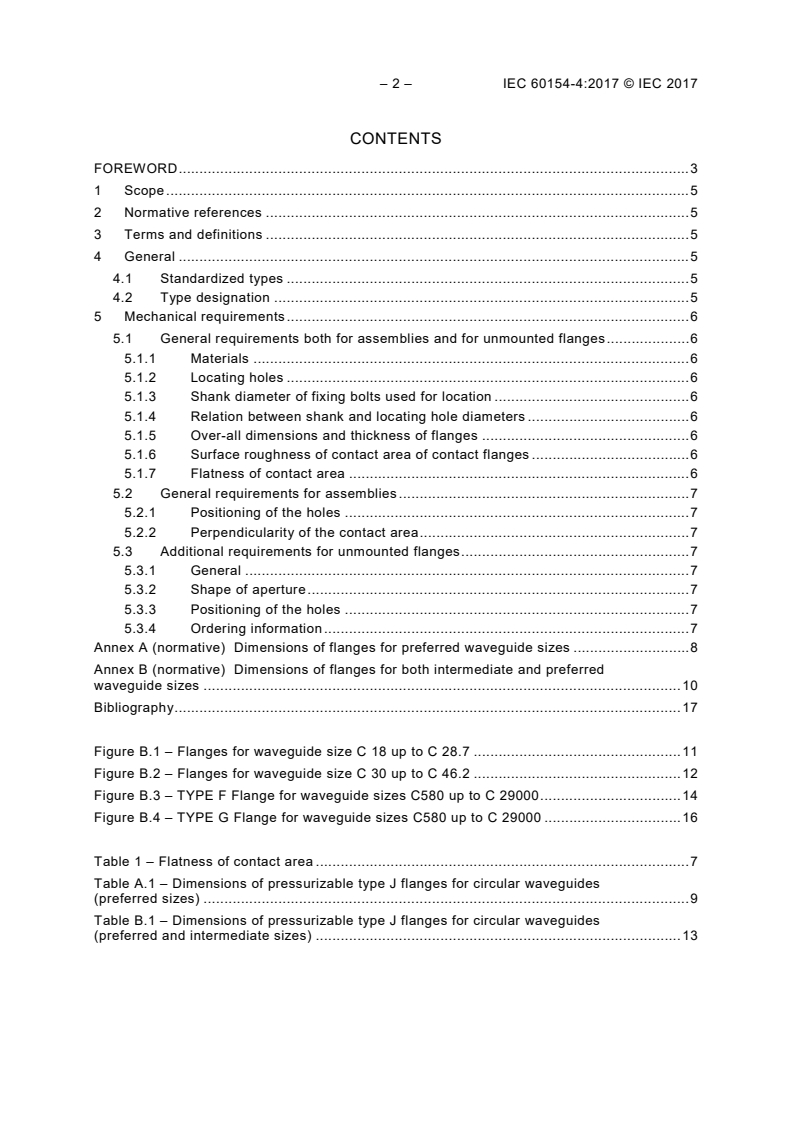
CONTENTS
FOREWORD . 3
1 Scope . 5
2 Normative references . 5
3 Terms and definitions . 5
4 General . 5
4.1 Standardized types . 5
4.2 Type designation . 5
5 Mechanical requirements . 6
5.1 General requirements both for assemblies and for unmounted flanges . 6
5.1.1 Materials . 6
5.1.2 Locating holes . 6
5.1.3 Shank diameter of fixing bolts used for location . 6
5.1.4 Relation between shank and locating hole diameters . 6
5.1.5 Over-all dimensions and thickness of flanges . 6
5.1.6 Surface roughness of contact area of contact flanges . 6
5.1.7 Flatness of contact area . 6
5.2 General requirements for assemblies . 7
5.2.1 Positioning of the holes . 7
5.2.2 Perpendicularity of the contact area . 7
5.3 Additional requirements for unmounted flanges . 7
5.3.1 General . 7
5.3.2 Shape of aperture . 7
5.3.3 Positioning of the holes . 7
5.3.4 Ordering information . 7
Annex A (normative) Dimensions of flanges for preferred waveguide sizes . 8
Annex B (normative) Dimensions of flanges for both intermediate and preferred
waveguide sizes . 10
Bibliography . 17
Figure B.1 – Flanges for waveguide size C 18 up to C 28.7 . 11
Figure B.2 – Flanges for waveguide size C 30 up to C 46.2 . 12
Figure B.3 – TYPE F Flange for waveguide sizes C580 up to C 29000 . 14
Figure B.4 – TYPE G Flange for waveguide sizes C580 up to C 29000 . 16
Table 1 – Flatness of contact area . 7
Table A.1 – Dimensions of pressurizable type J flanges for circular waveguides
(preferred sizes) . 9
Table B.1 – Dimensions of pressurizable type J flanges for circular waveguides
(preferred and intermediate sizes) . 13
INTERNATIONAL ELECTROTECHNICAL COMMISSION
____________
FLANGES FOR WAVEGUIDES –
Part 4: Relevant specifications for flanges for circular waveguides
FOREWORD
1) The International Electrotechnical Commission (IEC) is a worldwide organization for standardization comprising
all national electrotechnical committees (IEC National Committees). The object of IEC is to promote
international co-operation on all questions concerning standardization in the electrical and electronic fields. To
this end and in addition to other activities, IEC publishes International Standards, Technical Specifications,
Technical Reports, Publicly Available Specifications (PAS) and Guides (hereafter referred to as “IEC
Publication(s)”). Their preparation is entrusted to technical committees; any IEC National Committee interested
in the subject dealt with may participate in this preparatory work. International, governmental and non-
governmental organizations liaising with the IEC also participate in this preparation. IEC collaborates closely
with the International Organization for Standardization (ISO) in accordance with conditions determined by
agreement between the two organizations.
2) The formal decisions or agreements of IEC on technical matters express, as nearly as possible, an international
consensus of opinion on the relevant subjects since each technical committee has representation from all
interested IEC National Committees.
3) IEC Publications have the form of recommendations for international use and are accepted by IEC National
Committees in that sense. While all reasonable efforts are made to ensure that the technical content of IEC
Publications is accurate, IEC cannot be held responsible for the way in which they are used or for any
misinterpretation by any end user.
4) In order to promote international uniformity, IEC National Committees undertake to apply IEC Publications
transparently to the maximum extent possible in their national and regional publications. Any divergence
between any IEC Publication and the corresponding national or regional publication shall be clearly indicated in
the latter.
5) IEC itself does not provide any attestation of conformity. Independent certification bodies provide conformity
assessment services and, in some areas, access to IEC marks of conformity. IEC is not responsible for any
services carried out by independent certification bodies.
6) All users should ensure that they have the latest edition of this publication.
7) No liability shall attach to IEC or its directors, employees, servants or agents including individual experts and
members of its technical committees and IEC National Committees for any personal injury, property damage or
other damage of any nature whatsoever, whether direct or indirect, or for costs (including legal fees) and
expenses arising out of the publication, use of, or reliance upon, this IEC Publication or any other IEC
Publications.
8) Attention is drawn to the Normative references cited in this publication. Use of the referenced publications is
indispensable for the correct application of this publication.
9) Attention is drawn to the possibility that some of the elements of this IEC Publication may be the subject of
patent rights. IEC shall not be held responsible for identifying any or all such patent rights.
International Standard IEC 60154-4 has been prepared by subcommittee 46F: RF and
microwave passive components, of IEC technical committee TC 46: Cables, wires,
waveguides, RF connectors, RF and microwave passive components and accessories.
This second edition cancels and replaces the first edition published in 1969. This edition
constitutes a technical revision.
This edition includes the following significant technical changes with respect to the previous
edition:
a) revise the estimation for return loss at connection interface of waveguides;
b) add two type of waveguide flange for high frequency application, i.e. over 50 GHz;
c) expand the operation frequency range up to 3,3 THz;
d) rename the frequency band over R1200, i.e. R1.2K.
– 4 – IEC 60154-4:2017 © IEC 2017
The text of this document is based on the following documents:
CDV Report on voting
46F/346A/CDV 46F/358/RVC
Full information on the voting for the approval of this International Standard can be found in
the report on voting indicated in the above table.
This document has been drafted in accordance with the ISO/IEC Directives, Part 2.
A list of all parts in the IEC 60154 series, published under the general title Flanges for
waveguides, can be found on the IEC website.
The committee has decided that the contents of this document will remain unchanged until the
stability date indicated on the IEC website under "http://webstore.iec.ch" in the data related to
the specific document. At this date, the document will be
• reconfirmed,
• withdrawn,
• replaced by a revised edition, or
• amended.
IMPORTANT – The 'colour inside' logo on the cover page of this publication indicates
that it contains colours which are considered to be useful for the correct
understanding of its contents. Users should therefore print this document using a
colour printer.
FLANGES FOR WAVEGUIDES –
Part 4: Relevant specifications for flanges for circular waveguides
1 Scope
This part of IEC 60154-4 specifies the dimensions of flanges for circular waveguides for use
in electronic equipment.
It covers requirements for flanges drilled before or after mounting on waveguides.
The aim of this document is to specify for waveguide flanges the mechanical requirements
necessary to ensure compatibility and, as far as practicable, interchangeability as well as to
ensure adequate electrical performance.
2 Normative references
The following documents are referred to in the text in such a way that some or all of their
content constitutes requirements of this document. For dated references, only the edition
cited applies. For undated references, the latest edition of the referenced document (including
any amendments) applies.
IEC 60154-1:2016, Flanges for waveguides – General requirements
3 Terms and definitions
No terms and definitions are listed in this document.
ISO and IEC maintain terminological databases for use in standardization at the following
addresses:
• IEC Electropedia: available at http://www.electropedia.org/
• ISO Online browsing platform: available at http://www.iso.org/obp
4 General
4.1 Standardized types
The series of flanges for circular waveguides covered by this document is shown in
Figures B.1 to B.4.
Dimensions of flanges for preferred waveguide sizes are given in Table A.1.
Dimensions of flanges for both intermediate and preferred waveguide sizes are given in
Table B.1.
4.2 Type designation
For the standardized types of flanges, the type designation comprises:
• the code: 60154 IEC;
– 6 – IEC 60154-4:2017 © IEC 2017
• a dash;
• a letter relating to the basic construction of the flange, viz.:
– P = pressurizable
– U = unpressurizable
• a letter for the type according to the drawing;
• the letter and number of the waveguide for which the flange is designed.
EXAMPLE 60154 IEC – PJC 18 denotes a pressurizable type flange for circular waveguide 60153 IEC – C 18.
5 Mechanical requirements
5.1 General requirements both for assemblies and for unmounted flanges
5.1.1 Materials
It should be noted that no recommendations are made for the materials to be used for flanges
for waveguides. The choice of material shall be agreed on between customer and
manufacturer.
The cross-section of the circlip shown in Figures B.1. to B.4 is given for information only. The
actual cross-section may assume any shape that does not adversely affect the mating of the
flanges.
5.1.2 Locating holes
Not applicable, because location is not effected by bolts and holes.
5.1.3 Shank diameter of fixing bolts used for location
Not applicable, because location is not effected by bolts and holes.
5.1.4 Relation between shank and locating hole diameters
Not applicable, because location is not effected by bolts and holes.
5.1.5 Over-all dimensions and thickness of flanges
The over-all dimensions and thickness of flanges shall conform to the requirements specified
in IEC 60154-1.
5.1.6 Surface roughness of contact area of contact flanges
The surface roughness of contact area of contact flanges shall conform to the requirements
specified in IEC 60154-1.
5.1.7 Flatness of contact area
The flatness of contact area shall be better than the values given in Table 1.
Table 1 – Flatness of contact area
Range of Type C Requirements
waveguide size
mm
C 14 and larger dimensions For subsequent study
C 16 to C 28.7 0,03
C 30 to C 53.9 0,02
C 56 to X 136 0,01
C 140 and smaller dimensions For further study
5.2 General requirements for assemblies
5.2.1 Positioning of the holes
Positioning of the holes shall be as shown in Figures B.1 to B.4 and in Tables 1, A.1 and B.1.
5.2.2 Perpendicularity of the contact area
As specified in IEC 60154-1, the perpendicularity of the contact area of the flange to the axis
of the waveguide shall be 90° ± 1/4°.
5.3 Additional requirements for unmounted flanges
5.3.1 General
Figures B.1 to B.4 are for mounted flanges. In the individual drawings, the through type
mounting of flanges to the waveguide is shown by way of example. This, however, does not
exclude another method of mounting if the actual dimensions allow this.
It should be noted that for optimum electrical performance, post-drilling of the alignment holes
after mounting is recommended.
5.3.2 Shape of aperture
The shape of aperture shall conform to the requirements specified in IEC 60154-1.
5.3.3 Positioning of the holes
Positioning of the holes shall be as shown in Figures B.1 to B.4 and in Tables 1, A.1 and B.1.
5.3.4 Ordering information
When ordering unmounted flanges, an allowance should be made on certain of the specified
dimensions to cover the effects of possible machining after mounting.
– 8 – IEC 60154-4:2017 © IEC 2017
Annex A
(normative)
Dimensions of flanges for preferred waveguide sizes
The values given in Table A.1 are the basic (nominal) values of the outside cross-section of
the waveguide according to IEC 60153 (all parts), and should be regarded as nominal values
for the aperture according to IEC 60154-1:2016, 5.2.2, and they apply to unmounted flanges
only.
When the outside D1 of circular waveguide sizes C 18, C 22, and C 25 are standardized, it
may be necessary to modify some dimensions of these flanges to ensure compatibility with
the waveguide.
The outer diameters D1 for waveguide sizes C 30 to C 89 were increased some time after the
major dimensions in this document were approved and the gasket grooves may, in some
cases, cut into the waveguide wall. It will be necessary in such cases to machine the gasket
groove after assembly. Alternatively, a socket type flange could be used.
Each flange is comprised of a castellated ring and a part which is fixed to the waveguide. For
this series of flanges, location depends on the fit between each castellated ring and both fixed
parts. The diameter of the fixed part is called “shaft” in the table and the diameter of the
castellated ring aperture is called “hole”. The fit between these dimensions is ISO F7/h7 for
sizes C 18 up to C 140.
Example: Flange 60154 IEC – PJC 18
• The maximum shaft diameter is 133,00 mm.
• The minimum shaft diameter is 132,960 mm.
• The maximum hole diameter is 133,083 mm.
• The minimum hole diameter is 133,043 mm.
The actual position of any hole shall be within a tolerance zone diameter φ of 0,4 mm,
concentric to the theoretical position of the hole.
The symbol ◎ indicates the maximum eccentricity of the flange dimension C with respect to
the waveguides inside cross-section dimension D (see IEC 60153-4).
The figures given in Table A.1, which are given for information only, are calculated maximum
values of the axial offset resulting from the most unfavourable combinations of deviations and
eccentricities.
Table A.1 – Dimensions of pressurizable type J flanges
for circular waveguides (preferred sizes)
Dimensions in millimetres
To be used
P B C
Type designation
with Offset
of waveguide Figure D1 Deviation X Deviation Shaft deviation Hole deviation E ◎
waveguide of axis
Basic Basic Basic
flange
153 IEC Upper Lower Upper Lower Upper Lower Upper Lower
18 C 18 B.1 158,0 +0,5 -0,5 126,0 +0,2 -0,2 133,0 0 -0,04 +0,083 +0,043 144,0 0,05 0,22
For
22 C 22 B.1 subsequent 141,0 +0,5 -0,5 109,0 +0,2 -0,2 116,0 0 -0,035 +0,071 +0,036 127,0 0,05 0,21
study
25 C 25 B.1 127,0 +0,5 -0,5 95,0 +0,2 -0,2 102,0 0 -0,035 +0,071 +0,036 113,0 0,05 0,21
30 C 30 B.2 78,029 114,0 +0,4 -0,4 82,0 +0,2 -0,2 90,0 0 -0,035 +0,071 +0,036 100,5 0,05 0,21
35 C 35 B.2 67,64 103,0 +0,4 -0,4 71,0 +0,2 -0,2 78,0 0 -0,03 +0,060 +0,030 89,0 0,05 0,19
40 C 40 B.2 57,074 94,0 +0,4 -0,4 62,0 +0,2 -0,2 69,0 0 -0,03 +0,060 +0,030 80,0 0,05 0,19
154-PJC 48 C 48 B.3 49,53 87,0 +0,4 -0,4 55,0 +0,2 -0,2 62,0 0 -0,03 +0,060 +0,030 73,0 0,05 0,19
56 C 56 B.3 42,164 81,0 +0,4 -0,4 49,0 +0,2 -0,2 56,0 0 -0,03 +0,060 +0,030 67,0 0,05 0,19
65 C 65 B.3 36,601 75,0 +0,4 -0,4 43,0 +0,2 -0,2 50,0 0 -0,025 +0,050 +0,025 61,0 0,05 0,17
76 C 76 B.4 31,09 69,0 +0,4 -0,4 37,0 +0,2 -0,2 44,0 0 -0,025 +0,050 +0,025 55,0 0,05 0,17
89 C 89 B.4 27,127 65,0 +0,4 -0,4 33,0 +0,2 -0,2 40,0 0 -0,025 +0,050 +0,025 51,0 0,05 0,17
104 C 104 B.4 22,784 62,0 +0,4 -0,4 30,0 +0,2 -0,2 37,0 0 -0,025 +0,050 +0,025 48,0 0,05 0,17
120 C 120 B.4 20,015 59,0 +0,4 -0,4 27,0 +0,2 -0,2 34,0 0 -0,025 +0,050 +0,025 45,0 0,04 0,15
140 C 140 B.4 17,12 56,0 +0,4 -0,4 24,0 +0,2 -0,2 31,0 0 -0,025 +0,050 +0,025 42,0 0,04 0,15
Note The footnotes for this table are contained in Annex A.
For subsequent study
– 10 – IEC 60154-4:2017 © IEC 2017
Annex B
(normative)
Dimensions of flanges for both intermediate
and preferred waveguide sizes
The designations given for the preferred sizes were rounded off before the intermediate sizes
were given their designations. This accounts for the small step which occasionally occurs
between a preferred size designation and an adjacent intermediate size designation.
These values are the basic (nominal) values of the outside cross-section of the waveguide
according to IEC 60153 (all parts) and should be regarded as nominal values for the aperture
according to IEC 60154-1:2016, 5.2.2, and they apply to un mounted flanges only.
When the outside diameters D1 for preferred waveguide sizes C 18, C 22, C 25 and the
intermediate sizes in Table B.1 are standardized, it may be necessary to modify certain
dimensions of these flanges to ensure compatibility with the waveguide.
The outer diameters D1 for waveguide sizes C 30 to C 89 were increased some time after the
major dimensions in this document were approved and the gasket grooves may, in some
cases, cut into the waveguide wall. It will be necessary in such cases to machine the gasket
groove after assembly. Alternatively, a socket type flange could be used.
Each flange is comprised of a castellated ring and a part which ids fixed to the waveguide.
For this series of flanges, location depends on the fit between each castellated ring and both
fixed parts. The diameter of the fixed part is called “shaft” in the table and the diameter of the
castellated ring aperture is called “hole”. The fit between these dimensions is ISO f7/h7 for
sizes C 18 up to C 140.
Example: Flange 60154 IEC – PJC 18
• The maximum shaft diameter is 133,00 mm.
• The minimum shaft diameter is 132,960 mm.
• The maximum hole diameter is 133,083 mm.
• The minimum hole diameter is 133,043 mm.
The actual position of any hole shall be within a tolerance zone diameter φ of 0,4 mm (or
0,016 in), concentric to the theoretical position of the hole.
The symbol ◎ indicates the maximum eccentricity of the flange dimension C with respect to
the waveguide inside cross-section dimension D in IEC 60153-4.
These figures, which are given for information only, are calculated maximum values of the
axial offset resulting from the most unfavourable combinations of deviations and eccentricities.
Dimensions in millimetres (Dimensions in inches)
øP
øE
øC
øB
øD
Circlip for example 3,5 × 3,5 (0,138 × 0,138)
ø5,8 (ø0,228)
A-A
47°
43°
45°
A 23,5° A
Diameter for bolts to be used
mm in
Shank diameter 5 0,19
43°
This drawing shows the maximum angles
between radii which bound the projecting teeth.
Different shapes are also permitted provided
that the projecting teeth do not extend beyond
the angular dimensions given.
IEC
Figure B.1 – Flanges for waveguide size C 18 up to C 28.7
X
+1
3 0
2,5 –0,5
– 12 – IEC 60154-4:2017 © IEC 2017
Dimensions in millimetres (Dimensions in inches)
øP
øE
øC
øB
øD
Circlip for example 3,5 × 3,5 (0,138 × 0,138)
ø5,8 (ø0,228)
A-A
A
88°
92°
44°
A
Diameter for bolts to be used
mm in
Shank diameter 5 0,19
90°
88°
92°
This drawing shows the maximum angles
between radii which bound the projecting teeth.
Different shapes are also permitted provided
that the projecting teeth do not extend beyond
the angular dimensions given.
IEC
Figure B.2 – Flanges for waveguide size C 30 up to C 46.2
X
+1
3 0
2,5 –0,5
Table B.1 – Dimensions of pressurizable type J flanges for circular waveguides
(preferred and intermediate sizes)
Dimensions in millimetres
P B C
To be used
Type designation of with Deviation Deviation Shaft deviation Hole deviation Offset
Figure D1 X E ◎
waveguide flange waveguide Basic Basic Basic of axis
Upper Lower Upper Lower Upper Lower Upper Lower
153 IEC
18 C 18 1 158,0 +0,5 -0,5 126,0 +0,2 -0,2 133,0 0,000 -0,04 +0,083 +0,043 144 0,05 0,22
19,4 C 19,4 1 153,0 +0,5 -0,5 121,0 +0,2 -0,2 128,0 0,000 -0,04 +0,083 +0,043 139 0,05 0,22
20,1 C 20,1 1 149,0 +0,5 -0,5 117,0 +0,2 -0,2 124,0 0,000 -0,04 +0,083 +0,043 135 0,05 0,22
20,9 C 20,9 1 145,0 +0,5 -0,5 113,0 +0,2 -0,2 120,0 0,000 -0,35 +0,071 +0,036 131 0,05 0,21
22 C 22 1 141,0 +0,5 -0,5 109,0 +0,2 -0,2 116,0 0,000 -0,35 +0,071 +0,036 127 0,05 0,21
22,7 C 22,7 1 137,0 +0,5 -0,5 105,0 +0,2 -0,2 112,0 0,000 -0,35 +0,071 +0,036 123 0,05 0,21
23,6 C 23,6 1 134,0 +0,5 -0,5 102,0 +0,2 -0,2 109,0 0,000 -0,35 +0,071 +0,036 120 0,05 0,21
24,5 C 24,5 1 130,0 +0,5 -0,5 98,0 +0,2 -0,2 105,0 0,000 -0,35 +0,071 +0,036 116 0,05 0,21
25 C 25 1 127,0 +0,5 -0,5 95,0 +0,2 -0,2 102,0 0,000 -0,35 +0,071 +0,036 113 0,05 0,21
26,6 C 26,6 1 124,0 +0,5 -0,5 92,0 +0,2 -0,2 99,0 0,000 -0,35 +0,071 +0,036 110 0,05 0,21
27,7 C 27,7 1 121,0 +0,5 -0,5 89,0 +0,2 -0,2 96,0 0,000 -0,35 +0,071 +0,036 107 0,05 0,21
28,7 C 28,7 1 118,0 +0,4 -0,4 86,0 +0,2 -0,2 93,0 0,000 -0,35 +0,071 +0,036 104 0,05 0,21
30 C 30 2 78,03 114,0 +0,4 -0,4 82,0 +0,2 -0,2 90,0 0,000 -0,35 +0,071 +0,036 100,5 0,05 0,21
31,1 C 31,1 2 ** 111,0 +0,4 -0,4 79,0 +0,2 -0,2 86,0 0,000 -0,35 +0,071 +0,036 97 0,05 0,21
32,3 C 32,3 2 ** 108,0 +0,4 -0,4 76,0 +0,2 -0,2 83,0 0,000 -0,35 +0,071 +0,036 94 0,05 0,21
33,7 C 33,7 2 ** 106,0 +0,4 -0,4 74,0 +0,2 -0,2 81,0 0,000 -0,35 +0,071 +0,036 92 0,05 0,21
35 C 35 2 67,64 103,0 +0,4 -0,4 71,0 +0,2 -0,2 78,0 0,000 -0,03 +0,060 +0,030 89 0,05 0,19
36,4 C 36,4 2 ** 101,0 +0,4 -0,4 69,0 +0,2 -0,2 76,0 0,000 -0,03 +0,060 +0,030 87 0,05 0,19
37,8 C 37,8 2 ** 99,0 +0,4 -0,4 67,0 +0,2 -0,2 74,0 0,000 -0,03 +0,060 +0,030 85 0,05 0,19
39,4 C 39,4 2 ** 97,0 +0,4 -0,4 65,0 +0,2 -0,2 72,0 0,000 -0,03 +0,060 +0,030 83 0,05 0,19
40 C 40 2 57,07 94,0 +0,4 -0,4 62,0 +0,2 -0,2 69,0 0,000 -0,03 +0,060 +0,030 80 0,05 0,19
42,7 C 42,7 2 ** 92,0 +0,4 -0,4 60,0 +0,2 -0,2 67,0 0,000 -0,03 +0,060 +0,030 78 0,05 0,19
44,4 C 44,4 2 ** 91,0 +0,4 -0,4 59,0 +0,2 -0,2 66,0 0,000 -0,03 +0,060 +0,030 77 0,05 0,19
46,2 C 46,2 2 ** 89,0 +0,4 -0,4 57,0 +0,2 -0,2 64,0 0,000 -0,03 +0,060 +0,030 75 0,05 0,19
48 C 48 3 49,53 87,0 +0,4 -0,4 55,0 +0,2 -0,2 62,0 0,000 -0,03 +0,060 +0,030 73 0,05 0,19
49,9 C 49,9 3 ** 85,0 +0,4 -0,4 53,0 +0,2 -0,2 60,0 0,000 -0,03 +0,060 +0,030 71 0,05 0,19
154-PJC 51,8 C 51,8 3 ** 84,0 +0,4 -0,4 52,0 +0,2 -0,2 59,0 0,000 -0,03 +0,060 +0,030 70 0,05 0,19
53,9 C 53,9 3 ** 82,0 +0,4 -0,4 50,0 +0,2 -0,2 57,0 0,000 -0,03 +0,060 +0,030 68 0,05 0,19
56 C 56 3 42,16 81,0 +0,4 -0,4 49,0 +0,2 -0,2 56,0 0,000 -0,03 +0,060 +0,030 67 0,05 0,19
58,3 C 58,3 3 ** 79,0 +0,4 -0,4 47,0 +0,2 -0,2 54,0 0,000 -0,03 +0,060 +0,030 65 0,05 0,19
60,6 C 60,6 3 ** 78,0 +0,4 -0,4 46,0 +0,2 -0,2 53,0 0,000 -0,03 +0,060 +0,030 64 0,05 0,19
63,2 C 63,2 3 ** 76,0 +0,4 -0,4 44,0 +0,2 -0,2 51,0 0,000 -0,03 +0,060 +0,030 62 0,05 0,19
65 C 65 3 36,6 75,0 +0,4 -0,4 43,0 +0,2 -0,2 50,0 0,000 -0,025 +0,050 +0,025 61 0,05 0,17
68,2 C 68,2 3 ** 74,0 +0,4 -0,4 42,0 +0,2 -0,2 49,0 0,000 -0,025 +0,050 +0,025 60 0,05 0,17
70,9 C 70,9 3 ** 73,0 +0,4 -0,4 41,0 +0,2 -0,2 48,0 0,000 -0,025 +0,050 +0,025 59 0,05 0,17
73,9 C 73,9 3 ** 71,0 +0,4 -0,4 39,0 +0,2 -0,2 46,0 0,000 -0,025 +0,050 +0,025 67 0,05 0,17
76 C 76 4 31,09 69,0 +0,4 -0,4 37,0 +0,2 -0,2 44,0 0,000 -0,025 +0,050 +0,025 55 0,05 0,17
80 C 80 4 ** 68,0 +0,4 -0,4 36,0 +0,2 -0,2 43,0 0,000 -0,025 +0,050 +0,025 54 0,05 0,17
83,1 C 83,1 4 ** 67,0 +0,4 -0,4 35,0 +0,2 -0,2 42,0 0,000 -0,025 +0,050 +0,025 53 0,05 0,17
86,1 C 86,1 4 ** 66,0 +0,4 -0,4 34,0 +0,2 -0,2 41,0 0,000 -0,025 +0,050 +0,025 52 0,05 0,17
89 C 89 4 27 127 65,0 +0,4 -0,4 33,0 +0,2 -0,2 40,0 0,000 -0,025 +0,050 +0,025 51 0,05 0,17
93,2 C 93,2 4 ** 34,0 +0,4 -0,4 32,0 +0,2 -0,2 39,0 0,000 -0,025 +0,050 +0,025 50 0,05 0,17
97 C 97 4 ** 63,0 +0,4 -0,4 31,0 +0,2 -0,2 38,0 0,000 -0,025 +0,050 +0,025 49 0,05 0,17
101 C 101 4 ** 62,5 +0,4 -0,4 30,5,0 +0,2 -0,2 37,5,0 0,000 -0,025 +0,050 +0,025 48,5 0,05 0,17
104 C 104 4 22 784 62,0 +0,4 -0,4 30,0 +0,2 -0,2 37,0 0,000 -0,025 +0,050 +0,025 48 0,05 0,17
109 C 109 4 ** 61,0 +0,4 -0,4 29,0 +0,2 -0,2 36,0 0,000 -0,025 +0,050 +0,025 47 0,05 0,17
114 C 114 4 ** 60,0 +0,4 -0,4 28,0 +0,2 -0,2 35,0 0,000 -0,025 +0,050 +0,025 46 0,05 0,17
118 C 118 4 ** 59,5 +0,4 -0,4 27,5 +0,2 -0,2 34,5 0,000 -0,025 +0,050 +0,025 45,5 0,05 0,17
120 C 120 4 20 015 59,0 +0,4 -0,4 27,0 +0,2 -0,2 34,0 0,000 -0,025 +0,050 +0,025 45 0,04 0,15
127 C 127 4 ** 58,0 +0,4 -0,4 26,0 +0,2 -0,2 33,0 0,000 -0,025 +0,050 +0,025 44 0,04 0,15
129 C 129 4 ** 57,5 +0,4 -0,4 25,5 +0,2 -0,2 32,5,0 0,000 -0,025 +0,050 +0,025 43,5 0,04 0,15
136 C 136 4 ** 57,0 +0,4 -0,4 25,0 +0,2 -0,2 32,0 0,000 -0,025 +0,050 +0,025 43 0,04 0,15
140 C 140 4 17,12 56,0 +0,4 -0,4 24,0 +0,2 -0,2 31,0 0,000 -0,025 +0,050 +0,025 42 0,04 0,15
Note The footnotes for this table are contained in Annex B.
** For subsequent study.
For subsequent study
For subsequent study
– 14 – IEC 60154-4:2017 © IEC 2017
Dimensions in millimetres
ø9
ø19,05 – 0,005
+0,05
ø17,25 0
3,302 ±0,006
3,302 ±0,006
+0,02
ø1,65 0
Pin holes
+0,015
ø1,58 0
5 depth
IEC
Flange
Dimensions in millimetres
0,5 0,5
30°
7,85 ±0,05
IEC
Alignment pin
Figure B.3 – TYPE F Flange for waveguide sizes C580 up to C 29000
2 4
1,5665 ±0,0005
ø9,525
0,5
Dimensions in millimetres
ø22
ø17,27
ø9,53
ø9
Waveguide
aperture
+0,006
ø19,15 +0,001 Distance between teeth
ø19,15 –0,005 Flange diameter
X
+0,10°
DP +0,10°
44,8°+0,05°
44,8°+0,05°
+0,10°
45,2°+0,05°
7,144
–0,05°
45,2°–0,10°
5,051
8 – C0,7
Y
-0,05°
8 – R0,5
+0,10°
45,2°-0,10°
45,2°+0,05°
5,051
7,144
-0,05°
44,8°-0,10°
+0,10°
44,8°+0,05°
IEC
Flange
+0,001 +0,008 32
2 – ø1,544 0 (Insert pin) 2 – ø1,613 0
1,5
1,5
ø2,286 ±0,051 × 90°
ø2,286 ±0,051 × 90°
ø0,025 XY ø0,025 XY
7,144
5,051
3,302
3,302
5,051
7,144
+0,008
2 – ø1,57 0 4 – #4-40 UNC-2B THRU 3,2 0,5
ø2,286 ±0,051 × 90° ø3,5 1,6
5 22 5
ø0,008 XY ø0,051 XY
– 16 – IEC 60154-4:2017 © IEC 2017
Dimensions in millimetres
0,5 0,5
30°
7,85 ±0,05
IEC
Alignment pin
Figure B.4 – TYPE G Flange for waveguide sizes C580 up to C 29000
1,5665 ±0,0005
Bibliography
IEC 60153 (all parts), Hollow metallic waveguides
IEC 60153-4, Hollow metallic waveguides – Part 4: Relevant specifications for circular
waveguides
ISO/IEC Guide 98-1, Uncertainty of measurement – Part 1: Introduction to the expression of
uncertainty in measurement
ISO/IEC Guide 98-3:2008, Uncertainty of measurement – Part 3: Guide to the expression of
uncertainty in measurement (GUM:1995)
ISO/IEC 17025:2005, General requirements for the competence of testing and calibration
laboratories
___________
– 18 – IEC 60154-4:2017 © IEC 2017
SOMMAIRE
AVANT-PROPOS . 19
1 Domaine d'application . 21
2 Références normatives . 21
3 Termes et définitions . 21
4 Généralités . 21
4.1 Types normalisés . 21
4.2 Désignation de type . 22
5 Exigences mécaniques . 22
5.1 Exigences générales pour les assemblages et pour les brides non montées . 22
5.1.1 Matériaux . 22
5.1.2 Trous de positionnement . 22
5.1.3 Diamètres des fûts des boulons de fixation utilisés pour le
positionnement . 22
5.1.4 Relation entre les diamètres des fûts et des trous de positionnement . 22
5.1.5 Dimensions hors tout et épaisseur des brides . 22
5.1.6 Rugosité des surfaces de contact des brides de contact . 22
5.1.7 Planéité des surfaces de contact . 22
5.2 Exigences générales pour l'assemblage . 23
5.2.1 Emplacement des trous . 23
5.2.2 Perpendicularité des surfaces de contact . 23
5.3 Exigences supplémentaires pour les brides non montées . 23
5.3.1 Généralités . 23
5.3.2 Forme de l'ouverture . 23
5.3.3 Emplacement des trous . 23
5.3.4 Informations pour les commandes . 23
Annexe A (normative) Dimensions des brides pour les tailles de guides d'ondes
préférentielles . 24
Annexe B (normative) Dimensions des brides pour les tailles de guides d'ondes
intermédiaires et préférentielles . 26
Bibliographie . 33
Figure B.1 – Brides pour guides d'ondes de type C 18 à C 28.7 . 27
Figure B.2 – Brides pour guides d'ondes de type C 30 à C 46.2 . 28
Figure B.3 – TYPE F Bride pour guides d'ondes de type C 580 à C 29000 . 30
Figure B.4 – TYPE G Bride pour guides d'ondes de type C 580 à C 29000 . 32
Tableau 1 – Planéité des surfaces de contact . 23
Tableau A.1 – Dimensions des brides pressurisables de type J pour les guides d'ondes
circulaires (dimensions préférentielles) . 25
Tableau B.1 – Dimensions des brides pressurisables de type J pour les guides d'ondes
circulaires (dimensions préférentielles et intermédiaires) . 29
COMMISSION ÉLECTROTECHNIQUE INTERNATIONALE
____________
BRIDES POUR GUIDES D'ONDES –
Partie 4: Spécifications particulières applicables
aux brides pour guides d'ondes circulaires
AVANT-PROPOS
1) La Commission Electrotechnique Internationale (IEC) est une organisation mondiale de normalisation
composée de l'ensemble des comités électrotechniques nationaux (Comités nationaux de l’IEC). L’IEC a pour
objet de favoriser la coopération internationale pour toutes les questions de normalisation dans les domaines
de l'électricité et de l'électronique. A cet effet, l’IEC – entre autres activités – publie des Normes internationales,
des Spécifications techniques, des Rapports techniques, des Spécifications accessibles au public (PAS) et des
Guides (ci-après dénommés "Publication(s) de l’IEC"). Leur élaboration est confiée à des comités d'études, aux
travaux desquels tout Comité national intéressé par le sujet traité peut participer. Les organisations
internationales, gouvernementales et non gouvernementales, en liaison avec l’IEC, participent également aux
travaux. L’IEC collabore étroitement avec l'Organisation Internationale de Normalisation (ISO), selon des
conditions fixées par accord entre les deux organisations.
2) Les décisions ou accords officiels de l’IEC concernant les questions techniques représentent, dans la mesure
du possible, un accord international sur les sujets étudiés, étant donné que les Comités nationaux de l’IEC
intéressés sont représentés dans chaque comité d’études.
3) Les Publications de l’IEC se présentent sous la forme de recommandations internationales et sont agréées
comme telles par les Comités nationaux de l’IEC. Tous les efforts raisonnables sont entrepris afin que l’IEC
s'assure de l'exactitude du contenu technique de ses publications; l’IEC ne peut pas être tenue responsable de
l'éventuelle mauvaise utilisation ou interprétation qui en est faite par un quelconque utilisateur final.
4) Dans le but d'encourager l'uniformité internationale, les Comités nationaux de l’IEC s'engagent, dans toute la
mesure possible, à appliquer de façon transparente les Publications de l’IEC dans leurs publications nationales
et régionales. Toutes divergences entre toutes Publications de l’IEC et toutes publications nationales ou
régionales correspondantes doivent être indiquées en termes clairs dans ce
...