

IEC 61000-3-2:2005
(Main)Electromagnetic compatibility (EMC) - Part 3-2: Limits - Limits for harmonic current emissions (equipment input current ≤ 16 A per phase)
General Information
- Abstract
Deals with the limitation of harmonic currents injected into the public supply system. Specifies limits of harmonic components of the input current which may be produced by equipment tested under specified conditions. Harmonic components are measured according to Annexes A and B. This part of IEC 61000 is applicable to electrical and electronic equipment having an input current up to and including 16 A per phase, and intended to be connected to public low voltage distribution systems. Arc welding equipment which is not professional equipment, with input current up to and including 16 A per phase, is included in this standard. Arc welding equipment intended for professional use, as specified in IEC 60974-1, is excluded from this standard and may be subject to installation restrictions as indicated in IEC 61000-3-4 or IEC 61000-3-12. The tests according to this standard are type tests. Test conditions for particular equipment are given in Annex C.
- Status
- Published
- Publication Date
- 11-Aug-2009
- Technical Committee
- SC 77A - EMC - Low frequency phenomena
- Drafting Committee
- WG 1 - TC 77/SC 77A/WG 1
- Current Stage
- DELPUB - Deleted Publication
- Start Date
- 26-May-2014
- Completion Date
- 28-Aug-2026
Buy Documents


IEC 61000-3-2:2005+AMD1:2008+AMD2:2009 CSV/COR1:2009 - Corrigendum 1 - Electromagnetic compatibility (EMC) - Part 3-2: Limits - Limits for harmonic current emissions (equipment input current ?16 A per phase) Released:8/12/2009


IEC 61000-3-2:2005 - Electromagnetic compatibility (EMC) - Part 3-2: Limits - Limits for harmonic current emissions (equipment input current ? 16 A per phase) Released:11/28/2005
IEC 61000-3-2:2005+AMD1:2008+AMD2:2009 CSV - Electromagnetic compatibility (EMC) - Part 3-2: Limits - Limits for harmonic current emissions (equipment input current ?16 A per phase) Released:4/20/2009
IEC 61000-3-2:2005 Overview
IEC 61000-3-2:2005 is an international standard established by the International Electrotechnical Commission (IEC) that focuses on electromagnetic compatibility (EMC) concerning harmonic current emissions. It specifically sets limits for harmonic currents produced by electrical and electronic equipment with an input current of up to 16 A per phase connected to public low-voltage distribution systems. The standard aims to minimize the distortion of electrical supply networks caused by equipment that injects harmonic currents, ensuring better quality and reliability of power distribution.
Key features of IEC 61000-3-2 include:
- Limiting harmonic current emissions to reduce interference and maintain power system integrity
- Applicable to single-phase and three-phase equipment with input current ≤ 16 A per phase
- Covers a wide range of electrical and electronic equipment, including non-professional arc welding equipment
- Provides measurement procedures detailed in normative annexes for consistent and accurate harmonic current evaluation
- Specifies type test conditions tailored for different equipment categories to ensure relevance and effectiveness
Key Topics in IEC 61000-3-2:2005
The standard comprehensively addresses several critical areas:
- Scope and Applicability: Defines the equipment types and operating conditions to which the limits apply, excluding professional arc welding equipment which is subject to separate standards (IEC 60974-1, IEC 61000-3-4, and IEC 61000-3-12).
- Harmonic Current Limits: Specifies different harmonic current limits according to equipment classification such as Class A, B, C, and D, each with distinct emission thresholds.
- Measurement Techniques: Annexes A and B provide detailed test circuits and requirements for measuring harmonic currents to ensure uniformity in type testing.
- Equipment Classification: Categorizes equipment based on their functional and current characteristics to apply proper emission limits.
- Test Conditions: Annex C outlines specific procedures for testing various equipment classes including lighting, audio amplifiers, TVs, vacuum cleaners, microwaves, and arc welding machines (non-professional).
- Control Methods: Strategies for harmonic current control to meet emission requirements effectively.
Practical Applications
IEC 61000-3-2:2005 is broadly applicable across multiple sectors where equipment is connected to public low-voltage distribution networks and where regulatory compliance for EMC is mandatory:
- Consumer Electronics: TVs, audio systems, video recorders, and IT equipment that must meet harmonic current limits to reduce interference.
- Household Appliances: Vacuum cleaners, washing machines, kitchen machines, and lighting equipment are tested under specific conditions to ensure compliance.
- Industrial Equipment: Non-professional arc welding machines used in small workshops and maintenance.
- Lighting Systems: Including dimmers and other lighting control devices whose harmonic emissions can affect power quality.
- Power Quality Management: Utilities and equipment manufacturers use this standard to mitigate harmonic pollution, ensuring smooth operation of electrical grids and compliance with local regulations.
Adherence to IEC 61000-3-2 helps manufacturers design products that reduce harmonic distortion, contributing to sustainable power systems and enhanced consumer satisfaction.
Related Standards
IEC 61000-3-2:2005 intersects with and complements several other important standards and technical documents:
- IEC 60974-1: Professional arc welding equipment standards, excluding such equipment from IEC 61000-3-2 application.
- IEC 61000-3-4 and IEC 61000-3-12: Address installation restrictions and harmonic limits for equipment with input currents above 16 A per phase, including professional arc welding.
- IEC 60335 Series: Safety standards for household appliances, providing context for testing equipment like vacuum cleaners and kitchen machines.
- IEC 60050 (IEV): Provides necessary electromagnetic compatibility vocabulary for consistent terminology.
- IEC 61000 Series: Other parts dealing with emission limits, immunity levels, testing techniques, and mitigation guidelines for comprehensive EMC compliance.
Conclusion
The IEC 61000-3-2:2005 standard is critical for ensuring electromagnetic compatibility by limiting harmonic current emissions from electrical equipment with input currents of up to 16 A per phase. It supports maintaining power quality in public low-voltage systems and underpins regulatory frameworks worldwide. Manufacturers, testing bodies, and utilities benefit from its detailed requirements and measurement methods to achieve reliable, interference-free electrical environments.
Keywords: IEC 61000-3-2, electromagnetic compatibility, EMC, harmonic current emissions, low voltage distribution, non-professional arc welding equipment, harmonic limits, type testing, power quality, electrical equipment standards.
Relations
- Effective Date
- 25-Aug-2026
- Effective Date
- 05-Sep-2023
- Effective Date
- 05-Sep-2023
- Effective Date
- 05-Sep-2023
- Effective Date
- 05-Sep-2023
- Effective Date
- 05-Sep-2023
- Effective Date
- 05-Sep-2023
Buy Documents
IEC 61000-3-2:2005+AMD1:2008+AMD2:2009 CSV/COR1:2009 - Corrigendum 1 - Electromagnetic compatibility (EMC) - Part 3-2: Limits - Limits for harmonic current emissions (equipment input current ?16 A per phase) Released:8/12/2009
IEC 61000-3-2:2005 - Electromagnetic compatibility (EMC) - Part 3-2: Limits - Limits for harmonic current emissions (equipment input current ? 16 A per phase) Released:11/28/2005
IEC 61000-3-2:2005+AMD1:2008+AMD2:2009 CSV - Electromagnetic compatibility (EMC) - Part 3-2: Limits - Limits for harmonic current emissions (equipment input current ?16 A per phase) Released:4/20/2009
Get Certified
Connect with accredited certification bodies for this standard

ANCE
Mexican certification and testing association.

Intertek Slovenia
Intertek testing, inspection, and certification services in Slovenia.

LNE (Laboratoire National de Métrologie et d'Essais)
French national laboratory for metrology and testing.
Sponsored listings
Frequently Asked Questions
IEC 61000-3-2:2005 is a standard published by the International Electrotechnical Commission (IEC). Its full title is "Electromagnetic compatibility (EMC) - Part 3-2: Limits - Limits for harmonic current emissions (equipment input current ≤ 16 A per phase)". This standard covers: Deals with the limitation of harmonic currents injected into the public supply system. Specifies limits of harmonic components of the input current which may be produced by equipment tested under specified conditions. Harmonic components are measured according to Annexes A and B. This part of IEC 61000 is applicable to electrical and electronic equipment having an input current up to and including 16 A per phase, and intended to be connected to public low voltage distribution systems. Arc welding equipment which is not professional equipment, with input current up to and including 16 A per phase, is included in this standard. Arc welding equipment intended for professional use, as specified in IEC 60974-1, is excluded from this standard and may be subject to installation restrictions as indicated in IEC 61000-3-4 or IEC 61000-3-12. The tests according to this standard are type tests. Test conditions for particular equipment are given in Annex C.
Deals with the limitation of harmonic currents injected into the public supply system. Specifies limits of harmonic components of the input current which may be produced by equipment tested under specified conditions. Harmonic components are measured according to Annexes A and B. This part of IEC 61000 is applicable to electrical and electronic equipment having an input current up to and including 16 A per phase, and intended to be connected to public low voltage distribution systems. Arc welding equipment which is not professional equipment, with input current up to and including 16 A per phase, is included in this standard. Arc welding equipment intended for professional use, as specified in IEC 60974-1, is excluded from this standard and may be subject to installation restrictions as indicated in IEC 61000-3-4 or IEC 61000-3-12. The tests according to this standard are type tests. Test conditions for particular equipment are given in Annex C.
IEC 61000-3-2:2005 is classified under the following ICS (International Classification for Standards) categories: 33.100.10 - Emission. The ICS classification helps identify the subject area and facilitates finding related standards.
IEC 61000-3-2:2005 has the following relationships with other standards: It is inter standard links to EN ISO 10535:2006, IEC 61000-3-2:2005/AMD1:2008, IEC 61000-3-2:2005/AMD2:2009, IEC 61000-3-2:2000, IEC 61000-3-2:2014, IEC 61000-3-2:2000/AMD2:2004, IEC 61000-3-2:2000/AMD1:2001. Understanding these relationships helps ensure you are using the most current and applicable version of the standard.
IEC 61000-3-2:2005 is available in PDF format for immediate download after purchase. The document can be added to your cart and obtained through the secure checkout process. Digital delivery ensures instant access to the complete standard document.
Standards Content (Sample)
IEC 61000-3-2
(Edition 3.2 – 2009)
Electromagnetic compatibility (EMC) –
Part 3-2: Limits – Limits for harmonic current emissions
(equipment input current ≤16A per phase)
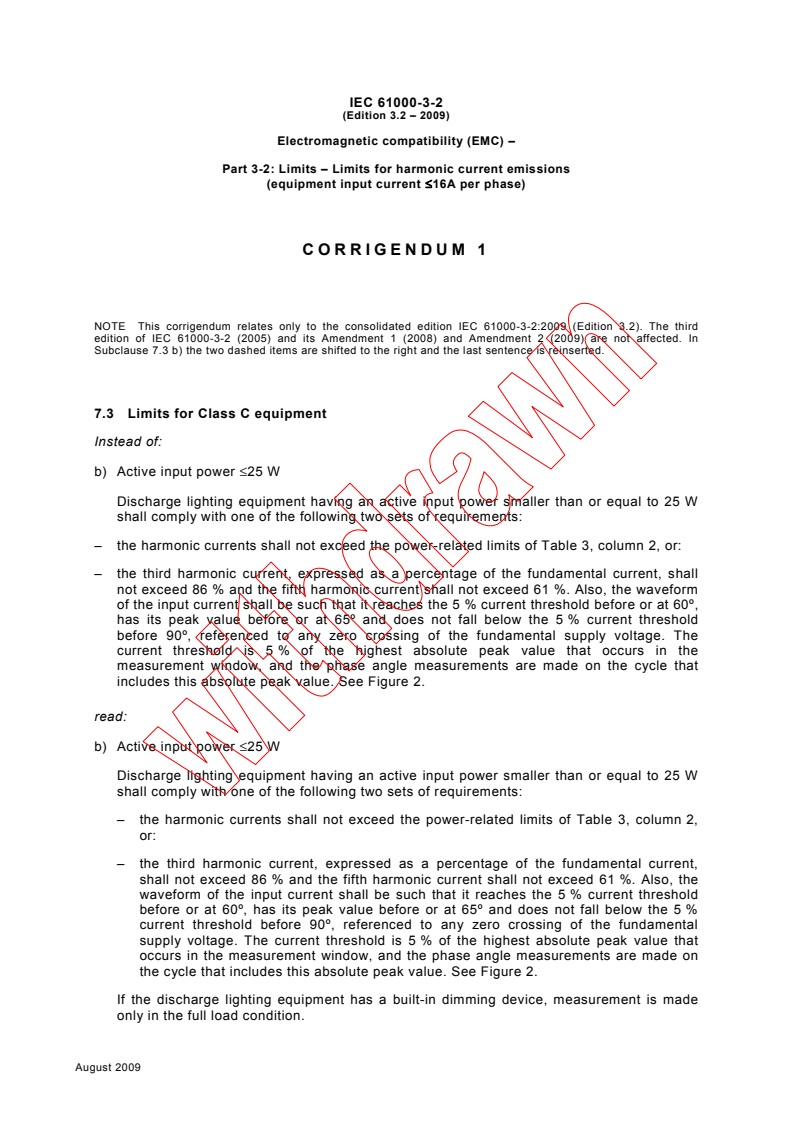
CORRIGENDUM 1
NOTE This corrigendum relates only to the consolidated edition IEC 61000-3-2:2009 (Edition 3.2). The third
edition of IEC 61000-3-2 (2005) and its Amendment 1 (2008) and Amendment 2 (2009) are not affected. In
Subclause 7.3 b) the two dashed items are shifted to the right and the last sentence is reinserted.
7.3 Limits for Class C equipment
Instead of:
b) Active input power ≤25 W
Discharge lighting equipment having an active input power smaller than or equal to 25 W
shall comply with one of the following two sets of requirements:
– the harmonic currents shall not exceed the power-related limits of Table 3, column 2, or:
– the third harmonic current, expressed as a percentage of the fundamental current, shall
not exceed 86 % and the fifth harmonic current shall not exceed 61 %. Also, the waveform
of the input current shall be such that it reaches the 5 % current threshold before or at 60º,
has its peak value before or at 65º and does not fall below the 5 % current threshold
before 90º, referenced to any zero crossing of the fundamental supply voltage. The
current threshold is 5 % of the highest absolute peak value that occurs in the
measurement window, and the phase angle measurements are made on the cycle that
includes this absolute peak value. See Figure 2.
read:
b) Active input power ≤25 W
Discharge lighting equipment having an active input power smaller than or equal to 25 W
shall comply with one of the following two sets of requirements:
– the harmonic currents shall not exceed the power-related limits of Table 3, column 2,
or:
– the third harmonic current, expressed as a percentage of the fundamental current,
shall not exceed 86 % and the fifth harmonic current shall not exceed 61 %. Also, the
waveform of the input current shall be such that it reaches the 5 % current threshold
before or at 60º, has its peak value before or at 65º and does not fall below the 5 %
current threshold before 90º, referenced to any zero crossing of the fundamental
supply voltage. The current threshold is 5 % of the highest absolute peak value that
occurs in the measurement window, and the phase angle measurements are made on
the cycle that includes this absolute peak value. See Figure 2.
If the discharge lighting equipment has a built-in dimming device, measurement is made
only in the full load condition.
August 2009
CEI 61000-3-2
(Edition 3.2 – 2009)
Compatibilité électromagnétique (CEM) –
Partie 3-2: Limites – Limites pour les émissions de courant harmonique
(courant appelé par les appareils ≤16A par phase)
CORRIGENDUM 1
...
IEC 61000-3-2
Edition 3.0 2005-11
INTERNATIONAL
STANDARD
NORME
INTERNATIONALE
Electromagnetic compatibility (EMC) –
Part 3-2: Limits – Limits for harmonic current emissions (equipment input
current ≤16 A per phase)
Compatibilité électromagnétique (CEM) –
Partie 3-2: Limites – Limites pour les émissions de courant harmonique
(courant appelé par les appareils ≤16 A par phase)
All rights reserved. Unless otherwise specified, no part of this publication may be reproduced or utilized in any form or by
any means, electronic or mechanical, including photocopying and microfilm, without permission in writing from either IEC or
IEC's member National Committee in the country of the requester.
If you have any questions about IEC copyright or have an enquiry about obtaining additional rights to this publication,
please contact the address below or your local IEC member National Committee for further information.
Droits de reproduction réservés. Sauf indication contraire, aucune partie de cette publication ne peut être reproduite
ni utilisée sous quelque forme que ce soit et par aucun procédé, électronique ou mécanique, y compris la photocopie
et les microfilms, sans l'accord écrit de la CEI ou du Comité national de la CEI du pays du demandeur.
Si vous avez des questions sur le copyright de la CEI ou si vous désirez obtenir des droits supplémentaires sur cette
publication, utilisez les coordonnées ci-après ou contactez le Comité national de la CEI de votre pays de résidence.
IEC Central Office
3, rue de Varembé
CH-1211 Geneva 20
Switzerland
Email: inmail@iec.ch
Web: www.iec.ch
About the IEC
The International Electrotechnical Commission (IEC) is the leading global organization that prepares and publishes
International Standards for all electrical, electronic and related technologies.
About IEC publications
The technical content of IEC publications is kept under constant review by the IEC. Please make sure that you have the
latest edition, a corrigenda or an amendment might have been published.
ƒ Catalogue of IEC publications: www.iec.ch/searchpub
The IEC on-line Catalogue enables you to search by a variety of criteria (reference number, text, technical committee,…).
It also gives information on projects, withdrawn and replaced publications.
ƒ IEC Just Published: www.iec.ch/online_news/justpub
Stay up to date on all new IEC publications. Just Published details twice a month all new publications released. Available
on-line and also by email.
ƒ Electropedia: www.electropedia.org
The world's leading online dictionary of electronic and electrical terms containing more than 20 000 terms and definitions
in English and French, with equivalent terms in additional languages. Also known as the International Electrotechnical
Vocabulary online.
ƒ Customer Service Centre: www.iec.ch/webstore/custserv
If you wish to give us your feedback on this publication or need further assistance, please visit the Customer Service
Centre FAQ or contact us:
Email: csc@iec.ch
Tel.: +41 22 919 02 11
Fax: +41 22 919 03 00
A propos de la CEI
La Commission Electrotechnique Internationale (CEI) est la première organisation mondiale qui élabore et publie des
normes internationales pour tout ce qui a trait à l'électricité, à l'électronique et aux technologies apparentées.
A propos des publications CEI
Le contenu technique des publications de la CEI est constamment revu. Veuillez vous assurer que vous possédez
l’édition la plus récente, un corrigendum ou amendement peut avoir été publié.
ƒ Catalogue des publications de la CEI: www.iec.ch/searchpub/cur_fut-f.htm
Le Catalogue en-ligne de la CEI vous permet d’effectuer des recherches en utilisant différents critères (numéro de référence,
texte, comité d’études,…). Il donne aussi des informations sur les projets et les publications retirées ou remplacées.
ƒ Just Published CEI: www.iec.ch/online_news/justpub
Restez informé sur les nouvelles publications de la CEI. Just Published détaille deux fois par mois les nouvelles
publications parues. Disponible en-ligne et aussi par email.
ƒ Electropedia: www.electropedia.org
Le premier dictionnaire en ligne au monde de termes électroniques et électriques. Il contient plus de 20 000 termes et
définitions en anglais et en français, ainsi que les termes équivalents dans les langues additionnelles. Egalement appelé
Vocabulaire Electrotechnique International en ligne.
ƒ Service Clients: www.iec.ch/webstore/custserv/custserv_entry-f.htm
Si vous désirez nous donner des commentaires sur cette publication ou si vous avez des questions, visitez le FAQ du
Service clients ou contactez-nous:
Email: csc@iec.ch
Tél.: +41 22 919 02 11
Fax: +41 22 919 03 00
IEC 61000-3-2
Edition 3.0 2005-11
INTERNATIONAL
STANDARD
NORME
INTERNATIONALE
Electromagnetic compatibility (EMC) –
Part 3-2: Limits – Limits for harmonic current emissions (equipment input
current ≤16 A per phase)
Compatibilité électromagnétique (CEM) –
Partie 3-2: Limites – Limites pour les émissions de courant harmonique
(courant appelé par les appareils ≤16 A par phase)
INTERNATIONAL
ELECTROTECHNICAL
COMMISSION
COMMISSION
ELECTROTECHNIQUE
PRICE CODE
INTERNATIONALE
U
CODE PRIX
ICS 33.100.10 ISBN 2-8318-8353-9
61000-3-2 IEC:2005 – 3 – – 2 – 61000-3-2 © IEC:2005
CONTENTS
FOREWORD.4
INTRODUCTION.6
1 Scope. 7
2 Normative references. 7
3 Definitions . 8
4 General .11
5 Classification of equipment .11
6 General requirements .12
6.1 Control methods .12
6.2 Harmonic current measurement .13
6.3 Equipment in a rack or case.15
7 Harmonic current limits .15
7.1 Limits for Class A equipment .17
7.2 Limits for Class B equipment .17
7.3 Limits for Class C equipment .17
7.4 Limits for Class D equipment .17
Annex A (normative) Measurement circuit and supply source.20
A.1 Test circuit .20
A.2 Supply source.20
Annex B (normative) Requirements for measurement equipment .23
Annex C (normative) Type test conditions.24
C.1 General .24
C.2 Test conditions for television (TV) receivers.24
C.3 Test conditions for audio amplifiers.25
C.4 Test conditions for video-cassette recorders .25
C.5 Test conditions for lighting equipment .25
C.6 Test conditions for independent and built-in incandescent lamp dimmers .26
C.7 Test conditions for vacuum cleaners .26
C.8 Test conditions for washing machines.27
C.9 Test conditions for microwave ovens.27
C.10 Test conditions for information technology equipment (ITE).27
C.11 Test conditions for induction hobs.27
C.12 Test conditions for air conditioners.28
C.13 Test conditions for kitchen machines as defined in IEC 60335-2-14.28
C.14 Test conditions for arc welding equipment which is not professional
equipment .28
C.15 Test conditions for other equipment .29
61000-61000-3-2 © IEC:20053-2 IEC:2005 – 5 – – 3 –
Figure 1 – Flowchart for determining conformity .16
Figure A.1 – Measurement circuit for single-phase equipment.21
Figure A.2 – Measurement circuit for three-phase equipment.22
Table 1 – Limits for Class A equipment .18
Table 2 – Limits for Class C equipment .18
Table 3 – Limits for Class D equipment .18
Table 4 – Test observation period .19
Table C.1 – Conventional load for arc welding equipment tests.29
61000-3-2 IEC:2005 – 7 – – 4 – 61000-3-2 © IEC:2005
INTERNATIONAL ELECTROTECHNICAL COMMISSION
____________
ELECTROMAGNETIC COMPATIBILITY (EMC) –
Part 3-2: Limits –
Limits for harmonic current emissions
(equipment input current ≤16 A per phase)
FOREWORD
1) The International Electrotechnical Commission (IEC) is a worldwide organization for standardization comprising
all national electrotechnical committees (IEC National Committees). The object of IEC is to promote
international co-operation on all questions concerning standardization in the electrical and electronic fields. To
this end and in addition to other activities, IEC publishes International Standards, Technical Specifications,
Technical Reports, Publicly Available Specifications (PAS) and Guides (hereafter referred to as “IEC
Publication(s)”). Their preparation is entrusted to technical committees; any IEC National Committee interested
in the subject dealt with may participate in this preparatory work. International, governmental and non-
governmental organizations liaising with the IEC also participate in this preparation. IEC collaborates closely
with the International Organization for Standardization (ISO) in accordance with conditions determined by
agreement between the two organizations.
2) The formal decisions or agreements of IEC on technical matters express, as nearly as possible, an international
consensus of opinion on the relevant subjects since each technical committee has representation from all
interested IEC National Committees.
3) IEC Publications have the form of recommendations for international use and are accepted by IEC National
Committees in that sense. While all reasonable efforts are made to ensure that the technical content of IEC
Publications is accurate, IEC cannot be held responsible for the way in which they are used or for any
misinterpretation by any end user.
4) In order to promote international uniformity, IEC National Committees undertake to apply IEC Publications
transparently to the maximum extent possible in their national and regional publications. Any divergence
between any IEC Publication and the corresponding national or regional publication shall be clearly indicated in
the latter.
5) IEC provides no marking procedure to indicate its approval and cannot be rendered responsible for any
equipment declared to be in conformity with an IEC Publication.
6) All users should ensure that they have the latest edition of this publication.
7) No liability shall attach to IEC or its directors, employees, servants or agents including individual experts and
members of its technical committees and IEC National Committees for any personal injury, property damage or
other damage of any nature whatsoever, whether direct or indirect, or for costs (including legal fees) and
expenses arising out of the publication, use of, or reliance upon, this IEC Publication or any other IEC
Publications.
8) Attention is drawn to the Normative references cited in this publication. Use of the referenced publications is
indispensable for the correct application of this publication.
9) Attention is drawn to the possibility that some of the elements of this IEC Publication may be the subject of
patent rights. IEC shall not be held responsible for identifying any or all such patent rights.
International Standard IEC 61000-3-2 has been prepared by sub-committee 77A: Low-frequency
phenomena, of IEC technical committee 77: Electromagnetic compatibility.
This third edition of IEC 61000-3-2 cancels and replaces the second edition published in 2000,
its amendment 1 (2001) and amendment 2 (2004).
61000-61000-3-2 © IEC:20053-2 IEC:2005 – 9 – – 5 –
The text of this standard is based on the second edition, amendment 1, amendment 2 and the
following documents:
FDIS Report on voting
77A/503/FDIS 77A/516/RVD
Full information on the voting for the approval of this standard can be found in the report on
voting indicated in the above table.
This publication has been drafted in accordance with the ISO/IEC Directives, Part 2.
The committee has decided that the contents of this publication will remain unchanged until the
maintenance result date indicated on the IEC web site under "http://webstore.iec.ch" in the data
related to the specific publication. At this date, the publication will be
• reconfirmed;
• withdrawn;
• replaced by a revised edition, or
• amended.
61000-3-2 IEC:2005 – 11 – – 6 – 61000-3-2 © IEC:2005
INTRODUCTION
IEC 61000 is published in separate parts, according to the following structure:
Part 1: General
General considerations (introduction, fundamental principles)
Definitions, terminology
Part 2: Environment
Description levels
Classification of the environment
Compatibility levels
Part 3: Limits
Emission limits
Immunity limits (in so far as they do not fall under the responsibility of the product
committees)
Part 4: Testing and measurement techniques
Measurement techniques
Testing techniques
Part 5: Installation and mitigation guidelines
Installation guidelines
Mitigation methods and devices
Part 6: Generic standards
Part 9: Miscellaneous
Each part is further subdivided into sections which are to be published either as international
standards, technical specifications, or as technical reports.
These standards and reports will be published in chronological order and numbered
accordingly (for example, 61000-6-1).
This part is an international standard which gives emission limits for harmonic currents from
equipment having an input current up to and including 16 A per phase.
This part is a Product Family Standard.
61000-61000-3-2 © IEC:20053-2 IEC:2005 – 13 – – 7 –
ELECTROMAGNETIC COMPATIBILITY (EMC) –
Part 3-2: Limits –
Limits for harmonic current emissions
(equipment input current ≤16 A per phase)
1 Scope
This part of IEC 61000 deals with the limitation of harmonic currents injected into the public
supply system.
It specifies limits of harmonic components of the input current which may be produced by
equipment tested under specified conditions.
Harmonic components are measured according to Annexes A and B.
This part of IEC 61000 is applicable to electrical and electronic equipment having an input
current up to and including 16 A per phase, and intended to be connected to public low-voltage
distribution systems.
Arc welding equipment which is not professional equipment, with input current up to and
including 16 A per phase, is included in this standard.
Arc welding equipment intended for professional use, as specified in IEC 60974-1, is excluded
from this standard and may be subject to installation restrictions as indicated in IEC 61000-3-4
or IEC 61000-3-12.
The tests according to this standard are type tests. Test conditions for particular equipment are
given in Annex C.
For systems with nominal voltages less than 220 V (line-to-neutral), the limits have not yet
been considered.
NOTE The words apparatus, appliance, device and equipment are used throughout this standard. They have the
same meaning for the purpose of this standard.
2 Normative references
The following referenced documents are indispensable for the application of this document. For
dated references, only the edition cited applies. For undated references, the latest edition of
the referenced document (including any amendments) applies.
IEC 60050(131), International Electrotechnical Vocabulary (IEV) – Chapter 131: Electric and
magnetic circuits
IEC 60050(161), International Electrotechnical Vocabulary (IEV) – Chapter 161: Electro-
magnetic compatibility
IEC 60065, Audio, video and similar electronic apparatus – Safety requirements
61000-3-2 IEC:2005 – 15 – – 8 – 61000-3-2 © IEC:2005
IEC 60107-1, Methods of measurement on receivers for television broadcast transmissions –
Part 1: General considerations – Measurements at radio and video frequencies
IEC 60155, Glow-starters for fluorescent lamps
IEC 60268-3, Sound system equipment – Part 3: Amplifiers
IEC 60335-2-2, Household and similar electrical appliances - Safety - Part 2-2: Particular
requirements for vacuum cleaners and water-suction cleaning appliances
IEC 60335-2-14, Household and similar electrical appliances - Safety - Part 2-14: Particular
requirements for kitchen machines
IEC 60974-1, Arc welding equipment – Part 1: Welding power sources
IEC 61000-2-2, Electromagnetic compatibility (EMC) – Part 2: Environment – Section 2:
Compatibility levels for low-frequency conducted disturbances and signalling in public low-
voltage power supply systems
IEC/TS 61000-3-4, Electromagnetic compatibility (EMC) – Part 3-4: Limits – Limitation of
emission of harmonic currents in low-voltage power supply systems for equipment with rated
current greater than 16 A
IEC 61000-3-12, Electromagnetic compatibility (EMC) – Part 3-12: Limits – Limits for harmonic
currents produced by equipment connected to public low-voltage systems with input current
>16 A and ≤75 A per phase
IEC 61000-4-7, Electromagnetic compatibility (EMC) – Part 4-7: Testing and measurement
techniques – General guide on harmonics and interharmonics measurements and
instrumentation, for power supply systems and equipment connected thereto
Recommendation ITU-R BT.471-1, Nomenclature and description of colour bar signals
3 Definitions
For the purpose of this part of IEC 61000, the following definitions apply, as well as the
definitions of IEC 60050(161).
3.1
portable tool
an electrical tool which is hand-held during normal operation and used for a short time (a few
minutes) only
3.2
lamp
a source for producing light
3.3
self-ballasted lamp
a unit which cannot be dismantled without being permanently damaged, provided with a lamp
cap and incorporating a light source and any additional element necessary for starting and
stable operation of the light source
3.4
luminaire
an apparatus (other than a lamp) which distributes, filters or transforms the light transmitted
from one or more lamps and which includes all the parts necessary for supporting, fixing and
protecting the lamps, and, where necessary, circuit auxiliaries, together with the means for
connecting them to the supply
61000-61000-3-2 © IEC:20053-2 IEC:2005 – 17 – – 9 –
3.5
semi-luminaire
a unit similar to a self-ballasted lamp but designed to utilize a replaceable light source and/or
starting device
3.6
ballast
a device connected between the supply and one or more discharge lamps which serves mainly
to limit the current of the lamp(s) to the required value. It may include means for transforming
the supply voltage and/or frequency, correcting the power factor and, either alone or in
combination with a starting device, provide the necessary conditions for starting the lamp(s)
3.7
step-down converter for lighting equipment
a unit inserted between the supply and one or more tungsten halogen or other filament lamps
which serves to supply the lamp(s) with its (their) rated voltage, generally at high frequency.
The unit may consist of one or more separate components. It may include means for dimming,
correcting the power factor and suppressing radio interference
3.8
lighting unit
lighting equipment consisting of one self-ballasted lamp or the combination of one control
device (ballast, semi-luminaire, transformer or the like) operating one or more lamps
3.9
reference lamp
a lamp selected for testing ballasts which, when associated with a reference ballast, has
electrical characteristics that are close to the objective values given in the relevant lamp
specification
3.10
reference ballast
a special inductive-type ballast designed for the purpose of providing comparison standards for
use in testing ballasts and for the selection of reference lamps. It is essentially characterized
by a stable voltage-to-current ratio, which is relatively uninfluenced by variations in current,
temperature, and the magnetic surroundings
3.11
input current
current directly supplied to an equipment or a part of equipment by the a.c. distribution system
3.12
circuit power factor
the circuit power factor is the ratio of the measured active input power to the product of the
supply voltage (r.m.s.) and the supply current (r.m.s.)
3.13
active power
the mean value, taken over one period, of the instantaneous power
[IEV 131-03-18]
NOTE The active input power is the active power measured at the input supply terminals of the equipment under
test.
61000-3-2 IEC:2005 – 19 – – 10 – 61000-3-2 © IEC:2005
3.14
balanced three-phase equipment
equipment having rated line current modules which differ by no more than 20 %
3.15
professional equipment
equipment for use in trades, professions, or industries and which is not intended for sale to the
general public. The designation shall be specified by the manufacturer
3.16
total harmonic current
total r.m.s. value of the harmonic current components of orders 2 to 40
total harmonic current = I
∑
n
n=2
3.17
built-in dimmer
dimmer, including the user control, which is entirely contained within the enclosure of a
luminaire
3.18
partial odd harmonic current
total r.m.s. value of the odd harmonic current components of orders 21 to 39
partial odd harmonic current = I
∑
n
n=21,23
3.19
lighting equipment
equipment with a primary function of generating and/or regulating and/or distributing optical
radiation by means of incandescent lamps, discharge lamps or LED's
Included are:
– lamps and luminaires;
– the lighting part of multi-function equipment where one of the primary functions of this is
illumination;
– independent ballasts for discharge lamps and independent incandescent lamp
transformers;
– ultraviolet (UV) and infrared (IR) radiation equipment;
– illuminated advertising signs;
– dimmers for lamps other than incandescent.
Excluded are:
– lighting devices built in equipment with another primary purpose such as photocopiers,
overhead projectors and slide projectors or employed for scale illuminating or indication
purposes;
– dimmers for incandescent lamps.
3.20
stand-by mode
sleep-mode
non-operational, low power consumption mode (usually indicated in some way on the
equipment) that can persist for an indefinite time
61000-61000-3-2 © IEC:20053-2 IEC:2005 – 21 – – 11 –
4 General
The objective of this standard is to set limits for harmonic emissions of equipment within its
scope, so that, with due allowance for the emissions from other equipment, compliance with
the limits ensures that harmonic disturbance levels do not exceed the compatibility levels
defined in IEC 61000-2-2.
Professional equipment that does not comply with the requirements of this standard may be
permitted to be connected to certain types of low voltage supplies, if the instruction manual
contains a requirement to ask the supply utility for permission to connect. Recommendations
concerning this aspect are contained in IEC/TS 61000-3-4 or IEC 61000-3-12.
5 Classification of equipment
For the purpose of harmonic current limitation, equipment is classified as follows:
Class A:
– balanced three-phase equipment;
– household appliances, excluding equipment identified as class D;
– tools, excluding portable tools;
– dimmers for incandescent lamps;
– audio equipment.
Equipment not specified in one of the three other classes shall be considered as class A
equipment.
NOTE 1 Equipment that can be shown to have a significant effect on the supply system may be reclassified in a
future edition of the standard. Factors to be taken into account include:
– number of pieces of equipment in use;
– duration of use;
– simultaneity of use;
– power consumption;
– harmonic spectrum, including phase.
Class B:
– portable tools;
– arc welding equipment which is not professional equipment.
Class C:
– lighting equipment.
Class D:
Equipment having a specified power according to 6.2.2 less than or equal to 600 W, of the
following types:
– personal computers and personal computer monitors;
– television receivers.
NOTE 2 Class D limits are reserved for equipment that, by virtue of the factors listed in note 1, can be shown to
have a pronounced effect on the public electricity supply system.
61000-3-2 IEC:2005 – 23 – – 12 – 61000-3-2 © IEC:2005
6 General requirements
The following restrictions apply even to equipment to which no harmonic current limits apply as
defined in Clause 7.
The requirements and limits specified in this clause are applicable to the power input terminals
of equipment intended to be connected to 220/380 V, 230/400 V and 240/415 V systems
operating at 50 Hz or 60 Hz. Requirements and limits for other cases are not yet considered.
6.1 Control methods
Asymmetrical controls according to IEV 161-07-12 and half wave rectification directly on the
mains supply may only be used in the following circumstances:
a) where they are the only practical solution permitting the detection of unsafe conditions, or
b) where the controlled active input power is less or equal to 100 W, or
c) where the controlled appliance is a portable equipment fitted with a two-core flexible cord
and is intended for use for a short period of time, i.e. for a few minutes only.
If one of these three conditions is fulfilled, half wave rectification may be used for any purpose,
whereas asymmetrical controls may only be used for the control of motors.
NOTE Such equipment includes, but is not limited to, hair dryers, electrical kitchen appliances and portable tools.
Symmetrical control methods which are prone to produce harmonics of low order (n ≤ 40) in the
input current may be used for the control of the power supplied to heating elements provided
that the full sine-wave input power is less than or equal to 200 W, or that the limits of Table 3
are not exceeded.
Such symmetrical control methods are also allowed for professional equipment provided that
either
a) one of the above conditions are fulfilled, or
b) the relevant limits are not exceeded when tested at the supply input terminals and in
addition both the following conditions are fulfilled:
1) it is necessary to control precisely the temperature of a heater whose thermal time
constant is less than 2 s, and
2) there is no other technique economically available.
Professional equipment whose primary purpose, considered as a whole, is not for heating, shall
be tested against the relevant limits.
NOTE 1 An example of a product whose primary purpose is not heating is a photocopier, whereas a cooker is
considered to have heating as its primary purpose.
Domestic equipment with symmetrical control used for a short time (for example hair dryers)
shall be tested under Class A.
Even though asymmetrical controls and half-wave rectification are permitted under the
conditions given above, the equipment shall still comply with the harmonic requirements of this
standard.
NOTE 2 The use of asymmetrical controls and half-wave rectification is allowed in the above circumstances;
however, in case of fault, the d.c. component of the supplied current may disturb certain types of protection
devices. In the same way, this may also happen with the use of symmetrical controls.
61000-61000-3-2 © IEC:20053-2 IEC:2005 – 25 – – 13 –
6.2 Harmonic current measurement
6.2.1 Test configuration
Specific test conditions for the measurement of harmonic currents associated with some types
of equipment are given in Annex C.
For equipment not mentioned in Annex C, emission tests shall be conducted with the user's
operation controls or automatic programs set to the mode expected to produce the maximum
total harmonic current (THC) under normal operating conditions. This defines the equipment
set-up during emission tests and not a requirement to measure THC or to conduct searches for
worst-case emissions.
The harmonic current limits specified in Clause 7 apply to line currents and not to currents in
the neutral conductor. Nevertheless, for single-phase equipment, it is permissible to measure
the currents in the neutral conductor instead of the currents in the line.
The equipment is tested as presented by, and in accordance with information provided by, the
manufacturer. Preliminary operation of motor drives by the manufacturer may be needed
before the test are undertaken to ensure that results correspond with normal use.
6.2.2 Measurement procedure
The test shall be conducted according to the general requirements given in 6.2.3. The test
duration shall be as defined in 6.2.4.
The measurement of harmonic currents shall be performed as follows:
– for each harmonic order, measure the 1,5 s smoothed r.m.s. harmonic current in each DFT
time window as defined in Annex B;
– calculate the arithmetic average of the measured values from the DFT time windows, over
the entire observation period as defined in 6.2.4.
The value of the input power to be used for the calculation of limits shall be determined as
follows:
– measure the 1,5 s smoothed active input power in each DFT time window;
– determine the maximum of the measured values of power from the DFT time windows over
the entire duration of the test.
NOTE The active input power supplied to the smoothing section of the measuring instrument as defined in
Annex B is the active input power in each DFT time window.
The harmonic currents and the active input power shall be measured under the same test
conditions but need not be measured simultaneously.
The value of the power, measured as defined in this clause, shall be specified by the
manufacturer and documented in the test report. This value shall be used for establishing limits
during emissions tests when limits are specified in terms of power. In order not to specify a
power at which limits change abruptly, thus giving rise to doubt as to which limits apply, the
manufacturer may specify any value which is within ±10 % of the actual measured value.
61000-3-2 IEC:2005 – 27 – – 14 – 61000-3-2 © IEC:2005
The value of the power found by measurement during emission tests other than the original
manufacturer’s conformity assessment test, measured according to the terms of this clause,
shall not be less than 90 % nor greater than 110 % of the value for power specified by the
manufacturer in the test report (see 6.2.3.4). In the event that the measured value is outside of
this tolerance band around the specified value, the measured power shall be used to establish
the limits.
For class C equipment, the fundamental current and power factor, specified by the
manufacturer, shall be used for the calculation of limits (see 3.12). The fundamental
component of the current and the power factor are measured and specified by the
manufacturer in the same way as the power is measured and specified for the calculation of
class D limits. The value used for the power factor shall be obtained from the same DFT
measurement window as the value for the fundamental component of current.
6.2.3 General requirements
6.2.3.1 Repeatability
The repeatability of the measurements shall be better than ±5 %, when the following conditions
are met:
– the same equipment under test (EUT) (not another of the same type, however similar it may be);
– identical test conditions;
– the same test system;
– identical climatic conditions, if relevant.
6.2.3.2 Starting and stopping
When a piece of equipment is brought into operation or is taken out of operation, manually or
automatically, harmonic currents and power are not taken into account for the first 10 s
following the switching event.
The equipment under test shall not be in stand-by mode (see 3.20) for more than 10 % of any
observation period.
6.2.3.3 Application of limits
The average values for the individual harmonic currents, taken over the entire test observation
period shall be less than or equal to the applicable limits.
For each harmonic order, all 1,5 s smoothed r.m.s. harmonic current values, as defined in
6.2.2, shall be either:
a) less than or equal to 150 % of the applicable limits, or
b) less than or equal to 200 % of the applicable limits under the following conditions, which
apply all together:
1) the EUT belongs to Class A for harmonics;
2) the excursion beyond 150 % of the applicable limits lasts less than 10 % of the test
observation period or in total 10 min (within the test observation period), whichever is
smaller, and
3) the average value of the harmonic current, taken over the entire test observation
period, is less than 90 % of the applicable limits.
61000-61000-3-2 © IEC:20053-2 IEC:2005 – 29 – – 15 –
Harmonic currents less than 0,6 % of the input current measured under the test conditions, or
less than 5 mA, whichever is greater, are disregarded.
st
For the 21 and higher odd order harmonics, the average value obtained for each individual
odd harmonic over the full observation period, calculated from the 1,5 s smoothed r.m.s. values
according to 6.2.2, may exceed the applicable limits by 50 % provided that the following
conditions are met:
• the measured partial odd harmonic current does not exceed the partial odd harmonic
current which can be calculated from the applicable limits;
• all 1,5 s smoothed r.m.s. individual harmonic current values shall be less than or equal to
150 % of the applicable limits.
NOTE These exemptions (the use of the partial odd harmonic current for the average values and the 200 % short
term limit for single 1,5 s smoothed values) are mutually exclusive and cannot be used together.
6.2.3.4 Test report
The test report may be based on information supplied by the manufacturer to a testing facility,
or be a document recording details of the manufacturer’s own tests. It shall include all relevant
information for the test conditions, the test observation period, and, when applicable for
establishing the limits, the active power or fundamental current and power factor.
6.2.4 Test observation period
Observation periods (T ) for four different types of equipment behaviour are considered and
obs
described in Table 4.
6.3 Equipment in a rack or case
Where individual self-contained items of equipment are installed in a rack or case, they are
regarded as being individually connected to the mains supply. The rack or case need not be
tested as a whole.
7 Harmonic current limits
The procedure for applying the limits and assessing the results is shown in Figure 1.
For the following categories of equipment, limits are not specified in this standard:
NOTE 1 Limits may be defined in a future amendment or revision of the standard.
– equipment with a rated power of 75 W or less, other than lighting equipment;
NOTE 2 This value may be reduced from 75 W to 50 W in the future, subject to approval by National Committees
at that time.
– professional equipment with a total rated power greater than 1 kW;
– symmetrically controlled heating elements with a rated power less than or equal to 200 W;
– independent dimmers for incandescent lamps with a rated power less than or equal to
1 kW.
NOTE 3 See also C.5.3.
61000-3-2 IEC:2005 – 31 – – 16 – 61000-3-2 © IEC:2005
Start here:
determine class
(clause 5)
Uses techniques
Yes
Professional Yes
not allowed by See clause 4
equipment ?
6.1 ?
No
No
Does not conform
to 61000-3-2
Belongs to
Yes
exceptions of Conforms to
clause 7 or 61000-3-2
annex C ?
No
Test conditions
defined in C.2 and
onwards ?
Yes
No
Use the ˝generic˝ Apply those
conditions in 6.2.1 conditions
Yes
Relevant limits Conforms to
met ? 61000-3-2
No
Professional
Yes
See clause 4
equipment ?
No
Does not conform
with 61000-3-2
IEC 1412/01
Figure 1 – Flowchart for determining conformity
61000-61000-3-2 © IEC:20053-2 IEC:2005 – 33 – – 17 –
7.1 Limits for Class A equipment
For Class A equipment, the harmonics of the input current shall not exceed the values given in
Table 1.
Audio amplifiers shall be tested according to Clause C.3. Dimmers for incandescent lamps
shall be tested according to Clause C.6.
7.2 Limits for Class B equipment
For Class B equipment, the harmonics of the input current shall not exceed the values given in
Table 1 multiplied by a factor of 1,5.
7.3 Limits for Class C equipment
a) Active input power >25 W
For lighting equipment having an active input power greater than 25 W, the harmonic
currents shall not exceed the relative limits given in Table 2.
However, the limits given in Table 1 apply to incandescent lighting equipment that has built-
in dimmers or consists of dimmers built in an enclosure.
For discharge lighting equipment that has built-in dimmers or consists of independent
dimmers or dimmers built in an enclosure, the following conditions apply:
– the harmonic current values for the maximum load condition derived from the
percentage limits given in Table 2 shall not be exceeded;
– in any dimming position, the harmonic current shall not exceed the value of current
allowed in the maximum load condition;
– the equipment shall be tested according to the conditions given in C.5.
b) Active input power ≤25 W
Discharge lighting equipment having an active input power smaller than or equal to 25 W
shall comply with one of the following two sets of requirements:
– the harmonic currents shall not exceed the power-related limits of Table 3, column 2, or:
– the third harmonic current, expressed as a percentage of the fundamental current, shall not
exceed 86 % and the fifth shall not exceed 61 %; moreover, the waveform of the input
current shall be such that it begins to flow before or at 60°, has its last peak (if there are
several peaks per half period) before or at 65° and does not stop flowing before 90°, where
the zero crossing of the fundamental supply voltage is assumed to be at 0°.
If the discharge lighting equipment has a built-in dimming device, measurement is made
only in the full load condition.
7.4 Limits for Class D equipment
For Class D equipment, the harmonic currents and the power shall be measured as defined
in 6.2.2. The input currents at harmonic frequencies shall not exceed the values that can be
derived from Table 3 according to the requirements specified in 6.2.3 and 6.2.4.
61000-3-2 IEC:2005 – 35 – – 18 – 61000-3-2 © IEC:2005
Table 1 – Limits for Class A equipment
Harmonic order Maximum permissible
harmonic current
n A
Odd harmonics
3 2,30
5 1,14
7 0,77
9 0,40
11 0,33
13 0,21
15 ≤ n ≤ 39
0,15
n
Even harmonics
2 1,08
4 0,43
6 0,30
8 ≤ n 40
≤
0,23
n
Table 2 – Limits for Class C equipment
Harmonic order Maximum permissible harmonic currrent
expressed as a percentage of the input
current at the fundamental frequency
n
%
2 2
30 ⋅ λ *
5 10
7 7
9 5
11 ≤ n 39 3
≤
(odd harmonics only)
* λ is the circuit power factor
Table 3 – Limits for Class D equipment
Harmonic order Maximum permissible Maximum permissible
harmonic current harmonic current
per watt
n A
mA/W
3 3,4 2,30
5 1,9 1,14
7 1,0 0,77
9 0,5 0,40
11 0,35 0,33
3,85
See Table 1
13 n 39
≤ ≤
n
(odd harmonics only)
61000-61000-3-2 © IEC:20053-2 IEC:2005 – 37 – – 19 –
Table 4 – Test observation period
Type of equipment behaviour Observation period
Quasi-stationary
T of sufficient duration to meet the requirements for repeatability in 6.2.3.1
obs
Short cyclic (T ≤ 2,5 min) T ≥ 10 cycles (reference method) or T of sufficient duration or
cycle obs obs
a
synchronisation to meet the requirements for repeatability in 6.2.3.1
Random T of sufficient duration to meet the requirements for repeatability in 6.2.3.1
obs
Long cyclic (T > 2,5 min) Full equipment program cycle (reference method) or a representative 2,5 min
cycle
period considered by the manufacturer as the operating period with the
highest THC
a
By 'synchronization' is meant that the total observation period is sufficiently close to including an exact integral
number of equipment cycles such that the requirements for repeatability in 6.2.3.1 are met.
61000-3-2 IEC:2005 – 39 – – 20 – 61000-3-2 © IEC:2005
Annex A
(normative)
Measurement circuit and supply source
A.1 Test circuit
The measured harmonic values shall be compared with the limits given in Clause 7. The
harmonic currents of the equipment under test (EUT) shall be measured in accordance with the
circuits given in the following figures:
– Figure A.1 for single-phase equipment;
– Figure A.2 for three-phase equipment.
Measurement equipment complying with Annex B shall be used. Test conditions for the EUT
are given in Annex C.
A.2 Supply source
While the measurements are being made, the test voltage (U) at the terminals of the
equipment under test, when operated according to Annex C, shall meet the following
requirements.
a)
...
IEC 61000-3-2 ®
Edition 3.2 2009-04
INTERNATIONAL
STANDARD
NORME
INTERNATIONALE
Electromagnetic compatibility (EMC) –
Part 3-2: Limits – Limits for harmonic current emissions (equipment input
current ≤16 A per phase)
Compatibilité électromagnétique (CEM) –
Partie 3-2: Limites – Limites pour les émissions de courant harmonique
(courant appelé par les appareils ≤16 A par phase)
All rights reserved. Unless otherwise specified, no part of this publication may be reproduced or utilized in any form or by
any means, electronic or mechanical, including photocopying and microfilm, without permission in writing from either IEC or
IEC's member National Committee in the country of the requester.
If you have any questions about IEC copyright or have an enquiry about obtaining additional rights to this publication,
please contact the address below or your local IEC member National Committee for further information.
Droits de reproduction réservés. Sauf indication contraire, aucune partie de cette publication ne peut être reproduite
ni utilisée sous quelque forme que ce soit et par aucun procédé, électronique ou mécanique, y compris la photocopie
et les microfilms, sans l'accord écrit de la CEI ou du Comité national de la CEI du pays du demandeur.
Si vous avez des questions sur le copyright de la CEI ou si vous désirez obtenir des droits supplémentaires sur cette
publication, utilisez les coordonnées ci-après ou contactez le Comité national de la CEI de votre pays de résidence.
IEC Central Office
3, rue de Varembé
CH-1211 Geneva 20
Switzerland
Email: inmail@iec.ch
Web: www.iec.ch
About the IEC
The International Electrotechnical Commission (IEC) is the leading global organization that prepares and publishes
International Standards for all electrical, electronic and related technologies.
About IEC publications
The technical content of IEC publications is kept under constant review by the IEC. Please make sure that you have the
latest edition, a corrigenda or an amendment might have been published.
ƒ Catalogue of IEC publications: www.iec.ch/searchpub
The IEC on-line Catalogue enables you to search by a variety of criteria (reference number, text, technical committee,…).
It also gives information on projects, withdrawn and replaced publications.
ƒ IEC Just Published: www.iec.ch/online_news/justpub
Stay up to date on all new IEC publications. Just Published details twice a month all new publications released. Available
on-line and also by email.
ƒ Electropedia: www.electropedia.org
The world's leading online dictionary of electronic and electrical terms containing more than 20 000 terms and definitions
in English and French, with equivalent terms in additional languages. Also known as the International Electrotechnical
Vocabulary online.
ƒ Customer Service Centre: www.iec.ch/webstore/custserv
If you wish to give us your feedback on this publication or need further assistance, please visit the Customer Service
Centre FAQ or contact us:
Email: csc@iec.ch
Tel.: +41 22 919 02 11
Fax: +41 22 919 03 00
A propos de la CEI
La Commission Electrotechnique Internationale (CEI) est la première organisation mondiale qui élabore et publie des
normes internationales pour tout ce qui a trait à l'électricité, à l'électronique et aux technologies apparentées.
A propos des publications CEI
Le contenu technique des publications de la CEI est constamment revu. Veuillez vous assurer que vous possédez
l’édition la plus récente, un corrigendum ou amendement peut avoir été publié.
ƒ Catalogue des publications de la CEI: www.iec.ch/searchpub/cur_fut-f.htm
Le Catalogue en-ligne de la CEI vous permet d’effectuer des recherches en utilisant différents critères (numéro de référence,
texte, comité d’études,…). Il donne aussi des informations sur les projets et les publications retirées ou remplacées.
ƒ Just Published CEI: www.iec.ch/online_news/justpub
Restez informé sur les nouvelles publications de la CEI. Just Published détaille deux fois par mois les nouvelles
publications parues. Disponible en-ligne et aussi par email.
ƒ Electropedia: www.electropedia.org
Le premier dictionnaire en ligne au monde de termes électroniques et électriques. Il contient plus de 20 000 termes et
définitions en anglais et en français, ainsi que les termes équivalents dans les langues additionnelles. Egalement appelé
Vocabulaire Electrotechnique International en ligne.
ƒ Service Clients: www.iec.ch/webstore/custserv/custserv_entry-f.htm
Si vous désirez nous donner des commentaires sur cette publication ou si vous avez des questions, visitez le FAQ du
Service clients ou contactez-nous:
Email: csc@iec.ch
Tél.: +41 22 919 02 11
Fax: +41 22 919 03 00
IEC 61000-3-2 ®
Edition 3.2 2009-04
INTERNATIONAL
STANDARD
NORME
INTERNATIONALE
Electromagnetic compatibility (EMC) –
Part 3-2: Limits – Limits for harmonic current emissions (equipment input
current ≤16 A per phase)
Compatibilité électromagnétique (CEM) –
Partie 3-2: Limites – Limites pour les émissions de courant harmonique
(courant appelé par les appareils ≤16 A par phase)
INTERNATIONAL
ELECTROTECHNICAL
COMMISSION
COMMISSION
ELECTROTECHNIQUE
PRICE CODE
INTERNATIONALE
CM
CODE PRIX
ICS 33.100.10 ISBN 978-2-88910-370-6
– 2 – 61000-3-2 © IEC:2005+A1:2008
+A2:2009
CONTENTS
FOREWORD.4
INTRODUCTION.6
1 Scope.7
2 Normative references.7
3 Definitions .8
4 General .12
5 Classification of equipment .12
6 General requirements .13
6.1 Control methods .13
6.2 Harmonic current measurement .14
6.3 Equipment in a rack or case.16
7 Harmonic current limits .17
7.1 Limits for Class A equipment .19
7.2 Limits for Class B equipment .19
7.3 Limits for Class C equipment .19
7.4 Limits for Class D equipment .20
Annex A (normative) Measurement circuit and supply source.22
A.1 Test circuit.22
A.2 Supply source .22
Annex B (normative) Requirements for measurement equipment .25
Annex C (normative) Type test conditions.26
C.1 General.26
C.2 Test conditions for television (TV) receivers .26
C.3 Test conditions for audio amplifiers .27
C.4 Test conditions for video-cassette recorders.28
C.5 Test conditions for lighting equipment .28
C.6 Test conditions for independent and built-in incandescent lamp dimmers.29
C.7 Test conditions for vacuum cleaners .29
C.8 Test conditions for washing machines .29
C.9 Test conditions for microwave ovens .29
C.10 Test conditions for information technology equipment (ITE) .30
C.11 Test conditions for induction hobs .31
C.12 Test conditions for air conditioners .31
C.13 Test conditions for kitchen machines as defined in IEC 60335-2-14 .31
C.14 Test conditions for arc welding equipment which is not professional equipment .32
61000-3-2 © IEC:2005+A1:2008 – 3 –
+A2:2009
Figure 1 – Flowchart for determining conformity .18
Figure 2 – Illustration of the relative phase angle and current parameters
described in 7.3 b) .19
Figure A.1 – Measurement circuit for single-phase equipment.23
Figure A.2 – Measurement circuit for three-phase equipment.24
Table 1 – Limits for Class A equipment .20
Table 2 – Limits for Class C equipment .21
Table 3 – Limits for Class D equipment .21
Table 4 – Test observation period .21
Table C.1 – Conventional load for arc welding equipment tests.32
– 4 – 61000-3-2 © IEC:2005+A1:2008
+A2:2009
INTERNATIONAL ELECTROTECHNICAL COMMISSION
____________
ELECTROMAGNETIC COMPATIBILITY (EMC) –
Part 3-2: Limits –
Limits for harmonic current emissions
(equipment input current ≤16 A per phase)
FOREWORD
1) The International Electrotechnical Commission (IEC) is a worldwide organization for standardization comprising
all national electrotechnical committees (IEC National Committees). The object of IEC is to promote
international co-operation on all questions concerning standardization in the electrical and electronic fields. To
this end and in addition to other activities, IEC publishes International Standards, Technical Specifications,
Technical Reports, Publicly Available Specifications (PAS) and Guides (hereafter referred to as “IEC
Publication(s)”). Their preparation is entrusted to technical committees; any IEC National Committee interested
in the subject dealt with may participate in this preparatory work. International, governmental and non-
governmental organizations liaising with the IEC also participate in this preparation. IEC collaborates closely
with the International Organization for Standardization (ISO) in accordance with conditions determined by
agreement between the two organizations.
2) The formal decisions or agreements of IEC on technical matters express, as nearly as possible, an international
consensus of opinion on the relevant subjects since each technical committee has representation from all
interested IEC National Committees.
3) IEC Publications have the form of recommendations for international use and are accepted by IEC National
Committees in that sense. While all reasonable efforts are made to ensure that the technical content of IEC
Publications is accurate, IEC cannot be held responsible for the way in which they are used or for any
misinterpretation by any end user.
4) In order to promote international uniformity, IEC National Committees undertake to apply IEC Publications
transparently to the maximum extent possible in their national and regional publications. Any divergence
between any IEC Publication and the corresponding national or regional publication shall be clearly indicated in
the latter.
5) IEC provides no marking procedure to indicate its approval and cannot be rendered responsible for any
equipment declared to be in conformity with an IEC Publication.
6) All users should ensure that they have the latest edition of this publication.
7) No liability shall attach to IEC or its directors, employees, servants or agents including individual experts and
members of its technical committees and IEC National Committees for any personal injury, property damage or
other damage of any nature whatsoever, whether direct or indirect, or for costs (including legal fees) and
expenses arising out of the publication, use of, or reliance upon, this IEC Publication or any other IEC
Publications.
8) Attention is drawn to the Normative references cited in this publication. Use of the referenced publications is
indispensable for the correct application of this publication.
9) Attention is drawn to the possibility that some of the elements of this IEC Publication may be the subject of
patent rights. IEC shall not be held responsible for identifying any or all such patent rights.
International Standard IEC 61000-3-2 has been prepared by sub-committee 77A: Low-frequency
phenomena, of IEC technical committee 77: Electromagnetic compatibility.
This consolidated version of IEC 61000-3-2 consists of the third edition (2005) [documents
77A/503/FDIS and 77A/516/RVD], its amendment 1 (2008) [documents 77A/625/FDIS and
77A/641/RVD] and its amendment 2 (2009) [documents 77A/674/FDIS and 77A/677/RVD].
The technical content is therefore identical to the base edition and its amendments and has
been prepared for user convenience.
It bears the edition number 3.2.
A vertical line in the margin shows where the base publication has been modified by
amendments 1 and 2.
61000-3-2 © IEC:2005+A1:2008 – 5 –
+A2:2009
This publication has been drafted in accordance with the ISO/IEC Directives, Part 2.
The committee has decided that the contents of the base publication and its amendments will
remain unchanged until the maintenance result date indicated on the IEC web site under
"http://webstore.iec.ch" in the data related to the specific publication. At this date,
the publication will be
• reconfirmed,
• withdrawn,
• replaced by a revised edition, or
• amended.
The contents of the corrigendum of August 2009 have been included in this copy.
– 6 – 61000-3-2 © IEC:2005+A1:2008
+A2:2009
INTRODUCTION
IEC 61000 is published in separate parts, according to the following structure:
Part 1: General
General considerations (introduction, fundamental principles)
Definitions, terminology
Part 2: Environment
Description levels
Classification of the environment
Compatibility levels
Part 3: Limits
Emission limits
Immunity limits (in so far as they do not fall under the responsibility of the product
committees)
Part 4: Testing and measurement techniques
Measurement techniques
Testing techniques
Part 5: Installation and mitigation guidelines
Installation guidelines
Mitigation methods and devices
Part 6: Generic standards
Part 9: Miscellaneous
Each part is further subdivided into sections which are to be published either as international
standards, technical specifications, or as technical reports.
These standards and reports will be published in chronological order and numbered
accordingly (for example, 61000-6-1).
This part is an international standard which gives emission limits for harmonic currents from
equipment having an input current up to and including 16 A per phase.
This part is a Product Family Standard.
61000-3-2 © IEC:2005+A1:2008 – 7 –
+A2:2009
ELECTROMAGNETIC COMPATIBILITY (EMC) –
Part 3-2: Limits –
Limits for harmonic current emissions
(equipment input current ≤16 A per phase)
1 Scope
This part of IEC 61000 deals with the limitation of harmonic currents injected into the public
supply system.
It specifies limits of harmonic components of the input current which may be produced by
equipment tested under specified conditions.
Harmonic components are measured according to Annexes A and B.
This part of IEC 61000 is applicable to electrical and electronic equipment having an input
current up to and including 16 A per phase, and intended to be connected to public low-voltage
distribution systems.
Arc welding equipment which is not professional equipment, with input current up to and
including 16 A per phase, is included in this standard.
Arc welding equipment intended for professional use, as specified in IEC 60974-1, is excluded
from this standard and may be subject to installation restrictions as indicated in IEC 61000-3-4
or IEC 61000-3-12.
The tests according to this standard are type tests. Test conditions for particular equipment are
given in Annex C.
For systems with nominal voltages less than 220 V (line-to-neutral), the limits have not yet
been considered.
NOTE The words apparatus, appliance, device and equipment are used throughout this standard. They have the
same meaning for the purpose of this standard.
2 Normative references
The following referenced documents are indispensable for the application of this document. For
dated references, only the edition cited applies. For undated references, the latest edition of
the referenced document (including any amendments) applies.
IEC 60050(131), International Electrotechnical Vocabulary (IEV) – Chapter 131: Electric and
magnetic circuits
IEC 60050(161), International Electrotechnical Vocabulary (IEV) – Chapter 161: Electro-
magnetic compatibility
IEC 60107-1, Methods of measurement on receivers for television broadcast transmissions –
Part 1: General considerations – Measurements at radio and video frequencies
– 8 – 61000-3-2 © IEC:2005+A1:2008
+A2:2009
IEC 60155, Glow-starters for fluorescent lamps
IEC 60268-1:1985, Sound system equipment – Part 1: General
IEC 60268-3, Sound system equipment – Part 3: Amplifiers
IEC 60335-2-2, Household and similar electrical appliances - Safety - Part 2-2: Particular
requirements for vacuum cleaners and water-suction cleaning appliances
IEC 60335-2-14, Household and similar electrical appliances - Safety - Part 2-14: Particular
requirements for kitchen machines
IEC 60974-1, Arc welding equipment – Part 1: Welding power sources
IEC 61000-2-2, Electromagnetic compatibility (EMC) – Part 2: Environment – Section 2:
Compatibility levels for low-frequency conducted disturbances and signalling in public low-
voltage power supply systems
IEC/TS 61000-3-4, Electromagnetic compatibility (EMC) – Part 3-4: Limits – Limitation of
emission of harmonic currents in low-voltage power supply systems for equipment with rated
current greater than 16 A
IEC 61000-3-12, Electromagnetic compatibility (EMC) – Part 3-12: Limits – Limits for harmonic
currents produced by equipment connected to public low-voltage systems with input current
>16 A and ≤75 A per phase
IEC 61000-4-7, Electromagnetic compatibility (EMC) – Part 4-7: Testing and measurement
techniques – General guide on harmonics and interharmonics measurements and
instrumentation, for power supply systems and equipment connected thereto
Recommendation ITU-R BT.471-1, Nomenclature and description of colour bar signals
3 Definitions
For the purpose of this part of IEC 61000, the following definitions apply, as well as the
definitions of IEC 60050(161).
3.1
portable tool
an electrical tool which is hand-held during normal operation and used for a short time (a few
minutes) only
3.2
lamp
a source for producing light
3.3
self-ballasted lamp
a unit which cannot be dismantled without being permanently damaged, provided with a lamp
cap and incorporating a light source and any additional element necessary for starting and
stable operation of the light source
3.4
luminaire
an apparatus (other than a lamp) which distributes, filters or transforms the light transmitted
from one or more lamps and which includes all the parts necessary for supporting, fixing and
protecting the lamps, and, where necessary, circuit auxiliaries, together with the means for
connecting them to the supply
61000-3-2 © IEC:2005+A1:2008 – 9 –
+A2:2009
3.5
3.6
ballast
a device connected between the supply and one or more discharge lamps which serves mainly
to limit the current of the lamp(s) to the required value. It may include means for transforming
the supply voltage and/or frequency, correcting the power factor and, either alone or in
combination with a starting device, provide the necessary conditions for starting the lamp(s)
3.7
step-down converter for lighting equipment
a unit inserted between the supply and one or more tungsten halogen or other filament lamps
which serves to supply the lamp(s) with its (their) rated voltage, generally at high frequency.
The unit may consist of one or more separate components. It may include means for dimming,
correcting the power factor and suppressing radio interference
3.8
3.9
reference lamp
a lamp selected for testing ballasts which, when associated with a reference ballast, has
electrical characteristics that are close to the objective values given in the relevant lamp
specification
3.10
reference ballast
a special inductive-type ballast designed for the purpose of providing comparison standards for
use in testing ballasts and for the selection of reference lamps. It is essentially characterized
by a stable voltage-to-current ratio, which is relatively uninfluenced by variations in current,
temperature, and the magnetic surroundings
3.11
input current
current directly supplied to an equipment or a part of equipment by the a.c. distribution system
3.12
circuit power factor
the circuit power factor is the ratio of the measured active input power to the product of the
supply voltage (r.m.s.) and the supply current (r.m.s.)
3.13
active power
the mean value, taken over one period, of the instantaneous power
[IEV 131-03-18]
NOTE The active input power is the active power measured at the input supply terminals of the equipment under
test.
3.14
balanced three-phase equipment
equipment having rated line current modules which differ by no more than 20 %
– 10 – 61000-3-2 © IEC:2005+A1:2008
+A2:2009
3.15
professional equipment
equipment for use in trades, professions, or industries and which is not intended for sale to the
general public. The designation shall be specified by the manufacturer
3.16
total harmonic
3.16.1
total harmonic current
total r.m.s. value of the harmonic current components of orders 2 to 40
total harmonic current = I
∑
n
n=2
3.16.2
total harmonic distortion
THD
ratio of the r.m.s. value of the sum of the harmonic components (in this context harmonic
current components I of orders 2 to 40) to the r.m.s. value of the fundamental component
h
⎛ I ⎞
h
THD = ⎜ ⎟
∑
⎜ ⎟
I
⎝ 1 ⎠
h=2
3.17
built-in dimmer
dimmer, including the user control, which is entirely contained within the enclosure of a
luminaire
3.18
partial odd harmonic current
total r.m.s. value of the odd harmonic current components of orders 21 to 39
partial odd harmonic current = I
∑
n
n=21,23
3.19
lighting equipment
equipment with a primary function of generating and/or regulating and/or distributing optical
radiation by means of incandescent lamps, discharge lamps or LED's
Included are:
– lamps and luminaires;
– the lighting part of multi-function equipment where one of the primary functions of this is
illumination;
– independent ballasts for discharge lamps and independent incandescent lamp
transformers;
– ultraviolet (UV) and infrared (IR) radiation equipment;
– illuminated advertising signs;
– dimmers for lamps other than incandescent.
61000-3-2 © IEC:2005+A1:2008 – 11 –
+A2:2009
Excluded are:
– lighting devices built in equipment with another primary purpose such as photocopiers,
overhead projectors and slide projectors or employed for scale illuminating or indication
purposes;
– dimmers for incandescent lamps.
3.20
stand-by mode
sleep-mode
non-operational, low power consumption mode (usually indicated in some way on the
equipment) that can persist for an indefinite time
3.21
repeatability of results of measurements
closeness of the agreement between the results of measurements of harmonic currents on the
same equipment under test, carried out with the same test system, at the same location, under
identical test conditions
)
[IEV 394-40-38, modified ]
3.22
reproducibility of results of measurements
closeness of the agreement between the results of measurements of harmonic currents on the
same equipment under test, carried out with different test systems under conditions of
measurement intended to be the same in each case
[IEV 394-40-39, modified]
NOTE The test system and test conditions are assumed to fulfil all normative requirements in the standards.
3.23
variability of results of measurements
closeness of the agreement between the results of measurements of harmonic currents on
different samples of the same type of equipment under test, having no intentional differences,
carried out with different test systems under conditions of measurement intended to be the
same in each case
NOTE 1 The test system and test conditions are assumed to fulfil all normative requirements in the standards.
NOTE 2 In the context of this standard, the meaning of the terms can be summarized as follows:
Term Meaning
Repeatability Same EUT, same test system, same test conditions, repeated tests
Reproducibility Same EUT, different but normative test systems, different but normative test conditions
Variability Different EUTs of the same type, having no intentional differences, different but
normative test systems, different but normative test conditions
___________
1)
IEC 60050-394:2007, International Electrotechnical Vocabulary – Part 394: Nuclear instrumentation –
Instruments, systems, equipment and detectors
– 12 – 61000-3-2 © IEC:2005+A1:2008
+A2:2009
4 General
The objective of this standard is to set limits for harmonic emissions of equipment within its
scope, so that, with due allowance for the emissions from other equipment, compliance with
the limits ensures that harmonic disturbance levels do not exceed the compatibility levels
defined in IEC 61000-2-2.
Professional equipment that does not comply with the requirements of this standard may be
permitted to be connected to certain types of low voltage supplies, if the instruction manual
contains a requirement to ask the supply utility for permission to connect. Recommendations
concerning this aspect are contained in IEC/TS 61000-3-4 or IEC 61000-3-12.
5 Classification of equipment
For the purpose of harmonic current limitation, equipment is classified as follows:
Class A:
– balanced three-phase equipment;
– household appliances, excluding equipment identified as class D;
– tools, excluding portable tools;
– dimmers for incandescent lamps;
– audio equipment.
Equipment not specified in one of the three other classes shall be considered as class A
equipment.
NOTE 1 Equipment that can be shown to have a significant effect on the supply system may be reclassified in a
future edition of the standard. Factors to be taken into account include:
– number of pieces of equipment in use;
– duration of use;
– simultaneity of use;
– power consumption;
– harmonic spectrum, including phase.
Class B:
– portable tools;
– arc welding equipment which is not professional equipment.
Class C:
– lighting equipment.
Class D:
Equipment having a specified power according to 6.2.2 less than or equal to 600 W, of the
following types:
– personal computers and personal computer monitors;
– television receivers.
NOTE 2 Class D limits are reserved for equipment that, by virtue of the factors listed in note 1, can be shown to
have a pronounced effect on the public electricity supply system.
61000-3-2 © IEC:2005+A1:2008 – 13 –
+A2:2009
6 General requirements
The following restrictions apply even to equipment to which no harmonic current limits apply as
defined in Clause 7.
The requirements and limits specified in this clause are applicable to the power input terminals
of equipment intended to be connected to 220/380 V, 230/400 V and 240/415 V systems
operating at 50 Hz or 60 Hz. Requirements and limits for other cases are not yet considered.
A simplified test method is permitted for equipment that undergoes minor changes or updates,
provided that, in previous full compliance tests, it has been shown to have current emissions
below 60 % of the applicable limits and the THD of the supply current is less than 15 %. The
simplified test method consists of verifying that the updated equipment has an active input
power within ±20 % of that of the originally tested product, and that the THD of the supply
current is less than 15 %. Products that fulfill these requirements are deemed to comply with
the applicable limits, but in case of doubt the result of a full compliance test according to
Clauses 6 and 7 takes precedence over this simplified method.
6.1 Control methods
Asymmetrical controls according to IEV 161-07-12 and half wave rectification directly on the
mains supply may only be used in the following circumstances:
a) where they are the only practical solution permitting the detection of unsafe conditions, or
b) where the controlled active input power is less or equal to 100 W, or
c) where the controlled appliance is a portable equipment fitted with a two-core flexible cord
and is intended for use for a short period of time, i.e. for a few minutes only.
If one of these three conditions is fulfilled, half wave rectification may be used for any purpose,
whereas asymmetrical controls may only be used for the control of motors.
NOTE Such equipment includes, but is not limited to, hair dryers, electrical kitchen appliances and portable tools.
Symmetrical control methods which are prone to produce harmonics of low order (n ≤ 40) in the
input current may be used for the control of the power supplied to heating elements provided
that the full sine-wave input power is less than or equal to 200 W, or that the limits of Table 3
are not exceeded.
Such symmetrical control methods are also allowed for professional equipment provided that
either
a) one of the above conditions are fulfilled, or
b) the relevant limits are not exceeded when tested at the supply input terminals and in
addition both the following conditions are fulfilled:
1) it is necessary to control precisely the temperature of a heater whose thermal time
constant is less than 2 s, and
2) there is no other technique economically available.
Professional equipment whose primary purpose, considered as a whole, is not for heating, shall
be tested against the relevant limits.
NOTE 1 An example of a product whose primary purpose is not heating is a photocopier, whereas a cooker is
considered to have heating as its primary purpose.
Domestic equipment with symmetrical control used for a short time (for example hair dryers)
shall be tested under Class A.
– 14 – 61000-3-2 © IEC:2005+A1:2008
+A2:2009
Even though asymmetrical controls and half-wave rectification are permitted under the
conditions given above, the equipment shall still comply with the harmonic requirements of this
standard.
NOTE 2 The use of asymmetrical controls and half-wave rectification is allowed in the above circumstances;
however, in case of fault, the d.c. component of the supplied current may disturb certain types of protection
devices. In the same way, this may also happen with the use of symmetrical controls.
6.2 Harmonic current measurement
6.2.1 Test configuration
Specific test conditions for the measurement of harmonic currents associated with some types
of equipment are given in Annex C.
For equipment not mentioned in Annex C, emission tests shall be conducted with the user's
operation controls or automatic programs set to the mode expected to produce the maximum
total harmonic current (THC) under normal operating conditions. This defines the equipment
set-up during emission tests and not a requirement to measure THC or to conduct searches for
worst-case emissions.
The harmonic current limits specified in Clause 7 apply to line currents and not to currents in
the neutral conductor. Nevertheless, for single-phase equipment, it is permissible to measure
the currents in the neutral conductor instead of the currents in the line.
The equipment is tested as presented by, and in accordance with information provided by, the
manufacturer. Preliminary operation of motor drives by the manufacturer may be needed
before the test are undertaken to ensure that results correspond with normal use.
6.2.2 Measurement procedure
The test shall be conducted according to the general requirements given in 6.2.3. The test
duration shall be as defined in 6.2.4.
The measurement of harmonic currents shall be performed as follows:
– for each harmonic order, measure the 1,5 s smoothed r.m.s. harmonic current in each DFT
time window as defined in Annex B;
– calculate the arithmetic average of the measured values from the DFT time windows, over
the entire observation period as defined in 6.2.4.
The value of the input power to be used for the calculation of limits shall be determined as
follows:
– measure the 1,5 s smoothed active input power in each DFT time window;
– determine the maximum of the measured values of power from the DFT time windows over
the entire duration of the test.
NOTE The active input power supplied to the smoothing section of the measuring instrument as defined in
Annex B is the active input power in each DFT time window.
The harmonic currents and the active input power shall be measured under the same test
conditions but need not be measured simultaneously.
In order not to use a value of power at which limits change abruptly, thus giving rise to doubt as
to which limits apply, the manufacturer may specify any value which is within ±10 % of the
actual measured value and use it for determining the limits for the original manufacturer's
conformity assessment test. The measured and specified values of power, as defined in this
clause, shall be documented in the test report.
61000-3-2 © IEC:2005+A1:2008 – 15 –
+A2:2009
If the value of the power found by measurement during emission tests other than the original
manufacturer’s conformity assessment test, measured according to the terms of this clause, is
not less than 90 % nor greater than 110 % of the value for power specified by the manufacturer
in the test report (see 6.2.3.5), the specified value shall be used to establish the limits. If the
measured value is outside of this tolerance band around the specified value, the measured
power shall be used to establish the limits.
For class C equipment, the fundamental current and power factor, specified by the
manufacturer, shall be used for the calculation of limits (see 3.12). The fundamental
component of the current and the power factor are measured and specified by the
manufacturer in the same way as the power is measured and specified for the calculation of
class D limits. The value used for the power factor shall be obtained from the same DFT
measurement window as the value for the fundamental component of current.
6.2.3 General requirements
6.2.3.1 Repeatability
The repeatability (see 3.21) of the average value for the individual harmonic currents over the
entire test observation period shall be better than ±5 % of the applicable limit, when the
following conditions are met:
– the same equipment under test (EUT) (not another of the same type, however similar);
– identical test conditions;
– the same test system;
– identical climatic conditions, if relevant.
NOTE This repeatability requirement serves the purpose of defining the necessary observation period, see 6.2.4.
It is not intended to serve as a pass/fail criterion for the assessment of compliance with the requirements of this
standard.
6.2.3.2 Reproducibility
The reproducibility (see 3.22) of measurements on the same EUT with different test systems
cannot be definitively calculated so as to apply to all possible combinations of EUT, harmonics
meter and test supply, but can be estimated to be better than ± (1 % + 10 mA), where the 1 %
is 1 % of the average value of the total input current taken over the entire test observation
period. Therefore, differences in results which are less than that value of current are deemed
negligible, but in some cases a higher value may occur.
For the avoidance of doubt in such cases, test results, obtained at different locations or on
different occasions, that show that all the relevant limits are met shall be accepted as
demonstrating compliance, even though the results may differ more than the values for
repeatability and reproducibility, given above.
NOTE The variability (see 3.23) of measurements on different EUTs of the same type, having no intentional
differences, can be increased by practical component tolerances and other effects, such as possible interactions
between the characteristics of the EUT and the measuring instrument or the power supply. The results of these
effects cannot be quantified in this standard, for the same reasons as for reproducibility. The second paragraph of
6.2.3.2 also applies in the case of variability.
A regulatory concession in respect of limit values to allow for possible variability is recommended but outside the
scope of this standard.
6.2.3.3 Starting and stopping
When a piece of equipment is brought into operation or is taken out of operation, manually or
automatically, harmonic currents and power are not taken into account for the first 10 s
following the switching event.
– 16 – 61000-3-2 © IEC:2005+A1:2008
+A2:2009
The equipment under test shall not be in stand-by mode (see 3.20) for more than 10 % of any
observation period.
6.2.3.4 Application of limits
The average values for the individual harmonic currents, taken over the entire test observation
period shall be less than or equal to the applicable limits.
For each harmonic order, all 1,5 s smoothed r.m.s. harmonic current values, as defined in
6.2.2, shall be either:
a) less than or equal to 150 % of the applicable limits, or
b) less than or equal to 200 % of the applicable limits under the following conditions, which
apply all together:
1) the EUT belongs to Class A for harmonics;
2) the excursion beyond 150 % of the applicable limits lasts less than 10 % of the test
observation period or in total 10 min (within the test observation period), whichever is
smaller, and
3) the average value of the harmonic current, taken over the entire test observation
period, is less than 90 % of the applicable limits.
Harmonic currents less than 0,6 % of the input current measured under the test conditions, or
less than 5 mA, whichever is greater, are disregarded.
st
For the 21 and higher odd order harmonics, the average value obtained for each individual
odd harmonic over the full observation period, calculated from the 1,5 s smoothed r.m.s. values
according to 6.2.2, may exceed the applicable limits by 50 % provided that the following
conditions are met:
• the measured partial odd harmonic current does not exceed the partial odd harmonic
current which can be calculated from the applicable limits;
• all 1,5 s smoothed r.m.s. individual harmonic current values shall be less than or equal to
150 % of the applicable limits.
NOTE These exemptions (the use of the partial odd harmonic current for the average values and the 200 % short
term limit for single 1,5 s smoothed values) are mutually exclusive and cannot be used together.
6.2.3.5 Test report
The test report may be based on information supplied by the manufacturer to a testing facility,
or be a document recording details of the manufacturer’s own tests. It shall include all relevant
information for the test conditions, the test observation period, and, when applicable for
establishing the limits, the active power or fundamental current and power factor.
6.2.4 Test observation period
Observation periods (T ) for four different types of equipment behaviour are considered and
obs
described in Table 4.
6.3 Equipment in a rack or case
Where individual self-contained items of equipment are installed in a rack or case, they are
regarded as being individually connected to the mains supply. The rack or case need not be
tested as a whole.
61000-3-2 © IEC:2005+A1:2008 – 17 –
+A2:2009
7 Harmonic current limits
The procedure for applying the limits and assessing the results is shown in Figure 1.
For the following categories of equipment, limits are not specified in this standard:
NOTE 1 Limits may be defined in a future amendment or revision of the standard.
– equipment with a rated power of 75 W or less, other than lighting equipment;
NOTE 2 This value may be reduced from 75 W to 50 W in the future, subject to approval by National Committees
at that time.
– professional equipment with a total rated power greater than 1 kW;
– symmetrically controlled heating elements with a rated power less than or equal to 200 W;
– independent dimmers for incandescent lamps with a rated power less than or equal to
1 kW.
NOTE 3 See also C.5.3.
– 18 – 61000-3-2 © IEC:2005+A1:2008
+A2:2009
Start here:
determine class
(clause 5)
Uses techniques
Yes
Professional Yes
not allowed by See clause 4
equipment ?
6.1 ?
No
No
Does not conform
to 61000-3-2
Belongs to
Yes
exceptions of Conforms to
clause 7 or 61000-3-2
annex C ?
No
Test conditions
defined in C.2 and
onwards ?
Yes
No
Use the ˝generic˝ Apply those
conditions in 6.2.1 conditions
Yes
Relevant limits Conforms to
met ? 61000-3-2
No
Professional
Yes
See clause 4
equipment ?
No
Does not conform
with 61000-3-2
IEC 1412/01
Figure 1 – Flowchart for determining conformity
61000-3-2 © IEC:2005+A1:2008 – 19 –
+A2:2009
V A
400 0,4
≤65°
300 0,3
I
p+
≥90°
200 0,2
≤60°
0,1
+0,05I
p(abs)
0 0
–0,05I
p(abs)
–100 –0,1
≤60°
–200 –0,2
≥90°
I
p–
–0,3
–300
≤65°
–400 –0,4
V A
IEC 230/09
NOTE I is the higher absolute value of I and I
p(abs) p+ p-
Figure 2 – Illustration of the relative phase angle
and current parameters described in 7.3 b)
7.1 Limits for
...