

IEC 63132-6:2023
(Main)Guidance for installation procedures and tolerances of hydroelectric machines - Part 6: Vertical Pelton turbines
General Information
- Abstract
IEC 63132-6:2023 is to establish, in a general way, suitable procedures and tolerances for the installation of Pelton vertical turbines. This document presents a typical assembly and whenever the word "turbine" is used in this document, it refers to a vertical Pelton turbine. There are many possible ways to assemble a unit. The size of the machine, the design of the machine, the layout of the powerhouse or the delivery schedule of the components are some of the elements that could result in additional steps, or the elimination of some steps and/or assembly sequences.
- Status
- Published
- Publication Date
- 13-Apr-2023
- Technical Committee
- TC 4 - Hydraulic turbines
- Drafting Committee
- WG 30 - TC 4/WG 30
- Current Stage
- PPUB - Publication issued
- Start Date
- 14-Apr-2023
- Completion Date
- 12-May-2023

Overview
IEC 63132-6:2023 is an international standard published by the International Electrotechnical Commission (IEC) that provides comprehensive guidance on the installation procedures and tolerances specific to vertical Pelton turbines in hydroelectric power plants. As a part of the IEC 63132 series focused on hydroelectric machines, this standard aims to establish general but practical procedures and tolerance levels to ensure the effective, reliable, and precise installation of vertical Pelton turbine units.
This standard is applicable to typical installations but allows for adaptability depending on factors such as turbine size, design variations, powerhouse layout, and component delivery schedules. The document provides a systematic flowchart and detailed step-by-step instructions covering embedded and mechanical parts of the turbine installation.
Key Topics
- Installation Procedures: The standard details a sequential flow of installation steps starting with setting benchmarks, installing foundations and embedded pipes, through to the assembly and embedding of turbine housing, distribution pipes, guide bearing supports, and finally the mechanical installation of turbine components.
- Installation Tolerances: IEC 63132-6 specifies dimensional checks and acceptable tolerance levels for key components like the turbine housing, distribution pipes, shaft alignment, guide bearing brackets, nozzles, and runner installations, ensuring alignment and operational efficiency.
- Assembly Sequence: The guidance includes critical handovers between installation and concreting phases to coordinate construction activities, maintaining quality control throughout.
- Inspection and Testing: Emphasizes the importance of pressurization tests for piping, embedding inspections, corrosion protection of embedded parts, and functional checks before commissioning.
- Commissioning Guidelines: Provides recommendations on the final inspection, cleaning, painting, and pre-commissioning test processes vital for the turbine’s operational readiness.
Applications
The IEC 63132-6:2023 standard is highly valuable for:
- Hydropower Plant Builders: Ensuring that vertical Pelton turbines are installed accurately, meeting international quality and safety benchmarks.
- Turbine Manufacturers: Aligning production and delivery with installation requirements to streamline onsite assembly and reduce downtime.
- Project Engineers and Contractors: Managing installation projects with clear steps and tolerance criteria that minimize risks associated with misalignment and improper embedment.
- Maintenance Teams: Understanding installation baseline tolerances for effective troubleshooting and refurbishment planning.
- Regulatory Bodies and Inspectors: Applying internationally recognized installation standards for certification and inspection of hydroelectric turbines.
By following IEC 63132-6, all stakeholders in hydroelectric power projects can enhance efficiency, operational reliability, and safety of vertical Pelton turbine installations.
Related Standards
- IEC 63132 Series: The broader series providing guidance for installation procedures and tolerances for various hydroelectric machines.
- IEC Technical Committee 4 publications: Covering hydraulic turbines and related electromechanical components.
- ISO/IEC Directives: Reference procedural documents guiding the preparation and development of international standards.
- Relevant National and Regional Hydro Standards: For compatibility and harmonization of turbine installation processes worldwide.
Keywords
Vertical Pelton turbine installation, hydroelectric machine installation standards, IEC 63132-6, turbine assembly procedures, installation tolerances, hydroelectric power plant construction, turbine foundation installation, guide bearing support, distribution pipe installation, turbine commissioning guidance, hydropower turbine alignment, IEC hydroelectric standards, Pelton turbine embedment.
Get Certified
Connect with accredited certification bodies for this standard

DNV
DNV is an independent assurance and risk management provider.

Lloyd's Register
Lloyd's Register is a global professional services organisation specialising in engineering and technology.
DNV Energy Systems
Energy and renewable energy certification.
Sponsored listings
Frequently Asked Questions
IEC 63132-6:2023 is a standard published by the International Electrotechnical Commission (IEC). Its full title is "Guidance for installation procedures and tolerances of hydroelectric machines - Part 6: Vertical Pelton turbines". This standard covers: IEC 63132-6:2023 is to establish, in a general way, suitable procedures and tolerances for the installation of Pelton vertical turbines. This document presents a typical assembly and whenever the word "turbine" is used in this document, it refers to a vertical Pelton turbine. There are many possible ways to assemble a unit. The size of the machine, the design of the machine, the layout of the powerhouse or the delivery schedule of the components are some of the elements that could result in additional steps, or the elimination of some steps and/or assembly sequences.
IEC 63132-6:2023 is to establish, in a general way, suitable procedures and tolerances for the installation of Pelton vertical turbines. This document presents a typical assembly and whenever the word "turbine" is used in this document, it refers to a vertical Pelton turbine. There are many possible ways to assemble a unit. The size of the machine, the design of the machine, the layout of the powerhouse or the delivery schedule of the components are some of the elements that could result in additional steps, or the elimination of some steps and/or assembly sequences.
IEC 63132-6:2023 is classified under the following ICS (International Classification for Standards) categories: 27.140 - Hydraulic energy engineering. The ICS classification helps identify the subject area and facilitates finding related standards.
IEC 63132-6:2023 is available in PDF format for immediate download after purchase. The document can be added to your cart and obtained through the secure checkout process. Digital delivery ensures instant access to the complete standard document.
Standards Content (Sample)
IEC 63132-6 ®
Edition 1.0 2023-04
INTERNATIONAL
STANDARD
NORME
INTERNATIONALE
colour
inside
Guidance for installation procedures and tolerances of hydroelectric machines –
Part 6: Vertical Pelton turbines
Lignes directrices des procédures et tolérances d’installation des machines
hydroélectriques –
Partie 6: Turbines Pelton verticales
All rights reserved. Unless otherwise specified, no part of this publication may be reproduced or utilized in any form
or by any means, electronic or mechanical, including photocopying and microfilm, without permission in writing from
either IEC or IEC's member National Committee in the country of the requester. If you have any questions about IEC
copyright or have an enquiry about obtaining additional rights to this publication, please contact the address below or
your local IEC member National Committee for further information.
Droits de reproduction réservés. Sauf indication contraire, aucune partie de cette publication ne peut être reproduite ni
utilisée sous quelque forme que ce soit et par aucun procédé, électronique ou mécanique, y compris la photocopie et
les microfilms, sans l'accord écrit de l'IEC ou du Comité national de l'IEC du pays du demandeur. Si vous avez des
questions sur le copyright de l'IEC ou si vous désirez obtenir des droits supplémentaires sur cette publication, utilisez
les coordonnées ci-après ou contactez le Comité national de l'IEC de votre pays de résidence.
IEC Secretariat Tel.: +41 22 919 02 11
3, rue de Varembé info@iec.ch
CH-1211 Geneva 20 www.iec.ch
Switzerland
About the IEC
The International Electrotechnical Commission (IEC) is the leading global organization that prepares and publishes
International Standards for all electrical, electronic and related technologies.
About IEC publications
The technical content of IEC publications is kept under constant review by the IEC. Please make sure that you have the
latest edition, a corrigendum or an amendment might have been published.
IEC publications search - webstore.iec.ch/advsearchform IEC Products & Services Portal - products.iec.ch
The advanced search enables to find IEC publications by a Discover our powerful search engine and read freely all the
variety of criteria (reference number, text, technical publications previews. With a subscription you will always have
committee, …). It also gives information on projects, replaced access to up to date content tailored to your needs.
and withdrawn publications.
Electropedia - www.electropedia.org
IEC Just Published - webstore.iec.ch/justpublished
The world's leading online dictionary on electrotechnology,
Stay up to date on all new IEC publications. Just Published
containing more than 22 300 terminological entries in English
details all new publications released. Available online and once
and French, with equivalent terms in 19 additional languages.
a month by email.
Also known as the International Electrotechnical Vocabulary
(IEV) online.
IEC Customer Service Centre - webstore.iec.ch/csc
If you wish to give us your feedback on this publication or need
further assistance, please contact the Customer Service
Centre: sales@iec.ch.
A propos de l'IEC
La Commission Electrotechnique Internationale (IEC) est la première organisation mondiale qui élabore et publie des
Normes internationales pour tout ce qui a trait à l'électricité, à l'électronique et aux technologies apparentées.
A propos des publications IEC
Le contenu technique des publications IEC est constamment revu. Veuillez vous assurer que vous possédez l’édition la
plus récente, un corrigendum ou amendement peut avoir été publié.
Recherche de publications IEC - Découvrez notre puissant moteur de recherche et consultez
webstore.iec.ch/advsearchform gratuitement tous les aperçus des publications. Avec un
La recherche avancée permet de trouver des publications IEC abonnement, vous aurez toujours accès à un contenu à jour
en utilisant différents critères (numéro de référence, texte, adapté à vos besoins.
comité d’études, …). Elle donne aussi des informations sur les
projets et les publications remplacées ou retirées. Electropedia - www.electropedia.org
Le premier dictionnaire d'électrotechnologie en ligne au monde,
IEC Just Published - webstore.iec.ch/justpublished
avec plus de 22 300 articles terminologiques en anglais et en
Restez informé sur les nouvelles publications IEC. Just
français, ainsi que les termes équivalents dans 19 langues
Published détaille les nouvelles publications parues.
additionnelles. Egalement appelé Vocabulaire
Disponible en ligne et une fois par mois par email.
Electrotechnique International (IEV) en ligne.
Service Clients - webstore.iec.ch/csc
Si vous désirez nous donner des commentaires sur cette
publication ou si vous avez des questions contactez-nous:
sales@iec.ch.
IEC Products & Services Portal - products.iec.ch
IEC 63132-6 ®
Edition 1.0 2023-04
INTERNATIONAL
STANDARD
NORME
INTERNATIONALE
colour
inside
Guidance for installation procedures and tolerances of hydroelectric machines –
Part 6: Vertical Pelton turbines
Lignes directrices des procédures et tolérances d’installation des machines
hydroélectriques –
Partie 6: Turbines Pelton verticales
INTERNATIONAL
ELECTROTECHNICAL
COMMISSION
COMMISSION
ELECTROTECHNIQUE
INTERNATIONALE
ICS 27.140 ISBN 978-2-8322-6782-0
– 2 – IEC 63132-6:2023 © IEC 2023
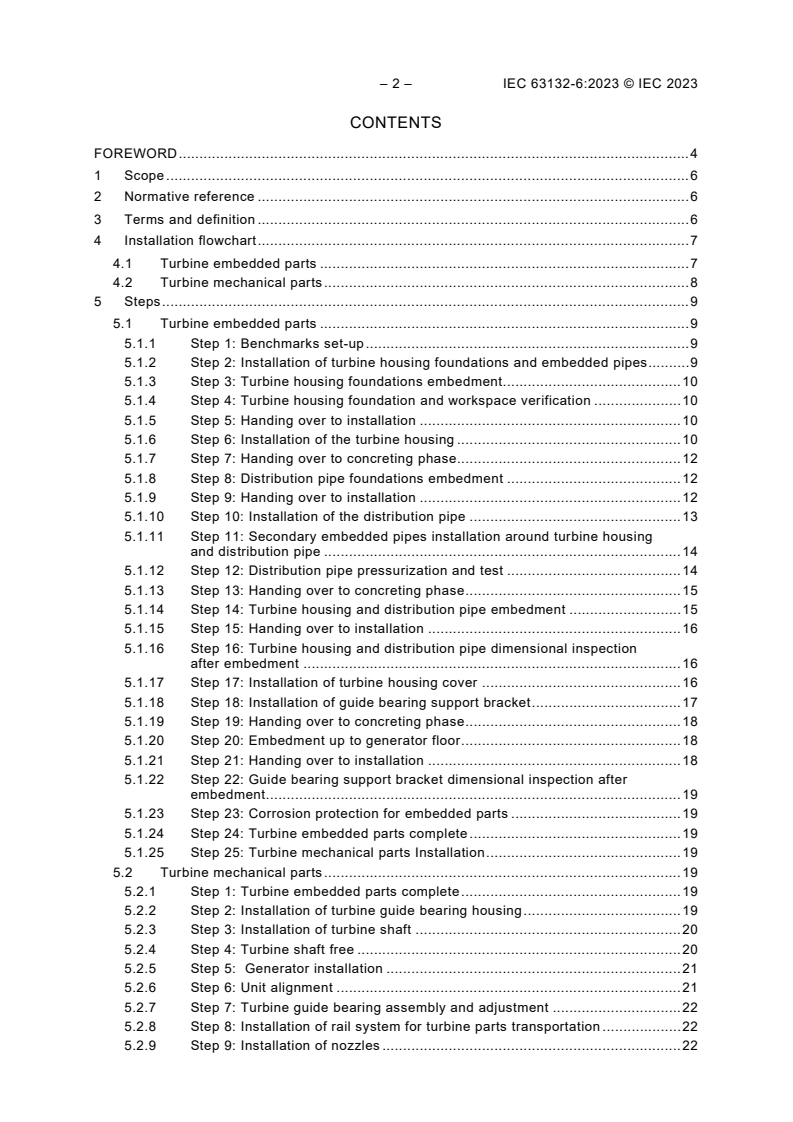
CONTENTS
FOREWORD . 4
1 Scope . 6
2 Normative reference . 6
3 Terms and definition . 6
4 Installation flowchart . 7
4.1 Turbine embedded parts . 7
4.2 Turbine mechanical parts . 8
5 Steps . 9
5.1 Turbine embedded parts . 9
5.1.1 Step 1: Benchmarks set-up . 9
5.1.2 Step 2: Installation of turbine housing foundations and embedded pipes . 9
5.1.3 Step 3: Turbine housing foundations embedment. 10
5.1.4 Step 4: Turbine housing foundation and workspace verification . 10
5.1.5 Step 5: Handing over to installation . 10
5.1.6 Step 6: Installation of the turbine housing . 10
5.1.7 Step 7: Handing over to concreting phase. 12
5.1.8 Step 8: Distribution pipe foundations embedment . 12
5.1.9 Step 9: Handing over to installation . 12
5.1.10 Step 10: Installation of the distribution pipe . 13
5.1.11 Step 11: Secondary embedded pipes installation around turbine housing
and distribution pipe . 14
5.1.12 Step 12: Distribution pipe pressurization and test . 14
5.1.13 Step 13: Handing over to concreting phase . 15
5.1.14 Step 14: Turbine housing and distribution pipe embedment . 15
5.1.15 Step 15: Handing over to installation . 16
5.1.16 Step 16: Turbine housing and distribution pipe dimensional inspection
after embedment . 16
5.1.17 Step 17: Installation of turbine housing cover . 16
5.1.18 Step 18: Installation of guide bearing support bracket . 17
5.1.19 Step 19: Handing over to concreting phase . 18
5.1.20 Step 20: Embedment up to generator floor . 18
5.1.21 Step 21: Handing over to installation . 18
5.1.22 Step 22: Guide bearing support bracket dimensional inspection after
embedment . 19
5.1.23 Step 23: Corrosion protection for embedded parts . 19
5.1.24 Step 24: Turbine embedded parts complete . 19
5.1.25 Step 25: Turbine mechanical parts Installation . 19
5.2 Turbine mechanical parts . 19
5.2.1 Step 1: Turbine embedded parts complete . 19
5.2.2 Step 2: Installation of turbine guide bearing housing . 19
5.2.3 Step 3: Installation of turbine shaft . 20
5.2.4 Step 4: Turbine shaft free . 20
5.2.5 Step 5: Generator installation . 21
5.2.6 Step 6: Unit alignment . 21
5.2.7 Step 7: Turbine guide bearing assembly and adjustment . 22
5.2.8 Step 8: Installation of rail system for turbine parts transportation . 22
5.2.9 Step 9: Installation of nozzles . 22
5.2.10 Step 10: Installation of deflector systems . 23
5.2.11 Step 11: Installation of water guide shield . 24
5.2.12 Step 12: Installation of turbine runner . 24
5.2.13 Step 13: Remaining turbine parts installation completion . 24
5.2.14 Step 14: Cleaning, painting and inspection before initial tests . 25
5.2.15 Step 15: Turbine mechanical parts complete . 25
5.2.16 Step 16: Commissioning . 25
Bibliography . 26
Figure 1 – Generic installation flowchart – Pelton turbine embedded parts . 7
Figure 2 – Generic installation flowchart – Pelton turbine mechanical parts . 8
Figure 3 – Turbine housing installation . 11
Figure 4 – Distribution pipe installation . 13
Figure 5 – Nozzles installation . 23
Table 1 – Turbine housing measurements . 11
Table 2 – Distribution pipe measurements . 14
Table 3 – Turbine housing cover measurements . 17
Table 4 – Guide bearing support bracket measurements . 17
Table 5 – Shaft measurements . 20
Table 6 – Unit alignment measurements . 21
Table 7 – Nozzles measurements . 23
– 4 – IEC 63132-6:2023 © IEC 2023
INTERNATIONAL ELECTROTECHNICAL COMMISSION
____________
GUIDANCE FOR INSTALLATION PROCEDURES AND
TOLERANCES OF HYDROELECTRIC MACHINES –
Part 6: Vertical Pelton turbines
FOREWORD
1) The International Electrotechnical Commission (IEC) is a worldwide organization for standardization comprising
all national electrotechnical committees (IEC National Committees). The object of IEC is to promote international
co-operation on all questions concerning standardization in the electrical and electronic fields. To this end and
in addition to other activities, IEC publishes International Standards, Technical Specifications, Technical Reports,
Publicly Available Specifications (PAS) and Guides (hereafter referred to as "IEC Publication(s)"). Their
preparation is entrusted to technical committees; any IEC National Committee interested in the subject dealt with
may participate in this preparatory work. International, governmental and non-governmental organizations liaising
with the IEC also participate in this preparation. IEC collaborates closely with the International Organization for
Standardization (ISO) in accordance with conditions determined by agreement between the two organizations.
2) The formal decisions or agreements of IEC on technical matters express, as nearly as possible, an international
consensus of opinion on the relevant subjects since each technical committee has representation from all
interested IEC National Committees.
3) IEC Publications have the form of recommendations for international use and are accepted by IEC National
Committees in that sense. While all reasonable efforts are made to ensure that the technical content of IEC
Publications is accurate, IEC cannot be held responsible for the way in which they are used or for any
misinterpretation by any end user.
4) In order to promote international uniformity, IEC National Committees undertake to apply IEC Publications
transparently to the maximum extent possible in their national and regional publications. Any divergence between
any IEC Publication and the corresponding national or regional publication shall be clearly indicated in the latter.
5) IEC itself does not provide any attestation of conformity. Independent certification bodies provide conformity
assessment services and, in some areas, access to IEC marks of conformity. IEC is not responsible for any
services carried out by independent certification bodies.
6) All users should ensure that they have the latest edition of this publication.
7) No liability shall attach to IEC or its directors, employees, servants or agents including individual experts and
members of its technical committees and IEC National Committees for any personal injury, property damage or
other damage of any nature whatsoever, whether direct or indirect, or for costs (including legal fees) and
expenses arising out of the publication, use of, or reliance upon, this IEC Publication or any other IEC
Publications.
8) Attention is drawn to the Normative references cited in this publication. Use of the referenced publications is
indispensable for the correct application of this publication.
9) Attention is drawn to the possibility that some of the elements of this IEC Publication may be the subject of patent
rights. IEC shall not be held responsible for identifying any or all such patent rights.
IEC 63132-6 has been prepared by IEC technical committee 4: Hydraulic turbines. It is an
International Standard.
The text of this International Standard is based on the following documents:
Draft Report on voting
4/457/FDIS 4/465/RVD
Full information on the voting for its approval can be found in the report on voting indicated in
the above table.
The language used for the development of this International Standard is English.
This document was drafted in accordance with ISO/IEC Directives, Part 2, and developed in
accordance with ISO/IEC Directives, Part 1 and ISO/IEC Directives, IEC Supplement, available
at www.iec.ch/members_experts/refdocs. The main document types developed by IEC are
described in greater detail at www.iec.ch/publications.
A list of all parts in the IEC 63132 series, published under the general title Guidance for
installation procedures and tolerances of hydroelectric machines, can be found on the IEC
website.
The committee has decided that the contents of this document will remain unchanged until the
stability date indicated on the IEC website under webstore.iec.ch in the data related to the
specific document. At this date, the document will be
• reconfirmed,
• withdrawn,
• replaced by a revised edition, or
• amended.
IMPORTANT – The "colour inside" logo on the cover page of this document indicates that it
contains colours which are considered to be useful for the correct understanding of its
contents. Users should therefore print this document using a colour printer.
– 6 – IEC 63132-6:2023 © IEC 2023
GUIDANCE FOR INSTALLATION PROCEDURES AND
TOLERANCES OF HYDROELECTRIC MACHINES –
Part 6: Vertical Pelton turbines
1 Scope
The purpose of this document is to establish, in a general way, suitable procedures and
tolerances for the installation of Pelton vertical turbines. This document presents a typical
assembly and whenever the word "turbine" is used in this document, it refers to a vertical Pelton
turbine. There are many possible ways to assemble a unit. The size of the machine, the design
of the machine, the layout of the powerhouse or the delivery schedule of the components are
some of the elements that could result in additional steps, or the elimination of some steps
and/or assembly sequences.
It is understood that a publication of this type will be binding only if, and to the extent that, both
contracting parties have agreed upon it.
The document excludes matters of purely commercial interest, except those inextricably bound
up with the conduct of installation.
The tolerances in this document have been established upon best practices and experience,
although it is recognized that other standards are specifying different tolerances.
Wherever the document specifies that documents, drawings or information are supplied by a
manufacturer (or by manufacturers), each individual manufacturer will furnish the appropriate
information for their own supply only.
2 Normative reference
There are no normative references in this document.
3 Terms and definition
No terms and definitions are listed in this document.
ISO and IEC maintain terminological databases for use in standardization at the following
addresses:
• IEC Electropedia: available at http://www.electropedia.org/
• ISO Online browsing platform: available at http://www.iso.org/obp
4 Installation flowchart
4.1 Turbine embedded parts
Figure 1 shows a generic installation flowchart for Pelton turbine embedded parts.
Figure 1 – Generic installation flowchart – Pelton turbine embedded parts
– 8 – IEC 63132-6:2023 © IEC 2023
4.2 Turbine mechanical parts
Figure 2 shows generic installation flowchart for Pelton turbine mechanical parts.
Figure 2 – Generic installation flowchart – Pelton turbine mechanical parts
5 Steps
5.1 Turbine embedded parts
5.1.1 Step 1: Benchmarks set-up
a) Objective of work in the step
– Set-up benchmarks to be used for starting proper installation of the turbine and
generator.
b) Explanation of work
– Sufficient benchmarks should be provided to establish the unit centreline, axis and
elevation.
c) Recommendations
N/A
d) Additional information
Depending on the project delivery system (EPC, design build, etc.), the benchmarks or their
reference points could be provided by the owner, civil contractor, etc. Whoever provides
the benchmarks or reference points is responsible to make sure they are correct.
The benchmark type (x, y, z coordinates, defining axis and elevations, etc.) should be
agreed to prior to the work commencing.
The turbine supplier should take care of transferring the necessary benchmarks throughout
the erection and/or concreting processes so that the benchmarks remain accessible as the
unit is assembled.
5.1.2 Step 2: Installation of turbine housing foundations and embedded pipes
a) Objective of work in the step
– Install primary embedded pipes and turbine housing foundations in the correct locations.
b) Explanation of work
– Install the primary embedded pipes and supporting systems.
– Install the foundation components for turbine housing and rail system for turbine parts
transportation etc.
c) Recommendations
Different designs require different tolerances; therefore, the turbine supplier should provide
the tolerances. It is considered as a best practice to perform:
– NDT as applicable (i.e. visual inspections, pressure tests of the piping, test of welding
seams);
– measures to prevent the concrete from entering the pipes or contaminating the machined
surfaces of foundations during concreting.
d) Additional information
The contract should define which party is responsible to install the primary embedded pipes
and/or the foundation components.
Depending on the design, the rail system for turbine parts transportation may not require
foundation components.
Depending on the size of unit, a support column for platform might be installed in the water
passage below the turbine housing.
– 10 – IEC 63132-6:2023 © IEC 2023
5.1.3 Step 3: Turbine housing foundations embedment
a) Objective of work in the step
– Embed the turbine housing foundations and the pipes in primary concrete.
b) Explanation of work
– Embed the foundation components for turbine housing and rail system for turbine parts
transportation etc.
c) Recommendations
Care should be taken not to damage any of the embedded components or piping when
pouring concrete.
d) Additional information
Depending on the design, the rail system for turbine parts transportation may not require
the foundation components.
Depending on the size of unit, a support column for platform might be embedded in the
water passage below the turbine housing.
5.1.4 Step 4: Turbine housing foundation and workspace verification
a) Objective of work in the step
– Confirm that the turbine housing foundation has been installed in the correct place,
verifying that it is per the design and there is sufficient access to the workplace.
b) Explanation of work
– Once the workplace is acceptable, the turbine installation work can start.
c) Recommendations
Check that the foundation components of the turbine housing were installed within the
tolerances provided by the turbine supplier.
d) Additional information
N/A
5.1.5 Step 5: Handing over to installation
a) Objective of work in the step
– Transfer the workspace to the turbine supplier/installer.
b) Explanation of work
– There is normally an official transfer of the working area of the turbine housing from the
civil contractor to the turbine supplier/installer. Typically, the transfer is documented with
some type of signed form.
c) Recommendations
N/A
d) Additional information
N/A
5.1.6 Step 6: Installation of the turbine housing
a) Objective of work in the step
– Install the turbine housing (see Figure 3).
b) Explanation of work
– Transport the turbine housing segments to the foundation and place them on the
supports.
– Tack-weld of the turbine housing segments.
– Inspect the alignment and principal dimensions of the turbine housing before welding.
– Weld the turbine housing.
– Inspect the alignment and principal dimensions of the turbine housing after welding.
– Install the inspection platform.
c) Recommendations
The items showed in Table 1 should be checked.
Figure 3 – Turbine housing installation
Table 1 – Turbine housing measurements
Minimum no. of
Item Tolerance Measurement location
measurements
To be determined by Inside walls of turbine
Concentricity Number of nozzles
turbine supplier housing
To be determined by Orientation of turbine
Orientation in plan 1
turbine supplier housing
To be determined by Top surface of turbine
Elevation Number of nozzles
turbine supplier housing
To be determined by Top surface of turbine
Level Number of nozzles
turbine supplier housing
– NDT of the welding seams
– Proper fixation of the turbine housing.
In addition to the above requirements, principal dimensions should be checked.
The tolerances and measurement locations of the principal dimensions are indicated in
turbine supplier drawings.
The turbine housing should be set concentric to the theoretical unit axis (benchmark) and
centreline.
– 12 – IEC 63132-6:2023 © IEC 2023
d) Additional information
The sequence for the installation of the turbine housing should be provided by the turbine
supplier.
Adequate supports or bracing are required to prevent the turbine housing from moving or
changing shape during placing of the secondary concrete.
5.1.7 Step 7: Handing over to concreting phase
a) Objective of work in the step
– Transfer the workspace to the civil contractor.
b) Explanation of work
– The turbine supplier should confirm that the turbine housing has been installed and
aligned properly and is ready for concreting.
– There is normally an official transfer of the working area of the turbine housing from the
turbine supplier to the civil contractor. Typically, the transfer is documented with some
type of signed form.
c) Recommendations
N/A
d) Additional information
N/A
5.1.8 Step 8: Distribution pipe foundations embedment
a) Objective of work in the step
– Install and embed distribution pipe foundations.
b) Explanation of work in the step
– Install the distribution pipe foundations.
– Embed the distribution pipe foundations and lower section of turbine housing.
c) Recommendations
– The concrete pour rate, pour/step heights and allowable differential levels should be
agreed among the concerned parties during the early stages of project development,
due to the critical impacts (to schedule and costs) related to the design and installation
of the turbine housing.
d) Additional information
Care should be taken when pouring concrete not to damage any of the embedded
components or piping.
5.1.9 Step 9: Handing over to installation
a) Objective of work in the step
– Transfer the workspace to the turbine supplier/installer.
b) Explanation of work
– There is normally an official transfer of the working area from the civil contractor to the
turbine supplier/installer. Typically, the transfer is documented with some types of signed
form.
c) Recommendations
N/A
d) Additional information
N/A
5.1.10 Step 10: Installation of the distribution pipe
a) Objective of work in the step
– Install the distribution pipe (see Figure 4).
b) Explanation of work
– Transport and assemble distribution pipe segments.
– Align distribution pipe flanges (elevation, orientation, distance and offset).
– Install and weld steel plates between distribution pipe flanges to turbine housing.
c) Recommendations
The items showed in Table 2 should be checked.
Figure 4 – Distribution pipe installation
– 14 – IEC 63132-6:2023 © IEC 2023
Table 2 – Distribution pipe measurements
Minimum no. of
Item Tolerance Measurement location
measurements
To be determined by Elevation of distribution
Elevation Number of nozzles
turbine supplier pipe flange centre
To be determined by Orientation of distribution
Orientation Number of nozzles
turbine supplier pipe flanges
Distance of distribution
To be determined by
Distance Number of nozzles pipe flange surfaces to
turbine supplier
turbine centre
Offset of distribution pipe
To be determined by
Offset Number of nozzles flange centre to turbine
turbine supplier
centre
– NDT of the welding seams.
– Proper fixation of the turbine housing.
In addition to the above requirements, principal dimensions should be checked.
The tolerances and measurement locations of the principal dimensions are indicated in
turbine supplier drawings.
d) Additional information
Orientation and distance of distribution pipe flanges shall be adjusted by adaption plates
between nozzle and distribution pipes.
Several measurement methods of distribution pipe position are existing. (i.e. laser tracker,
measuring templates etc.).
5.1.11 Step 11: Secondary embedded pipes installation around turbine housing and
distribution pipe
a) Objective of work in the step
– Install the embedded pipes.
b) Explanation of work
– Install the pipes around the turbine housing and distribution pipe before final concreting.
c) Recommendations
NDT (i.e. visual inspections, pressure tests, test of welding seams) and dimensional checks
of the pipe locations should be performed.
The following preventive measures should be considered:
– support the pipes so they cannot move or be damaged during concreting;
– cover/block pipe openings to prevent concrete from entering the pipes during concreting.
d) Additional information
N/A
5.1.12 Step 12: Distribution pipe pressurization and test
a) Objective of work in the step
– Check the deformation and integrity (water tightness) of the distribution pipe when
pressurized.
– Relieve some local high stresses in the welds which will improve the fatigue life of the
distribution pipe.
b) Explanation of work
– Close the inlet flange and all nozzle outlet flanges of the distribution pipe with temporary
covers.
– Fill the distribution pipe with water.
– Pressurize the distribution pipe.
– Check for leaks.
c) Recommendations
150 % of the design head is generally used for the pressure test. The test pressure, duration
and parameters should be provided by the turbine supplier.
d) Additional information
Depending on the civil and mechanical design, the pressure test may not be required.
The turbine supplier typically supplies a pressurization procedure which defines the number
of steps, the duration of each step, the pressures of each step, etc.
In order to make it easier to detect any leakage, it is helpful to control the water temperature
to be higher than the ambient air dew point to avoid water condensation on the surfaces.
However, depending on the size of the distribution pipe and conditions at the site, this
method is not always possible.
The distribution pipe pressure will need to be controlled throughout the test.
5.1.13 Step 13: Handing over to concreting phase
a) Objective of work in the step
– Transfer the workspace to the civil contractor.
b) Explanation of work
– The turbine supplier should confirm that the distribution pipe has been installed and
aligned properly and is ready for concreting.
– There is normally an official transfer of the working area of the turbine housing and
distribution pipe from the turbine supplier to the civil contractor. Typically, the transfer
is documented with some type of signed form.
c) Recommendations
N/A
d) Additional information
Before handing over, some measures are required to prevent distortion of the distribution
pipe during concreting and/or excessive load transfer to the civil structures after
commissioning.
Some common methods are:
– To keep the distribution pipe pressurized at some pressure below the test pressure.
– Monitor the pressure and temperature of the distribution pipe and adjust if required.
5.1.14 Step 14: Turbine housing and distribution pipe embedment
a) Objective of work in the step
– Embed the turbine housing and distribution pipe.
b) Explanation of work
– Install the reinforcement.
– Place the formwork.
– Concreting.
c) Recommendations
The concrete pour rate, pour/step heights and allowable differential levels should be agreed
among the concerned parties during the early stages of project development, due to the
critical impacts (to schedule and costs) related to the design and installation of the turbine
housing and distribution pipe.
After concreting of the turbine housing, the presence of voids behind the steel plates should
be checked, typically with hammer test. Grout injection should be performed to fill these
voids.
– 16 – IEC 63132-6:2023 © IEC 2023
d) Additional information
Care should be taken when pouring concrete not to damage any of the embedded
components or piping.
5.1.15 Step 15: Handing over to installation
a) Objective of work in the step
– Transfer the workspace to the turbine supplier/installer.
b) Explanation of work
– There is normally an official transfer of the working area from the civil contractor to the
turbine supplier/installer. Typically, the transfer is documented with some types of signed
form.
c) Recommendations
N/A
d) Additional information
N/A
5.1.16 Step 16: Turbine housing and distribution pipe dimensional inspection after
embedment
a) Objective of work in the step
– Determine the shape and location of the turbine housing and distribution pipe after
embedment.
b) Explanation of work
– Take measurements.
c) Recommendations
The turbine housing concentricity, orientation in plan, elevation and level should be checked
to see if the readings, taken in Step 6: Installation of the turbine housing, have changed
after concreting.
The distribution pipe flanges orientation, elevation, distance and offset should be checked
to see if the readings, taken in Step 10: Installation of the distribution pipe, have changed
after concreting.
d) Additional information
Depending on the design of the components or if the components were distorted or moved
during concreting, some adjustments such as re-machining, grinding or shimming may be
required on the machined surfaces to get them within the tolerance.
5.1.17 Step 17: Installation of turbine housing cover
a) Objective of work in the step
Install turbine housing cover
b) Explanation of work
– Transport the turbine housing cover segments to the turbine housing.
– Tack-weld of the turbine housing cover segments.
– Inspect the alignment and principal dimensions of the turbine housing cover before
welding.
– Weld the turbine housing cover.
– Inspect the alignment and principal dimensions of the turbine housing cover after
welding.
c) Recommendations
The items showed in Table 3 should be checked.
Table 3 – Turbine housing cover measurements
Minimum no. of
Item Tolerance Measurement location
measurements
To be determined by Inner diameter of turbine
Concentricity 4
turbine supplier housing cover
To be determined by Orientation of turbine
Orientation in plan 1
turbine supplier housing cover
To be determined by Top surface of turbine
Elevation
turbine supplier housing cover
To be determined by Top surface of turbine
Level 4
turbine supplier housing cover
– NDT of the welding seams
d) Additional information
The sequence for the installation of the turbine housing cover should be provided by the
turbine supplier.
5.1.18 Step 18: Installation of guide bearing support bracket
a) Objective of work in the step
– Install the guide bearing support bracket.
b) Explanation of work
– Transport the guide bearing support bracket segments to the turbine housing cover and
placing them on the supports.
– Tack-weld of the guide bearing support bracket segments.
– Inspect the alignment and principal dimensions of the turbine guide bearing support
bracket before welding.
– Weld the guide bearing support bracket.
– Inspect the alignment and principal dimensions of the guide bearing support bracket
after welding.
c) Recommendations
The items showed in Table 4 should be checked.
Table 4 – Guide bearing support bracket measurements
Minimum no. of
Item Tolerance Measurement location
measurements
To be determined by Upper flange of guide
Concentricity 4
turbine supplier bearing support bracket
To be determined by Orientation of guide
Orientation in plan 1
turbine supplier bearing support bracket
To be determined by Top surface of guide
Elevation 4
turbine supplier bearing support bracket
To be determined by Top surface of guide
Level 4
turbine supplier bearing support bracket
– NDT of the welding seams.
– Proper fixation of the guide bearing support bracket.
The guide bearing support bracket should be set concentric to the centre of distribution pipe
nozzle flanges.
– 18 – IEC 63132-6:2023 © IEC 2023
d) Additional information
The sequence for the installation of the guide bearing support bracket should be provided
by the turbine supplier.
5.1.19 Step 19: Handing over to concreting phase
a) Objective of work in the step
– Transfer the work space to the civil contractor.
b) Explanation of work
– The turbine supplier should confirm that the turbine housing cover and guide bearing
support bracket has been installed and aligned properly and are ready for concreting.
– There is normally an official transfer of the working area of the turbine housing cover
and guide bearing support bracket from the turbine supplier to the civil contractor.
Typically, the transfer is documented with some type of signed form.
c) Recommendations
N/A
d) Additional information
N/A
5.1.20 Step 20: Embedment up to generator floor
a) Objective of work in the step
– Embed all embedded parts including, but not limited to, the turbine housing cover, guide
bearing support bracket and the turbine and/or generator component anchors, plates
and pipes.
b) Explanation of work
– Place the concrete around the remaining embedded components.
c) Recommendations
The concrete pour rate, pour/step heights and allowable differential levels should be agreed
by the concerned parties during the early stages of project development due to the critical
impacts (on schedule and costs) of the design and installation of embedded parts.
d) Additional Information
Care should be taken when pouring concrete not to damage any of the embedded
components or the piping.
If the generator components need to be embedded in the primary concrete, it should be
considered in this step.
5.1.21 Step 21: Handing over to installation
a) Objective of work in the step
– Transfer the work space to the turbine supplier/installer.
b) Explanation of work
– There is normally an official transfer of the working area from the civil contractor to the
turbine supplier/installer. Typically, the transfer is documented with some types of signed
form.
c) Recommendations
N/A
d) Additional information
N/A
5.1.22 Step 22: Guide bearing support bracket dimensional inspection after
embedment
a) Objective of work in the step
– Determine the shape and location of the guide bearing support bracket after embedment.
b) Explanation of work
– Take measurements.
c) Recommendations
The guide bearing support bracket concentricity, elevation and level should be checked to
see if the readings, taken in Step 18: Installation of guide bearing support bracket, have
changed after concreting.
d) Additional information
Depending on the design of the components or if the components were distorted or moved
during concreting, some adjustments such as re-machining, grinding or shimming may be
required on the machined surfaces to get them within the tolerance.
5.1.23 Step 23: Corrosion protection for embedded parts
a) Objective of work in the step
– Protect the water passage side of embedded parts against corrosion.
b) Explanation of work
– Prepare the embedded parts for corrosion protection.
– Apply the corrosion protection.
c) Recommendations
Corrosion protection specification should be provided by the turbine supplier.
d) Additional information
All temporary measures installed during the turbine embedded parts installation, such as
stiffeners and supports, should be removed at this stage
5.1.24 Step 24: Turbine embedded parts complete
This step defines the end of the process.
5.1.25 Step 25: Turbine mechanical parts Installation
This step identifies the beginning of the next group of activities.
5.2 Turbine mechanical parts
5.2.1 Step 1: Turbine embedded parts complete
This step identifies the end of the previous group of activities.
5.2.2 Step 2: Installation of turbine guide bearing housing
a) Objective of work in the step
– Install the turbine guide bearing housing.
b) Explanation of work
– Assemble the turbine guide bearing housing and install it.
c) Recommendations
N/A
– 20 – IEC 63132-6:2023 © IEC 2023
d) Additional information
The installation of the turbine guide bearing housing should not interfere with the
measurements being taken during unit alignment.
The turbine guide bearing housing cover will serve as support for turbine shaft and might
be assembled with turbine shaft.
5.2.3 Step 3: Installation of turbine shaft
a) Objective of work in the step
– Install the turbine shaft.
b) Explanation of work
– Place the turbine shaft into the turbine guide bearing housing.
– Assemble turbine guide bearing housing cover to support the turbine shaft.
– Align the turbine shaft.
c) Recommendations
The concentricity, elevation and level of the turbine shaft should be aligned within the
tolerances listed in step 4: Turbine shaft free.
d) Additional information
In some cases, the turbine guide bearing housing cover and shaft are assembled outside
the turbine pit and installed as an assembly.
5.2.4 Step 4: Turbine shaft free
a) Objective of work in the step
– Establish the turbine shaft free condition.
b) Explanation of work
– Shaft free is defined as the handover from the turbine supplier to the generator supplier.
c) Recommendations
The items showed in Table 5 should be checked.
Table 5 – Shaft measurements
Item Tolerance No. of measurements Measurement location
Distance between turbine
Turbine shaft To be determined by shaft and reference
4 (every 90°)
Concentricity turbine supplier surface a
...