

IEC 60095-7:2019
(Main)Lead-acid starter batteries - Part 7: General requirements and methods of test for motorcycle batteries
General Information
- Abstract
IEC 60095-7:2019 is applicable to lead-acid batteries used primarily as a power source for the starting of internal combustion engines, lighting and ignition (SLI) of motorcycles and other power sport vehicles. The nominal voltage is 12 V or 6 V.
Test definitions and criteria in this document are for batteries with a nominal voltage of 12 V only. For batteries with a nominal voltage of 6 V, all voltages have to be divided by two.
The other power sports vehicles covered in this document are snowmobiles, personal water crafts and all-terrain vehicles.
This document is not applicable to batteries for other purposes, such as the back-up power sources, auxiliary equipment of internal combustion engine vehicles and e-bikes.
This document specifies:
• general requirements;
• size, essential functional characteristics, relevant test methods and results required.
- Status
- Published
- Publication Date
- 11-Sep-2019
- Technical Committee
- TC 21 - Secondary cells and batteries
- Drafting Committee
- WG 2 - TC 21/WG 2
- Current Stage
- PPUB - Publication issued
- Start Date
- 12-Sep-2019
- Completion Date
- 04-Oct-2019
Overview
IEC 60095-7:2019 is an international standard developed by the International Electrotechnical Commission (IEC) that specifies the general requirements and test methods for lead-acid starter batteries used in motorcycles and other power sport vehicles. This standard focuses on lead-acid batteries primarily intended as power sources for starting internal combustion engines, as well as for lighting and ignition (SLI systems). It covers nominal battery voltages of 12 V and 6 V and includes vehicles such as motorcycles, snowmobiles, personal water crafts, and all-terrain vehicles (ATVs).
The document defines important criteria for 12 V batteries, while special adjustments apply for 6 V batteries, such as halving voltage values in testing. IEC 60095-7:2019 excludes applications like auxiliary power equipment, backup power sources, and electric bicycles (e-bikes). This standard aims to ensure safety, performance, and reliability across lead-acid batteries for SLI applications in motorcycles and similar vehicles.
Key Topics
Scope and Applicability
Defines the scope of lead-acid starter batteries for motorcycles and related power sport vehicles, focusing on nominal voltages of 12 V and 6 V batteries with adjusted testing procedures.General Requirements
Specifies battery designations, size, identification, labeling, polarity marking, and safety information. Includes requirements for valve-regulated lead-acid (VRLA) batteries and flooded batteries.Functional Characteristics
Covers electrical characteristics such as nominal cranking current, capacity at a 10-hour rate, and capacity retention. Mechanical features including battery sizing and terminal design are also detailed.Test Methods and Procedures
Provides standardized test methods including:- Capacity check (10-hour capacity)
- Cranking performance tests (cold cranking at -18°C)
- Charge acceptance and charge retention tests
- Endurance cycling and water consumption
- Vibration resistance tests to ensure durability under extreme conditions
- Specific tests for dry-charged and conserved-charge batteries after activation
Marking and Labeling
Specifies requirements for clear product identification, safety warnings, recycling information, production date codes, and polarity marking to ensure safe handling and traceability.Battery Sizing Standards
Annexes include detailed tables defining standard battery sizes for both VRLA and flooded types, ensuring compatibility and interchangeability in vehicle applications.
Applications
IEC 60095-7:2019 is crucial for manufacturers, suppliers, and quality assurance professionals involved in producing lead-acid starter batteries for:
Motorcycles
Ensuring batteries meet performance and safety criteria required for reliable engine start, lighting, and ignition functions.Snowmobiles and Personal Water Crafts
Providing robust power solutions that perform well in harsh environments, including cold weather and vibration exposure.All-Terrain Vehicles (ATVs)
Supporting demanding terrain operation by ensuring battery endurance and resistance to mechanical stress.
This standard helps stakeholders maintain high-quality battery production and testing, promoting product safety, durability, and compliance with international norms for power sport vehicle applications.
Related Standards
IEC 60095-1:2018 – Lead-acid starter batteries: General requirements and test methods applicable across multiple vehicle types beyond motorcycles, including cars and trucks.
IEC 60050-482 – International Electrotechnical Vocabulary (IEV) Part 482: Defines terminology related to primary and secondary cells and batteries to standardize language used in battery technology.
Additional IEC 60095 Series Parts – Covering other specialized lead-acid battery applications, providing complementary guidelines for different battery types and uses.
Keywords: IEC 60095-7, lead-acid starter batteries, motorcycle batteries, power sport vehicles, battery test methods, cranking performance, VRLA battery, flooded battery, battery safety standards, battery size, cold cranking current, charge retention, vibration resistance, battery labeling, international battery standard.
Get Certified
Connect with accredited certification bodies for this standard

IMQ S.p.A. (Certification)
Italian electrical product certification.

SLG Prüf- und Zertifizierungs GmbH
German testing and certification body.

UL Solutions
Global safety science company with testing, inspection and certification.
Sponsored listings
Frequently Asked Questions
IEC 60095-7:2019 is a standard published by the International Electrotechnical Commission (IEC). Its full title is "Lead-acid starter batteries - Part 7: General requirements and methods of test for motorcycle batteries". This standard covers: IEC 60095-7:2019 is applicable to lead-acid batteries used primarily as a power source for the starting of internal combustion engines, lighting and ignition (SLI) of motorcycles and other power sport vehicles. The nominal voltage is 12 V or 6 V. Test definitions and criteria in this document are for batteries with a nominal voltage of 12 V only. For batteries with a nominal voltage of 6 V, all voltages have to be divided by two. The other power sports vehicles covered in this document are snowmobiles, personal water crafts and all-terrain vehicles. This document is not applicable to batteries for other purposes, such as the back-up power sources, auxiliary equipment of internal combustion engine vehicles and e-bikes. This document specifies: • general requirements; • size, essential functional characteristics, relevant test methods and results required.
IEC 60095-7:2019 is applicable to lead-acid batteries used primarily as a power source for the starting of internal combustion engines, lighting and ignition (SLI) of motorcycles and other power sport vehicles. The nominal voltage is 12 V or 6 V. Test definitions and criteria in this document are for batteries with a nominal voltage of 12 V only. For batteries with a nominal voltage of 6 V, all voltages have to be divided by two. The other power sports vehicles covered in this document are snowmobiles, personal water crafts and all-terrain vehicles. This document is not applicable to batteries for other purposes, such as the back-up power sources, auxiliary equipment of internal combustion engine vehicles and e-bikes. This document specifies: • general requirements; • size, essential functional characteristics, relevant test methods and results required.
IEC 60095-7:2019 is classified under the following ICS (International Classification for Standards) categories: 29.220.20 - Acid secondary cells and batteries. The ICS classification helps identify the subject area and facilitates finding related standards.
IEC 60095-7:2019 is available in PDF format for immediate download after purchase. The document can be added to your cart and obtained through the secure checkout process. Digital delivery ensures instant access to the complete standard document.
Standards Content (Sample)
IEC 60095-7 ®
Edition 1.0 2019-09
INTERNATIONAL
STANDARD
NORME
INTERNATIONALE
Lead-acid starter batteries –
Part 7: General requirements and methods of test for motorcycle batteries
Batteries d'accumulateurs de démarrage au plomb –
Partie 7: Exigences générales et méthodes d'essais pour les batteries de
motocycles
All rights reserved. Unless otherwise specified, no part of this publication may be reproduced or utilized in any form
or by any means, electronic or mechanical, including photocopying and microfilm, without permission in writing from
either IEC or IEC's member National Committee in the country of the requester. If you have any questions about IEC
copyright or have an enquiry about obtaining additional rights to this publication, please contact the address below or
your local IEC member National Committee for further information.
Droits de reproduction réservés. Sauf indication contraire, aucune partie de cette publication ne peut être reproduite
ni utilisée sous quelque forme que ce soit et par aucun procédé, électronique ou mécanique, y compris la photocopie
et les microfilms, sans l'accord écrit de l'IEC ou du Comité national de l'IEC du pays du demandeur. Si vous avez des
questions sur le copyright de l'IEC ou si vous désirez obtenir des droits supplémentaires sur cette publication, utilisez
les coordonnées ci-après ou contactez le Comité national de l'IEC de votre pays de résidence.
IEC Central Office Tel.: +41 22 919 02 11
3, rue de Varembé info@iec.ch
CH-1211 Geneva 20 www.iec.ch
Switzerland
About the IEC
The International Electrotechnical Commission (IEC) is the leading global organization that prepares and publishes
International Standards for all electrical, electronic and related technologies.
About IEC publications
The technical content of IEC publications is kept under constant review by the IEC. Please make sure that you have the
latest edition, a corrigendum or an amendment might have been published.
IEC publications search - webstore.iec.ch/advsearchform Electropedia - www.electropedia.org
The advanced search enables to find IEC publications by a The world's leading online dictionary on electrotechnology,
variety of criteria (reference number, text, technical containing more than 22 000 terminological entries in English
committee,…). It also gives information on projects, replaced and French, with equivalent terms in 16 additional languages.
and withdrawn publications. Also known as the International Electrotechnical Vocabulary
(IEV) online.
IEC Just Published - webstore.iec.ch/justpublished
Stay up to date on all new IEC publications. Just Published IEC Glossary - std.iec.ch/glossary
details all new publications released. Available online and 67 000 electrotechnical terminology entries in English and
once a month by email. French extracted from the Terms and Definitions clause of
IEC publications issued since 2002. Some entries have been
IEC Customer Service Centre - webstore.iec.ch/csc collected from earlier publications of IEC TC 37, 77, 86 and
If you wish to give us your feedback on this publication or CISPR.
need further assistance, please contact the Customer Service
Centre: sales@iec.ch.
A propos de l'IEC
La Commission Electrotechnique Internationale (IEC) est la première organisation mondiale qui élabore et publie des
Normes internationales pour tout ce qui a trait à l'électricité, à l'électronique et aux technologies apparentées.
A propos des publications IEC
Le contenu technique des publications IEC est constamment revu. Veuillez vous assurer que vous possédez l’édition la
plus récente, un corrigendum ou amendement peut avoir été publié.
Recherche de publications IEC - Electropedia - www.electropedia.org
webstore.iec.ch/advsearchform Le premier dictionnaire d'électrotechnologie en ligne au
La recherche avancée permet de trouver des publications IEC monde, avec plus de 22 000 articles terminologiques en
en utilisant différents critères (numéro de référence, texte, anglais et en français, ainsi que les termes équivalents dans
comité d’études,…). Elle donne aussi des informations sur les 16 langues additionnelles. Egalement appelé Vocabulaire
projets et les publications remplacées ou retirées. Electrotechnique International (IEV) en ligne.
IEC Just Published - webstore.iec.ch/justpublished Glossaire IEC - std.iec.ch/glossary
Restez informé sur les nouvelles publications IEC. Just 67 000 entrées terminologiques électrotechniques, en anglais
Published détaille les nouvelles publications parues. et en français, extraites des articles Termes et Définitions des
Disponible en ligne et une fois par mois par email. publications IEC parues depuis 2002. Plus certaines entrées
antérieures extraites des publications des CE 37, 77, 86 et
Service Clients - webstore.iec.ch/csc CISPR de l'IEC.
Si vous désirez nous donner des commentaires sur cette
publication ou si vous avez des questions contactez-nous:
sales@iec.ch.
IEC 60095-7 ®
Edition 1.0 2019-09
INTERNATIONAL
STANDARD
NORME
INTERNATIONALE
Lead-acid starter batteries –
Part 7: General requirements and methods of test for motorcycle batteries
Batteries d'accumulateurs de démarrage au plomb –
Partie 7: Exigences générales et méthodes d'essais pour les batteries de
motocycles
INTERNATIONAL
ELECTROTECHNICAL
COMMISSION
COMMISSION
ELECTROTECHNIQUE
INTERNATIONALE
ICS 29.220.20 ISBN 978-2-8322-7367-8
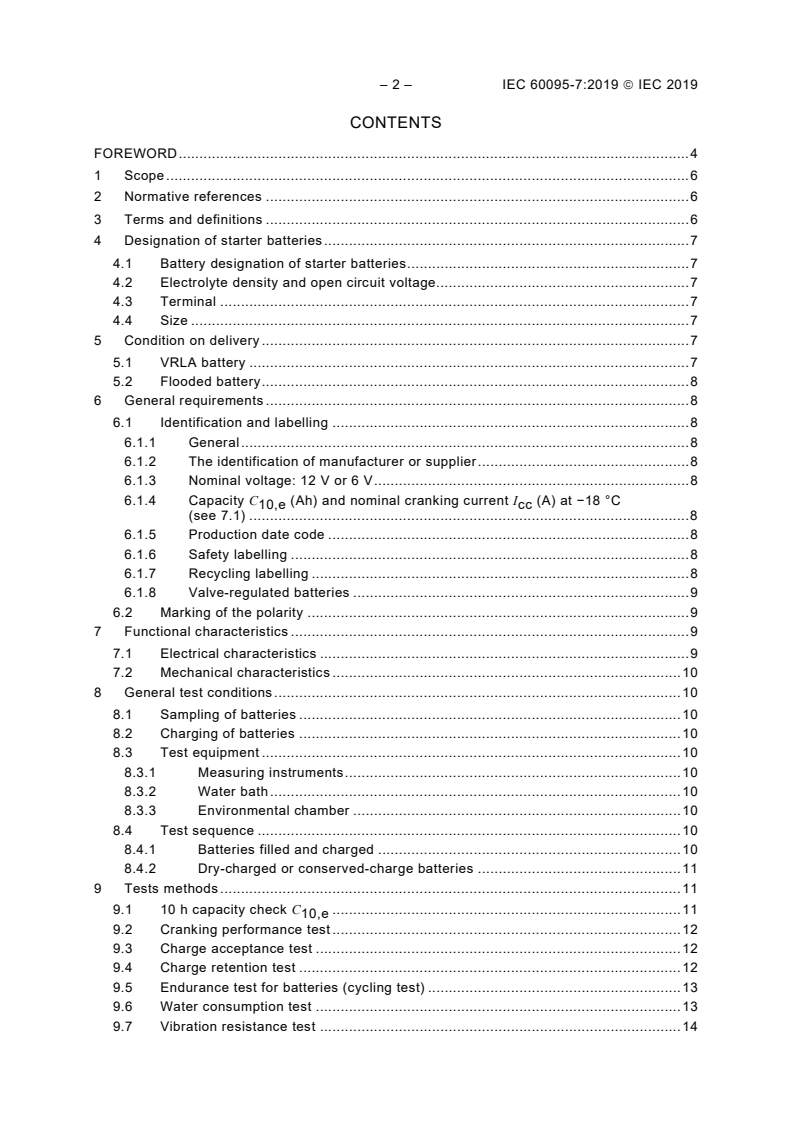
– 2 – IEC 60095-7:2019 IEC 2019
CONTENTS
FOREWORD . 4
1 Scope . 6
2 Normative references . 6
3 Terms and definitions . 6
4 Designation of starter batteries . 7
4.1 Battery designation of starter batteries . 7
4.2 Electrolyte density and open circuit voltage. 7
4.3 Terminal . 7
4.4 Size . 7
5 Condition on delivery . 7
5.1 VRLA battery . 7
5.2 Flooded battery . 8
6 General requirements . 8
6.1 Identification and labelling . 8
6.1.1 General . 8
6.1.2 The identification of manufacturer or supplier . 8
6.1.3 Nominal voltage: 12 V or 6 V . 8
6.1.4 Capacity C (Ah) and nominal cranking current I (A) at −18 °C
10,e cc
(see 7.1) . 8
6.1.5 Production date code . 8
6.1.6 Safety labelling . 8
6.1.7 Recycling labelling . 8
6.1.8 Valve-regulated batteries . 9
6.2 Marking of the polarity . 9
7 Functional characteristics . 9
7.1 Electrical characteristics . 9
7.2 Mechanical characteristics . 10
8 General test conditions . 10
8.1 Sampling of batteries . 10
8.2 Charging of batteries . 10
8.3 Test equipment . 10
8.3.1 Measuring instruments . 10
8.3.2 Water bath . 10
8.3.3 Environmental chamber . 10
8.4 Test sequence . 10
8.4.1 Batteries filled and charged . 10
8.4.2 Dry-charged or conserved-charge batteries . 11
9 Tests methods . 11
9.1 10 h capacity check C . 11
10,e
9.2 Cranking performance test . 12
9.3 Charge acceptance test . 12
9.4 Charge retention test . 12
9.5 Endurance test for batteries (cycling test) . 13
9.6 Water consumption test . 13
9.7 Vibration resistance test . 14
9.8 Cranking performance for dry-charged (or conserved-charge) batteries after
activation . 14
10 Requirements . 14
Annex A (normative) Battery size . 16
A.1 Battery size for VRLA battery . 16
A.2 Battery size for flooded battery . 17
Bibliography . 20
Figure 1 – Designation of the position for measurement . 7
Table 1 – Charging method . 10
Table 2 – Test sequence . 11
Table 3 – Summary of requirements . 15
Table A.1 – Battery size for VRLA battery . 16
Table A.2 – First letter for each battery type . 16
Table A.3 – Size codes for each battery dimension . 17
Table A.4 – Battery size for 6 V flooded battery . 17
Table A.5 – Battery size for 12 V flooded battery . 18
– 4 – IEC 60095-7:2019 IEC 2019
INTERNATIONAL ELECTROTECHNICAL COMMISSION
____________
LEAD-ACID STARTER BATTERIES –
Part 7: General requirements and methods
of test for motorcycle batteries
FOREWORD
1) The International Electrotechnical Commission (IEC) is a worldwide organization for standardization comprising
all national electrotechnical committees (IEC National Committees). The object of IEC is to promote
international co-operation on all questions concerning standardization in the electrical and electronic fields. To
this end and in addition to other activities, IEC publishes International Standards, Technical Specifications,
Technical Reports, Publicly Available Specifications (PAS) and Guides (hereafter referred to as "IEC
Publication(s)"). Their preparation is entrusted to technical committees; any IEC National Committee interested
in the subject dealt with may participate in this preparatory work. International, governmental and non-
governmental organizations liaising with the IEC also participate in this preparation. IEC collaborates closely
with the International Organization for Standardization (ISO) in accordance with conditions determined by
agreement between the two organizations.
2) The formal decisions or agreements of IEC on technical matters express, as nearly as possible, an international
consensus of opinion on the relevant subjects since each technical committee has representation from all
interested IEC National Committees.
3) IEC Publications have the form of recommendations for international use and are accepted by IEC National
Committees in that sense. While all reasonable efforts are made to ensure that the technical content of IEC
Publications is accurate, IEC cannot be held responsible for the way in which they are used or for any
misinterpretation by any end user.
4) In order to promote international uniformity, IEC National Committees undertake to apply IEC Publications
transparently to the maximum extent possible in their national and regional publications. Any divergence
between any IEC Publication and the corresponding national or regional publication shall be clearly indicated in
the latter.
5) IEC itself does not provide any attestation of conformity. Independent certification bodies provide conformity
assessment services and, in some areas, access to IEC marks of conformity. IEC is not responsible for any
services carried out by independent certification bodies.
6) All users should ensure that they have the latest edition of this publication.
7) No liability shall attach to IEC or its directors, employees, servants or agents including individual experts and
members of its technical committees and IEC National Committees for any personal injury, property damage or
other damage of any nature whatsoever, whether direct or indirect, or for costs (including legal fees) and
expenses arising out of the publication, use of, or reliance upon, this IEC Publication or any other IEC
Publications.
8) Attention is drawn to the Normative references cited in this publication. Use of the referenced publications is
indispensable for the correct application of this publication.
9) Attention is drawn to the possibility that some of the elements of this IEC Publication may be the subject of
patent rights. IEC shall not be held responsible for identifying any or all such patent rights.
International Standard IEC 60095-7 has been prepared by IEC technical committee 21:
Secondary cells and batteries.
The text of this International Standard is based on the following documents:
FDIS Report on voting
21/1014/FDIS 21/1019/RVD
Full information on the voting for the approval of this International Standard can be found in
the report on voting indicated in the above table.
This document has been drafted in accordance with the ISO/IEC Directives, Part 2.
A list of all parts in the IEC 60095 series, published under the general title Lead-acid starter
batteries, can be found on the IEC website.
The committee has decided that the contents of this document will remain unchanged until the
stability date indicated on the IEC website under "http://webstore.iec.ch" in the data related to
the specific document. At this date, the document will be
• reconfirmed,
• withdrawn,
• replaced by a revised edition, or
• amended.
– 6 – IEC 60095-7:2019 IEC 2019
LEAD-ACID STARTER BATTERIES –
Part 7: General requirements and methods
of test for motorcycle batteries
1 Scope
This part of IEC 60095 is applicable to lead-acid batteries used primarily as a power source
for the starting of internal combustion engines, lighting and ignition (SLI) of motorcycles and
other power sport vehicles. The nominal voltage is 12 V or 6 V.
Test definitions and criteria in this document are for batteries with a nominal voltage of 12 V
only. For batteries with a nominal voltage of 6 V, all voltages have to be divided by two.
The other power sports vehicles covered in this document are snowmobiles, personal water
crafts and all-terrain vehicles.
This document is not applicable to batteries for other purposes, such as the back-up power
sources, auxiliary equipment of internal combustion engine vehicles and e-bikes.
This document specifies:
• general requirements;
• size, essential functional characteristics, relevant test methods and results required.
2 Normative references
The following documents are referred to in the text in such a way that some or all of their
content constitutes requirements of this document. For dated references, only the edition
cited applies. For undated references, the latest edition of the referenced document (including
any amendments) applies.
IEC 60050-482, International Electrotechnical Vocabulary (IEV) – Part 482: Primary and
secondary cells and batteries
IEC 60095-1:2018, Lead-acid starter batteries – Part 1: General requirements and methods of
test
IEC 60417, Graphical symbols for use on equipment (available at http://www.graphical-
symbols.info/equipment)
3 Terms and definitions
For the purposes of this document, the terms and definitions given in IEC 60050-482 apply.
ISO and IEC maintain terminological databases for use in standardization at the following
addresses:
• IEC Electropedia: available at http://www.electropedia.org/
• ISO Online browsing platform: available at http://www.iso.org/obp
4 Designation of starter batteries
4.1 Battery designation of starter batteries
For VRLA batteries, flooded batteries, dry charged batteries (or conserved charge batteries),
AGM batteries, and gel batteries, refer to IEC 60095-1.
4.2 Electrolyte density and open circuit voltage
For electrolyte density and open circuit voltage, refer to IEC 60095-1.
4.3 Terminal
The standard terminal shall be manufactured using lead alloy, and for a battery having a bolt
and nut, the terminal shall be mounted. However, for a battery whose outside dimensions are
small, a lead wire type may be used instead of a terminal. As regards this lead wire, an
electric wire, and as a wire covering colour, red shall be used for the positive polarity side and
black for the negative polarity one.
4.4 Size
As regards the size, the outside dimensions shown in Table 1 for VRLA batteries and
Tables A.4 and A.5 for flooded batteries (see Annex A), shall be measured using a length
meter.
The designation of the position in which the outside dimensions are measured is shown in
Figure 1.
Figure 1 – Designation of the position for measurement
5 Condition on delivery
5.1 VRLA battery
The battery is normally supplied in a state ready for use. For these batteries, the electrolyte is
not accessible and, therefore, its density cannot be checked.
The battery may be supplied in a dry-charged (or charge-conserved) state not filled with
electrolyte. These batteries shall be supplied, by the manufacturer, with a bottle of electrolyte
of specific strength and volume. The density of the acid to fill these batteries before use
(unless otherwise recommended by the manufacturer) shall be: 1,32 kg/l ± 0,01 kg/l at 25 °C
for valve regulated batteries.
– 8 – IEC 60095-7:2019 IEC 2019
5.2 Flooded battery
The battery may be supplied:
• in a state ready for use
• in a dry-charged (or charge-conserved) state not filled with electrolyte. The density of the
acid to fill these batteries before use (unless otherwise recommended by the manufacturer)
shall be:
– 1,28 kg/l ± 0,01 kg/l at 25 °C.
Any other manufacturer instruction for handling after filling and before first usage shall be
considered.
6 General requirements
6.1 Identification and labelling
6.1.1 General
Batteries according to this document shall bear the characteristics described from 6.1.2 to
6.1.8 on at least one of their sides or on the top surface.
6.1.2 The identification of manufacturer or supplier
The name of the manufacturer or supplier shall be indicated.
6.1.3 Nominal voltage: 12 V or 6 V
The nominal voltage of 6 V or 12 V shall be indicated.
(Ah) and nominal cranking current I (A) at −18 °C (see 7.1)
6.1.4 Capacity C
10,e cc
Label size: The capacity C (Ah) and the cold cranking current I (A) shall be displayed on
10,e cc
a separate label or as text on a combined label (e.g. together with additional information of
the producer or type mark). The size of the label shall be at least 3 % of the largest side of
the battery. The height of the characters should be at least 3 mm. The label shall be fixed on
one of the four sides or on the lid. A multiple labelling is allowed.
Instead of labels, silk printing or similar methods for marking can be used as well. Designated
marking areas with corresponding sizes should be realized.
The battery designed for lighting application only is not required to be marked with the value
of nominal cranking current.
6.1.5 Production date code
Subclause 6.1.5 of IEC 60095-1:2018 is applicable.
6.1.6 Safety labelling
Subclause 6.1.6 of IEC 60095-1:2018 is applicable.
6.1.7 Recycling labelling
Subclause 6.1.7 of IEC 60095-1:2018 is applicable.
6.1.8 Valve-regulated batteries
Subclause 6.1.8 of IEC 60095-1:2018 is applicable.
6.2 Marking of the polarity
The batteries shall be marked with signs for both polarities that have to be positioned near the
terminals.
The marking of the positive terminals shall take the form of the symbol "+". It shall be in
accordance with IEC 60417-5005:2002-10.
The negative terminal shall take the form of the symbol "−". It shall be in accordance with
IEC 60417-5006:2002-10.
7 Functional characteristics
7.1 Electrical characteristics
7.1.1 The 10 h capacity of a starter battery is defined for a temperature of 25 °C ± 2 °C.
The 10 h nominal capacity C may be indicated by the manufacturer.
n
The 10 h nominal capacity C is the electric charge in ampere hours (Ah) that a battery can
n
supply with a current:
I C / 10 h (A)
n = n
until the terminal voltage falls to U = 10,50 V.
f
The effective 10 h capacity C shall be determined by discharging a battery with constant
10,e
current I to U = 10,50 V (see 9.1). The resultant discharge time, in hours, is used for the
n f
verification of C .
n
7.1.2 The cranking performance is the discharge current I as indicated by the
cc
manufacturer, which a battery can supply (see 9.2).
7.1.3 The charge acceptance is expressed as the current I which a partially discharged
ca
battery accepts at 0 °C and a constant voltage of 14,40 V (see 9.3).
7.1.4 The charge retention is defined as the cold cranking performance of the charged and
filled battery after storage on open circuit under defined conditions of temperature and time
(see 9.4).
7.1.5 The endurance test represents the ability of a battery to perform repeated discharge
and recharge cycles and long rest periods on open circuit. This ability shall be tested by a
series of cycles and rest periods under specified conditions after which the cold cranking
performance shall be determined (see 9.5).
7.1.6 Water consumption: maintenance-free service of a battery requires a low rate of
water decomposition through overcharge (see 9.6).
VRLA batteries have a very low water consumption and are not intended to receive additional
water.
– 10 – IEC 60095-7:2019 IEC 2019
7.2 Mechanical characteristics
Vibration resistance represents the ability of a battery to maintain service under periodic or
irregular acceleration forces. Minimum requirements shall be verified by a test (see 9.7).
8 General test conditions
8.1 Sampling of batteries
Regarding the sampling of batteries, refer to 8.1 of IEC 60095-1:2018.
8.2 Charging of batteries
Batteries shall be considered as fully charged if they have undergone the charging procedures.
Prior to the first capacity test, the battery charge shall be limited to 16 h.
If not specified differently by the battery manufacturer, the batteries that will be tested
according to this document shall be charged according to Table 1.
Table 1 – Charging method
Battery type Voltage U Current Time Remarks
c
a)
VRLA batteries 14,80 V ± 0,05 V 2,5 I 24 h (16 h)
a)
Flooded batteries 16,00 V ± 0,05 V 2,5 I 24 h (16 h)
a)
After cranking performance test and prior to first capacity check
If necessary, the environmental control system shall be used instead of the water bath.
8.3 Test equipment
8.3.1 Measuring instruments
Regarding the measuring instruments, refer to 8.3.1 of IEC 60095-1:2018.
8.3.2 Water bath
Regarding the water bath, refer to 8.3.2 of IEC 60095-1:2018.
8.3.3 Environmental chamber
Regarding the environmental chamber, refer to 8.3.3 of IEC 60095-1:2018.
8.4 Test sequence
8.4.1 Batteries filled and charged
a) Initially, the batteries are subjected to the following series of tests:
– first C check;
10,e
– first cranking performance test;
– second C check;
10,e
– second cranking performance test;
– third C check;
10,e
– third cranking performance test.
b) It is not necessary to complete the sequence if the specified values are achieved on the
first or second test.
The tests according to Table 2 shall be carried out only if the batteries have complied with the
tests mentioned in a), and no more than one week after completion of the said tests.
Table 2 – Test sequence
Test Battery
Step
Reference 1 2 3 4 5
0 Cranking performance for dry-charged 8.4.2, 9.8
batteries
1 Initial charge prior to test 8.2
st
2 1 10 h capacity 9.1
st
3 1 cranking performance 9.2
nd
4 2 10 h capacity 9.1 () () () ()
nd
5 2 cranking performance 9.2 () () () () ()
rd
6 3 10 h capacity 9.1 () () () ()
rd
7 3 cranking performance 9.2 () () () () ()
8 Charge acceptance 9.3
9 Charge retention 9.4
10 Endurance tests 9.5
11 Water consumption 9.6
12 Vibration resistance 9.7
Key
test to be fulfilled.
() test to be fulfilled only if the previous identical test carried out failed.
For batteries used only for lighting with no cranking performance required, the cranking
performance test shall be replaced by a discharge at the current of 10 I in the test sequence
step 9, 10 and 12 of Table 2.
8.4.2 Dry-charged or conserved-charge batteries
a) Initially, the batteries are subjected to the initial cranking performance test after being
filled with electrolyte (see 9.8).
b) The tests according to Table 2 shall be carried out only if the batteries have complied with
the test mentioned in a) and no more than one week after that test.
9 Tests methods
9.1 10 h capacity check C
10,e
Throughout the duration of the tests, the battery shall be placed in a water bath at a
temperature of 25 °C ± 2 °C, according to 8.3.2. If necessary, the environmental control
system (refer to 8.3.3) shall be used instead of the water bath.
The battery shall be discharged with the current I (calculated according to 7.1.1) kept
n
constant at ±2 % of the nominal value until the terminal voltage falls to 10,50 V ± 0,05 V.
The duration t (h) of the discharge shall be recorded. The beginning of the discharge shall
take place between 1 h to 5 h after the completion of charging according to 8.2.
– 12 – IEC 60095-7:2019 IEC 2019
The capacity C is as follows:
10,e
C = t × I (Ah).
10,e n
9.2 Cranking performance test
The tests shall be carried out as follows:
Step 1: After a rest period of up to 24 h after preparation according to 8.2, the battery shall be
placed in a cooling environmental chamber with (forced) air circulation at a temperature of
−18 °C ± 1 °C until the temperature in one of the middle cells has reached −18 °C ± 1 °C.
NOTE It is generally accepted that the required temperature is achieved after a minimum period of 16 h in the
environmental chamber.
Step 2: The battery shall then be discharged within 2 min after the cooling with nominal cold
cranking current I (see 7.1.2) for 30 s. This current shall be kept constant to within
cc
I ± 0,5 % during the discharge.
cc
Step 3: After 30 s discharge, the terminal voltage U shall also be recorded and the current
30 s
shall be cut off.
9.3 Charge acceptance test
The tests shall be carried out on fully charged batteries in accordance with 8.2, as follows:
Step 1: The battery shall be placed in a water bath at a temperature of 25 °C ± 2 °C,
according to 8.3.2. If necessary, the environmental control system (refer to 8.3.3) shall be
used instead of the water bath.
Step 2: The battery shall be discharged at a current I :
I = C / 10 h (A) for 5 h.
0 10,e
The value C shall be taken as the maximum value C of the three previous discharges
10,e 10,e
according to 9.1.
Step 3: Immediately after the discharge, the battery shall be cooled at a temperature of
0 °C ± 1 °C for a minimum of 20 h.
Step 4: At this temperature of 0 °C ± 1 °C, the battery shall be charged at a constant voltage
of 14,40 V ± 0,10 V.
After 10 min, the charging current I shall be recorded.
ca
9.4 Charge retention test
The tests shall be carried out on fully charged batteries in accordance with 8.2, as follows.
Step 1: Cell plugs shall be closed but any venting system shall be open.
Step 2: The battery shall be placed in a water bath (refer to 8.3.2) or an environmental
chamber (refer to 8.3.3) at 40 °C ± 2 °C for 49 days on open circuit. No connecting clamps or
cables shall be connected to the terminals.
Step 3: After the storage time the battery shall be placed in an environmental chamber with
(forced) air circulation at a temperature of 40 °C ± 2 °C until the temperature of the middle
cells has reached 40 °C ± 2 °C.
NOTE It is generally accepted that the required temperature will be achieved after a minimum period of 24 h in
the environmental chamber (refer to 8.3.3).
Step 4: The battery shall then be discharged at I for 30 s. The current shall be kept
cc
constant to within ±0,5 % during the discharge. After 30 s discharge, the terminal voltage U
f
shall be recorded in volts.
9.5 Endurance test for batteries (cycling test)
The cycling tests shall be carried out on fully charged batteries in accordance with 8.2 as
follows.
Step 1: Throughout the whole test period, the battery shall be placed in a water bath at a
temperature of 40 °C ± 2 °C, according to 8.3.2. If necessary the environmental control system
(refer to 8.3.3) shall be used instead of the water bath.
Step 2: Except in the case of VRLA, purified water should be added to the electrolyte as
required during the cycling portion of the test.
Step 3: The batteries shall be connected to a device where they undergo a continuous series
of cycles, for 100 h +12/−0 h, each cycle comprising:
a) a discharge for 240 s ± 1 s at the numerical value ± 0,05 A of capacity ±0,05 A (10 h rate),
b) followed, within 10 s, by a charge for 600 s ± 1 s at the maximum charge current of the
numerical value of capacity ±0,05 A (10 h rate) with a maximum charge voltage of
14,80 V ± 0,03 V, with the interval between the charge and the discharge periods not
exceeding 10 s.
Step 4: The battery, maintained at 40 °C, shall be stored on open circuit for between 65 h to
70 h.
Step 5: With the battery at a temperature of 40 °C, discharge at 0,6 I for 30 s. The terminal
cc
voltage at 30 s (U ) shall be recorded together with the number of cycles described.
30 s
Step 6: The battery should be replaced on the cycling test without a separate charge, starting
on the "charge" portion "b)" of the cycle.
Step 7: The cycling test should be considered complete when the terminal voltage at 30 s
(U ) of the cranking test falls to below 7,20 V. The number of cycles shall be determined by
30 s
plotting the 30 s (U ) voltage values versus the cycle values. The point where the line
30 s
crosses 7,20 V shall be the cycle reported for that battery.
9.6 Water consumption test
The test shall be carried out as follows.
Step 1: The battery, after being charged according to 8.2, shall be cleaned, dried and
weighed (m1) to an accuracy of ±0,05 %.
Step 2: The battery shall be placed in a water bath maintained at a temperature of
40 °C ± 2 °C, according to 8.3.2. If necessary, the environmental control system (refer to
8.3.3) shall be used instead of the water bath.
– 14 – IEC 60095-7:2019 IEC 2019
Step 3: The battery shall be charged at a constant voltage of 14,40 V ± 0,05 V (measured
across the battery terminals) for 500 h.
Step 4: Immediately after this overcharge period, the battery shall be weighed (m ) under the
same conditions as in step 1 of 9.6 with the same scales.
Step 5: The ratio (m − m ) / C shall be calculated.
1 2 n
9.7 Vibration resistance test
The test shall be carried out as follows.
Step 1: The tests shall be carried out on fully charged batteries in accordance with 8.2.
Step 2: The battery shall be fastened rigidly to the table of the vibration tester and in the
upright position. The flooded batteries should have a vent tube during the vibration test.
Step 3: The resistance to vibration of fully charged batteries shall be tested under the
following conditions and the presence or absence of abnormalities in them shall be checked:
a) Vibration direction: Single vibration in the vertical direction
b) Vibrational acceleration: 68,6 m/s
c) Vibration frequency
Increase or decrease the vibration frequency continuously at a constant time rate (log
sweep); 50 Hz to 500 Hz, then 500 Hz to 50 Hz. The time required for this reciprocating
motion (once back and forth) shall be 10 min.
d) Vibration time: 2 h
Step 4: After a maximum of 4 h after the end of the vibration, the battery shall be subjected,
without recharge, to a discharge at a temperature of 25 °C ± 2 °C with a current I = I .
cc
Step 5: The terminal voltage after 30 s (U ) discharge shall be recorded. The discharge
30 s
shall then be terminated.
9.8 Cranking performance for dry-charged (or conserved-charge) batteries after
activation
The dry-charged battery and a sufficient amount of electrolyte supplied by the manufacturer,
or according to the manufacturer's specifications, shall be stored at 25 °C ± 2 °C for at least
12 h (before filling).
The battery shall be filled with its electrolyte up to the level indicated by the manufacturer.
After a rest period of 20 min at the same ambient temperature, the battery shall be discharged
at a current I = I for 30 s.
cc
The voltage after a discharge period of 30 s (U ) shall be recorded. The discharge shall
30 s
then be terminated.
10 Requirements
The requirements shall be in accordance with Table 3.
Table 3 – Summary of requirements
Functional characteristics Requirements Comments
10 h capacity (9.1) C ≧ 0,95 C
10,e n
Cranking performance test −18 °C (9.2) U ≧ 7,2 V Compulsory
30 s
Charge acceptance (9.3) I ≧ 1,5 I
ca 0
Charge retention (9.4) U ≧ 7,2 V
30 s
Endurance test (9.5)
Number of cycles
VRLA batteries ≧ 3 840 cycles
Flooded batteries ≧ 2 880 cycles
Water consumption (9.6)
VRLA batteries ≦ 2 g / Ah
Flooded batteries
≦ 4 g / Ah
Vibration (9.7) U ≧ 7,2 V
30 s
No internal damage.
No acid leakage for VRLA batteries.
No acid leakage except exhaust pipe for
flooded batteries.
For both C and the cranking performance, the specified values shall be met in at least one of
e
the relevant discharges as mentioned in Table 1 and 2.
– 16 – IEC 60095-7:2019 IEC 2019
Annex A
(normative)
Battery size
A.1 Battery size for VRLA battery
The battery size shall be in accordance with Table A.1.
Table A.1 – Battery size for VRLA battery
a) b)
Battery Length Width Height Ref. JIS type Ref. GB type
size ±2 mm ±2 mm ±2 mm
VPA J 113 38 85 BT4B 6-MF-2,3I
VPG J 113 70 85 BTZ3(V),BTZ4(V),BTZ5S,BT(X)4 6-MT-3II
N 105 BTZ5,BTZ6(V),BTZ7S, BT(X)5 -
Q 120 BTZ7V -
S 130 BTZ8V,BTX7 6-MFQ-6I
VWF L 150 65 93 BT7B 6-MFQ-6,5III
VWG N 150 69 105 BT9B 6-MFQ-8II
S 130 BT12B 6-MFQ-10I
V 145 BT14B -
VWJ L 150 87 93 BTZ10(S),BTX7A -
N 105 BTX9,BT12A 6-MFQ-8III
O 110 BTZ12S,BTZ14S -
S 130 BTX12 6-MFQ-10II
V 145 BTZ14,BTZ16,BTX14 6-MFQ-12
Y 161 BTX16 -
VZR 1 166 126 175 BTZ32 -
V1J X 175 87 155 BTZ20,BTX20 6-MFQ-18II
a)
JIS: Japanese industrial standards
b)
GB: China's national standards
The first letter indicates each battery type in accordance with Table A.2.
Table A.2 – First letter for each battery type
Battery type First letter
12 V VRLA battery V
6 V VRLA battery U
12 V flooded battery F
6 V flooded battery E
Size codes shall be used for the length, width and height in accordance with Table A.3. The
tolerance for each battery dimension is ±2 mm.
Table A.3 – Size codes for each battery dimension
Size codes A B C D E F G H I J K L
mm 40 45 50 55 60 65 70 75 80 85 90 95
Size codes M N O P Q R S T U V W X
mm 100 105 110 115 120 125 130 135 140 145 150 155
Size codes Y Z 0 1 2 3 4 5 6 7 8 9
mm 160 165 170 175 180 185 190 195 200 205 210 215
A.2 Battery size for flooded battery
The battery size shall be in accordance with Table A.4 for the 6 V flooded battery type and
Table A.5 for the 12 V flooded battery type.
Table A.4 – Battery size for 6 V flooded battery
Battery size Length Width Height Ref. Ref.
a) b)
±2 mm ±2 mm ±2 mm JIS type GB type
EDE S 55 60 130 - 3-M-4I
N 105 6N2B 3-M-2I
EED 60 56
S 130 6N4A 3-M-4II
L 95 6N2 3-M-2II
EGB 70 46
N 105 6N2A 3-M-2III
L 95 6N4 3-M-4III
EGG 71 70
N 104 6N4C 3-M-4IV
EKG M 89 69 99 6N5.5 3-M-5,5I
L 95 - 3-M-5
EMB 100 45
L 95 6N4B 3-M-4V
O 110 6N6 3-M-6I
EMD 98 56
Q 120 - 3-M-6II
EMG M 100 70 100 - 3-M-5,5II
ENH U 105 75 140 - 3-M-12I
EQE S 120 60 130 6N11A 3-M-11I
EQG L 120 70 95 6BX8 3-M-8
EWG M 149 69 99 6N11 3-M-11II
EXD P 155 56 115 6N12A 3-M-12II
a)
JIS: Japanese industrial standards
b)
GB: China's national standards
– 18 – IEC 60095-7:2019 IEC 2019
Table A.5 – Battery size for 12 V flooded battery
a) b)
Battery size Length Width Height Ref. JIS type Ref. GB type
±2 mm ±2 mm ±2 mm
FIG N 80 70 105 BX2,5 6-M-2,5
FMD O 98 56 110 BX3 6-M-3
FM1 3 100 175 185 - 6-MQ-16I
FNE P 105 60 115 - 6-MQ-5.5I
FNH U 105 75 140 12N12 6-MQ-12I
FNK P 105 90 115 - 6-MQ-6I
L 93 - 6-M-4I
FPG 115 70
N 105 - 6-M-5I
BX5,
FQE S 120 60 130 6-M-5II
12N5
FQG K 120 70 92 BX4A 6-M-4II
FSK P 130 90 114 BX7C 6-MQ-7I
BX6,
FTE S 134 59 129 6-MQ-5.5II
12N5,5
BX12A,
Y 160 6-MQ-12II
12N12A
FTI 134 80
BX12C,
1 175 6-MQ-12III
12N12C
BX10,
V 145 6-MQ-10I
12N10
6-MQ-10II,
X 155 12N11
6-MQ-11
FTK 134 89
BX14,
Z 166 6-MQ-14I
12N14
1 176 BX14A 6-MQ-14II
FTG L 135 70 95 - 6-MQ-6II
Q 120 - 6-MQ-7II
R 125 - 6-MQ-7III
BX7,
T 133 6-MQ-7IV
12N7
FTH 135 75
BX9, 6-MQ-9I,
U 139
12N9 6-MQ-7V
W 149 12N7D 6-MQ-7VI
X 155 BX9A -
FUF M 140 65 100 - 6-MQ-6III
FUG M 140 70 100 - 6-MQ-6,5
M 100 - 6-MQ-6V
FUH 140 75
N 107 - 6-MQ-6IV
FVD R 145 55 125 - 6-MQ-7VII
FWK O 148 88 110 - 6-MQ-9II
F-WE S 150 60 130 - 6-MQ-7VII
FWJ L 150 85 95 - 6-MQ-7IX
M 100 - 6-MQ-7X
FWK 150 90
2 180 - 6-MQ-16II
S 130 BX10A 6-MQ-12IV
FYK 160 90
Y 161 BX16B 6-MQ-16III
a) b)
Battery size Length Width Height Ref. JIS type Ref. GB type
±2 mm ±2 mm ±2 mm
F0S 1 170 130 175 - 6-MQ-30
6-MQ-19,
X 155 BX16
6-MQ-16IV
F1M 175 100
1 175 BX16C 6-MQ-16V
F2K Y 180 90 162 BX18A 6-MQ-18I
F3M X 185 100 155 - 6-MQ-16VI
F3P 7 185 115 205 - 6-MQ-28I
1 175 - 6-MQ-24
F3R 185 125
2 180 - 6-MQ-28II
F5S Y 195 130 160 - 6-MQ-32I
F6H T 200 75 135 - 6-MQ-12V
F7G Y 205 70 162 BX16A 6-MQ-16VII
BX18,
Y 162 6-MQ-18II
12N18
F7K 205 90
1 176 BX18B -
F7S Z 205 130 165 - 6-MQ-32II
a)
JIS: Japanese industrial standards
b)
GB: China's national standards
– 20 – IEC 60095-7:2019 IEC 2019
Bibliography
ISO 7010, Graphical symbols – Safety colours and safety signs – Registered safety signs
___________
– 22 – IEC 60095-7:2019 IEC 2019
SOMMAIRE
AVANT-PROPOS . 24
1 Domaine d'application . 26
2 Références normatives . 26
3 Termes et définitions . 26
4 Désignation des batteries de démarrage . 27
4.1 Désignation des différentes batteries de démarrage . 27
4.2 Masse volumique de l'électrolyte et tension de circuit ouvert . 27
4.3 Borne .
...