

IEC 61156-15:2024
(Main)Multicore and symmetrical pair/quad cables for digital communications - Part 15: Symmetrical pair/quad cables for horizontal floor wiring with transmission characteristics up to 1 000 MHz and resistance to fire performance characteristics - Sectional specification
General Information
- Abstract
IEC 61156-15:2024 refers to cables as described in IEC 61156-5:2020 or cables containing element(s) from cables as described in IEC 61156-5 which are required to maintain both circuit integrity and data transmission capability before, during and after flame application under specified conditions.
In addition to the basic cable construction, it describes the means of sample preparation, checking arrangements and gives the performance requirements, means to evaluate the data transmission capability during and after subjecting to fire, and gives means for evaluating test results and the parameters that are specified in the detail specification.
The cables covered by this document are intended to operate with voltages and currents normally encountered in communication systems. While these cables are not intended to be used in conjunction with low impedance sources, for example the electric power supplies of public utility mains, they are intended to be used to support the delivery of low voltage remote powering applications and have no rated voltage and are used for extra low voltage circuits.
For the purpose of this document, fire conditions as currently listed in IEC 60331-23:1999 and basic test apparatus as per IEC 60331-11:1999 apply.
As the test method according to IEC 60331-23:1999 will not be developed further, other test methods could be used or added in future editions of this document.
IEC 60331-1 and IEC 60331-2 will be added in a future revision as the standard tests for circuit integrity and the test rig to be used for all testing.
- Status
- Published
- Publication Date
- 20-Aug-2024
- Technical Committee
- SC 46C - Wires and symmetric cables
- Drafting Committee
- WG 7 - TC 46/SC 46C/WG 7
- Current Stage
- PPUB - Publication issued
- Start Date
- 21-Aug-2024
- Completion Date
- 20-Sep-2024
Buy Documents
IEC 61156-15:2024 - Multicore and symmetrical pair/quad cables for digital communications - Part 15: Symmetrical pair/quad cables for horizontal floor wiring with transmission characteristics up to 1 000 MHz and resistance to fire performance characteristics - Sectional specification Released:8/21/2024
Overview
IEC 61156-15:2024 is the IEC sectional specification for symmetrical pair/quad cables for horizontal floor wiring with transmission characteristics up to 1 000 MHz and defined resistance to fire performance. It applies to cables described in IEC 61156-5:2020 (or cables containing elements from those designs) that are required to maintain both circuit integrity and data transmission capability before, during and after flame exposure under specified conditions.
This standard defines sample preparation, checking arrangements, performance requirements, and methods to evaluate transmission performance when subjected to fire. It targets cables used in communications and extra-low-voltage remote powering applications (not intended for mains power distribution).
Key topics and requirements
- Scope and construction: Builds on IEC 61156-5 constructions; specifies materials and cable geometry for horizontal floor wiring.
- Transmission performance: Defines electrical and transmission characteristics (impedance, attenuation, NEXT/ANEXT, return loss, delay/velocity) up to 1 000 MHz.
- Fire resistance testing: Two distinct tests are required - one for circuit integrity and one for transmission integrity - using fire conditions as listed in IEC 60331-23:1999 and test apparatus per IEC 60331-11:1999. The document notes future adoption of IEC 60331-1 and IEC 60331-2 as standard test methods.
- Sample preparation and measurement: Procedures for preparing specimens, checking arrangements and measuring transmission parameters while under flame attack.
- Mechanical, environmental and safety criteria: Dimensional and mechanical tests, environmental ageing, smoke, halogen gas and toxic gas considerations, bundled-cable requirements, and integrated fire testing.
- Test reporting and evaluation: Criteria for evaluating post‑fire transmission capability, retest procedures and documentation requirements. Annex provides a blank detail specification template.
Practical applications and users
Who uses IEC 61156-15:2024:
- Cable manufacturers designing fire-resistant horizontal floor cabling
- Independent test laboratories performing fire-resistance and transmission tests
- Building services engineers and network designers specifying resilient data cabling
- Safety and compliance officers assessing emergency communications and critical infrastructure cabling
- Procurement teams and standards committees creating product requirements for installations that require both data performance and fire resilience
Typical applications:
- Horizontal floor wiring in commercial, industrial and public buildings
- Data networks and telecommunication links that must retain operation during fire incidents
- Systems requiring extra-low-voltage remote powering combined with high-frequency data transmission
Related standards
- IEC 61156-5:2020 (cable constructions referenced)
- IEC 60331-23:1999 and IEC 60331-11:1999 (fire conditions and basic test apparatus)
- Future: IEC 60331-1 and IEC 60331-2 (planned additions for circuit integrity and test rig)
Keywords: IEC 61156-15:2024, symmetrical pair/quad cables, horizontal floor wiring, resistance to fire, transmission up to 1000 MHz, circuit integrity, fire-resistant cabling, IEC 60331-23.
Buy Documents
IEC 61156-15:2024 - Multicore and symmetrical pair/quad cables for digital communications - Part 15: Symmetrical pair/quad cables for horizontal floor wiring with transmission characteristics up to 1 000 MHz and resistance to fire performance characteristics - Sectional specification Released:8/21/2024
Get Certified
Connect with accredited certification bodies for this standard

ANCE
Mexican certification and testing association.

Intertek Slovenia
Intertek testing, inspection, and certification services in Slovenia.

LNE (Laboratoire National de Métrologie et d'Essais)
French national laboratory for metrology and testing.
Sponsored listings
Frequently Asked Questions
IEC 61156-15:2024 is a standard published by the International Electrotechnical Commission (IEC). Its full title is "Multicore and symmetrical pair/quad cables for digital communications - Part 15: Symmetrical pair/quad cables for horizontal floor wiring with transmission characteristics up to 1 000 MHz and resistance to fire performance characteristics - Sectional specification". This standard covers: IEC 61156-15:2024 refers to cables as described in IEC 61156-5:2020 or cables containing element(s) from cables as described in IEC 61156-5 which are required to maintain both circuit integrity and data transmission capability before, during and after flame application under specified conditions. In addition to the basic cable construction, it describes the means of sample preparation, checking arrangements and gives the performance requirements, means to evaluate the data transmission capability during and after subjecting to fire, and gives means for evaluating test results and the parameters that are specified in the detail specification. The cables covered by this document are intended to operate with voltages and currents normally encountered in communication systems. While these cables are not intended to be used in conjunction with low impedance sources, for example the electric power supplies of public utility mains, they are intended to be used to support the delivery of low voltage remote powering applications and have no rated voltage and are used for extra low voltage circuits. For the purpose of this document, fire conditions as currently listed in IEC 60331-23:1999 and basic test apparatus as per IEC 60331-11:1999 apply. As the test method according to IEC 60331-23:1999 will not be developed further, other test methods could be used or added in future editions of this document. IEC 60331-1 and IEC 60331-2 will be added in a future revision as the standard tests for circuit integrity and the test rig to be used for all testing.
IEC 61156-15:2024 refers to cables as described in IEC 61156-5:2020 or cables containing element(s) from cables as described in IEC 61156-5 which are required to maintain both circuit integrity and data transmission capability before, during and after flame application under specified conditions. In addition to the basic cable construction, it describes the means of sample preparation, checking arrangements and gives the performance requirements, means to evaluate the data transmission capability during and after subjecting to fire, and gives means for evaluating test results and the parameters that are specified in the detail specification. The cables covered by this document are intended to operate with voltages and currents normally encountered in communication systems. While these cables are not intended to be used in conjunction with low impedance sources, for example the electric power supplies of public utility mains, they are intended to be used to support the delivery of low voltage remote powering applications and have no rated voltage and are used for extra low voltage circuits. For the purpose of this document, fire conditions as currently listed in IEC 60331-23:1999 and basic test apparatus as per IEC 60331-11:1999 apply. As the test method according to IEC 60331-23:1999 will not be developed further, other test methods could be used or added in future editions of this document. IEC 60331-1 and IEC 60331-2 will be added in a future revision as the standard tests for circuit integrity and the test rig to be used for all testing.
IEC 61156-15:2024 is classified under the following ICS (International Classification for Standards) categories: 33.120.20 - Wires and symmetrical cables. The ICS classification helps identify the subject area and facilitates finding related standards.
IEC 61156-15:2024 is available in PDF format for immediate download after purchase. The document can be added to your cart and obtained through the secure checkout process. Digital delivery ensures instant access to the complete standard document.
Standards Content (Sample)
IEC 61156-15 ®
Edition 1.0 2024-08
INTERNATIONAL
STANDARD
Multicore and symmetrical pair/ quad cables for digital communications –
Part 15: Symmetrical pair/quad cables for horizontal floor wiring with
transmission characteristics up to 1 000 MHz and resistance to fire performance
characteristics – Sectional specification
All rights reserved. Unless otherwise specified, no part of this publication may be reproduced or utilized in any form
or by any means, electronic or mechanical, including photocopying and microfilm, without permission in writing from
either IEC or IEC's member National Committee in the country of the requester. If you have any questions about IEC
copyright or have an enquiry about obtaining additional rights to this publication, please contact the address below or
your local IEC member National Committee for further information.
IEC Secretariat Tel.: +41 22 919 02 11
3, rue de Varembé info@iec.ch
CH-1211 Geneva 20 www.iec.ch
Switzerland
About the IEC
The International Electrotechnical Commission (IEC) is the leading global organization that prepares and publishes
International Standards for all electrical, electronic and related technologies.
About IEC publications
The technical content of IEC publications is kept under constant review by the IEC. Please make sure that you have the
latest edition, a corrigendum or an amendment might have been published.
IEC publications search - webstore.iec.ch/advsearchform IEC Products & Services Portal - products.iec.ch
The advanced search enables to find IEC publications by a Discover our powerful search engine and read freely all the
variety of criteria (reference number, text, technical publications previews, graphical symbols and the glossary.
committee, …). It also gives information on projects, replaced With a subscription you will always have access to up to date
and withdrawn publications. content tailored to your needs.
IEC Just Published - webstore.iec.ch/justpublished
Electropedia - www.electropedia.org
Stay up to date on all new IEC publications. Just Published
The world's leading online dictionary on electrotechnology,
details all new publications released. Available online and once
containing more than 22 500 terminological entries in English
a month by email.
and French, with equivalent terms in 25 additional languages.
Also known as the International Electrotechnical Vocabulary
IEC Customer Service Centre - webstore.iec.ch/csc
(IEV) online.
If you wish to give us your feedback on this publication or need
further assistance, please contact the Customer Service
Centre: sales@iec.ch.
IEC 61156-15 ®
Edition 1.0 2024-08
INTERNATIONAL
STANDARD
Multicore and symmetrical pair/ quad cables for digital communications –
Part 15: Symmetrical pair/quad cables for horizontal floor wiring with
transmission characteristics up to 1 000 MHz and resistance to fire performance
characteristics – Sectional specification
INTERNATIONAL
ELECTROTECHNICAL
COMMISSION
ICS 33.120.20 ISBN 978-2-8322-9555-7
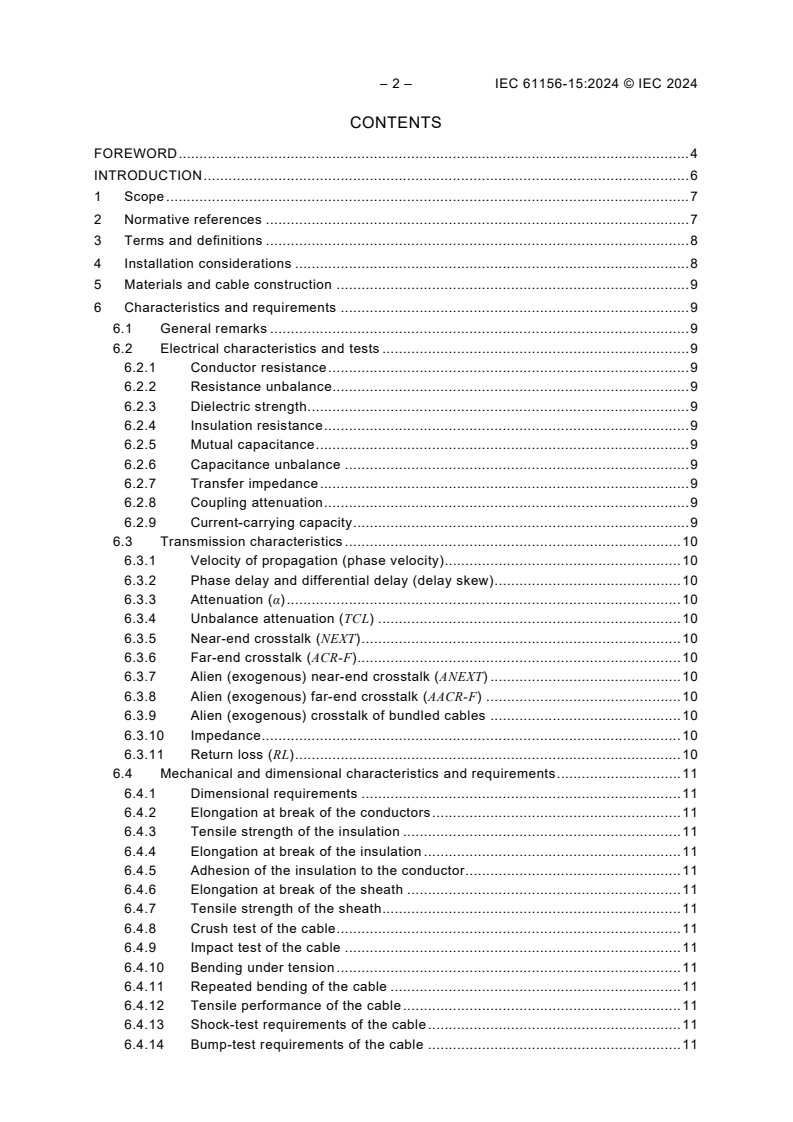
– 2 – IEC 61156-15:2024 © IEC 2024
CONTENTS
FOREWORD . 4
INTRODUCTION . 6
1 Scope . 7
2 Normative references . 7
3 Terms and definitions . 8
4 Installation considerations . 8
5 Materials and cable construction . 9
6 Characteristics and requirements . 9
6.1 General remarks . 9
6.2 Electrical characteristics and tests . 9
6.2.1 Conductor resistance . 9
6.2.2 Resistance unbalance. 9
6.2.3 Dielectric strength . 9
6.2.4 Insulation resistance . 9
6.2.5 Mutual capacitance . 9
6.2.6 Capacitance unbalance . 9
6.2.7 Transfer impedance . 9
6.2.8 Coupling attenuation . 9
6.2.9 Current-carrying capacity . 9
6.3 Transmission characteristics . 10
6.3.1 Velocity of propagation (phase velocity) . 10
6.3.2 Phase delay and differential delay (delay skew) . 10
6.3.3 Attenuation (α) . 10
6.3.4 Unbalance attenuation (TCL) . 10
6.3.5 Near-end crosstalk (NEXT) . 10
6.3.6 Far-end crosstalk (ACR-F) . 10
6.3.7 Alien (exogenous) near-end crosstalk (ANEXT) . 10
6.3.8 Alien (exogenous) far-end crosstalk (AACR-F) . 10
6.3.9 Alien (exogenous) crosstalk of bundled cables . 10
6.3.10 Impedance . 10
6.3.11 Return loss (RL) . 10
6.4 Mechanical and dimensional characteristics and requirements . 11
6.4.1 Dimensional requirements . 11
6.4.2 Elongation at break of the conductors . 11
6.4.3 Tensile strength of the insulation . 11
6.4.4 Elongation at break of the insulation . 11
6.4.5 Adhesion of the insulation to the conductor . 11
6.4.6 Elongation at break of the sheath . 11
6.4.7 Tensile strength of the sheath . 11
6.4.8 Crush test of the cable . 11
6.4.9 Impact test of the cable . 11
6.4.10 Bending under tension . 11
6.4.11 Repeated bending of the cable . 11
6.4.12 Tensile performance of the cable . 11
6.4.13 Shock-test requirements of the cable . 11
6.4.14 Bump-test requirements of the cable . 11
6.4.15 Vibration-test requirements of a cable . 12
6.5 Environmental characteristics . 12
6.5.1 Shrinkage of insulation . 12
6.5.2 Wrapping test of insulation after thermal ageing . 12
6.5.3 Bending test of insulation at low temperature . 12
6.5.4 Elongation at break of the sheath after ageing . 12
6.5.5 Tensile strength of the sheath after ageing . 12
6.5.6 Sheath pressure test at high temperature . 12
6.5.7 Cold bend test of the cable . 12
6.5.8 Heat shock test . 12
6.5.9 Damp heat steady state . 12
6.5.10 Solar radiation (UV test) . 12
6.5.11 Solvents and contaminating fluids . 12
6.5.12 Salt mist and sulphur dioxide . 12
6.5.13 Water immersion . 12
6.5.14 Hygroscopicity . 13
6.5.15 Wicking. 13
6.5.16 Flame propagation characteristics of a single cable . 13
6.5.17 Flame propagation characteristics of bunched cables . 13
6.5.18 Halogen gas evolution . 13
6.5.19 Smoke generation . 13
6.5.20 Toxic gas emission . 13
6.5.21 Integrated fire test . 13
7 Fire resistance/resistance to fire . 13
7.1 Test of sample 1 – Circuit integrity . 13
7.2 Test of sample 2 – Transmission integrity . 14
7.2.1 General remarks . 14
7.2.2 Sample preparation . 14
7.2.3 Checking arrangement . 14
7.2.4 Measurements of the transmission characteristics under fire . 14
7.2.5 Performance requirement . 15
7.2.6 Retest procedure . 16
8 Test report . 16
9 Bundled cables requirements . 16
10 Introduction to the blank detail specification . 16
Annex A (informative) Blank detail specification . 17
Bibliography . 22
Table 1 – parameters . 15
– 4 – IEC 61156-15:2024 © IEC 2024
INTERNATIONAL ELECTROTECHNICAL COMMISSION
____________
MULTICORE AND SYMMETRICAL PAIR/ QUAD CABLES
FOR DIGITAL COMMUNICATIONS –
Part 15: Symmetrical pair/quad cables for horizontal floor wiring with
transmission characteristics up to 1 000 MHz and resistance to fire
performance characteristics – Sectional specification
FOREWORD
1) The International Electrotechnical Commission (IEC) is a worldwide organization for standardization comprising
all national electrotechnical committees (IEC National Committees). The object of IEC is to promote international
co-operation on all questions concerning standardization in the electrical and electronic fields. To this end and
in addition to other activities, IEC publishes International Standards, Technical Specifications, Technical Reports,
Publicly Available Specifications (PAS) and Guides (hereafter referred to as "IEC Publication(s)"). Their
preparation is entrusted to technical committees; any IEC National Committee interested in the subject dealt with
may participate in this preparatory work. International, governmental and non-governmental organizations liaising
with the IEC also participate in this preparation. IEC collaborates closely with the International Organization for
Standardization (ISO) in accordance with conditions determined by agreement between the two organizations.
2) The formal decisions or agreements of IEC on technical matters express, as nearly as possible, an international
consensus of opinion on the relevant subjects since each technical committee has representation from all
interested IEC National Committees.
3) IEC Publications have the form of recommendations for international use and are accepted by IEC National
Committees in that sense. While all reasonable efforts are made to ensure that the technical content of IEC
Publications is accurate, IEC cannot be held responsible for the way in which they are used or for any
misinterpretation by any end user.
4) In order to promote international uniformity, IEC National Committees undertake to apply IEC Publications
transparently to the maximum extent possible in their national and regional publications. Any divergence between
any IEC Publication and the corresponding national or regional publication shall be clearly indicated in the latter.
5) IEC itself does not provide any attestation of conformity. Independent certification bodies provide conformity
assessment services and, in some areas, access to IEC marks of conformity. IEC is not responsible for any
services carried out by independent certification bodies.
6) All users should ensure that they have the latest edition of this publication.
7) No liability shall attach to IEC or its directors, employees, servants or agents including individual experts and
members of its technical committees and IEC National Committees for any personal injury, property damage or
other damage of any nature whatsoever, whether direct or indirect, or for costs (including legal fees) and
expenses arising out of the publication, use of, or reliance upon, this IEC Publication or any other IEC
Publications.
8) Attention is drawn to the Normative references cited in this publication. Use of the referenced publications is
indispensable for the correct application of this publication.
9) IEC draws attention to the possibility that the implementation of this document may involve the use of (a)
patent(s). IEC takes no position concerning the evidence, validity or applicability of any claimed patent rights in
respect thereof. As of the date of publication of this document, IEC had not received notice of (a) patent(s), which
may be required to implement this document. However, implementers are cautioned that this may not represent
the latest information, which may be obtained from the patent database available at https://patents.iec.ch. IEC
shall not be held responsible for identifying any or all such patent rights.
IEC 61156-15 has been prepared by subcommittee 46C: Wires and symmetric cables, of IEC
technical committee 46: Cables, wires, waveguides, RF connectors, RF and microwave passive
components and accessories. It is an International Standard.
The text of this International Standard is based on the following documents:
Draft Report on voting
46C/1272/CDV 46C/1290/RVC
Full information on the voting for its approval can be found in the report on voting indicated in
the above table.
The language used for the development of this International Standard is English.
This document was drafted in accordance with ISO/IEC Directives, Part 2, and developed in
accordance with ISO/IEC Directives, Part 1 and ISO/IEC Directives, IEC Supplement, available
at www.iec.ch/members_experts/refdocs. The main document types developed by IEC are
described in greater detail at www.iec.ch/publications.
A list of all parts in the IEC 61156 series, published under the general title Multicore and
symmetrical pair/quad cables for digital communications, can be found on the IEC website.
The committee has decided that the contents of this document will remain unchanged until the
stability date indicated on the IEC website under webstore.iec.ch in the data related to the
specific document. At this date, the document will be
• reconfirmed,
• withdrawn, or
• revised.
– 6 – IEC 61156-15:2024 © IEC 2024
INTRODUCTION
The demand for applications using cables maintaining power and data transmission under fire
attack is rising. Current installation standards address mainly the "short circuit" protection issue,
and some electrical parameters. Data transmission information is limited and further important
parameters are not addressed.
For the evaluation of the circuit integrity (both short circuit protection and maintaining data
transmission capability), two different samples and two different tests should be performed. The
cable should pass the test as per IEC 60331-23:1999 and only then be evaluated to its data
transmission integrity under flame attack as per IEC 60331-23:1999 by the definitions and
instructions stated in this document.
Compliance with this document is not an indication that the cable will suite all types of
applications or attack by any fire scenario. It only ensures that the circuit integrity, as defined,
is maintained using the test procedures and flame application described.
MULTICORE AND SYMMETRICAL PAIR/ QUAD CABLES
FOR DIGITAL COMMUNICATIONS –
Part 15: Symmetrical pair/quad cables for horizontal floor wiring with
transmission characteristics up to 1 000 MHz and resistance to fire
performance characteristics – Sectional specification
1 Scope
This part of IEC 61156 refers to cables as described in IEC 61156-5:2020 or cables containing
element(s) from cables as described in IEC 61156-5 which are required to maintain both circuit
integrity and data transmission capability before, during and after flame application under
specified conditions.
In addition to the basic cable construction, it describes the means of sample preparation,
checking arrangements and gives the performance requirements, means to evaluate the data
transmission capability during and after subjecting to fire, and gives means for evaluating test
results and the parameters that are specified in the detail specification.
The cables covered by this document are intended to operate with voltages and currents
normally encountered in communication systems. While these cables are not intended to be
used in conjunction with low impedance sources, for example the electric power supplies of
public utility mains, they are intended to be used to support the delivery of low voltage remote
powering applications and have no rated voltage and are used for extra low voltage circuits.
For the purpose of this document, fire conditions as currently listed in IEC 60331-23:1999 and
basic test apparatus as per IEC 60331-11:1999 apply.
As the test method according to IEC 60331-23:1999 will not be developed further, other test
methods could be used or added in future editions of this document.
IEC 60331-1 and IEC 60331-2 will be added in a future revision as the standard tests for circuit
integrity and the test rig to be used for all testing.
2 Normative references
The following documents are referred to in the text in such a way that some or all of their content
constitutes requirements of this document. For dated references, only the edition cited applies.
For undated references, the latest edition of the referenced document (including any
amendments) applies.
IEC 60331-11:1999, Tests for electric cables under fire conditions – Circuit integrity – Part 11:
Apparatus – Fire alone at a flame temperature of at least 750 °C
IEC 60331-23:1999, Tests for electric cables under fire conditions – Circuit integrity – Part 23:
Procedures and requirements – Electric data cables
IEC 61156 (all parts), Multicore and symmetrical pair/quad cables for digital communications
IEC 61156-1:2023, Multicore and symmetrical pair/quad cables for digital communications –
Part 1: Generic specification
– 8 – IEC 61156-15:2024 © IEC 2024
IEC 61156-5:2020, Multicore and symmetrical pair/quad cables for digital communications –
Part 5: Symmetrical pair/quad cables with transmission characteristics up to 1 000 MHz –
Horizontal floor wiring – Sectional specification
ISO/IEC 11801-1:2017, Information technology − Generic cabling for customer premises –
Part 1: General requirements
3 Terms and definitions
For the purposes of this document, the terms and definitions given in IEC 61156-5 and the
following apply.
ISO and IEC maintain terminology databases for use in standardization at the following
addresses:
• IEC Electropedia: available at https://www.electropedia.org/
• ISO Online browsing platform: available at https://www.iso.org/obp
3.1
sample 1
sample one
finished cable used to achieve the circuit integrity test as per IEC 60331-23:1999
3.2
sample 2
sample two
finished cable, used for the transmission characteristic test during and after flame application
3.3
resistance to fire
fire resistance
ability to continue to operate in the designated manner, both in terms of circuit integrity and
transmission integrity, whilst subjected to a specified flame source for a specified period of time
under specified conditions
3.4
circuit integrity
ability to continue to operate without short circuit between elements or wire breaks whilst
subjected to a specified flame source for a specified period of time
Note 1 to entry: There shall be no short circuits during and after the flame attack.
3.5
transmission integrity
ability to maintain a level of data transmission capability according to the transmission
characteristics defined in the IEC 61156
...