

IEC TR 61831:2011
(Main)On-line analyser systems - Guide to design and installation
General Information
- Abstract
IEC 61831:2011(E) is a guide applicable to on-line analyser systems. It provides the necessary guidance for the system supplier and user to specify or design a complete analyser system from sample point in the process to the final output for display or control purposes. This second edition cancels and replaces the first edition published in 1999. This edition constitutes a technical revision. The main changes with respect to the previous edition are:
- Updated references;
- Made consistent with current practices and regulations;
- Incorporating new technologies where applicable.
- Status
- Published
- Publication Date
- 18-Aug-2011
- Technical Committee
- SC 65B - Measurement and control devices
- Drafting Committee
- WG 14 - TC 65/SC 65B/WG 14
- Current Stage
- PPUB - Publication issued
- Start Date
- 19-Aug-2011
- Completion Date
- 31-Oct-2011
Overview
IEC TR 61831:2011 - On-line analyser systems - Guide to design and installation is an IEC Technical Report that provides guidance for specifying, designing and installing complete on-line analyser systems from the process sample point to the final output for display or control. This second edition (2011) updates references, aligns the document with current practices and regulations, and incorporates new technologies where applicable. It is intended as a practical guide for both system suppliers and users.
Key topics and technical requirements
The report covers the full analyser-system lifecycle and includes technical guidance on:
- Sampling systems and probes - sample point location, fast circulating (fast loop) and by‑pass systems, multi‑stream sampling, probe design and material selection.
- Housings and enclosures - analyser cases, cabinets, shelters and houses; construction, mounting and ventilation options (natural and forced).
- Ventilation and environmental control - ventilation sizing, intake and fan requirements, heating, ventilation failure logic and safety trip recommendations.
- Health, safety and environmental considerations - explosion/fire prevention, toxic/asphyxiant and radiation hazards, manual shutdown and safety facilities.
- Communications and signal handling - signal transmission, cabling, alarms, safety considerations and use of analyser outputs for control.
- Calibration and verification - calibration facilities and automatic calibration, plus example verification/calibration sequences.
- Reliability, design and centralization considerations - guidance on system architecture and maintenance access.
- Supporting calculations and schematics - annexes provide sample system calculations, natural and forced ventilation calculations, sample probe design examples, and typical system schematics.
Practical applications and users
IEC TR 61831:2011 is directly applicable to organizations involved with process analysers in industries such as oil & gas, petrochemical, chemical manufacturing, power generation and water/wastewater treatment. Typical users include:
- Process engineers and instrumentation specialists specifying analyser systems
- OEMs and system integrators designing analyser skids and shelters
- Maintenance and reliability engineers planning sampling and calibration strategies
- Safety and HSE personnel assessing risks associated with analyser installations
Why use this guide
- Ensures consistent, safe installation practices from sample point to control output
- Helps reduce measurement errors due to poor sampling, enclosure or ventilation design
- Provides practical examples, calculations and verification workflows to support commissioning and routine operation
Related standards
IEC TR 61831 is complementary to other IEC/ISO standards and industry guidance on electrical area classification, explosion protection, process instrumentation and industrial communications. Users should apply relevant national and industry regulations when implementing recommendations from this TR.
Relations
- Effective Date
- 05-Sep-2023
Get Certified
Connect with accredited certification bodies for this standard

BSMI (Bureau of Standards, Metrology and Inspection)
Taiwan's standards and inspection authority.
CIS Institut d.o.o.
Personal Protective Equipment (PPE) certification body. Notified Body NB-2890 for EU Regulation 2016/425 PPE.

Kiwa BDA Testing
Building and construction product certification.
Sponsored listings
Frequently Asked Questions
IEC TR 61831:2011 is a technical report published by the International Electrotechnical Commission (IEC). Its full title is "On-line analyser systems - Guide to design and installation". This standard covers: IEC 61831:2011(E) is a guide applicable to on-line analyser systems. It provides the necessary guidance for the system supplier and user to specify or design a complete analyser system from sample point in the process to the final output for display or control purposes. This second edition cancels and replaces the first edition published in 1999. This edition constitutes a technical revision. The main changes with respect to the previous edition are: - Updated references; - Made consistent with current practices and regulations; - Incorporating new technologies where applicable.
IEC 61831:2011(E) is a guide applicable to on-line analyser systems. It provides the necessary guidance for the system supplier and user to specify or design a complete analyser system from sample point in the process to the final output for display or control purposes. This second edition cancels and replaces the first edition published in 1999. This edition constitutes a technical revision. The main changes with respect to the previous edition are: - Updated references; - Made consistent with current practices and regulations; - Incorporating new technologies where applicable.
IEC TR 61831:2011 is classified under the following ICS (International Classification for Standards) categories: 13.040 - Air quality; 13.060 - Water quality; 17.020 - Metrology and measurement in general. The ICS classification helps identify the subject area and facilitates finding related standards.
IEC TR 61831:2011 has the following relationships with other standards: It is inter standard links to IEC TR 61831:1999. Understanding these relationships helps ensure you are using the most current and applicable version of the standard.
IEC TR 61831:2011 is available in PDF format for immediate download after purchase. The document can be added to your cart and obtained through the secure checkout process. Digital delivery ensures instant access to the complete standard document.
Standards Content (Sample)
IEC/TR 61831 ®
Edition 2.0 2011-08
TECHNICAL
REPORT
On-line analyser systems – Guide to design and installation
IEC/TR 61831:2011(E)
All rights reserved. Unless otherwise specified, no part of this publication may be reproduced or utilized in any form or by
any means, electronic or mechanical, including photocopying and microfilm, without permission in writing from either IEC or
IEC's member National Committee in the country of the requester.
If you have any questions about IEC copyright or have an enquiry about obtaining additional rights to this publication,
please contact the address below or your local IEC member National Committee for further information.
Droits de reproduction réservés. Sauf indication contraire, aucune partie de cette publication ne peut être reproduite
ni utilisée sous quelque forme que ce soit et par aucun procédé, électronique ou mécanique, y compris la photocopie
et les microfilms, sans l'accord écrit de la CEI ou du Comité national de la CEI du pays du demandeur.
Si vous avez des questions sur le copyright de la CEI ou si vous désirez obtenir des droits supplémentaires sur cette
publication, utilisez les coordonnées ci-après ou contactez le Comité national de la CEI de votre pays de résidence.
IEC Central Office
3, rue de Varembé
CH-1211 Geneva 20
Switzerland
Email: inmail@iec.ch
Web: www.iec.ch
About IEC publications
The technical content of IEC publications is kept under constant review by the IEC. Please make sure that you have the
latest edition, a corrigenda or an amendment might have been published.
Catalogue of IEC publications: www.iec.ch/searchpub
The IEC on-line Catalogue enables you to search by a variety of criteria (reference number, text, technical committee,…).
It also gives information on projects, withdrawn and replaced publications.
IEC Just Published: www.iec.ch/online_news/justpub
Stay up to date on all new IEC publications. Just Published details twice a month all new publications released. Available
on-line and also by email.
Electropedia: www.electropedia.org
The world's leading online dictionary of electronic and electrical terms containing more than 20 000 terms and definitions
in English and French, with equivalent terms in additional languages. Also known as the International Electrotechnical
Vocabulary online.
Customer Service Centre: www.iec.ch/webstore/custserv
If you wish to give us your feedback on this publication or need further assistance, please visit the Customer Service
Centre FAQ or contact us:
Email: csc@iec.ch
Tel.: +41 22 919 02 11
Fax: +41 22 919 03 00
IEC/TR 61831 ®
Edition 2.0 2011-08
TECHNICAL
REPORT
On-line analyser systems – Guide to design and installation
INTERNATIONAL
ELECTROTECHNICAL
COMMISSION
PRICE CODE
XB
ICS 13.040; 13.060; 17.020 ISBN 978-2-88912-633-0
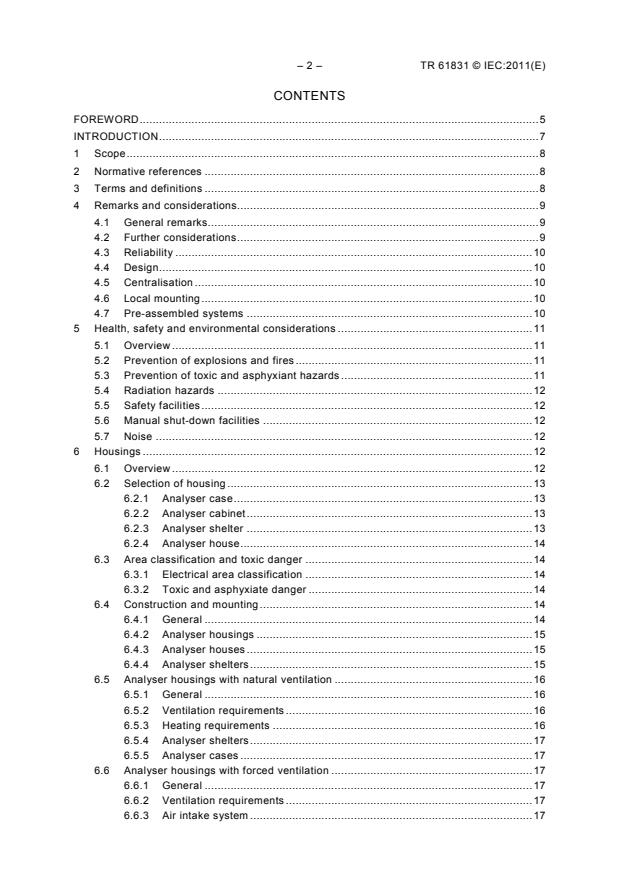
– 2 – TR 61831 © IEC:2011(E)
CONTENTS
FOREWORD . 5
INTRODUCTION . 7
1 Scope . 8
2 Normative references . 8
3 Terms and definitions . 8
4 Remarks and considerations. 9
4.1 General remarks. 9
4.2 Further considerations . 9
4.3 Reliability . 10
4.4 Design . 10
4.5 Centralisation . 10
4.6 Local mounting . 10
4.7 Pre-assembled systems . 10
5 Health, safety and environmental considerations . 11
5.1 Overview . 11
5.2 Prevention of explosions and fires . 11
5.3 Prevention of toxic and asphyxiant hazards . 11
5.4 Radiation hazards . 12
5.5 Safety facilities . 12
5.6 Manual shut-down facilities . 12
5.7 Noise . 12
6 Housings . 12
6.1 Overview . 12
6.2 Selection of housing . 13
6.2.1 Analyser case . 13
6.2.2 Analyser cabinet . 13
6.2.3 Analyser shelter . 13
6.2.4 Analyser house . 14
6.3 Area classification and toxic danger . 14
6.3.1 Electrical area classification . 14
6.3.2 Toxic and asphyxiate danger . 14
6.4 Construction and mounting . 14
6.4.1 General . 14
6.4.2 Analyser housings . 15
6.4.3 Analyser houses . 15
6.4.4 Analyser shelters . 15
6.5 Analyser housings with natural ventilation . 16
6.5.1 General . 16
6.5.2 Ventilation requirements . 16
6.5.3 Heating requirements . 16
6.5.4 Analyser shelters . 17
6.5.5 Analyser cases . 17
6.6 Analyser housings with forced ventilation . 17
6.6.1 General . 17
6.6.2 Ventilation requirements . 17
6.6.3 Air intake system . 17
TR 61831 © IEC:2011(E) – 3 –
6.6.4 Ventilation fan requirements . 17
6.6.5 Airflow requirements . 18
6.6.6 Heating requirements . 18
6.6.7 Safety monitors and alarms . 18
7 Sampling systems . 21
7.1 Overview . 21
7.2 Sample system terminology . 22
7.3 General requirements . 22
7.4 Sample point location . 23
7.5 Fast circulating systems (fast loops) . 24
7.6 By-pass systems . 24
7.7 Sample recovery systems . 24
7.8 Special considerations . 25
7.9 Multi-stream systems . 25
7.10 Construction . 26
7.10.1 General . 26
7.10.2 Material selection . 26
7.10.3 Flushing facilities . 27
7.10.4 Blockage removal . 27
7.10.5 Heat tracing and insulation . 27
7.10.6 Minimising risks from leakage . 28
7.10.7 Location of equipment . 28
7.10.8 Instrumentation. 28
7.10.9 Identification . 28
7.11 Effluent disposal . 29
7.11.1 General . 29
7.11.2 Vapour . 29
7.11.3 Liquid . 29
7.12 Calibration facilities . 30
7.13 Automatic calibration . 30
8 Analyser communications . 31
8.1 Overview . 31
8.2 Signal transmission . 31
8.3 Safety . 32
8.4 Cables . 33
8.5 Use of signal . 33
8.6 Alarms . 33
Annex A (informative) Typical analyser process line sampling probe for line sizes NPS
2" and above . 34
Annex B (informative) Determination of sample probe lengths . 35
Annex C (informative) Sample system calculations . 43
Annex D (informative) Natural ventilation calculations . 56
Annex E (informative) Forced ventilation calculations . 62
Annex F (informative) Example of verification/calibration sequence of data to
computer . 63
Annex G (informative) Analyser house with forced ventilation – Summary of
recommended control shut-down actions for flammable hazard operation . 64
– 4 – TR 61831 © IEC:2011(E)
Annex H (informative) Analyser houses with forced ventilation – Ventilation failure and
flammable gas detection trip logic . 65
Annex I (informative) Typical analyser system schematics . 67
Annex J (informative) Example schematic showing a typical wall penetration using a
transit . 69
Bibliography . 70
Figure A.1 – Typical analyser sample probe design . 34
Figure C.1 – Sample system configuration . 49
Figure D.1 – Schematic showing wind induced free ventilation principles with worked
example ventilation louvre layout and suggested warm air distribution . 56
Figure F.1 – Typical signal sequence during verification . 63
Figure H.1 – Typical analyser shelter logic diagram . 66
Figure I.1 – Multi-stream sampling for processes of similar pressure and components
(e.g. atmospheric sampling) . 67
Figure I.2 – Multi-stream sampling for processes of differing pressure and/or
components showing typical double block and bleed arrangement . 67
Figure I.3 – Minimum pollution sampling configuration . 68
Figure I.4 – Typical double block and bleed arrangement . 68
Figure J.1 – Typical wall penetration using a transit . 69
Table B.1 – Vibrational Mode Constants . 36
Table B.2 – Example calculations for maximum fluid velocity . 40
Table C.1 – Nomenclature Used In Calculations . 43
Table C.2 – Equivalent lengths of valves and fittings . 46
Table C.3 – Sample system component pressure drop allowances . 48
Table G.1 – Shelter safety cause and effect matrix . 64
TR 61831 © IEC:2011(E) – 5 –
INTERNATIONAL ELECTROTECHNICAL COMMISSION
____________
ON-LINE ANALYSER SYSTEMS –
GUIDE TO DESIGN AND INSTALLATION
FOREWORD
1) The International Electrotechnical Commission (IEC) is a worldwide organization for standardization comprising
all national electrotechnical committees (IEC National Committees). The object of IEC is to promote
international co-operation on all questions concerning standardization in the electrical and electronic fields. To
this end and in addition to other activities, IEC publishes International Standards, Technical Specifications,
Technical Reports, Publicly Available Specifications (PAS) and Guides (hereafter referred to as “IEC
Publication(s)”). Their preparation is entrusted to technical committees; any IEC National Committee interested
in the subject dealt with may participate in this preparatory work. International, governmental and non-
governmental organizations liaising with the IEC also participate in this preparation. IEC collaborates closely
with the International Organization for Standardization (ISO) in accordance with conditions determined by
agreement between the two organizations.
2) The formal decisions or agreements of IEC on technical matters express, as nearly as possible, an international
consensus of opinion on the relevant subjects since each technical committee has representation from all
interested IEC National Committees.
3) IEC Publications have the form of recommendations for international use and are accepted by IEC National
Committees in that sense. While all reasonable efforts are made to ensure that the technical content of IEC
Publications is accurate, IEC cannot be held responsible for the way in which they are used or for any
misinterpretation by any end user.
4) In order to promote international uniformity, IEC National Committees undertake to apply IEC Publications
transparently to the maximum extent possible in their national and regional publications. Any divergence
between any IEC Publication and the corresponding national or regional publication shall be clearly indicated in
the latter.
5) IEC itself does not provide any attestation of conformity. Independent certification bodies provide conformity
assessment services and, in some areas, access to IEC marks of conformity. IEC is not responsible for any
services carried out by independent certification bodies.
6) All users should ensure that they have the latest edition of this publication.
7) No liability shall attach to IEC or its directors, employees, servants or agents including individual experts and
members of its technical committees and IEC National Committees for any personal injury, property damage or
other damage of any nature whatsoever, whether direct or indirect, or for costs (including legal fees) and
expenses arising out of the publication, use of, or reliance upon, this IEC Publication or any other IEC
Publications.
8) Attention is drawn to the Normative references cited in this publication. Use of the referenced publications is
indispensable for the correct application of this publication.
9) Attention is drawn to the possibility that some of the elements of this IEC Publication may be the subject of
patent rights. IEC shall not be held responsible for identifying any or all such patent rights.
The main task of IEC technical committees is to prepare International Standards. However, a
technical committee may propose the publication of a technical report when it has collected
data of a different kind from that which is normally published as an International Standard, for
example "state of the art".
IEC 61831, which is a technical report, has been prepared by subcommittee 65B: Devices and
integration in enterprise systems, of IEC technical committee 65: Industrial-process
measurement, control and automation.
With the kind permission of the Engineering Equipment and Materials Users Association this
report is based on and includes extracts from EEMUA Publication 138.
This second edition cancels and replaces the first edition published in 1999. This edition
constitutes a technical revision.
The main changes with respect to the previous edition are listed below.
• Updated references;
– 6 – TR 61831 © IEC:2011(E)
• Made consistent with current practices and regulations;
• Incorporating new technologies where applicable.
The text of this technical report is based on the following documents:
Enquiry draft Report on voting
65B/744/DTR 65B/793/RVC
Full information on the voting for the approval of this technical report can be found in the
report on voting indicated in the above table.
This publication has been drafted in accordance with the ISO/IEC Directives, Part 2.
The committee has decided that the contents of this publication will remain unchanged until
the stability date indicated on the IEC web site under "http://webstore.iec.ch" in the data
related to the specific publication. At this date, the publication will be
• reconfirmed,
• withdrawn,
• replaced by a revised edition, or
• amended.
TR 61831 © IEC:2011(E) – 7 –
INTRODUCTION
This Technical Report provides guidance on the design and installation of on-line analyser
systems. There are many International standards and documents which are referenced below
relating to specific parts of the design and safety of on-line analyser systems. However, there
is limited practical guidance available on the overall design concepts, approaches, tools and
methodology for the design and installation of on-line analyser systems to ensure they
perform with the required reliability and precision which this publication addresses.
The document is divided into eight clauses
1. General
2. Normative references
3. Terms and definitions
4. Remarks and considerations
5. Health, safety and environmental considerations
6. Housings
7. Sampling systems
8. Analyser communications
Individual users of on-line analysers have varying practices but the fundamental approach is
generally similar. It is therefore hoped that this document will encourage standardisation
within industry and lead to reduction in design and construction costs and to improved safety.
The word "analyser" has been used throughout this document to refer to instruments variously
known as on-line analysers, process stream analysers, quality analysers, quality measuring
instruments and process quality monitors.
Where reference is made to International standards it should be noted that National
authorities may have statutory requirements that are mandatory.
– 8 – TR 61831 © IEC:2011(E)
ON-LINE ANALYSER SYSTEMS –
GUIDE TO DESIGN AND INSTALLATION
1 Scope
This technical report is a guide applicable to on-line analyser systems. It provides the
necessary guidance for the system supplier and user to specify or design a complete analyser
system from sample point in the process to the final output for display or control purposes.
2 Normative references
IEC 61285:2004, Industrial-process control – Safety of analyzer houses
ISO/IEC 8802-3:2000, Information technology – Telecommunications and information
exchange between systems – Local and metropolitan area networks – Specific requirements –
Part 3: Carrier sense multiple access with collision detection (CSMA/CD) access method and
physical layer specifications
BS 5925:1991, Code of practice for ventilation principles and designing for natural ventilation
API (ANSI/ASTM D4177), Manual of Petroleum Measurement Standards – Part 8: Chapter 8.2
Automatic Sampling of Petroleum Products ()
EEMUA 175, Code of Practice for Calibration and Checking Process Analysers (Formerly IP
340)
3 Terms and definitions
For the purposes of this document, the following terms and definitions apply.
3.1
analyser housing
general term including any of the following terms:
3.2
analyser case
enclosure forming part of the instrument
3.3
analyser cabinet
small simple housing in which analysers are installed singly or grouped together. Maintenance
is carried out from outside the cabinet
3.4
analyser shelter
structure with one or more sides open and free from obstruction to the natural passage of air,
in which are installed one or more analysers. The maintenance of the analyser is normally
carried out from within the shelter
TR 61831 © IEC:2011(E) – 9 –
3.5
analyser house
enclosed structure in which are installed one or more analysers. Either natural or forced
ventilation is used. The maintenance of the analyser is always carried out from within the
house
4 Remarks and considerations
4.1 General remarks
The petrochemical, chemical, pharmaceutical and food industries need to be able to control
their processes to ensure safety and environmental compliance and to optimise operations for
maximum profitability. The use of on-line process analysers is a valuable tool in helping to
achieve these objectives. This is because analysers provide frequent (continuous or cyclic)
analytical information on key process properties to allow continuous on-line optimisation of
the plant and rapid identification and correction of off-spec or undesirable operating
conditions. Analyser repeatability is also usually better than a laboratory reference method
which allows closer control and targeting to product specification.
However, the correct design and installation of on-line analysers which are addressed in this
publication are essential to achieve the full benefits from the analyser systems. Analysers are
expensive to install and maintain and should only be installed when there is a clearly defined
and quantified benefit. On-line process analysers are usually justified for one or more of the
following reasons:
a) Personnel and plant safety
b) Pollution measurement, prevention and control
c) Optimising plant operations for yield and throughput
d) Control of final products as closely as possible to maintain specification and minimise
product quality give-away
e) Minimising product degradation and reprocessing costs in cases of plant upsets, change in
mode of operation and start-ups
f) Improving energy efficiency of boilers, furnaces, distillation columns and reactors
g) Corrosion control
4.2 Further considerations
The following considerations are also important in the application of on-line analyser systems:
a) Analysers and associated sampling systems are often complex installations demanding
attention from specialist personnel responsible for their maintenance. Therefore, it is
essential that the end user has the appropriate, correctly trained manpower resources and
spare parts available to ensure the analysers operate at the required level of performance
to capture the anticipated benefits
b) The justification for analysers is not usually based on the reduction in the cost of
laboratory testing as this saving is often offset by the associated increase in analyser
maintenance costs. To promote the effective use of analysers by operators it is often
beneficial to discontinue the duplication of analyses by laboratory testing. Laboratory
facilities are still required for validating and calibrating the on-line analyser systems and
for any statutory requirements
c) Single stream analysers are preferred and are usually essential for continuous automatic
control
d) On-line analysers usually require environmental protection in the form of housings to
ensure reliable operation
– 10 – TR 61831 © IEC:2011(E)
4.3 Reliability
The following points are important considerations in the design and installation of analyser
systems:
a) Correct location and orientation of sample point
b) Proper design of the sample transport and sample conditioning systems
c) Availability of reliable and clean utilities
d) Environmental protection against heat/cold, humidity, solar radiation, rain, dust and
corrosion
e) Ease of accessibility for maintenance of all the analyser system components
f) Proper design of validation and calibration facilities
g) Adequate preventive maintenance
4.4 Design
The design should permit maintenance, adjustments and repairs to be carried out quickly and
preferably whilst the analyser is in operation. Components likely to require attention should be
accessible without the aid of portable ladders or other temporary means and shall have
mountings/fixings located such they are also accessible from the front. The overall design
should eliminate or keep to a minimum the emission of hazardous or noxious gases and
vapours and the possibility of liquid spillage.
4.5 Centralisation
The grouping together of a number of analysers where practical in a shared analyser house or
shelter has a number of advantages:
a) Single housing
b) Common multi-core signal cables to control system
c) Common location for power, water, steam and compressed air supplies. Common drain,
vent and purge lines
d) More efficient for maintenance
e) Common heating, ventilation and air conditioning (HVAC) systems
4.6 Local mounting
There are, however, cases where local mounting is desirable for the following reasons:
a) When the cost of centralisation would be disproportionate to the expected benefit
b) When centralisation would result in excessive sample transport time lags
c) When sample handling problems are to be expected e.g. waxy samples, trace components
4.7 Pre-assembled systems
Pre-assembled analyser systems supplied by specialist analyser systems contractors or the
analyser vendors are generally the most convenient and economical approach to install new
analyser systems in the plant. They may include one or more analysers with their associated
sample conditioning system and common utility connections mounted together in the
appropriate housing(s). There are many advantages to this approach:
a) Systems designed and factory constructed by a specialist supplier are generally superior
to those produced in the field by a contractor on site
b) Detailed design and field construction by site contractor are reduced
c) Factory construction is independent of weather and labour conditions at site
d) Manpower at site is not usually skilled and experienced in this type of work
TR 61831 © IEC:2011(E) – 11 –
e) Systems can be fully tested under simulated operating conditions and major design,
equipment and construction faults corrected before delivery to site
f) Proven designs can be used with consequent savings in costs and improved reliability
g) All relevant documentation can be incorporated into a single design and operating manual
by the specialist supplier
5 Health, safety and environmental considerations
5.1 Overview
Analyser systems shall be designed, installed and operated in such a manner that they are
non-hazardous to personnel, to the process plant and to the environment.
The principle hazards are ignition of flammable substances, contact with toxic substances,
asphyxiation in enclosed spaces and release of harmful or polluting materials to the
environment. It is also important that personnel coming into contact with analyser systems do
not suffer injury from additional hazards such as burns, electric shock and cuts from exposed
sharp edges.
A number of statutory requirements pertaining to safe design and practices are in force in
many countries e.g. the ATEX and PED Directives in Europe. There are also specific
standards relating to the safety of analyser systems e.g, IEC 61825. (See Clause 2 for
normative references and bibliography for other references.).
5.2 Prevention of explosions and fires
The same conditions apply to the installation of analysers as with installation of any other
electrical equipment in electrically classified hazardous areas and the appropriate relevant
legal regulations and standards should be followed for the country in which the equipment is
being installed.
The extent to which the measures need to be applied can be minimised by restricting the
likely size of an internal release in the housing by:
a) Minimising and restricting the quantity of potentially dangerous materials entering the
housing
b) Reducing the number of joints in sample lines
c) Using the lowest possible operating pressures
d) Reducing the power dissipation of the electrical equipment installed within the main
enclosure of the equipment
e) Ensuring that the design does not produce surface temperatures above the ignition
temperature of the gases or vapours that may be present
5.3 Prevention of toxic and asphyxiant hazards
When a system is designed, the toxicity of the substances should be considered so that under
the worst fault conditions, the legal short-term exposure limits of the substances in the
atmosphere are not exceeded. The design shall also ensure that, under the worst fault
conditions, the atmosphere inside enclosed spaces which personnel may also enter, cannot
reach asphyxiating levels. It should be noted that many substances will reach the short-term
exposure limit or asphyxiant levels long before the lower flammable limit value.
Analysers handling toxic substances may need to be separately housed and clearly identified.
Sampling systems containing toxic or otherwise dangerous substances should be purged with
air or an inert material prior to disassembly. Warning signs shall be provided to alert
personnel to possible toxic and asphyxiate hazards.
– 12 – TR 61831 © IEC:2011(E)
Certain analysers contain toxic components and care is needed during maintenance e.g.
reagents in wet chemical analysers and certain materials of construction. Toxic calibration
samples shall be stored and piped from outside analyser housings.
5.4 Radiation hazards
Apparatus and enclosures containing radioactive sources shall be clearly identified and
handled in accordance with the relevant statutory regulations.
5.5 Safety facilities
Gas monitoring and alarm systems for flammable, toxic and asphyxiant substances should be
installed in enclosed analyser houses and cabinets as necessary. Fire extinguishers and/or
fire blankets should be made readily available at housings containing flammable substances.
Fire detection and automatic suppression equipment may also be appropriate. Escape
facilities should also be provided as necessary.
Housings containing toxic, acid or alkaline materials should have eye baths and showers in a
readily accessible nearby location.
5.6 Manual shut-down facilities
Manual shut-down devices for the incoming power, sample, carrier gas and other potentially
hazardous utilities should be fitted close to the analysers. In the case of analyser cabinets,
shelters or houses, these devices should be clearly identified and located outside the
housing.
A separate shut-down device should be fitted for any associated house ventilation fans.
5.7 Noise
Attention should be paid to noise levels within analyser housings to ensure maximum short
term and long term noise exposure limits are not exceeded. The most likely sources of noise
are from heating air conditioning and ventilation systems, water chiller units, air vortex
coolers, purge systems, pneumatic valve switching and sample pumps.
6 Housings
6.1 Overview
Analysers and analyser sampling systems require varying degrees of protection, depending
on the type of analyser, importance of application and the environment in which it has to
operate. Where the instrument case itself is not suitable for the working environment,
additional protection should be provided. This additional protection is to ensure satisfactory
performance of the instrument and to facilitate maintenance.
The selection of the housing required for a particular analyser system depends on a number
of factors, such as:
a) Hazardous area classification of the area in which the analyser is to be located
b) Special requirements specified by the relevant safety authority, vendor or user
c) Range of ambient conditions at site (e.g. temperature, rain, humidity, snow, wind, dust/
sand, direct sunlight, corrosive atmosphere)
d) Environment specified by the analyser vendor for reliable, accurate and/or safe operation
e) Protection required for equipment and personnel during maintenance operations
f) Maintenance and accessibility requirements of the system components
TR 61831 © IEC:2011(E) – 13 –
g) The initial installed cost
This section primarily describes analyser housings located in hazardous areas and/or into
which hazardous samples are introduced. Analyser housings located in a non-hazardous area
and into which no flammable, asphyxiate or toxic samples, services, calibration mixtures, or
air from a hazardous area is introduced are only required to provide the necessary
environment for accurate and reliable operation without any special conditions for ventilation.
Four types of housing, as defined in Clause 3 are considered:
a) Analyser case
b) Analyser cabinet
c) Analyser shelter
d) Analyser house
6.2 Selection of housing
6.2.1 Analyser case
Analysers such as pH meters, electrolytic conductivity meters etc. may be installed directly in
the open (enclosed only in the case) provided they comply with the specification of hazardous
area classification and environment.
The advantages of this method are that the area around the case is naturally ventilated so
there is no risk of accumulating an explosive atmosphere outside the casing. This is the
lowest cost method of installation. The disadvantages are that there is no weather protection
for equipment or maintenance personnel. Equipment shall be carefully specified to minimize
corrosion attack and it may not have as long an operational life as equipment which is
installed in a cabinet, shelter or house. This method of housing is not suitable when analysers
require heating or extensive maintenance.
6.2.2 Analyser cabinet
Analysers can be installed singly or grouped in cabinets provided that the equipment is
installed in accordance with the hazardous area classification. Analyser cabinets provide a
low cost means of improving environmental protection for analysers and can help make the
equipment more easily accessible for maintenance.
The analyser manufacturers environmental specifications can be met by e.g. including heater
in the cabinet if required. Ventilation where necessary is normally achieved by natural means.
The advantage of a naturally ventilated method is that ventilation is permanent and
independent of mechanical failure.
However, natural ventilation does not change the hazardous area classification inside the
cabinet and where a non-certified analyser with cabinet is to be installed in a hazardous area
a certified air purge system will be required. The disadvantages of cabinets are that there is a
practical limit on the size of analyser installed and no protection is provided for maintenance
personnel.
6.2.3 Analyser shelter
This construction can be used when the analysers comply with the hazardous area
classification of the location and the ambient environmental conditions comply with the
analyser manufacturers specification. A shelter may be conveniently used for equipment
requiring minimal protection.
A shelter is advantageous where highly toxic materials are handled. The advantages are that
it facilitates the grouping of analysers and affords some protection for maintenance personnel,
as well as affording permanent natural ventilation. Its disadvantage is that it does not give the
– 14 – TR 61831 © IEC:2011(E)
facility to change the hazardous area classification and affords only minimum environmental
protection.
6.2.4 Analyser house
The analyser house is the highest cost installation but is usually justified for analysers, which
require a high degree of protection, which are expected to require regular attention and from
which a high service factor is required. These analysers may be installed in an analyser
house which affords a controlled environment for operations and maintenance, and should
reduce long term maintenance costs.
This type of protection is essential where extreme ambient conditions are encountered. The
two alternatives for the ventilation system are either the natural ventilation system or the
forced ventilation system.
The natural ventilation system provides limited control of the environment and the area
classification within the house will always be the same as the surrounding atmosphere.
The advantages are a simpler and cheaper installation, since natural ventilation is permanent
and independent of mechanical failure. The forced ventilation system can closely control the
environment within the structure and the area classification within the house can be chosen
depending on the source of the ventilation air. An advantage is that uncertified equipment can
be used in the house provided ventilation air is drawn from a safe area and safety interlocks
are included to isolate the equipment when the ventilation system is not operating.
6.3 Area classification and toxic danger
6.3.1 Electrical area classification
The area within the above house, shelter or cabinet should be classified in accordance with
the appropriate local regulations. These documents will lay down the type of equipment which
is necessary and the precautions which must be taken to achieve the required level of safety
within the housings. All equipment used in these housings should be suitable for use in
accordance with the area classification.
6.3.2 Toxic and asphyxiate danger
Ventilation requirements for an analyser housing into which toxic materials are introduced
should ensure that the relevant occupational exposure limit for those materials is not
exceeded under normal or any likely fault condition. Entry into a housing where toxic
materials can be present above the occupational exposure limit should be prohibited without
supervision and appropriate means of detection and protection. A warning sign of the possible
presence of a highly toxic gas within the housing should be given on doors or case.
Ventilation requirements for an analyser housing into which asphyxiate materials are
introduced should ensure that dangerous asphyxiate levels are not exceeded under normal or
any likely fault condition. A warning sign of the possible presence of an asphyxiate gas within
the housing should be given on doors or case.
6.4 Construction and mounting
6.4.1 General
The preference for the type of construction within the options below should be specified by
the user.
TR 61831 © IEC:2011(E) – 15 –
6.4.2 Analyser housings
The following guidelines are applicable to all types of analyser housing: Materials of
construction should be of fire-resisting material and be resistant to attack from oil and
chemicals. Other environmental factors such as hig
...