

IEC 61191-2:2013
(Main)Printed board assemblies - Part 2: Sectional specification - Requirements for surface mount soldered assemblies
General Information
- Abstract
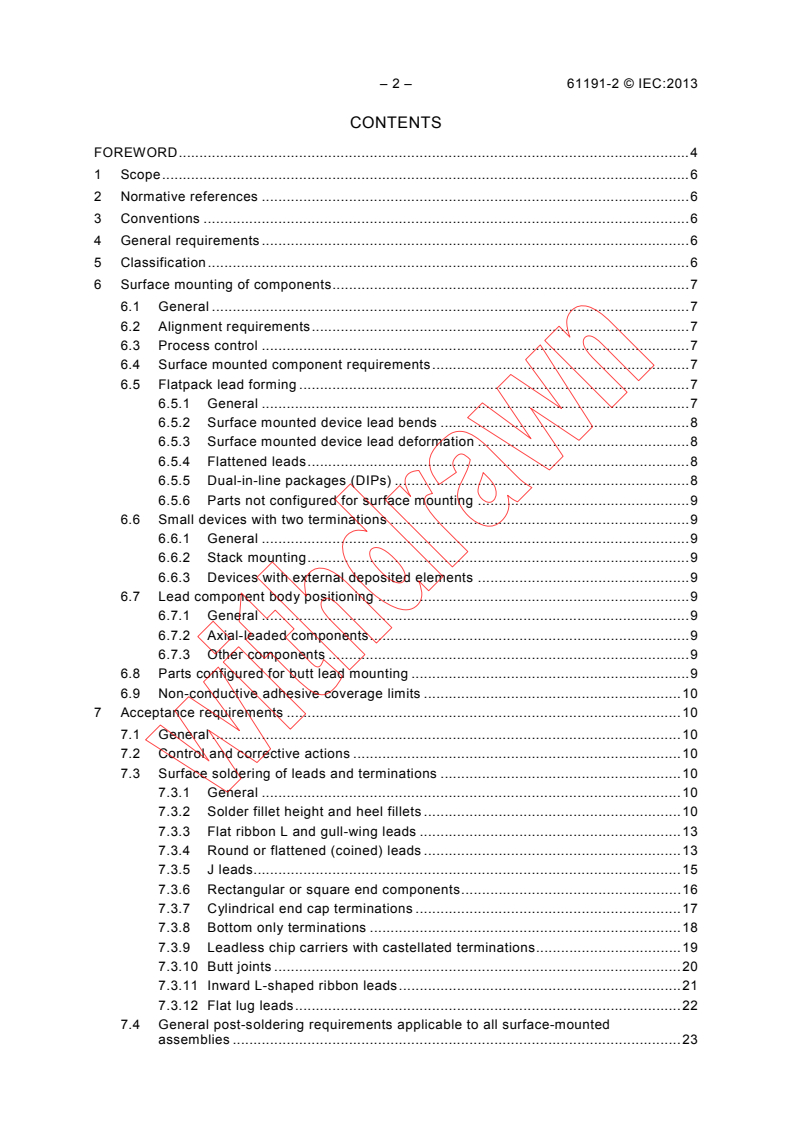
IEC 61191-2:2013 gives the requirements for surface mount solder connections. The requirements pertain to those assemblies that are totally surface mounted or to the surface mounted portions of those assemblies that include other related technologies (e.g. through-hole, chip mounting, terminal mounting, etc.). This edition includes the following significant technical changes with respect to the previous edition:
- IPC-A-610 on workmanship has been included as a normative reference;
- some of the terminology used in the document has been updated;
- references to IEC standards have been corrected;
- the use of lead-free solder paste and plating are addressed.
- Status
- Published
- Publication Date
- 04-Jun-2013
- Technical Committee
- TC 91 - Electronics assembly technology
- Drafting Committee
- WG 2 - TC 91/WG 2
- Current Stage
- DELPUB - Deleted Publication
- Start Date
- 23-May-2017
- Completion Date
- 28-Aug-2026
Overview
IEC 61191-2:2013 is an international standard issued by the International Electrotechnical Commission (IEC) that defines the requirements for surface mount soldered assemblies in printed board assemblies (PBA). This standard applies to assemblies that are fully surface-mounted or include surface mount portions alongside other mounting technologies such as through-hole and terminal mounting. The edition introduces key updates including the incorporation of IPC-A-610 workmanship criteria, revised terminology, updated IEC references, and new guidelines addressing lead-free solder paste and plating.
Key Topics
- Scope and Application: Provides detailed requirements for surface mount solder connections, ensuring quality and reliability in electronic assemblies.
- Component Alignment and Placement: Specifies alignment tolerances and placement criteria for surface mounted components to ensure optimal mechanical and electrical performance.
- Lead Formation and Configuration: Covers appropriate lead forming techniques for device leads, including flatpacks, gull-wing leads, J-leads, and other common SMT (surface mount technology) package styles.
- Solder Joint Criteria: Defines acceptance parameters for solder joints, such as fillet height, heel fillets, and joint shape for different soldered lead types – emphasizing defect detection and prevention.
- Post-Soldering Inspection: Highlights common solder defects including dewetting, leaching, voids, bridging, and component damage with guidance for detection.
- Process Control and Rework: Provides guidelines for process control during assembly and procedures for repair or rework to maintain assembly integrity.
- Use of Lead-Free Materials: Addresses the increasing adoption of lead-free solder pastes and plating processes in compliance with environmental and regulatory requirements.
Applications
IEC 61191-2:2013 is essential for electronics manufacturers, quality engineers, and designers involved in:
- Production of surface mounted printed circuit board assemblies (PCBAs) for consumer electronics, automotive, aerospace, telecommunications, and industrial equipment.
- Establishing quality control benchmarks for soldered electrical connections in SMT assemblies.
- Ensuring compliance with international standards to facilitate global market access and interoperability.
- Supporting lead-free manufacturing processes, crucial for environmentally friendly electronics production.
- Guiding inspection and acceptance criteria for solder joints, enhancing reliability and reducing failure rates in electronic products.
Related Standards
- IPC-A-610 - Acceptability of Electronic Assemblies: Adopted as a normative reference by IEC 61191-2, this standard complements the workmanship criteria for electronic assembly quality.
- IEC 61191 series - Covers various aspects of printed board assemblies including assembly requirements, process control, and inspection techniques.
- ISO/IEC Directives, Part 2 - Governs the drafting of international standards ensuring consistency and clarity.
- Other IEC standards related to soldering materials and processes, especially those addressing lead-free and RoHS compliance.
By adhering to IEC 61191-2:2013, organizations can ensure surface mount soldered assemblies meet internationally recognized requirements for quality, reliability, and environmental stewardship. This fosters improved product performance and durability in today’s demanding electronic applications.
Relations
- Effective Date
- 05-Sep-2023
- Effective Date
- 05-Sep-2023
Frequently Asked Questions
IEC 61191-2:2013 is a standard published by the International Electrotechnical Commission (IEC). Its full title is "Printed board assemblies - Part 2: Sectional specification - Requirements for surface mount soldered assemblies". This standard covers: IEC 61191-2:2013 gives the requirements for surface mount solder connections. The requirements pertain to those assemblies that are totally surface mounted or to the surface mounted portions of those assemblies that include other related technologies (e.g. through-hole, chip mounting, terminal mounting, etc.). This edition includes the following significant technical changes with respect to the previous edition: - IPC-A-610 on workmanship has been included as a normative reference; - some of the terminology used in the document has been updated; - references to IEC standards have been corrected; - the use of lead-free solder paste and plating are addressed.
IEC 61191-2:2013 gives the requirements for surface mount solder connections. The requirements pertain to those assemblies that are totally surface mounted or to the surface mounted portions of those assemblies that include other related technologies (e.g. through-hole, chip mounting, terminal mounting, etc.). This edition includes the following significant technical changes with respect to the previous edition: - IPC-A-610 on workmanship has been included as a normative reference; - some of the terminology used in the document has been updated; - references to IEC standards have been corrected; - the use of lead-free solder paste and plating are addressed.
IEC 61191-2:2013 is classified under the following ICS (International Classification for Standards) categories: 31.190 - Electronic component assemblies; 31.240 - Mechanical structures for electronic equipment. The ICS classification helps identify the subject area and facilitates finding related standards.
IEC 61191-2:2013 has the following relationships with other standards: It is inter standard links to IEC 61191-2:2017, IEC 61191-2:1998. Understanding these relationships helps ensure you are using the most current and applicable version of the standard.
IEC 61191-2:2013 is available in PDF format for immediate download after purchase. The document can be added to your cart and obtained through the secure checkout process. Digital delivery ensures instant access to the complete standard document.
Standards Content (Sample)
IEC 61191-2 ®
Edition 2.0 2013-06
INTERNATIONAL
STANDARD
NORME
INTERNATIONALE
Printed board assemblies –
Part 2: Sectional specification – Requirements for surface mount soldered
assemblies
Ensembles de cartes imprimées –
Partie 2: Spécification intermédiaire – Exigences relatives à l’assemblage par
brasage pour montage en surface
All rights reserved. Unless otherwise specified, no part of this publication may be reproduced or utilized in any form
or by any means, electronic or mechanical, including photocopying and microfilm, without permission in writing from
either IEC or IEC's member National Committee in the country of the requester.
If you have any questions about IEC copyright or have an enquiry about obtaining additional rights to this publication,
please contact the address below or your local IEC member National Committee for further information.
Droits de reproduction réservés. Sauf indication contraire, aucune partie de cette publication ne peut être reproduite ni
utilisée sous quelque forme que ce soit et par aucun procédé, électronique ou mécanique, y compris la photocopie et les
microfilms, sans l'accord écrit de la CEI ou du Comité national de la CEI du pays du demandeur.
Si vous avez des questions sur le copyright de la CEI ou si vous désirez obtenir des droits supplémentaires sur cette
publication, utilisez les coordonnées ci-après ou contactez le Comité national de la CEI de votre pays de résidence.
IEC Central Office Tel.: +41 22 919 02 11
3, rue de Varembé Fax: +41 22 919 03 00
CH-1211 Geneva 20 info@iec.ch
Switzerland www.iec.ch
About the IEC
The International Electrotechnical Commission (IEC) is the leading global organization that prepares and publishes
International Standards for all electrical, electronic and related technologies.
About IEC publications
The technical content of IEC publications is kept under constant review by the IEC. Please make sure that you have the
latest edition, a corrigenda or an amendment might have been published.
Useful links:
IEC publications search - www.iec.ch/searchpub Electropedia - www.electropedia.org
The advanced search enables you to find IEC publications The world's leading online dictionary of electronic and
by a variety of criteria (reference number, text, technical electrical terms containing more than 30 000 terms and
committee,…). definitions in English and French, with equivalent terms in
It also gives information on projects, replaced and additional languages. Also known as the International
withdrawn publications. Electrotechnical Vocabulary (IEV) on-line.
IEC Just Published - webstore.iec.ch/justpublished Customer Service Centre - webstore.iec.ch/csc
Stay up to date on all new IEC publications. Just Published If you wish to give us your feedback on this publication
details all new publications released. Available on-line and or need further assistance, please contact the
also once a month by email. Customer Service Centre: csc@iec.ch.
A propos de la CEI
La Commission Electrotechnique Internationale (CEI) est la première organisation mondiale qui élabore et publie des
Normes internationales pour tout ce qui a trait à l'électricité, à l'électronique et aux technologies apparentées.
A propos des publications CEI
Le contenu technique des publications de la CEI est constamment revu. Veuillez vous assurer que vous possédez
l’édition la plus récente, un corrigendum ou amendement peut avoir été publié.
Liens utiles:
Recherche de publications CEI - www.iec.ch/searchpub Electropedia - www.electropedia.org
La recherche avancée vous permet de trouver des Le premier dictionnaire en ligne au monde de termes
publications CEI en utilisant différents critères (numéro de électroniques et électriques. Il contient plus de 30 000
référence, texte, comité d’études,…). termes et définitions en anglais et en français, ainsi que
Elle donne aussi des informations sur les projets et les les termes équivalents dans les langues additionnelles.
publications remplacées ou retirées. Egalement appelé Vocabulaire Electrotechnique
International (VEI) en ligne.
Just Published CEI - webstore.iec.ch/justpublished
Service Clients - webstore.iec.ch/csc
Restez informé sur les nouvelles publications de la CEI.
Just Published détaille les nouvelles publications parues. Si vous désirez nous donner des commentaires sur
Disponible en ligne et aussi une fois par mois par email. cette publication ou si vous avez des questions
contactez-nous: csc@iec.ch.
IEC 61191-2 ®
Edition 2.0 2013-06
INTERNATIONAL
STANDARD
NORME
INTERNATIONALE
Printed board assemblies –
Part 2: Sectional specification – Requirements for surface mount soldered
assemblies
Ensembles de cartes imprimées –
Partie 2: Spécification intermédiaire – Exigences relatives à l’assemblage par
brasage pour montage en surface
INTERNATIONAL
ELECTROTECHNICAL
COMMISSION
COMMISSION
ELECTROTECHNIQUE
PRICE CODE
INTERNATIONALE
CODE PRIX U
ICS 31.190; 31.240 ISBN 978-2-83220-856-4
– 2 – 61191-2 © IEC:2013
CONTENTS
FOREWORD . 4
1 Scope . 6
2 Normative references . 6
3 Conventions . 6
4 General requirements . 6
5 Classification . 6
6 Surface mounting of components . 7
6.1 General . 7
6.2 Alignment requirements . 7
6.3 Process control . 7
6.4 Surface mounted component requirements . 7
6.5 Flatpack lead forming . 7
6.5.1 General . 7
6.5.2 Surface mounted device lead bends . 8
6.5.3 Surface mounted device lead deformation . 8
6.5.4 Flattened leads . 8
6.5.5 Dual-in-line packages (DIPs) . 8
6.5.6 Parts not configured for surface mounting . 9
6.6 Small devices with two terminations . 9
6.6.1 General . 9
6.6.2 Stack mounting . 9
6.6.3 Devices with external deposited elements . 9
6.7 Lead component body positioning . 9
6.7.1 General . 9
6.7.2 Axial-leaded components . 9
6.7.3 Other components . 9
6.8 Parts configured for butt lead mounting . 9
6.9 Non-conductive adhesive coverage limits . 10
7 Acceptance requirements . 10
7.1 General . 10
7.2 Control and corrective actions . 10
7.3 Surface soldering of leads and terminations . 10
7.3.1 General . 10
7.3.2 Solder fillet height and heel fillets . 10
7.3.3 Flat ribbon L and gull-wing leads . 13
7.3.4 Round or flattened (coined) leads . 13
7.3.5 J leads. 15
7.3.6 Rectangular or square end components . 16
7.3.7 Cylindrical end cap terminations . 17
7.3.8 Bottom only terminations . 18
7.3.9 Leadless chip carriers with castellated terminations . 19
7.3.10 Butt joints . 20
7.3.11 Inward L-shaped ribbon leads . 21
7.3.12 Flat lug leads . 22
7.4 General post-soldering requirements applicable to all surface-mounted
assemblies . 23
61191-2 © IEC:2013 – 3 –
7.4.1 Dewetting . 23
7.4.2 Leaching. 23
7.4.3 Pits, voids, blowholes, and cavities . 23
7.4.4 Solder wicking . 23
7.4.5 Solder webs and skins . 23
7.4.6 Bridging . 23
7.4.7 Degradation of marking . 23
7.4.8 Solder spikes . 23
7.4.9 Disturbed joint . 23
7.4.10 Component damage . 24
7.4.11 Open circuit, non-wetting . 24
7.4.12 Component tilting . 24
7.4.13 Non-conducting adhesive encroachment . 24
7.4.14 Open circuit, no solder available (skip) . 24
7.4.15 Component on edge . 24
8 Rework and repair . 24
Annex A (normative) Placement requirements for surface mounted devices . 26
Figure 1 – Lead formation for surface mounted device . 8
Figure 2 – Fillet height . 12
Figure 3 – Flat ribbon L and gull-wing leads . 13
Figure 4 – Round or flattened (coined) lead joint . 14
Figure 5 – J lead joint . 15
Figure 6 – Rectangular or square end components . 16
Figure 7 – Cylindrical end-cap terminations . 17
Figure 8 – Bottom only terminations . 18
Figure 9 – Leadless chip carriers with castellated terminations . 19
Figure 10 – Butt joints . 20
Figure 11 – Inward L-shaped ribbon leads . 21
Figure 12 – Flat lug leads . 22
Table 1 – Surface mounted solder joint defects . 25
– 4 – 61191-2 © IEC:2013
INTERNATIONAL ELECTROTECHNICAL COMMISSION
_____________
PRINTED BOARD ASSEMBLIES –
Part 2: Sectional specification –
Requirements for surface mount soldered assemblies
FOREWORD
1) The International Electrotechnical Commission (IEC) is a worldwide organization for standardization comprising
all national electrotechnical committees (IEC National Committees). The object of IEC is to promote
international co-operation on all questions concerning standardization in the electrical and electronic fields. To
this end and in addition to other activities, IEC publishes International Standards, Technical Specifications,
Technical Reports, Publicly Available Specifications (PAS) and Guides (hereafter referred to as “IEC
Publication(s)”). Their preparation is entrusted to technical committees; any IEC National Committee interested
in the subject dealt with may participate in this preparatory work. International, governmental and non-
governmental organizations liaising with the IEC also participate in this preparation. IEC collaborates closely
with the International Organization for Standardization (ISO) in accordance with conditions determined by
agreement between the two organizations.
2) The formal decisions or agreements of IEC on technical matters express, as nearly as possible, an international
consensus of opinion on the relevant subjects since each technical committee has representation from all
interested IEC National Committees.
3) IEC Publications have the form of recommendations for international use and are accepted by IEC National
Committees in that sense. While all reasonable efforts are made to ensure that the technical content of IEC
Publications is accurate, IEC cannot be held responsible for the way in which they are used or for any
misinterpretation by any end user.
4) In order to promote international uniformity, IEC National Committees undertake to apply IEC Publications
transparently to the maximum extent possible in their national and regional publications. Any divergence
between any IEC Publication and the corresponding national or regional publication shall be clearly indicated in
the latter.
5) IEC itself does not provide any attestation of conformity. Independent certification bodies provide conformity
assessment services and, in some areas, access to IEC marks of conformity. IEC is not responsible for any
services carried out by independent certification bodies.
6) All users should ensure that they have the latest edition of this publication.
7) No liability shall attach to IEC or its directors, employees, servants or agents including individual experts and
members of its technical committees and IEC National Committees for any personal injury, property damage or
other damage of any nature whatsoever, whether direct or indirect, or for costs (including legal fees) and
expenses arising out of the publication, use of, or reliance upon, this IEC Publication or any other IEC
Publications.
8) Attention is drawn to the Normative references cited in this publication. Use of the referenced publications is
indispensable for the correct application of this publication.
9) Attention is drawn to the possibility that some of the elements of this IEC Publication may be the subject of
patent rights. IEC shall not be held responsible for identifying any or all such patent rights.
International Standard IEC 61191-2 has been prepared by IEC technical committee 91:
Electronics assembly technology.
This second edition cancels and replaces the first edition, published in 1998, and constitutes
a technical revision.
This edition includes the following significant technical changes with respect to the previous
edition:
– IPC-A-610 on workmanship has been included as a normative reference;
– some of the terminology used in the document has been updated;
– references to IEC standards have been corrected;
– the use of lead-free solder paste and plating are addressed.
61191-2 © IEC:2013 – 5 –
The text of this standard is based on the following documents:
FDIS Report on voting
91/1091/FDIS 91/1103/RVD
Full information on the voting for the approval of this standard can be found in the report on
voting indicated in the above table.
This publication has been drafted in accordance with the ISO/IEC Directives, Part 2.
A list of all parts of IEC 61191 under the general title Printed board assemblies can be found
in the IEC website.
The committee has decided that the contents of this publication will remain unchanged until
the stability date indicated on the IEC web site under "http://webstore.iec.ch" in the data
related to the specific publication. At this date, the publication will be
• reconfirmed,
• withdrawn,
• replaced by a revised edition, or
• amended.
– 6 – 61191-2 © IEC:2013
PRINTED BOARD ASSEMBLIES –
Part 2: Sectional specification –
Requirements for surface mount soldered assemblies
1 Scope
This part of IEC 61191 gives the requirements for surface mount solder connections. The
requirements pertain to those assemblies that are totally surface mounted or to the surface
mounted portions of those assemblies that include other related technologies (e.g. through-
hole, chip mounting, terminal mounting, etc.).
2 Normative references
The following documents, in whole or in part, are normatively referenced in this document and
are indispensable for its application. For dated references, only the edition cited applies. For
undated references, the latest edition of the referenced document (including any
amendments) applies.
IEC 61191-1:2013, Printed board assemblies – Part 1: Generic specification – Requirements
for soldered electrical and electronic assemblies using surface mount and related assembly
technologies
IPC-A-610E:2010, Acceptability of Electronic Assemblies
3 Conventions
Unless otherwise specified by the user, the word "shall" signifies that the requirement is
mandatory. Deviations from any "shall" requirement requires written acceptance by the user,
e.g. via assembly drawing, specification or contract provision.
The word “should” is used to indicate a recommendation or guidance statement. The word
“may” indicates an optional situation. Both “should” and “may” express non-mandatory
situations. “Will” is used to express a declaration of purpose.
4 General requirements
Clause 4 of IEC 61191-1:2013 is a mandatory part of this standard.
Workmanship of surface mount assemblies shall meet the requirements of IPC-A-610E in
accordance with the classification requirements of this standard.
5 Classification
This standard recognizes that electrical and electronic assemblies are subject to
classifications by intended end-item use. Three general end-product classes have been
established to reflect differences in producibility, complexity, functional performance
requirements, and verification (inspection/test) frequency. These are the following:
Level A: General electronic products
Level B: Dedicated service electronic products
61191-2 © IEC:2013 – 7 –
Level C: High performance electronic products
The user of the assemblies is responsible for determining the level to which his product
belongs. It should be recognized that there may be overlaps of equipment between levels.
The contract shall specify the level required and indicate any exceptions or additional
requirements to the parameters, where appropriate (see 4.3 of IEC 61191-1:2013).
6 Surface mounting of components
6.1 General
This clause covers assembly of components that are placed on the surface to be manually or
machine soldered and includes components designed for surface mounting as well as
through-hole components that have been adapted for surface mounting technology.
6.2 Alignment requirements
Sufficient process control at all stages of design and assembly shall be in place to enable the
post-soldering alignments and solder joint fillet controls specified in 7.3 to be achieved.
Relevant factors affecting the requirements include land and conductor design, component
proximities, component and land solderability, solder paste/adhesive quantity and alignment
and component placement accuracy.
6.3 Process control
If suitable process controls are not in place to ensure compliance with 6.2 and the intent of
Annex A, the detailed requirements of Annex A shall be mandatory.
6.4 Surface mounted component requirements
The leads of lead surface mounted components shall be formed to their final configuration
prior to mounting. Leads shall be formed in such a manner that the lead-to-body seal is not
damaged or degraded and that they may be soldered into place by subsequent processes
which do not result in residual stresses decreasing reliability. When the leads of dual-in-line
packages, flatpacks, and other multilead devices become misaligned during processing or
handling, they may be straightened to ensure parallelism and alignment prior to mounting,
while maintaining the lead-to-body seal integrity.
6.5 Flatpack lead forming
6.5.1 General
Leads on opposite sides of surface mounted flatpacks shall be formed such that the
non-parallelism between the base surface of the component and the surface of the printed
board (i.e. component cant) is minimal. Component cant is permissible provided the final
configuration does not exceed the maximum spacing limit of 2,0 mm (see Figure 1).
– 8 – 61191-2 © IEC:2013
IEC 1364/13
Figure 1 – Lead formation for surface mounted device
6.5.2 Surface mounted device lead bends
Leads shall be supported during forming to protect the lead-to-body seal. Bends shall not
extend into the seal (see Figure 1). The lead-bend radius (R) shall be >1 T (T = nominal lead
thickness). The angle of that part of the lead between the upper and lower bends in relation to
the mounting land shall be 45° minimum and 90° maximum.
6.5.3 Surface mounted device lead deformation
Lead deformation (unintentional bending) may be allowed when
a) no evidence of a short circuit or potential short circuit exists,
b) lead-to-body seal or weld is not damaged by the deformation,
c) does not violate minimum electrical spacing requirement,
d) top of lead does not extend beyond the top of body; preformed stress loops may extend
above the top of the body; however, stand-off height limit shall not be exceeded,
e) toe curl, if present on bends, shall not exceed two times the thickness of the lead (2 T),
f) coplanarity limits are not exceeded.
6.5.4 Flattened leads
Components with axial leads of round cross-section may be flattened (coined) for positive
seating in surface mounting. If flattening is used, the flattened thickness shall be not less than
40 % of the original diameter. Flattened areas of leads shall be excluded from the 10 %
deformation requirement in 6.5.3 of IEC 61191-1:2013.
Flattened leads on opposite sides of a surface mount part shall be formed such that the non-
parallelism between the base surface of the component and the surface of the printed board
(e.g., component cant) is minimal.
6.5.5 Dual-in-line packages (DIPs)
Dual-in-line packages may be surface mounted provided the leads are configured to meet the
mounting requirements for surface mounted loaded parts. The lead preparation operation
shall be performed using die forming/cutting systems. Hand forming and trimming of leads are
prohibited.
61191-2 © IEC:2013 – 9 –
6.5.6 Parts not configured for surface mounting
Flatpacks of the through-hole configuration, transistors, metal power packages, and other
non-axial lead components shall not be surface mounted unless the leads are formed to meet
the surface mounted device lead forming requirements. Such applications shall be agreed on
between user and manufacturer.
6.6 Small devices with two terminations
6.6.1 General
The detailed requirements for mounting of small devices with two lead terminations are
defined in the following subclauses.
6.6.2 Stack mounting
When part stacking is permitted by the assembly drawing, parts shall not bridge spacing
between other parts or components such as terminals or other chip components.
6.6.3 Devices with external deposited elements
Components with electrical elements deposited on an external surface (such as chip resistors)
shall be mounted with that surface facing away from the printed board or substrate.
6.7 Lead component body positioning
6.7.1 General
Parts mounted over protected surfaces and insulated parts that are positioned over circuitry
or parts mounted over surfaces without exposed circuitry may be flush mounted (i.e. no stand-
off height). Parts mounted over exposed circuitry shall have their leads formed to provide a
minimum of 0,25 mm between the bottom of the component body and the exposed circuitry.
The maximum clearance between the bottom of the leaded component body and the printed
wiring surface shall not exceed 2,0 mm.
6.7.2 Axial-leaded components
The body of a surface mounted axial-leaded component should be spaced from the surface of
the printed board at a maximum of 2,0 mm unless the component is mechanically attached to
the substrate by adhesive or other means. Leads on opposite sides of surface mounted
axial-leaded components shall be formed such that component cant (non-parallelism between
the base surface of the mounted component and the surface of the printed board) is minimal
and in no instance shall body cant result in non-conformance with maximum spacing limits.
6.7.3 Other components
TO-can devices, tall profile components (i.e. over 15 mm), transformers, and metal power
packages may be surface mounted provided the parts are bonded or otherwise secured to the
board in a manner which enables the part to withstand the end-item shock, vibration and
environmental stresses.
6.8 Parts configured for butt lead mounting
Components designed for through hole (pin-in-hole) applications and modified for butt joint
attachment, or stiff leaded dual-in-line packages may be butt mounted on level A and B
products. Butt mounting is not permitted on level C products unless the component is
designed for surface mounting.
– 10 – 61191-2 © IEC:2013
6.9 Non-conductive adhesive coverage limits
Non-conductive adhesive materials, when used for component mounting, shall not flow onto,
or obscure, areas to be soldered or into vias or plated-through holes.
7 Acceptance requirements
7.1 General
Materials, processes, and procedures described and specified in IEC 61191-1 provide for
soldered interconnections that are better than the minimum surface mount acceptance
requirements in this clause. Processes and their control should be capable of producing
product meeting or exceeding the acceptance criteria for defined product levels.
7.2 Control and corrective actions
The detailed requirements for acceptance, corrective action limits, control limit determination,
and general assembly criteria described in IEC 61191-1 are a mandatory part of this standard.
In addition, the following subclause shall be met for all surface mount assembly and for
connection acceptability.
7.3 Surface soldering of leads and terminations
7.3.1 General
Solder joints or terminations on components designed for surface mounting shall exhibit
solder joints that meet the general descriptions of Clause 10 of IEC 61191-1:2013 with the
specific measurements defined in 7.3.3 through 7.3.12 of this standard. Some surface
mounted components will self-align during reflow soldering but a degree of misalignment is
permitted to the extent specified. However, minimum design conductor spacing shall not be
violated.
In the following paragraphs, certain joint features are unspecified in size and the only
requirement is that a properly wetted fillet to both lead/termination and lands be visible.
Geometric dimensions not called out with any requirements are considered non-critical to the
performance of the interconnection.
Surface mounted joints formed to connector, socket, and other leads or terminations without
mechanical support, subject to stress from insertion and withdrawal of components or printed
boards shall meet the requirements of level C.
7.3.2 Solder fillet height and heel fillets
7.3.2.1 General
The height F of solder fillets, including heel fillets, as required in the following subclauses
shall be judged by the distance the applied solder has risen up the joined surface. Figure 2
illustrates this measurement for joints of equal height but having different solder volume. In
7.3.3 to 7.3.12, for some lead configurations, the minimum acceptable fillet height criteria is
referenced to the lead thickness T, or one half the thickness (0,5 T). When referenced to T,
the height of the heel fillet to a formed lead shall be measured at the lowest point of the inside
bend radius of the lead, as indicated by point A of Figure 2b (e.g. level C in Figures 3 to 5).
When referenced to 0,5 T, the fillet may be 0,5 T lower (e.g. level B in Figures 3 to 5).
NOTE Subclause 7.3.3 provides an organization that combines the requirement paragraph, the appropriate Figure
and a dimensional table that describes the specific details.
61191-2 © IEC:2013 – 11 –
7.3.2.2 Solder connection contours
A mounting technique shall be used to compensate for the coefficient of thermal expansion
(CTE) mismatch of the part and board. This mounting technique shall be limited to part leads,
specialized mounting devices, and normal solder connections. The use of specialized stand-
offs mounted between the part and the land is permissible. Leadless components shall not be
soldered into place utilizing redundant interconnect wiring between the component
castellation and the land. When CTE mismatch compensation is provided, bottom only
terminations and leadless chip carriers (see 7.3.8 and 7.3.9) are not required to have 0,2 mm
solder thickness.
Designs which utilize special solder connection contours as part of a CTE mismatch
compensation system shall be identified on the approval assembly drawing. The mounting
technique shall be capable of performing with a solder connection which meets the
requirements of this standard.
7.3.2.3 Surface mount device lead heel position
The heel of a leaded component shall not overhang the land.
NOTE The heel begins where the lead starts to curve at the lead bend.
7.3.2.4 Break-away tie bars
Components (e.g. connectors and flexible circuits) which incorporate break-away tie bars in
their design may be installed or soldered in place prior to removal of the tie bar. Exposed
basis metal resulting from tie bar removal is permissible.
F = fillet height
F
IEC 1365/13
Figure 2a – Fillet height
– 12 – 61191-2 © IEC:2013
L = projected lead length
T = lead thickness
T
A = lowest point of inside
bend radius
F F
L L
IEC 1366/13
Figure 2b – Fillet height referenced to lead thickness
Figure 2 – Fillet height
61191-2 © IEC:2013 – 13 –
7.3.3 Flat ribbon L and gull-wing leads
Solder joints between substrate lands and flat ribbon leads formed into L, and gull wing shape
component leads of either stiff or flexible materials shall meet the alignment and solder fillet
requirements of Figure 3 for each product level.
a
IEC 1367/13
Dimensions in millimetres
Feature Dimension Level A Level B Level C
d d d
Maximum side overhang A 1/2 W or 0,5 1/2 W or 0,5 1/4 W or 0,5
whichever is less; whichever is less; whichever is less
1/3 W below 0,5 mm 1/3 W below 0,5 mm
pitch devices pitch devices
d
Maximum toe overhang B 1/2 W Not permitted Not permitted
c
Minimum end joint width C W – A W – A W – A
,
b c
Minimum side joint length D 1/2 L 2/3 L 3/4 L
e a a a
Maximum heel fillet height E
e
Minimum heel fillet height F G + 1/2 T G + T
e e e
Minimum solder thickness G
For lead frames made of Fe-Ni alloy 42 the next higher level should be chosen.
a
Solder fillets for levels A and B may extend through the top bend.
b
Leads not having wettable sides or ends by design (such as leads stamped or sheared from prepared stock)
are not required to have side or end fillets, but side overhang is not permitted (all levels).
c
Devices with W greater than D shall be exempted from the side joint requirements of this table.
d
Shall not violate minimum design conductor spacing.
e
Properly wetted fillet evident.
Figure 3 – Flat ribbon L and gull-wing leads
7.3.4 Round or flattened (coined) leads
Joints formed to round or flattened (coined) leads shall meet the dimensional and fillet
requirements of Figure 4 for each product level.
– 14 – 61191-2 © IEC:2013
a
IEC 1368/13
Dimensions in millimetres
a b
Feature Dimension Level Level B Level C
Maximum side overhang A 1/3 W 1/3 W 1/4 W
b b b
Maximum toe overhang B
c c
Minimum end joint width C W – A
Minimum side joint length D 1/2 L 2/3 L 3/4 L
a a a
Maximum heel fillet height E
c
Minimum heel fillet height F
G + 1/2 T G + T
c c c
Minimum solder thickness G
c
Minimum side joint height Q G + 1/2 T or G + 1/2 T or G + 0,5
G + 0,5 whichever whichever is less
is less
a
Solder fillet for levels A and B may extend through the top bend. Solder should not extend under the body of low
profile surface mount components whose leads are made of Fe-Ni alloy 42 or similar metals.
b
Shall not violate minimum design conductor spacing.
c
Properly wetted fillet evident.
Figure 4 – Round or flattened (coined) lead joint
61191-2 © IEC:2013 – 15 –
7.3.5 J leads
Joints formed to leads having a J shape at the joint site shall meet the dimensional and fillet
requirements of Figure 5 for each product level.
a
IEC 1369/13
Dimensions in millimetres
Feature Dimension Level A Level B Level C
f
Maximum side overhang A 1/2 W 1/2 W 1/4 W
c f a f a f
Maximum toe overhang B
d
Minimum end joint width C W – A W – A
e d
Minimum side joint length D 1 1/2 W 1 1/2 W
a a a
Maximum fillet height E
b, d
2 2
Minimum fillet height F
G + 1/2 T G + T
d d d
Minimum solder thickness G
a
Maximum solder fillet should not touch package body.
b
Maximum height to bend radius shall not exceed 2 T. Fillets shall be furnished on both toe and heel area of J-
lead.
c
Unspecified parameter.
d
Properly wetted fillet evident.
e
Leads not having wettable sides by design (such as leads stamped from pre-plated stock) are not required to
have side fillets.
f
Shall not violate minimum design conductor spacing.
Figure 5 – J lead joint
– 16 – 61191-2 © IEC:2013
7.3.6 Rectangular or square end components
Solder joints to components having terminations of a square or rectangular configuration shall
meet the dimensional and solder fillet requirements of Figure 6 for each product level.
a
IEC 1370/13
Dimensions in millimetres
Feature Dimension Level A Level B Level C
e
Maximum side overhang A 1/2 W or 1,5 1/3 W or 1,5 1/4 W or 1,5
whichever is less whichever is less whichever is less
End overhang B Not permitted Not permitted Not permitted
Minimum end joint width C 1/2 W 1/2 W 3/4 W
c d
Minimum side joint length D 1/2 T 3/4 T
a a a a
Maximum fillet height E
d
Minimum fillet height F
G + 1/4 H or G + 1/4 H or G + 0,5
whichever is less
G + 0,5 whichever
is less
b d d b
Minimum solder thickness G 0,2
c
Minimum end overlap J 2/3 T 2/3 T 3/4 T
a
The maximum fillet may overhang the land or extend onto the top of the end cap metallization; however, the
solder shall not extend further onto the component body.
b
Unless satisfactory cleaning can be demonstrated with reduced clearance. G is not specified when cleaning is
not required.
c
Not required for one face only termination type components.
d
Properly wetted fillet evident.
e
Shall not violate minimum design conductor spacing.
Figure 6 – Rectangular or square end components
61191-2 © IEC:2013 – 17 –
7.3.7 Cylindrical end cap terminations
Solder joints to components having cylindrical end cap terminations (e.g. MELFs) shall meet
the dimensional and solder fillet requirements of Figure 7 for each product level.
a
IEC 1371/13
Dimensions in millimetres
Feature Dimension Level A Level B Level C
c
Maximum side overhang A 1/3 W 1/3 W 1/4 W
End overhang B Not permitted Not permitted Not permitted
b
Minimum end joint width C 1/2 W 1/2 W
b
Minimum side joint length D 1/2 T 3/4 T
a b a)
Maximum fillet height E
(end and side)
b b
Minimum fillet height F G + 1/4 W or
(end and side)
G + 1,0 whichever
is less
b b b)
Minimum solder thickness G
Minimum end overlap J 2/3 T 2/3 T T
a
The maximum fillet may overhang the land or extend onto the top of the end-cap metallization; however, the
solder shall not extend further onto the component body.
b
Properly wetted fillet evident.
c
Shall not violate minimum design conductor spacing.
Figure 7 – Cylindrical end-cap terminations
– 18 – 61191-2 © IEC:2013
7.3.8 Bottom only terminations
Discrete chip components, leadless chip carriers, and other devices having metallized
terminations on the bottom side only shall meet the dimensional and solder fillet requirements
of Figure 8 for each product level.
IEC 1372/13
Dimensions in millimetres
Feature Dimension Level A Level B Level C
a d a d a d
Maximum side overhang A
End overhang B Not permitted Not permitted Not permitted
Minimum end joint width C 1/2 W 1/2 W 3/4 W
a a a
Minimum side joint length D
a a a
Maximum fillet height E
a a a
Minimum fillet height F
c b b c
Minimum solder thickness G 0,2
a
Unspecified parameter.
b
Properly wetted fillet evident.
c
Unless satisfactory cleaning can be demonstrated with reduced clearance. G is not specified when cleaning is
not required.
d
Shall not violate minimum design conductor spacing.
Figure 8 – Bottom only terminations
61191-2 © IEC:2013 – 19 –
7.3.9 Leadless chip carriers with castellated terminations
Joints formed to castellated terminations of leadless chip carriers shall meet the dimensional
and solder fillet requirements of Figure 9 for each product level.
IEC 1373/13
Dimensions in millimetres
Feature Dimension Level A Level B Level C
d
Maximum side overhang A 1/2 W 1/2 W 1/4 W
End overhang B Not permitted Not permitted Not permitted
Minimum end joint width C 1/2 W 1/2 W 3/4 W
a c
Minimum side joint length D 1/2 F or P 1/2 F or P
whichever is less whichever is less
Maximum fillet height E Not applicable Not applicable Not applicable
c
Minimum fillet height F G + 1/4 H G + 1/2 H
c c b
Minimum solder thickness G 0,2
a
Length D is dependent upon fillet height F, and is referenced to end of package.
b
Unless satisfactory cleaning can be demonstrated with reduced clearance. G is not specified when cleaning is
not required.
c
Properly wetted fillet evident.
d
Shall not violate minimum design conductor spacing.
Figure 9 – Leadless chip carriers with castellated terminations
– 20 – 61191-2 © IEC:2013
7.3.10 Butt joints
Joints formed to leads positioned perpendicular to a circuit land in a butt configuration shall
meet the dimensional and solder fillet requirements of Figure 10 for each product level. For
level A and B products, leads not having wettable sides by design (such as leads stamped or
sheared from preplated stock) are not required to have side fillets; however the design should
permit easy inspection of wetting to the wettable surfaces.
a
IEC 1374/13
Dimensions in millimetres
b
Feature Dimension Level A Level B Level C
e
Maximum side overhang A 1/4 W Not permitted Not permitted
Minimum land protrusion B T or 0,5 whichever T or 0,5 whichever T or 0,5 whichever
is greater is greater is greater
Minimum end joint width C 3/4 W 3/4 W 3/4 W
a c c c
Minimum side joint length D
a a a
Maximum fillet height E
Minimum fillet height F 0,5 0,5 G + 1,5 W or
G + 0,5 whichever
is greater
d d d
Maximum solder thickness G 0,1 0,1 0,1
a
Maximum fillet may extend into the bend radius. Solder shall not extend under the body of low profile surface
mount components whose leads are made of Fe-Ni alloy 42 or similar metals.
b
To be permitted for level C product, parts shall have been defined for butt joint SMT mounting.
c
Unspecified parameter.
d
Properly wetted fillet evident.
e
Shall not violate minimum design conductor spacing.
Figure 10 – Butt joints
61191-2 © IEC:2013 – 21 –
7.3.11 Inward L-shaped ribbon leads
Solder joints to components having inward L-shaped ribbon lead terminations shall meet the
dimensional and solder fillet requirement of Figure 11.
W
E
H = lead height
L = lead length
P = land width
P W = lead width
P
Split lead version
B
W
G
H
F
G
Land
F
B
C
L
P
A
IEC 1375/13
Dimensions in millimetres
Feature Dimension Level A Level B Level C
b
Maximum side overhang A 1/2 W 1/2 W 1/4 W or 1/4 P
whichever is less
a
...